Showing posts with label Gothic. Show all posts

Thursday, February 8, 2024

Classic Films in Focus: MY NAME IS JULIA ROSS (1945)

Director Joseph H. Lewis is best remembered today for his influential noir classic, Gun Crazy (1950), but he also brings great tension to My Name is Julia Ross (1945), an atmospheric thriller from Columbia Pictures that stars Nina Foch as the titular heroine. Despite its modern day setting, Julia's story revels in Gothic trappings, with an imprisoned and imperiled protagonist who endures extreme gaslighting at the hands of her kidnappers. Fans of Gaslight (either the 1940 or the 1944 version) and more traditional Gothic fare will find a lot to appreciate in this tight, well-acted production, including especially sinister performances from Dame May Whitty and a barely restrained George Macready.

Foch plays the penniless but determined Julia Ross, who lands a seemingly perfect job as the live-in secretary of wealthy Mrs. Hughes (May Whitty). Julia is too relieved to worry at questions about her being absolutely without friends or family, but she realizes the awful truth when she awakens from a drugged slumber to find herself transported to Cornwall and declared to be the mentally ill wife of Ralph Hughes (George Macready). Luckily, Julia's aspiring love interest, Dennis (Roland Varno), is searching for her while Julia repeatedly tries to escape before Ralph and his mother can carry out their nefarious plans.

The success of the whole picture depends on its heroine, and Nina Foch makes Julia active and appealing in spite of her damsel in distress situation. Foch's long career included a Best Supporting Actress Oscar nomination for her role in Executive Suite (1954), but she never became a top star, which seems a shame considering her energetic performance here. Foch is beautiful in a wide-eyed but spirited way, definitely not the kind of girl to surrender meekly to villainous schemes, no matter how many times the Hughes family tries to convince Julia that she's Marion Hughes. Our heroine might be naive enough to jump at the sudden job offer, but she's never passive or resigned to her fate. Ironically, Julia's constant efforts to escape and tell someone about her situation only support the Hughes' claim that she's insane, but Julia manages to outsmart them enough to get a letter out to Dennis. Part of the fun of the movie lies in waiting to see what Julia will try next, whether she's hiding in cars, looking for secret passages, or pretending that she really believes she might be Marion Hughes.

Most of the other important characters present threats to Julia's well-being, and each is interesting in his or her own fashion. Julia's chief antagonist is the unflappable Mrs. Hughes, played with sly menace by Dame May Whitty. Whitty is a fun choice for the role because she doesn't seem like a villain even when she's blatantly plotting Julia's demise. The mother provides a stark contrast to the psychopath son, Ralph, who has already murdered the original Marion and clearly yearns to kill again. Only Mrs. Hughes can control him, and one wonders how long that can last, given the number of sharp objects she has to confiscate from Ralph over the course of the picture. The criminal pair have ample assistance from their most trusted servants, especially Sparkes (Anita Bolster), who poses as the employment agent and ensures that the newer servants spread gossip about "Marion Hughes" being insane. She's a great example of the sinister housekeeper so quintessential in the Gothic genre, and Bolster has a perfect face for the role.

My only real complaint about My Name is Julia Ross relates to the abrupt and overly tidy ending, which turns a blind eye to the extremity of Julia's ordeal. Compare that with the endings of Gaslight or Notorious (1946), in which the heroines are clearly going to need to work through some heavy post-traumatic stress. For more of the lovely Nina Foch, see The Return of the Vampire (1943), in which Roland Varno also plays her love interest, An American in Paris (1951), or Illegal (1955). She also appears in both The Ten Commandments (1956) and Spartacus (1960). Dame May Whitty earned Best Supporting Actress Oscar nominations for Night Must Fall (1937) and Mrs. Miniver (1942), but she has memorable roles in The Lady Vanishes (1938), Suspicion (1941), and Gaslight (1944). Don't miss George Macready in Gilda (1946), which is probably his most important film.

Wednesday, September 27, 2023

Classic Films in Focus: BLANCHE FURY (1948)

Of all the films I have watched so far in the Criterion Channel's Gaslight Noir collection, Blanche Fury (1948) is the darkest, even though it's also the brightest thanks to its use of gorgeous Technicolor. This adaptation of the 1939 novel by Marjorie Bowen (under the pseudonym Joseph Shearing) employs many of the familiar elements of Victorian Gothic fiction, including the governess heroine and the upper class's obsessions with legitimacy and inheritance, but it has more in common with Wuthering Heights than Jane Eyre in the romance department, with doomed lovers who are both far from innocent in their desires. Without spoiling the ending too much, let me at least warn you that Blanche Fury is true noir in Victorian dress, and no happy endings should be expected for any of the central characters. That said, it's a fascinating example of the overlap between traditional Gothic and noir, with a complex anti-heroine whose better angels are as dangerous to her as her demons.

Valerie Hobson takes the lead as the title character, a penniless young woman named Blanche Fuller who changes her surname to Fury when she joins her wealthy uncle (Walter Fitzgerald) and his household as a governess to the uncle's granddaughter, Lavinia (Suzanne Gibbs). Soon Blanche is married to her cousin, Lawrence (Michael Gough), but also engaged in a passionate affair with Philip Thorn (Stewart Granger), the illegitimate son of the estate's previous owners, who is now reduced to a servant in his own childhood home. The embittered Philip is obsessed with reclaiming the property for himself, even to the point of plotting to murder everyone who stands in his way. When Philip decides that Lavinia is just another obstacle to his plans, Blanche must choose between the man she loves and the innocent stepchild she longs to protect.

Hobson nimbly walks the fine line required for Blanche, who possesses both good and bad qualities that dominate her nature at different times. We first see her as a Becky Sharp type of adventuress, chafing under her subservient role as a paid companion and eager to improve her situation through marriage to the weak-willed but unfeeling Lawrence. At the Fury estate, her immediate kindness to Lavinia softens her, and her courage in retrieving stolen horses proves her fortitude. What seems at first like mere carnal lust for Philip develops into real love, which makes her choices in the third act all the more difficult, and she evokes our sympathy even as we recognize her complicity in the events that have brought her so much suffering. In addition, Hobson looks divine in the costumes and elaborate hairstyles worn by Blanche, with a finely made face that conveys hatred, love, and grief equally well in her many closeups. As the title suggests, this story belongs to Blanche and therefore to Hobson, but Stewart Granger has fantastic energy as Philip that evokes shades of Wuthering Heights' Heathcliff in his intensity and dark, brooding sex appeal. Their scenes together don't really need the confirmation of a closing door to tell us the nature of their relationship, while doors repeatedly closing against Gough's character symbolize the contrasting coldness of Blanche's marriage to Lawrence.

The real darkness and noir mood of Blanche Fury stem from the relentless sense of fate bearing down over the unfolding events, starting with the opening scene, which is actually the end of the story being told. The legend of the fierce ape who defends the Fury name and fortune serves to remind us constantly that the current family are interlopers who have usurped both the name and estate from the biological - if not legal - heir, Philip. Fate, as embodied by the figure of the ape, will not spare any of the usurpers as it works to restore the line of the rightful owners. Blanche's uncle and husband are too dim to sense the doom that hangs over them, but Blanche and the old Italian nurse (Sybilla Binder) both feel it. Fate wields a Shakespearean level of power here, so much so that neither Blanche nor even Philip can be considered free agents; they are pulled by forces they cannot fathom or resist. Blanche attempts to moderate the scorched earth tactics of Fate, but like many noir protagonists she suffers more for her good actions than she does for her evil ones, and Fate still wins in the end. 

The Gaslight Noir collection includes two other movies adapted from novels by Marjorie Bowen: Moss Rose (1947) and So Evil My Love (1948). Her 1943 novel, Airing in a Closed Carriage, was adapted as The Mark of Cain (1947). Valerie Hobson also stars in The Bride of Frankenstein (1935), Great Expectations (1946), and Kind Hearts and Coronets (1949). See more of Stewart Granger in Scaramouche (1952), The Prisoner of Zenda (1952), and Footsteps in the Fog (1955). If you enjoy melodramatic tales of governesses and forbidden love, try All This and Heaven Too (1940), Adam Had Four Sons (1941), and, of course, Jane Eyre (1943) or any of the other adaptations of the classic novel.

Friday, September 1, 2023

Gaslight Noir on the Criterion Channel

While many of the Criterion Channel's featured categories highlight newer or international films, the lineup for September 2023 also includes one of my favorite classic sub-genres, "Gaslight Noir." If you love films like Gaslight (whether the 1940 or 1944 version), this is a collection sure to send delicious chills up and down your corseted spine.


Most of the iconic noir classics take place in their own present day, usually the 1940s and 1950s, but gaslight noir sets the action in an earlier age, usually the 19th century and often in London or elsewhere in the UK or Europe, although looming manor houses in America can also provide a suitably sinister location. The protagonist is most often a young woman who is both victim and de facto detective, striving to solve a mystery before she meets a tragic end. The films provide a heady mix of Gothic sensibility, noir style, and romance, and many of them appeared in the wake of the success of Hitchcock's Rebecca (1940) and the 1943 adaptation of Jane Eyre, the Gothic masterpiece that Daphne du Maurier's original novel of Rebecca uses as a thematic touchstone. 

Here is the full list of films available this month on the Criterion Channel as part of the Gaslight Noir collection (use the links to read my discussions of these films):

Ladies in Retirement (1941)

Gaslight (1944)

The Suspect (1944)

Experiment Perilous (1944)

Hangover Square (1945)

Dragonwyck (1946)

Ivy (1947)

Moss Rose (1947)

Blanche Fury (1948)

Corridor of Mirrors (1948)

So Evil My Love (1948)

Madeleine (1950)

So Long at the Fair (1950) 

While I've seen and written about several of these films, quite a few are new to me, and I'm really looking forward to watching them. I hope to add several new Classic Films in Focus posts about these movies in the coming weeks.

For more in-depth discussions of the Gothic tradition in film, check out my essays:

"Consuming Passions: Gothic Romance and the Bronte Sisters"

"The Housekeeper in the Gothic Film Tradition"

Tuesday, August 29, 2023

Classic Films in Focus: LADIES IN RETIREMENT (1941)

If Arsenic and Old Lace (1944) were a tragic drama instead of a screwball comedy, it might play out something like Ladies in Retirement (1941), in which a desperate young woman goes to extreme measures to protect her psychologically complicated sisters. We talk about insanity and mental health very differently today, as well we should, but the trope of the mad woman (or women) has a long history in literature and film, and in Ladies in Retirement we get a profoundly moving depiction of the type from both Elsa Lanchester and Edith Barrett, who play the two older sisters of Ida Lupino's grimly determined anti-heroine. Director Charles Vidor keeps the suspense brewing even though there's very little mystery about the story's central murder, while sharply defined performances from the stars and supporting cast members Louis Hayward, Evelyn Keyes, and Isobel Elsom draw us into multiple tangled webs of desire and deception.

Lupino leads the cast as paid companion Ellen Creed, who struggles to keep her difficult sisters out of an asylum or worse. Gentle Louisa (Edith Barrett) is a harmless chatterbox, but Emily (Elsa Lanchester) is prone to outbursts and mischief, and soon enough Ellen gets an eviction letter from the landlady in London where the two sisters have been living. Ellen deceives her wealthy employer, Leonora Fiske (Isobel Elsom), into letting the sisters stay with them in the country, but Leonora soon tires of the troublesome guests and insists that they depart. After Leonora mysteriously disappears for a sudden trip abroad, the sisters seem to be settling into the house for good, but the arrival of a charming, amoral cousin named Albert Feather (Louis Hayward) puts Ellen's schemes in danger.

Ladies in Retirement offers a feast of fascinating characters, with actors who know how to hold their own against scene stealers like Lanchester and Barrett. Both of those gifted character actors play their roles with sensitivity that tempers the more outlandish quirks of the sisters, and we sympathize with Ellen's desire to protect them. The aunts of Arsenic and Old Lace are comical figures, but Louisa and Emily grieve us because they cannot comprehend the tragedy of their situation or the despair to which they drive their devoted younger sister. Louis Hayward, who was married to Lupino when they made this picture, brings both menace and charisma to the cad Albert, although it's ironic that his romantic overtures in this story are directed at the gullible maid, Lucy (Evelyn Keyes), and never at Lupino's more skeptical protagonist. Isobel Elsom's temperamental Leonora is more like the sisters than she'd care to admit; it's easy to see why Ellen is so good at dealing with her but also pushed to the limit by having three difficult older women all making demands of her in one small house.

With its Victorian setting and Gothic mystery atmosphere, Ladies in Retirement might seem like a classic tale of suspense, and a very good one at that, but it's also a serious engagement of the limited options available to unmarried women and caregivers struggling with their dependents' mental instability. The Creed sisters have no brothers or husbands to support them in a deeply patriarchal society that also makes no provisions for the humane care of mentally ill people. Ellen is a woman with no good choices in front of her, and the film dares us to judge her harshly for the course of action she takes. Some of Ellen's problems are specific to the time and place of the story, but even today older, unmarried or widowed women are more likely to suffer poverty and become homeless or dependent on overstretched family members (also more likely to be women). As I watched the film, I couldn't help but think about this NPR piece from 2016 about older women who had lost their homes and were reduced to living in their cars. What would happen to Louisa and Emily today? What would Ellen be forced to do in order to care for them? These questions give Ladies in Retirement currency and encourage us to think very carefully about the bonds and boundaries of familial devotion. 

The inspiration for the original stage version of Ladies in Retirement was apparently the 19th century French murderer Euphrasie Mercier, whose brief history makes a great read for true crime fans. A 1969 remake called The Mad Room stars Stella Stevens and Shelley Winters, but it's a more typical horror film that adds extra murders and gore. For other intense performances from Ida Lupino, see They Drive by Night (1940), The Hard Way (1943), and Devotion (1946). Ladies in Retirement would be the last screen appearance of Louise Hayward before several years of service in the US Marine Corps during World War II. His marriage to Ida Lupino ended in 1945, the same year he returned to films with his role in And Then There Were None.


Monday, February 20, 2023

Classic Films in Focus: THE QUEEN OF SPADES (1949)

Once considered lost, The Queen of Spades (1949) is an example of buried cinematic treasure that was luckily rediscovered so that we can enjoy it again today, an ironic twist since it's a tale about the fickle turns of Fortune's wheel. The plot comes from a short story of the same name by Alexander Pushkin, which explains its Russian setting and Romantic bent, but the movie is a British production directed by Thorold Dickinson, with Anton Walbrook, Edith Evans, and Yvonne Mitchell in its most significant roles. A meticulous 4K restoration by Studiocanal means that modern viewers can enjoy The Queen of Spades in all her baroque glory, and it really is a stunning picture, with a moody atmosphere reminiscent of Val Lewton and a delirious mix of romance, menace, and supernatural chills.

Anton Walbrook stars as Herman Suvorin, an officer in the Russian army who envies the wealth and good fortune of his nobler and more successful peers. When he hears the story of a beautiful countess who sold her soul for the secret of winning at cards, he sets out to learn it from her by first seducing her lonely young companion, Lizaveta (Yvonne Mitchell). Soon Suvorin comes face to face with the now ancient Countess (Edith Evans), but his meeting with her does not go as planned, and his manipulation of Lizaveta rouses the resentment of her honest admirer, Andrei (Ronald Howard).

The horror element of The Queen of Spades relies more on Gothic ambience than overt terrors, but it's always there, pulsing in the undercurrent of the narrative and rising with Suvorin's paranoia in the third act, when he might or might not be experiencing supernatural encounters. We're introduced early to the idea that malevolent forces are at work in this world, as we hear the story of Countess Ranevskaya and her desperate bargain to regain a fortune stolen from her by a secret lover. Faustian deals with the devil, wax figures containing lost souls, and unseen horrors prime our imaginations for the unfolding tale of Suvorin's obsession. The resulting narrative exists somewhere between the Lewton oeuvre and classic thrillers like Gaslight (the British 1940 version was also directed by Dickinson and stars Anton Walbrook). The reality of the supernatural is up for debate, especially where the final climactic scene is concerned, but there's a fantastic turn of the screw quality to Suvorin's increasing hysteria, and if anyone deserves to be haunted he's top of the list. Fans of the 1961 anthology film, Black Sabbath, might appreciate the parallels between the haunting scenes and those found in the segment titled "The Drop of Water," although Mario Bava's movie provides more lurid terrors for the guilty protagonist.

Elegant performances help to elevate The Queen of Spades and complement its gorgeous period settings, with Walbrook especially compelling as the ambitious Suvorin. He opens the picture tightly controlled and standoffish, and it's enthralling to watch him succumb to his envy, avarice, and guilt as he worms his way into the presence of the elderly Countess. Dame Edith Evans, looking about a hundred years old and outfitted in full 18th-century finery with a stupendous wig, still manages to be shrewish, funny, pathetic, and terrible by turns. Neither she nor Suvorin is a good person, but both retain degrees of humanity and frailty that excite some sympathy from the viewer, especially because Lizaveta feels pity for both of them. Yvonne Mitchell invests Lizaveta with moving Gothic sensibility; as a paid companion she's very similar to a governess, inhabiting an uneasy liminal space between servant and family member, but she burns with longing and a desire to be loved. The film's brilliant visual metaphors make it clear that Suvorin means to trap Lizaveta in his web of lies, but she attracts a nobler suitor in handsome Andrei, played to great effect by Leslie Howard's son, Ronald. 

Arresting cinematography by Otto Heller also makes this picture a gem. It's a stunning feast for the eyes, making the most of the gorgeous costumes and elaborately decorated sets created by Oliver Messel. Memorable moments abound: we see the young Countess hurrying down a secret passage, Suvorin waiting in the snow at night, and a beautiful dancer entertaining the amorous officers. Most of the central characters are shown in mirrors at various times, confronting themselves, reflecting themselves, or revealing their natures to the viewer, and the scenes in which we see one character directly and another in reflection are particularly striking and well shot. The long awaited confrontation between Suvorin and the Countess is absolutely riveting, thanks to the performances of the actors and the ways in which the camera frames them.


For more of director Thorold Dickinson and Anton Walbrook, start with the 1940 Gaslight, which some consider superior to the 1944 Hollywood version. Walbrook's other British films include 49th Parallel (1941), The Life and Death of Colonel Blimp (1943), and The Red Shoes (1948). Edith Evans earned Oscar nominations for her performances in Tom Jones (1963), The Chalk Garden (1964), and The Whisperers (1967), but don't miss her as Lady Bracknell in The Importance of Being Earnest (1952). Yvonne Mitchell, who made her screen debut in The Queen of Spades, can also be found in The Divided Heart (1954), Woman in a Dressing Gown (1957), and Sapphire (1959). For an eerie period double feature, try pairing The Queen of Spades with Bedlam (1946), or follow up with Gothic thrillers like The Uninvited (1944), The Spiral Staircase (1946), and Dragonwyck (1946).

The Queen of Spades is available on Blu-ray and DVD; the new Studiocanal restoration is region specific, but a 2019 version with some extras is available on Amazon from Kino Lorber.  You can also find it streaming on the horror subscription channel Shudder as of February 2023.

Monday, March 7, 2022

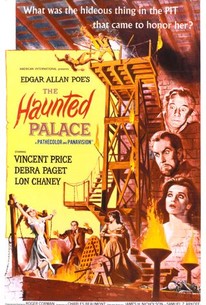
Classic Films in Focus: THE HAUNTED PALACE (1963)

Although the story really comes from H.P. Lovecraft's The Case of Charles Dexter Ward, Roger Corman's The Haunted Palace (1963) bills itself as one of the director's Edgar Allan Poe films and features all of the familiar trappings of those Gothic horror tales. Vincent Price is, as usual, in the lead, here playing a dual role as an evil warlock and his identical descendant, with Debra Paget making her final screen appearance as the descendant's long-suffering wife. The constant fog, gloomy period setting, and well-established genre tropes ensure that fans of Corman's other films will find plenty to appreciate here, but the chief attractions beyond Price and Paget are a gaggle of creepy mutant villagers and supporting performances from Lon Chaney, Jr. and Elisha Cook, Jr. The Haunted Palace is one of five films Corman directed in 1963, and it's not the first Corman picture anyone should see, but it's a fun outing for its iconic stars and worth the time if you enjoy the other Corman and Price collaborations.

Price appears first as the powerful necromancer Joseph Curwen, who conspires with his mistress, Hester (Cathie Merchant), to bewitch young women and bring them to his castle for unspeakable occult practices. The local villagers form a vigilante mob and burn Curwen at the stake, but not before he curses them and their descendants. Over a century later, Curwen's identical great-great-grandson, Charles Dexter Ward, inherits the castle and arrives in the town of Arkham with his lovely wife, Ann (Debra Paget). The village men (played by the same actors who appeared as their ancestors) make the Wards unwelcome, but Curwen's spirit soon possesses Charles and resumes his diabolical schemes of necromancy and revenge.

The dual roles of Joseph Curwen and Charles Dexter Ward give Vincent Price plenty to do, especially when he gets to play the two personalities warring for dominance over Ward's mind. Greenish makeup on the warlocks' faces helps us know when Curwen has control, but Price embodies the shift convincingly without the visual cue. Ward is a perfectly normal gentleman who loves his wife and doesn't believe in supernatural curses, while Curwen is a cunning sadist who is more than willing to murder anyone who crosses him. Of course, Curwen is destined to get the upper hand and wreak havoc, which ensures that Price can cut loose with his villain and make the most of a thoroughly terrible character. His sudden cruelty to his devoted wife leads her to suspect that evil is at work in the castle, but over time Curwen gets better at impersonating Ward so that he can continue his schemes in the secret chambers underground.

Debra Paget gives a solid performance as the worried wife, although she's the only developed female character in the whole story and spends most of her time looking frightened. Curwen is supposed to be obsessed with his dead mistress, Hester, but we don't see enough of her to understand his determination to resurrect her even though it's a distraction from the mission he and the other necromancers are supposed to be accomplishing. Lon Chaney Jr. has several scenes with Price but is subdued throughout; by 1963 he's long past his heyday as a horror star and not really credible as a fiendish immortal necromancer. The villagers, both past and present, are played by Leo Gordon, Elisha Cook, Jr., Frank Maxwell, and John Dierkes, and of the lot Maxwell has the most scenes because his doctor character tries to befriend and assist the Wards, although Cook is probably the most fun to watch because he plays fear-induced panic so brilliantly. Almost all of the named characters are rather dramatically upstaged by the deformed mutant villagers, descendants of the women Corwen bewitched and the ancient godlike thing he keeps locked in his underground lair. Cook's character, Peter, hints at the way the unholy mating has tainted the bloodlines of Arkham by revealing his own webbed hand, while Gordon's Edgar Weeden keeps his violent mutant son imprisoned in his home. Sadly, we don't know what, if anything, becomes of the mutants at the end of the story, since the Curwen/Ward conflict dominates the third act.

Different Corman fans will have their own favorites, but I recommend House of Usher (1960), The Masque of the Red Death (1964), and The Tomb of Ligeia (1964) if you want to see some of the best of the Poe adaptations with Vincent Price. You'll find both Price and Debra Paget in The Ten Commandments (1956), while Elisha Cook Jr. and Price both appear to great effect in William Castle's classic shocker, House on Haunted Hill (1959). See Lon Chaney Jr. in better times in his most memorable role as the ill-fated Larry Talbot in The Wolf Man (1941) and Frankenstein Meets the Wolf Man (1943), or check out his dramatic roles in Of Mice and Men (1939) or High Noon (1952).

Tuesday, September 17, 2019

Classic Films in Focus: THE HORRIBLE DR. HICHCOCK (1962)

I'm a sucker for early 60s Gothic horror, whether it's Corman, Hammer, or Bava, which means my opinion of a picture like Riccardo Freda's The Horrible Dr. Hichcock (1962) is inclined to be positive in spite of its shortcomings. Yes, it's about a necrophiliac surgeon who like his bedmates totally incapacitated, and the dubbing is pretty ridiculous, as well, but it has that lurid charm that Gothic horrors of the period so often possess, plus there's Barbara Steele starring as the hapless second wife who little suspects her husband's sordid appetites. Suffused with references and allusions to the work of Alfred Hitchcock, as one might guess from the title, The Horrible Dr. Hichcock provides the viewer with ample entertainment and plenty to parse in terms of its relationships to other films.

Robert Flemyng plays Professor Bernard Hichcock, a London surgeon with a secret passion for dead women. His wife, Margaret (Maria Teresa Vianello, credited as Maria Fitzgerald), accommodates his desires by allowing him to anesthetize her before sex in a boudoir made up like a funeral chamber. Unfortunately for Margaret, Hichcock overdoses her one night and then leaves the country shortly after her interment in the family vault. Twelve years later he returns to London with his new wife, Cynthia (Barbara Steele), and resumes his medical practice as well as his lust for corpses. Cynthia soon suspects that Margaret is haunting the house with sinister plans for her replacement, but when Bernard discovers the truth about Margaret he makes lethal plans of his own to restore his first wife to her former place and beauty.

As Budd Wilkins observes in his Slant review of the film's Blu-ray release, The Horrible Dr. Hichcock borrows heavily from Alfred Hitchcock's Rebecca (1940), with nods to Suspicion (1941) and Vertigo (1958), as well, but there's also a strong connection to 19th century literary works like Robert Browning's "Porphyria's Lover" and Edgar Allan Poe's "Ligeia." (For a discussion of Gothic texts and the theme of necrophilia, see my essay, "Gothic Angels: The Good, Dead Girl in Robert Browning's 'Porphyria's Lover' and Alice Cooper's 'Cold Ethyl'.") Bernard's obsession with beautiful corpses is the logical, if extreme, endpoint of the Victorian fantasy of the angel in the house. Margaret is more than happy to play this role for him, while Cynthia resists it, which puts her in danger of being made a corpse for real by the forces that seek to uphold the patriarchy's rule that women be utterly passive. While Cynthia has a bad habit of fainting every time something interesting happens, she is nonetheless determined not to succumb to the threats around her without a struggle, and the audience's sympathy lies entirely with her.

As is often the case with horror, the villain has the best role, and Robert Flemyng makes Hichcock an intriguing study in masculine selfishness, self-loathing, and irresistible sexual desire. The best scenes are the ones where Hichcock struggles against his urges but inevitably yields to them, drawn like a moth to a flame whenever a beautiful corpse lies nearby. He's the quintessential Victorian gentleman of horror, all propriety in public but pulsing with depravity in private, a Jekyll and Hyde figure whose hidden nature Cynthia doesn't suspect until it's almost too late. As the film opens we see him ruthlessly assault a grave digger in order to molest the body being buried; later, he performs surgery to repair the damage done to the very same man, with admiring proteges and a grateful family never dreaming that the same hands both harmed and healed. His duality makes him fascinating, though not particularly sympathetic, since even at his best he's a condescending, patriarchal ruler who expects everyone around him to obey his commands, whether they be student, servant, or wife. When Cynthia tries to tell him about the mysterious presence in the house he gaslights her and says that her nerves are coming undone, but once he knows it's real he just intensifies the gaslighting to keep Cynthia from realizing her peril. That alone makes him a monster, but his mad plan to restore Margaret at Cynthia's expense shows just how unbalanced he becomes by the film's fiery conclusion.

Director Riccardo Freda, who often worked under the name Robert Hampton, also made Lust of the Vampire (1957), Caltiki, The Immortal Monster (1959), and The Ghost (1963). Don't miss scream queen Barbara Steele in Black Sunday (1960) and Pit and the Pendulum (1961); she also stars - this time as a character named Margaret Hichcock! - in The Ghost, which makes it an obvious second choice for a Freda double feature. You'll find Robert Flemyng in Funny Face (1957), The Deadly Affair (1967), and The Blood Beast Terror (1968).


Wednesday, September 4, 2019

Classic Films in Focus: THE OLD DARK HOUSE (1932)

Of course it's a dark and stormy night when Raymond Massey, Gloria Stuart, and Melvyn Douglas stumble into a strange old house whose occupants are even more menacing than the raging floods outside, and director James Whale milks the atmosphere for all it's worth in this delightfully dire horror comedy. The Old Dark House (1932) delivers on all points, with thrills and giggles in equal measure thanks to the performers who make up the cast, including Boris Karloff, Ernest Thesiger, Charles Laughton, and Eva Moore.

Massey and Stuart play married couple Philip and Margaret Waverton, who, along with their traveling companion, Penderel (Douglas), literally wash up at the old dark house during a massive storm. They're not exactly welcomed in by the occupants, a strange brother and sister whose other family members haunt the upper floors of the gloomy mansion, but they settle in to stay the night and are soon joined by fellow refugees Sir William Porterhouse (Charles Laughton) and Gladys (Lilian Bond). Things take a turn for the worse when the looming, mute butler, Morgan (Boris Karloff), gets drunk and releases the house's most dangerous resident, a pyromaniac murderer called Saul (Brember Wills).

If you're already familiar with Whale's sense of humor from Frankenstein (1931), The Invisible Man (1933), and Bride of Frankenstein (1935), you'll appreciate more of the same in The Old Dark House (1932), especially with the crusty, deaf Rebecca Femm (Eva Moore) and her brother, the fey, nervous Horace (Ernest Thesiger). The brief appearance of their father, Sir Roderick, turns out to be a treat, too; the whole family is mad as hatters, which keeps the reluctant house guests in a constant state of confusion. Karloff's shambling Morgan is a scarier version of Lurch from The Addams Family; he spends a lot of time trying to molest Margaret, who has inexplicably changed out of her wet traveling clothes into the least practical evening dress one could possibly wear in a cold, damp lunatic asylum pretending to be a family home. The sense of impending doom is also lightened by the whirlwind romance of Penderel and Gladys, with Penderel seeming to nurse something of a foot fetish where his new love interest is concerned.

The atmosphere and cinematography also make this film a lot of fun, with fabulous camera shots lingering on Morgan's scarred face in closeup or building terrible suspense with just Saul's hand at the top of the stairs appearing in the frame. There's plenty of striking storm scenery, too, especially as the Wavertons wend their hazardous way through the deluge. Flickering candles and uncertain electrical lights add to the sense of dread; nobody wants the lights to go out in this house. The Gothic ambience and focus on crumbling heaps recall Poe's "The Fall of the House of Usher" but also Horace Walpole's Castle of Otranto, and Whale shares Walpole's characteristic mingling of the ludicrous and the sublime. The joke of the title reveals the film's keen awareness of its place in relationship to earlier Gothic horror; the "old dark house" motif was a cliche of the genre long before 1932, but Whale's direction is always winking at us about the familiarity of it all.

Whale, Karloff, and Thesiger reunited for Bride of Frankenstein, while Gloria Stuart also stars in Whale's adaptation of The Invisible Man. Melvyn Douglas is not generally remembered for his horror films, but you'll also find him in The Vampire Bat (1933), and, much later, The Changeling (1980) and Ghost Story (1981). While Charles Laughton plays a solid fellow in this film, he really gets to work the horror vein in Island of Lost Souls (1932) and The Strange Door (1951). Don't miss Raymond Massey doing his own Karloff inspired turn in Arsenic and Old Lace (1944). William Castle made his own version of The Old Dark House in 1963, so you could make a double feature of it by watching both adaptations of the novel by J.B. Priestley.

Tuesday, February 12, 2019

Classic Films in Focus: DARK WATERS (1944)

Somewhere between Lifeboat (1944) and Gaslight (1944) lies the plot of Dark Waters (1944), in which Merle Oberon stars as the survivor of a U-boat attack whose fragile sanity is tested by a collection of nefarious characters. All three pictures appeared in the same year, but the first two are decidedly better films, while Dark Waters holds interest primarily for its cast. Joining Oberon for this wartime swamp Gothic are Franchot Tone, Thomas Mitchell, Elisha Cook, Jr., and Fay Bainter, with Rex Ingram making sporadic but memorable appearances as a former employee who suspects that something is amiss at the old plantation. Dark Waters fails to deliver enough creepy atmosphere to achieve its Gothic ambitions, and the ending is more a hard stop than a proper conclusion, but Oberon is fascinating to watch as she tries to figure out whether she's going or being driven insane.

Oberon's perpetually imperiled heroine is Leslie Calvin, whose family flees the Japanese descent on Batavia (present day Jakarta) only to fall victim to a German U-boat attack at sea. Leslie survives many days in an open boat before ending up in a New Orleans hospital. After months of convalescence she travels to a nearby plantation owned by her aunt and uncle, where she hopes to recover from her post traumatic stress. She meets a handsome doctor (Franchot Tone), who quickly falls for her, but everything else goes awry as she is constantly exposed to situations that recall her ordeal and unsettle her sense of reality. Leslie begins to suspect that the manipulative Mr. Sydney (Thomas Mitchell) and his sidekick, Cleeve (Elisha Cook, Jr.), are tormenting her on purpose, but to what end?

Gothic mystery is a fine setting for Oberon's exotic beauty, but she gets better material to work with in both Wuthering Heights (1939) and The Lodger (1944), where her characters have more energy and more successfully developed plots. Franchot Tone's country doctor, George, doesn't spark much chemistry, but he seems to be the only available man in the area aside from Elisha Cook Jr.'s creepy Cleeve. It doesn't take two minutes to recognize both Cleeve and Sydney as the villains of this piece, and Thomas Mitchell has a handful of effectively menacing scenes, but Fay Bainter's Aunt Emily is neither disturbing nor reassuring, and it's hard to justify John Qualen's presence as Uncle Norbert, since he barely comes out of his room to utter a few lines at dinner. Fine actors inhabiting the background don't get enough to do, either, especially Rex Ingram and Odette Myrtil, who turns up as the mother of a large, friendly Cajun family.

There's enough potential in Dark Waters to see the movie it could be, and that warrants a viewing, especially for contrast with moodier explorations of similar plots and atmospheres. The Louisiana bayou makes an evocative setting, and the premise of Leslie's very justified anxiety about water and boats creates numerous opportunities for her to be tormented. We know from the beginning where the third act of this story will inevitably end (hence the title), but when the film finally reaches that point it seems in a hurry to wrap things up, and quite a few loose ends are left dangling. The pacing is more of a shock because there had apparently been plenty of time to linger on an earlier fais do-do sequence that adds nothing to the story. It's hard to say if director Andre De Toth or the writers are to blame for these issues, but De Toth certainly made tighter pictures over the course of his career.

Do pause a moment to appreciate the underused Nina Mae McKinney as the housemaid, Florella, who unfortunately disappears from the picture in the third act. For more of Merle Oberon, try The Private Life of Henry VIII (1933), The Scarlet Pimpernel (1934), or That Uncertain Feeling (1941). See earlier roles for Franchot Tone in Bombshell (1933), Dancing Lady (1933), and Dangerous (1935). Thomas Mitchell is best remembered for more sympathetic characters in Stagecoach (1939), Gone with the Wind (1939), and It's a Wonderful Life (1946), while Elisha Cook, Jr. offers more of his usual type in The Maltese Falcon (1941), I Wake Up Screaming (1941), and The Killing (1956). For a more thoughtful and provocative treatment of a similar atmosphere, try I Walked with a Zombie (1943), or, for some really excessive gaslighting bayou horror, go for Hush... Hush, Sweet Charlotte (1964).


* As of February 2019, DARK WATERS is available for streaming on Amazon Prime, but the print is rather muddy, especially in the outdoor night sequences.

Thursday, August 31, 2017

Classic Films in Focus: THE WOMAN IN WHITE (1948)

The 1948 adaptation of Wilkie Collins' The Woman in White features some notable character performances and plenty of Gothic mystery, but it isn't an ideal picture or a very faithful treatment of its source material. Its appeal depends mainly on its sinister figures, particularly the always memorable Sydney Greenstreet as Count Fosco, but its leads are less interesting, and they get the majority of the screen time. Classic film fans will find the movie worth watching for Greenstreet, Agnes Moorehead, and John Abbott, but devotees of the original novel will find the changes problematic, especially where the romantic plot is concerned.

Gig Young plays the painter Walter Hartright, who gets drawn into intrigue when he becomes a drawing master to pretty heiress Laura Fairlie (Eleanor Parker) at Limmeridge House. Walter falls for Laura but is warned of her engagement to Sir Percival Glyde (John Emery) by Laura's cousin, Marian (Alexis Smith). When Walter accuses Sir Percival and Count Fosco (Sydney Greenstreet) of a diabolical plot involving a mad girl who strongly resembles Laura, Marian tells him to leave, but both Laura and Marian soon discover that Walter's suspicions were correct. Reunited some months later, Walter and Marian realize that Laura's double has died and been buried as Laura herself; together, they set out to rescue Laura from an asylum and restore her true identity.

The most appealing of the novel's sympathetic characters is Marian Halcombe, and the film recognizes this fact even as it rewrites much of her role. Alexis Smith gives a fine performance as the intelligent, capable Marian, who serves as a foil to the delicate and rather insipid Laura. Eleanor Parker is actually more interesting as mad Ann, Laura's double, than she is as Laura herself, and sadly that's a fault that the film keeps from the original text, in which Laura is a demure Victorian angel made damsel in distress. Both actresses give better performances than poor Gig Young, whose Walter seems very stiff for a lover who can't decide which girl he likes. Walter's role in the novel as de facto detective doesn't really carry over into the movie, and this leaves Young with little to do but strike poses and lock eyes with both of his leading ladies.

The action depends much more on the heavies, especially Greenstreet's Count Fosco as the prime mover of the plot. Greenstreet has just the combination of charm and menace, as well as the impressive girth, that make Fosco so fascinating as a literary villain, and if you like Greenstreet in other films you'll enjoy his performance here. John Emery's Sir Percival is just a thug in comparison, always eager to jump into murder, while John Abbott is delightfully awful and ineffectual as Laura's hypochondriac Uncle Frederick. Only Agnes Moorehead enjoys any ambiguity about her character's intentions; her Countess Fosco is an odd, repressed figure who has her own reasons for hating Fosco and pitying the plight of poor Ann. Fans of the actress will be sorry that she doesn't have more scenes, but she gets quite a moment in the film's climax as compensation.

The problems with The Woman in White might lie more with Stephen Morehouse Avery's screenplay than Peter Godfrey's direction or any actor's performance, but flaws it definitely has, although some of them are only apparent to those familiar with Collins' source material. Godfrey's best film, Christmas in Connecticut (1945), also stars Greenstreet, but most people remember the rotund actor most for his appearances in The Maltese Falcon (1941) and Casablanca (1942). You can see Alexis Smith play nasty in Godfrey's 1947 picture, The Two Mrs. Carrolls. Eleanor Parker went on to earn three Best Actress nominations for her roles in Caged (1950), Detective Story (1951), and Interrupted Melody (1955). Gig Young gets more to do in The Three Musketeers (1948), Torch Song (1953), and Desk Set (1957), and he won a Best Supporting Actor Oscar for They Shoot Horses, Don't They? (1969).


Monday, July 24, 2017

Classic Films in Focus: THE TWO MRS. CARROLLS (1947)

Director Peter Godfrey's modern Gothic offers two iconic stars - Humphrey Bogart and Barbara Stanwyck - as its leads, which is reason enough to see The Two Mrs. Carrolls (1947) in spite of its flaws. Bogart, who played heavies off and on throughout his career, is back on the dark side as a painter who finds artistic inspiration by murdering his wives, while Stanwyck is unusually naive as his current wife and next intended victim. Supporting performers include Nigel Bruce as an atrociously incompetent doctor and Ann Carter as Bogart's beguiling daughter, while Alexis Smith is particularly memorable as a predatory seductress who might be getting more than she expects by tempting Bogart's unhinged artist to leave his wife for her. Bogart, Stanwyck, and Smith all give fine performances, but the film suffers from a lack of suspense that undermines its chilling premise.

Stanwyck plays Sally, who becomes the second wife of painter Geoffrey Carroll (Bogart) after his first wife dies. Sally doesn't suspect that her predecessor's demise was murder, and Geoffrey goes to great lengths to hide his crimes even as he contemplates a second disposal to make way for wife number three. Goaded by the offers of the beautiful Cecily (Alexis Smith), Geoffrey intends to make Sally another victim of his maniacal need for a new muse to drive his work. Geoffrey's young daughter, Bea (Ann Carter), eventually reveals some of his secrets, and Sally realizes the truth about her husband, but her revelation might come too late to save her from his murderous schemes.

The two leads are the chief attraction here, though both are somewhat out of their element. Humphrey Bogart never looks like an artist, but he does make for a credible killer, and it's great fun to watch his Geoffrey come unhinged whenever his secrets are threatened. By the end of the film he has gone right off the rails, justifying his actions with a horrifically sexist assertion that his art is more important than any woman's life. The simmering intensity that Bogart exemplifies works well for dangerous, unstable characters, and his performance here provides a parallel to his more celebrated work in The Petrified Forest (1936), The Treasure of the Sierra Madre (1948), In a Lonely Place (1950), and The Caine Mutiny (1954). Stanwyck, normally a tough cookie and occasionally up for murder herself, here has an ingenue's role, and one of the film's frustrations is that we expect a Stanwyck character to be smarter. Stanwyck plays Sally as loyal, kind, and unsuspecting, which is what the role seems to demand of her, but it's not as good a part as the actress deserves, and Alexis Smith has the meatier role as the scheming Cecily. Stanwyck would get a much better chance to play an imperiled wife in the 1948 film, Sorry, Wrong Number, showing what she could do with a part more suited to her talent.

While the casting issues cause some obvious problems, the chief complaint about The Two Mrs. Carrolls is its inability to generate suspense. The film shows us up front that Geoffrey murders his first wife, creating dramatic irony for the audience as we wait for Sally to catch up. This approach can work well in a narrative, depending on how the unfolding events are handled as the protagonist learns the truth, but Sally stays in the dark so long that we wonder if she's paying attention. When she does finally figure it out there's a flood of information dumped into the last act so rapidly that we don't have time to savor Sally's discoveries. Even the reveal of the gruesome portrait of Sally as an Angel of Death - which ought to be a major moment - seems rushed. We see it briefly and then it's gone as Sally rushes on to the next piece of evidence. Great Gothic thrillers, whether literary or cinematic, use the slow build of rising suspicion and horror to drive the plot and the heroine forward to the inevitable confrontation with the villain. One has only to compare this movie's poisoned milk scenes with the one in Suspicion (1941) to see how differently a really suspenseful film handles the same concept. The 1940s, in fact, saw a host of excellent Gothic thrillers appear in the wake of Rebecca (1940) and the Jane Eyre inspired boom that followed, and it's a shame that The Two Mrs. Carrolls falls short in comparison with its sister films.

In spite of its failures, classic movie buffs will want to see The Two Mrs. Carrolls because it's the only picture to pair Bogart and Stanwyck. It's also worth seeing for fans of Ann Carter, the child star who so memorably plays the young protagonist of The Curse of the Cat People (1944). Peter Godfrey directs Alexis Smith again in The Woman in White (1948), which continues the Gothic trend, as does Cry Wolf (1947), which has Godfrey directing again for Stanwyck. For more of Smith and Bogart in a tale of murderous marriage, try Conflict (1945). Most of the Warner Bros. films are available as DVD on demand from the Warner Archive, including The Two Mrs. Carrolls.

Tuesday, November 1, 2016

Classic Films in Focus: MR. SARDONICUS (1961)

Horror showman William Castle ventures into Gothic territory more familiar to Roger Corman and Hammer Studios with his 1961 feature, Mr. Sardonicus, which saves its trademark Castle gimmick, the Punishment Poll, for the very end of the film. Adapted from the story by Ray Russell, Mr. Sardonicus also includes visual and thematic nods to Dracula (1931), The Man Who Laughs (1928), and the frock-coated period horror that flourished during this era. Castle's version indulges his perverse sense of humor, especially when Castle himself appears on screen to open and close the picture, but there are some real horrors to be found, too, especially in sexual violence that is more suggested than shown.

Ronald Lewis stars as Sir Robert Cargrave, an English doctor who specializes in paralysis cases. He is called to remote Gorslava by his former flame, Maude, now the Baroness Sardonicus (Audrey Dalton), who begs him to cure her cruel husband, the Baron (Guy Rolfe), of an affliction that twists his face into a permanent and horrific grin. The Baron eventually reveals his history to Sir Robert to explain his disfigurement; he was once a simple peasant who robbed his father's grave to retrieve a winning lottery ticket, but the sight of his dead father's face caused his own to become frozen in a matching grimace. He then threatens to mutilate the beautiful Maude if Sir Robert cannot reverse the paralysis. Under duress and running out of time, Sir Robert struggles to save himself and Maude by restoring the Baron to some semblance of his former humanity.

Mr. Sardonicus includes all the usual elements one expects from Gothic horror, especially in the films of the 1950s and 1960s. It has a distant, crumbling castle in a strange Eastern European land, with villagers who live in fear of the aristocratic sadist who lurks there. It has damsels in distress, including scenes of torture tinged with sexual connotations. There's a very straight-laced hero type to foil the ghoulish villain, and, of course, there's a leering, sinister henchman, played in this production by character actor Oskar Homolka. Homolka's Krull, a one-eyed fiend with a thing for leeches, belongs to a caste that includes any number of characters played by Dwight Frye, Boris Karloff, and Bela Lugosi. His menacing presence reinforces the familiarity of the whole setup, from Sir Robert's ominous summons to the castle to the final twist that proves the hazards of having an evil fiend for a right hand man.

The big shock of the picture is the Baron's rictus grin, which we see only a few times because the prosthetics were too painful for Guy Rolfe to wear for very long. He looks truly gruesome - and uncomfortable. Just pay attention to Rolfe's eyes when he appears in the fully realized face. The excruciating disfigurement recalls Conrad Veidt's turn as the more sympathetic Gwynplaine in The Man Who Laughs, although Baron Sardonicus' condition is the result of psychological torment rather than sadistic Gypsy surgery. In a modern context, the Baron's backstory would be the origin of a super villain, which isn't much of a stretch for a man who put out his own henchman's eye and enjoys tying up his wife. Despite his sins, we see him as a dynamic figure and the real protagonist of the narrative, and in the subtext we get the sense that his issues have as much to do with his shrewish first wife as his descent into ghoulish grave robbery. What the Baron fails to understand is that he can't restore his lost humanity, his human goodness, just by restoring his human face. That makes him a tragic monster, as all great cinematic and literary monsters are. It might say something about our own monstrosity that Castle knew how we would vote in the Punishment Poll every time.

For more of William Castle's shockers, try The Tingler (1959), House on Haunted Hill (1959), and 13 Ghosts (1960). You can binge on Gothic castle horror from this era with Roger Corman's House of Usher (1960) and Pit and the Pendulum (1961), as well as Hammer's Horror of Dracula (1958) and Mario Bava's Black Sunday (1960). Look for Ronald Lewis in Scream of Fear (1961), and catch Audrey Dalton in The Monster That Challenged the World (1957). Oskar Homolka earned an Oscar nomination for his performance in I Remember Mama (1948), but if you prefer him being evil go with Alfred Hitchcock's Sabotage (1936). You'll find Guy Rolfe playing the vile Prince John in Ivanhoe (1952); he ended his career as something of a horror staple in Dolls (1987) and a series of Puppet Master films.

MR. SARDONICUS is currently streaming on the horror subscription service, Shudder.

Tuesday, November 3, 2015

Classic Films in Focus: TWICE-TOLD TALES (1963)

Borrowing both the star and the literary atmosphere of Roger Corman's Poe adaptations, Twice-Told Tales (1963) offers a trilogy of stories from Nathaniel Hawthorne, with Vincent Price taking the lead in all three segments of the film. Like the Corman pictures, this anthology of horror drips with Gothic period atmosphere and relies heavily on Price's irresistible appeal, but for Price devotees the actor's presence more than justifies the movie's existence. Given the genteel 19th-century quality of the tales, there aren't really any shocks on offer, but the Hawthorne stories do present abundant examples of irony and even a little of the supernatural. The third piece, "The House of the Seven Gables," is the most truly Gothic of the three, but both "Dr. Heidegger's Experiment" and "Rappaccini's Daughter" have their charms.

In "Dr. Heidegger's Experiment," Price stars as Alex, an old friend of  Carl Heidegger (Sebastian Cabot), whose lifetime of mourning his lost love takes a strange turn when the pair discover water with the power to restore youth and life. Price then plays the sinister father in "Rappaccini's Daughter," using his botanical science to transform his child (Joyce Taylor) into a poisonous vessel of death. "The House of the Seven Gables" features Price as prodigal son Gerald Pyncheon, who brings his wife (Beverly Garland) back to his family's haunted estate to search for the wealth in a hidden vault.

Hawthorne's favorite themes are very much on display throughout the trilogy; he has a finer, less macabre sense of horror than Poe, and his works often hinge on moral considerations. Each of the anthology segments makes significant changes to Hawthorne's original texts, but they still retain the spirit in which the stories were conceived. The first two are basically weird tales wrapped in the crushed crimson velvet of American Romanticism; they are almost, but not quite, science fiction, but both concern themselves more with questions of irony and ethics than scientific speculation. Price, of course, is a master at registering a character's dawning sense of the tragically ironic, although he's far less campy in all three segments than in many of his most iconic horror roles. Each of his characters fails Hawthorne's moral tests and richly deserves his fate, but Price also invests the first two with sincerity and regret; the third, Gerald Pyncheon, is a fully realized Gothic heavy, a scheming wastrel who defies a vengeful ghost in spite of the danger to himself and his innocent wife. Price's performance in that part harks back to his role as Nicholas Van Ryn in Dragonwyck (1946), although Price had actually played a very different Pyncheon character in the 1940 feature length adaptation of The House of the Seven Gables.

Price's costars in each segment benefit from his screen presence, with the women in particular standing out in their performances. Mari Blanchard is lovely if less than innocent as Sylvia, Dr. Heidegger's long lost bride, while Joyce Taylor conveys the anguish of Beatrice Rappaccini, a Rapunzel trapped in her garden by her father's poisonous love. Beverly Garland and Jacqueline deWit provide foils for one another, as well as obstacles to Price's Gerald Pyncheon, as Gerald's wife, Alice, and formidable sister, Hannah. Garland appears as the heroine and deWit as a variation on the sinister Gothic housekeeper, the person who knows the family's darkest secrets. The other men are generally less memorable, although Sebastian Cabot gives a very fine performance as the heartbroken Heidegger. Brett Halsey and Richard Denning, both playing straight romantic leads, are mostly there to pine after the ladies and get in Price's way, but their characters suffer from the usual flatness of their type.

For a double bill of Vincent Price horror anthologies, pair Twice-Told Tales with Corman's Tales of Terror (1962). The actor had a busy year in 1963, which also saw the release of The Raven, The Haunted Palace, and The Comedy of Terrors. Sebastian Cabot is best remembered today for the TV series, A Family Affair, and for his voice acting roles in Disney films, including The Sword in the Stone (1963), The Jungle Book (1967), and The Many Adventures of Winnie the Pooh (1977). Be sure to catch Beverly Garland in The Alligator People (1959), and see Richard Denning in Creature from the Black Lagoon (1954). Sidney Salkow, who directed Twice-Told Tales, mostly worked on television episodes and Westerns, but his career stretched all the way back to the 1930s. He also directed Bulldog Drummond at Bay (1947), Sitting Bull (1954), and four episodes of The Addams Family.

Wednesday, June 17, 2015

Classic Films in Focus: EXPERIMENT PERILOUS (1944)

Like the more illustrious Gaslight (1944), Experiment Perilous (1944) focuses on a beautiful woman trapped in a sinister plot to destroy her sanity, with Hedy Lamarr as the lady in peril and George Brent as her aspiring protector. The film also features direction by Jacques Tourneur, but it falls short of his best work in classics like Cat People (1942) and Out of the Past (1947). In spite of its flaws, Experiment Perilous is a moderately entertaining thriller, largely because of Lamarr's irresistible charms and the suave menace of Paul Lukas as the dangerously possessive husband.

George Brent plays Dr. Hunt Bailey, who meets a timorous but kindly older woman (Olive Blakeney) on a train trip home to New York. When the woman suddenly dies on her return to her family's house, Hunt is left with her diaries and a growing urge to know more about the surviving members of the Bederaux family. Nick Bederaux (Paul Lukas) is a wealthy man, but his house's chief attraction is his lovely wife, Allida (Hedy Lamarr). Nick engages Hunt to assess Allida's sanity, but the doctor suspects that Allida is in very real danger from her manipulative spouse.

We never reach the hysterical pitch of Gaslight as this plot unfolds, perhaps because Nick Bederaux is a less sophisticated tormentor than Charles Boyer's sadistic villain. Nick is merely jealous and mentally unstable; he is more capable of murder than the slow, deliberate turning of the screws that really Gothic cruelty demands. Paul Lukas handles the role as well as possible, but his performance would have benefited from juicier sins to commit over the course of the film. Because Nick is less inventive as an antagonist, Hedy Lamarr has less to work with as the victimized Allida, although her delicate beauty suggests her vulnerability and justifies all of the masculine attention she attracts. George Brent more or less plods forward through his part as the heroic doctor; he's too solid and respectable to seem threatened, even when he realizes that he's being followed and then discovers that Miss Bederaux's diaries have been stolen from their hiding place in his own home. Hunt never believes Nick's claims about Allida, and he progresses from admiring her portrait to being in love with her with alarming speed.

The picture does offer some memorable visual moments, from closeups of Lamarr's impossibly beautiful face to a bank of fascinating aquariums that we never get close enough to inspect. The Bederaux home, with its strange hidden stairs and maze of rooms, invites mystery, and it provides for an explosive climax when Nick finally launches his homicidal endgame. These elements earned the movie an Oscar nomination for Best Art Direction, but it's easy to imagine this setting filled with much more gripping suspense than we actually get. Tourneur creates that kind of hair-raising dread in his most important films, but it only breaks through in fits and starts in this production. The result is not a terrible picture but a mediocre one; dedicated Tourneur fans might want to see it just to expand their knowledge of the director's oeuvre, and others will find it worthwhile just for an hour and a half to admire Lamarr's incomparable looks.

Be sure to note Albert Dekker in a supporting role as Hunt's friend, Clag. For a really different perspective on George Brent in the thriller genre, see The Spiral Staircase (1945). Hedy Lamarr also stars in Algiers (1938), Ziegfeld Girl (1941), and Samson and Delilah (1949). Paul Lukas won the Oscar for Best Actor for his performance in Watch on the Rhine (1943), but you'll also find him in The Lady Vanishes (1938) and 20,000 Leagues Under the Sea (1954). For more from Jacques Tourneur, see I Walked with a Zombie (1943), The Flame and the Arrow (1950), and Night of the Demon (1957).

Thursday, June 12, 2014

Classic Films in Focus: GASLIGHT (1944)

Gothic thrills get a stylish Hollywood makeover in George Cukor’s 1944 version of Gaslight, which earned Ingrid Bergman a Best Actress Oscar as a naive bride whose duplicitous husband tries to drive her insane. The top-notch cast also includes Charles Boyer, Joseph Cotten, and Dame May Whitty, but the best is a scene-stealing screen debut by a teenaged Angela Lansbury, who picked up an Oscar nomination for her performance, as well. Mounting suspense and thrilling cinematography make this tale of psychological terror a true classic, which rewards repeat viewings with its carefully developed motifs and keen attention to detail.

Ingrid Bergman stars as Paula Alquist, whose famous aunt is strangled by an intruder when Paula is just a young girl. Ten years later, Paula returns to the home she and her aunt once shared with her new husband, Gregory (Charles Boyer), but the honeymoon is short-lived, as Gregory soon turns cool and insists that Paula is losing her mind. As the evidence against her sanity mounts, Paula doubts her own senses, even though she sees and hears mysterious things every night when her husband leaves the house. Only Brian Cameron (Joseph Cotten), a handsome Scotland Yard detective, suspects the truth about Gregory’s motives for having his wife committed to an asylum.

The plot has a Bluebeard’s wife quality that is suggested early on by Paula’s encounter with Miss Thwaites (Dame May Whitty), a murder mystery fan who promptly tells Paula a gory story about a man who killed his wives. This is the dark side of fairy tale romance; after a whirlwind courtship, Paula’s dream becomes a nightmare, and her prince turns out to be an ogre. Bergman unravels beautifully over the course of Paula’s travails; her innocent, happy energy gives way to nervousness and doubt, then hysteria, as she comes unglued under Gregory’s baleful influence. Charles Boyer, sadistic and urbane, makes a perfect villain; he doesn’t have to smile for us to know how much he enjoys his insidious mind games. Gregory works on Paula’s mind with subtle, calculated cruelty, moving objects and undermining her confidence but also building her up with brief moments of happiness just to bring her crashing down. The audience understands his motives long before Paula even suspects, but the dramatic irony only enhances our suspense. We know it’s just a matter of time before Paula cracks under Gregory’s constant pressure.

Everyone in the cast is excellent, and Charles Boyer even got a Best Actor nod for his performance, but it’s impossible not to watch Angela Lansbury with particular fascination. Only nineteen at the time of her first film role, Lansbury commands the screen as Nancy, the pert housemaid whose presence unnerves the self-conscious Paula. With a tilt of her chin and a lazy stare, Lansbury makes Nancy insufferably vulgar and vain. She boldly propositions her master and subverts her mistress at every turn, but we can’t wait to see her again. Like the constables and even Gregory himself, we’re drawn to her undeniable charisma, no matter how forward and presumptuous she becomes. Nancy’s insubordinate behavior is yet another tool that Gregory employs to his advantage; he knows that she’s the worst possible choice of a maid to serve his wife, and that’s exactly why he hires her. Lansbury, all insolence and innuendo, would have carried off the whole picture had the leads been even a hair less skillful in their own performances.

Gaslight picked up seven Oscar nominations in all, with a second win for Best Art Direction. For comparison see the British 1940 version starring Anton Walbrook and Diana Wynyard; it’s sometimes included with DVD editions of the 1944 picture. Ingrid Bergman is best remembered for films like Casablanca (1942), Spellbound (1945), and Notorious (1946), but she won two more Best Actress Oscars for Anastasia (1956) and Murder on the Orient Express (1974). Charles Boyer stars in Love Affair (1939), All This, and Heaven Too (1940), and The Constant Nymph (1943). See Joseph Cotten in Citizen Kane (1941), Shadow of a Doubt (1943), and The Third Man (1949). For more of Angela Lansbury’s early films, try The Picture of Dorian Gray (1945) and The Harvey Girls (1946).

Thursday, February 6, 2014

Classic Films in Focus: THE UNSUSPECTED (1947)

Michael Curtiz’s 1947 thriller, The Unsuspected, puts Claude Rains back into the kind of role he had already played with great success in films like Casablanca (1942) and Notorious (1946), so it’s no surprise that he’s equally compelling as Victor Grandison, the suave but manipulative radio host who is really this picture’s protagonist. Fans of the incomparable Rains will enjoy The Unsuspected because it focuses on his character and gives him a series of excellent scenes in which to work out Grandison’s various moods, although the romantic leads aren’t able to hold the screen against their more interesting costar. Despite a few weak spots that hold it back from true greatness, The Unsuspected is certainly worth watching if you like Claude Rains, and it also offers some memorable performances from Audrey Totter, Hurd Hatfield, and Constant Bennett.

Rains dominates the movie as the “genial host” of a murder mystery radio show, who lives with his vicious niece, Althea (Audrey Totter), and her drunken husband, Oliver (Hurd Hatfield), in a mansion that actually belongs to Grandison’s ward, the naive Matilda (Joan Caulfield). When Matilda unexpectedly returns home after being presumed drowned in a shipwreck, she finds not only her familiar housemates but also Steven (Ted North), a mysterious young man who claims to be her husband. Murder, mystery, and hysteria ensue as the apparent suicide of Grandison’s secretary is revealed to be foul play, and the chief suspects are the residents of Matilda’s own home.

A strong Gothic quality hangs over the whole plot, with the imperiled heiress constantly under siege from one quarter or another. Her sanity is already questionable because of the shock of being lost at sea, and the events that unfold do little to improve her mental health. Like Paula Alquist in Gaslight (1944) or Lina McLaidlaw in Suspicion (1941), Matilda Frazier spends much of the story coming unglued, but Joan Caulfield lacks the presence of an Ingrid Bergman or a Joan Fontaine. We never see enough spine in this heroine to root for her or really fear for her safety. In fact, Caulfield’s Matilda is such a milquetoast that it’s easy to see why Althea hates her and much more difficult to understand her appeal to either Steven or Oliver. Steven also comes off as a bland, straight arrow sort, which undermines his guise as the forgotten husband. Joseph Cotten or Cary Grant might have played his role with a little more menace and uncertainty, but Ted North, credited as Michael North, can’t muster the necessary subtlety, and this role would prove to be his last screen appearance.

As problematic as the lovers might be, there are several solid players giving top-notch performances here. Rains, of course, puts his talent for slippery types to excellent use, and his hypnotizing voice makes him a perfect choice for a radio host. The great Audrey Totter oozes malice as nasty Althea, who steals Oliver from Matilda just for spite and quickly gets to work on Steven when she finds out that he belongs to Matilda, too. Hurd Hatfield, best remembered today as the title character in the 1945 adaptation of The Picture of Dorian Gray, here looks more like Dorian’s ruined portrait than his ageless original, with the decay of alcohol and self-loathing heavy on his brow. He makes us pity Oliver even as we deplore the weakness that leaves him vulnerable to Althea’s predatory charms. Constance Bennett has a small but effective part as Jane, who works for Grandison and is deeply interested in finding out who killed his secretary. Unlike Matilda and Althea, who could easily relocate to a Gothic castle, Jane is a thoroughly modern woman, cheerful, smart, and independent. Her no-nonsense attitude and strong moral character make her the only female character in the movie who is never in the slightest bit of danger.

Be sure to appreciate comedian Fred Clark in a supporting role as Richard Donovan. See more of Claude Rains in The Adventures of Robin Hood (1938), Mr. Smith Goes to Washington (1939), and The Wolf Man (1941). You’ll find Audrey Totter in The Postman Always Rings Twice (1946), Tension (1949), and The Set Up (1949). Michael Curtiz also directed Angels with Dirty Faces (1938), Mildred Pierce (1945), and White Christmas (1954). For even more Gothic thrillers, try Rebecca (1940), Jane Eyre (1943), and Dragonwyck (1946).

The Unsuspected is available on DVD from Warner Archive.

Friday, September 13, 2013

"The Spinsters" on Kindle

Yes, there are spiders involved!
Being a former English professor and lifelong cinephile, I not only love good stories but yearn to tell them myself. I have been tapping away at various fiction projects for years - in between academic writing and classic movie blogging - and this week I finally took the plunge and published a short story on Kindle.

"The Spinsters" is a Gothic tale whose twisted sense of humor and little old lady characters are definitely inspired by ARSENIC AND OLD LACE (1944), although I have known quite a few mad old women in real life. There's something about them that I find endearing, even (and perhaps especially) when they behave badly. I dislike people who take advantage of the elderly, which happens all too often these days, so I invented Letitia and Louisa to even up the score. They're dear little things with a good dose of my Aunts Birdie and Sis in their makeup.

With a title like "The Spinsters," there have to be some spiders involved, so be forewarned if arachnids give you the willies. This fall the web spinners have been all about my garden, which reminded me that I had started this story some time ago and really wanted to finish it. 

This is meant to be the beginning of a collection of horror stories, each dealing with a different classic "monster" type. I have been watching quite a lot of old Universal horrors this fall, and if I don't run as mad as Dwight Frye by Halloween I hope to have several more finished and ready for readers.

"The Spinsters" is free on Kindle through Saturday, so you've nothing to lose by giving it a try. I hope you'll enjoy reading it as much as I enjoyed writing it.

Here's the link to the story on Amazon. Let me know what you think if you read it!

Friday, February 22, 2013

Classic Films in Focus: REBECCA (1940)

Rebecca (1940), adapted from Daphne du Maurier's hugely successful novel, looks like it ought to be a winner, given that it was directed by Alfred Hitchcock, produced by David O. Selznick, and performed by Laurence Olivier and Joan Fontaine. Indeed, it was a winner at the 1941 Academy Awards, where it snagged the Best Picture prize from contenders as worthy as The Philadelphia Story, The Grapes of Wrath, and Kitty Foyle. It boasted a total of eleven nominations, including a second win for Best Cinematography in a black-and-white picture. Still, there's something missing from Rebecca, something essential that would have made it truly a great film and not merely a great success. Despite its excellent pedigree and shower of nominations, it disappoints; one wants to like it, and there are clearly some fine things in it, but as a whole it lags, drags on, and shuffles its feet until the delirious Gothic tension of the original novel is all but lost.

The screenplay sticks remarkably close to the original material. A nameless young woman (Joan Fontaine), the paid companion of a disagreeable old busybody (Florence Bates), falls in love with Maxim de Winter (Laurence Olivier), a wealthy but emotionally withdrawn widower. Maxim marries the girl and carries her away to his fabulous estate, Manderley, where she encounters the lingering presence of the previous Mrs. de Winter, Rebecca, throughout the house, particularly because Rebecca's insanely devoted servant, Mrs. Danvers (Judith Anderson), runs the place as if Rebecca were still there. Little by little, the new Mrs. de Winter uncovers bits and pieces of the first Mrs. de Winter's story, leading to a dramatic revelation from Maxim about Rebecca's true nature and the circumstances of her mysterious death.

The film's fidelity to the novel was something that Selznick insisted upon; the opening credits even identify Rebecca as a "picturization" of the novel. It was a source of conflict between the producer and his director, and it affects the whole film. Hitch wanted to capture the mood of the literature without slavishly recreating it, but Selznick pretty much got his own way, and Rebecca suffers because of that. It is much too long, with too many shots of Joan Fontaine crying and wringing her hands helplessly, and not nearly enough of Mrs. Danvers, who is absolutely the best thing going on in the whole picture. The novel's tension and insidious power stemmed from its deeply subjective, interior perspective of the heroine's thoughts, something that could not be translated onto film. In the novel, the spectral Rebecca exists solely within her replacement's imagination, but there she takes insidious shape, almost possessing the heroine at times. In the adaptation, Rebecca lacks this power; we see her initials and her things, but we don't feel her the way that we do in du Maurier's text. If Selznick had allowed Hitchcock to recreate that delightful paranoid sensibility by changing the screenplay more, it would have made a better movie. As it is, watching Rebecca is a lot like viewing a series of illustrations for the novel; you see the scene but miss what's going on behind it.

None of this is really the fault of the performers, but it limits what they can do. Olivier is too distant and cold by half; he had reportedly wanted Vivien Leigh for the heroine's part, and perhaps his coldness is as much toward Joan Fontaine as it is toward her character. Fontaine's heroine spends most of the movie in tears, cringing awkwardly at every social encounter and adoring Maxim with the irritating enthusiasm of a puppy. It's never clear why we are supposed to believe that Maxim loves her, except perhaps in that she is the opposite of Rebecca. I much prefer Fontaine as the tougher title character in Jane Eyre (1944), an interesting casting choice since the novel Rebecca was itself a revision of Charlotte Bronte's Gothic masterpiece.

In the supporting cast, George Sanders gives a good show as Rebecca's too-intimate friend, Jack Favell, and Florence Bates is perfectly horrid as the heroine's awful employer. The most stirring performance of the whole movie is given by Judith Anderson as the villainous Mrs. Danvers; the terrible light that comes into her eyes when she speaks of the dead Rebecca is truly chilling, and the final scene of Mrs. Danvers in the burning Manderley is terrific, even if it doesn't appear in du Maurier's novel. Anderson's performance helps to set the tone for many Gothic housekeepers to come, and you can definitely see her influence in Rosalie Crutchley's turn as Mrs. Dudley in The Haunting (1963).

Many classic movie fans adore Rebecca, and I'll admit that my familiarity with the novel might be a major factor in my own less enthusiastic response to the film. If you're looking for more Gothic romance, try Dragonwyck (1946) with Gene Tierney and Vincent Price. See more of Joan Fontaine in The Women (1939), Suspicion (1941), and Ivanhoe (1952). Olivier is best remembered today for literary films like Wuthering Heights (1939), Pride and Prejudice (1940), and Hamlet (1948). For more of the great Judith Anderson, try Laura (1944) and The Strange Love of Martha Ivers (1946).

An earlier version of this review originally appeared on Examiner.com. The author retains all rights to this content.