Showing posts with label Film Noir. Show all posts

Tuesday, August 5, 2025

Classic Films in Focus: BAD DAY AT BLACK ROCK (1955)

There's more than one bad day being referenced in the title, but Bad Day at Black Rock (1955) mostly focuses on the deadly 24 hours spent by Spencer Tracy's war veteran protagonist in a dusty little town that definitely doesn't want him there. It's a searing and sadly still relevant indictment of prejudice, small town corruption, and the way cowardice prevents ostensibly good people from doing what they know to be right. John Sturges, known for his Westerns and war films, directs this taut noir in a modern Western setting, and Tracy leads a cast of outstanding performers, with Robert Ryan, Ernest Borgnine, Walter Brennan, Dean Jagger, Lee Marvin, and Anne Francis all doing excellent work. 

Tracy plays WWII veteran John Macreedy, who lost an arm in Italy and arrives in Black Rock to present a medal to the father of the Japanese-American soldier who died saving his life. Denizens of the town are immediately suspicious of Macreedy, and their mood sours to outright hostility when they learn why he has come, with local boss Reno Smith (Robert Ryan) encouraging his henchmen, Coley (Ernest Borgnine) and Hector (Lee Marvin), to bait Macreedy at every turn. Macreedy soon realizes that Smith and his lackeys are behind the mysterious disappearance of the Japanese farmer, Komoko, but they don't intend to let Macreedy live long enough to tell the state police about their crimes.

Each character in this story represents a possible response to injustice, with Tracy's disabled veteran as our moral example and Ryan's seething racist at the other extreme. Macreedy, wanting to honor the memory of his fallen comrade and perhaps assuage his survivor's guilt, never wavers in his commitment to seeing justice done, even though it could mean his own death. He isn't temperamental or easy to bully into foolish action, which makes him particularly dangerous to the volatile, tyrannical Smith, who recognizes him as the inexorable force of justice personified. Smith puts on a friendly face at first, but it's merely a calculating facade. His need to rule over his neighbors and his vicious hatred of Japanese people soon become obvious. Coley and Hector eagerly abet Smith's reign, if only because it gives them scope to exercise their own sadistic natures and probably line their pockets at the same time. Young Pete (John Ericson) and his sister, Liz (Anne Francis), both express ambivalence at first, but each of them must eventually choose a side, and their starkly different decisions determine their fates. Good intentions and cowardice mark the characters of Doc Velie (Walter Brennan) and Sheriff Tim Horn (Dean Jagger), older men who don't condone Smith's crimes but seem unable to stand up to him until Macreedy shows them how it's done. It's worthwhile to note that Liz is the only female character we see in the entire town until the very last scene, as if Black Rock women have to stay in hiding as long as Smith's gang holds absolute sway. Black Rock is no place for them or children, either, because no one is safe as long as a ruthless tyrant rules the town.

American movies often romanticize small town life, but Bad Day at Black Rock picks up that rock to examine the venomous insects scurrying underneath. Four years before Macreedy's arrival, those insects swarmed out to murder the innocent Komoko just for being Japanese, even as his son fought for their collective freedom overseas. That was a bad day, too, but Black Rock is a place made for bad days, as Macreedy soon discovers. Small towns are prone to group think, susceptible to strong man predators, and often solipsistic in their worldviews, as they have trouble imagining that other places and people exist, much less matter. Macreedy says that he doesn't think there are a lot of towns like Black Rock in America, but the viewer ought to know better. Bad Day at Black Rock recreates World World II and the fight against the Nazi regime in a hot desert microcosm, warning us that cruelty, prejudice, cowardice, and apathy are not just problems "then" or "over there" but also, always, here and now. There's always another Reno Smith and plenty of Hectors and Coleys ready to enforce his will for their own gratification. There are plenty of "stay out of it" types, too, and those who disapprove but only wring their hands because they're afraid of incurring the bully's wrath. In the movie, Macreedy arrives on the train to save the town from itself, like a roving samurai, a lone gunfighter, or even a middle-aged, one-armed superhero, but that's the part of the story we can't depend on in real life. There's no guarantee that the train will ever stop, or that the hero we're waiting for will be on it if it does. If you have to pick a character to be in Bad Day at Black Rock (and you do), be Macreedy, and don't wait for him to be someone else.

Bad Day at Black Rock earned three Oscar nominations, including nods for Sturges and Tracy and a Best Screenplay nomination for Millard Kaufman, who adapted the story from Howard Breslin's 1947 short story, "Bad Time at Honda." Sturges' other films include Gunfight at the O.K. Corral (1957), The Magnificent Seven (1960), and The Great Escape (1963), all of them terrific pictures. For a thematic Spencer Tracy double feature, pair Bad Day at Black Rock with Fury (1936) or Judgment at Nuremberg (1961). Robert Ryan, often cast as a heavy in noir and Western films, also plays a prejudiced killer in Crossfire (1947), but to see him as the good guy catch The Set-Up (1949). Unlike their characters in the film, Robert Ryan, Lee Marvin, and Ernest Borgnine all served in the military during WWII. For more films about the dark side of American small towns, try Kings Row (1942), Storm Warning (1950), or Invasion of the Body Snatchers (1956).


Thursday, May 8, 2025

Classic Films in Focus: NIGHT HAS A THOUSAND EYES (1948)

I hadn't heard of Night Has a Thousand Eyes (1948) before The Criterion Channel included it in a trio of noir films directed by John Farrow, the other two being The Big Clock (1948) and Alias Nick Beal (1949). The most obscure of the three, Night Has a Thousand Eyes is still a fascinating picture, thanks to a supernatural story originally written by Cornell Woolrich and a great performance by Edward G. Robinson as the tragic protagonist. Like the other Farrow pictures in the set, this one starts at a pivotal moment and then backtracks to the events that created the crisis of the opening scene, which gives the viewer a kind of precognition, too. While Night Has a Thousand Eyes benefits from the performances of Robinson, Russell, William Demarest, and Virginia Bruce, a weak showing from John Lund as the heroine's love interest undermines the appeal of the young couple Robinson tries to save from disaster.

Robinson stars as former traveling psychic John Triton, who unhappily discovers that his ability to see the future is real. After his visions drive oil heiress Jean Courtland (Gail Russell) to attempt suicide, Triton recounts his history with Jean's parents, Whitney (Jerome Cowan) and Jenny (Virginia Bruce), who were once partners in Triton's act. Jean's boyfriend, Elliott (John Lund), remains skeptical of Triton's story, but as the older man's predictions repeatedly come true everyone around Jean has to take the threats to her safety seriously.

Edward G. Robinson is the main draw here, and he delivers a compelling depiction of a man forever on the outside of humanity thanks to his unwanted ability. Triton can't control his visions, and most of the time he can't stop the future he sees from happening, either. He gives up the love of his life hoping to save her from the early death he foresees, but it doesn't work, and Triton spends the next two decades secretly watching his old friend Whitney Courtland raise the daughter who should have been Triton's child. When Whitney and then Jean face mortal danger, Triton rouses himself for a final attempt to change someone's fate. Robinson, adept at playing almost every kind of character, invests this one with tremendous pathos. Triton has the air of a martyr without making a fuss about it, his aging face lined with grief and resignation. He never seems crazed or deluded, even though the people around him mostly discount his claims until it's too late. The viewer, seeing all of the evidence in Triton's favor from the beginning, has no reason to doubt him, and we wait in suspense for the rest of the characters to figure out that Triton's powers are the real thing.

Most of the supporting cast is solid, with Gail Russell especially engaging as a young woman grappling with her own sense of doom. Her scenes with Robinson are tender and moving because Jean believes Triton and he desperately wants to save her, even though he isn't sure he can. Jerome Cowan and Virginia Bruce both have some good moments in the backstory section, while William Demarest and John Alexander stand out among the skeptics in the third act. Unfortunately, there's no feeling of true devotion between Jean and Elliott because John Lund is so bland and unsympathetic as the latter. Because the audience and Jean both believe Triton, Elliott's persistent skepticism comes across as boorish, and his attempts to reassure Jean seem more like paternalistic chauvinism at best. Triton risks everything to save Jean, and his concern for her feels deeply genuine, but Elliott doesn't seem to feel much of anything. It's a shame Triton can't save Jean from marrying a wooden bore, but his psychic powers don't extend to bad casting decisions.

For more from director John Farrow, see Where Danger Lives (1950), His Kind of Woman (1951), and Hondo (1953). Edward G. Robinson rose to fame for his gangsters in movies like Little Caesar (1931), but his other noir pictures include Double Indemnity (1944), The Woman in the Window (1944), Scarlet Street (1945), and The Stranger (1946),as well as the iconic Key Largo (1948). Catch Gail Russell facing more supernatural peril in The Uninvited (1944) or try Angel and the Badman (1947) or Moonrise (1948). If you enjoy movies based on the work of Cornell Woolrich, look for The Leopard Man (1943), Phantom Lady (1944), Black Angel (1946), and The Window (1949).

Wednesday, April 30, 2025

Classic Films in Focus: ALIAS NICK BEAL (1949)

The Faust story has inspired many revisions over the centuries, so it's no surprise that director John Farrow's 1949 film noir, Alias Nick Beal, re-imagines the familiar tale of a man who sells his soul to the devil and comes to regret the bargain. In this version, however, it's not the Faust character who gets top billing, but the Devil himself, aka Nick Beal, brilliantly played by Ray Milland with suave menace and brimstone eyes. Thomas Mitchell's tempted attorney seems rather mild to warrant such a satanic charmer, but Audrey Totter's reluctant seductress makes a perfect feminine (and ultimately very human) foil to Milland's diabolical antagonist. It's a bit too tame and moral - especially in the final scenes - to be a truly outstanding adaptation of the tale, but Milland and Totter make it well worth viewing.

Thomas Mitchell plays righteous district attorney Joseph Foster, who unwittingly summons the demonic Nick Beal (Ray Milland) when he says he would give his soul to convict a notorious local criminal. Nick soon enables Foster to realize his goal and also promotes his candidacy for governor, but his help inevitably pushes Foster into deeper entanglements and more unethical situations. Foster's wife, Martha (Geraldine Wall), and friend, Reverend Garfield (George Macready), try to warn Foster against Nick's machinations, but Nick enlists the help of the attractive Donna Allen (Audrey Totter) to undermine Foster's marriage. By the time Foster climbs the steps of the governor's mansion, he realizes how far Nick has caused him to stray from his original ethics, but the only way out might literally lead him through the gates of Hell.

As its title and billing hierarchy imply, this movie belongs to its villain, and the good man exists mostly to give the Devil something to do. I don't mean to malign Thomas Mitchell, who is truly brilliant in films like Stagecoach (1939) and Gone with the Wind (1939), but his character, like Adam and Eve in Milton's Paradise Lost, proves far less interesting than the infernal antagonist. Milland has a way with dangerous, sly types that makes him absolutely perfect for the role. If you've seen him in Dial M for Murder (1954), or the less familiar So Evil My Love (1948), you know what a terrific heel he makes, and with Nick Beal he gets to inhabit an inhuman being of pure evil. Beal never makes much of a secret of his identity, even remarking to the Reverend Garfield that Rembrandt painted his portrait, and he simply appears and disappears wherever he likes. The human characters eventually catch on to his supernatural nature, but it takes Foster a surprisingly long time to confront the fact that he really has made a deal with the Devil.

Audrey Totter has long been a particular favorite of mine, and here she's perfectly cast as the temptress struggling with pangs of conscience over her part in Foster's corruption. Nobody aims a hard, hateful glare better than Totter, but she also shows her mastery of more complex emotions like fear, doubt, and deep regret. We first meet Donna at the low point of her life thus far, and Nick clearly believes she'll stoop to anything for a little worldly comfort. For a while she plays along, posing as a civic-minded socialite to infiltrate Foster's personal and political circles. Once she gets to know both Foster and Nick better, she proves that she's not nearly as morally bankrupt as Nick would like, although she finds him impossible to escape. Totter's performance helps to elevate Donna; she's far more than a mere phantom of desire like Faust's Helen of Troy and a more serious character than Lola in Damn Yankees (1958). After her role as Donna, Totter moved on to play both a faithful wife in The Set-Up (1949) and a truly vicious femme fatale in Tension (1949), but Alias Nick Beal gives her a complex character who possesses both good and evil qualities.

 John Farrow earned an Oscar nomination for Best Director for his work on the WWII war picture, Wake Island (1942), and he won Best Adapted Screenplay as a writer for Around the World in 80 Days (1956). His other noir pictures include The Big Clock (1948), Where Danger Lives (1950), and His Kind of Woman (1951). Ray Milland won Best Actor for The Lost Weekend (1945), but for lighter roles see him in The Major and the Minor (1942) and Rhubarb (1951). For more of Audrey Totter, try Lady in the Lake (1946) and The Unsuspected (1947). If you're interested in other classic films inspired by the Faust story, check out The Devil and Daniel Webster (1941), Angel on My Shoulder (1946), Bedazzled (1967), Doctor Faustus (1967), or the cult classic musical, Phantom of the Paradise (1974).

Sunday, March 16, 2025

Classic Films in Focus: SHOCKPROOF (1949)

Having already seen and enjoyed both Lured (1947) and Thunder on the Hill (1951), I decided to try Shockproof (1949), the third picture included in the Criterion Channel's recent collection spotlighting the film noir work of director Douglas Sirk. Of the trio, this romantic crime story is certainly the weakest, with a lot of unexamined issues in its subtext and an abrupt ending that prioritizes neatness over credibility, but it's still entertaining enough to be worth watching, especially for fans of leading man Cornel Wilde. Shock master Samuel Fuller injects his trademark style into the story, which gives the movie much of its appeal, and it's fascinating to see the onscreen chemistry between real-life spouses Wilde and Patricia Knight as the parole officer and recently released murderess who falls to his care.

Wilde plays parole officer Griff Marat, whose latest charge is the newly released Jenny Marsh (Patricia Knight), fresh from five years in prison for killing a man to protect her crooked boyfriend, Harry Wesson (John Baragrey). On parole, Jenny is supposed to follow a long list of rules, but she finds it particularly hard to stay away from Harry, even though Griff quickly becomes a romantic rival to the opportunistic gambler. Griff even brings Jenny into his own home, ostensibly as a caregiver for his blind mother (Esther Minciotti). Suspicious and resentful at first, Jenny falls for Griff and wants to extricate herself from Harry's influence, but her attempts only end up turning the lovers into outlaws.

Shockproof arrived near the end of Wilde and Knight's marriage - they would divorce in 1951 after 14 years together - but they heat up the screen when they share a scene. The straight and narrow Griff seems an unlikely admirer for the convicted killer, but Griff repeatedly insists that Jenny is different and better than his other parolees, perhaps because she's also younger and prettier. Jenny is a more ambiguous character in the early scenes, hardened by her prison time and rightfully skeptical of the parole officer's intentions given the extent of the power imbalance between them. Is his attention merely a test of her reformation or a trap designed to send her back to prison? The movie doesn't really address the underlying problems of power and consent here; it's too eager to show us what a good guy Griff is, with his blind mother and kid brother, to stop and wonder whether Jenny actually has the ability to turn him down. Griff, on the other hand, is too sure of himself to suspect that Jenny might be manipulating him for her own advantage or at the behest of Harry Wesson, who hopes to see the moral crusader brought down from his high horse. As Griff relaxes his own code of ethics, Jenny begins to reclaim hers, but their meeting in the middle only creates danger for both.

I don't normally like to spoil an ending, but it's difficult to pinpoint what goes wrong with the movie without addressing its sudden change in tone in the final scenes. Fuller's setup and the actors' performances write doom on the lovers' brows in the vein of Gun Crazy (1950), especially once they go on the run and experience real hardship as they constantly try to avoid capture by the authorities. Griff, his moral code undone by his love for Jenny, has that air of desperation one sees on Paul Muni's face in I am a Fugitive from a Chain Gang (1932), while Jenny's loyalty to Griff has softened all the hard edges that probably ensured her survival in prison. We've already seen another parolee commit suicide rather than go back to prison in a dramatic moment that highlights the stakes for Jenny should the couple be caught. All of these elements point toward an apocalyptic finale that Fuller intended but rewrites by Helen Deutsch replaced with a completely unbelievable ending that hinges on one of the least plausible changes of heart you'll ever see in a movie. I like a happy ending as much as anyone, but in Shockproof it comes off as phony.

For more from Douglas Sirk, see Magnificent Obsession (1954), All That Heaven Allows (1955), or the 1959 version of Imitation of Life. Samuel Fuller is both writer and director for noir classics like Pickup on South Street (1953), House of Bamboo (1955), Underworld U.S.A. (1961), and The Naked Kiss (1964). Catch Cornel Wilde in Leave Her to Heaven (1945), Road House (1948), and The Big Combo (1955). Patricia Knight left Hollywood after her divorce from Wilde, having appeared in only five films, while Alabama native John Baragrey worked mostly in television.

Monday, September 16, 2024

Science Fiction Mysteries for Classic Movie Fans

I'm always excited to see my varying interests combine in books/films/TV series, and the last few years have been generous to SFF readers who also know and love classic movies. This year I've read two particularly good science fiction novels that look to classic literary/movie detectives for inspiration, and I want to get the word out to other cinephiles who also enjoy science fiction and fantasy.

First up is Mary Robinette Kowal's 2022 book, The Spare Man, which takes heaps of inspiration from Nick and Nora Charles, the protagonists of Dashiell Hammett's 1934 novel, The Thin Man. Film fans know the hard-partying Nick and Nora from the series of films starring William Powell and Myrna Loy, starting with The Thin Man (1934) and ending with Song of the Thin Man (1947). Although Kowal's novel is set on a luxury space liner with many creative updates and changes to the original characters, it still rewards readers who come to it with a deep appreciation for the originals. I especially like the way Kowal revises the Charles' dog, Asta, to create the adorable service Westie, Gimlet. This book is the perfect pick for any Nick and Nora fans who wonder what a futuristic version of the detective duo might look like.

If a darker noir mystery is more your speed, try Nick Harkaway's 2023 novel, Titanium Noir, which recalls Hammett's other iconic detective, Sam Spade, and the colorful characters of the 1930 novel, The Maltese Falcon. The most famous adaptation of the original novel is, of course, the 1941 version starring Humphrey Bogart, although it was actually the third time the story was adapted for film. Harkaway's protagonist, Cal Sounder, has a very Spade way of operating, including his world-weariness and his tendency to find trouble, but the character of Doublewide really evokes Sydney Greenstreet's performance as Kasper Gutman, aka "the fat man." In Titanium Noir, wealthy people gain immortality thanks to a drug that makes them young again but also causes them to grow into giant superhumans, which plays perfectly into noir's distrust of the powerful upper classes. Fans of tech noir films like Blade Runner (1982) and Dark City (1998) already know what to expect from a story like Titanium Noir, but Hammett readers will find this territory familiar, too.

While I'm recommending SFF books for classic movie fans, I have to add a mention for the 2022 dark fantasy, Siren Queen, written by Nghi Vo. The novel imagines 1930s Hollywood as a dangerous, magical place where aspiring stars make deals sealed in blood. With its Asian, lesbian protagonist, Siren Queen tackles many of the historical sins of the era, but it also treats stardom as a supernatural transformation that gives the stars eternal life. While the characters incorporate bits of personality and history from actual stars from the 1930s, Vo is more interested in recreating the atmosphere than any specific individuals. It does help, however, to know something about classic movie actress Anna May Wong.

Finally, if you haven't already, check out the 2024 television series, Monsieur Spade, which serves as a sequel to The Maltese Falcon. Clive Owen gives a terrific performance as an older and even wearier Spade, now living in France and looking after the daughter of the late Brigid O'Shaughnessy. If the science fiction and fantasy genres are outside your comfort zone, you'll feel right at home with this thoughtful, beautifully shot drama series that makes the most of its post-WWII French setting.

Sunday, August 4, 2024

Vacation Noir on the Criterion Channel

I'm always excited when the Criterion Channel offers a themed film noir collection, especially because there are usually a few gems I don't own and a few more obscure titles I haven't yet seen. For August 2024, Criterion has a particularly seductive lineup with Vacation Noir, which showcases dark deeds set against sunny seasides, deep waters, and posh resorts. If you're a fan of all things noir, this is a great time to check out Criterion's streaming service if you don't already have access to it.

Orson Welles and Rita Hayworth in The Lady from Shanghai (1947)

Some of my personal favorites from the genre are featured in this group, including  Leave Her to Heaven (1945), The Lady from Shanghai (1947), His Kind of Woman (1951), and Niagara (1953). Most noir devotees will already be familiar with these selections, but they're all worth seeing as many times as the chance arises. Most of these I own on physical media, but as I haven't yet added Niagara to my closet I won't miss the chance to see it again this month.

Richard Attenborough in Brighton Rock (1948)

It's still early in August, but of the new-to-me films in the collection I've already enjoyed Brighton Rock (1948), Dangerous Crossing (1953), and The Last of Sheila (1973). Adapted from the novel by Graham Greene, Brighton Rock is the best of that trio, with an electric performance by a very young Richard Attenborough as the criminal psychopath. Fans of more recent whodunnits like Glass Onion (2022) will find a lot to love in The Last of Sheila, a very Hollywood story about a group of frenemies brought together for a fateful reunion on the personal yacht of movie producer Clinton Greene (James Coburn). While its abrupt ending leaves something to be desired, Dangerous Crossing still offers an engaging take on the gaslit woman narrative, with Jeanne Crain starring as a distressed newlywed and Michael Rennie as the ship's doctor who tries to help her. 

I'm looking forward to watching the rest of the films in the collection later this month. Purple Noon (1960) and La Piscine (1969) both star French icon Alain Delon. The remaining entries are Desert Fury (1947), Kansas City Confidential (1952), Inferno (1953), and Female on the Beach (1955), all of which sound worthwhile from their casts and descriptions. I hope even the most obscure of them will be better than the 1978 adaptation of The Big Sleep that I watched last week; Robert Mitchum and Jimmy Stewart couldn't help that movie hold a candle to the 1946 version.

Additional collections for August include films about photographers, showcases for Paul Thomas Anderson and Philip Seymour Hoffman, and a collection of Preston Sturges pictures, among others.

 What classic movies are you watching this month? Let me know in the comments!

Wednesday, September 27, 2023

Classic Films in Focus: BLANCHE FURY (1948)

Of all the films I have watched so far in the Criterion Channel's Gaslight Noir collection, Blanche Fury (1948) is the darkest, even though it's also the brightest thanks to its use of gorgeous Technicolor. This adaptation of the 1939 novel by Marjorie Bowen (under the pseudonym Joseph Shearing) employs many of the familiar elements of Victorian Gothic fiction, including the governess heroine and the upper class's obsessions with legitimacy and inheritance, but it has more in common with Wuthering Heights than Jane Eyre in the romance department, with doomed lovers who are both far from innocent in their desires. Without spoiling the ending too much, let me at least warn you that Blanche Fury is true noir in Victorian dress, and no happy endings should be expected for any of the central characters. That said, it's a fascinating example of the overlap between traditional Gothic and noir, with a complex anti-heroine whose better angels are as dangerous to her as her demons.

Valerie Hobson takes the lead as the title character, a penniless young woman named Blanche Fuller who changes her surname to Fury when she joins her wealthy uncle (Walter Fitzgerald) and his household as a governess to the uncle's granddaughter, Lavinia (Suzanne Gibbs). Soon Blanche is married to her cousin, Lawrence (Michael Gough), but also engaged in a passionate affair with Philip Thorn (Stewart Granger), the illegitimate son of the estate's previous owners, who is now reduced to a servant in his own childhood home. The embittered Philip is obsessed with reclaiming the property for himself, even to the point of plotting to murder everyone who stands in his way. When Philip decides that Lavinia is just another obstacle to his plans, Blanche must choose between the man she loves and the innocent stepchild she longs to protect.

Hobson nimbly walks the fine line required for Blanche, who possesses both good and bad qualities that dominate her nature at different times. We first see her as a Becky Sharp type of adventuress, chafing under her subservient role as a paid companion and eager to improve her situation through marriage to the weak-willed but unfeeling Lawrence. At the Fury estate, her immediate kindness to Lavinia softens her, and her courage in retrieving stolen horses proves her fortitude. What seems at first like mere carnal lust for Philip develops into real love, which makes her choices in the third act all the more difficult, and she evokes our sympathy even as we recognize her complicity in the events that have brought her so much suffering. In addition, Hobson looks divine in the costumes and elaborate hairstyles worn by Blanche, with a finely made face that conveys hatred, love, and grief equally well in her many closeups. As the title suggests, this story belongs to Blanche and therefore to Hobson, but Stewart Granger has fantastic energy as Philip that evokes shades of Wuthering Heights' Heathcliff in his intensity and dark, brooding sex appeal. Their scenes together don't really need the confirmation of a closing door to tell us the nature of their relationship, while doors repeatedly closing against Gough's character symbolize the contrasting coldness of Blanche's marriage to Lawrence.

The real darkness and noir mood of Blanche Fury stem from the relentless sense of fate bearing down over the unfolding events, starting with the opening scene, which is actually the end of the story being told. The legend of the fierce ape who defends the Fury name and fortune serves to remind us constantly that the current family are interlopers who have usurped both the name and estate from the biological - if not legal - heir, Philip. Fate, as embodied by the figure of the ape, will not spare any of the usurpers as it works to restore the line of the rightful owners. Blanche's uncle and husband are too dim to sense the doom that hangs over them, but Blanche and the old Italian nurse (Sybilla Binder) both feel it. Fate wields a Shakespearean level of power here, so much so that neither Blanche nor even Philip can be considered free agents; they are pulled by forces they cannot fathom or resist. Blanche attempts to moderate the scorched earth tactics of Fate, but like many noir protagonists she suffers more for her good actions than she does for her evil ones, and Fate still wins in the end. 

The Gaslight Noir collection includes two other movies adapted from novels by Marjorie Bowen: Moss Rose (1947) and So Evil My Love (1948). Her 1943 novel, Airing in a Closed Carriage, was adapted as The Mark of Cain (1947). Valerie Hobson also stars in The Bride of Frankenstein (1935), Great Expectations (1946), and Kind Hearts and Coronets (1949). See more of Stewart Granger in Scaramouche (1952), The Prisoner of Zenda (1952), and Footsteps in the Fog (1955). If you enjoy melodramatic tales of governesses and forbidden love, try All This and Heaven Too (1940), Adam Had Four Sons (1941), and, of course, Jane Eyre (1943) or any of the other adaptations of the classic novel.

Wednesday, September 6, 2023

My Criterion Closet Wish List

I really enjoy watching the Criterion Closet Picks videos where various actors and filmmakers get to choose movies to take home with them. Their selections reveal interesting details about their tastes and experience with film, although they do tend to favor certain genres, decades, and directors, partly because of the generational range of the guests themselves and partly because of the cinematic tastes cultivated by being in the film business. I don't own a lot of Criterion Collection discs because I spent many years building up a classic movie DVD collection back when they were more widely available and fairly cheap, but now that DVDs and Blu-rays of classic movies are much harder to acquire I am increasingly turning to Criterion and Kino Lorber to expand my collection.

The Closet Picks videos always make me wish I could afford a full scale Criterion shopping spree, but if, by magic or divine intervention, I got to be a guest on Closet Picks, what movies would I choose? I'd want to pick films I don't already own and that I have seen at least once and know I would enjoy owning. I'm limiting myself to eight movies because the Closet Picks videos only show a handful being selected, which means I spent a lot of time narrowing my list! 

Here's my fantasy Criterion Closet list:

I Know Where I'm Going! (1945) - I absolutely adore this comic gem from Powell and Pressburger, with Wendy Hiller as a headstrong young woman determined to marry a rich, older man in spite of the handsome Scottish laird fate suddenly throws her way. The location cinematography, the delightful visual style, and the wonderful characters make this movie truly special. 

Nightmare Alley (1947) - As much as I love the romantic swashbuckling version of Tyrone Power, I can't deny his brilliance as the scheming carny in this original movie adaptation of the novel. It's one of the weirder noir classics, but the carnival sideshow makes a perfect setting for noir's favorite themes. The Criterion Blu-ray has been in my Amazon wish list for ages, but other items keep taking precedence.

The Third Man (1949) - Carol Reed's fantastic post-war noir is such a great use of Orson Welles' sinister charisma. Who can resist Harry Lime? Joseph Cotten and Alida Valli are also terrific, and the musical score really gets into your head. I've seen this movie several times, but somehow I haven't managed to own it yet, even though I love it enough to build LEGO tributes to its more iconic scenes.

Kind Hearts and Coronets (1949) - I would love to own all of the Ealing Studios films, but this one is especially hilarious thanks to Alec Guinness playing eight different characters. It's currently listed as out of print on the Criterion website, but I bet they still have copies in that closet. (It looks like Kino Lorber might have this and some other Ealing pictures available for those of us who can't get invited to raid the closet or launch a daring Ladykillers style heist.)  

Stagecoach (1939) - Along with My Darling Clementine (1946), this is one of my favorite John Ford Westerns, thanks to its amazing ensemble cast. John Wayne doesn't show up right away, but he has a tender romance with Claire Trevor that works beautifully and allows him to be sweet and vulnerable. I'm a sucker for great character actors, and this movie just bursts with them  - John Carradine, Andy Devine, Thomas Mitchell, and Donald Meek all have significant roles.

Arsenic and Old Lace (1944) - I don't have an actual Boris Karloff movie on this list, but he's present in spirit for this wacky Capra adaptation of the stage play, in which Karloff played the role taken by Raymond Massey for the movie version. This is one my top Halloween favorites, so it's a shame I don't own it yet, but I went with the Criterion edition of I Married a Witch (1942) the last time I had to pick which Halloween comedy to buy.

Beauty and the Beast (1946) - Jean Cocteau's dreamy fairy tale is a great starter choice for kids and people just venturing into foreign classics. It's both deeply familiar and hauntingly strange, and Disney borrowed heavily from it for their own animated version of the old story. Every frame is just gorgeous, and I'd love to be able to revisit it whenever I want.

Mildred Pierce (1945) - This Joan Crawford tour de force is another one I've seen several times but haven't managed to pick up yet for my personal collection. It's packed with so many of the things I love in classic movies - female narratives, noir style, romance and melodrama, great cinematography and costumes. Women's noir fascinates me, and this is one of the very best of the genre. I especially appreciate the way it focuses on Mildred's relationship with her poisonous daughter and the lengths to which the guilt-stricken Mildred will go to protect her.

Two Criterion films I already own (both great!).

That's my wish list! Some of the movies that almost made the final eight are To Be or Not to Be (1942), Heaven Can Wait (1943), Hobson's Choice (1954), 3:10 to Yuma (1957), and The Heiress (1949), but there are dozens of others in the Criterion catalog that I would love to own. What movies would you pick from the Criterion Closet if you had the opportunity?*

* Reminder! If, like me, you enjoy classic movies on a more modest budget, you can get access to a wide selection of Criterion titles by subscribing to the Criterion Channel, which is a great bargain at $11 a month.


Friday, September 1, 2023

Gaslight Noir on the Criterion Channel

While many of the Criterion Channel's featured categories highlight newer or international films, the lineup for September 2023 also includes one of my favorite classic sub-genres, "Gaslight Noir." If you love films like Gaslight (whether the 1940 or 1944 version), this is a collection sure to send delicious chills up and down your corseted spine.


Most of the iconic noir classics take place in their own present day, usually the 1940s and 1950s, but gaslight noir sets the action in an earlier age, usually the 19th century and often in London or elsewhere in the UK or Europe, although looming manor houses in America can also provide a suitably sinister location. The protagonist is most often a young woman who is both victim and de facto detective, striving to solve a mystery before she meets a tragic end. The films provide a heady mix of Gothic sensibility, noir style, and romance, and many of them appeared in the wake of the success of Hitchcock's Rebecca (1940) and the 1943 adaptation of Jane Eyre, the Gothic masterpiece that Daphne du Maurier's original novel of Rebecca uses as a thematic touchstone. 

Here is the full list of films available this month on the Criterion Channel as part of the Gaslight Noir collection (use the links to read my discussions of these films):

Ladies in Retirement (1941)

Gaslight (1944)

The Suspect (1944)

Experiment Perilous (1944)

Hangover Square (1945)

Dragonwyck (1946)

Ivy (1947)

Moss Rose (1947)

Blanche Fury (1948)

Corridor of Mirrors (1948)

So Evil My Love (1948)

Madeleine (1950)

So Long at the Fair (1950) 

While I've seen and written about several of these films, quite a few are new to me, and I'm really looking forward to watching them. I hope to add several new Classic Films in Focus posts about these movies in the coming weeks.

For more in-depth discussions of the Gothic tradition in film, check out my essays:

"Consuming Passions: Gothic Romance and the Bronte Sisters"

"The Housekeeper in the Gothic Film Tradition"

Tuesday, May 23, 2023

Wanting More: The Open Ending of THE DAMNED DON'T CRY (1950)

WARNING! This post contains major spoilers for THE DAMNED DON'T CRY and other classic noir films. Proceed at your own risk.

When I showed The Damned Don't Cry (1950) to my lifetime learners as the final film of our Joan Crawford series, they were especially struck by the open ending of the story, which leaves us wondering about the ultimate fate of protagonist Ethel Whitehead, aka Mrs. Lorna Hansen Forbes. Director Vincent Sherman and leading lady Crawford carry us through a dark journey over the course of the picture, which is equal parts melodrama and film noir as it shows us Ethel's seduction by avarice and ambition. My lifetime learners fully expected Ethel to die or at least go to prison in the movie's final scenes, but neither happens. Why doesn't Ethel pay a heavier price for her actions, and why are we surprised that she doesn't? Those questions deserve some consideration, especially since both melodrama and noir are known for killing off their most deeply flawed protagonists. Ethel Whitehead is, indeed, deeply flawed, but the film consistently displays a degree of sympathy for her that resists reading her as a villain or reaching a harsher conclusion as poetic justice for her crimes.

The picture opens with murder and scandal as the wealthy Mrs. Lorna Hansen Forbes is revealed as a fraud, but we are soon provided with her backstory. Ethel Whitehead is a poor woman from a working class family, scraping to get by and unable to afford any of the things her beloved young son desires. When the son tragically dies, Ethel feels that she has nothing to lose by leaving her old life behind. She heads to New York City and gets a job as a dress model, which she uses as a springboard to better - but increasingly criminal - prospects. Along the way she entangles Martin Blackford (Kent Smith), an accountant who accepts lucrative jobs with mobsters to win her love, but she abandons Martin in favor of the boss himself, the ruthless but refined George Castleman (David Brian). George remakes Ethel into socialite oil heiress Lorna, but his favors come at a price, and Ethel eventually finds herself dispatched to California on a dangerous mission to uncover the treachery of mob underling Nick Prenta (Steve Cochran).

Given that Ethel abandons her husband and parents, ruins Martin's life, misrepresents her identity and social standing, and knowingly gets involved with gangsters, we might imagine death or prison to be more than justified, and perhaps even obligatory given the Hays Code demand that crime always be punished. She also demonstrates dissatisfaction with married poverty and a desire to have money and nice possessions, and that kind of rebellion against conservative, patriarchal values usually doesn't end well for female characters, especially after the enforcement of Hays in 1934, which brought an end to heroines who cheerfully hustle their way to the top. Ethel wants more, and wanting more is very dangerous to a woman's life expectancy in Hays era films. Crawford's heroine in Humoresque (1946) drowns herself as penance for her sins, while her rival Bette Davis pays the ultimate price in pictures like Of Human Bondage (1934), Jezebel (1938), The Letter (1940), and Another Man's Poison (1951). Although melodramas sometimes kill their heroines, noir's femme fatale types are especially likely to meet violent ends. Mary Astor's slippery Brigid faces hanging or hard time at the end of The Maltese Falcon (1941), while Barbara Stanwyck eats lead in both Double Indemnity (1944) and The Strange Love of Martha Ivers (1946). If we hold Ethel fully responsible for Martin's corruption and Nick's murder, then we might conclude that she deserves the same fate as her "sisters under the mink," as Gloria Grahame says in The Big Heat (1953) (her character doesn't make it out alive, either).


Ethel, however, is never presented as a true femme fatale, and the film repeatedly balances her materialism with scenes that humanize her. We sympathize with her desire to get out of her miserable life in the oil fields and away from her brutish father and domineering husband. Her child's death breaks her resolve to endure that life any longer, and we can't blame her for running away from a hollow existence without the sole joy she found there. As a dress model, Ethel at first balks at the shady aspects of the job, but she grows accustomed to trading moral qualms for money by degrees. The rewards are concrete - a nicer place, better food, prettier clothes - while the costs are less tangible. Ethel doesn't intentionally corrupt Martin or plan to jilt him from the beginning; she really cares about him but can't stop herself from taking the opportunity that George represents. She holds no animosity toward George's pitiful wife and is, in fact, gentle with her in their one scene together. When George orders her to California, Ethel obeys because she thinks she loves him, but her sympathy for Nick and revulsion at the idea of murder prove stronger than her loyalty to George. Martin, who has clearly resented Ethel for his fall from grace, similarly reveals that his love for her trumps other concerns, and his forgiveness encourages our own.

By the end of the film, Nick and George are both dead, Martin has turned police informant, and Ethel has been shot by George after returning to her parents' spartan hovel. Her ruse as Lorna Hansen Forbes is definitely over, especially with the source of her illicit wealth now gone. The final scenes focus again on Ethel's humanity and the better aspects of her nature. We see her reunited with her parents and with Martin, whom she bravely tries to protect by going alone to face the vengeful George. After George shoots Ethel, the movie could easily have ended with her death, but instead we see that she survives to be comforted by her parents and questioned by both reporters and the police. Martin is notably absent at the conclusion, possibly in police custody and possibly on the lam; we get no hint about a reunion with Ethel. The clusters of policemen all around the house suggest that Ethel might also be looking at jail, but instead of speculating about her trial the departing reporters wonder if she'll make another attempt to escape the stark poverty of her home. "Wouldn't you?" asks one of the reporters, and the other nods his answer with certainty. We leave the story not knowing the fates of either Ethel or Martin, but we're encouraged by the last bit of dialogue to wonder what happens next.

While this open ending might well surprise viewers expecting a definite conclusion, it lets The Damned Don't Cry obey the letter of the Hays Code while still offering us hope for a flawed heroine whom the narrative encourages us to care about in spite of her flaws. Ethel has already suffered a great deal, although of course a narrow-minded moralist like Joseph Breen would be happy to see her die in the dirt or the execution chamber. Instead, we get an ending that lets the viewer imagine what happens next according to his or her own preferences. Personally, I like to imagine that Ethel and Martin get back together and disappear into new identities far away from the shadow of their shared past, maybe somewhere in Mexico. I don't blame Ethel for wanting out of her miserable, downtrodden life, but I hope that she can find a via media to real happiness somewhere between poverty and ruthless materialism. A less sympathetic viewer might assume that jail time, if nothing worse, awaits Ethel as punishment for her crimes, and the hovering police officers certainly make that option plausible. If we want more from the ending of The Damned Don't Cry, that in itself makes us more like Ethel than some viewers who judge her harshly might care to admit. How much is someone allowed to want? How much wanting is too much, and what should happen to someone who wants it? Like Ethel, we're left wanting more, but we'll have to make it up ourselves to get it.

If you're interested in reading more of my posts about Joan Crawford, check out the following:

DANCING LADY (1933)

JOHNNY GUITAR (1954)

THE DAMNED DON'T CRY (1950) 

STRANGE CARGO (1940)


Thursday, February 9, 2023

Classic Films in Focus: THE SUSPECT (1944)

Warning: This review contains spoilers for The Suspect (1944).

Director Robert Siodmak weaves Victorian sensibility with noir energy in the justifiable homicide story of The Suspect (1944), which sees a mild-mannered Charles Laughton driven to murder by his extremely disagreeable wife. It's an unusual tale in that it pitches our sympathies toward the murderer throughout, even though we know the Hays Code won't let the picture - or its protagonist - get away with the crimes. Laughton, equally adept at comedic and horror roles, here plays an amiable working man who never stops being likable even as the corpses pile up. Ella Raines gives a sweet performance as the young woman whose affection ironically plunges the protagonist into violence, while Rosalind Ivan and Henry Daniell are delightfully horrible as the two antagonists who threaten him to their peril.

Laughton stars as Philip Marshall, a pleasant middle-aged man who manages a cigar store and does his best to placate the wrath of his hectoring, hateful wife, Cora (Rosalind Ivan). After Cora drives away their son, Philip takes comfort in a new friendship with pretty, young Mary (Ella Raines), but his hopes for a second chance at happiness are dashed when Cora refuses to give him a divorce. Cora's threat to ruin both of the lovers by publicly exposing them proves too much for Philip, but his snap decision to take drastic action has unexpected effects, especially when his abusive, alcoholic neighbor, Mr. Simmons (Henry Daniell), sees an opportunity for blackmail.

The success of this picture relies very much on Laughton's ability to play a truly kind, sympathetic man who is also believably capable of outright murder. Philip Marshall is no smiling sociopath like Joseph Cotten's character in Shadow of a Doubt (1943), nor is he incompetent once he commits to the deed. It helps that Cora and Mr. Simmons are so thoroughly rotten that even a saint might be forgiven for wishing them dead. Cora is unhinged enough that she doesn't seem to realize or care that ruining Philip's career would put her in the poorhouse, too; she means to torment him until death do them part. The revelation that Mr. Simmons beats his long-suffering wife (Molly Lamont) makes Philip and the audience hate him long before the blackmail attempt, as ironic as that seems when we consider that Mr. Simmons doesn't actually murder his wife. The Scotland Yard detective, Inspector Huxley (Stanley Ridges), enters this story as a most unwelcome pest; he's determined to prove Philip's guilt but doesn't care at all about the circumstances or the consequences. He might not be a corrupt cop, but he's willing to tell lies, set traps, and ruin lives without a moment's hesitation because he believes in his own moral superiority.

Touches of romance and comedy constantly lighten the mood to remind us of Philip's essential decency and the happiness he and Mary might enjoy if only fate would deal them a better hand, but there are fully realized moments of thrilling noir tension, too. Some of the sweetest scenes feature Raymond Severn as the errand boy, Merridew, whom Philip treats with paternal affection. The mix of moods also leads to black comedy, including a perversely entertaining sequence where Philip attempts to hide a body behind a couch while also entertaining unexpected guests. Laughton carries all of it beautifully, even the tenderest scenes with Raines, which might easily be rendered ridiculous by the difference in their ages and Laughton's cherubic curls atop a round, sad face. The ending might not offer what the audience really wants, but it's as gentle as possible given the inevitable conclusion to Philip's experience, and it leaves some poignant questions hanging in the air. Can you forgive a murderer depending on who they murder and why? How does that change the nature of justice and who gets it? What does the end of the story mean for Mary, or Mrs. Simmons, or Philip's adult son, John? The Suspect is the kind of murder story that begs for group viewing and discussion.

Robert Siodmak's other films from the 1940s include classics like Phantom Lady (1944), The Spiral Staircase (1946), and The Killers (1946). Charles Laughton won the Oscar for Best Actor for his performance in The Private Life of Henry VIII (1933) and was nominated again for Mutiny on the Bounty (1935) and Witness for the Prosecution (1957), but be sure to see him in Hobson's Choice (1954), too. Ella Raines also stars in Phantom Lady, The Strange Affair of Uncle Harry (1945), The Web (1947), and Brute Force (1947). If you like mild-mannered men embroiled in murder, pair The Suspect with The Woman in the Window (1944) or Scarlet Street (1945), both starring Edward G. Robinson.


Monday, November 7, 2022

Classic Films in Focus: OUT OF THE FOG (1941)

Director Anatole Litvak's Out of the Fog (1941) delivers on the promised atmosphere, with fog heavy piers and dark alleys providing a moody setting for this story of Brooklyn's waterfront working class, but the tone veers away from true noir thanks to the sympathetic and often very funny characters played by Thomas Mitchell and John Qualen. Adapted from a play called The Gentle People by Irwin Shaw, the movie also features compelling performances from John Garfield and Ida Lupino as more typical noir types, with Eddie Albert in a supporting role, but the title of the original work suggests that the characters played by Mitchell and Qualen, two old men who dream only of boats and fishing, are the real protagonists here. Still, Garfield and Lupino fans will find plenty of scenes with the stars to appreciate, and the picture's message about standing up to a bully is a pointed commentary on the looming American entrance into World War II.

Mitchell and Qualen play Jonah Goodwin and Olaf Johnson, two working men who are saving their money to buy a seaworthy fishing boat for a long imagined trip to Cuba. Their dream is threatened when small-time racketeer Harold Goff (John Garfield) forces them to pay protection money for the little boat they already own. Goff also takes up with Goodwin's restless daughter, Stella (Ida Lupino), who chafes at her bland future with boyfriend George (Eddie Albert) and is attracted by the money and excitement Goff offers. With Goff trying to steal both his savings and his daughter, Goodwin becomes increasingly desperate to make a stand against the dangerous gangster. 

Garfield's crook is a grinning menace, bright enough to cause trouble and make himself untouchable by the local law while happily spending his ill-gotten cash. In an especially ironic moment, he uses the money he just extorted from her father to buy Stella a bottle of perfume. Even Stella knows Goff is headed for a violent end, but she likes the excitement of being around him after her humdrum days as a telephone operator and nights on predictably cheap dates with George. Garfield and Lupino don't give us the impression that these two characters share any genuine romance; they're just thrill seekers using each other for their own ends. If they really loved each other this would be an entirely different, and much darker, story because it's clear that nothing good can come out of their relationship. George would undoubtedly be better off with a steadier girl than Stella, especially as a wife, but she doesn't seem any more devoted to him than to Goff. She's a young version of the two older women we see in the picture: her mother, played by Aline MacMahon as a shrill hypochondriac, and Caroline (Odette Myrtil), the domineering owner of the restaurant where Olaf works. Domestic bliss is a myth in this world.

Counterbalancing the classic noir setup are Mitchell and Qualen as the kindly old men, whose scenes without Garfield generally involve fussing about their boat, dodging their disagreeable women, and debating the merits of making a stand against Goff. Mitchell, a brilliant character actor with iconic appearances in Stagecoach (1939), Gone with the Wind (1939), and It's a Wonderful Life (1946), deftly navigates the shifts between gentle comedy, paternal suffering, and hardened resolution. Qualen acts more as his sidekick but perfectly embodies the cook's mild-mannered, philosophical nature. Given the noir atmosphere of the picture the two seem destined for victimization, but the third act sees them rally against their oppressor, first through the useless court of law and then through their own devices. Throughout the narrative they make an argument to the audience about the importance of pushing back against an insatiable antagonist who only takes more and more if left to operate unchecked. The parallels between Goff and Nazi Germany aren't meant to be subtle, especially with Jonah and Olaf frequently punctuating their conversations with discussions of what America ought to be.

Lupino and Garfield also starred in The Sea Wolf (1941) the same year they made Out of the Fog. Garfield would go on to a particularly memorable noir role in The Postman Always Rings Twice (1946), while Lupino would star in The Man I Love (1946), Road House (1948), and On Dangerous Ground (1951). Thomas Mitchell is easy to find given his prominent roles in some of Hollywood's greatest hits, but look for more of prolific supporting player John Qualen in The Grapes of Wrath (1940), Casablanca (1942), and The Man Who Shot Liberty Valance (1962). Anatole Litvak also directed the noir classic, Sorry, Wrong Number (1948), and earned an Oscar nomination for Best Director for The Snake Pit (1948). Moontide (1942) makes a particularly good follow-up to Out of the Fog because it reunites Lupino and Mitchell in another waterfront noir, this time costarring Jean Gabin and directed by Archie Mayo.

Friday, November 4, 2022

Classic Films in Focus: THE DARK CORNER (1946)

Henry Hathaway directed the very solid Fox noir, The Dark Corner (1946), which features genre standouts like Mark Stevens, William Bendix, and Clifton Webb, but most viewers will be drawn to the picture for Lucille Ball, an actress not normally known for noir roles but perfectly at home as the loyal heroine of this romantic detective mystery. The love story between the private eye and his secretary lightens the overall mood in a tale of betrayal, deception, and revenge, but we get plenty of hard-boiled action thanks to Stevens' scenes with Bendix, who knows how to make the most of a tough guy role. With plenty of double crosses and twists to keep the audience guessing, The Dark Corner has everything a noir fan could want, even if it doesn't spin as nasty a plot as some of the genre's darkest gems.

Mark Stevens stars as private detective Bradford Galt, who's trying to rebuild his life after a frame job by a crooked former partner in San Fransisco stuck him with a two year prison sentence. He's making good progress with his new office and his attractive secretary, Kathleen (Lucille Ball), at least until it looks like his old foe, Jardine (Kurt Kreuger), is back to torment him again. Galt's efforts to to learn the truth about his latest string of bad luck set him on the trail of Jardine, a shady henchman (William Bendix), and a wealthy art collector named Hardy Cathcart (Clifton Webb), whose beautiful wife is Jardine's latest conquest.

Stevens is well cast in the detective role, which requires him to shift between hard-boiled violence and budding romance with Ball. His good looks and jawline make him an attractive leading man, and he's equally capable of making eyes at his leading lady and throwing punches at his male costars. Ball, of course, already has that star power about her, and her Kathleen quickly emerges as a very compelling character, practical but good-hearted, and smart enough to be the detective herself. Too often noir detectives ignore Kathleen's type in favor of smoky-eyed femme fatales, but luckily for Kathleen she doesn't have any competition in that department. It's always fascinating to see Lucille Ball in her roles before TV stardom made her an icon; we think of her now as a goofy comedian, but she can be glamorous and serious when the role allows.

The supporting players spread out our attention between them fairly evenly, partly in order to keep us guessing about their motives and relationship to Galt's predicament. Kurt Kreuger is suitably smooth as the blackmailing serial adulterer who makes wealthy married women pay for falling in love with him, and Clifton Webb oozes his trademark sinister charm as the art lover who has acquired a much younger and very alluring wife. Cathcart's obsession with his wife, Mari (Cathy Downs), recalls that of Robert Browning's speaker in "My Last Duchess," particularly when we see him pull back a curtain to reveal a portrait whose subject looks remarkably like her. If Mari read more poetry she might know better than to tempt Cathcart's jealous wrath. Bendix enjoys a little more screen time than his fellow cast members because he handles the dirty work of persecuting Galt, but he's so good as a heavy that the audience can't complain. Reed Hadley drifts into the picture for a few scenes as policeman Frank Reeves, a local cop who wants to make sure Galt sticks to the straight and narrow path of legality after his prison stint.

If you like Lucille Ball in The Dark Corner, be sure to see her in Lured (1947), in which she plays a dancer who turns detective to help Scotland Yard catch a serial killer. Mark Stevens' other noir films include The Street with No Name (1948), Between Midnight and Dawn (1950), The Big Frame (1952), and Time Table (1956). William Bendix earned an Oscar nomination for Best Supporting Actor for his role in Wake Island (1942), but be sure to see him in Lifeboat (1944), The Blue Dahlia (1946), and, for contrast, A Connecticut Yankee in King Arthur's Court (1949). Don't miss the scene-stealing Clifton Webb in Laura (1944), The Razor's Edge (1946), Sitting Pretty (1948), and Cheaper by the Dozen (1950). Henry Hathaway was primarily a director of Westerns, but his other notable noir films include Kiss of Death (1947), Call Northside 777 (1948), and the outstanding Marilyn Monroe noir, Niagara (1953).


Wednesday, February 16, 2022

Trek Noir: Out of the Past in Deep Space Nine's "Necessary Evil"

Note: This post contains plot spoilers for the Deep Space Nine episode, "Necessary Evil"


I'm currently making my way through the entirety of the Star Trek TV series, Deep Space Nine, which I never got to watch regularly during its first run, and so far it has been a richly rewarding experience. While all of the episodes have their merits, I was especially struck by Season Two's eighth episode, titled "Necessary Evil." This one stands out from the others and from most of the older Star Trek shows for its serious - and successful - evocation of classic film noir to tell a dark, duplicitous story about events that unfold before the Cardassians leave Bajor and the Federation takes charge of the space station. While the Star Trek universe is traditionally a positive space with an optimistic vision of the future, this episode uses the tropes of classic noir to investigate the dark past that haunts Deep Space Nine, and it calls into question the motives and relationships of some of its most complex characters.

The Next Generation crew in "The Big Goodbye"

Star Trek shows have been playing with genre since the original series, but the sensibility of true noir is at odds with the core values of the Trek universe. When The Next Generation ventures into noir territory in the first season episode, "The Big Goodbye," it does so as a holodeck adventure with Captain Picard adopting the role of fictional private eye Dixon Hill, a figure very much inspired by Humphrey Bogart as Dashiell Hammett's iconic Sam Spade in both the book and film versions of The Maltese Falcon. The holodeck story is intended to be a nostalgic amusement for Picard and his friends, but an external event causes the safety protocols of the holodeck to disengage, thus thrusting the crew members into a more dangerous adventure than they had expected. While the episode includes real peril for the crew, the noir element of the experience is artificial and contained, and it is also pointedly self-conscious, an homage to noir rather than an embodiment of it.

Such is not the case on the Deep Space Nine episode, where a dark past of Cardassian control and Bajoran resistance creates opportunities for a noir plot that exists as part of the characters' reality. It's not surprising that a series with persistent connections to Casablanca (1942) might see the shadowy world of noir as fruitful territory to mine for narrative; the show even gets around to a blatant revision of Casablanca later in Season Two with the episode, "Profit and Loss" (with Quark, of course, as the stand-in for Bogart's bar owner Rick). In "Necessary Evil," the series takes us back and forth between its past and present to explore what life on the space station was like before the Bajoran liberation, which also evokes shades of Casablanca and the Nazi Occupation. That past is a dark place, where everyone's motives are suspect and our core characters meet for the first time under grim circumstances. It's a perfect setting for a very unusual example of tech noir, the (literal and figurative) space where noir and science fiction meet.

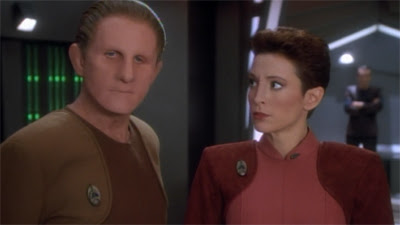
"Necessary Evil" focuses on the past between Odo and Kira.
 

The story opens in the present, when Quark is hired to retrieve a hidden, valuable item for an attractive Bajoran widow. Quark then becomes the victim of an attempted murder, and security chief Odo sets about uncovering Quark's assailant. His investigation takes him back to his first case on the station, when the Cardassian Gul Dukat assigned him to solve the murder of the widow's husband, a Bajoran merchant. The lead suspect in that case turned out to be the Bajoran Kira, then newly arrived on the station but now Odo's friend and colleague in the present. As Odo tries to uncover the present crime he begins to understand more about the murder from the past, but his realizations threaten his relationship with Kira.

Unlike Captain Picard in "The Big Goodbye," Odo is an unwitting noir protagonist and utterly unsentimental about the past, whether fictional or real. As an alien shape-shifter with no knowledge of his own home planet or people, Odo is a perfect noir lead - alone, aloof, cynical, and observant by necessity. He provides a classic noir narration of events only because Commander Sisko has asked him to create a record of the investigation. His failure to solve his first case haunts Odo, making him determined to solve not only the present crime but also the original murder. Gul Dukat claims that Odo is an ideal agent of justice in this case because his outsider status makes him neutral to both the occupying Cardassians and the subjugated Bajorans, but that neutrality is as questionable as Gul Dukat's explanation for Odo's assignment. Odo does, however, have a strong and clearly stated interest in justice, which makes him dogged in pursuit of the guilty parties in both the past and the present.

A Ferengi and a femme fatale meet in "Necessary Evil."

The character who most complicates Odo's sense of justice is Kira, the Bajoran woman who arrives at the station just before the original murder and is set up with the hallmarks of noir's good-bad girl and mystery's red herring (see Andrew Spicer's book Film Noir for a discussion of the genre's good-bad girl type). The widow claims that Kira was having an affair with her husband and is thus the obvious suspect, but the present tense crime has already depicted the widow as a classic femme fatale, so we, the audience, don't trust her. Kira denies the affair but eventually confesses to Odo that she is a saboteur for the Bajoran resistance and could not have committed the murder because she was busy causing damage elsewhere at that time. Odo protects Kira from Gul Dukat and leaves the murder unsolved, a situation that drives him all the more when the attack on Quark recalls the earlier crime. Finally, in the present, Kira reveals to Odo that she did, in fact, kill the Bajoran merchant when he discovered her trying to steal the same list of Bajoran collaborators that the widow hires Quark to find. The twist ending reveals Kira to be a better liar, and a less reliable associate, than Odo imagined, and it's not clear if he's more shocked by her duplicity or his own credulity. The episode concludes with the relationship between the two unresolved and the future of their friendship uncertain. It's a very noir ending for the episode even if both of the major characters remain alive and still working on the station afterward.

Everything else about this episode contributes to its noir sensibility. The scenes in the past use dark, blue lighting to cast shadows and uncertainty over the characters, while the other characters around Odo and Kira also fall into classic noir types, including Quark as the petty criminal in over his head and the widow as a beautiful femme fatale, complete with white evening gown and seductive manner. Odo's voice over narration, a staple of the genre, helps us navigate the shifts between past and present, but the two markedly different visual styles make the time periods quite distinct already. Gul Dukat, technically Odo's client in this investigation, has ulterior motives that he does not disclose, and the viewer comes away with the sense that "justice" is really a slippery idea. The smaller problems - who killed the merchant and who attacked Quark - might be solved, but larger and more unsettling questions persist. The episode presents, in abbreviated form, all the characteristics of classic noir, and it never winks or tips its hand about doing it. There's nothing cute about "Necessary Evil," which is part of the reason it's so good.

If you're interested in the particular pleasures of tech noir, check out film-length examples like Blade Runner (1982), Dark City (1998), and Minority Report (2002). If you're a Star Trek fan new to classic noir, start with iconic favorites like The Maltese Falcon (1941), Double Indemnity (1944), and, as my post title suggests, Out of the Past (1947).

Wednesday, March 14, 2018

Classic Films in Focus: DECOY (1946)

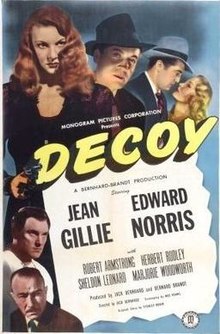
Directed by Jack Bernhard, Decoy (1946) is one of those film noir gems that lacks the glitter of a big budget and A-list stars but nonetheless shines with its own devilish light. Jean Gillie makes her penultimate screen appearance as a femme fatale so fixated on claiming a stolen fortune that she'll literally bring a man back from the dead to get it, with Robert Armstrong, Edward Norris, and Herbert Rudley as the men who will kill and die in service to her schemes. Those who love a twisted tale of murder and greed will relish this dark delight, which begins at the finale and then rewinds to unfold its sordid story. We know from the start that this is going to end badly.

Gillie plays the beautiful but deadly Margot, the girlfriend of death row inmate Frankie Olins (Robert Armstrong). Margot knows that Frankie is sitting on a pile of stolen cash, but she doesn't know where it is, so she arranges for Frankie to be resurrected after his date with the gas chamber. Gangster Jim Vincent (Edward Norris) helps her because he wants to recoup the costs he incurred paying for Frankie's defense, while Dr. Lloyd Craig (Herbert Rudley) is seduced into the plot by Margot's charms. Once Lloyd resuscitates Frankie, avarice drives both Margot and Vincent to extremes, while Lloyd is drawn ever deeper into their crimes.

There's no budget or time for fancy flourishes, but Decoy works with the materials at hand, especially Gillie's mesmerizing performance as one of the coldest, most ruthless dames to grace the noir genre. She doesn't love any of the men she uses; she will happily see every one of them dead twice over if it means the bag of cash belongs to her alone. Plotting to resurrect Frankie just to betray him is mean even for a femme fatale, but Gillie does it with a grim determination that never veers into hysteria or camp. She approaches the elimination of the equally faithless Vincent the same way, running him over with their car and then coolly collecting the tools he had been using to fix a flat tire. Lloyd, horrified into a frozen stupor, can only hiss, "I'd like to kill you," as Margot carries on with her single-minded quest. She finally cracks up when she thinks she has the cash at last, laughing maniacally while Lloyd digs up the box in Frankie's hiding spot. Frankie, however, will have the last laugh, and the ending is a gut punch of irony that knocks the viewer flat.

The film is a pitch black study in the ways a man can be ruined by a woman like Margot, a siren so powerful and deadly that she lures even men who don't trust her to a horrible fate. Frankie is a criminal but not a monster; he adores Margot and wants money only to lavish gifts on his girl, but he's smart enough to take steps against an inevitable betrayal. Vincent is a cold-blooded snake; he clearly means to get the upper hand, but he doesn't realize that Margot is a python in comparison until it's too late. Tragic Lloyd is a good man undone by this serpentine beauty; he loses everything because of Margot until all that's left is a dying wish to take her out with him, which is where the picture begins. The only man who survives contact with Margot is Sgt. Joe Portugal (Sheldon Leonard), a cop with a gangster's face who feels an attraction to Margot even though he knows what she is. "People who use pretty faces like you use yours," he tells her, "don't live very long anyway." The film opens and closes with the fulfillment of his prediction.

Jean Gillie made only one additional film, The Macomber Affair (1947), before her premature death in 1949, but she can be found in earlier pictures like The Gentle Sex (1943) and Flight from Folly (1945). She was married to director Jack Bernhard when Decoy was made, but they divorced in 1947, and Bernhard went on to direct Blonde Ice (1948) and Appointment with Murder (1948). Robert Armstrong is best remembered today for King Kong (1933), and you can also see him in The Most Dangerous Game (1932), Son of Kong (1933), and Mighty Joe Young (1949). Herbert Rudley found success primarily in television, but he makes appearances in Brewster's Millions (1945) and Rhapsody in Blue (1945), while Sheldon Leonard earned numerous Emmy nominations and two wins for his work behind the camera on Make Room for Daddy (1953-1964). You might also recognize Leonard as Nick the bartender in It's a Wonderful Life (1946) and Harry the Horse in Guys and Dolls (1955).