Showing posts with label thriller. Show all posts

Wednesday, January 29, 2025

Classic Films in Focus: ROPE (1948)

Rope (1948), Alfred Hitchcock's first color picture, is a twisting, carefully orchestrated thriller with a deceptively simple title, one that is as much about the killers as the murder weapon they wield in the film's opening shot. There's no air of mystery hovering over the claustrophobic confines of the single room where the action unfolds; instead, this story revels in the audience's full knowledge of the crime, tormenting us with information we possess but cannot share with the party guests drinking their champagne over the corpse of their murdered loved one. The film's gruesome appeal depends mainly on its theatrical visual style and the tightly wound performances of John Dall and Farley Granger as the handsome young killers, although James Stewart gets top billing as their former mentor and increasingly suspicious house guest.

The story opens with Brandon (John Dall) and Phillip (Farley Granger) strangling their classmate David (Dick Hogan) and then hiding his body in a large trunk in the middle of their living room. Eager to prove their intellectual superiority and gloat over the crime, Brandon insists on hosting a party immediately following the murder, with David's friends and family in attendance. David's father, Mr. Kentley (Cedric Hardwicke), and girlfriend Janet (Joan Chandler) grow uneasy over David's uncharacteristic absence, but only the boys' old house master begins to grasp the horrible truth.

Dall and Granger work the queer subtext of their relationship with tremendous skill, with Dall's Brandon very clearly the leader of the couple and Phillip only slowly coming to realize the nature of the monster he loves and obeys. Does Brandon love Phillip in return? Is Brandon capable of such a human emotion? Both actors are fascinating to watch as they reveal their characters' psychological states. The subtext implies that Brandon also has a particular connection to Rupert Cadell, presumably romantic in nature, but here the casting of James Stewart throws a spanner into the works. I've always felt Stewart to be miscast in the role, and that continues to be my view after my most recent return to the movie. Hitchcock's later collaborations with Stewart brilliantly evoke the actor's capacity for darkness, but this first outing shows the limits of Stewart's ability. Even Stewart felt he was out of place in the part, although he said he didn't think he was credible as an academic, not that he couldn't imagine himself as a closeted gay man who had indulged in a romantic tryst with one of his students. I think that an actor like George Sanders, Claude Rains, James Mason, or Cary Grant (who was Hitchcock's first choice for the role) would have made a more interesting and believable Rupert, but the role certainly had an impact on Stewart's later career. For more observations on that topic, read Chloe Walker's 2023 Paste article,  "Rope Was a Cruel, Prickly Turning Point in Jimmy Stewart's Career."

The single set and real-time pacing of the picture are the other noteworthy elements for discussion, with long takes that heighten the feeling of watching a stage play rather than a movie. These techniques intentionally make us feel trapped in the room; we can't get away from the chest and its terrible contents, and neither can Brandon and Phillip, as much as they might talk about their plans to leave town as soon as the party ends. Psychologically, neither of them will ever be able to leave that room, and when the truth comes out the other party guests will forever be haunted by it, as well. We might think, at the beginning, that the murder is the worst possible moment, but for everyone except David it's the aftermath that really turns the screws. Every time Phillip sees the rope again he comes a bit more unglued, but Brandon can't resist the urge to flaunt their crime, practically daring Rupert to confront them. Each reappearance of the rope symbolizes another bit of the crime being let out, until the murderers finally offer enough to hang themselves. It's both terrible and fascinating to watch, thrilling even though so little actually happens onscreen.

Hitchcock's later work with James Stewart in Rear Window (1954), The Man Who Knew Too Much (1956), and Vertigo (1958) would give the actor some of the most iconic roles of his long career, and Farley Granger also gets another outstanding role from Hitchcock in Strangers on a Train (1951). John Dall is particularly remembered as half of another murderous couple in Gun Crazy (1950), although his screen debut in The Corn is Green (1945) earned him an Oscar nomination for Best Supporting Actor. If you enjoy the limitations of the single set approach, be sure to see Hitchcock's earlier film, Lifeboat (1944), which traps all of its characters at sea in a small, cramped boat.

Monday, January 27, 2025

Book Review: THE HITCHCOCK HOTEL (2024)

I recently devoured Stephanie Wrobel's new mystery novel, The Hitchcock Hotel, and, as its name implies, this is a fantastic book for fans of Alfred Hitchcock's films. I picked up the ebook based solely on its title and promo blurb, not having read anything by Wrobel before, and I was hooked as soon as I started reading. In addition to the titular hotel and its macabre collection of Hitchcock memorabilia, the novel features plenty of homages to the iconic auteur and his work, particularly Rope (1948), Vertigo (1958), Psycho (1960), and The Birds (1963). If you're looking for a twisty, character-driven thriller tailored to the tastes of classic movie fans, The Hitchcock Hotel should be your next read.

The novel alternates third-person perspectives between a group of former college friends reunited for a weekend at the Hitchcock themed hotel recently opened by Alfred Smettle, who was part of the tight-knit gang in school until a shocking event senior year tore them apart. More than fifteen years later, Alfred still blames his old friends for the downward turn of his life, and he envisions the weekend get-together as a way to settle some scores with the assistance of his elderly housekeeper, Danny, while also drumming up publicity for the hotel. Attending the gathering are overachiever Grace, alcoholic Zoe, peacemaker Samira, rich playboy Julius, and secretive bodyguard TJ, all of them nursing their own guilt and resentment. When old wounds are re-opened and old sins resurrected, the weekend goes violently awry.

I came for the Hitchcock connections, of course, and on that front I was not disappointed, from the aviary full of crows to the hotel decor and the way the plot wove through the plots of the films, especially the less familiar Rope. (If you haven't seen Rope before, watching it prior to reading the book will enhance your appreciation, but it's not absolutely necessary). A repeated tribute to Suspicion (1941) was also great fun, as was the creepy evocation of Norman Bates in Alfred's relationship with his late mother. Wrobel plays with favorite Hitchcockian themes like paranoia, surveillance, sexual frustration, revenge, and obsession, with particular emphasis on the idea of the perfect murder as presented in Rope, Shadow of a Doubt (1943), and Strangers on a Train (1951). Reading the book reminded me of the delicious thrills of the films and made me want to revisit them, which I hope to do over the next several weeks.

Beyond the classic movie angle, however, I very much enjoyed the novel's exploration of the way time changes friendships and even forces people to question why they forged those relationships in the first place. The friend group in this story has not really kept in touch since graduation, and they mostly only know about each other's lives through their social media feeds, but when they reunite they quickly fall back into their old patterns of behavior with one another. Some of them harbor resentments, while others yearn for a return to the camaraderie they believe they shared in their youth. I'm still in regular communication with my group of college friends from 30 years ago, but it's not the same as it was in our school days, when we ate and lived and studied together. In the novel, dark secrets cloud the friends' reunion, but their nostalgia for their shared youth feels terribly familiar to me. I still think fondly of days spend reading Shakespeare on the quad and nights in the secret garden behind the library that we claimed as our private gathering space. Of course, as far as I know, none of us has ever been involved in a murder, but we did once end up in traffic court.

The Hitchcock Hotel is Stephanie Wrobel's third novel, following her debut, Darling Rose Gold (2020), and This Might Hurt (2022). You can learn more about her at her website. For more mystery novels with a classic movie connection, I recommend the Toby Peters series by Stuart M. Kaminsky, but if you like books that really play with a particular classic celebrity's legacy, you can revel in the love for Vincent Price that haunts Kate Racculia's 2019 novel, Tuesday Mooney Talks to Ghosts.


Looking for full reviews of Hitchcock's films? Here are a few!


STRANGERS ON A TRAIN (1951)

STAGE FRIGHT (1950)

SHADOW OF A DOUBT (1943)

PSYCHO (1960)

VERTIGO (1958)

SUSPICION (1941)

Thursday, February 8, 2024

Classic Films in Focus: MY NAME IS JULIA ROSS (1945)

Director Joseph H. Lewis is best remembered today for his influential noir classic, Gun Crazy (1950), but he also brings great tension to My Name is Julia Ross (1945), an atmospheric thriller from Columbia Pictures that stars Nina Foch as the titular heroine. Despite its modern day setting, Julia's story revels in Gothic trappings, with an imprisoned and imperiled protagonist who endures extreme gaslighting at the hands of her kidnappers. Fans of Gaslight (either the 1940 or the 1944 version) and more traditional Gothic fare will find a lot to appreciate in this tight, well-acted production, including especially sinister performances from Dame May Whitty and a barely restrained George Macready.

Foch plays the penniless but determined Julia Ross, who lands a seemingly perfect job as the live-in secretary of wealthy Mrs. Hughes (May Whitty). Julia is too relieved to worry at questions about her being absolutely without friends or family, but she realizes the awful truth when she awakens from a drugged slumber to find herself transported to Cornwall and declared to be the mentally ill wife of Ralph Hughes (George Macready). Luckily, Julia's aspiring love interest, Dennis (Roland Varno), is searching for her while Julia repeatedly tries to escape before Ralph and his mother can carry out their nefarious plans.

The success of the whole picture depends on its heroine, and Nina Foch makes Julia active and appealing in spite of her damsel in distress situation. Foch's long career included a Best Supporting Actress Oscar nomination for her role in Executive Suite (1954), but she never became a top star, which seems a shame considering her energetic performance here. Foch is beautiful in a wide-eyed but spirited way, definitely not the kind of girl to surrender meekly to villainous schemes, no matter how many times the Hughes family tries to convince Julia that she's Marion Hughes. Our heroine might be naive enough to jump at the sudden job offer, but she's never passive or resigned to her fate. Ironically, Julia's constant efforts to escape and tell someone about her situation only support the Hughes' claim that she's insane, but Julia manages to outsmart them enough to get a letter out to Dennis. Part of the fun of the movie lies in waiting to see what Julia will try next, whether she's hiding in cars, looking for secret passages, or pretending that she really believes she might be Marion Hughes.

Most of the other important characters present threats to Julia's well-being, and each is interesting in his or her own fashion. Julia's chief antagonist is the unflappable Mrs. Hughes, played with sly menace by Dame May Whitty. Whitty is a fun choice for the role because she doesn't seem like a villain even when she's blatantly plotting Julia's demise. The mother provides a stark contrast to the psychopath son, Ralph, who has already murdered the original Marion and clearly yearns to kill again. Only Mrs. Hughes can control him, and one wonders how long that can last, given the number of sharp objects she has to confiscate from Ralph over the course of the picture. The criminal pair have ample assistance from their most trusted servants, especially Sparkes (Anita Bolster), who poses as the employment agent and ensures that the newer servants spread gossip about "Marion Hughes" being insane. She's a great example of the sinister housekeeper so quintessential in the Gothic genre, and Bolster has a perfect face for the role.

My only real complaint about My Name is Julia Ross relates to the abrupt and overly tidy ending, which turns a blind eye to the extremity of Julia's ordeal. Compare that with the endings of Gaslight or Notorious (1946), in which the heroines are clearly going to need to work through some heavy post-traumatic stress. For more of the lovely Nina Foch, see The Return of the Vampire (1943), in which Roland Varno also plays her love interest, An American in Paris (1951), or Illegal (1955). She also appears in both The Ten Commandments (1956) and Spartacus (1960). Dame May Whitty earned Best Supporting Actress Oscar nominations for Night Must Fall (1937) and Mrs. Miniver (1942), but she has memorable roles in The Lady Vanishes (1938), Suspicion (1941), and Gaslight (1944). Don't miss George Macready in Gilda (1946), which is probably his most important film.

Friday, September 1, 2023

Gaslight Noir on the Criterion Channel

While many of the Criterion Channel's featured categories highlight newer or international films, the lineup for September 2023 also includes one of my favorite classic sub-genres, "Gaslight Noir." If you love films like Gaslight (whether the 1940 or 1944 version), this is a collection sure to send delicious chills up and down your corseted spine.


Most of the iconic noir classics take place in their own present day, usually the 1940s and 1950s, but gaslight noir sets the action in an earlier age, usually the 19th century and often in London or elsewhere in the UK or Europe, although looming manor houses in America can also provide a suitably sinister location. The protagonist is most often a young woman who is both victim and de facto detective, striving to solve a mystery before she meets a tragic end. The films provide a heady mix of Gothic sensibility, noir style, and romance, and many of them appeared in the wake of the success of Hitchcock's Rebecca (1940) and the 1943 adaptation of Jane Eyre, the Gothic masterpiece that Daphne du Maurier's original novel of Rebecca uses as a thematic touchstone. 

Here is the full list of films available this month on the Criterion Channel as part of the Gaslight Noir collection (use the links to read my discussions of these films):

Ladies in Retirement (1941)

Gaslight (1944)

The Suspect (1944)

Experiment Perilous (1944)

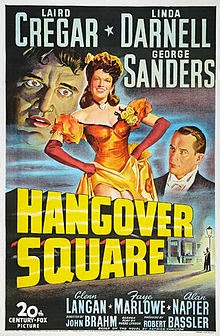
Hangover Square (1945)

Dragonwyck (1946)

Ivy (1947)

Moss Rose (1947)

Blanche Fury (1948)

Corridor of Mirrors (1948)

So Evil My Love (1948)

Madeleine (1950)

So Long at the Fair (1950) 

While I've seen and written about several of these films, quite a few are new to me, and I'm really looking forward to watching them. I hope to add several new Classic Films in Focus posts about these movies in the coming weeks.

For more in-depth discussions of the Gothic tradition in film, check out my essays:

"Consuming Passions: Gothic Romance and the Bronte Sisters"

"The Housekeeper in the Gothic Film Tradition"

Monday, February 20, 2023

Classic Films in Focus: THE QUEEN OF SPADES (1949)

Once considered lost, The Queen of Spades (1949) is an example of buried cinematic treasure that was luckily rediscovered so that we can enjoy it again today, an ironic twist since it's a tale about the fickle turns of Fortune's wheel. The plot comes from a short story of the same name by Alexander Pushkin, which explains its Russian setting and Romantic bent, but the movie is a British production directed by Thorold Dickinson, with Anton Walbrook, Edith Evans, and Yvonne Mitchell in its most significant roles. A meticulous 4K restoration by Studiocanal means that modern viewers can enjoy The Queen of Spades in all her baroque glory, and it really is a stunning picture, with a moody atmosphere reminiscent of Val Lewton and a delirious mix of romance, menace, and supernatural chills.

Anton Walbrook stars as Herman Suvorin, an officer in the Russian army who envies the wealth and good fortune of his nobler and more successful peers. When he hears the story of a beautiful countess who sold her soul for the secret of winning at cards, he sets out to learn it from her by first seducing her lonely young companion, Lizaveta (Yvonne Mitchell). Soon Suvorin comes face to face with the now ancient Countess (Edith Evans), but his meeting with her does not go as planned, and his manipulation of Lizaveta rouses the resentment of her honest admirer, Andrei (Ronald Howard).

The horror element of The Queen of Spades relies more on Gothic ambience than overt terrors, but it's always there, pulsing in the undercurrent of the narrative and rising with Suvorin's paranoia in the third act, when he might or might not be experiencing supernatural encounters. We're introduced early to the idea that malevolent forces are at work in this world, as we hear the story of Countess Ranevskaya and her desperate bargain to regain a fortune stolen from her by a secret lover. Faustian deals with the devil, wax figures containing lost souls, and unseen horrors prime our imaginations for the unfolding tale of Suvorin's obsession. The resulting narrative exists somewhere between the Lewton oeuvre and classic thrillers like Gaslight (the British 1940 version was also directed by Dickinson and stars Anton Walbrook). The reality of the supernatural is up for debate, especially where the final climactic scene is concerned, but there's a fantastic turn of the screw quality to Suvorin's increasing hysteria, and if anyone deserves to be haunted he's top of the list. Fans of the 1961 anthology film, Black Sabbath, might appreciate the parallels between the haunting scenes and those found in the segment titled "The Drop of Water," although Mario Bava's movie provides more lurid terrors for the guilty protagonist.

Elegant performances help to elevate The Queen of Spades and complement its gorgeous period settings, with Walbrook especially compelling as the ambitious Suvorin. He opens the picture tightly controlled and standoffish, and it's enthralling to watch him succumb to his envy, avarice, and guilt as he worms his way into the presence of the elderly Countess. Dame Edith Evans, looking about a hundred years old and outfitted in full 18th-century finery with a stupendous wig, still manages to be shrewish, funny, pathetic, and terrible by turns. Neither she nor Suvorin is a good person, but both retain degrees of humanity and frailty that excite some sympathy from the viewer, especially because Lizaveta feels pity for both of them. Yvonne Mitchell invests Lizaveta with moving Gothic sensibility; as a paid companion she's very similar to a governess, inhabiting an uneasy liminal space between servant and family member, but she burns with longing and a desire to be loved. The film's brilliant visual metaphors make it clear that Suvorin means to trap Lizaveta in his web of lies, but she attracts a nobler suitor in handsome Andrei, played to great effect by Leslie Howard's son, Ronald. 

Arresting cinematography by Otto Heller also makes this picture a gem. It's a stunning feast for the eyes, making the most of the gorgeous costumes and elaborately decorated sets created by Oliver Messel. Memorable moments abound: we see the young Countess hurrying down a secret passage, Suvorin waiting in the snow at night, and a beautiful dancer entertaining the amorous officers. Most of the central characters are shown in mirrors at various times, confronting themselves, reflecting themselves, or revealing their natures to the viewer, and the scenes in which we see one character directly and another in reflection are particularly striking and well shot. The long awaited confrontation between Suvorin and the Countess is absolutely riveting, thanks to the performances of the actors and the ways in which the camera frames them.


For more of director Thorold Dickinson and Anton Walbrook, start with the 1940 Gaslight, which some consider superior to the 1944 Hollywood version. Walbrook's other British films include 49th Parallel (1941), The Life and Death of Colonel Blimp (1943), and The Red Shoes (1948). Edith Evans earned Oscar nominations for her performances in Tom Jones (1963), The Chalk Garden (1964), and The Whisperers (1967), but don't miss her as Lady Bracknell in The Importance of Being Earnest (1952). Yvonne Mitchell, who made her screen debut in The Queen of Spades, can also be found in The Divided Heart (1954), Woman in a Dressing Gown (1957), and Sapphire (1959). For an eerie period double feature, try pairing The Queen of Spades with Bedlam (1946), or follow up with Gothic thrillers like The Uninvited (1944), The Spiral Staircase (1946), and Dragonwyck (1946).

The Queen of Spades is available on Blu-ray and DVD; the new Studiocanal restoration is region specific, but a 2019 version with some extras is available on Amazon from Kino Lorber.  You can also find it streaming on the horror subscription channel Shudder as of February 2023.

Tuesday, February 12, 2019

Classic Films in Focus: DARK WATERS (1944)

Somewhere between Lifeboat (1944) and Gaslight (1944) lies the plot of Dark Waters (1944), in which Merle Oberon stars as the survivor of a U-boat attack whose fragile sanity is tested by a collection of nefarious characters. All three pictures appeared in the same year, but the first two are decidedly better films, while Dark Waters holds interest primarily for its cast. Joining Oberon for this wartime swamp Gothic are Franchot Tone, Thomas Mitchell, Elisha Cook, Jr., and Fay Bainter, with Rex Ingram making sporadic but memorable appearances as a former employee who suspects that something is amiss at the old plantation. Dark Waters fails to deliver enough creepy atmosphere to achieve its Gothic ambitions, and the ending is more a hard stop than a proper conclusion, but Oberon is fascinating to watch as she tries to figure out whether she's going or being driven insane.

Oberon's perpetually imperiled heroine is Leslie Calvin, whose family flees the Japanese descent on Batavia (present day Jakarta) only to fall victim to a German U-boat attack at sea. Leslie survives many days in an open boat before ending up in a New Orleans hospital. After months of convalescence she travels to a nearby plantation owned by her aunt and uncle, where she hopes to recover from her post traumatic stress. She meets a handsome doctor (Franchot Tone), who quickly falls for her, but everything else goes awry as she is constantly exposed to situations that recall her ordeal and unsettle her sense of reality. Leslie begins to suspect that the manipulative Mr. Sydney (Thomas Mitchell) and his sidekick, Cleeve (Elisha Cook, Jr.), are tormenting her on purpose, but to what end?

Gothic mystery is a fine setting for Oberon's exotic beauty, but she gets better material to work with in both Wuthering Heights (1939) and The Lodger (1944), where her characters have more energy and more successfully developed plots. Franchot Tone's country doctor, George, doesn't spark much chemistry, but he seems to be the only available man in the area aside from Elisha Cook Jr.'s creepy Cleeve. It doesn't take two minutes to recognize both Cleeve and Sydney as the villains of this piece, and Thomas Mitchell has a handful of effectively menacing scenes, but Fay Bainter's Aunt Emily is neither disturbing nor reassuring, and it's hard to justify John Qualen's presence as Uncle Norbert, since he barely comes out of his room to utter a few lines at dinner. Fine actors inhabiting the background don't get enough to do, either, especially Rex Ingram and Odette Myrtil, who turns up as the mother of a large, friendly Cajun family.

There's enough potential in Dark Waters to see the movie it could be, and that warrants a viewing, especially for contrast with moodier explorations of similar plots and atmospheres. The Louisiana bayou makes an evocative setting, and the premise of Leslie's very justified anxiety about water and boats creates numerous opportunities for her to be tormented. We know from the beginning where the third act of this story will inevitably end (hence the title), but when the film finally reaches that point it seems in a hurry to wrap things up, and quite a few loose ends are left dangling. The pacing is more of a shock because there had apparently been plenty of time to linger on an earlier fais do-do sequence that adds nothing to the story. It's hard to say if director Andre De Toth or the writers are to blame for these issues, but De Toth certainly made tighter pictures over the course of his career.

Do pause a moment to appreciate the underused Nina Mae McKinney as the housemaid, Florella, who unfortunately disappears from the picture in the third act. For more of Merle Oberon, try The Private Life of Henry VIII (1933), The Scarlet Pimpernel (1934), or That Uncertain Feeling (1941). See earlier roles for Franchot Tone in Bombshell (1933), Dancing Lady (1933), and Dangerous (1935). Thomas Mitchell is best remembered for more sympathetic characters in Stagecoach (1939), Gone with the Wind (1939), and It's a Wonderful Life (1946), while Elisha Cook, Jr. offers more of his usual type in The Maltese Falcon (1941), I Wake Up Screaming (1941), and The Killing (1956). For a more thoughtful and provocative treatment of a similar atmosphere, try I Walked with a Zombie (1943), or, for some really excessive gaslighting bayou horror, go for Hush... Hush, Sweet Charlotte (1964).


* As of February 2019, DARK WATERS is available for streaming on Amazon Prime, but the print is rather muddy, especially in the outdoor night sequences.

Monday, July 24, 2017

Classic Films in Focus: THE TWO MRS. CARROLLS (1947)

Director Peter Godfrey's modern Gothic offers two iconic stars - Humphrey Bogart and Barbara Stanwyck - as its leads, which is reason enough to see The Two Mrs. Carrolls (1947) in spite of its flaws. Bogart, who played heavies off and on throughout his career, is back on the dark side as a painter who finds artistic inspiration by murdering his wives, while Stanwyck is unusually naive as his current wife and next intended victim. Supporting performers include Nigel Bruce as an atrociously incompetent doctor and Ann Carter as Bogart's beguiling daughter, while Alexis Smith is particularly memorable as a predatory seductress who might be getting more than she expects by tempting Bogart's unhinged artist to leave his wife for her. Bogart, Stanwyck, and Smith all give fine performances, but the film suffers from a lack of suspense that undermines its chilling premise.

Stanwyck plays Sally, who becomes the second wife of painter Geoffrey Carroll (Bogart) after his first wife dies. Sally doesn't suspect that her predecessor's demise was murder, and Geoffrey goes to great lengths to hide his crimes even as he contemplates a second disposal to make way for wife number three. Goaded by the offers of the beautiful Cecily (Alexis Smith), Geoffrey intends to make Sally another victim of his maniacal need for a new muse to drive his work. Geoffrey's young daughter, Bea (Ann Carter), eventually reveals some of his secrets, and Sally realizes the truth about her husband, but her revelation might come too late to save her from his murderous schemes.

The two leads are the chief attraction here, though both are somewhat out of their element. Humphrey Bogart never looks like an artist, but he does make for a credible killer, and it's great fun to watch his Geoffrey come unhinged whenever his secrets are threatened. By the end of the film he has gone right off the rails, justifying his actions with a horrifically sexist assertion that his art is more important than any woman's life. The simmering intensity that Bogart exemplifies works well for dangerous, unstable characters, and his performance here provides a parallel to his more celebrated work in The Petrified Forest (1936), The Treasure of the Sierra Madre (1948), In a Lonely Place (1950), and The Caine Mutiny (1954). Stanwyck, normally a tough cookie and occasionally up for murder herself, here has an ingenue's role, and one of the film's frustrations is that we expect a Stanwyck character to be smarter. Stanwyck plays Sally as loyal, kind, and unsuspecting, which is what the role seems to demand of her, but it's not as good a part as the actress deserves, and Alexis Smith has the meatier role as the scheming Cecily. Stanwyck would get a much better chance to play an imperiled wife in the 1948 film, Sorry, Wrong Number, showing what she could do with a part more suited to her talent.

While the casting issues cause some obvious problems, the chief complaint about The Two Mrs. Carrolls is its inability to generate suspense. The film shows us up front that Geoffrey murders his first wife, creating dramatic irony for the audience as we wait for Sally to catch up. This approach can work well in a narrative, depending on how the unfolding events are handled as the protagonist learns the truth, but Sally stays in the dark so long that we wonder if she's paying attention. When she does finally figure it out there's a flood of information dumped into the last act so rapidly that we don't have time to savor Sally's discoveries. Even the reveal of the gruesome portrait of Sally as an Angel of Death - which ought to be a major moment - seems rushed. We see it briefly and then it's gone as Sally rushes on to the next piece of evidence. Great Gothic thrillers, whether literary or cinematic, use the slow build of rising suspicion and horror to drive the plot and the heroine forward to the inevitable confrontation with the villain. One has only to compare this movie's poisoned milk scenes with the one in Suspicion (1941) to see how differently a really suspenseful film handles the same concept. The 1940s, in fact, saw a host of excellent Gothic thrillers appear in the wake of Rebecca (1940) and the Jane Eyre inspired boom that followed, and it's a shame that The Two Mrs. Carrolls falls short in comparison with its sister films.

In spite of its failures, classic movie buffs will want to see The Two Mrs. Carrolls because it's the only picture to pair Bogart and Stanwyck. It's also worth seeing for fans of Ann Carter, the child star who so memorably plays the young protagonist of The Curse of the Cat People (1944). Peter Godfrey directs Alexis Smith again in The Woman in White (1948), which continues the Gothic trend, as does Cry Wolf (1947), which has Godfrey directing again for Stanwyck. For more of Smith and Bogart in a tale of murderous marriage, try Conflict (1945). Most of the Warner Bros. films are available as DVD on demand from the Warner Archive, including The Two Mrs. Carrolls.

Wednesday, September 21, 2016

Classic Films in Focus: OBSESSION (1949)

Released in the United States as The Hidden Room, Edward Dmytryk's Obsession (1949) is an unusual little gem of a thriller, a strangely polite and very English story of murder, jealousy, and revenge. It makes the most of its cast and its setting to craft a thoughtful tale of suspense that never becomes showy or overdone, with especially effective use of Robert Newton and post-war London. In fact, Obsession would probably have enjoyed enduring fame had it featured bigger stars or a different director, but don't let its obscurity dissuade you from spending some time with this unique film.

Robert Newton leads as psychiatrist Clive Riordan, who gets fed up with his wife's affairs and decides to murder the next man she takes on as a lover. Unfortunately for American Bill Kronin (Phil Brown), he happens to be the next man, and Clive soon has him imprisoned in a hidden room beneath a bomb damaged area of London. Clive's wife, Storm (Sally Gray), suspects that Clive has murdered Bill but can't prove anything to the police, while Clive keeps Bill alive as long as there's a chance that Scotland Yard might deduce his role in making Bill disappear. Bill, meanwhile, suffers loneliness and anxiety in his secret prison, even as he hopes that Clive's murderous plans will ultimately fall through.

The consequences and cultural shifts that followed World War II shape the subtext of the film and make it much more sophisticated than a simple murder plot. Like The Third Man (1949), Obsession takes advantage of the ruined landscapes of post-war Europe; Clive's plot hinges on the availability of abandoned and damaged buildings in which to hide his prisoner. The film also captures a strong feeling of English resentment toward American usurpation as a result of the war; not only is Bill poaching Clive's wife, but there are American sailors lolling in the streets, and at Clive's club the conversation inevitably turns to the strange colonials and their omnipotent dollars. Bill, the interloping young American, embodies all that Clive and his peers abhor about the new order of the world, but the American influence proves inescapable, even to the indubitably English Clive.

It's easy to imagine more illustrious stars in the roles, but each actor in the film delivers a compelling performance. Newton, a character actor best remembered as Long John Silver in Treasure Island (1950), here plays a role that would have perfectly suited Claude Rains, but Newton does such a good job that Rains' absence cannot be lamented. Newton keeps Clive in a low register throughout, so that he always seems like a perfectly reasonable human being who just happens to be dead set on murdering his wife's lover. His lethal plans aren't personal as far as Bill is concerned; in fact, he's unfailingly polite to his intended victim, even when Bill cracks under stress. With his slight build, all-American persona, and casual amiability, Phil Brown might be a stand-in for Henry Fonda as Bill, whose inherent decency becomes more apparent after he pays for his caddish dalliance with another man's wife, especially when he rescues Clive's persistent little dog, Monty, from becoming a test subject for Clive's acid bath. The beautiful but unfaithful Storm might have been played by any of the classic Hitchcock blondes, but Sally Gray has the perfect jaw and disdainful gaze to convey Storm's essential nature. Naunton Wayne arrives late in the picture as the Scotland Yard superintendent, Finsbury, but he adds another aspect of the English character to the proceedings as he corners Clive through a series of seemingly harmless exchanges. One can imagine Cecil Kellaway in the part, but Wayne is precisely right for it himself, and to English audiences he would have been quite recognizable from his appearances as the comical Caldicott in previous films.

Edward Dmytryk's directorial career suffered after he was caught up in the anti-Communist hearings of the late 1940s, but for more of his work see Murder, My Sweet (1944), Crossfire (1947), and The Caine Mutiny (1954). In addition to his appearances as Long John Silver in two films and a television series, Robert Newton can be found in This Happy Breed (1944), Oliver Twist (1948), and The Desert Rats (1953). Naunton Wayne turns up as Caldicott in both The Lady Vanishes (1938) and Night Train to Munich (1940), while Sally Gray appears in Green for Danger (1947). You might not recognize Bill Kronin as a young man, but you've certainly seen him; he had in small parts in The Pink Panther Strikes Again (1976) and Superman (1978) but gained a measure of movie immortality as Luke's Uncle Owen in Star Wars: A New Hope (1977).


Tuesday, July 12, 2016

Classic Films in Focus: STAGE FRIGHT (1950)

Released just before the wildly successful Strangers on a Train (1951), Stage Fright (1950) ranks among the minor entries in the Alfred Hitchcock canon. It lacks the screw tightening suspense of the best of the director's pictures, and its humor, while engaging, never reaches that pitch black, twisted level that fans adore in the most iconic Hitchcock films. That said, Stage Fright offers an assortment of entertaining performances from its cast, especially a collection of delightful character actors in supporting roles. Jane Wyman and Marlene Dietrich carry the lightweight murder plot, such as it is, but the scene stealers here are Alastair Sim, Sybil Thorndike, Kay Walsh, and Joyce Grenfell, each playing the sort of offbeat character you'll remember long after you forget the details of the fuzzy central narrative.

The film opens with aspiring actress Eve Gill (Jane Wyman) trying to help Jonathan Cooper (Richard Todd) escape a murder charge that he claims to have gotten mixed up in on behalf of the seductive stage star Charlotte Inwood (Marlene Dietrich). Charlotte's husband has been killed, with Cooper spotted leaving the scene by Charlotte's maid, Nellie (Kay Walsh). Eve enlists her father, Commodore Gill (Alastair Sim), as a confederate in hiding Cooper from the police, including the charming Detective Smith (Michael Wilding), for whom Eve rapidly develops some very inconvenient feelings. Determined to expose Charlotte as the real killer, Eve disguises herself as a mousy dresser named Doris, but her efforts are complicated by the constant appearance of people who know her as Eve.

Several elements make this movie a less than successful Hitchcock production. The most glaring is the flashback used at the beginning to create a set of expectations for both Eve and the audience. There's something not quite right about it, as later events prove. There's also not much suspense in the way that the action unfolds. Eve's deceptions provide plenty of comedy, but it's more straightforward than perverse, and she never encounters any seriously dangerous situations until the very end of the film. Contrast the pacing and mood here with those in Shadow of a Doubt (1943), for instance, and it's easy to see that Stage Fright wanders a bit and lacks real teeth as a proper thriller. More might be made of the uncertainty the audience feels about Cooper, who exploits Eve's unrequited affection to save his own neck, but Richard Todd's perfectly acceptable performance is overshadowed by the livelier character actors and the very engaging Dietrich, who makes a far more interesting murder suspect as the selfish, glamorous star.

What it lacks in suspense and narrative thrust, Stage Fright makes up for in the little things, and it's still a movie worth seeing if you're a fan of English character actors. Alastair Sim and Sybil Thorndike are delightful as Eve's eccentric, estranged parents, with Sim getting an especially juicy role. The scene in which Cooper asks to spend the night at Eve's home gives the pair a great scene together; watch their expressions and body language as they discuss where everyone is going to sleep. Kay Walsh is pricklier but no less engaging as the scheming dresser, Nellie, who lets Eve bribe her and then demands blackmail money to continue their ruse. She and Sim get big laughs when he brings the required funds to the garden party but fails to recognize their intended recipient. Joyce Grenfell, billed in the credits as "Lovely Ducks," has only one scene, but it's a corker, a sublime example of feminine physical comedy. Just watch how she fumbles and chatters her way through an attempt to load the Commodore's gun. Speaking of characters with limited scenes, be sure to note the director's daughter, Patricia Hitchcock, as Chubby Bannister, one of Eve's friends from the drama school.

With its English setting and characters, Stage Fright hearkens back to the films Hitchcock made before his move to Hollywood. Try The 39 Steps (1935) and The Lady Vanishes (1938) for a sense of that phase of the director's career. Jane Wyman won the Oscar for Best Actress for Johnny Belinda (1948); you'll also find her in The Yearling (1946), The Glass Menagerie (1950), and Magnificent Obsession (1954). Marlene Dietrich's other films from the 1950s include Rancho Notorious (1952), Witness for the Prosecution (1957), and Touch of Evil (1958). Catch Michael Wilding in Torch Song (1953), and see Richard Todd take a more saintly turn in A Man Called Peter (1955). Although he appeared in more than fifty films, including Green for Danger (1947), An Inspector Calls (1954), and School for Scoundrels (1960), Alastair Sim is best remembered today for his performance as Ebenezer Scrooge in the 1951 adaptation of A Christmas Carol.

Tuesday, May 17, 2016

Classic Films in Focus: STRANGERS ON A TRAIN (1951)

Strangers on a Train (1951) brought Alfred Hitchcock back to box office success after the lull that followed Notorious (1946), and today it remains a favorite with the auteur's fans. Hitchcock presents a deliciously twisted thriller in this tale of murder and blackmail, with Farley Granger returning after his performance in Rope (1948) for a second outing with the director, but it's the creepy appeal of Robert Walker that makes Strangers on a Train such a macabre delight. There's nary a blonde in sight, but Ruth Roman, Laura Elliott, and Hitchcock's daughter, Patricia, all give memorable performances as the younger women, while Marion Lorne and Norma Varden provide some delightful comic relief in their smaller roles.


Granger plays tennis star Guy Haines, who meets a fan named Bruno Antony (Robert Walker) while on a train. Bruno knows all about Guy and his personal problems, especially that Guy can't be with his new love, Anne (Ruth Roman), until his wife (Laura Elliott, aka Kasey Rogers) gives him a divorce. Bruno proposes to kill Guy's wife while Guy kills Bruno's hated father, but Guy doesn't take him seriously until it's too late. When Guy refuses to commit Bruno's murder in return, Bruno sets out to frame Guy for his wife's death, forcing Guy to dodge the police and resort to drastic measures.

Like a lot of Hitchcock's protagonists, Granger's Guy quickly finds himself deep in a situation beyond his control, and the stress pushes him outside the comfortable norms of polite behavior. He becomes secretive, driven, and tense, but we get hints of his inherent darkness early on, when he argues with his faithless wife and then tells his girlfriend that he could strangle the uncooperative woman. Guy never seems especially upset that his wife is dead, just unhappy that he's the most obvious suspect. Granger is solid in the role, but the real star of the picture is Walker, whose talkative, unstable Bruno drives the action throughout. He's a weirdly likable killer, devoted to his mother and rather desperate for Guy's approval, and he's shaken enough by the act of murder to develop a kind of PTSD in response to it. Bruno's scenes with his mother and Mrs. Cunningham, played by Marion Lorne and Norma Varden respectively, show his ability to endear himself to older women through his "naughty" sense of mischief; in some ways he's the opposite of Joseph Cotten's homicidal Uncle Charlie in Shadow of a Doubt (1942). The role ought to have been a comeback moment for Walker, who had struggled with alcoholism after being left by his wife, Jennifer Jones, but the actor died tragically just months after finishing the film.

Hitchcock engages in his usual visual tricks to crank up the suspense, and the amusement park setting of the murder gives him with plenty of striking images to use. Bruno pursues Miriam Haines through the Tunnel of Love in a boat named for Pluto, the god of the underworld; she constantly looks back at him as she romps through the carnival, never recognizing her seeming admirer as a figure of Death. We see Miriam strangled in the reflection of her own glasses, and afterward the glasses worn by Barbara (Patricia Hitchcock) cause Bruno to relive the murder, complete with echoing carnival music and a spinning sense of vertigo. A thoughtful viewer might pause a moment to wonder why Hitchcock would cast his own daughter as someone the antagonist wants to strangle every time he sees her, but the scenes are certainly provocative. The director also has fun with the tennis matches, where the spectators watch the back-and-forth between the players just as we watch the deadlier match being played by Bruno and Guy. The climax, back at the amusement park, delivers a hair-raising finale on a runaway carousel, as well as a wonderfully vicious little scene in which Bruno loses the cigarette lighter that he needs to frame Guy.

Strangers on a Train picked up only one Oscar nod, for Best Cinematography, but it's certainly a picture every Hitchcock fan should see. The director followed this film with I Confess (1953), Dial M for Murder (1954), and Rear Window (1954). You can see more of Robert Walker in Since You Went Away (1944), Thirty Seconds Over Tokyo (1944), and The Clock (1945), while Farley Granger has memorable roles in They Live by Night (1948), Side Street (1949), and Senso (1954). Look for Ruth Roman in The Window (1949) and The Far Country (1954). Patricia Hitchcock, who is still living at this time, appears in two other Hitchcock films, Stage Fright (1950) and Psycho (1960), and she acted in numerous episodes of the Alfred Hitchcock Presents TV series.

PS - If you want to know more about Robert Walker, you can read a thorough discussion of his life and career at The Lady Eve's Reel Life.

Tuesday, February 16, 2016

Classic Films in Focus: SHADOW OF A DOUBT (1943)

Alfred Hitchcock called Shadow of a Doubt (1943) his favorite of his own pictures, and there's certainly a lot to appreciate in this smart, dark thriller about a young woman who suspects that her beloved uncle might not be what he seems. Teresa Wright and Joseph Cotten give riveting performances as the two central characters, both called Charlie, who rightly claim that their relationship goes far beyond the typically avuncular. While much of the really daring subject matter remains in the subtext, Shadow of a Doubt stirs up quite a psychological hornet's nest with its conflicted young heroine and her charming but deadly relative, and for fans of character actors the film also delivers plum performances from Henry Travers and Hume Cronyn.

Wright plays the younger Charlie, who pines for something to shake up her family's boring routine in Santa Rosa, California. Her prayers seem to be answered when her Uncle Charlie (Joseph Cotten) arrives for a rare visit, bearing gifts and smiles for everyone, but especially for Charlie and her mother, Emma (Patricia Collinge). Soon, however, young Charlie learns that her uncle is being pursued by two men who suspect him of committing terrible crimes, and Charlie herself begins to think that Uncle Charlie might actually be the Merry Widow Murderer for whom the police have been searching.

Young Charlie makes for an unusual Hitchcock protagonist if we think of the kinds of characters who take center stage in his most popular thrillers, where James Stewart and Cary Grant play very grown-up men embroiled in mystery and violence. Teresa Wright's heroine is, by contrast, not only female and innocent but also childlike in her initial view of the world and its inhabitants; in a modern remake Charlie might well be played by a fifteen year old, and the chaste romance with Detective Jack Graham (Macdonald Carey) could be dispensed with altogether. Despite her youth and girlish attitudes, Charlie proves to be a resourceful, strong-willed heroine, who has to confront her uncle on her own and then survive the consequences of knowing too much. Only Charlie manages to uncover the truth that eludes the police, and only Charlie can defend herself against her uncle's lethal intentions.When the climactic moment comes, nobody can save young Charlie but herself, and, in the end, she has to carry a burden of knowledge and sorrow that she rightly judges to be too much for her loving family.

In addition to its intriguing young heroine, the movie offers a mesmerizing study in duality. Two suspects elude the police, one in the west and one in the east. Two detectives pursue Uncle Charlie from place to place. Two train trips frame the action; one brings Uncle Charlie to town, and another carries him away. Most importantly, two Charlies stand at the center of the story, linked by blood but separated by it, too. Uncle Charlie is himself another example of duality, with one charming persona for company and a hidden, deadly side that he keeps secret at all costs. The extensive doubling also turns up with young Charlie's father (Henry Travers) and his friend, Herbie (Hume Cronyn), a strange pair of would-be murderers who constantly imagine ways to kill each other. Their macabre fantasies contrast with the real murder attempts taking place in the family's own home, but they never suspect a thing. Only Emma, Charlie's devoted older sister, ponders the significance of the two strange "accidents" that befall young Charlie and almost take her life. A subtler pairing occurs between Uncle Charlie and Detective Graham; both of them want young Charlie's loyalty and love, and it's only after the romance between the two young people flowers that Uncle Charlie turns violent. Does he view Graham as a romantic rival as well as a threat to his freedom? There's an incestuous undercurrent in the relationship between the two Charlies, hinted at and suggested in the ring that he gives her and the fact that he's sleeping in her bed. Think about it hard enough and Shadow of a Doubt more than lives up to its ominous name.

Gordon McDonell's original story for Shadow of a Doubt earned the movie its only Oscar nomination, but Teresa Wright had already won the Academy Award for Best Supporting Actress the previous year, for her performance in Mrs. Miniver (1942). The young actress also picked up nominations for The Little Foxes (1941) and The Pride of the Yankees (1942). Joseph Cotten is probably best remembered today for his performance in Orson Welles' Citizen Kane (1941), but he also stars in Gaslight (1944), Portrait of Jennie (1948), and The Third Man (1949). Shadow of a Doubt marks the screen debut of Hume Cronyn; see more of him in Lifeboat (1944), The Postman Always Rings Twice (1946), and Brute Force (1947). For more Hitchcock heroines, try Sabotage (1936), The Lady Vanishes (1938), and Rebecca (1940).

Wednesday, June 17, 2015

Classic Films in Focus: EXPERIMENT PERILOUS (1944)

Like the more illustrious Gaslight (1944), Experiment Perilous (1944) focuses on a beautiful woman trapped in a sinister plot to destroy her sanity, with Hedy Lamarr as the lady in peril and George Brent as her aspiring protector. The film also features direction by Jacques Tourneur, but it falls short of his best work in classics like Cat People (1942) and Out of the Past (1947). In spite of its flaws, Experiment Perilous is a moderately entertaining thriller, largely because of Lamarr's irresistible charms and the suave menace of Paul Lukas as the dangerously possessive husband.

George Brent plays Dr. Hunt Bailey, who meets a timorous but kindly older woman (Olive Blakeney) on a train trip home to New York. When the woman suddenly dies on her return to her family's house, Hunt is left with her diaries and a growing urge to know more about the surviving members of the Bederaux family. Nick Bederaux (Paul Lukas) is a wealthy man, but his house's chief attraction is his lovely wife, Allida (Hedy Lamarr). Nick engages Hunt to assess Allida's sanity, but the doctor suspects that Allida is in very real danger from her manipulative spouse.

We never reach the hysterical pitch of Gaslight as this plot unfolds, perhaps because Nick Bederaux is a less sophisticated tormentor than Charles Boyer's sadistic villain. Nick is merely jealous and mentally unstable; he is more capable of murder than the slow, deliberate turning of the screws that really Gothic cruelty demands. Paul Lukas handles the role as well as possible, but his performance would have benefited from juicier sins to commit over the course of the film. Because Nick is less inventive as an antagonist, Hedy Lamarr has less to work with as the victimized Allida, although her delicate beauty suggests her vulnerability and justifies all of the masculine attention she attracts. George Brent more or less plods forward through his part as the heroic doctor; he's too solid and respectable to seem threatened, even when he realizes that he's being followed and then discovers that Miss Bederaux's diaries have been stolen from their hiding place in his own home. Hunt never believes Nick's claims about Allida, and he progresses from admiring her portrait to being in love with her with alarming speed.

The picture does offer some memorable visual moments, from closeups of Lamarr's impossibly beautiful face to a bank of fascinating aquariums that we never get close enough to inspect. The Bederaux home, with its strange hidden stairs and maze of rooms, invites mystery, and it provides for an explosive climax when Nick finally launches his homicidal endgame. These elements earned the movie an Oscar nomination for Best Art Direction, but it's easy to imagine this setting filled with much more gripping suspense than we actually get. Tourneur creates that kind of hair-raising dread in his most important films, but it only breaks through in fits and starts in this production. The result is not a terrible picture but a mediocre one; dedicated Tourneur fans might want to see it just to expand their knowledge of the director's oeuvre, and others will find it worthwhile just for an hour and a half to admire Lamarr's incomparable looks.

Be sure to note Albert Dekker in a supporting role as Hunt's friend, Clag. For a really different perspective on George Brent in the thriller genre, see The Spiral Staircase (1945). Hedy Lamarr also stars in Algiers (1938), Ziegfeld Girl (1941), and Samson and Delilah (1949). Paul Lukas won the Oscar for Best Actor for his performance in Watch on the Rhine (1943), but you'll also find him in The Lady Vanishes (1938) and 20,000 Leagues Under the Sea (1954). For more from Jacques Tourneur, see I Walked with a Zombie (1943), The Flame and the Arrow (1950), and Night of the Demon (1957).

Thursday, November 6, 2014

Classic Films in Focus: DEAD RINGER (1964)

Despite its gruesome title, Dead Ringer (1964) provides a sharp contrast to the better known hagsploitation movies Bette Davis made during the same period. In both Whatever Happened to Baby Jane? (1962) and Hush... Hush, Sweet Charlotte (1964), Davis plays aging women well beyond the verge of a nervous breakdown, but in Dead Ringer the actress returns to more glamorous territory as a wealthy widow and the vengeful twin who assumes her identity. Between the two characters, Davis plays callous, resentful, homicidal, and deceptive, but neither Margaret nor Edith ever comes across as crazy. Paul Henreid, one of Davis' most important leading men from the old days, directs the action with an eye for its melodramatic sensibilities more than its thrills, while Davis' costars Karl Malden and Peter Lawford also emphasize the romantic angles as each of the twins' love interests. Thriller fans looking for high tension might find Dead Ringer a bit of a letdown, but Davis admirers will get twice the gratification from this story of thwarted love and deeply ironic justice.

Davis opens the film as Edith Phillips, a middle-aged spinster with a failing Los Angeles cocktail bar and a cop boyfriend, Jim (Karl Malden). When Edith attends the funeral of her brother-in-law, the lover her sister, Margaret, stole from her years ago, the twin sisters meet again for the first time in nearly two decades. Angry about the old betrayal and desperate to escape her bleak life, Edith murders Margaret, stages the body as her own suicide, and takes the rich sister's place in a lavish mansion. Unfortunately for Edith, Jim proves more dedicated to her memory than she expects, while Margaret's lover, Tony (Peter Lawford), has dangerous secrets of his own to protect.

We actually see very little of the real Margaret in the movie; a double stands in for Davis, conveniently wearing a mourning veil, in most of the early scenes, and Edith kills Margaret in the first act. When we do see both sisters in the same frame, the effects work looks convincing, and Davis does an excellent job acting opposite herself. She had played twins before, in the 1946 film, A Stolen Life, so she had experience with the trick of seeming to be two different people in the same shot, although the older film actually employs the technique more frequently and to more startling effect. Davis spends most of Dead Ringer playing Edith pretending to be Margaret, a challenging task made more difficult by the constant presence of servants, family members, friends, and, worst of all, Margaret's suspicious lover. Not having seen her sister in so many years, Edith naturally has no idea who Margaret's friends are or how to behave around them, and her suddenly cooled ardor toward Tony quickly tips him off that a changeling has taken Margaret's place. In the third act, however, Davis has some truly triumphant moments as Edith finally realizes the extent of Margaret's crimes and makes a fateful decision to protect the integrity of her old identity from the person she has become. There the picture plunges into the melodramatic territory that Davis knows so well, and her final moments as the bravely masquerading "Margaret" are quite as good as any of the climactic scenes she played in her younger days.

A strong supporting cast helps to elevate the material, as well, particularly Karl Malden as Edith's rather prosaic beau. Edith doesn't understand how much Jim cares about her until she has already gone too far to reclaim him, and Malden is especially good in the later acts, when Jim doggedly hangs around the DeLorca mansion because "Margaret" reminds him so much of Edith. Malden doesn't play Jim as a dope, but he has to be thick enough not to see through Edith's disguise. Peter Lawford, on the other hand, is every bit the wolf; his Tony is as sharp-eyed and callous and Jim is gullible and sentimental. Fifteen years younger than Davis, Lawford has the air of a gigolo, handsome but opportunistic and calculating. Since Margaret is only in the movie for the first act, Tony becomes the real villain of the piece, and he's marvelously awful, so much so that the viewer will cheer his much-deserved doom. Jean Hagen has a small role as Margaret's socialite friend, Dede, and Paul Henreid's daughter, Monika, plays Margaret's maid, but Estelle Winwood is the most memorable of the bit players as the elderly Dona Anna.

Davis' other pictures from the early 1960s include A Pocketful of Miracles (1961) and The Nanny (1965), but A Stolen Life makes an especially good double feature for a double dose of Davis twins. See Paul Henreid in front of the camera with Davis in Now, Voyager (1942) and Deception (1946); he is best remembered today for his performance in Casablanca (1942), but he directed a number of films and television series, including 28 episodes of Alfred Hitchcock Presents. Karl Malden won an Oscar for A Streetcar Named Desire (1951); catch more of him in On the Waterfront (1954), Baby Doll (1956), and Gypsy (1962). Peter Lawford also stars in Easter Parade (1948), Royal Wedding (1951), and Ocean's Eleven (1960). For more actors in dual roles, try Lady of the Night (1925), The Prisoner of Zenda (1937 or 1952), That Night in Rio (1941), and Cat Ballou (1965).


Tuesday, October 7, 2014

Mystery and Maternity in GASLIGHT (1944)

George Cukor's 1944 version of the Patrick Hamilton play Angel Street is not the first adaptation of the material for film, but Gaslight provides a unique take on the events found in the original text. The screenplay makes a number of important changes, including the identity of the heroine as the murdered woman's family member, and it layers mystery upon mystery without feeling obligated to unravel every thread in a neat, methodical fashion. Because of that, one of the great charms of Gaslight is the way in which it tantalizes us with lingering questions long after the final scene fades. Chief among these, perhaps, although hidden in the subtext of the story, is the mystery of Paula's mother. Who was she? What happened to her? Why did Alice Alquist tell Paula so little about her biological parents? This mystery creates an important opportunity for Paula's sadistic husband, Gregory, but it also invites the viewer the consider the possibility that the answer, like Alice's priceless jewels, might be hidden in plain sight.

The 1944 adaptation of the story stars Ingrid Bergman as the naive young Paula, who interrupts the murder of her opera diva aunt and prevents the killer from obtaining the jewels for which Alice Alquist is so brutally strangled. A decade later, Paula falls into a whirlwind romance with the suave Gregory Anton (Charles Boyer), who convinces his bride to return to the London home where Alice Alquist died. Once they are in London, Gregory's affection rapidly transforms into menacing control, and he constantly suggests that Paula is losing her mind. Circumstances make Paula believe that her husband might be correct, but a determined Scotland Yard detective, played by Joseph Cotten, suspects that Gregory has sinister motives for his cruel, calculating behavior.

Throughout the film, Paula is described as Alice Alquist's niece, but her resemblance to her dead aunt is remarkable. "I look like her, but I don't sing like her," Paula laments early on in the film, after her mentor comments on the uncanny likeness. When Paula shows Gregory a portrait of her famous aunt, the face of the opera diva is unmistakably that of Ingrid Bergman, even though the costume shows the singer with dark hair. Brian Cameron, the Scotland Yard detective, thinks at first that he has seen a ghost when he initially spots Paula at the Tower of London. The resemblance is so powerful that Cameron breaks out the old case files on the Alquist murder and resolves to get a closer look at Paula and her secretive spouse. That fact alone makes Paula's resemblance to her aunt vital to the plot, but the likeness of the two women is far more pronounced than one might expect between an aunt and a niece. Paula seems to Cameron to be Alice Alquist herself come back from the grave, demanding that the mystery of her murder finally be solved. The two women's fates are, ultimately, inextricably linked, as Paula turns out to be married to the same man who murdered Alice. Gregory Anton, once known as Sergis Bauer, has the power to destroy both incarnations; in the attic room he wrecks Alice's possessions, the relics of her life, while downstairs he wrecks Paula's mind. Even after Alice's death, the two women are like different aspects of the same life force.

Gregory uses the mystery of Paula's mother as one of his weapons against her sanity. Paula reveals that she knows nothing at all about her biological parents, except that her mother died when she was born. She does not even carry the name of her missing mother and father; her own name before marriage appears to be the same as that of her aunt. The only person who might have told Paula about her parents is Alice, and Alice apparently chose to say nothing at all. Gregory later takes advantage of this blank history by claiming that he has been investigating Paula's mother and has discovered that she went mad and died in an insane asylum. "Your mother was mad," he tells her. "She died in an asylum when you were a year old." The news terrifies Paula and pushes her that much closer to the breaking point, but Gregory later admits that this story is a lie, something he made up as part of his attempt to drive Paula mad. Paula's mother is as much a mystery as ever, her history subject to falsification because Paula knows nothing about her. By withholding any information about her parents, Alice has left Paula vulnerable to Gregory's lies, but she must have had some reason for concealing the truth.


Alice Alquist was certainly good at concealing other vital pieces of information. She hid the very existence of her jewels from Paula, who knew nothing about them even though she lived with Alice from infancy. Alice hid them partly because of their immense value and partly because they were a gift from her royal lover, the Tzar. While opera divas lived somewhat outside the social norms of the time, Alice could not publicly admit such a scandalous relationship, even though it seems to have been something of an open secret to the police. Ironically, Alice chose to hide the stones in plain sight by having them sewn into her costume as Empress Theodora, the same character depicted in the portrait that Paula shows to Gregory. When Alice appeared on stage at the opera, only her lover would recognize his magnificent gift as part of her apparel. It was a secret between the couple that none of the adoring crowds could guess. Gregory, intent on finding the jewels, mistakes the real things for costume fakes when he first rifles through Alice's clothes. Only near the film's end does he recognize them as the object of his murderous desire. He never seems to suspect that Alice might have hidden other fruits of her romance with the Tzar in plain sight, as well.

All of these elements of the story, however, point to one conclusion: Alice Alquist was Paula's real mother, and her father was most likely the Tzar. A love child would explain the extravagance of the Tzar's gift; he wanted to give the mother of his child something priceless because he could never acknowledge either of them. Alice Alquist wanted to protect Paula from the stigma of being illegitimate and the danger of being recognized as the Tzar's offspring. As she did with the jewels, Alice hid Paula in plain sight, concocting a fictional sister who conveniently died abroad while giving birth. The closer familial relationship explains the extraordinary resemblance between the two women, but it also makes Paula's final confrontation with Gregory more poetic and significant. Paula has no idea how much she has lost because of Gregory, but she is able to seal his fate and gain vengeance for her mother's murder. Alice dies because of one hidden treasure, but another, even more precious to her, becomes the catalyst for long delayed justice.


Thursday, June 12, 2014

Classic Films in Focus: GASLIGHT (1944)

Gothic thrills get a stylish Hollywood makeover in George Cukor’s 1944 version of Gaslight, which earned Ingrid Bergman a Best Actress Oscar as a naive bride whose duplicitous husband tries to drive her insane. The top-notch cast also includes Charles Boyer, Joseph Cotten, and Dame May Whitty, but the best is a scene-stealing screen debut by a teenaged Angela Lansbury, who picked up an Oscar nomination for her performance, as well. Mounting suspense and thrilling cinematography make this tale of psychological terror a true classic, which rewards repeat viewings with its carefully developed motifs and keen attention to detail.

Ingrid Bergman stars as Paula Alquist, whose famous aunt is strangled by an intruder when Paula is just a young girl. Ten years later, Paula returns to the home she and her aunt once shared with her new husband, Gregory (Charles Boyer), but the honeymoon is short-lived, as Gregory soon turns cool and insists that Paula is losing her mind. As the evidence against her sanity mounts, Paula doubts her own senses, even though she sees and hears mysterious things every night when her husband leaves the house. Only Brian Cameron (Joseph Cotten), a handsome Scotland Yard detective, suspects the truth about Gregory’s motives for having his wife committed to an asylum.

The plot has a Bluebeard’s wife quality that is suggested early on by Paula’s encounter with Miss Thwaites (Dame May Whitty), a murder mystery fan who promptly tells Paula a gory story about a man who killed his wives. This is the dark side of fairy tale romance; after a whirlwind courtship, Paula’s dream becomes a nightmare, and her prince turns out to be an ogre. Bergman unravels beautifully over the course of Paula’s travails; her innocent, happy energy gives way to nervousness and doubt, then hysteria, as she comes unglued under Gregory’s baleful influence. Charles Boyer, sadistic and urbane, makes a perfect villain; he doesn’t have to smile for us to know how much he enjoys his insidious mind games. Gregory works on Paula’s mind with subtle, calculated cruelty, moving objects and undermining her confidence but also building her up with brief moments of happiness just to bring her crashing down. The audience understands his motives long before Paula even suspects, but the dramatic irony only enhances our suspense. We know it’s just a matter of time before Paula cracks under Gregory’s constant pressure.

Everyone in the cast is excellent, and Charles Boyer even got a Best Actor nod for his performance, but it’s impossible not to watch Angela Lansbury with particular fascination. Only nineteen at the time of her first film role, Lansbury commands the screen as Nancy, the pert housemaid whose presence unnerves the self-conscious Paula. With a tilt of her chin and a lazy stare, Lansbury makes Nancy insufferably vulgar and vain. She boldly propositions her master and subverts her mistress at every turn, but we can’t wait to see her again. Like the constables and even Gregory himself, we’re drawn to her undeniable charisma, no matter how forward and presumptuous she becomes. Nancy’s insubordinate behavior is yet another tool that Gregory employs to his advantage; he knows that she’s the worst possible choice of a maid to serve his wife, and that’s exactly why he hires her. Lansbury, all insolence and innuendo, would have carried off the whole picture had the leads been even a hair less skillful in their own performances.

Gaslight picked up seven Oscar nominations in all, with a second win for Best Art Direction. For comparison see the British 1940 version starring Anton Walbrook and Diana Wynyard; it’s sometimes included with DVD editions of the 1944 picture. Ingrid Bergman is best remembered for films like Casablanca (1942), Spellbound (1945), and Notorious (1946), but she won two more Best Actress Oscars for Anastasia (1956) and Murder on the Orient Express (1974). Charles Boyer stars in Love Affair (1939), All This, and Heaven Too (1940), and The Constant Nymph (1943). See Joseph Cotten in Citizen Kane (1941), Shadow of a Doubt (1943), and The Third Man (1949). For more of Angela Lansbury’s early films, try The Picture of Dorian Gray (1945) and The Harvey Girls (1946).

Thursday, February 6, 2014

Classic Films in Focus: THE UNSUSPECTED (1947)

Michael Curtiz’s 1947 thriller, The Unsuspected, puts Claude Rains back into the kind of role he had already played with great success in films like Casablanca (1942) and Notorious (1946), so it’s no surprise that he’s equally compelling as Victor Grandison, the suave but manipulative radio host who is really this picture’s protagonist. Fans of the incomparable Rains will enjoy The Unsuspected because it focuses on his character and gives him a series of excellent scenes in which to work out Grandison’s various moods, although the romantic leads aren’t able to hold the screen against their more interesting costar. Despite a few weak spots that hold it back from true greatness, The Unsuspected is certainly worth watching if you like Claude Rains, and it also offers some memorable performances from Audrey Totter, Hurd Hatfield, and Constant Bennett.

Rains dominates the movie as the “genial host” of a murder mystery radio show, who lives with his vicious niece, Althea (Audrey Totter), and her drunken husband, Oliver (Hurd Hatfield), in a mansion that actually belongs to Grandison’s ward, the naive Matilda (Joan Caulfield). When Matilda unexpectedly returns home after being presumed drowned in a shipwreck, she finds not only her familiar housemates but also Steven (Ted North), a mysterious young man who claims to be her husband. Murder, mystery, and hysteria ensue as the apparent suicide of Grandison’s secretary is revealed to be foul play, and the chief suspects are the residents of Matilda’s own home.

A strong Gothic quality hangs over the whole plot, with the imperiled heiress constantly under siege from one quarter or another. Her sanity is already questionable because of the shock of being lost at sea, and the events that unfold do little to improve her mental health. Like Paula Alquist in Gaslight (1944) or Lina McLaidlaw in Suspicion (1941), Matilda Frazier spends much of the story coming unglued, but Joan Caulfield lacks the presence of an Ingrid Bergman or a Joan Fontaine. We never see enough spine in this heroine to root for her or really fear for her safety. In fact, Caulfield’s Matilda is such a milquetoast that it’s easy to see why Althea hates her and much more difficult to understand her appeal to either Steven or Oliver. Steven also comes off as a bland, straight arrow sort, which undermines his guise as the forgotten husband. Joseph Cotten or Cary Grant might have played his role with a little more menace and uncertainty, but Ted North, credited as Michael North, can’t muster the necessary subtlety, and this role would prove to be his last screen appearance.

As problematic as the lovers might be, there are several solid players giving top-notch performances here. Rains, of course, puts his talent for slippery types to excellent use, and his hypnotizing voice makes him a perfect choice for a radio host. The great Audrey Totter oozes malice as nasty Althea, who steals Oliver from Matilda just for spite and quickly gets to work on Steven when she finds out that he belongs to Matilda, too. Hurd Hatfield, best remembered today as the title character in the 1945 adaptation of The Picture of Dorian Gray, here looks more like Dorian’s ruined portrait than his ageless original, with the decay of alcohol and self-loathing heavy on his brow. He makes us pity Oliver even as we deplore the weakness that leaves him vulnerable to Althea’s predatory charms. Constance Bennett has a small but effective part as Jane, who works for Grandison and is deeply interested in finding out who killed his secretary. Unlike Matilda and Althea, who could easily relocate to a Gothic castle, Jane is a thoroughly modern woman, cheerful, smart, and independent. Her no-nonsense attitude and strong moral character make her the only female character in the movie who is never in the slightest bit of danger.

Be sure to appreciate comedian Fred Clark in a supporting role as Richard Donovan. See more of Claude Rains in The Adventures of Robin Hood (1938), Mr. Smith Goes to Washington (1939), and The Wolf Man (1941). You’ll find Audrey Totter in The Postman Always Rings Twice (1946), Tension (1949), and The Set Up (1949). Michael Curtiz also directed Angels with Dirty Faces (1938), Mildred Pierce (1945), and White Christmas (1954). For even more Gothic thrillers, try Rebecca (1940), Jane Eyre (1943), and Dragonwyck (1946).

The Unsuspected is available on DVD from Warner Archive.

Monday, October 7, 2013

Heavy: The Life and Films of Laird Cregar


            Laird Cregar is by no means a household name today, but in the early 1940s the up-and-coming 20th Century Fox star stood perched on the edge of a long and productive career. The studio clearly imagined Cregar as another Vincent Price type, destined to play heavies because of his large size and cultured but sinister manner. Cregar, however, had other plans, and his obsession with proving himself as leading man material ultimately cost him not only his promising film career but his very life. The story of Laird Cregar fascinates movie buffs and film scholars today because it underscores the tragically high price actors sometimes paid in pursuing their dreams of stardom and prestige, but Cregar also merits attention as a gifted performer whose too-brief career reveals a tremendous talent that would have given the illustrious Price a run for his money had Cregar lived just a few more years.
Samuel Laird Cregar was born in Philadelphia on July 28, 1913. The youngest of six sons  sired by a professional cricket player, Cregar was sent to England at an early age to be educated at Winchester College, and it was there that he became involved with the theater, although he harbored a strong desire to act from early childhood. On his arrival in Hollywood, Cregar made the most of his theatrical experience by playing Oscar Wilde at the El Capitan Theatre, and he was so successful in the role that Fox studio head Darryl F. Zanuck took note of the young performer. After two small roles in forgettable films for other studios, Cregar made his debut for 20th Century Fox in the 1941 historical adventure, Hudson’s Bay, which also featured rising Fox star Vincent Price.
From there on Cregar enjoyed increasingly memorable roles, including several in high profile Fox productions like Blood and Sand (1941), The Black Swan (1942), and Heaven Can Wait (1943). At 300 pounds and six feet three inches tall, however, Cregar found himself typecast as a stock villain in most of his films, and he usually played characters decades older than the young actor, who was only in his late twenties in 1941. Cregar’s menacing size and more mature appearance were not the only reasons that Fox viewed him as a natural villain; his homosexuality, although not openly acknowledged, gave him a slightly fey quality that translated on screen as a debauched, even perverse, sensuality. Filmmakers capitalized on that aspect of Cregar’s persona in the noir films, I Wake Up Screaming (1941) and This Gun for Hire (1942), and in Cregar’s final two pictures, the atmospheric horrors The Lodger (1944) and Hangover Square (1945).
Cregar, determined to remake himself as a traditional leading man, could not change his height or sexual orientation but could dramatically alter his girth, and he embarked on a radical weight loss program between the filming of The Lodger and Hangover Square, dropping more than one hundred pounds in a very short period of time. The alteration put a terrible strain on Cregar’s mind and body, but the actor still was not satisfied with his transformation. In November of 1944, he underwent gastric bypass surgery. His heart, already weakened, gave out, and Cregar suffered a massive coronary. On December 9, 1944, at 31 years old and on the verge of real stardom, Cregar died, and Hangover Square, the only film for which he would receive top billing, was released some two months after his demise. Vincent Price delivered the eulogy at Cregar’s funeral, and he was interred at Forest Lawn Memorial Park, where his simple headstone bears the epitaph, “I am with you always.”
Thus ended the brief, tragic life of Laird Cregar the man, but his epitaph would prove prophetic in regards to Laird Cregar the screen persona. He left behind sixteen film performances, some nine of them destined to ensure that Cregar’s name would never be completely forgotten. Although Cregar had resented the studio’s typecasting and given his life to escape it, his work in his most memorable pictures reveals that he had a tremendous talent for heavy roles, and his larger-than-life personality demands the viewer’s attention even in small supporting parts. A closer look at a handful of his best-known films - particularly Blood and Sand, I Wake Up Screaming, This Gun for Hire, The Lodger, and Hangover Square - shows how adept Cregar was at creating memorable villains whose obsessive yet charismatic personalities help them steal the screen from the movies’ ostensible leads.


I should mention before moving on to Cregar’s full-blown bad guys that he did, in fact, play other types of characters with great success. He appears as the comical sidekick, Gooseberry, in his breakout role in Hudson’s Bay, and in The Black Swan he makes a wonderfully funny Captain Henry Morgan, especially in the scenes of Morgan uncomfortably rising to respectability as the governor of Jamaica. In the 1941 Jack Benny comedy, Charley’s Aunt, Cregar plays the father of a college student - ironic because Cregar was actually three years younger than the actor who plays his son. His best scenes in Charley’s Aunt have Cregar pitching middle-aged woo to a cross-dressed Benny, who spends much of the movie disguised as the picture’s title character. Fox even flirted with Cregar’s reputation as a villain by casting him as the Devil in Ernst Lubitsch’s 1943 romantic comedy, Heaven Can Wait, in which a recently deceased Don Ameche tells the story of his misspent life to Cregar’s smiling Satan. Smartly dressed and infernally sophisticated with his black goatee, Cregar is actually a very sympathetic listener to Ameche’s long confession, although he does relish dropping Florence Bates through a trapdoor to Hell. Despite these memorable forays beyond straightforward villainy, Fox primarily viewed Cregar as a character actor and career heavy, and Cregar’s ability to shine in comedic roles did not substantially alter the studio’s opinion. Cregar was brilliant at playing villains, no question, but these other performances remind us that his desire for a more diverse career was not unrealistic or beyond his considerable talents.
Cregar got his first big antagonistic part in Rouben Mamoulian’s 1941 Technicolor bullfighting spectacle, Blood and Sand, a lavish Spanish epic adapted from the novel by Vicente Blasco Ibàñez. Here Cregar establishes several of the qualities that recur in his later heavies. His character is the bullfighting critic, Curro, an egotistical, bombastic dictator of the public taste. Curro at first antagonizes the hero, an aspiring matador played by Tyrone Power, but when Power’s fighter becomes a success Curro fawns on him and praises him as lavishly as he had once denounced him. Curro, however, can turn as viciously and suddenly as an asp, and he celebrates the matador’s eventual fall with cruelly barbed quips. Throughout the film Curro demonstrates a talent for thrusting his knife into his victims’ most vulnerable spots. He is the most dangerous and unpredictable sort of villain because he is simultaneously sadistic, clever, and weak, a limp snake in the grass that bites where the flesh is most exposed.
Cregar also invests Curro with a subtle jealousy of the masculine Juan, which might be interpreted either as Curro’s desire to be more like Juan or to be with him, a position that makes Curro a theoretical rival to both Linda Darnell’s angelic wife and Rita Hayworth’s destructive siren. As one critic in the documentary short, “The Tragic Mask: The Laird Cregar Story,” points out, Cregar “plays the character quite gay,” a risky choice in the closeted world of 1940s Hollywood. The gamble, however, pays off handsomely. In a film that boasts iconic stars like Power, Darnell, Hayworth, John Carradine, and Anthony Quinn, Cregar makes his villain stand out, no small achievement for an actor making his fourth film with only one year of Hollywood roles behind him.
In I Wake Up Screaming, released the same year as Blood and Sand, Cregar plays corrupt cop Ed Cornell, the villain who persecutes stars Betty Grable and Victor Mature after the murder of an aspiring model played by Carole Landis. Film critic David N. Meyer pans this minor film noir as “unconvincing” and even “unwatchable,” but he praises Cregar’s performance as “creepy and terrific” despite his complaints about the rest of the picture (142-143). In his book, Film Noir, Andrew Spicer identifies Cregar’s character as an example of the homme fatal, which Spicer describes as having “connotations of sexual perversity as well as sadism” (90). Cregar’s Ed Cornell thus belongs to the same camp as Sydney Greenstreet’s Kasper Gutman in The Maltese Falcon (1941), Clifton Webb’s Waldo Lydecker in Laura (1944), and Claude Rains’ Victor Grandison in The Unsuspected (1947), with strong parallels to Orson Welles’ Hank Quinlan in Touch of Evil (1958), as well. The similarity between Waldo Lydecker and Ed Cornell is more than coincidental trivia; Cregar was actually considered for the role in Laura until director Otto Preminger rejected him as too obvious a villain. The typecasting that Cregar so desperately wanted to avoid cut him out of the running for one of the greatest character roles in film noir history, which only made him more determined to pursue his fatal makeover scheme.
Fox loaned Cregar out to Paramount for the more successful 1942 noir picture, This Gun for Hire, in which Alan Ladd and Veronica Lake take the leads as a professional killer and the beautiful girl who might or might not be trying to help him. Cregar plays the treacherous crook, Willard Gates, who betrays Ladd’s Raven by paying him off for a job with stolen, marked bills. In A Girl and a Gun, David N. Meyer describes Cregar’s character as an “early-noir archetype - the oversized, soft-spoken villain with the palette of an urban sophisticate and the implied sexual preferences of a degenerate” (254). Willard is both a pervert and a coward, but once again Cregar uses his character to steal the movie from its stars. Cregar himself described his character type as “a grotesque,” a term that perfectly suits his most villainous roles but highlights Cregar’s sense of his size and sexuality as limitations that prevented him from winning the coveted leading man roles.
Cregar’s final two films at Fox reveal his genius at playing the grotesque and also his obsession with breaking out of the villainous typecasting. The 1944 Gothic thriller, The Lodger, provides a truly iconic villain for the actor to play - that depraved Victorian vivisectionist, Jack the Ripper. The source material for the film was the novel by Marie Belloc Lowndes, which had already provided the inspiration for a silent 1927 treatment from Alfred Hitchcock and would later be made again with Jack Palance in 1953 as Man in the Attic.
Ironically, Cregar is the title character in The Lodger but not the top-billed actor; both Merle Oberon and George Sanders are credited above him. Despite third billing, Cregar is clearly the protagonist of the story, and his truly macabre performance dominates the film. He plays the mysterious Mr. Slade, a stranger who rents a set of rooms from an older couple in the midst of the Jack the Ripper murders. His landlady, played by Sara Allgood, becomes suspicious of the new tenant, but nobody takes her seriously until it is almost too late, after Slade has already settled on lovely Merle Oberon as his next victim. George Sanders stars as the police detective determined to uncover the killer’s true identity and save Oberon’s character, Kitty, from a horrific fate.
The audience knows from the beginning that Cregar’s protagonist is the killer, which eliminates any concern about the actor being too obviously the villain. There’s no twist to spoil, and the plot moves forward with the tension relying on how long it will take for everyone else to figure out what the viewers already know. Cregar gives an incredibly creepy, intense performance, but like the best monster players he mingles his monstrosity with pity, especially in the scenes where he laments the death of his beloved brother, for whom he harbors a decidedly homoerotic passion. Cregar murmurs many of his most chilling lines, and his soft-spoken, almost dreamy manner leads Merle Oberon’s Kitty to pity him as a lost, lonely soul, little suspecting the brutal violence that lurks beneath the surface.
The Lodger revels in full-on Gothic atmosphere, with a Victorian setting replete with foggy streets, gaslight, and an aesthetic attitude toward horror very similar to that of Val Lewton in the RKO pictures Cat People, Bedlam, and I Walked with a Zombie. Cregar’s Slade perfectly embodies the Gothic themes of sexual repression and obsession; he both adores and hates Merle Oberon’s youthful beauty because he sees it as a snare that traps and destroys men. Like a more bloodthirsty version of the speaker in “Porphyria’s Lover,” he kills women and cuts them up in order to remove their evil natures and make them perfectly good and still. Slade also evinces a fascination with water, in this case the River Thames, which he ironically sees as a cleansing force that washes evil away. The finale lets Cregar cut loose with a wild-eyed, bravura performance that prefigures Orson Welles’ trapped rat run at the climax of The Third Man (1949) but also reveals shades of Peter Lorre in M (1931).
The Lodger proved successful enough that Fox reunited its major players for Cregar’s final picture, Hangover Square. George Sanders was cast as the detective, John Brahm was again tapped as director, and Barré Lyndon adapted the screenplay from the novel by Patrick Hamilton. Hamilton was already known for his Gothic work thanks to the successful screen versions of his play, Gaslight, and in 1948 another of his plays, Rope, would be made into a film by Alfred Hitchcock. It was Cregar himself who suggested the novel for his next project, although he did not react well to the drastic alterations Fox made to the story. The final picture actually bears little resemblance to Hamilton’s black comedy, since the studio changed the period and the plot to more closely resemble The Lodger, but the idea of the protagonist as a man with a split personality disorder remains central to the film, as does his destructive relationship with a greedy, self-serving woman.
Cregar, achieving top billing at last, stars as classical composer George Harvey Bone, a gentle, soft-spoken soul who transforms into a homicidal maniac any time he hears a discordant sound. He has a sweetly bland girlfriend, Barbara, played by the unremarkable Faye Marlowe, who supports his musical career and promotes his work with her father, a successful conductor. Despite the girlfriend’s devoted concern about his periodic blackouts George becomes entangled with the seductive Netta, a self-interested singer played to deliciously repugnant effect by Linda Darnell. Netta milks George for music to advance her own career but only pretends affection for him while keeping a variety of other useful lovers on the side. Little does she realize that the gullible, pathetic George is also a violent murderer whose impulse to kill becomes fixed on her when her deception is finally revealed.
As far as Fox was concerned, Hangover Square was simply meant to duplicate the basic elements of The Lodger, but Cregar saw the love scenes with Linda Darnell as his opportunity to prove himself as a leading man. His intense diet and exercise regimen resulted in rapid weight loss and put a tremendous strain on him both physically and emotionally. According to “The Tragic Mask: The Laird Cregar Story,” the stress made for a difficult production, with Cregar eventually getting into an ugly and very public spat with John Brahm and the film crew through the Hollywood media. His death before the picture’s release in early 1945 meant that Cregar would never see how his obsessive makeover played out on screen.
The ultimate tragedy is that Cregar’s performance is simply brilliant, a showcase of the actor’s potential to play both romantic and maniacal types. Cregar had always been good at villainy, but in this role he adds even greater nuance and meaning to his monster by changing the way the audience sees him as a physical presence. Only in Hangover Square do we see Cregar looking close to his actual age, without the makeup, facial hair, and costumes that so often made him seem to be decades older. Like Cregar himself, George Harvey Bone is a young man on the verge of a promising career, laid low by darkness both within and without. With his slimmer figure and thinner face, Cregar sells himself as a worthy romantic hero, even though evil ultimately gets the upper hand.
Cregar manages to make George sympathetic, even tragic, despite a set up that once again tells the audience that he is a killer in the very first scene. We are introduced to George in homicidal mode, stabbing an antiques dealer and then setting fire to the shop. As water had been the murderer’s obsession in The Lodger, so fire becomes a central motif for George in Hangover Square. Both elements function as violent cleansing agents, with Cregar’s character as the final stain that must be removed from the world. When George is sane, Cregar plays him as a gentle artist, naïve perhaps but not so much a sap that he doesn’t resent Netta’s treatment of him. His sensitive nature makes Barbara want to protect him even as it invites Netta to take advantage of him, but Cregar gives George enough spirit that we see the bridge between his two sides. Besides, his artistic sensitivity is the quality that also causes him to go mad at the clang of pipes falling or the screeching thump of instruments being knocked over. He presses a hand to the back of his head, blinks hard, and then becomes a dangerous sleepwalker, barely aware of anything beyond his compulsion to kill. When the fog finally clears, George remembers nothing of his violent escapades, and we pity him deeply as he struggles to come to terms with a monstrosity that he suspects lives within him without his knowledge or consent.
Cregar again makes the most of a deliriously Gothic finale, with George finally recognizing his own evil and choosing death by fire rather than execution or life in the insane asylum. “I’ll never be held nor hanged!” George shouts at the Scotland Yard detectives. He sets the house on fire and plays his final concerto as everyone else rushes out. Fittingly, Laird Cregar sits at the piano, an artist to the last, performing with his whole soul until the billowing smoke rises up. In the final shot, he vanishes from our view.
Cregar’s death prevented him from playing the next role that Fox meant for him, that of Nicholas Van Ryn in the 1946 Gothic thriller, Dragonwyck. The part went to Vincent Price instead, and it would help to advance Price’s career as one of Hollywood’s most memorable heavies. Price died in 1993 with nearly 200 film and television credits to his name, leaving us to speculate what Cregar might have done had he lived past the age of 31. Instead, Cregar became an obscure footnote in the history of Hollywood tragedies, another casualty of the dream machine’s darker side. Some of his costars also met terrible fates: Carole Landis committed suicide at age 29, Tyrone Power suffered a fatal heart attack at the age of 44, and Linda Darnell burned to death in a house fire when she was 41. George Sanders killed himself in 1972, at the comparatively old age of 67. All of them left questions, roles that might have been, and films that proved the worth of that which had been lost, but Cregar, so talented and so ambitious, is as tragic a figure as any of those better known stars. As the mourning Slade lamented of his departed brother in The Lodger, “He need not have died.” Had Cregar been able to accept his fate as a heavy, or had Hollywood been more broad-minded in its image of the leading man, he might have lived a long life, and cinema would have been far richer for his presence.


This paper was originally presented at the 2013 conference of Popular Culture in the South (PCAS) in Savannah, GA. Works Cited information is omitted to discourage plagiarism.