Showing posts with label Lon Chaney Jr.. Show all posts

Monday, March 7, 2022

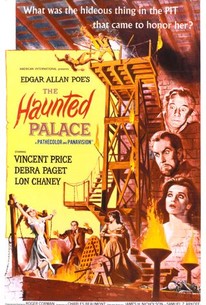
Classic Films in Focus: THE HAUNTED PALACE (1963)

Although the story really comes from H.P. Lovecraft's The Case of Charles Dexter Ward, Roger Corman's The Haunted Palace (1963) bills itself as one of the director's Edgar Allan Poe films and features all of the familiar trappings of those Gothic horror tales. Vincent Price is, as usual, in the lead, here playing a dual role as an evil warlock and his identical descendant, with Debra Paget making her final screen appearance as the descendant's long-suffering wife. The constant fog, gloomy period setting, and well-established genre tropes ensure that fans of Corman's other films will find plenty to appreciate here, but the chief attractions beyond Price and Paget are a gaggle of creepy mutant villagers and supporting performances from Lon Chaney, Jr. and Elisha Cook, Jr. The Haunted Palace is one of five films Corman directed in 1963, and it's not the first Corman picture anyone should see, but it's a fun outing for its iconic stars and worth the time if you enjoy the other Corman and Price collaborations.

Price appears first as the powerful necromancer Joseph Curwen, who conspires with his mistress, Hester (Cathie Merchant), to bewitch young women and bring them to his castle for unspeakable occult practices. The local villagers form a vigilante mob and burn Curwen at the stake, but not before he curses them and their descendants. Over a century later, Curwen's identical great-great-grandson, Charles Dexter Ward, inherits the castle and arrives in the town of Arkham with his lovely wife, Ann (Debra Paget). The village men (played by the same actors who appeared as their ancestors) make the Wards unwelcome, but Curwen's spirit soon possesses Charles and resumes his diabolical schemes of necromancy and revenge.

The dual roles of Joseph Curwen and Charles Dexter Ward give Vincent Price plenty to do, especially when he gets to play the two personalities warring for dominance over Ward's mind. Greenish makeup on the warlocks' faces helps us know when Curwen has control, but Price embodies the shift convincingly without the visual cue. Ward is a perfectly normal gentleman who loves his wife and doesn't believe in supernatural curses, while Curwen is a cunning sadist who is more than willing to murder anyone who crosses him. Of course, Curwen is destined to get the upper hand and wreak havoc, which ensures that Price can cut loose with his villain and make the most of a thoroughly terrible character. His sudden cruelty to his devoted wife leads her to suspect that evil is at work in the castle, but over time Curwen gets better at impersonating Ward so that he can continue his schemes in the secret chambers underground.

Debra Paget gives a solid performance as the worried wife, although she's the only developed female character in the whole story and spends most of her time looking frightened. Curwen is supposed to be obsessed with his dead mistress, Hester, but we don't see enough of her to understand his determination to resurrect her even though it's a distraction from the mission he and the other necromancers are supposed to be accomplishing. Lon Chaney Jr. has several scenes with Price but is subdued throughout; by 1963 he's long past his heyday as a horror star and not really credible as a fiendish immortal necromancer. The villagers, both past and present, are played by Leo Gordon, Elisha Cook, Jr., Frank Maxwell, and John Dierkes, and of the lot Maxwell has the most scenes because his doctor character tries to befriend and assist the Wards, although Cook is probably the most fun to watch because he plays fear-induced panic so brilliantly. Almost all of the named characters are rather dramatically upstaged by the deformed mutant villagers, descendants of the women Corwen bewitched and the ancient godlike thing he keeps locked in his underground lair. Cook's character, Peter, hints at the way the unholy mating has tainted the bloodlines of Arkham by revealing his own webbed hand, while Gordon's Edgar Weeden keeps his violent mutant son imprisoned in his home. Sadly, we don't know what, if anything, becomes of the mutants at the end of the story, since the Curwen/Ward conflict dominates the third act.

Different Corman fans will have their own favorites, but I recommend House of Usher (1960), The Masque of the Red Death (1964), and The Tomb of Ligeia (1964) if you want to see some of the best of the Poe adaptations with Vincent Price. You'll find both Price and Debra Paget in The Ten Commandments (1956), while Elisha Cook Jr. and Price both appear to great effect in William Castle's classic shocker, House on Haunted Hill (1959). See Lon Chaney Jr. in better times in his most memorable role as the ill-fated Larry Talbot in The Wolf Man (1941) and Frankenstein Meets the Wolf Man (1943), or check out his dramatic roles in Of Mice and Men (1939) or High Noon (1952).

Tuesday, October 13, 2015

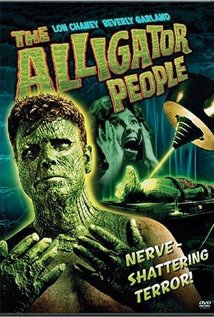
Classic Films in Focus: THE ALLIGATOR PEOPLE (1959)

Like The Fly (1958), The Alligator People (1959) merges science fiction and horror with a premise about dangerous experimentation gone horribly wrong, although in the second movie's case the combination of animal and human traits is intentional rather than tragically coincidental. Thus we get Richard Crane, as the increasingly reptilian victim of medical innovation, wandering the Louisiana swamps with one seriously bad case of gator face, while Beverly Garland chases after him as a dedicated wife who just won't take "no" for an answer. Most horror fans will come to The Alligator People for Lon Chaney, Jr., who plays a drunken villain, or for another example of the drive-in sci-fi chiller that flowered in the 1950s, but additional attractions can be found in the direction of Roy Del Ruth and performances from experienced players like Bruce Bennett, George Macready, and Frieda Inescort, each of whom helps to nudge the picture beyond mere B-movie spectacle.

Garland is the story's protagonist, a newly married nurse named Joyce Webster whose husband, Paul (Richard Crane), vanishes from a train on their honeymoon. Joyce tracks Paul to his family's plantation in the swamps, where she meets his mother, Mrs. Hawthorne (Frieda Inescort), who gives Joyce an icy welcome and tries to force her to leave. Determined to uncover the truth, Joyce stays until her mother-in-law and a local medical researcher, Dr. Sinclair (George Macready), reveal that Paul is suffering the side effects of a radical treatment for injuries he sustained in a plane crash during the war. Joyce joins their efforts to reverse Paul's transformation, but chaos erupts when a loutish plantation worker, Manon (Lon Chaney, Jr.), transfers his violent hatred for alligators to the alligator man.

The Alligator People is by no means a great film, and it often makes choices that are typical of its genre, but it also offers pleasant surprises. The pseudo-science of the central plot is wrapped in a strange psychological setup that presents Joyce, now known as Jane, as a victim of trauma induced amnesia as a result of her experience. Bruce Bennett appears in the frame scenes as one of two sexist doctors who can't stop mentioning how attractive the nurse is even as they use hypnosis to dredge up her horrible past. On the plus side, the frame tale serves a practical purpose in that it lets the audience know right away that this story won't end well for the alligator man or his bride, much as the opening of The Fly sets that story on its unbending course toward tragedy. The sexism also gets a much appreciated rebuke in the stalwart devotion of Joyce, who refuses to give up her search or abandon her husband once she sees his monstrous transformation. She even goes after him at the end, screaming not so much at his freakish appearance as his awful demise. Sure, his alligator head looks utterly fake, and we can even see the seams in his bodysuit, but Beverly Garland's performance as Joyce helps us focus on the drama of the situation rather than its special effects budget.

The success of the movie depends mostly on Garland, who plays Joyce as an active, intelligent woman caught up in overwhelming horror, but several supporting performances are worth noting. Lon Chaney. Jr. makes his presence felt as the belligerent Manon, a far nastier role than the actor's best known characters in other horror films. With his hook hand and his lecherous eye, Manon is a true monster; he provides a telling contrast to Paul, who loses the appearance of humanity but retains its inner qualities, even to the bitter end. Frieda Inescort also turns in a good performance as Paul's distraught mother; her accent wanders a bit, but she navigates the emotional territory of her character with greater assurance, letting her stern rejection of Joyce melt into shared misery over a loved one's terrible fate. Richard Crane gets less screen time as Paul, since he mostly skulks around the bayou in hiding, but his opening scenes set the stage for his later anguish. Hold on to the subtle cues on his handsome face as he talks about his accident with Joyce; that subtlety is lost later, but its emotional impact endures. Bruce Bennett and George Macready are both somewhat underused in their roles, but they give their doctors far more animation than such characters usually have in these pictures.

Some sci-fi B movies of this era are beloved precisely because they are campy and badly done, but The Alligator People takes a more serious tone, and despite its faults it's really a much better picture than it probably has any right to be. Give some of the credit for that to Roy Del Ruth, who also directed Born to Dance (1936), It Happened on Fifth Avenue (1947), and On Moonlight Bay (1951). See more of Beverly Garland in D.O.A. (1950), Not of This Earth (1957), and Twice-Told Tales (1963); she also enjoyed a long and varied television career and was even nominated for an Emmy. Lon Chaney, Jr. is best remembered for The Wolf Man (1941), but he plays supporting roles in many films, including The Black Castle (1952), The Black Sleep (1956), and The Haunted Palace (1963). Catch Frieda Inescort in Pride and Prejudice (1940), You'll Never Get Rich (1941), and The Return of the Vampire (1943). For similar 50s creature features, try I Was a Teenage Werewolf (1957), Attack of the 50 Foot Woman (1958), and Return of the Fly (1959).


Tuesday, August 11, 2015

Classic Films in Focus: THE BLACK CASTLE (1952)

Boris Karloff and Lon Chaney, Jr., only have supporting roles in The Black Castle (1952), but their presence adds genre credibility to this minor period thriller directed by Nathan Juran, here making his directorial debut. Richard Greene, Stephen McNally, and Paula Corday are the real stars of the picture, playing a deadly game of deception in a Black Forest castle crowded with spies and Gothic atmosphere. Although it's by no means an essential example of its type, The Black Castle succeeds at providing a round of interesting performances and some modest chills, with Greene in fine heroic mode and Karloff amusingly inscrutable as the castle's secretive physician.

Richard Greene plays the Englishman Sir Ronald Burton, who comes to the Black Forest looking for the vengeful count (Stephen McNally) who killed his friends. Under an assumed name, Sir Ronald gains admission to Count Karl von Bruno's castle as a guest, but his investigation is complicated by his attraction to the count's beautiful wife, Elga (Paula Corday, also known as Rita Corday). When the count discovers the truth about Sir Ronald and Elga, their lives are in peril, but the sympathetic Dr. Meissen (Boris Karloff) offers them a dangerous chance to escape.

Greene, best remembered for playing Robin Hood in a 1960 TV series, makes a charming and likable protagonist, with an early sword fight scene establishing his heroic character. He looks good in his eighteenth-century costume, as well, so we understand why Elga might be attracted to the gallant Englishman instead of her sadistic spouse. Stephen McNally keeps his villain's rage more or less under control until the last quarter of the picture, but Karl still gives us plenty of warning that he's a very dangerous man, and when he finally cuts loose we see the real brute beneath the civilized facade. Corday is lovely as the forcibly wed Elga, although early on she doesn't act as though she understands the extent of her husband's cruelty, and shouldn't she know better than anyone? We get the strange idea that theirs is a chaste marriage, which might make The Black Castle more suitable for the matinee kiddies but doesn't at all address the horror of being married to a psychotic egomaniac.

The tame sexuality is a sign that The Black Castle isn't really a horror film at all, in spite of Karloff and Chaney lurking around the castle's dark corridors. The opening is the most horrific scene in the whole movie, with Sir Ronald and Elga about to be buried alive after taking a powerful drug to evade Karl's evil plans. The story then flashes back to show us how they ended up in such jeopardy. Karloff's Dr. Meissen wavers between good intentions and cowardice as he tries to help the pair escape from Karl, but he's mostly there to advance the plot, and Karloff has to make the most of what he gets. Chaney gets even less to do as the mute henchman Gargon; almost anyone could have lumbered around and grunted in the few scenes where he appears, looking like a cross between Igor and Quasimodo. The more interesting henchman roles go to John Hoyt and Michael Pate as Karl's fellow counts, Steiken and Ernst, with Pate basically reprising his role from The Strange Door (1951).

Be sure to note character actor Henry Corden in the role of Fender; he's best remembered today as the voice of Fred Flintstone. Nathan Juran went on to direct 20 Million Miles to Earth (1957), The 7th Voyage of Sinbad (1958), and, as Nathan Hertz, Attack of the 50 Foot Woman (1958). See Karloff give Count Karl a more sinister role model in The Black Cat (1934), and catch Chaney in a more talkative mood in Inner Sanctum Mysteries like Weird Woman (1944) and The Frozen Ghost (1945). You'll find Richard Greene in The Little Princess (1939), The Hound of the Baskervilles (1939), and Forever Amber (1947). Stephen McNally, who started his career as Horace McNally, was a regular in Westerns; look for him in Winchester '73 (1950), The Duel at Silver Creek (1952), and Tribute to a Bad Man (1956).

Thursday, April 16, 2015

Classic Films in Focus: FRANKENSTEIN MEETS THE WOLF MAN (1943)

Universal Studios enjoyed so much success with its various monsters that the temptation to make endless sequels and combinations of characters proved too tempting, and movies like Frankenstein Meets the Wolf Man (1943) appeared in large numbers throughout the 1930s and 40s. Of course, the quality of these pictures declines in direct proportion with their quantity, but fans of classic horror enjoy them as much for their flaws as for their virtues. Frankenstein Meets the Wolf Man plays mostly as a direct sequel to the 1941 film, The Wolf Man, and it features Lon Chaney's Larry Talbot/Wolf Man character far more than it does Frankenstein's monster. While it lacks the narrative coherence of the original film, it does offer a second encounter with some wonderful characters, and the cast brings together an impressive cadre of classic horror's most reliable stars.

The plot resurrects Larry Talbot (Lon Chaney, Jr.) four years after his assumed death. Talbot, distraught at being alive and cursed by lycanthropy again, eventually makes his way to the home of Dr. Frankenstein, in the hope that the infamous doctor can end his eternal life. Unfortunately, the doctor is dead, and Larry finds and revives the monster (Bela Lugosi) instead. The unfortunate village near Frankenstein's castle falls prey to the depredations of both werewolf and monster, prompting panic and a rising mob, while Larry's doctor, Frank Mannering (Patric Knowles), and the attractive Baroness Elsa Frankenstein (Ilona Massey) struggle to bring Larry and the monster to a peaceful end.

The plot fails to resolve itself, probably because Universal wanted to keep its monsters alive for additional sequels, and editing decisions cut much of Lugosi's role out of the final version of the picture. Technically speaking, the only Frankenstein in the film is Elsa, who is actually the granddaughter of the original mad scientist and the daughter of his son, who had taken up the family vocation in The Ghost of Frankenstein (1942). Frank Mannering ends up being the doctor who must face the temptation of controlling life and death, and he never gets insane enough to be much fun.

Chaney continues to imbue Larry Talbot with tragic pathos, and his transformation scenes are really quite good, better even than those seen in the original film. Rejoining him on his journey to Frankenstein's castle is Maria Ouspenskaya as Maleva, and she makes the movie worth watching all by herself. Dwight Frye has a small role as one of the villagers (you'll miss him if you aren't watching for him), and Lionel Atwill, another regular in the genre, plays the reasonable town mayor. Lugosi, sadly, has little to do; many of the scenes featuring the monster are really stunt doubles, and the monster's limited screen time makes him merely a minor character, despite the title's implication to the contrary.

I can't tell you why Patric Knowles ends up playing two different characters named Frank between The Wolf Man and this film, but it makes for a rather odd sense of deja vu if you watch both movies in rapid succession. Maybe he just makes a perfect foil to Chaney, or perhaps director Roy William Neill wanted to bring back as many of the original film's cast as possible. Even Chaney's beloved German Shepherd, Moose, who played the role of the wolf in the original movie, makes a brief appearance in the sequel. Chaney himself would bring Larry Talbot back for more suffering in House of Frankenstein (1944), House of Dracula (1945), and Abbott and Costello Meet Frankenstein (1948). You can see more of Maria Ouspenskaya in Love Affair (1939), Waterloo Bridge (1940), and Dance, Girl, Dance (1940). Roy William Neill's directorial credits include many Sherlock Holmes adventures with Basil Rathbone, but he also directed Black Angel (1946).

Monday, August 26, 2013

Classic Films in Focus: HOUSE OF FRANKENSTEIN (1944)

Plenty of the later Universal horror movies pack in the monsters, but House of Frankenstein (1944) really outdoes the rest by jamming a whole madhouse of familiar players into its many roles, not only as the headlining creatures but also as supporting characters. The story is so convoluted and episodic that it’s certainly not the chief attraction, but classic horror fans who know their stars will find the parade of performers entertaining in its own way, and Boris Karloff gets a particularly fun role as the devious and obsessive mad doctor whose adventures string together the appearances of Dracula, the Wolf Man, and Frankenstein’s monster. Directed by Erle C. Kenton, House of Frankenstein is by no means the best of the Universal horrors, but taken scene by scene and monster by monster it does provide some unique twists on the usual situations.

Karloff plays aspiring Frankenstein successor Dr. Niemann, who escapes from prison along with his hunchbacked assistant, Daniel (J. Carrol Naish). They hitch a ride from a traveling horror show and then murder its owner, Lampini (George Zucco), so that Niemann can assume his identity. Posing as the showman, Niemann resurrects Count Dracula (John Carradine) as an accomplice in his extensive revenge plot against the men who sent him to prison, but the vampire promptly becomes distracted by attractive female prey (Anne Gwynne). Later, in the ruins of Frankenstein’s castle, Niemann finds the Wolf Man (Lon Chaney, Jr.) and Frankenstein’s creature (Glenn Strange) frozen in ice and revives both of them, but he finds werewolf Larry Talbot harder to control than the other monsters. Daniel, meanwhile, becomes enamored of a pretty gypsy girl (Elena Verdugo) and grows jealous of her attention to Talbot.

While Karloff had originally gained fame playing the lumbering monster, he shows in this film that he can just as easily assume the role of the creator, and his Niemann is a fine example of the wild-eyed devotee of transgressive science. There are references to an earlier experiment in which Niemann transplanted a human brain into a dog, so from the start we know that he might actually be crazier than the original Frankenstein or any of his ill-fated heirs. More importantly, Niemann lies to and takes advantage of the dangerous supernatural beings he encounters; this is a man mad enough to play Dracula for a dupe and plot to make a science experiment out of the Wolf Man’s body and brain. He really only cares about Frankenstein’s creature; the rest of the monsters are just convenient means to his nefarious ends. Inevitably, Niemann’s duplicity catches up with him, but it’s ironically the lowly hunchback, tired of being played for a sucker, who raises the hand of vengeance against the scheming doctor.

The rest of the cast keep things interesting in spite of the disjointed plot. John Carradine has a brief but effective run as Count Dracula; his lean physique prefigures that of Christopher Lee even as he retains the aristocratic manners of Lugosi. Lon Chaney, Jr. makes his usual contribution as doomed Larry Talbot, this time with the added interest of a tragic love affair with the spirited gypsy girl. His role as part of a romantic triangle with the girl and the hunchback puts him into the odd position of playing Captain Phoebus in their version of the Victor Hugo tale, although Larry really does seem to return the gypsy’s affection. J. Carrol Naish proves one of the most inspired additions to the collection with his pathetic, jealous Daniel, who commits most of the murders in the film and yet still commands a degree of sympathy from the audience for his unrequited love. The victims and supporting characters are played by a who’s who of favorite actors, including George Zucco, Sig Ruman, Lionel Atwill, Frank Reicher, and Glenn Strange under all the makeup taking Karloff’s place as the creature.

Like most of the Universal monster pictures, House of Frankenstein kills off all of the creatures by the final scene, but House of Dracula (1945) brings them back to life for another round. For a different sort of horror from director Erle C. Kenton, try Island of Lost Souls (1932). Look for the many faces of Boris Karloff in The Mummy (1932), the Mr. Wong series, and Bedlam (1946). Lon Chaney, Jr. plays the Wolf Man in several Universal films, beginning with The Wolf Man (1941). Versatile character actor J. Carrol Naish turns up in more than 200 film and television roles, but he earned Oscar nominations for Best Supporting Actor in Sahara (1943) and A Medal for Benny (1945). He’s hard to recognize under the makeup and feathers, but you’ll also find him playing Chief Sitting Bull in Annie Get Your Gun (1950).

Tuesday, August 20, 2013

Classic Films in Focus: SON OF DRACULA (1943)

Lon Chaney, Jr., God bless him, had certain talents as an actor, but he was no man of a thousand faces like his chameleon father. The limits of the younger Chaney’s abilities come into plain view in Son of Dracula (1943), which badly miscasts the horror star as the iconic vampire (or his descendant, it’s never quite clear). Directed by Robert Siodmak and costarring Robert Paige, Louise Allbritton, and Evelyn Ankers, Son of Dracula never really takes off, although it does tempt the audience with its story of a morbid anti-heroine and increasingly unhinged hero.

Arriving under the pseudonym of Count Alucard, Chaney plays a vampire drawn to the swamps of the Southern United States by Kay Caldwell (Louise Allbritton), a lovely young woman with an unhealthy interest in the occult. Alucard promptly kills Kay’s elderly father, and Kay inherits the Gothic mansion where she and Alucard intend to take up their undead residence. Kay’s longtime boyfriend, Frank (Robert Paige), is horrified by her fascination with the count, and her sister, Claire (Evelyn Ankers), doesn’t know what to make of Frank’s wild-eyed reports that Kay has become an immortal monster. Only kindly Dr. Brewster (Frank Craven) and vampire expert Professor Lazlo (J. Edward Bromberg) suspect that Frank’s ravings really contain the truth about Alucard and his morbid bride.

Chaney is best remembered today for his performances as werewolf Larry Talbot, first in The Wolf Man (1941) and then in a number of sequels. As a tragic everyman, Talbot perfectly suits Chaney’s middle-class look and earnest demeanor, but Dracula is a completely different type. He embodies Old World privilege, seductive foreign influence, and dangerous sex appeal, none of which are conveyed by Chaney’s version of the character. His bulky, solid Alucard looks more likely to drink beer than blood, and his flat American accent makes his dialogue patently ridiculous. Chaney would play werewolves, mummies, and a variety of strange characters over the course of his career, but Son of Dracula would be his only attempt at a vampire role, and that’s probably for the best.

Chaney’s inadequacy as the title character dooms the film as a whole, but the plot revolving around Frank and Kay still offers some entertainment for the hardcore horror fan. Louise Allbritton has something of a Cat People look going on for Kay, and we know she’s a strange girl when we first see her trailing her Gothic dress into the swamp to visit her old gypsy adviser. Even before she becomes a vampire she looks like one, with her dark hair, gossamer gowns, and moonstruck air. Robert Paige has the role with the most meat on it as the increasingly unhinged Frank; he’s equal parts Renfield and Harker, especially when the undead Kay turns up in his jail cell after he has confessed to accidentally killing her. The doomed love story between Frank and Kay makes the end of the picture one of its strongest scenes, one in which Chaney’s ineffective vampire does not figure at all.

Be sure to notice Hattie McDaniel’s sister, Etta, in a small role as Dr. Brewster’s housekeeper, Sarah. Robert Siodmak went on to direct a number of well-regarded films, including The Spiral Staircase (1945), The Killers (1946), and Criss Cross (1949). For contrast, see Lon Chaney, Jr. in serious dramatic roles in Of Mice and Men (1939) and High Noon (1952). You’ll find Louise Allbritton in The Egg and I (1947), while Evelyn Ankers plays Larry Talbot’s love interest in The Wolf Man (1941) and Elsa Frankenstein in The Ghost of Frankenstein (1942). For more of Robert Paige, try Blonde Ice (1948), Abbott and Costello Go to Mars (1953), or Bye Bye Birdie (1963).

Monday, August 19, 2013

Classic Films in Focus: HOUSE OF DRACULA (1945)

Released in 1945, House of Dracula is one of the many monster movie sequels that Universal churned out in an effort to keep audiences coming back for more of their favorite fiends, and, like Frankenstein Meets the Wolf Man (1943), House of Frankenstein (1944), or the later Abbott and Costello Meet Frankenstein (1948), this picture takes a “more is more” approach to its monsters. This particular mad monster party has some intriguing components, but it squanders its potential with a disastrous third act that doesn’t so much end as simply stop. Up until that frustrating finale, the picture has its appeal, especially in the performance of John Carradine as a thin, hypnotic Count and the creative twists applied to the mad doctor and hunchback staples.


Onslow Stevens stands at the center of the action as the good Doctor Edelmann, who is approached first by Dracula (John Carradine) and then by Larry Talbot (Lon Chaney, Jr.) for cures to their unique conditions. Dracula, as it turns out, really only wants to get close to Edelmann’s attractive nurse, Miliza (Martha O’Driscoll), and Edelmann pays a terrible price for trying to cure the vampire, even as his efforts to help Larry seem more hopeful. Edelmann also discovers the Frankenstein’s creature (Glenn Strange) in the caves beneath his castle, but his hunchbacked assistant, Nina (Jane Adams), repeatedly warns him against resurrecting the monster.

As the ostensible protagonist of the story, Onslow Stevens makes a good showing, especially during his Jekyll and Hyde moments later in the picture. Stevens is not particularly well-known today, but he worked a long and prolific career in film and television, and in Edelmann he has a role that allows him to play with many classic horror types at once. Edelmann is both Van Helsing and Victor Frankenstein as well as Jekyll and Hyde, a good man who resists evil until he is tragically overcome by it. His approach to the monstrous makes House of Dracula as much science fiction as horror; Edelmann treats vampirism as a blood condition and uses transfusions to combat it, although his treatment of lycanthropy proves far more successful, in part because Dracula doesn’t really to be cured, while Larry is ready commit suicide if he can't find a way to escape his werewolf curse.

The monsters, as usual, have the most fun here, with John Carradine leading the charge as an effective incarnation of the famous Count. Carradine has the mesmerizing eyes needed for this role, and the screen makes the most of them with several close-up shots. He doesn’t bother with a fake foreign accent, but his deep voice carries notes of aristocratic culture and seductive menace nonetheless. Dracula’s inevitable death scene begins the series of bad endings that plague the second half, but the Count still manages to make his influence felt beyond the grave. Lon Chaney, Jr. is back in familiar territory with his Larry Talbot role, which he wears as comfortably as a favorite suit, and we get some fun transformation sequences with lots of hair and teeth. Glenn Strange, however, has very little to do as the creature, whose few scenes are sometimes borrowed from earlier films with other actors in the makeup. As the love interest of both vampire and werewolf, Martha O’Driscoll is pretty but a bit flat, especially in her trance scenes with Dracula, and Jane Adam’s hunchbacked Nina proves a far more interesting female character. The abrupt ending that literally brings down the house on these characters is especially unfair to Nina, who ought to have a much better final moment than the throwaway treatment she receives.

Be sure to notice Lionel Atwill in one of his last screen roles as the police inspector. Erle C. Kenton, who directed House of Dracula, also headed up the terrific Island of Lost Souls (1932) as well as The Ghost of Frankenstein (1942) and House of Frankenstein (1944). For more early but memorable performances by John Carradine, see Stagecoach (1939), The Grapes of Wrath (1940), and Blood and Sand (1941); the actor appeared in more than 300 films and television programs, including many cult horror classics as well as serious Oscar contenders. Lon Chaney, Jr. made his first appearance as Larry Talbot in The Wolf Man (1941), but he went on to play the character many times, and he also starred in other monster roles in Son of Dracula (1943) and The Mummy's Curse (1944).

Thursday, August 2, 2012

The Sins of the Father: Claude Rains in THE WOLF MAN (1941)


Although rock solid supporting player Claude Rains is certainly best remembered today as the mercurial Louis in CASABLANCA (1942), the English actor also made huge contributions to the genre of horror, and Turner Classic Movies will put the spotlight on that aspect of Rains’ career with its primetime lineup for SUMMER UNDER THE STARS on Sunday, August 5.

THE INVISIBLE MAN (1933), a wickedly funny James Whale classic that proved a breakthrough role for Rains, takes center stage with the 8 p.m. Eastern time slot, but just before it at 6:45 p.m. is THE WOLF MAN (1941), the original Universal picture starring Lon Chaney, Jr. as the moon-cursed protagonist and Rains as his skeptical father. Directed by George Waggner, THE WOLF MAN is one of my all-time favorite movies, not because it’s particularly scary but because the performances of Rains, Chaney, and their costars pitch the story as a deeply affecting domestic tragedy, in which Rain’s Sir John Talbot pays a terrible price for his failures as a father.

Rains brings wonderful gravitas to his role, and he lets us see very early on that Sir John has done a great deal of damage to his relationship with his son, not through outward cruelty, but through the insidious effects of favoritism and indifference. Larry’s older brother was the heir to the family estate, and Sir John pinned all of his hopes and his love on his firstborn son, leaving so little for Larry that the younger son fled to a new life in America. Now, in the wake of the heir’s death, Larry returns to England but seems fated to fail in taking his brother’s place. Rains keeps his distance as Sir John, never really embracing his only surviving child but still subtly dependent on him in a way that neither expected.

In the context of the story, Larry never does anything wrong to deserve his awful fate. In fact, he is bitten by the werewolf (Bela Lugosi) while trying to save a young woman from being killed by the monster. Sir John, however, has earned the wrath of the heavens by first neglecting his younger son and then expecting him to give up his own desires to replace the dead heir. Like King Lear, Sir John fails as a father to his younger child and is therefore punished by the loss of all of his children. A bad father becomes no father at all. The film’s most eloquent and tragic piece of poetic justice comes in the final scene, when it is Sir John himself who brings his fate to bear.

It takes an actor of Claude Rains’ caliber to carry off such an important role. Sir John must be sympathetic enough that we understand why Larry yearns for his approval, but he must be flawed enough that we recognize the ending as right in some way, no matter how terrible it is for our protagonist. The expression on Rains’ face in the final scene of this film is one of the most heartbreaking things you will ever see. With the silver cane in his hand and his dead child at his feet, Sir John knows, too late, how much he has lost in the son he failed to love before.

TCM will air plenty of other great Rains performances on Sunday, August 5. Among my other favorites on the schedule are NOW, VOYAGER (1924) and THE ADVENTURES OFROBIN HOOD (1938). Rains also plays a very different father in MR. SKEFFINGTON (1944), which features one of the most sob-inducing father-daughter moments ever seen on film. 


 This post is part of the TCM Summer Under the Stars Blogathon hosted by classic movie bloggers at Sittin' On a Backyard Fence and ScribeHard on Film. Check out their sites for links to all of the blog posts celebrating every star of the day on TCM in August!