Showing posts with label Edgar Allan Poe. Show all posts

Sunday, October 15, 2023

Classic Films in Focus: MURDERS IN THE RUE MORGUE (1932)

On paper, Universal's 1932 Murders in the Rue Morgue sounds terrific; it adapts a chilling story from Edgar Allan Poe, stars Bela Lugosi, and offers Expressionist cinematography by Karl Freund, complete with all the lurid sensibility that Pre-Code horror can provide. Unfortunately, the movie doesn't work as well in practice, especially for viewers who know and appreciate Poe's original tale. While Lugosi is truly terrifying as the menacing Dr. Mirakle, the picture suffers from a weak leading man, creaky monster effects, and too much deviation from its source material that also leads it into some extremely thorny issues regarding racist tropes. Fans of Pre-Code horror and/or Edgar Allan Poe might be willing to forgive some of its failings for Lugosi's sake, but overall this is a far less successful picture than stand-out classics like The Black Cat (1934) and Roger Corman's Poe cycle.

Lugosi plays a character who doesn't exist in the original tale, a mad scientist obsessed with proving evolution by injecting the blood of his captive gorilla into beautiful young women. His experiments have inevitably proved fatal to the women, but Dr. Mirakle blames the failure on the women's "impure" blood instead of his own mad theory. When the gorilla takes a particular shine to lovely Camille L'Espanaye (Sidney Fox), Dr. Mirakle plans to kidnap her as his next test subject, but Camille's suitor, Pierre Dupin (Leon Ames), rightly suspects the doctor of having sinister motives.  

Deviations from the source create more problems than opportunities here. Poe's tale focuses on the murders of two women and the clever detective, C. Auguste Dupin, an important forerunner of and inspiration for Sir Arthur Conan Doyle's Sherlock Holmes. Weirdly, the Universal picture isn't a detective mystery at all, even though Poe's story is widely considered the original example of the genre. Instead, Leon Ames plays a medical student named Pierre Dupin, who already knows who did it when his sweetheart, Camille, disappears and her mother's corpse is found stuffed up a chimney. Ames is not particularly effective in this role, and the problems are all the more noticeable because Pierre is such a ho-hum hero compared to Poe's brilliant detective. The locked room mystery of the short story gives way to a bizarre mad scientist plot that draws on deeply racist imagery about gorillas as substitutes for Black men and their supposed desire for White women. Mirakle's experiment is a thinly veiled take on miscegenation that results in the deaths of the women whose blood has been "contaminated" by that of the gorilla. None of this comes from Poe's story, in which a pet orangutan gets loose from its owner and cannot really be held responsible for its actions. On a more practical level, the gorilla who replaces Poe's orangutan is very obviously a guy in a bad gorilla suit, except during closeups, when he transforms into an actual chimpanzee. It's a jarring and absurd switch every time it happens, but the movie does it repeatedly, even recycling the same shot of the chimp pressing against the bars of its cage.

All of these problems detract from a fine performance by Lugosi, who certainly knows how to leer menacingly at an audience and deliver a chilling monologue. His face is by far the scariest thing in the movie; its signature feature is an impressive monobrow that sprouts over his trademark burning gaze. The Expressionist influence reaches it high point during the experiment scene with Lugosi's only onscreen victim, a kidnapped streetwalker played by Arlene Francis. Tied to a huge wooden X like a martyr or a witch at the stake, Mirakle's victim exposes a lot of pretty flesh and casts a striking shadow on the laboratory wall. When she dies as a result of his injections, he seems surprised, even though he has her positioned over a convenient trapdoor that drops her body directly into the river. These effective scenes connect Murders in the Rue Morgue to German Expressionist classics like The Cabinet of Dr. Caligari (1920) and Nosferatu (1922) as well as better Universal horrors like Dracula (1931), Frankenstein (1931), and The Mummy (1932), reflecting the influence of cinematographer and occasional director Karl Freund after his relocation from Germany to Hollywood.

Robert Florey, who directed Murders in the Rue Morgue, eventually moved to television work, but before that he directed the 1946 horror, The Beast with Five Fingers, starring Peter Lorre. Karl Freund also directed Lorre in another Expressionist horror feature, Mad Love (1935), and I would recommend either Lorre picture over Murders in the Rue Morgue. Leon Ames is much more in his element in Meet Me in St. Louis (1944), A Date with Judy (1948), and Little Women (1949); Murders in the Rue Morgue was one of his first screen appearances, and it's not really his fault that he's miscast. Poe adaptations and loose retellings abound, with the most recent being the 2023 Netflix miniseries, The Fall of the House of Usher. Roger Corman, however, still reigns as the king of Poe on film, with Vincent Price as his star of choice. Start with Corman's House of Usher (1960) and proceed to Tales of Terror (1962) and The Tomb of Ligeia (1964) for a sample of their best efforts.

Monday, March 7, 2022

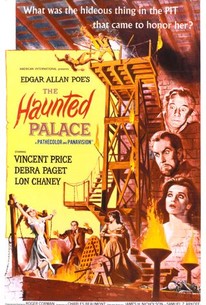
Classic Films in Focus: THE HAUNTED PALACE (1963)

Although the story really comes from H.P. Lovecraft's The Case of Charles Dexter Ward, Roger Corman's The Haunted Palace (1963) bills itself as one of the director's Edgar Allan Poe films and features all of the familiar trappings of those Gothic horror tales. Vincent Price is, as usual, in the lead, here playing a dual role as an evil warlock and his identical descendant, with Debra Paget making her final screen appearance as the descendant's long-suffering wife. The constant fog, gloomy period setting, and well-established genre tropes ensure that fans of Corman's other films will find plenty to appreciate here, but the chief attractions beyond Price and Paget are a gaggle of creepy mutant villagers and supporting performances from Lon Chaney, Jr. and Elisha Cook, Jr. The Haunted Palace is one of five films Corman directed in 1963, and it's not the first Corman picture anyone should see, but it's a fun outing for its iconic stars and worth the time if you enjoy the other Corman and Price collaborations.

Price appears first as the powerful necromancer Joseph Curwen, who conspires with his mistress, Hester (Cathie Merchant), to bewitch young women and bring them to his castle for unspeakable occult practices. The local villagers form a vigilante mob and burn Curwen at the stake, but not before he curses them and their descendants. Over a century later, Curwen's identical great-great-grandson, Charles Dexter Ward, inherits the castle and arrives in the town of Arkham with his lovely wife, Ann (Debra Paget). The village men (played by the same actors who appeared as their ancestors) make the Wards unwelcome, but Curwen's spirit soon possesses Charles and resumes his diabolical schemes of necromancy and revenge.

The dual roles of Joseph Curwen and Charles Dexter Ward give Vincent Price plenty to do, especially when he gets to play the two personalities warring for dominance over Ward's mind. Greenish makeup on the warlocks' faces helps us know when Curwen has control, but Price embodies the shift convincingly without the visual cue. Ward is a perfectly normal gentleman who loves his wife and doesn't believe in supernatural curses, while Curwen is a cunning sadist who is more than willing to murder anyone who crosses him. Of course, Curwen is destined to get the upper hand and wreak havoc, which ensures that Price can cut loose with his villain and make the most of a thoroughly terrible character. His sudden cruelty to his devoted wife leads her to suspect that evil is at work in the castle, but over time Curwen gets better at impersonating Ward so that he can continue his schemes in the secret chambers underground.

Debra Paget gives a solid performance as the worried wife, although she's the only developed female character in the whole story and spends most of her time looking frightened. Curwen is supposed to be obsessed with his dead mistress, Hester, but we don't see enough of her to understand his determination to resurrect her even though it's a distraction from the mission he and the other necromancers are supposed to be accomplishing. Lon Chaney Jr. has several scenes with Price but is subdued throughout; by 1963 he's long past his heyday as a horror star and not really credible as a fiendish immortal necromancer. The villagers, both past and present, are played by Leo Gordon, Elisha Cook, Jr., Frank Maxwell, and John Dierkes, and of the lot Maxwell has the most scenes because his doctor character tries to befriend and assist the Wards, although Cook is probably the most fun to watch because he plays fear-induced panic so brilliantly. Almost all of the named characters are rather dramatically upstaged by the deformed mutant villagers, descendants of the women Corwen bewitched and the ancient godlike thing he keeps locked in his underground lair. Cook's character, Peter, hints at the way the unholy mating has tainted the bloodlines of Arkham by revealing his own webbed hand, while Gordon's Edgar Weeden keeps his violent mutant son imprisoned in his home. Sadly, we don't know what, if anything, becomes of the mutants at the end of the story, since the Curwen/Ward conflict dominates the third act.

Different Corman fans will have their own favorites, but I recommend House of Usher (1960), The Masque of the Red Death (1964), and The Tomb of Ligeia (1964) if you want to see some of the best of the Poe adaptations with Vincent Price. You'll find both Price and Debra Paget in The Ten Commandments (1956), while Elisha Cook Jr. and Price both appear to great effect in William Castle's classic shocker, House on Haunted Hill (1959). See Lon Chaney Jr. in better times in his most memorable role as the ill-fated Larry Talbot in The Wolf Man (1941) and Frankenstein Meets the Wolf Man (1943), or check out his dramatic roles in Of Mice and Men (1939) or High Noon (1952).

Monday, October 18, 2021

Five Favorite Directors: Classic Horror


Even people who don't care for classic horror movies have probably heard of Bela Lugosi, Boris Karloff, and Vincent Price, but behind every horror classic there's also a director asking for heavier fog, more menacing closeups, and louder screams. Alfred Hitchcock, although not primarily a horror director, might be the most familiar to modern viewers thanks to Psycho (1960) and The Birds (1963), and more recent masters of the genre include George Romero, John Carpenter, and Wes Craven, but my personal favorites tend to be the earlier icons whose work influenced everyone after them. Most of the films from these directors are light on gore and heavy on atmosphere, which is how I like my creepy midnight thrills, and many worthy contenders aren't listed here only because I limit myself to five. These are the directors I most often turn to when I want something spooky to send a shiver down my cinematic spine.

Tod Browning

Browning is best remembered today for two horror classics, Dracula (1931) and Freaks (1932), but his directorial career started with silent shorts in 1915, and he helmed a number of notable silent horror pictures before his date with Dracula. Browning's movies with Lon Chaney, "the man of a thousand faces" and a master of silent horror, are especially good; try The Unholy Three (1925), The Unknown (1927), and West of Zanzibar (1928) for a sense of Browning's work before Dracula.

James Whale

Like Browning, James Whale is best remembered today for his iconic Universal monster movies, including Frankenstein (1931), The Invisible Man (1933), and Bride of Frankenstein (1935). Whale's work combines the usual elements of horror with a very dark sense of humor that sometimes tips right over into black comedy, especially with Claude Rains in the lead role for The Invisible Man. In between these more famous films Whale also directed The Old Dark House (1932), a wonderful spooky house picture with his usual flair for mixing giggles with screams.

Jacques Tourneur

As the son of French director Maurice Tourneur, Jacques Tourneur grew up in the movie making business in both France and the US; his career really took off when he teamed up with RKO horror boss Val Lewton for films like Cat People (1942), I Walked with a Zombie (1943), and The Leopard Man (1943). Later Tourneur would make memorable pictures in a number of genres, but he returned to horror for Night of the Demon (1957) and The Comedy of Terrors (1963). Cat People is justly celebrated today for its moody ambience and loaded subtext, but I'm also very fond of I Walked with a Zombie for its imaginative revision of Jane Eyre.


Robert Wise

Like Tourneur, Robert Wise enjoyed a fruitful collaboration with Val Lewton early in his career, even though he later became more famous as the Oscar-winning director of musicals like West Side Story (1961) and The Sound of Music (1965). His work in horror remains an important part of his oeuvre and the genre as a whole, with early Lewton projects like The Curse of the Cat People (1944) and The Body Snatcher (1945) laying the foundation for the horror masterpiece, The Haunting (1963), which is so good that it alone justifies Wise's place in this list. Watch it with the lights out and the sound turned up, and you won't sleep a wink.

Roger Corman

Roger Corman directed more than 50 movies, many of them low-budget shockers and now cult classics, and Corman has lived long enough to see himself become a true Hollywood legend. As much as I enjoy a really ridiculous B-movie romp like Attack of the Crab Monsters (1957), my favorite Corman horror films are the Poe adaptations he made with Vincent Price, some of them more faithful than others but all of them very entertaining. House of Usher (1960) kicked off the series, but two later entries, The Masque of the Red Death (1964) and The Tomb of Ligeia (1964) are probably my top picks for being less campy and more evocative of Edgar Allan Poe's works than a picture like The Raven (1963), even though that one is also a lot of fun.

Looking for even more classic horror directors? Try F.W. Murnau, Mario Bava, Mark Robson, and Terence Fisher for additional thrills and chills. 

See also: "The Kiss That is the Kill: Sex and Death in Three Classic Vampire Movies"


Saturday, October 3, 2020

Classic Films in Focus: THE MASQUE OF THE RED DEATH (1964)


 The Masque of the Red Death (1964) is another of Roger Corman's loose adaptations of the stories of Edgar Allan Poe with Vincent Price in the starring role, this time as the debauched and heartless Prince Prospero, a ruler who holds lavish parties while his people die of a horrific plague. Like most of the Poe films it takes many liberties with the source material and also incorporates the characters and plot from another Poe story, "Hop-Frog," but its deviations don't detract from its delights as a film. Lurid, lavish, and full of the usual Corman elements, it's a grim but entertaining morality tale that depicts the just desserts meted out to cruel and uncaring oligarchs who foolishly believe themselves to be immune to the afflictions that stalk their subjects.

Price is in high villain style as the sadistic Prospero, who shuts himself and his cronies off from the plague stricken countryside for a massive party inside the safety of the castle walls. He abducts a beautiful young village girl, Francesca (Jane Asher), with the intention of corrupting her innocence and seducing her into the service of Satan, and he uses her captured father (Nigel Green) and lover (David Weston) as leverage to keep her by his side. Prospero's jealous lady, Juliana (Hazel Court), dares the ultimate sacrifices to Satan to ensure her own position with the prince, even as the gathered nobles drink and debase themselves throughout the castle. Little does Prospero guess that a mysterious red robed figure is slowly but surely bringing doom to the revelers.

The romantic plot involving Francesca and her intended, Gino, delays the fate that awaits the corrupted court, but there's never any doubt about the ending of this tale. We only wonder whether Francesca and Gino, along with Hop Toad (Skip Martin) and the diminutive dancer Esmeralda (Verina Greenlaw), will escape the punishment so richly deserved by the rest. The personified Red Death opens the film with the promise of liberation for the people, but it's soon clear that liberation from Prospero might also mean liberation from life. Plagues, as we know, aren't very precise when it comes to such matters. The build up, then, is more about how much the story can make us anticipate and enjoy Prospero's downfall; we see him burn the village, murder the people, humiliate his courtiers, and even murder his followers when the mood strikes him. He is utterly faithless and without redeeming qualities of any kind. He delights in the suffering and debasement of others but believes himself untouchable. Thus, when the third act finally arrives, we have to cheer as Prospero first glimpses that flash of forbidden red in the midst of the masquerade.

Price, of course, makes for a delightfully satisfying villain, by turns preening and predatory in his sumptuous robes. Prospero is one of his more serious horror heavies, neither hysterical nor ludicrous, but very much in his comfort zone during this period of his career. Hazel Court makes a solid costar as the increasingly desperate Juliana, although she spends a lot of her screen time staring at Prospero or his Satanic altar, but Jane Asher seems a bit dazed as Francesca, which might be intentional but drains her of the ability to express the horror and disgust one might expect her to show. The bad dubbing for Verina Greenlaw undermines the pathos of her big scene with Skip Martin as Esmeralda and Hop Toad plan their escape, but Martin has some very good moments with Patrick Magee as the secondary villain, Alfredo.In fact, Hop Toad's revenge on Alfredo might be the most shocking scene of the picture, especially if you haven't read Poe's story. 

You might make a double feature of The Masque of the Red Death with Vincent Price's other 1964 movie about a plague, The Last Man on Earth, which has been remade several times. For more of Corman's Poe films with Price, see House of Usher (1960), Pit and the Pendulum (1961), and The Tomb of Ligeia (1964). You can get a look at Price's early excursions into the horror genre with Dragonwyck (1946), House of Wax (1953), and The Fly (1958), or catch scream queen Hazel Court in The Curse of Frankenstein (1957), Premature Burial (1962), and The Raven (1963). For more classic movies about plagues, see The Seventh Seal (1957) or Vampire Circus (1972), or branch into different territory with the yellow fever outbreak in Jezebel (1938).

Tuesday, June 9, 2015

Classic Films in Focus: THE BLACK CAT (1934)

For a horror film that actually shows very little, The Black Cat (1934) manages to suggest a great deal, and the result is a story that works on the imagination long after the brief picture has ended. Director Edgar G. Ulmer crams this small, dark package with surreal images and grotesque crimes only hinted at and glimpsed in snatches, which makes them all the more disturbing to the astute viewer. Like most films "suggested" by Edgar Allan Poe's short stories, The Black Cat has little to do with the original text, but it spins a narrative gruesome enough to fascinate classic horror fans, and the performances of Boris Karloff and Bela Lugosi help to make the movie an enduring cult favorite among Universal horror's devotees.

Lugosi plays Dr. Vitus Werdegast, who meets a young American couple on an ill-fate rail journey through Hungary. Newlyweds Peter and Joan Alison (David Manners and Julie Bishop, credited as Jacqueline Wells) find their new companion strange, but their misgivings only grow when a bus accident forces them to join Werdegast as the house guests of Hjalmar Poelzig (Boris Karloff). Werdegast and Poelzig have a history that makes them bitter enemies; their conflict rapidly becomes deadly, with the honeymooners caught in the middle of their bizarre struggle over the mysterious fates of Werdegast's wife and daughter.

The Black Cat marks the first screen pairing of Karloff and Lugosi, who would go on to make eight films together in all. Both were top horror stars already, and Universal clearly realized that putting them together would double the picture's appeal. Their roles offer them a little deviation from the parts that they had most recently played, but each is still very much in the vein of his overall screen persona. Karloff, talkative, urbane, and utterly perverse, is the ultimate villain of the piece, but Lugosi's doctor is sinister and vengeful enough that Peter and Joan are right to shy away from him, even if he hopes to save them from Poelzig's satanic schemes. Evenly matched, neither can conquer the other without sacrificing himself; the inevitable finale of rampant destruction is a scene Poe himself might well have approved, with undertones of "The Fall of the House of Usher" in the explosive collapse of Poelzig's modernist temple of death. Knowledge of the ending in no way spoils the picture, for doom has been written on these characters' brows from the moment they first appeared, and our only uncertainty is whether the Alisons will make it out to tell their tale of bloodcurdling revenge.

Coming at the very end of the Pre-Code period, The Black Cat gets away with material that would never have gotten into theaters a year or two later, and it still contains enough shock value to get the attention of a jaded modern viewer. Poelzig is a sadist, a murderer, and the leader of a satanic cult; he embalms the corpses of his dead wives and keeps them on display in glass cases hidden beneath his cosmopolitan home. The women are suspended in midair, a grisly collection of blonde butterflies in white gowns. Poelzig has also committed a strange form of incest by first marrying Werdegast's wife and then marrying his daughter (Lucille Lund). Murders and violent deaths abound, but we also see Poelzig plot to sacrifice Joan on his satanic altar, and the climax reveals more horrors that we're glad we never witness in too much detail. Beneath these terrors lies the grim history of Hungary itself; Poelzig's house is built on the site of a bloody massacre from World War I, and Werdegast blames his nemesis for the deaths of thousands as well as his own family's destruction. Viewers in 1934, especially in Europe, would have remembered that conflict better than we do today, but its violence echoes through the eerie menace of the picture. Ulmer and Lugosi had both been born in Austria-Hungary, which collapsed when the war ended in 1918, so it's not surprising that the tragic back story of the picture depends so heavily on the atrocities of that conflict.

Most horror fans will recognize David Manners from his roles in other Universal horror films, including Dracula (1931) and The Mummy (1932). For more of Karloff and Lugosi together, see The Raven (1935), Son of Frankenstein (1939), and The Body Snatcher (1945). Jacqueline Wells started appearing as Julie Bishop in the 1940s and went on to star in Northern Pursuit (1943), Westward the Women (1951), and a number of other films, mostly Westerns and war dramas. Edgar G. Ulmer is best remembered today for The Black Cat and the 1945 noir favorite, Detour, but he also made The Strange Woman (1946) and The Man from Planet X (1951).


Saturday, November 8, 2014

Classic Films in Focus: TALES OF TERROR (1962)

Most of Roger Corman's Poe movies stretch the author's short stories into feature length plots, but in Tales of Terror (1962) the director opts for an anthology approach, presenting a handful of tales in three distinct segments. Vincent Price, naturally, stars in all three, but his costars change with each story; Peter Lorre and Basil Rathbone make particularly memorable appearances, along with leading ladies Debra Paget, Leona Gage, Maggie Pierce, and Joyce Jameson. The segments vary in tone and quality, but overall Tales of Terror offers a good time for fans of Corman's unique take on the horror genre, and those who admire Vincent Price get the special pleasure of seeing him play three very different Poe characters in rapid succession.

The anthology opens with "Morella," in which Price plays a lonely widower haunted by the premature death of his beautiful wife (Leona Gage). The return of his dying daughter (Maggie Pierce) stirs him to long repressed emotion, but her presence also awakens the malevolent spirit of Morella. In "The Black Cat," Peter Lorre stars as the drunken Montresor, whom Price antagonizes in the guise of the wine critic Fortunato. When Fortunato has an affair with Montresor's wife (Joyce Jameson), Montresor decides to murder both of them, but his wife's pet cat thwarts his attempts to hide the crime. Price returns as the title character in the final segment, "The Case of M. Valdemar," in which Basil Rathbone plays a sinister mesmerist who seeks to control a dead man's will.

"Morella," the weakest of the three acts, makes for an awkward start to the collection, since it is neither seriously uncanny nor amusingly campy. Morella's grudge against her husband and daughter is never entirely clear, although the final conflagration does present an interesting spectacle. Both of the other segments, though wildly different from one another, succeed better and reward the viewer's perseverance. "The Black Cat" combines the plot of Poe's original version with that of "The Cask of Amontillado," twisting both tales into a single narrative that exploits its stars' talent for pitch black comedy. Lorre's Montresor is a drunkard and a buffoon, while Price's character is a supercilious fop, but both excel at this kind of work, and Lorre milks the part for every bit of dry, dark humor. The last story breaks in the other direction, toward the truly horrific, with Valdemar's soul held hostage in his corpse by the diabolical Carmichael. Basil Rathbone gives a chilling performance, especially toward the end, when Carmichael uses his power over the dead man to claim Valdemar's widow and fortune for himself.

Aside from Poe, whose work Corman always adapts very loosely, Vincent Price serves as the unifying element for the three vignettes, and his different roles give viewers a chance to survey his varying approaches to horror. He plays it straight in both "Morella" and "The Case of M. Valdemar," first as the haunted victim of horrors and then as the monstrous being who haunts others. In "Morella" he also displays signs of nervous decay, and Price is always reliable as a character who is rapidly coming unglued. His Valdemar does not become a ghoul willingly, but Price makes for a very unnerving animated corpse, and his climactic scene might be one of the scariest bits of the actor's career. In "The Black Cat" he indulges in the gallows humor for which he is well remembered by cult horror-comedy fans, romping through gruesome gags and hamming it up enthusiastically, especially during the wine tasting contest. Lorre makes an excellent partner in crime for this sort of macabre merriment; his short, rotund figure and dour expressions contrast Price's elegant height and overly refined manner perfectly. Price gets to work through all of these modes at greater length in the other Corman productions and in his later work during the 1970s, but the anthology of shorts provides a chance to compare and contrast his methods in each segment. Even when the material is not as good as it might be, as in the case of "Morella," Price gives it his best, and he's always fun to watch.

To see Price, Lorre, and Rathbone together again, move on to The Comedy of Terrors (1963), which also features Joyce Jameson and Boris Karloff. Corman reunites Lorre and Price for The Raven (1963), as well, and you can catch Price and Rathbone together in the much earlier Tower of London (1939). For a survey of Price's roles in other Corman Poe pictures, see House of Usher (1960), The Pit and the Pendulum (1961), and The Tomb of Ligeia (1964). Twice Told Tales (1963) offers a similar anthology of stories, this time from the works of Nathaniel Hawthorne, with Price again starring in every segment. Basil Rathbone is best remembered for playing Sherlock Holmes, but if you like the idea of him as a horror star, check out The Son of Frankenstein (1939), The Black Cat (1941), and The Black Sleep (1956).

Thursday, October 30, 2014

Classic Films in Focus: THE PREMATURE BURIAL (1962)

Ray Milland takes over from Vincent Price as Roger Corman's lead actor in The Premature Burial (1962), which builds a feature-length story of obsession and betrayal around a much simpler tale by Edgar Allan Poe. Price's absence makes this entry into Corman's Poe canon less of a favorite among classic horror fans, but those who appreciate Milland on his own merits will find him capable and even quite chilling in the picture's third act. Horror queen Hazel Court also gives a memorable performance, but those who like to see familiar stars in unusual roles will particularly enjoy the presence of Alan Napier and Heather Angel as supporting characters with their own motives for watching Milland's morbid protagonist succumb to his fears. Less deliriously Gothic than some of the best Poe pictures, The Premature Burial is nonetheless an entertaining contribution to the Corman collection and a good example of the horror director's distinctive style.

Milland plays Guy Carrell, a middle-aged gentleman gripped by his fear of being buried alive. Despite the objections of his sister, Kate (Heather Angel), Guy marries the lovely Emily (Hazel Court) and tries to be happy, but events around his home constantly remind him of his phobia. He builds an elaborate mausoleum for himself equipped with numerous escape routes, but when he suffers a bout of catalepsy and is mistaken for dead he is, of course, confronted with the realization of his worst nightmare.

Vincent Price is so closely associated with the Corman Poe movies that it's strange to see Ray Milland step into his place as the haunted protagonist, and Milland certainly plays Guy differently from Price's usual style. Early on he seems much more normal and sane than we might expect, his mania about death excepted, and we wonder why such a charming, ordinary man doesn't just shake off his grim daydreams and get on with his life. Milland's intensity bursts forth in his darker moments, when he rejects flowers and his wife's intrusions, but he really transforms into a figure of madness after his premature burial takes place and he sets off to punish everyone he holds responsible for his fate. This is, after all, the actor who won an Oscar for going on an epic bender in The Lost Weekend (1945), and when he cuts loose Milland shows that he really can work his way around a Gothic fit of violent insanity.

The other players also offer more subtle performances that complement Milland's approach to the protagonist, with the third act finally seeing each character's true nature revealed by the aftermath of Guy's interment. Hazel Court has a spectacular conclusion that justifies her presence, while Alan Napier's Dr. Gault turns out to be a much more heartless old scoundrel than his paternal demeanor suggests. Gault's grave-robbing expedition is the event that first propels Guy into his ongoing fear of live burial, but Gault is the kind of man who will have the corpse of his own son-in-law dug up for medical experimentation, so poetic justice practically begs to catch up with him. Heather Angel is the most inscrutable of the lot; she plays Guy's sister with impeccable reserve, so that we never know how she really feels about her brother and his wife until the very last scene. Richard Ney has the relatively thankless job of playing Miles, a foil to Milland's character who once courted Emily and still harbors strong feelings for her.

Corman presents viewers with the Victorian atmosphere and constant swirling fog that feature in so many of his Poe films, along with copious cobwebs and a handful of dry corpses. If the themes of catalepsy and live burial seem repetitive after House of Usher (1960) and The Pit and the Pendulum (1961), that has as much to do with Poe's obsessions as Corman's. The influence of German Expressionism and the importance of art also recur in this outing, with Guy's dream sequence awash in blue and green light and his surreal paintings depicting the disordered state of his mind. Corman also evinces a sly, twisted sense of humor in his use of the old song, "Molly Malone," as a persistent theme. We never hear the actual lyrics sung in the film, but the refrain of the song is "Alive, alive, oh," which serves as an ironic summary of Guy's obsession.

Like many classic stars, Ray Milland made a number of horror features late in his career, but for a great example of his earlier work in the genre see The Uninvited (1944). He also gives a standout performance in Alfred Hitchcock's 1954 thriller, Dial M for Murder. Look for Hazel Court in The Curse of Frankenstein (1957) as well as Corman's The Raven (1963) and The Masque of the Red Death (1964). Heather Angel appears in Suspicion (1941), The Undying Monster (1942), and Lifeboat (1944), but you might also recognize her as the voice of Mrs. Darling in Disney's Peter Pan (1953). Alan Napier is best remembered today as Alfred on the 1960s TV series, Batman, although his long career spanned more than 50 years and nearly 150 roles.

Friday, October 24, 2014

ELVIRA'S HAUNTED HILLS (2001) Have Eyes for Vincent Price

Serendipity led me to watch the 2001 horror-comedy Elvira's Haunted Hills this week, immediately after several nights running of Roger Corman classics. The Elvira picture popped up on Hulu Plus; I wasn't planning to watch it but figured "Why not?"since I like Elvira's oddball style well enough that I own the Elvira: Scared Stiff pinball machine (come on over sometime and you can play, too). I hadn't seen Haunted Hills before, but imagine my delight when it turned out to be a loving parody of two movies I had just seen: House of Usher (1960) and The Pit and the Pendulum (1961)!

Seriously, Richard Matheson really deserves a writing credit for Elvira's Haunted Hills because whole chunks of dialogue are lifted directly from the older movies. The plot splices together the Roger Corman versions of two classic stories by Edgar Allan Poe, with much more emphasis on Corman than Poe. There's some Dracula (1931) thrown in for good measure, along with a string of other gags that mock familiar films and tropes. The result is sort of a mess, but it's a funny mess, especially if you recognize the source material and the way the Elvira film turns it to comedic purposes.

Elvira plays herself, naturally, roaming around 19th century Carpathia en route to Paris and her showbiz career. Along with her French maid, Zou Zou (Mary Jo Smith), Elvira accepts a carriage ride from randy Dr. Bradley (Scott Atkinson) and ends up at Castle Hellsubus, where she meets Vladimere Hellsubus (Richard O'Brien), his wife (Mary Scheer), and his consumptive niece (Heather Hopper). Vladimere suffers from acute sensitivity and an obsession with his dead wife, Elura, whom Elvira happens to resemble. Weird mayhem ensues, along with a fair bit of randy humor, which is just what one expects from Elvira.

This is goofy, low-budget stuff, but it's clear that Cassandra Peterson and her director, Sam Irvin, share a deep love for the Corman Poe movies. The picture is even dedicated to Vincent Price, who played the lead characters in Corman's films. Richard O'Brien, best known for The Rocky Horror Picture Show (1975), offers his own take on the Price characters but certainly seems to be having a lot of fun. He looks more like Nosferatu but doubles down on psychological infirmities with Roderick Usher's hypersensitivity and Nicholas Medina's morbid obsession with his deceased bride. The wan Lady Roxana, aka "Catalepsy Poster Child," wickedly skewers the Poe motif of the dying maiden, while Lady Ema takes her cues from Cloris Leachman's Frau Blucher in Young Frankenstein (1974) but still evokes the Gothic wives of the Corman pictures.

For the best experience with Elvira's Haunted Hills, do watch House of Usher and The Pit and the Pendulum first, perhaps over the Halloween weekend. Then you can really revel in the allusions and jokes the way God and Cassandra Peterson intended.

You wanted to see the pinball machine, didn't you?

Wednesday, October 22, 2014

Classic Films in Focus: THE PIT AND THE PENDULUM (1961)

The Pit and the Pendulum (1961) rambles far afield of the original story by Edgar Allan Poe, even for a Roger Corman adaptation, but that doesn't prevent it from being an entertaining horror film. With Vincent Price and Barbara Steele both giving memorable performances and a gruesome story of adultery and torture providing the narrative thrust, The Pit and the Pendulum has plenty to offer viewers who enjoy Corman's distinctive style, and Richard Matheson's screenplay delivers a sly mix of Radcliffean Gothic and psychological suspense. While it can't really be considered as an adaptation of Poe's work, the movie stands on its own creative merits well enough to warrant the attention of horror fans, especially those who appreciate the macabre charms of Vincent Price.

Price plays Nicholas Medina, whose grief over the death of his young wife is interrupted by the arrival of her brother, Francis (John Kerr), from England. Francis insists on details about the demise of Elizabeth (Barbara Steele), forcing Nicholas and his sister, Catherine (Luana Anders), to reveal family secrets they would just as soon keep hidden. When strange events cause Nicholas to believe that Catherine was buried alive, Francis and Catherine struggle to get to the truth, but sinister machinations draw all of them to a fateful encounter in the torture chambers deep beneath the house.

Only the last ten minutes of the movie have any connection to the Poe story, but the original material is lurid enough to make for a good Gothic yarn, even if it isn't Poe. The screenplay concocts an elaborate narrative of betrayal and revenge against Poe's backdrop of the Spanish Inquisition, adding romantic intrigue and a haunted house element to flesh out the brief source material. We learn that Nicholas witnessed the brutal murders of his adulterous mother and uncle at the hands of his father when he was just a child. Already psychologically fragile, he seems poised on the verge of a complete breakdown when eerie happenings suggest that his wife's angry spirit is haunting the house in order to punish Nicholas for her premature burial. His doctor (Antony Carbone) advises him to leave the house forever, but Nicholas is drawn back to his wife's tomb and the horrid torture chamber where his father carried on the bloody work of the Inquisition.

The weakest link in the picture is John Kerr as Francis, who is something of a stick and too stiff-necked for us to care much about his fate. Playing the straight man against an actor like Price is never a rewarding job, but Francis could at least react when he's about to be cut in half by a giant pendulum. Antony Carbone also plays it very low-key as the doctor, leaving Luana Anders as the most interesting member of the household after Price himself. Barbara Steele is great in her few scenes, especially in the final act, but once again Price is the main attraction, coming unglued like Ingrid Bergman in Gaslight (1944) until he finally snaps. His pursuit of the ghostly Elizabeth through the cobwebbed secret passages drips with classic Gothic atmosphere, and the finale gives him a terrific mad scene in which to cut loose.

Be sure to appreciate the dreadful irony of the picture's closing shot; it's a devilish example of poetic justice at its most perverse. For more of the Corman and Price collaborations, see House of Usher (1960), Tales of Terror (1962), and The Raven (1963). John Kerr worked mostly in television, but you can find him in The Cobweb (1955), Tea and Sympathy (1956), and South Pacific (1958). Catch Barbara Steele in Mario Bava's horror classic, Black Sunday (1960), and Federico Fellini's 8 1/2 (1963). Luana Anders appears in Night Tide (1961), Dementia 13 (1963), and Easy Rider (1969), while Antony Carbone turns up in other Corman pictures like A Bucket of Blood (1959), Last Woman on Earth (1960), and Creature from the Haunted Sea (1961).

Tuesday, October 21, 2014

Classic Films in Focus: HOUSE OF USHER (1960)

Roger Corman's series of Poe adaptations begins with House of Usher (1960), which sets the tone for the later films and establishes Vincent Price as Corman's ideal Gothic figure, a cultured, romantic, but fatally haunted central character entangled by strange twists of fate. Screenwriter Richard Matheson takes liberties with Poe's original tale but remains true to its essence, while Corman uses art and Price's tremendous screen presence to invest the proceedings with an air of sophistication in spite of the director's reputation for low-budget cult productions. If one doesn't insist too much on strict fidelity to the source material, the Corman Poe films are all great fun, and House of Usher makes an excellent introduction to the ghoulish thrills that follow it.

Price takes center stage as Roderick Usher, a solitary gentleman peculiarly afflicted by acute sensitivity. Roderick is not pleased when Philip Winthrop (Mark Damon) intrudes on the Usher mansion looking for Madeline (Myrna Fahey), who is Roderick's sister and Philip's intended bride. Philip resolves to take Madeline away from the crumbling house and the morbid obsessions that seem to plague both siblings, but Madeline's sudden death defeats his schemes. Soon he discovers that Roderick may have buried his sister somewhat prematurely, with fatal consequences for everyone associated with the house of Usher.

There can be no spoilers in a story so well known, and House of Usher telegraphs its conclusion insistently, so that we only wait to see how the inevitable end comes and not whether it will happen. Inexorable doom descending is, after all, a favorite theme of the Poe tales. Corman and Matheson add some new wrinkles to the familiar story by making Madeline a much younger sister instead of a twin and by giving the originally anonymous narrator a more pointed identity as Madeline's love interest. The film also eschews the story's hints at incest and provides a truly sordid collection of sinners to justify the familial curse; Roderick and Madeline have quite a family tree of murderers, thieves, and madmen, and Roderick firmly believes that any future progeny will only perpetuate the crimes of their forebears. Eerie paintings by Burt Shonberg (credited as Burt Schoenberg) evoke the Ushers' perversions and add an element of nightmare to the ruined house. They also prepare us for a dream sequence straight out of German expressionist horror, in which Philip assumes the role of a Gothic heroine, fearfully searching the house only to encounter the leering ghosts of the Usher ancestors.

Damon, Fahey, and Harry Ellerbe as the old family servant all play their parts capably enough, but the movie belongs to Vincent Price from the moment he appears on screen. Price was not quite fifty when he made the picture, and he was already established as a horror star with roles in The Invisible Man Returns (1940), House of Wax (1953), and House on Haunted Hill (1959). The Corman Poe movies are perfectly tailored to Price's talents; his rich voice, aristocratic bearing, and ability to play both true horror and winking black comedy all contribute to his success as a variety of Poe protagonists, starting with the overwrought Roderick. We never know for certain if Roderick is insane or if the house really does pulse with generational evil, but Price depicts Roderick's conviction as absolute. It's a shame that we don't get to hear Price recite Roderick's poem, "The Haunted Palace," in this picture, especially since the 1963 movie of that title is actually adapted from H.P. Lovecraft and is not a Poe story at all. Luckily, we get such a bevy of great performances from Price in the later Corman films that it's ungrateful to complain too much about the small things that get left out.

For more of the best Corman collaborations with Vincent Price, see Pit and the Pendulum (1961), The Masque of the Red Death (1964), and The Tomb of Ligeia (1964). For later Price horrors, try The Abominable Dr. Phibes (1971), Theatre of Blood (1973), and Madhouse (1974). Mark Damon's other acting credits include Young and Dangerous (1957), Black Sabbath (1963), and a number of Italian horrors and Westerns, but he has also enjoyed a very successful career as a producer and is still working in 2014.


Wednesday, October 24, 2012

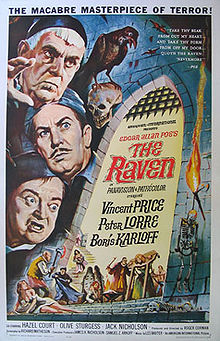
Classic Films in Focus: THE RAVEN (1963)

The Raven is certainly one of the most famous poems ever written in the English language, and it has earned a particular place of honor in the realm of popular culture, where everyone from John Carradine and James Earl Jones to John De Lancie and Christopher Walken has recorded a version of its irresistible lines. Roger Corman's loose adaptation of Edgar Allan Poe's iconic poem is more a lark than an "ominous bird of yore," but that won't stop fans of the poem or the horror director's work from enjoying this funny, star-studded horror-comedy.

Vincent Price stars as Dr. Erasmus Craven, a scholarly magician whose nightly studies are interrupted when a large raven seeks admittance to his home. The bird turns out to be Dr. Bedlo (Peter Lorre), another practitioner of the dark arts. Along with their respective offspring, Bedlo and Craven make a journey to the castle of a rival sorcerer, Dr. Scarabus (Boris Karloff), where the magicians enter into a deadly contest of supernatural skill.

While the stars of the film are some of horror's most prolific masters, The Raven relies primarily on comedy for its effect. The performers all seem to be having a good time, although Peter Lorre's hangdog looks and hilarious dialogue make him a real scene-stealer. Any viewer with an affection for Price, Lorre, and Karloff will enjoy this romp, although it's best to come at the picture with an expectation of campy pleasures rather than credible thrills. Scream queen Hazel Court plays Craven's supposedly dead wife, Lenore, but one of the most interesting casting choices in the film is the appearance of a very young Jack Nicholson as Lorre's son, Rexford. Nicholson had worked with Corman before in the original film version of The Little Shop of Horrors (1960), but seeing the three time Oscar winner as a handsome young fellow in tights is an opportunity not to be missed.

Fans of horror-comedy who enjoy The Raven might move on to other examples of the genre, including The Ghostbreakers (1940) and Abbott and Costello Meet Frankenstein (1948). If Corman's Poe pictures suit your tastes, try House of Usher (1960), Tales of Terror (1962), and The Masque of the Red Death (1964). You'll find Price, Lorre, and Karloff joined by the elegant Basil Rathbone in another delightfully macabre horror-comedy, The Comedy of Terrors (1963), directed by Jacques Tourneur. Richard Matheson, best known today for his often filmed novel, I Am Legend, wrote the screenplays for both The Raven and The Comedy of Terrors.

An earlier version of this review originally appeared on Examiner.com. The author retains all rights to this content.

Saturday, October 20, 2012

Classic Films in Focus: THE TOMB OF LIGEIA (1964)

 The last of Roger Corman’s series of Poe horrors, The Tomb of Ligeia (1964) has both admirers and detractors, although it often makes the lower levels of best-of lists of Corman’s films. In Corman terms Ligeia is a fairly restrained production, less inclined to morbidly humorous excess and more interested in subtle terrors evoked by encounters with the uncanny. As a Gothic thriller, The Tomb of Ligeia offers plenty of the conventional trappings of its genre, plus a particularly interesting double performance from Elizabeth Shepherd as both of the story’s central female characters. Corman’s favorite leading man, the inimitable Vincent Price, also stars in a characteristic role as the haunted anti-hero, and, as usual, his presence alone is enough to make the entire picture worthwhile.

The story concerns the doomed romance of high-spirited Lady Rowena (Shepherd) and reclusive widower Verden Fell (Price). From their first meeting, the two feel a powerful attraction to one another, even though Fell seems haunted by the memory of his dead wife, Ligeia (also played by Shepherd). Rowena marries Fell and tries to draw him out of his disturbing obsession, but it soon becomes clear that Ligeia’s power over him reaches far beyond the grave.


As usual, Corman treats Poe as an inspirational foundation but has little interest in strict adaptation, which might work in the film’s favor. The altered story provides Elizabeth Shepherd with not one but two juicy roles, and she succeeds admirably as both the lively Rowena and the deadly Ligeia. Transformed into a Gothic heroine, Rowena actively pursues and desires Verden Fell, while in Poe’s tale she is merely an unloved pawn in her family’s mercenary game. Price is thrillingly Byronic in his dark glasses and black suit, prone to fits of madness in the grip of his dead wife’s spell but struggling all the while to free himself and forge a new life with Rowena. As much as we want to see him gain the upper hand we know that the perverse sensibilities of Poe and Corman demand his destruction, and the feverish conflagration that concludes the picture is perfectly suited to the tastes of both.

The Gothic flavor of the picture owes a lot to its effective use of location, in this case the ruins at Castle Acre Priory near Swaffham, England. The outdoor scenes early on establish the sense of Fell’s home as a literal graveyard, a wrecked place where only the dead can thrive. The thrills introduced as the story progresses tend to be subtler, less gory affairs than one might expect; a fox’s corpse turns up in strange places, an evil cat lies in wait for Rowena, and a housemaid is unexpectedly transformed into a leering maniac. The film also introduces a blandly heroic counterpoint to Price in the person of John Westbrook, whose presence conforms to the conventions of the genre but adds little to the overall effect of the picture.

Try Tales of Terror (1962), The Raven (1963), and The Masque of the Red Death (1964) for more of Corman’s Poe adaptations. You’ll find Price in all of those films, but see his more dramatic turns in Laura (1944), Leave Her to Heaven (1945), and Dragonwyck (1946) for the sake of contrast. Elizabeth Shepherd, who was still working in 2009, is primarily a television actress. Get more Gothic thrills from classic films like Rebecca (1940), Jane Eyre (1943), and Gaslight (1944).

An earlier version of this review originally appeared on Examiner.com. The author retains all rights to this content.

Thursday, October 18, 2012

Interview with Vincent Price expert Jonathan Lampley

The Halloween season is the perfect time to talk about classic horror icon Vincent Price, who ranks among the all-time greats alongside Bela Lugosi, Boris Karloff, and Christopher Lee. In order to learn more about the star of classic thrillers like House of Wax (1953), The Fly (1958), and House on Haunted Hill (1959), I turned to horror movie scholar and lifelong fan Jonathan M. Lampley, a professor in the Humanities Department at Dalton State College and the author of the 2010 McFarland book, Women in the Horror Films of Vincent Price. He's also the co-author of The Amazing, Colossal Book of Horror Trivia (Cumberland House, 1999). Here's what Jonathan has to say about one of everyone's favorite classic horror stars.

VV: When did you first become a Vincent Price fan? What are some of your earliest memories of seeing him and his films?
 
You know, I can't remember a time when I was NOT a Price fan!  Usually I can remember when and where I was when I got into something; for example, I trace my interest in horror films to 1975, when I was about 8 years old and my parents bought me a copy of Thomas G. Aylesworth's kiddie book, Movie Monsters. Aylesworth went into the literary and historical origins of the various monster myths, so it was from him that I learned Dracula and Frankenstein were novels before they were movies.  Aylesworth also discussed the great horror stars, so he introduced me to Karloff, Lugosi, Cushing, Lee, etc.  Even after the passage of almost 40 years, I still recall knowing the name "Vincent Price" even if I did not know the other names in the book.

I have often wondered why I knew Price's name by the time I was 8, but I have no recollection of seeing any of his movies at that time.  Perhaps my older brother had something to do with it, as I remember him playing Alice Cooper's album Welcome to My Nightmare, which of course features Price's monologue on "The Black Widow," which also came out in '75.  It is also possible that I knew Price almost by osmosis, as he was on so many TV shows in the early 70s, and I have vague recollections of his appearance on The Brady Bunch around that time. I know in the late 70s I saw him on TV in The Abominable Dr. Phibes, Theater of Blood, Tomb of Ligeia, Masque of the Red Death, and many others.  Certainly I was a hardcore fan by 1979, when I saw Price live on stage in Diversions and Delights, which he did in Nashville at Vanderbilt University.  In fact, many years later I learned that Price came out and did a Q and A with the audience after the performance--but my mother and I didn't know he was going to do it, so we left at the end of the show.  I missed my chance to meet Price!  Again, though, I always knew who he was and always was interested in the actor.

VV: What made you particularly interested in looking at the women in Price’s horror movies?

Well, the book is an expansion of my doctoral dissertation, which looked at the women in Price's Poe adaptations.  I wanted to do something with classic horror for my dissertation, and even before I began writing it, I knew I wanted to publish it eventually. I started out thinking about doing something with Hammer Horror movies, and when I was considering possible approaches, I thought of focusing on the role of women in Hammer films. I don't remember exactly why I switched to the Price/Poe films, but it probably had something to do with the fact that there were already books about the women of Hammer, but nothing had been done about women in the Poe films. The more I watched and thought about the Price/Poe films and the ways women are portrayed in those pictures, the more I realized this was a topic that needed to be explored in depth.  As I point out in the book, women are portrayed as victims, vixens, and objects of veneration, often at the same time, in the Poe adaptations. When I approached McFarland about publishing the dissertation, I was told it was a little too short and needed to be expanded.  That's when I decided to look at women in all of Price's horror films, not just the Poe pictures.

VV: If you could recommend just one Vincent Price movie to readers, which one would it be? What makes that one an essential example?

That's a tough question! It's so hard to pick just one, but if I had to, I would pick The Abominable Dr. Phibes (1971).  It's my favorite of his horror films - in fact, after Horror of Dracula, it is my favorite horror movie, period!  I love the blend of horror and humor, and it is one of the relatively few scary movies set during the 1920s - even after 40 years, the costumes and sets are really cool. I have always been fascinated with the film's portrayal of the relationship between Dr. Phibes and his late wife, Victoria. In fact, my chapter on the Phibes films is my favorite in the book, but it was the hardest to write because I had so much to say about that relationship, and also Phibes' relationship with his lovely but mute female assistant, Vulnavia. There really do seem to be some interesting things going on in the subtext of those relationships!

Having chosen Phibes, though, I must admit that to really appreciate the film, you have to be familiar with Price's previous film work - and his public persona in general. The movie clearly borrows some of its ideas from previous Price movies, especially the Poe films. The idea of the Price character mourning his dead wife, still being fascinated with her - that had already been established as a trope in Price's career. The fact that Dr. Phibes is out for revenge is almost a homage to the revenge themes in House of Wax (1953) and many others.  And of course there are nods in the film to Price's reputation as an art critic and a gourmet chef. I know Phibes was one of the first Price movies I ever saw, and it has always been one of my favorites, but I think I only fully appreciated it after I had studied his life and works.

A part of me wants to pick another "desert island" Price movie, just as something to introduce future fans to his work, but something always makes me reject those other suggestions. Theater of Blood, for example, is a very, very close second favorite of mine - but its mixture of horror and humor is derived from Phibes, so at the end of the day I must choose Phibes first. The Poe films are obviously way up on my list, but which one is the quintessential Price movie?  My favorite of those would be The Conqueror Worm, but that wasn't even made as a Poe adaptation, really, and the others are just so evenly matched in terms of their strong and weak points that no clear winner emerges. House of Wax and The Fly are probably the most familiar VP movies - they certainly made the most money and were the ones most often cited in his obituaries - but as much as I like them, they just don't resonate in the same way Phibes does.

VV: Vincent Price has become such an icon of classic horror. Why do you think people react to Price so strongly, especially in horror roles?

I think Price became such a favorite because his horror star status came along at just the right time. His status had been slowly developing; remember that his earliest film roles included parts in such early shockers as Tower of London and The Invisible Man Returns. House of Wax was certainly a major turning point in his career in 1953, but an examination of his filmography reveals few other "scary movies" until 1958, when he did both The Fly and House on Haunted Hill.  By the time Price did House of Usher in 1960, he was firmly associated with the horror genre - a genre in which he found himself, incidentally, with few peers. Lugosi was dead by 1960, and Karloff hadn't made a major horror film in years. Karloff enjoyed a renaissance of sorts in the 60s, but I think interest in him was rekindled largely because of interest in Price. As much as I love Peter Cushing and Christopher Lee, and as influential as their films were in the late 50s and early 60s, their impact was always greater in Britain than in America.

Vincent Price was a "name brand" in this country, somebody my parents knew, even though they never watched horror movies. Price was such a fixture on TV and radio, and to a certain extent in print, that he really was a media superstar even without his horror films. He had a certain degree of fame among older fans because of his pre-horror career, and the 60s horror movies and TV roles introduced him to younger fans, so it was just a case of being in the right place at the right time and finding a way to exploit the opportunities that came his way.

Some critics have claimed that Price represents a sort of rebel figure that 60s-era young people related to; even though he was well into his middle years, there was something about Price that symbolized the youth movement of the time. Frankly, I think the Price characters more often than not represent the older generation; many of his performances are as characters who represent an obsolete way of life, such as the aristocratic types trying to hold onto their non-democratic way of life in 19th century America in House of Usher and especially Dragonwyck. I think young viewers in the 60s may have related more to the young protagonists in Price's Poe films. But at the end of the day, the #1 factor in Price's rise to fame seems to be his charisma and sense of humor, which shines through in so many otherwise serious performances. I don't agree with many critics who claim the actor didn't take his roles seriously; his best roles, even when there are comic overtones, demonstrate his sense of timing (comic and otherwise) and make wonderful use of his voice. Still, there is a twinkle in his eye in pretty much everything he did, and I think people of all ages were attracted to it - and some of us still are!

VV: Tell us about some of your other favorite classic horror movies and stars.

I must confess that Vincent Price is not my favorite horror star - he's #2 on my list, following very closely on the heels of Peter Cushing. My affection for Peter Cushing is largely a matter of timing; he was in Star Wars, which I saw on its original release, and that film really cemented my love not just for fantasy, sci fi, and horror, but for film in general. Star Wars changed my life, and I think the fact that Cushing was in it made me such a hardcore fan. Of course, it also is true that I became a rabid Hammer Horror fan in the middle and late 70s, and Cushing is such an icon of those pictures. Of all the horror movie stars, I think Cushing is the one who most often gave 100% - no matter how crappy the movie might be or how small the role. Cushing's face, particularly his eyes, were so good at conveying evil and villainy, but they were also perfect for conveying goodness and heroism. I am always impressed when my film students react to him - these young folks, some of whom were born after Cushing's death, somehow seem to relate to him more than the other Horror Heroes, at least based on the few films I have time to show during a semester. And as I mentioned before, Horror of Dracula has been my favorite horror film - my favorite film, period, quite honestly - for decades.

Obviously, this means I love Christopher Lee as well! I am so glad he's still around, still making movies in his 90s! I am also glad that directors like Peter Jackson and Tim Burton are using Lee and introducing him to a new generation of fans. Lee is also getting the honors for his career that the other Horror Heroes never dreamed of - his knighthood, for instance, represents to me a sort of indirect acknowledgement of the contributions to the entertainment industry made by Cushing, Karloff, Rathbone, and many other fine British performers. The same goes for his Lifetime Achievement Award from the British Film Institute. I just hope the Academy Award will honor his work before it's too late! I met Lee briefly back in 1999, so that's a highlight of my film fan career!

I also love the work of Bela Lugosi, whom I think is a seriously underrated actor. I definitely prefer him to Karloff, even though Karloff's movies tend to be better. Frankly, as much as I love Karloff, he phoned in a lot more performances than Lugosi. I am quite proud of my familiarity with old horror movies, and even I can't tell Karloff's "mad doctor" films from the 30s and 40s apart!  Of course, when Karloff was on his game, as in the Frankenstein films or The Mummy or Targets, he's nothing short of amazing.

I am less familiar with the Chaneys, especially Lon Sr., many of whose films are now lost, but I like them as well. I suppose I should list some other favorite classic horror films to your readers, so here goes: The Flesh and the Fiends (Cushing and Donald Pleasance), The Wicker Man (the original with Lee), Island of Terror (Cushing), The Human Monster (Lugosi), Son of Frankenstein (Karloff, Lugosi, Rathbone, and Lionel Atwill), Tower of London (Karloff, Rathbone, Price), Tomb of Ligeia and The Masque of the Red Death (both with Price), The Haunted Palace (Price and Chaney Jr), and one of my very favorites, the criminally underrated cult film Scream and Scream Again (with Price, Lee, and Cushing).

VV: What other books about classic horror movies can you recommend to readers?

The trivia book I wrote with Ken Beck and Jim Clark is the closest thing to those big old picture books of my childhood, as it contains a lot more information than just trivia, but it has been out for a few years. I strongly recommend David J. Skal's books, especially Hollywood Gothic and The Monster Show, as Skal is sort of the dean of classic horror movie experts these days, and a mighty fine writer as well. There are a few other books about Vincent Price; the ones I recommend most highly are the biography his daughter Victoria wrote and Dennis Meikle's excellent study from 2003. My single favorite horror movie book of all time is David Pirie's A Heritage of Horror, which came out in 1973 and was really the first serious study of British horror movies. A great book and highly influential, even though Pirie for some reason called Phibes the worst British horror film made since 1945! Pirie revised and expanded the book in 2008, and I noticed he took the anti-Phibes comment out of the new edition! Jonathan Rigby has two great books, English Gothic and American Gothic, that I highly recommend. I also suggest scouring used bookstores and eBay for copies of those great old picture books from the 70s: anything by Dennis Gifford, Alan Frank, Everson, and Clarens is worth reading. And if you have younger fans in the house, consider finding copies of Tom Aylesworth's books. Look what they've done for me!

VV: How does an expert on classic horror movies celebrate Halloween? Any special plans this year?

Actually, I will be doing a book signing at Dalton State College, where I teach English and film, and I will also be running a horror/Halloween trivia game. It should be lots of fun!

Jonathan's books are available at online at booksellers like Amazon and Barnes & Noble.com, and you can also get Women in the Horror Films of Vincent Price on Kindle. Both books make great Halloween treats (or Christmas gifts) for serious horror fans!

Tuesday, September 18, 2012

10 Classic Movies Inspired by Edgar Allan Poe


Quoth the raven, "Nevermore!"

Movies and shorts inspired by the works of Edgar Allan Poe first appeared during the silent era, but Poe’s greatest age came in the 1960s, when Roger Corman made the author his macabre muse for a series of cult horror classics. With Vincent Price as his leading man, Corman defined the Poe movie canon for generations of horror fans. Here are ten classic movies inspired by Poe’s works, with special emphasis on the Corman pictures.

The Black Cat (1934) – Universal monster stars Boris Karloff and Bela Lugosi head up the cast in this hit film from the golden age of classic horror. Like most movie “adaptations” of Poe’s work, the story takes many liberties with the original text and functions more as a tribute to Poe’s influence than a strict translation.

The Raven (1935) – Following on the success of the 1934 picture, this Universal horror treatment again teams Karloff and Lugosi in the lead roles, although the story is once more really a tribute to Poe’s work than an actual adaptation of it.

The Black Cat (1941) – Well-known stars like Basil Rathbone, Broderick Crawford, and Bela Lugosi appear in this adaptation from Universal Pictures and director Albert S. Rogell.

House of Usher (1960) – Corman’s first Poe movie stars horror favorite Vincent Price as Roderick Usher. While Corman’s film is more faithful to Poe than many other pictures, the story still makes major changes to the plot of the original tale, including a romance between the house guest and Madeline Usher.

Pit and the Pendulum (1961) – Richard Matheson wrote the screenplay for this Corman adaptation of one of Poe’s best-known tales, which stars Vincent Price, John Kerr, and Barbara Steele in the leading roles.
 
Premature Burial (1962) – Ray Milland and scream queen Hazel Court star in this Corman production, the only Poe picture not to star Vincent Price. 

Tales of Terror (1962) – Richard Matheson once again contributes the screenplay for Corman’s anthology of shorts inspired by several Poe tales, including “The Black Cat,” “Morella,” “The Cast of Amontillado,” and “The Facts in the Case of M. Valdemar.” The teaming of Peter Lorre and Price for this picture’s version of “The Cask of Amontillado” is a highlight for fans.

The Raven (1963) – This horror comedy from Corman unites Vincent Price with Boris Karloff, Peter Lorre, and Hazel Court for a rather silly but fun take on Poe’s most famous poem. A young Jack Nicholson also appears as Peter Lorre’s son.

The Masque of the Red Death (1964) – Vincent Price and Hazel Court star in yet another Corman film, which also incorporates elements from a different Poe story, “Hop-Frog.”

The Tomb of Ligeia (1964) – Price stars with Elizabeth Shepherd in the last of Corman’s Poe pictures, this time a story of obsession that reaches beyond the grave. The outdoor location shots early in the movie set this picture apart from the earlier Corman productions.

While The Haunted Palace (1963) is often listed with the Poe films, and its title is taken from a poem featured in “The Fall of the House of Usher,” the story actually comes from H.P. Lovecraft. Still, you’ll find Vincent Price teamed up with Lon Chaney, Jr., Elisha Cook, Jr., and Debra Paget in this bonus “Poe picture” from Corman.

An earlier version of this article originally appeared on Examiner.com. The author retains all rights to this content.