Showing posts with label murder. Show all posts

Tuesday, March 18, 2025

Classic Films in Focus: SUPERNATURAL (1933)

As you might expect from its title, Supernatural (1933) is a spooky Pre-Code horror story, full of restless spirits, murderers, and over the top atmosphere that plunges the viewer into a fever dream semblance of a plot. It boasts notable stars, with Carole Lombard and Randolph Scott as the young couple endangered by a pair of sinister characters straddling both sides of the grave, but, honestly, it's the sheer giddy weirdness of the movie that makes it so entertaining. I can't tell you that Supernatural is a great movie, or even a good one, but I can say that I had a lot of fun watching it, and sometimes that's more than enough. If you're looking for more female monsters to add to your annual round of Halloween classics alongside Dracula's Daughter (1936) and Cat People (1942), Supernatural offers up a doozy with its ghostly femme fatale.

Carole Lombard stars as pretty heiress Roma Courtney, whose twin brother (Lyman Williams) has recently died. In her grief, Roma makes an easy target for sham medium Paul Bavian (Alan Dinehart), who claims that her brother's restless spirit wants to speak to her. At the same time, Roma's family friend, Dr. Houston (H.B. Warner), has a theory about the malevolent souls of evil people remaining active after death, and to test it he conducts experiments with the body of executed strangler Ruth Rogen (Vivienne Osborne). Unfortunately for Roma, Ruth's spirit manages to possess her in order to get revenge on the former lover who ratted Ruth out to the police, who is none other than Paul Bavian.

Pre-Code status lets Supernatural engage in more death, sex, and violence than a later production could have dared to include, which makes it fascinating to watch even when it falls apart as a narrative. It revels in its lady strangler's crimes, trial, and execution, all of which open the picture as a montage accompanied by a chorus of marvelously eerie wails. Later scenes involve onscreen murders with actors really making the most of their death scenes; my favorite is the conniving landlady (Beryl Mercer), whose early demise tells us a lot about her tenant's true nature. We also get some startling scenes of Ruth's corpse in Dr. Houston's laboratory, which aren't gruesome or gory but still not the kind of thing you'd be likely to see after 1934. There's little romance to speak of, as Randolph Scott mostly stands around in a tux like a handsome statue, but the intimate encounter between the possessed Roma and the unsuspecting Bavian is both racy and unsettling. 

Lombard draws attention as the most famous star with the biggest role, especially because horror is not her usual territory, but I'm more struck by Vivienne Osborne's performance as the murderess. She doesn't get as much screen time as Lombard, being dead and an invisible ghost through most of the movie, but when we do see her she really owns the role. She laughs, weeps, and rages with the abandon of the damned, as monstrous in her own way as Claude Rains' Invisible Man or Fredric March's Hyde. We don't often get female villains as unhinged as Ruth Rogen in classic movies, and we certainly don't see a lot of women who compulsively strangle their lovers with their bare hands. Although she started her career in silent films and successfully made the transition to talkies, I've only seen Osborne in one other picture, her swan song appearance in Dragonwyck (1946), and I thought she made the most of a small role there, as well. 

Director Victor Halperin also made the 1932 Bela Lugosi chiller, White Zombie, and Revolt of the Zombies (1936). Lombard, of course, would go on to make comedy classics like Twentieth Century (1934), My Man Godfrey (1936), and To Be or Not to Be (1942). Although Randolph Scott is best remembered for Western roles, you can also catch him in the very weird thriller, Murders in the Zoo (1933) and the 1935 adaptation of H. Rider Haggard's She. Scott and Alan Dinehart both appear in the Shirley Temple picture, Rebecca of Sunnybrook Farm (1938), while Beryl Mercer makes her own appearance with Temple as Queen Victoria in The Little Princess (1939), a role she repeats in The Story of Alexander Graham Bell (1939). 

Wednesday, January 29, 2025

Classic Films in Focus: ROPE (1948)

Rope (1948), Alfred Hitchcock's first color picture, is a twisting, carefully orchestrated thriller with a deceptively simple title, one that is as much about the killers as the murder weapon they wield in the film's opening shot. There's no air of mystery hovering over the claustrophobic confines of the single room where the action unfolds; instead, this story revels in the audience's full knowledge of the crime, tormenting us with information we possess but cannot share with the party guests drinking their champagne over the corpse of their murdered loved one. The film's gruesome appeal depends mainly on its theatrical visual style and the tightly wound performances of John Dall and Farley Granger as the handsome young killers, although James Stewart gets top billing as their former mentor and increasingly suspicious house guest.

The story opens with Brandon (John Dall) and Phillip (Farley Granger) strangling their classmate David (Dick Hogan) and then hiding his body in a large trunk in the middle of their living room. Eager to prove their intellectual superiority and gloat over the crime, Brandon insists on hosting a party immediately following the murder, with David's friends and family in attendance. David's father, Mr. Kentley (Cedric Hardwicke), and girlfriend Janet (Joan Chandler) grow uneasy over David's uncharacteristic absence, but only the boys' old house master begins to grasp the horrible truth.

Dall and Granger work the queer subtext of their relationship with tremendous skill, with Dall's Brandon very clearly the leader of the couple and Phillip only slowly coming to realize the nature of the monster he loves and obeys. Does Brandon love Phillip in return? Is Brandon capable of such a human emotion? Both actors are fascinating to watch as they reveal their characters' psychological states. The subtext implies that Brandon also has a particular connection to Rupert Cadell, presumably romantic in nature, but here the casting of James Stewart throws a spanner into the works. I've always felt Stewart to be miscast in the role, and that continues to be my view after my most recent return to the movie. Hitchcock's later collaborations with Stewart brilliantly evoke the actor's capacity for darkness, but this first outing shows the limits of Stewart's ability. Even Stewart felt he was out of place in the part, although he said he didn't think he was credible as an academic, not that he couldn't imagine himself as a closeted gay man who had indulged in a romantic tryst with one of his students. I think that an actor like George Sanders, Claude Rains, James Mason, or Cary Grant (who was Hitchcock's first choice for the role) would have made a more interesting and believable Rupert, but the role certainly had an impact on Stewart's later career. For more observations on that topic, read Chloe Walker's 2023 Paste article,  "Rope Was a Cruel, Prickly Turning Point in Jimmy Stewart's Career."

The single set and real-time pacing of the picture are the other noteworthy elements for discussion, with long takes that heighten the feeling of watching a stage play rather than a movie. These techniques intentionally make us feel trapped in the room; we can't get away from the chest and its terrible contents, and neither can Brandon and Phillip, as much as they might talk about their plans to leave town as soon as the party ends. Psychologically, neither of them will ever be able to leave that room, and when the truth comes out the other party guests will forever be haunted by it, as well. We might think, at the beginning, that the murder is the worst possible moment, but for everyone except David it's the aftermath that really turns the screws. Every time Phillip sees the rope again he comes a bit more unglued, but Brandon can't resist the urge to flaunt their crime, practically daring Rupert to confront them. Each reappearance of the rope symbolizes another bit of the crime being let out, until the murderers finally offer enough to hang themselves. It's both terrible and fascinating to watch, thrilling even though so little actually happens onscreen.

Hitchcock's later work with James Stewart in Rear Window (1954), The Man Who Knew Too Much (1956), and Vertigo (1958) would give the actor some of the most iconic roles of his long career, and Farley Granger also gets another outstanding role from Hitchcock in Strangers on a Train (1951). John Dall is particularly remembered as half of another murderous couple in Gun Crazy (1950), although his screen debut in The Corn is Green (1945) earned him an Oscar nomination for Best Supporting Actor. If you enjoy the limitations of the single set approach, be sure to see Hitchcock's earlier film, Lifeboat (1944), which traps all of its characters at sea in a small, cramped boat.

Tuesday, August 29, 2023

Classic Films in Focus: LADIES IN RETIREMENT (1941)

If Arsenic and Old Lace (1944) were a tragic drama instead of a screwball comedy, it might play out something like Ladies in Retirement (1941), in which a desperate young woman goes to extreme measures to protect her psychologically complicated sisters. We talk about insanity and mental health very differently today, as well we should, but the trope of the mad woman (or women) has a long history in literature and film, and in Ladies in Retirement we get a profoundly moving depiction of the type from both Elsa Lanchester and Edith Barrett, who play the two older sisters of Ida Lupino's grimly determined anti-heroine. Director Charles Vidor keeps the suspense brewing even though there's very little mystery about the story's central murder, while sharply defined performances from the stars and supporting cast members Louis Hayward, Evelyn Keyes, and Isobel Elsom draw us into multiple tangled webs of desire and deception.

Lupino leads the cast as paid companion Ellen Creed, who struggles to keep her difficult sisters out of an asylum or worse. Gentle Louisa (Edith Barrett) is a harmless chatterbox, but Emily (Elsa Lanchester) is prone to outbursts and mischief, and soon enough Ellen gets an eviction letter from the landlady in London where the two sisters have been living. Ellen deceives her wealthy employer, Leonora Fiske (Isobel Elsom), into letting the sisters stay with them in the country, but Leonora soon tires of the troublesome guests and insists that they depart. After Leonora mysteriously disappears for a sudden trip abroad, the sisters seem to be settling into the house for good, but the arrival of a charming, amoral cousin named Albert Feather (Louis Hayward) puts Ellen's schemes in danger.

Ladies in Retirement offers a feast of fascinating characters, with actors who know how to hold their own against scene stealers like Lanchester and Barrett. Both of those gifted character actors play their roles with sensitivity that tempers the more outlandish quirks of the sisters, and we sympathize with Ellen's desire to protect them. The aunts of Arsenic and Old Lace are comical figures, but Louisa and Emily grieve us because they cannot comprehend the tragedy of their situation or the despair to which they drive their devoted younger sister. Louis Hayward, who was married to Lupino when they made this picture, brings both menace and charisma to the cad Albert, although it's ironic that his romantic overtures in this story are directed at the gullible maid, Lucy (Evelyn Keyes), and never at Lupino's more skeptical protagonist. Isobel Elsom's temperamental Leonora is more like the sisters than she'd care to admit; it's easy to see why Ellen is so good at dealing with her but also pushed to the limit by having three difficult older women all making demands of her in one small house.

With its Victorian setting and Gothic mystery atmosphere, Ladies in Retirement might seem like a classic tale of suspense, and a very good one at that, but it's also a serious engagement of the limited options available to unmarried women and caregivers struggling with their dependents' mental instability. The Creed sisters have no brothers or husbands to support them in a deeply patriarchal society that also makes no provisions for the humane care of mentally ill people. Ellen is a woman with no good choices in front of her, and the film dares us to judge her harshly for the course of action she takes. Some of Ellen's problems are specific to the time and place of the story, but even today older, unmarried or widowed women are more likely to suffer poverty and become homeless or dependent on overstretched family members (also more likely to be women). As I watched the film, I couldn't help but think about this NPR piece from 2016 about older women who had lost their homes and were reduced to living in their cars. What would happen to Louisa and Emily today? What would Ellen be forced to do in order to care for them? These questions give Ladies in Retirement currency and encourage us to think very carefully about the bonds and boundaries of familial devotion. 

The inspiration for the original stage version of Ladies in Retirement was apparently the 19th century French murderer Euphrasie Mercier, whose brief history makes a great read for true crime fans. A 1969 remake called The Mad Room stars Stella Stevens and Shelley Winters, but it's a more typical horror film that adds extra murders and gore. For other intense performances from Ida Lupino, see They Drive by Night (1940), The Hard Way (1943), and Devotion (1946). Ladies in Retirement would be the last screen appearance of Louise Hayward before several years of service in the US Marine Corps during World War II. His marriage to Ida Lupino ended in 1945, the same year he returned to films with his role in And Then There Were None.


Wednesday, July 19, 2023

Classic Films in Focus: THE MAD MISS MANTON (1938)

Although it's not on the same level as their later collaboration, The Lady Eve (1941), The Mad Miss Manton is still an amusing outing for stars Barbara Stanwyck and Henry Fonda. It's a goofy mix of romantic comedy and murder mystery, with Stanwyck leading a pack of socialite sleuths and Fonda falling head over heels as a reporter who gets entangled in the titular Miss Manton's adventures. You won't find a lot of household names here beyond the two leads, but Leigh Jason directs a fairly large cast that includes Sam Levene, Stanley Ridges, Penny Singleton, and the always memorable Hattie McDaniel. Fans of Fonda's funny side will especially appreciate his silly antics in this picture, but Stanwyck's all-girl Scooby gang also proves delightful, even if they're a little too prone to fainting when they find a corpse.

Stanwyck stars as wealthy socialite Melsa Manton, who discovers a murdered man while walking her dogs late one night after her return from a costume party. Her reputation and costume make the cops doubt her report, especially when the corpse in question has disappeared, but Melsa enlists the help of her society girlfriends to search for clues. At the same time, Melsa enters a war with newspaper reporter Peter Ames (Henry Fonda) because of his printed tirades against her and her group, but Peter's ire turns to adoration once he meets Melsa in person, even as he continues to frustrate her schemes. With the suspects and corpses piling up, Melsa and Peter must help the beleaguered Lieutenant Brent (Sam Levene) catch the murderer before Melsa becomes the next victim.

The Mad Miss Manton is not a comic masterpiece, but it moves along briskly and lands enough laughs to be entertaining throughout. It can be hard to differentiate Melsa's gang of friends, who might have more individual development if there were just three or four of them instead of a crowded half dozen. On the plus side, the picture passes the Bechdel-Wallace Test with flying colors as the women scramble to find clues and track suspects. Hattie McDaniel has a much larger role than any of the other supporting women, and she makes the most of it even though she's playing another of her inevitable maid characters. The film does, at least, depict McDaniel's Hilda as a sensible, capable person in contrast to the giddy socialites around her. 

Although Stanwyck's Miss Manton is much saner than the title of the movie implies, she doesn't let anything stop her from pursuing the case, even the death threats the murderer makes to scare her off. She has a general's command over her group of friends, who complain about their lost meals and dates but always follow her orders. Fonda's newspaper reporter is by far the giddier of the pair; he is absolutely smitten from the moment he meets Melsa, which leads him into some truly silly situations. One highlight is the scene in which Peter fakes being on his deathbed in order to trick Melsa into revealing information she has uncovered about the murders. The chemistry Fonda and Stanwyck share here paves the way for the sparks that fly between them in The Lady Eve, and if you enjoy them together in that classic then The Mad Miss Manton is well worth your time.

Barbara Stanwyck and Henry Fonda made one additional movie together, the 1941 romantic comedy You Belong to Me. For more of Stanwyck's comedy roles, see Ball of Fire (1941) and Christmas in Connecticut (1945). You'll find her solving another comic mystery in Lady of Burlesque (1943). For Fonda's lighter side try The Male Animal (1942), Rings on Her Fingers (1942), and The Magnificent Dope (1942), as well as later career roles in Yours, Mine and Ours (1968) and The Cheyenne Social Club (1970).

Thursday, February 9, 2023

Classic Films in Focus: THE SUSPECT (1944)

Warning: This review contains spoilers for The Suspect (1944).

Director Robert Siodmak weaves Victorian sensibility with noir energy in the justifiable homicide story of The Suspect (1944), which sees a mild-mannered Charles Laughton driven to murder by his extremely disagreeable wife. It's an unusual tale in that it pitches our sympathies toward the murderer throughout, even though we know the Hays Code won't let the picture - or its protagonist - get away with the crimes. Laughton, equally adept at comedic and horror roles, here plays an amiable working man who never stops being likable even as the corpses pile up. Ella Raines gives a sweet performance as the young woman whose affection ironically plunges the protagonist into violence, while Rosalind Ivan and Henry Daniell are delightfully horrible as the two antagonists who threaten him to their peril.

Laughton stars as Philip Marshall, a pleasant middle-aged man who manages a cigar store and does his best to placate the wrath of his hectoring, hateful wife, Cora (Rosalind Ivan). After Cora drives away their son, Philip takes comfort in a new friendship with pretty, young Mary (Ella Raines), but his hopes for a second chance at happiness are dashed when Cora refuses to give him a divorce. Cora's threat to ruin both of the lovers by publicly exposing them proves too much for Philip, but his snap decision to take drastic action has unexpected effects, especially when his abusive, alcoholic neighbor, Mr. Simmons (Henry Daniell), sees an opportunity for blackmail.

The success of this picture relies very much on Laughton's ability to play a truly kind, sympathetic man who is also believably capable of outright murder. Philip Marshall is no smiling sociopath like Joseph Cotten's character in Shadow of a Doubt (1943), nor is he incompetent once he commits to the deed. It helps that Cora and Mr. Simmons are so thoroughly rotten that even a saint might be forgiven for wishing them dead. Cora is unhinged enough that she doesn't seem to realize or care that ruining Philip's career would put her in the poorhouse, too; she means to torment him until death do them part. The revelation that Mr. Simmons beats his long-suffering wife (Molly Lamont) makes Philip and the audience hate him long before the blackmail attempt, as ironic as that seems when we consider that Mr. Simmons doesn't actually murder his wife. The Scotland Yard detective, Inspector Huxley (Stanley Ridges), enters this story as a most unwelcome pest; he's determined to prove Philip's guilt but doesn't care at all about the circumstances or the consequences. He might not be a corrupt cop, but he's willing to tell lies, set traps, and ruin lives without a moment's hesitation because he believes in his own moral superiority.

Touches of romance and comedy constantly lighten the mood to remind us of Philip's essential decency and the happiness he and Mary might enjoy if only fate would deal them a better hand, but there are fully realized moments of thrilling noir tension, too. Some of the sweetest scenes feature Raymond Severn as the errand boy, Merridew, whom Philip treats with paternal affection. The mix of moods also leads to black comedy, including a perversely entertaining sequence where Philip attempts to hide a body behind a couch while also entertaining unexpected guests. Laughton carries all of it beautifully, even the tenderest scenes with Raines, which might easily be rendered ridiculous by the difference in their ages and Laughton's cherubic curls atop a round, sad face. The ending might not offer what the audience really wants, but it's as gentle as possible given the inevitable conclusion to Philip's experience, and it leaves some poignant questions hanging in the air. Can you forgive a murderer depending on who they murder and why? How does that change the nature of justice and who gets it? What does the end of the story mean for Mary, or Mrs. Simmons, or Philip's adult son, John? The Suspect is the kind of murder story that begs for group viewing and discussion.

Robert Siodmak's other films from the 1940s include classics like Phantom Lady (1944), The Spiral Staircase (1946), and The Killers (1946). Charles Laughton won the Oscar for Best Actor for his performance in The Private Life of Henry VIII (1933) and was nominated again for Mutiny on the Bounty (1935) and Witness for the Prosecution (1957), but be sure to see him in Hobson's Choice (1954), too. Ella Raines also stars in Phantom Lady, The Strange Affair of Uncle Harry (1945), The Web (1947), and Brute Force (1947). If you like mild-mannered men embroiled in murder, pair The Suspect with The Woman in the Window (1944) or Scarlet Street (1945), both starring Edward G. Robinson.


Wednesday, February 16, 2022

Trek Noir: Out of the Past in Deep Space Nine's "Necessary Evil"

Note: This post contains plot spoilers for the Deep Space Nine episode, "Necessary Evil"


I'm currently making my way through the entirety of the Star Trek TV series, Deep Space Nine, which I never got to watch regularly during its first run, and so far it has been a richly rewarding experience. While all of the episodes have their merits, I was especially struck by Season Two's eighth episode, titled "Necessary Evil." This one stands out from the others and from most of the older Star Trek shows for its serious - and successful - evocation of classic film noir to tell a dark, duplicitous story about events that unfold before the Cardassians leave Bajor and the Federation takes charge of the space station. While the Star Trek universe is traditionally a positive space with an optimistic vision of the future, this episode uses the tropes of classic noir to investigate the dark past that haunts Deep Space Nine, and it calls into question the motives and relationships of some of its most complex characters.

The Next Generation crew in "The Big Goodbye"

Star Trek shows have been playing with genre since the original series, but the sensibility of true noir is at odds with the core values of the Trek universe. When The Next Generation ventures into noir territory in the first season episode, "The Big Goodbye," it does so as a holodeck adventure with Captain Picard adopting the role of fictional private eye Dixon Hill, a figure very much inspired by Humphrey Bogart as Dashiell Hammett's iconic Sam Spade in both the book and film versions of The Maltese Falcon. The holodeck story is intended to be a nostalgic amusement for Picard and his friends, but an external event causes the safety protocols of the holodeck to disengage, thus thrusting the crew members into a more dangerous adventure than they had expected. While the episode includes real peril for the crew, the noir element of the experience is artificial and contained, and it is also pointedly self-conscious, an homage to noir rather than an embodiment of it.

Such is not the case on the Deep Space Nine episode, where a dark past of Cardassian control and Bajoran resistance creates opportunities for a noir plot that exists as part of the characters' reality. It's not surprising that a series with persistent connections to Casablanca (1942) might see the shadowy world of noir as fruitful territory to mine for narrative; the show even gets around to a blatant revision of Casablanca later in Season Two with the episode, "Profit and Loss" (with Quark, of course, as the stand-in for Bogart's bar owner Rick). In "Necessary Evil," the series takes us back and forth between its past and present to explore what life on the space station was like before the Bajoran liberation, which also evokes shades of Casablanca and the Nazi Occupation. That past is a dark place, where everyone's motives are suspect and our core characters meet for the first time under grim circumstances. It's a perfect setting for a very unusual example of tech noir, the (literal and figurative) space where noir and science fiction meet.
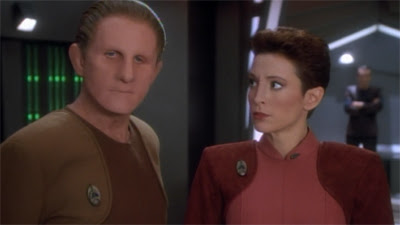
"Necessary Evil" focuses on the past between Odo and Kira.
 

The story opens in the present, when Quark is hired to retrieve a hidden, valuable item for an attractive Bajoran widow. Quark then becomes the victim of an attempted murder, and security chief Odo sets about uncovering Quark's assailant. His investigation takes him back to his first case on the station, when the Cardassian Gul Dukat assigned him to solve the murder of the widow's husband, a Bajoran merchant. The lead suspect in that case turned out to be the Bajoran Kira, then newly arrived on the station but now Odo's friend and colleague in the present. As Odo tries to uncover the present crime he begins to understand more about the murder from the past, but his realizations threaten his relationship with Kira.

Unlike Captain Picard in "The Big Goodbye," Odo is an unwitting noir protagonist and utterly unsentimental about the past, whether fictional or real. As an alien shape-shifter with no knowledge of his own home planet or people, Odo is a perfect noir lead - alone, aloof, cynical, and observant by necessity. He provides a classic noir narration of events only because Commander Sisko has asked him to create a record of the investigation. His failure to solve his first case haunts Odo, making him determined to solve not only the present crime but also the original murder. Gul Dukat claims that Odo is an ideal agent of justice in this case because his outsider status makes him neutral to both the occupying Cardassians and the subjugated Bajorans, but that neutrality is as questionable as Gul Dukat's explanation for Odo's assignment. Odo does, however, have a strong and clearly stated interest in justice, which makes him dogged in pursuit of the guilty parties in both the past and the present.

A Ferengi and a femme fatale meet in "Necessary Evil."

The character who most complicates Odo's sense of justice is Kira, the Bajoran woman who arrives at the station just before the original murder and is set up with the hallmarks of noir's good-bad girl and mystery's red herring (see Andrew Spicer's book Film Noir for a discussion of the genre's good-bad girl type). The widow claims that Kira was having an affair with her husband and is thus the obvious suspect, but the present tense crime has already depicted the widow as a classic femme fatale, so we, the audience, don't trust her. Kira denies the affair but eventually confesses to Odo that she is a saboteur for the Bajoran resistance and could not have committed the murder because she was busy causing damage elsewhere at that time. Odo protects Kira from Gul Dukat and leaves the murder unsolved, a situation that drives him all the more when the attack on Quark recalls the earlier crime. Finally, in the present, Kira reveals to Odo that she did, in fact, kill the Bajoran merchant when he discovered her trying to steal the same list of Bajoran collaborators that the widow hires Quark to find. The twist ending reveals Kira to be a better liar, and a less reliable associate, than Odo imagined, and it's not clear if he's more shocked by her duplicity or his own credulity. The episode concludes with the relationship between the two unresolved and the future of their friendship uncertain. It's a very noir ending for the episode even if both of the major characters remain alive and still working on the station afterward.

Everything else about this episode contributes to its noir sensibility. The scenes in the past use dark, blue lighting to cast shadows and uncertainty over the characters, while the other characters around Odo and Kira also fall into classic noir types, including Quark as the petty criminal in over his head and the widow as a beautiful femme fatale, complete with white evening gown and seductive manner. Odo's voice over narration, a staple of the genre, helps us navigate the shifts between past and present, but the two markedly different visual styles make the time periods quite distinct already. Gul Dukat, technically Odo's client in this investigation, has ulterior motives that he does not disclose, and the viewer comes away with the sense that "justice" is really a slippery idea. The smaller problems - who killed the merchant and who attacked Quark - might be solved, but larger and more unsettling questions persist. The episode presents, in abbreviated form, all the characteristics of classic noir, and it never winks or tips its hand about doing it. There's nothing cute about "Necessary Evil," which is part of the reason it's so good.

If you're interested in the particular pleasures of tech noir, check out film-length examples like Blade Runner (1982), Dark City (1998), and Minority Report (2002). If you're a Star Trek fan new to classic noir, start with iconic favorites like The Maltese Falcon (1941), Double Indemnity (1944), and, as my post title suggests, Out of the Past (1947).

Wednesday, January 22, 2020

Cozy Up with Acorn TV

When I'm not watching movies, there's a 90% chance that I'm watching a cozy murder mystery. I'm obsessed with them; I read a lot of cozy mystery series and enjoy them, but I love seeing the characters and stories embodied in television series. For the most part, the murder mysteries that I like best hail from the UK, Australia, and New Zealand. I'm not a fan of dark police procedurals or crime shows "ripped from the headlines." I want a cast of quirky, interesting characters, a distinctive and detailed sense of place, and an unusual murder (or three) for the audience to solve along with the detectives. Thankfully, the streaming service Acorn TV dishes up a wide variety of cozy mystery series from several different countries.

UK offerings include the venerable and beloved Midsomer Murders and the adorably quirky Agatha Raisin. I've watched every episode of Midsomer so far, but if you're new to it you've got enough entertainment ahead to last most of 2020. The show is famed for its dry sense of humor and hilariously dreadful murder methods (hint: never go on holiday in Badger's Drift!). Agatha Raisin has a delightful Scooby gang vibe with middle aged romance added to the mix; the relationships between characters on the show are dynamic and interesting without being maudlin. With only one season so far, Queens of Mystery is a newcomer that started very strong and has lots of room for future development, and its particularly knowing treatment of the genre is great fun for cozy fans. The British fare also includes a solid collection of Agatha Christie adaptations, especially the excellent Agatha Christie's Marple, featuring first Geraldine McEwan and then Julia McKenzie as the iconic sleuth.

Australia is ably represented by Miss Fisher's Murder Mysteries, starring the fabulous Essie Davis as a 1920s private detective who lives and loves with equal abandon. Adapted from a wildly popular book series (I've read them all, and they're terrific), the Miss Fisher series is currently getting a second life with a feature film sequel that should appear on Acorn later in 2020. A spin-off, called Miss Fisher's Modern Mysteries, is also available on Acorn, with Geraldine Hakewell as a relative of the original Miss Fisher living in the 1960s. I enjoyed the spin-off but wasn't quite as enchanted by it as the original show, perhaps because the four episode series had less time to develop all of the interesting supporting characters. If you're looking for a particularly funny Australian murder series, Acorn also offers all 13 episodes of the tragically short-lived Mr. and Mrs. Murder, in which married crime scene cleaners solve murders and get entangled in ridiculous situations along the way.

My last recommendation hales from New Zealand, where police detective Mike Shepherd (Neill Rea) solves murders in The Brokenwood Mysteries. Great leads, lots of fun recurring characters, and gorgeous scenery make this series one of my current favorites, with new episodes dropping on Acorn each week as the latest season is released. The show has a surprisingly strong first episode that hooks the viewer immediately, and later seasons build on that solid foundation. If you've exhausted Midsomer Murders and want something with the same mix of dry humor, murder, and detective work, this New Zealand show is the perfect choice.

Acorn TV has dozens of mystery series and other programming to choose from, but these are the shows I have especially enjoyed since I first subscribed to the streaming service in 2019. With new shows and seasons regularly appearing, Acorn has been well worth the cost of $6 a month or $60 a year. Do check it out if you're looking for great cozy mysteries to keep you warm through the winter!


Disclaimer: I am in no way affiliated with Acorn TV and received no payment of any kind for this post.