Showing posts with label Judith Anderson. Show all posts

Thursday, September 28, 2017

Classic Films in Focus: KINGS ROW (1942)

Mixed reviews are often the hardest ones to write, and I have mixed feelings about Kings Row (1942), the Sam Wood drama adapted from the controversial novel by Henry Bellamann. I think, ultimately, the film is useful as an example of the ways the Hays Code could undermine the purpose of an artistic work in its relentless censorship of any really serious engagement of complicated issues, especially those involving sex. The original novel was an explosive bestseller, while the adaptation is far more conventional and even banal. It's hard to watch Kings Row and not notice the gaps and missteps where material had to be cut out or heavily revised in order to appease the puritanical Joseph Breen, but the film still has some very fine performances, especially from one of my favorite supporting actresses, the diminutive Maria Ouspenskaya.

In the film, Robert Cummings plays the protagonist, Parris Mitchell, who grows up in turn-of-the-century Kings Row, a sort of Everytown, USA. Parris has a privileged childhood despite being orphaned, and his best friend, Drake (Ronald Reagan), enjoys similar wealth and ease. Parris suffers a doomed romance with a fragile girl named Cassie (Betty Field), whose father, Dr. Tower (Claude Rains), serves as a mentor to the aspiring physician. Drake, meanwhile, draws the ire of his sweetheart's parents with his wild ways and ultimately settles down with Randy (Ann Sheridan), a girl from the wrong side of the tracks, but his luck takes a turn for the tragic. When a vengeful action threatens to destroy Drake, Parris and Randy work together to restore his will to live.

The movie garnered three Oscar nominations, with nods for Best Picture, Best Director, and Best Cinematography, and James Wong Howe certainly does make the most of the sets and faces on offer. The film also features a plethora of fine performers in supporting roles, including Charles Coburn, Judith Anderson, Henry Davenport, Claude Rains, and the always terrific Ouspenskaya, whose small stature never prevents her from totally dominating a scene. Cummings, Sheridan, and Reagan get the most screen time as the adult versions of the three main characters, whose friendship sustains them through the lowest points in their lives. Sheridan manages to make Randy appealing in spite of the weird tightrope she has to walk about what kind of girl Randy is and the blatantly sexist drivel she has to spout to soothe Drake's wounded self-esteem. Cummings is good looking but not terribly exciting as Parris, while Reagan gets the role of his career as the once carefree victim of Fate's turning wheel.

However, the changes that the Hays office demanded rob Kings Row of most of its purpose as a scathing commentary about the dark side of small town American life. The opening sign extolling the town's virtues should be read ironically, but instead the film bears it out as truth. We never really get the sense that Kings Row is a bad place at all; there's one sadistic doctor with very limited screen time and one crooked banker, but most of the other negative elements have been swept under the rug. The most glaring changes involve the Tower family; the movie makes Cassie a hysterical, mentally disturbed girl whose father is a paragon of paternal concern... for Parris, not his own child. With Drake's initial girlfriend, Louise (Nancy Coleman), also dissolving into hysteria and incipient madness later in the film, Kings Row seems to suggest that what's really wrong with small town America is just a bunch of overwrought girls, not the secret and villainous actions of their powerful, authoritarian fathers. Parris, who is supposed to be a caring psychiatrist, even goes so far as to consider having Louise committed to an asylum to shut her up although he knows perfectly well that she is telling the truth. He only reconsiders because it turns out not to be necessary to protect Drake, whose mental health means more to him than Louise's life. That sexist attitude makes Parris less sympathetic as a character, for it shows how easily he can become just a new generation of the same old attitudes embodied by Dr. Gordon and Dr. Tower.

Director Sam Wood earned two other Oscar nominations in addition to Kings Row, the others being for Goodbye, Mr. Chips (1939) and Kitty Foyle (1940). See more of Ann Sheridan in Angels with Dirty Faces (1938), They Drive by Night (1940), and Nora Prentiss (1947). Robert Cummings stars in Hitchcock's Dial M for Murder (1954), while Ronald Reagan has his other most memorable dramatic roles in Dark Victory (1939) and Knute Rockne, All American (1940). If, like me, you just can't get enough of Maria Ouspenskaya, see her in Dodsworth (1936) and Love Affair (1939), both of which earned her nominations for Best Supporting Actress, and don't miss her best remembered performance in The Wolf Man (1941).

You can read a little more about the background of the Kings Row novel and film here.

Monday, October 26, 2015

Classic Films in Focus: AND THEN THERE WERE NONE (1945)

Long a staple of high school and community drama programs, Agatha Christie's stage version of And Then There Were None is a little less murderous than the original novel but still packed with good parts. The 1945 film adaptation, directed by Rene Clair, stocks those parts with truly memorable character actors, including Walter Huston, Judith Anderson, Barry Fitzgerald, Mischa Auer, and Richard Haydn, each in fine form as one of the condemned guests of the mysterious Mr. Owen. Invested with a mischievous sense of humor as well as a constantly growing heap of corpses, And Then There Were None moves quickly and handles its large cast well, giving each at least one good scene before the murderer removes that player from the game. The result is great fun, even if the viewer already knows the identity of the killer before the opening credits roll.


Eight guests and two house servants gather to spend the weekend on a remote island estate at the command of the secretive Mr. U.N. Owen, whom none of them seem to know. A recording soon informs them that their host is privy to their terrible secrets; each is accused of causing the death of another person and getting away with it. The guests are then rapidly dispatched, each in a way that corresponds to the nursery song, "Ten Little Indians," and every death is accompanied by the destruction of another Indian statue on the dining room table. Realizing that one of them must be the killer, the shrinking group of survivors tries to identity the murderer, but alliances within the group both help and hinder the process.


It's difficult to say very much about the mystery itself without giving away the ending, although most viewers who come to the movie will already know it from previous encounters with the frequently performed play. The conclusion does differ significantly from that of Christie's 1939 novel (the title also differs, and for good reason), although most of the characters carry over in somewhat altered forms. Christie's premise has been copied, parodied, and reworked countless times, but it's still a very good setup for a mystery, and the criminal conduct of most of the guests makes us fairly nonchalant about their deaths. The absence of a proper detective - Roland Young's dense Mr. Bloor definitely doesn't count - leaves the nervous survivors to figure things out for themselves, while the audience makes it own guesses as each new death removes another suspect from the list. No two deaths are exactly the same, although, this being Agatha Christie, there is a decided preference for poison overall, which helps to keep the women and older male characters in play as potential killers.

For movie buffs, the real pleasure of this particular production is the large and impressive cast, including Walter Huston as the alcoholic Dr. Armstrong and Barry Fitzgerald as Judge Quincannon. Both of those actors are celebrated for their strong character performances, and here they simply revel in their delightfully suspicious roles, especially when they join forces in the third act. Judith Anderson, best remembered as Mrs. Danvers in Rebecca (1940), plays the sanctimonious Miss Brent with heartless hauteur, while C. Aubrey Smith is rather tragic as the elderly general. Richard Haydn and Mischa Auer both play their characters for laughs, with Haydn as the long-suffering butler, Rogers, and Auer as the "professional house guest" prince. Sadly, Auer's character is the first to go, but he makes the most of his brief time on screen. Louis Hayward and June Duprez play the attractive young couple who fall for each other even as the murderer closes in, and they have fine chemistry together, especially when each suspects that the other might be the killer. Rounding out the crowd are Roland Young as the ineffectual Mr. Bloor and Queenie Leonard as the housekeeper, Mrs. Rogers, whose early death the other characters lament mainly because it deprives them of their cook.


If the black comedy of And Then There Were None appeals, follow up with Murder by Death (1976) or Clue (1985), both of which take their cues from Christie's plot. For more film adaptations of Agatha Christie, try Witness for the Prosecution (1957), Murder on the Orient Express (1974), and The Mirror Crack'd (1980). Rene Clair also directed The Ghost Goes West (1935), The Flame of New Orleans (1941), and I Married a Witch (1942). See Barry Fitzgerald in Going My Way (1944), where his performance earned nominations for both Best Actor and Best Supporting Actor (he won the latter). Walter Huston won an Oscar for The Treasure of the Sierra Madre (1948), but don't miss his wild performance in Kongo (1932). Look for both C. Aubrey Smith and June Duprez in The Four Feathers (1939), and catch Louis Hayward in The Man in the Iron Mask (1939). Oddly enough, both Richard Haydn and Queenie Leonard, who play a married couple in this film, provided voices for the 1951 Disney classic, Alice in Wonderland.

Monday, October 19, 2015

Classic Films in Focus: CAT ON A HOT TIN ROOF (1958)

Along with A Streetcar Named Desire (1951), Cat on a Hot Tin Roof (1958) is one of the most popular Hollywood treatments of a Tennessee Williams play, although the author himself was not a fan of the changes that had to be made to get his story onto film. In spite of Williams' understandable frustration with Hays Code homophobia, Cat on a Hot Tin Roof garnered six Oscar nominations and helped to boost the popularity of its stars, Paul Newman and Elizabeth Taylor, who both picked up Academy Award nominations for their performances. The movie still packs a punch nearly sixty years later, thanks to Newman and Taylor's tortured chemistry as well as truly memorable turns by Burl Ives, Judith Anderson, and Jack Carson. Like most Tennessee Williams stories, this one deals with a deeply dysfunctional Southern family, which provides plenty of explosive material without the missing theme of Brick's suppressed homosexuality, and the stars in each major role give their all in bringing their complicated, conflicted, and flawed characters to life.

Newman plays alcoholic football has-been Brick Pollitt, who returns to his family's plantation home with his wife, Maggie (Elizabeth Taylor), for the birthday of the ailing Pollitt patriarch, Big Daddy (Burl Ives). Brick breaks his leg in a drunken attempt to relive high school glories, but his real problems are the recent death of his best friend, Skipper, and his subsequent estrangement from his wife, whom he punishes for her role in Skipper's death by withholding sex. Brick's brother, Gooper (Jack Carson), and his aggressively fertile wife, Mae (Madeleine Sherwood), spend their time eavesdropping on Brick and Maggie and plotting ways to get a bigger piece of Big Daddy's considerable estate, while Big Momma (Judith Anderson) clings to the hope that Big Daddy's illness is not as serious as everyone else suspects.

Newman and Taylor set the screen on fire with their depiction of a fraught relationship on the very edge of annihilation; they are both impossibly sexy, prowling around in states of undress and simultaneously tempted to tear each other's clothes off or tear each other apart. The film makes a point of Brick's heterosexuality by having Newman secretly bury his face in Maggie's nightgown even as he rejects her from behind a closed bathroom door. He wants her badly but feels driven to hurt both her and himself because of his guilt over Skipper. Taylor's Maggie, the titular cat, never stops fighting to win Brick back, but she also has to contend with Goober and Mae and their brood of obnoxious children; her genuine sympathy for Big Daddy and Big Momma contrasts with her loathing for Goober's family, which can sometimes make her seem shrill. Brick proves the more dynamic of the pair, since he has to come to grips with his alcoholism, his marriage, and his relationship with his father during a condensed period of time. The symbolic shift occurs when he breaks his crutch while trying to flee the plantation in a pouring rain; his guilt, his booze, and his anger are all crutches that he'll have to give up if he wants to survive.

The supporting cast members have less attractive but equally complex roles to play. Burl Ives, best remembered today as the jovial voice of the Snowman in Rudolph the Red-Nosed Reindeer (1964), gets a chance to demonstrate his belligerent side with Big Daddy, a bad-tempered old tyrant who bullies and harasses his family but doesn't know how to love them. He and Judith Anderson both walk a very fine line in playing characters who are often difficult and even exasperating but ultimately have to be sympathetic. The film shows us the warts first and then asks us to understand these wounded, yearning older people; in one especially powerful scene, a heartbroken Big Momma holds Big Daddy's birthday cake and laments, "In all these years you never believed I loved you. And I did." Anderson invests her character with equal parts foolishness and anguished affection, and in lines like that her performance goes straight to the heart. Less likable are Jack Carson and Madeleine Sherwood as Gooper and Mae, both grasping and disingenuous schemers who treat reproduction like an arms race. Carson gets to redeem Gooper just a bit near the very end, but Sherwood's Mae is an unrepentant bitch, and her performance is gloriously vicious throughout, with Mae getting a lot of the movie's best lines. You'll itch to slap the insufferable "Sister Woman" cockeyed, especially after that crack about the "Punch Bowl," and her comeuppance is one of the finale's sweetest payoffs.

Richard Brooks, who directed Cat on a Hot Tin Roof, returned to Williams material and Paul Newman with Sweet Bird of Youth (1962); Brooks also directed Elmer Gantry (1960), The Professionals (1966), and In Cold Blood (1967). For more film adaptations of Tennessee Williams, try Baby Doll (1956), Suddenly, Last Summer (1959), and The Roman Spring of Mrs. Stone (1961). Elizabeth Taylor's third husband, Michael Todd, died in a plane crash during the production of Cat on a Hot Tin Roof, making this film a particularly difficult effort for her; see her in happier times in Lassie Come Home (1943) or in later roles in Who's Afraid of Virginia Woolf? (1966) and The Taming of the Shrew (1967). Don't miss Paul Newman in The Hustler (1961), Cool Hand Luke (1967), and Butch Cassidy and the Sundance Kid (1969). For the sake of contrast, see Judith Anderson's terrifying performance as Mrs. Danvers in Rebecca (1940) and Jack Carson's comedy shenanigans in Romance on the High Seas (1948) and Dangerous When Wet (1953).

Friday, February 22, 2013

Classic Films in Focus: REBECCA (1940)

Rebecca (1940), adapted from Daphne du Maurier's hugely successful novel, looks like it ought to be a winner, given that it was directed by Alfred Hitchcock, produced by David O. Selznick, and performed by Laurence Olivier and Joan Fontaine. Indeed, it was a winner at the 1941 Academy Awards, where it snagged the Best Picture prize from contenders as worthy as The Philadelphia Story, The Grapes of Wrath, and Kitty Foyle. It boasted a total of eleven nominations, including a second win for Best Cinematography in a black-and-white picture. Still, there's something missing from Rebecca, something essential that would have made it truly a great film and not merely a great success. Despite its excellent pedigree and shower of nominations, it disappoints; one wants to like it, and there are clearly some fine things in it, but as a whole it lags, drags on, and shuffles its feet until the delirious Gothic tension of the original novel is all but lost.

The screenplay sticks remarkably close to the original material. A nameless young woman (Joan Fontaine), the paid companion of a disagreeable old busybody (Florence Bates), falls in love with Maxim de Winter (Laurence Olivier), a wealthy but emotionally withdrawn widower. Maxim marries the girl and carries her away to his fabulous estate, Manderley, where she encounters the lingering presence of the previous Mrs. de Winter, Rebecca, throughout the house, particularly because Rebecca's insanely devoted servant, Mrs. Danvers (Judith Anderson), runs the place as if Rebecca were still there. Little by little, the new Mrs. de Winter uncovers bits and pieces of the first Mrs. de Winter's story, leading to a dramatic revelation from Maxim about Rebecca's true nature and the circumstances of her mysterious death.

The film's fidelity to the novel was something that Selznick insisted upon; the opening credits even identify Rebecca as a "picturization" of the novel. It was a source of conflict between the producer and his director, and it affects the whole film. Hitch wanted to capture the mood of the literature without slavishly recreating it, but Selznick pretty much got his own way, and Rebecca suffers because of that. It is much too long, with too many shots of Joan Fontaine crying and wringing her hands helplessly, and not nearly enough of Mrs. Danvers, who is absolutely the best thing going on in the whole picture. The novel's tension and insidious power stemmed from its deeply subjective, interior perspective of the heroine's thoughts, something that could not be translated onto film. In the novel, the spectral Rebecca exists solely within her replacement's imagination, but there she takes insidious shape, almost possessing the heroine at times. In the adaptation, Rebecca lacks this power; we see her initials and her things, but we don't feel her the way that we do in du Maurier's text. If Selznick had allowed Hitchcock to recreate that delightful paranoid sensibility by changing the screenplay more, it would have made a better movie. As it is, watching Rebecca is a lot like viewing a series of illustrations for the novel; you see the scene but miss what's going on behind it.

None of this is really the fault of the performers, but it limits what they can do. Olivier is too distant and cold by half; he had reportedly wanted Vivien Leigh for the heroine's part, and perhaps his coldness is as much toward Joan Fontaine as it is toward her character. Fontaine's heroine spends most of the movie in tears, cringing awkwardly at every social encounter and adoring Maxim with the irritating enthusiasm of a puppy. It's never clear why we are supposed to believe that Maxim loves her, except perhaps in that she is the opposite of Rebecca. I much prefer Fontaine as the tougher title character in Jane Eyre (1944), an interesting casting choice since the novel Rebecca was itself a revision of Charlotte Bronte's Gothic masterpiece.

In the supporting cast, George Sanders gives a good show as Rebecca's too-intimate friend, Jack Favell, and Florence Bates is perfectly horrid as the heroine's awful employer. The most stirring performance of the whole movie is given by Judith Anderson as the villainous Mrs. Danvers; the terrible light that comes into her eyes when she speaks of the dead Rebecca is truly chilling, and the final scene of Mrs. Danvers in the burning Manderley is terrific, even if it doesn't appear in du Maurier's novel. Anderson's performance helps to set the tone for many Gothic housekeepers to come, and you can definitely see her influence in Rosalie Crutchley's turn as Mrs. Dudley in The Haunting (1963).

Many classic movie fans adore Rebecca, and I'll admit that my familiarity with the novel might be a major factor in my own less enthusiastic response to the film. If you're looking for more Gothic romance, try Dragonwyck (1946) with Gene Tierney and Vincent Price. See more of Joan Fontaine in The Women (1939), Suspicion (1941), and Ivanhoe (1952). Olivier is best remembered today for literary films like Wuthering Heights (1939), Pride and Prejudice (1940), and Hamlet (1948). For more of the great Judith Anderson, try Laura (1944) and The Strange Love of Martha Ivers (1946).

An earlier version of this review originally appeared on Examiner.com. The author retains all rights to this content.

Thursday, January 17, 2013

Classic Films in Focus: THE STRANGE LOVE OF MARTHA IVERS (1946)

Lewis Milestone's 1946 noir thriller, The Strange Love of Martha Ivers, merits attention for a number of reasons, including another excellent femme fatale performance from Double Indemnity (1944) star Barbara Stanwyck. A story of murder, money, and carefully guarded power, the film presents a fascinating commentary on the ways in which early experiences shape personality and determine destiny, either for good or evil. It also offers an outstanding cast in addition to Stanwyck, including Van Heflin, Lizabeth Scott, Kirk Douglas, and Judith Anderson, all of them in top form as the familiar types of the genre.

Stanwyck plays the adult incarnation of Martha Ivers, a character we first meet as a young girl (played by Janis Wilson). Young Martha's fatal argument with her tyrannical aunt (Judith Anderson) sets the wheel of fortune in motion, bringing freedom and power to Martha but also binding her to the few people who might know what really happened that night. Once grown, she marries Walter (Kirk Douglas), the son of her aunt's chief sycophant, and pushes him into politics and the law. The unexpected return of another childhood companion, Sam (Van Heflin), seems to threaten Martha and Walter's long protection of their dark secrets, and the couple will stop at nothing to ensure his silence, even using his newfound love interest, Toni (Lizabeth Scott), as a pawn in their deadly game.

Martha is one of Stanwyck's steeliest and most deranged characters, and those qualities are established by Janis Wilson's performance before Stanwyck even takes over the role. She needs desperately, and because of that she draws both Walter and Sam to her, although in Walter's case her embrace quickly becomes a death grip. Walter and Martha make for a spectacularly dysfunctional couple, fighting, plotting, and hating each other but bound together in a Wuthering Heights kind of codependency. Countering their mad marriage we have Sam's developing relationship with Toni, a hard luck angel who serves as a foil to Stanwyck's spoiled succubus. The audience sees right away that Toni is the right girl for Sam, but Martha's siren appeal confuses him and draws him in, despite the fact that Sam has been around enough that he ought to know better.

The Strange Love of Martha Ivers is also noteworthy because Walter is Kirk Douglas' very first screen role, and he springs fully-formed from the head of Hollywood, holding his own against the well-established Stanwyck, who was nine years his senior and had been in movies for nearly two decades in 1946. Douglas plays Walter as a tragically mixed bag of weakness and good intentions, and his drunk scenes are some of his best moments in the film. His good looks and strong chin suggest that Walter might have been a better man if not for his opportunistic father and dangerous, demanding wife, but he loves Martha in spite of her rotten heart. He can drink himself into a stupor, but he can never leave her, and she knows it all too well. The ending of the movie brings their relationship to a shocking, but perfectly realized, close, with a scene that embodies everything we love about classic noir.

See more of young Kirk Douglas in Out of the Past (1947), his next film and another great example of film noir. Director Lewis Milestone earned the Oscar for Best Director for his work on All Quiet on the Western Front (1930), but he also directed Of Mice and Men (1939) and the original Ocean's 11 (1960). Judith Anderson is best remembered today as Mrs. Danvers in Rebecca (1940), while Van Heflin is probably best known for Shane (1953) and 3:10 to Yuma (1957), although he won a Best Supporting Actor Oscar for Johnny Eager (1941). See more of Lizabeth Scott in Dead Reckoning (1947) with Humphrey Bogart. For a different side of Stanwyck, try Stella Dallas (1937 and The Lady Eve (1941.)  

The Strange Love of Martha Ivers is now in the public domain, which means you can see it for free on almost any streaming service, but it looks much better if you can find a high quality print, especially with the stormy scenes early in the film.

Tuesday, September 25, 2012

The Housekeeper in the Gothic Film Tradition


Margaret Hamilton plays the creepy housekeeper in 13 Ghosts.

Good Haunted Housekeeping: The Housekeeper in the Gothic Film Tradition


The Gothic tradition features a host of particularly striking stock characters. We have the mysterious first wife, whether missing, mad, or murdered, the brooding Bluebeard lover, the inquisitive orphaned heroine, and, perhaps the most iconic in modern popular culture, the creepy housekeeper, a curator of keys, cupboards, and the family’s closeted skeletons. In her book, Hollywood Heroines: Women in Film Noir and the Female Gothic Film, Helen Hanson identifies two major tasks set for the housekeeper character in the traditional Gothic film: the first is “to mark the heroine as an outsider,” and the second is “to act as keeper of knowledge about the family” (75). These roles underline the unique power of the character as part of the typical Gothic machinery. In the genre’s often feminized world, the housekeeper’s function as a woman with dominion over the domestic space and its secrets can make her a formidable ally or enemy to the heroine. Her loyalties, however, may not lie with the intruding newcomer; she may choose to protect the secrets of the family or may even devote herself to the house itself. In Gothic films, the housekeeper becomes an especially potent creator of terror and dread through her penchant for lurking in shadows, watching the heroine, and manipulating both characters and audience with her ominous movements and expressions. Looking at classic Gothic films like Rebecca (1940), Dragonwyck (1946), and The Haunting (1963), we can see the housekeeper’s development into a crucial figure of the genre, while later incarnations of the character in films like Young Frankenstein (1974) highlight her importance while simultaneously mocking the clichéd representation of her type.

Tracing the development of the housekeeper character and appreciating her importance to the Gothic film tradition requires some sense of her earliest appearances. Like the modern Gothic novel, Gothic film has its roots firmly planted in the literary traditions of eighteenth and nineteenth-century England. There is no menacing housekeeper in Horace Walpole’s original Gothic text, The Castle of Otranto, but the type had already been established by the time Walpole’s novel first appeared on the scene in 1764.  Going as far back as Samuel Richardson’s Pamela in 1740, we can see the housekeeper as an important stock character with a marked potential for duality. Richardson’s novel offers us two opposing but suggestively linked housekeeper models: the first, Mrs. Jervis, is a kindly matron who befriends and defends the heroine, while the second, Mrs. Jewkes, is a masculine monstrosity who threatens and imprisons her. Their shared “J” names hint at their function as two sides of a single character type, and in their complex relationships with the virginal Pamela they also form a version of the archetypal trinity of maiden, mother, and crone.

The dual functions of the housekeeper remain distinct in Charlotte Brontë’s influential Gothic novel, Jane Eyre, which first appeared in print in 1847. Much of the Gothic film tradition that developed in the twentieth century depends on this text, for Jane Eyre is the cornerstone on which both Rebecca and Dragonwyck are built, just as Pamela serves as the cornerstone for Jane Eyre itself. In Brontë’s novel, the official housekeeper of Thornfield Hall is Mrs. Fairfax, a generous, maternal woman who accepts Jane as part of the domestic community and provides her with much-needed companionship, as well as information about the hall’s inscrutable master, Mr. Rochester. Mrs. Fairfax, however, does not possess all of the keys to unlock the mysteries of Thornfield. Her mysterious counterpart in the house, Grace Poole, has knowledge that Mrs. Fairfax and Jane both lack, but Grace Poole keeps the heroine at bay and refuses to answer her questions about the ghostly presence that haunts the hidden room of Thornfield’s highest floor. Like Mrs. Jewkes in Pamela, Grace Poole displays a rough, masculine appearance and functions as a jailer, although it is the heroine’s predecessor, mad Bertha Rochester, who is her prisoner. Mrs. Fairfax, as her name suggests, represents the fair side of the housekeeper figure, a supportive feminine presence capable of educating the heroine about her new home. Grace Poole, however, is the dark secret keeper of the house, the guardian of a forbidden zone hidden within the larger domestic space.
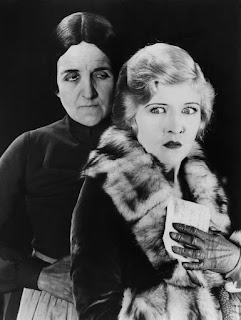
As the Gothic begins to appear on film, the menacing Grace Poole version dominates as the more potent form of the character. We get an early taste of housekeepers to come in the old dark house picture, The Cat and the Canary. Directed by Paul Leni, this 1927 silent film is memorable largely because of its creepy housekeeper, a dead-eyed horror humorously christened Mammy Pleasant. Like later and more familiar Gothic housekeepers, Mammy Pleasant acts as a menacing presence, constantly watching the heroine but refusing to divulge the secrets of the house to her. In addition, Mammy reveals the housekeeper’s evolving taste for a rather morbid, deadpan brand of humor. In one conversation, another character says, “You must have been lonely here these twenty years, Mammy Pleasant,” to which she replies, “I don’t need the living ones.” Mammy also operates as a predictor of doom, alarming the houseguests with her assertion that “something terrible will happen here tonight!” Mammy’s dark hair, dour expression, and thin, tight lips become the standard equipment of Gothic housekeepers forever more, making her an important figure in the character’s cinematic development.

Of course, the lynchpin figure in the evolution of the Gothic housekeeper is Mrs. Danvers, the terrifying antagonist who protects the territory of her dead mistress in Daphne du Maurier’s 1938 novel, Rebecca. The nameless heroine recalls her first encounter with Mrs. Danvers thus:
Someone advanced from the sea of faces, someone tall and gaunt, dressed in deep black, whose prominent cheek-bones and great, hollow eyes gave her a skull’s face, parchment-white, set on a skeleton’s frame.
She came towards me, and I held out my hand, envying her for her dignity and her composure, but when she took my hand hers was limp and heavy, deathly cold, and it lay in mine like a lifeless thing. (67-68)
The heroine’s language loads Mrs. Danvers with images of death and horror, and it also sets the stage for the housekeeper’s function as the guardian of the dead Rebecca. Mrs. Danvers is the housekeeper not of a living home but of a tomb that enshrines the memory of her lost idol; she rejects the new mistress of Manderley as an interloper and seeks to drive her away. Obsessive, manipulative, and in total control of the house, Mrs. Danvers imprisons the new Mrs. de Winter in Manderley while simultaneously trying to eject her from it. When she feels that Rebecca’s ownership of Manderley can no longer be protected, Mrs. Danvers sets fire to the house rather than see the second Mrs. de Winter successfully inhabit it.

            Alfred Hitchcock’s 1940 adaptation of Rebecca is a watershed moment in the history of the female Gothic film, not least because it perfectly captures the menacing allure of Mrs. Danvers’ character. Among its eleven Oscar nominations was a Best Supporting Actress nod for Judith Anderson, who delivers a truly iconic performance as Mrs. Danvers. Her appearance in the movie owes something to Mammy Pleasant while capturing the spirit of du Maurier’s description, if not the letter, for Anderson’s version is menacingly alive, with piercing eyes and a coiled braid of black hair perfectly arranged above the severe white line of her part. On screen, Mrs. Danvers controls the heroine with her gaze and her gestures; we can see her watching Joan Fontaine’s mousy victim with a predator’s glittering interest. In the famous bedroom scene in which Mrs. Danvers tries to drive the heroine to commit suicide, Hitchcock faithfully recreates du Maurier’s written description, but the visual representation lends the moment an additional sense of suspense and horror. Mrs. Danvers leans over the heroine, her burning eyes intensely fixed on her victim, her power over the younger woman tellingly displayed in their physical positions. In this scene and in others throughout the film, Anderson creates a definitive image of the Gothic housekeeper, endowing her with characteristics and mannerisms that will be hallmarks of the character in the popular imagination from 1940 onward.

Edith Barrett as Mrs. Fairfax
The box office success and Best Picture Oscar of Rebecca inspired a wave of female Gothic films in the early 1940s, including, somewhat ironically, a 1943 film adaptation of Jane Eyre, also starring Joan Fontaine as the heroine. For the housekeeper character, however, this is a throwback to the pre-Danvers era, back to the dual figures of good and bad household guardians. Edith Barrett plays a nervous, rather frail Mrs. Fairfax, with English stage actress Ethel Griffies in an uncredited appearance as Grace Poole (Hitchcock fans might remember Griffies as the skeptical ornithologist in The Birds). Barrett again plays the family secret keeper in the same year’s Eyre-inspired Val Lewton horror film, I Walked with a Zombie. Lewton’s picture has no menacing housekeeper; the most important domestic servant is Alma, a cheerful young black woman played by Theresa Harris. Barrett, however, fills in for the housekeeper as Mrs. Rand, the mother of the two male leads; she alone knows what really happened to her son’s first wife, the zombified Jessica. Like the motherly housekeepers of older Gothic stories, Mrs. Rand tries to help Frances Dee’s heroine even as she withholds the most important family secrets from her, but she lacks a menacing female counterpart.

More interesting, perhaps, is the 1946 adaptation of Anya Seton’s 1944 novel, Dragonwyck, written after both the original novel and the film version of Rebecca and thus ostensibly able to capitalize on the evolving conventions of the female Gothic genre. The film trailer, in fact, proudly announces the new picture’s appeal to fans of the earlier work. Like Rebecca, Dragonwyck draws from Jane Eyre as its source material, but it translates the Gothic action to nineteenth-century New York and the upper class Dutch society of the Patroons. Differences between the novel and the film affect the representations of the housekeeper characters, but both offer some insight into the type’s importance to the genre by showing the pitfalls of tinkering with effective conventions.

The novel itself takes a problematic dual approach to the housekeeper figure. As in Jane Eyre, we have two domestic characters who highlight the heroine’s outsider status and possess power and information that might be able to help or harm her. The official housekeeper, Magda, resents the heroine’s arrival and persistently gives her the cold shoulder, reserving her loyalty for the mistress of the house. Seton does very little with Magda, failing to provide even a single detailed description of her appearance. She gives greater attention to the other, more ominous domestic secret keeper, the ancient mixed-race servant, Zélie. Zélie gets all of the creepiest, most Gothic scenes, revealing to the newcomer the haunted history of Dragonwyck and foretelling the doom of the Van Ryn family members. Seton gives this character a suitably striking introduction:
The door opened and a strange woman walked in, shutting the door behind her. A thin old figure in a shapeless black dress who came over to the bed and gazed down at the frightened girl. The woman was nearly six feet tall and erect, her coarse black hair, which showed no gray, drawn back into a scraggy knot, her face a ruddy brown crisscrossed with wrinkles from which peered two shrewd little eyes as black as dewberries
“What do you want?” whispered Miranda.
“Me old Zélie,” said the woman in a harsh accented voice, touching her slab-like chest. “I want to see what you look laike.” (49)
Unfortunately, Seton abruptly writes both Magda and Zélie out of the book about a third of the way through, and no similar character fills the resulting gap. The problems with Seton’s treatment may help to explain why her novel is little read today, since she mishandles two different variations on one of the genre’s most important character types.

Director Joseph L. Mankiewicz’s film adaptation makes some marked changes to Seton’s novel, especially in the housekeeper department. Sadly, the movie completely drops Zélie, who would be quite provocative, to say the least, to see on screen. It transfers her ominous warnings and insider knowledge to Magda, revising Seton’s flat, barely described character into something audiences might more properly expect in a female Gothic tale. Played by the very capable character actress, Spring Byington, the movie Magda embodies both the menacing and the maternal, and the result is a woman who strikes both the audience and Gene Tierney’s heroine as slightly insane. In one early scene, for example, Magda suddenly veers off from seemingly friendly talk to warn, “One day, you’ll wish with all your heart you’d never come to Dragonwyck.” Byington’s character occupies a middle distance between Mrs. Fairfax and Mrs. Danvers, which makes her interesting in terms of the housekeeper’s changing role in the genre, but the movie, like the novel, drops Magda midway through, and thus the potential for a really serious engagement of the housekeeper figure remains unrealized.

Unlike Anya Seton, Shirley Jackson takes full advantage of the creepy housekeeper in her 1959 novel, The Haunting of Hill House, which was adapted into the film, The Haunting, in 1963. The film makes a number of changes to the original text, but it faithfully preserves the unnerving housekeeper, Mrs. Dudley, while also highlighting her relationship to Mrs. Danvers through casting and costume decisions. Like earlier housekeepers, Mrs. Dudley possesses insider knowledge of the house she oversees, and she resents the presence of the newcomers who disrupt her routine. Hill House has no master or mistress to command her loyalties, and Mrs. Dudley’s feelings about the house are never quite clear, just as everything else about Hill House remains shrouded in questions and doubt. Jackson does, however, hint at the connection between Mrs. Dudley and Hill House near the end of the novel, when she describes Mrs. Dudley as “shudder[ing] in her sleep” from six miles away when the heroine touches a kitchen door (171). In contrast to the visitors, Mrs. Dudley seems to understand and respect the house, never trespassing against its unspoken rules, and in return the house never affects her as it does the others.

Jackson offers little description of the character when she first appears in the novel, but she does provide a truly memorable exchange with the protagonist, Eleanor, a few paragraphs later.
“I don’t stay after I set out dinner,” Mrs. Dudley went on. “Not after it begins to get dark. I leave before the dark comes.”
“I know,” Eleanor said.
“We live over in the town, six miles away.”
“Yes,” Eleanor said, remembering Hillsdale.
“So there won’t be anyone around if you need help.”
“I understand.”
“We couldn’t even hear you, in the night.”
“I don’t suppose-“
“No one could. No one lives any nearer than the town. No one else will come any nearer than that.”
“I know,” Eleanor said tiredly.
“In the night,” Mrs. Dudley said, and smiled outright. “In the dark,” she said, and closed the door behind her.
(27-28)
The ominous warning from the housekeeper becomes a kind of nervous joke between Eleanor and Theodora, but it sets the stage for the horrors to come and provides both characters and readers with important information about Hill House. The locals are afraid of the place, none of them will have anything to do with it, and the residents can expect no assistance when their presumptuous occupation rouses the house into action. The inmates of the house laugh at Mrs. Dudley just as they laugh at the strange things that happen in Hill House; both frighten them, although they cannot necessarily explain why. 

            The film adaptation, directed by Robert Wise, reflects these elements of the novel and builds on them by making the most of the character conventions established by earlier films like Rebecca. Rosalie Crutchley, whose earlier roles had included the terrifying Madame Defarge in a 1958 adaptation of A Tale of Two Cities, is just the sort of actress for the Gothic housekeeper role, with a thin face, dark hair, and a most unnatural smile. Her somber attire and pinned-up hair, both black of course, signal her sorority with Mrs. Danvers and Mammy Pleasant, and Crutchley delivers Mrs. Dudley’s lines to great effect, especially in the scene mentioned earlier. Building on the character as originally created in Jackson’s novel, the film reveals the conventional traits that have come to be associated with the Gothic housekeeper. Mrs. Dudley, as much an insider as Hill House allows, lays out the house rules to Eleanor and the other guests in a way that emphasizes her own power and position of authority. “I don’t wait on people,” she tells the newcomers firmly. “What I agreed to, it doesn’t mean I wait on people” (27). She clearly knows more about the house than she is willing to tell, and her veiled warnings serve only to alarm the visitors and the audience without helping them prepare for the terrors that they will face. Like Mrs. Danvers, Mrs. Dudley projects menace rather than maternal comfort, and the film emphasizes this aspect by eliminating a kitchen scene in which Jackson has Mrs. Dudley gossiping about the young people in a very motherly, ordinary fashion. Unfortunately, by the time the next film adaptation of The Haunting of Hill House arrived in 1999, the Gothic housekeeper character had become so familiar that Mrs. Dudley is merely a cliché, another stale note in an over-played symphony of horrors.

Mrs. Slydes frightens a guest in House on Haunted Hill.
Anything repeated often enough to be a cliché is already ripe for parody, and in the years after the original film adaptation of The Haunting the Gothic housekeeper became an obvious target. William Castle had helped to entrench the conventions of the character with films like House on Haunted Hill in 1959 and especially 13 Ghosts in 1960, which featured The Wicked Witch of the West herself, Margaret Hamilton, as a creepy housekeeper complete with black dress, tight bun, and dour expressions, who also turned out to be a medium able to communicate with the ghosts who haunted her employers’ house. Today, the website, tvtropes.com, even has an entry for “Creepy Housekeeper” that identifies her major traits and aligns her with another stock character, the “Crusty Caretaker.” Most importantly, the incarnation of the creepy housekeeper chosen for the entry’s quote and image is not Mammy Pleasant, Mrs. Danvers, Magda, or Mrs. Dudley, it is Cloris Leachman as Frau Blücher in Mel Brooks’ 1974 Gothic horror parody, Young Frankenstein. The character, as written by Mel Brooks and Gene Wilder and performed by Leachman, incorporates all of the Gothic housekeeper clichés and then revels in them, permanently altering the way in which movie audiences perceive her role. 

Young Frankenstein, as its name suggests, draws its inspiration from James Whale’s 1931 Frankenstein and 1935 Bride of Frankenstein, and the origins of Frau Blücher can also be found there. In the second Whale film, Irish character actress Una O’Connor plays a frequently hysterical housekeeper named Minnie, although Whale uses her for comic effect rather than horror. Despite her shrieking, Minnie herself is all motherly concern, much like Mrs. Fairfax in Jane Eyre. In Young Frankenstein, Frau Blücher’s costume and position in the household are references to O’Connor’s character, but her creepy and often menacing behavior develops from housekeepers like Mrs. Danvers and Mrs. Dudley. Leachman also sports the thin lips, severe bun, and sinister facial expressions of the more menacing housekeeper type. In fact, Frau Blücher is so absurdly terrifying that horses whinny in fear every time her name is mentioned. Early on, the movie exploits one particularly popular housekeeper trope, in which the taciturn household guardian conducts newcomers through the mysterious domain over which she reigns, often with a large candle in hand. Frau Blücher carries a holder with three candles, all of them markedly unlit, as she warns Frederick to “stay close to the candles. The stairway can be… treacherous.” Like other Gothic housekeepers, but unlike Minnie, Frau Blücher has special insider knowledge about her house and its family. She manipulates Frederick Frankenstein into resuming his grandfather’s research, apparently out of loyalty to the deceased Victor, with whom she was in love. Brooks and Wilder, of course, play all of these plot elements for laughs, but they depend upon the already established conventions of the housekeeper role and show the extent to which the writers expect the audience to be familiar with them. The parody succeeds so well that Frau Blücher usurps the place of earlier, more serious treatments of the character to become the quintessential example of the type. 

The entwined literary and cinematic evolution of the Gothic housekeeper demonstrates the ways in which genre conventions gather force and then sometimes sink under their own weight. In this case, the housekeeper character, along with the rest of her genre’s conventions, developed first in literary works of the eighteenth and nineteenth centuries and then gathered new steam with the rise of film. She reached her peak when Rebecca took the world by storm, thanks in part to the ways in which the film version capitalized on her potential. After that, other literary works and films could only repeat what had already been accomplished or twist that representation for parodic effect, since efforts to tinker with the formula were problematic at best. Audiences today will come to any housekeeper character with a very distinct mental image, that developed by the earlier Gothic novels and films, but they will also almost certainly have a sense of the character as inherently clichéd and even ridiculous, given the immense cultural impact of the later parody. We haven’t seen much of the Gothic housekeeper in recent years, perhaps because Mrs. Danvers and Frau Blücher have so completely occupied the spaces in which such a character can stand. Perhaps the recent return of Hammer films will bring the creepy housekeeper back to us in a new but still eerily familiar form. For now, however, it is the housekeeper herself who has become haunted, not by the ghosts of her employers’ house, but by the enduring influence of her own most iconic incarnations.

This essay was written for presentation at the 2012 meeting of the Popular Culture Association in the South (PCAS). The Works Cited page is intentionally excluded in order to discourage plagiarism of the material. This content is the intellectual property of the author and must be properly cited if referenced elsewhere. The author reserves the right to send Mrs. Danvers to have a little personal chat with any plagiarists!