Showing posts with label James Whale. Show all posts

Thursday, October 24, 2024

10 Classic Frankenstein Movies Worth Watching

This fall I taught a lifetime learning class about the history and cinematic legacy of Frankenstein, so of course I've had the iconic tale of gods and monsters on my mind throughout the Halloween season. One of the reasons for the story's enduring success is its adaptability; like Shakespearean plays, Frankenstein can change with the times to reflect an era's particular fears about life, death, science, and what it means to be human. Even from the early days, movie versions of Mary Shelley's 1818 novel have varied wildly from their source material, altering both story and meaning to suit their own aims. Here are 10 of my favorite Frankenstein movies, presented in chronological order, to make a frightful film festival for monster movie fans.

1) Frankenstein (1931)

The original Universal movie has to start this list because Boris Karloff and Colin Clive create indelible images with their performances as the Creature and his creator (inexplicably renamed Henry Frankenstein). I think it drags a bit when it leaves the laboratory to focus on Henry's domestic life and worried loved ones, but its influence over later adaptations continues to be felt, especially when we see Shelley's articulate, philosophical Creature reduced to a shuffling, undead thing.
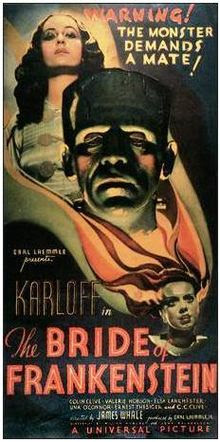

2) The Bride of Frankenstein (1935)

I prefer the sequel to the first Universal picture because it lets James Whale and his cast loose from the limitations of the first movie's roots in a stage play adaptation of the novel. It's wilder, weirder, and a lot more fun all the way through, especially with Ernest Thesiger, Una O'Connor, and Elsa Lanchester joining Karloff and Clive for this outing. If you only see one of the classic Universal entries, this is the one to watch.

3) Son of Frankenstein (1939)

The next generation succumbs to the family's penchant for reanimation in this follow-up, with Karloff returning as the Creature and Basil Rathbone stepping in as Wolf Frankenstein, the son of the original scientist. This one is also notable for its gorgeous German expressionist sets and for Bela Lugosi's appearance as Ygor, the first time that name refers to Dr. Frankenstein's assistant. This is probably the best of the later Universal films, although I do enjoy Frankenstein Meets the Wolf Man (1943) for its revival of the long-suffering werewolf, Larry Talbot (Lon Chaney, Jr.).

4) Abbott and Costello Meet Frankenstein (1948)

More treat than terror, this horror comedy is a Halloween favorite that pits Abbott and Costello against a ghoulish gang of classic monsters, including Glenn Strange as the Creature, Bela Lugosi as Dracula, and Lon Chaney, Jr. as Larry Talbot, aka the Wolf Man. If you want to introduce kids to classic Universal monsters without scaring them too much, this movie is a great choice. You even get Vincent Price making a cameo "appearance" as the Invisible Man at the very end!

5) The Curse of Frankenstein (1957)

Hammer started its own series of Frankenstein films with this adaptation, which stars a very creepy looking Christopher Lee as the Creature and Peter Cushing as Dr. Frankenstein. Scream queen Hazel Court also appears as Elizabeth, and the whole thing is rendered gorier because it's in color. Although Cushing's character is condemned to execution in the first movie, he survives to wreak more havoc with his experiments in The Revenge of Frankenstein (1958), The Evil of Frankenstein (1964), Frankenstein Created Woman (1967), Frankenstein Must Be Destroyed (1969), and Frankenstein and the Monster from Hell (1974).

6) Young Frankenstein (1974)

No list of Frankenstein movies would be complete without this comedy gem from Mel Brooks, with Gene Wilder starring as Frederick Frankenstein, the unwilling heir to his family's legacy who nonetheless ends up building a Creature of his own. The movie uses sets from the original Universal films and is stuffed with gags that work best if you've seen both the 1931 movie and the 1935 sequel. Often hailed as one of the best comedies of all time, it's still uproariously funny 50 years later.

7) Frankenweenie (1984)

Tim Burton has a long-standing love affair with the Frankenstein story, as evidenced by Edward Scissorhands (1990) and the 2012 stop motion remake of this 1984 live action short, but I like the short for its brevity and concentrated weirdness. Disney originally considered this version too scary for kids and fired Burton because of it, but Burton's later success caused Disney to reconsider the short's appeal. Kids today are unlikely to be phased by anything in Frankenweenie, especially those who have already seen any of Burton's other, later films.

8) The Bride (1985)

Fair warning that I haven't rewatched The Bride in a long time, but it makes the list for nostalgia's sake because I first saw it in the 80s and loved it then, partly for its focus on a female Creature (played by Jennifer Beals) and partly for its casting of rock god Sting as Dr. Frankenstein. The movie also stars Clancy Brown as the male Creature and Cary Elwes as another man with a romantic interest in the heroine. I won't pretend this is a brilliant movie, but it is very much a product of its era, and my inner teenager still regards it with affection.

9) The Monster Squad (1987)

Speaking of the 80s and nostalgia, The Monster Squad brings plenty of love for classic monsters and a Goonies sensibility to its horror comedy hijinks, with a group of kids who band together to fight the evil schemes of Count Dracula (Duncan Regehr) and his minions. Frankenstein's Creature, played by Tom Noonan, is supposed to be helping the vampire but turns out to be an ally to the kids, and his friendship with a little girl (Ashley Bank) makes a sweet counterpoint to the tragic scene with a different girl in the 1931 film. This one might actually be too scary (and too free-wheeling with its profanity and sexual references) for very young kids, but it's a perfect pick for tweens, teens, and adult monster kids.

10) Gods and Monsters (1998)

Although it isn't technically a horror movie or an adaptation of Shelley's novel, this fictionalized account of the last days of James Whale is an insightful look at the director's life and work, and it seems fitting to end this list here. Ian McKellen gives a brilliant and moving performance as the aging Whale, and the picture includes flashbacks to the making of Whale's most memorable films. Brendan Fraser costars as Whale's young gardener. Gods and Monsters earned three Oscar nominations, with nods for McKellen as Best Actor and Lynn Redgrave as Best Supporting Actress, and it won the award for Best Screenplay. 

See also: 10 Classic Movies Starring Boris Karloff and 10 Classic Movies Directed by James Whale

Monday, October 18, 2021

Five Favorite Directors: Classic Horror


Even people who don't care for classic horror movies have probably heard of Bela Lugosi, Boris Karloff, and Vincent Price, but behind every horror classic there's also a director asking for heavier fog, more menacing closeups, and louder screams. Alfred Hitchcock, although not primarily a horror director, might be the most familiar to modern viewers thanks to Psycho (1960) and The Birds (1963), and more recent masters of the genre include George Romero, John Carpenter, and Wes Craven, but my personal favorites tend to be the earlier icons whose work influenced everyone after them. Most of the films from these directors are light on gore and heavy on atmosphere, which is how I like my creepy midnight thrills, and many worthy contenders aren't listed here only because I limit myself to five. These are the directors I most often turn to when I want something spooky to send a shiver down my cinematic spine.

Tod Browning

Browning is best remembered today for two horror classics, Dracula (1931) and Freaks (1932), but his directorial career started with silent shorts in 1915, and he helmed a number of notable silent horror pictures before his date with Dracula. Browning's movies with Lon Chaney, "the man of a thousand faces" and a master of silent horror, are especially good; try The Unholy Three (1925), The Unknown (1927), and West of Zanzibar (1928) for a sense of Browning's work before Dracula.

James Whale

Like Browning, James Whale is best remembered today for his iconic Universal monster movies, including Frankenstein (1931), The Invisible Man (1933), and Bride of Frankenstein (1935). Whale's work combines the usual elements of horror with a very dark sense of humor that sometimes tips right over into black comedy, especially with Claude Rains in the lead role for The Invisible Man. In between these more famous films Whale also directed The Old Dark House (1932), a wonderful spooky house picture with his usual flair for mixing giggles with screams.

Jacques Tourneur

As the son of French director Maurice Tourneur, Jacques Tourneur grew up in the movie making business in both France and the US; his career really took off when he teamed up with RKO horror boss Val Lewton for films like Cat People (1942), I Walked with a Zombie (1943), and The Leopard Man (1943). Later Tourneur would make memorable pictures in a number of genres, but he returned to horror for Night of the Demon (1957) and The Comedy of Terrors (1963). Cat People is justly celebrated today for its moody ambience and loaded subtext, but I'm also very fond of I Walked with a Zombie for its imaginative revision of Jane Eyre.


Robert Wise

Like Tourneur, Robert Wise enjoyed a fruitful collaboration with Val Lewton early in his career, even though he later became more famous as the Oscar-winning director of musicals like West Side Story (1961) and The Sound of Music (1965). His work in horror remains an important part of his oeuvre and the genre as a whole, with early Lewton projects like The Curse of the Cat People (1944) and The Body Snatcher (1945) laying the foundation for the horror masterpiece, The Haunting (1963), which is so good that it alone justifies Wise's place in this list. Watch it with the lights out and the sound turned up, and you won't sleep a wink.

Roger Corman

Roger Corman directed more than 50 movies, many of them low-budget shockers and now cult classics, and Corman has lived long enough to see himself become a true Hollywood legend. As much as I enjoy a really ridiculous B-movie romp like Attack of the Crab Monsters (1957), my favorite Corman horror films are the Poe adaptations he made with Vincent Price, some of them more faithful than others but all of them very entertaining. House of Usher (1960) kicked off the series, but two later entries, The Masque of the Red Death (1964) and The Tomb of Ligeia (1964) are probably my top picks for being less campy and more evocative of Edgar Allan Poe's works than a picture like The Raven (1963), even though that one is also a lot of fun.

Looking for even more classic horror directors? Try F.W. Murnau, Mario Bava, Mark Robson, and Terence Fisher for additional thrills and chills. 

See also: "The Kiss That is the Kill: Sex and Death in Three Classic Vampire Movies"


Thursday, October 8, 2020

A LEGO Treat for Frankenstein Fans


I'm always excited when my two obsessions - LEGO and classic movies - overlap, and when they do it's usually related to classic horror. This year LEGO has added something especially fun in time for Halloween, a new Brickheadz set for an official Universal Frankenstein! Fans are hoping that more licensed Universal monster characters will follow, but right now we just have the iconic creature first played on the big screen by Boris Karloff in James Whale's 1931 film. 

The Brickheadz line has been very popular the last few years, running about $10 for a set that builds one character with an oversized head. Licensed characters have been especially plentiful, including lots of Star Wars figures, but seasonal ones like Santa Claus and the Easter Bunny have also been frequent additions to the lineup. Frankenstein's monster is a delightful new part of this series, rendered in shades of gray and black to better reflect the image of the Universal version of the character. If you're not into complex builds, don't worry; the Brickheadz take just a few minutes to assemble and make perfect cubicle or desk adornments and will also fit neatly onto a display shelf with your other classic horror collectibles. The box art is also wonderful, with Karloff's version of the creature prominently featured.


Over the years LEGO has released a number of sets and themes with obvious ties to classic horror, and they've always been fun, but this new, official connection with Universal makes me hope that we will see even more Brickheadz and minifigure scale sets in 2021. Right now the Hidden Side theme is my favorite collection of sets because of the spooky atmosphere and ghost figures, but a Dracula's Castle set would be a dream come true (it should have armadillos, of course, just to be extra faithful to the film). If and when LEGO releases information about upcoming Universal Monster sets, I'll be sure to let you know about it here on the blog!

If you want your own Frankenstein Brickheadz, you can find him on the LEGO Shop at Home website for $9.99. I don't have a LEGO store nearby, and with COVID it's difficult to travel to the closest one in the next state over, so I don't know if you can find the set at LEGO Stores, although I assume that you can if you have one near you. If you visit the website, be sure to check out the other fun Halloween items, including the Hidden Side theme and the gorgeous (but so expensive) Haunted House exclusive set.

Related Posts:

10 Classic Movies Directed by James Whale

FRANKENSTEIN MEETS THE WOLF MAN (1943)

LEGO Monster Fighters: Making AFOL Dreams Come True 

Die Toten Reiten Schnell


Wednesday, September 4, 2019

Classic Films in Focus: THE OLD DARK HOUSE (1932)

Of course it's a dark and stormy night when Raymond Massey, Gloria Stuart, and Melvyn Douglas stumble into a strange old house whose occupants are even more menacing than the raging floods outside, and director James Whale milks the atmosphere for all it's worth in this delightfully dire horror comedy. The Old Dark House (1932) delivers on all points, with thrills and giggles in equal measure thanks to the performers who make up the cast, including Boris Karloff, Ernest Thesiger, Charles Laughton, and Eva Moore.

Massey and Stuart play married couple Philip and Margaret Waverton, who, along with their traveling companion, Penderel (Douglas), literally wash up at the old dark house during a massive storm. They're not exactly welcomed in by the occupants, a strange brother and sister whose other family members haunt the upper floors of the gloomy mansion, but they settle in to stay the night and are soon joined by fellow refugees Sir William Porterhouse (Charles Laughton) and Gladys (Lilian Bond). Things take a turn for the worse when the looming, mute butler, Morgan (Boris Karloff), gets drunk and releases the house's most dangerous resident, a pyromaniac murderer called Saul (Brember Wills).

If you're already familiar with Whale's sense of humor from Frankenstein (1931), The Invisible Man (1933), and Bride of Frankenstein (1935), you'll appreciate more of the same in The Old Dark House (1932), especially with the crusty, deaf Rebecca Femm (Eva Moore) and her brother, the fey, nervous Horace (Ernest Thesiger). The brief appearance of their father, Sir Roderick, turns out to be a treat, too; the whole family is mad as hatters, which keeps the reluctant house guests in a constant state of confusion. Karloff's shambling Morgan is a scarier version of Lurch from The Addams Family; he spends a lot of time trying to molest Margaret, who has inexplicably changed out of her wet traveling clothes into the least practical evening dress one could possibly wear in a cold, damp lunatic asylum pretending to be a family home. The sense of impending doom is also lightened by the whirlwind romance of Penderel and Gladys, with Penderel seeming to nurse something of a foot fetish where his new love interest is concerned.

The atmosphere and cinematography also make this film a lot of fun, with fabulous camera shots lingering on Morgan's scarred face in closeup or building terrible suspense with just Saul's hand at the top of the stairs appearing in the frame. There's plenty of striking storm scenery, too, especially as the Wavertons wend their hazardous way through the deluge. Flickering candles and uncertain electrical lights add to the sense of dread; nobody wants the lights to go out in this house. The Gothic ambience and focus on crumbling heaps recall Poe's "The Fall of the House of Usher" but also Horace Walpole's Castle of Otranto, and Whale shares Walpole's characteristic mingling of the ludicrous and the sublime. The joke of the title reveals the film's keen awareness of its place in relationship to earlier Gothic horror; the "old dark house" motif was a cliche of the genre long before 1932, but Whale's direction is always winking at us about the familiarity of it all.

Whale, Karloff, and Thesiger reunited for Bride of Frankenstein, while Gloria Stuart also stars in Whale's adaptation of The Invisible Man. Melvyn Douglas is not generally remembered for his horror films, but you'll also find him in The Vampire Bat (1933), and, much later, The Changeling (1980) and Ghost Story (1981). While Charles Laughton plays a solid fellow in this film, he really gets to work the horror vein in Island of Lost Souls (1932) and The Strange Door (1951). Don't miss Raymond Massey doing his own Karloff inspired turn in Arsenic and Old Lace (1944). William Castle made his own version of The Old Dark House in 1963, so you could make a double feature of it by watching both adaptations of the novel by J.B. Priestley.

Thursday, April 30, 2015

CMBA Blogathon - The Fabulous Films of the 30s: THE INVISIBLE MAN (1933)

This post is part of the CMBA Spring Blogathon celebrating The Fabulous Films of the 30s. Visit the Classic Movie Blog Association for more information and links to participating posts!

Even among the great horrors produced by Universal in the 1930s, The Invisible Man (1933) stands out. It revels in madness and genius in equal measure, presenting viewers with a shocking example of a figure we now know all too well, the insane super villain. It's the movie that made Claude Rains a star, even though we can't see him, and that's all the more reason to be impressed with his stunning performance, which gains in grandeur by being set loose from the conventional experience of being seen. Just as Rains is the picture's unseen star, James Whale is its equally invisible yet utterly palpable director, putting his ineffable stamp on every moment of chaos and comedy. Between the two of them, Rains and Whale make The Invisible Man a cinematic work like no other, a dark delight that takes us over the edge with its tragically mad protagonist.

Rains plays Jack Griffin, who has already tried his fatal experiment with invisibility by the time we first meet him. His formula has worked, but Griffin has no way to reverse the effects, and murderous insanity turns out to be a secondary result of the transformation. Griffin works feverishly to find a cure for his condition even as his madness grows, while his mentor, Dr. Cranley (Henry Travers), and fiancee, Flora (Gloria Stuart), try to help him. Unfortunately for all of them, Griffin's humanity is also vanishing, and many lives must be lost before fate catches up with the doomed madman.

One of the great shared elements of the Universal horrors is their ability to present their monsters as figures of sympathy and pity in spite of the destruction they wreak. We feel bad for them because they once were human beings, and we understand that they have not chosen this fate, even though we also recognize that death is the only possible ending for their stories. Bela Lugosi, Boris Karloff, and both Lon Chaney Sr. and Jr. invest their monsters with enough pathos to complicate our feelings about them. Claude Rains follows this tradition, but he has to evoke those simultaneous responses of revulsion and sympathy without the usual makeup or even the expressions of his own face. His voice, however, is powerful enough all on its own, gripping the audience and holding it mesmerized throughout the picture. Through that exquisite instrument Rains conveys all the panic, despair, and horrific insanity that Griffin experiences. He is monstrous, murderous, an id utterly divorced from the higher powers that once controlled it, and yet he is heartbreaking in his struggle to reclaim his humanity and hold onto his love for Flora.


Whale creates scenes around Rains' invisible protagonist that heighten the horror but also undercut it with the director's usual pitch black sense of humor. The special effects are marvelous, even by today's CGI standards, but they are also jokes that Whale is playing on the audience. It doesn't take a genius to realize that Whale basically gets away with a movie in which a naked madman parades around destroying things and riding bicycles through town. We even get scenes in which Griffin chucks his clothes, highlighting the fact that he's only invisible because he's totally nude. For Whale, the joke has its deeper side, too; Griffin's naked id, unprotected by reason or morality, is set loose, just as Griffin's naked body breaks the bounds of social convention and self-protection. His nakedness hides him, but it also leaves him exposed, especially in the final scenes, when falling snow becomes a threat to him in more ways than one. Griffin has dreamed of greatness, influence, and power, but he is reduced to a naked animal, shivering in the cold, hunted and cast out from humankind. It's a tragic ending, and when we see Rains' face at last, we remember that Griffin was a man before he became a monster.

The supporting cast also makes The Invisible Man a memorable film. Be sure to appreciate the performances of Henry Travers, Gloria Stuart, William Harrigan, and the inimitable Una O'Connor. Compare Whale's work on The Invisible Man with his direction for Frankenstein (1931) and The Bride of Frankenstein (1935). See more of Claude Rains' work in the horror genre in The Wolf Man (1941) and Phantom of the Opera (1943). The Invisible Man inspired a number of sequels, including The Invisible Man Returns (1940), in which Vincent Price takes on the title role, and The Invisible Woman (1940), which stars Virginia Bruce as a calmer and more comedic unseen protagonist.


Tuesday, July 22, 2014

10 Classic Movies Directed by James Whale

Born on July 22, 1889, the English director James Whale stands with Tod Browning as one of the most important developers of the 1930s horror genre. Both directors worked to give the iconic Universal horrors their sense of style, but Whale set the bar particularly high with his combination of terror and sly, subversive comedy in The Bride of Frankenstein (1935). Whale directed 23 films over the course of his career, but the Universal horrors are the pictures for which he is best remembered today. In honor of Whale's birthday, here are ten classic movies where you can see the director's hand at work.

1) Journey's End (1930) - Whale's first directorial effort was an adaptation of a 1928 stage play about World War I. Its cast included two actors who would later be major players in the Universal horror unit: Colin Clive and David Manners.

2) Waterloo Bridge (1931) - This romantic drama about a prostitute and a soldier stars Mae Clarke and Douglass Montgomery, but it was also the third screen appearance of 23 year old Bette Davis. A 1940 adaptation of the Robert Sherwood play would prove more enduring with stars Vivien Leigh and Robert Taylor.

3) Frankenstein (1931) - Whale's first horror picture would shape the genre for decades to come, influencing countless later adaptations of Mary Shelley's Gothic novel. With Boris Karloff as the resurrected monster and Colin Clive as his mentally unbalanced creator, Whale crafted a stylish, wry, and genuinely terrifying masterpiece. Mae Clarke, Edward Van Sloan, and the deliriously mad Dwight Frye also contributed to Whale's success with their performances.

4) The Old Dark House (1932) - As the name implies, this film belongs to the "old dark house" genre of horror, with Whale emphasizing the absurdly comedic possibilities of the conventional plot. The collected cast makes this picture a delight for classic movie fans, with Boris Karloff, Charles Laughton, Gloria Stuart, Melvyn Douglas, Ernest Thesiger, and Raymond Massey all in the mix, but the strangest pleasure is Elspeth Dudgeon cross-dressed to play the elderly Sir Roderick Femm.

5) The Invisible Man (1933) - Whale's next horror production took the darkly humorous aspect of the genre to a whole different level, with the increasingly mad Claude Rains gamboling invisibly and wreaking havoc all over the English countryside. The film was the first screen role for Rains, who remains unseen until the very last shot, but his voice proved the real draw. Gloria Stuart and Henry Travers star as the friends trying to save Rains from himself, but Una O'Connor also demonstrates her ample talent for scene-stealing and an ear-piercing pitch.

6) The Bride of Frankenstein (1935) - Whale's earlier efforts paved the way for this outstanding picture, which also mingles absurd comedy with its gripping horror. The film reunited Whale with Boris Karloff, Colin Clive, Ernest Thesiger, Dwight Frye, and Una O'Connor, but its most iconic, if only briefly seen, performer is the young Elsa Lanchester as both Mary Shelley and the shock-haired Bride.

7) Show Boat (1936) - Whale is remembered primarily for his horror, but this 1936 musical drama proved that he could also tap into tender emotions. Generally considered the best film adaptation of the original stage play, Whale's Show Boat gave the world both spectacle and sentiment, with touches of the Whale humor still in evidence. The cast includes many top stars, from Irene Dunne and Allan Jones to Charles Winninger and Helen Morgan, but the film is known today primarily for Paul Robeson's performance as Joe and his powerful rendition of "Old Man River."

8) The Great Garrick (1937) - After The Bride of Frankenstein, Whale moved away from horror, making several dramas and war films. This picture took Whale into the territory of the romantic comedy, with a period setting and Brian Aherne as David Garrick, the great theater personality of the 18th century. Other notable members of the cast include Olivia de Havilland, Edward Everett Horton, Lionel Atwill, and Lana Turner.

9) The Man in the Iron Mask (1939) - Whale continued the period theme with this adaptation of the Alexandre Dumas adventure, with Louis Hayward starring in the double role of the twin royals. Swashbuckling regulars in the cast include Alan Hale and Montagu Love, but Joan Bennett, Warren William, Joseph Schildkraut, and Albert Dekker also make appearances.

10) They Dare Not Love (1941) - Sadly, by the beginning of the 1940s Whale's career was more or less over.  Show Boat had been his last truly memorable work. They Dare Not Love, a World War II drama starring George Brent, Martha Scott, and Paul Lukas, would be his last feature film.

In 1998, Whale's story became familiar to a new generation of moviegoers with the release of Gods and Monsters, adapted from Christopher Bram's novel, Father of Frankenstein. In the film, Ian McKellen plays the director at the very end of his life, while Brendan Fraser stars as the gardener who befriends him. You can also learn more about Whale by reading James Curtis' 2003 biography, James Whale: A New World of Gods and Monsters.

Tuesday, March 4, 2014

Classic Films in Focus: SHOW BOAT (1936)

James Whale is best remembered today as the director of horror films like Frankenstein (1931), but he also made the 1936 adaptation of Show Boat, the successful Kern and Hammerstein musical based on Edna Ferber’s novel. It was neither the first nor the last big screen rendition of the story; Laura La Plante starred in a 1929 production, and a 1951 version featured Kathryn Grayson, Ava Gardner, and Howard Keel. The 1936 adaptation is, however, generally considered the best and most faithful of the three, and it benefits tremendously from the contributions of many performers who had appeared in the original stage production, including Charles Winninger, Helen Morgan, and Paul Robeson. As the director, Whale carefully balances the serious and comic elements of the expansive plot, and the end result is a moving, engaging musical that every fan of the genre ought to see.

Irene Dunne stars as Magnolia Hawks, who grows up on her father’s show boat in the late 19th century. Cap’n Andy (Charles Winninger) and his formidable wife (Helen Westley) don’t agree on most issues, including their daughter’s friendship with singer Julie (Helen Morgan), and Mrs. Hawks disapproves even more when Magnolia falls in love with Gaylord Ravenal (Allan Jones), a handsome roving gambler. Magnolia endures ups and downs as she becomes a performer herself, while Julie suffers hardship and heartbreak after her racial identity is revealed by a jealous admirer.

The cast of the film is large, but nearly every actor makes the most of his or her role, and the majority of the stars had already played the same parts in earlier stage productions. Almost 38 years old when she made the picture, Irene Dunne is much too mature to play the teenaged Magnolia, but no actress could be the right age all the time in a story that spans some forty years in its characters’ lives. She gives the heroine some spunk to go along with her sentimental nature, and Dunne ultimately proves her ability to embody the many moods and moments of Magnolia’s experience. Allan Jones, with his clean cut, almost cherubic, good looks, makes a very tame version of a riverboat gambler, but of course he sings beautifully, especially in numbers like “Make Believe,” and we can see why Magnolia loves him. Charles Winninger has a great deal of fun as the perpetually upbeat Cap’n Andy, while Helen Morgan gives a subtle but heart-breaking performance as the selfless Julie. The showstopper of the picture is Paul Robeson performing his iconic rendition of “Ol’ Man River,” but Robeson also has some effective scenes with Hattie McDaniel, who plays his wife, Queenie.

The racial plot involving Julie and Steven (Donald Cook) is the most memorable element of the story, and it was certainly controversial in the 1930s, but really Show Boat is about romantic relationships and what makes them last or fall apart. We have a handful of couples to take as models or object lessons: Magnolia and Gaylord, Mr. and Mrs. Hawks, Julie and Steven, Frank and Elly, and Queenie and Joe. All have their problems, whether humorous or tragic, but the recurring theme of the song, “Can’t Help Lovin’ Dat Man,” argues that people can’t choose who or whether they love, even if their partners bring them unhappiness. Julie can’t help loving Steve, even after he abandons her, and Magnolia never stops loving Gaylord, despite some twenty years of separation.

Show Boat is also memorable for its musical numbers, and Whale’s adaptation works hard to retain as many of the songs as possible, although some favorites like “Life Upon the Wicked Stage” get reduced to instrumental allusions rather than full performances. The minstrel songs, particularly one where Irene Dunne appears in blackface, contrast their outmoded racial imagery with the miscegenation plot’s strikingly progressive tone, but Paul Robeson’s performance overpowers all of that with its arresting subtlety and depth, especially during his signature number. Later black-listed for his left-wing politics, Robeson gives one of the first truly great film performances by an African-American actor; his “Ol’ Man River” sums up the mingled resignation, dignity, and suppressed anger of a people enduring generations of oppression. Few, if any, movie musicals can boast a song that even comes close to matching the emotional impact of that performance.

Sadly, Show Boat would be the final screen appearance of Helen Morgan, who died in 1941. Her life story became the basis for the 1957 biopic, The Helen Morgan Story. Irene Dunne is best remembered today for films like The Awful Truth (1937), Love Affair (1939), and I Remember Mama (1948). You can see and hear more of Allan Jones in A Night at the Opera (1935) and The Firefly (1937). Charles Winninger has memorable roles in Babes in Arms (1939), Destry Rides Again (1939), and State Fair (1945). While Paul Robeson's screen career ended in 1942 with just thirteen appearances, Hattie McDaniel went on to make history as the first African-American to win an Oscar for her performance in Gone with the Wind (1939); when she died in 1952, she had played nearly 100 film roles, many of them uncredited.

Warner Archive has provided the author with a free review copy of this film, with no promise or expectation of a positive review.

Thursday, October 11, 2012

Classic Films in Focus: THE BRIDE OF FRANKENSTEIN (1935)

The success of Universal's Frankenstein in 1931 quite naturally led to the studio's desire for a sequel, and in 1935 they gave the audience more of Boris Karloff's lumbering monster with The Bride of Frankenstein, which also brought back director James Whale and Colin Clive's resurrectionist doctor. Whale took the opportunity to exercise a particularly dark sense of humor, and today The Bride of Frankenstein is probably best appreciated as an example of wry, sardonic comedy, although it also has the honor of introducing Elsa Lanchester's iconic Bride to the pantheon of Hollywood horrors.

Having miraculously survived the events that ended the first film, Karloff's creature returns to terrorize the countryside, while his creator (Colin Clive) struggles with conflicted urges about continuing his work. Henry Frankenstein's worried bride, Elizabeth (Valerie Hobson), begs him to give up his unnatural studies, but her arguments lose their force when Dr. Pretorius (Ernest Thesiger), a fellow scientist with sinister designs, turns up to coerce Frankenstein into making a mate for the original monster.

The modern viewer can't help but realize that there are very few steps indeed between Whale's sequel and Mel Brooks' 1974 parody, Young Frankenstein, and in fact Brooks lifts whole scenes almost without alteration, particularly the segment involving the kindly blind man who befriends the monster. Una O'Connor's screeching maid is a prelude to Cloris Leachman's Frau Blücher, while the generally silly villagers and their burgomaster seem equally at home in either film.

Still, Whale introduces some uniquely crafted images. He puts his monster into tableaux of suffering that suggest his identity as a kind of Christ figure, tormented and abused by the pitiless mob. The monster, after all, is meant to represent humanity's redemption from death, and like Christ he is something both human and other at the same time. Whale also gives us the macabre glory of Lanchester's resurrected bride, and he has the genius to cast the same actress as both the monster and the ultimate maker of this myth, Mary Godwin Shelley. Lanchester only appears onscreen for a few minutes, as Shelley in the opening scenes and as the bride in the finale, but she makes a tremendous impression. Karloff's creature, however, gets the final lines. "We belong dead," he says, wiser at last than the man who made him and weary of a world in which he can find no acceptance, even from the mate who was created as his companion.

For more of Whale's wickedly humorous horror, see The Old Dark House (1932) and The Invisible Man (1933). Look for Karloff in more talkative roles in The Mummy (1932), Bedlam (1946), and The Raven (1963). You'll find Elsa Lanchester in The Private Life of Henry VIII (1933), Lassie Come Home (1946), and Witness for the Prosecution (1957). Some people might find Una O'Connor's old biddies irritating, but if you like her as much as I do you'll want to see her in The Invisible Man and The Adventures of Robin Hood (1938). Ernest Thesiger also appears in The Ghoul (1933), They Drive by Night (1938), and The Man in the White Suit (1951).

An earlier version of this review originally appeared on Examiner.com. The author retains all rights to this content.

Wednesday, October 10, 2012

Classic Films in Focus: FRANKENSTEIN (1931)


Let's be clear about one thing: Frankenstein is the man, not the monster. Although films like the 1931 Frankenstein have irreparably muddled the original story in the public imagination, Mary Shelley's novel, way back in 1818, was about human vanity, the perils of scientific progress, and spectacularly irresponsible paternity. Her protagonist was the over-reaching scientist, the man who thought he could be God, and that is why the novel bears his name. We forget much of this when we watch classic films based on the story because the monster becomes the whole show, and the movie monster is a far different creature from the one that Shelley imagined. Despite its gross infidelity to its source material, director James Whale's Frankenstein has become a high point in the history of horror, a watershed event on whose existence countless subsequent films depend. If you want to understand the visual and thematic vocabulary of classic horror, you have to start here.

The film's version of the story owes much of its material to Peggy Webling's 1927 dramatic adaptation. We get Henry Frankenstein, not Victor, and the scene is modern day. Henry (Colin Clive) wastes no time in getting his gruesome creation up and lumbering, although his friends try very hard to talk him out of it. Lovely Elizabeth (Mae Clarke) waits to marry him, even though Henry's best friend (John Boles), who, oddly enough, is named Victor, clearly would be glad to step in as the groom. Henry's mentor is Dr. Waldman, played with typical gravitas by Edward Van Sloan; the good doctor tries to talk Henry out of the experiment, but he seems reluctantly fascinated by the whole thing himself, so his entreaties have little effect. Eventually, Boris Karloff's monster takes over, and the rest of the picture belongs to him. The other characters are just the grist for his mill, so to speak (it's a bad joke, and you'll get it once you see the ending).

Given these deviations from its source material, what is it about Frankenstein that makes the movie so great? Whale's direction counts for a lot; he takes this whole enterprise seriously in terms of art, and the scenes he creates get referenced and remade in later films with justified reverence. Boris Karloff invests the monster with tragic grandeur; there is pathos in his expression, and a terrible innocence in the way that he flings little Maria to her death. How could he know better? Newly born yet rejected by his creator, the monster's crimes have more to do with a childlike ignorance of right and wrong than with the kind of brain that rests inside his huge, bolted head. Dwight Frye makes his own horror icon with cringing, sadistic Fritz, who will become the model for so many Igors after him. It might have helped if they had stuck with the original ending and killed off Henry; that climactic fall certainly looks fatal, and poetic justice demands punishment for such hubris.

Over time, these elements become the stuff of comedy and parody, but in 1931 it isn't funny yet. In fact, the movie opens with a warning, delivered with just a wry smirk by Edward Van Sloan, who lets the audience know what it's in for. Looking back at Frankenstein as we do, through the layers of sequels, spoofs, and revisions, such a warning hardly seems necessary. Karloff's craggy, scarred face is as familiar to us as an old friend, but what was it like to see him for the first time? There he is in the film, backing through the door, the actor's name left a blank in the opening credits, a mystery and a horror. When the heavy brow, the leaden eyes, and the poor, patchwork features are revealed at last, we are meant to shudder with a deep sense of dread. The dead thing lives, and man has usurped the very throne of God. In the age of plastic surgery, we ought to understand that horror more.

Karloff would return to the role of the monster in Bride of Frankenstein (1935) and Son of Frankenstein (1939), while Bela Lugosi, Lon Chaney, Jr., and Glenn Strange would take the character on in later classic films. Here's a bit of mind-bending trivia along those lines: in Casino Royale (1967) and The Horror of Frankenstein (1970), the actor in the monster role would be David Prowse, better known for playing that other monstrous walking corpse, the Dark Lord of the Sith himself, Darth Vader. Don't think George Lucas saw the similarities? Watch Whale's Frankenstein, and then go watch the ending of Revenge of the Sith (2005).

For more from James Whale, see The Old Dark House (1932) and The Invisible Man (1933). Karloff also stars in The Mummy (1932), The Black Cat (1934), and several Mr. Wong films, although I especially like him in Val Lewton’s Bedlam (1946). Edward Van Sloan is best remembered as Van Helsing in Dracula (1931), a role he reprised in Dracula’s Daughter (1936). Look for Colin Clive as Rochester in the 1934 adaptation of Jane Eyre and in movies like Christopher Strong (1933) and Mad Love (1935). Clive’s death in 1937 cut short his film career while he was still in his thirties.

An earlier version of this review originally appeared on Examiner.com. The author retains all rights to this content.

Monday, September 3, 2012

10 Classic Movies Starring Boris Karloff


Born in England in 1887 with the much less sinister name of William Henry Pratt, Boris Karloff rose to lasting Hollywood fame as one of the great stars of classic horror. Although he is best remembered today as the heavily disguised and largely silent monster in James Whale’s iconic adaptation of Frankenstein (1931), Karloff also made many screen appearances that showcased his saturnine features and elegantly menacing voice. By the time he died in 1969, Karloff was an undisputed master of the genre, rivaled only by the likes of Lon Chaney, Bela Lugosi, and Vincent Price. Here are ten classic movies that highlight the best of Karloff’s career.

1. Frankenstein (1931) – Karloff first gained fame on the strength of his terrifying yet pitiable portrayal of Dr. Frankenstein’s monstrous creation. Karloff’s version of the character remains the definitive image, despite dozens of later films that have also adapted Mary Shelley’s novel for the screen.

2. Scarface (1932) – Early in his career, Karloff also played heavies of a more ordinary sort, and he makes a memorable appearance as one of Paul Muni’s enemies in Howard Hawks’ influential gangster classic. 

3. The Mummy (1932) – Karloff is brilliant in another classic monster role, but this time he also gets all the good lines as the resurrected Egyptian, Imhotep, whose passion for his lost beloved transcends even death. The 1999 film, The Mummy, pays tribute to this picture in almost every character and scene, and the original version remains the touchstone for all mummy movies.

4. Bride of Frankenstein (1935) – Karloff returns for another outing as the monster in this sequel to the 1931 film, also directed by James Whale. Often considered superior to the first Frankenstein movie, this take on the story also features Elsa Lanchester as the titular bride.

5. Bedlam (1946) – Karloff worked with horror producer Val Lewton on a number of films in the 1940s, including this artistic tale of England’s infamous madhouse. As the keeper of the asylum, Karloff exudes mannerly menace toward his prisoners and suffers a grisly fate at their hands in the picture’s climax.

6. Abbott and Costello Meet the Killer, Boris Karloff (1949) – Comedians Abbott and Costello met all kinds of horror icons in a series of films that began with Abbott and Costello Meet Frankenstein (1948). Karloff appears in two films with the duo, including this picture and one in which he plays the dual role of Dr. Jekyll and Mr. Hyde.

7. Corridors of Blood (1958) – Karloff appears with Christopher Lee and Finlay Currie in this English horror film about a doctor whose experiments with anesthetic have terrible, unintended consequences.

8. The Raven (1963) – In this horror comedy from Roger Corman, Karloff unites with fellow genre stars Peter Lorre and Vincent Price to pay ghoulishly humorous tribute to the poem by Edgar Allan Poe. 

9. The Comedy of Terrors (1963) – Another horror comedy, this time directed by the brilliant Jacques Tourneur, reunites Karloff with Lorre and Price for more macabre fun. Joining the other actors on this outing is Basil Rathbone, which makes The Comedy of Terrors a particularly wonderful place to see some of Hollywood’s greatest heavies collected in a single film.

10. How the Grinch Stole Christmas (1966) – Near the end of his career, Karloff made several lesser horror films as well as television appearances, but his vocal performance in this holiday television special would be his last great work. Karloff voices both the narrator and the Grinch in this beloved Christmas tale adapted from the book by Dr. Seuss.

This article was originally posted on Examiner.com. The author retains all rights to this content.