Showing posts with label Elisha Cook Jr.. Show all posts

Monday, March 7, 2022

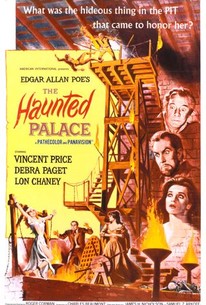
Classic Films in Focus: THE HAUNTED PALACE (1963)

Although the story really comes from H.P. Lovecraft's The Case of Charles Dexter Ward, Roger Corman's The Haunted Palace (1963) bills itself as one of the director's Edgar Allan Poe films and features all of the familiar trappings of those Gothic horror tales. Vincent Price is, as usual, in the lead, here playing a dual role as an evil warlock and his identical descendant, with Debra Paget making her final screen appearance as the descendant's long-suffering wife. The constant fog, gloomy period setting, and well-established genre tropes ensure that fans of Corman's other films will find plenty to appreciate here, but the chief attractions beyond Price and Paget are a gaggle of creepy mutant villagers and supporting performances from Lon Chaney, Jr. and Elisha Cook, Jr. The Haunted Palace is one of five films Corman directed in 1963, and it's not the first Corman picture anyone should see, but it's a fun outing for its iconic stars and worth the time if you enjoy the other Corman and Price collaborations.

Price appears first as the powerful necromancer Joseph Curwen, who conspires with his mistress, Hester (Cathie Merchant), to bewitch young women and bring them to his castle for unspeakable occult practices. The local villagers form a vigilante mob and burn Curwen at the stake, but not before he curses them and their descendants. Over a century later, Curwen's identical great-great-grandson, Charles Dexter Ward, inherits the castle and arrives in the town of Arkham with his lovely wife, Ann (Debra Paget). The village men (played by the same actors who appeared as their ancestors) make the Wards unwelcome, but Curwen's spirit soon possesses Charles and resumes his diabolical schemes of necromancy and revenge.

The dual roles of Joseph Curwen and Charles Dexter Ward give Vincent Price plenty to do, especially when he gets to play the two personalities warring for dominance over Ward's mind. Greenish makeup on the warlocks' faces helps us know when Curwen has control, but Price embodies the shift convincingly without the visual cue. Ward is a perfectly normal gentleman who loves his wife and doesn't believe in supernatural curses, while Curwen is a cunning sadist who is more than willing to murder anyone who crosses him. Of course, Curwen is destined to get the upper hand and wreak havoc, which ensures that Price can cut loose with his villain and make the most of a thoroughly terrible character. His sudden cruelty to his devoted wife leads her to suspect that evil is at work in the castle, but over time Curwen gets better at impersonating Ward so that he can continue his schemes in the secret chambers underground.

Debra Paget gives a solid performance as the worried wife, although she's the only developed female character in the whole story and spends most of her time looking frightened. Curwen is supposed to be obsessed with his dead mistress, Hester, but we don't see enough of her to understand his determination to resurrect her even though it's a distraction from the mission he and the other necromancers are supposed to be accomplishing. Lon Chaney Jr. has several scenes with Price but is subdued throughout; by 1963 he's long past his heyday as a horror star and not really credible as a fiendish immortal necromancer. The villagers, both past and present, are played by Leo Gordon, Elisha Cook, Jr., Frank Maxwell, and John Dierkes, and of the lot Maxwell has the most scenes because his doctor character tries to befriend and assist the Wards, although Cook is probably the most fun to watch because he plays fear-induced panic so brilliantly. Almost all of the named characters are rather dramatically upstaged by the deformed mutant villagers, descendants of the women Corwen bewitched and the ancient godlike thing he keeps locked in his underground lair. Cook's character, Peter, hints at the way the unholy mating has tainted the bloodlines of Arkham by revealing his own webbed hand, while Gordon's Edgar Weeden keeps his violent mutant son imprisoned in his home. Sadly, we don't know what, if anything, becomes of the mutants at the end of the story, since the Curwen/Ward conflict dominates the third act.

Different Corman fans will have their own favorites, but I recommend House of Usher (1960), The Masque of the Red Death (1964), and The Tomb of Ligeia (1964) if you want to see some of the best of the Poe adaptations with Vincent Price. You'll find both Price and Debra Paget in The Ten Commandments (1956), while Elisha Cook Jr. and Price both appear to great effect in William Castle's classic shocker, House on Haunted Hill (1959). See Lon Chaney Jr. in better times in his most memorable role as the ill-fated Larry Talbot in The Wolf Man (1941) and Frankenstein Meets the Wolf Man (1943), or check out his dramatic roles in Of Mice and Men (1939) or High Noon (1952).

Tuesday, February 12, 2019

Classic Films in Focus: DARK WATERS (1944)

Somewhere between Lifeboat (1944) and Gaslight (1944) lies the plot of Dark Waters (1944), in which Merle Oberon stars as the survivor of a U-boat attack whose fragile sanity is tested by a collection of nefarious characters. All three pictures appeared in the same year, but the first two are decidedly better films, while Dark Waters holds interest primarily for its cast. Joining Oberon for this wartime swamp Gothic are Franchot Tone, Thomas Mitchell, Elisha Cook, Jr., and Fay Bainter, with Rex Ingram making sporadic but memorable appearances as a former employee who suspects that something is amiss at the old plantation. Dark Waters fails to deliver enough creepy atmosphere to achieve its Gothic ambitions, and the ending is more a hard stop than a proper conclusion, but Oberon is fascinating to watch as she tries to figure out whether she's going or being driven insane.

Oberon's perpetually imperiled heroine is Leslie Calvin, whose family flees the Japanese descent on Batavia (present day Jakarta) only to fall victim to a German U-boat attack at sea. Leslie survives many days in an open boat before ending up in a New Orleans hospital. After months of convalescence she travels to a nearby plantation owned by her aunt and uncle, where she hopes to recover from her post traumatic stress. She meets a handsome doctor (Franchot Tone), who quickly falls for her, but everything else goes awry as she is constantly exposed to situations that recall her ordeal and unsettle her sense of reality. Leslie begins to suspect that the manipulative Mr. Sydney (Thomas Mitchell) and his sidekick, Cleeve (Elisha Cook, Jr.), are tormenting her on purpose, but to what end?

Gothic mystery is a fine setting for Oberon's exotic beauty, but she gets better material to work with in both Wuthering Heights (1939) and The Lodger (1944), where her characters have more energy and more successfully developed plots. Franchot Tone's country doctor, George, doesn't spark much chemistry, but he seems to be the only available man in the area aside from Elisha Cook Jr.'s creepy Cleeve. It doesn't take two minutes to recognize both Cleeve and Sydney as the villains of this piece, and Thomas Mitchell has a handful of effectively menacing scenes, but Fay Bainter's Aunt Emily is neither disturbing nor reassuring, and it's hard to justify John Qualen's presence as Uncle Norbert, since he barely comes out of his room to utter a few lines at dinner. Fine actors inhabiting the background don't get enough to do, either, especially Rex Ingram and Odette Myrtil, who turns up as the mother of a large, friendly Cajun family.

There's enough potential in Dark Waters to see the movie it could be, and that warrants a viewing, especially for contrast with moodier explorations of similar plots and atmospheres. The Louisiana bayou makes an evocative setting, and the premise of Leslie's very justified anxiety about water and boats creates numerous opportunities for her to be tormented. We know from the beginning where the third act of this story will inevitably end (hence the title), but when the film finally reaches that point it seems in a hurry to wrap things up, and quite a few loose ends are left dangling. The pacing is more of a shock because there had apparently been plenty of time to linger on an earlier fais do-do sequence that adds nothing to the story. It's hard to say if director Andre De Toth or the writers are to blame for these issues, but De Toth certainly made tighter pictures over the course of his career.

Do pause a moment to appreciate the underused Nina Mae McKinney as the housemaid, Florella, who unfortunately disappears from the picture in the third act. For more of Merle Oberon, try The Private Life of Henry VIII (1933), The Scarlet Pimpernel (1934), or That Uncertain Feeling (1941). See earlier roles for Franchot Tone in Bombshell (1933), Dancing Lady (1933), and Dangerous (1935). Thomas Mitchell is best remembered for more sympathetic characters in Stagecoach (1939), Gone with the Wind (1939), and It's a Wonderful Life (1946), while Elisha Cook, Jr. offers more of his usual type in The Maltese Falcon (1941), I Wake Up Screaming (1941), and The Killing (1956). For a more thoughtful and provocative treatment of a similar atmosphere, try I Walked with a Zombie (1943), or, for some really excessive gaslighting bayou horror, go for Hush... Hush, Sweet Charlotte (1964).


* As of February 2019, DARK WATERS is available for streaming on Amazon Prime, but the print is rather muddy, especially in the outdoor night sequences.

Friday, September 11, 2015

Classic Films in Focus: BORN TO KILL (1947)

The illustrious Robert Wise directs Born to Kill (1947), a sharp, smart noir drama that showcases the considerable talents of Claire Trevor as its morally ambivalent protagonist. It's an early foray into the genre for Wise, who would go on to direct The Set-Up (1949) and The House on Telegraph Hill (1951) before moving to Oscar winning projects like West Side Story (1961) and The Sound of Music (1965). Unlike those more famous musicals, Born to Kill allows Wise to explore some truly dark territory, and it provides interesting gender reversals of several noir tropes, with Trevor's character in the sway of Lawrence Tierney's menacing homme fatal. Memorable supporting performances from Walter Slezak, Elisha Cook, Jr., and Esther Howard also make this taut crime story worth seeking out, with Isabel Jewell making a brief but pivotal appearance as the good-time girl whose bad behavior sets the plot in motion.

Claire Trevor stars as the newly divorced Helen, who concludes her stay in Reno by discovering a pair of corpses and then skipping town without informing the police. On the train back to San Francisco, she meets the attractive but overbearing Sam (Lawrence Tierney), who makes overtures to Helen but then rapidly marries her wealthy foster sister, Georgia (Audrey Long). Neither Helen's engagement to Fred (Phillip Terry) nor Sam's marriage can cool their lust for each other, even though Helen begins to suspect that Sam is the murderer who left those bodies behind. Meanwhile, a private detective (Walter Slezak) hired by a friend of the dead woman arrives in San Francisco to investigate Sam's involvement in the crime, and Helen is torn between betraying Sam and keeping his dangerous secrets.

Trevor's Helen takes the place of the usual noir anti-hero; like Walter Neff or Frank Chambers, she has a sliver of conscience to struggle against the dark impulses that dictate her fate. Ironically, of course, one of her few generous actions, that of returning a little dog to its home, leads her to find the bodies and make the far less laudable decision to leave town without telling the police. Helen doesn't want to get involved, but soon she's involved so deeply that she can't get out. She knows perfectly well what kind of man Sam is, but she can't resist him, even after he marries her innocent sister. Tierney's male seducer is more brutal than a classic femme fatale; he's always just a breath away from losing his temper and killing someone, although his friend, Marty (Elisha Cook, Jr.), tries to keep him under control. Noir fans will instantly see the irony of having Cook, so often cast as the unhinged type himself,  play the sane one of the pair, while Tierney is really terrifying in his role, and it's clear that he's the inspiration for the picture's title. Moreover, we understand that Helen is a fool to think she can manage him or even survive her entanglement in this compulsive killer's web.

Cook is probably the most familiar of the supporting players, thanks to his many noir roles, but Born to Kill offers several other performances worth noting. Walter Slezak, sounding just a little sketchy with his Austrian accent, plays the detective, Arnett, a slippery philosopher who might or might not have any morals at the bottom of his corpulent soul. Isabel Jewell vanishes too soon as Laury, the girl whose infidelity first pushes Sam over the edge, but she gives the character enough life to highlight Helen's cold self-interest and Mrs. Kraft's devotion. It's Esther Howard as the older woman who proves the scene-stealer of the picture; as the tragicomic Mrs. Kraft, she's brassy and worn, but probably the most deeply sympathetic character in the whole story. Her confrontation with Cook's murderous Marty turns up the tension to an almost unbearable degree, first by forcing us to watch her walk right into a trap and then by making her fight for her life with desperate courage. She's funny, crass, loyal, and utterly heartbreaking in her grief over Laury's untimely death, a perfect foil to Helen's pitiless refinement.

Be sure to note Tommy Noonan in an uncredited role as the bellboy who knows that Mrs. Kraft cheats at cards and Ellen Corby of The Waltons as one of the household maids. For more of Robert Wise's films from the 1940s, try The Curse of the Cat People (1944) and The Body Snatcher (1945), both made under the oversight of horror maestro Val Lewton. Claire Trevor won a much-deserved Oscar for Best Supporting Actress in Key Largo (1948), but you'll also find her in Stagecoach (1939), Murder, My Sweet (1944), and Raw Deal (1948). Lawrence Tierney plays bad guys like the title outlaw in Dillinger (1945) and Jesse James in Badman's Territory (1946) and Best of the Badmen (1951). Don't miss Walter Slezak in the Hitchcock thriller, Lifeboat (1944), in which he puts that accent to especially unnerving use. Esther Howard turns up regularly in Preston Sturges comedies, as well as Murder, My Sweet and Champion (1949). You might recognize Isabel Jewell from her role as Emmy Slattery in Gone with the Wind (1939), but she also appears in Marked Woman (1937), Lost Horizon (1937), and The Leopard Man (1943).


Tuesday, November 18, 2014

Classic Films in Focus: THE BIG SLEEP (1946)

Humphrey Bogart successfully steps into the gumshoes of detective Philip Marlowe in Howard Hawks' adaptation of The Big Sleep (1946), but in 1945 the top brass at Warner Brothers were far more concerned about Lauren Bacall, as the extensive revisions that preceded the film's release prove. It's not that the original 1945 cut of the picture and the final version are all that different; it's just that the tinkering labors to put Bacall in the best possible light, both literally and figuratively. The studio's effort paid off; Bacall, by then Mrs. Humphrey Bogart, got her career back on track after bad reviews in Confidential Agent (1945), and noir fans got a picture for the ages, with the perfectly paired leads trading zippy quips and stepping around corpses as coolly as they pour themselves drinks. As obvious as The Big Sleep is when it comes to top noir picks, the movie deserves its elevated spot in the genre pantheon, not only because of Bogart and Bacall but because of writers like Raymond Chandler, William Faulkner, and Leigh Brackett, as well as a seriously deranged Martha Vickers as one of the worst kid sisters in cinematic history.

The story opens when Bogart's Marlowe is hired by the elderly General Sternwood (Charles Waldron) to shake off a blackmailer targeting his wild younger daughter, Carmen (Martha Vickers). Marlowe immediately suspects that some other funny business is afoot when the older daughter, Vivian Rutledge (Bacall), pumps him for information but acts coy about her own interest in the blackmailer job, and she clearly knows a lot more than she's willing to say. Marlowe soon finds himself and Carmen tangled up in a murder scene, and more corpses follow, but the mystery keeps coming back to a missing man named Regan and casino owner Eddie Mars (John Ridgely).

The revisions play up the chemistry between Bogart and Bacall by giving them more lines and scenes together, although some of the changes are purely cosmetic in terms of making Bacall look as alluring as possible. More of the pair is certainly a plus, even if the cuts obscure important elements of the murder mystery plot. Bogart and Bacall fit with noir - and with each other - the way a bullet fits into the chamber of a gun. His Marlowe is smart and unsentimental, a guy who has been around the block enough to know when he's being had. Her Vivian is no debutante, either, with her gambling debts and her husky, come-on voice. Nobody ever declared her affection with such sullen resignation as Bacall's Vivian when she tells Marlowe, "I guess I'm in love with you." Marlowe falls for her even as he realizes that he can't trust her, but he correctly guesses that she's no femme fatale. If they never reach quite the level of smart-mouthed irresistible attraction that they share in To Have and Have Not (1944), they do smolder very enjoyably, especially during their conversational cat-and-mouse games.

It takes tremendous screen presence to distract our attention from such a couple, but the supporting cast is full of actors who give it their best shot. Martha Vickers plays Carmen as a crazy Lolita, so hopped up on drugs and booze she can't even walk, but dangerous nonetheless. An infantile femme fatale with her thumb in her mouth, Carmen puts the moves on every man she meets, including Marlowe. "You're cute," she tells him, but the way she says it makes the listener's blood run cold. Charles Waldron has one really wonderful scene up front that makes us wish we could see more of his character; his General Sternwood has no pity for himself and only wants a real man to sit with him a while and drink his liquor for him. Even the bit players go for broke; Elisha Cook, Jr. makes the most of his brief appearance as Harry Jones, and Sonia Darrin provides a marvelously nasty foil to Bacall as the heartless, calculating Agnes. Dorothy Malone is so good as the book shop girl that we wonder how Marlowe can resist, especially after she takes off her glasses, but Marlowe's wartime Los Angeles seems to be full of self-possessed, available girls, from Vivian Rutledge all the way down to the eager cab driver who trades innuendos with the amused detective. It's as if Raymond Chandler and Howard Hawks both long to raid a jar stuffed with tough cookies, with Marlowe as the unlikely embodiment of their shared masculine fantasy. At least it gives the young actresses plenty of material, and each of them contributes to the overall appeal of the film.

For more screen versions of Raymond Chandler's detective, see Murder, My Sweet (1944), Lady in the Lake (1947), and The Long Goodbye (1973). Bogart and Bacall went on to star together in Dark Passage (1947) and Key Largo (1948), while Howard Hawks moved into Western territory with Red River (1948). Martha Vickers, sadly, did not become a great star, although she did become Mickey Rooney's third wife from 1949 to 1951. You can see more of her in The Man I Love (1947), Ruthless (1948), and Alimony (1949). Dorothy Malone, on the other hand, ended up winning an Oscar for Best Supporting Actress for Written on the Wind (1956), and she later appeared in Man of a Thousand Faces (1957), Warlock (1959), and even Basic Instinct (1992).


Monday, July 29, 2013

Classic Films in Focus: TWO SMART PEOPLE (1946)

Before she was Ricky Ricardo’s wacky wife, Lucille Ball had a different career as an up-and-coming leading lady on the big screen. She never became as big a star there as she would on television, but Ball made several pictures that are still worth watching today, including the crime romance mash-up Two Smart People (1946). Directed by Jules Dassin, this minor classic offers an interesting mix of genres but is carried mostly by the performances of Ball and her toothy costar, John Hodiak. Fans of caper stories and con men will appreciate Two Smart People for its larcenous protagonists, while cinephiles will enjoy seeing Ball, Hodiak, and a supporting cast that includes Lloyd Nolan and Elisha Cook, Jr.

Ball plays attractive lady swindler Ricki Woodner, who gets involved with fellow con artist Ace Connors (Hodiak) at the behest of mutual acquaintance Fly Feletti (Elisha Cook, Jr.). Fly wants to get his hands on a stack of bonds stolen by Ace, but so does law man Bob Simms (Lloyd Nolan), who is taking Ace by train to New York and prison. Ricki tags along on the trip, which includes stopovers in Mexico and New Orleans, but her developing attraction to Ace complicates her efforts to make off with the bonds.

Despite her reputation as a comedienne, Lucille Ball could be as gorgeous and classy as any leading lady of her era, and she makes a good match for Hodiak and his carnivorous grin. Both actors know their way around the wised up attitudes of career criminals who are much better at lying than they are at telling the truth, even when falling in love. Their dishonest habits both bring them together and divide them, and much of the romance builds upon the problems of two untrustworthy people trying to come clean about themselves and their feelings for each other. The story underlines its themes of penitence and redemption by situating the last third of the action in New Orleans at Mardi Gras, where Ace describes his impending prison term as the Lent that follows a last wild night of self-indulgence.

The romance is further complicated by the presence of Bob as an unusual third wheel, given that Ace is technically under arrest the whole trip. Lloyd Nolan plays Bob as a perfectly straight arrow, which actually makes him subtly funny, and his mild demeanor keeps him likeable in spite of his kill-joy role as jailer. We like Ace because he’s more fun, but we never dislike Bob, partly because Ace clearly respects and likes his opponent, too. Bob’s opposite is Elisha Cook, Jr. as the devious, thoroughly nasty Fly, who threatens Ricki to keep her working for him and then resorts to more deadly efforts during the dramatic Mardi Gras climax. These two supporting characters represent the polar opposites of good and evil, law and chaos, with Ricki and Ace existing somewhere in between. The narrative’s insistence that the lovers pay for their past sins makes for something of a downer ending, but we’re meant to understand that they’ll come out on the other side worthy of having a new life together. The end result is basically a morality play, but there’s enough entertainment to make the dose palatable to most viewers.

For more romantic criminals, try Trouble in Paradise (1932), To Catch a Thief (1955), and The Thomas Crown Affair (1968). Jules Dassin, known mostly for his work with film noir, also directed The Naked City (1948), Night and the City (1950), and Rififi (1955). See more of Lucille Ball’s big screen roles in Dance, Girl, Dance (1940), The Dark Corner (1946), and Lured (1947). John Hodiak stars in Lifeboat (1944), The Harvey Girls (1946), and Battleground (1949), and you'll also find him paired with Lloyd Nolan in Somewhere in the Night (1946). Elisha Cook, Jr. turns up everywhere from The Maltese Falcon (1941) to House on Haunted Hill (1959), while Lloyd Nolan takes the title role in Michael Shayne: Private Detective (1940) and its many sequels.

Two Smart People is currently available for streaming on Warner Archive Instant.

Wednesday, February 13, 2013

Classic Films in Focus: I WAKE UP SCREAMING (1941)

Betty Grable is not an actress one normally associates with film noir, but she makes an unusual foray into Dark City in H. Bruce Humberstone's 1941 picture for Fox, I Wake Up Screaming. Nobody ever actually does wake up screaming in the movie, and the ill-chosen title is not the only weakness in evidence, but the picture is watchable and offers an interestingly twisted tale of passion, murder, and suspense.

Grable plays good girl Jill Lynn, whose beautiful and ambitious sister, Vicky (Carole Landis), has just been murdered. The chief suspect in the case is Frankie Christopher (Victor Mature), a promoter who was helping Vicky become a star, but Frankie insists that he had nothing to do with Vicky's death. Both Frankie and Jill fall under the relentless watch of imposing cop Ed Cornell (Laird Cregar), who refuses to believe that Frankie might be innocent. As they struggle to find Vicky's real killer, Frankie and Jill must come to grips with their feelings for one another, and their blossoming romance might prove the weakness that finally helps Cornell to pin the crime on Frankie.

The dialogue in I Wake Up Screaming can't compare to that of the real masterpieces of noir, where lines get thrown like so many daggers in a deadly circus act. Double Indemnity (1946) it is not. The film was adapted from a novel by Steve Fisher with the screenplay by Dwight Taylor, who mostly wrote scripts for Fred Astaire and Ginger Rogers but also penned Pickup on South Street (1956), a much more highly regarded example of noir style. There's also an obsessive and rather bizarre use of an instrumental version of "Somewhere Over the Rainbow" for the film's musical backdrop. You'll get tired of hearing it by the time the picture ends.

On the plus side, Laird Cregar is a smoldering menace as the relentless cop, and Elisha Cook, Jr., always great, appears in a small but crucial role. Victor Mature is fun to watch, although his heavy features constantly raise suspicion that he might actually be the killer, and that might be the whole point of casting him in the first place. Carole Landis makes a lovely and cold-hearted foil to Grable's good sister, and Alan Mowbray and Alyn Joslyn have interesting roles as Frankie's slippery friends.

If you like Betty Grable, see her in her natural element in Down Argentine Way (1940) and How to Marry a Millionaire (1953). You'll find Victor Mature in My Darling Clementine (1946), Kiss of Death (1947), and The Robe (1953). Don't miss Laird Cregar in The Black Swan (1942), Heaven Can Wait (1943), and The Lodger (1944). Elisha Cook, Jr. turns up in all kinds of classic movies, but makes his most memorable appearance in The Maltese Falcon (1941). For more from director Bruce Humberstone, try To the Shores of Tripoli (1942), Wonder Man (1945), or Happy Go Lovely (1951).

An earlier version of this review originally appeared on Examiner.com. The author retains all rights to this content.

Friday, December 14, 2012

Classic Films in Focus: DON'T BOTHER TO KNOCK (1952)

Marilyn Monroe is best remembered today for her work in musical comedies like Gentlemen Prefer Blondes (1953) and Some Like It Hot (1959), but the blonde bombshell appeared in darker films, as well, among them the 1952 psychological thriller, Don't Bother to Knock, in which Monroe plays a mentally disturbed young woman whose employment as a hotel babysitter turns out to be a Very Bad Idea. Fans of Monroe who have only seen the lighter pictures will find this film a fascinating glimpse at a different side of the iconic star, one that demonstrates her talent as a real actress in a complex dramatic role. Directed by Roy Ward Baker, the movie also features Richard Widmark and Anne Bancroft, along with an excellent supporting cast that includes Elisha Cook, Jr. and Jim Backus.

Widmark plays the lead character, Jed, a pilot whose relationship with hotel chanteuse Lyn (Bancroft) is on the rocks. Stung by her rejection, Jed puts the moves on Nell (Monroe), but he soon discovers that the young woman is dangerously unhinged. Her instability spirals out of control as she confuses Jed with her own dead lover and blames her charge, Bunny, an innocent little girl, for coming between them.

Widmark, a veteran of noir thrillers, is an interesting choice for the lead, but he pulls it off. We expect him to be callous and unsympathetic, but his shifting perspective over the course of the picture works well. His girlfriend correctly accuses him of lacking "an understanding heart" during the opening scenes, and we see that flaw demonstrated in his willingness to lie to and seduce Nell; later, however, he comes to pity and worry about both Nell and Bunny. This encounter changes Jed in some profound and positive ways, putting him on an upward arc even as Nell slides down. Anne Bancroft makes her very first screen appearance as Jed's girl, Lyn, and she's a good foil to Monroe, although she appears in relatively few scenes. Elisha Cook, Jr. makes excellent use of his small part as the elevator operator who is also Nell's uncle, while Jim Backus provides plenty of personality for the supporting character of Bunny's businessman father.

Monroe brings fragility and fierce energy to her role as Nell; we realize right away that there's something wrong with the girl, but it's hard to pin down until the details of her past start spilling out. When she first appears she seems repressed, plain even, and very, very young; there's no hint of the sex appeal for which the actress would become so famous. Later, in borrowed finery, she plays at being a woman of the world, but the broken heart and mind of her character remain central to our perception of her. It's a shame that Monroe didn't get more parts like this one over the course of her career; it might have given more substance to our sense of her.

Try Niagara (1953) for another thriller with Monroe. You'll find Richard Widmark playing more typical characters in Kiss of Death (1947) and Road House (1948), but he also turns up in some good Westerns and more straightforward dramas. Anne Bancroft would go on to win a Best Actress Oscar for The Miracle Worker (1962) and achieve Hollywood immortality as Mrs. Robinson in The Graduate (1967). If you like Donna Corcoran as Bunny, catch her in Angels in the Outfield (1951), as well. Roy Ward Baker also directed A Night to Remember (1953) and a number of Hammer horror films.

An earlier version of this review originally appeared on Examiner.com. The author retains all rights to this content.

Wednesday, November 28, 2012

Classic Films in Focus: THE MALTESE FALCON (1941)

Few classic films are more iconic than The Maltese Falcon (1941). It occupies the same rarefied space reserved for The Wizard of Oz (1939), Gone with the Wind (1939), and Casablanca (1942), yet its mood and style set it apart from the lavish spectacles created by the first two films, while its razor sharp nastiness makes it a different picture entirely from the third, even though they share several of the same stars. The Maltese Falcon is also unique in its role as the first appearance of a wholly new kind of American film, the noir picture, even though its roots lie in the gangster movies and European expressionist films of the 1930s. As lean and wolfish as Sam Spade himself, The Maltese Falcon remains one of the most famous of all movies because each of its many parts works so perfectly that the whole does indeed become the stuff that dreams are made of.

Based very closely on the novel by Dashiell Hammett, The Maltese Falcon presents the story of Sam Spade (Humphrey Bogart), a private detective in San Francisco who finds his latest case more trouble than he expected when his partner, Miles Archer (Jerome Cowan), turns up dead. His attractive client (Mary Astor) offers Spade so many different names and half truths that getting to the bottom of Miles' murder requires getting involved with the mysterious lady's affairs right up to Spade's frequently imperiled neck. The whole seedy business boils down to a pack of thieves and a near mythical statue that all of them are willing to kill to possess.

Director John Huston penned the screenplay himself, and he wisely retained Hammett's grimly humorous lines and almost the entire plot of the original novel; this is really one of the most faithful adaptations of a literary work ever filmed for the big screen, and it says something about the slim elegance of Hammett's prose that such fidelity is even possible, even more that a faithful adaptation can simultaneously make for such outstanding cinema. Hammett's brilliant, jaded dialogue would come to epitomize noir cool, with lines like "Mrs. Spade didn't raise any children dippy enough to make guesses in front of a district attorney, an assistant district attorney, and a stenographer" and "When you're slapped, you'll take it and like it." Naturally, there are a few changes. A subplot involving a girl in Gutman's retinue gets dropped, and the end of the film differs in some subtle but important ways. Oddly enough, Huston's ending is actually a little nicer than Hammett's, if one can call either ending "nice" at all.

Hammett had described his protagonist as "rather pleasantly like a blond Satan" in the novel, and of course Bogart is not blond, but he captures perfectly the balance of light and dark that make up Sam Spade's character. Spade is no hero, although he eventually tells Brigid O'Shaughnessy that he isn't as crooked as she might think, that being morally ambiguous is part of the job of being a private detective. He catches Miles' killer not because he liked Miles (he didn't), but because it's bad for business to let a job like that get by right under the detective's own nose. Spade lives a rough life and likes it that way as long as it pays well enough, and Bogart's devilish grin conveys his control over every ugly situation, particularly when he needles the tightly wound Wilmer (Elisha Cook, Jr.) and dances his way around the questions of the local cops.

The rest of the cast give the performances of their careers here. Peter Lorre, Sydney Greenstreet, Mary Astor, and Elisha Cook, Jr. make for as faithless and dishonorable a den of thieves as one could hope for; their chemistry as a group crackles with equal parts menace and humor. As the effeminate Joel Cairo, Lorre walks a very fine line, suggesting the sexual attraction Cairo feels for Wilmer but keeping it subtle enough to get by the censors. Hammett had been able to get away with more of that aspect of the character in the novel, but it takes a character actor as brilliant as Lorre to make it work on screen without tempting the fate of the censors' morally anxious editors. Effie Perine, played beautifully by Lee Patrick, might be the only really lovable character in the whole thing, which is precisely why Spade won't give her the time of day. Astor, Patrick, and Gladys George as Iva Archer make a fascinating trinity of the feminine types that populate the noir world, and it's no surprise that the bad girls outnumber the good ones two to one.

The Maltese Falcon earned three Oscar nominations in 1942, although it won nothing, and How Green Was My Valley (1941) carried away all of the honors instead. In retrospect, Huston couldn't have felt too bad about that, since the other film that lost to the sentimental family drama that year was Citizen Kane (1941). For more of Bogart's best films, see The Big Sleep (1946), The Treasure of the Sierra Madre (1948), and The African Queen (1951), the last two of which were also directed by Huston. Look for Mary Astor in The Great Lie (1941), for which she won a Best Supporting Actress Oscar, and in The Palm Beach Story (1942) and Meet Me in St. Louis (1944). Don't miss Peter Lorre in M (1931) and Mad Love (1935), two early roles that helped to define the course of his macabre career. Elisha Cook Jr. turns up in all sorts of places, from Shane (1953) to Rosemary's Baby (1968), but he's great fun to watch in House on Haunted Hill (1959). You'll find Sydney Greenstreet in Christmas in Connecticut (1945) and The Woman in White (1948), but The Maltese Falcon and Casablanca are certainly his most memorable appearances on film.

An earlier version of this review originally appeared on Examiner.com. The author retains all rights to this content.