Showing posts with label George Macready. Show all posts

Wednesday, April 30, 2025

Classic Films in Focus: ALIAS NICK BEAL (1949)

The Faust story has inspired many revisions over the centuries, so it's no surprise that director John Farrow's 1949 film noir, Alias Nick Beal, re-imagines the familiar tale of a man who sells his soul to the devil and comes to regret the bargain. In this version, however, it's not the Faust character who gets top billing, but the Devil himself, aka Nick Beal, brilliantly played by Ray Milland with suave menace and brimstone eyes. Thomas Mitchell's tempted attorney seems rather mild to warrant such a satanic charmer, but Audrey Totter's reluctant seductress makes a perfect feminine (and ultimately very human) foil to Milland's diabolical antagonist. It's a bit too tame and moral - especially in the final scenes - to be a truly outstanding adaptation of the tale, but Milland and Totter make it well worth viewing.

Thomas Mitchell plays righteous district attorney Joseph Foster, who unwittingly summons the demonic Nick Beal (Ray Milland) when he says he would give his soul to convict a notorious local criminal. Nick soon enables Foster to realize his goal and also promotes his candidacy for governor, but his help inevitably pushes Foster into deeper entanglements and more unethical situations. Foster's wife, Martha (Geraldine Wall), and friend, Reverend Garfield (George Macready), try to warn Foster against Nick's machinations, but Nick enlists the help of the attractive Donna Allen (Audrey Totter) to undermine Foster's marriage. By the time Foster climbs the steps of the governor's mansion, he realizes how far Nick has caused him to stray from his original ethics, but the only way out might literally lead him through the gates of Hell.

As its title and billing hierarchy imply, this movie belongs to its villain, and the good man exists mostly to give the Devil something to do. I don't mean to malign Thomas Mitchell, who is truly brilliant in films like Stagecoach (1939) and Gone with the Wind (1939), but his character, like Adam and Eve in Milton's Paradise Lost, proves far less interesting than the infernal antagonist. Milland has a way with dangerous, sly types that makes him absolutely perfect for the role. If you've seen him in Dial M for Murder (1954), or the less familiar So Evil My Love (1948), you know what a terrific heel he makes, and with Nick Beal he gets to inhabit an inhuman being of pure evil. Beal never makes much of a secret of his identity, even remarking to the Reverend Garfield that Rembrandt painted his portrait, and he simply appears and disappears wherever he likes. The human characters eventually catch on to his supernatural nature, but it takes Foster a surprisingly long time to confront the fact that he really has made a deal with the Devil.

Audrey Totter has long been a particular favorite of mine, and here she's perfectly cast as the temptress struggling with pangs of conscience over her part in Foster's corruption. Nobody aims a hard, hateful glare better than Totter, but she also shows her mastery of more complex emotions like fear, doubt, and deep regret. We first meet Donna at the low point of her life thus far, and Nick clearly believes she'll stoop to anything for a little worldly comfort. For a while she plays along, posing as a civic-minded socialite to infiltrate Foster's personal and political circles. Once she gets to know both Foster and Nick better, she proves that she's not nearly as morally bankrupt as Nick would like, although she finds him impossible to escape. Totter's performance helps to elevate Donna; she's far more than a mere phantom of desire like Faust's Helen of Troy and a more serious character than Lola in Damn Yankees (1958). After her role as Donna, Totter moved on to play both a faithful wife in The Set-Up (1949) and a truly vicious femme fatale in Tension (1949), but Alias Nick Beal gives her a complex character who possesses both good and evil qualities.

 John Farrow earned an Oscar nomination for Best Director for his work on the WWII war picture, Wake Island (1942), and he won Best Adapted Screenplay as a writer for Around the World in 80 Days (1956). His other noir pictures include The Big Clock (1948), Where Danger Lives (1950), and His Kind of Woman (1951). Ray Milland won Best Actor for The Lost Weekend (1945), but for lighter roles see him in The Major and the Minor (1942) and Rhubarb (1951). For more of Audrey Totter, try Lady in the Lake (1946) and The Unsuspected (1947). If you're interested in other classic films inspired by the Faust story, check out The Devil and Daniel Webster (1941), Angel on My Shoulder (1946), Bedazzled (1967), Doctor Faustus (1967), or the cult classic musical, Phantom of the Paradise (1974).

Thursday, February 8, 2024

Classic Films in Focus: MY NAME IS JULIA ROSS (1945)

Director Joseph H. Lewis is best remembered today for his influential noir classic, Gun Crazy (1950), but he also brings great tension to My Name is Julia Ross (1945), an atmospheric thriller from Columbia Pictures that stars Nina Foch as the titular heroine. Despite its modern day setting, Julia's story revels in Gothic trappings, with an imprisoned and imperiled protagonist who endures extreme gaslighting at the hands of her kidnappers. Fans of Gaslight (either the 1940 or the 1944 version) and more traditional Gothic fare will find a lot to appreciate in this tight, well-acted production, including especially sinister performances from Dame May Whitty and a barely restrained George Macready.

Foch plays the penniless but determined Julia Ross, who lands a seemingly perfect job as the live-in secretary of wealthy Mrs. Hughes (May Whitty). Julia is too relieved to worry at questions about her being absolutely without friends or family, but she realizes the awful truth when she awakens from a drugged slumber to find herself transported to Cornwall and declared to be the mentally ill wife of Ralph Hughes (George Macready). Luckily, Julia's aspiring love interest, Dennis (Roland Varno), is searching for her while Julia repeatedly tries to escape before Ralph and his mother can carry out their nefarious plans.

The success of the whole picture depends on its heroine, and Nina Foch makes Julia active and appealing in spite of her damsel in distress situation. Foch's long career included a Best Supporting Actress Oscar nomination for her role in Executive Suite (1954), but she never became a top star, which seems a shame considering her energetic performance here. Foch is beautiful in a wide-eyed but spirited way, definitely not the kind of girl to surrender meekly to villainous schemes, no matter how many times the Hughes family tries to convince Julia that she's Marion Hughes. Our heroine might be naive enough to jump at the sudden job offer, but she's never passive or resigned to her fate. Ironically, Julia's constant efforts to escape and tell someone about her situation only support the Hughes' claim that she's insane, but Julia manages to outsmart them enough to get a letter out to Dennis. Part of the fun of the movie lies in waiting to see what Julia will try next, whether she's hiding in cars, looking for secret passages, or pretending that she really believes she might be Marion Hughes.

Most of the other important characters present threats to Julia's well-being, and each is interesting in his or her own fashion. Julia's chief antagonist is the unflappable Mrs. Hughes, played with sly menace by Dame May Whitty. Whitty is a fun choice for the role because she doesn't seem like a villain even when she's blatantly plotting Julia's demise. The mother provides a stark contrast to the psychopath son, Ralph, who has already murdered the original Marion and clearly yearns to kill again. Only Mrs. Hughes can control him, and one wonders how long that can last, given the number of sharp objects she has to confiscate from Ralph over the course of the picture. The criminal pair have ample assistance from their most trusted servants, especially Sparkes (Anita Bolster), who poses as the employment agent and ensures that the newer servants spread gossip about "Marion Hughes" being insane. She's a great example of the sinister housekeeper so quintessential in the Gothic genre, and Bolster has a perfect face for the role.

My only real complaint about My Name is Julia Ross relates to the abrupt and overly tidy ending, which turns a blind eye to the extremity of Julia's ordeal. Compare that with the endings of Gaslight or Notorious (1946), in which the heroines are clearly going to need to work through some heavy post-traumatic stress. For more of the lovely Nina Foch, see The Return of the Vampire (1943), in which Roland Varno also plays her love interest, An American in Paris (1951), or Illegal (1955). She also appears in both The Ten Commandments (1956) and Spartacus (1960). Dame May Whitty earned Best Supporting Actress Oscar nominations for Night Must Fall (1937) and Mrs. Miniver (1942), but she has memorable roles in The Lady Vanishes (1938), Suspicion (1941), and Gaslight (1944). Don't miss George Macready in Gilda (1946), which is probably his most important film.

Tuesday, October 13, 2015

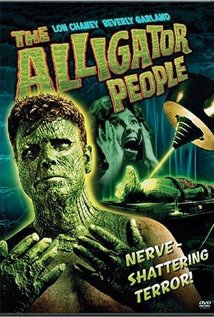
Classic Films in Focus: THE ALLIGATOR PEOPLE (1959)

Like The Fly (1958), The Alligator People (1959) merges science fiction and horror with a premise about dangerous experimentation gone horribly wrong, although in the second movie's case the combination of animal and human traits is intentional rather than tragically coincidental. Thus we get Richard Crane, as the increasingly reptilian victim of medical innovation, wandering the Louisiana swamps with one seriously bad case of gator face, while Beverly Garland chases after him as a dedicated wife who just won't take "no" for an answer. Most horror fans will come to The Alligator People for Lon Chaney, Jr., who plays a drunken villain, or for another example of the drive-in sci-fi chiller that flowered in the 1950s, but additional attractions can be found in the direction of Roy Del Ruth and performances from experienced players like Bruce Bennett, George Macready, and Frieda Inescort, each of whom helps to nudge the picture beyond mere B-movie spectacle.

Garland is the story's protagonist, a newly married nurse named Joyce Webster whose husband, Paul (Richard Crane), vanishes from a train on their honeymoon. Joyce tracks Paul to his family's plantation in the swamps, where she meets his mother, Mrs. Hawthorne (Frieda Inescort), who gives Joyce an icy welcome and tries to force her to leave. Determined to uncover the truth, Joyce stays until her mother-in-law and a local medical researcher, Dr. Sinclair (George Macready), reveal that Paul is suffering the side effects of a radical treatment for injuries he sustained in a plane crash during the war. Joyce joins their efforts to reverse Paul's transformation, but chaos erupts when a loutish plantation worker, Manon (Lon Chaney, Jr.), transfers his violent hatred for alligators to the alligator man.

The Alligator People is by no means a great film, and it often makes choices that are typical of its genre, but it also offers pleasant surprises. The pseudo-science of the central plot is wrapped in a strange psychological setup that presents Joyce, now known as Jane, as a victim of trauma induced amnesia as a result of her experience. Bruce Bennett appears in the frame scenes as one of two sexist doctors who can't stop mentioning how attractive the nurse is even as they use hypnosis to dredge up her horrible past. On the plus side, the frame tale serves a practical purpose in that it lets the audience know right away that this story won't end well for the alligator man or his bride, much as the opening of The Fly sets that story on its unbending course toward tragedy. The sexism also gets a much appreciated rebuke in the stalwart devotion of Joyce, who refuses to give up her search or abandon her husband once she sees his monstrous transformation. She even goes after him at the end, screaming not so much at his freakish appearance as his awful demise. Sure, his alligator head looks utterly fake, and we can even see the seams in his bodysuit, but Beverly Garland's performance as Joyce helps us focus on the drama of the situation rather than its special effects budget.

The success of the movie depends mostly on Garland, who plays Joyce as an active, intelligent woman caught up in overwhelming horror, but several supporting performances are worth noting. Lon Chaney. Jr. makes his presence felt as the belligerent Manon, a far nastier role than the actor's best known characters in other horror films. With his hook hand and his lecherous eye, Manon is a true monster; he provides a telling contrast to Paul, who loses the appearance of humanity but retains its inner qualities, even to the bitter end. Frieda Inescort also turns in a good performance as Paul's distraught mother; her accent wanders a bit, but she navigates the emotional territory of her character with greater assurance, letting her stern rejection of Joyce melt into shared misery over a loved one's terrible fate. Richard Crane gets less screen time as Paul, since he mostly skulks around the bayou in hiding, but his opening scenes set the stage for his later anguish. Hold on to the subtle cues on his handsome face as he talks about his accident with Joyce; that subtlety is lost later, but its emotional impact endures. Bruce Bennett and George Macready are both somewhat underused in their roles, but they give their doctors far more animation than such characters usually have in these pictures.

Some sci-fi B movies of this era are beloved precisely because they are campy and badly done, but The Alligator People takes a more serious tone, and despite its faults it's really a much better picture than it probably has any right to be. Give some of the credit for that to Roy Del Ruth, who also directed Born to Dance (1936), It Happened on Fifth Avenue (1947), and On Moonlight Bay (1951). See more of Beverly Garland in D.O.A. (1950), Not of This Earth (1957), and Twice-Told Tales (1963); she also enjoyed a long and varied television career and was even nominated for an Emmy. Lon Chaney, Jr. is best remembered for The Wolf Man (1941), but he plays supporting roles in many films, including The Black Castle (1952), The Black Sleep (1956), and The Haunted Palace (1963). Catch Frieda Inescort in Pride and Prejudice (1940), You'll Never Get Rich (1941), and The Return of the Vampire (1943). For similar 50s creature features, try I Was a Teenage Werewolf (1957), Attack of the 50 Foot Woman (1958), and Return of the Fly (1959).


Friday, November 14, 2014

Classic Films in Focus: GILDA (1946)

Gilda (1946) would prove both the high point of Rita Hayworth's career and the bane of her personal life, since it created an enduring image of the actress as sex symbol, temptress, and femme fatale. Hayworth would later lament, "Every man I knew went to bed with Gilda... and woke up with me." Even in her own lifetime, the fictional character outshone the person, who had started out as a dancer named Margarita Cansino. Hayworth certainly provides the fuel that sets Charles Vidor's noir film on fire; she's impossibly alluring from the first moment we see her, flipping that fabulous hair to reveal a perfect face and eyes lit up with mischief. Gilda's dazzling sexuality helps to make up for a frankly bewildering plot, but it also acts as cover for the movie's more daring depiction of the passionate attraction between its two male protagonists, played with smoldering intensity by Glenn Ford and George Macready.

Ford turns up first as Johnny Farrell, a drifter who blows into Buenos Aires and strikes up a strangely intense friendship with urbane casino owner Ballin Mundson (George Macready). They make a happy pair until Mundson brings Gilda (Hayworth) home as his wife. Johnny and Gilda have a past together, but Johnny dedicates himself to watching Gilda for Mundson's benefit, even though she seems determined to throw herself at every man in town. When Mundson's illicit business affairs end in his apparent death, Johnny takes his loyalty to extremes by marrying Gilda as a way to ensure her fidelity to the dead man.

The business end of the plot, which involves Germans, the tungsten market, and a mysterious pile of patents, merely muddies the narrative and gives Mundson a reason to act shifty and then disappear. Gilda never pays any attention to it, Johnny never understands it, and the viewer might as well ignore it, too. Mostly it makes Mundson a more sinister figure by giving him Nazi associations, but he already looks the part with his blond hair, refined features, and long facial scar. All of the really interesting scenes focus on the bizarre love triangle between the three leads; Johnny's eyes burn with a kind of crazed devotion to Mundson even as they ignite with equal hatred for the faithless Gilda. "Hate can be a very exciting emotion," Mundson observes, and that confusion of love and hate drives the picture. Johnny loves Mundson and hates Gilda, especially when Mundson gives Gilda the place that Johnny wishes to occupy himself, even though neither man would ever admit to the true nature of their mutual attraction. Gilda hates Johnny and punishes him through her marriage to Mundson; she hurts him more by pretending to cuckold the man Johnny loves. Mundson might not really love anyone except himself, but he certainly has strong feelings of some kind about both Johnny and Gilda, especially when he returns to find them married to each other and living off of his money.

Through it all, Hayworth is resplendent, a gorgeous bundle of utterly irrational femininity. Gilda's actions never make much sense except in her own mind, but the film doesn't present her as an intellect, merely an id. Mundson accurately describes her as "a beautiful, greedy child," although he doesn't add that she is the kind of child who would gleefully pull the wings off of flies. It's a sexist characterization, to be sure, but the film works because the camera loves Hayworth just as devotedly as Johnny loves Mundson. She blazes like a fiery idol; even her dubbed song numbers have a jaw-dropping effect, especially the famous "Put the Blame on Mame" segment, which ends with her threatening to strip in front of an eagerly leering audience. Her shocking behavior is all part of her scheme to hurt Johnny, but she really drives each nail in, delivering an endless stream of barbed lines. "If I'd been a ranch," she says, "they would have named me the bar nothing." The worse Gilda behaves, the more we adore her; even Johnny can't resist her electric appeal, though he might be the last person to figure that out. It's little wonder that the role became the signature moment of Hayworth's career; after all these years it's still so easy to fall under Gilda's provocative spell.

Be sure to appreciate Joseph Calleia and Steven Geray in supporting roles as Detective Obregon and Uncle Pio. For more of Rita Hayworth, see Cover Girl (1944), The Lady from Shanghai (1947), and Pal Joey (1957). Glenn Ford also stars in The Big Heat (1953), Blackboard Jungle (1955), and 3:10 to Yuma (1957). You'll find George Macready in The Big Clock (1948), Detective Story (1951), and Paths of Glory (1957). Charles Vidor directed Hayworth in both Cover Girl and The Loves of Carmen (1948); his other films include Hans Christian Andersen (1952), Love Me or Leave Me (1955), and the 1957 adaptation of A Farewell to Arms.