Showing posts with label Westerns. Show all posts

Tuesday, August 5, 2025

Classic Films in Focus: BAD DAY AT BLACK ROCK (1955)

There's more than one bad day being referenced in the title, but Bad Day at Black Rock (1955) mostly focuses on the deadly 24 hours spent by Spencer Tracy's war veteran protagonist in a dusty little town that definitely doesn't want him there. It's a searing and sadly still relevant indictment of prejudice, small town corruption, and the way cowardice prevents ostensibly good people from doing what they know to be right. John Sturges, known for his Westerns and war films, directs this taut noir in a modern Western setting, and Tracy leads a cast of outstanding performers, with Robert Ryan, Ernest Borgnine, Walter Brennan, Dean Jagger, Lee Marvin, and Anne Francis all doing excellent work. 

Tracy plays WWII veteran John Macreedy, who lost an arm in Italy and arrives in Black Rock to present a medal to the father of the Japanese-American soldier who died saving his life. Denizens of the town are immediately suspicious of Macreedy, and their mood sours to outright hostility when they learn why he has come, with local boss Reno Smith (Robert Ryan) encouraging his henchmen, Coley (Ernest Borgnine) and Hector (Lee Marvin), to bait Macreedy at every turn. Macreedy soon realizes that Smith and his lackeys are behind the mysterious disappearance of the Japanese farmer, Komoko, but they don't intend to let Macreedy live long enough to tell the state police about their crimes.

Each character in this story represents a possible response to injustice, with Tracy's disabled veteran as our moral example and Ryan's seething racist at the other extreme. Macreedy, wanting to honor the memory of his fallen comrade and perhaps assuage his survivor's guilt, never wavers in his commitment to seeing justice done, even though it could mean his own death. He isn't temperamental or easy to bully into foolish action, which makes him particularly dangerous to the volatile, tyrannical Smith, who recognizes him as the inexorable force of justice personified. Smith puts on a friendly face at first, but it's merely a calculating facade. His need to rule over his neighbors and his vicious hatred of Japanese people soon become obvious. Coley and Hector eagerly abet Smith's reign, if only because it gives them scope to exercise their own sadistic natures and probably line their pockets at the same time. Young Pete (John Ericson) and his sister, Liz (Anne Francis), both express ambivalence at first, but each of them must eventually choose a side, and their starkly different decisions determine their fates. Good intentions and cowardice mark the characters of Doc Velie (Walter Brennan) and Sheriff Tim Horn (Dean Jagger), older men who don't condone Smith's crimes but seem unable to stand up to him until Macreedy shows them how it's done. It's worthwhile to note that Liz is the only female character we see in the entire town until the very last scene, as if Black Rock women have to stay in hiding as long as Smith's gang holds absolute sway. Black Rock is no place for them or children, either, because no one is safe as long as a ruthless tyrant rules the town.

American movies often romanticize small town life, but Bad Day at Black Rock picks up that rock to examine the venomous insects scurrying underneath. Four years before Macreedy's arrival, those insects swarmed out to murder the innocent Komoko just for being Japanese, even as his son fought for their collective freedom overseas. That was a bad day, too, but Black Rock is a place made for bad days, as Macreedy soon discovers. Small towns are prone to group think, susceptible to strong man predators, and often solipsistic in their worldviews, as they have trouble imagining that other places and people exist, much less matter. Macreedy says that he doesn't think there are a lot of towns like Black Rock in America, but the viewer ought to know better. Bad Day at Black Rock recreates World World II and the fight against the Nazi regime in a hot desert microcosm, warning us that cruelty, prejudice, cowardice, and apathy are not just problems "then" or "over there" but also, always, here and now. There's always another Reno Smith and plenty of Hectors and Coleys ready to enforce his will for their own gratification. There are plenty of "stay out of it" types, too, and those who disapprove but only wring their hands because they're afraid of incurring the bully's wrath. In the movie, Macreedy arrives on the train to save the town from itself, like a roving samurai, a lone gunfighter, or even a middle-aged, one-armed superhero, but that's the part of the story we can't depend on in real life. There's no guarantee that the train will ever stop, or that the hero we're waiting for will be on it if it does. If you have to pick a character to be in Bad Day at Black Rock (and you do), be Macreedy, and don't wait for him to be someone else.

Bad Day at Black Rock earned three Oscar nominations, including nods for Sturges and Tracy and a Best Screenplay nomination for Millard Kaufman, who adapted the story from Howard Breslin's 1947 short story, "Bad Time at Honda." Sturges' other films include Gunfight at the O.K. Corral (1957), The Magnificent Seven (1960), and The Great Escape (1963), all of them terrific pictures. For a thematic Spencer Tracy double feature, pair Bad Day at Black Rock with Fury (1936) or Judgment at Nuremberg (1961). Robert Ryan, often cast as a heavy in noir and Western films, also plays a prejudiced killer in Crossfire (1947), but to see him as the good guy catch The Set-Up (1949). Unlike their characters in the film, Robert Ryan, Lee Marvin, and Ernest Borgnine all served in the military during WWII. For more films about the dark side of American small towns, try Kings Row (1942), Storm Warning (1950), or Invasion of the Body Snatchers (1956).


Tuesday, February 6, 2018

Classic Films in Focus: DODGE CITY (1939)

Michael Curtiz directs Errol Flynn in Dodge City (1939), the first of the swashbuckling star's forays into Western territory, with frequent costars Olivia de Havilland and Alan Hale along for the action, as well. Briskly paced and packed with excitement, Dodge City forgoes elegaic musings on the closing of the West and instead celebrates its taming as Flynn's cattle driver turned lawman fights to bring civilization to lawless Dodge. Flynn and de Havilland spark against a bright Technicolor backdrop while an excellent supporting cast fills out the archetypes of the genre, including Bruce Cabot as the ruthless villain and Ann Sheridan as his saloon singer girlfriend.

Flynn stars as Wade Hatton, a roving Irishman whose latest American adventure is running cattle from Texas to Dodge City. He meets Abbie (Olivia de Havilland) as a wagon passenger accompanying the drive, but the death of her feckless brother on the trail sours their budding romance. In Dodge Hatton finds an old enemy, Jeff Surrett (Bruce Cabot), running the town with the help of his murderous lackeys, and Hatton eventually agrees to take up the sheriff's badge in order to beat Surrett and make Dodge safe for frontier families. Surrett, however, will stop at nothing to hang on to his power; numerous innocent people die as a result of his corruption and greed.

Flynn's accent marks him as a recent arrival to the West even if he doesn't sound a bit like an Irishman, but the good looks and vigor that make him so compelling in derring-do serve him just as well in a cattle driver's saddle. His character pursues romance and justice in equal measure, leaving the dirty work of a huge, comic brawl to sidekicks Rusty (Alan Hale) and Tex (Guinn Williams). The heroic Hatton is well-matched by the villainous Surrett, played to cool effect by Bruce Cabot, who always looks at home in a Western setting. The women, sadly, have less to do. Olivia de Havilland's Abbie endures some egregiously sexist chatter from Flynn in a wrong-headed attempt at flirtation, but we still get the sense that she has a durable, pioneer spirit that attracts him just as much as her luminous beauty. Ann Sheridan turns up for a couple of song numbers but seems to be missing the good girl/bad girl subplot that would give her character more development. In Destry Rides Again (1939) and Stagecoach (1939), both released in the same year, Sheridan's type of character shines, but there's just no room left to explore her motivations or even her fate in the bustling pace of Dodge City.

Small roles in the film feature a number of memorable actors turning in fine performances, most notably Victor Jory as Surrett's saturnine henchman, Yancey. The sympathetic characters tend toward tragedy, but adversity gives the performers an opportunity to make their scenes resonate with the audience. Frank McHugh is excellent as the feisty crusading journalist Joe Clemens, whom Surrett hates for daring to expose murder and corruption in the local headlines. Amiable Henry Travers appears as Abbie's uncle, Dr. Irving, a figure of respectability and the kind of man Dodge needs more of instead of the wild ruffians who roam the streets. The tragic Cole family includes John Litel as the father, Bobs Watson as the precocious Harry, and Gloria Holden as the grieving Mrs. Cole. Holden makes the most of her one big scene in the newspaper office, investing her few lines with all the suppressed suffering and resignation we imagine she would feel. Also making the most of a limited role is William Lundigan as Abbie's wastrel brother, Lee, who is too young and stupid to understand the danger of his actions until it's too late.

Santa Fe Trail (1940) reunites director Curtiz with Flynn, de Havilland, and Hale, along with a number of the supporting players, for another Western adventure, but for the best of the Flynn-Curtiz collaborations see Captain Blood (1935), The Adventures of Robin Hood (1938), and The Sea Hawk (1940). For more of Flynn in Western wear, try Virginia City (1940) and They Died with Their Boots On (1941). Ann Sheridan has bigger roles in Kings Row (1940), The Man Who Came to Dinner (1942), and Nora Prentiss (1947). Look for Bobs Watson in Boys Town (1938) and Men of Boys Town (1941), and see Bruce Cabot in King Kong (1933) and The Flame of New Orleans (1941). In later years Cabot became a regular in John Wayne Westerns, with supporting roles in The Comancheros (1961), McLintock! (1963), and The War Wagon (1967).

More posts about Errol Flynn:

The Private Lives of Elizabeth and Essex (1939)


Wednesday, June 8, 2016

Film, Fact & Fiction: Buffalo Bill

Buffalo Bill's
defunct
     -- e.e. cummings

Like many historical figures of the American West, William F. Cody, better known as Buffalo Bill, became a legend within his own lifetime. Unlike many of his contemporaries, however, Cody engineered the process himself, carefully crafting the persona of Buffalo Bill for his own ends. His flair for showmanship led him to create the Wild West show that entertained people all over the world and perpetuated many of the images of the Old West that we still see in films and other media today. At the center of that show was the man himself, larger than life, dressed in decorated buckskin and tall boots and crowned with flowing locks. Cody, who died in 1917, even appeared in some early film footage promoting his show; if he had lived to see the way cinema would continue his legacy he would no doubt have been pleased. Like other icons of the West, Cody has been depicted in numerous films, although most of them have succumbed to the lure of his public persona and few have looked into the facts of his actual life. An overview of Cody's appearances in classic movies reveals the extent to which Buffalo Bill looms over our imaginary Western landscape, but it also shows how much of Cody's real life has yet to be depicted on film.


Cody actually plays himself in the first entry for depictions of Buffalo Bill on IMDB, a 1915 three-reel silent known as The Circus Girl's Romance or Patsy of the Circus. (There is also a 1912 production called The Life of Buffalo Bill, in which he is credited as himself, and a host of other shorts and documentary shorts, mostly depicting the Wild West show. Look for these under William F. Cody as an actor rather than Buffalo Bill as a character.) This was not a new tactic for the showman, who had been playing himself in stage shows starting in 1872, when he alternated between having real adventures out West and then starring in fictionalized versions of them for the stage back in Chicago. He even took to wearing his stage costume on his frontier expeditions. The plays served as tie-ins to the huge number of dime novels that starred Buffalo Bill as their hero; in all, some 1,700 stories would be produced.

The novels were long on heroics but very short on facts. While the fictional Bill roamed the frontier and fought with Indians, the real William Cody struggled through a long-distance marriage and the deaths of three of his four children, including his five year old son, Kit Carson Cody, and his eleven year old daughter, Orra. Restless, extravagant, and always hatching a new plan for wealth and fame, Cody hit great heights as well as terrible depths over the course of his life. In 1904 he endured scandal when he unsuccessfully sued his wife, Louisa, for divorce, only to have his own affairs and alcoholism revealed to the public. The couple eventually reconciled, and Cody died on January 10, 1917, at the home of his sister in Denver, Colorado. His last living child, Irma Cody Garlow, died of the flu in 1918, and Louisa died in 1921, having outlived both her husband and all four of her children. (See the William F. Cody Archive for a longer biographical account.)

After his death, Cody continued to be popular in films and was played by a wide variety of actors. George Waggner played him in John Ford's silent, The Iron Horse (1924), and Duke R. Lee played him in both 1922 and 1927. The dawn of the talkie era brought more depictions, with lots of noisy excitement to bring both the frontier and the Wild West show to life. Moroni Olsen gets significant screen time as the showman in the 1935 Barbara Stanwyck vehicle, Annie Oakley, a very free-handed biographical account of the sharpshooter's rise to fame. Although it's not the place to look for historical accuracy, it's an excellent picture and a lively rendering of the height of the Wild West show's success. In 1940 Roy Rogers played a youthful version of Bill in the aptly named Young Buffalo Bill, which touched off a series of other productions depicting the icon's early adventures. George Reeves took up that vein with the serial, Pony Express Days, in 1940, followed by child actor Dickie Moore a decade later in Cody of the Pony Express. Other actors who took on the role in subsequent years included Charlton Heston and Clayton Moore, and even more performers played Buffalo Bill once television took hold.

A few films from the classic era provide the most memorable screen depictions of Cody. He was treated to a full biopic production with Buffalo Bill in 1944, in which Joel McCrea plays Cody and Maureen O'Hara plays Louisa. Ironically, Moroni Olsen, who had played Bill in Annie Oakley back in 1935, here appears as Louisa's father. The picture also features Linda Darnell, Thomas Mitchell, and Anthony Quinn. Cody is probably best remembered by movie fans as he appears in Annie Get Your Gun (1950), the musical account of Annie Oakley's life starring Betty Hutton. In this picture, Louis Calhern portrays the showman, while Howard Keel costars as Annie's love interest and eventual husband, Frank Butler. In 1976, after the heyday of the classic Western had ended, Robert Altman offered a satirical look at the legend in Buffalo Bill and the Indians, starring Paul Newman in the title role.

You can find Buffalo Bill in plenty of more recent films and television series. He's played by Keith Carradine in Wild Bill (1995) and by J.K. Simmons in Hidalgo (2004). New depictions are certainly still on the horizon; Buffalo Bill is a hard figure to resist, even if we always seem more interested in the legend instead of the man.

If you want to learn more about the real William F. Cody, add a visit to Cody, Wyoming, to your bucket list. Cody founded the town, which is named in his honor, and it's there that you'll find the Buffalo Bill Center of the West. The museum includes a large wing devoted to the story of the man and his myths, where you'll find not only a talking hologram of Buffalo Bill but also countless artifacts and personal items from his family and Buffalo Bill's Wild West show. While you're there, pop into the historic Irma Hotel for a buffet lunch. Cody built the hotel and named it for his daughter in 1902; the huge bar was a gift to Cody from Queen Victoria. The town will give you a palpable sense of Cody's legacy beyond his depictions on the silver screen.


Monday, June 6, 2016

Guns of the Old Western in Wyoming

We spent last week in Montana and Wyoming, mostly touring Yellowstone and Grant Teton National Parks, but I'm happy to say that I still found some balm for my classic movie loving soul. One of the best spots for indulging a cinema obsession was Cody, Wyoming, where we spent a full day exploring the Buffalo Bill Center of the West, a five museum complex affiliated with the Smithsonian and a treasure trove for all kinds of fascinating knowledge. I'll talk about Buffalo Bill's personal history and the movies in another post, but this time I want to focus on the Cody Firearms Museum, one of the five museums in the Center.


I'm not normally a gun fan; I grew up around them but find them disconcerting. In Westerns, however, I accept that guns are a necessary and iconic part of frontier culture, where homesteaders and cowboys might have good reasons for keeping firearms handy. Thus, as we were breezing through the firearms museum, not really paying too much attention to exhibits on Glocks and whatnot, I came up short when we arrived at an exhibit about guns in Westerns. This was a gun exhibit that could get my attention!


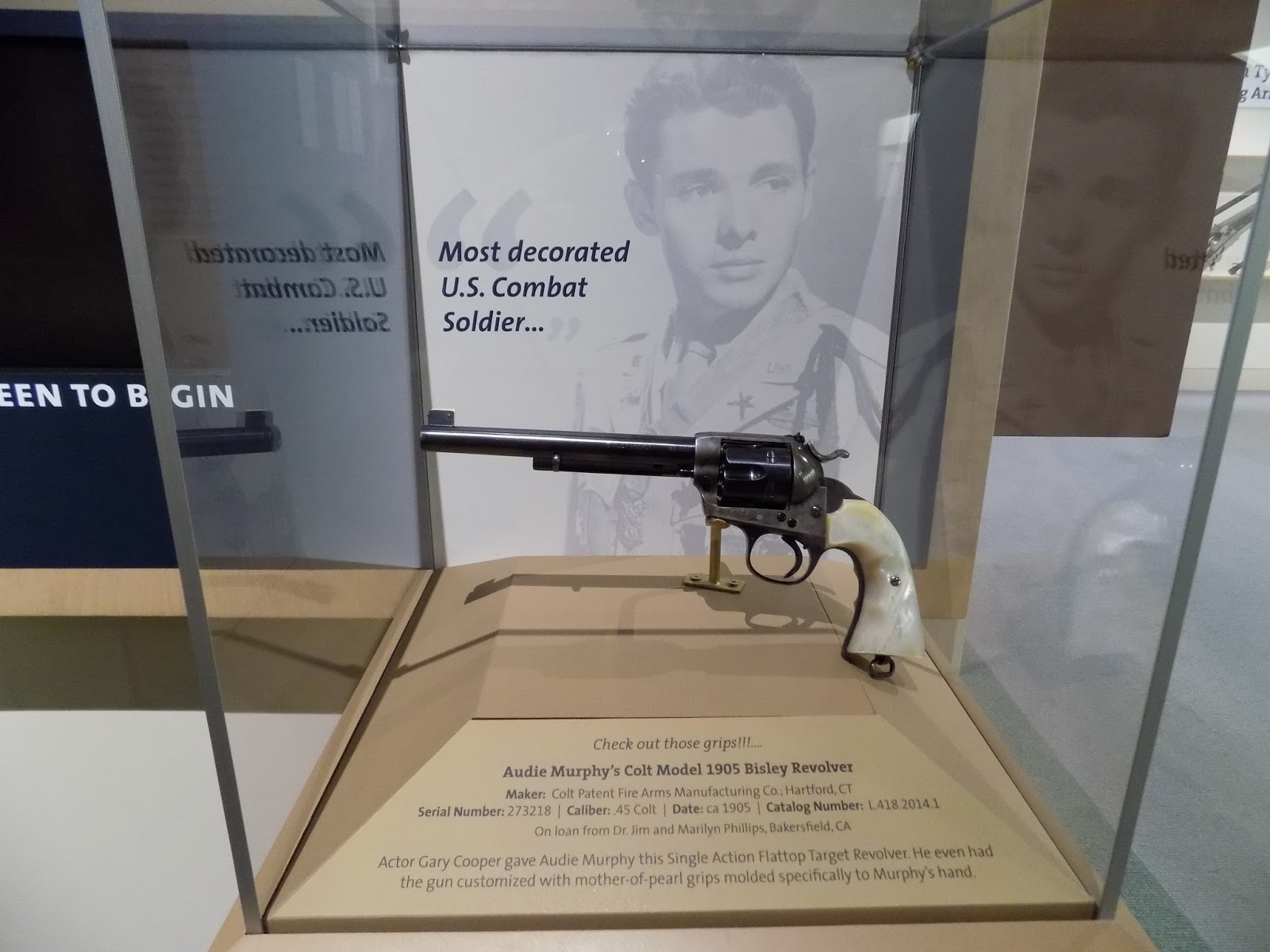
The display of Western Movie & TV Guns is not really large, but it does feature some gems sure to delight any true fan of the genre. The main cases contain the belts and guns of the stars of Bonanza as well as guns used by the stars of Gunsmoke, Bat Masterson, and The Lone Ranger. They also include a gun used by Gary Cooper in Vera Cruz (1954) and High Noon (1952). Another display pays tribute to World War II hero and Western star Audie Murphy. The gun displayed with it, a Colt Model 1905 Bisley Revolver, was a gift to Murphy from Gary Cooper.


The highlight of the exhibit, however, is the iconic rifle that gives its name to the 1950 Anthony Mann Western, Winchester '73. Displayed in a case by itself, it's an impressive sight, with a production still from the film serving as its backdrop. A closer look, however, reveals that the weapon was signed by all of the film's stars, starting with James Stewart himself. It's a fabulous piece of movie memorabilia that absolutely belongs here, surrounded not only by other Western firearms but by a history of the Winchester and its importance to the settling of the frontier.

If you're ever out around Yellowstone, make time for a stop in Cody, Wyoming. There's a lot of history here for a Western devotee to devour, as well as a nightly gunfight in the street and a whole lot of gift shops and rodeos.

Monday, May 16, 2016

Top 10 List: My Favorite Westerns

My Westerns lifetime learning class is wrapping up this week, and my students have asked me about a top ten list of classic Westerns. I imagine there are plenty of such lists naming the "best" Westerns, but I'd rather make mine a list of personal favorites. I do aim for some diversity in terms of decade, focus, director, and stars, but these are all Westerns that I enjoy tremendously every time I see them. I'm not including the comedy and parody films that prospered late in the day, although I do really love Cat Ballou (1965), Butch Cassidy and the Sundance Kid (1969), and, for reasons even I can't fully explain, Paint Your Wagon (1969). Here, then, are ten of of my all-time favorite Westerns, listed in chronological order.

1. STAGECOACH (1939)

2. MY DARLING CLEMENTINE (1946)

3.WESTWARD THE WOMEN (1951)

4. HIGH NOON (1952)

5. SHANE (1953)

6. THE MAN FROM LARAMIE (1955)

7. BAD DAY AT BLACK ROCK (1955)

8. THE SEARCHERS (1956)

9. RIO BRAVO (1959)

10. THE PROFESSIONALS (1966)

What are your favorite classic Westerns?

Monday, May 9, 2016

10 Great Westerns of the 1950s

The 1950s produced a bumper crop of A-level Westerns with some of Hollywood's biggest stars in the leading roles, including some we don't necessarily associate with the genre. Over the course of the decade, darker and more complex psychological Westerns appealed to adult viewers, even as the matinee cowboys continue to ride high with the Saturday morning crowd. Westerns and film noir provided fertile territory for directors and actors, with many jumping between the two genres and even blurring the line at times about which was which. Of course, John Wayne and John Ford were still on the scene, but a new generation of Western icons was also developing, with Lee Marvin making his presence known and director Delmer Daves venturing into the genre with Broken Arrow in 1950. You could spend a long time watching Westerns from the 1950s (check out 50 Westerns from the 50s for proof), but here are just ten great Westerns - one from each year of the decade - to get you started.

1) WINCHESTER '73 (1950) - Anthony Mann and James Stewart begin a fruitful collaboration in the genre with this picture, which focuses on the hands through which the coveted title rifle must travel. The cast also includes Shelley Winters, Dan Duryea, and Stephen McNally, but viewers will also find early appearances by Rock Hudson (as a Native American) and Tony Curtis. Mann and Stewart would go on to make four more Westerns together: Bend of the River (1952), The Naked Spur (1953), The Far Country (1954), and The Man from Laramie (1955), all of which are well worth watching.

Westward the Women

2) WESTWARD THE WOMEN (1951) - Probably the least familiar picture on this list, this women's Western is truly unique in its focus on the suffering and determination of a group of women headed West by wagon train to marry settlers on the frontier. William A. Wellman directs an ensemble cast headed up by Robert Taylor as the women's guide, with Denise Darcel and Hope Emerson getting top billing among the many fine actresses. Renata Vanni gives an especially moving performance as one of the group's older members.

3) HIGH NOON (1952) - A four-time Oscar winner, this dramatic Western appears on almost any top ten list for the genre, and for good reason. Its real-time unfolding adds urgency to the story as we watch the clock tick down to Frank Miller's fateful arrival, while Gary Cooper's Oscar-winning performance is noble and moving, even if he is much too old to be marrying Grace Kelly. A terrific supporting cast helps seal the deal, including Thomas Mitchell, Lon Chaney Jr., Henry Morgan, Lloyd Bridges, and Katy Jurado. Tex Ritter, a singing cowboy from the matinee herd, provides the film's mournful title song, which inspired many later Westerns to have their own, similar themes.

4) SHANE (1953) - George Stevens directs this chivalric romance recast as frontier drama with Alan Ladd in the lead as the Wild West's version of a knight errant. Building their own rustic Camelot on the range are Van Heflin and Jean Arthur as the Starretts, with young Brandon De Wilde giving an Oscar-nominated performance as their son. Jack Palance, also nominated for Best Supporting Actor, is Shane's rival gunslinger. Other familiar faces in the cast include Ben Johnson, Elisa Cook Jr., and Ellen Corby.

5) JOHNNY GUITAR (1954) - Joan Crawford makes a rare genre appearance in this very unusual Western from Nicholas Ray, with Sterling Hayden as the title character. There's a lot of noir atmosphere seeping through, no surprise with Ray in the director's chair and Crawford and Hayden in the leads. The supporting cast is full of Western favorites, though, including Ward Bond, John Carradine, Royal Dano, Ernest Borgnine, and Paul Fix. Look out for a truly vicious performance by Mercedes McCambridge as Crawford's rival.

6) BAD DAY AT BLACK ROCK (1955) - Spencer Tracy stars in John Sturges' modern take on Western themes, once again with noir atmosphere turning everything a shade darker and dirtier. Tracy's one-armed WWII veteran comes to Black Rock on a mission of peace, but he finds out that Black Rock has a secret its residents will kill to hide. The landscape and the town speak to the lingering traces of the Old West, and the rest of the cast is packed with genre stalwarts, including Robert Ryan, Walter Brennan, Ernest Borgnine, and Lee Marvin. Tracy earned an Oscar nomination for Best Actor for his performance, while Sturges picked up a nod for Best Director, but every aspect of this film exudes excellence. It's just as hard-hitting today as it was in 1955.

7) THE SEARCHERS (1956) - John Ford and John Wayne deliver their most iconic collaboration with this epic tale of loss and obsession, with Wayne in the lead as ex-Confederate soldier Ethan Edwards, who embarks on a years-long quest to find his niece (Natalie Wood) after she is kidnapped by the Comanche. This is a darker, more morally complicated character for Wayne, but he suits the role perfectly. Widely considered one of the greatest Westerns of all time, this picture is the go-to example of Ford and Wayne's work together, with a rich subtext and emotional supporting performances that reward multiple viewings.

8) 3:10 TO YUMA (1957) - Delmer Daves directs Van Heflin and Glenn Ford in this tense character study of two very different men brought together by fate. Ford plays the smooth-talking, opportunistic outlaw, while Heflin plays the upright rancher with the dangerous job of getting the captured bandit to the train that will take him to prison. From there the lines between good man and bad begin to blur, with the outlaw and the rancher each coming to understand the nature of the other. Frankie Laine sings the theme song, which harks back to the melancholy theme of High Noon.

9) THE BIG COUNTRY (1958) - At 165 minutes, this is an epic Western, indeed, with Gregory Peck leading an impressive cast under the direction of William Wyler. Peck plays a former sea captain who heads West to take up ranching with his fiancee but, predictably, finds drama and strife as he becomes embroiled in a bitter feud. Burl Ives won the Oscar for Best Supporting Actor for his performance, but other notable cast members include Jean Simmons, Charlton Heston, Chuck Connors, Carroll Baker, and Alfonso Bedoya.

10) RIO BRAVO (1959) - Howard Hawks and John Wayne strike back against the serious (and often left-leaning) tone of many 1950s Westerns with the rollicking Rio Bravo, which is more interested in action than psychological analysis. Wayne plays Sheriff John T. Chance, who gets a very motley crew of assistants when the bad guys turn up to reclaim one of their own from Chance's jail. Dean Martin is the alcoholic Dude, trying to sober up enough to hold a gun, and Walter Brennan plays crusty old Stumpy. Dreamy Ricky Nelson sings and shoots as Colorado, while Angie Dickinson gives Wayne some romantic trouble as Feathers. The picture is usually seen as a rebuttal to High Noon, and it presages the kind of movie Wayne would continue to make from here until the end of his career. However, for the A Western as pure entertainment, this one is hard to beat.

For even more great Westerns from the 1950s, try The Gunfighter (1950), The Baron of Arizona (1950), The Furies (1950), Vera Cruz (1954), Seven Men from Now (1956), and Gunfight at the O.K. Corral (1957). You'll find full-length reviews for many of the Westerns listed here in my books, Beyond Casablanca: 100 Classic Movies Worth Watching and Beyond Casablanca II. Both are available on Amazon Kindle.

Wednesday, March 30, 2016

Classic Films in Focus: BARBARY COAST (1935)

Howard Hawks made far better and more memorable films than the 1935 period drama, Barbary Coast, but the movie is worth watching for a number of reasons, not least of which is Edward G. Robinson with an earring. The title identifies the setting of this rather gritty picture as the wildest section of San Francisco during the California Gold Rush; within this powder keg location we find Robinson ensconced as one of his most flamboyant heavies, playing opposite a grimly determined Miriam Hopkins and a naive Joel McCrea. If you're a particular fan of any of those stars you'll find enough in Barbary Coast to keep you entertained, but the film also boasts several bonuses in its supporting players, including Walter Brennan, Brian Donlevy, Frank Craven, and Donald Meek. Basically a Western with a melodramatic slant, Barbary Coast isn't perfect, but it is an interesting depiction of a woman's struggle to survive in a world of violence, gold, and lawless, dangerous men.

Hopkins stars as Mary Rutledge, who arrives in San Francisco to find her impending marriage ruined by the murder of the man she meant to wed. Undeterred, Mary quickly gets herself into the good graces of the local crime boss and gambling hall owner, Louis Chamalis (Robinson). As Swan she serves as the attractive bait that lures gold-loaded miners to try their luck at Louis' rigged roulette wheel, but Louis becomes violently jealous when he suspects that she has met a man whom she likes better than him. The newcomer is handsome Jim Carmichael (Joel McCrea), a poetic miner ready to head back East if he can get out of San Francisco without losing his gold, his heart, and his life.

With its Western trappings and melodramatic perspective, the movie has to juggle the masculine elements of its world with the heroine's emotional narrative, a task made more complicated by the enforcement of the Hays Code. Anyone paying the slightest bit of attention understands that Mary is Louis' mistress, but the scenes tend to be coy enough that a stubbornly prudish person - say, Joseph Breen - could pretend that Mary's moral crisis is only about working a crooked wheel. Mary is the only female character with any screen time of note; it's clear that she's fighting to get by in an aggressively male society, and she does that by embracing stereotypes of hyper femininity like beauty, charm, and heartlessness. The dirty men of the city, agog at the arrival of a "white woman," carry her over the filthy streets to keep her dress from getting muddy; they treat her as if she were made of fine china, and she encourages it, especially because it subjects them to her control. Her chance encounter with Jim Carmichael catches her off guard and reminds her of the person she was before San Francisco, but that endangers both of them because it becomes harder for Mary to return to her life as Swan. She overcompensates at first, then relents, while around her the fierce male world erupts into violence and vigilante retribution. The ending lays bare some of the problems with the uneasy coupling of the two genres and their gendered worlds; it doesn't work, partly because it forces murderous Louis to shift abruptly from Western blackguard to melodramatic love martyr.

Hopkins gives a very solid performance as the morally conflicted Mary; she has a perfect look for the role but is also able to convey her character's calculated coldness and desire for gold. The men dwarf her physically, but she dominates the screen; only Robinson really wrests attention away from her, and he has help from his oddly piratical costume. Robinson doesn't really break any new ground with the Louis character, but he's always such a compelling villain that it doesn't matter. McCrea comes into the movie like a lamb to the slaughter; he seems too big and strong to be credible as a guy who only survives because of lucky chances, but at least it's easy to see why Hopkins' character likes him. The supporting players bring the Western atmosphere to life, with Walter Brennan in fine form as the mischievous coot, Old Atrocity, lovable in spite of his many flaws, and Frank Craven tragic and compelling as the crusading journalist who wants to tell the city the truth about its crooked ways. Brian Donlevy, always useful as a tough guy, doesn't talk much as Louis' muscle, Knuckles, but he does make his ominous presence felt. Donald Meek gets a few good scenes as Sawbuck, one of many miners to fall prey to Swan's spinning wheel, and Harry Carey leads the town's vigilantes with dogged purpose. With all of these actors in the mix, Western aficionados will have plenty to appreciate, even if the melodramatic elements of the picture don't appeal.

Be aware that Barbary Coast lives up to its setting's reputation for racial antagonism, especially of the Chinese. The picture earned an Oscar nomination for Best Cinematography, but Howard Hawks went on to more enduring hits with Bringing Up Baby (1938), The Big Sleep (1946), and Rio Bravo (1959). See Miriam Hopkins in Dr. Jekyll and Mr. Hyde (1931), Trouble in Paradise (1932), and The Old Maid (1939). Edward G. Robinson is best remembered today for noir films like Double Indemnity (1944) and Key Largo (1948), but he's delightful in the less familiar comedy, Brother Orchid (1940), in which he pokes fun at his earlier roles in gangster films. I find Joel McCrea irresistible in Sullivan's Travels (1941) and The More the Merrier (1943), but for contrast in his Western work try Ride the High Country (1962). If you thrill to tales of the Barbary Coast, check out Frisco Kid (1935), San Francisco (1936), or Flame of Barbary Coast (1945).

Sunday, December 6, 2015

Scenes from a LEGO Western

If you have been reading this blog much over the years, you know that I love classic Westerns. I grew up watching them with my father and grandfather, and I've always had a nostalgic love for the Old West. You also know that I love LEGO and am an active member of a large LEGO hobby club for adults. For our show this weekend at a local science museum I decided to combine those passions and create a Wild West LEGO display. Here are a few photos of the results!


Plenty of classic Westerns focus on the cattle drive, so I've got one going on in my display. Two cowboys and their dog are driving the herd across the desert frontier, but it looks like they've found a good watering hole. In the background you can spot the Lone Ranger and Tonto off to save the day and Stinky Pete the Prospector mining for gold.


Western towns are rough and tumble places, but the Sheriff's office looks popular. Of course, if the sheriff gets thirsty, he's right next to the saloon. I wonder if it's John Wayne, Jimmy Stewart, Henry Fonda, or Gary Cooper wearing the badge in there? Maybe one day I'll recreate Destry Rides Again or My Darling Clementine.


The gunfighter is more spaghetti Western than Hollywood. He's definitely a tough character, but I think the sheriff can take him. I also have robot cowboys to stage a Westworld shootout later on!

If you like the LEGO movie stuff, you might also have a look at my LEGO Dracula post. There are a couple of tributes to classic film noir, too.

Wednesday, October 21, 2015

CMBA Blogathon: THE HARVEY GIRLS (1946)

The theme for this year's CMBA Blogathon is "Planes, Trains, & Automobiles," which makes the 1946 musical, The Harvey Girls, an obvious choice. The movie won an Oscar for its train themed song, "On the Atchison, Topeka and Santa Fe," and it depicts, in a fictionalized and colorful way, the importance of the train in bringing women to the American West. Adapted from a novel by Samuel Hopkins Adams, The Harvey Girls stars Judy Garland, Cyd Charisse, and Virginia O'Brien as three young women who head West on the train to find new opportunities and romance. While it's not a perfect picture, this is a fun, lively musical that tells an often unknown story about women's part in settling the frontier, made even more entertaining by the presence of outstanding actors like Angela Lansbury, Marjorie Main, Ray Bolger, and John Hodiak.

The Harvey Girls were real people; these young women went West to staff the Harvey Houses that sprang up along the railroad lines in the late 19th century. Fred Harvey recruited young women with good backgrounds and civilized manners to work in his establishments, where train passengers found a short rest and a good meal during their stops. For women of that time, there were few respectable job opportunities out West, but the Harvey Houses provided good wages along with room and board. The crisp uniforms and cheerful manners of the Harvey Girls brought a wholesome, civilized femininity to rough country, and their presence helped to tame wild frontier towns. One notable Harvey House location was the Grand Canyon, where the Fred Harvey Company provided concessions and visitor services until 1968. Today, the El Tovar Hotel at the South Rim includes a display honoring the Harvey Girls and the 1946 film tribute to their legacy. Becoming a Harvey Girl changed the lives of many women who yearned for independence and adventure. Over 100,000 young women took the opportunity that the Harvey Houses offered, and you can learn more about their stories by watching the trailer for the 2013 documentary film, The Harvey Girls: Opportunity Bound.

In the movie, Judy Garland's character, Susan, doesn't set out to be a Harvey Girl at all. She responds to a call for a mail-order bride, but when she meets the intended groom (Chill Wills) she jumps at the chance to become a Harvey Girl like the other young women on her train. Marjorie Main plays a funny but effective chaperone and manager for the young ladies in her charge, while Cyd Charisse and Virginia O'Brien appear as two Harvey Girls who befriend Susan. The girls encounter a different type of Western womanhood in Angela Lansbury's saloon singer, Em, who doesn't appreciate the competition or the straitlaced morality of the new arrivals. Susan attracts the interest of the bar's owner, Ned Trent (John Hodiak), while Virginia O'Brien's character, Alma, engages in an awkward but entertaining romance with Chris (Ray Bolger). Sadly, O'Brien disappears from the movie in the third act, thanks to shooting delays that made her pregnancy impossible to hide, but she does get in a particularly funny performance with the song, "The Wild, Wild West."

If The Harvey Girls romanticizes the real experiences of the women who staffed the restaurants on the Santa Fe lines, it also depicts women as individuals who went West for many reasons, and not just as daughters, wives, or prostitutes. Women's Westerns have been few and far between in Hollywood history, but when they do come along they reveal fascinating hints at stories that have largely been left untold. As a musical comedy, The Harvey Girls is lighter and sweeter than Westward the Women (1951) or cattle queen dramas like The Furies (1950) and Johnny Guitar (1954), but it does a great job leaving the viewer wanting to know more about the real women who took that chance for a new life out West. Trains made Harvey Houses necessary, and Harvey Houses made a place for young women to earn a living and lead independent lives. That's a theme worth singing about!

You can find a full-length review of The Harvey Girls in my book, Beyond Casablanca: 100 Classic Movies Worth Watching, available on Kindle at Amazon.com. For more about The Harvey Girls, try the 1994 book by Lesley Poling-Kempes, The Harvey Girls: Women Who Opened the West.


Tuesday, June 16, 2015

Classic Films in Focus: I SHOT JESSE JAMES (1949)

I Shot Jesse James (1949) marked the directorial debut of Samuel Fuller, who would go on to make the noir classic, Pickup on South Street (1953), as well as films like Shock Corridor (1963) and The Naked Kiss (1964). Like his later pictures, this semi-biographical account of Robert Ford rejects easy moral distinctions; its protagonist is no hero, but a man motivated to murder his friend in pursuit of his own personal happiness. Fuller's screenplay takes liberties with the history of the James Gang and the man who eventually caught up with Bob Ford, but it makes for a gripping narrative that demonstrates Fuller's talent even at the beginning of his career. A taut performance from John Ireland as the lead character helps to pull us into Bob Ford's flawed logic even as we recoil from his brutal, selfish nature.

Ireland plays Ford at the critical juncture of his life as an outlaw, when he hopes to marry longtime sweetheart, Cynthy (Barbara Britton), but finds himself trapped by his association with the notorious Jesse James (Reed Hadley). When the authorities offer amnesty to anyone who brings James in dead or alive, Bob sees his chance and shoots his unsuspecting friend in the back. His actions make him a pariah with the public and a target for aspiring gunmen, but they also make Cynthy rethink her feelings for him. Soon she attracts the romantic interest of Kelley (Preston Foster), a decent but unsuccessful prospector, and Bob's jealousy becomes violent.

The film promotes the popular view of James as a pretty good guy in spite of his criminal career, especially in the way it depicts him at home, where he lives under the pseudonym of Mr. Howard. Jesse is loyal and generous to his friends, including Bob and his brother, Charles (Tommy Noonan), although their prolonged stay in the James home irritates Jesse's wife, Zee (Barbara Woodell). Jesse's treatment of Bob makes the younger man's betrayal all the more inexcusable, and Fuller never lets us believe that Bob is really motivated by love because he clearly doesn't understand what it is. Bob sees Cynthy as a reward he can win through underhanded actions, but the murder makes her love for him turn to fear and disgust. She's too afraid of him to tell him that she doesn't want to marry him anymore, and Bob is too dumb to figure it out for himself.

John Ireland's portrayal of Ford casts him as a small-time thug, a jealous lover, and a total failure as a human being. Ireland looks very much at home in the Western genre, where he spent much of his career, and he evokes the brutish quality of his character with his dark features and tight-lipped mouth. His Ford always looks ready to punch somebody in the face, even in his love scenes with Cynthy, who is right to be afraid of him. Even worse, Bob offers to recreate the killing on the stage as a way to make cash, although opening night finds him unable to face the prospect, with a stony-faced crowd silently watching him sweat. Some stories tell of good men gone wrong, and some of bad men who become good, but Bob Ford is a stinker through and through, a treacherous snake who uses love as an excuse to commit an unforgivable act. It takes Bob a long time to figure out why that might have been the wrong thing to do, and by then it's too late, with his friend in the grave and his hopes for the future in ruins.

Samuel Fuller's next picture was also a Western, The Baron of Arizona (1950), with Vincent Price as an amoral but more lovable schemer. John Ireland earned an Oscar nomination for Best Supporting Actor for All the King's Men (1949), but you'll also find him in Raw Deal (1948), The Return of Jesse James (1950), and Gunfight at the O.K. Corral (1957). For more films about the James Gang, try Jesse James (1939) and The Return of Frank James (1940), both of which feature John Carradine in the Bob Ford role. In 2007, Hollywood revisited the story with The Assassination of Jesse James by the Coward Robert Ford, with Brad Pitt as Jesse and Casey Affleck as Ford.

Wednesday, March 18, 2015

Classic Films in Focus: CALAMITY JANE (1953)

Calamity Jane (1953) transforms a Western legend into a frontier Cinderella story, complete with the requisite ball, but instead of a prince our heroine is out to land a handsome cavalry lieutenant. This Warner Brothers musical, directed by David Butler, can't be faulted for its lack of historical veracity, since the real Calamity Jane's story remains deeply buried in myths, half-truths, and self-aggrandizing lies, and its charm relies primarily on the spunky charisma of Doris Day as the rough but lovestruck protagonist. With Howard Keel as her costar, Day gives one of her signature performances, bringing the feisty heroine both liveliness and loveliness as the story unfolds.

As Calamity, Day whoops, fights, and sings her way around Deadwood, a wild frontier town where the men pine for Chicago stage star Adelaid Adams. Calamity goes to fetch the sexy chanteuse but accidentally brings back her maid, Katie Brown (Allyn McLerie), instead. After a rough start, Katie proves a hit, but Calamity is jealous when both her pal, Wild Bill Hickok (Howard Keel), and her crush, Lieutenant Danny Gilmartin (Philip Carey), try to court Katie.

Day is absolutely the star attraction here, and the buckskin costumes give her an opportunity to deliver an unusually physical performance as both a singer and a comedienne. As she rides, shoots, runs, and bounces through her scenes her energy is simply irresistible. Ironically, it's the slow, quintessentially feminine song, "Secret Love," that won the Oscar for Best Song, even though Day's more boisterous numbers, especially "The Deadwood Stage," are much more fun. Howard Keel is in his natural element as Day's leading man; the two sound very good together in their musical segments and have a feisty chemistry that telegraphs the inevitable ending. Allyn McLerie also makes an excellent partner and foil for Day, and the budding friendship between Katie and Calamity adds another layer to the story that Cinderella fantasies usually lack. Philip Carey has the least rewarding role of the four major players, since his Danny is no prince, and our final judgment of each character stems from his or ability to appreciate Calamity, which Danny never proves himself able to do.

The theme, the setting, and the presence of Keel recall the 1950 musical Annie Get Your Gun, in which Betty Hutton plays another Western legend, the sharpshooter Annie Oakley. In both movies, the rugged, uncultured heroines adopt conventional femininity in order to get their men, but Calamity Jane avoids the worst sins of the earlier story by having Calamity retain the essential elements of her character. Calamity doesn't give up her old identity or her scrappy frontier spirit. She adds dresses to her wardrobe but keeps pants, too, and her ability to inhabit both modes is particularly emphasized when she sings the sweetly romantic "Secret Love" while dressed in a buckskin pants outfit. The ending also promises a much more egalitarian marriage than that achieved in the Hutton film, in which Annie loses a shooting match on purpose because her man can't stand to be beaten by a woman. In both pictures, Howard Keel plays the leading man, but his Wild Bill has a far less fragile ego than his Frank Butler. While it takes a pretty dress to make Bill aware of it, his affection for Calamity has been there the whole time, and the picture's final moment makes it clear that Calamity has developed a characteristically possessive view of their new relationship.

Be sure to appreciate the very funny Dick Wesson as Francis Fryer; his drag number is a hoot. For more of Doris Day, see Romance on the High Seas (1948), Love Me or Leave Me (1955), and Pillow Talk (1959). Howard Keel also stars in Show Boat (1951), Kiss Me Kate (1953), and Seven Brides for Seven Brothers (1954). Look for Allyn McLerie in The Way We Were (1973), and catch Philip Carey in Westerns like Cattle Town (1952) and Springfield Rifle (1952). Other films directed by David Butler include Shirley Temple vehicles like Bright Eyes (1934) and Captain January (1936) as well as the Crosby and Hope road picture, Road to Morocco (1942).

Thursday, August 14, 2014

Build-Your-Own-Blogathon: Bad Apples in BEND OF THE RIVER (1952)

This post is part of the Build-Your-Own-Blogathon hosted by the Classic Film and TV Cafe. It follows Caftan Woman's discussion of T-Men (1947), which shares its director, Anthony Mann, with Bend of the River (1952). Visit the Classic Film and TV Cafe for a complete list of the blogs participating in this blogathon!


"That kind can't change. When an apple's rotten, there's nothing you can do except throw it away or it will spoil the whole barrel." - Jeremy Baile

Director Anthony Mann collaborated with Jimmy Stewart on a number of excellent Westerns, including the 1952 film, Bend of the River, which takes the rugged country of the Pacific Northwest as its frontier territory. It's a story about gold fever, moral decay, and second chances, with Stewart as a former outlaw trying to turn over a new leaf as an honest man. Stewart's Glyn McLyntock is, of course, a good apple, no matter how shady his past, but the movie also presents us with a parade of foils and variations on the same theme. Jay C. Flippen and Chubby Johnson play for the angels as the movie's older good men, with Flippen especially crucial to Stewart's character as the leader of the Oregon settlers, but the less exemplary characters prove far more numerous. Arthur Kennedy and Rock Hudson play men whose moral compasses need more recalibration than Stewart's, while Howard Petrie depicts the rapid transformation of a good man gone wrong over gold, and Harry Morgan plays one of the dirtiest little apples ever seen in a Western barrel. These slippery, complicated performances help make Bend of the River a smart study of psychology as well as an exciting frontier adventure, and the bad apples inform our understanding of the hero's own inner struggle.

"$100,000 is a lot of money." - Emerson Cole (Arthur Kennedy)

Glyn's primary counterpart throughout the picture is Kennedy's Emerson Cole, a man who has so much in common with Glyn that Glyn tends to think of their destinies as inextricably linked. Cole shares Glyn's past as a raider, and he has enough integrity to appreciate it when Glyn saves his life, but Cole lacks the essential strength of character that sets Glyn apart. Cole likes fast living and violence; he's quick to draw his gun, even when lesser measures would suffice. Kennedy plays Cole as an enigma at first, encouraging us to like him even when we don't trust him, but the lure of wealth proves too much for him to resist. Even the love of Laura (Julie Adams) means nothing to him once a fortune comes within reach. Glyn offers him multiple chances at true redemption, but Cole succumbs to greed.

"You're real fast with that gun, kid, but you're soft." - Emerson Cole (Arthur Kennedy)

Hudson's handsome young gambler, Trey Wilson, makes the relationship between Glyn and Cole into a triangle. His essential nature is ambiguous early on; as a gambler, he is clearly a man who values money, but he doesn't like to kill. Cole even scolds him for being too soft-hearted. Trey throws in with Glyn and Cole without much thought, and he doesn't have to choose between them until it becomes clear that the two older men are moving in starkly different directions. Even then, Trey keeps his cards hidden, so that we're never quite sure which side he's on until the very end of the film. Trey actually fills two Western character types at once. Despite his worldly demeanor and flashy clothes, he is also this film's version of the Kid who has to decide which model of masculinity he wants to embrace; he can chase wealth and become like Cole, or he can do the right thing and emulate Glyn.

"I could get fifty times what you paid for that food. It's gold, do you understand, gold!" - Tom Hendricks (Howard Petrie)

Howard Petrie plays Tom Hendricks, the Portland official who first welcomes the settlers with open arms but later betrays their trust by reselling their winter supplies at wildly inflated prices. If Hendricks seems a little too friendly at first, that merely sets the stage for his later corruption, when we see him at his overflowing money table with a mad gleam in his eyes. Hendricks' fall mirrors that of the entire community; when Glyn and Jeremy (Jay C. Flippen) return to Portland looking for their supplies, they find the formerly pleasant town transformed into a filthy den of violence, greed, and lust. Hendricks is so far gone that he doesn't care if his double dealing costs the settlers their lives; he is even willing to kill Glyn and Jeremy to protect his financial interest. Tellingly, Cole doesn't seem to process the warning of Hendricks' fate; he's too busy shooting Hendricks' men while they try to run away.

"We're going to the gold camp with this food." - Shorty (Harry Morgan)

While most of the other flawed men in the film have some good qualities, Harry Morgan's Shorty is about as rotten as they come. Along with Red (Jack Lambert) and Long Tom (Royal Dano), Shorty never makes any move unless he's going to get paid for it. Shorty is a far cry from the uncertain but good-hearted character Morgan played in The Ox-Bow Incident (1943). He's a dirty, narrow-eyed sneak, always watching for the opportunity to take advantage of the others. He and the other workers conspire to hijack the food supply and sell it at the highest possible price in the gold mining camp; like Hendricks, they don't care if the settlers starve to death as a result. Unlike Hendricks, Shorty and his pals were never good in the first place. Their worst scene comes when they intentionally drop a wagon on Jeremy, Glyn, and Cole in an effort to murder all three at once.

"Any man can make a mistake." - Laura (Julie Adams)

These men run the gamut in terms of moral character, and each one shapes his own fate through his choices. The corruption of the weaker men reminds us how much is at stake in Glyn's struggle for redemption. Glyn knows that the kind of life he once led can only end badly, but his determination to do right and take a harder path makes him a hero in this story more than any skill with a rifle or knife. While there are plenty of bad apples in Bend of the River, they only make the good ones look that much better.

Friday, June 20, 2014

Classic Films in Focus: 3 GODFATHERS (1948)

John Ford offers a distinctly Western take on the Christmas story in 3 Godfathers (1948), where there’s no sign of the usual snow and comfortable holiday cheer. In their place we witness the parched terrain of the desert frontier and a grueling journey by our protagonists, three not so very bad men struggling to save an orphaned newborn even though they are on the run from the law. As usual, much of the appeal of a John Ford picture stems from its cast, with John Wayne leading a collection of the usual suspects, including Ward Bond, Harry Carey, Jr., Jane Darwell, and Mildred Natwick. With Ford’s characteristic blend of toughness and sentiment and a visual style bursting with religious iconography, 3 Godfathers delivers a surprisingly soulful tribute to the original story of the three wise men, but Western devotees will find it worthwhile at any time of year.

Wayne leads a trio of cattle rustlers turned bank robbers as Robert Hightower, with the Mexican Pete (Pedro Armendáriz) and the boyish Abilene Kid (Harry Carey, Jr.) as his accomplices. The three men ride into Welcome, Arizona, and accidentally make small talk with the sheriff (Ward Bond) and his wife (Mae Marsh) before robbing the bank, and their luck only gets worse from there. As the sheriff’s posse cuts them off from all sources of water, Hightower and his gang are forced to run ever deeper into the desert, where they find a dying woman who places her newborn son under their protection. The three men put the child’s welfare before their own to fulfill their promise to his mother, but they have little hope of saving themselves, much less the helpless baby.

As he had in Ford’s Stagecoach (1939) nearly a decade earlier, Wayne plays an outlaw with a sentimental side, but his tribulation in the desert suggests that Hightower still has some penance to pay for his sins. The pervasive themes of the picture deal with redemption, self-sacrifice, and the symbolic importance of water, a precious commodity in both the American wilderness and the land of the Israelites. Musical cues reinforce these elements, from the mournful lament of “Streets of Laredo” to “Shall We Gather at the River.” The camera dwells on the relentless heat of the arid frontier, the drops of water falling on the baby’s face, and the image of a derelict wagon sitting forlornly beside a hopelessly broken tank. Wayne’s best scenes occur in the extremity of these moments, especially when he returns from his first visit to the wagon and the useless water tank. The film has many dark episodes, but that is the worst of the lot, as Hightower sits contemplating the countless lives that will be lost because of one man’s foolish actions. For that man there is no redemption; even his wife rejects him by naming her baby Robert William Pedro Hightower, after the three men who arrive just in time to help the child be born. Bob Hightower, whose paternal nature has already revealed itself in his behavior toward the wounded Kid, becomes a true father in that moment, and his arc toward salvation begins.

Ford’s regular supporting players are all in fine form, with Ward Bond enjoying an especially meaty role as the sheriff, Perley Sweet. Harry Carey, Jr. is a credit to his father, to whom the picture is dedicated, with his performance as the sweet-natured William, whose outlaw title as the Abilene Kid contrasts with his inherent goodness and faith. At 43, Mildred Natwick is more than a decade too old for her character, and she only has one big scene, but she really knows how to make it count. Other reliable Ford actors in the background include Jane Darwell, Ben Johnson, and Hank Worden. In addition we get the delightful Pedro Armendáriz and silent film veteran Mae Marsh. Armendáriz proves quite the scene-stealer with his exuberant personality, while Marsh makes a good counterpart to Ward Bond as the sheriff’s wife, especially in the final scenes.

Fans of the Western are sure to appreciate the film’s opening tribute to Harry Carey, who died in 1947. For more of John Ford, John Wayne, and the Ford crowd of characters, see Fort Apache (1948), She Wore a Yellow Ribbon (1949), The Quiet Man (1952), and The Searchers (1956). Ford also directed powerhouse classics like The Grapes of Wrath (1940), How Green Was My Valley (1941), and The Man Who Shot Liberty Valance (1962). Mae Marsh is best remembered as the doomed sister in The Birth of a Nation (1915), but she actually has uncredited roles in a number of Ford pictures, and both she and Pedro Armendáriz appear in Fort Apache. Be sure to catch the late-career performances of Harry Carey, Jr. in The Long Riders (1980), Gremlins (1984), and especially The Whales of August (1987).

Monday, June 16, 2014

Classic Films in Focus: SHE WORE A YELLOW RIBBON (1949)

She Wore a Yellow Ribbon (1949) is the second act in John Ford’s trilogy of cavalry films, and it does indeed wave the patriotic frontier banner pretty fervently, but the title’s feminine pronoun also suggests the picture’s deep preoccupation with the familial and romantic aspects of cavalry life. With John Wayne cast in a distinctly paternal role, this narrative contemplates an older man’s relationship with his substitute children, both the younger officers under his command and a young woman who stands in for his own lost daughters. While the usual Western battles and chases, plus Ford’s beloved Monument Valley, provide the story with its excitement and grandeur, the domestic scenes form its sentimental heart. Wayne and Ford fans justly rank She Wore a Yellow Ribbon as a favorite, but fine performances from Victor McLaglen, Mildred Natwick, and Ben Johnson also help to cement the picture’s enduring appeal.

Wayne plays Captain Nathan Brittles, a career cavalry officer facing a plethora of problems in the days just before his retirement. A massive Indian uprising is destabilizing the entire territory, even as Brittles’ commanding officer (George O’Brien) saddles his patrol with two women trying to catch the stagecoach back to the East. The tough and experienced Abby Allshard (Mildred Natwick) proves her mettle as a cavalry officer’s wife, but her attractive niece, Olivia (Joanne Dru), creates conflict between Brittles’ junior officers, Lieutenant Cohill (John Agar) and Lieutenant Pennell (Harry Carey, Jr.). With the brash younger chiefs of the tribes stirring up trouble and the women slowing his progress, Brittles must keep order within his ranks and strive to head off a deadly frontier war.

John Wayne gives a particularly sensitive performance that prefigures some of his later, more mature roles, especially those in which he takes on overtly paternal roles. In his early forties when he made this picture, Wayne is aged with a little makeup and a lot of gray hair to portray the older Captain Brittles, who dreads his retirement from the only life he has known for forty years. The usual Duke bravado is tempered by Brittles’ emotional attachment to his long dead wife, who lies buried in the fort’s cemetery along with his two small daughters. Brittles frequently visits the graves to tend to them and report on the day’s events. We understand that his fatherly interest in the headstrong Olivia has a lot to do with his yearning for his lost family; his own daughters might be about Olivia’s age had they lived, and he even tells his wife that Olivia reminds him of her. With the living he is less able to articulate his feelings; he silently pats Olivia on the shoulder and jokingly bickers with his devoted comrade, Sgt. Quincannon (Victor McLaglen), but the people around him know exactly how to interpret his behavior, and he is fiercely admired and respected by his men.

Ford stocks the supporting cast with his usual company of players, a reliable crowd of tremendously talented actors who lend both humor and gravitas to all of Ford’s films. Victor McLaglen provides comic relief as the thirsty sergeant who is following his captain into retirement, while Mildred Natwick brings great courage and warmth to her role as “Old Iron Pants,” the cavalry wife who only leaves the fort to get her niece away before the long, hard winter. John Agar and Harry Carey, Jr. both look fine in their blue uniforms, even if Carey seems a bit miscast as a privileged son of eastern wealth, but Ben Johnson steals their thunder with his charismatic, casually brave Southerner, Sgt. Tyree. It’s never clear why Olivia doesn’t set her sights on him instead of the other young men. Beautiful Joanne Dru, who had already starred with John Wayne in Red River (1948), makes an excellent Olivia; her strong chin and flashing eyes tell us that she could, in fact, “be Army” if she would just set aside her stubborn pride and settle on one of her suitors. Filling in the smaller roles are George O’Brien, Arthur Shields, and Chief John Big Tree as the elderly Pony That Walks, who laments that old men like himself and Brittles cannot stop young men from going to war.

She Wore a Yellow Ribbon won an Oscar for its sweeping Technicolor cinematography, making it the only Academy Award winner or nominee of the cavalry trilogy. For the full trio, see Fort Apache (1948) and Rio Grande (1950). John Ford’s best pictures with John Wayne include Stagecoach (1939), The Searchers (1956), and The Man Who Shot Liberty Valance (1962), though you’ll find Victor McLaglen and Mildred Natwick joining the director and star for memorable roles in the cherished Irish romance, The Quiet Man (1952). Catch Ben Johnson, Joanne Dru, and Harry Carey, Jr. in Ford’s Wagon Master (1950). Take time to appreciate Ford’s love affair with popular songs and music; just as “She Wore a Yellow Ribbon” dominates the score of this film, so “Streets of Laredo” informs 3 Godfathers (1948) and “My Darling Clementine” lends its yearning theme to the 1946 film that shares its name.

Thursday, May 29, 2014

Classic Films in Focus: ACROSS THE WIDE MISSOURI (1951)

Hollywood churned out Westerns during the 1950s, but only a few of them became true classics on the level of Winchester ‘73 (1950) and The Searchers (1956). The rest, like William Wellman’s Across the Wide Missouri (1951), amused the Saturday matinee crowd well enough, and today they are still decent company for an hour or two, especially for fans of the genre as a whole. Although it’s by no means a great film, Across the Wide Missouri offers just enough entertainment to make it interesting, especially in its fine cast and gorgeous Technicolor scenery. Classic movie fans will appreciate Clark Gable in the lead role, with supporting players like Ricardo Montalban, John Hodiak, Adolphe Menjou, and J. Carrol Naish.

Gable stars as Flint Mitchell, a beaver trapper who takes a pretty native wife (María Elena Marqués) as a business arrangement to open up new territory. Soon enough he finds himself in love with his spirited bride, but their happiness is threatened by the antagonism of the Blackfoot warrior, Ironshirt (Ricardo Montalban).

Yes, indeed, we have Ricardo Montalban as the shirtless Blackfoot antagonist, looking almost as ridiculous in retrospect as Rock Hudson in Winchester ’73. Both of the most important “native” roles in the film are actually played by Mexican actors, with the lovely María Elena Marqués making a charming if ethnically inaccurate Blackfoot heroine. The chiefs are equally inauthentic; J. Carrol Naish plays Looking Glass, and Jack Holt appears as the aging Bear Ghost. Of the lot, the Marqués character, Kamiah, proves the most interesting. Unfortunately, she follows the Pocahontas model of Native American femininity; she’s spunky, eager to throw in with the white man’s cause, and safely controlled by tragedy.

Moments of startling cultural conflation provide some of the film’s best scenes. John Hodiak appears as a Scotsman who has adopted Blackfoot dress and culture, which makes his performance of a traditional Scottish jig quite a sight. Later, a Native American chief appears decked in a suit of medieval armor, buckskins, and a huge feather headdress. Throughout the film, the frontier appears as a place where cultural identities are negotiated and revised, with a diverse group of settlers banding together and sharing aspects of their national tastes and traits with one another. Thus we have characters like the French trapper, Pierre (Adolphe Menjou), joining the mix of Scots, Southerners, and natives who populate the wilderness.

Take note of Howard Keel as the uncredited narrator of the tale. For more of Wellman’s Westerns, see The Ox-Bow Incident (1943), Buffalo Bill (1944), and Yellow Sky (1948). Gable made several Westerns late in his career, including Lone Star (1952), The Tall Men (1955), The King and Four Queens (1956), and his final picture, The Misfits (1961). Ricardo Montalban also appears as a Native American in Cheyenne Autumn (1964), but you can catch him in more diverse roles in Neptune's Daughter (1949), Border Incident (1949), and Battleground (1949). Look for more of John Hodiak in Lifeboat (1944) and The Harvey Girls (1946).

An earlier version of this review originally appeared on Examiner.com. The author retains all rights to this content.

Friday, May 9, 2014

Katharine Hepburn in ROOSTER COGBURN

This post is part of the Great Katharine Hepburn Blogathon hosted by Margaret Perry at The Great Katharine Hepburn. Visit her blog for links to all of the participating posts!


Young Katharine Hepburn is a glorious creature, a perfect combination of brains and beauty, but old Katharine Hepburn is the version that really gives me hope. Even when I was young I loved this weathered, grayer version of the iconic star; I grew up around older people and found them familiar, comfortable in their own skin, and inspiring because of their experience and tenacity. I still feel that way today, which is why I spend my time volunteering for lifetime learning programs. Older people are full participants in the human experience, although our popular and movie cultures often seem to think that the world belongs only to the young. Released in 1975, when Hepburn was 68 years old, Rooster Cogburn (1975) offers a welcome antidote to our collective obsession with youth, with two aging stars giving richly nuanced performances. Katharine Hepburn and John Wayne, as opposite one another as any two actors could be, prove to us that the later years of our own lives can be as adventurous, romantic, and meaningful as we choose, even if we don't find ourselves facing down desperadoes on the American frontier.

The movie is ostensibly a sequel to True Grit (1969), with Wayne reprising his Oscar-winning role as the cantankerous lawman, Rooster Cogburn. Hepburn plays yet another determined female who horns in on Cogburn's mission to bring killers to justice; like Mattie Ross in the original film, Eula Goodnight is looking for the man who murdered her father. Unlike Mattie, Eula is a Yankee spinster of advanced years who possesses a wry sense of humor. She baffles and fascinates Rooster, and a chaste kind of love blooms between them as they struggle to complete their task and survive a series of deadly encounters.

Hepburn's Eula has a lot in common with her Rose Sayer character in The African Queen (1951), but Miss Goodnight is far better prepared for the dangerous wilderness she inhabits; she seems far more at home on the frontier than we find Rose in her African village. A good rider and an excellent shot, Eula irritates Rooster with her morality but quickly earns his respect. She proves her fortitude and courage repeatedly, especially when the villainous Hawk (Richard Jordan) and his gang attack the small posse. Hepburn is utterly believable in the role; she has the grace and carriage of a lady as well as the fierce independence of a pioneer. She invests Eula with so many of the qualities that we associate with Hepburn herself: intelligence, passion, confidence, and humor. We understand why Wayne's Rooster finds her an irresistible force.

Wayne was also 68 the year Rooster Cogburn was released, but unlike Hepburn he had only a few more years to live. He would die in 1979, while Hepburn endured until 2003, almost a quarter of a century longer. Both show their ages in the film, but despite his greater size Wayne is actually the frailer of the pair. Perhaps that mellows his persona a bit; he seems content to share an amiable, bickering chemistry with his leading lady. Of course, Wayne had plenty of experience with fiery redheads as costars; his films with Maureen O'Hara were proof that he worked well with that kind of onscreen pairing. Hepburn is also mellower; despite deep differences in their political views, she really seems to glow with warmth toward Wayne, at least on screen.

I won't argue that Rooster Cogburn is among the best pictures either star ever made, or even that it is a great film. It has its flaws, and it arrived at a point in movie history when the Western was on its way out. Rooster Cogburn is, however, a great testament to the enduring appeal of its two stars; it speaks to us of aging proudly, defiantly, and with courage. Critics at the time might have complained that Hepburn and Wayne were too old for their roles, but I think they are perfectly cast. Like Rooster Cogburn himself, they can still outcrow anything in the barnyard. I hope I'm half as grand as that in 2040, when I wake up and find that I, too, am 68. Maybe I'll watch Rooster Cogburn to celebrate.


Sunday, April 13, 2014

James Stewart Blogathon: DESTRY RIDES AGAIN (1939)

This post is part of the James Stewart Blogathon hosted by the Classic Film & TV Cafe. You can view the complete blogathon schedule here.

If we come to Jimmy Stewart as a Western star looking back from the present, we peer through a history that makes his appearance in the genre seem obvious, perhaps even necessary. We see him in The Shootist (1976) and The Man Who Shot Liberty Valance (1962) with that greatest of Western icons, John Wayne, and he holds his own there as a believable resident of Wayne’s frontier world. Stewart seems as much a part of the genre’s history as his real life friend, Henry Fonda, with whom he starred in The Cheyenne Social Club (1970) and Firecreek (1968). All three Western stars would appear in How the West was Won (1962), which is basically a who’s who of the genre. Thus, from where we stand now, Stewart looks like a natural part of the Western landscape, but that wasn't the case at all in 1939, when Stewart starred in Destry Rides Again.

It was the first Western of the young actor's career, and at that point Stewart seemed an odd choice for the role. Tall and amiable, with an air of peculiarly American innocence, Stewart had primarily been seen in romances and comedies. Frank Capra had put him to good use in You Can't Take It with You (1938) and Mr. Smith Goes to Washington (1939), but Destry was entirely new territory. It took Stewart out of the polite, civilized settings he had previously inhabited and dropped him into the rugged and rowdy frontier.

Stewart plays the film's title character, the son of a legendary lawman and the last hope of the honest citizens of Bottleneck, a wild, corrupted frontier town. Summoned by the town drunk (Charles Winninger), whom the crooks have made sheriff as a cruel joke, Destry at first seems like a terrible disappointment. He doesn't even carry a gun. As Destry says, however, first impressions are darn fool things, and even the local good time girl (Marlene Dietrich) is drawn to him, despite her understanding with the conniving crime boss (Brian Donlevy). When the crooks murder Destry's friend, he is compelled to take up his guns and rid the town of its oppressors for good.

Stewart makes Destry work precisely because he seems so unlikely as a gunslinger. Lanky, soft-spoken, and polite, Stewart's hero doesn't strike anyone as a threat, much less a gunfighter. Destry, of course, knows his own ability and lets the townspeople wallow in their assumptions. Stewart invests him with an easy nature that is only mistaken for weakness. In fact, it's born of self-assurance. When he finally takes out his guns, we see the other side of Destry's character, and this is where Stewart surprises us most. He is tough. He can be a dangerous man. There's a whole future unfolding for Stewart in this moment, one that will make him an icon not only for It's a Wonderful Life (1946) but also for Winchester '73 (1950), The Man from Laramie (1955), and The Man Who Shot Liberty Valance. There's an unexpected edge to Stewart that later directors will seize upon: Anthony Mann will reveal Stewart's darkness as an underlying vein of hysteria in The Naked Spur (1953), and Alfred Hitchcock will make it the sublime theme of his masterpiece, Vertigo (1958). Despite the fact that Destry Rides Again is technically a comedy, it actually paves the way for Stewart to venture far beyond the territory he had covered in the Capra pictures or early work like Wife vs. Secretary (1936), Born to Dance (1936), or Vivacious Lady (1938).

Thus, as a Jimmy Stewart picture, Destry Rides Again is a watershed moment in the actor's career. Only by looking back at it from the perspective of 1939 can we really appreciate how important it would become in terms of Stewart's own legacy and the evolution of the Western as a whole. Destry opens the door for an actor who would go on to make some of the finest Westerns in Hollywood history, one who would become so associated with the genre that his final screen credit would be for his performance in a Western tale. By the time he loaned his voice to An American Tail: Fievel Goes West (1991), Stewart was as much a part of the Western as any actor who ever rode a horse into a dusty frontier town. For that, we have Destry to thank.