Showing posts with label pop culture. Show all posts

Wednesday, February 16, 2022

Trek Noir: Out of the Past in Deep Space Nine's "Necessary Evil"

Note: This post contains plot spoilers for the Deep Space Nine episode, "Necessary Evil"


I'm currently making my way through the entirety of the Star Trek TV series, Deep Space Nine, which I never got to watch regularly during its first run, and so far it has been a richly rewarding experience. While all of the episodes have their merits, I was especially struck by Season Two's eighth episode, titled "Necessary Evil." This one stands out from the others and from most of the older Star Trek shows for its serious - and successful - evocation of classic film noir to tell a dark, duplicitous story about events that unfold before the Cardassians leave Bajor and the Federation takes charge of the space station. While the Star Trek universe is traditionally a positive space with an optimistic vision of the future, this episode uses the tropes of classic noir to investigate the dark past that haunts Deep Space Nine, and it calls into question the motives and relationships of some of its most complex characters.

The Next Generation crew in "The Big Goodbye"

Star Trek shows have been playing with genre since the original series, but the sensibility of true noir is at odds with the core values of the Trek universe. When The Next Generation ventures into noir territory in the first season episode, "The Big Goodbye," it does so as a holodeck adventure with Captain Picard adopting the role of fictional private eye Dixon Hill, a figure very much inspired by Humphrey Bogart as Dashiell Hammett's iconic Sam Spade in both the book and film versions of The Maltese Falcon. The holodeck story is intended to be a nostalgic amusement for Picard and his friends, but an external event causes the safety protocols of the holodeck to disengage, thus thrusting the crew members into a more dangerous adventure than they had expected. While the episode includes real peril for the crew, the noir element of the experience is artificial and contained, and it is also pointedly self-conscious, an homage to noir rather than an embodiment of it.

Such is not the case on the Deep Space Nine episode, where a dark past of Cardassian control and Bajoran resistance creates opportunities for a noir plot that exists as part of the characters' reality. It's not surprising that a series with persistent connections to Casablanca (1942) might see the shadowy world of noir as fruitful territory to mine for narrative; the show even gets around to a blatant revision of Casablanca later in Season Two with the episode, "Profit and Loss" (with Quark, of course, as the stand-in for Bogart's bar owner Rick). In "Necessary Evil," the series takes us back and forth between its past and present to explore what life on the space station was like before the Bajoran liberation, which also evokes shades of Casablanca and the Nazi Occupation. That past is a dark place, where everyone's motives are suspect and our core characters meet for the first time under grim circumstances. It's a perfect setting for a very unusual example of tech noir, the (literal and figurative) space where noir and science fiction meet.
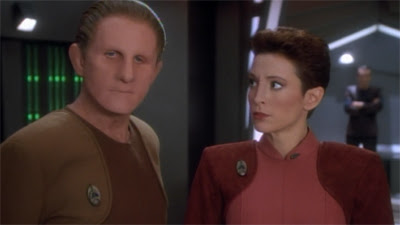
"Necessary Evil" focuses on the past between Odo and Kira.
 

The story opens in the present, when Quark is hired to retrieve a hidden, valuable item for an attractive Bajoran widow. Quark then becomes the victim of an attempted murder, and security chief Odo sets about uncovering Quark's assailant. His investigation takes him back to his first case on the station, when the Cardassian Gul Dukat assigned him to solve the murder of the widow's husband, a Bajoran merchant. The lead suspect in that case turned out to be the Bajoran Kira, then newly arrived on the station but now Odo's friend and colleague in the present. As Odo tries to uncover the present crime he begins to understand more about the murder from the past, but his realizations threaten his relationship with Kira.

Unlike Captain Picard in "The Big Goodbye," Odo is an unwitting noir protagonist and utterly unsentimental about the past, whether fictional or real. As an alien shape-shifter with no knowledge of his own home planet or people, Odo is a perfect noir lead - alone, aloof, cynical, and observant by necessity. He provides a classic noir narration of events only because Commander Sisko has asked him to create a record of the investigation. His failure to solve his first case haunts Odo, making him determined to solve not only the present crime but also the original murder. Gul Dukat claims that Odo is an ideal agent of justice in this case because his outsider status makes him neutral to both the occupying Cardassians and the subjugated Bajorans, but that neutrality is as questionable as Gul Dukat's explanation for Odo's assignment. Odo does, however, have a strong and clearly stated interest in justice, which makes him dogged in pursuit of the guilty parties in both the past and the present.

A Ferengi and a femme fatale meet in "Necessary Evil."

The character who most complicates Odo's sense of justice is Kira, the Bajoran woman who arrives at the station just before the original murder and is set up with the hallmarks of noir's good-bad girl and mystery's red herring (see Andrew Spicer's book Film Noir for a discussion of the genre's good-bad girl type). The widow claims that Kira was having an affair with her husband and is thus the obvious suspect, but the present tense crime has already depicted the widow as a classic femme fatale, so we, the audience, don't trust her. Kira denies the affair but eventually confesses to Odo that she is a saboteur for the Bajoran resistance and could not have committed the murder because she was busy causing damage elsewhere at that time. Odo protects Kira from Gul Dukat and leaves the murder unsolved, a situation that drives him all the more when the attack on Quark recalls the earlier crime. Finally, in the present, Kira reveals to Odo that she did, in fact, kill the Bajoran merchant when he discovered her trying to steal the same list of Bajoran collaborators that the widow hires Quark to find. The twist ending reveals Kira to be a better liar, and a less reliable associate, than Odo imagined, and it's not clear if he's more shocked by her duplicity or his own credulity. The episode concludes with the relationship between the two unresolved and the future of their friendship uncertain. It's a very noir ending for the episode even if both of the major characters remain alive and still working on the station afterward.

Everything else about this episode contributes to its noir sensibility. The scenes in the past use dark, blue lighting to cast shadows and uncertainty over the characters, while the other characters around Odo and Kira also fall into classic noir types, including Quark as the petty criminal in over his head and the widow as a beautiful femme fatale, complete with white evening gown and seductive manner. Odo's voice over narration, a staple of the genre, helps us navigate the shifts between past and present, but the two markedly different visual styles make the time periods quite distinct already. Gul Dukat, technically Odo's client in this investigation, has ulterior motives that he does not disclose, and the viewer comes away with the sense that "justice" is really a slippery idea. The smaller problems - who killed the merchant and who attacked Quark - might be solved, but larger and more unsettling questions persist. The episode presents, in abbreviated form, all the characteristics of classic noir, and it never winks or tips its hand about doing it. There's nothing cute about "Necessary Evil," which is part of the reason it's so good.

If you're interested in the particular pleasures of tech noir, check out film-length examples like Blade Runner (1982), Dark City (1998), and Minority Report (2002). If you're a Star Trek fan new to classic noir, start with iconic favorites like The Maltese Falcon (1941), Double Indemnity (1944), and, as my post title suggests, Out of the Past (1947).

Tuesday, July 9, 2019

Three Favorite Movies in STRANGER THINGS 3

*Warning! Mild spoilers ahead, but only related to minor incidents. No major plot points are discussed.

The third season of Stranger Things continues its love affair with all things 80s, including the movies of that decade and the heyday of the local video rental store, which gives the final episode of the season an opportunity to name drop a number of films that reveal aspects of the characters' personalities. A visit to the video store presents fan favorite Steve and new character Robin with an opportunity to name their three favorite films as a test of their movie knowledge and personal taste. Not surprisingly, Steve goes with some pretty obvious recent choices, while Robin plays the movie snob card by naming three classic films.


Robin (played by Maya Hawke) appears throughout the season as a new kind of girl in the character mix, but one with her own 80s movie roots. She's the edgy, prickly, smart girl who doesn't care about popularity or the usual high school status symbols. Sarcastic and bored with her job at Scoops Ahoy, she torments Steve but also proves herself to be a useful, loyal friend to the former high school golden boy. When asked to name her three favorite movies, Robin lists The Apartment (1960), The Hidden Fortress (1958), and Children of Paradise (1945). Her picks are especially esoteric for a teenager living in small town America in the mid 1980s, where it would have been difficult to see any of those three pictures, but they're intended to show her as a "serious" cineaste who leans toward foreign classics and film school standards. They immediately win the approval of the video store clerk, as well.

Steve's taste is, as Robin admits, "pedestrian" in comparison with her own. His picks, after much stumbling, are Animal House (1978), Return of the Jedi (1983), and Back to the Future (1985), the last of which Steve had just caught parts of during his misadventures with Robin, Dustin, and Erica. We've seen Steve grow a lot as a character since his initial appearance in Season One, but his first choice of Animal House reminds us of the kind of guy Steve used to be and might have remained if not for his experiences with the other Hawkins kids. He doesn't know the names of the specific episodes of Star Wars, either, and he loses even more credibility with the clerk by saying he likes "the one with the teddy bears" instead of going with the more fanboy approved The Empire Strikes Back. Ironically, Robin has included in her list Akira Kurosawa's The Hidden Fortress, one of the films that George Lucas heavily borrowed from for A New Hope, thus showing that the best approach is to name not an actual Star Wars film at all but to show your depth of knowledge by picking one of its inspirations.

In a season packed with movie references, especially shout outs to horror films like Day of the Dead (1985), The Thing (1982), Invasion of the Body Snatchers (1956 and 1978 are equally relevant), and Alien (1979), along with a heavy dose of The Terminator (1984), the final episode's video store scene is a chance for the show to engage the cultural significance of movies very directly and mention some films that fall outside its horror/action/80s frame of reference. Robin's list is more about a hardcore movie buff's idea of what matters, but Steve's list is more in tune with the specific cultural moment in which the show takes place.

Honestly, in retrospect, they're both perfectly good lists, just reflective of very different movie watching moods and perspectives. When I was 18, back in 1990, I certainly hadn't yet seen any of Robin's picks, but I had seen all three of Steve's (I only saw Animal House because I was in college by then and away from parents who strictly cut off my access to R rated films). My top three would probably have been something like The Princess Bride (1987), The Lost Boys (1987), and, yes, Return of the Jedi (I also like the teddy bears. Fight me.)

What were your three favorite movies when you were 18? Were they "classics" or things you had only recently seen for the first time? How does your knowledge of movies - from the 80s or otherwise - enhance your enjoyment of a show like Stranger Things? I'd love to see your thoughts in the comments!

PS - If you're interested in my early teenage experiences with serious cinema watching back in the 1980s, check out "My First Summer of Cinema - 1988."

Friday, August 5, 2016

The Failure of Fathers in STRANGER THINGS

Warning: This essay contains spoilers! Read at your own risk.

The Duffer Brothers' 2016 Netflix series, Stranger Things, takes its cues from a bevy of 80s movies, most notably the films of Steven Spielberg and screen adaptations of the works of Stephen King. The mix also includes iconic pictures from the horror, science fiction, and teen genres like Alien (1979), A Nightmare on Elm Street (1984), and the films of John Hughes. The television series reflects the culture of the 1980s as seen through the lenses of these pictures, creating a strong sense of nostalgia for Gen Xers in particular, who were the same age as the show's characters during the era depicted in the series. As a kind of period piece, Stranger Things offers us a chance to look back at the 1980s and consider its essential themes, from Cold War paranoia to the initial rise of geek culture as embodied by Dungeons & Dragons. One of the most telling themes incorporated into the series is the breakdown of the traditional nuclear family and the normalization of divorce, especially as those issues relate to absent or failed father figures in the lives of the children and teens. In fact, while Stranger Things depicts a number of father characters, almost none of its fathers manage to live up to the obligations of paternity, and substitute father figures must stand in to provide guidance and protection to the four young boys who function as the show's core characters.

The series focuses on a group of 12 year old friends who stumble into a bizarre government conspiracy after one of them disappears. Will Byers (Noah Schnapp) vanishes from the small town of Hawkins, but his mother, Joyce (Winona Ryder), soon suspects that her son is both alive and held captive in some mysterious place, where he communicates with her by flashing electric lights. While the friends conduct their own search for Will, Joyce enlists the help of police chief Jim Hopper (David Harbour), who becomes convinced that a government lab near the town is connected to Will's disappearance. The boys unexpectedly find Eleven (Millie Bobby Brown), a girl whose strange abilities and sudden appearance link her to both Will and the secretive lab. Meanwhile, the teen siblings of two of the boys discover more clues to the mystery and realize that a bloodthirsty monster is also involved.

The four boys at the center of the story are Will Byers, Mike Wheeler, Dustin Henderson, and Lucas Sinclair. Only two of the four are shown to have fathers at all: Will has an absent, divorced father named Lonnie, while Mike has an older, sedentary father who spends a lot of his time sleeping in a Lazy Boy chair. We never see the fathers of Dustin and Lucas at all, although we can infer from the series that Lucas has a father who is a veteran of the war in Vietnam. Neither Lonnie nor Ted Wheeler can be called a good father in any meaningful sense, although Ted's failures are more sins of omission than anything else. Lonnie takes no interest in Will or older son Jonathan, and his ex-wife, Joyce, asserts that Lonnie used to deride Will as a "fag" before the parents broke up. When Lonnie does return after Will's disappearance, he turns out to be interested only in suing the quarry where Will's body was supposedly found; he doesn't actually care about his missing/dead son. Ted, who is still married to Mike's mother, Karen, and clearly has a good job, seems like a better father on the surface, but he has no emotional connection to his three children and doesn't seem to understand them at all. While Karen doggedly tries to earn the trust of both Mike and older sister Nancy while constantly caring for toddler Holly, Ted merely works and sleeps. He doesn't know how to talk to his children, doesn't seem to interact with them, and is shown in the last episode to be the only person sleeping in a hospital waiting room full of otherwise worried characters. If Lonnie is the stereotypical deadbeat dad of the 80s, then Ted is the stereotypical dad of the 50s and 60s, who leaves all the domestic and emotional work of parenting to his wife. Neither is the kind of father a child wants or needs, especially a boy on the cusp of adolescence.

Dr. Brenner with Eleven

Even worse than Lonnie and Ted is the manipulative Dr. Brenner, who adopts a paternal facade in his relationship with Eleven. Dr. Brenner is not the girl's real father, and no hint of a biological father's identity is provided, but he trains Eleven to call him "Papa" and to think of him as a parental figure. Lonnie and Ted are neglectful, emotionally distant fathers, but Brenner is actively evil and abusive. He encourages Eleven to rely on him, to obey him, and even to fear him, but he repeatedly hurts her and endangers her for his own ends. Part of Eleven's psychological journey in the series is her realization of Brenner's essentially bad nature and her ultimate decision to reject him. A stark contrast is provided for Eleven in the way that Brenner has treated her versus the way Joyce treats her in the seventh episode, "The Bathtub." Brenner has pushed Eleven to do dangerous things simply because he wants the power and knowledge, but Joyce asks Eleven to take risks to save her son. Joyce thanks Eleven for her bravery but also reassures her, holds her, and supports her, while Brenner dumps Eleven into the lab's sensory deprivation chamber and leaves her to confront the monster alone. Joyce's maternal behavior is utterly alien to Eleven; the scenes in the lab always show her surrounded by emotionally blank male scientists, with only Brenner's insidiously abusive relationship as a gross perversion of parenthood. Nonetheless, Joyce's brief relationship with Eleven clearly has a huge impact on the girl and helps her see the truth about Brenner. The last word she says to him is "bad," and the look on his face tells us that he understands that his hold over her has been broken.

Hopper and Sarah

Somewhere in the middle of the set we find Jim Hopper, the emotionally damaged police chief. Hopper has been a good father; we see that demonstrated in flashbacks of his daughter, Sarah. Tragically, Hopper's daughter contracted a terminal illness; her death destroyed his marriage, drove him to self-destructive habits, and closed him off emotionally until Will's disappearance resurrects his paternal instincts. Hopper was such a devoted father that the loss of his child wrecked him; it's clear that embracing the role means accepting the risk of loss and heartbreak. As he searches for Will, Hopper begins to revisit his grief and simultaneously regain his ability to be a strong father figure, even though the child he tries to help is generally unaware of his efforts. Trapped in the Upside Down, Will doesn't know how dedicated Hopper has become to finding him, but we see how Hopper adopts the paternal role that has been callously vacated by Lonnie, not only toward Will but toward Jonathan, as well. Hopper also takes the domestic role in relationship to Joyce, becoming her partner and emotional support. Despite his courage and resolution on Will's behalf, Hopper does not become an ideal father figure. He makes a Faustian bargain with Brenner to get Will back, one that directly endangers Eleven, so his paternal urge is limited in its scope. He is willing to trade one endangered child for another, even though he has learned that Eleven's mother never stopped trying to find her. It's ironic, on some level, that Hopper is willing to sacrifice the life of a girl to save a boy, given that he was himself the father of a daughter. He does, however, reach out to her in the series' coda, leaving food for her in a box in the woods. It might be too late - the show leaves us with a lot of questions about Eleven's fate - but at least Hopper continues to move back toward the role he once filled.

The absence of real fathers, whether physical or emotional, leaves the role to be filled by substitutes. Hopper becomes one surrogate father, albeit one with serious issues of his own, but other characters also volunteer themselves for the job. Will's older bother, Jonathan, steps in to fill the gap left by Lonnie, even though Jonathan still needs a father figure himself. Jonathan goes to school, works, helps to care for Will, and cooks for the family; he functions as a model for a newer, more invested kind of fatherhood that more closely resembles the multi-tasking required of mothers. He nurtures and supports Will, teaching him about music and bonding with him; Jonathan is the one who knows how to find Will's friends using the two-way radios. When Will goes missing, Jonathan searches for him and openly grieves; he is more in touch with his emotions than any of the previous generation of father figures. Jonathan and Nancy become younger parallels of the partnership embodied by Hopper and Joyce, both active, dedicated, and defined by their devotion to someone else. Jonathan's willingness to accept this burden makes us prefer him to Nancy's love interest, Steve, who is selfish and immature in comparison. The science teacher, Mr. Clarke, is also a surrogate father figure, although his role is less emotionally involved. All four boys have a close relationship with him; he provides them with the intellectual nurturing they cannot get at home and even tries to offer some emotional support after Will's disappearance. Ironically, Brenner's lab uses Clarke's dedication to the boys as a way to locate them; they pretend to be looking for talented science students for a fictitious state club. Clarke has no idea that he's actually betraying his favorite students to their enemies, but he - again unwittingly - makes up for it when he helps them design a sensory deprivation chamber for Eleven, even though it's Saturday night. Although the boys lack actual fathers in their lives who fulfill their parental obligations, the show depicts hope in the form of those who willingly take on such burdens, whether they are authority figures, male relatives, or teachers. If Mike, Will, Dustin, and Lucas become good men in their turn, it's because of characters like Hopper, Jonathan, and Mr. Clarke, not the men who sired them.

Stranger Things offers a dense narrative with many threads worth pursuing, especially in terms of its relationship to the culture of the 1980s, but the failure of fatherhood certainly seems to lie close to its heart. While mothers are generally shown as loving, dedicated figures - not only Joyce, but Karen Wheeler and even Terry Ives - fathers are seen as deeply flawed. They are absent, uninterested, clueless, or even cruel. They leave young boys to fend for themselves in a dangerous and uncertain world, even as the rules for what it means to be a man are in flux. They treat girls as things and betray them to suffering and peril. Still, there is hope. Where some men rush to vacate their roles as fathers, others step in. It will be interesting to see if Stranger Things revisits these themes with a second season or offers us a glimpse of the ways in which the four boys mature to become the fathers of another generation.

Friday, September 27, 2013

Bringing the Hollywood Heavies to PCAS 2013

Next week I'll be in Savannah, GA, for the 2013 meeting of the Popular Culture Association in the South (PCAS). It's a great time to see friends and hear papers about literature, film, and television as well as anything else that falls under the very broad umbrella of popular culture.

This year my paper is "Heavy: The Life and Films of Laird Cregar." Some friends and I have put together a whole panel on Hollywood heavies, which is going to be great because of the ways in which the topics intersect. Our panel is "Born to Be Bad: Classic Hollywood Villains." Jeff Thompson will be talking about "Leave Her to Heaven: A Film Noir with a Difference," Jonathan Lampley will discuss "Those Icy Eyes: Vincent Price in Shock and Dragonwyck," and Geoff Weiss will present "Lee Van Cleef: Badder than Eastwood."

I always learn something new about classic film when I get together with these guys, so I am really looking forward to hearing what they have to say. Many of my other cinephile and pop culture buddies are also PCAS regulars, and I'm especially happy that some of my former graduate students are once again attending the conference. Seeing them reminds me that that those years of teaching at UAH were not spent in vain.

I'll post my Laird Cregar essay here on the blog once I get back from the conference. I'm also hoping to persuade the other panelists to contribute their papers as guest posts - we'll see how that goes! If you happen to be a classic film scholar/blogger, I should mention that PCAS is very friendly toward non-academics and also welcomes graduate and even undergraduate students. Next year's meeting is already scheduled for New Orleans, so visit the PCAS website if you're interested in attending.

Thursday, November 29, 2012

Classic Films in Focus: THE MUPPET MOVIE (1979)

Like Star Wars (1977), The Muppet Movie (1979) was a watershed event in the formation of Gen Xers' cinematic culture. Jim Henson and George Lucas certainly recognized a common spirit in one another, and their films resonated with their youthful audiences in similarly enduring ways. By the time the first Muppet film appeared, The Muppet Show had already been on television for several seasons, but the movie was something larger and more ambitious, in terms of both puppetry and narrative. The Muppet Movie also shares with Star Wars a deep and pervasive debt to the film traditions that had come before, although The Muppet Movie celebrates its relationship to classic movies more overtly and self-consciously than Lucas' film. This playful awareness of itself as part of the great Hollywood tradition is part of the movie's charm, and it helps to set The Muppet Movie apart as a special kind of family film, both smart and sentimental, both wildly creative and instantly accessible, a film that rewards the adult viewer with different but equal pleasures from those experienced by the child.

The plot follows a classic Hollywood line: Kermit the Frog, talented, generous, and completely inexperienced, sets off for Hollywood to become a star. Along the way he picks up a menagerie of companions, including Fozzie Bear, Miss Piggy, and The Great Gonzo. They encounter a number of obstacles on the way to realizing their dream, chiefly embodied by the greedy Doc Hopper (Charles Durning), who intends to use Kermit as the spokesfrog for his fried frogs' legs restaurant chain, whether Kermit likes the idea or not.

The plot of The Muppet Movie combines elements of two popular Hollywood genres, the show business picture and the road picture. The show business plot ties it to films like A Star is Born (pick a version), Singin' in the Rain (1952), and a host of other movies in which starry-eyed kids arrive in Tinseltown looking for their own "standard rich and famous contracts," while the road elements connect it with films like the Hope and Crosby vehicles and even The Wizard of Oz (1939). Both genres can be played as either comedy or drama, and The Muppet Movie incorporates both, although its drama is generally tinged with enough surreal weirdness to render it palatable to the youngest members of the audience. Thinking about it now, it seems to me that the classic film The Muppet Movie most resembles is Sullivan's Travels (1941), with its emphasis on the importance of making people laugh combined with its picaresque adventures and Hollywood self-reflection. There are times in Preston Sturges' brilliant comedy when Sullivan does not feel like laughing at all, becoming downcast and even in despair, and Kermit shares those moments during his own journey. Still, both stories insist on the belief that it will all come right in the end.

The Muppet characters have their own indebtedness to classic films and types, having been created to reflect the values and conventions of Vaudeville and other old school entertainment institutions, and in The Muppet Movie those relationships get more play because of the opportunities presented by the sustained narrative. While Kermit, for example, possesses a certain affinity with Sturges' Sullivan, he might rightly be called a Capraesque hero, as well. Henson could have named his picture Mr. Frog Goes to Hollywood and summed it up pretty handily. If Kermit were a human being and not a frog, he would be played by Jimmy Stewart (Roger Ebert has called him "Mickey Rooney in a frog suit," but I think he has more romantic charisma than that implies). The sense of common ground between Henson and Capra characters becomes particularly obvious in It's a Very Merry Muppet Christmas Movie (2002), which more or less recreates the entire plot of It's a Wonderful Life (1946) with Kermit as its amphibian George Bailey. Miss Piggy has her own classic movie roots; with her diva's ego and talent for self-transformation, she channels the glamor and hard-edged determination of stars like Bette Davis and Joan Crawford. In The Muppet Movie, her lust for fame causes her to abandon Kermit, the frog of her heart, but her porcine melodrama brings her back to him in time to share in his success.

The scores of cameo appearances that populate The Muppet Movie shore up these affiliations. We get, in no particular order, Bob Hope, Edgar Bergen, Milton Berle, Mel Brooks, James Coburn, and Orson Welles, just to name a few of the veteran performers who appear in the film. The presence of Welles is probably the most interesting from a classic film perspective; imagine the man who made Citizen Kane (1941), arguably the greatest movie of all time, appearing in The Muppet Movie! It's the cinematic equivalent of the Pope's blessing. Many of these stars were better known for their television careers, but all had experience in the movies, including Milton Berle, who had been appearing in silent films in Hollywood since the age of 5.

The Muppet Movie was a collaborative effort, as were all of Jim Henson's productions; director James Frawley, writers Jerry Juhl and Jack Burns, and the entire crew of puppeteers all had to share a dream as much as the Muppet characters themselves in order to make the film a success. What they also shared was a very sharp eye for what made classic Hollywood films so good, their energy and spirit, their familiar types and universal themes. They drew from the best that had been done before, and it gave their felt and fur characters a kind of gravity even when they were being the most ridiculous, the way that characters are in the films of Sturges and Capra and Hawks. In that sense, The Muppet Movie is a true classic, and it's just as worthwhile to watch it today as it was more than thirty years ago.

For more films that share the themes and spirit of The Muppet Movie, try 42nd Street (1933), Gold Diggers of 1933 (1933), Mr. Deeds Goes to Town (1936), and Babes in Arms (1939). Round out the classic Muppet trilogy by watching The Great Muppet Caper (1981) and The Muppets Take Manhattan (1984) before moving on to films made after Jim Henson's death, including The Muppet Christmas Carol (1992), Muppet Treasure Island (1996), and Disney's The Muppets (2011).

An earlier version of this review originally appeared on Examiner.com. The author retains all rights to this content.

Postscript
My author copies of The Wider Worlds of Jim Henson just arrived today, which reminded me that it was time to revise and reprint this review of the original Muppet film. The Wider Worlds of Jim Henson is the second anthology of essays I have edited with my friend and colleague, Anissa Graham. It's now available on Amazon and through numerous other book retailers, along with our original anthology, Kermit Culture. Both books were published by McFarland. In case you're wondering, my favorite Muppet is The Great Gonzo, which might explain why I try to do so many different things "while and at the same time!"

Thursday, October 4, 2012

Halloween Music for Classic Horror Fans


Plenty of songs have been inspired by classic horror films. In fact, you can easily make a whole playlist of them to get you in the mood for the upcoming chills and thrills of the spectral season. Here are a few of my favorite songs that trace their origins back to classic horror movies.

"The Monster Mash" by Bobby "Boris" Pickett - Of course, it's the obvious choice for Halloween, with references to all of the old Universal monsters and creatures. Like Michael Jackson’s “Thriller,” you just can’t have a Halloween playlist without it.

"Bela Lugosi's Dead" by Bauhaus - Almost 10 minutes long, this Goth classic pays homage to horror star Bela Lugosi, best known as the iconic vampire in Dracula (1931).

"Pinhead" by The Ramones - Inspired by Tod Browning's Freaks (1932), this punk rock classic quotes some of the film's most famous lines, "We accept you...One of us." Also check out their song, "Pet Sematary," which is one of my personal favorites for this time of year. It’s spooky and mournful with just enough rocker edge.

"Batman, Wolfman, Frankenstein or Dracula" by The Diamonds - Like "The Monster Mash," this song from the 1950s refers to lots of well known monsters and creatures, but its humorous twist is more disturbing because the speaker in the song finds out that his girlfriend only feels romantic when they're watching horror movies!

"Boris Karloff" by The Barbarellatones - If Bauhaus can pay tribute to Bela, then Boris also needs some love. The band gets added points for having a name inspired by the cult classic, Barbarella (1968), starring Jane Fonda. Karloff made many great classic horror movies, among them Frankenstein (1931) and The Mummy (1932).

"I Was a Teenage Werewolf" by The Cramps - These punk rockers really loved old horror movies, including the 1957 film of the same name starring a very young Michael Landon. Plenty of later songs take their cue from either this film or The Cramps song about it, including several about Remus Lupin from the Harry Potter novels.

"Werewolves of London" by Warren Zevon - This popular song was inspired by The Werewolf of London (1935), which set the tone for many werewolf movies to come.

"I Walked with a Zombie" by Roky Erickson and The Aliens - Horror maestro Val Lewton is best remembered today for the original Cat People (1942), but Roky Erickson and The Aliens give up some love for Lewton's take on Jane Eyre - with zombies! - in this song that shares the name of the 1943 film.

"Eyes Without a Face" by Billy Idol - 80s punk star Idol makes direct reference to the 1960 horror masterpiece by director Georges Franju; the backup singers during the chorus are actually saying the name of the film in its original French, Les Yeux Sans Visage.

"Nosferatu" by Blue Oyster Cult - Nobody can be surprised that the band best known for "Don't Fear the Reaper" liked classic horror films. Here, they take their inspiration from the 1922 silent film from F.W. Murnau. The song actually retells the story of the movie.

"Return of the Fly" by The Misfits - The Misfits loved classic horror a lot, and they recorded quite a few songs inspired by their favorite movies, including this one, which refers to the 1959 Vincent Price film. Try "Die, Die My Darling," inspired by Tallulah Bankhead's last film, or "Abominable Dr. Phibes," also a Vincent Price picture, for more of their horror tributes.

"The Creature from the Black Lagoon" by Dave Edmunds - Old school rocker Edmunds sings this tribute to the aquatic member of the classic monster gang; the title comes from the 1954 film.

"Peter Lorre" by Satan's Pilgrims - Don't let the band's name fool you. This is a surf rock tribute to the classic horror star and great character actor. The very idea of a surf rock song being named after Peter Lorre is wonderful. Catch Lorre himself in M (1931), Mad Love (1935), and Arsenic and Old Lace (1944), as well as in The Maltese Falcon (1941) and Casablanca (1942).

"Ballad of Dwight Fry" by Alice Cooper - Even though Cooper leaves the last letter off of Dwight Frye's name, this song still merits attention for its celebration of the great horror actor, most remembered for his portrayal of Renfield in the 1931 version of Dracula. Frye also appeared in Frankenstein (1931) and The Vampire Bat (1933). Cooper's song adopts the perspective of a Renfield sort of character, and it’s a must-have for fans of either the actor or the Goth rock star.

Need more? Try Florence + The Machine’s “Howl,” which quotes The Wolf Man (1941), Ookla the Mok’s “Bride of Wolfman,” and vampire-inspired hits like Sting’s “Moon Over Bourbon Street” and Concrete Blonde’s “Bloodletting.” Also, let me know in the comments section about your favorite songs inspired by classic horror films!

Thursday, September 20, 2012

These Are a Few of My Favorite Things

That's me, with Carl Sandburg (sort of).
Newcomers to this blog might sometimes suspect that its owner is a victim of multiple personality disorder, but the Virago is merely an enthusiast about many things. Just in case you were wondering, here are six of my very favorite things, any of which might turn up in a blog post at any time.

1) Literature - If you trust the evidence of a collection of framed diplomas, I am really a PhD in English literature, which might explain the piles of books stuffed into every nook and cranny of the family residence. I taught college English courses for more than 15 years, and I now have a head full of poetry, theory, and strong opinions about the proper use of the comma. There's also a dissertation lying around here somewhere - it's about British nationhood and late 18th-century courtship novels. The blog occasionally delves into literary topics, and the blogger occasionally nurses delusions of becoming a great novelist.

You can never watch enough movies!
2) Movies - Literature and film go together like chocolate and peanut butter, and I'm a big fan of both combinations. Classic movies take the spotlight because they're just cooler and more entertaining to watch. I like classic movies so much that I wrote a book about them, which I would very much like for people who aren't related to me to buy (I'd like for all of my relatives to buy copies, too, just so they know). I started teaching film units in my college courses around 1995, and now I teach lifetime learning courses about classic film at my local library, for a great program called LearningQUEST. The only thing better than watching a great classic movie is sharing it with other people!

My club does an annual show at a local toy store.
3) Popular Culture - The first two obsessions have oozed naturally into the third, where literature and film make their influence on society felt. I love all kinds of popular culture, from Muppets to Joss Whedon to comic books, and I write about all of those things from time to time. With my frequent partner in crime, Anissa Graham, I have edited two books about Jim Henson's creations and contributed to a third anthology about modern culture's perspectives on Sherlock Holmes. We have about half a dozen ideas for future books, which is crazy because we both have quite enough to do already, but popular culture studies is just too much fun to resist.

4) LEGO - Yes, I am an AFOL, an Adult Fan of LEGO. I belong to a very active local adult club, and we build huge LEGO towns for shows a couple of times a year. I post about LEGO here sometimes because I like to talk about the hobby and share my LEGO photography, which often recreates scenes from favorite things 1, 2, and 3. See? They all go together. Really.

It's gorgeous at Grand Canyon National Park!
5) National Parks - For the last several years I have been in love with the National Park Service. I drag my family on elaborate road trips designed solely to hit the most national park sites in the shortest amount of time. I am a shameless promoter of the NPS and its fantastic programs. When the national park turns out to have a classic movie or literary connection, so much the better.

6) Homeschooling - I have been teaching my daughter at home since 4th grade, when the WORST TEACHER EVER made our lives so miserable we had to do something to protect our kid. I ought to be grateful to that awful woman because it has turned out to be a great experience, and I have lots of time to introduce my daughter to passions 1, 2, 3, 4, and 5. The Kid, as I call her on Twitter, is my constant companion, and I find her responses to what she reads and watches very illuminating.

We make special trips to pinball museums and arcades.
I also love other things, like pinball, video games, cupcakes, chap hop, and theme parks. I reserve the right to tell you about them at any time. The world is full of awesome things! I feel it's my duty to share them. Feel free to send me comments to tell me about your passions, too, especially when they dovetail with mine. 

Now you can't say you weren't warned when the next blog post turns out to be an analysis of the cultural fad for cupcakes, or a LEGO recreation of the The Birds, or a photo-filled travelogue about a weeklong field trip with the Kid to Death Valley. Nine out of ten posts tend to be about classic movies, but you never know when I might get excited about one of my other passions and have to share!


Tuesday, September 4, 2012

Classic Films in Focus: STAR WARS (1977)


Some people might be surprised to find Star Wars: A New Hope (1977) categorized as a classic movie. Certainly it can be difficult to look back at the original film now with a clear picture of it, especially with the clutter of the later trilogy and the commercial juggernaut Lucas built from the whole series crowding one's view. Nonetheless, the Star Wars that debuted in 1977 is very much a film whose roots are deep in the classic movie tradition, and that tradition accounts in large part for its enduring appeal.

George Lucas borrowed heavily from one particular classic movie for his plots and characters. Akira Kurosawa's The Hidden Fortress (1958) has been widely cited as a major source, and, when one sees the film, one can see the similarities quite clearly. Nobody can fault an American director for stealing from Kurosawa, since it only shows the good sense of the borrower in recognizing the work of a superior creative mind. John Sturges stole from Kurosawa's The Seven Samurai (1954) for The Magnificent Seven (1960), and Sergio Leone stole from Yojimbo (1961) for A Fistful of Dollars (1964). This busy borrowing was all fine because Kurosawa himself had been pilfering Shakespeare and Dashiell Hammett, as well as the American Western film tradition at large, for his own pictures. Lucas took the comical, scene-stealing peasants of The Hidden Fortress as the models for C-3PO and R2-D2, and the plot involving the imperiled but feisty princess gave rise to the story of Princess Leia. The Japanese film is over two hours long, and it lacks the vehicle sequences that Lucas delights in creating, but any serious Star Wars devotee or Kurosawa fan ought to take the time to watch The Hidden Fortress in its entirety. It clarifies so much of what A New Hope is all about and where its loyalties to its characters really lie (think about the fact that the droids manage to be major players in all six movies!).

The discussion above hints at the complex relationships between different cinematic traditions, and Star Wars is one of those films that form a kind of nexus where many different influences reveal their ties to one another. Directors who made Westerns borrowed from Kurosawa, who was himself borrowing from the older Westerns, and Lucas borrowed from both of them. Samurai movies and cowboy pictures have a lot in common, and Star Wars functions as both simultaneously. The Jedi are more like samurai in their strict codes and rejection of blasters in favor of lightsabers, but they also have a strong gunslinger aspect in their larger-than-life abilities and engagement of danger. Obi-Wan Kenobi's name sounds more sensei than sheriff, but he's also a lot like an older John Wayne hero, who shows the kid the ropes and goes down to make way for a new generation. Think about Wayne in a film like The Man Who Shot Liberty Valance (1962), for example, or The Shootist (1976). The dusty scenes of Tatooine are as much Tombstone as Tunesia (where they were actually shot), with the bar fight simply a more exotic saloon where the new cowboy in town inevitably gets into a fight. Certainly one can see the Western influence in the character of Han Solo; he's almost a space version of Hondo (1953) with a Wookie instead of a dog. He's the classic drifter whose better nature eventually gets the upper hand, in spite of his intention to remain detached, just like so many of the gamblers, gunslingers, and rough riders who populate the classic Western landscape.

Star Wars is nominally science fiction, although some might counter that real science fiction has to speculate about the future and the changes brought by technology and events (I would agree with them, and I think it is more appropriate to call Star Wars a fantasy). However, the science fiction vibe of Star Wars also comes from its classic movie roots, this time in the form of matinee serials from the 1930s and 1940s. Flash Gordon (1936) comes immediately to mind, but one also has to look at Gene Autry's 1935 Phantom Empire serial, which obviously connects with the name of the later Star Wars installment, The Phantom Menace (1999). Autry was making a cowboy sci-fi series forty years before Lucas made his picture, and again the genres reveal their connections to one another in terms of plots, themes, and characters. 

Finally, add in performances from classic movie stalwarts like Sir Alec Guinness and Peter Cushing to leaven the energy of the largely newcomer cast. They give a certain gravitas to the film; Guinness lends class and a touch of dry English humor, while Cushing brings classic horror menace and serpentine intelligence. Guinness might not have liked the resulting fervor for Star Wars, but he helped to create it with his brilliant work, and nobody could project urbane evil better than Peter Cushing, except perhaps Christopher Lee, who would get his own turn as a Star Wars villain some twenty years after his longtime horror costar. These kinds of casting choices indicate Lucas's deep affection for and awareness of classic films and their stars. Even Carrie Fisher brought ties to that world into Star Wars; the daughter of Eddie Fisher and Debbie Reynolds was a Hollywood princess, indeed.

I realize that some classic movie lovers might scratch their heads over the appeal of a picture like Star Wars, but there's a lot here for a classic film fan to love. Lucas' original movie was a love letter to the films that he himself loved, classic films and forgotten gems from another era. Mix all of those elements up with a hefty dose of Joseph Campbell and you get a film that is at once startlingly new and deeply familiar. It is so many things at once, but all of its parts were forged from the fine materials of classic movies. Go watch the original 1977 version again, and, this time, do it with the classics in mind.

This review was originally published on Examiner.com. The author retains all rights to this content.