Showing posts with label Science Fiction. Show all posts

Monday, September 16, 2024

Science Fiction Mysteries for Classic Movie Fans

I'm always excited to see my varying interests combine in books/films/TV series, and the last few years have been generous to SFF readers who also know and love classic movies. This year I've read two particularly good science fiction novels that look to classic literary/movie detectives for inspiration, and I want to get the word out to other cinephiles who also enjoy science fiction and fantasy.

First up is Mary Robinette Kowal's 2022 book, The Spare Man, which takes heaps of inspiration from Nick and Nora Charles, the protagonists of Dashiell Hammett's 1934 novel, The Thin Man. Film fans know the hard-partying Nick and Nora from the series of films starring William Powell and Myrna Loy, starting with The Thin Man (1934) and ending with Song of the Thin Man (1947). Although Kowal's novel is set on a luxury space liner with many creative updates and changes to the original characters, it still rewards readers who come to it with a deep appreciation for the originals. I especially like the way Kowal revises the Charles' dog, Asta, to create the adorable service Westie, Gimlet. This book is the perfect pick for any Nick and Nora fans who wonder what a futuristic version of the detective duo might look like.

If a darker noir mystery is more your speed, try Nick Harkaway's 2023 novel, Titanium Noir, which recalls Hammett's other iconic detective, Sam Spade, and the colorful characters of the 1930 novel, The Maltese Falcon. The most famous adaptation of the original novel is, of course, the 1941 version starring Humphrey Bogart, although it was actually the third time the story was adapted for film. Harkaway's protagonist, Cal Sounder, has a very Spade way of operating, including his world-weariness and his tendency to find trouble, but the character of Doublewide really evokes Sydney Greenstreet's performance as Kasper Gutman, aka "the fat man." In Titanium Noir, wealthy people gain immortality thanks to a drug that makes them young again but also causes them to grow into giant superhumans, which plays perfectly into noir's distrust of the powerful upper classes. Fans of tech noir films like Blade Runner (1982) and Dark City (1998) already know what to expect from a story like Titanium Noir, but Hammett readers will find this territory familiar, too.

While I'm recommending SFF books for classic movie fans, I have to add a mention for the 2022 dark fantasy, Siren Queen, written by Nghi Vo. The novel imagines 1930s Hollywood as a dangerous, magical place where aspiring stars make deals sealed in blood. With its Asian, lesbian protagonist, Siren Queen tackles many of the historical sins of the era, but it also treats stardom as a supernatural transformation that gives the stars eternal life. While the characters incorporate bits of personality and history from actual stars from the 1930s, Vo is more interested in recreating the atmosphere than any specific individuals. It does help, however, to know something about classic movie actress Anna May Wong.

Finally, if you haven't already, check out the 2024 television series, Monsieur Spade, which serves as a sequel to The Maltese Falcon. Clive Owen gives a terrific performance as an older and even wearier Spade, now living in France and looking after the daughter of the late Brigid O'Shaughnessy. If the science fiction and fantasy genres are outside your comfort zone, you'll feel right at home with this thoughtful, beautifully shot drama series that makes the most of its post-WWII French setting.

Wednesday, June 1, 2022

LEGO Star Wars: Be My BBY

People who know me in real life or who read this blog frequently already know that I love combining my passions for LEGO and movies. As a Gen Xer I have a particular soft spot for the original Star Wars trilogy, and of course I love Carrie Fisher as Princess Leia. The daughter of Debbie Reynolds and Eddie Fisher, Carrie was a true princess of Classic Hollywood as well as an icon in her own right. I've been enjoying the appearance of young Leia on the new Obi-Wan Kenobi series on Disney+, and I think casting did a great job choosing Vivien Lyra Blair. 

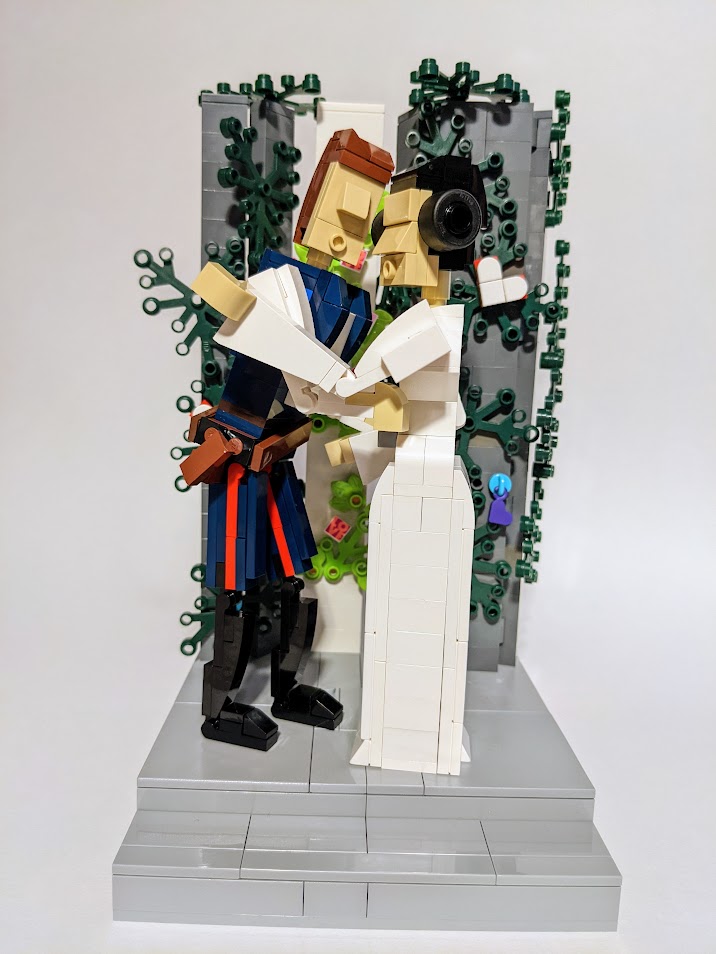
Here's a recent LEGO MOC that celebrates my love for A New Hope and the love we fans feel for Princess Leia and her scruffy looking nerf herder, Han Solo. I know Han and Leia didn't get together until later, but the pun was just too good to resist, and this piece was built for a Valentine's Day themed contest in my club, TNVLC. Here we see Han and Leia (or maybe it's Harrison and Carrie?) stealing a kiss just before the Battle of Yavin.


BE MY BBY


Wednesday, February 16, 2022

Trek Noir: Out of the Past in Deep Space Nine's "Necessary Evil"

Note: This post contains plot spoilers for the Deep Space Nine episode, "Necessary Evil"


I'm currently making my way through the entirety of the Star Trek TV series, Deep Space Nine, which I never got to watch regularly during its first run, and so far it has been a richly rewarding experience. While all of the episodes have their merits, I was especially struck by Season Two's eighth episode, titled "Necessary Evil." This one stands out from the others and from most of the older Star Trek shows for its serious - and successful - evocation of classic film noir to tell a dark, duplicitous story about events that unfold before the Cardassians leave Bajor and the Federation takes charge of the space station. While the Star Trek universe is traditionally a positive space with an optimistic vision of the future, this episode uses the tropes of classic noir to investigate the dark past that haunts Deep Space Nine, and it calls into question the motives and relationships of some of its most complex characters.

The Next Generation crew in "The Big Goodbye"

Star Trek shows have been playing with genre since the original series, but the sensibility of true noir is at odds with the core values of the Trek universe. When The Next Generation ventures into noir territory in the first season episode, "The Big Goodbye," it does so as a holodeck adventure with Captain Picard adopting the role of fictional private eye Dixon Hill, a figure very much inspired by Humphrey Bogart as Dashiell Hammett's iconic Sam Spade in both the book and film versions of The Maltese Falcon. The holodeck story is intended to be a nostalgic amusement for Picard and his friends, but an external event causes the safety protocols of the holodeck to disengage, thus thrusting the crew members into a more dangerous adventure than they had expected. While the episode includes real peril for the crew, the noir element of the experience is artificial and contained, and it is also pointedly self-conscious, an homage to noir rather than an embodiment of it.

Such is not the case on the Deep Space Nine episode, where a dark past of Cardassian control and Bajoran resistance creates opportunities for a noir plot that exists as part of the characters' reality. It's not surprising that a series with persistent connections to Casablanca (1942) might see the shadowy world of noir as fruitful territory to mine for narrative; the show even gets around to a blatant revision of Casablanca later in Season Two with the episode, "Profit and Loss" (with Quark, of course, as the stand-in for Bogart's bar owner Rick). In "Necessary Evil," the series takes us back and forth between its past and present to explore what life on the space station was like before the Bajoran liberation, which also evokes shades of Casablanca and the Nazi Occupation. That past is a dark place, where everyone's motives are suspect and our core characters meet for the first time under grim circumstances. It's a perfect setting for a very unusual example of tech noir, the (literal and figurative) space where noir and science fiction meet.

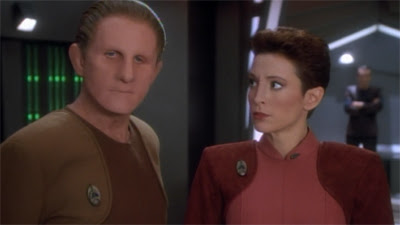
"Necessary Evil" focuses on the past between Odo and Kira.
 

The story opens in the present, when Quark is hired to retrieve a hidden, valuable item for an attractive Bajoran widow. Quark then becomes the victim of an attempted murder, and security chief Odo sets about uncovering Quark's assailant. His investigation takes him back to his first case on the station, when the Cardassian Gul Dukat assigned him to solve the murder of the widow's husband, a Bajoran merchant. The lead suspect in that case turned out to be the Bajoran Kira, then newly arrived on the station but now Odo's friend and colleague in the present. As Odo tries to uncover the present crime he begins to understand more about the murder from the past, but his realizations threaten his relationship with Kira.

Unlike Captain Picard in "The Big Goodbye," Odo is an unwitting noir protagonist and utterly unsentimental about the past, whether fictional or real. As an alien shape-shifter with no knowledge of his own home planet or people, Odo is a perfect noir lead - alone, aloof, cynical, and observant by necessity. He provides a classic noir narration of events only because Commander Sisko has asked him to create a record of the investigation. His failure to solve his first case haunts Odo, making him determined to solve not only the present crime but also the original murder. Gul Dukat claims that Odo is an ideal agent of justice in this case because his outsider status makes him neutral to both the occupying Cardassians and the subjugated Bajorans, but that neutrality is as questionable as Gul Dukat's explanation for Odo's assignment. Odo does, however, have a strong and clearly stated interest in justice, which makes him dogged in pursuit of the guilty parties in both the past and the present.

A Ferengi and a femme fatale meet in "Necessary Evil."

The character who most complicates Odo's sense of justice is Kira, the Bajoran woman who arrives at the station just before the original murder and is set up with the hallmarks of noir's good-bad girl and mystery's red herring (see Andrew Spicer's book Film Noir for a discussion of the genre's good-bad girl type). The widow claims that Kira was having an affair with her husband and is thus the obvious suspect, but the present tense crime has already depicted the widow as a classic femme fatale, so we, the audience, don't trust her. Kira denies the affair but eventually confesses to Odo that she is a saboteur for the Bajoran resistance and could not have committed the murder because she was busy causing damage elsewhere at that time. Odo protects Kira from Gul Dukat and leaves the murder unsolved, a situation that drives him all the more when the attack on Quark recalls the earlier crime. Finally, in the present, Kira reveals to Odo that she did, in fact, kill the Bajoran merchant when he discovered her trying to steal the same list of Bajoran collaborators that the widow hires Quark to find. The twist ending reveals Kira to be a better liar, and a less reliable associate, than Odo imagined, and it's not clear if he's more shocked by her duplicity or his own credulity. The episode concludes with the relationship between the two unresolved and the future of their friendship uncertain. It's a very noir ending for the episode even if both of the major characters remain alive and still working on the station afterward.

Everything else about this episode contributes to its noir sensibility. The scenes in the past use dark, blue lighting to cast shadows and uncertainty over the characters, while the other characters around Odo and Kira also fall into classic noir types, including Quark as the petty criminal in over his head and the widow as a beautiful femme fatale, complete with white evening gown and seductive manner. Odo's voice over narration, a staple of the genre, helps us navigate the shifts between past and present, but the two markedly different visual styles make the time periods quite distinct already. Gul Dukat, technically Odo's client in this investigation, has ulterior motives that he does not disclose, and the viewer comes away with the sense that "justice" is really a slippery idea. The smaller problems - who killed the merchant and who attacked Quark - might be solved, but larger and more unsettling questions persist. The episode presents, in abbreviated form, all the characteristics of classic noir, and it never winks or tips its hand about doing it. There's nothing cute about "Necessary Evil," which is part of the reason it's so good.

If you're interested in the particular pleasures of tech noir, check out film-length examples like Blade Runner (1982), Dark City (1998), and Minority Report (2002). If you're a Star Trek fan new to classic noir, start with iconic favorites like The Maltese Falcon (1941), Double Indemnity (1944), and, as my post title suggests, Out of the Past (1947).

Wednesday, December 16, 2020

Classic Films in Focus: BARBARELLA (1968)

I have frequently declared my affection for movies that are more entertaining than they are good, so it shouldn't surprise anyone that I enjoy the bizarre spectacle of Barbarella (1968) even if it makes no effort to make any sense. Produced by Dino De Laurentiis and directed by Roger Vadim, this adaptation of a French comic book is very much of its era, with sex on its mind and shag carpet covering every inch of its hedonistic heart. It doesn't take itself seriously, and the viewer shouldn't take it seriously, either, but its silliness is part of its appeal, along with the undeniable charms of the very lovely Jane Fonda as its eponymous heroine.

Fonda plays the enlightened space navigatrix who ventures onto a barbaric planet in search of the missing scientist, Durand-Durand (Milo O'Shea). Startled at first by the primitive sexual practices of the locals, she soon develops an appreciation for old-fashioned coitus and proceeds to enjoy encounters with a hairy child catcher (Ugo Tognazzi) and a beautiful blind angel (John Phillip Law) before reverting to her own culture's use of pills for a mind melding tryst with the freedom fighter Dildano (David Hemmings). She eventually makes her way to a city of pure evil where both Durand-Durand and the sadistic ruler, known as The Great Tyrant (Anita Pallenberg), attempt to destroy her and her new friends.

That's pretty much it for the plot, but along the way there are delightfully mad scenes that one only finds in truly weird science fiction films, like the opening spacesuit strip tease, the feral children and their toothy, flesh-eating dolls, the sled pulled by a giant manta ray, the BDSM city where dissipated locals have orgies and smoke "essence of man" from huge hookahs, and the seriously kinky looking pink spaceship that Barbarella pilots. You also get Marcel Marceau in a speaking role as Professor Ping, a casting choice that perfectly sums up the movie's illogical logic. Try to analyze it too much and the whole thing collapses like a house of cards, which makes it difficult to argue whether Barbarella is sexist for Fonda's objectification or feminist for liberating its heroine from mid-century ideals about female chastity and monogamy. It's most likely both at the same time, just like it's both a really bad movie and a really fun one for the right sort of audience, which is true about most pictures that achieve cult status. 

Whatever one's critical opinion of Barbarella, its title as a cult classic cannot be disputed, thanks to its own wacky but memorable images and its influence on the iconic 80s band, Duran Duran, who named their group for its villain and even doubled down on the connection with the 1997 single, "Electric Barbarella." The picture provides an intriguing alternative to the male dominated science fiction adventures that preceded it in both comics and film, including Buck Rogers and Flash Gordon, but it also draws from a deep well of influence in the literary and cinematic history of women's sexual escapades, whether that be a pornographic classic like Fanny Hill (1748) or a Pre-Code picture like Madam Satan (1930). Jane Fonda would go on to earn seven Oscar nominations for Best Actress with two wins, which better fit with her legacy as the daughter of Henry Fonda, but her performance as Barbarella is no less entertaining for being out of line with the rest of her career, though it does overlap in several ways with her work in Cat Ballou (1965), another genre comedy that never takes itself seriously. 

If Barbarella is your idea of a good time, revel in the weird charms of other cult sci-fi classics like The Blob (1958), Fiend Without a Face (1958), The Brain That Wouldn't Die (1962), or The Horror of Party Beach (1964). Terry Southern, who wrote the screenplay for Barbarella, earned Oscar nominations for his work on Dr. Strangelove (1964) and Easy Rider (1969), and he wrote the original novel that was adapted into the sex-fueled 1968 film, Candy, where you'll find a host of familiar stars and Anita Pallenberg. Roger Vadim, who was married to Fonda when they made Barbarella, also directed the 1960 vampire picture, Blood and Roses, which I recommend if you're a fan of variations on Sheridan Le Fanu's Carmilla.

Saturday, March 21, 2020

Classics for Coronavirus: Robinson Crusoe

The world is staying home this spring as a pandemic spreads through our countries, leaving many people to cope with the unfamiliar experience of social isolation. Literature and film are suddenly lifelines to adventure, community, and knowledge, and some of them can really teach us a few things about how to live while cut off from the rest of the world. As I keep up with the news this month I find myself thinking especially about Robinson Crusoe, Daniel Defoe's iconic castaway and master of social distancing. Defoe's original novel, published in 1719, has inspired many subsequent books, films, and television series, and there's never been a better excuse or time to explore them. Here are some of my favorite Robinson Crusoe revisions and adaptations.

1) Robinson Crusoe on Mars (1964) - This is probably my favorite of the films inspired by the novel because it takes Defoe's story and mixes it into 60s sci-fi, Paul Mantee stars as the castaway astronaut on the red planet, but you'll also find Adam West in a supporting role early in the film. Try this one if you're already a fan of classic sci-fi or you really loved The Martian (2015)!

2) The Martian (2015) - Matt Damon's turn as a castaway astronaut on Mars isn't a direct adaptation of Robinson Crusoe, but it certainly owes a lot to Defoe, and it makes a perfect double feature with Robinson Crusoe on Mars. When he gets left behind on Mars, Mark Watney uses science and creativity to survive. You'll really learn to appreciate potatoes!

3) Cast Away (2000) - If you want to come back to earth for your isolation, try the Tom Hanks hit in which a FedEx employee survives a plane crash and is stranded on a remote island. This is very much a modern Crusoe tale, although Crusoe's eventual companion, Friday, is a lot more useful than the soccer ball that Hanks' character names Wilson. Hanks, of course, has been in the news recently after being diagnosed with COVID-19 while filming in Australia, but I hope his time in medical isolation was a lot less traumatic than being marooned on an uninhabited island!

4) Swiss Family Robinson (1960) - Defoe's original story inspired the 1812 family classic, which is also worth handing to your kids while they're at home, but the 1960 Disney film adaptation is probably the best known of the numerous film treatments. John Mills and Dorothy McGuire star as the parents of a shipwrecked family with several sons, and this one makes a good family pick for kids who are too young for the films I've already listed. Best of all, you can stream it on Disney Plus if you're already sick of the two Frozen movies!

5) Lost in Space (1965-1968) - The Crusoe family tree adds another branch with this 60s TV revision of Swiss Family Robinson, which gave the world the iconic line, "Danger, Will Robinson!" Make your kids watch the 1960 Disney film first and then introduce the 60s TV series, the 1998 feature film version, or the newest 2018 TV series version (although the 1998 film is not particularly good, the new series is getting high marks).

Whether you're an adult looking for interesting ways to spend your time at home or a parent trying to craft educational but fun activities for kids, an exploration of Robinson Crusoe's literary and cinematic legacy is a timely choice. The original story is a good place to start if you have the patience for 18th century literature - it's a good read and a true classic with enormous influence. Otherwise try jumping in with any of the films and TV series listed here.


Thursday, January 9, 2020

Ida Lupino and THE TWILIGHT ZONE

Ida Lupino is not as familiar today as screen icons like Bette Davis and Joan Crawford, but classic film fans know and love her work as both an actress and one of the few women directors working in Hollywood during the mid 20th century. If you're not familiar with Lupino in either capacity, you can get a quick introduction to her work thanks to The Twilight Zone, which features one episode in which Lupino is the star and one that she directs. Both are worthwhile episodes of the show, with Lupino proving that she had just as much to offer behind the camera as in front of it. Early 2020 is a particularly good time to see these Twilight Zone episodes because you can currently find four seasons of the series streaming on Netflix.

Ida Lupino started out as a young actress in England and then made her way to Hollywood, where she enjoyed her greatest success as a performer in films like They Drive by Night (1940), High Sierra (1941), and On Dangerous Ground (1951). Her acting career tends to overshadow her directorial work, partly because it was so difficult for women to succeed as directors during the studio era, but Lupino had better success directing episodes of television series. According to IMDB, Lupino achieved 106 screen acting appearances and 41 credits as a director, including eight episodes of Have Gun - Will Travel, five of General Electric Theater, and nine of Thriller. Although she worked on only two episodes, The Twilight Zone is an especially good introduction to Lupino because you can see her work on both sides of the camera with just a Netflix account and about 45 minutes of free time.


The first episode, "The Sixteen-Millimeter Shrine" from Season One, features Lupino as the protagonist, a middle-aged movie queen named Barbara Jean Trenton. Like Norma Desmond in Sunset Blvd. (1950), Barbara is a difficult woman unwilling to confront reality and obsessed with her own films, but unlike Norma Barbara actually manages to escape from that ugly reality by entering the world of the pictures flickering on the screen. The expected twist of the story occurs quite late, and since Barbara's wish gets fulfilled without ironic subversion it's not one of the show's more famous episodes. Lupino, however, looks great in it and gives a very solid performance playing a character type she certainly knew in real life. (For more Twilight Zone actress stories, see "Ring-a-Ding Girl" and "Queen of the Nile," both of which are also in the Netflix collection.)


The second episode, "The Masks" from Season Five, shows Lupino's skill as a director. The story focuses on a dying old man who gets revenge against his greedy, awful relatives on the night of Mardi Gras in New Orleans. In order to get their expected inheritance, the relatives are required to wear hideous masks until midnight, at which point the old man dies and they discover that their true selves have been revealed. As the director, Lupino does a wonderful job conveying the shallow selfishness of the relatives and their growing horror as they finally remove their masks. The camera frequently focuses on the faces of the relatives in close-up; we see the ugly masks with their frozen mouths, but we also see the increasingly anxious eyes of the wearers. Vulture lists "The Masks" as #18 in its top 50 Twilight Zone episodes, and Rolling Stone puts it at #25 on their best-of list, making it an episode any fan of the classic series should definitely see.

If you watch and enjoy these two episodes of The Twilight Zone, track down some of Lupino's other work. In addition to the films mentioned before, you can find her acting in Moontide (1942), The Man I Love (1946), and Road House (1948). The Trouble with Angels (1966) is probably the most available of the films Lupino directed, but she both directed and stars in The Bigamist (1953), and her other directorial efforts include Not Wanted (1949), Never Fear (1950), and The Hitch-Hiker (1953).


Wednesday, October 2, 2019

It's Alive! Touring the Kirk Hammett Collection

Metallica guitarist Kirk Hammett is a dedicated classic horror and science fiction fan who is sharing his love for these movies through a touring exhibit of posters and other artifacts from his personal collection. "It's Alive! Classic Horror and Sci-Fi Art from the Kirk Hammett Collection" is currently on exhibit at the Royal Ontario Museum in Toronto, where I caught up with it earlier this month for a delightful tour of gorgeous posters for some of of my all-time favorite films.

Hammett's collection features some amazing posters, including art for Frankenstein (1931), Island of Lost Souls (1932) Dracula's Daughter (1936), I Walked with a Zombie (1943), and dozens of other films. The exhibit organizes the posters by film, era, genre, or star so that groupings have a common theme of some sort, with the major monsters and stars getting special areas that focus on them. The displays also include some three dimensional items like props, costumes, and several of Hammett's custom horror themed guitars. Particularly fun are the excellent wax figures of Bela Lugosi and Boris Karloff wearing costumes from their films. The exhibit stages a number of items so visitors can take selfies with them, which makes the experience even more fun.

My sister and I were the first people to visit the exhibit on our morning at the ROM, which allowed us plenty of space to take photos and talk about the movies. A true classic horror enthusiast can easily spend an hour in the exhibit, but it's small enough to tour in about 30 minutes if you're pressed for time. During our visit the accompanying soundtrack was a Hammett instrumental cover of Blue Oyster Cult's "Nosferatu," which played with a video in the section displaying Hammett's guitars. Because the exhibit was empty when we arrived I could hear the creepy, familiar opening notes of the song perfectly, which cast a tingle of delicious dread over the whole exhibit.

If you're able to visit Toronto in the near future, the Kirk Hammett exhibit is absolutely worth the trip and the extra admission price. The exhibit will remain at the ROM until January 5, 2020. It will then move to the Columbia Museum of Art in South Carolina and be available there from February 15 until May 17, 2020. If you can't get to the exhibit in person there's a gorgeous photo book of the collection available on Amazon for $20.97, which is a great deal compared to the amount you'd pay for it at one of the museum shops.


Tuesday, July 9, 2019

Three Favorite Movies in STRANGER THINGS 3

*Warning! Mild spoilers ahead, but only related to minor incidents. No major plot points are discussed.

The third season of Stranger Things continues its love affair with all things 80s, including the movies of that decade and the heyday of the local video rental store, which gives the final episode of the season an opportunity to name drop a number of films that reveal aspects of the characters' personalities. A visit to the video store presents fan favorite Steve and new character Robin with an opportunity to name their three favorite films as a test of their movie knowledge and personal taste. Not surprisingly, Steve goes with some pretty obvious recent choices, while Robin plays the movie snob card by naming three classic films.


Robin (played by Maya Hawke) appears throughout the season as a new kind of girl in the character mix, but one with her own 80s movie roots. She's the edgy, prickly, smart girl who doesn't care about popularity or the usual high school status symbols. Sarcastic and bored with her job at Scoops Ahoy, she torments Steve but also proves herself to be a useful, loyal friend to the former high school golden boy. When asked to name her three favorite movies, Robin lists The Apartment (1960), The Hidden Fortress (1958), and Children of Paradise (1945). Her picks are especially esoteric for a teenager living in small town America in the mid 1980s, where it would have been difficult to see any of those three pictures, but they're intended to show her as a "serious" cineaste who leans toward foreign classics and film school standards. They immediately win the approval of the video store clerk, as well.

Steve's taste is, as Robin admits, "pedestrian" in comparison with her own. His picks, after much stumbling, are Animal House (1978), Return of the Jedi (1983), and Back to the Future (1985), the last of which Steve had just caught parts of during his misadventures with Robin, Dustin, and Erica. We've seen Steve grow a lot as a character since his initial appearance in Season One, but his first choice of Animal House reminds us of the kind of guy Steve used to be and might have remained if not for his experiences with the other Hawkins kids. He doesn't know the names of the specific episodes of Star Wars, either, and he loses even more credibility with the clerk by saying he likes "the one with the teddy bears" instead of going with the more fanboy approved The Empire Strikes Back. Ironically, Robin has included in her list Akira Kurosawa's The Hidden Fortress, one of the films that George Lucas heavily borrowed from for A New Hope, thus showing that the best approach is to name not an actual Star Wars film at all but to show your depth of knowledge by picking one of its inspirations.

In a season packed with movie references, especially shout outs to horror films like Day of the Dead (1985), The Thing (1982), Invasion of the Body Snatchers (1956 and 1978 are equally relevant), and Alien (1979), along with a heavy dose of The Terminator (1984), the final episode's video store scene is a chance for the show to engage the cultural significance of movies very directly and mention some films that fall outside its horror/action/80s frame of reference. Robin's list is more about a hardcore movie buff's idea of what matters, but Steve's list is more in tune with the specific cultural moment in which the show takes place.

Honestly, in retrospect, they're both perfectly good lists, just reflective of very different movie watching moods and perspectives. When I was 18, back in 1990, I certainly hadn't yet seen any of Robin's picks, but I had seen all three of Steve's (I only saw Animal House because I was in college by then and away from parents who strictly cut off my access to R rated films). My top three would probably have been something like The Princess Bride (1987), The Lost Boys (1987), and, yes, Return of the Jedi (I also like the teddy bears. Fight me.)

What were your three favorite movies when you were 18? Were they "classics" or things you had only recently seen for the first time? How does your knowledge of movies - from the 80s or otherwise - enhance your enjoyment of a show like Stranger Things? I'd love to see your thoughts in the comments!

PS - If you're interested in my early teenage experiences with serious cinema watching back in the 1980s, check out "My First Summer of Cinema - 1988."

Tuesday, April 3, 2018

FLASH GORDON and Sam Jones in Huntsville

The 2018 Huntsville Comic Con opened with a screening of the 1980 cult classic Flash Gordon with a Q&A featuring special guest Sam Jones, who played the title character in the film. An excited audience gathered on Thursday, March 29th, to see the movie on the big screen and ask its star a few questions.

The screening itself was a big success, with a good crowd for a town like Huntsville and an excellent sound system that blasted the Queen soundtrack in all its glory. The vibrant colors of the sets and costumes still pop, and the audience cheered as Flash played football with a giant egg, fought future 007 Timothy Dalton on a hazardous tilting platform, and saved the Earth from Max von Sydow's sneering Emperor Ming.

Nearly forty years after its original release, Flash Gordon continues to be a campy sci-fi delight, with stand out performances from Dalton, von Sydow, Brian Blessed, and Topol. Other memorable actors in the cast include Melody Anderson as Dale, Ornella Muti as Princess Aura, Peter Wyngarde as Klytus, and Richard O'Brien as Fico. Along with Dale and Dr. Zarkov, Flash travels to an alien world and fights to save his own planet after Ming the Merciless makes Earth his latest plaything. While Ming lusts after Dale, Flash struggles to unite the warring factions of Ming's court in a rebellion against the tyrant, but his efforts are complicated by Princess Aura's attraction to him and Prince Barin's resulting jealousy. The heroic adventures conclude in a grand battle to take down Ming and rescue Dale from her forced marriage to him. Queen's earworm theme for the film punctuates key moments with campy enthusiasm, while Danilo Donati's costume designs fill the eye with vivid color and quite a bit of female flesh. The final effect is more Barbarella than Star Wars, full of S&M undertones and visual hyperbole, but clearly reveling in both.

After the screening, Sam Jones took the stage to answer questions from the audience, but he was less interested in talking about the making of the film and more focused on his personal life, later career, and thoughts about acting in general. He discussed his appearance in Ted (2012) and his current film project, The Silent Natural, which does not yet have a release date. Those looking forward to an in-depth talk about the origins of Flash Gordon, its history as a comic strip and serial, and personal anecdotes about Timothy Dalton, Max von Sydow, and Brian Blessed were disappointed, but the audience was treated to Jones' positive opinion of Steven Seagal and lingering grudge against Arnold Schwarzenegger.

For those who really want to learn more about Flash Gordon, the Blu-ray release features an interview with Alex Ross and the first episode of the 1936 serial starring Buster Crabbe in the title role. You can also explore the history of the comic strip online. Empire Online has a detailed article about the 1980 film called "Gordon's alive! The untold story of Flash Gordon."

Tuesday, February 27, 2018

Classic Films in Focus: QUEEN OF BLOOD (1966)

With its lurid title and eerie opening credits, Queen of Blood (1966) promises a delirious sci-fi phantasmagoria that, sadly, it never delivers. Even Basil Rathbone and Dennis Hopper get bogged down in the picture's ponderous pace and refusal to pivot away from the pseudo-science that typically fills the slow parts of 50s and 60s science fiction films. It's a shame, too, because writer and director Curtis Harrington's ideas might have made for a truly unnerving narrative; the last third of the movie, with the predatory title character and her secret intentions, has a lot in common with Alien (1979), but you'll never worry about whether they can hear you scream in space when you're watching Queen of Blood.

Rathbone plays Dr. Farraday, the lead scientist for a space exploration group that mounts a rescue mission to Mars when an alien ship crashes there. Among the astronauts are alpha male Allan Brenner (John Saxon), his girlfriend, Laura James (Judi Meredith), and Paul Grant (Dennis Hopper). Once the astronauts locate the sole survivor of the alien wreck, they attempt to bring her to Earth, but the small crew gets smaller each day the alien stays on board. The remaining astronauts struggle to complete their mission without becoming the vampiric stranger's next meal.

Queen of Blood is set in the far future of 1990, where women finally get to be astronauts but still wear 60s hairstyles. Lots of references to moon bases and science are meant to show how far humans have come since 1966, but the movie is in no hurry to introduce its title character or even get its astronauts to Mars to look for her, and most of the scenes take place in small control rooms or the sterile, confined space of the rescue ship. The flashes we see of the aliens, who sport clear plastic crowns that look a bit like rabbit ears, are intriguing and vaguely disturbing, but they also remind us how deadly dull the humans are in comparison. It's never really clear if the aliens are the same species as the bloodthirsty queen; Dr. Farraday speculates about their intentions but doesn't give us solid answers. That ambiguity persists right to the end, when we're left with the distinctly unpleasant expectation that the humans are making a colossal mistake, but there's no effective build up of dread that would have given the ending a truly horrific punch.

The slow pace, closed spaces, and dry dialogue don't allow Basil Rathbone or the other actors to shine, and they rarely do anything except talk. Judi Meredith is more or less the lead as Laura James, and as the only woman Laura stands out among the very typical masculine characters who make up the rest of the crew. We don't get much sense of the individual personalities of the astronauts played by John Saxon, Dennis Hopper, Robert Boon, and Don Eitner, and as a result we don't really care if they live or die. When she finally does appear, the Queen of Blood, played by Florence Marly, has no lines and never even makes a sound, yet she still manages to be the most interesting character in the whole film. The male characters blithely assume that she isn't dangerous because she is so obviously female, and they treat her with patronizing kindness until they realize that she sees them as tasty snacks. Laura has to come to the rescue against this seductive predator, but it's a disappointing confrontation that wraps up much too quickly.

Curtis Harrington also wrote and directed Night Tide (1961), which handles its slow burn horror with more skill and gives young Dennis Hopper a more interesting role. For better late career performances from Basil Rathbone, see Tales of Terror (1962) and The Comedy of Terrors (1963). John Saxon, who is still working in 2018, is known for his appearances in the Nightmare on Elm Street series but can also be seen in Blood Beast from Outer Space (1965). You'll find both Saxon and Judi Meredith in Summer Love (1958). Be sure to note sci-fi icon and superfan Forrest J. Ackerman in a small role in Queen of Blood as Dr. Farraday's assistant.

Wednesday, July 19, 2017

The First Time: Memorable Movie Introductions

In my last post I talked about the first time I saw George Romero's Night of the Living Dead (1968), which got me thinking about the other movies I remember seeing for the first time. If you're like me, you watch so many movies that a lot of the viewings run together (which is why some of us have film journals to keep track), but other experiences stand out. Perhaps it's the place where it happened, or the other people who were there, or maybe it's that the film itself made such a huge impact on you as a first-time viewer. I made an effort to think about the movies I can clearly remember seeing for the first time, and here's the list I came up with, as well as what I can recall about the circumstances in which I saw them.

Clash of the Titans (1981)

This is the first movie I distinctly remember seeing for the first time, at a drive-in in Jesup, GA, in 1981. Given my long-standing love for SF/F and special effects, it's no shock that I loved it. It also stirred my interest in mythology, which fueled a passion for all things literary.

Night of the Living Dead (1968)
One Flew Over the Cuckoo's Nest (1975)
Invasion of the Body Snatchers (1978)

All seen in 1988 at the Governor's Honors Program in Valdosta, GA (see my post about that)

Alien (1979)

At a fraternity house at Georgia Tech in 1989 - the brothers were drunk, but I was sober, and I got so sucked into watching the movie that I paid no attention to the shenanigans going on around me, much to the disappointment of the guy who hoped I'd be scared by the film and need his manly protection. I think he left when I started laughing at the death scenes. (No, I don't remember now why I thought they were funny!)

The Cook, the Thief, His Wife & Her Lover (1989)
Tie Me Up! Tie Me Down! (1989)

At an NC-17 film series at Emory University in late January 1991, with the man I would eventually marry. Oddly enough, this series formed the basis of most of our first week of dating, an odd start in terms of content but fitting given how many movies we have seen together since. Of the two, The Cook, the Thief, His Wife & Her Lover made by far the greatest impression. I can still close my eyes and see whole scenes of that film, though I have not watched it again in all these years. The ending in particular is impossible to forget. This was my first real exposure to foreign films as such, not to mention NC-17 films. I went back to Emory's little theater for a Star Trek marathon, Prospero's Books (1991), and My Own Private Idaho (1991) during my college years, all memorable in their own ways.

The Silence of the Lambs (1991)
The Rocky Horror Picture Show (1975)

Talk about a weird double feature! I saw both with a large group of friends from Agnes Scott and Emory. We all went to an Atlanta theater for Silence of the Lambs, which left us feeling freaked out by the time it got over. Luckily, we came out of the theater to find a floor show of Rocky Horror recruiting an audience for their midnight screening. It turned out that Frank-N-Furter was a high school friend of some of our folks, and we all got in for free. Silence is the better movie, but Rocky Horror was more fun; it was the first time I saw the live show.

Bram Stoker's Dracula (1992)

Another group trip with a different crowd of friends - this one involved a pickup truck full of freezing college students at a drive-in theater outside Atlanta. I don't know why we thought it was a good idea to sit in the back of a truck on a freakishly cold night, but nobody lost any toes. I had to watch the movie again a few years later because I was too cold to pay that much attention to it at the time, but I'll never forget the experience itself.

Easter Parade (1948)

Most of these entries have been movies that were new at the time, but I got to discover this charming musical as part of a senior colloquium on comedy in 1992. The professor who showed it was Pat Pinka, and she was obviously delighted to present it to a room full of English majors. We studied many excellent works during this seminar course, including Swift's "Modest Proposal" and Evelyn Waugh's The Loved One, but Easter Parade stands out as an example of the pure joy of a different kind of comedy.

Most of this list comes from my college years, a formative time, I think, for most young people, but for me especially because the town where I grew up had limited my access to so much of art and popular culture. I was lucky to get away to Atlanta and liberal arts campuses where I could explore literature, film, and my own identity. I went to museums, live theater, the ballet, and pretty much every movie theater in the greater metro area. So many of those movie experiences were memorable because it was all so new to me; even having friends with whom to see those movies was new. Now I see movies in the theater with my family all the time, but I also get to show movies to groups at libraries and lifetime learning programs, and I think the communal experience of watching and talking about a film makes a big difference.

I also talk about seeing some of these films for the first time in this post, so head over to that if you're interested in the portrait of the cinephile as a young girl theme.

What are the movies you remember seeing for the first time? Where were you and who were you with? I'd love to hear about it in the comments section!


Tuesday, March 21, 2017

My Life in Films: Favorite Movies by Year

Film Twitter has prompted me to join in on the recent lists of people's favorite movies for each year of their lives. At 45, I feel like that's a lot of territory to cover, and of course a lot of the movies I watch these days came out long before I was born, but I have seen most of the big hits for most of the years in question.

I want to clarify my process a bit before I get to the actual list. As I looked at the films for each year, I asked myself the following questions:

1) Do I own the movie? If I didn't feel the need to buy it, then it's probably not my favorite.
2) How many times have I voluntarily watched this movie? Have I watched it again recently?
3) How much of this movie can I quote or recite from memory? The more of it I know by heart, the bigger the impression it has obviously made.
4) Do I own merchandise and/or clothing celebrating my love for this movie? Since I'm wearing a Yoda t-shirt as I type this post, it would be silly to pretend that I'm not a sucker for Star Wars and/or Muppets. Not all movies get merchandise, of course, but if I love something enough to wear it on a shirt I'm probably pretty attached to it.

I didn't pick the "best" movie from each year; I picked a favorite. I didn't think about Oscars or box office appeal (or lack thereof) or whether hipsters would approve of my choices. Sometimes the decisions were excruciatingly hard, and there are three or even four really close seconds that on a different day might get the edge over the one I chose today. I didn't pick any of these to impress anyone; I'm a lifelong geek with a deep love for science fiction, fantasy, Disney, animation, and comic books. I like quirky, funny stuff. I like super heroes. I picked movies that I go back to many times because they make me happy, so you won't see a lot of tragic downers on this list because my favorite movies are the ones that make me want to keep living. Your list will be different, and that's OK.

So, without further delay, here's a favorite film for every year of my life so far...

1972 Dracula A.D. 1972   (Cushing & Lee do disco Dracula - I can't help it)
1973 Robin Hood    (yes, the Disney one)
1974 Young Frankenstein    (Sweet mystery of life at last I've found you!)
1975 Monty Python and the Holy Grail      (Just a little peril...)
1976 Murder by Death     (I love the cast; I love the parody of the genre)
1977 Star Wars     (Changed my life)
1978 Invasion of the Body Snatchers    (Donald Sutherland's goggle-eyed stare!)
1979 The Muppet Movie    (Makes me deeply happy. Can you picture that?)
1980 The Empire Strikes Back    ("I love you." "I know.")
1981 Raiders of the Lost Ark    (Bad dates. Plus, Nazi punching!)
1982 The Last Unicorn      (Makes me cry. One of my favorite books ever.)
1983 Return of the Jedi     (Yes, I even like the Ewoks.)
1984 Ghostbusters     (There is no Dana!)
1985 Back to the Future     (Still so much fun)
1986 Labyrinth     (Tough year of choices, but I'm going for Bowie & weird Muppets)
1987 The Princess Bride    (Come, my love, I'll tell you a tale...)
1989 Indiana Jones and the Last Crusade    (My favorite Indy movie)
1990 Back to the Future III    (I love the Western steampunk vibe)
1991 The Addams Family    (Because it's awesome & so is the pinball machine)
1992 The Muppet Christmas Carol    (Light the lamp, not the rat!)
1993 Groundhog Day    (Because we watch it every year)
1994 The Lion King     (Hakuna matata!)
1995 Babe    (I grew up with Border Collies, and James Cromwell is great.)
1996 Matilda    (A girl reads books - what's not to love?)
1997 The Fifth Element   (Super green!)
1998 Dark City    (Ebert's favorite for 1998 and mine, too)
1999 The Iron Giant    (What you currently have - IN YOUR MOUTH - is art!)
2000 O Brother, Where Art Thou? (For the Preston Sturges allusion & so much more)
2001 Monsters Inc.    (Put that thing back where it came from or so help me...!)
2002 Lilo & Stitch    (It's hard to be weird, whether you're a girl or an alien experiment)
2003 Peter Pan    (best adaptation yet of this story)
2004 Hellboy     (I love everything about this movie)
2005 Wallace & Gromit: The Curse of the Were-Rabbit  (My favorite W&G)
2006 Penelope    (Modern fairy tale with a very cool cast)
2007 Hot Fuzz   (The soundtrack alone wins for me, but movie is so delightful)
2008 Miss Pettigrew Lives for a Day (So English. Hilarious & heartbreaking.)
2009 Star Trek   (Trek is back! Nimoy is back! Joy!)
2010 Scott Pilgrim vs. the World    (I'm team Knives)
2011 The Muppets   (For embodying my nostalgic love perfectly)
2012 The Avengers   (Joss Whedon! Agent Coulson!)
2013 Belle    (Gets my 18th century groove on in a big way - lovely film)
2014 Guardians of the Galaxy   (It's all about Rocket and Groot)
2015 Mad Max: Fury Road    (Motorcycle matriarchs - heck, yeah)
2016 Star Trek Beyond    (Trek done right - plus, Simon Pegg!)

Since it's only March, it's too early to declare a favorite for 2017, but it looks like a full year of contenders. Hopefully it will end up being another year where it's really hard to choose.

Friday, August 5, 2016

The Failure of Fathers in STRANGER THINGS

Warning: This essay contains spoilers! Read at your own risk.

The Duffer Brothers' 2016 Netflix series, Stranger Things, takes its cues from a bevy of 80s movies, most notably the films of Steven Spielberg and screen adaptations of the works of Stephen King. The mix also includes iconic pictures from the horror, science fiction, and teen genres like Alien (1979), A Nightmare on Elm Street (1984), and the films of John Hughes. The television series reflects the culture of the 1980s as seen through the lenses of these pictures, creating a strong sense of nostalgia for Gen Xers in particular, who were the same age as the show's characters during the era depicted in the series. As a kind of period piece, Stranger Things offers us a chance to look back at the 1980s and consider its essential themes, from Cold War paranoia to the initial rise of geek culture as embodied by Dungeons & Dragons. One of the most telling themes incorporated into the series is the breakdown of the traditional nuclear family and the normalization of divorce, especially as those issues relate to absent or failed father figures in the lives of the children and teens. In fact, while Stranger Things depicts a number of father characters, almost none of its fathers manage to live up to the obligations of paternity, and substitute father figures must stand in to provide guidance and protection to the four young boys who function as the show's core characters.

The series focuses on a group of 12 year old friends who stumble into a bizarre government conspiracy after one of them disappears. Will Byers (Noah Schnapp) vanishes from the small town of Hawkins, but his mother, Joyce (Winona Ryder), soon suspects that her son is both alive and held captive in some mysterious place, where he communicates with her by flashing electric lights. While the friends conduct their own search for Will, Joyce enlists the help of police chief Jim Hopper (David Harbour), who becomes convinced that a government lab near the town is connected to Will's disappearance. The boys unexpectedly find Eleven (Millie Bobby Brown), a girl whose strange abilities and sudden appearance link her to both Will and the secretive lab. Meanwhile, the teen siblings of two of the boys discover more clues to the mystery and realize that a bloodthirsty monster is also involved.

The four boys at the center of the story are Will Byers, Mike Wheeler, Dustin Henderson, and Lucas Sinclair. Only two of the four are shown to have fathers at all: Will has an absent, divorced father named Lonnie, while Mike has an older, sedentary father who spends a lot of his time sleeping in a Lazy Boy chair. We never see the fathers of Dustin and Lucas at all, although we can infer from the series that Lucas has a father who is a veteran of the war in Vietnam. Neither Lonnie nor Ted Wheeler can be called a good father in any meaningful sense, although Ted's failures are more sins of omission than anything else. Lonnie takes no interest in Will or older son Jonathan, and his ex-wife, Joyce, asserts that Lonnie used to deride Will as a "fag" before the parents broke up. When Lonnie does return after Will's disappearance, he turns out to be interested only in suing the quarry where Will's body was supposedly found; he doesn't actually care about his missing/dead son. Ted, who is still married to Mike's mother, Karen, and clearly has a good job, seems like a better father on the surface, but he has no emotional connection to his three children and doesn't seem to understand them at all. While Karen doggedly tries to earn the trust of both Mike and older sister Nancy while constantly caring for toddler Holly, Ted merely works and sleeps. He doesn't know how to talk to his children, doesn't seem to interact with them, and is shown in the last episode to be the only person sleeping in a hospital waiting room full of otherwise worried characters. If Lonnie is the stereotypical deadbeat dad of the 80s, then Ted is the stereotypical dad of the 50s and 60s, who leaves all the domestic and emotional work of parenting to his wife. Neither is the kind of father a child wants or needs, especially a boy on the cusp of adolescence.

Dr. Brenner with Eleven

Even worse than Lonnie and Ted is the manipulative Dr. Brenner, who adopts a paternal facade in his relationship with Eleven. Dr. Brenner is not the girl's real father, and no hint of a biological father's identity is provided, but he trains Eleven to call him "Papa" and to think of him as a parental figure. Lonnie and Ted are neglectful, emotionally distant fathers, but Brenner is actively evil and abusive. He encourages Eleven to rely on him, to obey him, and even to fear him, but he repeatedly hurts her and endangers her for his own ends. Part of Eleven's psychological journey in the series is her realization of Brenner's essentially bad nature and her ultimate decision to reject him. A stark contrast is provided for Eleven in the way that Brenner has treated her versus the way Joyce treats her in the seventh episode, "The Bathtub." Brenner has pushed Eleven to do dangerous things simply because he wants the power and knowledge, but Joyce asks Eleven to take risks to save her son. Joyce thanks Eleven for her bravery but also reassures her, holds her, and supports her, while Brenner dumps Eleven into the lab's sensory deprivation chamber and leaves her to confront the monster alone. Joyce's maternal behavior is utterly alien to Eleven; the scenes in the lab always show her surrounded by emotionally blank male scientists, with only Brenner's insidiously abusive relationship as a gross perversion of parenthood. Nonetheless, Joyce's brief relationship with Eleven clearly has a huge impact on the girl and helps her see the truth about Brenner. The last word she says to him is "bad," and the look on his face tells us that he understands that his hold over her has been broken.

Hopper and Sarah

Somewhere in the middle of the set we find Jim Hopper, the emotionally damaged police chief. Hopper has been a good father; we see that demonstrated in flashbacks of his daughter, Sarah. Tragically, Hopper's daughter contracted a terminal illness; her death destroyed his marriage, drove him to self-destructive habits, and closed him off emotionally until Will's disappearance resurrects his paternal instincts. Hopper was such a devoted father that the loss of his child wrecked him; it's clear that embracing the role means accepting the risk of loss and heartbreak. As he searches for Will, Hopper begins to revisit his grief and simultaneously regain his ability to be a strong father figure, even though the child he tries to help is generally unaware of his efforts. Trapped in the Upside Down, Will doesn't know how dedicated Hopper has become to finding him, but we see how Hopper adopts the paternal role that has been callously vacated by Lonnie, not only toward Will but toward Jonathan, as well. Hopper also takes the domestic role in relationship to Joyce, becoming her partner and emotional support. Despite his courage and resolution on Will's behalf, Hopper does not become an ideal father figure. He makes a Faustian bargain with Brenner to get Will back, one that directly endangers Eleven, so his paternal urge is limited in its scope. He is willing to trade one endangered child for another, even though he has learned that Eleven's mother never stopped trying to find her. It's ironic, on some level, that Hopper is willing to sacrifice the life of a girl to save a boy, given that he was himself the father of a daughter. He does, however, reach out to her in the series' coda, leaving food for her in a box in the woods. It might be too late - the show leaves us with a lot of questions about Eleven's fate - but at least Hopper continues to move back toward the role he once filled.

The absence of real fathers, whether physical or emotional, leaves the role to be filled by substitutes. Hopper becomes one surrogate father, albeit one with serious issues of his own, but other characters also volunteer themselves for the job. Will's older bother, Jonathan, steps in to fill the gap left by Lonnie, even though Jonathan still needs a father figure himself. Jonathan goes to school, works, helps to care for Will, and cooks for the family; he functions as a model for a newer, more invested kind of fatherhood that more closely resembles the multi-tasking required of mothers. He nurtures and supports Will, teaching him about music and bonding with him; Jonathan is the one who knows how to find Will's friends using the two-way radios. When Will goes missing, Jonathan searches for him and openly grieves; he is more in touch with his emotions than any of the previous generation of father figures. Jonathan and Nancy become younger parallels of the partnership embodied by Hopper and Joyce, both active, dedicated, and defined by their devotion to someone else. Jonathan's willingness to accept this burden makes us prefer him to Nancy's love interest, Steve, who is selfish and immature in comparison. The science teacher, Mr. Clarke, is also a surrogate father figure, although his role is less emotionally involved. All four boys have a close relationship with him; he provides them with the intellectual nurturing they cannot get at home and even tries to offer some emotional support after Will's disappearance. Ironically, Brenner's lab uses Clarke's dedication to the boys as a way to locate them; they pretend to be looking for talented science students for a fictitious state club. Clarke has no idea that he's actually betraying his favorite students to their enemies, but he - again unwittingly - makes up for it when he helps them design a sensory deprivation chamber for Eleven, even though it's Saturday night. Although the boys lack actual fathers in their lives who fulfill their parental obligations, the show depicts hope in the form of those who willingly take on such burdens, whether they are authority figures, male relatives, or teachers. If Mike, Will, Dustin, and Lucas become good men in their turn, it's because of characters like Hopper, Jonathan, and Mr. Clarke, not the men who sired them.

Stranger Things offers a dense narrative with many threads worth pursuing, especially in terms of its relationship to the culture of the 1980s, but the failure of fatherhood certainly seems to lie close to its heart. While mothers are generally shown as loving, dedicated figures - not only Joyce, but Karen Wheeler and even Terry Ives - fathers are seen as deeply flawed. They are absent, uninterested, clueless, or even cruel. They leave young boys to fend for themselves in a dangerous and uncertain world, even as the rules for what it means to be a man are in flux. They treat girls as things and betray them to suffering and peril. Still, there is hope. Where some men rush to vacate their roles as fathers, others step in. It will be interesting to see if Stranger Things revisits these themes with a second season or offers us a glimpse of the ways in which the four boys mature to become the fathers of another generation.

Thursday, July 28, 2016

I Feel It in My Bones: My Favorite Star Trek Character

With Star Trek Beyond out in theaters just in time for the 50th anniversary of the original show, I find myself thinking back about my lifetime of Trek experiences. I first saw the show as a little girl, when it was on in re-runs during the 1970s. I have been a fan ever since, seeing every movie and every new television series (although Enterprise never quite captured my attention like everything else). There's a lot to love about Treks old and new, from the progressive vision of humanity's future to the deep love of literature that balances its more obvious focus on science and engineering. Every fan, of course, has his or her favorite episode, movie, and character, and for me that character has always been the irascible Dr. Leonard McCoy, particularly as played by original series star, DeForest Kelley.

I've had some trouble adjusting to the new McCoy, played by Karl Urban, but mainly because my devotion to the original ran so deep. Urban finally won me over with his performance in Star Trek Beyond, thanks largely to his wonderful banter with Zachary Quinto's pitch-perfect Spock. Still, Kelley will always be the "real" McCoy as far as I'm concerned. His depiction of a future Southerner struck home for me as a little girl growing up in the Deep South; he was one of the only truly positive representations of Southern people I had seen. Usually Southerners were hicks on television; The Dukes of Hazzard was the worst offender, but even The Andy Griffith Show had a folksy, aw-shucks sensibility that galled me. I was a voracious reader, a bookish kid who loathed sports, but I was also defined by a distinctive drawl and a childhood spent on a farm. I never saw anybody like me on TV.

Something about Bones, though, spoke to me. He was cranky but humane, the voice of the heart to balance Spock's voice of the head. He didn't relish adventure and being transported across space, but you could rely on him in a pinch. He never gave up his drawl or his Southern manner, but he worked on an integrated starship where everyone was judged by his or her individual merits. He knew Shakespeare just as well as Kirk and Spock. He was instantly familiar but so different from any Southern TV character I had seen before. Most of all, his Southern identity felt authentic, and that's because it was. DeForest Kelley was born in Georgia, where he lived until he left for California to become an actor. His accent wasn't forced or feigned; it sounded like the people I grew up with and knew. I've talked about Southern identity in classic films and television before; it's rare to see an actual Southerner play a positively depicted Southern character. It means a lot to young people in particular to see someone like them get to be smart, forward-thinking, and part of the in-crowd of heroes and pioneers.

Bones was a doctor, damn it, as he often liked to say, but to me he's still the heart of Trek. I'm pleased to see the character continue in the new series, even if I'll always hold a special place in my heart for Kelley's original version. Do you have a favorite Star Trek actor or character? I'd love to hear about it in the comments section!

Wednesday, February 10, 2016

Classic Films in Focus: THE CREATURE WALKS AMONG US (1956)

What you make of The Creature Walks Among Us (1956) probably depends on how you feel about 1950s B horror and science fiction as well as the iconic monster himself. The third and final Gill Man picture revises the formula established in Creature from the Black Lagoon (1954) with a couple of odd twists, most notably an injury and subsequent radical experiments that make this movie's creature quite different from the original version. Many of the other elements remain the same, including the presumptuous scientists and some attractive female bait to get the Gill Man's attention, but these are standard equipment for scores of similar films from this era. Director John Sherwood takes over from Jack Arnold, who spearheaded the first two pictures, while Jeff Morrow, Rex Reason, and Leigh Snowden star, but, once again, the Gill Man is the most interesting character on screen, a tragic figure of alienation whose third encounter with human beings only brings him more suffering and pain.

Jeff Morrow leads the cast as Dr. William Barton, an obsessed scientist who finances a trip to capture and experiment on the Gill Man. Along for the journey are Barton's young wife, Marcia (Leigh Snowden), the brash Jed Grant (Gregg Palmer), and Barton's reluctant colleague, Dr. Thomas Morgan (Rex Reason), as well as a handful of other scientists and crew. When their capture of the creature results in his gills and scales being badly burned, the scientists trigger changes that make the Gill Man a more humanoid air breather, but they argue about the inherent violence of the creature's nature. Meanwhile, Barton's jealousy about his wife creates further tension between him and everyone else, especially when Jed pursues Marcia with boorish determination.

Like most of these pseudo-science B pictures, The Creature Walks Among Us gets off to a slow start, with lots of inane explanation and technical talk about aquatic life, genetics, and sonar. Things pick up as the human characters reveal their quirks, but the real action begins when the Gill Man makes his first appearance. The sluggish first act is more of a problem in a film that only runs 78 minutes, and it does seem like the third movie in a series, coming out so soon after the first two, could dispense with the exposition and get on with the monster mayhem. Actually, the monster doesn't even get to wreak that much havoc, since he's quickly captured, wrapped in bandages, and then imprisoned with a flock of sheep for company. He spends most of his time lying on an operating table or staring forlornly at the ocean from his cage. The cruel irony of a sea creature separated from his natural element generates a lot of pathos, but it eliminates much of the underwater action that made the original movie so interesting.

The creature is, at any rate, one of the film's more dynamic characters, since he undergoes both physical and psychological changes as a result of his experiences. He's very much a figure out of Frankenstein or The Island of Dr. Moreau, the violent but innocent victim of man's hubris. This particular installment does less with the Gill Man's usual preoccupation with the ladies, but it does draw parallels between his situation and that of Marcia, whom Barton also treats as an inferior possession. Barton, it turns out, is the real monster of the story; Jeff Morrow plays him with a creepy intensity that makes him the scariest the thing in the picture, especially in his confrontations with Marcia and Jed. Morgan, who is meant to be a humane foil to Barton, looks good in a swimsuit but has a less interesting role to play, and he goes along with the experiments too much to escape culpability. Of the humans, only Marcia is really exempt from blame, and the mixed depiction of her characters makes it hard to like her, especially when she insists on accompanying a diving expedition for no good reason and then promptly requires rescuing. The rest of the characters remain rooted in the background, providing some ostensibly necessary dialogue but never really contributing to the development of the narrative themes.

The Creature Walks Among Us is something of a weak finish to the Gill Man series, but there's enough going on here to warrant attention from fans of the genre or the monster. Be sure to see the original Creature from the Black Lagoon (1954) and Revenge of the Creature (1955) first to get the whole story. John Sherwood worked much more often as an assistant or second unit director, but he's also in the director's chair for The Monolith Monsters (1957). See Jeff Morrow and Rex Reason in This Island Earth (1955); you can also catch Morrow in Kronos (1957) and The Giant Claw (1957). You'll find Leigh Snowden in Kiss Me Deadly (1955) and a handful of B pictures like Hot Rod Rumble (1957).

Monday, January 4, 2016

Classic Films in Focus: THE HORROR OF PARTY BEACH (1964)

No genre lends itself to glorious badness like classic sci-fi horror, and director Del Tenney's The Horror of Party Beach (1964) makes for an excellent example of sublimely entertaining schlock. No, it isn't scary, thanks to stilted dialogue, flat acting, and some seriously DIY monster costumes, but it does wallow in the conventions of its type with gleeful abandon. If you enjoy really bad movies of the Mystery Science Theater 3000 variety, then The Horror of Party Beach is just your cup of radioactive monster-making sludge.

John Scott heads up a cast of unknowns as Hank Green, whose troublesome girlfriend, Tina (Marilyn Clarke), is the monsters' first victim. Hank doesn't seem to miss Tina; his scientist mentor's daughter, Elaine (Alice Lyon), readily jumps in as his new romantic interest, and the two set about trying to locate the monsters and destroy them before they kill off the entire town. Unfortunately, neither the scientist, Dr. Gavin (Allan Laurel), nor the local police can figure out how to defeat the creatures until dozens of residents have been killed, although the increasing body count doesn't seem to convince any of the locals to stay inside with the doors locked.

Monster movies are, of course, only as good as their monsters, and the weird ichthyoid menaces of this picture are very, very bad. Like Attack of the Giant Leeches (1959) and other B movies of this era, The Horror of Party Beach uses atomic age paranoia as its foundation, with plenty of pseudo-science to explain how its monsters come into existence. In this case, a boatload of radioactive waste spills over a shipwreck site, creating fish-headed freaks with human skeletons and a thirst for people's blood. The number of monsters increases over the course of the picture, but it's never clear if those are the transformed remnants of victims we see carried into the water or just more skeletons from the shipwreck. Dumping toxic waste into the ocean is definitely a bad idea, but even a ton of poisonous sludge would be hard-pressed to fuse marine life and human corpses in this fashion. The monsters have enormous fishy heads with mouths entirely unsuited to the drinking of human blood, and they're dumb enough to mistake shop mannequins for prey but smart enough to cover both exits at an ill-fated slumber party. Still, they have a certain silly charm, especially when bad actors run screaming from them in the dark.

None of the actors is good enough to warrant discussion, although the opening scenes with the biker gang are ridiculous and fun, and the obligatory beach party dancers seem to be having a good time in between murders. The Horror of Party Beach actually has enough dance numbers to qualify as a musical as well as a sci-fi horror film, with the Del-Aires performing half a dozen songs, including "Drag," "Elaine," and "The Zombie Stomp." They might actually be the most talented people involved with the whole picture, and they're certainly livelier than the wooden leads. The rest of the movie relies on cliches, casual sexism, and a very dated depiction of an African-American housemaid to keep things moving when the monsters aren't on screen. Fortunately, the creatures stay busy, attacking a slumber party, a car full of out-of-towners, a pair of drunks, and some shop girls walking home at night before anyone figures out that they're probably holed up at the deepest body of water in town.

The Horror of Party Beach has a 2.7 rating on IMDB, so let that be your warning about how bad a movie you're in for. It was, not surprisingly, the featured attraction on an episode of Mystery Science Theater 3000, but you won't need a professional peanut gallery to enjoy the absurd appeal of this film. Del Tenney's other notable contribution to cinema is The Curse of the Living Corpse (1964), which stars Roy Scheider of Jaws fame. For more mutated monsters, try Attack of the Crab Monsters (1957), Fiend without a Face (1958), and The Alligator People (1959).