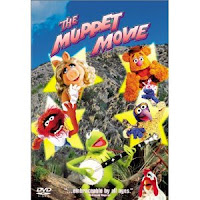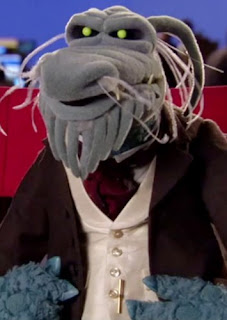
Showing posts with label movies. Show all posts

Monday, January 1, 2024

2023 Movie Log in Review

Happy New Year! Here's hoping that 2024 brings you good moments and many great movies. It's time again to look back at the last year of my movie viewing and make the final tally of films watched. My classic movie choices for 2023 were heavily affected by the many great collections on the Criterion Channel last year, and I'm looking forward to another year of old favorites and new discoveries there. Most of the other streaming services continue to be useless for classic films, but I watched quite a few new movies on them. Visits to the theater continue to be low compared to pre-pandemic numbers; we saw a few new releases on the big screen this year - including super hit Barbie - but in general it just wasn't worth the cost and hassle, especially after we were accosted by a drunk/high and very noisy audience member at Dungeons and Dragons. Much of my energy in 2023 went to work on a forthcoming anthology of feminist essays about Star Trek, so I spent a lot of time rewatching episodes and films from that iconic franchise (more about that later!). 

Here's the monthly breakdown for every movie I watched at home or elsewhere in 2023.

January

The Woman on the Beach (1947)

Francis (1950)

Forbidden Planet (1956)

The Nice Guys (2016)

Love is News (1937)

Honor Society (2023)

Theodora Goes Wild (1936)

Big Brown Eyes (1936)

The Pale Blue Eye (2023)

Dead of Night (1945)

Goldeneye (1995)


February

The Unknown (1927)

Pillow Talk (1959)

Black Panther: Wakanda Forever (2022)

Harvey (1950)

The Suspect (1944)

The World is Not Enough (1999)

Rosaline (2022)

The Sound of 007 (2022)

Lover Come Back (1961)

Phantom Lady (1944)

A View to a Kill (1985)

Send Me No Flowers (1964)

For Your Eyes Only (1981)

The Queen of Spades (1949)


March

Dancing Lady (1933)

The Incredible Mr. Limpet (1964)

The Princess Bride (1987)

42nd Street (1933)

The Heroic Trio (1993)

Will Success Spoil Rock Hunter? (1957)

Antman: Quantumania (2023)

Clue (1985)

Mrs. Harris Goes to Paris (2022)

Thunder on the Hill (1951)

Prom Pact (2023)


April

Sky High (2005)

The Importance of Being Earnest (1951)

A Woman's Face (1941)

Grease 2 (1982)

Dungeons and Dragons: Honor Among Thieves (2023)

Magic (1978)


May  (my kid graduated from college and we had a big family trip to the UK!)

Invasion of the Body Snatchers (1956)

The Damned Don't Cry (1950)


June

The Lost King (2023)

What's Love Go to Do With It? (2022)

For Me and My Gal (1942)

Monkey Business (1952)

Spider-Man: Across the Spider-Verse (2023)


July

Polite Society (2023)

The Seven Year Itch (1955)

The Mad Miss Manton (1938)

On the Town (1949)

The Woman in Question (1950)


August

Haunted Mansion (2023)

Barbie (2023)

Guardians of the Galaxy Vol. 3 (2023)

Asteroid City (2023)

Murder, My Sweet (1944)

Ladies in Retirement (1941)

Brigadoon (1954)


September 

Encounters of the Spooky Kind (1980)

Mr. Vampire (1985)

Mr. Vampire II (1986)

Mr. Vampire III (1987)

Hush... Hush, Sweet Charlotte (1964)

Jane Eyre (1943)

Mr. Vampire IV (1988)

MST3K: Beyond Atlantis (1973) - live at the Center for Puppetry Arts

Ivy (1947)

Moss Rose (1947)

Teenage Mutant Ninja Turtles (2023)

Blanche Fury (1948)

Elemental (2023)

3000 Years of Longing (2022)


October

Red, White and Royal Blue (2023)

So Long at the Fair (1950)

Murders in the Zoo (1933)

Doctor X (1932)

Haunted Mansion (2023) - second time this year

The Old Dark House (1933)

Arsenic and Old Lace (1944)

Corridor of Mirrors (1948)

Gaslight (1944)

Star Trek: First Contact (1996)

Dial M for Murder (1954)

The Monster Squad (1987)

Murders in the Rue Morgue (1932)

So Evil My Love (1947)

Phantom of the Paradise (1974)

Devotion (1946)

The Lost Boys (1987)

Dead Again (1991)

Freaks (1932)

Madeline (1950)

Hocus Pocus (1993)

Haunted Spooks (1920)

Bewitched (2005)

No Hard Feelings (2023)

Casper (1995)


November

The Lodger (1944)

The Quick and the Dead (1995)

Johnny Guitar (1954)

Rancho Notorious (1952)

A Haunting in Venice (2023)

My Best Friend's Wedding (1997)

The Marvels (2023)

The House on Telegraph Hill (1951)

High Anxiety (1977)

Dragnet (1987)

Werewolves Within (2021)

The Cheat (1931)

Three on a Match (1932)


December

The Spiral Staircase (1946)

Repeat Performance (1947)

Bell, Book and Candle (1958)

The Year Without a Santa Claus (1974)

Die Hard (1988)

The Muppet Christmas Carol (1992)

Hudson Hawk (1991)

Indiana Jones and the Dial of Destiny (2023)

Scrooged (1987)

White Christmas (1955)

Chicken Run 2: Dawn of the Nugget (2023)

Love, Actually (2003)

Rudolph the Red-Nosed Reindeer (1964)

A Christmas Story (1983)

Iron Man 3 (2013)

Shang-Chi and the Legend of the Ten Rings (2021)

Glass Onion (2022)


Total for 2023: 130

I watched 23 more movies in 2023 than in 2022, so that's an improvement! As usual, it's an eclectic mix of classics, new releases, family favorites, and weeknight compromises with the spouse.


Thursday, October 6, 2022

From Phantom to Phenom: The Evolution of Uncle Deadly

Uncle Deadly made his first appearance in the Vincent Price episode of The Muppet Show in 1977, but the four decades since have seen him evolve considerably from a periodic secondary character to a core member of the ensemble with major roles in several of the more recent Muppet productions, including the feature film The Muppets (2011), the 2015 ABC series, The Muppets, and Disney’s 2020 shortform streaming series, Muppets Now. As his significance has grown, so has the development of his personality. He first appeared as a monster character who occasionally contributed to situations that called for the creepier members of the extended cast, but the Uncle Deadly of today is quite a different fellow from the menacing thespian fiend of the distant past. Indeed, Uncle Deadly might be one of the Muppets’ most dynamic characters, partly because his ascension to central player status arrived so long after his original introduction. More recent productions have taken advantage of his potential and room for development to create a very modern Uncle Deadly, one who still has his roots in his theatrical, macabre past but also embodies twenty-first century sensibilities regarding fashion, social media, and sexuality.

Uncle Deadly began his existence as a tribute to classic horror, and his early appearances on The Muppet Show highlighted his connection to that genre. Michael K. Frith designed the character, Dave Goelz built him, and Jerry Nelson created his voice and manner as an homage to classic horror icon John Carradine. The notoriously hammy Carradine inspired the character’s Shakespearean bent and theatricality and also underscored his identity as the embodiment of a certain kind of horror, not the bloody slashers so prominent in the mid-1970s, when The Muppet Show first aired, but B monster movies like House of Frankenstein (1944), House of Dracula (1945), and The Black Sleep (1956). Carradine, in other words, was a king of horror camp, especially after appearances in low-budget 1960s pictures like Billy the Kid Versus Dracula (1966), Blood of Dracula’s Castle (1969), and Madame Death (1969). It’s entirely appropriate, then, that Uncle Deadly made his initial appearance on the series during the Vincent Price episode, where he played the horror star’s “beautiful assistant” during a New Year’s Eve sketch called “House of Horrors.” Price, another icon of the genre, was a natural choice to pair with Uncle Deadly; Price would even go on to star with John Carradine in The Monster Club in 1981 and House of the Long Shadows in 1983, and Price would be reunited with Uncle Deadly when the Muppets took over The Tonight Show in 1979 to promote The Muppet Movie, even though Uncle Deadly had no real part in that film. 
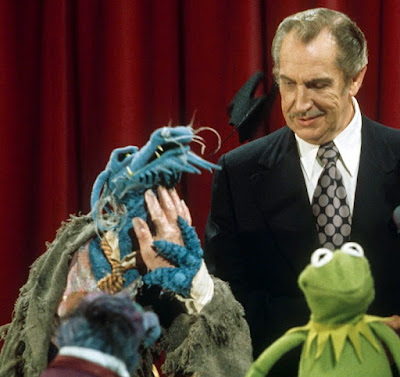
Uncle Deadly and Vincent Price

Uncle Deadly’s second appearance on the show, and his formal introduction by name, came in the first season Twiggy episode, where he haunted the cast as The Phantom of the Muppet Show, a Shakespearean actor who had died onstage thanks to bad reviews of his Othello. Many of the great horror stars had similar theatrical backgrounds, including Carradine, Price, Basil Rathbone, and Boris Karloff. Price had even starred as a Shakespearean actor driven mad by critics in the 1973 film, Theatre of Blood. As a theater phantom, Deadly tapped into the rich legacy of The Phantom of the Opera, from the original novel by Gaston Leroux and the 1925 Lon Chaney film to the much more contemporary Phantom of the Paradise, the 1974 cult musical directed by Brian De Palma and starring Paul Williams, an important Henson collaborator who had also been a first season guest on The Muppet Show. In 2017, the Muppets hung a lampshade on this connection by casting Uncle Deadly as the actual Phantom in the Penguin paperback, Muppets Meet the Classics: The Phantom of the Opera. Thus, even as a minor character, Uncle Deadly came heavily invested in a particularly rich mix of literary, theatrical, and cinematic influences, which possibly explains how he could capture viewers’ imaginations so thoroughly with so little screen time on the original television series and films. 

Despite his promising beginning, The Muppet Show never quite figured out what to do with the character, and he made only a few additional appearances on the original television series, including two installments of a melodrama parody that had him terrorizing an imperiled Miss Piggy. He never became a key figure for the show and ceased to be featured after the third season, making his appearance on the 1979 episode of The Tonight Show all the more noteworthy, and almost certainly solely due to Price’s presence as the episode’s first guest. While he turned up occasionally in other Muppet media, mainly print publications, he ceased to be a performed character, with Nelson’s last credit for him taking place in 1979. Just like a phantom, Uncle Deadly more or less disappeared, and his comeback would take decades to materialize.

Of course, the 2011 Disney movie, The Muppets, marked a comeback for all of the characters, who had not starred in a theatrical release since Muppets from Space in 1999, but none more so than Uncle Deadly, who burst into greater prominence than he had ever enjoyed before. According to Ryan Roe of the Muppets fansite, Tough Pigs, the picture’s director, James Bobin, was a fan of the sinister blue monster who wanted Uncle Deadly in the story, which cast him as a henchman to villainous oil tycoon Tex Richman (Chris Cooper). Performed by Matt Vogel, this new iteration retained the core elements of his original personality but traded his phantom rags for a neat if somber suit that fitted his role as the lackey of a wealthy businessman. Deadly’s self-described “terrifying name and evil English accent” made him a more traditional villain sidekick than his co-henchman, Bobo the Bear, even though Bobo had already filled the same function in Muppets from Space a decade earlier. It was nothing like a major role compared to those of the core characters, but it proved to be a particularly dynamic one. At first depicted as an accessory to Richman’s evil schemes, Uncle Deadly dramatically rejected the villain and embraced his identity as a Muppet. Longtime Uncle Deadly fans, Ryan Roe and myself included, cheered this development and looked forward to Uncle Deadly’s continuing presence as a more important character, but the 2014 sequel, Muppets Most Wanted, didn’t seem to know how to use him if he wasn’t going to be a villain anymore, and he was once again reduced to a minor cameo role.
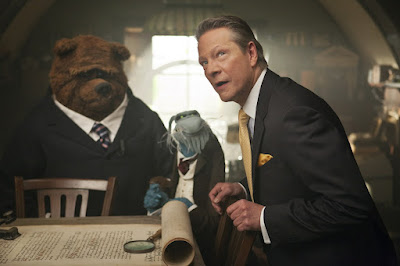
Uncle Deadly schemes with Bobo and Tex Richman.

Luckily, a return to television was just around the corner for the now Disney-owned characters, and Uncle Deadly’s evolution persisted in surprising but utterly appropriate ways. No longer a phantom or a fiend, Deadly took up the job of wardrobe manager for Up Late with Miss Piggy, the fictional talk show setting for the short-lived 2015 ABC series, The Muppets. The show had a troubled start, with The New York Times calling it “mundane” and “overwrought,” and The Guardian describing it as “cynical” and “heartbreaking.” Most of the complaints focused on the core characters, especially a depressed and joyless Kermit, but the retooling the show underwent after the first ten episodes brought major changes that extended to Uncle Deadly, as well. Initially a background character - yet again - with relatively few scenes and lines, Deadly blossomed into a fully realized member of the cast after the tenth episode. He was not only the wardrobe manager for the show but a talented fashion designer and, most importantly, the chief confidant and friend of Miss Piggy, who had long suffered from the boys’ club nature of the core Muppets cast and her own treatment of other female characters as professional and romantic rivals. Piggy had always needed a scene partner who could appreciate her perspective and also push back against her temper while still maintaining their relationship, and Uncle Deadly turned out to be a perfect choice. With new, dapper costume changes that suited his sartorial sensibility and large chunks of screen time with Piggy, Uncle Deadly was suddenly even more developed and integral than he had been in the 2011 film. He was witty, wry, and still an old theater ham at heart, but he also brought much needed emotional grounding to Piggy, allowing her to move beyond the one-note diva depiction that had plagued her since the original show. In late season episodes like “A Tale of Two Piggies” and “Got Silk?”the friendship took center stage, with Deadly actually returning to the stage in full Alicia Silverstone costume for a production of Clueless that he was directing. Unfortunately, the series makeover came too late to convince Disney and ABC to greenlight a second season, but the evolution of Uncle Deadly stuck as one of the best outcomes of the canceled show. 

Since the 2015 series, we’ve continued to see this new version of Uncle Deadly in a variety of media. He joined Twitter in January 2016, where his account bio reads “Get thee to Twitter where I, Uncle Deadly, deliciously dish about great acting, high fashion, and absolutely everything in between.” The account is still active in 2022, where the most recent post on September 3rd says, “All fans of fashion know that one of the best places for outfit shopping is the thrift store. You just might find absolutely anything there! Well... not ANYTHING. For instance: you'd never find Miss Piggy there.” He provided fashion advice and witticisms on the YouTube “Muppet Thought of the Week” series from 2017 to 2018. He appeared at the Disney media event, D23, in 2019, and made appearances along with other Muppets for a variety of special performances. He then returned as Piggy’s constant companion for the 2020 Disney+ series, Muppets Now, which also saw him getting back to his theatrical roots by teaching Walter about stage combat. His significant presence on Muppets Now was particularly noteworthy because the six episode show, a stripped down production that dropped to streaming in July 2020, in the midst of the first year of the Covid pandemic, featured a very small cast of core Muppet characters. Uncle Deadly had clearly arrived as a beloved major character, one whom fans expected to see in any Muppet project. 

It was surprising, then, to see Disney relegate Uncle Deadly to a cameo role once more for the 2021 Disney+ Halloween special, Muppets Haunted Mansion, which ought to have been the one place the character absolutely deserved a major presence. Disney certainly knew that Uncle Deadly belonged in such a setting; he had served as the host for the 2021 Disney Parks video, “A Self-Guided Tour of the Most Mystifying Attractions Around the World,” which covered the various incarnations of The Haunted Mansion in Disney theme parks. Uncle Deadly’s horror connections overlapped with those of the famous Disney dark rides, especially Phantom Manor at Disneyland Paris, which Vincent Price had provided the original English language dialogue for and which to this day features Price’s iconic laughter. It seems painfully obvious to any fan of the Muppets and The Haunted Mansion that Uncle Deadly ought to have played the Ghost Host for the special. The elegant cast member costume, the Host’s sepulchral and darkly comedic voice, his identity as one of the resident specters, and the ride’s intentional evocation of classic horror atmosphere all pointed to Uncle Deadly as the perfect choice, but Disney chose instead to cast Will Arnett in the important role and have Uncle Deadly appear only as the Justice of the Peace during the wedding scene. In an otherwise delightful Halloween special, this slight stood out as an attempt to return Uncle Deadly to the background, and I hope it proves to be an aberration and not a sign of things to come with future Muppet productions. 

Having looked at the long, dynamic history of the character, we can see that Uncle Deadly has evolved much more markedly than many of his fellow Muppets. He has been particularly well-positioned to do so by his tremendous potential and his early role as a background character without as much baggage to dictate his development over the decades. The original core cast, like Kermit, Piggy, and Fozzie, have been more fixed over time because their personalities and roles were so clearly established in the 1970s. The negative reaction to a depressed Kermit on the ABC series shows how viewers expect those characters to remain true to their earlier selves even as studio owners, puppeteers, and decades change. Other minor characters with less compelling personalities have stayed in the background or mostly disappeared; think of Hilda, the original wardrobe manager on The Muppet Show, or Wayne and Wanda, or Bobby Benson’s Baby Band. The Muppets cast is full of weird characters who have never broken into the inner circle, even though we do see the occasional newcomer, like Rizzo, Pepe, and Bobo, rise to prominence, and sometimes fall out again, as Rizzo seems to have done with the contentious departure of creator and performer Steve Whitmire. Uncle Deadly has already survived the transition from original performer to second generation, even though his somewhat uneven prominence over the last decade suggests that his position as a top tier character is not yet secure, at least in the eyes of the Disney studio bosses. His rise, however, suggests how much the Muppets need a character like Uncle Deadly, who can change with the times by building on his original traits rather than erasing them. He fills gaps in the original core without negating what we already know about him. Like Gonzo, he’s a bizarre character associated with performance, counterculture, and the arts, but his horror roots give him a more grandiose, elegant personality and an ego that makes him an ideal equal and foil to Miss Piggy. Deadly’s evolution as a fashion icon fits with those traits, too, especially given the Gothic extravagance of many of his costumes, which would have looked just as appropriate on Vincent Price in his best horror roles. Vanity, after all, is a trait long associated with both preening stage actors, maniacal villains, and fashion designers. 
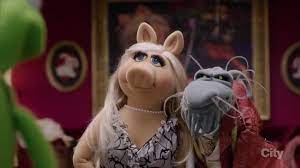
Uncle Deadly and Miss Piggy, BFFs.
 

There’s another aspect to this evolving Uncle Deadly that also fills a gap in the core cast and merges a variety of subtexts from his history, and that’s the way in which the character has increasingly leaned into an identity that we recognize as queer. Disney has carefully avoided making this aspect of Uncle Deadly explicit, but it surges through the undercurrent of his personality and function. His original persona, inspired by scenery chewing horror heavies, already contained the seeds of queerness because queer-coded villains in classic horror, film noir, and science fiction were often depicted in the same way, with their suspect sexuality expressed by their sinister yet refined demeanor, their fastidious fashion sense, and their penchant for theatricality. The representation, while certainly problematic in many respects, simultaneously made space for gay and bisexual actors who built their careers on such roles, including Clifton Webb, Laird Cregar, Charles Laughton, and Ernest Thesiger, while actors like Peter Lorre, George Sanders, Claude Rains, and, of course, Vincent Price, capitalized on their ability to channel the same energy into villainous characters. 

The more modern depiction of Uncle Deadly moves beyond the villain stereotype even as it steps into the territory of the queer-coded character as “gay best friend” to a female protagonist, a trope familiar from films like Clueless (1995), My Best Friend’s Wedding (1997), and The Devil Wears Prada (2006). There’s a reason, after all, that Deadly is directing a stage production of Clueless in the “Got Silk?” episode of the ABC series. He gets more screen time in the recent series largely because Piggy needs a scene partner and he can talk to her about the things that interest her, namely herself, her appearance, and her outfits. As Deadly dishes about fashion and acting on Twitter, TV series, and YouTube, he performs an identity familiar to modern viewers from Queer Eye, Legendary, RuPaul’s Drag Race, and other productions where fashion and queer sexuality connect as the central themes. On the plus side, Deadly’s frequent appearances in online media allow him to embody those traits without being an accessory to Miss Piggy, and he gets to command our attention as the true star of the scene. As a character who originally had his own independent function as a character, Deadly is proving that he can still stand alone and appeal to audiences without being tethered to Piggy, even though his relationship with the diva has driven much of his recent development. 

At this time, it’s difficult to say what comes next for Uncle Deadly. His Twitter account still posts new content frequently, and Matt Vogel is still very much involved with the Muppets as a performer, so we can hope that he won’t disappear again as he did in 1979. In spite of his reduced presence, we did see him feature in a key scene in Muppets Haunted Mansion in 2021, and the Disney Parks Haunted Mansion video shows that Disney sees him as a good fit for spooky or Halloween content. However, the Muppets present an embarrassment of riches similar to those of the Marvel Cinematic Universe and Star Wars when it comes to Disney project opportunities. We know that the next Muppet production coming to Disney+ will be Muppets Mayhem, a series focusing on The Electric Mayhem and a supporting group of human characters. Deadly may or may not appear in the series, depending on the extent to which it incorporates characters beyond the actual band members. The Muppets YouTube channel, while still up and full of older content, last saw a new post six months ago, and two years have passed since Uncle Deadly’s last appearance there. Because the Muppets are now just one property within the ever-expanding multimedia Disney juggernaut, projects featuring them have to compete with other brands for development, streaming opportunities on Disney+, and theatrical releases. We’ve already seen Disney cancel Muppet series after a single season or abort them mid-development, as happened with the planned 2019 series, Muppets Live Another Day. It’s possible that Disney might relegate Deadly to the background again as it focuses on different Muppet projects, which are themselves of less importance to the studio than the wildly lucrative Marvel and Star Wars properties.


That would be a shame, too, because I, for one, can imagine many projects where Uncle Deadly’s particular talents could be employed to great effect. His personality and history would make him ideal for productions highlighting theater, fashion, the arts in general, and light horror. Even though the Uncle Deadly’s House of Badness TV concept for a kid-friendly horror show never got off the ground back in 2000, the idea still has merit, especially since the enduring appeal of Hocus Pocus ought to prove to Disney that family appropriate horror can have tremendous appeal. Uncle Deadly would be a perfect horror host for tales of the weird and eerie, but he would also fit in perfectly in Muppet adaptations of Shakespeare, or as the host and star of a Muppet makeover show where various characters or human guest stars get their looks updated. A return to theatrical releases of literary adaptations would also provide rich possible roles for Uncle Deadly, from the obvious Phantom of the Opera to Dracula, Sherlock Holmes, and even Robin Hood, with Deadly in any of the roles previously filled by kindred spirits like Carradine, Karloff, Price, Basil Rathbone, or Christopher Lee. With a character as rich and versatile as Uncle Deadly, only a failure of imagination on the studio’s part can limit his future with the Muppets cast. 

* This essay was originally written for and presented online at The Evolution of Jim Henson's Puppetry: From Analog Craft to Digital Franchise symposium.

Tuesday, September 20, 2022

Searching for Silent Treasure on Paramount Plus

We signed up for Paramount Plus to watch Star Trek, which is probably why most people subscribe to the streaming service, but it has turned out to be a very interesting opportunity to watch classic movies that don't necessarily appear on other streamers. Classic movie fans still mourning the loss of Filmstruck mostly find their content on HBO Max, with its TCM hub, or the Criterion Channel, but the collapse of the DVD market has made old movies harder to find in general as streamers focus on original content instead of large libraries full of hidden gems. Venerable old studio Paramount, however, has less original content to offer and instead fills out its catalogue with lots of iconic and obscure features from its distant past, including a surprising number of silents. If you're looking for classic movies you haven't seen before, and especially if you're looking for silents, Paramount Plus might be worth your while, but the interface leaves the hard work of finding its buried treasure to you.

I originally wrote about classic movies on CBS All Access, as it was then called, back in 2020, so I wanted to follow up with a look at its current catalogue under the Paramount Plus moniker. The service still has quite a large collection of classic movies on offer, ranging from comedies and dramas to horror and Westerns, although your best method of finding them is to search the entire category A-Z for each genre because you can't search the library using people's names or general terms like "silent" or "classic." Mixed into the groups are numerous silent features, but you'll only identify them as such if you recognize the titles or click on them to get to a brief info page that includes the release date. You can follow one listing to a group of similar films, so once you find a silent picture you can more easily turn up others, but it's a haphazard method of discovery, for sure.

In spite of the effort it takes to find them, Paramount Plus does have some real gems tucked into its collection. Here are a few of the silent movies currently on offer:


The Mark of Zorro
(1920)

The Lost World (1925)

Little Annie Rooney (1925)

The Black Pirate (1926)

Sparrows (1926)

The Phantom of the Opera (1925)

Steamboat Bill Jr. (1928)

The General (1926)


         The Thief of Bagdad 1924) 

         The Eagle (1925)

         Blood and Sand (1922)

        Orphans of the Storm (1921)

The films themselves come from several different studios, but the prints included on Paramount Plus seem, after a casual survey, to be generally good quality, unlike the unwatchable prints sometimes offered up by Amazon Prime. Thus far my experiences watching silent movies on the service have been good ones, even if I would really like a better way to search for them and better information about them in their listings. 

Have you watched classic movies on Paramount Plus? Have you uncovered any hidden gems from the silent era lurking in its collection? I'd love to hear about it in the comments!

Wednesday, June 1, 2022

LEGO Star Wars: Be My BBY

People who know me in real life or who read this blog frequently already know that I love combining my passions for LEGO and movies. As a Gen Xer I have a particular soft spot for the original Star Wars trilogy, and of course I love Carrie Fisher as Princess Leia. The daughter of Debbie Reynolds and Eddie Fisher, Carrie was a true princess of Classic Hollywood as well as an icon in her own right. I've been enjoying the appearance of young Leia on the new Obi-Wan Kenobi series on Disney+, and I think casting did a great job choosing Vivien Lyra Blair. 

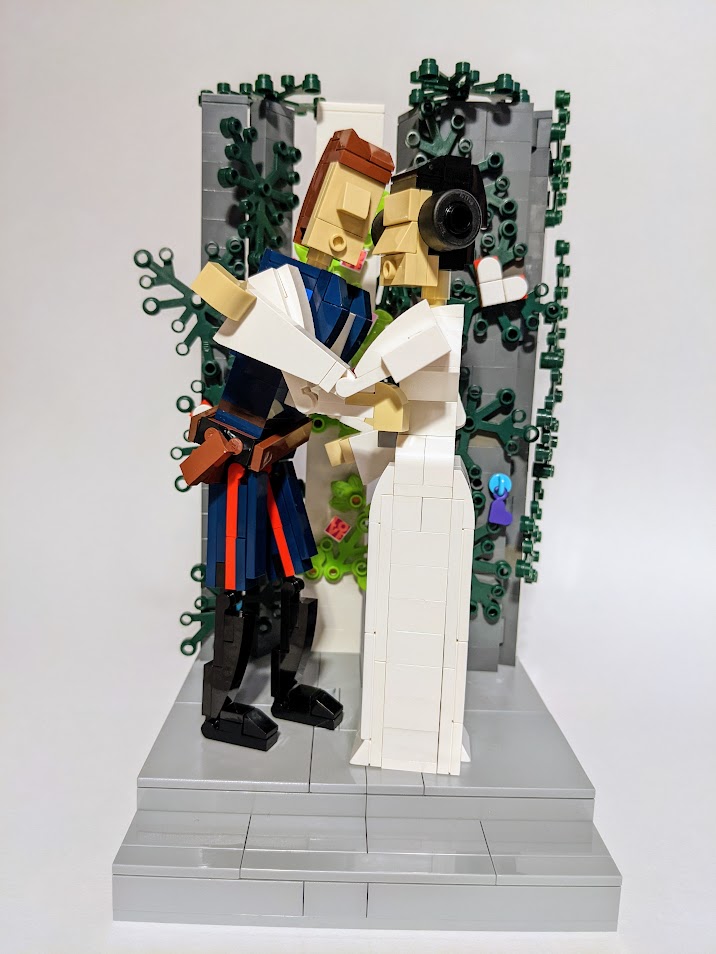
Here's a recent LEGO MOC that celebrates my love for A New Hope and the love we fans feel for Princess Leia and her scruffy looking nerf herder, Han Solo. I know Han and Leia didn't get together until later, but the pun was just too good to resist, and this piece was built for a Valentine's Day themed contest in my club, TNVLC. Here we see Han and Leia (or maybe it's Harrison and Carrie?) stealing a kiss just before the Battle of Yavin.


BE MY BBY


Thursday, April 28, 2022

The What-If Alternate Timeline of CRUELLA (2021)

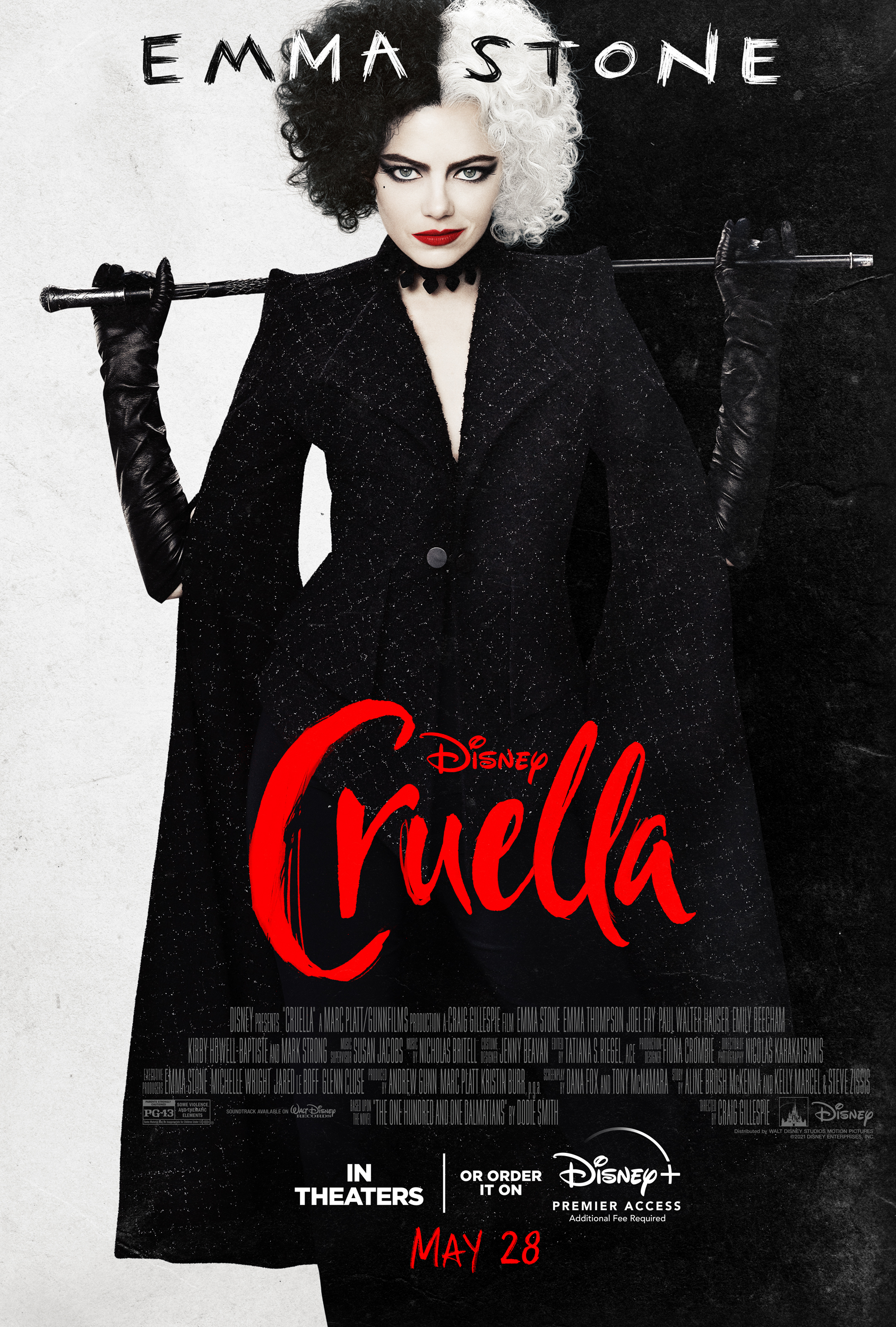
When it first arrived, Disney's 2021 reboot of the various films based on 101 Dalmatians was widely discussed as yet another "prequel" to a well-known Disney property, but in order to appreciate Cruella fully you have to stop thinking about it as a prequel and instead consider it as an alternate timeline narrative similar to the multiverse arcs now at work in the Marvel franchise. This is NOT the story of how the villain of the 1961 animated movie became that character, and it's not the story of the villain from the 1996 live action movie, either. Instead, Emma Stone's version of Cruella is a character with a narrative arc all her own, distinct from those of the other Cruellas but still affected by many of the same elements with alternate versions of the same characters. She's much like the central Loki character played by Tom Hiddleston in the Disney Plus series; she is one of many possible Cruella variants, some of whom are truly villainous and some of whom are dynamic enough to become protagonists in their own right rather than merely antagonists to more conventionally heroic characters. When read this way, Cruella becomes a much more interesting and engaging movie, one that rewrites the iconic villain, sure, but also one that reaches deep into the sources of inspiration that formed the original Disney character.


Fidelity to the 1961 animated classic is already an odd demand, not only because live action versions of that story were already made in the late 90s but because the original Disney movie is itself unfaithful to its source material in several significant ways. Dodie Smith's beloved 1956 children's novel features many characters and scenes that aren't in the Disney film. A third adult Dalmatian (the one actually named Perdita) is removed completely, with a dog originally named Missus assuming her name and erasing her from the story. The novel's Roger is wealthy because he is a "financial wizard" and not a struggling musician, so the family can afford all of their Dalmatians even when they end up with 101 of them (note that the 101st Dalmatian of the novel also isn't in the movie because he's the liver spotted love interest of the original Perdita). The Cruella of the book is more explicitly demonic and even more vicious than the movie version; she is also married to a submissive furrier who enables her obsession with fur coats. The changes don't make the Disney adaptation a bad movie, but they do make it a significantly different story from the novel. The live action versions get farther afield still, making Roger an American video game creator, Anita a fashion designer, and Cruella a fashion house owner and Anita's employer. In fact, the versions are so different (and set in different eras to boot) that the 2021 movie cannot possibly function as a true prequel to any of them.

Tallulah!

Instead, Cruella is its own story, a reinvention of the character that combines her most iconic traits with bits and pieces of the previous versions in order to make her a dynamic protagonist rather than a static villain. The movie does not attempt to make us like or forgive the other Cruellas; we like this new Cruella partly because she isn't them. Our glimpse of her childhood recalls the schoolgirl connection with Anita from the novel, her mannerisms are taken from the 1961 Disney film, and her fashion career is borrowed from the 1996 movie, but she is not simply a younger version of any of these characters. Disney opts to do something different by mining the tradition of the anti-heroine as filtered through one of the most important inspirations for the 1961 Cruella, the legendary actress and all around hellraiser Tallulah Bankhead. The film even signals the affiliation with a clip of Tallulah demonstrating her distinctive, throaty laugh in Alfred Hitchcock's 1944 thriller, Lifeboat. We see it play on a television set in a room with Estella/Cruella early in the story. Bankhead, known for her genius, self-destructive behavior, terrible driving, and theatrical personality, was definitely no saint, but this new version of Cruella has her charisma and charm as well as her less likeable qualities. It's refreshing to see a complicated, difficult, too-much female character be the heroine of her own life without having to be either a traditionally good person or a completely amoral anti-heroine of the Becky Sharp variety.

Because this Cruella is not the same as the previous versions, she can make different choices and develop different values. She loves fashion but isn't specifically obsessed with fur. She has a found family that she mistreats at times but ultimately loves, which includes several dogs. She is even the person who gives Pongo and Perdita to Roger and Anita, which she certainly wouldn't do if she wanted to make Dalmatian fur coats. Near the end of the movie, Cruella says about the Baroness: "The good thing about evil people is that you can always trust them to do something, well, evil." Cruella, despite her name, is not that kind of person, because her Estella side makes her capable of doing good. Currently, a sequel to the movie is in the works, and most fans and critics seem to expect it to launch us into the more familiar dog-napping, coat-making territory of the original story, but I really hope it doesn't go in that direction, because this Cruella deserves better. It's certainly possible that she might become a newer version of the Baroness, the murderous mother whom she deposes in the film, and therefore ruthless enough to become a full-blown villain, but it would be much more satisfying to see her continue to make bold new choices for herself, to continue to be the future she embodies in Cruella and not the past that she sees as the Baroness. To rope this Cruella back into the framework of the original story would be a grave disservice to her and to viewers who fell for her eccentric, outlandish personality.

I've watched Cruella a couple of times now, and while I have concerns about Disney's persistent efforts to strip mine its own properties, I think this movie is one of the best live action treatments of a classic Disney story and far more interesting and fun than the previous attempts to cash in on the Dalmatians' popularity, largely because it isn't about the dogs. It's fun, it's visually engaging, it features terrific performances from Stone and Emma Thompson, and it offers us a Disney "heroine" who is very different from the usual crowd of princesses and whose transgressive modernity is part of her appeal. I don't care that it isn't actually a prequel to 101 Dalmatians; that's why it works. This Cruella might well be brilliant and bad and a little bit mad, but she's more 70s counterculture rock goddess than maniacal puppy murderer, and I'd like to see any additional films about her continue to give her the freedom to be her own version of herself.


Wednesday, February 16, 2022

Trek Noir: Out of the Past in Deep Space Nine's "Necessary Evil"

Note: This post contains plot spoilers for the Deep Space Nine episode, "Necessary Evil"


I'm currently making my way through the entirety of the Star Trek TV series, Deep Space Nine, which I never got to watch regularly during its first run, and so far it has been a richly rewarding experience. While all of the episodes have their merits, I was especially struck by Season Two's eighth episode, titled "Necessary Evil." This one stands out from the others and from most of the older Star Trek shows for its serious - and successful - evocation of classic film noir to tell a dark, duplicitous story about events that unfold before the Cardassians leave Bajor and the Federation takes charge of the space station. While the Star Trek universe is traditionally a positive space with an optimistic vision of the future, this episode uses the tropes of classic noir to investigate the dark past that haunts Deep Space Nine, and it calls into question the motives and relationships of some of its most complex characters.

The Next Generation crew in "The Big Goodbye"

Star Trek shows have been playing with genre since the original series, but the sensibility of true noir is at odds with the core values of the Trek universe. When The Next Generation ventures into noir territory in the first season episode, "The Big Goodbye," it does so as a holodeck adventure with Captain Picard adopting the role of fictional private eye Dixon Hill, a figure very much inspired by Humphrey Bogart as Dashiell Hammett's iconic Sam Spade in both the book and film versions of The Maltese Falcon. The holodeck story is intended to be a nostalgic amusement for Picard and his friends, but an external event causes the safety protocols of the holodeck to disengage, thus thrusting the crew members into a more dangerous adventure than they had expected. While the episode includes real peril for the crew, the noir element of the experience is artificial and contained, and it is also pointedly self-conscious, an homage to noir rather than an embodiment of it.

Such is not the case on the Deep Space Nine episode, where a dark past of Cardassian control and Bajoran resistance creates opportunities for a noir plot that exists as part of the characters' reality. It's not surprising that a series with persistent connections to Casablanca (1942) might see the shadowy world of noir as fruitful territory to mine for narrative; the show even gets around to a blatant revision of Casablanca later in Season Two with the episode, "Profit and Loss" (with Quark, of course, as the stand-in for Bogart's bar owner Rick). In "Necessary Evil," the series takes us back and forth between its past and present to explore what life on the space station was like before the Bajoran liberation, which also evokes shades of Casablanca and the Nazi Occupation. That past is a dark place, where everyone's motives are suspect and our core characters meet for the first time under grim circumstances. It's a perfect setting for a very unusual example of tech noir, the (literal and figurative) space where noir and science fiction meet.

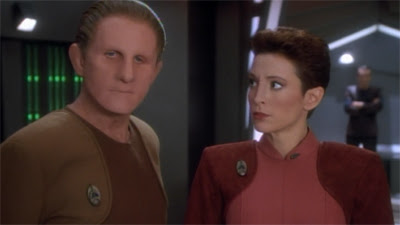
"Necessary Evil" focuses on the past between Odo and Kira.
 

The story opens in the present, when Quark is hired to retrieve a hidden, valuable item for an attractive Bajoran widow. Quark then becomes the victim of an attempted murder, and security chief Odo sets about uncovering Quark's assailant. His investigation takes him back to his first case on the station, when the Cardassian Gul Dukat assigned him to solve the murder of the widow's husband, a Bajoran merchant. The lead suspect in that case turned out to be the Bajoran Kira, then newly arrived on the station but now Odo's friend and colleague in the present. As Odo tries to uncover the present crime he begins to understand more about the murder from the past, but his realizations threaten his relationship with Kira.

Unlike Captain Picard in "The Big Goodbye," Odo is an unwitting noir protagonist and utterly unsentimental about the past, whether fictional or real. As an alien shape-shifter with no knowledge of his own home planet or people, Odo is a perfect noir lead - alone, aloof, cynical, and observant by necessity. He provides a classic noir narration of events only because Commander Sisko has asked him to create a record of the investigation. His failure to solve his first case haunts Odo, making him determined to solve not only the present crime but also the original murder. Gul Dukat claims that Odo is an ideal agent of justice in this case because his outsider status makes him neutral to both the occupying Cardassians and the subjugated Bajorans, but that neutrality is as questionable as Gul Dukat's explanation for Odo's assignment. Odo does, however, have a strong and clearly stated interest in justice, which makes him dogged in pursuit of the guilty parties in both the past and the present.

A Ferengi and a femme fatale meet in "Necessary Evil."

The character who most complicates Odo's sense of justice is Kira, the Bajoran woman who arrives at the station just before the original murder and is set up with the hallmarks of noir's good-bad girl and mystery's red herring (see Andrew Spicer's book Film Noir for a discussion of the genre's good-bad girl type). The widow claims that Kira was having an affair with her husband and is thus the obvious suspect, but the present tense crime has already depicted the widow as a classic femme fatale, so we, the audience, don't trust her. Kira denies the affair but eventually confesses to Odo that she is a saboteur for the Bajoran resistance and could not have committed the murder because she was busy causing damage elsewhere at that time. Odo protects Kira from Gul Dukat and leaves the murder unsolved, a situation that drives him all the more when the attack on Quark recalls the earlier crime. Finally, in the present, Kira reveals to Odo that she did, in fact, kill the Bajoran merchant when he discovered her trying to steal the same list of Bajoran collaborators that the widow hires Quark to find. The twist ending reveals Kira to be a better liar, and a less reliable associate, than Odo imagined, and it's not clear if he's more shocked by her duplicity or his own credulity. The episode concludes with the relationship between the two unresolved and the future of their friendship uncertain. It's a very noir ending for the episode even if both of the major characters remain alive and still working on the station afterward.

Everything else about this episode contributes to its noir sensibility. The scenes in the past use dark, blue lighting to cast shadows and uncertainty over the characters, while the other characters around Odo and Kira also fall into classic noir types, including Quark as the petty criminal in over his head and the widow as a beautiful femme fatale, complete with white evening gown and seductive manner. Odo's voice over narration, a staple of the genre, helps us navigate the shifts between past and present, but the two markedly different visual styles make the time periods quite distinct already. Gul Dukat, technically Odo's client in this investigation, has ulterior motives that he does not disclose, and the viewer comes away with the sense that "justice" is really a slippery idea. The smaller problems - who killed the merchant and who attacked Quark - might be solved, but larger and more unsettling questions persist. The episode presents, in abbreviated form, all the characteristics of classic noir, and it never winks or tips its hand about doing it. There's nothing cute about "Necessary Evil," which is part of the reason it's so good.

If you're interested in the particular pleasures of tech noir, check out film-length examples like Blade Runner (1982), Dark City (1998), and Minority Report (2002). If you're a Star Trek fan new to classic noir, start with iconic favorites like The Maltese Falcon (1941), Double Indemnity (1944), and, as my post title suggests, Out of the Past (1947).

Sunday, January 23, 2022

Making the News with The Muppets

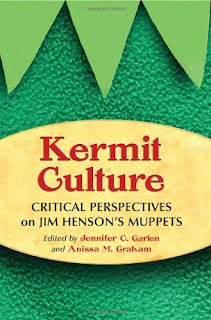
 Some years ago my dear friend and fellow popular culture scholar Anissa Graham and I co-edited two books about the works of Jim Henson. They're essay anthologies featuring scholarly discussions by a wide variety of authors, including us, and they were a lot of fun to create. Both of the books were published by McFarland and are still in print today. The first is Kermit Culture and the second is The Wider Worlds of Jim Henson. You'll find them on Amazon in paperback and Kindle editions, and they can be purchased from other book retailers, as well.

As a result of our work on those books, we sometimes get to do cool Muppet related stuff, and this week brought an unexpected opportunity to talk about the Muppets with a journalist from CNN. I thought some of my blog readers might enjoy the article, so here's the link:

"The Muppets are having a moment - just when we need them most" (CNN, Jan 23, 2022)

I really enjoyed talking to CNN's Scottie Andrew about the Muppets, and I think the article is a great discussion of their current cultural importance. Luckily for Scottie, it's a print article, so she didn't have to worry about suffering the fate of the Muppet News Flash anchor on The Muppet Show!

If you're interested in more of my Muppet related shenanigans, you can listen to my 2013 interview with the BBC radio program, "Last Word," marking the death of Jane Henson. I also appear as a guest on a couple of episodes of "Movin' Right Along: A Muppet Movie Podcast," hosted by ToughPigs Muppet super fans Ryan Roe and Anthony Strand.

For more Muppet posts here on the blog, try these:

Classic Films in Focus: THE MUPPET MOVIE (1979)

The Lovers, the Dreamers, and Me: Reflections on The Muppets

Classic Movie Tourist: A Day in Hollywood 

Christmas Movie Blogathon: The Muppet Christmas Carol (1992)

Classic Movie Stars on The Muppet Show 

Monday, January 10, 2022

2021 Movie Log in Review

It's that time again, when I post my my movie log in review for the previous year and reflect on another year's worth of movie watching. 2021 continued to be dominated by the pandemic, which affected my movie viewing in several ways. I saw exactly one new release in an actual theater in 2021, and that was the disappointing Marvel offering, The Eternals. Alabama has done almost nothing to curb Covid cases, and theaters just haven't felt safe or worth the risk. Vaccinations did allow me to return to my lifetime learners and retirement community residents for film programs in the summer and fall, and I really enjoyed being with them again. With my family still at home for much of the year, newer movies remained a more popular group choice in the evenings, and I had less time to squeeze in classics that I hadn't seen before. We also watched a lot of British murder mysteries and Disney+ TV series.

Here's the list for 2021 - let's hope that we'll eventually see some normalcy again in 2022!


January (15)

The Return of the King (2003)

The Enchanted Cottage (1945)

Valley Girl (2020)

Dragonslayer (1981)

The Blind Swordsman: Zatoichi (2003)

The New Mutants (2020)

Fisherman's Friends (2019)

Judy (2019)

Never Too Late (2020)

Peggy Sue Got Married (1986)

Max Reload and the Nether Blasters (2020)

Evil Under the Sun (1981)

The Mirror Crack'd (1980)

House (1977)

The History of Future Folk (2012)

 
February
(9)

Yojimbo (1961)

The Mark of Zorro (1940)

The Flesh and the Fiends (1960)

Space Sweepers (2020)

Rogers and Hammerstein's Cinderella (1997)

The Scarlet Pimpernel (1934)

Cast a Deadly Spell (1991)

Gotham by Gaslight (2018)

Justice League Dark: Apokalips War (2020)


March (2)

Legally Blonde (2001)

Stagecoach (1939)


April (6)

Godzilla vs. Kong (2021)

The Gay Divorcee (1934)

So I Married an Axe Murderer (1993)

Mystery Men (1999)

Dark Shadows (2012)

The Reluctant Debutante (1958)


May (7)

Scooby Doo (2002)

In the Good Old Summertime (1949)

Summer Stock (1950)

The Harvey Girls (1946)

Separate Tables (1958)

Rachel and the Stranger (1948)

Bathing Beauty (1944)


June (11)

Streets of Fire (1984)

Raya and the Last Dragon (2021)

42nd Street (1933)

The Personal History of David Copperfield (2019)

Dangerous When Wet (1953)

Gold Diggers of 1933 (1933)

In the Heights (2021)

Luca (2021)

Suicide Squad (2018)

Roxanne (1987)

Hidalgo (2004)


July (16)

Demolition Man (1993)

The Mummy (1999)

Black Widow (2021)

The Avengers (2012)

Pygmalion (1938)

My Fair Lady (1964)

Earth Girls Are Easy (1988)

She's All That (1999)

Victor/Victoria (1982)

The Adventures of Robin Hood (1938)

The Opposite Sex (1956)

Miss Congeniality (2000)

Ocean's 8 (2018)

The Witches of Eastwick (1987)

Jungle Cruise (2021)

The Truman Show (1994)


August (7)

Ivanhoe (1954)

The Birdcage (1996)

The Map of Tiny Perfect Things (2020)

The Green Knight (2021)

Jurassic Park (1993)

Jurassic Park II: The Lost World (1997)

Cruella (2021)


September (4)

Cinderella (2021)

House on Haunted Hill (1959)

The 39 Steps (1935)

The Haunting (1963)


October (11)

They Drive by Night (1940)

Mystery of the Wax Museum (1933)

The Duff (2015)

The Haunted Hotel (2021)

Death on the Nile (2004)

Good News (1947)

House on Haunted Hill (1959) - Again!

Carnival of Souls (1963)

The Brain That Wouldn't Die (1962)

Monster House (2006)

Horror of Dracula (1958)


November (7)

The Sparks Brothers (2020)

To Have and Have Not (1944)

Free Guy (2021)

The Harder They Fall (2021)

The Eternals (2021)

Shang-Chi and the Legend of the Ten Rings (2021) - 2x this month


December (16)

Love Hard (2021)

The Big Sleep (1946)

Single All the Way (2021)

Mixtape (2021)

My Man Godfrey (1936)

A Castle for Christmas (2021)

Christmas in Connecticut (1945)

The Man Who Came to Dinner (1942)

Matrix Resurrections (2021)

Encanto (2021)

Scrooged (1988)

The Muppet Christmas Carol (1992)

Gremlins (1984)

Gremlins II (1990)

Love and Monsters (2020)

White Christmas (1954) 


Total film count for 2021: 111

Friday, January 29, 2021

2020 Movie Log in Review

As we all know, 2020 was a year unlike any other. With the pandemic raging and constant political crises unfolding, we needed movies to comfort us more than ever but couldn't leave the house to enjoy them. My 2020 movie log reflects the fact that I usually had company on the couch and that our collective tastes leaned toward movies that took our minds off the overwhelming problems of the day. With that in mind, here's the log for 2020.


January 

The Black Cauldron (1985)

But I'm a Cheerleader! (1999)

Gentlemen Prefer Blondes (1953)

Bombshell: The Hedy Lamarr Story (2017)

Troop Zero (2019)

MIB International (2019)

Blinded by the Light (2019)

Master of Dark Shadows (2019)

Payment on Demand (1951)

The Strawberry Blonde (1941)

Old Acquaintance (1943)


February

Big Business (1988)

How to Marry a Millionaire (1953)

The Spiral Staircase (1946)

The Private Life of Henry VIII (1933)

Night of the Comet (1984)

The Maltese Falcon (1941)

To All the Boys: PS I Still Love You (2020)

Birds of Prey (2020)

The Fog (1980)

Shaun the Sheep: Farmaggedon (2019)

Tremors (1990)


March

Monsters vs. Aliens (2009)

Terminator: Dark Fate (2019)

Casablanca (1942)

Onward (2020)

Galaxy Quest (1999)

Tremors (1990) - yes, again

Atlantis: The Lost Empire (2001)

The Mask of Zorro (1998)

Miss Fisher and the Crypt of Tears (2020)


April

Smoke Signals (1998)

Jaws (1975)

The Rescuers Down Under (1990)

The More the Merrier (1943)

Willow (1988)

Rashomon (1950)

The Women (1939)

Edge of Tomorrow (2014)

Star Trek Beyond (2016)


May

The Half of It (2020)

Tangled (2010)

Star Trek Nemesis (2002)

Bringing Up Baby (1938)

Star Trek: Generations (1994)

Escape from New York (1981)

Hail, Caesar! (2016)

Emma (2020)

Soap Dish (1991)


June

Rocketman (2019)

The Vast of Night (2019)

Batman Forever (1995)

The Princess and the Frog (2009)

Heartbreakers (2001)

Marty (1955)


July 

Knives Out (2019)

The Haunted Mansion (2003)

The Invisible Man (1933)

Hamilton (2020)

Clash of the Titans (1981)

Mask of the Phantasm (1993)

The Creeping Flesh (1973)

Madam Satan (1930)

Mortal Kombat (1995)

Guardians of the Galaxy Vol. 2 (2017)

Captain America: The First Avenger (2011)

The Avengers (2012)

Jurassic Park (1993)

Jurassic World (2015)


August

Extra Ordinary (2020)

The Night of the Hunter (1955)

Feel the Beat (2020)

Steel Magnolias (1989)

Jumanji: The Next Level (2020)

Emo - The Musical (2016)

Bill and Ted Face the Music (2020)


September

Countess Dracula (1971)

Twins of Evil (1971)

Stage Mother (2020)

Wonder Man (1945)

The Sons of Tennessee Williams (2010)

Fade to Black (1980)

Poltergeist (1982)

Disclosure (2020)

Valley Girl (1983)

Suburban Gothic (2014)

Kung Fu Hustle (2004)


October

The Masque of the Red Death (1964)

Paris is Burning (1990)

Theater of Blood (1973)

The Muppets Take Manhattan (1984)

The Monster Club (1981)

Vampires vs. the Bronx (2020)

Sundown: The Vampire in Retreat (1989)

The Addams Family (2019)

The Selling (2011)

How to Survive a Plague (2012)

The Petrified Forest (1936)

Sleepy Hollow (1999)

The Red House (1947)

Tremors: Shrieker Island (2020)

Paranorman (2012)

The Babysitter's Guide to Monster Hunting (2020)


November

Now, Voyager (1942)

The Sorcerer's Apprentice (2010)

The Late Edwina Black (1951)

Holidate (2020)

Sabrina (1954)

Hello, Dolly! (1969)

That Touch of Mink (1962)

Return of the Jedi (1983)

White Christmas (1954)


December

The Muppet Christmas Carol (1992)

Jingle Jangle (2020)

Barbarella (1968)

Rogue One (2016)

Christmas in Connecticut (1945)

Mank (2020)

Ghosts of Girlfriends Past (2009)

A Christmas Carol (1938)

The Prom (2020)

Scrooged (1988)

Christmas Chronicles 2 (2020)

A Christmas Story (1983)

Die Hard (1988)

Soul (2020)

The Fellowship of the Ring (2001)

The Two Towers (2002)

(And the first movie of 2021 was, of course, The Return of the King!)


Total movies watched in 2020: 128

Side note on 2020 viewing: We also watched all four seasons of Star Wars: Rebels this year, which was time well spent. Other TV series for 2020 included Star Trek: Discovery, Star Trek: Lower Decks, The Mandalorian, Bridgerton, and the British comedy/quiz series, QI, which became a favorite bedtime show for the whole family.

Tuesday, January 26, 2021

2020, The Year Without Movies

2020 - a year of masks, not movies.
The last movie I saw in a theater was Onward back in March of 2020. It was spring break for my college freshman, who had brought a friend home for the holiday, and that week we were also finally closing on the sale of our old house, six months after moving into our new one across town. It should have been a celebratory week, but instead the pandemic loomed over us. The small talk at the closing was all about the virus, but in vague terms; nobody had really grasped what was about to happen. We had been to our usual theater earlier that week to see Onward with the kids, but it was never crowded there, and I didn't really think about it. By March 12th, when we closed on the sale and went out to dinner to mark the occasion, I was suddenly terribly aware of how crowded the restaurant was and for the first time felt a sense of panic about other people that has now become all too familiar. By the end of the week we were making a headlong rush back to the college in Florida to clear out the kids' dorms because the school was shutting down.

I haven't been inside a movie theater or a restaurant since then, and I don't know when I'll be back. The restaurant is still there - we've enjoyed their curbside service several times - but the movie theater is gone. I haven't driven by the spot where they're now demolishing it, but I feel its absence. I wonder what the friendly ticket seller we always chatted with is doing now. I hope she found another job before they officially closed the place and sold it. There are other theaters in town, farther from our house and more expensive, but I have no idea when I'll consider going to one of them. Vaccination is probably still months away for me, and by then, who knows what will be happening with all these new variants of the virus?

One of the last movie days with the retirement community.

2020 was a long year for a lot of reasons, but among the things we've lost are the movies. I don't mean streaming, of course. The streaming services had a banner year, and right now they're betting on another one. What we lost was the communal experience of movies that happens in a theater when people who might have nothing else in common gather to laugh, cry, scream, and shout at flickering images on a big screen. Somehow that seems even more precious when I consider the broken, divided state of our nation. We had movies in the Great Depression and World War II to see us through the dark days. They lifted spirits, brought people together, and showed us how to be resilient and brave. In 2020, when we really needed that experience more than most of us could remember, we couldn't have it. All of my film programs with lifetime learners and retirement communities were suspended indefinitely as the virus locked us down. The movie theaters closed, some forever. We had to watch our movies by ourselves, at home, and it isn't the same. 

Some of the new releases have been delayed again and again, waiting for the expected return to normalcy. Others were dropped to streaming services instead, either to lure new subscribers or to get some return on the investment through premiere access fees. Many movies that were in development had to shut down, which means the impact of the pandemic will be felt for years to come. Right now, as we complete the first month of 2021, we really don't know when movies or moviegoers will return. We don't actually know IF they will return, either. It's possible that the future will always be different from the past we've left behind. Perhaps I'll look at this blog post a year from now and feel relief. Perhaps I'll read it and laugh ironically at my naivete. Only time will tell.

I've missed the movies this last year. I've missed the people I shared classic movies with at the library and the retirement community. I've missed being able to think about movies and write about them, but the pandemic and the upheaval in the country have fractured my attention into sharp bits of crisis all coming down like glass. I'll post my 2020 review of films watched soon, but my comforts this last year were more cinematic popcorn than brain food. We'll see if 2021 restores our collective sanity.


Tuesday, June 30, 2020

Classic Films in Focus: MARTY (1955)


Somehow I've managed to miss seeing Marty (1955) in my classic movie viewing up until this month, when I happened to find it hidden in the depths of the Prime streaming catalog on Amazon. I'm glad I finally discovered it, though, because this modest romantic drama is as sweet and compelling a picture as one could possibly want in troubled times. At only 90 minutes long, it's the shortest movie ever to win the Academy Award for Best Picture, but it packs those minutes with feeling in its story about a lonely butcher (Ernest Borgnine) who finds a chance at love with a shy teacher (Betsy Blair) who has also been unlucky at romance. Directed by Delbert Mann, this low-budget gem collected eight Oscar nominations and won four, with Best Director, Best Actor, and Best Screenplay in addition to the Best Picture win.

Borgnine takes the title role as Marty, a 34 year old butcher in New York whose numerous siblings have all already married and started families. Marty's old-school Italian mother (Esther Minciotti) harangues him about finding a wife of his own, but Marty's friends are only interested in conventionally attractive women who won't give Marty the time of day. Depressed about the prospect of living the rest of his life alone, Marty nonetheless ventures out to a ballroom with his friend, Angie (Joe Mantell), where he sees a heartless date ditch plain Clara (Blair) after judging her to be a "dog." Marty steps in with sympathy, and a romance blossoms between the two, but Marty's friends and family prove to be less excited about his choice than he might have expected.

With its humdrum middle class working world and plain protagonists, Marty is a welcome antidote to swoony romances of impossibly beautiful people meeting on elegant transcontinental cruises or in the streets of Paris. It doesn't try to throw a veneer of glamor over its situations or its characters, but it does examine the unrealistic ideals that both men and women, but women especially, are held to in order to be deemed worthy of love. Marty's friends are constantly leering at girlie magazines and talking about the "dames" who appear in Mickey Spillane novels, and it's clear that they have internalized the messages from those mediums. Marty might also have been looking for love in the wrong places by following their lead, and when he finds a kind, smart young woman who takes an interest in him, both his friends and even his mother are quick to criticize her for not being beautiful. Marty has to push back against that criticism and recognize the value of the opportunity that Clara represents or else risk losing it forever.

The performances by Borgnine and Blair draw us into sympathy with each of them and suggest a lot more than they actually show, which makes the short movie equal far more than the sum of its minutes. When Clara reacts negatively to Marty's awkward play for a kiss, we understand intuitively that she's frightened because she has probably never been kissed before, while Marty - still struggling with the old, bad examples that have been presented to him - opts for ardent aggression when gentleness is required. As newcomers to romance they have to stumble through their mistakes and doubts toward one another, but it's delightful to see them open up, laugh, and connect over their long first night together as they wander from place to place. Neither of them is beautiful in the classic sense, but their yearning toward one another is exquisitely so, with Clara's silent tears near the end as moving and heartbreaking as any you'll see on film.

Marty originally aired as a 1953 televised play starring Rod Steiger in the lead; online and DVD versions of that production are available if you want to compare the two. The big screen remake was the first film for director Delbert Mann, whose later work includes Desire Under the Elms (1958), That Touch of Mink (1962), and Fitzwilly (1967). Ernest Borgnine, who continued working right up until his death in 2012, can be found in films and TV series all over the place, including Johnny Guitar (1954), Bad Day at Black Rock (1955), McHale's Navy (1964), The Dirty Dozen (1967), The Wild Bunch (1969), and Escape from New York (1981). Look for Betsy Blair in Another Part of the Forest (1948) and The Snake Pit (1948); her career stalled after she was blacklisted, but she got the role in Marty thanks to the demands of her husband at the time, Gene Kelly, who was able to insist that the studio use her.


Wednesday, April 29, 2020

Following Along with Film and Narrative

I haven't posted a classic movie review here in several weeks because the pandemic means that my movie watching is more a group activity than my choice alone. Normally I have Monday nights to myself to watch old movies and weeks together when the spouse is away on work travel, but right now we're all at home and trying to make the most of family time! That means a lot of more recent movies that appeal to the spouse and kid and fewer films that make good blog posts for Virtual Virago. We are, however, watching movies together, especially because one of the kid's classes this term is Film and Narrative, with a different movie assignment each week. Watching a college student work through someone else's course has been really interesting to me as a former college professor, and I've enjoyed - but sometimes really questioned - the choices for this film course.

We've watched Hot Fuzz (2007), Smoke Signals (1998), Jaws (1975), Rashomon (1950), and Edge of Tomorrow (2014) together as part of the kid's film course, with the last one being the only odd choice of that lot. Sure, it's got the whole non-linear, time looping story line set against a sci-fi version of the Normandy invasion, but it's still a Tom Cruise movie and not the most original or provocative example one might have chosen. The spouse and I had seen all of these films before, of course, but they were all new to the kid, who really liked Smoke Signals and Jaws but was wishing the syllabus had more comedy to balance to out the drama and action.

The professor had the students pick a final film on their own, preferably something outside their "comfort zone," and the kid asked me to suggest some comedies for the assignment. Off to the DVD closet we went! We ended up watching The Women (1939), which was a huge hit thanks to the gleefully awful performances of Rosalind Russell and Joan Crawford. It definitely provided something different from the films on the syllabus, and it gave the kid plenty to write about for the assignment. Sadly, we're now at the end of the semester, so we don't have any more movies to watch for the course.

Following along with the kid's film class got me thinking about what movies I would put on a syllabus for a similar course. This happens to be the second college film and narrative class the kid has taken; the first was as a dual enrollment student at the local university. The first class provided the students with a list to choose from for each unit, which I think worked better and created a lot more opportunity to delve into different interests, while this second class only had the one open option and all the rest assigned (which they normally watched in class as a group). I wonder if a film and narrative class works better if it sticks to a theme as opposed to being a little of this and a little of that, all over the cinematic map, but I realize it's an introductory level course and not a special topics section.

The kid's most recent class watched:

The Cameraman (1928)
 Cat People (1942)
 Batman Returns (1992)
Hero (2002)
The Way Way Back (2013)
Creed (2015)
Strangers on a Train (1951)
Hot Fuzz (2007)
Smoke Signals (1998)
Jaws (1975)
Rashomon (1950)
Edge of Tomorrow (2014)
(WALL-E from 2008 was also on the original syllabus but got dropped due to the pandemic closing campus and sending students home.)

Most of this list is pretty good, really, but I would definitely make some changes. For one thing, I'd like to see a little better representation of women as protagonists here, not just supporting characters. There are obvious boxes being checked in terms of minority and international representation, but some of those choices could be better (why come in with Creed for a bunch of kids who probably haven't seen any of the earlier Rocky films?). Here are the substitutions I might make:

Batman Returns (1992) - Change to Blade (1998) because it's not a sequel, features a black comic book hero with a great female lead, too, and taps into the enduring interest in vampires

The Way Way Back (2013) - Change to The Breakfast Club (1985) because I feel like John Hughes needs to be in here somewhere and the ensemble cast gives lots of teen types to explore. I also don't love having really recent movies in the mix because 1) kids are more likely to have seen them anyway and 2) they need more time to shake out into "important" and not so much.

Creed (2015) - Change to The Color Purple (1985) because Blade gets you a black male superhero fighter and this list still needs more women's stories in it. Even Hidden Figures (2016) would be great if one is just determined to have really recent films on the list.

Edge of Tomorrow (2014) - Change to Dark City (1998) because it still has lots of mind-bending weirdness and sci-fi cred but also tech noir cool and was Roger Ebert's favorite film of 1998. It's more original but less obvious than The Matrix (1999) and offers lots of opportunities to talk about film noir and science fiction and the nature of identity and memory. I will probably put Dark City on any syllabus where it makes any sense to have it because it's just that fantastic. I used to teach it as part of my film noir unit, and it always went over really well.

What 12-13 movies would YOU put on a film and narrative syllabus? I'd love to see your lists in the comments section!