Showing posts with label television. Show all posts

Monday, July 20, 2026

The Small Town Hell of WIDOW'S BAY (2026)

Widow's Bay, the 2026 horror-comedy series on Apple TV, gives viewers plenty of reasons to shudder with its darkly funny evocation of 70s and 80s horror tropes, and fans of classic horror movies from those decades can revel in the tributes to Stephen King, John Carpenter, and Jaws (1975), among many others. Over the course of the first season's ten episodes, the monsters range from immortal serial killers, hungry demonic entities, and sea hags to the locals themselves, who might be willing to do anything to break the curse that grips their island. The unfolding of the larger plot pulls the series further into absolute horror as we learn more about the nature and history of that curse, but one of the scariest things about Widow's Bay - both the show and the setting - is the lifelong isolation of anyone unlucky enough to be born on the island. Like the Hotel California, Widow's Bay is a place where you can check out, but if you're a native, you can never, ever leave. While many horror movies focus on the insular, corrupted nature of small town life, Widow's Bay imagines a small town whose inescapable borders make it an especially chilling image of hell on earth.

All of the show's characters are forced to grapple with the implications of this particular element of the island's cursed nature. The series stars Matthew Rhys as Tom Loftis, who was not born in Widow's Bay but spent his summers there as a child and now lives on the island as the town's mayor. His dead wife, however, was a native, as is their restless teenage son, Evan (Kingston Rumi Southwick). Tom wants to bring tourists to the island even though he should know better, and his efforts are forcefully criticized by local Wyck Crawford (Stephen Root), who was also born in the town. The sheriff, Bechir Clemmons (Kevin Carroll), is a recent arrival, and he soon gets fed up with the creepy events taking place, but if his wife, Chelle (Sipiwe Moyo), gives birth to their first child in Widow's Bay, the sheriff's family will also become permanent residents whether they like it or not.

The trope of "there's something horribly wrong with this small town" is extremely common in horror, with Widow's Bay drawing particular inspiration from John Carpenter's 1980 classic, The Fog, in which the sins of the founders literally come back to haunt the community's present day inhabitants, but also Halloween (1978) and The Shining (1980), among others. There's a strong evocation of Jaws, too, thanks to the mayor's willingness to put both residents and tourists at risk, with the connection to Spielberg's iconic blockbuster made especially obvious in the seventh episode, "Seasickness." There are, in fact, lots of things horribly wrong with Widow's Bay, and we only get full episodes about some of them in the first season. There's a haunted hotel, a predatory sea hag, a serial killer called The Boogeyman, the town's cursed founder, an ominous church bell that shouldn't be able to ring, and a mysterious underground chamber, just to name a few of the more prominently featured terrors. Casually tossed lines from locals hint at centuries of similar weirdness, from the catastrophe-filled genealogy recited by Rosemary (Dale Dickey) to comments from the elderly Ruth (K Callan), who talks about the bizarre fates met by her family members and friends over the decades. (I really hope we're going to get a second season episode about the guy who was bitten by an animal and then became that animal.) Whatever can be scary and wrong with a small town, Widow's Bay has it, so much so that part of the dark comedy stems from the sheer variety of horrors one little island can contain.

Most people, of course, wouldn't choose to stay in such an awful and dangerous place, but the real knife-twist of Widow's Bay is that native-born islanders cannot physically leave without dying as a result. For every person who has ever escaped their own personal small town hell, this component of the horror story is by far the most disturbing. Like a lot of ambitious youngsters from the rural South, I left the small town where I grew up as soon as possible and would never move back, so the idea that I couldn't leave a place like that is absolute nightmare fuel. I wasn't even born in the town I longed to escape, but still the show's depiction of permanent imprisonment in an isolated community fills me with dread. In most horror stories, the survivors escape the cursed location, but Widow's Bay never lets its children break away, as we see depicted in several tragic incidents over the course of the season. Tom's foolhardy desire to bring tourism to the island is partly the result of his knowledge that his son is a prisoner there, and Tom thinks he can improve Evan's life by getting a little more of the outside world to come to him. That, however, ends up being more of a "misery loves company" situation, as the tourists inevitably encounter some of the island's terrors in the episodes "Beach Reads" and "Emergency Shelter." They, at least, can depart the island and never return, but it remains to be seen if locals like Evan and Wyck will ever be able to say goodbye to Widow's Bay. The show will undoubtedly maintain this worst and most central aspect of the town's cursed nature until the very end so that viewers and characters alike continue to experience the claustrophobic terror of being trapped in a place that wants to destroy them. My fellow small town escapees might find those future seasons easier to experience far from their own personal hells, preferably in the safe harbors of their own choosing.

If you've enjoyed the first season of Widow's Bay, be sure to check out some of the horror movies that inspired it, starting with The Fog. Kate Dippold, the creator and showrunner of Widow's Bay, co-wrote the 2016 Ghostbusters movie and wrote the 2023 horror-comedy treatment of Haunted Mansion, which I did think was a big improvement over the 2003 version starring Eddie Murphy. For a truly terrifying story about a small town nobody can escape, read the original version or see the 1961 Twilight Zone adaptation of Jerome Bixby's short story, "It's a Good Life." Peaksville, Ohio, almost makes Widow's Bay look cozy in comparison, but we'll have to wait to see what's actually inhabiting that strange container in the underground chamber.

Monday, May 15, 2023

Big Stars on the Small Screen: THE MUPPET SHOW

This post is part of the CMBA Spring Blogathon - Big Stars on the Small Screen: In Support of National Classic Movie Day. Check out all of the participating blogs and posts by visiting the Classic Movie Blog Association's post about the blogathon!


Big Stars on the Small Screen: Classic Movie Guest Stars on The Muppet Show

Guest stars on the original Muppet Show television series spanned the full range of celebrity types in the public eye during the late 1970s, from singers and actors to puppeteers, dancers, and musicians. For many children watching the episodes, The Muppet Show provided a kid-friendly introduction to entertainers they had never encountered before, including many classic movie stars entering the later decades of their careers. If you were four years old in 1976, as I was that year when the first season of The Muppet Show aired, you might not know who most of the Season 1 guest stars were, but a Muppet curated introduction to Vincent Price might prove a watershed moment in your young life. For five seasons, The Muppet Show entertained adults and children alike with its quirky mix of old and new, high and low, classy and wacky, all mingled together to form the joyful chaos so quintessential to the Muppet aesthetic. Here's a look at some of the classic movie stars featured in each season of the series, with highlights on some of my personal favorites.


Season One

The 24 episodes of Season One offer a wide range of guest stars, including Joel Grey, Ruth Buzzi, Florence Henderson, Paul Williams, Sandy Duncan, and Phyllis Diller, and of course many stars who were fairly new in 1976 are considered "classics" today. Among the guest stars who hail from the Golden Age of Hollywood are Rita Moreno, Lena Horne, Peter Ustinov, Vincent Price, and Ethel Merman. Of the group, both the Rita Moreno and Vincent Price episodes are standouts, with both stars fully committed to interacting with their puppet hosts.

For me, the Vincent Price episode is a special favorite. The campy horror maestro is totally at home with his weird monster companions, including the delightful Uncle Deadly, who appears as Price's "beautiful assistant" in one horror movie parody sketch. Price also gets to tout his reputation as a gourmet and art lover, although of course the sketches veer into vampirism, cannibalism, and other gruesome but silly twists. It's a thoroughly essential episode for any fan of the Muppets, Price, or classic horror in general.


Season Two 

Classic movie stars in the second season include many performers who were also famous for their radio and television work, like Don Knotts, Milton Berle, George Burns, and Bob Hope, but you'll also find stars like Julie Andrews and Peter Sellers in the mix ("modern" guest stars for this season include Rich Little, Madeline Kahn, Elton John, and John Cleese). Both the Julie Andrews and Peter Sellers episodes are noteworthy in their own, separate ways, although the Sellers episode suffers some for Sellers' outdated and stereotyped performance of "A Gypsy's Violin."

I can't really choose between the Peter Sellers and Julie Andrews episodes because they're both great. While the first sketch with Sellers is culturally problematic, the Queen Victoria sketch is a brilliant bit of meta comedy that is one of my all-time favorite Muppet Show moments, and the segment with Sellers as a sadistic German masseur who mangles Link Hogthrob is another demented gem. The Sellers episode is also notable for featuring Kermit's performance of "Bein' Green," which would become a signature song for the character. The Julie Andrews episode is sweeter in tone, with Andrews performing "The Lonely Goatherd" from The Sound of Music (1965) for her first number. Andrews is very natural and funny with her puppet costars throughout the episode, and for added humor you can watch Carol Burnett be jealous of Andrews' popularity on the show in Burnett's Season 5 appearance.


Season Three

The most memorable episode of Season 3, for me, at least, is the one featuring Alice Cooper, who might as well be a Muppet given how well he fits in with the monsters of the group. The Faust angle of the episode's plot also makes it a hit. Among the newer stars featured, the episodes guest starring Gilda Radner and Roger Miller also stand out. Classic movie stars appearing in the third season include Jean Stapleton, Raquel Welch, Harry Belafonte, Danny Kaye, and Roy Rogers and Dale Evans (who appear together, naturally). 

While the Danny Kaye episode is cute, the must-see classic star of the season is definitely Harry Belafonte, who collaborated closely with the show's creative team to make a truly special episode. "Day-O" is a Belafonte hit that adult viewers would have recognized, but the real highlight is Belafonte's performance of "Turn the World Around," a song that would prove so meaningful to Muppets creator Jim Henson that Belafonte performed it at Henson's New York memorial service in 1990. While this episode of The Muppet Show focuses on Harry Belafonte's skill as a singer, his acting ability serves him well in his interactions with the puppets. I couldn't help but think of this episode and the song, "Turn the World Around," when Belafonte died on April 25, 2023.


Season Four

The fourth season includes fewer guests who really qualify as "classic movie stars" in the strictest sense, and overall there are a lot of popular singers represented, such as John Denver, Arlo Guthrie, Crystal Gayle, Andy Williams, and Diana Ross. The best episode of the season is the one featuring the stars of Star Wars, with Mark Hamill absolutely game for the comedy shenanigans and accompanied by C-3PO (Anthony Daniels), R2-D2, and Chewbacca (Peter Mayhew). The most "classic" of the stars included in this season are Liza Minnelli and Carol Channing, and both of their episodes are worth watching.

If you're interested in episodes where The Muppet Show varied its usual format (as it did several times during its five season run), the Liza Minnelli episode is the one to watch. The usual songs and comedy skits are organized as part of a murder mystery with Kermit as the detective and Minnelli as his client. The episode earned an Emmy for Outstanding Directing, and the Mystery Writers of America honored it with a Raven Award, as well. If you want to see how a human Muppet interacts with actual Muppets, see the episode with Carol Channing, who really fits in perfectly and performs some delightfully nutty numbers.


Season Five

The final season of The Muppet Show ran from the fall of 1980 to the spring of 1981, and it followed the fourth season in leaning toward newer celebrity guests. Some of the best include Brooke Shields (in an Alice in Wonderland themed episode), Carol Burnett, Johnny Cash, Marty Feldman, Linda Ronstadt, and Paul Simon. The classic movie stars featured in this season are, however, truly classic, with Gene Kelly, James Coburn, and Tony Randall all making appearances. As great a star as Kelly was, he looks uncomfortable with the puppets, and it's not a great performance (his episode aired around the same time as his appearance in the 1980 film, Xanadu). Tony Randall is having more fun, but the wackiest of the lot turns out to be James Coburn.

I'll admit that, having seen the entire series multiple times and co-edited two books about Jim Henson, I can't really remember a lot about the Tony Randall episode, which is why I'm giving the nod to James Coburn as the best classic star guest for this season. The finale, which involves a chaotic tribute to Japan that turns into a square dance with invading cowboys, has some of the same cultural sensitivity issues as the Peter Sellers episode, but James Coburn going for broke with a bunch of Muppets is just too wacky to resist. The sketches poke great fun at Coburn's tough guy reputation, especially in the salute to the Roaring 20s segment. Coburn also has a fun cameo as the owner of the El Sleezo Cafe in The Muppet Movie (1979), if you want another bit of Coburn-Muppet collaboration.


If you're interested in reading more of my posts about the Muppets, check out these links:

Classic Movie Stars on THE MUPPET SHOW

The Lovers, the Dreamers, and Me: Reflections on The Muppets

From Phantom to Phenom: The Evolution of Uncle Deadly

Christmas Movie Blogathon: THE MUPPET CHRISTMAS CAROL (1992) 

Making News with The Muppets


Thursday, October 6, 2022

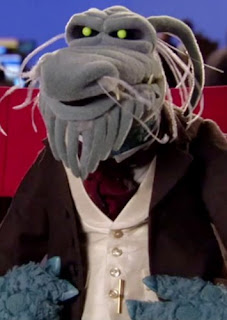
From Phantom to Phenom: The Evolution of Uncle Deadly

Uncle Deadly made his first appearance in the Vincent Price episode of The Muppet Show in 1977, but the four decades since have seen him evolve considerably from a periodic secondary character to a core member of the ensemble with major roles in several of the more recent Muppet productions, including the feature film The Muppets (2011), the 2015 ABC series, The Muppets, and Disney’s 2020 shortform streaming series, Muppets Now. As his significance has grown, so has the development of his personality. He first appeared as a monster character who occasionally contributed to situations that called for the creepier members of the extended cast, but the Uncle Deadly of today is quite a different fellow from the menacing thespian fiend of the distant past. Indeed, Uncle Deadly might be one of the Muppets’ most dynamic characters, partly because his ascension to central player status arrived so long after his original introduction. More recent productions have taken advantage of his potential and room for development to create a very modern Uncle Deadly, one who still has his roots in his theatrical, macabre past but also embodies twenty-first century sensibilities regarding fashion, social media, and sexuality.

Uncle Deadly began his existence as a tribute to classic horror, and his early appearances on The Muppet Show highlighted his connection to that genre. Michael K. Frith designed the character, Dave Goelz built him, and Jerry Nelson created his voice and manner as an homage to classic horror icon John Carradine. The notoriously hammy Carradine inspired the character’s Shakespearean bent and theatricality and also underscored his identity as the embodiment of a certain kind of horror, not the bloody slashers so prominent in the mid-1970s, when The Muppet Show first aired, but B monster movies like House of Frankenstein (1944), House of Dracula (1945), and The Black Sleep (1956). Carradine, in other words, was a king of horror camp, especially after appearances in low-budget 1960s pictures like Billy the Kid Versus Dracula (1966), Blood of Dracula’s Castle (1969), and Madame Death (1969). It’s entirely appropriate, then, that Uncle Deadly made his initial appearance on the series during the Vincent Price episode, where he played the horror star’s “beautiful assistant” during a New Year’s Eve sketch called “House of Horrors.” Price, another icon of the genre, was a natural choice to pair with Uncle Deadly; Price would even go on to star with John Carradine in The Monster Club in 1981 and House of the Long Shadows in 1983, and Price would be reunited with Uncle Deadly when the Muppets took over The Tonight Show in 1979 to promote The Muppet Movie, even though Uncle Deadly had no real part in that film. 
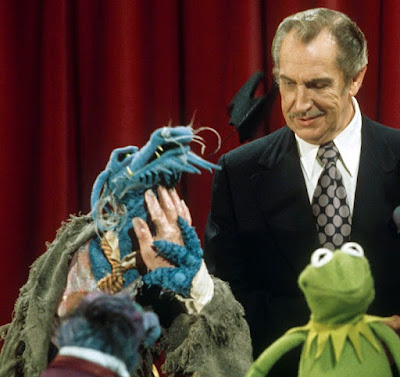
Uncle Deadly and Vincent Price

Uncle Deadly’s second appearance on the show, and his formal introduction by name, came in the first season Twiggy episode, where he haunted the cast as The Phantom of the Muppet Show, a Shakespearean actor who had died onstage thanks to bad reviews of his Othello. Many of the great horror stars had similar theatrical backgrounds, including Carradine, Price, Basil Rathbone, and Boris Karloff. Price had even starred as a Shakespearean actor driven mad by critics in the 1973 film, Theatre of Blood. As a theater phantom, Deadly tapped into the rich legacy of The Phantom of the Opera, from the original novel by Gaston Leroux and the 1925 Lon Chaney film to the much more contemporary Phantom of the Paradise, the 1974 cult musical directed by Brian De Palma and starring Paul Williams, an important Henson collaborator who had also been a first season guest on The Muppet Show. In 2017, the Muppets hung a lampshade on this connection by casting Uncle Deadly as the actual Phantom in the Penguin paperback, Muppets Meet the Classics: The Phantom of the Opera. Thus, even as a minor character, Uncle Deadly came heavily invested in a particularly rich mix of literary, theatrical, and cinematic influences, which possibly explains how he could capture viewers’ imaginations so thoroughly with so little screen time on the original television series and films. 

Despite his promising beginning, The Muppet Show never quite figured out what to do with the character, and he made only a few additional appearances on the original television series, including two installments of a melodrama parody that had him terrorizing an imperiled Miss Piggy. He never became a key figure for the show and ceased to be featured after the third season, making his appearance on the 1979 episode of The Tonight Show all the more noteworthy, and almost certainly solely due to Price’s presence as the episode’s first guest. While he turned up occasionally in other Muppet media, mainly print publications, he ceased to be a performed character, with Nelson’s last credit for him taking place in 1979. Just like a phantom, Uncle Deadly more or less disappeared, and his comeback would take decades to materialize.

Of course, the 2011 Disney movie, The Muppets, marked a comeback for all of the characters, who had not starred in a theatrical release since Muppets from Space in 1999, but none more so than Uncle Deadly, who burst into greater prominence than he had ever enjoyed before. According to Ryan Roe of the Muppets fansite, Tough Pigs, the picture’s director, James Bobin, was a fan of the sinister blue monster who wanted Uncle Deadly in the story, which cast him as a henchman to villainous oil tycoon Tex Richman (Chris Cooper). Performed by Matt Vogel, this new iteration retained the core elements of his original personality but traded his phantom rags for a neat if somber suit that fitted his role as the lackey of a wealthy businessman. Deadly’s self-described “terrifying name and evil English accent” made him a more traditional villain sidekick than his co-henchman, Bobo the Bear, even though Bobo had already filled the same function in Muppets from Space a decade earlier. It was nothing like a major role compared to those of the core characters, but it proved to be a particularly dynamic one. At first depicted as an accessory to Richman’s evil schemes, Uncle Deadly dramatically rejected the villain and embraced his identity as a Muppet. Longtime Uncle Deadly fans, Ryan Roe and myself included, cheered this development and looked forward to Uncle Deadly’s continuing presence as a more important character, but the 2014 sequel, Muppets Most Wanted, didn’t seem to know how to use him if he wasn’t going to be a villain anymore, and he was once again reduced to a minor cameo role.
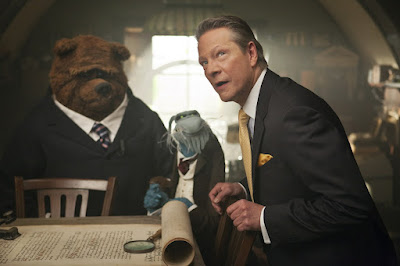
Uncle Deadly schemes with Bobo and Tex Richman.

Luckily, a return to television was just around the corner for the now Disney-owned characters, and Uncle Deadly’s evolution persisted in surprising but utterly appropriate ways. No longer a phantom or a fiend, Deadly took up the job of wardrobe manager for Up Late with Miss Piggy, the fictional talk show setting for the short-lived 2015 ABC series, The Muppets. The show had a troubled start, with The New York Times calling it “mundane” and “overwrought,” and The Guardian describing it as “cynical” and “heartbreaking.” Most of the complaints focused on the core characters, especially a depressed and joyless Kermit, but the retooling the show underwent after the first ten episodes brought major changes that extended to Uncle Deadly, as well. Initially a background character - yet again - with relatively few scenes and lines, Deadly blossomed into a fully realized member of the cast after the tenth episode. He was not only the wardrobe manager for the show but a talented fashion designer and, most importantly, the chief confidant and friend of Miss Piggy, who had long suffered from the boys’ club nature of the core Muppets cast and her own treatment of other female characters as professional and romantic rivals. Piggy had always needed a scene partner who could appreciate her perspective and also push back against her temper while still maintaining their relationship, and Uncle Deadly turned out to be a perfect choice. With new, dapper costume changes that suited his sartorial sensibility and large chunks of screen time with Piggy, Uncle Deadly was suddenly even more developed and integral than he had been in the 2011 film. He was witty, wry, and still an old theater ham at heart, but he also brought much needed emotional grounding to Piggy, allowing her to move beyond the one-note diva depiction that had plagued her since the original show. In late season episodes like “A Tale of Two Piggies” and “Got Silk?”the friendship took center stage, with Deadly actually returning to the stage in full Alicia Silverstone costume for a production of Clueless that he was directing. Unfortunately, the series makeover came too late to convince Disney and ABC to greenlight a second season, but the evolution of Uncle Deadly stuck as one of the best outcomes of the canceled show. 

Since the 2015 series, we’ve continued to see this new version of Uncle Deadly in a variety of media. He joined Twitter in January 2016, where his account bio reads “Get thee to Twitter where I, Uncle Deadly, deliciously dish about great acting, high fashion, and absolutely everything in between.” The account is still active in 2022, where the most recent post on September 3rd says, “All fans of fashion know that one of the best places for outfit shopping is the thrift store. You just might find absolutely anything there! Well... not ANYTHING. For instance: you'd never find Miss Piggy there.” He provided fashion advice and witticisms on the YouTube “Muppet Thought of the Week” series from 2017 to 2018. He appeared at the Disney media event, D23, in 2019, and made appearances along with other Muppets for a variety of special performances. He then returned as Piggy’s constant companion for the 2020 Disney+ series, Muppets Now, which also saw him getting back to his theatrical roots by teaching Walter about stage combat. His significant presence on Muppets Now was particularly noteworthy because the six episode show, a stripped down production that dropped to streaming in July 2020, in the midst of the first year of the Covid pandemic, featured a very small cast of core Muppet characters. Uncle Deadly had clearly arrived as a beloved major character, one whom fans expected to see in any Muppet project. 

It was surprising, then, to see Disney relegate Uncle Deadly to a cameo role once more for the 2021 Disney+ Halloween special, Muppets Haunted Mansion, which ought to have been the one place the character absolutely deserved a major presence. Disney certainly knew that Uncle Deadly belonged in such a setting; he had served as the host for the 2021 Disney Parks video, “A Self-Guided Tour of the Most Mystifying Attractions Around the World,” which covered the various incarnations of The Haunted Mansion in Disney theme parks. Uncle Deadly’s horror connections overlapped with those of the famous Disney dark rides, especially Phantom Manor at Disneyland Paris, which Vincent Price had provided the original English language dialogue for and which to this day features Price’s iconic laughter. It seems painfully obvious to any fan of the Muppets and The Haunted Mansion that Uncle Deadly ought to have played the Ghost Host for the special. The elegant cast member costume, the Host’s sepulchral and darkly comedic voice, his identity as one of the resident specters, and the ride’s intentional evocation of classic horror atmosphere all pointed to Uncle Deadly as the perfect choice, but Disney chose instead to cast Will Arnett in the important role and have Uncle Deadly appear only as the Justice of the Peace during the wedding scene. In an otherwise delightful Halloween special, this slight stood out as an attempt to return Uncle Deadly to the background, and I hope it proves to be an aberration and not a sign of things to come with future Muppet productions. 

Having looked at the long, dynamic history of the character, we can see that Uncle Deadly has evolved much more markedly than many of his fellow Muppets. He has been particularly well-positioned to do so by his tremendous potential and his early role as a background character without as much baggage to dictate his development over the decades. The original core cast, like Kermit, Piggy, and Fozzie, have been more fixed over time because their personalities and roles were so clearly established in the 1970s. The negative reaction to a depressed Kermit on the ABC series shows how viewers expect those characters to remain true to their earlier selves even as studio owners, puppeteers, and decades change. Other minor characters with less compelling personalities have stayed in the background or mostly disappeared; think of Hilda, the original wardrobe manager on The Muppet Show, or Wayne and Wanda, or Bobby Benson’s Baby Band. The Muppets cast is full of weird characters who have never broken into the inner circle, even though we do see the occasional newcomer, like Rizzo, Pepe, and Bobo, rise to prominence, and sometimes fall out again, as Rizzo seems to have done with the contentious departure of creator and performer Steve Whitmire. Uncle Deadly has already survived the transition from original performer to second generation, even though his somewhat uneven prominence over the last decade suggests that his position as a top tier character is not yet secure, at least in the eyes of the Disney studio bosses. His rise, however, suggests how much the Muppets need a character like Uncle Deadly, who can change with the times by building on his original traits rather than erasing them. He fills gaps in the original core without negating what we already know about him. Like Gonzo, he’s a bizarre character associated with performance, counterculture, and the arts, but his horror roots give him a more grandiose, elegant personality and an ego that makes him an ideal equal and foil to Miss Piggy. Deadly’s evolution as a fashion icon fits with those traits, too, especially given the Gothic extravagance of many of his costumes, which would have looked just as appropriate on Vincent Price in his best horror roles. Vanity, after all, is a trait long associated with both preening stage actors, maniacal villains, and fashion designers. 
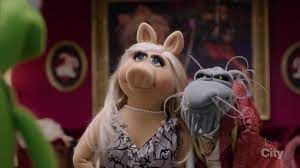
Uncle Deadly and Miss Piggy, BFFs.
 

There’s another aspect to this evolving Uncle Deadly that also fills a gap in the core cast and merges a variety of subtexts from his history, and that’s the way in which the character has increasingly leaned into an identity that we recognize as queer. Disney has carefully avoided making this aspect of Uncle Deadly explicit, but it surges through the undercurrent of his personality and function. His original persona, inspired by scenery chewing horror heavies, already contained the seeds of queerness because queer-coded villains in classic horror, film noir, and science fiction were often depicted in the same way, with their suspect sexuality expressed by their sinister yet refined demeanor, their fastidious fashion sense, and their penchant for theatricality. The representation, while certainly problematic in many respects, simultaneously made space for gay and bisexual actors who built their careers on such roles, including Clifton Webb, Laird Cregar, Charles Laughton, and Ernest Thesiger, while actors like Peter Lorre, George Sanders, Claude Rains, and, of course, Vincent Price, capitalized on their ability to channel the same energy into villainous characters. 

The more modern depiction of Uncle Deadly moves beyond the villain stereotype even as it steps into the territory of the queer-coded character as “gay best friend” to a female protagonist, a trope familiar from films like Clueless (1995), My Best Friend’s Wedding (1997), and The Devil Wears Prada (2006). There’s a reason, after all, that Deadly is directing a stage production of Clueless in the “Got Silk?” episode of the ABC series. He gets more screen time in the recent series largely because Piggy needs a scene partner and he can talk to her about the things that interest her, namely herself, her appearance, and her outfits. As Deadly dishes about fashion and acting on Twitter, TV series, and YouTube, he performs an identity familiar to modern viewers from Queer Eye, Legendary, RuPaul’s Drag Race, and other productions where fashion and queer sexuality connect as the central themes. On the plus side, Deadly’s frequent appearances in online media allow him to embody those traits without being an accessory to Miss Piggy, and he gets to command our attention as the true star of the scene. As a character who originally had his own independent function as a character, Deadly is proving that he can still stand alone and appeal to audiences without being tethered to Piggy, even though his relationship with the diva has driven much of his recent development. 

At this time, it’s difficult to say what comes next for Uncle Deadly. His Twitter account still posts new content frequently, and Matt Vogel is still very much involved with the Muppets as a performer, so we can hope that he won’t disappear again as he did in 1979. In spite of his reduced presence, we did see him feature in a key scene in Muppets Haunted Mansion in 2021, and the Disney Parks Haunted Mansion video shows that Disney sees him as a good fit for spooky or Halloween content. However, the Muppets present an embarrassment of riches similar to those of the Marvel Cinematic Universe and Star Wars when it comes to Disney project opportunities. We know that the next Muppet production coming to Disney+ will be Muppets Mayhem, a series focusing on The Electric Mayhem and a supporting group of human characters. Deadly may or may not appear in the series, depending on the extent to which it incorporates characters beyond the actual band members. The Muppets YouTube channel, while still up and full of older content, last saw a new post six months ago, and two years have passed since Uncle Deadly’s last appearance there. Because the Muppets are now just one property within the ever-expanding multimedia Disney juggernaut, projects featuring them have to compete with other brands for development, streaming opportunities on Disney+, and theatrical releases. We’ve already seen Disney cancel Muppet series after a single season or abort them mid-development, as happened with the planned 2019 series, Muppets Live Another Day. It’s possible that Disney might relegate Deadly to the background again as it focuses on different Muppet projects, which are themselves of less importance to the studio than the wildly lucrative Marvel and Star Wars properties.


That would be a shame, too, because I, for one, can imagine many projects where Uncle Deadly’s particular talents could be employed to great effect. His personality and history would make him ideal for productions highlighting theater, fashion, the arts in general, and light horror. Even though the Uncle Deadly’s House of Badness TV concept for a kid-friendly horror show never got off the ground back in 2000, the idea still has merit, especially since the enduring appeal of Hocus Pocus ought to prove to Disney that family appropriate horror can have tremendous appeal. Uncle Deadly would be a perfect horror host for tales of the weird and eerie, but he would also fit in perfectly in Muppet adaptations of Shakespeare, or as the host and star of a Muppet makeover show where various characters or human guest stars get their looks updated. A return to theatrical releases of literary adaptations would also provide rich possible roles for Uncle Deadly, from the obvious Phantom of the Opera to Dracula, Sherlock Holmes, and even Robin Hood, with Deadly in any of the roles previously filled by kindred spirits like Carradine, Karloff, Price, Basil Rathbone, or Christopher Lee. With a character as rich and versatile as Uncle Deadly, only a failure of imagination on the studio’s part can limit his future with the Muppets cast. 

* This essay was originally written for and presented online at The Evolution of Jim Henson's Puppetry: From Analog Craft to Digital Franchise symposium.

Wednesday, February 16, 2022

Trek Noir: Out of the Past in Deep Space Nine's "Necessary Evil"

Note: This post contains plot spoilers for the Deep Space Nine episode, "Necessary Evil"


I'm currently making my way through the entirety of the Star Trek TV series, Deep Space Nine, which I never got to watch regularly during its first run, and so far it has been a richly rewarding experience. While all of the episodes have their merits, I was especially struck by Season Two's eighth episode, titled "Necessary Evil." This one stands out from the others and from most of the older Star Trek shows for its serious - and successful - evocation of classic film noir to tell a dark, duplicitous story about events that unfold before the Cardassians leave Bajor and the Federation takes charge of the space station. While the Star Trek universe is traditionally a positive space with an optimistic vision of the future, this episode uses the tropes of classic noir to investigate the dark past that haunts Deep Space Nine, and it calls into question the motives and relationships of some of its most complex characters.

The Next Generation crew in "The Big Goodbye"

Star Trek shows have been playing with genre since the original series, but the sensibility of true noir is at odds with the core values of the Trek universe. When The Next Generation ventures into noir territory in the first season episode, "The Big Goodbye," it does so as a holodeck adventure with Captain Picard adopting the role of fictional private eye Dixon Hill, a figure very much inspired by Humphrey Bogart as Dashiell Hammett's iconic Sam Spade in both the book and film versions of The Maltese Falcon. The holodeck story is intended to be a nostalgic amusement for Picard and his friends, but an external event causes the safety protocols of the holodeck to disengage, thus thrusting the crew members into a more dangerous adventure than they had expected. While the episode includes real peril for the crew, the noir element of the experience is artificial and contained, and it is also pointedly self-conscious, an homage to noir rather than an embodiment of it.

Such is not the case on the Deep Space Nine episode, where a dark past of Cardassian control and Bajoran resistance creates opportunities for a noir plot that exists as part of the characters' reality. It's not surprising that a series with persistent connections to Casablanca (1942) might see the shadowy world of noir as fruitful territory to mine for narrative; the show even gets around to a blatant revision of Casablanca later in Season Two with the episode, "Profit and Loss" (with Quark, of course, as the stand-in for Bogart's bar owner Rick). In "Necessary Evil," the series takes us back and forth between its past and present to explore what life on the space station was like before the Bajoran liberation, which also evokes shades of Casablanca and the Nazi Occupation. That past is a dark place, where everyone's motives are suspect and our core characters meet for the first time under grim circumstances. It's a perfect setting for a very unusual example of tech noir, the (literal and figurative) space where noir and science fiction meet.

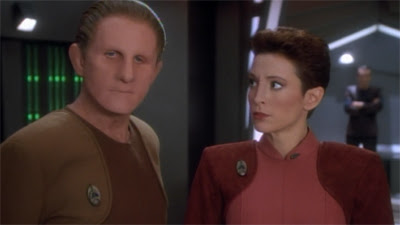
"Necessary Evil" focuses on the past between Odo and Kira.
 

The story opens in the present, when Quark is hired to retrieve a hidden, valuable item for an attractive Bajoran widow. Quark then becomes the victim of an attempted murder, and security chief Odo sets about uncovering Quark's assailant. His investigation takes him back to his first case on the station, when the Cardassian Gul Dukat assigned him to solve the murder of the widow's husband, a Bajoran merchant. The lead suspect in that case turned out to be the Bajoran Kira, then newly arrived on the station but now Odo's friend and colleague in the present. As Odo tries to uncover the present crime he begins to understand more about the murder from the past, but his realizations threaten his relationship with Kira.

Unlike Captain Picard in "The Big Goodbye," Odo is an unwitting noir protagonist and utterly unsentimental about the past, whether fictional or real. As an alien shape-shifter with no knowledge of his own home planet or people, Odo is a perfect noir lead - alone, aloof, cynical, and observant by necessity. He provides a classic noir narration of events only because Commander Sisko has asked him to create a record of the investigation. His failure to solve his first case haunts Odo, making him determined to solve not only the present crime but also the original murder. Gul Dukat claims that Odo is an ideal agent of justice in this case because his outsider status makes him neutral to both the occupying Cardassians and the subjugated Bajorans, but that neutrality is as questionable as Gul Dukat's explanation for Odo's assignment. Odo does, however, have a strong and clearly stated interest in justice, which makes him dogged in pursuit of the guilty parties in both the past and the present.

A Ferengi and a femme fatale meet in "Necessary Evil."

The character who most complicates Odo's sense of justice is Kira, the Bajoran woman who arrives at the station just before the original murder and is set up with the hallmarks of noir's good-bad girl and mystery's red herring (see Andrew Spicer's book Film Noir for a discussion of the genre's good-bad girl type). The widow claims that Kira was having an affair with her husband and is thus the obvious suspect, but the present tense crime has already depicted the widow as a classic femme fatale, so we, the audience, don't trust her. Kira denies the affair but eventually confesses to Odo that she is a saboteur for the Bajoran resistance and could not have committed the murder because she was busy causing damage elsewhere at that time. Odo protects Kira from Gul Dukat and leaves the murder unsolved, a situation that drives him all the more when the attack on Quark recalls the earlier crime. Finally, in the present, Kira reveals to Odo that she did, in fact, kill the Bajoran merchant when he discovered her trying to steal the same list of Bajoran collaborators that the widow hires Quark to find. The twist ending reveals Kira to be a better liar, and a less reliable associate, than Odo imagined, and it's not clear if he's more shocked by her duplicity or his own credulity. The episode concludes with the relationship between the two unresolved and the future of their friendship uncertain. It's a very noir ending for the episode even if both of the major characters remain alive and still working on the station afterward.

Everything else about this episode contributes to its noir sensibility. The scenes in the past use dark, blue lighting to cast shadows and uncertainty over the characters, while the other characters around Odo and Kira also fall into classic noir types, including Quark as the petty criminal in over his head and the widow as a beautiful femme fatale, complete with white evening gown and seductive manner. Odo's voice over narration, a staple of the genre, helps us navigate the shifts between past and present, but the two markedly different visual styles make the time periods quite distinct already. Gul Dukat, technically Odo's client in this investigation, has ulterior motives that he does not disclose, and the viewer comes away with the sense that "justice" is really a slippery idea. The smaller problems - who killed the merchant and who attacked Quark - might be solved, but larger and more unsettling questions persist. The episode presents, in abbreviated form, all the characteristics of classic noir, and it never winks or tips its hand about doing it. There's nothing cute about "Necessary Evil," which is part of the reason it's so good.

If you're interested in the particular pleasures of tech noir, check out film-length examples like Blade Runner (1982), Dark City (1998), and Minority Report (2002). If you're a Star Trek fan new to classic noir, start with iconic favorites like The Maltese Falcon (1941), Double Indemnity (1944), and, as my post title suggests, Out of the Past (1947).

Wednesday, January 22, 2020

Cozy Up with Acorn TV

When I'm not watching movies, there's a 90% chance that I'm watching a cozy murder mystery. I'm obsessed with them; I read a lot of cozy mystery series and enjoy them, but I love seeing the characters and stories embodied in television series. For the most part, the murder mysteries that I like best hail from the UK, Australia, and New Zealand. I'm not a fan of dark police procedurals or crime shows "ripped from the headlines." I want a cast of quirky, interesting characters, a distinctive and detailed sense of place, and an unusual murder (or three) for the audience to solve along with the detectives. Thankfully, the streaming service Acorn TV dishes up a wide variety of cozy mystery series from several different countries.

UK offerings include the venerable and beloved Midsomer Murders and the adorably quirky Agatha Raisin. I've watched every episode of Midsomer so far, but if you're new to it you've got enough entertainment ahead to last most of 2020. The show is famed for its dry sense of humor and hilariously dreadful murder methods (hint: never go on holiday in Badger's Drift!). Agatha Raisin has a delightful Scooby gang vibe with middle aged romance added to the mix; the relationships between characters on the show are dynamic and interesting without being maudlin. With only one season so far, Queens of Mystery is a newcomer that started very strong and has lots of room for future development, and its particularly knowing treatment of the genre is great fun for cozy fans. The British fare also includes a solid collection of Agatha Christie adaptations, especially the excellent Agatha Christie's Marple, featuring first Geraldine McEwan and then Julia McKenzie as the iconic sleuth.

Australia is ably represented by Miss Fisher's Murder Mysteries, starring the fabulous Essie Davis as a 1920s private detective who lives and loves with equal abandon. Adapted from a wildly popular book series (I've read them all, and they're terrific), the Miss Fisher series is currently getting a second life with a feature film sequel that should appear on Acorn later in 2020. A spin-off, called Miss Fisher's Modern Mysteries, is also available on Acorn, with Geraldine Hakewell as a relative of the original Miss Fisher living in the 1960s. I enjoyed the spin-off but wasn't quite as enchanted by it as the original show, perhaps because the four episode series had less time to develop all of the interesting supporting characters. If you're looking for a particularly funny Australian murder series, Acorn also offers all 13 episodes of the tragically short-lived Mr. and Mrs. Murder, in which married crime scene cleaners solve murders and get entangled in ridiculous situations along the way.

My last recommendation hales from New Zealand, where police detective Mike Shepherd (Neill Rea) solves murders in The Brokenwood Mysteries. Great leads, lots of fun recurring characters, and gorgeous scenery make this series one of my current favorites, with new episodes dropping on Acorn each week as the latest season is released. The show has a surprisingly strong first episode that hooks the viewer immediately, and later seasons build on that solid foundation. If you've exhausted Midsomer Murders and want something with the same mix of dry humor, murder, and detective work, this New Zealand show is the perfect choice.

Acorn TV has dozens of mystery series and other programming to choose from, but these are the shows I have especially enjoyed since I first subscribed to the streaming service in 2019. With new shows and seasons regularly appearing, Acorn has been well worth the cost of $6 a month or $60 a year. Do check it out if you're looking for great cozy mysteries to keep you warm through the winter!


Disclaimer: I am in no way affiliated with Acorn TV and received no payment of any kind for this post.

Thursday, January 9, 2020

Ida Lupino and THE TWILIGHT ZONE

Ida Lupino is not as familiar today as screen icons like Bette Davis and Joan Crawford, but classic film fans know and love her work as both an actress and one of the few women directors working in Hollywood during the mid 20th century. If you're not familiar with Lupino in either capacity, you can get a quick introduction to her work thanks to The Twilight Zone, which features one episode in which Lupino is the star and one that she directs. Both are worthwhile episodes of the show, with Lupino proving that she had just as much to offer behind the camera as in front of it. Early 2020 is a particularly good time to see these Twilight Zone episodes because you can currently find four seasons of the series streaming on Netflix.

Ida Lupino started out as a young actress in England and then made her way to Hollywood, where she enjoyed her greatest success as a performer in films like They Drive by Night (1940), High Sierra (1941), and On Dangerous Ground (1951). Her acting career tends to overshadow her directorial work, partly because it was so difficult for women to succeed as directors during the studio era, but Lupino had better success directing episodes of television series. According to IMDB, Lupino achieved 106 screen acting appearances and 41 credits as a director, including eight episodes of Have Gun - Will Travel, five of General Electric Theater, and nine of Thriller. Although she worked on only two episodes, The Twilight Zone is an especially good introduction to Lupino because you can see her work on both sides of the camera with just a Netflix account and about 45 minutes of free time.


The first episode, "The Sixteen-Millimeter Shrine" from Season One, features Lupino as the protagonist, a middle-aged movie queen named Barbara Jean Trenton. Like Norma Desmond in Sunset Blvd. (1950), Barbara is a difficult woman unwilling to confront reality and obsessed with her own films, but unlike Norma Barbara actually manages to escape from that ugly reality by entering the world of the pictures flickering on the screen. The expected twist of the story occurs quite late, and since Barbara's wish gets fulfilled without ironic subversion it's not one of the show's more famous episodes. Lupino, however, looks great in it and gives a very solid performance playing a character type she certainly knew in real life. (For more Twilight Zone actress stories, see "Ring-a-Ding Girl" and "Queen of the Nile," both of which are also in the Netflix collection.)


The second episode, "The Masks" from Season Five, shows Lupino's skill as a director. The story focuses on a dying old man who gets revenge against his greedy, awful relatives on the night of Mardi Gras in New Orleans. In order to get their expected inheritance, the relatives are required to wear hideous masks until midnight, at which point the old man dies and they discover that their true selves have been revealed. As the director, Lupino does a wonderful job conveying the shallow selfishness of the relatives and their growing horror as they finally remove their masks. The camera frequently focuses on the faces of the relatives in close-up; we see the ugly masks with their frozen mouths, but we also see the increasingly anxious eyes of the wearers. Vulture lists "The Masks" as #18 in its top 50 Twilight Zone episodes, and Rolling Stone puts it at #25 on their best-of list, making it an episode any fan of the classic series should definitely see.

If you watch and enjoy these two episodes of The Twilight Zone, track down some of Lupino's other work. In addition to the films mentioned before, you can find her acting in Moontide (1942), The Man I Love (1946), and Road House (1948). The Trouble with Angels (1966) is probably the most available of the films Lupino directed, but she both directed and stars in The Bigamist (1953), and her other directorial efforts include Not Wanted (1949), Never Fear (1950), and The Hitch-Hiker (1953).


Tuesday, July 9, 2019

Three Favorite Movies in STRANGER THINGS 3

*Warning! Mild spoilers ahead, but only related to minor incidents. No major plot points are discussed.

The third season of Stranger Things continues its love affair with all things 80s, including the movies of that decade and the heyday of the local video rental store, which gives the final episode of the season an opportunity to name drop a number of films that reveal aspects of the characters' personalities. A visit to the video store presents fan favorite Steve and new character Robin with an opportunity to name their three favorite films as a test of their movie knowledge and personal taste. Not surprisingly, Steve goes with some pretty obvious recent choices, while Robin plays the movie snob card by naming three classic films.


Robin (played by Maya Hawke) appears throughout the season as a new kind of girl in the character mix, but one with her own 80s movie roots. She's the edgy, prickly, smart girl who doesn't care about popularity or the usual high school status symbols. Sarcastic and bored with her job at Scoops Ahoy, she torments Steve but also proves herself to be a useful, loyal friend to the former high school golden boy. When asked to name her three favorite movies, Robin lists The Apartment (1960), The Hidden Fortress (1958), and Children of Paradise (1945). Her picks are especially esoteric for a teenager living in small town America in the mid 1980s, where it would have been difficult to see any of those three pictures, but they're intended to show her as a "serious" cineaste who leans toward foreign classics and film school standards. They immediately win the approval of the video store clerk, as well.

Steve's taste is, as Robin admits, "pedestrian" in comparison with her own. His picks, after much stumbling, are Animal House (1978), Return of the Jedi (1983), and Back to the Future (1985), the last of which Steve had just caught parts of during his misadventures with Robin, Dustin, and Erica. We've seen Steve grow a lot as a character since his initial appearance in Season One, but his first choice of Animal House reminds us of the kind of guy Steve used to be and might have remained if not for his experiences with the other Hawkins kids. He doesn't know the names of the specific episodes of Star Wars, either, and he loses even more credibility with the clerk by saying he likes "the one with the teddy bears" instead of going with the more fanboy approved The Empire Strikes Back. Ironically, Robin has included in her list Akira Kurosawa's The Hidden Fortress, one of the films that George Lucas heavily borrowed from for A New Hope, thus showing that the best approach is to name not an actual Star Wars film at all but to show your depth of knowledge by picking one of its inspirations.

In a season packed with movie references, especially shout outs to horror films like Day of the Dead (1985), The Thing (1982), Invasion of the Body Snatchers (1956 and 1978 are equally relevant), and Alien (1979), along with a heavy dose of The Terminator (1984), the final episode's video store scene is a chance for the show to engage the cultural significance of movies very directly and mention some films that fall outside its horror/action/80s frame of reference. Robin's list is more about a hardcore movie buff's idea of what matters, but Steve's list is more in tune with the specific cultural moment in which the show takes place.

Honestly, in retrospect, they're both perfectly good lists, just reflective of very different movie watching moods and perspectives. When I was 18, back in 1990, I certainly hadn't yet seen any of Robin's picks, but I had seen all three of Steve's (I only saw Animal House because I was in college by then and away from parents who strictly cut off my access to R rated films). My top three would probably have been something like The Princess Bride (1987), The Lost Boys (1987), and, yes, Return of the Jedi (I also like the teddy bears. Fight me.)

What were your three favorite movies when you were 18? Were they "classics" or things you had only recently seen for the first time? How does your knowledge of movies - from the 80s or otherwise - enhance your enjoyment of a show like Stranger Things? I'd love to see your thoughts in the comments!

PS - If you're interested in my early teenage experiences with serious cinema watching back in the 1980s, check out "My First Summer of Cinema - 1988."

Friday, August 5, 2016

The Failure of Fathers in STRANGER THINGS

Warning: This essay contains spoilers! Read at your own risk.

The Duffer Brothers' 2016 Netflix series, Stranger Things, takes its cues from a bevy of 80s movies, most notably the films of Steven Spielberg and screen adaptations of the works of Stephen King. The mix also includes iconic pictures from the horror, science fiction, and teen genres like Alien (1979), A Nightmare on Elm Street (1984), and the films of John Hughes. The television series reflects the culture of the 1980s as seen through the lenses of these pictures, creating a strong sense of nostalgia for Gen Xers in particular, who were the same age as the show's characters during the era depicted in the series. As a kind of period piece, Stranger Things offers us a chance to look back at the 1980s and consider its essential themes, from Cold War paranoia to the initial rise of geek culture as embodied by Dungeons & Dragons. One of the most telling themes incorporated into the series is the breakdown of the traditional nuclear family and the normalization of divorce, especially as those issues relate to absent or failed father figures in the lives of the children and teens. In fact, while Stranger Things depicts a number of father characters, almost none of its fathers manage to live up to the obligations of paternity, and substitute father figures must stand in to provide guidance and protection to the four young boys who function as the show's core characters.

The series focuses on a group of 12 year old friends who stumble into a bizarre government conspiracy after one of them disappears. Will Byers (Noah Schnapp) vanishes from the small town of Hawkins, but his mother, Joyce (Winona Ryder), soon suspects that her son is both alive and held captive in some mysterious place, where he communicates with her by flashing electric lights. While the friends conduct their own search for Will, Joyce enlists the help of police chief Jim Hopper (David Harbour), who becomes convinced that a government lab near the town is connected to Will's disappearance. The boys unexpectedly find Eleven (Millie Bobby Brown), a girl whose strange abilities and sudden appearance link her to both Will and the secretive lab. Meanwhile, the teen siblings of two of the boys discover more clues to the mystery and realize that a bloodthirsty monster is also involved.

The four boys at the center of the story are Will Byers, Mike Wheeler, Dustin Henderson, and Lucas Sinclair. Only two of the four are shown to have fathers at all: Will has an absent, divorced father named Lonnie, while Mike has an older, sedentary father who spends a lot of his time sleeping in a Lazy Boy chair. We never see the fathers of Dustin and Lucas at all, although we can infer from the series that Lucas has a father who is a veteran of the war in Vietnam. Neither Lonnie nor Ted Wheeler can be called a good father in any meaningful sense, although Ted's failures are more sins of omission than anything else. Lonnie takes no interest in Will or older son Jonathan, and his ex-wife, Joyce, asserts that Lonnie used to deride Will as a "fag" before the parents broke up. When Lonnie does return after Will's disappearance, he turns out to be interested only in suing the quarry where Will's body was supposedly found; he doesn't actually care about his missing/dead son. Ted, who is still married to Mike's mother, Karen, and clearly has a good job, seems like a better father on the surface, but he has no emotional connection to his three children and doesn't seem to understand them at all. While Karen doggedly tries to earn the trust of both Mike and older sister Nancy while constantly caring for toddler Holly, Ted merely works and sleeps. He doesn't know how to talk to his children, doesn't seem to interact with them, and is shown in the last episode to be the only person sleeping in a hospital waiting room full of otherwise worried characters. If Lonnie is the stereotypical deadbeat dad of the 80s, then Ted is the stereotypical dad of the 50s and 60s, who leaves all the domestic and emotional work of parenting to his wife. Neither is the kind of father a child wants or needs, especially a boy on the cusp of adolescence.

Dr. Brenner with Eleven

Even worse than Lonnie and Ted is the manipulative Dr. Brenner, who adopts a paternal facade in his relationship with Eleven. Dr. Brenner is not the girl's real father, and no hint of a biological father's identity is provided, but he trains Eleven to call him "Papa" and to think of him as a parental figure. Lonnie and Ted are neglectful, emotionally distant fathers, but Brenner is actively evil and abusive. He encourages Eleven to rely on him, to obey him, and even to fear him, but he repeatedly hurts her and endangers her for his own ends. Part of Eleven's psychological journey in the series is her realization of Brenner's essentially bad nature and her ultimate decision to reject him. A stark contrast is provided for Eleven in the way that Brenner has treated her versus the way Joyce treats her in the seventh episode, "The Bathtub." Brenner has pushed Eleven to do dangerous things simply because he wants the power and knowledge, but Joyce asks Eleven to take risks to save her son. Joyce thanks Eleven for her bravery but also reassures her, holds her, and supports her, while Brenner dumps Eleven into the lab's sensory deprivation chamber and leaves her to confront the monster alone. Joyce's maternal behavior is utterly alien to Eleven; the scenes in the lab always show her surrounded by emotionally blank male scientists, with only Brenner's insidiously abusive relationship as a gross perversion of parenthood. Nonetheless, Joyce's brief relationship with Eleven clearly has a huge impact on the girl and helps her see the truth about Brenner. The last word she says to him is "bad," and the look on his face tells us that he understands that his hold over her has been broken.

Hopper and Sarah

Somewhere in the middle of the set we find Jim Hopper, the emotionally damaged police chief. Hopper has been a good father; we see that demonstrated in flashbacks of his daughter, Sarah. Tragically, Hopper's daughter contracted a terminal illness; her death destroyed his marriage, drove him to self-destructive habits, and closed him off emotionally until Will's disappearance resurrects his paternal instincts. Hopper was such a devoted father that the loss of his child wrecked him; it's clear that embracing the role means accepting the risk of loss and heartbreak. As he searches for Will, Hopper begins to revisit his grief and simultaneously regain his ability to be a strong father figure, even though the child he tries to help is generally unaware of his efforts. Trapped in the Upside Down, Will doesn't know how dedicated Hopper has become to finding him, but we see how Hopper adopts the paternal role that has been callously vacated by Lonnie, not only toward Will but toward Jonathan, as well. Hopper also takes the domestic role in relationship to Joyce, becoming her partner and emotional support. Despite his courage and resolution on Will's behalf, Hopper does not become an ideal father figure. He makes a Faustian bargain with Brenner to get Will back, one that directly endangers Eleven, so his paternal urge is limited in its scope. He is willing to trade one endangered child for another, even though he has learned that Eleven's mother never stopped trying to find her. It's ironic, on some level, that Hopper is willing to sacrifice the life of a girl to save a boy, given that he was himself the father of a daughter. He does, however, reach out to her in the series' coda, leaving food for her in a box in the woods. It might be too late - the show leaves us with a lot of questions about Eleven's fate - but at least Hopper continues to move back toward the role he once filled.

The absence of real fathers, whether physical or emotional, leaves the role to be filled by substitutes. Hopper becomes one surrogate father, albeit one with serious issues of his own, but other characters also volunteer themselves for the job. Will's older bother, Jonathan, steps in to fill the gap left by Lonnie, even though Jonathan still needs a father figure himself. Jonathan goes to school, works, helps to care for Will, and cooks for the family; he functions as a model for a newer, more invested kind of fatherhood that more closely resembles the multi-tasking required of mothers. He nurtures and supports Will, teaching him about music and bonding with him; Jonathan is the one who knows how to find Will's friends using the two-way radios. When Will goes missing, Jonathan searches for him and openly grieves; he is more in touch with his emotions than any of the previous generation of father figures. Jonathan and Nancy become younger parallels of the partnership embodied by Hopper and Joyce, both active, dedicated, and defined by their devotion to someone else. Jonathan's willingness to accept this burden makes us prefer him to Nancy's love interest, Steve, who is selfish and immature in comparison. The science teacher, Mr. Clarke, is also a surrogate father figure, although his role is less emotionally involved. All four boys have a close relationship with him; he provides them with the intellectual nurturing they cannot get at home and even tries to offer some emotional support after Will's disappearance. Ironically, Brenner's lab uses Clarke's dedication to the boys as a way to locate them; they pretend to be looking for talented science students for a fictitious state club. Clarke has no idea that he's actually betraying his favorite students to their enemies, but he - again unwittingly - makes up for it when he helps them design a sensory deprivation chamber for Eleven, even though it's Saturday night. Although the boys lack actual fathers in their lives who fulfill their parental obligations, the show depicts hope in the form of those who willingly take on such burdens, whether they are authority figures, male relatives, or teachers. If Mike, Will, Dustin, and Lucas become good men in their turn, it's because of characters like Hopper, Jonathan, and Mr. Clarke, not the men who sired them.

Stranger Things offers a dense narrative with many threads worth pursuing, especially in terms of its relationship to the culture of the 1980s, but the failure of fatherhood certainly seems to lie close to its heart. While mothers are generally shown as loving, dedicated figures - not only Joyce, but Karen Wheeler and even Terry Ives - fathers are seen as deeply flawed. They are absent, uninterested, clueless, or even cruel. They leave young boys to fend for themselves in a dangerous and uncertain world, even as the rules for what it means to be a man are in flux. They treat girls as things and betray them to suffering and peril. Still, there is hope. Where some men rush to vacate their roles as fathers, others step in. It will be interesting to see if Stranger Things revisits these themes with a second season or offers us a glimpse of the ways in which the four boys mature to become the fathers of another generation.