Showing posts with label Robert Armstrong. Show all posts

Wednesday, March 14, 2018

Classic Films in Focus: DECOY (1946)

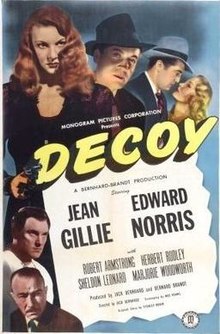
Directed by Jack Bernhard, Decoy (1946) is one of those film noir gems that lacks the glitter of a big budget and A-list stars but nonetheless shines with its own devilish light. Jean Gillie makes her penultimate screen appearance as a femme fatale so fixated on claiming a stolen fortune that she'll literally bring a man back from the dead to get it, with Robert Armstrong, Edward Norris, and Herbert Rudley as the men who will kill and die in service to her schemes. Those who love a twisted tale of murder and greed will relish this dark delight, which begins at the finale and then rewinds to unfold its sordid story. We know from the start that this is going to end badly.

Gillie plays the beautiful but deadly Margot, the girlfriend of death row inmate Frankie Olins (Robert Armstrong). Margot knows that Frankie is sitting on a pile of stolen cash, but she doesn't know where it is, so she arranges for Frankie to be resurrected after his date with the gas chamber. Gangster Jim Vincent (Edward Norris) helps her because he wants to recoup the costs he incurred paying for Frankie's defense, while Dr. Lloyd Craig (Herbert Rudley) is seduced into the plot by Margot's charms. Once Lloyd resuscitates Frankie, avarice drives both Margot and Vincent to extremes, while Lloyd is drawn ever deeper into their crimes.

There's no budget or time for fancy flourishes, but Decoy works with the materials at hand, especially Gillie's mesmerizing performance as one of the coldest, most ruthless dames to grace the noir genre. She doesn't love any of the men she uses; she will happily see every one of them dead twice over if it means the bag of cash belongs to her alone. Plotting to resurrect Frankie just to betray him is mean even for a femme fatale, but Gillie does it with a grim determination that never veers into hysteria or camp. She approaches the elimination of the equally faithless Vincent the same way, running him over with their car and then coolly collecting the tools he had been using to fix a flat tire. Lloyd, horrified into a frozen stupor, can only hiss, "I'd like to kill you," as Margot carries on with her single-minded quest. She finally cracks up when she thinks she has the cash at last, laughing maniacally while Lloyd digs up the box in Frankie's hiding spot. Frankie, however, will have the last laugh, and the ending is a gut punch of irony that knocks the viewer flat.

The film is a pitch black study in the ways a man can be ruined by a woman like Margot, a siren so powerful and deadly that she lures even men who don't trust her to a horrible fate. Frankie is a criminal but not a monster; he adores Margot and wants money only to lavish gifts on his girl, but he's smart enough to take steps against an inevitable betrayal. Vincent is a cold-blooded snake; he clearly means to get the upper hand, but he doesn't realize that Margot is a python in comparison until it's too late. Tragic Lloyd is a good man undone by this serpentine beauty; he loses everything because of Margot until all that's left is a dying wish to take her out with him, which is where the picture begins. The only man who survives contact with Margot is Sgt. Joe Portugal (Sheldon Leonard), a cop with a gangster's face who feels an attraction to Margot even though he knows what she is. "People who use pretty faces like you use yours," he tells her, "don't live very long anyway." The film opens and closes with the fulfillment of his prediction.

Jean Gillie made only one additional film, The Macomber Affair (1947), before her premature death in 1949, but she can be found in earlier pictures like The Gentle Sex (1943) and Flight from Folly (1945). She was married to director Jack Bernhard when Decoy was made, but they divorced in 1947, and Bernhard went on to direct Blonde Ice (1948) and Appointment with Murder (1948). Robert Armstrong is best remembered today for King Kong (1933), and you can also see him in The Most Dangerous Game (1932), Son of Kong (1933), and Mighty Joe Young (1949). Herbert Rudley found success primarily in television, but he makes appearances in Brewster's Millions (1945) and Rhapsody in Blue (1945), while Sheldon Leonard earned numerous Emmy nominations and two wins for his work behind the camera on Make Room for Daddy (1953-1964). You might also recognize Leonard as Nick the bartender in It's a Wonderful Life (1946) and Harry the Horse in Guys and Dolls (1955).


Tuesday, June 23, 2015

Classic Films in Focus: KING KONG (1933)

King Kong rules as the alpha ape among a crowd of cinematic simians, and the original 1933 movie that bears his name has influenced countless other films. Many of our modern blockbusters can trace their roots to King Kong; its special effects work and emphasis on big action sequences showed later filmmakers what the masses craved, and for that we can either praise or blame Merian C. Cooper and Ernest B. Schoedsack, who both produced and directed the film. While its oversized stop-motion ape and attitudes toward race and gender might well strike today's viewers as out of date, King Kong remains an essential picture for any horror or adventure genre fan, especially those interested in the evolution of the technical tricks that bring movie monsters to life.

Fay Wray screams and screams again as Ann Darrow, a penniless girl picked up off the street by director Carl Denham (Robert Armstrong) for his latest crazy picture scheme. Denham leads an expedition to a mysterious island where Kong and his human subjects live, but the movie maker's plans go awry when the natives kidnap Ann as a sacrifice to their giant gorilla god. After much peril and the deaths of numerous men, Jack Driscoll (Bruce Cabot) manages to save Ann, and Denham takes Kong as a captive back to New York for public exhibition. Kong inevitably breaks free to run amok in the city, and Ann is once again carried off by her terrifying admirer.

In an age of ever more complicated CGI effects, it's easy to see the limitations of the movie's techniques, and Kong has been parodied and revisited so many times that his power to shock has more or less disappeared. In 1933, however, he really was the Eighth Wonder of the World. Nobody had seen anything like him before, and the scientific study of actual gorillas was still in its infancy, so audiences didn't have extensive knowledge of the animals to contrast with the movie's nightmare vision. Stop-motion makes Kong an expressive, mobile creature, able to fight spectacular battles with dinosaurs and sea serpents, and composite shots of stop-motion and rear projection bring him and his human costars into perilous proximity. The work done by Willis O'Brien to bring the creature to life inspired Ray Harryhausen to make his own stop-motion monsters, and Harryhausen in turn inspired another generation of special effects wizards and blockbuster movie makers to create even more realistic dinosaurs, aliens, and giant gorillas. Without King Kong, we wouldn't have Jason and the Argonauts (1963) or Clash of the Titans (1981), and we wouldn't have Jurassic World (2015), either.

Despite its revolutionary special effects work, King Kong is very much a product of its era, with racy Pre-Code sexuality and casual violence that were excised from later reissues until the end of the Hays Code period. The story, which Denham insists on casting as a version of "Beauty and the Beast," really has more to do with taboo interspecies desire. Ann is chosen by the natives as a "Bride of Kong," which suggests a fate both deeply disturbing and biologically impossible. Kong reinforces the idea in the scene where he pulls away pieces of Ann's clothing like petals from a flower, revealing her exposed flesh for his own enjoyment and the titillation of the audience.The movie opens with a pointedly sexist discussion that segues into Driscoll's begrudging attraction to Ann in spite of her being a useless girl. For her part, Ann spends a lot of time insisting that she hasn't been any trouble to the ship's crew of red-blooded, woman-hating sailors, who then get killed trying to save her from Kong's clutches. The Skull Island natives are an overtly racist mess, while Kong himself is a more subtle commentary on the same themes, and Denham's unchecked capitalist chauvinism never gets the comeuppance it deserves. In a modern movie, at least, we can be pretty sure that the monster will eat a guy like that before the final scene fades. None of these problems should keep people from seeing the picture, since the same sins have been repeated in dozens of blockbusters since, but it's important to go into King Kong with an understanding of its not very subtle subtext.

Robert Armstrong and Frank Reicher return for the sequel, Son of Kong (1933), in which Denham and Captain Englehorn find another giant gorilla on Skull Island. The original movie was remade in 1976 and 2005, but each newer version has problems of its own, with the most recent treatment from Peter Jackson clocking in at a whopping 187 minutes. See more of Fay Wray in Doctor X (1932), The Vampire Bat (1933), and Mystery of the Wax Museum (1933). Bruce Cabot, a regular in Westerns, appears in Dodge City (1939), Angel and the Badman (1947), and Cat Ballou (1965). The Most Dangerous Game (1932) makes a fascinating double feature with King Kong; it also stars Fay Wray and was shot on the same sets.

Wednesday, March 12, 2014

Classic Films in Focus: MIGHTY JOE YOUNG (1949)

King Kong (1933) gave rise to a whole host of subsequent gorilla movies, beginning with The Son of Kong (1933), but Mighty Joe Young (1949) merits special attention because it marks the feature film debut of one of the greatest innovators in special effects history, Ray Harryhausen, who worked on the stop-motion sequences in the picture along with King Kong veteran Willis O’Brien. Those who watch Mighty Joe Young today probably do so because of Harryhausen’s involvement with the production, and his ability to invest a stop-motion character with incredible emotion and vitality is on full display in the expressive Joe. The human cast are solid in their performances, and the story is interesting if a bit overblown toward the end, but this is the big gorilla’s movie from start to finish, and Harryhausen’s Joe does not disappoint.

Robert Armstrong plays Max O’Hara, a showman who travels to Africa to promote his latest nightclub scheme, which features an African theme and live lions behind glass. There he encounters the gigantic Joe and his companion, Jill (Terry Moore), whom he convinces to travel to America in order to be the headline act at the club. Jill soon realizes that leaving home was a big mistake, especially since Joe is condemned to life in a cage, but Max is reluctant to give up his profitable stars. When thoughtless patrons provoke Joe into a violent rampage, Jill and her cowboy friend, Gregg (Ben Johnson), must escape with the big ape in order to save his life.

From his first appearance on the screen, Joe is a fascinating character. His capacity for violence quickly becomes evident, but the travelers and the audience are surprised by his gentleness with Jill, who bosses him around like an overgrown baby or an unruly pup. Joe has soulful eyes that sometimes widen with surprise or blaze with fury; we sympathize with him as a real individual, forgetting that he is a special effect when he mourns his imprisonment or lashes out during a moment of drunken panic. He can be funny or tragic, brave or bestial, depending on what happens around him. Harryhausen uses subtle changes in body language and facial expression to suggest depression, disgust, and even uncertainty, making this early creation one of his most human characters and also paving the way for creatures seen in later films like Jason and the Argonauts (1963), Sinbad and the Eye of the Tiger (1977), and Clash of the Titans (1981).

The human actors support the simian star admirably and help us to believe in Joe by their reactions to him. Robert Armstrong, a veteran of both King Kong and The Son of Kong, brings plenty of experience acting against animated apes to his role as the overeager producer, Max, but he also evinces a great talent for comedy in his scenes with Joe and an uncooperative horse early in the film. Relative newcomer Terry Moore plays one of her first really significant roles as Jill; she has a fresh-faced sweetness that justifies her gullibility as well as the strength of character to make us believe that she can handle a rampaging giant gorilla all by herself. Of the three lead actors, Ben Johnson is the most familiar to modern viewers, although Gregg is one of his first big roles, as well, and the Oklahoma cowboy functions as a gentler, younger version of the kind of Western character Johnson would go on to play. The subdued romance between Jill and Gregg is a sweetly played sidenote to the central plot, with both Moore and Johnson expressing a very G rated passion that even the youngest viewers won’t find offensive. Their one really romantic moment quickly gives way to a fiery climax involving a burning orphanage, where Joe once again dominates the screen.

Blink and you’ll miss Beverly Hillbillies star Irene Ryan in the bar scene during Joe’s big debut. Ernest B. Schoedsack, who directed Mighty Joe Young, also made The Most Dangerous Game (1932), The Son of Kong (1933), and The Last Days of Pompeii (1935). Ben Johnson won the Oscar for Best Supporting Actor in The Last Picture Show (1971), but he also has memorable roles in Wagon Master (1950), Rio Grande (1950), and The Wild Bunch (1969). See Terry Moore in Come Back, Little Sheba (1952), Daddy Long Legs (1955), and Peyton Place (1957). For more of Ray Harryhausen’s special effects, see The Beast from 20,000 Fathoms (1953), It Came from Beneath the Sea (1955), and The Valley of Gwangi (1969). Mighty Joe Young was remade in 1998 with Charlize Theron and Bill Paxton in the lead roles, but see the original first.

Mighty Joe Young is currently available for streaming on Warner Archive Instant.

Monday, June 24, 2013

Classic Films in Focus: BE YOURSELF! (1930)

In 1969, Barbra Streisand won an Oscar for playing Fanny Brice in Funny Girl (1968), but that performance is probably the only encounter most modern viewers have with the Jewish comedienne, who became a star with the Ziegfeld Follies and was also known for her radio performances as Baby Snooks. Brice was not primarily a film actress. She made fewer than half a dozen notable screen appearances, which is too bad because she’s awfully fun to watch in Be Yourself! (1930), a minor comedy-drama that is worth seeing largely because of Brice’s comedic talent.

Brice (credited as Fannie rather than Fanny) plays Fannie Field, a nightclub performer who develops an affection for promising boxer Jerry (Robert Armstrong). Along with her lawyer brother, Harry (Harry Green), Fannie trains and manages Jerry until he becomes a big success, but her romance with him hits the skids when a predatory rival (Gertrude Astor) puts the moves on the gullible lug.

Be Yourself! is primarily a musical comedy, with Brice performing a number of songs that highlight her humorous bent. Her opera parody is funny stuff, but the highlight of the picture is Brice’s loony take on a swan ballet, in which the graceful conceit of a woman impersonating a dying bird gets turned on its head. Brice also excels at delivering one-liners and rolling her eyes to great effect, and she revels in stereotypically Jewish exchanges with Harry Green. Their constant kvetching, carried on with affection for each other and for Jewish identity, is another memorable aspect of the film.

Brice also has a chance to show her more serious side, especially in her moving and heartfelt performance of “When a Woman Loves a Man.” The song echoes the tone of Brice’s signature song, “My Man,” and Brice delivers both with great pathos. She also invests her character with dramatic feeling when Jerry jilts her for the gold digging Lil, although being a smart cookie Fannie soon cooks up a plan to win him back for good. Robert Armstrong plays Jerry as such a goofy palooka that we never know exactly what it is that Fannie sees in him, but having picked him she sticks faithfully, even when Lil lures him away.

Thornton Freeland, who directed Be Yourself!, also directed They Call It Sin (1932), Flying Down to Rio (1933), and Jericho (1937). For more of Fanny Brice on film, see The Great Ziegfeld (1936) and Everybody Sing (1938). Prolific supporting player Robert Armstrong is best remembered today for his roles in The Most Dangerous Game (1932), King Kong (1933), and Son of Kong (1933).

You can see Be Yourself! on Netflix Instant or on Amazon Prime Instant Video.