Showing posts with label femme fatale. Show all posts

Tuesday, May 23, 2023

Wanting More: The Open Ending of THE DAMNED DON'T CRY (1950)

WARNING! This post contains major spoilers for THE DAMNED DON'T CRY and other classic noir films. Proceed at your own risk.

When I showed The Damned Don't Cry (1950) to my lifetime learners as the final film of our Joan Crawford series, they were especially struck by the open ending of the story, which leaves us wondering about the ultimate fate of protagonist Ethel Whitehead, aka Mrs. Lorna Hansen Forbes. Director Vincent Sherman and leading lady Crawford carry us through a dark journey over the course of the picture, which is equal parts melodrama and film noir as it shows us Ethel's seduction by avarice and ambition. My lifetime learners fully expected Ethel to die or at least go to prison in the movie's final scenes, but neither happens. Why doesn't Ethel pay a heavier price for her actions, and why are we surprised that she doesn't? Those questions deserve some consideration, especially since both melodrama and noir are known for killing off their most deeply flawed protagonists. Ethel Whitehead is, indeed, deeply flawed, but the film consistently displays a degree of sympathy for her that resists reading her as a villain or reaching a harsher conclusion as poetic justice for her crimes.

The picture opens with murder and scandal as the wealthy Mrs. Lorna Hansen Forbes is revealed as a fraud, but we are soon provided with her backstory. Ethel Whitehead is a poor woman from a working class family, scraping to get by and unable to afford any of the things her beloved young son desires. When the son tragically dies, Ethel feels that she has nothing to lose by leaving her old life behind. She heads to New York City and gets a job as a dress model, which she uses as a springboard to better - but increasingly criminal - prospects. Along the way she entangles Martin Blackford (Kent Smith), an accountant who accepts lucrative jobs with mobsters to win her love, but she abandons Martin in favor of the boss himself, the ruthless but refined George Castleman (David Brian). George remakes Ethel into socialite oil heiress Lorna, but his favors come at a price, and Ethel eventually finds herself dispatched to California on a dangerous mission to uncover the treachery of mob underling Nick Prenta (Steve Cochran).

Given that Ethel abandons her husband and parents, ruins Martin's life, misrepresents her identity and social standing, and knowingly gets involved with gangsters, we might imagine death or prison to be more than justified, and perhaps even obligatory given the Hays Code demand that crime always be punished. She also demonstrates dissatisfaction with married poverty and a desire to have money and nice possessions, and that kind of rebellion against conservative, patriarchal values usually doesn't end well for female characters, especially after the enforcement of Hays in 1934, which brought an end to heroines who cheerfully hustle their way to the top. Ethel wants more, and wanting more is very dangerous to a woman's life expectancy in Hays era films. Crawford's heroine in Humoresque (1946) drowns herself as penance for her sins, while her rival Bette Davis pays the ultimate price in pictures like Of Human Bondage (1934), Jezebel (1938), The Letter (1940), and Another Man's Poison (1951). Although melodramas sometimes kill their heroines, noir's femme fatale types are especially likely to meet violent ends. Mary Astor's slippery Brigid faces hanging or hard time at the end of The Maltese Falcon (1941), while Barbara Stanwyck eats lead in both Double Indemnity (1944) and The Strange Love of Martha Ivers (1946). If we hold Ethel fully responsible for Martin's corruption and Nick's murder, then we might conclude that she deserves the same fate as her "sisters under the mink," as Gloria Grahame says in The Big Heat (1953) (her character doesn't make it out alive, either).


Ethel, however, is never presented as a true femme fatale, and the film repeatedly balances her materialism with scenes that humanize her. We sympathize with her desire to get out of her miserable life in the oil fields and away from her brutish father and domineering husband. Her child's death breaks her resolve to endure that life any longer, and we can't blame her for running away from a hollow existence without the sole joy she found there. As a dress model, Ethel at first balks at the shady aspects of the job, but she grows accustomed to trading moral qualms for money by degrees. The rewards are concrete - a nicer place, better food, prettier clothes - while the costs are less tangible. Ethel doesn't intentionally corrupt Martin or plan to jilt him from the beginning; she really cares about him but can't stop herself from taking the opportunity that George represents. She holds no animosity toward George's pitiful wife and is, in fact, gentle with her in their one scene together. When George orders her to California, Ethel obeys because she thinks she loves him, but her sympathy for Nick and revulsion at the idea of murder prove stronger than her loyalty to George. Martin, who has clearly resented Ethel for his fall from grace, similarly reveals that his love for her trumps other concerns, and his forgiveness encourages our own.

By the end of the film, Nick and George are both dead, Martin has turned police informant, and Ethel has been shot by George after returning to her parents' spartan hovel. Her ruse as Lorna Hansen Forbes is definitely over, especially with the source of her illicit wealth now gone. The final scenes focus again on Ethel's humanity and the better aspects of her nature. We see her reunited with her parents and with Martin, whom she bravely tries to protect by going alone to face the vengeful George. After George shoots Ethel, the movie could easily have ended with her death, but instead we see that she survives to be comforted by her parents and questioned by both reporters and the police. Martin is notably absent at the conclusion, possibly in police custody and possibly on the lam; we get no hint about a reunion with Ethel. The clusters of policemen all around the house suggest that Ethel might also be looking at jail, but instead of speculating about her trial the departing reporters wonder if she'll make another attempt to escape the stark poverty of her home. "Wouldn't you?" asks one of the reporters, and the other nods his answer with certainty. We leave the story not knowing the fates of either Ethel or Martin, but we're encouraged by the last bit of dialogue to wonder what happens next.

While this open ending might well surprise viewers expecting a definite conclusion, it lets The Damned Don't Cry obey the letter of the Hays Code while still offering us hope for a flawed heroine whom the narrative encourages us to care about in spite of her flaws. Ethel has already suffered a great deal, although of course a narrow-minded moralist like Joseph Breen would be happy to see her die in the dirt or the execution chamber. Instead, we get an ending that lets the viewer imagine what happens next according to his or her own preferences. Personally, I like to imagine that Ethel and Martin get back together and disappear into new identities far away from the shadow of their shared past, maybe somewhere in Mexico. I don't blame Ethel for wanting out of her miserable, downtrodden life, but I hope that she can find a via media to real happiness somewhere between poverty and ruthless materialism. A less sympathetic viewer might assume that jail time, if nothing worse, awaits Ethel as punishment for her crimes, and the hovering police officers certainly make that option plausible. If we want more from the ending of The Damned Don't Cry, that in itself makes us more like Ethel than some viewers who judge her harshly might care to admit. How much is someone allowed to want? How much wanting is too much, and what should happen to someone who wants it? Like Ethel, we're left wanting more, but we'll have to make it up ourselves to get it.

If you're interested in reading more of my posts about Joan Crawford, check out the following:

DANCING LADY (1933)

JOHNNY GUITAR (1954)

THE DAMNED DON'T CRY (1950) 

STRANGE CARGO (1940)


Wednesday, February 16, 2022

Trek Noir: Out of the Past in Deep Space Nine's "Necessary Evil"

Note: This post contains plot spoilers for the Deep Space Nine episode, "Necessary Evil"


I'm currently making my way through the entirety of the Star Trek TV series, Deep Space Nine, which I never got to watch regularly during its first run, and so far it has been a richly rewarding experience. While all of the episodes have their merits, I was especially struck by Season Two's eighth episode, titled "Necessary Evil." This one stands out from the others and from most of the older Star Trek shows for its serious - and successful - evocation of classic film noir to tell a dark, duplicitous story about events that unfold before the Cardassians leave Bajor and the Federation takes charge of the space station. While the Star Trek universe is traditionally a positive space with an optimistic vision of the future, this episode uses the tropes of classic noir to investigate the dark past that haunts Deep Space Nine, and it calls into question the motives and relationships of some of its most complex characters.

The Next Generation crew in "The Big Goodbye"

Star Trek shows have been playing with genre since the original series, but the sensibility of true noir is at odds with the core values of the Trek universe. When The Next Generation ventures into noir territory in the first season episode, "The Big Goodbye," it does so as a holodeck adventure with Captain Picard adopting the role of fictional private eye Dixon Hill, a figure very much inspired by Humphrey Bogart as Dashiell Hammett's iconic Sam Spade in both the book and film versions of The Maltese Falcon. The holodeck story is intended to be a nostalgic amusement for Picard and his friends, but an external event causes the safety protocols of the holodeck to disengage, thus thrusting the crew members into a more dangerous adventure than they had expected. While the episode includes real peril for the crew, the noir element of the experience is artificial and contained, and it is also pointedly self-conscious, an homage to noir rather than an embodiment of it.

Such is not the case on the Deep Space Nine episode, where a dark past of Cardassian control and Bajoran resistance creates opportunities for a noir plot that exists as part of the characters' reality. It's not surprising that a series with persistent connections to Casablanca (1942) might see the shadowy world of noir as fruitful territory to mine for narrative; the show even gets around to a blatant revision of Casablanca later in Season Two with the episode, "Profit and Loss" (with Quark, of course, as the stand-in for Bogart's bar owner Rick). In "Necessary Evil," the series takes us back and forth between its past and present to explore what life on the space station was like before the Bajoran liberation, which also evokes shades of Casablanca and the Nazi Occupation. That past is a dark place, where everyone's motives are suspect and our core characters meet for the first time under grim circumstances. It's a perfect setting for a very unusual example of tech noir, the (literal and figurative) space where noir and science fiction meet.

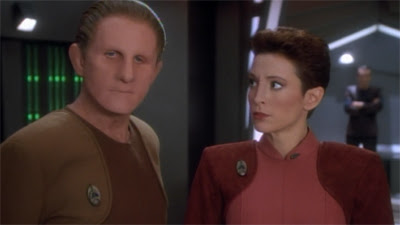
"Necessary Evil" focuses on the past between Odo and Kira.
 

The story opens in the present, when Quark is hired to retrieve a hidden, valuable item for an attractive Bajoran widow. Quark then becomes the victim of an attempted murder, and security chief Odo sets about uncovering Quark's assailant. His investigation takes him back to his first case on the station, when the Cardassian Gul Dukat assigned him to solve the murder of the widow's husband, a Bajoran merchant. The lead suspect in that case turned out to be the Bajoran Kira, then newly arrived on the station but now Odo's friend and colleague in the present. As Odo tries to uncover the present crime he begins to understand more about the murder from the past, but his realizations threaten his relationship with Kira.

Unlike Captain Picard in "The Big Goodbye," Odo is an unwitting noir protagonist and utterly unsentimental about the past, whether fictional or real. As an alien shape-shifter with no knowledge of his own home planet or people, Odo is a perfect noir lead - alone, aloof, cynical, and observant by necessity. He provides a classic noir narration of events only because Commander Sisko has asked him to create a record of the investigation. His failure to solve his first case haunts Odo, making him determined to solve not only the present crime but also the original murder. Gul Dukat claims that Odo is an ideal agent of justice in this case because his outsider status makes him neutral to both the occupying Cardassians and the subjugated Bajorans, but that neutrality is as questionable as Gul Dukat's explanation for Odo's assignment. Odo does, however, have a strong and clearly stated interest in justice, which makes him dogged in pursuit of the guilty parties in both the past and the present.

A Ferengi and a femme fatale meet in "Necessary Evil."

The character who most complicates Odo's sense of justice is Kira, the Bajoran woman who arrives at the station just before the original murder and is set up with the hallmarks of noir's good-bad girl and mystery's red herring (see Andrew Spicer's book Film Noir for a discussion of the genre's good-bad girl type). The widow claims that Kira was having an affair with her husband and is thus the obvious suspect, but the present tense crime has already depicted the widow as a classic femme fatale, so we, the audience, don't trust her. Kira denies the affair but eventually confesses to Odo that she is a saboteur for the Bajoran resistance and could not have committed the murder because she was busy causing damage elsewhere at that time. Odo protects Kira from Gul Dukat and leaves the murder unsolved, a situation that drives him all the more when the attack on Quark recalls the earlier crime. Finally, in the present, Kira reveals to Odo that she did, in fact, kill the Bajoran merchant when he discovered her trying to steal the same list of Bajoran collaborators that the widow hires Quark to find. The twist ending reveals Kira to be a better liar, and a less reliable associate, than Odo imagined, and it's not clear if he's more shocked by her duplicity or his own credulity. The episode concludes with the relationship between the two unresolved and the future of their friendship uncertain. It's a very noir ending for the episode even if both of the major characters remain alive and still working on the station afterward.

Everything else about this episode contributes to its noir sensibility. The scenes in the past use dark, blue lighting to cast shadows and uncertainty over the characters, while the other characters around Odo and Kira also fall into classic noir types, including Quark as the petty criminal in over his head and the widow as a beautiful femme fatale, complete with white evening gown and seductive manner. Odo's voice over narration, a staple of the genre, helps us navigate the shifts between past and present, but the two markedly different visual styles make the time periods quite distinct already. Gul Dukat, technically Odo's client in this investigation, has ulterior motives that he does not disclose, and the viewer comes away with the sense that "justice" is really a slippery idea. The smaller problems - who killed the merchant and who attacked Quark - might be solved, but larger and more unsettling questions persist. The episode presents, in abbreviated form, all the characteristics of classic noir, and it never winks or tips its hand about doing it. There's nothing cute about "Necessary Evil," which is part of the reason it's so good.

If you're interested in the particular pleasures of tech noir, check out film-length examples like Blade Runner (1982), Dark City (1998), and Minority Report (2002). If you're a Star Trek fan new to classic noir, start with iconic favorites like The Maltese Falcon (1941), Double Indemnity (1944), and, as my post title suggests, Out of the Past (1947).

Wednesday, October 5, 2016

Drug Store Delilah: Audrey Totter in TENSION (1949)

Audrey Totter is one of many actresses we naturally associate with noir; her best remembered films include noir classics like Lady in the Lake (1947) and The Set-Up (1949), and she also appears in a supporting role in The Postman Always Rings Twice (1946). Less well known than these other pictures is director John Berry’s 1949 MGM film, Tension, in which Totter stars as one of film noir’s nastiest femmes fatales, an adulterous wife who drives her milquetoast husband to change his identity and contemplate murder. While noir devotees may disagree about the overall merits of the picture, Tension undoubtedly provides Totter with a fabulously unrestrained example of the bad girl type, and her Claire Quimby merits a place in the film noir hall of dangerous dames right alongside Phyllis Dietrichson, Kathie Moffat, and Elsa Bannister.

Totter’s character, Claire, is the wife of Warren Quimby, a mild-mannered pharmacist played by Richard Basehart. While Warren works the late shift at an all-night drug store, Claire carries on an affair with a hairy lug named Barney Deager (Lloyd Gough) because he has money and a more macho personality, and eventually she leaves Warren altogether. Humiliated by a confrontation with his wife’s lover, Warren plots an elaborate scheme to murder Barney, but his plans falter when he meets Mary (Cyd Charisse) and begins to fall in love with her, just as he finally realizes that his wife is no good.

From her very first appearance Totter oozes malice and selfishness; her viper’s eyes brim with disdain for her husband and the life he provides for them. Even the way she eats a sandwich reveals her crass, wasteful nature; she only takes a few bites of it before moving on to pie. For reasons we never quite grasp, Warren lives only to serve her, but she gives him the cold shoulder and sends him scurrying back to his customers. Freddie, the soda fountain jerk, recognizes her ability to wreck men’s lives without a second thought and begs her not to flirt with him. “Don’t stink me up,” he implores. Claire finds his fear of her amusing. “OK, Junior,” she says, even as she makes him lie to Warren when she leaves with another man.

Like many of noir’s bad women, Claire cares most about material possessions and status. “What’s better than money?” she asks early on, and she isn’t being sarcastic. Her eyes linger lustfully on a fur coat in a magazine, but she does nothing to help earn the money she wants to spend. She expects men to give her everything that she desires, and it’s clear that her husband isn’t measuring up. When Warren protests her appropriation of an expensive bottle of perfume from the pharmacy’s stock, she retorts, “A big guy would spend this much on me in one evening,” and then she proceeds to more or less take a bath in the stuff, daring her unhappy spouse to stop her. Claire dominates her husband with a baleful glare, constantly belittling and abusing him, even as she puts on her best, most feminine airs for Barney and, later, the homicide detective Collier Bonnabel.

In another key scene, Totter embodies the femme fatale’s rejection of bourgeois feminine ideals of domesticity and motherhood. Warren has secretly saved his money to buy the couple a real home in the suburbs, which he naively assumes is the kind of life Claire wants. When they arrive at the house, however, Claire refuses even to get out of the car. Once again giving Warren a poisonous stare, Claire drowns out his remonstrances and pleas by leaning on the car horn. She wants no part of middle-class monotony, and very shortly afterward she decamps with her lover, whose beachfront property offers something more like the constant party Claire imagines as the good life.

Audrey Totter’s performance really sells the depth and intensity of Claire’s rotten heart. She never lets us think that Claire has any real class; she’s a two-bit tramp through and through, ready to jump from one convenient lover to the next in order to look out for her own immediate interests. Like the painted doll she carries around with her, Claire is pretty but vulgar, and we’re not surprised late in the picture to learn that she has a long criminal record lurking in her past. Totter plays Claire without any redeeming qualities; she’s a lethal combination of vanity, greed, and deception. AndrĂ© Previn’s score also provides Claire with a slinky theme that highlights her lack of subtlety; whenever she enters a room the music reminds us that she’s all kinds of trouble, especially for Warren. Unlike many of noir’s other deadly dames, Claire never comes across as a strong character; instead, she is grasping and vicious because she is weak. A human parasite, she needs men to earn money for her, protect her, and lie for her, but even as she feeds off of them she poisons them with her own venomous nature.

Totter’s drug store Delilah makes Tension essential viewing for those interested in the femme fatale archetype, and the character provides a pointed contrast to Totter’s turn as the anguished, sympathetic wife in The Set-Up. Totter also offers a different take on the bad blonde in The Unsuspected (1947), in which she plays Claude Rains’ duplicitous, gold-digging niece. Although Audrey Totter never became a huge star, and her film career stalled in the 1950s, she made an indelible mark on film noir with her performances. When it came to being a bad girl, she was truly one of the best.

This essay originally appeared in The Dark Pages, a newsletter devoted to film noir. Follow the link to subscribe.

Friday, February 18, 2011

Femmes Fatales, Film Noir, and Freshmen

The following post is adapted from a conference paper I presented at the Popular Culture Association in the South meeting in 2008. I'm posting it this week as part of the film noir blogathon, For the Love of Film (Noir), which is raising funds to help the Film Noir Foundation.


Dark City (1998)
With the release of blockbuster films like Sin City and the revival of cultural interest in characters like Batman, film noir has enjoyed something of a resurgence in the last few years. College age film goers and cultural consumers love dark violence and tortured protagonists, but they rarely recognize those elements as the territory of noir. Generally speaking, they have no idea what noir even is, much less where modern cultural productions are coming from when they draw on its conventions and traditions. This interesting combination of cultural currency and generational ignorance makes noir an especially productive choice for teaching film in lower level courses. I began to recognize noir’s potential for the classroom when I started teaching Alex Proyas’ 1998 film, Dark City, in Introduction to Literature courses some years ago. I quickly realized that my students liked the film but had no contextual knowledge on which to build a more sophisticated understanding of what they saw. Eventually the unit on film evolved into a fully-fledged engagement of film noir and its themes, and student evaluations of the course have proven it to be the biggest hit of the semester, far outstripping the units on poetry, short fiction and drama, and even surpassing a popular novel unit on Treasure Island in terms of student enthusiasm and response.
The Maltese Falcon (1941)
For those who might be less familiar with the term, “film noir” refers to a cinematic style first popular in American film in the 1940s and 50s, with the classic period of noir spanning from the 1941 release of The Maltese Falcon to the 1958 release of Orson Welles’ Touch of Evil. The term “film noir,” which suggests the darkness and fatalism typical of these films, was first coined by French critics watching American films in the years following World War II. Early noir films were often produced as “B” movies that were quickly filmed for as little money as possible, and they flew somewhat under the radar of the censors, whose attention to such matters was not as keen during the all-consuming war years. Taking their cues from hard-boiled crime fiction of the period and German expressionist film of the 1930s, noir films presented World War II era audiences with a gritty alternative to the bourgeois optimism and increasing social homogeneity that transformed American culture in the years following the war. Noir touched on themes that spoke to the barely suppressed fears of its original audiences, from paranoia and disillusionment to betrayal and the grinding inescapability of personal fate. The hard-boiled private detective and the seductive femme fatale would emerge as the quintessential icons of noir, with actors like Bogart and Stanwyck personifying the grim cool of the true noir soul. Later generations have alternately rejected and embraced the dark charms of noir, with the early “neo-noir” movement epitomized by Roman Polanski’s Chinatown (1974) later evolving into postmodern noir and the sci-fi hybrid of “tech-noir” characterized by films like Blade Runner (1982). More recently, films like Memento, Brick, Sin City, A History of Violence, and, arguably, Batman Begins, have brought noir style back into the cinemas and into DVD viewers’ homes, along with television series like Veronica Mars and The Dresden Files.
Who Framed Roger Rabbit (1988)
In the classroom, of course, our discussion of noir has to begin with a similar definition, since most of my students are unfamiliar with the term and few have seen enough older films to grasp the idea very quickly. They have a vague idea about the identity of Humphrey Bogart, thanks primarily to the lionization and commercialization of Casablanca, but they have never heard of noir’s other stalwarts, including the likes of Robert Mitchum, Richard Widmark, Barbara Stanwyck, and Dana Andrews. They are utterly unfamiliar with classic Hollywood’s plethora of important directors. We cover elements like cinematography, lighting, and editing in a very basic way, using props and examples from popular modern films to illustrate the ideas. We discuss the main character types of noir, including the detective, the damaged man, the good girl, and, of course, the femme fatale. At this point I ask the class how many of them have seen Who Framed Roger Rabbit (1988), and a light bulb appears almost visibly over most of their heads. We watch the scene where Jessica Rabbit first enters the film and performs the number “Why Don’t You Do Right?” to a bewitched, bothered, and bewildered Bob Hoskins as detective Eddie Valiant. The basic information gives the students some tools to apply to the films they’ll be studying, and Roger Rabbit primes the enthusiasm pump. At this point, they’re ready for a movie.
Sunset Boulevard (1950)
 I allow my students to vote on the noir film that we will actually watch in class, but I make them choose a classic film, an old school, black and white, traditional noir. Generally, I offer them The Maltese Falcon (1941), Double Indemnity (1944), Laura (1944), Out of the Past (1947), and Sunset Boulevard (1950). I give a brief description of each film and show trailers if time allows. They have generally chosen either The Maltese Falcon or Sunset Boulevard, and Boulevard goes over particularly well. Certainly, it’s hard to beat a maniacal Gloria Swanson, a talking dead man, and a monkey funeral for sheer spectacle value to get the attention of a group of restless freshmen. I force the class to choose a classic film because the basic themes and images of noir are being worked out in those texts, and those films will be the foundations on which later noir depends. I also know that, given the choice, they will instinctively choose a newer, more familiar, more comfortable color film. The entire class will watch this one film together, but their assignment allows them to watch additional films on their own and write about those for the required essay. Once students see and like one classic noir film, they are much more likely to choose other classic films as well as newer ones for these additional encounters.
Tension (1949)
One very important element of this assignment is the library of noir DVDs that I maintain for students to borrow as we make our way through the unit. I keep a collection of films, especially the older and harder to find ones, for student use. The lending library encourages the students to watch more films and to engage the idea of noir in more interesting and personal ways, and it leads to a more diverse set of essays. I also provide students with a long list of other noir films, including neo-noir and tech-noir pictures that they can watch as part of the unit and write about for their essays. Popular choices include Sin City, of course, as well as Blade Runner, Memento and Who Framed Roger Rabbit. The sleeper hit of the lending library is the 1949 Richard Basehart/Audrey Totter film Tension, which has only recently become available on DVD thanks to the noir resurgence and a Warner Brothers box set. While not a well-known example of noir, it might just be the perfect film for freshmen, with a nasty femme fatale, a sympathetic hero, and a tight 95 minutes of gripping entertainment. Students typically laugh at the introductory scene with the police detective, but a character like Audrey Totter’s Claire Quimby magnetically draws their attention and presents the femme fatale as a strikingly physical, even vulgar female monster.
Talking about what movies students can watch while studying noir brings up one of the chief difficulties and chief delights of using it as the basis for a film unit. Nobody can quite agree about what noir IS. Some critics, like Foster Hirsch, argue that noir is a fully-fledged genre, while others refer to it as a “cycle,” a “movement,” or a “style.” Noir is certainly more difficult to identify than, say, a Western or a gangster film, and some Westerns and some gangster films might even simultaneously be noir films, as well. Explaining the contested identity of noir to freshmen can be challenging, but it also invites them to have an opinion about the debate, and it gives them a clear argument that they can take a stake in, especially as that argument relates to specific films. Is Dark City, for example, really a noir film? What about other modern films? Do they have that certain je ne sais quoi that makes a film noir or not? Sometimes students suffer a kind of “medical students’ syndrome” where they begin to think that every movie they see must be noir, and we have to address their perception of the film and talk about what kind of classification is really defensible. However, as problems with students go, over-engagement is certainly one of the nicest problems one could have.
One way to head off some of this confusion is to lay good groundwork for the noir unit earlier in the term. In order to help students have a better sense of the elements of noir, I make a conscious effort to connect our film unit with the other material that we cover over the course of the semester. In our poetry unit, for example, we read texts like Keats’ “La Belle Dame Sans Merci” and introduce the idea of the femme fatale and the traditional virgin/whore dichotomy. Then, when students see Norma Desmond or Brigid O’Shaughnessy or Tension’s Claire Quimby for the first time, they know exactly what they are looking at. We study short stories and poems that deal with the themes of murder and death, and we talk about how the texts shape our perceptions of criminals or of fate. For an introduction to literature course, this multi-genre connection of themes and ideas helps to justify devoting a whole segment of the class to film studies because it presents film to students as a place to analyze and engage literary concepts. Students end up with a broader and more sophisticated picture of the literary themes that dominate the course, and they discover that the literary concepts we have studied apply to many different kinds of texts.
As I mentioned earlier, the noir unit consistently ranks as students’ favorite part of the entire course. Why do students respond to noir so enthusiastically? Partly they just like to watch movies more than they like to read, but that’s a generational trend that reflects an increasingly visual culture, and I incorporate visual and multi-media elements into every unit in the course. It isn’t that watching is “easier” than reading, though, because noir is a tough cinematic nut to crack, with a problematic identity and a lot of sophisticated themes. What students tell me about studying noir is that it teaches them to watch differently from the way they watched movies before and makes them think more about what they watch. It opens up classic films for them as interesting and even provocative. It casts new light and new shadows on the culture that they are already familiar with in films, television, video games, music and comic books. They appreciate Veronica Mars more, think a little harder about the themes of Sin City, play Max Payne with a greater understanding of its context, and read or watch Batman with a fuller sense of the Dark Knight’s darkness.  Students have even asked to borrow more films to watch after the course ended, and one student went on to develop an entire independent project for his art major around the creation of photographic images inspired by the look and style of noir. These are freshmen at a public university, majoring mostly in engineering, nursing and business. They are not the already intellectually engaged, privileged denizens of a liberal arts college. In spite of that, noir gets them, and most of them, ultimately, seem to “get” noir. They leave the classroom as better and more sophisticated readers of the culture in which they live. In short, noir inspires them to think and to learn more than anything else we study. For this teacher, at least, to paraphrase Sam Spade, that’s the stuff that dreams are made of.
If freshmen can learn to love it, then film noir must be worth saving! You can help the Film Noir Foundation preserve and restore classic noir films by donating during the Film Noir Blogathon, February 14-21, 2011.