Showing posts with label Pre-Code. Show all posts

Sunday, November 9, 2025

CMBA Fall Blogathon 2025: Horrors of the Colonized Body and Soul in THE MUMMY (1932)

This post is part of the CMBA Fall Blogathon for 2025, showcasing Early Shadows & Pre-Code Horror. Find more blogathon posts by visiting the CMBA website!

When we think about body horror as a subgenre, we usually imagine the gruesomely detailed visual images of more modern movies like Eraserhead (1977), The Thing (1982), or The Fly (1986), which have their ardent fans but are sometimes too stomach-turning for those who prefer the subtler thrills of classic horror. Silent and Pre-Code horror does, however, include many examples of body horror, from the contortions of Lon Chaney in The Unknown (1927) and the tortured face of Conrad Veidt in The Man Who Laughs (1928) to the inhabitants of Island of Lost Souls (1932) and the circus performers of Freaks (1932). These early films could get away with more provocative forms of horror than those arriving after the Hays Code cracked down in 1934, and they often use that freedom to great effect. It's striking, therefore, that Universal's The Mummy (1932) only suggests its most extreme bodily suffering in flashes, leaving viewers to imagine the extent of horrors implied but unexplored. What we actually see of Imhotep, the titular mummy, is filtered mainly through the perspectives of European characters whose sense of him as an unnatural Eastern/Other denies his humanity, but when we shift our point of view to Imhotep himself we begin to grasp the full horror of his situation and experience.

Boris Karloff stars as the undead Imhotep/Ardath Bey.

Our colonialist perspective of Egypt is formed by the way the story opens and unfolds, with British archeologists uncovering the tomb of the priest Imhotep (Boris Karloff) in 1921 and then unintentionally waking him. While they speculate about the crimes that might have warranted Imhotep's unusual burial, they don't express much sympathy for him as a human being who clearly suffered an awful fate. When Imhotep wakes, his appearance alone is enough to drive Ralph Norton (Bramwell Fletcher) mad, even though the mummy doesn't lay a hand on him. A decade later, we catch up with the Europeans back in Egypt, this time uncovering the tomb of Princess Ankh-es-en-Amon (Zita Johann) with the help of the mysterious Ardath Bey, whom they fail to recognize as Imhotep himself. Despite warnings about the supernatural from Dr. Muller (Edward Van Sloan), Sir Joseph Whemple (Arthur Byron) and his son, Frank (David Manners), only understand Egypt as a subject, both academic and colonial, and they recognize its power as manifested through Imhotep too late. Ultimately, of course, Imhotep is destroyed, and the half-Egyptian Helen (also Zita Johann) is saved from his clutches, but the story ends without any denouement that might articulate the meaning of the tale we've just seen.

Much of the plot of The Mummy is recycled from Dracula (1931), a narrative with its own preoccupations with British imperialism and the Eastern Other, but transferring the story to Egypt makes those tensions much more overt. The film lets them bubble to the surface in ways that undermine the "official" perspective being shaped by the modern Europeans. Dr. Muller warns his English friends to respect the ancient culture they are pillaging, but Sir Joseph doesn't listen. Ardath Bey bitterly comments on his inability to excavate the princess himself because only foreigners are allowed to do so, while Frank complains about being forced to keep his find in Egypt instead of whisking it away to London. Helen, caught between the two worlds and wrestling with the awakened soul of Ankh-es-en-Amon inside her, laments the modernity of Cairo in the twentieth century and yearns for the "real" Egypt of the past. There's no denouement when Imhotep is destroyed because it's only through the power of his own world, and Helen's invocation of the ancient goddess Isis, that he is defeated at all. Dr. Muller and Frank have nothing to do with it, and they serve merely as spectators, not heroes, in the final scene. We get no sense that Frank has ever understood any of the events that have transpired, but Helen might really be changed by her experience, so their success as a romantic pair is left uncertain. The ending, however, implies that Helen will be absorbed into English whiteness through marriage to Frank, erasing her past identity as Ankh-es-en-Amon and the Egyptian heritage passed to her from her (dead) mother. 

Imhotep prepares to make Helen undead like himself.
 

Through these pressure points and gaps Imhotep himself is constantly breaking, demanding that Helen and the viewer see him differently, as a very human man whose love for her has caused him to suffer unspeakable horror. We first see him as a dead thing, the gleam in his dark eyes signalling his rise to embodied consciousness after thousands of years. We don't know what happens to him during the decade before the Whemples return to Egypt, but somehow he reforms himself into a semblance of a living man, learns English and, presumably, Arabic, as well, and manages to survive in a twentieth-century Egypt that is utterly alien to him. As Ardath Bey, he's a remarkable figure, thin, stiff, and seemingly fragile, with skin still desiccated and features sunken. Sometimes mummies in horror films are presented as little more than wrapped zombies, mindless and shuffling, but Imhotep is a fully aware human being trapped inside a mummified body, a living soul yoked to a dried up corpse. He reveals to Helen the transgressions that led to this fate, hoping to awaken her own memories of their forbidden love. Unable to accept the death of the princess, Imhotep defied the gods by attempting to resurrect her, but he was caught and punished by being buried alive. We are shown the torture Imhotep endured as, fully conscious and struggling, he was wrapped as a mummy and thrown into his sarcophagus. We don't see his actual death by asphyxiation as his coffin ran out of air, but his last moments must have been utterly terrifying, unable to move, see, or even scream. Imagine then his horror on returning to consciousness in his own corpse, an outcast from both the living and the dead. Obsessed with his beloved when he was alive, condemned to eternal suffering for her sake, and tortured by his own decayed flesh, Imhotep is almost certainly insane, but he is determined to be seen by Helen/Ankh-es-en-Amon as a man who has endured horrors for her love, and not as a thing without a human soul. 

When we consider Imhotep as a man and not a thing, we become aware of the scope of the bodily horror he experiences. The Mummy doesn't dwell at length on the horror of Imhotep being a living soul inside a dead body, but it's present in Boris Karloff's physical performance and the anguish his character reveals only to Helen. Dracula might be undead, but his body is not a dry husk, while zombies are usually shown as animated corpses that lack self-awareness. Imhotep has the worse of both curses; he has the consciousness of a living man but exists in a mummified corpse. A more fully developed exploration of this theme can be found in Roger Corman's adaptation of the Poe short story, "The Facts in the Case of M. Valdemar," in Tales of Terror (1962), in which Vincent Price plays a dead man forced to continue to inhabit his decaying corpse by a sadistic hypnotist (Basil Rathbone), while the horror of a man who finds himself made monstrous dominates stories like The Wolf Man (1941) and The Fly (1958). In The Mummy, the horrific nature of Imhotep's existence is suggested most strongly in the third act, when Imhotep seeks to seduce or force Helen into sharing his fate. "No man ever suffered as I did for you," he tells her, hoping to convince her to "face moments of horror for an eternity of love." Even as her awareness shifts to that of the princess, Helen still recognizes the nightmarish nature of the immortality Imhotep wants her to embrace. She recoils when she see the flaky print of Imhotep's hand on a table, realizing that instead of "moments of horror"Imhotep wants her soul to exist forever trapped inside a dead and mummified body like his own. "I loved you once," she tells him, "but now you belong with the dead." The worst part of the gods' curse isn't just that Imhotep must animate his own dried corpse, but that he finally suffers rejection from the woman for whom he endured such a monstrous fate. 

The complexity underlying The Mummy has made it particularly ripe for sequels and revisions, although most later mummy movies fail to invest the supernatural character with Imhotep's gravitas and emotional depth, thus continuing to obscure the idea of the mummy as a figure of body horror. Vampires and werewolves have gotten better treatment in films like An American Werewolf in London (1981), The Lost Boys (1987), and Blade (1998), but the mummy's unique identity as ancient and Egyptian still makes it harder for us to imagine the mummy as an actual person instead of a thing. For some of the more interesting later takes on the monster, see the 1959 Hammer remake or the 1999 reboot directed by Stephen Sommers (both also titled The Mummy), the latter of which really does highlight the body horror aspects of Imhotep's live burial, if not his subsequent supernatural existence.

 See also: 12 Mummy Movies Worth Watching 

Classic Films in Focus: THE MUMMY'S HAND (1940)


Tuesday, March 18, 2025

Classic Films in Focus: SUPERNATURAL (1933)

As you might expect from its title, Supernatural (1933) is a spooky Pre-Code horror story, full of restless spirits, murderers, and over the top atmosphere that plunges the viewer into a fever dream semblance of a plot. It boasts notable stars, with Carole Lombard and Randolph Scott as the young couple endangered by a pair of sinister characters straddling both sides of the grave, but, honestly, it's the sheer giddy weirdness of the movie that makes it so entertaining. I can't tell you that Supernatural is a great movie, or even a good one, but I can say that I had a lot of fun watching it, and sometimes that's more than enough. If you're looking for more female monsters to add to your annual round of Halloween classics alongside Dracula's Daughter (1936) and Cat People (1942), Supernatural offers up a doozy with its ghostly femme fatale.

Carole Lombard stars as pretty heiress Roma Courtney, whose twin brother (Lyman Williams) has recently died. In her grief, Roma makes an easy target for sham medium Paul Bavian (Alan Dinehart), who claims that her brother's restless spirit wants to speak to her. At the same time, Roma's family friend, Dr. Houston (H.B. Warner), has a theory about the malevolent souls of evil people remaining active after death, and to test it he conducts experiments with the body of executed strangler Ruth Rogen (Vivienne Osborne). Unfortunately for Roma, Ruth's spirit manages to possess her in order to get revenge on the former lover who ratted Ruth out to the police, who is none other than Paul Bavian.

Pre-Code status lets Supernatural engage in more death, sex, and violence than a later production could have dared to include, which makes it fascinating to watch even when it falls apart as a narrative. It revels in its lady strangler's crimes, trial, and execution, all of which open the picture as a montage accompanied by a chorus of marvelously eerie wails. Later scenes involve onscreen murders with actors really making the most of their death scenes; my favorite is the conniving landlady (Beryl Mercer), whose early demise tells us a lot about her tenant's true nature. We also get some startling scenes of Ruth's corpse in Dr. Houston's laboratory, which aren't gruesome or gory but still not the kind of thing you'd be likely to see after 1934. There's little romance to speak of, as Randolph Scott mostly stands around in a tux like a handsome statue, but the intimate encounter between the possessed Roma and the unsuspecting Bavian is both racy and unsettling. 

Lombard draws attention as the most famous star with the biggest role, especially because horror is not her usual territory, but I'm more struck by Vivienne Osborne's performance as the murderess. She doesn't get as much screen time as Lombard, being dead and an invisible ghost through most of the movie, but when we do see her she really owns the role. She laughs, weeps, and rages with the abandon of the damned, as monstrous in her own way as Claude Rains' Invisible Man or Fredric March's Hyde. We don't often get female villains as unhinged as Ruth Rogen in classic movies, and we certainly don't see a lot of women who compulsively strangle their lovers with their bare hands. Although she started her career in silent films and successfully made the transition to talkies, I've only seen Osborne in one other picture, her swan song appearance in Dragonwyck (1946), and I thought she made the most of a small role there, as well. 

Director Victor Halperin also made the 1932 Bela Lugosi chiller, White Zombie, and Revolt of the Zombies (1936). Lombard, of course, would go on to make comedy classics like Twentieth Century (1934), My Man Godfrey (1936), and To Be or Not to Be (1942). Although Randolph Scott is best remembered for Western roles, you can also catch him in the very weird thriller, Murders in the Zoo (1933) and the 1935 adaptation of H. Rider Haggard's She. Scott and Alan Dinehart both appear in the Shirley Temple picture, Rebecca of Sunnybrook Farm (1938), while Beryl Mercer makes her own appearance with Temple as Queen Victoria in The Little Princess (1939), a role she repeats in The Story of Alexander Graham Bell (1939). 

Saturday, December 2, 2023

Classic Films in Focus: THE CHEAT (1931)

I decided to watch The Cheat (1931) knowing that other classic movie bloggers have found the picture merely mediocre, but with Huntsville native Tallulah Bankhead in the starring role I felt obligated to give it a try and see for myself. Sadly, this Pre-Code drama deserves the lukewarm reviews others have given it. Despite the shocking act that serves as its focal moment, The Cheat drags through its hour and 14 minutes and fails to make the most of its stars or themes. Despite its problematic use of Japanese culture, it's not so bad as to be unwatchable, but it isn't good enough to hold your full attention, either.

Bankhead stars as gambling addict Elsa Carlyle, whose husband, Jeffrey (Harvey Stephens), futilely asks his wife to rein in her expensive habits. When Elsa loses a huge sum of money on a frivolous bet, she steals from a charity fund to pay it off so that her husband doesn't find out about her debts, but she ends up in even worse shape because her investment of the pilfered cash crashes. Sensing an opportunity, the lecherous Hardy Livingstone (Irving Pichel) offers to give her the money in exchange for sexual submission, and the desperate Elsa agrees. A change of luck seems to offer an escape from her adulterous bargain, but Elsa discovers Hardy's deeply sadistic nature when she attempts to back out of their deal.

With its Faustian bargain, its climatic scenes of torture and public exposure, and Bankhead's tremendous presence, The Cheat ought to be a provocative Pre-Code shocker, but the end result falls sadly flat. Bankhead certainly has the persona to play a debauched gambler, but it's impossible to believe in her as an otherwise loving and faithful wife. Her husky, rich voice and world weary stare radiate carnal knowledge and experience, and as a giddy fool who doesn't realize her peril she's simply miscast. The happy ending, which insists on Elsa's reform and return to marital propriety, seems bizarre and out of joint with the events that have come before, especially the chaotic trial scene. Jeffrey himself is a bore, and Stephens has zero chemistry onscreen with Bankhead to make us believe these two people actually love each other. Irving Pichel provides moments of menace, but he's not equal to the lavish trappings of his character, which revel in a troublesome Orientialist vision of Japanese culture and people. 

Part of the problem with Pichel's villain reveals itself when we look back at Cecil B. DeMille's original 1915 version of The Cheat, which cast Japanese star Sessue Hayakawa as the vindictive seducer. In the 1931 remake, a white character replaces the Asian one but keeps all of his cultural context, which alters the racial stereotyping without dispelling it. Pichel's Hardy Livingstone is yellowface casting in disguise, but without the screen charisma of Fu Manchu stars Warner Oland, Boris Karloff, or Christopher Lee to make it interesting (although still offensive). I have yet to see the silent version, but I imagine that the smoldering good looks of Hayakawa at least make the villain's seduction more exciting, and, according to the San Francisco Silent Film Festival's discussion of the picture, the role brought Hayakawa instant - and controversial - fame. If Pichel sits awkwardly in the role, that might not be entirely his fault, given the ways in which the altered character obscures racial stereotyping without actually erasing it.

The best place to see Tallulah Bankhead on film remains Alfred Hitchcock's excellent WWII story, Lifeboat (1944), so start there if you're looking for the scandalous Broadway star's Hollywood work. George Abbott is the credited director for The Cheat (with uncredited assistance from Berthold Viertel); Abbott also directed Bankhead in My Sin (1931), but his best known pictures are The Pajama Game (1957) and Damn Yankees (1958). The Cheat marked the film debut of stage actor Harvey Stephens, who continued to appear in movies and television but in smaller supporting roles. Irving Pichel is probably better remembered as a director whose work includes The Most Dangerous Game (1932), The Man I Married (1940, and They Won't Believe Me (1947), as well as the charming romantic fantasy Mr. Peabody and the Mermaid (1948) and the Technicolor sci-fi classic Destination Moon (1950).

See also: A Tallulah Tribute in CRUELLA (2021)


Monday, July 20, 2020

Classic Films in Focus: MADAM SATAN (1930)

Cecil B. DeMille's 1930 musical extravaganza is hard to classify in terms of genre and even harder to describe in terms of sheer spectacular weirdness, but Madam Satan is one of those Pre-Code pictures you really need to see for yourself in order to appreciate the extent to which it revels in a "more is more" approach to cinema. Slow and creaky at times, especially in the early stages, it switches into high gear for a third act that more than makes up for its flaws, with a wild costume party aboard a floating Zeppelin and a full throttle descent into passion, chaos, and disaster. It's not the pinnacle of DeMille's oeuvre, but it certainly showcases the director's taste for excess, and Kay Johnson is a delight once she abandons her role as martyred wife to become the titular - and titillating - Madam Satan.

Johnson plays the much put upon Angela Brooks, a loyal and respectable wife to the wealthy but utterly unreliable Bob (Reginald Denny). Angela turns a blind eye to most of Bob's failings, but when she discovers his infidelity with the gold-digging Trixie (Lillian Roth) she decides first to leave him and then to fight to get him back. Angela uses a lavish costume party thrown by their friend Jimmy (Roland Young) as an opportunity to disguise herself as the worldly and seductive Madam Satan in order to lure Bob back into her arms. Fate, however, has a shock in store, as a violent storm pitches the Zeppelin and its occupants into peril.

We should probably agree up front not to take marital advice from 1930s Hollywood, which tends to advise injured wives to ignore spousal cheating and blame themselves for male infidelity. Madam Satan is squarely in this camp, with Angela accused of causing Bob to stray by acting like an adult in a serious relationship. To a modern viewer it's clearly Bob who ought to change his irresponsible party boy behavior, and I admit to being a little disappointed that Angela doesn't shoot him or push him out of the collapsing Zeppelin (who would have known? It would have been the perfect murder!). It's a mystery to me why she wants him back at all, but that's the goal that drives the rest of the picture, with the literally angelic wife, Angela - get it? - having to become a sexy devil in order to coax her wayward husband back into the marital fold.

As tiresome as that sexist ideology is, Angela does become a lot more entertaining when she stops crying over her idiot spouse and shows up at the Zeppelin shindig ready to gyrate her way into his heart, if his heart is actually involved in this scenario at all. The picture is loaded with innuendo and double entendre to remind us which of Bob's organs Angela is really supposed to capture. The costume party, which is basically an orgy of excess, is a perfect setting for this effort, with scantily clad women, leering men, an auction of sexy ladies, and a bizarre musical number about electricity that might be the result if Tesla had directed porn. Johnson really revels in the Madam Satan persona, and she and Lillian Roth engage in such spirited combat that the male actors just fade into the background. It's a shame, really, when Angela reveals her identity to Bob and goes back to being the love starved wife desperate for attention from a man who doesn't deserve her, but the ending suggests that a bit of the devil in Angela has come to stay.

For a comparison of Madam Satan with DeMille's other work in the early 1930s, see The Sign of the Cross (1932), or go straight to The Ten Commandments (1956) for his final towering achievement. You'll find Kay Johnson in Thirteen Women (1932), Of Human Bondage (1934), and Son of Fury (1942), while Reginald Denny, whose film career began in 1915, also appears in Of Human Bondage as well as Romeo and Juliet (1936), Rebecca (1940), and a number of the Bulldog Drummond films as Algy Longworth. Look for Lillian Roth in Animal Crackers (1930) and Ladies They Talk About (1933), but be sure to take note of I'll Cry Tomorrow, the 1955 biopic starring Susan Hayward that chronicles Roth's struggles with alcoholism. Roland Young is probably best remembered for the title role in the Topper films, but he's also very funny as Uncle Willie in The Philadelphia Story (1940).

Wednesday, August 15, 2018

Classic Films in Focus: BLONDE CRAZY (1931)

Blonde Crazy (1931) is a Pre-Code cracker that really puts the slap in its slapstick, with Joan Blondell regularly smacking costar James Cagney as the pair make their way through a series of scams and double crosses. Cagney's conman deserves Blondell's tough love; his Bert is too smart for his own good and always on the make, especially when attractive women turn up, but Cagney works the flawed charm of the character for all he's worth, and he and Blondell have excellent chemistry. Director Roy Del Ruth skillfully handles the mix of comedy and drama in this Depression Era tale of likable schemers, which also features Louis Calhern, Ray Milland, and Guy Kibbee.

Cagney plays enterprising hotel bellhop Bert, who uses his job primarily as an opportunity to run crooked schemes. He helps Anne (Joan Blondell) get a position at the hotel in order to chat her up, but when she forcefully rejects his smooth talk he ends up making her his partner instead. The pair work their way up and out of the hotel, but in the city they become entangled with big time conman Dapper Dan (Louis Calhern) and his partner, Helen (Noel Francis). Anne eventually tires of Bert's relentless schemes and falls for the seemingly straight arrow Joe (Ray Milland), but Joe turns out to have a few crooked angles of his own.

There's plenty of tantalizing Pre-Code action in Blonde Crazy, with illicit booze, gambling, adultery, honey traps, robbery, and Joan Blondell's brassiere stuffed full of cash. It's a world of moral relativity that Blondell's character enters somewhat by accident; she's not naturally crooked but is tough enough to handle herself in spite of constant sexual harassment. Anne isn't much bothered by Bert's scams because he usually swindles other swindlers, but she draws the line at outright robbery. When she decides to get out of the game and marry Joe, Bert realizes that he's missed out on his opportunity for a better life with Anne by his side, and he quits, too. Bert's inclination to go straight is then ironically thwarted by Anne's distress when Joe is revealed as the worst crook of them all.

Cagney and Blondell carry the picture with their performances, with Cagney clearly relishing the wolfish energy of his character and Blondell striking just the right balance between cynicism and vulnerability. Bert's favorite endearment, a drawled "Hoooney!" that he often directs at Anne, rolls out of Cagney's mouth with a cocksure smirk that perfectly sums up his personality. Supporting the pair most notably are Louis Calhern and Noel Francis as con artists who make a mark of Bert and cheat him out of his own ill-gotten cash. Their ruthless efficiency makes our protagonists look like angels, but Anne figures out a way to get even with them. Guy Kibbee makes a memorable appearance as one of Bert and Anne's early marks, while Ray Milland pops up fairly late in the picture as the rival for Anne's affections. We don't really see enough of Milland's Joe to form opinions about him until the very end, and it's kind of a shame that Milland doesn't get to work that shifty glint in Joe's eye a little more before his final act of selfish betrayal.

Roy Del Ruth, who started in the silent era, directed a wide variety of pictures, including Born to Dance (1936), It Happened on 5th Avenue (1947), and The Alligator People (1959). For more of Cagney and Blondell together, see The Public Enemy (1931), The Crowd Roars (1932), Footlight Parade (1933), and He Was Her Man (1934). Ray Milland is just a young up-and-comer in Blonde Crazy; catch him in his prime in the 1940s in The Major and the Minor (1942), The Uninvited (1944), and The Lost Weekend (1945).


Blonde Crazy is currently streaming on FilmStruck.


Tuesday, June 23, 2015

Classic Films in Focus: KING KONG (1933)

King Kong rules as the alpha ape among a crowd of cinematic simians, and the original 1933 movie that bears his name has influenced countless other films. Many of our modern blockbusters can trace their roots to King Kong; its special effects work and emphasis on big action sequences showed later filmmakers what the masses craved, and for that we can either praise or blame Merian C. Cooper and Ernest B. Schoedsack, who both produced and directed the film. While its oversized stop-motion ape and attitudes toward race and gender might well strike today's viewers as out of date, King Kong remains an essential picture for any horror or adventure genre fan, especially those interested in the evolution of the technical tricks that bring movie monsters to life.

Fay Wray screams and screams again as Ann Darrow, a penniless girl picked up off the street by director Carl Denham (Robert Armstrong) for his latest crazy picture scheme. Denham leads an expedition to a mysterious island where Kong and his human subjects live, but the movie maker's plans go awry when the natives kidnap Ann as a sacrifice to their giant gorilla god. After much peril and the deaths of numerous men, Jack Driscoll (Bruce Cabot) manages to save Ann, and Denham takes Kong as a captive back to New York for public exhibition. Kong inevitably breaks free to run amok in the city, and Ann is once again carried off by her terrifying admirer.

In an age of ever more complicated CGI effects, it's easy to see the limitations of the movie's techniques, and Kong has been parodied and revisited so many times that his power to shock has more or less disappeared. In 1933, however, he really was the Eighth Wonder of the World. Nobody had seen anything like him before, and the scientific study of actual gorillas was still in its infancy, so audiences didn't have extensive knowledge of the animals to contrast with the movie's nightmare vision. Stop-motion makes Kong an expressive, mobile creature, able to fight spectacular battles with dinosaurs and sea serpents, and composite shots of stop-motion and rear projection bring him and his human costars into perilous proximity. The work done by Willis O'Brien to bring the creature to life inspired Ray Harryhausen to make his own stop-motion monsters, and Harryhausen in turn inspired another generation of special effects wizards and blockbuster movie makers to create even more realistic dinosaurs, aliens, and giant gorillas. Without King Kong, we wouldn't have Jason and the Argonauts (1963) or Clash of the Titans (1981), and we wouldn't have Jurassic World (2015), either.

Despite its revolutionary special effects work, King Kong is very much a product of its era, with racy Pre-Code sexuality and casual violence that were excised from later reissues until the end of the Hays Code period. The story, which Denham insists on casting as a version of "Beauty and the Beast," really has more to do with taboo interspecies desire. Ann is chosen by the natives as a "Bride of Kong," which suggests a fate both deeply disturbing and biologically impossible. Kong reinforces the idea in the scene where he pulls away pieces of Ann's clothing like petals from a flower, revealing her exposed flesh for his own enjoyment and the titillation of the audience.The movie opens with a pointedly sexist discussion that segues into Driscoll's begrudging attraction to Ann in spite of her being a useless girl. For her part, Ann spends a lot of time insisting that she hasn't been any trouble to the ship's crew of red-blooded, woman-hating sailors, who then get killed trying to save her from Kong's clutches. The Skull Island natives are an overtly racist mess, while Kong himself is a more subtle commentary on the same themes, and Denham's unchecked capitalist chauvinism never gets the comeuppance it deserves. In a modern movie, at least, we can be pretty sure that the monster will eat a guy like that before the final scene fades. None of these problems should keep people from seeing the picture, since the same sins have been repeated in dozens of blockbusters since, but it's important to go into King Kong with an understanding of its not very subtle subtext.

Robert Armstrong and Frank Reicher return for the sequel, Son of Kong (1933), in which Denham and Captain Englehorn find another giant gorilla on Skull Island. The original movie was remade in 1976 and 2005, but each newer version has problems of its own, with the most recent treatment from Peter Jackson clocking in at a whopping 187 minutes. See more of Fay Wray in Doctor X (1932), The Vampire Bat (1933), and Mystery of the Wax Museum (1933). Bruce Cabot, a regular in Westerns, appears in Dodge City (1939), Angel and the Badman (1947), and Cat Ballou (1965). The Most Dangerous Game (1932) makes a fascinating double feature with King Kong; it also stars Fay Wray and was shot on the same sets.

Wednesday, December 17, 2014

Classic Films in Focus: THE HALF-NAKED TRUTH (1932)

Lee Tracy was a popular star during the Pre-Code era; his fast talking banter made him a hit with audiences during the early days of sound, and he had a waggish quality that perfectly suited the looser moral attitude of the times. In The Half-Naked Truth (1932), Tracy plays the kind of role for which he was made, that of a scheming carnival barker whose ambitions are as boundless as his imagination. With Lupe Velez, Eugene Pallette, and Frank Morgan along for the ride, this corker of a comedy has plenty to offer fans of the Pre-Code period, and Gregory La Cava's direction keeps the action rolling from one ridiculous publicity stunt to the next. Slightly naughty, very silly, and bursting with Tracy's frenetic energy, The Half-Naked Truth aims only to entertain, but it succeeds admirably; it also makes a perfectly good introduction to Tracy and Velez for those who are new to the Pre-Code pantheon of stars.

Tracy plays Jimmy Bates, who starts out hawking the sideshow charms of hoochie coochie dancer Teresita (Lupe Velez) at a second-rate carnival. When one of Jimmy's schemes for publicity causes trouble, the pair head for the greener pastures of New York City with their pal, Achilles (Eugene Pallette), in tow. There they pass Teresita off as a Turkish princess until Jimmy manipulates a famous Broadway show director (Frank Morgan) into making Teresita one of his stars.

As the title suggests, the characters rely mostly on sex appeal and lies to get what they want. Lupe Velez shows quite a lot of skin in her skimpy harem costumes, and Tracy's protagonist couldn't tell the truth to save his own life. Neither one of them is a model of morality, but we like them in spite of that because they have a lot of spunk. Depression era Pre-Code characters need not be exemplars of righteousness to appeal to their audience; they just need to do whatever it takes to get by and have a little fun, and both Jimmy and Teresita embody that unsinkable can-do spirit. If one is a liar and the other a tart, well, who are we to judge?The movie encourages us to see Jimmy as a trickster in the same vein as Bugs Bunny; he's sometimes too smart for his own good, but he has his better nature, too, as the third act reveals. The cartoon sensibility of the picture might not be coincidental, since Gregory La Cava had started his career as a cartoonist.

The supporting players are probably more familiar to modern viewers than the stars, since Eugene Pallette and Frank Morgan both had memorable roles in later films. Pallette, who played the father of just about every leading lady in Hollywood at some point or other, is just as grumpy and rotund as we expect him to be; his character, Achilles, gets saddled with the stigma of being the Princess Exotica's castrated guard. Jimmy tells the staff at the Savoy, "You know, they have them in all Turkish harems. He's very sensitive about it." Poor Achilles doesn't even realize what Jimmy has done until the rumor undermines his romantic overtures toward a hotel maid. Jimmy also bamboozles and frustrates Frank Morgan's overwrought Merle Farrell, giving Morgan plenty of opportunities to bluster and react with his usual comic flair. Farrell is such a self-important big shot that we enjoy watching Jimmy outfox him, and the picture scene near the end really stands out.

For Gregory La Cava's best remembered work, see My Man Godfrey (1936), which features Eugene Pallette as Carole Lombard's father. Lee Tracy also stars in Blessed Event (1932), Dinner at Eight (1933), and Bombshell (1933). Lupe Velez starred in a series of Mexican Spitfire films beginning in 1940, but for more of her early roles see The Gaucho (1927), Where East is East (1929), and Kongo (1932). Frank Morgan is best known today as the bombastic Wizard (and several other characters) in The Wizard of Oz (1939), but he earned Oscar nominations for The Affairs of Cellini (1934) and Tortilla Flat (1942). Eugene Pallette, with more than 250 screen appearances, is everywhere in classic film. Look for him in The Adventures of Robin Hood (1938), The Mark of Zorro (1940), and Heaven Can Wait (1943) for starters.

The Half-Naked Truth is currently available for streaming on Warner Archive Instant.

Tuesday, June 24, 2014

Classic Films in Focus: RED DUST (1932)

Steamy Pre-Code sensuality drives the plot of Victor Fleming’s Red Dust (1932), in which Clark Gable and Jean Harlow prove the powder keg appeal of their onscreen chemistry. The story unfolds against the equally heated backdrop of an exotic tropical location, where tigers and torrential rains mirror the violent natural forces at work in human hearts. Like many classic films with Eastern settings, Red Dust suffers from an Orientalist attitude toward the native workers and a horribly stereotypical Chinese domestic, but Gable and Harlow are so good that the movie works in spite of it, and Mary Astor gives an excellent performance as the married rival who loses her moral high ground by falling for Harlow’s man.

Gable stars as Dennis Carson, the head of a remote rubber plantation in Indochina. When his masculine world is invaded by streetwise Vantine (Jean Harlow), Carson complains loudly but soon takes advantage of the situation and Vantine’s considerable charms. Vantine hopes for a real relationship, but Carson throws her over when the well-heeled Barbara (Mary Astor) arrives with her naive husband, Gary (Gene Raymond). After Carson nurses Gary through a dangerous fever, he earns the younger man’s fervent admiration, which makes Carson feel guilty for his affair with Barbara. Jealousy erupts into violence as the monsoon season bears down and Gary finally begins to suspect Carson’s designs on his wife.

Red Dust was the second film in which both Gable and Harlow appeared but the first to capitalize on their sex appeal as leads; they work together so well because both have screen personalities that radiate toughness and animal lust. Gable looks like a guy whose idea of romance is a rough and tumble roll in the hay, and Harlow is just the kind of girl to like it that way. The surprise for us - and for Carson and Vantine - is that their attraction to each other becomes something more lasting and substantial. Carson chases Barbara because she appears as a rarity in his world, but it’s clear that she can never belong to it, and Gary’s boyish innocence is too pathetic and pure even for the worldly Carson to destroy. Vantine might be a woman of easy virtue, but she ultimately has more integrity than Barbara; she isn’t the one committing adultery on the heels of her honeymoon, and her lies protect both Gary and Barbara from their own foolishness. Their spontaneous acts of altruism and generosity assure us that Carson and Vantine deserve each other; whatever their faults, they’re better people than even they realize until the moment of truth arrives.

The setting for the story provides arresting images, from the tiger prowling the forest to Harlow naked in a rain barrel, but it also falls back on the usual clichés of lazy coolies and simple-minded house servants. The rubber plantation workers are represented as so much human cattle, with some pointed remarks about their eagerness to rape white women thrown in, but the most grating element for modern viewers is Willie Fung’s idiotic Hoy, who unfortunately gets the movie’s last line. Fung made a career of these kinds of roles, and it’s not his fault that parts for Asian actors were so limited in classic Hollywood, but his Chinese version of Stepin Fetchit is almost impossible to watch. Donald Crisp’s Guidon is an obnoxious drunk, but even he fares better than Hoy, who serves as the butt of a running gag that isn’t funny in the first place.

For more of Clark Gable and Jean Harlow, see Hold Your Man (1933), China Seas (1935), and Harlow’s final film, Saratoga (1937). Victor Fleming, who was uncredited as the director of Red Dust, is best remembered for his work on The Wizard of Oz (1939) and Gone with the Wind (1939), but he also worked with Harlow on Bombshell (1933). Look for Mary Astor in The Maltese Falcon (1941), The Palm Beach Story (1942), and Meet Me in St. Louis (1944). John Ford remade Red Dust as Mogambo in 1953, with Clark Gable starring once more; Ava Gardner and Grace Kelly both earned Oscar nominations for their performances as the female rivals for his love.

Monday, April 14, 2014

Book Review: COMPLICATED WOMEN by Mick LaSalle

First published in 2001, Mick LaSalle's Complicated Women: Sex and Power in Pre-Code Hollywood is primarily a feminist consideration of Pre-Code actresses and the roles they were able to play before Joseph Breen threw a big, wet blanket on the Tinseltown party in 1934. Although it is probably not an ideal introduction to Pre-Code pictures for the absolute novice, Complicated Women is a very good resource for those who already know something about the era and its stars, and it's written in a casual, personal voice that will appeal to classic movie fans who aren't necessarily academic in their approach to pictures.

LaSalle, who reviews movies for the San Francisco Chronicle, focuses on the actresses who helped to define the distinctive themes and styles of the Pre-Code era. Starting with Norma Shearer and Greta Garbo, he works his way through discussions of Jean Harlow, Barbara Stanwyck, Kay Francis, Joan Crawford, Ann Harding, Joan Blondell, Ann Dvorak, Miriam Hopkins, and other leading ladies who rose to stardom during the early days of the talkies. LaSalle contrasts the kinds of pictures these women were making before 1934 with the melodramas that came into favor after the strict enforcement of the Hays Code, and he argues that Hollywood - and perhaps society as a whole - were forced to take a big step backwards in terms of women's liberties and sexual freedom because of the rabidly conservative forces that lined up behind Joseph Breen. In LaSalle's view, the Hays Code was primarily and vindictively concerned with screen images of women enjoying active sex lives, pursuing careers, and being perceived as morally complex individuals; the Code attempted to shut down these visions of gender equality and force women to see themselves in the old 19th-century roles as domestic angels or worldly temptresses, with the temptresses inevitably being punished for their sins.

The book reveals LaSalle's particular interest in Shearer and Garbo, to whom he devotes the lion's share of his attention. In contrast, he clearly has no love for Joan Crawford, whom he often describes in pejorative terms. While his discussions of Harlow, Stanwyck, and Blondell are intriguing, most readers will probably finish the book wishing there had been more pages dedicated to them. There's a reason Norma Shearer graces the cover of Complicated Women, and Shearer fans will be delighted to find LaSalle championing her cause most emphatically. LaSalle's treatment of the movies made in the later 1930s and 1940s might upset fans of that period, especially those who love the women's weepies, or melodramas, that made huge stars of Crawford and Bette Davis. LaSalle finds these pictures stifling in their reactionary images of women who must give up sexual freedom, economic independence, and even personal integrity in order to please the flawed men who expect so much from them. He observes that 1940s film noir escapes from the Code's strictures in its depictions of the femme fatale, who often conforms to the letter of the Code by getting killed for her iniquities but also impresses viewers with her strength and refusal to submit to conventional morality. Toward the end of the book, LaSalle speculates about more modern actresses as the heirs to Shearer and Garbo's legacies, but classic movie fans might find these segments the least compelling of the whole work, since they deal in actresses who might not even be familiar to those who haven't seen a lot of their films.

Reading the book in 2014, it's hard not to wonder what LaSalle thinks has changed since Complicated Women was first published. Pre-Code movies have become much easier to watch with the advent of streaming and specialized services and television channels. Has Shearer's reputation risen with the success of Turner Classic Movies and the arrival of Warner Archive and Warner Archive Instant? Have the movies finally caught up with Pre-Code visions of women's sexual and professional lives? While LaSalle did publish a follow-up, Dangerous Men: Pre-Code Hollywood and the Birth of the Modern Man, in 2002, he hasn't produced another book since then. Maybe it's time for him to provide readers with a new consideration of Pre-Codes that turns more of its attention to the other actresses who enjoyed their greatest success during that brief, wild fling before Breen and his cronies shut the party down.

Complicated Women is currently available in paperback on Amazon for just over $12. It would make a great Mother's Day gift for Norma Shearer devotees or fans of Pre-Code film.

Wednesday, April 9, 2014

Classic Films in Focus: HOLD YOUR MAN (1933)

Directed by Sam Wood, Hold Your Man (1933) is a Pre-Code women’s prison story with Jean Harlow as the primary jailbird and Clark Gable as the career con man who lands her there. Put those elements and stars together, and you’re certain to get one crackerjack of a picture, but despite its focus on rocky romance Hold Your Man also reveals a deeply benevolent interest in the lives of women behind bars. This is a story about tough guys and dames with surprisingly soft hearts, even those we little expect to see jumping ship to the side of the angels. With Anita Loos on the screenplay and an ensemble of fine supporting actresses populating the reformatory, Hold Your Man sympathizes with its women instead of exploiting them, which gives viewers all the more reason to love Jean Harlow as the impetuous, streetwise heroine.

Harlow plays Ruby, who gets a shock when fleeing con man Eddie (Clark Gable) bursts into her apartment in order to hide from the cops. Despite being surprised while taking a bath, Ruby covers for Eddie, and after a short while they reunite and become lovers, much to the disgruntlement of Eddie’s former squeeze, Gypsy (Dorothy Burgess). Eddie decides to con one of Ruby’s admirers by luring him into a compromising tryst, but Ruby gets nabbed by the police after Eddie accidentally kills the mark in a jealous scuffle. In the reformatory, Ruby contends with the angry Gypsy, realizes that she is pregnant with Eddie’s child, and wonders if her lover has abandoned her to her fate.

Gable and Harlow appeared in six pictures together, with Hold Your Man coming just after their steamy collaboration in Red Dust (1932). As Ruby and Eddie, they prove that their chemistry in the previous film was no fluke. Gable tosses Harlow lines, and she knocks them out of the park, but all the while they both have a look that says they really enjoy this sort of game. The second half of the movie offers them more serious scenes, especially when Eddie sneaks into the reformatory to see Ruby and then hatches a crazy plan to marry her on the spot. Love proves powerful enough to make both of them go straight, especially when Eddie realizes that Ruby is carrying his baby. Both actors are perfectly cast as these dynamic characters, since both can play crooks without making us like them any less. If Ruby is fleecing lovers like the gullible Al (Stuart Erwin), well, a girl has to make a living somehow, and since Al doesn’t hold it against her we can’t, either.

The supporting cast really shines in the reformatory scenes, where we find a world of characters who defy stereotypes in their emotional complexity. Dorothy Burgess fills Gypsy with jealous spite during her first encounters with Ruby but later reveals her own capacity for change and becomes an important ally. Blanche Friderici gives a subtle but effective performance as the reformatory matron, Mrs. Wagner, who sympathizes with her charges in their sorrows and their hopes. Most striking is the uncredited appearance of the fantastic Theresa Harris as Lily Mae, a preacher’s daughter whose own father sends her to the reformatory not because he rejects her, but because he loves her and wants her to become a better person. Even though she is African-American, everyone in the prison treats Lily Mae as an equal, but the racism of the period denied the actress the credit she thoroughly deserved for her work. Muriel Kirkland and Inez Courtney add to the reformatory atmosphere but don’t actually contribute more than Harris. George Reed, also uncredited, makes the most of a few brief scenes as Lily Mae’s father, who listens to a higher power when he agrees to hide out in the reformatory in order to marry the desperate couple.

Some viewers might complain that the ending of Hold Your Man is too sentimental, but for most its sincerity about love will add to its appeal. Pair it with Ladies They Talk About (1933) for another Pre-Code take on women in love and behind bars. For more of Harlow and Gable, see China Seas (1935), Wife vs. Secretary (1936), and Saratoga (1937). Be sure to appreciate Theresa Harris in Baby Face (1933), Jezebel (1938), and I Walked with a Zombie (1943). Sam Wood earned Oscar nominations for Best Director for Goodbye, Mr. Chips (1939), Kitty Foyle (1940), and Kings Row (1942), but he also directed the Marx Brothers in A Night at the Opera (1935) and A Day at the Races (1937). Anita Loos, who wrote the screenplays for many memorable films of the 1930s, also wrote the novel from which Gentlemen Prefer Blondes was adapted in both 1928 and 1953.

Hold Your Man is currently streaming on Warner Archive Instant.

Tuesday, February 25, 2014

Classic Films in Focus: LADIES THEY TALK ABOUT (1933)

Barbara Stanwyck is always exciting to watch, especially in Pre-Code pictures that let her characters straddle a fascinating line between good and bad. Baby Face (1933) is the best known of her films from this era, but Ladies They Talk About (1933) also merits admiration, especially because Stanwyck gives such a great performance as its anti-heroine, a jaded crook who nonetheless wins the love of a straight arrow crusader against crime. Most of the movie takes place inside a women's prison, which gives Ladies They Talk About plenty of ladies who warrant some discussion, as well as lots of opportunities to revel in the freedoms of Pre-Code film production. Like its iconic star, Ladies They Talk About is smart, sexy, and as tough as they come.

Stanwyck stars as Nan Taylor, a career criminal and the lone female member of a gang of bank robbers. When a sharp-eyed detective recognizes Nan at the scene of the robbery, she ends up going to jail, but she also attracts the attention of David Slade (Preston Foster), an energetic young reformer from her old hometown. Nan confesses her role in the robbery to Slade, who then retracts his offer to help her avoid prison, even though he really cares about her. In the women's section of San Quentin, Nan refuses to see Slade and becomes embroiled in her gang's jailbreak attempt, but her feelings for the handsome Slade are far more complicated than she realizes.

This is Stanwyck's picture from start to finish, and she never disappoints. Her Nan is one cool customer, even on her first day in prison. A less self-assured woman might be daunted by the cries of "New fish!" that go up when Nan enters the common rooms, but she promptly shows her mettle and puts down Susie (Dorothy Burgess), the rival whose jealous obsession with Slade makes her Nan's inveterate enemy. Only Slade has the ability to rock Nan's boat; she melts enough to confess to him early on, but his moralistic reaction strikes her as an unforgivable betrayal. She angrily tears up his letters and then plots revenge against him, but her attraction to him reveals her own better nature, even when she herself refuses to acknowledge it.

The other players merely support Stanwyck's performance, but they do so capably, especially Lillian Roth as Nan's scrappy friend, Linda, and the wonderful Ruth Donnelly as a kind-hearted prison matron. Preston Foster has the clean features and erect posture expected of a religious reformer, but he never seems too stuffy to be likable. Dorothy Burgess plays Susie with a compelling mixture of malice and madness without upstaging the star, although Maude Eburne does engage in some scene stealing as the earthy old madam, Aunt Maggie. In fact, the women of San Quentin make up quite a colorful lot, including the murderous Mrs. Arlington (Cecil Cunningham) and the feisty Mustard (Madame Sul-Te-Wan).

Be sure to appreciate the posh amenities of the prison, including the women's numerous pets and the cell walls decorated with movie stars' pictures. For more classic women's prison movies, try Caged (1950) and I Want to Live! (1958). Barbara Stanwyck's other Pre-Code films include Illicit (1931), Night Nurse (1931), and The Purchase Price (1932). You'll find Preston Foster in Doctor X (1932), I am a Fugitive from a Chain Gang (1932), and The Last Days of Pompeii (1935). Howard Bretherton and William Keighley, who directed Ladies They Talk About, also collaborated on The Match King (1932).

Ladies They Talk About is currently available from streaming on Warner Instant Archive.

Tuesday, January 21, 2014

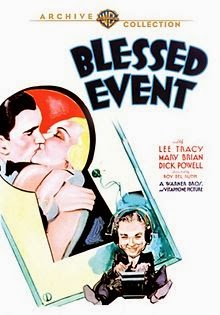
Classic Films in Focus: BLESSED EVENT (1932)

Although it's billed as a comedy, Roy Del Ruth's Pre-Code picture, Blessed Event (1932), actually gets into some pretty dark territory, thanks to an amoral protagonist who earns fame and fortune by airing other people's secrets in a sleazy tabloid column. Like Red-Headed Woman (1932) and Baby Face (1933), it's the kind of story that can only come from the Pre-Code era, replete with Prohibition drinking, sex scandals, and mobster violence. In this instance, the familiar theme of the social climber's willingness to use other people in order to get to the top is exemplified by Lee Tracy, who presents a masculine take on the street smart persona we often associate with Harlow and Stanwyck. Fans of the wisecracking star will appreciate his performance in Blessed Event, while those who favor the Busby Berkeley musicals of the period will enjoy seeing the big screen debut of Dick Powell as Tracy's chief target and social rival.

Tracy plays the ambitious Alvin Roberts, who gets his big break in the newspaper business by running short gossip pieces about the city's expectant mothers. He pens particularly juicy quips about the wealthy and the unwed, which earns the paper thousands of new readers and attracts death threats and lawsuits for Roberts. Alvin's girlfriend, Gladys (Mary Brian), has misgivings about the unethical nature of his work, but Alvin persists until a desperate pregnant woman (Isabel Jewell) embroils him in a dangerous situation with a mob boss (Edwin Maxwell) wants to murder Alvin to keep his name out of the affair.

The movie never pretends that Alvin's column isn't salacious, vicious, and under-handed, but it does offer us glimpses of Alvin's better nature. He supports and lives with his doting mother (Emma Dunn), whom he loves so much that he lets her listen to his nemesis, Bunny Harmon (Dick Powell), on the radio. He's smart, funny, and gifted with a cheerful disposition, even when confronted with gangsters who want to shut him up. One of Tracy's best scenes comes when tough guy Frankie Wells (Allen Jenkins) arrives to lean on Alvin but ends up being horrified into submission by Alvin's vivid recreation of a death row execution. The gossip columnist is presented to us as a 1930s version of the immortal trickster figure, a yellow press descendant of Coyote, Ananzi, and Brer Rabbit. He's not necessarily a good guy, but he's a lot of fun to watch.

Alvin steps over a line, though, when he prints the "blessed event" piece about Dorothy Lane, the pitiful little singer who begs him not to report her condition in the paper. Isabel Jewell gives a heartbreaking - although uncredited - performance as the pregnant girl. She's so pale and despairing that we expect any minute to hear that she has thrown herself out of a window after Alvin runs the tidbit in spite of her pleas. The story teeters on the edge of tragedy once she is introduced, and the ending can only ameliorate the damage that Alvin causes her. Once printed, his words can never be taken back, a fact that he doesn't appreciate until the very end of the film. Although most of the story makes light of scandalous pregnancies and quick marriages, this plot suggests the more serious plight of young women suffering Dorothy's fate; she loses her job, her home, her reputation, and even the support of her married lover in the wake of Alvin's disclosure.

Be sure to appreciate Ruth Donnelly as Alvin's assistant, Ned Sparks as a sour-faced colleague, and, of course, Dick Powell as the handsome radio crooner, Bunny Harmon. See more of Lee Tracy in Doctor X (1932), Dinner at Eight (1933), and Bombshell (1933). Roy Del Ruth also directed Blonde Crazy (1931), Born to Dance (1936), and Topper Returns (1941). Look for Mary Brian in The Front Page (1931), and don't miss Isabel Jewell in her best-known role as Emmy Slattery in Gone with the Wind (1939).

Blessed Event is currently available for streaming on Warner Archive Instant.

Sunday, November 10, 2013

Classic Films in Focus: DIPLOMANIACS (1933)

Although it’s often compared to The Marx Brothers’ Duck Soup (1933), which came out the same year, Diplomaniacs (1933) proves a far more difficult picture for a modern viewer to engage, and that difficulty helps to explain why The Marx Brothers are icons while Wheeler and Woolsey have been relegated to obscurity. This wild - and wildly inappropriate - satire of international politics certainly has its funny moments, but it’s probably best appreciated by serious classic film enthusiasts who are prepared to handle a manic 62 minute musical that packs in just about every racial “face” stereotype of 1930s Hollywood. Diplomaniacs is also rife with racy pre-Code sexual energy, so put the kids to bed before you attempt to fathom the appeal of this picture and its truly nutty stars.

Bert Wheeler and Robert Woolsey star as Willy and Hercules, a couple of barbers who fruitlessly set up shop on an Indian reservation, where, supposedly, their services are never required. The locals hire the pair to be their representatives at a peace conference in Geneva, but a scheming ammunitions tycoon (Louis Calhern) tries to sink their efforts because his business depends on countries trying to kill each other. He unleashes a vamp, Dolores (Marjorie White), to seduce the boys, and later he also hires Fifi (Phyllis Barry) to thwart them, but the duo’s own ineptitude seems equally likely to undermine their mission.

We start the picture with white chorus girls dressed up in some very skimpy - and utterly fake - Native American costumes, along with Edward Cooper as the tribe’s Oxford-educated chief. After a series of “red man” shenanigans, the action moves to Europe, where the villain’s henchman is a Chinese pseudo-philosopher played by Hugh Herbert. He spouts plenty of fortune cookie nonsense before abandoning the plot and rowing back to China. Left in Europe, Willy and Hercules avoid the embraces of the two women but wind up part of a huge black face musical number when a bomb explodes in the peace conference. That gives us red face, yellow face, and black face all in about one hour, if you happen to be keeping count.

For casual modern viewers and youngsters, that much racial humor is probably a deal breaker already, but Diplomaniacs also revels in the kind of saucy comedy that only pre-Code pictures could get away with, at least until many decades later. The chorus girls show up again in some eye-popping French maid outfits, and the running gags involving both Dolores and Fifi reveal their one-note function as sex objects. More subversive is Wheeler’s frequent positioning as the “female” half of the comedy pair; the joke is most obvious when the two protagonists wake up in bed together and Willy promptly dons a lady’s dressing gown.

An academic viewer might well find it worthwhile to parse the meta, satiric, and even carnivalesque aspects of this picture, and experienced classic movie viewers might enjoy it for its parallels to Duck Soup and its instructive glimpse of the Wheeler and Woolsey style. For a quick tour of all the crazy things pre-Code movies could get away with, it’s certainly an effective example, but you have to be prepared for what you are going to get. Many viewers are likely to be too offended by the movie’s caricatures to enjoy its gags, and that’s a valid response, especially if you happen to belong to one of the groups being misrepresented.

Wheeler and Woolsey can also be found in Caught Plastered (1931), Hips, Hips, Hooray! (1934), and Kentucky Kernels (1934). William A. Seiter, who directed Diplomaniacs, is best remembered today for Fred Astaire films like You Were Never Lovelier (1942) and Shirley Temple vehicles like Stowaway (1936). Look for Louis Calhern in Duck Soup (1933), Notorious (1946), and The Asphalt Jungle (1950). You'll find Hugh Herbert in Dames (1934), A Midsummer Night's Dream (1935), and Hollywood Hotel (1937).

Diplomaniacs is one of a handful of Wheeler and Woolsey films currently available for streaming on Warner Archive Instant.

Thursday, July 25, 2013

Classic Films in Focus: RED-HEADED WOMAN (1932)

Red-Headed Woman (1932) mixes drama and comedy in its story of a relentless gold digger who sleeps her way up the social ladder, with Jean Harlow starring as the title character. Despite her reputation as a platinum blonde, Harlow goes red to play the sexpot siren in this Pre-Code picture directed by Jack Conway. Her costars include Chester Morris, Leila Hyams, Una Merkel, Lewis Stone, and Henry Stephenson, but the picture belongs wholly to Harlow and her scheming anti-heroine, a Prohibition Becky Sharp who’ll stop at nothing to get the wealth and status she desires. With its scandalous affairs and amoral protagonist, Red-Headed Woman is a perfect example of Pre-Code style, although Harlow’s character is so vicious a homewrecker that viewers may find her very hard to like.

Harlow plays Lil Andrews, an office girl with her eye on her married boss, Bill (Chester Morris). When Bill’s wife, Irene (Leila Hyams), leaves town for a few days, Lil makes her move and succeeds in busting up the marriage. Lil then tries to break into Bill’s society circle, taking her pal Sally (Una Merkel) along, but Bill’s family and friends prove much harder to win over. Undaunted, Lil plays a duplicitous game by seducing both Bill’s friend, Charles (Henry Stephenson), and Charles’ French chauffeur, Albert (Charles Boyer).

The role of the sexual adventuress puts Harlow’s raw sex appeal on full display, and there’s certainly plenty of her to admire on camera, even when she’s fully dressed. Her ample curves always suggest nakedness, even beneath the cover of her clingy, transparent gowns. It’s little wonder that every man she meets succumbs to her charms, even though her approach is so aggressive that it’s really more a full frontal assault than a seduction. Lil possesses none of the fresh, feisty sweetness that marks Harlow’s best roles, and the plot has no interest whatsoever in her moral development or redemption. Poor Irene gets blamed for not fighting harder to keep her man, but it’s impossible to root for Lil when Irene so obviously occupies the moral high ground as the injured and insulted wife. If Lil doesn’t end the picture as a murderess on death row, it’s not for lacking of trying on her part.

The supporting cast includes frequent Harlow gal pal Una Merkel as the comic relief, although mostly she’s there to gasp in shock at Lil’s outrageous behavior. Lewis Stone and Henry Stephenson are both solid as the older men, although Chester Morris’ Bill is such a spineless sap that we wonder why Irene wants him back. Leila Hyams, however, makes a perfect foil to Harlow as the cultured, elegant Irene, a cool blonde whose beauty has nothing to do with sex. May Robson has a fun role as Irene’s Aunt Jane, and Charles Boyer is obviously Lil’s natural match as the handsome chauffeur who dallies with her right under his boss’ nose.

For a different take on the Pre-Code sexual adventuress, try Baby Face (1933). You’ll find Harlow playing more sympathetic characters in Bombshell (1933), The Girl from Missouri (1934), and Saratoga (1937), with more direction on the latter two from Jack Conway, who also directed Harlow in Libeled Lady (1936). Chester Morris earned an Oscar nomination for Best Actor for Alibi (1929), but he also played Boston Blackie in a long series of films and did a lot of television work late in his career. See more of Una Merkel, a great comedic character actress, in Destry Rides Again (1939) and It’s a Joke, Son! (1947). The screenplay for Red-Headed Woman was written by Anita Loos, whose other credits include several Harlow films and classics like San Francisco (1936) and The Women (1939). Loos also wrote the original 1926 novel version of Gentlemen Prefer Blondes, which would help to create the lasting image of another iconic blonde bombshell, Marilyn Monroe, when it was adapted as a film in 1953.

Red-Headed Woman is currently available for streaming on Warner Archive Instant.

Sunday, July 7, 2013

Classic Films in Focus: THIRTEEN WOMEN (1932)

Directed by George Archainbaud, Thirteen Women (1932) is a Pre-Code thriller starring two great actresses of the 1930s, Irene Dunne and Myrna Loy. As its name implies, this film focuses on female characters for most of its action, which sets it apart from other murder mysteries, but it’s a mixed bag as a picture, with a particularly weak third act. Fans of Myrna Loy, however, will still want to see Thirteen Women for another of the star’s memorable performances as an exotic femme fatale, while those who enjoy classic Hollywood trivia will appreciate the film as the only screen appearance of the doomed Peg Entwistle, who famously committed suicide by throwing herself from the top of the Hollywood sign.

Loy plays the mesmerizing half-caste murderess, Ursula Georgi, who uses a swami (C. Henry Gordon) to exact revenge on a group of schoolmates who were unkind to her years ago. One by one the women succumb to Ursula’s baleful influence, and even the swami ends up dead. The survivors gather and hope to ward off their predicted fates, but their leader, Laura (Irene Dunne), must confront the enemy when Ursula targets her son, Bobby (Wally Albright), as the next victim. With the help of a handsome police sergeant (Ricardo Cortez), Laura strives to keep Ursula’s latest prediction from coming true.

We never actually see the whole group of thirteen women in the movie; apparently, some of them ended up on the cutting room floor, with the final version of the picture chopped down to a mere 59 minutes. Fortunately for Hollywood history, Peg Entwistle’s brief appearance stayed in the picture, giving us our only chance to see her onscreen. Like most of the other actresses, Entwistle gets a chance to crank up the sense of doom; ironically, her character, Hazel Cousins, does not commit suicide but instead goes mad and stabs her husband. Mary Duncan opens the series of tragedies with a very effective performance as June Raskob, the trapeze artist, and Kay Johnson has perhaps the most heart-wrenching fate as the grieving mother, Helen, who needs little encouragement from Ursula to kill herself after the recent death of her young child.

Myrna Loy’s performance as the villainous foreigner serves as the real attraction of the film. With her striking costumes and heavy eye makeup, Ursula symbolizes the seductive Eastern Other, striking out at white Western women after their thoughtless rejection of her. Loy got typecast in this kind of role early in her career, but she does it so well that it’s easy to see why. Her best scenes feature her seducing and manipulating the helpless swami and her accomplice, Burns (Edward Pawley), especially the moment that sees her willing the swami to death on the train platform. Men simply turn to putty in her hands, and her hypnotic stare rivals that of Bela Lugosi in Dracula (1931). She really is a vamp, formed only to corrupt and destroy. Unfortunately, the ending denies her the kind of suspenseful, thrilling chase and climax that such a character deserves. That deflating, uninspired conclusion proves far more troubling than the missing women or any other problems with the picture, and it keeps Thirteen Women in the minor leagues as an example of its genre.

For another of Myrna Loy’s seductive vamps, see The Mask of Fu Manchu (1932), or catch her more famous performances in The Thin Man (1934), The Great Ziegfeld (1936), and The Best Years of Our Lives (1946). Irene Dunne earned five Oscar nominations for Best Actress over the course of her career, including nods for The Awful Truth (1937), Love Affair (1939), and I Remember Mama (1948). George Archainbaud directed for many Westerns and television series, including The Lone Ranger series starring Clayton Moore and Jay Silverheels.

You can currently see Thirteen Women on Warner Archive Instant.

Wednesday, September 12, 2012

Classic Films in Focus: NIGHT NURSE (1931)


As part of the Turner Classic Movies collection, Forbidden Hollywood Volume 2, Night Nurse (1931) represents the kinds of pictures made before the infamous Hays Code took effect and began to censor what movies could and could not show to the American viewing public. Prurient interests aside, Night Nurse is worth watching for several reasons, not the least of which is the opportunity to see Barbara Stanwyck square off against Clark Gable.

The plot focuses on Stanwyck's character, Lora Hart, a plucky young woman who devotes herself to a nursing career and eventually becomes entangled in a scheme to murder two little girls for their trust fund money. The first half of the film chronicles Lora's rise through the nurse training program, showing her to be a determined but good-hearted girl who faints in the operating room after a patient suddenly dies. The look on Lora's face as she hands out babies in the maternity ward tells us all that we need to know about her basic nature, so it comes as no surprise when her maternal instincts are roused by the plight of her two young charges, who are being slowly starved to death in a conspiracy engineered by the mother's menacing chauffeur, Nick (Gable).

Stanwyck, of course, became an icon playing femme fatale and tough cookie types, and this role is something of a departure for her, even in the early days of her long career, although it helps pave the way for her maternal turn in Stella Dallas (1937). The plot of the film might have made Night Nurse a Gothic tale except for the resolutely practical personality that Stanwyck manifests, and it is a great relief to see her aptly named Lora Hart so courageous and unyielding when other heroines might have collapsed under the strain.

Gable is just pure evil as Nick, the villainous chauffeur who keeps the girls' mother sloppy drunk as part of his plan to murder the children and then grab the trust fund fortune by marrying the incapacitated woman. Presumably he intends to become a widower soon afterward. Everyone else in the movie seems to be deathly afraid of him, and it's easy to see why whenever he appears in his black chauffeur's uniform, reeking of cruelty and masculine power. He is a violent man, which the film shows us very early on and then never lets us forget. We understand that he is a man who really will starve defenseless little girls to death, and Gable makes for a perfectly convincing villain in every respect. If he hadn't become a leading man he might have made a fine character actor for heavies.

Enjoy the loose talk, the various scenes of Stanwyck and Joan Blondell dressing and undressing, and the other scandalous bits of the film, but take note of the "view from the driver's seat" camera work, too. The movie experiments with some wonderful camera angles designed to convey the drama and urgency of the medical profession, particularly in the ambulance scenes. Night Nurse is packaged as a source of titillation for those who want to see Hollywood’s lustier period, but it is a fine picture, tightly plotted and extremely well acted by some of classic cinema's greatest stars. The Night Nurse disc from the Forbidden Hollywood collection also contains the fascinating documentary, Thou Shalt Not: Sex, Sin and Censorship in Pre-Code Hollywood, which provides a very entertaining overview of the Hays Code and the ways in which it altered the film industry's standards.

For more of Stanwyck’s Pre-Code pictures, see Ladies They Talk About (1933) and Baby Face (1933) on other volumes of the Forbidden Hollywood collection. Stanwyck makes some of her most memorable appearances in The Lady Eve (1941), Ball of Fire (1941), and Double Indemnity (1944). In addition to his iconic performance in Gone with the Wind (1939), see Clark Gable in It Happened One Night (1934), Wife vs. Secretary (1936), and The Misfits (1961). Director William A. Wellman also helmed The Public Enemy (1931), The Ox-Bow Incident (1943), and Westward the Women (1951).

An earlier version of this review originally appeared on Examiner.com. The author retains all rights to this content.