Showing posts with label Lewis Stone. Show all posts

Thursday, May 15, 2014

Classic Films in Focus: ROMANCE (1930)

Greta Garbo earned two Oscar nominations for Best Actress in 1930, one for Anna Christie (1930) and the other for Romance (1930). Both talking pictures and the Oscars were still new that year, and the double nomination testifies to the thrill viewers felt on hearing Garbo’s remarkable voice. In Romance, directed by Clarence Brown, Garbo uses that voice and all of her other charms to great effect, although the picture falls short of her best work because of trouble with the story and a weak performance from her leading man. Despite these issues, Romance is worth watching for its luminous star, who revels in the glamor and the tragedy of her character in truly operatic fashion.

Garbo plays European opera diva Rita Cavallini, who arrives in New York as the guest of her much older lover, Cornelius Van Tuyl (Lewis Stone). There she meets Tom Armstrong (Gavin Gordon), a young clergyman who becomes enamored of her and naively believes that they can be married. Van Tuyl encourages Rita to end the relationship in order to spare Tom the inevitable heartbreak of learning the truth about Rita’s past affairs, but Rita finds her own love for Tom too powerful to resist.

Rita is a perfect role for Garbo because it capitalizes on her persona as a foreign enchantress, an angel of the unknown, both gloriously bright and faintly threatening. Radiantly beautiful in her formal evening gown, Rita appears in her first important scene with Tom as a Sleeping Beauty awakened by his arrival in the room, but her pose is all a calculated role. Tom fails to recognize her, and she delights in his ignorance, even telling him that Madame Cavallini is a fat, ugly hunchback. The way she says “horrible” is thrillingly naughty, exaggerated and arch. Throughout the movie she is the flame to which moths and viewers are drawn, so we understand why both Van Tuyl and Tom fall in love with her, but it’s much harder to fathom what she sees in Tom, who comes off as priggish, stiff, and hopelessly out of touch. His prudish morality sounds especially dull coming from Gavin Gordon, who simply lacks any onscreen chemistry with his leading lady. We really believe he’d marry her and then expect her to be content crocheting doilies for the rectory and receiving the occasional chaste peck on the cheek as a mark of his affection.

The frame tale that surrounds the central narrative works very well, with the elderly Tom much more sympathetic and interesting than young Tom ever manages to be. Old Tom, a wiser and a sadder man, tells the story of his brief romance to his grandson, Harry (Elliott Nugent), a headstrong youth who wants to marry an actress against his mother’s wishes. We find out a lot about the aftermath of Tom and Rita’s brief time together in just a few lines of quiet dialogue. Of course Tom settles into a comfortable life with a woman more suited to his expectations and profession, but Rita’s story takes a different turn, surprising perhaps but perfectly in keeping with the grand theatrical nature of her passions. The last time we see her in Tom’s story, she is standing like a saint at the sacrificial stake, her rapt face turned toward God, with the forgotten and now worshipful Tom clinging to the hem of her gown. She seems poised for ascension; what earthly life could hold meaning for her after a moment like that?

Be sure to appreciate the appearance of Clara Blandick, best remembered as Auntie Em in The Wizard of Oz (1939), as Tom’s disapproving aunt. See more of the great Garbo in Grand Hotel (1932), Queen Christina (1933), and Ninotchka (1939). Gavin Gordon went on to play supporting roles in many films, including Mystery of the Wax Museum (1933), The Scarlet Empress (1934), and The Bride of Frankenstein (1935). Lewis Stone played Judge Hardy in the Andy Hardy series, but you’ll also find him in other Garbo films and in Jean Harlow pictures like Red-Headed Woman (1932) and China Seas (1935). Clarence Brown earned an Oscar nomination for Best Director for his work on Romance; although he never won, he picked up five more nominations over the course of his career for films like A Free Soul (1931), National Velvet (1944), and The Yearling (1946).

Tuesday, April 8, 2014

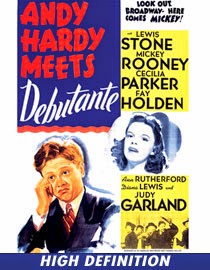
Classic Films in Focus: ANDY HARDY MEETS DEBUTANTE (1940)

This installment of the popular Andy Hardy series takes the Hardy family out of idyllic Carvel and sends them off to New York City, where teenage Andy promptly gets himself into all kinds of trouble. Despite the change of venue, it’s a typical Andy Hardy story, with youthful mistakes, romantic entanglements, and Mickey Rooney’s boundless zeal. You don’t have to have seen all of the previous Hardy pictures to drop into the action, although it does help if you have seen Love Finds Andy Hardy (1938), the earlier movie that introduces Judy Garland’s Betsy Booth character. Garland’s return to the world of the Hardy family makes Andy Hardy Meets Debutante a particularly appealing picture for fans of her collaborations with the energetic Rooney. For newcomers, the distinctive mix of adolescent romance, humor, and wide-eyed American idealism sums up the essence of the Hardy films’ enduring appeal.

At home in Carvel, Andy is nursing a crush on New York society girl, Daphne Fowler (Diana Lewis), and he foolishly brags about knowing her when his friends discover his passion. Andy is forced to prove his claims when Judge Hardy (Lewis Stone) takes the whole family to New York as part of his mission to protect the Carvel Orphanage from big city lawyers who want to defund it. Andy’s friend, Betsy (Judy Garland), tries to help him, but Andy suffers a series of shocks to his ego as he attempts to meet Daphne, and even Judge Hardy becomes concerned about the implications of Andy’s behavior.

Part of Andy Hardy’s appeal is his penchant for getting into scrapes; neither an angel nor a complete reprobate, he’s a twentieth-century Tom Sawyer with a waggish sense of fun and a lively eye for the ladies. Wherever Andy goes, girl trouble follows, and in this outing he has Polly Benedict (Ann Rutherford), Betsy, and Daphne to juggle. Andy thinks he’s too sophisticated for Polly, and he treats Betsy like a kid, but he soon finds out that the wealthy Daphne is out of his league. “There are millions of nice people in the world,” Daphne’s mother tells him, “and Daphne can’t be friends with all of them.” The irony of his comeuppance never seems to dawn on Andy, but the audience sees quite clearly that he reaps as he has sown. His taste in girls needs adjusting, anyway, if he can favor Daphne over her more available competition. Polly, the hometown favorite, wins our approval thanks to Ann Rutherford’s flashing eyes and bold manner, while Judy Garland makes Betsy so sweet and sadly lovestruck that we root for her even though we know that Polly has already staked her claim. Garland’s performance of “Alone,” which starts as a gag and ends with tears, is an emotional highlight of the picture that showcases the young star’s tremendous talent.

Comedy tempered with sentiment is the Andy Hardy formula, and the threat to the orphanage provides a counterweight to Andy’s romantic hijinks. Judge Hardy proves his faith in the system, lectures Andy on American ideals, and wins over a courtroom with the assistance of an adorable orphan, all of which will strike modern viewers as terribly naive. Still, with the Depression in the rearview mirror and the war directly ahead, Americans in 1940 must have wanted very much to believe in the benevolent paternal authority that Judge Hardy embodies. Andy’s relationship with his father gets a great deal of play, while his mother, aunt, and sister hardly make appearances at all. The serious part of Andy Hardy Meets Debutante has nothing to do with women but concerns itself with Andy’s emerging identity as a man with a particular place in the world.

The Andy Hardy series continued until 1958, when Mickey Rooney made his final bow as the character in Andy Hardy Comes Home. George B. Seitz directed most of the Andy Hardy pictures, beginning with A Family Affair (1937), You’re Only Young Once (1937), and Judge Hardy’s Children (1938). For more of Mickey Rooney’s youthful roles, see A Midsummer Night’s Dream (1935), Captains Courageous (1937), and Boys Town (1938). Diana Lewis, who was married to William Powell for more than forty years, retired from acting in the early 1940s after roles in Bitter Sweet (1940), Go West (1940), and Johnny Eager (1941). If you enjoy the collaborative work of Rooney and Garland, be sure to see their musicals together, particularly Babes in Arms (1939), Strike Up the Band (1940), and Babes on Broadway (1941).

Andy Hardy Meets Debutante is currently available for streaming on Warner Archive Instant.

Thursday, July 25, 2013

Classic Films in Focus: RED-HEADED WOMAN (1932)

Red-Headed Woman (1932) mixes drama and comedy in its story of a relentless gold digger who sleeps her way up the social ladder, with Jean Harlow starring as the title character. Despite her reputation as a platinum blonde, Harlow goes red to play the sexpot siren in this Pre-Code picture directed by Jack Conway. Her costars include Chester Morris, Leila Hyams, Una Merkel, Lewis Stone, and Henry Stephenson, but the picture belongs wholly to Harlow and her scheming anti-heroine, a Prohibition Becky Sharp who’ll stop at nothing to get the wealth and status she desires. With its scandalous affairs and amoral protagonist, Red-Headed Woman is a perfect example of Pre-Code style, although Harlow’s character is so vicious a homewrecker that viewers may find her very hard to like.

Harlow plays Lil Andrews, an office girl with her eye on her married boss, Bill (Chester Morris). When Bill’s wife, Irene (Leila Hyams), leaves town for a few days, Lil makes her move and succeeds in busting up the marriage. Lil then tries to break into Bill’s society circle, taking her pal Sally (Una Merkel) along, but Bill’s family and friends prove much harder to win over. Undaunted, Lil plays a duplicitous game by seducing both Bill’s friend, Charles (Henry Stephenson), and Charles’ French chauffeur, Albert (Charles Boyer).

The role of the sexual adventuress puts Harlow’s raw sex appeal on full display, and there’s certainly plenty of her to admire on camera, even when she’s fully dressed. Her ample curves always suggest nakedness, even beneath the cover of her clingy, transparent gowns. It’s little wonder that every man she meets succumbs to her charms, even though her approach is so aggressive that it’s really more a full frontal assault than a seduction. Lil possesses none of the fresh, feisty sweetness that marks Harlow’s best roles, and the plot has no interest whatsoever in her moral development or redemption. Poor Irene gets blamed for not fighting harder to keep her man, but it’s impossible to root for Lil when Irene so obviously occupies the moral high ground as the injured and insulted wife. If Lil doesn’t end the picture as a murderess on death row, it’s not for lacking of trying on her part.

The supporting cast includes frequent Harlow gal pal Una Merkel as the comic relief, although mostly she’s there to gasp in shock at Lil’s outrageous behavior. Lewis Stone and Henry Stephenson are both solid as the older men, although Chester Morris’ Bill is such a spineless sap that we wonder why Irene wants him back. Leila Hyams, however, makes a perfect foil to Harlow as the cultured, elegant Irene, a cool blonde whose beauty has nothing to do with sex. May Robson has a fun role as Irene’s Aunt Jane, and Charles Boyer is obviously Lil’s natural match as the handsome chauffeur who dallies with her right under his boss’ nose.

For a different take on the Pre-Code sexual adventuress, try Baby Face (1933). You’ll find Harlow playing more sympathetic characters in Bombshell (1933), The Girl from Missouri (1934), and Saratoga (1937), with more direction on the latter two from Jack Conway, who also directed Harlow in Libeled Lady (1936). Chester Morris earned an Oscar nomination for Best Actor for Alibi (1929), but he also played Boston Blackie in a long series of films and did a lot of television work late in his career. See more of Una Merkel, a great comedic character actress, in Destry Rides Again (1939) and It’s a Joke, Son! (1947). The screenplay for Red-Headed Woman was written by Anita Loos, whose other credits include several Harlow films and classics like San Francisco (1936) and The Women (1939). Loos also wrote the original 1926 novel version of Gentlemen Prefer Blondes, which would help to create the lasting image of another iconic blonde bombshell, Marilyn Monroe, when it was adapted as a film in 1953.

Red-Headed Woman is currently available for streaming on Warner Archive Instant.