Showing posts with label Tallulah Bankhead. Show all posts

Saturday, December 2, 2023

Classic Films in Focus: THE CHEAT (1931)

I decided to watch The Cheat (1931) knowing that other classic movie bloggers have found the picture merely mediocre, but with Huntsville native Tallulah Bankhead in the starring role I felt obligated to give it a try and see for myself. Sadly, this Pre-Code drama deserves the lukewarm reviews others have given it. Despite the shocking act that serves as its focal moment, The Cheat drags through its hour and 14 minutes and fails to make the most of its stars or themes. Despite its problematic use of Japanese culture, it's not so bad as to be unwatchable, but it isn't good enough to hold your full attention, either.

Bankhead stars as gambling addict Elsa Carlyle, whose husband, Jeffrey (Harvey Stephens), futilely asks his wife to rein in her expensive habits. When Elsa loses a huge sum of money on a frivolous bet, she steals from a charity fund to pay it off so that her husband doesn't find out about her debts, but she ends up in even worse shape because her investment of the pilfered cash crashes. Sensing an opportunity, the lecherous Hardy Livingstone (Irving Pichel) offers to give her the money in exchange for sexual submission, and the desperate Elsa agrees. A change of luck seems to offer an escape from her adulterous bargain, but Elsa discovers Hardy's deeply sadistic nature when she attempts to back out of their deal.

With its Faustian bargain, its climatic scenes of torture and public exposure, and Bankhead's tremendous presence, The Cheat ought to be a provocative Pre-Code shocker, but the end result falls sadly flat. Bankhead certainly has the persona to play a debauched gambler, but it's impossible to believe in her as an otherwise loving and faithful wife. Her husky, rich voice and world weary stare radiate carnal knowledge and experience, and as a giddy fool who doesn't realize her peril she's simply miscast. The happy ending, which insists on Elsa's reform and return to marital propriety, seems bizarre and out of joint with the events that have come before, especially the chaotic trial scene. Jeffrey himself is a bore, and Stephens has zero chemistry onscreen with Bankhead to make us believe these two people actually love each other. Irving Pichel provides moments of menace, but he's not equal to the lavish trappings of his character, which revel in a troublesome Orientialist vision of Japanese culture and people. 

Part of the problem with Pichel's villain reveals itself when we look back at Cecil B. DeMille's original 1915 version of The Cheat, which cast Japanese star Sessue Hayakawa as the vindictive seducer. In the 1931 remake, a white character replaces the Asian one but keeps all of his cultural context, which alters the racial stereotyping without dispelling it. Pichel's Hardy Livingstone is yellowface casting in disguise, but without the screen charisma of Fu Manchu stars Warner Oland, Boris Karloff, or Christopher Lee to make it interesting (although still offensive). I have yet to see the silent version, but I imagine that the smoldering good looks of Hayakawa at least make the villain's seduction more exciting, and, according to the San Francisco Silent Film Festival's discussion of the picture, the role brought Hayakawa instant - and controversial - fame. If Pichel sits awkwardly in the role, that might not be entirely his fault, given the ways in which the altered character obscures racial stereotyping without actually erasing it.

The best place to see Tallulah Bankhead on film remains Alfred Hitchcock's excellent WWII story, Lifeboat (1944), so start there if you're looking for the scandalous Broadway star's Hollywood work. George Abbott is the credited director for The Cheat (with uncredited assistance from Berthold Viertel); Abbott also directed Bankhead in My Sin (1931), but his best known pictures are The Pajama Game (1957) and Damn Yankees (1958). The Cheat marked the film debut of stage actor Harvey Stephens, who continued to appear in movies and television but in smaller supporting roles. Irving Pichel is probably better remembered as a director whose work includes The Most Dangerous Game (1932), The Man I Married (1940, and They Won't Believe Me (1947), as well as the charming romantic fantasy Mr. Peabody and the Mermaid (1948) and the Technicolor sci-fi classic Destination Moon (1950).

See also: A Tallulah Tribute in CRUELLA (2021)


Thursday, April 28, 2022

The What-If Alternate Timeline of CRUELLA (2021)

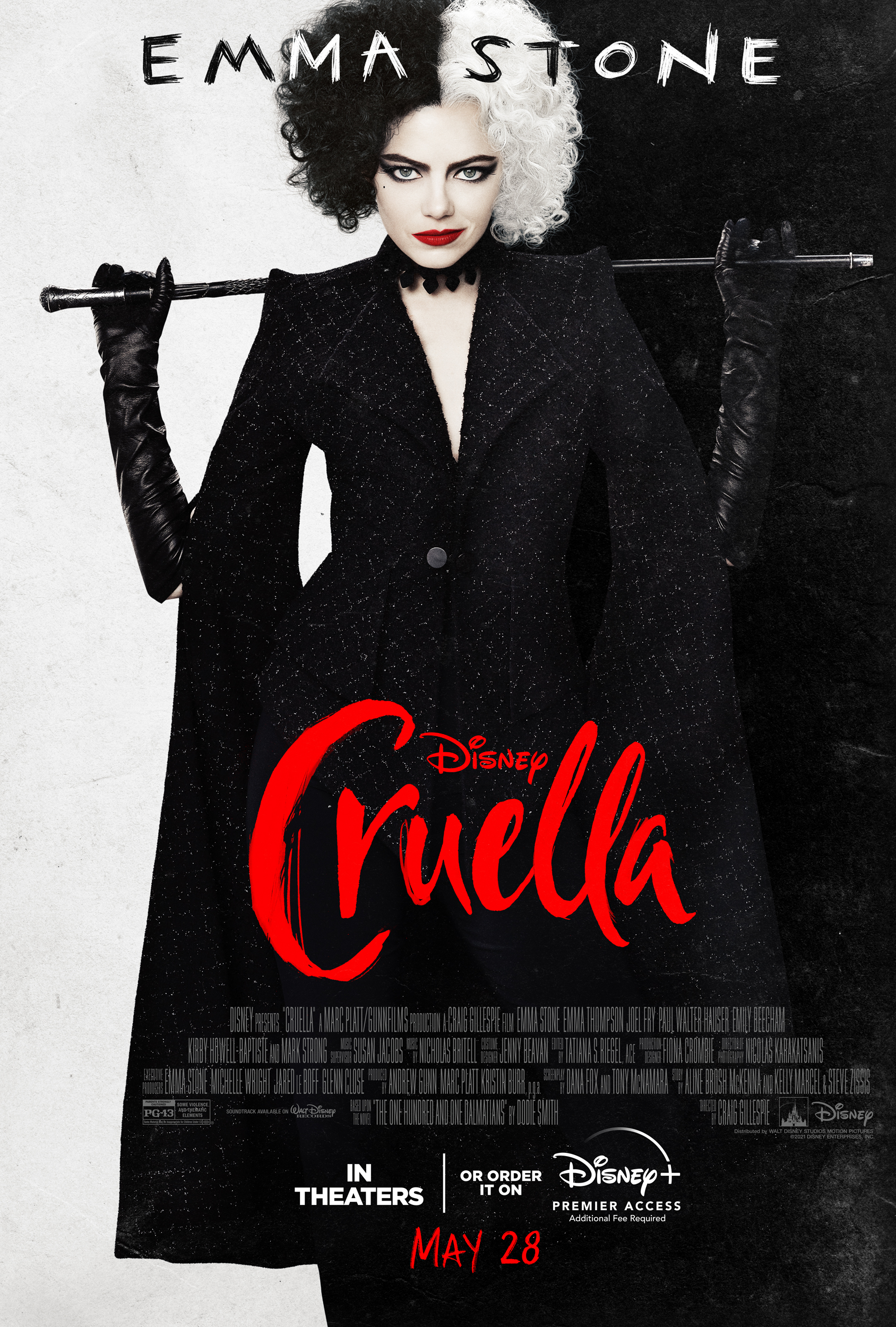
When it first arrived, Disney's 2021 reboot of the various films based on 101 Dalmatians was widely discussed as yet another "prequel" to a well-known Disney property, but in order to appreciate Cruella fully you have to stop thinking about it as a prequel and instead consider it as an alternate timeline narrative similar to the multiverse arcs now at work in the Marvel franchise. This is NOT the story of how the villain of the 1961 animated movie became that character, and it's not the story of the villain from the 1996 live action movie, either. Instead, Emma Stone's version of Cruella is a character with a narrative arc all her own, distinct from those of the other Cruellas but still affected by many of the same elements with alternate versions of the same characters. She's much like the central Loki character played by Tom Hiddleston in the Disney Plus series; she is one of many possible Cruella variants, some of whom are truly villainous and some of whom are dynamic enough to become protagonists in their own right rather than merely antagonists to more conventionally heroic characters. When read this way, Cruella becomes a much more interesting and engaging movie, one that rewrites the iconic villain, sure, but also one that reaches deep into the sources of inspiration that formed the original Disney character.


Fidelity to the 1961 animated classic is already an odd demand, not only because live action versions of that story were already made in the late 90s but because the original Disney movie is itself unfaithful to its source material in several significant ways. Dodie Smith's beloved 1956 children's novel features many characters and scenes that aren't in the Disney film. A third adult Dalmatian (the one actually named Perdita) is removed completely, with a dog originally named Missus assuming her name and erasing her from the story. The novel's Roger is wealthy because he is a "financial wizard" and not a struggling musician, so the family can afford all of their Dalmatians even when they end up with 101 of them (note that the 101st Dalmatian of the novel also isn't in the movie because he's the liver spotted love interest of the original Perdita). The Cruella of the book is more explicitly demonic and even more vicious than the movie version; she is also married to a submissive furrier who enables her obsession with fur coats. The changes don't make the Disney adaptation a bad movie, but they do make it a significantly different story from the novel. The live action versions get farther afield still, making Roger an American video game creator, Anita a fashion designer, and Cruella a fashion house owner and Anita's employer. In fact, the versions are so different (and set in different eras to boot) that the 2021 movie cannot possibly function as a true prequel to any of them.

Tallulah!

Instead, Cruella is its own story, a reinvention of the character that combines her most iconic traits with bits and pieces of the previous versions in order to make her a dynamic protagonist rather than a static villain. The movie does not attempt to make us like or forgive the other Cruellas; we like this new Cruella partly because she isn't them. Our glimpse of her childhood recalls the schoolgirl connection with Anita from the novel, her mannerisms are taken from the 1961 Disney film, and her fashion career is borrowed from the 1996 movie, but she is not simply a younger version of any of these characters. Disney opts to do something different by mining the tradition of the anti-heroine as filtered through one of the most important inspirations for the 1961 Cruella, the legendary actress and all around hellraiser Tallulah Bankhead. The film even signals the affiliation with a clip of Tallulah demonstrating her distinctive, throaty laugh in Alfred Hitchcock's 1944 thriller, Lifeboat. We see it play on a television set in a room with Estella/Cruella early in the story. Bankhead, known for her genius, self-destructive behavior, terrible driving, and theatrical personality, was definitely no saint, but this new version of Cruella has her charisma and charm as well as her less likeable qualities. It's refreshing to see a complicated, difficult, too-much female character be the heroine of her own life without having to be either a traditionally good person or a completely amoral anti-heroine of the Becky Sharp variety.

Because this Cruella is not the same as the previous versions, she can make different choices and develop different values. She loves fashion but isn't specifically obsessed with fur. She has a found family that she mistreats at times but ultimately loves, which includes several dogs. She is even the person who gives Pongo and Perdita to Roger and Anita, which she certainly wouldn't do if she wanted to make Dalmatian fur coats. Near the end of the movie, Cruella says about the Baroness: "The good thing about evil people is that you can always trust them to do something, well, evil." Cruella, despite her name, is not that kind of person, because her Estella side makes her capable of doing good. Currently, a sequel to the movie is in the works, and most fans and critics seem to expect it to launch us into the more familiar dog-napping, coat-making territory of the original story, but I really hope it doesn't go in that direction, because this Cruella deserves better. It's certainly possible that she might become a newer version of the Baroness, the murderous mother whom she deposes in the film, and therefore ruthless enough to become a full-blown villain, but it would be much more satisfying to see her continue to make bold new choices for herself, to continue to be the future she embodies in Cruella and not the past that she sees as the Baroness. To rope this Cruella back into the framework of the original story would be a grave disservice to her and to viewers who fell for her eccentric, outlandish personality.

I've watched Cruella a couple of times now, and while I have concerns about Disney's persistent efforts to strip mine its own properties, I think this movie is one of the best live action treatments of a classic Disney story and far more interesting and fun than the previous attempts to cash in on the Dalmatians' popularity, largely because it isn't about the dogs. It's fun, it's visually engaging, it features terrific performances from Stone and Emma Thompson, and it offers us a Disney "heroine" who is very different from the usual crowd of princesses and whose transgressive modernity is part of her appeal. I don't care that it isn't actually a prequel to 101 Dalmatians; that's why it works. This Cruella might well be brilliant and bad and a little bit mad, but she's more 70s counterculture rock goddess than maniacal puppy murderer, and I'd like to see any additional films about her continue to give her the freedom to be her own version of herself.


Tuesday, September 7, 2021

A Tallulah Tribute in CRUELLA (2021)

We finally got to watch Disney's latest entry in the live action treatments of 101 Dalmatians characters, which this time moves the focus off the dogs entirely and charts the early misadventures of its title anti-heroine, Cruella de Vil. Early reviews of Cruella (2021) were mixed enough that we chose not to pay for Premiere Access and instead waited for the movie to drop to regular subscriber streaming, but I thought it was a fun romp with a lot going for it in spite of some flaws. For fashion nerds and Emma Stone/Emma Thompson fans there's a lot to love, although it's certainly far afield from the original 1961 Disney movie, which was itself notably different from the 1956 novel by Dodie Smith. 

One small detail that endeared the movie's creators to me is the inclusion of a quick but much appreciated tribute to Huntsville native and stage legend Tallulah Bankhead, whose throaty laugh, mannerisms, and infamous London driving inspired the Disney animators who first brought Cruella to life on screen. In an early scene in Cruella, the young Estella is in a room where Tallulah appears on a small television screen, her head thrown back as she delivers her deliciously raucous laugh. The scene on the television comes from Tallulah's most memorable film, Alfred Hitchcock's Lifeboat (1944), in which Tallulah stars as a reporter trapped on a small vessel with other survivors of a German U-boat attack. It's the best place for modern viewers to see the legendary star in action, although she also made memorable appearances in Stage Door Canteen (1943), A Royal Scandal (1945), and the 1960s Batman TV series.


The Cruella of the 1961 Disney film is an absolute villain who schemes to make fur coats out of puppies, but the Cruella embodied by Emma Stone is perhaps more like Tallulah herself, a complicated, flawed, sometimes bad and sometimes mad woman riding a tidal wave of misadventures through an unconventional but always interesting life. In fact, a biopic about Tallulah Bankhead would make an amazing movie and probably present an Oscar opportunity for the actress able to play her. Until some studio decides to make that movie, or adapt one of several stage plays about her life, Cruella is as close as we're going to get. 

For more about Tallulah Bankhead:

"Tallulah Bankhead's Huntsville Roots: Maple Hill Cemetery"

"Southern Voices on the Silver Screen"

Monday, October 21, 2019

Tallulah Bankhead's Huntsville Roots: Maple Hill Cemetery

Tallulah Bankhead was born in Huntsville, Alabama, on January 31, 1902, and evidence of her Huntsville roots can still be seen around town, even though the infamous stage and screen star is long departed. There are numerous places and historical markers bearing witness to her family's impact on the city, but one of the more somber sites is the grave of Tallulah's mother, Adelaide Eugenia Bankhead, who died shortly after Tallulah's birth. Mrs. Bankhead is buried at Maple Hill Cemetery near Huntsville's historic district and downtown, not far from the house where Tallulah entered the world and her mother left it.

Perhaps Tallulah's life might have been different had her mother lived. Perhaps the early loss, which devastated her father, William, drove some of the darker elements of Tallulah's personality. It's impossible to say for sure, but knowing the dizzying heights and terrible lows of the actress' life one can't help but wonder when standing beside her mother's grave. In 1902 the infant Tallulah was baptized next to her mother's coffin, and she and her elder sister, Eugenia, were packed off to be raised by their paternal grandmother, their maternal grandmother having also died just after giving birth to their mother. Tallulah's mother was just 22 years old when she died; Tallulah died too soon at 66, but she packed a dozen lifetimes of success and suffering into those 44 years her mother never had.

Tallulah returns to Huntsville each year in spirit as one of the resident "ghosts" of the Maple Hill Cemetery Stroll, though she herself is buried in Maryland, where her sister lived. You'll find a costumed performer inhabiting the role of the iconic star near her mother's grave, waving a long cigarette holder and holding forth about her family and her own legendary exploits. The event is well worth a visit if you're in the area.

For more posts about Tallulah, see "Southern Voices on the Silver Screen," "Classic Films in Focus: LIFEBOAT (1944)," and "Classic Films in Focus: 101 DALMATIANS (1961)."

Tuesday, March 29, 2016

Southern Voices on the Silver Screen

Hollywood has always had a complicated relationship with the American South and its inhabitants. In so much of the classic movie era, the South seems to exist only in the context of the Civil War; almost nobody appears as a resident of the region as it actually existed in the 1930s and 40s. Sure, the occasional hick or drawling belle shows up as an easy joke, but if you see Southerners represented in old movies you are usually watching a period piece with hoop skirts and cotton fields. Even then, the actors playing the Southerners weren't typically from there; Gone with the Wind was populated by Brits, not the sons and daughters of Dixie, and even Georgians who love the movie cringe at its tone-deaf, Tinseltown interpretations of a Southern accent (or Leslie Howard's refusal to attempt one at all).

Hollywood, however, became home to many native Southerners, people who might have given Vivien Leigh and Leslie Howard some much needed dialect coaching on the subtleties and diversity of Southern speech. We don't always recognize them as Southerners because success in show business often required the erasure of regional distinctions like accents. Actors from many parts of the world acquired voices to match the industry's homogenized image of Anglo-American whiteness just as they acquired new names and even new biographies. Southern accents were particularly undesirable for leads, since they connoted ignorance and backwardness instead of cosmopolitan sophistication or even all-American integrity. Character actors and comedians could get away with their native dialects to a greater extent, but sometimes they ended up feeding the negative attitudes audiences had toward Southern speech. It was a circular trap well known to actors from any kind of ethnic or racial minority.

Tallulah Bankhead
I know something about how all of this works from personal experience. I grew up in rural South Georgia, where nobody ever told me that I had a strong Southern accent because everyone else sounded exactly the same. When I left the South for the first time, I was in high school, and I was stunned to be confronted by people who laughed at the way I talked, called me "Scarlett," and asked me if people where I came from wore shoes. The same thing happened, though to a lesser degree, when I went to college. In urban Atlanta, nobody sounded like me; peers and professors heard my accent and assumed that I must not be very bright. My History of the English Language class voted my speech "Most Pronounced Dialect" - I was actually asked to go to the professor's office and record it for the class to study. Embarrassed and determined to fit in, I quickly learned to change the way I talked, much to my mother's dismay, but I wanted people to hear what I had to say and not just the way that I said it. Today, you can still tell I'm from the South, but the voice of my childhood exists only on old cassette tapes. I have my own complicated relationship with my identity as a Southerner and the speech that comes with it.

Miriam Hopkins
That experience makes me listen carefully to Southern actors - and actors pretending to be Southern - in classic movies. Modern actors from the South do not feel pressure to change their natural speech except for specific roles (think of Reese Witherspoon or Channing Tatum), but the old studio system dictated actors' public personae to a far greater degree. This month I have been watching movies starring Savannah native Miriam Hopkins and trying to figure out how Southern she sounds. Sometimes I can hear it, especially if she's in a comedy, but in the dramas it seems fainter and less distinct. She sounds more like the other leading ladies of her era than someone who spent her childhood in Bainbridge, GA, where my uncle once pastored a church. In Tallulah Bankhead's dripping voice, however, I can always hear the tones of a moneyed Alabama upbringing, in spite of all the tobacco, booze, and globe-trotting for which the Huntsville born actress was known. I actually laugh out loud when her character claims to be from Chicago in Lifeboat (1944). Not with that accent she isn't! Like Dietrich and Garbo, Bankhead makes the otherness of her speech part of her allure, but she's an unusual example of the Southern type, and she never had a lot of success in Hollywood. Bankhead's costar in Lifeboat, Mary Anderson, was also from Alabama, but you'd never know it listening to her in that film.

Una Merkel
The character actors are more interesting to listen to because their Southern voices tend to be more noticeable. Charles Coburn, also from Savannah, makes good use of his rich, refined Southern voice, and I absolutely love to listen to Una Merkel's snarky drawl. A Kentucky native, Merkel never became a leading lady, but she did make a Southern voice sound funny and street smart, and I wish I had known about her when I was young and painfully self-conscious about the way I talked. When she died in 1986, the Los Angeles Times obituary described Merkel's accent as "grits-thick," which doesn't sound like a compliment but I guess evokes some essential Southern quality in regions where people don't actually eat grits. I'm still partial to Star Trek star DeForest Kelley, whose film career started in the 1940s, because he sounds like a real Georgian. Of course, he was one, just like his most famous character, Dr. Leonard "Bones" McCoy. When I was a kid, hearing him on Star Trek filled me with joy. His was the first smart, authentic Southern voice that I remember from the popular culture of my youth.

The fake Southern accents in classic movies usually sound awful; they grate on my ear the way Dick Van Dyke's bad attempt at Cockney irks actual Cockneys. For one thing they tend to obliterate all regional variation, and in reality there are as many distinct Southern accents as there are types of BBQ sauce (seriously, we have a lot of types of BBQ sauce, but the only true one ordained by God is mustard-based, and I will fight you to the death in defense of it). Even in 1944 Hollywood knew it wasn't doing right by Southern voices, as this article in The Evening Independent makes clear. The whole thing has the air of a joke, but of assumed Southern accents Tallulah Bankhead is quoted as saying, "I've never heard one on either stage or screen that did justice to southerners." Bette Davis and Henry Fonda try it in Jezebel, Gary Cooper attempts it in Sergeant York, and Leigh does her honey belle thing in both Gone with the Wind and, later, A Streetcar Named Desire, but they all achieve about as much authenticity as a Bugs Bunny cartoon (like this one, which is all kinds of problematic, and I'm warning you now not to read the comment thread.)

Today things are different in the movie industry. Stars like Andy Griffith and Elvis helped to make genuine Southern voices more familiar to viewers, and the modern South shows up a lot more often in films and television shows. Still, our larger cultural sense of the South and its voices remains complicated. It's true that the South can be its own worst enemy in terms of the rest of the country's opinion of it (I'm looking at you, North Carolina and Alabama; you've both been busy lately). However, there are plenty of progressive Southern voices trying to be heard, with or without a "grits-thick" drawl. I have to wonder, when I'm listening for Southern speech in classic films, how those voices are reflecting, obscuring, and shaping a culture's identity. Maybe you will, too, the next time you sit down to Show Boat or Tobacco Road.

If you're really curious, you can hear my voice on this episode of BBC Radio's Last Word, where I'm talking about Jane Henson. My segment starts around 22.08 minutes into the broadcast.

Monday, September 16, 2013

Classic Films in Focus: 101 DALMATIANS (1961)

Walt Disney adapted 101 Dalmatians (1961) from the popular novel by English writer Dodie Smith, and by all accounts Smith was much happier with the experience than Mary Poppins author P.L. Travers. Smith might have been pleased because 101 Dalmatians is, in fact, a fairly faithful adaptation of the original story, with some key alterations, of course, but with most of its best material firmly intact. For dog lovers, 101 Dalmatians ranks right up there with Lady and the Tramp (1955) as one of Disney’s best canine tales, while classic movie fans will appreciate the vocal performance of leading man Rod Taylor as the heroic Pongo as well as the sly send-up of Tallulah Bankhead embodied in the fantastically campy Cruella De Vil.

The story follows handsome Dalmatian Pongo (Rod Taylor) and his human pet, Roger (Ben Wright), as they meet and set up housekeeping in London with their mates, Perdita (Cate Bauer) and Anita (Lisa Davis). Soon the canine couple welcome a litter of puppies, but their happiness is spoiled by the intrusion of Cruella De Vil (Betty Lou Gerson), who tries to buy the puppies as soon as they are born. Roger rejects Cruella’s money, but the puppies are later stolen by Horace and Jasper Baddun (J. Pat O’Malley and Frederick Worlock), working on Cruella’s orders. Determined to rescue their children, Pongo and Perdita set off on a dangerous journey through the snowy English countryside to find the puppies and bring them home.

One of the nicest parts of this story is its emphasis on two parents working together to save their family. Both Pongo and Perdita are active, brave, and capable; Disney movies often come up short in the maternal department, so Perdita’s role is especially refreshing, even if Pongo tends to take the lead. With the focus on perilous adventure, this is actually one of Disney’s least musical classics, but the naughty appeal of “Cruella De Vil” makes up in quality what the movie lacks in quantity of songs. Cruella herself would be absolutely terrifying if she weren’t so ridiculous, especially since her dream is to make dog skin coats out of the plethora of Dalmatian puppies she has stashed away at her crumbling country manor. She’s at her scariest when she gets behind the wheel of her car and tries to chase the dogs down after their escape, although the inevitable joke about women drivers sounds pretty lame to twenty-first century ears.

Unlike some other Disney pictures, 101 Dalmatians mostly relies on voice actors who aren’t particularly well known today, with Rod Taylor the obvious exception. Still, the movie offers a few tidbits for classic movie fans, particularly in Betty Lou Gerson’s outrageous parody of fellow Southerner Tallulah Bankhead in the voice of Cruella. Gerson really captures the notorious star’s manner of speaking, while the animation emphasizes the campier aspects of Bankhead’s persona in Cruella’s appearance and behavior. The Disney Cruella is still tamer than Smith’s original, who appears to be much more literally what her name implies, although some well-bred Alabama ladies might have said the same about Huntsville’s most infamous daughter. Interestingly enough, prolific character actress Mary Wickes provided the live-action reference performance for Cruella, which gives the character another layer of classic Hollywood significance. Wickes is also credited as providing an unspecified voice for the picture, and she’s joined in the large background cast by Thurl Ravenscroft, Barbara Luddy, and Dal McKennon. Sharp ears might also pick out The Falcon star Tom Conway as the voice of the Quizmaster and the helpful collie. If you think that collie sounds like a much more familiar classic actor, it’s because Tom Conway was really Tom Sanders, the brother of Oscar-winning star George Sanders.

Be sure to watch for quick cameo appearances by several of the canine characters from the earlier Lady and the Tramp. With its action leading up to a Christmas climax, 101 Dalmatians makes for good holiday family viewing. Disney has since made a live action version of the story and some sequels, but the original movie is still the best of the lot. For Rod Taylor’s most memorable roles, see The Time Machine (1960) and Alfred Hitchcock’s iconic thriller, The Birds (1963). Betty Lou Gerson also provides the voice of the narrator in Cinderella (1950), but you can catch her in live action in The Fly (1958). Check out Tom Conway in The Falcon films of the 1940s and in Val Lewton horrors like Cat People (1942) and I Walked with a Zombie (1943). Finally, be sure to read Dodie Smith’s wonderful novel; it offers even more characters and scenes than the movie has room to include.

Thursday, September 20, 2012

Classic Films in Focus: LIFEBOAT (1944)


Based on a story by John Steinbeck, Alfred Hitchcock's tense wartime thriller, Lifeboat (1944), will induce claustrophobia in some viewers, as the entire film takes place within the confines of a single small boat. The ocean around might be wide, but the space on the boat is small, so small that the handful of survivors packed into it find themselves entirely too close for comfort, especially since one of them belonged to the German U boat that sank the ship on which the others were traveling. As with so many Hitchcock pictures, Lifeboat reveals the director turning the screws on his characters, constantly increasing their tension as he also increases the body count. It's a taut, gripping, psychologically complex film, one that addresses some of the most uncomfortable themes of its era, from ethnic prejudice and racism to class divisions and the brutal impulses of mob justice.  

As the picture opens, we see the detritus of shipwreck floating across the screen, with a corpse inevitably closing the procession of debris. The survivors of the ship are quickly collected, beginning with the lifeboat's first occupant, journalist Constance Porter (Tallulah Bankhead). Joining Connie are members of the ship's crew, including alpha male Kovac (John Hodiak), mild Stanley "Sparks" (Hume Cronyn), injured Gus (William Bendix), and kindly Joe (Canada Lee). A wealthy businessman named Charles Rittenhouse (Henry Hull), a shell-shocked young mother (Heather Angel), and a lovelorn nurse (Mary Anderson) round out the Allied survivors, while the German Willi (Walter Slezak) turns up to make all of them anxious and conflicted about sharing the boat with their enemy.

All of the actors give fine performances, but Tallulah has the best lines, and she dominates the screen throughout the picture. We are set up to see her as the vessel's most interesting occupant from the start, when we find her sitting alone in the lifeboat, surrounded by her possessions, busily photographing the fallout of the disaster as if she herself were not endangered. Everything about her seems incongruous with this setting, from her mink coat and camera to her sparkling diamond bracelet. The other women, plucked from the oil-strewn sea, are bedraggled from the start, but Connie clings to her glamour and sexuality, and she manages to look good even when things seem to be at their worst, hoarding her store of lipstick the way the other characters cherish their water or rations.

I don't know that I like John Hodiak as Bankhead's sparring partner and love interest; he has plenty of prickly machismo, but he seems dangerous, unstable, a powder keg rather than a hero. There's something about his teeth that makes him look like a manticore, ready to eat the rest of the survivors alive if necessary. Hume Cronyn's gentle Sparks is by far the most appealing of the young men, and he is amply repaid for that amiability through a budding romance with Mary Anderson's character, Alice. William Bendix makes a sympathetic Gus, though doom seems to be written on his brow from the beginning, as he is the most nostalgic of the crew, and we all know that characters who look backward too much cannot have a future ahead of them.

All kinds of prejudice get an airing in this film, but the most striking, given the time period, might be that of race. The lone African-American survivor, Joe, is played with grace and dignity by Canada Lee. Apparently, Steinbeck felt that Hitch toned down the original story's engagement of race too much, but Lee's subtle reactions and measured comments eloquently convey the message to those who are willing to receive it. Only Joe will have the moral fortitude to resist the power of the mob when the critical moment arrives, and he is keenly aware that he and the German are connected by their shared status as "Other," even though he finds that connection an uncomfortable qualifier to his own patriotic sensibility. The German himself seems far less conscious of the possibility that he and Joe might be tied together in this way, and his ultimate role as villain undermines much of the sympathy we might otherwise have for him. His treatment of Gus, near the end of the film, merely vindicates our suspicion of him, leaving Joe as the far more complex anchor for the film's treatment of prejudice as a whole.

On a final note, you might wonder how Hitchcock manages his trademark cameo appearance in a film set entirely aboard a small, crowded boat. Be sure and have a good look at the ad on the back of the newspaper that one character holds up to read. He was a clever fellow, that Hitch! For more of Hitchcock’s films from this era, try Suspicion (1941), Shadow of a Doubt (1943), and Notorious (1946). Tallulah Bankhead, far more successful on the stage than in Hollywood, made few memorable films, but you can see her in Tarnished Lady (1931), The Cheat (1931), and A Royal Scandal (1945). Lifeboat was nominated for three Oscars, including a nod for Hitchcock as Best Director. It was one of five times that the director would be nominated for the award and not win.

An earlier version of this review originally appeared on Examiner.com. The author retains all rights to this content.