The illustrious Robert Wise directs Born to Kill (1947), a sharp, smart noir drama that showcases the considerable talents of Claire Trevor as its morally ambivalent protagonist. It's an early foray into the genre for Wise, who would go on to direct The Set-Up (1949) and The House on Telegraph Hill (1951) before moving to Oscar winning projects like West Side Story (1961) and The Sound of Music (1965). Unlike those more famous musicals, Born to Kill allows Wise to explore some truly dark territory, and it provides interesting gender reversals of several noir tropes, with Trevor's character in the sway of Lawrence Tierney's menacing homme fatal. Memorable supporting performances from Walter Slezak, Elisha Cook, Jr., and Esther Howard also make this taut crime story worth seeking out, with Isabel Jewell making a brief but pivotal appearance as the good-time girl whose bad behavior sets the plot in motion.
Claire Trevor stars as the newly divorced Helen, who concludes her stay in Reno by discovering a pair of corpses and then skipping town without informing the police. On the train back to San Francisco, she meets the attractive but overbearing Sam (Lawrence Tierney), who makes overtures to Helen but then rapidly marries her wealthy foster sister, Georgia (Audrey Long). Neither Helen's engagement to Fred (Phillip Terry) nor Sam's marriage can cool their lust for each other, even though Helen begins to suspect that Sam is the murderer who left those bodies behind. Meanwhile, a private detective (Walter Slezak) hired by a friend of the dead woman arrives in San Francisco to investigate Sam's involvement in the crime, and Helen is torn between betraying Sam and keeping his dangerous secrets.
Trevor's Helen takes the place of the usual noir anti-hero; like Walter Neff or Frank Chambers, she has a sliver of conscience to struggle against the dark impulses that dictate her fate. Ironically, of course, one of her few generous actions, that of returning a little dog to its home, leads her to find the bodies and make the far less laudable decision to leave town without telling the police. Helen doesn't want to get involved, but soon she's involved so deeply that she can't get out. She knows perfectly well what kind of man Sam is, but she can't resist him, even after he marries her innocent sister. Tierney's male seducer is more brutal than a classic femme fatale; he's always just a breath away from losing his temper and killing someone, although his friend, Marty (Elisha Cook, Jr.), tries to keep him under control. Noir fans will instantly see the irony of having Cook, so often cast as the unhinged type himself, play the sane one of the pair, while Tierney is really terrifying in his role, and it's clear that he's the inspiration for the picture's title. Moreover, we understand that Helen is a fool to think she can manage him or even survive her entanglement in this compulsive killer's web.
Cook is probably the most familiar of the supporting players, thanks to his many noir roles, but Born to Kill offers several other performances worth noting. Walter Slezak, sounding just a little sketchy with his Austrian accent, plays the detective, Arnett, a slippery philosopher who might or might not have any morals at the bottom of his corpulent soul. Isabel Jewell vanishes too soon as Laury, the girl whose infidelity first pushes Sam over the edge, but she gives the character enough life to highlight Helen's cold self-interest and Mrs. Kraft's devotion. It's Esther Howard as the older woman who proves the scene-stealer of the picture; as the tragicomic Mrs. Kraft, she's brassy and worn, but probably the most deeply sympathetic character in the whole story. Her confrontation with Cook's murderous Marty turns up the tension to an almost unbearable degree, first by forcing us to watch her walk right into a trap and then by making her fight for her life with desperate courage. She's funny, crass, loyal, and utterly heartbreaking in her grief over Laury's untimely death, a perfect foil to Helen's pitiless refinement.
Be sure to note Tommy Noonan in an uncredited role as the bellboy who knows that Mrs. Kraft cheats at cards and Ellen Corby of The Waltons as one of the household maids. For more of Robert Wise's films from the 1940s, try The Curse of the Cat People (1944) and The Body Snatcher (1945), both made under the oversight of horror maestro Val Lewton. Claire Trevor won a much-deserved Oscar for Best Supporting Actress in Key Largo (1948), but you'll also find her in Stagecoach (1939), Murder, My Sweet (1944), and Raw Deal (1948). Lawrence Tierney plays bad guys like the title outlaw in Dillinger (1945) and Jesse James in Badman's Territory (1946) and Best of the Badmen (1951). Don't miss Walter Slezak in the Hitchcock thriller, Lifeboat (1944), in which he puts that accent to especially unnerving use. Esther Howard turns up regularly in Preston Sturges comedies, as well as Murder, My Sweet and Champion (1949). You might recognize Isabel Jewell from her role as Emmy Slattery in Gone with the Wind (1939), but she also appears in Marked Woman (1937), Lost Horizon (1937), and The Leopard Man (1943).
Showing posts with label Isabel Jewell. Show all posts
Friday, September 11, 2015
Thursday, February 13, 2014
Classic Films in Focus: THE LEOPARD MAN (1943)
The Leopard Man (1943) provides another example of the collaborative efforts of RKO producer Val Lewton and director Jacques Tourneur, a pair best known for their work on the iconic horror classic, Cat People (1942). Although this movie returns us to feline territory, the story takes a more practical view of horror, with suggestions of the supernatural limited to the dark fate predicted by a fortune teller's cards. The Leopard Man is strictly a low-budget production, with few familiar stars in sight, but like most of Lewton's pictures it shows what a talented filmmaker can do with a lot of imagination and a very small amount of cash. It's not the first Lewton film a newcomer should see - that would be Cat People or I Walked with a Zombie (1943), also directed by Tourneur - but it's a worthwhile addition to the horror canon, and at only 66 minutes long it doesn't take much time to experience.
Dennis O'Keefe stars as Jerry, the manager and boyfriend of an attractive singer named Kiki (Jean Brooks). Jerry and Kiki are playing a gig in New Mexico when he decides to generate publicity by renting a showman's leopard for Kiki to use as a prop, but the leopard promptly escapes. Soon young women are turning up dead all over town; the leopard is the obvious suspect, but Jerry realizes that something more sinister might be taking place.
Suspense and atmosphere are the key elements in this picture, which depends on the creation of a certain mood much more than it relies on the actual leopard or the killer who impersonates him. We see very little of either predator during the movie's most riveting scenes, when the young women meet their violent ends. The most famous is the first death scene, in which a frightened girl finds herself locked out of her house as something terrible closes in. Her skeptical mother, safely on the inside, mocks her until the girl's screams become too horrific to ignore. By then it is too late, and we see the dark pool of the girl's blood ooze beneath the door. The next girl meets an equally gory death in a walled cemetery, while a third, more brazen than her fellow victims, tries to laugh at the death card the fortune teller repeatedly draws for her. These moments make the most effective use of pacing, shadow, and sound, especially as Clo-Clo (Margo), the third young woman, plays a constant rhythm on her castanets wherever she goes.
Other Lewton films rely on the star power of actors like Simone Simon, Boris Karloff, Frances Dee, or Anna Lee, but The Leopard Man lacks a really fascinating central character. Dennis O'Keefe and Jean Brooks have no air of mystery about them; they're just two all-American folks hoping to assuage their guilt by finding the leopard and the opportunistic killer. The first two victims are lovely but not especially interesting girls, and they have too little screen time for us to become really invested in them. More compelling are Clo-Clo and her fortune teller friend, Maria, played by the very capable Isabel Jewell; they get quite a bit of development, and Clo-Clo's feisty, sweet and salty personality makes her the most engaging female character in the movie. While it would spoil the movie's ending to say too much about the killer, this is definitely not a story that makes a protagonist out of the heavy, which might be a bit of a letdown given the title and the implied possibilities for psychological aberration.
The story of The Leopard Man is adapted from Cornell Woolrich's novel, Black Alibi; film noir fans will also know Woolrich as the writer behind Phantom Lady (1944), Black Angel (1946), and Rear Window (1954). For more Lewton horror, try Curse of the Cat People (1944), The Body Snatcher (1945), and Bedlam (1946). Jacques Tourneur is best remembered today as the director of Out of the Past (1947), but he also made The Flame and the Arrow (1950), Night of the Demon (1957), and The Comedy of Terrors (1963). You'll find Dennis O'Keefe in Brewster's Millions (1945), T-Men (1947), and Raw Deal (1948). Jean Brooks and Isabel Jewell also star in Lewton's 1943 film, The Seventh Victim. See more of the charismatic Margo in Lost Horizon (1937) and Viva Zapata! (1952).
The Leopard Man is currently available for streaming on Warner Archive Instant.
Tuesday, February 4, 2014
Classic Films in Focus: MARKED WOMAN (1937)
The world of the gangster movie is largely a boys' club, where women exist only as victims or commodities and the mobsters' guns serve as constant reminders of their phallic power. In opposition to that trend we have director Lloyd Bacon's very effective Marked Woman (1937), which features Bette Davis as the leader of a group of women who fight back against the mob's control over their lives. Inspired by the real-life fall of mobster Lucky Luciano in 1936, Marked Woman is a film that took a lot of finesse to get by the censors, but it's an excellent example of a classic Warner Bros. gangster picture that also offers something different from the studio's better-known films.
Davis stars as Mary Dwight, one of five "hostesses" at a night club newly acquired by Johnny Vanning (Eduardo Ciannelli), a vicious crime lord. At first, Mary and her friends agree to play by Vanning's rules, and Mary even helps the mobster beat a murder charge prosecuted by a crusading assistant district attorney named David Graham (Humphrey Bogart). Later, Vanning murders Mary's innocent kid sister, Betty (Jane Bryan), and the devastated Mary leads the women in a dangerous bid to help Graham bring Vanning to justice for his crimes.
Of course the women are prostitutes. The movie calls them "hostesses" to placate the censors, but there's little doubt about their real occupation at the club. When Vanning first takes over, his speech to the assembled girls pointedly includes directions to soften up the suckers for the gambling tables by any means necessary, and later scenes show them cozying up to various men according to the management's orders. The seedy nature of their work contrasts with their beautiful clothes and attractive faces, but they are all tough survivors underneath, pragmatic and jaded enough to cover up Vanning's crimes and keep their mouths shut. The actresses who play the women are all very good at projecting those facets of their characters' personalities. Davis is the undisputed star, but Isabel Jewell is very good as the soiled Southern belle, Emmy Lou, and Lola Lane, Mayo Methot, and Rosalind Marquis all give solid performances, as well. In the most powerful scene in the film, the gangsters beat and mutilate Davis' Mary behind closed doors while the other girls (and the audience) shudder in horror at the sounds of screams and blows. When the door opens, we see only the girls' white-faced reaction shots as clues to the carnage inside. Davis proves her talent for dramatic transformation when she later appears bandaged and beaten in a hospital bed, the wrecked visage and copious gauze a result of her own decision to make the scene more realistic than Bacon and the make-up department had intended.
Bogart's role is comparatively small, although the film marks a reunion with Davis following their appearance together in The Petrified Forest in 1936. At least the part of David Graham put him on the other side of the law for a change. More importantly for Bogart, the film introduced him to Mayo Methot, whom he married in 1938, although the union would prove to be a train wreck that ended with divorce in 1945. Eduardo Ciannelli has a meatier part as the gangster boss, and he makes a truly horrifying villain. Jane Bryan is fresh-faced and sweet as Davis' kid sister, a perfect contrast to the streetwise group who avenge her tragic death.
You'll find plenty of more masculine gangster action in films like Little Caesar (1931), The Public Enemy (1931), and Scarface (1932). For more of Bogart and Davis, see Kid Galahad (1937) and Dark Victory (1939). Isabel Jewell is probably best remembered today for her performance as the unlikable Emmy Slattery in Gone with the Wind (1939). Look for Mayo Methot with Davis and James Cagney in Jimmy the Gent (1934). For more from Lloyd Bacon, try 42nd Street (1933), Footlight Parade (1933), and Brother Orchid (1940).
An earlier version of this review originally appeared on Examiner.com. The author retains all rights to this content.
Tuesday, January 21, 2014
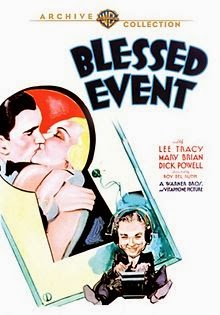
Classic Films in Focus: BLESSED EVENT (1932)
Although it's billed as a comedy, Roy Del Ruth's Pre-Code picture, Blessed Event (1932), actually gets into some pretty dark territory, thanks to an amoral protagonist who earns fame and fortune by airing other people's secrets in a sleazy tabloid column. Like Red-Headed Woman (1932) and Baby Face (1933), it's the kind of story that can only come from the Pre-Code era, replete with Prohibition drinking, sex scandals, and mobster violence. In this instance, the familiar theme of the social climber's willingness to use other people in order to get to the top is exemplified by Lee Tracy, who presents a masculine take on the street smart persona we often associate with Harlow and Stanwyck. Fans of the wisecracking star will appreciate his performance in Blessed Event, while those who favor the Busby Berkeley musicals of the period will enjoy seeing the big screen debut of Dick Powell as Tracy's chief target and social rival.
Tracy plays the ambitious Alvin Roberts, who gets his big break in the newspaper business by running short gossip pieces about the city's expectant mothers. He pens particularly juicy quips about the wealthy and the unwed, which earns the paper thousands of new readers and attracts death threats and lawsuits for Roberts. Alvin's girlfriend, Gladys (Mary Brian), has misgivings about the unethical nature of his work, but Alvin persists until a desperate pregnant woman (Isabel Jewell) embroils him in a dangerous situation with a mob boss (Edwin Maxwell) wants to murder Alvin to keep his name out of the affair.
The movie never pretends that Alvin's column isn't salacious, vicious, and under-handed, but it does offer us glimpses of Alvin's better nature. He supports and lives with his doting mother (Emma Dunn), whom he loves so much that he lets her listen to his nemesis, Bunny Harmon (Dick Powell), on the radio. He's smart, funny, and gifted with a cheerful disposition, even when confronted with gangsters who want to shut him up. One of Tracy's best scenes comes when tough guy Frankie Wells (Allen Jenkins) arrives to lean on Alvin but ends up being horrified into submission by Alvin's vivid recreation of a death row execution. The gossip columnist is presented to us as a 1930s version of the immortal trickster figure, a yellow press descendant of Coyote, Ananzi, and Brer Rabbit. He's not necessarily a good guy, but he's a lot of fun to watch.
Alvin steps over a line, though, when he prints the "blessed event" piece about Dorothy Lane, the pitiful little singer who begs him not to report her condition in the paper. Isabel Jewell gives a heartbreaking - although uncredited - performance as the pregnant girl. She's so pale and despairing that we expect any minute to hear that she has thrown herself out of a window after Alvin runs the tidbit in spite of her pleas. The story teeters on the edge of tragedy once she is introduced, and the ending can only ameliorate the damage that Alvin causes her. Once printed, his words can never be taken back, a fact that he doesn't appreciate until the very end of the film. Although most of the story makes light of scandalous pregnancies and quick marriages, this plot suggests the more serious plight of young women suffering Dorothy's fate; she loses her job, her home, her reputation, and even the support of her married lover in the wake of Alvin's disclosure.
Be sure to appreciate Ruth Donnelly as Alvin's assistant, Ned Sparks as a sour-faced colleague, and, of course, Dick Powell as the handsome radio crooner, Bunny Harmon. See more of Lee Tracy in Doctor X (1932), Dinner at Eight (1933), and Bombshell (1933). Roy Del Ruth also directed Blonde Crazy (1931), Born to Dance (1936), and Topper Returns (1941). Look for Mary Brian in The Front Page (1931), and don't miss Isabel Jewell in her best-known role as Emmy Slattery in Gone with the Wind (1939).
Blessed Event is currently available for streaming on Warner Archive Instant.
Subscribe to:
Posts (Atom)