Showing posts with label gender. Show all posts

Wednesday, August 28, 2024

Space, the Feminist Frontier: Essays on Sex and Gender in STAR TREK

After two years of work, I'm delighted to announce that Space, the Feminist Frontier: Essays on Sex and Gender in Star Trek is ready for publication! Our official release date with McFarland is September 2nd, 2024, and the book is now available for pre-order on Amazon and other retailers. You should also be able to special order it through traditional bookstores.

My co-editor and I are excited to have our author copies in hand, and we are currently mailing copies to the academic and fan scholars who contributed their work to the anthology. Our contributors wrote some truly fascinating essays about a wide range of characters, series, and topics, and I think there's probably something in this book for almost every Trek fan. We have essays about Christine Chapel, Michael Burnham, Seven of Nine, the Trill, Mirror Universe villains, Klingon weddings, Amanda Grayson, Nyota Uhura, Una Chin-Riley, the women of Lower Decks, and so much more.

If you're interested in reading the book but are daunted by the price (McFarland books aren't cheap), you can support our efforts by requesting that your local public or academic library order a copy for their collection. That way lots of fans will be able to enjoy our contributors' work for years to come. If you do add a copy to your personal collection or buy one for a special Trekkie friend, thank you so much! This is the third McFarland book Anissa and I have co-edited, and we know that these anthologies tend to have a long life with new readers finding them for many years.

It's always an exciting day when you hold a new book in your hand for the first time, and I'm so pleased with the work that our contributors have done for this anthology. My essay for the book is about the animated series Lower Decks and the ways that it merges genre parody and gender parity with its female characters. If you haven't watched it already, Lower Decks is a brilliant series that has become one of my absolute favorite Trek shows of all time, and the crossover episode with Strange New Worlds is not to be missed. 

If you're interested in my Trek related blog posts, check out:

Trek Noir: Out of the Past in Deep Space Nine's "Necessary Evil"

I Feel It in My Bones: My Favorite Star Trek Character


Friday, March 8, 2024

Rough and Dirty Girlhood in ANNIE (1982)

In his original review of the 1982 film musical, Roger Ebert offers qualified - and often rather faint - praise for Annie but says he doesn't know if kids will actually like the movie. Ebert doesn't find the story's heroine very compelling or believable, but it's noteworthy that all of the other child characters and performers he mentions in comparison are boys: Oliver Twist in Oliver! (1968), Henry Thomas in E.T. (1982), and Ricky Shroder in general. I recently rewatched Annie, and I have a very different perspective on the picture from the late, great reviewer, having actually been a ten year old girl (the same age as Annie herself) when I first saw the movie in theaters in 1982. While certain elements have aged poorly or lack the same appeal they had when I was a child, I can still see why my younger sister and I were so thoroughly charmed by the spunky heroine and her fellow orphans that we belted out "Tomorrow" incessantly and even got dolls of some of the characters. Yes, we were kids who liked Annie, and although we enjoyed the music and the adult characters very much, what really appealed to us was the depiction of girlhood as we experienced it, a rough and dirty childhood full of fights, conflict, and unbrushed hair.

Our culture as a whole has long imagined girls as more or less the opposite of boys. Girls are dear little things who play with dolls while waiting to grow up into loving wives and mothers. Even when they're protagonists and not merely supporting characters, most of them have to be pretty, kind, and generally well-behaved as models of permissible girl behavior. Shirley Temple, the quintessential "little girl" of Hollywood, wins everyone over with her dimpled sweetness, and even Alice and Dorothy are depicted as very "proper" girls in most of their film and TV adaptations (when their girlhood is not erased entirely by making them teenagers or even adults). There are exceptions, of course, like the Little House on the Prairie books and TV series, but celebrated girl-centered stories are harder to come by than stories about boys, and stories about groups of young girls (not marriageable young women) are even rarer.

Annie dispenses with all of those well-worn stereotypes about who and what girls are, replacing the usual sugar and spice with Depression era spunk. It's both a girl's version of Oliver Twist and a prepubescent take on Gold Diggers of 1933 (1933), with a scrappy crew of orphan girls trying to survive by their wits, camaraderie, and sheer stubbornness. Imagine the delight my little sister and I experienced seeing these dirty, grumpy, combative girls playing tricks on Miss Hannigan (Carol Burnett) and fighting amongst themselves just like we often did, much to our mother's dismay. We were girls who played outside, got dirty, tore our clothes, and only brushed our hair under duress. Annie and her friends provided a rare chance to see girls who looked and acted like us on the big screen, and we loved them for it. It helped that they weren't preternaturally cute or beautiful, like so many of the little and big girls Hollywood showcases. Mop wig aside, Aileen Quinn's Annie seemed like a kid we'd like to know, even if we felt disappointed that she had to be rescued by adults in the final act. We were hoping she'd kick Tim Curry's Rooster right off the top of the train bridge and send him screaming to his death, but at least she tore up the ill-gotten check and made her initial escape all by herself, while her friends persevered in their race to uncover the villains' deception.

In the decades since Annie, Hollywood movies have made some progress in telling stories about girls, especially in films like Matilda (1996), but Japan's Hiyao Miyazaki has done far better with My Neighbor Totoro (1988), Kiki's Delivery Service (1989), Spirited Away (2001), and Howl's Moving Castle (2004), just to name a few of the Studio Ghibli movies to center the experiences of young girls as interesting and not idealized characters. Women film reviewers, however, are still well aware of the dearth of great movies about young girls, as Anya Jaremko-Greenwold opines in the 2016 Atlantic essay, "Why Hollywood Doesn't Tell More Stories for - and About - Girls." Given that Hollywood still doesn't make many movies like Annie, I'm glad that today's little girls can see the 1982 version in spite of its dated elements. Maybe, at this very moment, some stubborn little girl with tangled pigtails and a dirty face is watching the movie on Netflix as the orphans sing "It's the Hard Knock Life" and delighting in the vision of girls who look and act like her.

Related Posts:

"My Life at the Movies" (2011)

"High School Movies, Then and Now" (2018)

Monday, October 25, 2021

Killing Bill: Female Vengeance in THE BRAIN THAT WOULDN'T DIE (1962)

Long before Uma Thurman's relentless Bride swore to kill Bill in the Quentin Tarantino movies, Jan in the Pan killed her own treacherous Bill in the low-budget horror classic, The Brain That Wouldn't Die (1962). Despite its B-horror status and sleazy male gaze, The Brain That Wouldn't Die turns out to be a surprisingly effective iteration of the women's revenge plot, in which the wronged female protagonist metes out bloody justice to those who harmed her. It also raises more serious issues than its cheap production and shock value climax might lead viewers to expect, chiefly the very real problems of women's agency and bodily autonomy in a dangerously patriarchal society.

The women's revenge narrative often hinges on rape as an obvious expression of masculine violence and misogyny, although mutilation and other forms of physical harm are also depicted. Hannie Caulder (1971), a Western that partly inspired Tarantino's Kill Bill movies, is one significant example of the first, while Gloria Grahame's disfigured moll in The Big Heat (1953) provides an example of the second. In The Brain That Wouldn't Die, Jan (Virginia Leith) is actually deprived of her entire body by her fiance's mad obsession. After he causes a car crash by driving recklessly toward his remote medical laboratory, Bill (Jason Evers) retrieves Jan's head from the wreckage and keeps it alive with his unethical experimental treatments. Jan has previously been shown as a woman who lives very much in her body; she can't wait to marry Bill and have children, and she demonstrates her physical desire for him very clearly. The loss of her body deprives her of these expected pleasures while also revealing to her the true nature of the man she planned to marry. Bill's scheme to acquire a new body for Jan offers her no comfort, since she realizes that he intends to murder an innocent woman to get it, and she feels very strongly that the transplanted body would be an unnatural horror.

Before the crash, Jan is fully alive and eager to marry.
 

We often talk about women's consent in sexual terms, in both fiction and real life situations, but medical consent is another component of women's bodily experience, especially when we look at the frequency with which women were denied medical autonomy in the past (and still are today, especially where their reproductive care is concerned). Bill assumes/usurps the right to make medical decisions for Jan. He keeps her head alive against her will, even when she begs for death. He intends to put her head on a stolen body of his choosing - one selected for his own prurient enjoyment - despite her objections. When Jan protests, Bill tapes her mouth. He feels that his authority as a man/surgeon/fiance gives him the right to violate Jan's wishes again and again, not to mention those of Peggy (Marilyn Hanold), the artist's model whose body Bill has decided to claim for Jan. While Bill provides an extreme example, there is plenty of real life history behind it. Well into the 20th century husbands, fathers, and other male relatives made medical decisions for women without their consent and often even without their knowledge. Women were considered too fragile or emotional to be in charge of their own medical care, and many dying women weren't told about their prognosis by "caring" men. Rex Harrison, for example, knew that his lover and then wife Kay Kendall was dying of leukemia, but he and her doctor told her it was just an iron deficiency. That took place from 1957 to 1959, so Jan's plight in the 1962 film is by no means outdated.

Jan hates Bill for keeping her alive as a head in a pan.

Deprived of her body and her ability to make her own decisions, Jan seems like a helpless victim, and Bill certainly thinks he has all the power, but Jan realizes that the experimental chemicals give her an uncanny ability to communicate with one of Bill's previous victims, a mutated captive made of amputated limbs and grafted tissue. She and the nameless prisoner plot their revenge against Bill and his complicit assistant, which they eventually accomplish in appropriately bloody fashion. Jan's hysterical laughter, existence as a disembodied head, and yearning for revenge present her as a monster, which is how she sees herself, too, but it's worth noting that Jan's moral compass is never compromised. Bill, the real monster, lacks empathy and see other people as his playthings, but Jan is determined to save Peggy while also punishing Bill. In the last scene of the movie, the mutant carries Peggy to safety while Jan remains in the burning lab with Bill's corpse, content with death and the justice she has wrought. This finale is also in keeping with the women's revenge narrative, although Jan has much more reason than most of her fellow avenging angels for being satisfied with her own death as the conclusion. Unlike the protagonist of Promising Young Woman (2020), for example, Jan is really already dead, and her release is what she herself has wanted all along.

Bill plans to get a "perfect" body for Jan by killing Peggy.

When we look at it from Jan's point of view, The Brain That Wouldn't Die becomes a fascinating variation on the women's revenge story, one that addresses some very real horrors for women in a pervasively misogynist culture that denies women bodily autonomy and free will. Jan is not a monster, despite her extreme physical condition; she's a heroine who overcomes disability and an abusive relationship to assert her right to dictate the terms of her own existence. She stops a madman's sadistic, ego-driven rampage and prevents him from claiming more victims. She liberates Bill's tortured captive, saves Peggy from being murdered, and unknowingly gets revenge for all of the other women Bill tried to abduct. The movie might be best known today as an example of cheap "schlock" horror, but there's a lot more going on in the tortured mind of The Brain That Wouldn't Die than one might at first expect. We just have to see it from the perspective in the pan.


Monday, November 7, 2016

Domestic Madness in MR. BLANDINGS BUILDS HIS DREAM HOUSE (1948)

As I watched Mr. Blandings Builds His Dream House (1948) again the other day, several things struck me that I hadn't given much thought to on previous screenings. One was that director H.C. Potter might have sped things up a bit, especially in the first quarter, where the scenes run more like documentary than comedy. Another was that the degree of marital intimacy in the picture is unusual; the protagonists, played by Myrna Loy and Cary Grant, sleep in chaste twin beds but share a bathroom even when one of them is showering. It's obvious from the context that Jim Blandings is getting an eyeful of naked Muriel when he hands her a towel, even if the movie doesn't make a big deal of it. Finally, and most importantly, I was struck by the extent of the Blandings' privilege and extravagance as they build their monstrous dream house in Connecticut. I realized that some of the absurdity that is lost on modern viewers would have been painfully obvious to audiences in 1948, while other aspects that jump out at us would have been more or less invisible to viewers who were accustomed to the race and gender norms of their era. Take both kinds of excess and privilege together, and you begin to see a very different picture overall.

Early in the film, the Blandings live in Manhattan in a very small apartment, with two bedrooms and just one bath. We learn that Jim makes $15,000 a year as an advertising executive, a very good income in those days. The Blandings have two daughters, both enrolled in a progressive private school, and a live-in maid/cook, Gussie (Louise Beavers), whose quarters we never see in either the apartment or the house. Muriel Blandings doesn't work, cook, clean, deal with children all day, or run a large house; mostly she seems to make plans with decorators and move Jim's clothes around so that he can't find them. The Blandings struggle to get themselves out of bed at 7:30 AM, but Gussie is there, dressed and busy and ready with their cups of coffee and their breakfasts. Jim says his office doesn't open until 9, and he never gets there before 10, but he seems very put upon about getting up and getting ready to go.

That setup already gives a modern viewer a lot to unpack. Why can't the Blandings simply move to a better apartment? It would be cheaper and more convenient than moving to Connecticut, but the "dream" of the title involves the American obsession with the ownership of property and houses. The Blandings want to live that dream, even if it bankrupts them and forces Jim to rise before dawn for his commute. They already have some of the most telling parts of that dream, as far as it was expressed in earlier times. Muriel lives a completely domestic life unencumbered by any of the actual work of running a family home; Gussie does all of that for her. The Blandings can afford tuition for two children at an undoubtedly pricey private school. Still, we're meant to see their situation in the apartment as an unbearable plight. We're meant to sympathize with their desire to move out to the country and live in a big house with its own land.

Of course, the Blandings get in over their heads almost immediately. The "historic" house they buy is a wreck that has to be torn down, and then they're really off to the races as they plan an even bigger and more elaborate new home that has to be built. Muriel insists that all of the four bedrooms in the new house have two closets and a private bath; it's never clear if the maid's room has a bath at all, however, since it's only briefly mentioned and then never discussed again. 21st century American homeowners, with their obsession for McMansions of ever-increasing size, might not see the folly of Muriel's demands, but in 1948 it would have sounded crazy. My own house, a modest rancher built in the late 1960s, originally had three bedrooms, each with one closet, and two baths. My grandmother's house, built in the 1950s, also had three bedrooms and two baths for a family of four. That was considered plenty for a comfortable middle class family. The Blandings, however, are not building a middle class home; they are building the 1948 version of a McMansion, and they're getting deep into debt doing it.

All of this is presented as comic mayhem throughout the picture, but the end of Mr. Blandings Builds His Dream House actually attempts to validate the Blandings' privilege and extravagance as admirable. Jim's career is saved, not by his own efforts, but by the clever ham slogan invented by Gussie, whose reward for saving the family's bacon is a $10 raise (still no word on that maid's room bath, or whether it has any closets). Jim and Muriel's friend, Bill (Melvyn Douglas), who has criticized their rash decisions throughout the story, ends up approving their madness and casting a warm glow over the conclusion, where we see the family, still served by Gussie, relaxing on the grounds of their lavish new home. Thus a picture that seems at times like a critique of suburban excess and consumerism ends up an advertisement for them, beckoning city dwellers to cast caution to the winds and invest every dollar in pursuing this particular American dream. Savings be damned! We're off to the suburbs!

I don't mean to ruin our enjoyment of the film by imposing modern standards on it; anybody who watches classic movies knows that they have to be judged with consideration for the era in which they were made. In this picture, however, audiences of 1948 would have seen issues we don't see, while we see other issues that they didn't really want to consider. We catch the subtexts about race and gender and are glad things are different now, but we fell hook, line, and sinker for the big house madness that would have made a lot of original viewers laugh out loud. These elements make Mr. Blandings Builds His Dream House a really interesting film to show in an academic setting, perhaps in an American history course or a seminar on race, gender, and class. New Yorkers, too, especially those in Manhattan, might have their own unique perspective on the film. Is Mr. Blandings building a dream or embracing a nightmare? The movie wants to have it both ways. Luckily for Mr. Blandings, the housing bubble was still half a century from bursting.


Friday, August 5, 2016

The Failure of Fathers in STRANGER THINGS

Warning: This essay contains spoilers! Read at your own risk.

The Duffer Brothers' 2016 Netflix series, Stranger Things, takes its cues from a bevy of 80s movies, most notably the films of Steven Spielberg and screen adaptations of the works of Stephen King. The mix also includes iconic pictures from the horror, science fiction, and teen genres like Alien (1979), A Nightmare on Elm Street (1984), and the films of John Hughes. The television series reflects the culture of the 1980s as seen through the lenses of these pictures, creating a strong sense of nostalgia for Gen Xers in particular, who were the same age as the show's characters during the era depicted in the series. As a kind of period piece, Stranger Things offers us a chance to look back at the 1980s and consider its essential themes, from Cold War paranoia to the initial rise of geek culture as embodied by Dungeons & Dragons. One of the most telling themes incorporated into the series is the breakdown of the traditional nuclear family and the normalization of divorce, especially as those issues relate to absent or failed father figures in the lives of the children and teens. In fact, while Stranger Things depicts a number of father characters, almost none of its fathers manage to live up to the obligations of paternity, and substitute father figures must stand in to provide guidance and protection to the four young boys who function as the show's core characters.

The series focuses on a group of 12 year old friends who stumble into a bizarre government conspiracy after one of them disappears. Will Byers (Noah Schnapp) vanishes from the small town of Hawkins, but his mother, Joyce (Winona Ryder), soon suspects that her son is both alive and held captive in some mysterious place, where he communicates with her by flashing electric lights. While the friends conduct their own search for Will, Joyce enlists the help of police chief Jim Hopper (David Harbour), who becomes convinced that a government lab near the town is connected to Will's disappearance. The boys unexpectedly find Eleven (Millie Bobby Brown), a girl whose strange abilities and sudden appearance link her to both Will and the secretive lab. Meanwhile, the teen siblings of two of the boys discover more clues to the mystery and realize that a bloodthirsty monster is also involved.

The four boys at the center of the story are Will Byers, Mike Wheeler, Dustin Henderson, and Lucas Sinclair. Only two of the four are shown to have fathers at all: Will has an absent, divorced father named Lonnie, while Mike has an older, sedentary father who spends a lot of his time sleeping in a Lazy Boy chair. We never see the fathers of Dustin and Lucas at all, although we can infer from the series that Lucas has a father who is a veteran of the war in Vietnam. Neither Lonnie nor Ted Wheeler can be called a good father in any meaningful sense, although Ted's failures are more sins of omission than anything else. Lonnie takes no interest in Will or older son Jonathan, and his ex-wife, Joyce, asserts that Lonnie used to deride Will as a "fag" before the parents broke up. When Lonnie does return after Will's disappearance, he turns out to be interested only in suing the quarry where Will's body was supposedly found; he doesn't actually care about his missing/dead son. Ted, who is still married to Mike's mother, Karen, and clearly has a good job, seems like a better father on the surface, but he has no emotional connection to his three children and doesn't seem to understand them at all. While Karen doggedly tries to earn the trust of both Mike and older sister Nancy while constantly caring for toddler Holly, Ted merely works and sleeps. He doesn't know how to talk to his children, doesn't seem to interact with them, and is shown in the last episode to be the only person sleeping in a hospital waiting room full of otherwise worried characters. If Lonnie is the stereotypical deadbeat dad of the 80s, then Ted is the stereotypical dad of the 50s and 60s, who leaves all the domestic and emotional work of parenting to his wife. Neither is the kind of father a child wants or needs, especially a boy on the cusp of adolescence.

Dr. Brenner with Eleven

Even worse than Lonnie and Ted is the manipulative Dr. Brenner, who adopts a paternal facade in his relationship with Eleven. Dr. Brenner is not the girl's real father, and no hint of a biological father's identity is provided, but he trains Eleven to call him "Papa" and to think of him as a parental figure. Lonnie and Ted are neglectful, emotionally distant fathers, but Brenner is actively evil and abusive. He encourages Eleven to rely on him, to obey him, and even to fear him, but he repeatedly hurts her and endangers her for his own ends. Part of Eleven's psychological journey in the series is her realization of Brenner's essentially bad nature and her ultimate decision to reject him. A stark contrast is provided for Eleven in the way that Brenner has treated her versus the way Joyce treats her in the seventh episode, "The Bathtub." Brenner has pushed Eleven to do dangerous things simply because he wants the power and knowledge, but Joyce asks Eleven to take risks to save her son. Joyce thanks Eleven for her bravery but also reassures her, holds her, and supports her, while Brenner dumps Eleven into the lab's sensory deprivation chamber and leaves her to confront the monster alone. Joyce's maternal behavior is utterly alien to Eleven; the scenes in the lab always show her surrounded by emotionally blank male scientists, with only Brenner's insidiously abusive relationship as a gross perversion of parenthood. Nonetheless, Joyce's brief relationship with Eleven clearly has a huge impact on the girl and helps her see the truth about Brenner. The last word she says to him is "bad," and the look on his face tells us that he understands that his hold over her has been broken.

Hopper and Sarah

Somewhere in the middle of the set we find Jim Hopper, the emotionally damaged police chief. Hopper has been a good father; we see that demonstrated in flashbacks of his daughter, Sarah. Tragically, Hopper's daughter contracted a terminal illness; her death destroyed his marriage, drove him to self-destructive habits, and closed him off emotionally until Will's disappearance resurrects his paternal instincts. Hopper was such a devoted father that the loss of his child wrecked him; it's clear that embracing the role means accepting the risk of loss and heartbreak. As he searches for Will, Hopper begins to revisit his grief and simultaneously regain his ability to be a strong father figure, even though the child he tries to help is generally unaware of his efforts. Trapped in the Upside Down, Will doesn't know how dedicated Hopper has become to finding him, but we see how Hopper adopts the paternal role that has been callously vacated by Lonnie, not only toward Will but toward Jonathan, as well. Hopper also takes the domestic role in relationship to Joyce, becoming her partner and emotional support. Despite his courage and resolution on Will's behalf, Hopper does not become an ideal father figure. He makes a Faustian bargain with Brenner to get Will back, one that directly endangers Eleven, so his paternal urge is limited in its scope. He is willing to trade one endangered child for another, even though he has learned that Eleven's mother never stopped trying to find her. It's ironic, on some level, that Hopper is willing to sacrifice the life of a girl to save a boy, given that he was himself the father of a daughter. He does, however, reach out to her in the series' coda, leaving food for her in a box in the woods. It might be too late - the show leaves us with a lot of questions about Eleven's fate - but at least Hopper continues to move back toward the role he once filled.

The absence of real fathers, whether physical or emotional, leaves the role to be filled by substitutes. Hopper becomes one surrogate father, albeit one with serious issues of his own, but other characters also volunteer themselves for the job. Will's older bother, Jonathan, steps in to fill the gap left by Lonnie, even though Jonathan still needs a father figure himself. Jonathan goes to school, works, helps to care for Will, and cooks for the family; he functions as a model for a newer, more invested kind of fatherhood that more closely resembles the multi-tasking required of mothers. He nurtures and supports Will, teaching him about music and bonding with him; Jonathan is the one who knows how to find Will's friends using the two-way radios. When Will goes missing, Jonathan searches for him and openly grieves; he is more in touch with his emotions than any of the previous generation of father figures. Jonathan and Nancy become younger parallels of the partnership embodied by Hopper and Joyce, both active, dedicated, and defined by their devotion to someone else. Jonathan's willingness to accept this burden makes us prefer him to Nancy's love interest, Steve, who is selfish and immature in comparison. The science teacher, Mr. Clarke, is also a surrogate father figure, although his role is less emotionally involved. All four boys have a close relationship with him; he provides them with the intellectual nurturing they cannot get at home and even tries to offer some emotional support after Will's disappearance. Ironically, Brenner's lab uses Clarke's dedication to the boys as a way to locate them; they pretend to be looking for talented science students for a fictitious state club. Clarke has no idea that he's actually betraying his favorite students to their enemies, but he - again unwittingly - makes up for it when he helps them design a sensory deprivation chamber for Eleven, even though it's Saturday night. Although the boys lack actual fathers in their lives who fulfill their parental obligations, the show depicts hope in the form of those who willingly take on such burdens, whether they are authority figures, male relatives, or teachers. If Mike, Will, Dustin, and Lucas become good men in their turn, it's because of characters like Hopper, Jonathan, and Mr. Clarke, not the men who sired them.

Stranger Things offers a dense narrative with many threads worth pursuing, especially in terms of its relationship to the culture of the 1980s, but the failure of fatherhood certainly seems to lie close to its heart. While mothers are generally shown as loving, dedicated figures - not only Joyce, but Karen Wheeler and even Terry Ives - fathers are seen as deeply flawed. They are absent, uninterested, clueless, or even cruel. They leave young boys to fend for themselves in a dangerous and uncertain world, even as the rules for what it means to be a man are in flux. They treat girls as things and betray them to suffering and peril. Still, there is hope. Where some men rush to vacate their roles as fathers, others step in. It will be interesting to see if Stranger Things revisits these themes with a second season or offers us a glimpse of the ways in which the four boys mature to become the fathers of another generation.

Monday, April 14, 2014

Book Review: COMPLICATED WOMEN by Mick LaSalle

First published in 2001, Mick LaSalle's Complicated Women: Sex and Power in Pre-Code Hollywood is primarily a feminist consideration of Pre-Code actresses and the roles they were able to play before Joseph Breen threw a big, wet blanket on the Tinseltown party in 1934. Although it is probably not an ideal introduction to Pre-Code pictures for the absolute novice, Complicated Women is a very good resource for those who already know something about the era and its stars, and it's written in a casual, personal voice that will appeal to classic movie fans who aren't necessarily academic in their approach to pictures.

LaSalle, who reviews movies for the San Francisco Chronicle, focuses on the actresses who helped to define the distinctive themes and styles of the Pre-Code era. Starting with Norma Shearer and Greta Garbo, he works his way through discussions of Jean Harlow, Barbara Stanwyck, Kay Francis, Joan Crawford, Ann Harding, Joan Blondell, Ann Dvorak, Miriam Hopkins, and other leading ladies who rose to stardom during the early days of the talkies. LaSalle contrasts the kinds of pictures these women were making before 1934 with the melodramas that came into favor after the strict enforcement of the Hays Code, and he argues that Hollywood - and perhaps society as a whole - were forced to take a big step backwards in terms of women's liberties and sexual freedom because of the rabidly conservative forces that lined up behind Joseph Breen. In LaSalle's view, the Hays Code was primarily and vindictively concerned with screen images of women enjoying active sex lives, pursuing careers, and being perceived as morally complex individuals; the Code attempted to shut down these visions of gender equality and force women to see themselves in the old 19th-century roles as domestic angels or worldly temptresses, with the temptresses inevitably being punished for their sins.

The book reveals LaSalle's particular interest in Shearer and Garbo, to whom he devotes the lion's share of his attention. In contrast, he clearly has no love for Joan Crawford, whom he often describes in pejorative terms. While his discussions of Harlow, Stanwyck, and Blondell are intriguing, most readers will probably finish the book wishing there had been more pages dedicated to them. There's a reason Norma Shearer graces the cover of Complicated Women, and Shearer fans will be delighted to find LaSalle championing her cause most emphatically. LaSalle's treatment of the movies made in the later 1930s and 1940s might upset fans of that period, especially those who love the women's weepies, or melodramas, that made huge stars of Crawford and Bette Davis. LaSalle finds these pictures stifling in their reactionary images of women who must give up sexual freedom, economic independence, and even personal integrity in order to please the flawed men who expect so much from them. He observes that 1940s film noir escapes from the Code's strictures in its depictions of the femme fatale, who often conforms to the letter of the Code by getting killed for her iniquities but also impresses viewers with her strength and refusal to submit to conventional morality. Toward the end of the book, LaSalle speculates about more modern actresses as the heirs to Shearer and Garbo's legacies, but classic movie fans might find these segments the least compelling of the whole work, since they deal in actresses who might not even be familiar to those who haven't seen a lot of their films.

Reading the book in 2014, it's hard not to wonder what LaSalle thinks has changed since Complicated Women was first published. Pre-Code movies have become much easier to watch with the advent of streaming and specialized services and television channels. Has Shearer's reputation risen with the success of Turner Classic Movies and the arrival of Warner Archive and Warner Archive Instant? Have the movies finally caught up with Pre-Code visions of women's sexual and professional lives? While LaSalle did publish a follow-up, Dangerous Men: Pre-Code Hollywood and the Birth of the Modern Man, in 2002, he hasn't produced another book since then. Maybe it's time for him to provide readers with a new consideration of Pre-Codes that turns more of its attention to the other actresses who enjoyed their greatest success during that brief, wild fling before Breen and his cronies shut the party down.

Complicated Women is currently available in paperback on Amazon for just over $12. It would make a great Mother's Day gift for Norma Shearer devotees or fans of Pre-Code film.

Tuesday, January 14, 2014

Classic Movies and the Bechdel Test: Part One

In the last few weeks, the Bechdel Test has been getting quite a bit of press, particularly with awards season heating up and people eager to argue about movies in general. In case you don't know, it's a concept - derived from a cartoon by Alison Bechdel - that grades movies based on their inclusion of women as fully fledged characters rather than window dressing or plot fodder.

The criteria are pretty simple. The movie has to 1) have at least two female characters, 2) who must talk to each other, and 3) about a topic other than a man. It doesn't really address the quality of the movie as art at all, but it does reveal the deeply ingrained gender bias in most of our modern blockbusters (you know, those movies that are made almost exclusively for a male 17-35 year old audience).

Being both a trained feminist scholar a classic movie blogger, I am interested in what the Bechdel Test might or might not tell us about films made before the modern blockbuster era. Do more classic movies pass? Which of the best-known classic movies fail the test, and why? How many high quality but lesser known pictures pass the test with flying colors and aren't familiar today partly because of their focus on women characters who aren't utterly obsessed with the men in their lives?

Since this is part one of a multi-part series of posts, let's start with some of the biggies. Here are ten extremely well-known classic movies. Do they pass or fail? What does it mean - if anything - if they do? I'll let you make your own observations in the comments below, and then I'll recap the discussion in the next post. I'd love to get a robust conversation started to fuel the next several posts!

1) GONE WITH THE WIND (1939)

2) IT'S A WONDERFUL LIFE (1946)

3) CITIZEN KANE (1941)

4) SINGIN' IN THE RAIN (1952)

5) VERTIGO (1958)

6) ALL ABOUT EVE (1950)

7) THE SEARCHERS (1956)

8) THE WIZARD OF OZ (1939)

9) SUNSET BLVD. (1950)

10) THE BIRTH OF A NATION (1915)

Remember, passing or failing the Bechdel Test is not a measure of the movie's artistic or even moral merit. 12 ANGRY MEN is a great movie with no female characters at all, and THE AFRICAN QUEEN fails outright since it only has two characters of note in the whole picture. I just want to start an ongoing discussion of the way classic movies might or might not treat women differently than the modern films that inspired the Bechdel Test in the first place.

Comment away!

Saturday, August 3, 2013

In Praise of Women's Pictures

I have been looking over my iCheckMovies rating again this week, which always forces me to confront the fact that I just don't want to sit through some of the movies that make all of those official lists. As I peruse the highly ranked pictures, trying to will myself to buckle down to some of those films, I inevitably come away with a strong desire to watch some unranked classic from the 30s and 40s instead.

Why this reluctance to watch movies that all the critics say are great?

One reason is that almost all of those critics are men (God rest you, Pauline Kael!), and the movies that move them are not the movies that move me. I'm a 40-something wife and mother, and I'm practically a non-entity in those top dog films, unless I'm being bumped off to fuel the plot and create angst for the protagonist. I can be shot by a sniper, beaten to death by organized crime thugs, devoured by zombies, or beheaded by a serial killer, and naturally I see myself being sexually assaulted quite a bit, but I very rarely get to be the protagonist of my own story in modern movies. Chick flicks are no restitution, since these days they tend to be stupid, flaky comedies about women who like to shop, or who put off marriage and children to pursue careers until they are also 40-something but acting as if they were still 22.

I think those women live in New York, where they apparently worry a lot about sex and matching shoes with designer handbags. I'm not sure, though, because I live in Alabama, where I worry a lot about how my kid will turn out and whether that sound in the middle of the night is a burglar or just the cat throwing up on my one good rug. I worry about my husband, especially when he's away on travel, and I worry about what I'm doing with my life, whether I have given up too much for the benefit of others or if I'll still manage to make good on all of those promises and dreams I had for myself twenty years ago.

When I want to see women like myself, be they wives or mothers or single career girls, with serious stories about what it means to live and struggle through the world, I turn to Greer Garson, Bette Davis, Joan Crawford, Claudette Colbert, Myrna Loy, Ginger Rogers, Mary Astor, and a host of other great leading ladies who show us the rich emotional lives of grown-up women living grown-up lives. They don't make actresses like them any more, and if they did make them they still wouldn't have any movies to star in, thanks to a box office driven by CGI testosterone fests aimed at 17-35 year old males.

Sure, I enjoy a bread and circuses comic book action movie on occasion, but I don't see myself in them. You let me know when Black Widow and Hawkeye have to juggle their separate crime fighting careers and decide which one will miss the big villain fight to attend Junior's soccer tournament. Then we'll talk.

At least there was a time, once upon a Hollywood, when things were different. There was a time when Mrs. Miniver could be an Oscar queen, when Mildred Pierce could straddle the line between film noir and weepie with the dark force of a mother's love, when the world wept with Kitty Foyle over her little contender for the year 2000. The women in those films grappled with love and sacrifice, ambition and regret - all the same issues that define my own life more than 60 years later. They tend to be hopeful movies, all things considered; these women are survivors - intelligent, capable, and strong even at their most vulnerable. Their choices may at times seem a little dated, especially to those who are young and single, but to me they resonate powerfully.

We talk about the power of the "every man" in literature and film because people want to see characters who
reflect them and their concerns. We don't talk much about the "every woman," but we should. Women also want to see characters who are like them, but these days we very rarely do. I'm not a super hero, or a secret agent, or a sexy distraction. I'm not a victim, or a cheap thrill, or a mindless child. My story is not written in the margins of other people's lives. One of the greatest things classic movies do for me is to remind me of that.

Thank you, Bette. Thank you, Olivia and Joan. Thank you, Ginger and Greer. Maybe one day there will be enough women critics to balance the score in ranking all of the wonderful films you made, but until then you'll have me, languishing at the bottom of the iCheckMovies heap but getting so much pleasure from the films that speak to me.

Tuesday, December 11, 2012

Classic Films in Focus: THE BIG HEAT (1953)

Many noir devotees rank Fritz Lang's The Big Heat (1953) very highly, and it certainly does have a great noir look and many memorable scenes, but I find that I much prefer some of Lang's other genre outings, like The Woman in the Window (1944) and Scarlet Street (1945), to this more celebrated 1953 picture. My reluctance to embrace the movie has a great deal to do with gender; this is the opposite of a women's noir film, set in a deeply misogynistic world where matrons and molls are equally doomed. That's not to say that the movie is not worth watching, since it features great performances from Lee Marvin and Gloria Grahame, but I don't think The Big Heat is a film that I will want to revisit any time soon.

Glenn Ford stars as police sergeant Dave Bannion, whose investigation of a fellow cop's suicide uncovers a ring of corruption and crime that goes all the way to the top brass in town. His interview with a barfly (Dorothy Green) leads to the girl's murder, but Bannion refuses to be bullied out of his pursuit, even after his own wife (Jocelyn Brando) is murdered in a car bombing meant to kill him. The local crime lord, Mike Lagana (Alexander Scourby), sends his thugs after Bannion, chief among them Vince Stone (Lee Marvin), but Stone's girlfriend, Debby (Gloria Grahame), gums up the works by taking a shine to Bannion and then aiding him in his investigation after an irate Vince disfigures her with a pot of boiling coffee. The body count rises as Bannion closes in on the truth, but the detective himself edges ever closer to becoming like those he hates as his anger and need for vengeance drive him forward.

The story reflects a lot of noir conventions, with its good cops and bad cops, its depictions of women, and its bloodthirstiness, but Glenn Ford's Bannion is never very compelling as the protagonist. He's too much of a man's man, stiff upper lip and all that, and he mostly emotes stony anger that breaks out into barely suppressed rage. He is presented to us as a man who does not cross the final line that separates him from the bad guys, but we get the sense that really he crossed it a long time ago, and only circumstances hold him back now. In other words, for a good guy he's too bad, and for a bad guy he's too good, and he either needs to soften up to be a real hero or toughen up and become a proper piece of work. His wife, Katie, played by Marlon Brando's older sister, ought to provide that softening, but the film doesn't show us enough there, especially in the way of her death scene, and Bannion seems tense around her and their daughter rather than domestic.

The bad guys have fewer issues with their identities, and they end up being the stronger and more interesting characters. Lee Marvin is just despicable as the sadistic Vince Stone, and that's exactly what he is supposed to be. Gloria Grahame's Debby enjoys playing with fire by hanging around Vince and taunting him; she wants to know how far she can go before he does something about it, and she gets her answer in a pot of hot coffee flung into her face. The dead police officer's wife, played by Jeanette Nolan, is another nasty prize; Debby claims that they are "sisters under the mink," both of them rotten women who have done horrible things for all the wrong reasons. All of these roles are played to the hilt by their performers, and they work so well that they wrest our attention away from our ostensible hero.

One thing that really strikes me about The Big Heat is the number of female characters in the movie. We have Debby the bitter mob girl, Katie the sweet wife, Lucy the earnest barfly, and Bertha the conniving widow. All of them end up dead. The film presents a lot of ugly ideas about women as disposable characters. Katie dies for being married to Bannion, Lucy dies for trying to do the right thing, Debby dies because she is sexually and morally tainted, and Bertha dies because that allows the hidden information to come out and clear the air. Another young woman, merely in the wrong place at the wrong time, is attacked by Vince with a lit cigarette; it seems that he has a penchant for torturing women by burning them. Perhaps the cigarette burns and the flaming death car give another meaning to the film's title. The deaths of all of the major women characters suggest that the world has no place for any of them, rather like some of Shakespeare's tragedies, where new world orders seem to be formed entirely of the surviving males. I don't know that male film critics notice these kinds of things, but for me, the film's treatment of its women constitutes a major concern, especially because the deaths are so brutal and absolute. There's a sadism at work here beyond that of Vince Stone, one that treats all female characters as mere sacrifices to men's plots, both fictional and cinematic.

Don't start an exploration of noir with The Big Heat unless you really like your films pitch black. Glenn Ford has more interesting roles in Gilda (1946) and 3:10 to Yuma (1957). Be sure to see more of Gloria Grahame in It's a Wonderful Life (1946), In a Lonely Place (1950), and The Greatest Show on Earth (1952). Lee Marvin also has memorable roles in Bad Day at Black Rock (1955), The Man Who Shot Liberty Valance (1962), and The Professionals (1966), although I admit to adoring his awful singing in Paint Your Wagon (1969). Fritz Lang's earlier work includes masterpieces like Metropolis (1927) and M (1931); he also directed the interesting Gothic mystery, House by the River (1950).

An earlier version of this review originally appeared on Examiner.com. The author retains all rights to this content.

Monday, December 10, 2012

Classic Films in Focus: IT'S A JOKE, SON! (1947)

Southerners are known for their regional devotion, but the hero of It's a Joke, Son! (1947) takes that loyalty to absurd levels in this quirky comedy inspired by skits from Allens' Alley, a popular radio show hosted by comedian Fred Allen. Directed by Benjamin Stoloff, It's a Joke, Son! is a delightfully silly film, full of comic mischief and good humor, with truly funny performances from its leads. The comedy of the picture depends upon a gentle ribbing of Southern institutions and a more complex engagement of the gender struggles found in so many classic films, and fans of O Brother, Where art Thou? (2000) will find many similarities in tone and content between the two movies.

Kenny Delmar, who created the character for Allen's Alley, stars as the Southern fried hero, Beauregard Claghorn, whose devotion to Dixie is matched only by his subservience to his wife, Magnolia (Una Merkel). The Claghorns are at odds with one another over the romance of daughter Mary Lou (June Lockhart) with suitor Jeff Davis (Kenneth Farrell), whom Beauregard likes but Magnolia finds unimpressive. Their disagreements become more pitched when Magnolia and Beauregard end up running against one another in a political campaign, but the corrupted incumbent tries to disrupt the election by kidnapping Beauregard.

Jokes about Southern traditions abound. The Claghorns live off the income derived from a family mint farm, which supplies the necessary ingredient in mint juleps. Magnolia is first induced to run for State Senator at the prompting of The Daughters of Dixie, a clucking flock of old biddies who sit around lamenting the fall of the Old South and calling for the return of Prohibition. In one particularly entertaining scene, Beauregard accidentally serves the chattering scolds a potent mixed punch that soon loosens them up beyond all decorum. Beauregard's devotion to the South is so great that the only sure fire way to summon him is to play "Dixie," a tactic that his nagging wife frequently employs to roust him out of hiding.

The War between the States has given way, however, to the war between the sexes, and most of the plot of the movie revolves around Beauregard's attempt to stave off his domineering wife's efforts to get him completely under her thumb. Beauregard only runs for State Senator because, as he says, "My life wouldn't be worth living" if Magnolia were to achieve that kind of public, political power. Una Merkel's Magnolia is certainly one of the steel variety of that flower; even her daughter implores her to be kinder to her husband, although it takes a drastic turn of events for Magnolia to relinquish arms. Beauregard begins the movie thoroughly hen-pecked, but the end offers a sense of greater balance between the spouses, although we (thankfully) get no hint of punitive masculine revolt like that seen in Kiss Me, Kate (1953) or McLintock! (1963).

Classic movie fans will find a whole host of great character actors in this film. Look for Douglass Dumbrille and Jimmy Conlin as the crooked politicians. June Lockhart, of course, went on to television immortality as Timmy's mother on Lassie, and Daisy the Dog appeared in the popular series of Blondie films. Kenny Delmar, who had been the announcer on Allen's Alley, went on to do a fair bit of voice work on cartoons like Underdog, which is ironic because his own Senator Claghorn also turned out to be a cartoon character in the making. Beauregard Claghorn helped to inspire the creation of that memorable Looney Tunes rooster, Foghorn Leghorn, who borrowed not only the Senator's Southern pride but many of his catch phrases, as well.

It's a Joke, Son! is now in the public domain, so you can watch it online at the Internet Archive or other sites that stream legally available films. You'll find a very young Kenny Delmar in the 1921 D.W. Griffith film, Orphans of the Storm, but he mostly turns up on television programs and in cartoons. Catch Kentucky native Una Merkel in classics like 42nd Street (1933), Destry Rides Again (1939), and Summer and Smoke (1961), the last of which earned her an Oscar nomination for Best Supporting Actress. See more of June Lockhart's early career in Sergeant York (1940), Meet Me in St. Louis (1944), and Son of Lassie (1945). Douglass Dumbrille also stars in Mr. Deeds Goes to Town (1936) and A Day at the Races (1937), while Jimmy Conlin turns up in small roles in all sorts of places, but especially in Preston Sturges comedies like Sullivan's Travels (1941) and Hail the Conquering Hero (1944).

An earlier version of this review originally appeared on Examiner.com. The author retains all rights to this content.

Tuesday, October 16, 2012

Classic Films in Focus: THE BAD SEED (1956)

The Bad Seed (1956) ranks pretty high on the list of classic "evil children" movies, although it's not exactly a straightforward horror film. Director Mervyn LeRoy, working from a stage adaptation of William March's original novel, presents the story more as dark melodrama, like Mildred Pierce (1945) cranked up to eleven. Film historian David Thomson hates the picture and provides a scathing review of it in his book, Have You Seen?, but The Bad Seed might well reveal its true horror only to a female audience, for this movie strikes at the very heart of maternal experience and fear.

Nancy Kelly stars as Christine Penmark, the mother of a seemingly perfect eight year old girl. Pig-tailed princess Rhoda (Patty McCormack) is not, however, as sweet as she appears. When one of Rhoda's classmates drowns at a school picnic, the evidence indicates that Rhoda knows more about what happened than she wants to say. Soon Christine realizes the horrible extent of Rhoda's homicidal tendencies, the hereditary product of a dark secret in Christine's own past.

Male characters exist mostly on the periphery of the story. Christine's husband (William Hopper), leaves town for an extended business trip, and the male criminologists utterly fail to spot the perfect little sociopath in their midst. Only Leroy (Henry Jones), the deranged handyman, sees through Rhoda and plays an active role in the characters' daily lives, and he intentionally taunts the infant serial killer and makes matters worse. All of the other significant characters are female, from bossy Monica Breedlove (Evelyn Varden) to grief-stricken Hortense Daigle (Eileen Heckart), whose little boy becomes one of Rhoda's victims. This women's world of domestic entrapment, uncertainty, and suppression inevitably unhinges many of the characters. Even the teacher, Miss Fern (Joan Croydon), has developed a nervous, strained manner, while Christine completely falls apart, clutching desperately at the useless men as she succumbs to her guilt and horror at Rhoda's amoral acts.

The horror of The Bad Seed derives from this stifled, segregated world in which women have few outlets for their hopes and fears. Maternity is the only accomplishment either Christine or Hortense can claim; each one loses her child in a different way, but the loss triggers similar collapse and self-destruction. Fear of a child's death is one kind of horror, but fear of giving birth to a monster is something even worse. New mothers look hard at their infants and count their fingers and toes, fearful lest anything wrong should have issued from their wombs. A pregnant woman obsesses over every action because blame for a damaged child invariably falls on her. Does the monstrous child repay us for our own failures, or is it some changeling trick, the work of the devil or an evil star? This fear of unnatural offspring drives stories as diverse as the Greek myths, King Lear, and Rosemary's Baby (1968).

The ending of the film pointedly asks viewers not to give away the final twist, so I'll refrain from commenting too much on the subtexts of those scenes. I will, however, say that I think the movie might have ended better about ten minutes earlier than its actual conclusion. You'll know the moment when you reach it. There would have been greater poetic justice, at least for Christine, had the credits simply rolled after that shocking - but absolutely necessary - act.

The Bad Seed earned four Oscar nominations, including nods for Nancy Kelly, Patty McCormack, and Eileen Heckart, all of whom had also appeared in the stage production. Mervyn LeRoy also directed I am a Fugitive from a Chain Gang (1932), Random Harvest (1942), and Mister Roberts (1955). For more awful offspring, try Village of the Damned (1960), The Omen (1976), and The Good Son (1993).

Tuesday, September 25, 2012

The Housekeeper in the Gothic Film Tradition


Margaret Hamilton plays the creepy housekeeper in 13 Ghosts.

Good Haunted Housekeeping: The Housekeeper in the Gothic Film Tradition


The Gothic tradition features a host of particularly striking stock characters. We have the mysterious first wife, whether missing, mad, or murdered, the brooding Bluebeard lover, the inquisitive orphaned heroine, and, perhaps the most iconic in modern popular culture, the creepy housekeeper, a curator of keys, cupboards, and the family’s closeted skeletons. In her book, Hollywood Heroines: Women in Film Noir and the Female Gothic Film, Helen Hanson identifies two major tasks set for the housekeeper character in the traditional Gothic film: the first is “to mark the heroine as an outsider,” and the second is “to act as keeper of knowledge about the family” (75). These roles underline the unique power of the character as part of the typical Gothic machinery. In the genre’s often feminized world, the housekeeper’s function as a woman with dominion over the domestic space and its secrets can make her a formidable ally or enemy to the heroine. Her loyalties, however, may not lie with the intruding newcomer; she may choose to protect the secrets of the family or may even devote herself to the house itself. In Gothic films, the housekeeper becomes an especially potent creator of terror and dread through her penchant for lurking in shadows, watching the heroine, and manipulating both characters and audience with her ominous movements and expressions. Looking at classic Gothic films like Rebecca (1940), Dragonwyck (1946), and The Haunting (1963), we can see the housekeeper’s development into a crucial figure of the genre, while later incarnations of the character in films like Young Frankenstein (1974) highlight her importance while simultaneously mocking the clichéd representation of her type.

Tracing the development of the housekeeper character and appreciating her importance to the Gothic film tradition requires some sense of her earliest appearances. Like the modern Gothic novel, Gothic film has its roots firmly planted in the literary traditions of eighteenth and nineteenth-century England. There is no menacing housekeeper in Horace Walpole’s original Gothic text, The Castle of Otranto, but the type had already been established by the time Walpole’s novel first appeared on the scene in 1764.  Going as far back as Samuel Richardson’s Pamela in 1740, we can see the housekeeper as an important stock character with a marked potential for duality. Richardson’s novel offers us two opposing but suggestively linked housekeeper models: the first, Mrs. Jervis, is a kindly matron who befriends and defends the heroine, while the second, Mrs. Jewkes, is a masculine monstrosity who threatens and imprisons her. Their shared “J” names hint at their function as two sides of a single character type, and in their complex relationships with the virginal Pamela they also form a version of the archetypal trinity of maiden, mother, and crone.

The dual functions of the housekeeper remain distinct in Charlotte Brontë’s influential Gothic novel, Jane Eyre, which first appeared in print in 1847. Much of the Gothic film tradition that developed in the twentieth century depends on this text, for Jane Eyre is the cornerstone on which both Rebecca and Dragonwyck are built, just as Pamela serves as the cornerstone for Jane Eyre itself. In Brontë’s novel, the official housekeeper of Thornfield Hall is Mrs. Fairfax, a generous, maternal woman who accepts Jane as part of the domestic community and provides her with much-needed companionship, as well as information about the hall’s inscrutable master, Mr. Rochester. Mrs. Fairfax, however, does not possess all of the keys to unlock the mysteries of Thornfield. Her mysterious counterpart in the house, Grace Poole, has knowledge that Mrs. Fairfax and Jane both lack, but Grace Poole keeps the heroine at bay and refuses to answer her questions about the ghostly presence that haunts the hidden room of Thornfield’s highest floor. Like Mrs. Jewkes in Pamela, Grace Poole displays a rough, masculine appearance and functions as a jailer, although it is the heroine’s predecessor, mad Bertha Rochester, who is her prisoner. Mrs. Fairfax, as her name suggests, represents the fair side of the housekeeper figure, a supportive feminine presence capable of educating the heroine about her new home. Grace Poole, however, is the dark secret keeper of the house, the guardian of a forbidden zone hidden within the larger domestic space.
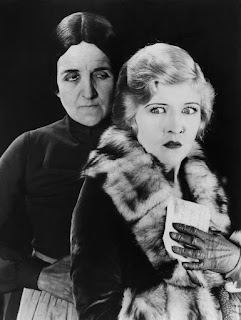
As the Gothic begins to appear on film, the menacing Grace Poole version dominates as the more potent form of the character. We get an early taste of housekeepers to come in the old dark house picture, The Cat and the Canary. Directed by Paul Leni, this 1927 silent film is memorable largely because of its creepy housekeeper, a dead-eyed horror humorously christened Mammy Pleasant. Like later and more familiar Gothic housekeepers, Mammy Pleasant acts as a menacing presence, constantly watching the heroine but refusing to divulge the secrets of the house to her. In addition, Mammy reveals the housekeeper’s evolving taste for a rather morbid, deadpan brand of humor. In one conversation, another character says, “You must have been lonely here these twenty years, Mammy Pleasant,” to which she replies, “I don’t need the living ones.” Mammy also operates as a predictor of doom, alarming the houseguests with her assertion that “something terrible will happen here tonight!” Mammy’s dark hair, dour expression, and thin, tight lips become the standard equipment of Gothic housekeepers forever more, making her an important figure in the character’s cinematic development.

Of course, the lynchpin figure in the evolution of the Gothic housekeeper is Mrs. Danvers, the terrifying antagonist who protects the territory of her dead mistress in Daphne du Maurier’s 1938 novel, Rebecca. The nameless heroine recalls her first encounter with Mrs. Danvers thus:
Someone advanced from the sea of faces, someone tall and gaunt, dressed in deep black, whose prominent cheek-bones and great, hollow eyes gave her a skull’s face, parchment-white, set on a skeleton’s frame.
She came towards me, and I held out my hand, envying her for her dignity and her composure, but when she took my hand hers was limp and heavy, deathly cold, and it lay in mine like a lifeless thing. (67-68)
The heroine’s language loads Mrs. Danvers with images of death and horror, and it also sets the stage for the housekeeper’s function as the guardian of the dead Rebecca. Mrs. Danvers is the housekeeper not of a living home but of a tomb that enshrines the memory of her lost idol; she rejects the new mistress of Manderley as an interloper and seeks to drive her away. Obsessive, manipulative, and in total control of the house, Mrs. Danvers imprisons the new Mrs. de Winter in Manderley while simultaneously trying to eject her from it. When she feels that Rebecca’s ownership of Manderley can no longer be protected, Mrs. Danvers sets fire to the house rather than see the second Mrs. de Winter successfully inhabit it.

            Alfred Hitchcock’s 1940 adaptation of Rebecca is a watershed moment in the history of the female Gothic film, not least because it perfectly captures the menacing allure of Mrs. Danvers’ character. Among its eleven Oscar nominations was a Best Supporting Actress nod for Judith Anderson, who delivers a truly iconic performance as Mrs. Danvers. Her appearance in the movie owes something to Mammy Pleasant while capturing the spirit of du Maurier’s description, if not the letter, for Anderson’s version is menacingly alive, with piercing eyes and a coiled braid of black hair perfectly arranged above the severe white line of her part. On screen, Mrs. Danvers controls the heroine with her gaze and her gestures; we can see her watching Joan Fontaine’s mousy victim with a predator’s glittering interest. In the famous bedroom scene in which Mrs. Danvers tries to drive the heroine to commit suicide, Hitchcock faithfully recreates du Maurier’s written description, but the visual representation lends the moment an additional sense of suspense and horror. Mrs. Danvers leans over the heroine, her burning eyes intensely fixed on her victim, her power over the younger woman tellingly displayed in their physical positions. In this scene and in others throughout the film, Anderson creates a definitive image of the Gothic housekeeper, endowing her with characteristics and mannerisms that will be hallmarks of the character in the popular imagination from 1940 onward.

Edith Barrett as Mrs. Fairfax
The box office success and Best Picture Oscar of Rebecca inspired a wave of female Gothic films in the early 1940s, including, somewhat ironically, a 1943 film adaptation of Jane Eyre, also starring Joan Fontaine as the heroine. For the housekeeper character, however, this is a throwback to the pre-Danvers era, back to the dual figures of good and bad household guardians. Edith Barrett plays a nervous, rather frail Mrs. Fairfax, with English stage actress Ethel Griffies in an uncredited appearance as Grace Poole (Hitchcock fans might remember Griffies as the skeptical ornithologist in The Birds). Barrett again plays the family secret keeper in the same year’s Eyre-inspired Val Lewton horror film, I Walked with a Zombie. Lewton’s picture has no menacing housekeeper; the most important domestic servant is Alma, a cheerful young black woman played by Theresa Harris. Barrett, however, fills in for the housekeeper as Mrs. Rand, the mother of the two male leads; she alone knows what really happened to her son’s first wife, the zombified Jessica. Like the motherly housekeepers of older Gothic stories, Mrs. Rand tries to help Frances Dee’s heroine even as she withholds the most important family secrets from her, but she lacks a menacing female counterpart.

More interesting, perhaps, is the 1946 adaptation of Anya Seton’s 1944 novel, Dragonwyck, written after both the original novel and the film version of Rebecca and thus ostensibly able to capitalize on the evolving conventions of the female Gothic genre. The film trailer, in fact, proudly announces the new picture’s appeal to fans of the earlier work. Like Rebecca, Dragonwyck draws from Jane Eyre as its source material, but it translates the Gothic action to nineteenth-century New York and the upper class Dutch society of the Patroons. Differences between the novel and the film affect the representations of the housekeeper characters, but both offer some insight into the type’s importance to the genre by showing the pitfalls of tinkering with effective conventions.

The novel itself takes a problematic dual approach to the housekeeper figure. As in Jane Eyre, we have two domestic characters who highlight the heroine’s outsider status and possess power and information that might be able to help or harm her. The official housekeeper, Magda, resents the heroine’s arrival and persistently gives her the cold shoulder, reserving her loyalty for the mistress of the house. Seton does very little with Magda, failing to provide even a single detailed description of her appearance. She gives greater attention to the other, more ominous domestic secret keeper, the ancient mixed-race servant, Zélie. Zélie gets all of the creepiest, most Gothic scenes, revealing to the newcomer the haunted history of Dragonwyck and foretelling the doom of the Van Ryn family members. Seton gives this character a suitably striking introduction:
The door opened and a strange woman walked in, shutting the door behind her. A thin old figure in a shapeless black dress who came over to the bed and gazed down at the frightened girl. The woman was nearly six feet tall and erect, her coarse black hair, which showed no gray, drawn back into a scraggy knot, her face a ruddy brown crisscrossed with wrinkles from which peered two shrewd little eyes as black as dewberries
“What do you want?” whispered Miranda.
“Me old Zélie,” said the woman in a harsh accented voice, touching her slab-like chest. “I want to see what you look laike.” (49)
Unfortunately, Seton abruptly writes both Magda and Zélie out of the book about a third of the way through, and no similar character fills the resulting gap. The problems with Seton’s treatment may help to explain why her novel is little read today, since she mishandles two different variations on one of the genre’s most important character types.

Director Joseph L. Mankiewicz’s film adaptation makes some marked changes to Seton’s novel, especially in the housekeeper department. Sadly, the movie completely drops Zélie, who would be quite provocative, to say the least, to see on screen. It transfers her ominous warnings and insider knowledge to Magda, revising Seton’s flat, barely described character into something audiences might more properly expect in a female Gothic tale. Played by the very capable character actress, Spring Byington, the movie Magda embodies both the menacing and the maternal, and the result is a woman who strikes both the audience and Gene Tierney’s heroine as slightly insane. In one early scene, for example, Magda suddenly veers off from seemingly friendly talk to warn, “One day, you’ll wish with all your heart you’d never come to Dragonwyck.” Byington’s character occupies a middle distance between Mrs. Fairfax and Mrs. Danvers, which makes her interesting in terms of the housekeeper’s changing role in the genre, but the movie, like the novel, drops Magda midway through, and thus the potential for a really serious engagement of the housekeeper figure remains unrealized.

Unlike Anya Seton, Shirley Jackson takes full advantage of the creepy housekeeper in her 1959 novel, The Haunting of Hill House, which was adapted into the film, The Haunting, in 1963. The film makes a number of changes to the original text, but it faithfully preserves the unnerving housekeeper, Mrs. Dudley, while also highlighting her relationship to Mrs. Danvers through casting and costume decisions. Like earlier housekeepers, Mrs. Dudley possesses insider knowledge of the house she oversees, and she resents the presence of the newcomers who disrupt her routine. Hill House has no master or mistress to command her loyalties, and Mrs. Dudley’s feelings about the house are never quite clear, just as everything else about Hill House remains shrouded in questions and doubt. Jackson does, however, hint at the connection between Mrs. Dudley and Hill House near the end of the novel, when she describes Mrs. Dudley as “shudder[ing] in her sleep” from six miles away when the heroine touches a kitchen door (171). In contrast to the visitors, Mrs. Dudley seems to understand and respect the house, never trespassing against its unspoken rules, and in return the house never affects her as it does the others.

Jackson offers little description of the character when she first appears in the novel, but she does provide a truly memorable exchange with the protagonist, Eleanor, a few paragraphs later.
“I don’t stay after I set out dinner,” Mrs. Dudley went on. “Not after it begins to get dark. I leave before the dark comes.”
“I know,” Eleanor said.
“We live over in the town, six miles away.”
“Yes,” Eleanor said, remembering Hillsdale.
“So there won’t be anyone around if you need help.”
“I understand.”
“We couldn’t even hear you, in the night.”
“I don’t suppose-“
“No one could. No one lives any nearer than the town. No one else will come any nearer than that.”
“I know,” Eleanor said tiredly.
“In the night,” Mrs. Dudley said, and smiled outright. “In the dark,” she said, and closed the door behind her.
(27-28)
The ominous warning from the housekeeper becomes a kind of nervous joke between Eleanor and Theodora, but it sets the stage for the horrors to come and provides both characters and readers with important information about Hill House. The locals are afraid of the place, none of them will have anything to do with it, and the residents can expect no assistance when their presumptuous occupation rouses the house into action. The inmates of the house laugh at Mrs. Dudley just as they laugh at the strange things that happen in Hill House; both frighten them, although they cannot necessarily explain why. 

            The film adaptation, directed by Robert Wise, reflects these elements of the novel and builds on them by making the most of the character conventions established by earlier films like Rebecca. Rosalie Crutchley, whose earlier roles had included the terrifying Madame Defarge in a 1958 adaptation of A Tale of Two Cities, is just the sort of actress for the Gothic housekeeper role, with a thin face, dark hair, and a most unnatural smile. Her somber attire and pinned-up hair, both black of course, signal her sorority with Mrs. Danvers and Mammy Pleasant, and Crutchley delivers Mrs. Dudley’s lines to great effect, especially in the scene mentioned earlier. Building on the character as originally created in Jackson’s novel, the film reveals the conventional traits that have come to be associated with the Gothic housekeeper. Mrs. Dudley, as much an insider as Hill House allows, lays out the house rules to Eleanor and the other guests in a way that emphasizes her own power and position of authority. “I don’t wait on people,” she tells the newcomers firmly. “What I agreed to, it doesn’t mean I wait on people” (27). She clearly knows more about the house than she is willing to tell, and her veiled warnings serve only to alarm the visitors and the audience without helping them prepare for the terrors that they will face. Like Mrs. Danvers, Mrs. Dudley projects menace rather than maternal comfort, and the film emphasizes this aspect by eliminating a kitchen scene in which Jackson has Mrs. Dudley gossiping about the young people in a very motherly, ordinary fashion. Unfortunately, by the time the next film adaptation of The Haunting of Hill House arrived in 1999, the Gothic housekeeper character had become so familiar that Mrs. Dudley is merely a cliché, another stale note in an over-played symphony of horrors.

Mrs. Slydes frightens a guest in House on Haunted Hill.
Anything repeated often enough to be a cliché is already ripe for parody, and in the years after the original film adaptation of The Haunting the Gothic housekeeper became an obvious target. William Castle had helped to entrench the conventions of the character with films like House on Haunted Hill in 1959 and especially 13 Ghosts in 1960, which featured The Wicked Witch of the West herself, Margaret Hamilton, as a creepy housekeeper complete with black dress, tight bun, and dour expressions, who also turned out to be a medium able to communicate with the ghosts who haunted her employers’ house. Today, the website, tvtropes.com, even has an entry for “Creepy Housekeeper” that identifies her major traits and aligns her with another stock character, the “Crusty Caretaker.” Most importantly, the incarnation of the creepy housekeeper chosen for the entry’s quote and image is not Mammy Pleasant, Mrs. Danvers, Magda, or Mrs. Dudley, it is Cloris Leachman as Frau Blücher in Mel Brooks’ 1974 Gothic horror parody, Young Frankenstein. The character, as written by Mel Brooks and Gene Wilder and performed by Leachman, incorporates all of the Gothic housekeeper clichés and then revels in them, permanently altering the way in which movie audiences perceive her role. 

Young Frankenstein, as its name suggests, draws its inspiration from James Whale’s 1931 Frankenstein and 1935 Bride of Frankenstein, and the origins of Frau Blücher can also be found there. In the second Whale film, Irish character actress Una O’Connor plays a frequently hysterical housekeeper named Minnie, although Whale uses her for comic effect rather than horror. Despite her shrieking, Minnie herself is all motherly concern, much like Mrs. Fairfax in Jane Eyre. In Young Frankenstein, Frau Blücher’s costume and position in the household are references to O’Connor’s character, but her creepy and often menacing behavior develops from housekeepers like Mrs. Danvers and Mrs. Dudley. Leachman also sports the thin lips, severe bun, and sinister facial expressions of the more menacing housekeeper type. In fact, Frau Blücher is so absurdly terrifying that horses whinny in fear every time her name is mentioned. Early on, the movie exploits one particularly popular housekeeper trope, in which the taciturn household guardian conducts newcomers through the mysterious domain over which she reigns, often with a large candle in hand. Frau Blücher carries a holder with three candles, all of them markedly unlit, as she warns Frederick to “stay close to the candles. The stairway can be… treacherous.” Like other Gothic housekeepers, but unlike Minnie, Frau Blücher has special insider knowledge about her house and its family. She manipulates Frederick Frankenstein into resuming his grandfather’s research, apparently out of loyalty to the deceased Victor, with whom she was in love. Brooks and Wilder, of course, play all of these plot elements for laughs, but they depend upon the already established conventions of the housekeeper role and show the extent to which the writers expect the audience to be familiar with them. The parody succeeds so well that Frau Blücher usurps the place of earlier, more serious treatments of the character to become the quintessential example of the type. 

The entwined literary and cinematic evolution of the Gothic housekeeper demonstrates the ways in which genre conventions gather force and then sometimes sink under their own weight. In this case, the housekeeper character, along with the rest of her genre’s conventions, developed first in literary works of the eighteenth and nineteenth centuries and then gathered new steam with the rise of film. She reached her peak when Rebecca took the world by storm, thanks in part to the ways in which the film version capitalized on her potential. After that, other literary works and films could only repeat what had already been accomplished or twist that representation for parodic effect, since efforts to tinker with the formula were problematic at best. Audiences today will come to any housekeeper character with a very distinct mental image, that developed by the earlier Gothic novels and films, but they will also almost certainly have a sense of the character as inherently clichéd and even ridiculous, given the immense cultural impact of the later parody. We haven’t seen much of the Gothic housekeeper in recent years, perhaps because Mrs. Danvers and Frau Blücher have so completely occupied the spaces in which such a character can stand. Perhaps the recent return of Hammer films will bring the creepy housekeeper back to us in a new but still eerily familiar form. For now, however, it is the housekeeper herself who has become haunted, not by the ghosts of her employers’ house, but by the enduring influence of her own most iconic incarnations.

This essay was written for presentation at the 2012 meeting of the Popular Culture Association in the South (PCAS). The Works Cited page is intentionally excluded in order to discourage plagiarism of the material. This content is the intellectual property of the author and must be properly cited if referenced elsewhere. The author reserves the right to send Mrs. Danvers to have a little personal chat with any plagiarists!