Showing posts with label Jimmy Stewart. Show all posts

Wednesday, January 29, 2025

Classic Films in Focus: ROPE (1948)

Rope (1948), Alfred Hitchcock's first color picture, is a twisting, carefully orchestrated thriller with a deceptively simple title, one that is as much about the killers as the murder weapon they wield in the film's opening shot. There's no air of mystery hovering over the claustrophobic confines of the single room where the action unfolds; instead, this story revels in the audience's full knowledge of the crime, tormenting us with information we possess but cannot share with the party guests drinking their champagne over the corpse of their murdered loved one. The film's gruesome appeal depends mainly on its theatrical visual style and the tightly wound performances of John Dall and Farley Granger as the handsome young killers, although James Stewart gets top billing as their former mentor and increasingly suspicious house guest.

The story opens with Brandon (John Dall) and Phillip (Farley Granger) strangling their classmate David (Dick Hogan) and then hiding his body in a large trunk in the middle of their living room. Eager to prove their intellectual superiority and gloat over the crime, Brandon insists on hosting a party immediately following the murder, with David's friends and family in attendance. David's father, Mr. Kentley (Cedric Hardwicke), and girlfriend Janet (Joan Chandler) grow uneasy over David's uncharacteristic absence, but only the boys' old house master begins to grasp the horrible truth.

Dall and Granger work the queer subtext of their relationship with tremendous skill, with Dall's Brandon very clearly the leader of the couple and Phillip only slowly coming to realize the nature of the monster he loves and obeys. Does Brandon love Phillip in return? Is Brandon capable of such a human emotion? Both actors are fascinating to watch as they reveal their characters' psychological states. The subtext implies that Brandon also has a particular connection to Rupert Cadell, presumably romantic in nature, but here the casting of James Stewart throws a spanner into the works. I've always felt Stewart to be miscast in the role, and that continues to be my view after my most recent return to the movie. Hitchcock's later collaborations with Stewart brilliantly evoke the actor's capacity for darkness, but this first outing shows the limits of Stewart's ability. Even Stewart felt he was out of place in the part, although he said he didn't think he was credible as an academic, not that he couldn't imagine himself as a closeted gay man who had indulged in a romantic tryst with one of his students. I think that an actor like George Sanders, Claude Rains, James Mason, or Cary Grant (who was Hitchcock's first choice for the role) would have made a more interesting and believable Rupert, but the role certainly had an impact on Stewart's later career. For more observations on that topic, read Chloe Walker's 2023 Paste article,  "Rope Was a Cruel, Prickly Turning Point in Jimmy Stewart's Career."

The single set and real-time pacing of the picture are the other noteworthy elements for discussion, with long takes that heighten the feeling of watching a stage play rather than a movie. These techniques intentionally make us feel trapped in the room; we can't get away from the chest and its terrible contents, and neither can Brandon and Phillip, as much as they might talk about their plans to leave town as soon as the party ends. Psychologically, neither of them will ever be able to leave that room, and when the truth comes out the other party guests will forever be haunted by it, as well. We might think, at the beginning, that the murder is the worst possible moment, but for everyone except David it's the aftermath that really turns the screws. Every time Phillip sees the rope again he comes a bit more unglued, but Brandon can't resist the urge to flaunt their crime, practically daring Rupert to confront them. Each reappearance of the rope symbolizes another bit of the crime being let out, until the murderers finally offer enough to hang themselves. It's both terrible and fascinating to watch, thrilling even though so little actually happens onscreen.

Hitchcock's later work with James Stewart in Rear Window (1954), The Man Who Knew Too Much (1956), and Vertigo (1958) would give the actor some of the most iconic roles of his long career, and Farley Granger also gets another outstanding role from Hitchcock in Strangers on a Train (1951). John Dall is particularly remembered as half of another murderous couple in Gun Crazy (1950), although his screen debut in The Corn is Green (1945) earned him an Oscar nomination for Best Supporting Actor. If you enjoy the limitations of the single set approach, be sure to see Hitchcock's earlier film, Lifeboat (1944), which traps all of its characters at sea in a small, cramped boat.

Tuesday, June 25, 2024

Capital Classics for the Fourth of July

Summer has arrived, and the Fourth of July is just around the corner. It's too hot to be outside, so why not celebrate with some classic movies set in our nation's capital? If you haven't been feeling especially optimistic about our country's politicians lately, these films might provide some relief from the debacle of modern politics, although it's important to remember that the Hays Code helped to tint those rose-colored spectacles an even softer shade. Nonetheless, here are some classic movies that memorably depict the ideals of the American experiment if not its reality.


MR SMITH GOES TO WASHINGTON (1939) - Frank Capra's tale of a young Senator's political education is quintessential Capra "corn" with James Stewart and Claude Rains delivering outstanding performances, especially Stewart in the famous filibuster scene. Although some in the US took offense at the depiction of Washington insiders, the film was banned in other countries precisely because of its pro-democracy stance. Capra, Stewart, Rains, and costar Harry Carey all picked up Oscar nominations for their work, and the movie earned six additional nominations, but it only won the Academy Award for Lewis R. Foster's writing for Best Original Story. The stellar cast also includes Jean Arthur, Guy Kibbee, Thomas Mitchell, Beulah Bondi, and H.B. Warner.


THE MORE THE MERRIER (1943) - This wartime romantic comedy uses a housing shortage in Washington, D.C., to bring together an unlikely trio played by Jean Arthur, Joel McCrea, and Charles Coburn. George Stevens directs the stars through some hilarious situations, with sizzling fireworks going off between Arthur and McCrea, but Coburn proves the scene-stealer of the lot in a performance that earned him an Oscar for Best Supporting Actor. The picture garnered five additional nominations, including nods for Stevens and Arthur. It's an absolute delight from start to finish, and fans of modern rom coms will find a lot to love in this underrated classic.


BORN YESTERDAY (1950) - George Cukor directs the brilliant Judy Holliday in her Oscar-winning performance as Billie Dawn, a former chorus girl whose domineering and crooked boyfriend (Broderick Crawford) wants her to become more respectably well-educated now that his business has him hobnobbing with Washington politicians. William Holden plays the political writer hired to tutor Billie, and the two inevitably fall in love while touring the sights of the nation's capital. Billie's personal and political awakenings drive the picture, which was adapted from the 1946 Broadway play by Garson Kanin (in which Holliday also originated the role). 


These three classics make a great triple feature for your Fourth of July holiday, but if you prefer patriotic goodwill outside the Beltway, you can always celebrate with the beloved James Cagney musical, YANKEE DOODLE DANDY (1942). If you prefer something darker, dive into JAWS (1975) for red blood, a Great White, and deep blue ocean with a climax that takes place over the Fourth of July weekend.


You'll find full-length reviews of Mr. Smith Goes to Washington, Born Yesterday, Yankee Doodle Dandy, and hundreds of other classic movies in my two books, BEYOND CASABLANCA and BEYOND CASABLANCA II, both of which are available as ebooks on Amazon. Hundreds more are posted here on my blog. Just use the labels to search for your favorite actors, directors, and genres!

Friday, May 4, 2018

Classic Films in Focus: AFTER THE THIN MAN (1936)

After the Thin Man (1936) reunites director W.S. Van Dyke and stars William Powell and Myrna Loy for a sequel to the 1934 hit, The Thin Man, in which Nick and Nora Charles first cracked wise and drank heavily through a crime-solving adventure. We pick up right where we left off at the end of the first movie, with Nick, Nora, and Asta on a train to California, which makes the first two films a great double bill, even though they were released two years apart. After the Thin Man offers more of everything that made the first picture such a success, with the wealthy couple boozing their way through the new year and a series of homicides. Along for the ride are a number of familiar classic stars, including James Stewart, Joseph Calleia, and George Zucco, as well as Elissa Landi as Nora's troubled cousin, Selma.

Nick and Nora (Powell and Loy) arrive in San Francisco for New Year's Eve only to find that Nora's cousin, Selma (Elissa Landi), is in distress after the disappearance of her faithless husband, Robert (Alan Marshal). Nick has no trouble locating Robert and his mistress at a crowded hot spot, but then Robert turns up dead in front of Selma's house, and it looks like Selma might have killed him. Her longtime admirer, David (James Stewart), arrives on the scene to help, but Robert is just the first corpse of the mystery, and two more rapidly follow. With plenty of suspects on hand, including sketchy businessman Dancer (Joseph Calleia), jealous loser Phil (Paul Fix), and sinister Dr. Kammer (George Zucco), the police have their work cut out for them, even with Nick and Nora's help.

Much of the comedy of this outing lies in the contrast between Nick and Nora's social sets, whom we first see set against each other and then brought together thanks to Robert's shady habits. Nick knows every low-life, ex-con, and purse snatcher in town, and even the guys he sent to prison seem to like him. When Nora is greeted by a well-heeled couple in a passing car, she wryly tells Nick, "Oh, you wouldn't know them, darling. They're respectable." It turns out, however, that Nora's relations are not all that respectable themselves; they merely preserve the appearance of respectability while engaging in coercion, blackmail, adultery, and obstruction of justice. Selma's philandering husband is up to his neck in self-made trouble, but Selma's mother (Jessie Ralph) bullies and manipulates Selma into keeping quiet about his disappearance and his behavior. The rest of Nora's relatives are just antiquated bores; poor Nick has to make up both sides of the conversation when he's left alone with a table full of snoring, elderly gents after a family dinner party. It's little wonder that both he and Nora prefer Nick's more exciting acquaintances.

Asta's domestic woes feature as an odd running gag throughout the film, creating a canine version of the plot's themes of adultery, betrayal, and romance gone wrong. Asta returns from his Christmas travels to find that Mrs. Asta has produced a litter of puppies, but one of the bunch looks suspiciously like the Scottish Terrier who keeps sneaking onto the property. Asta chases his rival off repeatedly but never seems to get rid of him for good. Perhaps it's the stress of his romantic frustrations that makes Asta snatch and then eat part of a vital clue. Nick and Nora, who lavish attention on Asta, never seem to give the slightest thought to Mrs. Asta and her children, which might explain why the neglected pup, shut up in her backyard pen, has gone looking for affection elsewhere. At least the dogs don't resort to murder to solve their problems with each other, and on the whole they're better behaved than most of the movie's humans.

Powell and Loy continue the series with Van Dyke in Another Thin Man (1939) and Shadow of the Thin Man (1941) before moving to other directors for The Thin Man Goes Home (1944) and Song of the Thin Man (1947). For more of a very young Jimmy Stewart, see Wife vs. Secretary (1936) and Born to Dance (1936). Look for Elissa Landi in The Sign of the Cross (1932), By Candlelight (1933), and The Count of Monte Cristo (1934). Penny Singleton, billed as Dorothy McNulty, proves quite a scene stealer as nightclub singer Polly; she would go on to play the title character in more than two dozen Blondie films and provide the voice for Jane Jetson in the cartoon TV series, so be sure to appreciate her early appearance here.

Want to watch The Thin Man series? All of the films are currently available for streaming on FilmStruck.

Related Reviews:

LIBELED LADY (1936)
THE GREAT ZIEGFELD (1936)

Monday, June 6, 2016

Guns of the Old Western in Wyoming

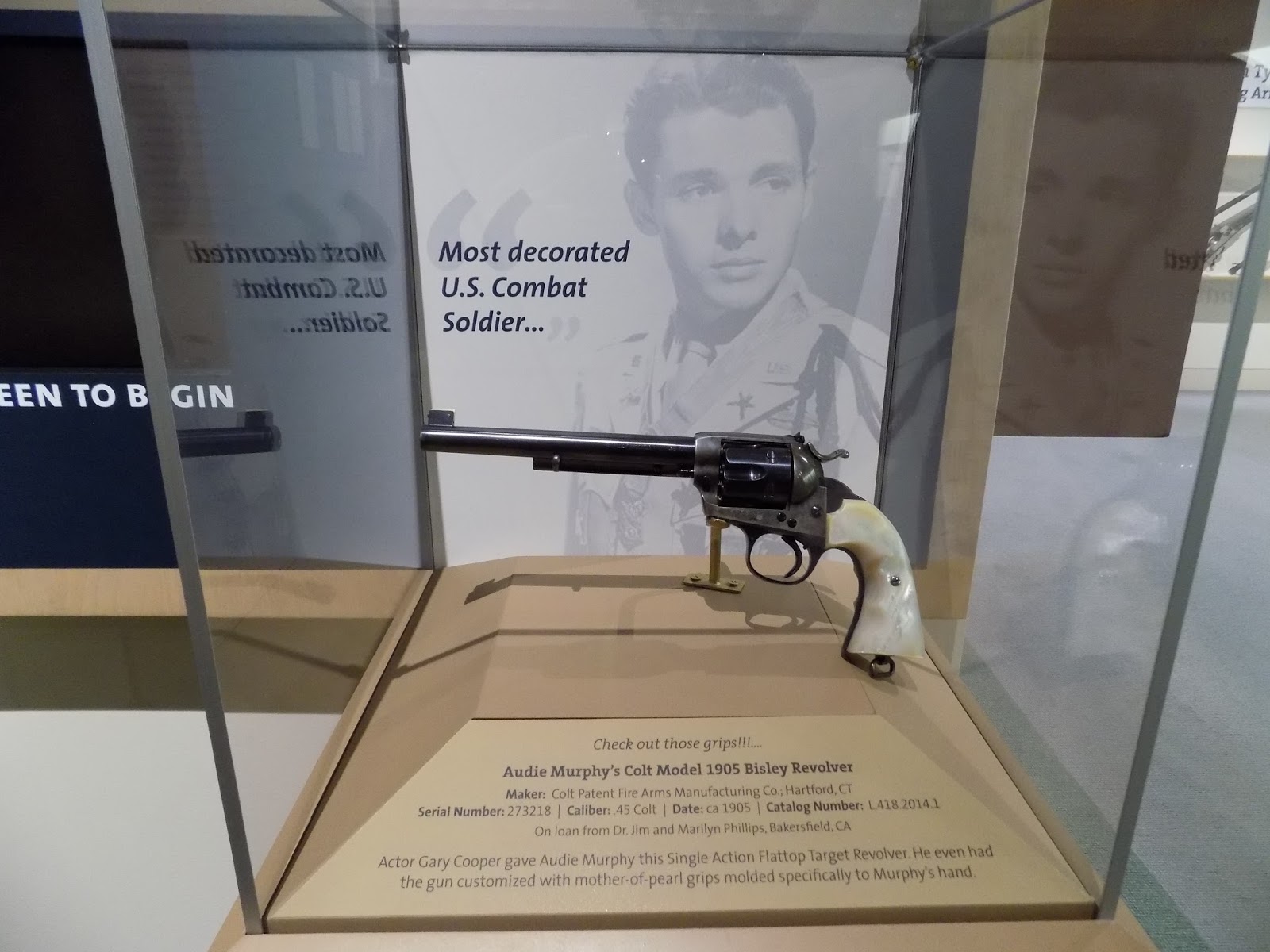
We spent last week in Montana and Wyoming, mostly touring Yellowstone and Grant Teton National Parks, but I'm happy to say that I still found some balm for my classic movie loving soul. One of the best spots for indulging a cinema obsession was Cody, Wyoming, where we spent a full day exploring the Buffalo Bill Center of the West, a five museum complex affiliated with the Smithsonian and a treasure trove for all kinds of fascinating knowledge. I'll talk about Buffalo Bill's personal history and the movies in another post, but this time I want to focus on the Cody Firearms Museum, one of the five museums in the Center.


I'm not normally a gun fan; I grew up around them but find them disconcerting. In Westerns, however, I accept that guns are a necessary and iconic part of frontier culture, where homesteaders and cowboys might have good reasons for keeping firearms handy. Thus, as we were breezing through the firearms museum, not really paying too much attention to exhibits on Glocks and whatnot, I came up short when we arrived at an exhibit about guns in Westerns. This was a gun exhibit that could get my attention!


The display of Western Movie & TV Guns is not really large, but it does feature some gems sure to delight any true fan of the genre. The main cases contain the belts and guns of the stars of Bonanza as well as guns used by the stars of Gunsmoke, Bat Masterson, and The Lone Ranger. They also include a gun used by Gary Cooper in Vera Cruz (1954) and High Noon (1952). Another display pays tribute to World War II hero and Western star Audie Murphy. The gun displayed with it, a Colt Model 1905 Bisley Revolver, was a gift to Murphy from Gary Cooper.


The highlight of the exhibit, however, is the iconic rifle that gives its name to the 1950 Anthony Mann Western, Winchester '73. Displayed in a case by itself, it's an impressive sight, with a production still from the film serving as its backdrop. A closer look, however, reveals that the weapon was signed by all of the film's stars, starting with James Stewart himself. It's a fabulous piece of movie memorabilia that absolutely belongs here, surrounded not only by other Western firearms but by a history of the Winchester and its importance to the settling of the frontier.

If you're ever out around Yellowstone, make time for a stop in Cody, Wyoming. There's a lot of history here for a Western devotee to devour, as well as a nightly gunfight in the street and a whole lot of gift shops and rodeos.

Monday, May 9, 2016

10 Great Westerns of the 1950s

The 1950s produced a bumper crop of A-level Westerns with some of Hollywood's biggest stars in the leading roles, including some we don't necessarily associate with the genre. Over the course of the decade, darker and more complex psychological Westerns appealed to adult viewers, even as the matinee cowboys continue to ride high with the Saturday morning crowd. Westerns and film noir provided fertile territory for directors and actors, with many jumping between the two genres and even blurring the line at times about which was which. Of course, John Wayne and John Ford were still on the scene, but a new generation of Western icons was also developing, with Lee Marvin making his presence known and director Delmer Daves venturing into the genre with Broken Arrow in 1950. You could spend a long time watching Westerns from the 1950s (check out 50 Westerns from the 50s for proof), but here are just ten great Westerns - one from each year of the decade - to get you started.

1) WINCHESTER '73 (1950) - Anthony Mann and James Stewart begin a fruitful collaboration in the genre with this picture, which focuses on the hands through which the coveted title rifle must travel. The cast also includes Shelley Winters, Dan Duryea, and Stephen McNally, but viewers will also find early appearances by Rock Hudson (as a Native American) and Tony Curtis. Mann and Stewart would go on to make four more Westerns together: Bend of the River (1952), The Naked Spur (1953), The Far Country (1954), and The Man from Laramie (1955), all of which are well worth watching.

Westward the Women

2) WESTWARD THE WOMEN (1951) - Probably the least familiar picture on this list, this women's Western is truly unique in its focus on the suffering and determination of a group of women headed West by wagon train to marry settlers on the frontier. William A. Wellman directs an ensemble cast headed up by Robert Taylor as the women's guide, with Denise Darcel and Hope Emerson getting top billing among the many fine actresses. Renata Vanni gives an especially moving performance as one of the group's older members.

3) HIGH NOON (1952) - A four-time Oscar winner, this dramatic Western appears on almost any top ten list for the genre, and for good reason. Its real-time unfolding adds urgency to the story as we watch the clock tick down to Frank Miller's fateful arrival, while Gary Cooper's Oscar-winning performance is noble and moving, even if he is much too old to be marrying Grace Kelly. A terrific supporting cast helps seal the deal, including Thomas Mitchell, Lon Chaney Jr., Henry Morgan, Lloyd Bridges, and Katy Jurado. Tex Ritter, a singing cowboy from the matinee herd, provides the film's mournful title song, which inspired many later Westerns to have their own, similar themes.

4) SHANE (1953) - George Stevens directs this chivalric romance recast as frontier drama with Alan Ladd in the lead as the Wild West's version of a knight errant. Building their own rustic Camelot on the range are Van Heflin and Jean Arthur as the Starretts, with young Brandon De Wilde giving an Oscar-nominated performance as their son. Jack Palance, also nominated for Best Supporting Actor, is Shane's rival gunslinger. Other familiar faces in the cast include Ben Johnson, Elisa Cook Jr., and Ellen Corby.

5) JOHNNY GUITAR (1954) - Joan Crawford makes a rare genre appearance in this very unusual Western from Nicholas Ray, with Sterling Hayden as the title character. There's a lot of noir atmosphere seeping through, no surprise with Ray in the director's chair and Crawford and Hayden in the leads. The supporting cast is full of Western favorites, though, including Ward Bond, John Carradine, Royal Dano, Ernest Borgnine, and Paul Fix. Look out for a truly vicious performance by Mercedes McCambridge as Crawford's rival.

6) BAD DAY AT BLACK ROCK (1955) - Spencer Tracy stars in John Sturges' modern take on Western themes, once again with noir atmosphere turning everything a shade darker and dirtier. Tracy's one-armed WWII veteran comes to Black Rock on a mission of peace, but he finds out that Black Rock has a secret its residents will kill to hide. The landscape and the town speak to the lingering traces of the Old West, and the rest of the cast is packed with genre stalwarts, including Robert Ryan, Walter Brennan, Ernest Borgnine, and Lee Marvin. Tracy earned an Oscar nomination for Best Actor for his performance, while Sturges picked up a nod for Best Director, but every aspect of this film exudes excellence. It's just as hard-hitting today as it was in 1955.

7) THE SEARCHERS (1956) - John Ford and John Wayne deliver their most iconic collaboration with this epic tale of loss and obsession, with Wayne in the lead as ex-Confederate soldier Ethan Edwards, who embarks on a years-long quest to find his niece (Natalie Wood) after she is kidnapped by the Comanche. This is a darker, more morally complicated character for Wayne, but he suits the role perfectly. Widely considered one of the greatest Westerns of all time, this picture is the go-to example of Ford and Wayne's work together, with a rich subtext and emotional supporting performances that reward multiple viewings.

8) 3:10 TO YUMA (1957) - Delmer Daves directs Van Heflin and Glenn Ford in this tense character study of two very different men brought together by fate. Ford plays the smooth-talking, opportunistic outlaw, while Heflin plays the upright rancher with the dangerous job of getting the captured bandit to the train that will take him to prison. From there the lines between good man and bad begin to blur, with the outlaw and the rancher each coming to understand the nature of the other. Frankie Laine sings the theme song, which harks back to the melancholy theme of High Noon.

9) THE BIG COUNTRY (1958) - At 165 minutes, this is an epic Western, indeed, with Gregory Peck leading an impressive cast under the direction of William Wyler. Peck plays a former sea captain who heads West to take up ranching with his fiancee but, predictably, finds drama and strife as he becomes embroiled in a bitter feud. Burl Ives won the Oscar for Best Supporting Actor for his performance, but other notable cast members include Jean Simmons, Charlton Heston, Chuck Connors, Carroll Baker, and Alfonso Bedoya.

10) RIO BRAVO (1959) - Howard Hawks and John Wayne strike back against the serious (and often left-leaning) tone of many 1950s Westerns with the rollicking Rio Bravo, which is more interested in action than psychological analysis. Wayne plays Sheriff John T. Chance, who gets a very motley crew of assistants when the bad guys turn up to reclaim one of their own from Chance's jail. Dean Martin is the alcoholic Dude, trying to sober up enough to hold a gun, and Walter Brennan plays crusty old Stumpy. Dreamy Ricky Nelson sings and shoots as Colorado, while Angie Dickinson gives Wayne some romantic trouble as Feathers. The picture is usually seen as a rebuttal to High Noon, and it presages the kind of movie Wayne would continue to make from here until the end of his career. However, for the A Western as pure entertainment, this one is hard to beat.

For even more great Westerns from the 1950s, try The Gunfighter (1950), The Baron of Arizona (1950), The Furies (1950), Vera Cruz (1954), Seven Men from Now (1956), and Gunfight at the O.K. Corral (1957). You'll find full-length reviews for many of the Westerns listed here in my books, Beyond Casablanca: 100 Classic Movies Worth Watching and Beyond Casablanca II. Both are available on Amazon Kindle.

Monday, June 22, 2015

Classic Films in Focus: ZIEGFELD GIRL (1941)

Ziegfeld Girl (1941) provides a different perspective on the Ziegfeld Follies from Best Picture Winner The Great Ziegfeld (1936); it focuses on a trio of chorines rather than the showman himself, who never actually appears in the picture. Judy Garland, Lana Turner, and Hedy Lamarr star as three young women whose Broadway experiences lead to different fates, and each shines in her respective role. Direction from Robert Z. Leonard heightens the drama and romance, and Jimmy Stewart gives a memorable performance as Turner's unhappy beau. Like other films about the Follies, Ziegfeld Girl includes lavish recreations of the original stage spectacles, with Busby Berkeley directing the show-stopping musical numbers.

Judy Garland plays Vaudeville baby Susan, who has the talent to become a star and the unflagging support of her performer father (Charles Winninger). Lana Turner is Sheila, an elevator girl picked out for the chorus by Ziegfeld himself, much to the dismay of her boyfriend, Gil (Jimmy Stewart). Hedy Lamarr plays Sandra, the wife of a gifted but unsuccessful violinist (Philip Dorn); she takes the chorus job for the income but wounds her husband's pride in the process, which strains their marriage to the breaking point. Each of the three women finds moments of happiness and heartbreak, but only one is destined for tragedy.

The three leading ladies are markedly different from one another, just like their characters, but each adds to the movie's overall appeal in her own unique way. Garland's Susan, fresh faced and girlish, is the innocent kid; she just wants to put on a good show and make it in the business. In spite of her unconventional upbringing on the Vaudeville stage, she's so unspoiled that her idea of romance is a root beer at the soda fountain. She's very similar to the teen characters Garland plays in her pictures with Mickey Rooney, including the Betsy Booth role in the Andy Hardy series. Lana Turner is a little more mature as Sheila, who is old enough to marry Gil but quickly gets distracted by money, male attention, and booze. Her downward spiral into alcoholic self-destruction takes Gil along with her until he ends up working for a gangster and going to jail. Both Turner and Stewart get plenty of dark moments that convey the bitter heartache their characters endure over the course of the film. Lamarr's Sandra is the oldest of the three women, and her story starts at a low point, when she and her husband, Franz, have had to pawn his violin to buy food. Sandra, so striking that even the chorus girls nickname her "Beautiful," has no desire for fame or attention, but she takes the job to help Franz even though it drives him away. Lamarr's breathtaking beauty is displayed most effectively in the stage production numbers, but she also brings an air of Continental experience to her character, who already knows more than the others about life, loss, and love.

The supporting cast is stocked with familiar faces. Charles Winninger does especially well as Susan's Pop, who has to face his own rejection by the Follies when Susan gets her big break. His character represents the the Vaudeville roots of the Broadway shows and a way of life that was fast disappearing as the twentieth century gathered steam. Jackie Cooper connects the characters of Susan and Sheila as Sheila's younger brother, Jerry, who worries about his sister while falling for her talented friend. Tony Martin provides music and illicit romance as the show's solo singer, Frank, who woos Sandra even though they are both still married. Since Ziegfeld himself never turns up in person, Edward Everett Horton fills in as his representative, Noble Sage, who has to handle a crowd of chorus girls and keep the show going. In smaller but still memorable roles are Eve Arden, Dan Dailey, Felix Bressart, and Fay Holden, each getting at least a few good scenes and, in Arden's case especially, some excellent lines.

The Follies get a third movie treatment with Ziegfeld Follies (1945), which also features Judy Garland. Robert Z. Leonard directed The Great Ziegfeld (1936), as well, and his other films include Dancing Lady (1933), Pride and Prejudice (1940), and In the Good Old Summertime (1949). For more of the gorgeous Hedy Lamarr, see Algiers (1938), Experiment Perilous (1944), and Samson and Delilah (1949). You'll find both Lana Turner and Judy Garland in Love Finds Andy Hardy (1938), but Turner is best remembered today for her femme fatale turn in The Postman Always Rings Twice (1946). Ziegfeld Girl was the last picture Jimmy Stewart made before departing for the Army and World War II; his next movie, five years later, would be It's a Wonderful Life (1946).

Thursday, August 14, 2014

Build-Your-Own-Blogathon: Bad Apples in BEND OF THE RIVER (1952)

This post is part of the Build-Your-Own-Blogathon hosted by the Classic Film and TV Cafe. It follows Caftan Woman's discussion of T-Men (1947), which shares its director, Anthony Mann, with Bend of the River (1952). Visit the Classic Film and TV Cafe for a complete list of the blogs participating in this blogathon!


"That kind can't change. When an apple's rotten, there's nothing you can do except throw it away or it will spoil the whole barrel." - Jeremy Baile

Director Anthony Mann collaborated with Jimmy Stewart on a number of excellent Westerns, including the 1952 film, Bend of the River, which takes the rugged country of the Pacific Northwest as its frontier territory. It's a story about gold fever, moral decay, and second chances, with Stewart as a former outlaw trying to turn over a new leaf as an honest man. Stewart's Glyn McLyntock is, of course, a good apple, no matter how shady his past, but the movie also presents us with a parade of foils and variations on the same theme. Jay C. Flippen and Chubby Johnson play for the angels as the movie's older good men, with Flippen especially crucial to Stewart's character as the leader of the Oregon settlers, but the less exemplary characters prove far more numerous. Arthur Kennedy and Rock Hudson play men whose moral compasses need more recalibration than Stewart's, while Howard Petrie depicts the rapid transformation of a good man gone wrong over gold, and Harry Morgan plays one of the dirtiest little apples ever seen in a Western barrel. These slippery, complicated performances help make Bend of the River a smart study of psychology as well as an exciting frontier adventure, and the bad apples inform our understanding of the hero's own inner struggle.

"$100,000 is a lot of money." - Emerson Cole (Arthur Kennedy)

Glyn's primary counterpart throughout the picture is Kennedy's Emerson Cole, a man who has so much in common with Glyn that Glyn tends to think of their destinies as inextricably linked. Cole shares Glyn's past as a raider, and he has enough integrity to appreciate it when Glyn saves his life, but Cole lacks the essential strength of character that sets Glyn apart. Cole likes fast living and violence; he's quick to draw his gun, even when lesser measures would suffice. Kennedy plays Cole as an enigma at first, encouraging us to like him even when we don't trust him, but the lure of wealth proves too much for him to resist. Even the love of Laura (Julie Adams) means nothing to him once a fortune comes within reach. Glyn offers him multiple chances at true redemption, but Cole succumbs to greed.

"You're real fast with that gun, kid, but you're soft." - Emerson Cole (Arthur Kennedy)

Hudson's handsome young gambler, Trey Wilson, makes the relationship between Glyn and Cole into a triangle. His essential nature is ambiguous early on; as a gambler, he is clearly a man who values money, but he doesn't like to kill. Cole even scolds him for being too soft-hearted. Trey throws in with Glyn and Cole without much thought, and he doesn't have to choose between them until it becomes clear that the two older men are moving in starkly different directions. Even then, Trey keeps his cards hidden, so that we're never quite sure which side he's on until the very end of the film. Trey actually fills two Western character types at once. Despite his worldly demeanor and flashy clothes, he is also this film's version of the Kid who has to decide which model of masculinity he wants to embrace; he can chase wealth and become like Cole, or he can do the right thing and emulate Glyn.

"I could get fifty times what you paid for that food. It's gold, do you understand, gold!" - Tom Hendricks (Howard Petrie)

Howard Petrie plays Tom Hendricks, the Portland official who first welcomes the settlers with open arms but later betrays their trust by reselling their winter supplies at wildly inflated prices. If Hendricks seems a little too friendly at first, that merely sets the stage for his later corruption, when we see him at his overflowing money table with a mad gleam in his eyes. Hendricks' fall mirrors that of the entire community; when Glyn and Jeremy (Jay C. Flippen) return to Portland looking for their supplies, they find the formerly pleasant town transformed into a filthy den of violence, greed, and lust. Hendricks is so far gone that he doesn't care if his double dealing costs the settlers their lives; he is even willing to kill Glyn and Jeremy to protect his financial interest. Tellingly, Cole doesn't seem to process the warning of Hendricks' fate; he's too busy shooting Hendricks' men while they try to run away.

"We're going to the gold camp with this food." - Shorty (Harry Morgan)

While most of the other flawed men in the film have some good qualities, Harry Morgan's Shorty is about as rotten as they come. Along with Red (Jack Lambert) and Long Tom (Royal Dano), Shorty never makes any move unless he's going to get paid for it. Shorty is a far cry from the uncertain but good-hearted character Morgan played in The Ox-Bow Incident (1943). He's a dirty, narrow-eyed sneak, always watching for the opportunity to take advantage of the others. He and the other workers conspire to hijack the food supply and sell it at the highest possible price in the gold mining camp; like Hendricks, they don't care if the settlers starve to death as a result. Unlike Hendricks, Shorty and his pals were never good in the first place. Their worst scene comes when they intentionally drop a wagon on Jeremy, Glyn, and Cole in an effort to murder all three at once.

"Any man can make a mistake." - Laura (Julie Adams)

These men run the gamut in terms of moral character, and each one shapes his own fate through his choices. The corruption of the weaker men reminds us how much is at stake in Glyn's struggle for redemption. Glyn knows that the kind of life he once led can only end badly, but his determination to do right and take a harder path makes him a hero in this story more than any skill with a rifle or knife. While there are plenty of bad apples in Bend of the River, they only make the good ones look that much better.

Wednesday, August 13, 2014

Classic Films in Focus: BELL, BOOK AND CANDLE (1958)

James Stewart and Kim Novak starred in Bell, Book and Candle (1958) the same year they made Vertigo (1958), and both films illustrate the hazards of becoming obsessed with someone you don't really know. Bell, Book and Candle plays this set-up as fodder for supernatural comedy rather than psychological suspense, but there's still an air of menace about the proceedings. The fun depends mostly on sly, offbeat performances from Jack Lemmon, Elsa Lanchester, Hermione Gingold, and Ernie Kovacs, with Stewart and Novak perfectly serious about their magical game of cat and mouse. The result is an odd film, engaging but troublesome, especially in its insistence on an ending that enforces conformity and outdated notions of gender-driven power.

Stewart plays middle-aged publisher Shep Henderson, who becomes entangled with his strange neighbors, the attractive Gil (Novak) and her mischievous aunt, Queenie (Elsa Lanchester). Despite their unusual habits, Shep never suspects that the women are actually witches, living in modern day New York and more or less hiding in plain sight. Shep's fiancee, Merle (Janice Rule), turns out to be Gil's old school nemesis, which inspires Gil to steal Shep for herself by using her magic, even though she insists that she doesn't really care about him. Gil also casts a spell to bring occult author Sidney Redlitch (Ernie Kovaks) to Shep's office, but his arrival complicates matters when he enlists the help of Gil's feckless brother, Nicky (Jack Lemmon), to write about the modern witches of New York.

There is plenty to like about this picture, especially the unconventional community of witches and warlocks, who even have their own night club and generally seem intent on having a good time. They're a bohemian crowd, weird but not really ambitious enough to play more than pranks. Nicky bangs the bongos and switches off street lights, while Aunt Queenie enjoys breaking into Shep's apartment and snooping around. Only Gil is serious and talented enough to do real harm; she terrifies Merle with a conjured thunderstorm and turns Shep's life upside down. Lanchester and Lemmon are delightful and perfectly cast, while Hermione Gingold revels in her matriarchal character, the powerful Bianca de Passe. She has her best scene when Shep comes to her for help in breaking Gil's love spell, in which she mixes a horrific potion and commands the poor victim to drink it. Rumpled Ernie Kovaks also fits in like a natural; the existence of witches in New York is great news for Redlitch and his next book, and his enthusiasm for the community contrasts Shep's growing horror.

The breakdown of the fun happens in the third act, when it becomes clear that Gil's power is deemed unnatural and antithetical to her femininity. Having it all is not an option; she can be a witch and never love, or she can lose her power to become the kind of girl Shep might want to marry. This is similar to the premise set forth in the earlier I Married a Witch (1942), in which Veronica Lake's supernatural heroine becomes a mortal for the love of Fredric March, but Bell, Book and Candle is much more heavy-handed about its disapproval of the powerful, unconventional woman. When we first meet Gil, she wears black, goes barefoot, and sells bizarre tribal masks in her shop, but in order to win Shep for real she has to give up all of those things and conform to his rather narrow expectations. Is Shep really worth it? Would it be so terrible to end up like Aunt Queenie and Madame de Passe? Given the glaring age difference between Stewart and Novak, many modern women might well decide that Gil would have been better off keeping her magic and her cat instead of surrendering to middle-class values for a man old enough to be her father. One suspects that Nicky and the witches will be having a good time long after Gil has gotten tired of seashells, shoes, and a kitchen full of dirty dishes.

Bell, Book and Candle earned two Oscar nominations, for art direction and costume design. Director Richard Quine also worked with Jack Lemmon in It Happened to Jane (1959) and How to Murder Your Wife (1965), and Lemmon and Novak both appear in his 1962 film, The Notorious Landlady. For more of Kim Novak, see Picnic (1955), The Man with the Golden Arm (1955), and Kiss Me, Stupid (1964). Jimmy Stewart's other pictures from the late 1950s include Night Passage (1957) and Anatomy of a Murder (1959). Don't miss Hermione Gingold in The Music Man (1962), and be sure to appreciate Elsa Lanchester's Oscar-nominated performance in Witness for the Prosecution (1957), in which she antagonizes her real-life husband, Charles Laughton.

Sunday, April 13, 2014

James Stewart Blogathon: DESTRY RIDES AGAIN (1939)

This post is part of the James Stewart Blogathon hosted by the Classic Film & TV Cafe. You can view the complete blogathon schedule here.

If we come to Jimmy Stewart as a Western star looking back from the present, we peer through a history that makes his appearance in the genre seem obvious, perhaps even necessary. We see him in The Shootist (1976) and The Man Who Shot Liberty Valance (1962) with that greatest of Western icons, John Wayne, and he holds his own there as a believable resident of Wayne’s frontier world. Stewart seems as much a part of the genre’s history as his real life friend, Henry Fonda, with whom he starred in The Cheyenne Social Club (1970) and Firecreek (1968). All three Western stars would appear in How the West was Won (1962), which is basically a who’s who of the genre. Thus, from where we stand now, Stewart looks like a natural part of the Western landscape, but that wasn't the case at all in 1939, when Stewart starred in Destry Rides Again.

It was the first Western of the young actor's career, and at that point Stewart seemed an odd choice for the role. Tall and amiable, with an air of peculiarly American innocence, Stewart had primarily been seen in romances and comedies. Frank Capra had put him to good use in You Can't Take It with You (1938) and Mr. Smith Goes to Washington (1939), but Destry was entirely new territory. It took Stewart out of the polite, civilized settings he had previously inhabited and dropped him into the rugged and rowdy frontier.

Stewart plays the film's title character, the son of a legendary lawman and the last hope of the honest citizens of Bottleneck, a wild, corrupted frontier town. Summoned by the town drunk (Charles Winninger), whom the crooks have made sheriff as a cruel joke, Destry at first seems like a terrible disappointment. He doesn't even carry a gun. As Destry says, however, first impressions are darn fool things, and even the local good time girl (Marlene Dietrich) is drawn to him, despite her understanding with the conniving crime boss (Brian Donlevy). When the crooks murder Destry's friend, he is compelled to take up his guns and rid the town of its oppressors for good.

Stewart makes Destry work precisely because he seems so unlikely as a gunslinger. Lanky, soft-spoken, and polite, Stewart's hero doesn't strike anyone as a threat, much less a gunfighter. Destry, of course, knows his own ability and lets the townspeople wallow in their assumptions. Stewart invests him with an easy nature that is only mistaken for weakness. In fact, it's born of self-assurance. When he finally takes out his guns, we see the other side of Destry's character, and this is where Stewart surprises us most. He is tough. He can be a dangerous man. There's a whole future unfolding for Stewart in this moment, one that will make him an icon not only for It's a Wonderful Life (1946) but also for Winchester '73 (1950), The Man from Laramie (1955), and The Man Who Shot Liberty Valance. There's an unexpected edge to Stewart that later directors will seize upon: Anthony Mann will reveal Stewart's darkness as an underlying vein of hysteria in The Naked Spur (1953), and Alfred Hitchcock will make it the sublime theme of his masterpiece, Vertigo (1958). Despite the fact that Destry Rides Again is technically a comedy, it actually paves the way for Stewart to venture far beyond the territory he had covered in the Capra pictures or early work like Wife vs. Secretary (1936), Born to Dance (1936), or Vivacious Lady (1938).

Thus, as a Jimmy Stewart picture, Destry Rides Again is a watershed moment in the actor's career. Only by looking back at it from the perspective of 1939 can we really appreciate how important it would become in terms of Stewart's own legacy and the evolution of the Western as a whole. Destry opens the door for an actor who would go on to make some of the finest Westerns in Hollywood history, one who would become so associated with the genre that his final screen credit would be for his performance in a Western tale. By the time he loaned his voice to An American Tail: Fievel Goes West (1991), Stewart was as much a part of the Western as any actor who ever rode a horse into a dusty frontier town. For that, we have Destry to thank.

Thursday, December 5, 2013

My Christmas Movies

Every film buff has a favorite Christmas movie, a picture that is such a part of the holiday that it just isn't Christmas without it. Plenty of us even have lists of such movies, and I'm no exception. As we head into the holidays, these are the movies - both classic and more recent - that I'll be watching to get into the holiday spirit.


IT'S A WONDERFUL LIFE (1946)

Sure, it's the obvious choice, but for me the Jimmy Stewart classic is a holiday necessity because I often feel down during the Christmas season, and George Bailey's story reminds me that Christmas is a hard time for a lot of people. Besides, it has such a fantastic cast, and every year as I watch more classic movies I appreciate the actors more, from Lionel Barrymore and Thomas Mitchell to Beulah Bondi and Gloria Grahame. 


WHITE CHRISTMAS (1954)

I love pretty much everything about this musical, but I'm especially fond of Danny Kaye and the movie's depiction of soldiers' lives after the war. "Snow" is a beautiful tune (they should play it on the holiday radio stations more often), and Mary Wickes is such a hoot as the nosy housekeeper. The drag performance of "Sisters" by Crosby and Kaye cracks me up, and the finale's salute to Dean Jagger's character always gets me right in the old ticker.


SCROOGED (1988)

My taste in Christmas Carol adaptations tends toward the bizarre, and this is certainly one of the weirdest and funniest versions. I just can't resist Carol Kane's sadistic sugar plum Ghost of Christmas Present or David Johansen's hilarious cab driver Ghost of Christmas Past - "Niagara Falls!" It even has Robert Mitchum in it! I don't love everything Bill Murray has done, but this picture and Groundhog Day are right up there with Ghostbusters in the comedian's canon. I laugh, I cry; it's better than Cats.


THE MUPPET CHRISTMAS CAROL (1992)

As the co-editor of two books about Jim Henson, I'm definitely a Muppet fan, and this twist on Dickens is such a fun outing for the familiar cast of characters. Gonzo, my favorite Muppet, gets an especially good part as Charles Dickens himself, and the Ghost puppets represent some of the Henson group's most beautiful creative designs. Michael Caine is a delight as Scrooge, even if he experiences his essential change of heart rather too quickly to be as mean as he's supposed to be. When I saw this movie in the theater after its original release, it made me sad because Jim Henson had died in 1990, and this picture was the first to appear after his passing. Today, its bittersweet quality has softened, but like the original story it remains a sentimental experience.

What movies make your Christmas holiday complete? Let me know in the comments!


Monday, May 20, 2013

Classic Films in Focus: THE CHEYENNE SOCIAL CLUB (1970)

The names attached to The Cheyenne Social Club (1970) might reasonably give a viewer certain expectations of greatness, but director Gene Kelly's easy-going Western is content to let its stars, Jimmy Stewart and Henry Fonda, amble companionably through its mildly interesting plot, which takes the pair off the Texas range and into the well-appointed - if morally suspect - rooms of the title location. What we get as a result is a cowboy buddy movie compounded with a fish-out-of-water plot, nothing revolutionary or particularly ambitious, but amusing enough thanks to the two stars' natural camaraderie and the bustling good humor of the supporting actresses who play the social club's attractive commodities. This is by no means the best Western ever made by either actor, but those who appreciate the oaters Stewart and Fonda made earlier in their careers will probably enjoy this one, too, and those who know something about the stars' real-life friendship will like it even more.

Stewart plays John O'Hanlan, an aging Texas cowboy who unexpectedly inherits his dead brother's business in Cheyenne. Little suspecting the nature of his brother's establishment, John and his talkative sidekick, Harley Sullivan (Fonda), ride to Cheyenne to claim the inheritance. John is dismayed when The Cheyenne Social Club turns out to be a brothel, stocked with a bevy of attractive young women and headed up by Jenny (Shirley Jones) in the absence of the actual owner. Unfortunately, John finds it difficult to shut the place down, and he becomes embroiled in a series of deadly encounters when a local tough (Robert J. Wilke) beats Jenny.

O'Hanlan provides the fish-out-of-water theme, constantly stymied by the women, the townspeople, and the very idea of the brothel. His laconic, conservative nature contrasts with that of garrulous, free-wheeling Harley, who samples the ladies' wares with enthusiasm but balks at being drawn into O'Hanlan's fights. Stewart and Fonda invest these characters with completely credible cowhand personalities; both had made many Westerns in the earlier decades of their careers, and they know exactly the right way to ride a horse, handle a rifle, and chew or spit a line like a plug of tobacco. Their banter draws attention to the actors' long-standing friendship and the differences between them, especially in the realm of politics, but it does so without undermining the characters they're playing. Like Stewart and Fonda, John and Harley have a relationship that transcends their disagreements, even if they themselves don't always understand why.

The movie is technically a comedy, but it's not an uproarious one. The humor relies mostly on John's initial discomfort about the brothel and then his paternal attitude toward its denizens, with Harley's randy adventures with the girls providing some sense of a romp. Like other Westerns of its era, The Cheyenne Social Club reflects a genre in flux, trying to be several things at once in the wake of the traditional Western's slow demise. It falls back on a lot of classic Western motifs, but the brothel plot winks at the rise of the sex comedy and tries to make the picture hip for a younger and more sexually liberated audience. It doesn't necessarily succeed, but it has enough good nature to make up for many of its faults.

Gene Kelly is best remembered today as a song-and-dance actor, but in addition to The Cheyenne Social Club he also directed The Tunnel of Love (1958), A Guide for the Married Man (1967), and Hello, Dolly! (1969). His most successful films, however, were those he co-directed with Stanley Donen, including Singin' in the Rain (1952). Jimmy Stewart's first Western was Destry Rides Again (1939), but you'll also find him starring in a series of excellent oaters from Anthony Mann, particularly Winchester '73 (1950) and The Man from Laramie (1955). See The Man Who Shot Liberty Valance (1962) and The Shootist (1976) for Stewart's late-career performances with cowboy icon John Wayne. Henry Fonda's early Westerns include Jesse James (1939), The Ox-Bow Incident (1943), and My Darling Clementine (1946), but he also makes an unusual foray into villainy in Sergio Leone's Once Upon a Time in the West (1968). For more of Shirley Jones, see Oklahoma! (1955), Carousel (1956), and The Music Man (1962), as well as the television series, The Partridge Family. You can also see her with Jimmy Stewart in another Western, Two Rode Together (1961).

The Cheyenne Social Club is currently available on Warner Archive Instant and for $2.99 on Amazon Instant Video.

Monday, March 4, 2013

Classic Films in Focus: VERTIGO (1958)

Alfred Hitchcock's films have been the gateway drugs for many a classic movie addict, and of all of his best-known thrillers, Vertigo (1958) is certainly the trippiest, a mind-blowing overdose of deception, desire, and betrayal. Set against the gorgeously atmospheric background of San Francisco, the film twists and turns as much as the city's famed Lombard Street, and the real scope of its perversity may require multiple viewings to appreciate fully. As black-hearted as the grittiest film noir, Vertigo is all the more sinister for its civil, romantic disguise; it unfolds slowly at first, seducing the viewer with its promises of redemption, but the finale reveals its true nature with one vicious, shattering blow.

Jimmy Stewart stars as John "Scottie" Ferguson, a former police detective whose fear of heights has resulted in the death of a fellow officer and Scottie's own resignation from the force. An old college friend named Gavin Elster (Tom Helmore) turns up and asks Scottie to tail his wife, Madeleine (Kim Novak), who has been drifting around town like a sleepwalker and doesn't seem to know what she does or where she goes. Gavin thinks she might be possessed by the spirit of a suicidal ancestor, and Scottie soon uncovers clues that suggest that a supernatural influence might be at work. He also falls in love with Madeleine, much to the dismay of his pining sometime girlfriend, Midge (Barbara Bel Geddes). Unfortunately for Scottie, the truth about Madeleine Elster turns out to be far more complicated than a mere ghost story.

Stewart gives a great performance as the damaged protagonist, and his nice guy persona makes an excellent disguise for the twisted heart that lies within Scottie Ferguson. His own perversion is merely hinted at in the early scenes with Midge, where he lounges about her apartment utterly oblivious to her misery and love. When he eventually meets up with Madeleine's double, Judy Barton (also played by Kim Novak), the real ugliness of his nature comes out. He twists and shapes her to suit his obsessive desire, ignoring her pain and her pathetic attempts to make him love her as herself. Kim Novak is actually more interesting as the brassy Judy than as the strangely wooden Madeleine, but Scottie's inability to appreciate that is just one of his many failings. Barbara Bel Geddes is absolutely heartbreaking as Midge, the only really likable character in the whole story and of course the one woman who can't get Scottie's attention for a minute. Her disappearance from the film before the final act signals the death of any hope that this story can end well; she walks out down a darkened hallway with terrible resignation, leaving Scottie to his ghosts, his madness, and his doom.

Aside from the wild camera work that dramatizes Scottie's vertigo and his moments of guilt-induced psychosis, we get stunning images of the city of San Francisco, sunnier and seemingly warmer than it is in real life but filled with angles and dips designed to make the most of Scottie's fear of heights. In many ways the city functions as another character in the film, one with its own secrets and desires. San Francisco has always been a cinematic town, but Vertigo capitalizes on its full potential as a setting for both romance and danger. All the best landmarks get their moments onscreen, and viewers might well lose their hearts to the fabled City by the Bay before the end credits roll.

Hitchcock also made Rope (1948), Rear Window (1954), and The Man Who Knew Too Much (1956) with Stewart. In the same year that they appeared in Vertigo, Stewart and Novak made Bell, Book, and Candle, a romantic comedy in which Novak's character really does turn out to have supernatural charms. For more Stewart hysteria, you might also try The Naked Spur (1953), a very Hitchcockian Western from director Anthony Mann. Vertigo was nominated for two Oscars in 1959 but was considered a failure at the time of its release. Luckily, time has proven a better judge of the picture's merits. In 2012, voters in the Sight & Sound poll actually selected Vertigo as the greatest film of all time, dethroning the long-standing champion, Citizen Kane (1941).

An earlier version of this review originally appeared on Examiner.com. The author retains all rights to this content.

Friday, December 7, 2012

Having Myself a Classic Movie Christmas

We're a full week into December, and it's time to get serious about classic Christmas movies. TCM is showing 33 of them this month, including several fan favorites and a lot of less obvious choices, but I'm mostly a traditionalist when it comes to classic holiday films (with a few notable exceptions). Here are six movies I have to watch over the holidays this year, or it just won't be Christmas.

1) It's a Wonderful Life (1946) - My father loves this movie, and I grew up watching it several times each holiday season. It still gets to me today, and I love the huge cast of memorable performers, from the big name leads to the veteran character players. This year I actually get to host a screening of the Capra classic at our local library!

2) White Christmas (1954) - I just love everything about this film, from its WWII patriotism and selfless themes to its crazy drag version of "Sisters" and Mary Wickes' nosy housekeeper. The songs are fantastic, the mood is nostalgic and sweet, and the holidays aren't complete without Danny, Bing, Rosemary, and Vera-Ellen.

3) Three Godfathers (1948) - So I've got a well-established thing for classic Westerns, especially those John Ford/John Wayne collaborations, and this one is simply a Yuletide treasure. Yes, it's another iteration of the now familiar "three men and a baby" plot, and not even the first Western to have the title or tell the story, but the Duke, Pedro Armendariz, and Harry Carey, Jr., are just so lovable and rough that I can't resist them. Personal favorites like Ward Bond, Mildred Natwick, and Jane Darwell help to make this one a holiday essential at my house.

4) The Muppet Christmas Carol (1992) - Yes, there are lots of great versions of Charles Dickens'  Christmas tale, but this one is my favorite hands-down, not just for the goofy Muppet humor but for the incredible puppetry work on the Ghosts, especially the Ghost of Christmas Past. Hey, I love the Muppets so much I co-edited two books about them, so nobody can be surprised if I spend time watching Muppet holiday movies every time December rolls around (I watch all of the other Muppet holiday shows, too, but this one is the best). Gonzo as Charles Dickens? Genius! Michael Caine as Scrooge? Fabulous!

5) Scrooged (1988) - Bill Murray's irreverent take on A Christmas Carol is a riot, and it's even got Robert Mitchum! The Ghosts are especially fun, thanks to over-the-top performances from David Johansen and Carol Kane. Bobcat Goldthwait steals his scenes as an ex-employee pushed a little too far by Bill Murray's modern-day Scrooge.

6) Rudolph, the Red-Nosed Reindeer (1964) - Having grown up a veritable resident of the Island of Misfit Toys, I find Rudolph's outcast protagonist deeply sympathetic in this quirky TV classic. We actually watch all of the Rankin/Bass holiday specials each year, but this one is especially funny and poignant, and full of quotable lines thanks to Larry Mann as Yukon Cornelius. "It's a night not fit for man nor beast! Here's the man... and here's the beast!" - such lines are endlessly repeated in my family this time of year.

Of course, I'll be watching other holiday films this month, including Christmas in Connecticut (1945), Miracle on 34th Street (1947), 101 Dalmatians (1961), A Christmas Story (1983), and even Gremlins (1984), but these six are at the top of my nice list when it comes to Christmas pleasures. Bake some cookies, make a cup of cocoa, and tell me about your favorite Christmas movies in the comments section below!

Wednesday, December 5, 2012

Classic Films in Focus: IT'S A WONDERFUL LIFE (1946)

The vast array of memorabilia that has sprung up around It's a Wonderful Life (1946) over the last two decades tends to support the general sense of the holiday staple as the ultimate example of director Frank Capra's corny sentimentality, strengthening that idea we have of the movie being all about angels and family values and the treacly sweetness embodied in a kid named Zuzu. There are snow globes and coffee table books, Christmas tree ornaments and talking greeting cards, all of them spouting the fuzzy warmth of the movie's ending: "Every time a bell rings, an angel gets its wings!"

These things, as ubiquitous as they are, do not go to the heart of It's a Wonderful Life; they show us only the the last glimpse of a story that has endured not because of its few bright moments, but because of its deeper understanding of the dark side of Christmas and of life, as well. It's a Wonderful Life is a Christmas story for the losers, the nice guys who finish last, the Bob Cratchits drowning in a world of Scrooges. It's a holiday film for those who find themselves miserably and helplessly depressed, not in spite of the season, but because of it. For these reasons it remains ones of the best and most truthful of seasonal films, and people who only ever catch the ending have missed everything that matters about it.

George Bailey (Jimmy Stewart) is a good man, yes, but this is a story that finds him trying to commit suicide at Christmas; his life has overwhelmed him so completely that the view from the bridge looks awfully tempting. Neither his loving wife (Donna Reed) nor their brood of young children are compelling enough reasons to keep George from jumping; it takes divine intervention to interrupt his despair, and that intervention turns up in the person of a daft little fellow named Clarence (Henry Travers), who tells a skeptical George that he is an angel. George, still miserable, wishes that he had never been born, and with this utterance the action of the story gets into gear, telling both the story of George's life and the story of life without George.

The memorabilia enshrines only the final scene of the film, that of a happy George and his family beneath the Christmas tree, but the darker scenes work themselves more subtly into the viewer's memory. George, having never been born, meets the woman who would have been his mother, and of course she does not know him. Lovely Mary, a lonely spinster, runs from him in fear. The grief stricken pharmacist whom George saved from a fatal mistake now wanders the town a broken drunk, mocked and reviled. Loathsome Potter, like a fat spider, looms over this town full of flies, and in George's absence the whole scene sinks and gasps and gives itself up to despair. Without George, the town becomes like him at the beginning of the film. His suffering is replaced by that of everyone else in Bedford Falls.

Of course, the ultimate message is positive, that one person makes a difference, that people will come together and do what is right when the time comes, that it really is a wonderful life, no matter how bad it may seem in the short term. Still, it acknowledges depression and suffering as a part of the Christmas experience, and it presents George as a sympathetic protagonist even when he is most unhappy. Looking at George's life in review, we have to admit that he has plenty of things to be unhappy about, and the redemption of George's faith at the end of the film is not a correction of his erroneous attitude so much as it is a long-overdue evening of the balance. George is not Scrooge, hardened and cruel, but Cratchit pushed one last lump of coal too far. We want to see him win for a change because we feel like him, overburdened, always one step behind our dreams, never in the right place at the right time to make life work for us for once.

Most of us have days when the view from the bridge looks tempting, and it's because of that shared misery that George speaks to us. If you have been a winner all your life and are happy at Christmas then you don't need to watch It's a Wonderful Life; it's not for you. It's for those of us who doubt, who grieve, who harbor sadness in our hearts as the carols are sung. It's for those of us who need to be reminded not so much that it's a wonderful life, but that we aren't alone in sometimes feeling that it's not.

If Capra's holiday classic is your only experience with the director, be sure to see Mr. Deeds Goes to Town (1936), You Can't Take It with You (1938), and Mr. Smith Goes to Washington (1939). George Bailey was Jimmy Stewart's first post-war role; see him in Destry Rides Again (1939) and The Philadelphia Story (1940) for more pre-war work, and then compare those with other post-war films like Rope (1948), Winchester '73 (1950), and Vertigo (1958). For more Christmas classics, try Christmas in Connecticut (1945), Miracle on 34th Street (1947), and White Christmas (1954).

An earlier version of this review originally appeared on Examiner.com. The author retains all rights to this content.

Thursday, November 29, 2012

Classic Films in Focus: THE MUPPET MOVIE (1979)

Like Star Wars (1977), The Muppet Movie (1979) was a watershed event in the formation of Gen Xers' cinematic culture. Jim Henson and George Lucas certainly recognized a common spirit in one another, and their films resonated with their youthful audiences in similarly enduring ways. By the time the first Muppet film appeared, The Muppet Show had already been on television for several seasons, but the movie was something larger and more ambitious, in terms of both puppetry and narrative. The Muppet Movie also shares with Star Wars a deep and pervasive debt to the film traditions that had come before, although The Muppet Movie celebrates its relationship to classic movies more overtly and self-consciously than Lucas' film. This playful awareness of itself as part of the great Hollywood tradition is part of the movie's charm, and it helps to set The Muppet Movie apart as a special kind of family film, both smart and sentimental, both wildly creative and instantly accessible, a film that rewards the adult viewer with different but equal pleasures from those experienced by the child.

The plot follows a classic Hollywood line: Kermit the Frog, talented, generous, and completely inexperienced, sets off for Hollywood to become a star. Along the way he picks up a menagerie of companions, including Fozzie Bear, Miss Piggy, and The Great Gonzo. They encounter a number of obstacles on the way to realizing their dream, chiefly embodied by the greedy Doc Hopper (Charles Durning), who intends to use Kermit as the spokesfrog for his fried frogs' legs restaurant chain, whether Kermit likes the idea or not.

The plot of The Muppet Movie combines elements of two popular Hollywood genres, the show business picture and the road picture. The show business plot ties it to films like A Star is Born (pick a version), Singin' in the Rain (1952), and a host of other movies in which starry-eyed kids arrive in Tinseltown looking for their own "standard rich and famous contracts," while the road elements connect it with films like the Hope and Crosby vehicles and even The Wizard of Oz (1939). Both genres can be played as either comedy or drama, and The Muppet Movie incorporates both, although its drama is generally tinged with enough surreal weirdness to render it palatable to the youngest members of the audience. Thinking about it now, it seems to me that the classic film The Muppet Movie most resembles is Sullivan's Travels (1941), with its emphasis on the importance of making people laugh combined with its picaresque adventures and Hollywood self-reflection. There are times in Preston Sturges' brilliant comedy when Sullivan does not feel like laughing at all, becoming downcast and even in despair, and Kermit shares those moments during his own journey. Still, both stories insist on the belief that it will all come right in the end.

The Muppet characters have their own indebtedness to classic films and types, having been created to reflect the values and conventions of Vaudeville and other old school entertainment institutions, and in The Muppet Movie those relationships get more play because of the opportunities presented by the sustained narrative. While Kermit, for example, possesses a certain affinity with Sturges' Sullivan, he might rightly be called a Capraesque hero, as well. Henson could have named his picture Mr. Frog Goes to Hollywood and summed it up pretty handily. If Kermit were a human being and not a frog, he would be played by Jimmy Stewart (Roger Ebert has called him "Mickey Rooney in a frog suit," but I think he has more romantic charisma than that implies). The sense of common ground between Henson and Capra characters becomes particularly obvious in It's a Very Merry Muppet Christmas Movie (2002), which more or less recreates the entire plot of It's a Wonderful Life (1946) with Kermit as its amphibian George Bailey. Miss Piggy has her own classic movie roots; with her diva's ego and talent for self-transformation, she channels the glamor and hard-edged determination of stars like Bette Davis and Joan Crawford. In The Muppet Movie, her lust for fame causes her to abandon Kermit, the frog of her heart, but her porcine melodrama brings her back to him in time to share in his success.

The scores of cameo appearances that populate The Muppet Movie shore up these affiliations. We get, in no particular order, Bob Hope, Edgar Bergen, Milton Berle, Mel Brooks, James Coburn, and Orson Welles, just to name a few of the veteran performers who appear in the film. The presence of Welles is probably the most interesting from a classic film perspective; imagine the man who made Citizen Kane (1941), arguably the greatest movie of all time, appearing in The Muppet Movie! It's the cinematic equivalent of the Pope's blessing. Many of these stars were better known for their television careers, but all had experience in the movies, including Milton Berle, who had been appearing in silent films in Hollywood since the age of 5.

The Muppet Movie was a collaborative effort, as were all of Jim Henson's productions; director James Frawley, writers Jerry Juhl and Jack Burns, and the entire crew of puppeteers all had to share a dream as much as the Muppet characters themselves in order to make the film a success. What they also shared was a very sharp eye for what made classic Hollywood films so good, their energy and spirit, their familiar types and universal themes. They drew from the best that had been done before, and it gave their felt and fur characters a kind of gravity even when they were being the most ridiculous, the way that characters are in the films of Sturges and Capra and Hawks. In that sense, The Muppet Movie is a true classic, and it's just as worthwhile to watch it today as it was more than thirty years ago.

For more films that share the themes and spirit of The Muppet Movie, try 42nd Street (1933), Gold Diggers of 1933 (1933), Mr. Deeds Goes to Town (1936), and Babes in Arms (1939). Round out the classic Muppet trilogy by watching The Great Muppet Caper (1981) and The Muppets Take Manhattan (1984) before moving on to films made after Jim Henson's death, including The Muppet Christmas Carol (1992), Muppet Treasure Island (1996), and Disney's The Muppets (2011).

An earlier version of this review originally appeared on Examiner.com. The author retains all rights to this content.

Postscript
My author copies of The Wider Worlds of Jim Henson just arrived today, which reminded me that it was time to revise and reprint this review of the original Muppet film. The Wider Worlds of Jim Henson is the second anthology of essays I have edited with my friend and colleague, Anissa Graham. It's now available on Amazon and through numerous other book retailers, along with our original anthology, Kermit Culture. Both books were published by McFarland. In case you're wondering, my favorite Muppet is The Great Gonzo, which might explain why I try to do so many different things "while and at the same time!"

Friday, September 21, 2012

Classic Films in Focus: THE GREATEST SHOW ON EARTH (1952)


Critics often deride The Greatest Show on Earth (1952) as one of the worst Best Picture winners in Oscar history, but Cecil B. DeMille’s elaborate circus spectacle deserves a better reputation among classic movie fans. Yes, High Noon is the better film, but the blame for choosing the safer picture over that politically charged Western belongs to the Academy voters of 1952, not to DeMille or the very compelling actors who star in The Greatest Show on Earth. While the movie does favor the grandeur and leisurely pace of another era of filmmaking, The Greatest Show on Earth remains well worth watching for admirers of its many stars and anyone who feels nostalgic for the big top’s glory days.

Charlton Heston leads a star-studded cast as Brad Braden, the tough, no-nonsense manager of the Ringling Bros. and Barnum & Bailey Circus. The circus has fallen on hard times, but Brad takes a chance on a troublesome trapeze artist, The Great Sebastian (Cornel Wilde), to bring in the crowds. Sebastian has a past with elephant trainer Angel (Gloria Grahame), but he quickly fixes his attentions on Brad’s girl, an ambitious trapeze artist named Holly (Betty Hutton). Other members of the circus family have their own problems, including gentle Buttons (Jimmy Stewart), a clown who hides his mysterious past beneath a painted smile.

The movie alternates between several distinct but overlapping plots, interspersed with documentary-style depictions of real circus life. The romantic entanglements of Brad, Holly, Sebastian, and Angel lead to various disasters, both inside the ring and out, culminating in a catastrophic train wreck that threatens to ruin the circus completely. The wreck is an amazing set piece, with animals running loose, injured people stumbling about, and plenty of smoke and chaos, but the scenes that come before it offer just as many thrills, especially with so many stars performing real circus stunts. Hutton, Wilde, and Grahame do impressive work, although dozens of the performers we see are real circus stars, including Emmett Kelly, Cucciola, The Alzanas, and The Flying Concellos. Their performances often suspend the progress of the narrative, but they provide a grand sense of the circus as a whole.

The Greatest Show on Earth has its flaws. It runs long, Hutton’s musical numbers don’t really work, and the romantic swapping of the protagonists seems arbitrary, especially at the end. Stewart, however, is in great form, and Hutton and Wilde have some fantastic scenes in which they try to upstage one another. People who love circuses will find plenty to admire, and kids will love it if they are old enough to sit still for the whole thing. Bonus goodies include cameo appearances by stars like Bing Crosby and Bob Hope, as well as Hopalong Cassidy star William Boyd.

The Greatest Show on Earth also won the Oscar for Best Writing, with five nominations in all. If you want to see more of Cecil B. DeMille’s big shows, try The Sign of the Cross (1932), Cleopatra (1934), and The Ten Commandments (1956). Look for Charlton Heston in other early roles in Dark City (1950), Touch of Evil (1958), and Ben-Hur (1959). Betty Hutton stars in The Miracle of Morgan’s Creek (1944) and Annie Get Your Gun (1950), while Cornel Wilde is remembered today for Leave Her to Heaven (1945) and The Naked Prey (1966), which he also directed. See more of Gloria Grahame in It’s a Wonderful Life (1946), In a Lonely Place (1950), and The Big Heat (1953). Jimmy Stewart’s other roles from this period include Winchester ’73 (1950), Harvey (1950), and Bend of the River (1952).