Showing posts with label literature. Show all posts

Monday, January 27, 2025

Book Review: THE HITCHCOCK HOTEL (2024)

I recently devoured Stephanie Wrobel's new mystery novel, The Hitchcock Hotel, and, as its name implies, this is a fantastic book for fans of Alfred Hitchcock's films. I picked up the ebook based solely on its title and promo blurb, not having read anything by Wrobel before, and I was hooked as soon as I started reading. In addition to the titular hotel and its macabre collection of Hitchcock memorabilia, the novel features plenty of homages to the iconic auteur and his work, particularly Rope (1948), Vertigo (1958), Psycho (1960), and The Birds (1963). If you're looking for a twisty, character-driven thriller tailored to the tastes of classic movie fans, The Hitchcock Hotel should be your next read.

The novel alternates third-person perspectives between a group of former college friends reunited for a weekend at the Hitchcock themed hotel recently opened by Alfred Smettle, who was part of the tight-knit gang in school until a shocking event senior year tore them apart. More than fifteen years later, Alfred still blames his old friends for the downward turn of his life, and he envisions the weekend get-together as a way to settle some scores with the assistance of his elderly housekeeper, Danny, while also drumming up publicity for the hotel. Attending the gathering are overachiever Grace, alcoholic Zoe, peacemaker Samira, rich playboy Julius, and secretive bodyguard TJ, all of them nursing their own guilt and resentment. When old wounds are re-opened and old sins resurrected, the weekend goes violently awry.

I came for the Hitchcock connections, of course, and on that front I was not disappointed, from the aviary full of crows to the hotel decor and the way the plot wove through the plots of the films, especially the less familiar Rope. (If you haven't seen Rope before, watching it prior to reading the book will enhance your appreciation, but it's not absolutely necessary). A repeated tribute to Suspicion (1941) was also great fun, as was the creepy evocation of Norman Bates in Alfred's relationship with his late mother. Wrobel plays with favorite Hitchcockian themes like paranoia, surveillance, sexual frustration, revenge, and obsession, with particular emphasis on the idea of the perfect murder as presented in Rope, Shadow of a Doubt (1943), and Strangers on a Train (1951). Reading the book reminded me of the delicious thrills of the films and made me want to revisit them, which I hope to do over the next several weeks.

Beyond the classic movie angle, however, I very much enjoyed the novel's exploration of the way time changes friendships and even forces people to question why they forged those relationships in the first place. The friend group in this story has not really kept in touch since graduation, and they mostly only know about each other's lives through their social media feeds, but when they reunite they quickly fall back into their old patterns of behavior with one another. Some of them harbor resentments, while others yearn for a return to the camaraderie they believe they shared in their youth. I'm still in regular communication with my group of college friends from 30 years ago, but it's not the same as it was in our school days, when we ate and lived and studied together. In the novel, dark secrets cloud the friends' reunion, but their nostalgia for their shared youth feels terribly familiar to me. I still think fondly of days spend reading Shakespeare on the quad and nights in the secret garden behind the library that we claimed as our private gathering space. Of course, as far as I know, none of us has ever been involved in a murder, but we did once end up in traffic court.

The Hitchcock Hotel is Stephanie Wrobel's third novel, following her debut, Darling Rose Gold (2020), and This Might Hurt (2022). You can learn more about her at her website. For more mystery novels with a classic movie connection, I recommend the Toby Peters series by Stuart M. Kaminsky, but if you like books that really play with a particular classic celebrity's legacy, you can revel in the love for Vincent Price that haunts Kate Racculia's 2019 novel, Tuesday Mooney Talks to Ghosts.


Looking for full reviews of Hitchcock's films? Here are a few!


STRANGERS ON A TRAIN (1951)

STAGE FRIGHT (1950)

SHADOW OF A DOUBT (1943)

PSYCHO (1960)

VERTIGO (1958)

SUSPICION (1941)

Wednesday, December 15, 2021

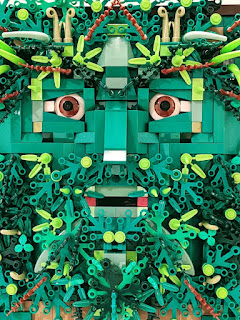
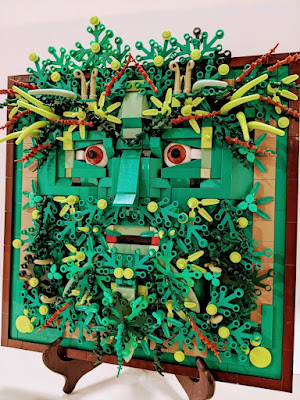
LEGO Green Man

Here's another one of those moments where my literary, cinematic, and LEGO obsessions collide. In August I watched The Green Knight (2021), a modern revision of the iconic chivalric romance, Sir Gawain and the Green Knight, a story I've loved since I first read it as a student and then taught many times during my years as a college English instructor. I've had the story on my mind again ever since I watched the film, which inspired me to build this LEGO version of the Green Man for an upcoming show with my local LUG (LEGO User Group), TNVLC.

The Green Knight of the story is the most famous incarnation of the Green Man, a mythological figure who represents the natural world and is usually shown as a man's face surrounded by or even made out of vegetation. You'll find him everywhere in the UK, even in churches, but he appears in many different cultures going back as far as the 2nd Century. Here's an article about the Green Man on Historic UK if you want to read more. 


Saturday, March 21, 2020

Classics for Coronavirus: Robinson Crusoe

The world is staying home this spring as a pandemic spreads through our countries, leaving many people to cope with the unfamiliar experience of social isolation. Literature and film are suddenly lifelines to adventure, community, and knowledge, and some of them can really teach us a few things about how to live while cut off from the rest of the world. As I keep up with the news this month I find myself thinking especially about Robinson Crusoe, Daniel Defoe's iconic castaway and master of social distancing. Defoe's original novel, published in 1719, has inspired many subsequent books, films, and television series, and there's never been a better excuse or time to explore them. Here are some of my favorite Robinson Crusoe revisions and adaptations.

1) Robinson Crusoe on Mars (1964) - This is probably my favorite of the films inspired by the novel because it takes Defoe's story and mixes it into 60s sci-fi, Paul Mantee stars as the castaway astronaut on the red planet, but you'll also find Adam West in a supporting role early in the film. Try this one if you're already a fan of classic sci-fi or you really loved The Martian (2015)!

2) The Martian (2015) - Matt Damon's turn as a castaway astronaut on Mars isn't a direct adaptation of Robinson Crusoe, but it certainly owes a lot to Defoe, and it makes a perfect double feature with Robinson Crusoe on Mars. When he gets left behind on Mars, Mark Watney uses science and creativity to survive. You'll really learn to appreciate potatoes!

3) Cast Away (2000) - If you want to come back to earth for your isolation, try the Tom Hanks hit in which a FedEx employee survives a plane crash and is stranded on a remote island. This is very much a modern Crusoe tale, although Crusoe's eventual companion, Friday, is a lot more useful than the soccer ball that Hanks' character names Wilson. Hanks, of course, has been in the news recently after being diagnosed with COVID-19 while filming in Australia, but I hope his time in medical isolation was a lot less traumatic than being marooned on an uninhabited island!

4) Swiss Family Robinson (1960) - Defoe's original story inspired the 1812 family classic, which is also worth handing to your kids while they're at home, but the 1960 Disney film adaptation is probably the best known of the numerous film treatments. John Mills and Dorothy McGuire star as the parents of a shipwrecked family with several sons, and this one makes a good family pick for kids who are too young for the films I've already listed. Best of all, you can stream it on Disney Plus if you're already sick of the two Frozen movies!

5) Lost in Space (1965-1968) - The Crusoe family tree adds another branch with this 60s TV revision of Swiss Family Robinson, which gave the world the iconic line, "Danger, Will Robinson!" Make your kids watch the 1960 Disney film first and then introduce the 60s TV series, the 1998 feature film version, or the newest 2018 TV series version (although the 1998 film is not particularly good, the new series is getting high marks).

Whether you're an adult looking for interesting ways to spend your time at home or a parent trying to craft educational but fun activities for kids, an exploration of Robinson Crusoe's literary and cinematic legacy is a timely choice. The original story is a good place to start if you have the patience for 18th century literature - it's a good read and a true classic with enormous influence. Otherwise try jumping in with any of the films and TV series listed here.


Tuesday, July 14, 2015

Harper Lee Talk at the Smyrna Public Library

I had the great pleasure of being the guest speaker at a celebration of Harper Lee held at the Smyrna Public Library on Monday, July 13, 2015, and it was just about the nicest event a person could possibly imagine. We had a wonderful crowd of fifty people - four of whom actually bought copies of Beyond Casablanca! - and a fabulous spread of Southern treats made by the library staff. My talk was called "Maycomb, Past and Present: Reading Harper Lee in 2015." In it I discussed the ways in which To Kill a Mockingbird addresses tough issues that are still very much with us today, including racial prejudice, a biased legal system, class divisions, and mental illness. I had a lively audience with lots of good questions and comments, so I was glad that I had planned the talk as a conversation rather than a prepared lecture. Of course, we talked some about the 1962 film, Gregory Peck's performance as Atticus Finch, and how we think a film adaptation of Go Set a Watchman might approach the major characters in the new story. We also speculated about Go Set A Watchman and how it might change readers' feelings about the original novel, although most of the people in attendance were eager to read the new book for themselves. I'm sure the next few weeks will see a flood of reviews and commentaries as people digest the new novel's content.


Huge thanks to my friend, Mary Wallace Moore, for inviting me to speak and spend some time with her excellent staff and delightful library patrons. If you happen to be in the neighborhood of Smyrna, GA, do check out the lovely library facility and the nearby shopping village, especially The Corner Taqueria, where I had a very tasty lunch. You can read more about the Harper Lee event in this article from the Marietta Daily Journal.

Tuesday, September 23, 2014

Classic Movie Tourist: The Margaret Mitchell House

The Atlanta area includes several places where devotees can get their Gone with the Wind fix: the Road to Tara Museum is in Jonesboro, and Marietta is home to the Gone with the Wind Museum. In the heart of the city, however, you'll find the Margaret Mitchell House, where the author lived for a number of years and where she wrote much of the novel after an auto accident left her housebound. The restored house is part of the Atlanta History Center, and for $13 ($10 for seniors and students), visitors can enjoy a guided tour of the apartment where Mitchell lived as well as several exhibits about her life, the novel, and the blockbuster film that premiered in Atlanta in 1939.

For most people, the book and the movie are inextricably entwined. It's fair to say that more people have seen the 1939 picture than have actually read Mitchell's lengthy saga. When Scarlett O'Hara appears in the cultural consciousness, she is inevitably played by Vivien Leigh, and Clark Gable fully occupies the role of the roguish Rhett Butler. The other major actors in the film have also become part of the GWTW legacy, including Olivia de Havilland, Hattie McDaniel, Leslie Howard, and even Butterfly McQueen. The exhibits at the Margaret Mitchell House reflect this aspect of the story's history; many of the displays focus on the film adaptation, which makes the museum a great destination for fans of the stars involved.


"The Making of a Film Legend" section features video about the picture's production history and a large portrait of Scarlett O'Hara that was seen in the movie. Another highlight of the exhibit is the actual door to Tara used in the film; visitors can stand in front of it and imagine themselves waving from the plantation mansion's steps. In the "Stars Fall on Atlanta" exhibit, there are photographs and keepsakes from the movie premiere, which Atlanta society turned into a huge series of parties with celebrity guests.


Of course, classic movie fans will want to browse the gift shop, where GWTW items of all sorts can be found. The shop also offers prints of production stills and promo photos depicting Gable and Leigh as well as posters for the film release. Hattie McDaniel magnets, Tara Christmas ornaments, and books about a variety of GWTW related subjects are also available. I was pleased to find Kendra Bean's new book, Vivien Leigh: An Intimate Portrait, prominently displayed on the front table.

If you're headed to Atlanta any time in the near future, the Margaret Mitchell House is definitely worth a visit. It's located at 979 Crescent Avenue NE in Atlanta, not far from many of the city's other major tourist attractions. The museum is open 10 AM to 5:30 PM Monday through Saturday and noon to 5:30 PM on Sunday. House tours are included in admission and are offered regularly throughout the day.


Sunday, August 10, 2014

Classic Movies and EVERYDAY MONSTERS

This weekend I got my short story collection, Everyday Monsters, posted on Amazon Kindle, where it now awaits the lavish praise of at least a dozen readers, not including my mother, who doesn't want me to become too conceited by thinking that I might be "all that." Everybody knows that short stories don't sell, but being obsessed with classic horror and shows like The Twilight Zone I wrote them anyway. A word of warning to you classic horror fans out there - this is the kind of thing that is liable to happen to you if you watch too much Boris, Bela, and Lon, not to mention too many episodes of Alfred Hitchcock Presents. Anyway, the seven stories in the collection represent a strange melange of influences from classic movies, literature, and my studies of feminist theory in graduate school. Here's a breakdown of some of the references and allusions in each story, which I hope will inspire at least three more people to go over to Amazon and have a look at the book itself.

"The Spinsters" - I have to be coy here to avoid spoiling the big twist, but I can say that there's a lot of Arsenic and Old Lace informing the characters of Louisa and Letitia. They're also based on my real-life dotty old aunts, Birdie and Sis, who were absolutely weird enough to fuel an entire career for any writer. I love wacky old ladies, especially in movies; I adore Una O'Connor, Hermione Gingold, Dame May Whitty, and all of their cinematic sisters. In this story, the little old ladies rule.

"Desiccated" - The Mummy and other later films often depict the protagonist's love interest as the mummy's reincarnated sweetheart, but in this story I do away with the male characters and let the heroine and the Ancient Egyptian princess become the focal characters. Margot definitely has a connection to Princess Ahmesahura, but their encounter has more complicated consequences than a simple substitution. Margot is also something a movie buff, since the horrible kids she has to chaperone remind her of The Omen, and she recognizes the encased mummy as a familiar figure from old films.

"Hoodoo Man" - Classic horror fans will immediately recognize that Cleophas Legendre has appropriated his surname from Bela Lugosi's character in White Zombie, which also informs the way that the zombies themselves are handled. These are classic zombies, not the Romero brain-eaters. I really admire the short fiction of Alice Walker and Eudora Welty, and I hope their influence comes through, but this story is particularly inspired by Zora Neale Hurston's "Sweat." It's also about the blues, especially Nina Simone's fantastic rendition of "I Put a Spell on You."

"Mama Doll" - I wanted to include stories about different kinds of oppressed characters finding some poetic justice through supernatural events, and I really liked the idea of the golem as a monster that we don't see that often. Carlita is a young Hispanic girl thrown into a corrupt foster care system, but her own creativity and will to live make her a surprisingly strong character. My sister and I used to make doll people like this one when we were kids; once we even hid my sister inside one and put her on the porch, where she came to life and terrified trick-or-treaters reaching for the bowl of candy in her lap.

"This is Not a Life" - Forbidden Planet is one of my favorite science fiction movies because of the way it revises Shakespeare's The Tempest as a Freudian fable, and I play with some of those ideas here, too. Isolated on his island paradise, William Prosper has mastered science that certainly looks like magic; instead of a daughter he has his wife, Perdita, who gets her name from The Winter's Tale. There's some Heart of Darkness going on, as well, plus a shout-out to Jules Verne's 20,000 Leagues Under the Sea. I saw a Magritte exhibit in Montreal many years ago, and those trippy images seemed like the perfect complement to this story.

"Morning Comes After the Storm" - I used to teach Robert Browning's "Porphyria's Lover" all the time, and the ending always bothered me. Browning is intentionally ambiguous, but this story reveals what I like to imagine happening next. The dog recalls the beloved pet of Browning's wife, Elizabeth Barrett, who was already a famous poet when Browning started writing fan mail to her. You might say I'm recasting Browning's story according to the workings of Poe's universe. Hopefully that works.

"The Exorcism of Wendell Grove" - I love funny ghost stories like The Ghost Goes West (1935) and The Canterville Ghost (1944). Even Blackbeard's Ghost (1968) makes me laugh. This story is meant to be fun rather than scary, like riding The Haunted Mansion at Disney World, but it still pursues the theme of poetic justice. Frederica Island is inspired by St. Simons Island, in coastal South Georgia. I don't know what actual ghosts they have there, but the story includes a Southern belle, a slave woman, freaky poltergeist twins, gentleman duelists, a drunken frat brother, and a pirate.

Here's the link to the ebook in case you're one of those three people!

Tuesday, September 25, 2012

The Housekeeper in the Gothic Film Tradition


Margaret Hamilton plays the creepy housekeeper in 13 Ghosts.

Good Haunted Housekeeping: The Housekeeper in the Gothic Film Tradition


The Gothic tradition features a host of particularly striking stock characters. We have the mysterious first wife, whether missing, mad, or murdered, the brooding Bluebeard lover, the inquisitive orphaned heroine, and, perhaps the most iconic in modern popular culture, the creepy housekeeper, a curator of keys, cupboards, and the family’s closeted skeletons. In her book, Hollywood Heroines: Women in Film Noir and the Female Gothic Film, Helen Hanson identifies two major tasks set for the housekeeper character in the traditional Gothic film: the first is “to mark the heroine as an outsider,” and the second is “to act as keeper of knowledge about the family” (75). These roles underline the unique power of the character as part of the typical Gothic machinery. In the genre’s often feminized world, the housekeeper’s function as a woman with dominion over the domestic space and its secrets can make her a formidable ally or enemy to the heroine. Her loyalties, however, may not lie with the intruding newcomer; she may choose to protect the secrets of the family or may even devote herself to the house itself. In Gothic films, the housekeeper becomes an especially potent creator of terror and dread through her penchant for lurking in shadows, watching the heroine, and manipulating both characters and audience with her ominous movements and expressions. Looking at classic Gothic films like Rebecca (1940), Dragonwyck (1946), and The Haunting (1963), we can see the housekeeper’s development into a crucial figure of the genre, while later incarnations of the character in films like Young Frankenstein (1974) highlight her importance while simultaneously mocking the clichéd representation of her type.

Tracing the development of the housekeeper character and appreciating her importance to the Gothic film tradition requires some sense of her earliest appearances. Like the modern Gothic novel, Gothic film has its roots firmly planted in the literary traditions of eighteenth and nineteenth-century England. There is no menacing housekeeper in Horace Walpole’s original Gothic text, The Castle of Otranto, but the type had already been established by the time Walpole’s novel first appeared on the scene in 1764.  Going as far back as Samuel Richardson’s Pamela in 1740, we can see the housekeeper as an important stock character with a marked potential for duality. Richardson’s novel offers us two opposing but suggestively linked housekeeper models: the first, Mrs. Jervis, is a kindly matron who befriends and defends the heroine, while the second, Mrs. Jewkes, is a masculine monstrosity who threatens and imprisons her. Their shared “J” names hint at their function as two sides of a single character type, and in their complex relationships with the virginal Pamela they also form a version of the archetypal trinity of maiden, mother, and crone.

The dual functions of the housekeeper remain distinct in Charlotte Brontë’s influential Gothic novel, Jane Eyre, which first appeared in print in 1847. Much of the Gothic film tradition that developed in the twentieth century depends on this text, for Jane Eyre is the cornerstone on which both Rebecca and Dragonwyck are built, just as Pamela serves as the cornerstone for Jane Eyre itself. In Brontë’s novel, the official housekeeper of Thornfield Hall is Mrs. Fairfax, a generous, maternal woman who accepts Jane as part of the domestic community and provides her with much-needed companionship, as well as information about the hall’s inscrutable master, Mr. Rochester. Mrs. Fairfax, however, does not possess all of the keys to unlock the mysteries of Thornfield. Her mysterious counterpart in the house, Grace Poole, has knowledge that Mrs. Fairfax and Jane both lack, but Grace Poole keeps the heroine at bay and refuses to answer her questions about the ghostly presence that haunts the hidden room of Thornfield’s highest floor. Like Mrs. Jewkes in Pamela, Grace Poole displays a rough, masculine appearance and functions as a jailer, although it is the heroine’s predecessor, mad Bertha Rochester, who is her prisoner. Mrs. Fairfax, as her name suggests, represents the fair side of the housekeeper figure, a supportive feminine presence capable of educating the heroine about her new home. Grace Poole, however, is the dark secret keeper of the house, the guardian of a forbidden zone hidden within the larger domestic space.
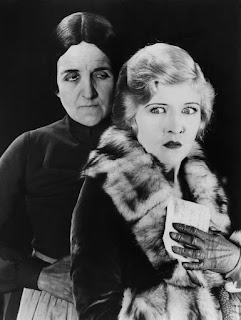
As the Gothic begins to appear on film, the menacing Grace Poole version dominates as the more potent form of the character. We get an early taste of housekeepers to come in the old dark house picture, The Cat and the Canary. Directed by Paul Leni, this 1927 silent film is memorable largely because of its creepy housekeeper, a dead-eyed horror humorously christened Mammy Pleasant. Like later and more familiar Gothic housekeepers, Mammy Pleasant acts as a menacing presence, constantly watching the heroine but refusing to divulge the secrets of the house to her. In addition, Mammy reveals the housekeeper’s evolving taste for a rather morbid, deadpan brand of humor. In one conversation, another character says, “You must have been lonely here these twenty years, Mammy Pleasant,” to which she replies, “I don’t need the living ones.” Mammy also operates as a predictor of doom, alarming the houseguests with her assertion that “something terrible will happen here tonight!” Mammy’s dark hair, dour expression, and thin, tight lips become the standard equipment of Gothic housekeepers forever more, making her an important figure in the character’s cinematic development.

Of course, the lynchpin figure in the evolution of the Gothic housekeeper is Mrs. Danvers, the terrifying antagonist who protects the territory of her dead mistress in Daphne du Maurier’s 1938 novel, Rebecca. The nameless heroine recalls her first encounter with Mrs. Danvers thus:
Someone advanced from the sea of faces, someone tall and gaunt, dressed in deep black, whose prominent cheek-bones and great, hollow eyes gave her a skull’s face, parchment-white, set on a skeleton’s frame.
She came towards me, and I held out my hand, envying her for her dignity and her composure, but when she took my hand hers was limp and heavy, deathly cold, and it lay in mine like a lifeless thing. (67-68)
The heroine’s language loads Mrs. Danvers with images of death and horror, and it also sets the stage for the housekeeper’s function as the guardian of the dead Rebecca. Mrs. Danvers is the housekeeper not of a living home but of a tomb that enshrines the memory of her lost idol; she rejects the new mistress of Manderley as an interloper and seeks to drive her away. Obsessive, manipulative, and in total control of the house, Mrs. Danvers imprisons the new Mrs. de Winter in Manderley while simultaneously trying to eject her from it. When she feels that Rebecca’s ownership of Manderley can no longer be protected, Mrs. Danvers sets fire to the house rather than see the second Mrs. de Winter successfully inhabit it.

            Alfred Hitchcock’s 1940 adaptation of Rebecca is a watershed moment in the history of the female Gothic film, not least because it perfectly captures the menacing allure of Mrs. Danvers’ character. Among its eleven Oscar nominations was a Best Supporting Actress nod for Judith Anderson, who delivers a truly iconic performance as Mrs. Danvers. Her appearance in the movie owes something to Mammy Pleasant while capturing the spirit of du Maurier’s description, if not the letter, for Anderson’s version is menacingly alive, with piercing eyes and a coiled braid of black hair perfectly arranged above the severe white line of her part. On screen, Mrs. Danvers controls the heroine with her gaze and her gestures; we can see her watching Joan Fontaine’s mousy victim with a predator’s glittering interest. In the famous bedroom scene in which Mrs. Danvers tries to drive the heroine to commit suicide, Hitchcock faithfully recreates du Maurier’s written description, but the visual representation lends the moment an additional sense of suspense and horror. Mrs. Danvers leans over the heroine, her burning eyes intensely fixed on her victim, her power over the younger woman tellingly displayed in their physical positions. In this scene and in others throughout the film, Anderson creates a definitive image of the Gothic housekeeper, endowing her with characteristics and mannerisms that will be hallmarks of the character in the popular imagination from 1940 onward.

Edith Barrett as Mrs. Fairfax
The box office success and Best Picture Oscar of Rebecca inspired a wave of female Gothic films in the early 1940s, including, somewhat ironically, a 1943 film adaptation of Jane Eyre, also starring Joan Fontaine as the heroine. For the housekeeper character, however, this is a throwback to the pre-Danvers era, back to the dual figures of good and bad household guardians. Edith Barrett plays a nervous, rather frail Mrs. Fairfax, with English stage actress Ethel Griffies in an uncredited appearance as Grace Poole (Hitchcock fans might remember Griffies as the skeptical ornithologist in The Birds). Barrett again plays the family secret keeper in the same year’s Eyre-inspired Val Lewton horror film, I Walked with a Zombie. Lewton’s picture has no menacing housekeeper; the most important domestic servant is Alma, a cheerful young black woman played by Theresa Harris. Barrett, however, fills in for the housekeeper as Mrs. Rand, the mother of the two male leads; she alone knows what really happened to her son’s first wife, the zombified Jessica. Like the motherly housekeepers of older Gothic stories, Mrs. Rand tries to help Frances Dee’s heroine even as she withholds the most important family secrets from her, but she lacks a menacing female counterpart.

More interesting, perhaps, is the 1946 adaptation of Anya Seton’s 1944 novel, Dragonwyck, written after both the original novel and the film version of Rebecca and thus ostensibly able to capitalize on the evolving conventions of the female Gothic genre. The film trailer, in fact, proudly announces the new picture’s appeal to fans of the earlier work. Like Rebecca, Dragonwyck draws from Jane Eyre as its source material, but it translates the Gothic action to nineteenth-century New York and the upper class Dutch society of the Patroons. Differences between the novel and the film affect the representations of the housekeeper characters, but both offer some insight into the type’s importance to the genre by showing the pitfalls of tinkering with effective conventions.

The novel itself takes a problematic dual approach to the housekeeper figure. As in Jane Eyre, we have two domestic characters who highlight the heroine’s outsider status and possess power and information that might be able to help or harm her. The official housekeeper, Magda, resents the heroine’s arrival and persistently gives her the cold shoulder, reserving her loyalty for the mistress of the house. Seton does very little with Magda, failing to provide even a single detailed description of her appearance. She gives greater attention to the other, more ominous domestic secret keeper, the ancient mixed-race servant, Zélie. Zélie gets all of the creepiest, most Gothic scenes, revealing to the newcomer the haunted history of Dragonwyck and foretelling the doom of the Van Ryn family members. Seton gives this character a suitably striking introduction:
The door opened and a strange woman walked in, shutting the door behind her. A thin old figure in a shapeless black dress who came over to the bed and gazed down at the frightened girl. The woman was nearly six feet tall and erect, her coarse black hair, which showed no gray, drawn back into a scraggy knot, her face a ruddy brown crisscrossed with wrinkles from which peered two shrewd little eyes as black as dewberries
“What do you want?” whispered Miranda.
“Me old Zélie,” said the woman in a harsh accented voice, touching her slab-like chest. “I want to see what you look laike.” (49)
Unfortunately, Seton abruptly writes both Magda and Zélie out of the book about a third of the way through, and no similar character fills the resulting gap. The problems with Seton’s treatment may help to explain why her novel is little read today, since she mishandles two different variations on one of the genre’s most important character types.

Director Joseph L. Mankiewicz’s film adaptation makes some marked changes to Seton’s novel, especially in the housekeeper department. Sadly, the movie completely drops Zélie, who would be quite provocative, to say the least, to see on screen. It transfers her ominous warnings and insider knowledge to Magda, revising Seton’s flat, barely described character into something audiences might more properly expect in a female Gothic tale. Played by the very capable character actress, Spring Byington, the movie Magda embodies both the menacing and the maternal, and the result is a woman who strikes both the audience and Gene Tierney’s heroine as slightly insane. In one early scene, for example, Magda suddenly veers off from seemingly friendly talk to warn, “One day, you’ll wish with all your heart you’d never come to Dragonwyck.” Byington’s character occupies a middle distance between Mrs. Fairfax and Mrs. Danvers, which makes her interesting in terms of the housekeeper’s changing role in the genre, but the movie, like the novel, drops Magda midway through, and thus the potential for a really serious engagement of the housekeeper figure remains unrealized.

Unlike Anya Seton, Shirley Jackson takes full advantage of the creepy housekeeper in her 1959 novel, The Haunting of Hill House, which was adapted into the film, The Haunting, in 1963. The film makes a number of changes to the original text, but it faithfully preserves the unnerving housekeeper, Mrs. Dudley, while also highlighting her relationship to Mrs. Danvers through casting and costume decisions. Like earlier housekeepers, Mrs. Dudley possesses insider knowledge of the house she oversees, and she resents the presence of the newcomers who disrupt her routine. Hill House has no master or mistress to command her loyalties, and Mrs. Dudley’s feelings about the house are never quite clear, just as everything else about Hill House remains shrouded in questions and doubt. Jackson does, however, hint at the connection between Mrs. Dudley and Hill House near the end of the novel, when she describes Mrs. Dudley as “shudder[ing] in her sleep” from six miles away when the heroine touches a kitchen door (171). In contrast to the visitors, Mrs. Dudley seems to understand and respect the house, never trespassing against its unspoken rules, and in return the house never affects her as it does the others.

Jackson offers little description of the character when she first appears in the novel, but she does provide a truly memorable exchange with the protagonist, Eleanor, a few paragraphs later.
“I don’t stay after I set out dinner,” Mrs. Dudley went on. “Not after it begins to get dark. I leave before the dark comes.”
“I know,” Eleanor said.
“We live over in the town, six miles away.”
“Yes,” Eleanor said, remembering Hillsdale.
“So there won’t be anyone around if you need help.”
“I understand.”
“We couldn’t even hear you, in the night.”
“I don’t suppose-“
“No one could. No one lives any nearer than the town. No one else will come any nearer than that.”
“I know,” Eleanor said tiredly.
“In the night,” Mrs. Dudley said, and smiled outright. “In the dark,” she said, and closed the door behind her.
(27-28)
The ominous warning from the housekeeper becomes a kind of nervous joke between Eleanor and Theodora, but it sets the stage for the horrors to come and provides both characters and readers with important information about Hill House. The locals are afraid of the place, none of them will have anything to do with it, and the residents can expect no assistance when their presumptuous occupation rouses the house into action. The inmates of the house laugh at Mrs. Dudley just as they laugh at the strange things that happen in Hill House; both frighten them, although they cannot necessarily explain why. 

            The film adaptation, directed by Robert Wise, reflects these elements of the novel and builds on them by making the most of the character conventions established by earlier films like Rebecca. Rosalie Crutchley, whose earlier roles had included the terrifying Madame Defarge in a 1958 adaptation of A Tale of Two Cities, is just the sort of actress for the Gothic housekeeper role, with a thin face, dark hair, and a most unnatural smile. Her somber attire and pinned-up hair, both black of course, signal her sorority with Mrs. Danvers and Mammy Pleasant, and Crutchley delivers Mrs. Dudley’s lines to great effect, especially in the scene mentioned earlier. Building on the character as originally created in Jackson’s novel, the film reveals the conventional traits that have come to be associated with the Gothic housekeeper. Mrs. Dudley, as much an insider as Hill House allows, lays out the house rules to Eleanor and the other guests in a way that emphasizes her own power and position of authority. “I don’t wait on people,” she tells the newcomers firmly. “What I agreed to, it doesn’t mean I wait on people” (27). She clearly knows more about the house than she is willing to tell, and her veiled warnings serve only to alarm the visitors and the audience without helping them prepare for the terrors that they will face. Like Mrs. Danvers, Mrs. Dudley projects menace rather than maternal comfort, and the film emphasizes this aspect by eliminating a kitchen scene in which Jackson has Mrs. Dudley gossiping about the young people in a very motherly, ordinary fashion. Unfortunately, by the time the next film adaptation of The Haunting of Hill House arrived in 1999, the Gothic housekeeper character had become so familiar that Mrs. Dudley is merely a cliché, another stale note in an over-played symphony of horrors.

Mrs. Slydes frightens a guest in House on Haunted Hill.
Anything repeated often enough to be a cliché is already ripe for parody, and in the years after the original film adaptation of The Haunting the Gothic housekeeper became an obvious target. William Castle had helped to entrench the conventions of the character with films like House on Haunted Hill in 1959 and especially 13 Ghosts in 1960, which featured The Wicked Witch of the West herself, Margaret Hamilton, as a creepy housekeeper complete with black dress, tight bun, and dour expressions, who also turned out to be a medium able to communicate with the ghosts who haunted her employers’ house. Today, the website, tvtropes.com, even has an entry for “Creepy Housekeeper” that identifies her major traits and aligns her with another stock character, the “Crusty Caretaker.” Most importantly, the incarnation of the creepy housekeeper chosen for the entry’s quote and image is not Mammy Pleasant, Mrs. Danvers, Magda, or Mrs. Dudley, it is Cloris Leachman as Frau Blücher in Mel Brooks’ 1974 Gothic horror parody, Young Frankenstein. The character, as written by Mel Brooks and Gene Wilder and performed by Leachman, incorporates all of the Gothic housekeeper clichés and then revels in them, permanently altering the way in which movie audiences perceive her role. 

Young Frankenstein, as its name suggests, draws its inspiration from James Whale’s 1931 Frankenstein and 1935 Bride of Frankenstein, and the origins of Frau Blücher can also be found there. In the second Whale film, Irish character actress Una O’Connor plays a frequently hysterical housekeeper named Minnie, although Whale uses her for comic effect rather than horror. Despite her shrieking, Minnie herself is all motherly concern, much like Mrs. Fairfax in Jane Eyre. In Young Frankenstein, Frau Blücher’s costume and position in the household are references to O’Connor’s character, but her creepy and often menacing behavior develops from housekeepers like Mrs. Danvers and Mrs. Dudley. Leachman also sports the thin lips, severe bun, and sinister facial expressions of the more menacing housekeeper type. In fact, Frau Blücher is so absurdly terrifying that horses whinny in fear every time her name is mentioned. Early on, the movie exploits one particularly popular housekeeper trope, in which the taciturn household guardian conducts newcomers through the mysterious domain over which she reigns, often with a large candle in hand. Frau Blücher carries a holder with three candles, all of them markedly unlit, as she warns Frederick to “stay close to the candles. The stairway can be… treacherous.” Like other Gothic housekeepers, but unlike Minnie, Frau Blücher has special insider knowledge about her house and its family. She manipulates Frederick Frankenstein into resuming his grandfather’s research, apparently out of loyalty to the deceased Victor, with whom she was in love. Brooks and Wilder, of course, play all of these plot elements for laughs, but they depend upon the already established conventions of the housekeeper role and show the extent to which the writers expect the audience to be familiar with them. The parody succeeds so well that Frau Blücher usurps the place of earlier, more serious treatments of the character to become the quintessential example of the type. 

The entwined literary and cinematic evolution of the Gothic housekeeper demonstrates the ways in which genre conventions gather force and then sometimes sink under their own weight. In this case, the housekeeper character, along with the rest of her genre’s conventions, developed first in literary works of the eighteenth and nineteenth centuries and then gathered new steam with the rise of film. She reached her peak when Rebecca took the world by storm, thanks in part to the ways in which the film version capitalized on her potential. After that, other literary works and films could only repeat what had already been accomplished or twist that representation for parodic effect, since efforts to tinker with the formula were problematic at best. Audiences today will come to any housekeeper character with a very distinct mental image, that developed by the earlier Gothic novels and films, but they will also almost certainly have a sense of the character as inherently clichéd and even ridiculous, given the immense cultural impact of the later parody. We haven’t seen much of the Gothic housekeeper in recent years, perhaps because Mrs. Danvers and Frau Blücher have so completely occupied the spaces in which such a character can stand. Perhaps the recent return of Hammer films will bring the creepy housekeeper back to us in a new but still eerily familiar form. For now, however, it is the housekeeper herself who has become haunted, not by the ghosts of her employers’ house, but by the enduring influence of her own most iconic incarnations.

This essay was written for presentation at the 2012 meeting of the Popular Culture Association in the South (PCAS). The Works Cited page is intentionally excluded in order to discourage plagiarism of the material. This content is the intellectual property of the author and must be properly cited if referenced elsewhere. The author reserves the right to send Mrs. Danvers to have a little personal chat with any plagiarists!

Thursday, September 20, 2012

These Are a Few of My Favorite Things

That's me, with Carl Sandburg (sort of).
Newcomers to this blog might sometimes suspect that its owner is a victim of multiple personality disorder, but the Virago is merely an enthusiast about many things. Just in case you were wondering, here are six of my very favorite things, any of which might turn up in a blog post at any time.

1) Literature - If you trust the evidence of a collection of framed diplomas, I am really a PhD in English literature, which might explain the piles of books stuffed into every nook and cranny of the family residence. I taught college English courses for more than 15 years, and I now have a head full of poetry, theory, and strong opinions about the proper use of the comma. There's also a dissertation lying around here somewhere - it's about British nationhood and late 18th-century courtship novels. The blog occasionally delves into literary topics, and the blogger occasionally nurses delusions of becoming a great novelist.

You can never watch enough movies!
2) Movies - Literature and film go together like chocolate and peanut butter, and I'm a big fan of both combinations. Classic movies take the spotlight because they're just cooler and more entertaining to watch. I like classic movies so much that I wrote a book about them, which I would very much like for people who aren't related to me to buy (I'd like for all of my relatives to buy copies, too, just so they know). I started teaching film units in my college courses around 1995, and now I teach lifetime learning courses about classic film at my local library, for a great program called LearningQUEST. The only thing better than watching a great classic movie is sharing it with other people!

My club does an annual show at a local toy store.
3) Popular Culture - The first two obsessions have oozed naturally into the third, where literature and film make their influence on society felt. I love all kinds of popular culture, from Muppets to Joss Whedon to comic books, and I write about all of those things from time to time. With my frequent partner in crime, Anissa Graham, I have edited two books about Jim Henson's creations and contributed to a third anthology about modern culture's perspectives on Sherlock Holmes. We have about half a dozen ideas for future books, which is crazy because we both have quite enough to do already, but popular culture studies is just too much fun to resist.

4) LEGO - Yes, I am an AFOL, an Adult Fan of LEGO. I belong to a very active local adult club, and we build huge LEGO towns for shows a couple of times a year. I post about LEGO here sometimes because I like to talk about the hobby and share my LEGO photography, which often recreates scenes from favorite things 1, 2, and 3. See? They all go together. Really.

It's gorgeous at Grand Canyon National Park!
5) National Parks - For the last several years I have been in love with the National Park Service. I drag my family on elaborate road trips designed solely to hit the most national park sites in the shortest amount of time. I am a shameless promoter of the NPS and its fantastic programs. When the national park turns out to have a classic movie or literary connection, so much the better.

6) Homeschooling - I have been teaching my daughter at home since 4th grade, when the WORST TEACHER EVER made our lives so miserable we had to do something to protect our kid. I ought to be grateful to that awful woman because it has turned out to be a great experience, and I have lots of time to introduce my daughter to passions 1, 2, 3, 4, and 5. The Kid, as I call her on Twitter, is my constant companion, and I find her responses to what she reads and watches very illuminating.

We make special trips to pinball museums and arcades.
I also love other things, like pinball, video games, cupcakes, chap hop, and theme parks. I reserve the right to tell you about them at any time. The world is full of awesome things! I feel it's my duty to share them. Feel free to send me comments to tell me about your passions, too, especially when they dovetail with mine. 

Now you can't say you weren't warned when the next blog post turns out to be an analysis of the cultural fad for cupcakes, or a LEGO recreation of the The Birds, or a photo-filled travelogue about a weeklong field trip with the Kid to Death Valley. Nine out of ten posts tend to be about classic movies, but you never know when I might get excited about one of my other passions and have to share!


Monday, September 10, 2012

Classic Disney Movies Based on Children's Books


Most of the classic Disney princess movies come straight out of fairy tales, but the family film studio has also combed other literary sources for many of its popular productions. Successful children's novels from around the world have served as the inspiration for some of Disney's most beloved animated and live-action pictures, although Walt Disney and his screenwriters were rarely very faithful to the original texts. Whether you're trying to get youngsters interested in classic movies or in reading good books, these Disney adaptations can make for a good starting point. Here are just a few of the classic Disney films that owe their existence to novels written for young readers.

Pinocchio (1940) - Italian writer Carlo Collodi created the original story of the wooden boy, which first appeared in Italy in 1883. Today you can find many versions of Pinocchio's story, and the novel that first imagined this puppet hero remains a classic in its own right. Try the Puffin Classics edition of the book for an inexpensive introduction to Collodi's enduring tale of adventure, transformation, and paternal love. Be forewarned, though, that a lot of bad things happen to Pinocchio, and Collodi's story has a moral tone much like the work of Hans Christian Andersen.

Bambi (1942) - While some of the novels adapted for Disney films remain well-known and widely available, Austrian author Felix Salten's 1923 tale of a young deer is harder to find. Older children who can handle more somber and realistic depictions of animal life might find the story very engaging, but, like the Disney movie, it might be too much for younger children to handle. Aladdin has a 1988 paperback edition still available from online retailers like Amazon.com, although the 1929 sequel, Bambi's Children, appears to be out of print. Try your local library for copies of both books.

101 Dalmatians (1961) - Disney has turned Dodie Smith's original novel into a whole series of movies and spin-off productions, including its own 1996 live-action remake of the animated film. The 1961 picture simplifies the novel by reducing the number of adult dogs involved in the story, but for the most part the Disney film takes its cues from Smith's charming tale. Dog lovers are sure to find the original book a winner, and anglophiles will enjoy its very English character. The Puffin edition provides Smith's full text for a very reasonable price, and the story is a perfect choice for reading aloud, particularly at Christmas, when much of the action takes place. Starlight Barking, a long-forgotten sequel to Smith's novel, is also now back in print.

Mary Poppins (1964) - P.L. Travers' long contention with Walt Disney over the adaptation of her very popular book series has been much discussed in Disney movie circles, but the 1964 live-action musical proved a watershed event in the career of its star, Julie Andrews, and hopefully the film's success has brought readers back to the English writer's original works. The movie won five Oscars and was nominated for thirteen, making it one of Disney's greatest screen accomplishments. Numerous paperback editions of all of the Mary Poppins novels are in print, and kids who enjoy the movie will probably like to find out about all of Mary's other adventures with the Banks family.

The Jungle Book (1967) - Film studios have frequently turned to the works of Rudyard Kipling for their stories, so it should be no surprise that Disney would offer its own adaptation of a Kipling tale. Kipling's original novella (it's really more a collection of stories than a proper novel) appeared in 1894. Although it's a fun movie with some terrific songs, the Disney version strays pretty far from the source material. Kids who enjoy talking animal novels like The Warriors and The Guardians of Ga'Hoole series ought to enjoy this influential literary classic. Disney also produced a live-action version starring Jason Scott Lee in 1994, although it's more interesting for its cast than its fidelity to Kipling. If your kids enjoy the original story, they should also love Neil Gaiman's Newbery-winning revision, The Graveyard Book (2008).

Bedknobs and Broomsticks (1971) - Adapted from the novels by Mary Norton, who also penned The Borrowers books, the 1971 Disney live-action film capitalized on the similar combination of Englishness, magic, and music that had made Mary Poppins such a hit. The movie is very good, especially with Angela Lansbury and David Tomlinson in the lead roles, but it has very little in common with Norton's texts. Look for Norton's original stories as The Magic Bed-knob and Bonfires and Broomsticks; a combined edition of both stories is available from Sandpiper. There's no guarantee, though, that fans of one version will like the other.

Other classic Disney films adapted from books include Song of the South (1946), Alice in Wonderland (1951), Treasure Island (1950), Peter Pan (1953), 20,000 Leagues Under the Sea (1954), and Old Yeller (1957). Almost all of these are based on true classics that you and your children can find at your local library or bookstore, and many of them are also free on ereaders like the Kindle and the Nook.

An earlier version of this article originally appeared on Examiner.com. The author retains all rights to this content.