This post is part of the Great Villain Blogathon hosted by Ruth of Silver Screenings, Karen of Shadows & Satin, and Kristina of Speakeasy — see all the movie baddies at any of these three blogs.
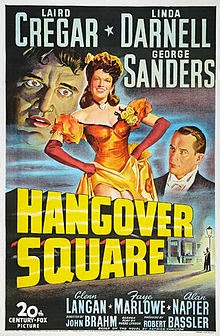
The Fox studio heads were certain that Laird Cregar was born to play villains, never mind that Cregar himself dreamed of being a romantic lead. In Hangover Square (1945), the final film of his tragically brief career, Cregar got to do both at once, creating for viewers a sympathetic, romantic figure who also happens to be a homicidal maniac. The price for his effort would prove high, indeed; Cregar died of a massive heart attack, brought on by his radical weight loss program, before Hangover Square made its way to the screen. The movie reveals the extent of the public's loss, for Cregar gives a powerhouse performance as a brilliant young composer driven to madness and murder by a heartless chanteuse (Linda Darnell) and the jarring shock of any discordant sound.
John Brahm, who directed Hangover Square, had previously directed Cregar in The Lodger (1944), in which Cregar plays Jack the Ripper as a pathetic monster driven to kill by his grief over the death of his brother. Twentieth Century Fox reunited Brahm and Cregar for a follow-up that was meant to play all of the same notes that had made the earlier movie a success, including a Victorian setting and George Sanders in a supporting role, but Cregar had other ideas. Dropping a huge amount of weight in a very short period of time, Cregar reshaped himself into more conventional leading man material and thereby added a whole new layer to his character by making the audience believe that women might actually find him attractive.
If you know Cregar's story, it's hard to watch Hangover Square without pondering these offscreen elements. We're watching an actor who is, quite literally, giving his life for his art. Here is a man who doesn't want to be known as a monster but seems trapped in that fate, anyway, which eerily parallels the story of the fictional character Cregar is playing. When the doomed protagonist goes up in smoke at the movie's end, we're left thinking about Cregar's own sudden departure from this world. He was only 31 years old, with just five years of films behind him.
Still, it's important to look closely at that performance on its own merits in order to appreciate and lament Cregar as much as he deserves. As Cregar plays him, George Harvey Bone is a shy, gifted composer who can't help turning into an insane killer every time a harsh sound assaults his ears. He's not bad; he's just really sensitive. In many ways, Bone resembles Larry Talbot in The Wolf Man (1941); an outside stimulus over which the protagonist has no control dictates his actions and ultimately his fate. As the gypsies say, "Even a man who is pure in heart and says his prayers by night, may become a wolf when the wolfbane blooms and the autumn moon is bright." Cregar, however, has to define the two sides of his character without any help from monster makeup; he does it all through his performance and the way he looks, like a wide-eyed sleepwalker lost in a maze of horrors.
As the doomed composer, Cregar taps into the same combination of the monstrous and pitiable that makes other movie monsters sublime: Lon Chaney as The Phantom of the Opera, Boris Karloff as both Frankenstein's monster and Imhotep, Claude Rains as The Invisible Man, and Chaney, Jr. as The Wolf Man. They are all beings who long for love, particularly from beautiful young women, but they can neither control nor deny their own monstrosity. Death and ruin follow them as surely as night follows day. Cregar accomplishes as much in his performance as any of these iconic actors, but he does it by flipping a switch within himself, not by transforming into a literal monster with fangs and claws or other outward markers of the bestial id let loose. Perhaps that makes his monster more frightening, because we know it could happen to any of us without the occurrence of the supernatural. George Harvey Bone drinks no potions; nothing extraordinary happens to explain his murderous urges. He's walking along, minding his own business, and suddenly the world lurches forward with a crashing sound and something terrible has happened. It's no wonder he chooses the certainty of death in the movie's finale. He can only reclaim his humanity by destroying his monstrosity, and to do that he must destroy himself.
Laird Cregar is not a household name today; for the most part, only serious classic movie fans remember him. He played villains so well - in Blood and Sand (1941), This Gun for Hire (1942), and The Lodger (1944) as well as in Hangover Square - that it's a shame to think that he died trying to be something else. Still, with the few films that he made, Cregar proved his genius for being more than a monster. He was truly a great actor, too.
Read my essay, "Heavy: The Life and Films of Laird Cregar," to learn more about the actor and his work.
Showing posts with label Laird Cregar. Show all posts
Saturday, April 19, 2014
Tuesday, November 12, 2013
Classic Films in Focus: HELLO, FRISCO, HELLO (1943)
San Francisco’s Barbary Coast always makes for a colorful setting, and in Hello, Frisco, Hello (1943) Fox capitalizes on the opportunities that the backdrop presents for lavish costumes, lively stage numbers, and an anything goes ambience. This splashy Technicolor musical is primarily a showcase for the talents of Alice Faye, and it’s actually a remake of an earlier Faye picture, the 1936 musical drama, King of Burlesque. The 1943 film reunites Faye with King of Burlesque costar Jack Oakie, but it also brings in John Payne as the love interest and June Havoc as the female sidekick. Faye, however, is the main attraction throughout, and fans of the star will find her in top form, looking especially lovely in a dazzling array of period costumes. Directed by H. Bruce Humberstone, Hello, Frisco, Hello is also worth watching for the supporting performances from Oakie, Havoc, and Laird Cregar, as well as Faye’s rendition of the Oscar-winning song, “You’ll Never Know.”
Alice Faye stars as Trudy Evans, a gifted chanteuse whose voice brings success to Barbary Coast showman Johnny Cornell (John Payne) even though he takes her devotion to him for granted. When Johnny’s social ambitions lure him into the arms of Nob Hill heiress Bernice (Lynn Bari), the heartbroken Trudy departs for fame on the London stage. Johnny eventually regrets his union with the gold-digging Bernice, but his fall from the height of success leads him to drive away his old friends, including his vaudevillian comrades Dan (Jack Oakie) and Beulah (June Havoc). When Trudy returns to San Francisco, she must find a way to help Johnny without hurting his stubborn pride.
Faye has plenty of musical numbers to keep her busy, including the title song and “You’ll Never Know,” but she’s also very good at projecting Trudy’s unrequited love for the business-minded Johnny. Trudy is certainly something of a sap for mooning over a man who only uses her to get rich, but Faye has so much appeal that we’re inclined to forgive her heroine for her starry-eyed faith in someone who really doesn’t deserve her. As Johnny, John Payne mixes the smoldering intensity of Tyrone Power with the showbiz charisma of Don Ameche, although he’s not quite as memorable as either of those leading men, both of whom starred with Faye in other films. He’s best in the darker segments of Johnny’s narrative, especially with Lynn Bari as the seductive socialite who fascinates him with her high class charms.
The supporting cast provides comedy to lighten the rest of the narrative’s sentimental drama. Jack Oakie is particularly fun as Johnny’s sidekick, Dan, and he gets several great stage numbers that show off his vaudevillian style as a comic song and dance man. June Havoc keeps up with the energetic Oakie as his performing partner; although she’s usually playing second fiddle to Faye in the production numbers, she and Oakie really shine in a sailor-themed segment late in the film, and Havoc shows both the spunk and the legs that one might expect from the sister of Gypsy Rose Lee. Laird Cregar has a small but memorable role as the bearded gold prospector Sam Weaver; although he was usually cast as a villain, Cregar proves yet again that he was equally capable of tackling comedic roles, and he gives his bit character a wonderfully Falstaffian quality.
Don’t miss Ward Bond making a brief appearance as saloon owner Sharkey; his hairstyle alone is worth watching out for. For more of Alice Faye, see In Old Chicago (1937), Alexander’s Ragtime Band (1938), and That Night in Rio (1941). John Payne and Jack Oakie also star with Faye in Tin Pan Alley (1940) and The Great American Broadcast (1941), although Payne is best remembered today for Miracle on 34th Street (1947), and Oakie is known for his role in The Great Dictator (1940). Catch Lynn Bari in The Bridge of San Luis Rey (1944) and Shock (1946), and see June Havoc in Brewster’s Millions (1945) and Gentleman’s Agreement (1947). For more of Laird Cregar’s comedic roles, try Charley’s Aunt (1941) and The Black Swan (1942). H. Bruce Humberstone also directed I Wake Up Screaming (1941), Happy Go Lovely (1951), and a number of Charlie Chan pictures.
Alice Faye stars as Trudy Evans, a gifted chanteuse whose voice brings success to Barbary Coast showman Johnny Cornell (John Payne) even though he takes her devotion to him for granted. When Johnny’s social ambitions lure him into the arms of Nob Hill heiress Bernice (Lynn Bari), the heartbroken Trudy departs for fame on the London stage. Johnny eventually regrets his union with the gold-digging Bernice, but his fall from the height of success leads him to drive away his old friends, including his vaudevillian comrades Dan (Jack Oakie) and Beulah (June Havoc). When Trudy returns to San Francisco, she must find a way to help Johnny without hurting his stubborn pride.
Faye has plenty of musical numbers to keep her busy, including the title song and “You’ll Never Know,” but she’s also very good at projecting Trudy’s unrequited love for the business-minded Johnny. Trudy is certainly something of a sap for mooning over a man who only uses her to get rich, but Faye has so much appeal that we’re inclined to forgive her heroine for her starry-eyed faith in someone who really doesn’t deserve her. As Johnny, John Payne mixes the smoldering intensity of Tyrone Power with the showbiz charisma of Don Ameche, although he’s not quite as memorable as either of those leading men, both of whom starred with Faye in other films. He’s best in the darker segments of Johnny’s narrative, especially with Lynn Bari as the seductive socialite who fascinates him with her high class charms.
The supporting cast provides comedy to lighten the rest of the narrative’s sentimental drama. Jack Oakie is particularly fun as Johnny’s sidekick, Dan, and he gets several great stage numbers that show off his vaudevillian style as a comic song and dance man. June Havoc keeps up with the energetic Oakie as his performing partner; although she’s usually playing second fiddle to Faye in the production numbers, she and Oakie really shine in a sailor-themed segment late in the film, and Havoc shows both the spunk and the legs that one might expect from the sister of Gypsy Rose Lee. Laird Cregar has a small but memorable role as the bearded gold prospector Sam Weaver; although he was usually cast as a villain, Cregar proves yet again that he was equally capable of tackling comedic roles, and he gives his bit character a wonderfully Falstaffian quality.
Don’t miss Ward Bond making a brief appearance as saloon owner Sharkey; his hairstyle alone is worth watching out for. For more of Alice Faye, see In Old Chicago (1937), Alexander’s Ragtime Band (1938), and That Night in Rio (1941). John Payne and Jack Oakie also star with Faye in Tin Pan Alley (1940) and The Great American Broadcast (1941), although Payne is best remembered today for Miracle on 34th Street (1947), and Oakie is known for his role in The Great Dictator (1940). Catch Lynn Bari in The Bridge of San Luis Rey (1944) and Shock (1946), and see June Havoc in Brewster’s Millions (1945) and Gentleman’s Agreement (1947). For more of Laird Cregar’s comedic roles, try Charley’s Aunt (1941) and The Black Swan (1942). H. Bruce Humberstone also directed I Wake Up Screaming (1941), Happy Go Lovely (1951), and a number of Charlie Chan pictures.
Monday, October 7, 2013
Heavy: The Life and Films of Laird Cregar
Laird Cregar is by no means a household name today, but in the early 1940s the up-and-coming 20th Century Fox star stood perched on the edge of a long and productive career. The studio clearly imagined Cregar as another Vincent Price type, destined to play heavies because of his large size and cultured but sinister manner. Cregar, however, had other plans, and his obsession with proving himself as leading man material ultimately cost him not only his promising film career but his very life. The story of Laird Cregar fascinates movie buffs and film scholars today because it underscores the tragically high price actors sometimes paid in pursuing their dreams of stardom and prestige, but Cregar also merits attention as a gifted performer whose too-brief career reveals a tremendous talent that would have given the illustrious Price a run for his money had Cregar lived just a few more years.
Samuel Laird Cregar was born in Philadelphia on July 28, 1913. The
youngest of six sons sired by a professional cricket player, Cregar was
sent to England at an early age to be educated at Winchester College, and it
was there that he became involved with the theater, although he harbored a
strong desire to act from early childhood. On his arrival in Hollywood, Cregar
made the most of his theatrical experience by playing Oscar Wilde at the El
Capitan Theatre, and he was so successful in the role that Fox studio head
Darryl F. Zanuck took note of the young performer. After two small roles in
forgettable films for other studios, Cregar made his debut for 20th Century Fox
in the 1941 historical adventure, Hudson’s Bay, which also featured
rising Fox star Vincent Price.
From there on Cregar enjoyed increasingly memorable roles, including
several in high profile Fox productions like Blood and Sand (1941), The
Black Swan (1942), and Heaven Can Wait (1943). At 300 pounds and six
feet three inches tall, however, Cregar found himself typecast as a stock
villain in most of his films, and he usually played characters decades older
than the young actor, who was only in his late twenties in 1941. Cregar’s
menacing size and more mature appearance were not the only reasons that Fox
viewed him as a natural villain; his homosexuality, although not openly
acknowledged, gave him a slightly fey quality that translated on screen as a
debauched, even perverse, sensuality. Filmmakers capitalized on that aspect of
Cregar’s persona in the noir films, I Wake Up Screaming (1941) and This
Gun for Hire (1942), and in Cregar’s final two pictures, the atmospheric
horrors The Lodger (1944) and Hangover Square (1945).
Cregar, determined to remake himself as a traditional leading man,
could not change his height or sexual orientation but could dramatically alter
his girth, and he embarked on a radical weight loss program between the filming
of The Lodger and Hangover Square, dropping more than one hundred
pounds in a very short period of time. The alteration put a terrible strain on
Cregar’s mind and body, but the actor still was not satisfied with his
transformation. In November of 1944, he underwent gastric bypass surgery. His
heart, already weakened, gave out, and Cregar suffered a massive coronary. On
December 9, 1944, at 31 years old and on the verge of real stardom, Cregar
died, and Hangover Square, the only film for which he would receive top
billing, was released some two months after his demise. Vincent Price delivered
the eulogy at Cregar’s funeral, and he was interred at Forest Lawn Memorial
Park, where his simple headstone bears the epitaph, “I am with you always.”
Thus ended the brief, tragic life of Laird Cregar the man, but his
epitaph would prove prophetic in regards to Laird Cregar the screen persona. He
left behind sixteen film performances, some nine of them destined to ensure
that Cregar’s name would never be completely forgotten. Although Cregar had
resented the studio’s typecasting and given his life to escape it, his work in
his most memorable pictures reveals that he had a tremendous talent for heavy
roles, and his larger-than-life personality demands the viewer’s attention even
in small supporting parts. A closer look at a handful of his best-known films -
particularly Blood and Sand, I Wake Up Screaming, This Gun for
Hire, The Lodger, and Hangover Square - shows how adept
Cregar was at creating memorable villains whose obsessive yet charismatic
personalities help them steal the screen from the movies’ ostensible leads.
I should mention before moving on to Cregar’s full-blown bad guys
that he did, in fact, play other types of characters with great success. He
appears as the comical sidekick, Gooseberry, in his breakout role in Hudson’s
Bay, and in The Black Swan he makes a wonderfully funny Captain
Henry Morgan, especially in the scenes of Morgan uncomfortably rising to
respectability as the governor of Jamaica. In the 1941 Jack Benny comedy, Charley’s
Aunt, Cregar plays the father of a college student - ironic because Cregar
was actually three years younger than the actor who plays his son. His best
scenes in Charley’s Aunt have Cregar pitching middle-aged woo to a
cross-dressed Benny, who spends much of the movie disguised as the picture’s title
character. Fox even flirted with Cregar’s reputation as a villain by casting
him as the Devil in Ernst Lubitsch’s 1943 romantic comedy, Heaven Can Wait,
in which a recently deceased Don Ameche tells the story of his misspent life to
Cregar’s smiling Satan. Smartly dressed and infernally sophisticated with his
black goatee, Cregar is actually a very sympathetic listener to Ameche’s long
confession, although he does relish dropping Florence Bates through a trapdoor
to Hell. Despite these memorable forays beyond straightforward villainy, Fox
primarily viewed Cregar as a character actor and career heavy, and Cregar’s
ability to shine in comedic roles did not substantially alter the studio’s
opinion. Cregar was brilliant at playing villains, no question, but these other
performances remind us that his desire for a more diverse career was not
unrealistic or beyond his considerable talents.
Cregar got his first big antagonistic part in Rouben Mamoulian’s
1941 Technicolor bullfighting spectacle, Blood and Sand, a lavish
Spanish epic adapted from the novel by Vicente Blasco Ibàñez. Here Cregar
establishes several of the qualities that recur in his later heavies. His
character is the bullfighting critic, Curro, an egotistical, bombastic dictator
of the public taste. Curro at first antagonizes the hero, an aspiring matador
played by Tyrone Power, but when Power’s fighter becomes a success Curro fawns
on him and praises him as lavishly as he had once denounced him. Curro,
however, can turn as viciously and suddenly as an asp, and he celebrates the
matador’s eventual fall with cruelly barbed quips. Throughout the film Curro
demonstrates a talent for thrusting his knife into his victims’ most vulnerable
spots. He is the most dangerous and unpredictable sort of villain because he is
simultaneously sadistic, clever, and weak, a limp snake in the grass that bites
where the flesh is most exposed.
Cregar also invests Curro with a subtle jealousy of the masculine
Juan, which might be interpreted either as Curro’s desire to be more like Juan
or to be with him, a position that makes Curro a theoretical rival to both
Linda Darnell’s angelic wife and Rita Hayworth’s destructive siren. As one
critic in the documentary short, “The Tragic Mask: The Laird Cregar Story,”
points out, Cregar “plays the character quite gay,” a risky choice in the
closeted world of 1940s Hollywood. The gamble, however, pays off handsomely. In
a film that boasts iconic stars like Power, Darnell, Hayworth, John Carradine,
and Anthony Quinn, Cregar makes his villain stand out, no small achievement for
an actor making his fourth film with only one year of Hollywood roles behind
him.
In I Wake Up Screaming, released the same year as Blood
and Sand, Cregar plays corrupt cop Ed Cornell, the villain who persecutes
stars Betty Grable and Victor Mature after the murder of an aspiring model
played by Carole Landis. Film critic David N. Meyer pans this minor film noir
as “unconvincing” and even “unwatchable,” but he praises Cregar’s performance
as “creepy and terrific” despite his complaints about the rest of the picture
(142-143). In his book, Film Noir, Andrew Spicer identifies Cregar’s
character as an example of the homme fatal, which Spicer describes as
having “connotations of sexual perversity as well as sadism” (90). Cregar’s Ed
Cornell thus belongs to the same camp as Sydney Greenstreet’s Kasper Gutman in The
Maltese Falcon (1941), Clifton Webb’s Waldo Lydecker in Laura
(1944), and Claude Rains’ Victor Grandison in The Unsuspected (1947),
with strong parallels to Orson Welles’ Hank Quinlan in Touch of Evil
(1958), as well. The similarity between Waldo Lydecker and Ed Cornell is more
than coincidental trivia; Cregar was actually considered for the role in Laura
until director Otto Preminger rejected him as too obvious a villain. The
typecasting that Cregar so desperately wanted to avoid cut him out of the
running for one of the greatest character roles in film noir history, which
only made him more determined to pursue his fatal makeover scheme.
Fox loaned Cregar out to Paramount for the more successful 1942
noir picture, This Gun for Hire, in which Alan Ladd and Veronica Lake
take the leads as a professional killer and the beautiful girl who might or
might not be trying to help him. Cregar plays the treacherous crook, Willard
Gates, who betrays Ladd’s Raven by paying him off for a job with stolen, marked
bills. In A Girl and a Gun, David N. Meyer describes Cregar’s character
as an “early-noir archetype - the oversized, soft-spoken villain with the
palette of an urban sophisticate and the implied sexual preferences of a
degenerate” (254). Willard is both a pervert and a coward, but once again
Cregar uses his character to steal the movie from its stars. Cregar himself
described his character type as “a grotesque,” a term that perfectly suits his
most villainous roles but highlights Cregar’s sense of his size and sexuality
as limitations that prevented him from winning the coveted leading man roles.
Cregar’s final two films at Fox reveal his genius at playing the
grotesque and also his obsession with breaking out of the villainous
typecasting. The 1944 Gothic thriller, The Lodger, provides a truly
iconic villain for the actor to play - that depraved Victorian vivisectionist,
Jack the Ripper. The source material for the film was the novel by Marie Belloc
Lowndes, which had already provided the inspiration for a silent 1927 treatment
from Alfred Hitchcock and would later be made again with Jack Palance in 1953
as Man in the Attic.
Ironically, Cregar is the title character in The Lodger but
not the top-billed actor; both Merle Oberon and George Sanders are credited
above him. Despite third billing, Cregar is clearly the protagonist of the
story, and his truly macabre performance dominates the film. He plays the
mysterious Mr. Slade, a stranger who rents a set of rooms from an older couple
in the midst of the Jack the Ripper murders. His landlady, played by Sara
Allgood, becomes suspicious of the new tenant, but nobody takes her seriously
until it is almost too late, after Slade has already settled on lovely Merle
Oberon as his next victim. George Sanders stars as the police detective
determined to uncover the killer’s true identity and save Oberon’s character,
Kitty, from a horrific fate.
The audience knows from the beginning that Cregar’s protagonist is
the killer, which eliminates any concern about the actor being too obviously
the villain. There’s no twist to spoil, and the plot moves forward with the
tension relying on how long it will take for everyone else to figure out what
the viewers already know. Cregar gives an incredibly creepy, intense
performance, but like the best monster players he mingles his monstrosity with pity,
especially in the scenes where he laments the death of his beloved brother, for
whom he harbors a decidedly homoerotic passion. Cregar murmurs many of his most
chilling lines, and his soft-spoken, almost dreamy manner leads Merle Oberon’s
Kitty to pity him as a lost, lonely soul, little suspecting the brutal violence
that lurks beneath the surface.
The Lodger revels in full-on Gothic atmosphere, with a Victorian setting
replete with foggy streets, gaslight, and an aesthetic attitude toward horror
very similar to that of Val Lewton in the RKO pictures Cat People, Bedlam,
and I Walked with a Zombie. Cregar’s Slade perfectly embodies the Gothic
themes of sexual repression and obsession; he both adores and hates Merle
Oberon’s youthful beauty because he sees it as a snare that traps and destroys
men. Like a more bloodthirsty version of the speaker in “Porphyria’s Lover,” he
kills women and cuts them up in order to remove their evil natures and make
them perfectly good and still. Slade also evinces a fascination with water, in
this case the River Thames, which he ironically sees as a cleansing force that
washes evil away. The finale lets Cregar cut loose with a wild-eyed, bravura
performance that prefigures Orson Welles’ trapped rat run at the climax of The
Third Man (1949) but also reveals shades of Peter Lorre in M (1931).
The Lodger proved successful enough that Fox reunited its major players for
Cregar’s final picture, Hangover Square. George Sanders was cast as the
detective, John Brahm was again tapped as director, and Barré Lyndon adapted
the screenplay from the novel by Patrick Hamilton. Hamilton was already known
for his Gothic work thanks to the successful screen versions of his play, Gaslight,
and in 1948 another of his plays, Rope, would be made into a film by
Alfred Hitchcock. It was Cregar himself who suggested the novel for his next
project, although he did not react well to the drastic alterations Fox made to
the story. The final picture actually bears little resemblance to Hamilton’s
black comedy, since the studio changed the period and the plot to more closely
resemble The Lodger, but the idea of the protagonist as a man with a
split personality disorder remains central to the film, as does his destructive
relationship with a greedy, self-serving woman.
Cregar, achieving top billing at last, stars as classical composer
George Harvey Bone, a gentle, soft-spoken soul who transforms into a homicidal
maniac any time he hears a discordant sound. He has a sweetly bland girlfriend,
Barbara, played by the unremarkable Faye Marlowe, who supports his musical
career and promotes his work with her father, a successful conductor. Despite
the girlfriend’s devoted concern about his periodic blackouts George becomes
entangled with the seductive Netta, a self-interested singer played to
deliciously repugnant effect by Linda Darnell. Netta milks George for music to
advance her own career but only pretends affection for him while keeping a
variety of other useful lovers on the side. Little does she realize that the gullible,
pathetic George is also a violent murderer whose impulse to kill becomes fixed
on her when her deception is finally revealed.
As far as Fox was concerned, Hangover Square was simply
meant to duplicate the basic elements of The Lodger, but Cregar saw the
love scenes with Linda Darnell as his opportunity to prove himself as a leading
man. His intense diet and exercise regimen resulted in rapid weight loss and
put a tremendous strain on him both physically and emotionally. According to
“The Tragic Mask: The Laird Cregar Story,” the stress made for a difficult
production, with Cregar eventually getting into an ugly and very public spat
with John Brahm and the film crew through the Hollywood media. His death before
the picture’s release in early 1945 meant that Cregar would never see how his
obsessive makeover played out on screen.
The ultimate tragedy is that Cregar’s performance is simply
brilliant, a showcase of the actor’s potential to play both romantic and
maniacal types. Cregar had always been good at villainy, but in this role he
adds even greater nuance and meaning to his monster by changing the way the
audience sees him as a physical presence. Only in Hangover Square do we
see Cregar looking close to his actual age, without the makeup, facial hair,
and costumes that so often made him seem to be decades older. Like Cregar
himself, George Harvey Bone is a young man on the verge of a promising career, laid
low by darkness both within and without. With his slimmer figure and thinner
face, Cregar sells himself as a worthy romantic hero, even though evil
ultimately gets the upper hand.
Cregar manages to make George sympathetic, even tragic, despite a
set up that once again tells the audience that he is a killer in the very first
scene. We are introduced to George in homicidal mode, stabbing an antiques
dealer and then setting fire to the shop. As water had been the murderer’s
obsession in The Lodger, so fire becomes a central motif for George in Hangover
Square. Both elements function as violent cleansing agents, with Cregar’s
character as the final stain that must be removed from the world. When George
is sane, Cregar plays him as a gentle artist, naïve perhaps but not so much a
sap that he doesn’t resent Netta’s treatment of him. His sensitive nature makes
Barbara want to protect him even as it invites Netta to take advantage of him,
but Cregar gives George enough spirit that we see the bridge between his two
sides. Besides, his artistic sensitivity is the quality that also causes him to
go mad at the clang of pipes falling or the screeching thump of instruments
being knocked over. He presses a hand to the back of his head, blinks hard, and
then becomes a dangerous sleepwalker, barely aware of anything beyond his
compulsion to kill. When the fog finally clears, George remembers nothing of
his violent escapades, and we pity him deeply as he struggles to come to terms
with a monstrosity that he suspects lives within him without his knowledge or
consent.
Cregar again makes the most of a deliriously Gothic finale, with
George finally recognizing his own evil and choosing death by fire rather than
execution or life in the insane asylum. “I’ll never be held nor hanged!” George
shouts at the Scotland Yard detectives. He sets the house on fire and plays his
final concerto as everyone else rushes out. Fittingly, Laird Cregar sits at the
piano, an artist to the last, performing with his whole soul until the
billowing smoke rises up. In the final shot, he vanishes from our view.
Cregar’s death prevented him from playing the next role that Fox
meant for him, that of Nicholas Van Ryn in the 1946 Gothic thriller, Dragonwyck.
The part went to Vincent Price instead, and it would help to advance Price’s
career as one of Hollywood’s most memorable heavies. Price died in 1993 with
nearly 200 film and television credits to his name, leaving us to speculate
what Cregar might have done had he lived past the age of 31. Instead, Cregar
became an obscure footnote in the history of Hollywood tragedies, another
casualty of the dream machine’s darker side. Some of his costars also met
terrible fates: Carole Landis committed suicide at age 29, Tyrone Power
suffered a fatal heart attack at the age of 44, and Linda Darnell burned to
death in a house fire when she was 41. George Sanders killed himself in 1972,
at the comparatively old age of 67. All of them left questions, roles that
might have been, and films that proved the worth of that which had been lost,
but Cregar, so talented and so ambitious, is as tragic a figure as any of those
better known stars. As the mourning Slade lamented of his departed brother in The
Lodger, “He need not have died.” Had Cregar been able to accept his fate as
a heavy, or had Hollywood been more broad-minded in its image of the leading
man, he might have lived a long life, and cinema would have been far richer for
his presence.
This paper was originally presented at the 2013 conference of Popular Culture in the South (PCAS) in Savannah, GA. Works Cited information is omitted to discourage plagiarism.
Friday, September 27, 2013
Bringing the Hollywood Heavies to PCAS 2013
Next week I'll be in Savannah, GA, for the 2013 meeting of the Popular Culture Association in the South (PCAS). It's a great time to see friends and hear papers about literature, film, and television as well as anything else that falls under the very broad umbrella of popular culture.
This year my paper is "Heavy: The Life and Films of Laird Cregar." Some friends and I have put together a whole panel on Hollywood heavies, which is going to be great because of the ways in which the topics intersect. Our panel is "Born to Be Bad: Classic Hollywood Villains." Jeff Thompson will be talking about "Leave Her to Heaven: A Film Noir with a Difference," Jonathan Lampley will discuss "Those Icy Eyes: Vincent Price in Shock and Dragonwyck," and Geoff Weiss will present "Lee Van Cleef: Badder than Eastwood."
I always learn something new about classic film when I get together with these guys, so I am really looking forward to hearing what they have to say. Many of my other cinephile and pop culture buddies are also PCAS regulars, and I'm especially happy that some of my former graduate students are once again attending the conference. Seeing them reminds me that that those years of teaching at UAH were not spent in vain.
I'll post my Laird Cregar essay here on the blog once I get back from the conference. I'm also hoping to persuade the other panelists to contribute their papers as guest posts - we'll see how that goes! If you happen to be a classic film scholar/blogger, I should mention that PCAS is very friendly toward non-academics and also welcomes graduate and even undergraduate students. Next year's meeting is already scheduled for New Orleans, so visit the PCAS website if you're interested in attending.
This year my paper is "Heavy: The Life and Films of Laird Cregar." Some friends and I have put together a whole panel on Hollywood heavies, which is going to be great because of the ways in which the topics intersect. Our panel is "Born to Be Bad: Classic Hollywood Villains." Jeff Thompson will be talking about "Leave Her to Heaven: A Film Noir with a Difference," Jonathan Lampley will discuss "Those Icy Eyes: Vincent Price in Shock and Dragonwyck," and Geoff Weiss will present "Lee Van Cleef: Badder than Eastwood."
I always learn something new about classic film when I get together with these guys, so I am really looking forward to hearing what they have to say. Many of my other cinephile and pop culture buddies are also PCAS regulars, and I'm especially happy that some of my former graduate students are once again attending the conference. Seeing them reminds me that that those years of teaching at UAH were not spent in vain.
I'll post my Laird Cregar essay here on the blog once I get back from the conference. I'm also hoping to persuade the other panelists to contribute their papers as guest posts - we'll see how that goes! If you happen to be a classic film scholar/blogger, I should mention that PCAS is very friendly toward non-academics and also welcomes graduate and even undergraduate students. Next year's meeting is already scheduled for New Orleans, so visit the PCAS website if you're interested in attending.
Tuesday, September 24, 2013
Classic Films in Focus: HANGOVER SQUARE (1945)
Laird Cregar’s final film is the only one in which he received top billing, but Hangover Square (1945) shows just how much talent was lost with the star’s premature death in 1944, two months before the picture was released. Like the earlier Fox horror thriller, The Lodger (1944), Hangover Square features direction by John Brahm and a memorable supporting performance from George Sanders, but Cregar rules the screen as a mentally unstable protagonist who is both the monster and the ultimate victim of his own uncontrollable evil.
Cregar plays George Harvey Bone, a talented composer whose mild manner gives way to murderous psychosis whenever he hears discordant sounds. Despite the devoted concern of his girlfriend, Barbara (Faye Marlowe), and the support of his mentor, Sir Henry (Alan Napier), George falls under the seductive spell of singer Netta Longdon (Linda Darnell), who uses George to compose songs for her rising career. Netta thinks that George is merely a convenient sap, but her treachery provokes another of George’s deadly rampages. Meanwhile, Scotland Yard expert Dr. Middleton (George Sanders) struggles to uncover the truth about George’s disturbing blackouts.
The movie opens with a dramatic sequence in which we see George commit his first murder, so there is never any doubt that he becomes a killer during his mental lapses. Our knowledge of his hidden nature creates ongoing dramatic irony as we wait for George and the people around him to figure out what we already know, and the tension mounts because we realize that George will kill again whenever his mind is jarred by the right kind of sound. Cregar’s genius in the role lies in his ability to play normal George as a sweet, sensitive artist and then invest monstrous George with glassy-eyed, animal violence. Like Larry Talbot or Dr. Jekyll, George Harvey Bone is an unwilling and even unconscious killer; he remains sympathetic throughout the picture because he really can’t stop himself or control what his darker side does. Unlike most of the actors who play these other monsters, however, Laird Cregar performs both versions of his character without any special makeup or transformation, and he does a magnificent job, especially in the climactic sequence where he finally recognizes his own monstrosity while playing his deliriously Gothic concerto.
Although Cregar is clearly the star of the show, Linda Darnell stands out as the scheming, selfish Netta, who plays with fire so contemptuously that we yearn to see her burned. Our wish is granted in a very literal sense, for fire is another motif that recurs throughout the picture. The use of fire as a component in a gentle artist’s transformation into evil also figures in the later Vincent Price picture, House of Wax (1953), but Hangover Square offers parallels to many classic horror stories, including The Phantom of the Opera, The Wolf Man, and the many adaptations of Dr. Jekyll and Mr. Hyde. Like the 1931 and 1941 versions of the Hyde story, Hangover Square provides George with love interests who reflect his light and dark aspects, although Faye Marlowe’s angelic Barbara is far less interesting than Darnell’s naughty Netta. George Sanders, however, has a very good role as the cool, clinical doctor who acts as a foil to the nervously unhinged George.
Laird Cregar dropped a hundred pounds by crash dieting to remake himself as a traditional leading man for this role; the drastic weight loss and a subsequent gastric bypass surgery proved too much for his body and caused a fatal heart attack shortly after Hangover Square was completed. Be sure to pay attention to his very different appearance in his earlier films, including Blood and Sand (1941), This Gun for Hire (1942), and The Lodger (1944). John Brahm also directed The Undying Monster (1942), Hot Rods to Hell (1967), and many episodes of thriller and horror television series. See more of Linda Darnell in The Mark of Zorro (1940), My Darling Clementine (1946), and A Letter to Three Wives (1949). Don’t miss George Sanders in Rebecca (1940), The Picture of Dorian Gray (1945), and All About Eve (1950), although his own most memorable villain might be the tiger Shere Khan in Disney’s The Jungle Book (1967).
Cregar plays George Harvey Bone, a talented composer whose mild manner gives way to murderous psychosis whenever he hears discordant sounds. Despite the devoted concern of his girlfriend, Barbara (Faye Marlowe), and the support of his mentor, Sir Henry (Alan Napier), George falls under the seductive spell of singer Netta Longdon (Linda Darnell), who uses George to compose songs for her rising career. Netta thinks that George is merely a convenient sap, but her treachery provokes another of George’s deadly rampages. Meanwhile, Scotland Yard expert Dr. Middleton (George Sanders) struggles to uncover the truth about George’s disturbing blackouts.
The movie opens with a dramatic sequence in which we see George commit his first murder, so there is never any doubt that he becomes a killer during his mental lapses. Our knowledge of his hidden nature creates ongoing dramatic irony as we wait for George and the people around him to figure out what we already know, and the tension mounts because we realize that George will kill again whenever his mind is jarred by the right kind of sound. Cregar’s genius in the role lies in his ability to play normal George as a sweet, sensitive artist and then invest monstrous George with glassy-eyed, animal violence. Like Larry Talbot or Dr. Jekyll, George Harvey Bone is an unwilling and even unconscious killer; he remains sympathetic throughout the picture because he really can’t stop himself or control what his darker side does. Unlike most of the actors who play these other monsters, however, Laird Cregar performs both versions of his character without any special makeup or transformation, and he does a magnificent job, especially in the climactic sequence where he finally recognizes his own monstrosity while playing his deliriously Gothic concerto.
Although Cregar is clearly the star of the show, Linda Darnell stands out as the scheming, selfish Netta, who plays with fire so contemptuously that we yearn to see her burned. Our wish is granted in a very literal sense, for fire is another motif that recurs throughout the picture. The use of fire as a component in a gentle artist’s transformation into evil also figures in the later Vincent Price picture, House of Wax (1953), but Hangover Square offers parallels to many classic horror stories, including The Phantom of the Opera, The Wolf Man, and the many adaptations of Dr. Jekyll and Mr. Hyde. Like the 1931 and 1941 versions of the Hyde story, Hangover Square provides George with love interests who reflect his light and dark aspects, although Faye Marlowe’s angelic Barbara is far less interesting than Darnell’s naughty Netta. George Sanders, however, has a very good role as the cool, clinical doctor who acts as a foil to the nervously unhinged George.
Laird Cregar dropped a hundred pounds by crash dieting to remake himself as a traditional leading man for this role; the drastic weight loss and a subsequent gastric bypass surgery proved too much for his body and caused a fatal heart attack shortly after Hangover Square was completed. Be sure to pay attention to his very different appearance in his earlier films, including Blood and Sand (1941), This Gun for Hire (1942), and The Lodger (1944). John Brahm also directed The Undying Monster (1942), Hot Rods to Hell (1967), and many episodes of thriller and horror television series. See more of Linda Darnell in The Mark of Zorro (1940), My Darling Clementine (1946), and A Letter to Three Wives (1949). Don’t miss George Sanders in Rebecca (1940), The Picture of Dorian Gray (1945), and All About Eve (1950), although his own most memorable villain might be the tiger Shere Khan in Disney’s The Jungle Book (1967).
Sunday, July 28, 2013
Laird Cregar at 100
July 28, 2013, marks the 100th birthday of classic Fox star Laird Cregar, one of my favorite lesser-known actors and the protagonist of one of Hollywood's most tragic stories. Cregar had been pegged by the studio as a heavy because of his large size and his air of hedonistic debauchery, but the actor longed for leading man status and was willing to take drastic measures to show that he could fit the studio's image of a romantic lead. He dropped 100 pounds and presented himself in a very different light in his final film, Hangover Square (1945), but the strain of his physical transformation resulted in a fatal heart attack, and Cregar died before the picture was released. He was only 31 years old, with a brilliant career ahead of him, and had he lived Cregar might have proved a true rival to his friend, Vincent Price.
Here are a few of my favorite Cregar performances -
HEAVEN CAN WAIT (1943) - Cregar plays the Devil in this romantic comedy from Ernst Lubitsch. He doesn't have a lot of scenes with star Don Ameche, but he makes every one of them count, and Cregar's Devil is a jolly - if slightly sinister - fellow, a laughing demon who doesn't really seem to wish his guest eternal damnation at all.
CHARLEY'S AUNT (1941) - With Jack Benny as the cross-dressing star, Cregar plays an older man who tries to court Benny in his widow's disguise. Ironically, Cregar's son in the movie, James Ellison, was actually three years older than Cregar!
BLOOD AND SAND (1941) - In this sweeping Spanish epic, Cregar plays a smug bullfight critic who can make or break careers with a wave of his pen. Cregar cuts Tyrone Power down as viciously as a gored bull, but the real threat to Ty's ambitious bullfighter is the seductive Rita Hayworth.
THE LODGER (1944) - Cregar takes on the Jack the Ripper role in this creepy thriller starring Merle Oberon and George Sanders. As dangerous as his killer is, Cregar invests him with a strange sympathy that fascinates both the audience and Oberon's heroine.
HANGOVER SQUARE (1945) - Although he didn't live to see it, Cregar gives a tour de force performance in his final film, building on the pitiable monster created in THE LODGER. His transformation scenes from nice guy to killer require no makeup or special effects, just Cregar's own ability to show his protagonist crossing over to the dark side at the sound of a particular tone.
Cregar also makes memorable appearances in I WAKE UP SCREAMING (1941), THE BLACK SWAN (1942), and THIS GUN FOR HIRE (1942). Honor his memory and his passion for stardom by catching a few of his movies this week.
Here are a few of my favorite Cregar performances -
HEAVEN CAN WAIT (1943) - Cregar plays the Devil in this romantic comedy from Ernst Lubitsch. He doesn't have a lot of scenes with star Don Ameche, but he makes every one of them count, and Cregar's Devil is a jolly - if slightly sinister - fellow, a laughing demon who doesn't really seem to wish his guest eternal damnation at all.
CHARLEY'S AUNT (1941) - With Jack Benny as the cross-dressing star, Cregar plays an older man who tries to court Benny in his widow's disguise. Ironically, Cregar's son in the movie, James Ellison, was actually three years older than Cregar!
BLOOD AND SAND (1941) - In this sweeping Spanish epic, Cregar plays a smug bullfight critic who can make or break careers with a wave of his pen. Cregar cuts Tyrone Power down as viciously as a gored bull, but the real threat to Ty's ambitious bullfighter is the seductive Rita Hayworth.
THE LODGER (1944) - Cregar takes on the Jack the Ripper role in this creepy thriller starring Merle Oberon and George Sanders. As dangerous as his killer is, Cregar invests him with a strange sympathy that fascinates both the audience and Oberon's heroine.
HANGOVER SQUARE (1945) - Although he didn't live to see it, Cregar gives a tour de force performance in his final film, building on the pitiable monster created in THE LODGER. His transformation scenes from nice guy to killer require no makeup or special effects, just Cregar's own ability to show his protagonist crossing over to the dark side at the sound of a particular tone.
Cregar also makes memorable appearances in I WAKE UP SCREAMING (1941), THE BLACK SWAN (1942), and THIS GUN FOR HIRE (1942). Honor his memory and his passion for stardom by catching a few of his movies this week.
Wednesday, February 13, 2013
Classic Films in Focus: I WAKE UP SCREAMING (1941)
Betty Grable is not an actress one normally associates with film noir, but she makes an unusual foray into Dark City in H. Bruce Humberstone's 1941 picture for Fox, I Wake Up Screaming. Nobody ever actually does wake up screaming in the movie, and the ill-chosen title is not the only weakness in evidence, but the picture is watchable and offers an interestingly twisted tale of passion, murder, and suspense.
Grable plays good girl Jill Lynn, whose beautiful and ambitious sister, Vicky (Carole Landis), has just been murdered. The chief suspect in the case is Frankie Christopher (Victor Mature), a promoter who was helping Vicky become a star, but Frankie insists that he had nothing to do with Vicky's death. Both Frankie and Jill fall under the relentless watch of imposing cop Ed Cornell (Laird Cregar), who refuses to believe that Frankie might be innocent. As they struggle to find Vicky's real killer, Frankie and Jill must come to grips with their feelings for one another, and their blossoming romance might prove the weakness that finally helps Cornell to pin the crime on Frankie.
The dialogue in I Wake Up Screaming can't compare to that of the real masterpieces of noir, where lines get thrown like so many daggers in a deadly circus act. Double Indemnity (1946) it is not. The film was adapted from a novel by Steve Fisher with the screenplay by Dwight Taylor, who mostly wrote scripts for Fred Astaire and Ginger Rogers but also penned Pickup on South Street (1956), a much more highly regarded example of noir style. There's also an obsessive and rather bizarre use of an instrumental version of "Somewhere Over the Rainbow" for the film's musical backdrop. You'll get tired of hearing it by the time the picture ends.
On the plus side, Laird Cregar is a smoldering menace as the relentless cop, and Elisha Cook, Jr., always great, appears in a small but crucial role. Victor Mature is fun to watch, although his heavy features constantly raise suspicion that he might actually be the killer, and that might be the whole point of casting him in the first place. Carole Landis makes a lovely and cold-hearted foil to Grable's good sister, and Alan Mowbray and Alyn Joslyn have interesting roles as Frankie's slippery friends.
If you like Betty Grable, see her in her natural element in Down Argentine Way (1940) and How to Marry a Millionaire (1953). You'll find Victor Mature in My Darling Clementine (1946), Kiss of Death (1947), and The Robe (1953). Don't miss Laird Cregar in The Black Swan (1942), Heaven Can Wait (1943), and The Lodger (1944). Elisha Cook, Jr. turns up in all kinds of classic movies, but makes his most memorable appearance in The Maltese Falcon (1941). For more from director Bruce Humberstone, try To the Shores of Tripoli (1942), Wonder Man (1945), or Happy Go Lovely (1951).
An earlier version of this review originally appeared on Examiner.com. The author retains all rights to this content.
Grable plays good girl Jill Lynn, whose beautiful and ambitious sister, Vicky (Carole Landis), has just been murdered. The chief suspect in the case is Frankie Christopher (Victor Mature), a promoter who was helping Vicky become a star, but Frankie insists that he had nothing to do with Vicky's death. Both Frankie and Jill fall under the relentless watch of imposing cop Ed Cornell (Laird Cregar), who refuses to believe that Frankie might be innocent. As they struggle to find Vicky's real killer, Frankie and Jill must come to grips with their feelings for one another, and their blossoming romance might prove the weakness that finally helps Cornell to pin the crime on Frankie.
The dialogue in I Wake Up Screaming can't compare to that of the real masterpieces of noir, where lines get thrown like so many daggers in a deadly circus act. Double Indemnity (1946) it is not. The film was adapted from a novel by Steve Fisher with the screenplay by Dwight Taylor, who mostly wrote scripts for Fred Astaire and Ginger Rogers but also penned Pickup on South Street (1956), a much more highly regarded example of noir style. There's also an obsessive and rather bizarre use of an instrumental version of "Somewhere Over the Rainbow" for the film's musical backdrop. You'll get tired of hearing it by the time the picture ends.
On the plus side, Laird Cregar is a smoldering menace as the relentless cop, and Elisha Cook, Jr., always great, appears in a small but crucial role. Victor Mature is fun to watch, although his heavy features constantly raise suspicion that he might actually be the killer, and that might be the whole point of casting him in the first place. Carole Landis makes a lovely and cold-hearted foil to Grable's good sister, and Alan Mowbray and Alyn Joslyn have interesting roles as Frankie's slippery friends.
If you like Betty Grable, see her in her natural element in Down Argentine Way (1940) and How to Marry a Millionaire (1953). You'll find Victor Mature in My Darling Clementine (1946), Kiss of Death (1947), and The Robe (1953). Don't miss Laird Cregar in The Black Swan (1942), Heaven Can Wait (1943), and The Lodger (1944). Elisha Cook, Jr. turns up in all kinds of classic movies, but makes his most memorable appearance in The Maltese Falcon (1941). For more from director Bruce Humberstone, try To the Shores of Tripoli (1942), Wonder Man (1945), or Happy Go Lovely (1951).
An earlier version of this review originally appeared on Examiner.com. The author retains all rights to this content.
Wednesday, September 19, 2012
Classic Films in Focus: THE BLACK SWAN (1942)
Of
course Tyrone Power had to play a pirate at some point in his career. Like
Errol Flynn, he exuded the kind of masculine charisma that lent itself to the
swashbuckler, and in director Henry King's The Black Swan
(1942) we get to see that quality exhibited in spades, along with a pretty good
portion of Power's attractive torso. Although there are some rather thorny
issues to deal with when it comes to the picture's representation of romance, The Black Swan works very well as an old
school adventure film, with exciting performances from Power and the rest of
the cast.
Power
takes the lead as English pirate Jamie Waring, who finds his activities at sea
and on land complicated by the appointment of his old friend, Henry Morgan
(Laird Cregar), to the governorship of Jamaica. Henry expects Jamie's
assistance in hunting down former comrades, particularly the rebellious Captain
Leech (George Sanders), but Jamie finds himself distracted by the previous
governor's beautiful daughter, Lady Margaret (Maureen O'Hara). Sparks fly
between the sparring couple even as Jamie comes to realize that Margaret's
father (George Zucco) and suitor (Edward Ashley) have resorted to some
seriously underhanded measures in order to oust Henry Morgan from his new office.
![]() |
| Laird Cregar as Henry Morgan |
The
presence of real pirate Henry Morgan makes for an interesting spin on the usual
swashbuckler tale of the era, but the film's interest in politics is mainly focused
on the idea that piracy and politics are really the same thing once you get
past the semantics. Henry is pirate first and politician second, while his
adversaries present the reverse order, but Henry and his comrades come off as
appealing because their piratical nature is transparent, while the scheming
Lord Denby and Roger Ingram are despicable because they hide their black colors
under hypocritical righteousness. Like Morgan, Jamie Waring is, therefore, a
lovable rogue, despite his boorish and even felonious behavior, because we know
he's a pirate and so does he. The casting of the "good" pirates
highlights their demand for our sympathy. Laird Cregar creates an immensely
interesting character out of Morgan as an old sea dog trying to learn a new
trick; you have to feel sorry for him squirming in his respectable clothes,
clearly trying to bluff his way out of every situation and ready to eat his wig
as the whole mess gets more and more out of control. Brilliant character actor
Thomas Mitchell gets to cut loose as Jamie's first mate, Tommie Blue, and he
looks like he's having a wonderful time. Contrast these charming scoundrels
with the "bad" pirates played by George Sanders and Anthony Quinn,
both of them looking quite wild, and it's clear which ones we're supposed to
like.
The
romantic plot of the film plays less well for a modern audience. It's hard for
us today to defend or even grasp the idea of romance predicated on violence,
even though it was a common trope for certain kinds of classic films. The first
time we meet Margaret Denby, Jamie assaults her, hits her, tries to kidnap her,
and then drops her on the floor once his attention is directed elsewhere. No
wonder she doesn't seem to like him! The only justification for this love as
war theme is the fact that Margaret gives as good as she gets; these two
firebrands both like it rough, and that's why they're attracted to each other.
The casting of Maureen O'Hara as Margaret makes this squaring off of the sexes
more palatable; she makes a very credible hellcat, and of course that's why she
appears in so many similar roles opposite John Wayne in movies like The Quiet Man (1952) and McLintock! (1963). Still, the idea of
"saying no, saying yes" makes serious trouble for the astute modern
viewer, and it might be wise to have a thoughtful conversation about this
element of the film with any youngsters watching the picture. There's a certain
forced quality to the end of the movie, akin to that of The Taming of the Shrew, that defends the idea that a battle of the
sexes ends well when a woman chooses to "win" by losing.
An earlier version of this review originally appeared on Examiner.com. The author retains all rights to this content.
Thursday, September 6, 2012
Classic Films in Focus: THE LODGER (1944)
There
have been plenty of Jack the Ripper movies in the history of cinema, but few
can lay claim to the eerie charms of director John Brahm's 1944 picture, The Lodger, which stars the incomparable
Laird Cregar as the mysterious title character. Adapted from a novel by Marie
Belloc Lowndes (which had already been adapted into a 1927 film by Alfred
Hitchcock), this delirious tale of murder and monstrosity basks in the ambience
of gaslight London and builds suspense not through any doubt about the killer's
identity but through the audience's ironic knowledge of the psychopath hidden
in plain sight.
When
Mr. Slade (Laird Cregar) first rents a set of rooms, his landlady (Sara
Allgood) is only too happy to have the additional income, even though the
grisly Ripper murders have set all of London on edge. Slowly, however, the
family begins to notice odd parallels between their lodger's activities and the
ensuing attacks, although the landlord (Cedric Hardwicke) passes them off as
mere coincidence. The landlady's beautiful niece, Kitty (Merle Oberon), tries
to engage Mr. Slade's friendship and interest, but his reaction to her is
puzzling and sinister. In the meantime, a handsome police inspector (George
Sanders) becomes concerned for Kitty's welfare because all of the Ripper's
victims have been associated with the stage, but the entire force might not be
enough to save her from the deranged killer's dangerous obsession.
Although
Merle Oberon and George Sanders get top billing as the picture's leads, the
film really belongs to Laird Cregar, and it's his performance that makes The Lodger so effectively creepy and
compelling. He brings touches of sadness and humanity to his madman, especially
when he laments the tragic death of his beloved brother. Like all great
monsters, Slade is all the more terrible for being an object of pity as well as
horror; he has that sublime quality so often praised in characters like
Frankenstein's monster, the Wolf Man, and Peter Lorre's pathetic serial killer
in M (1931). By the end of the movie,
as he lurches through the theater trapped and bleeding, we see Cregar's
character as his own ultimate victim, and his death is more tragedy than
triumph, the inevitable result of urges that could not be controlled. In the
last scene, the camera frames him like a wild animal caught in a corner, with
the circling policemen closing in like hounds at bay, and his final desperate
act creates a fatal poetry that the survivors note in the film's closing lines.
You'll
find more of the exotic Merle Oberon in The
Dark Angel (1935) and Wuthering
Heights (1939). George Sanders, who won a Best Supporting Actor Oscar for
his role in All About Eve (1950),
turns up in several other memorable films, including Rebecca (1940), The Black
Swan (1942), and The Picture of
Dorian Gray (1945). Laird Cregar, whose career was cut tragically short,
can also be found in The Black Swan
(1942), and he makes a delightful Devil in Heaven
Can Wait (1943). Cregar, Sanders, Brahms, and screenwriter Barre Lyndon all
return for Cregar's final picture, the effective thriller, Hangover Square (1945).
This review was originally posted on Examiner.com. The author retains all rights to this content.
Subscribe to:
Posts (Atom)