Laird Cregar is by no means a household name today, but in the
early 1940s the up-and-coming 20th Century Fox star stood perched on the edge
of a long and productive career. The studio clearly imagined Cregar as another
Vincent Price type, destined to play heavies because of his large size and
cultured but sinister manner. Cregar, however, had other plans, and his
obsession with proving himself as leading man material ultimately cost him not
only his promising film career but his very life. The story of Laird Cregar
fascinates movie buffs and film scholars today because it underscores the
tragically high price actors sometimes paid in pursuing their dreams of stardom
and prestige, but Cregar also merits attention as a gifted performer whose
too-brief career reveals a tremendous talent that would have given the
illustrious Price a run for his money had Cregar lived just a few more years.
Samuel Laird Cregar was born in Philadelphia on July 28, 1913. The
youngest of six sons sired by a professional cricket player, Cregar was
sent to England at an early age to be educated at Winchester College, and it
was there that he became involved with the theater, although he harbored a
strong desire to act from early childhood. On his arrival in Hollywood, Cregar
made the most of his theatrical experience by playing Oscar Wilde at the El
Capitan Theatre, and he was so successful in the role that Fox studio head
Darryl F. Zanuck took note of the young performer. After two small roles in
forgettable films for other studios, Cregar made his debut for 20th Century Fox
in the 1941 historical adventure, Hudson’s Bay, which also featured
rising Fox star Vincent Price.

From there on Cregar enjoyed increasingly memorable roles, including
several in high profile Fox productions like Blood and Sand (1941), The
Black Swan (1942), and Heaven Can Wait (1943). At 300 pounds and six
feet three inches tall, however, Cregar found himself typecast as a stock
villain in most of his films, and he usually played characters decades older
than the young actor, who was only in his late twenties in 1941. Cregar’s
menacing size and more mature appearance were not the only reasons that Fox
viewed him as a natural villain; his homosexuality, although not openly
acknowledged, gave him a slightly fey quality that translated on screen as a
debauched, even perverse, sensuality. Filmmakers capitalized on that aspect of
Cregar’s persona in the noir films, I Wake Up Screaming (1941) and This
Gun for Hire (1942), and in Cregar’s final two pictures, the atmospheric
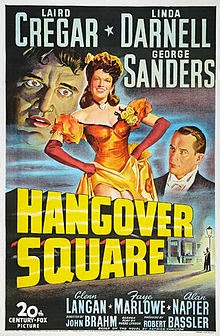
horrors The Lodger (1944) and Hangover Square (1945).
Cregar, determined to remake himself as a traditional leading man,
could not change his height or sexual orientation but could dramatically alter
his girth, and he embarked on a radical weight loss program between the filming
of The Lodger and Hangover Square, dropping more than one hundred
pounds in a very short period of time. The alteration put a terrible strain on
Cregar’s mind and body, but the actor still was not satisfied with his
transformation. In November of 1944, he underwent gastric bypass surgery. His
heart, already weakened, gave out, and Cregar suffered a massive coronary. On
December 9, 1944, at 31 years old and on the verge of real stardom, Cregar
died, and Hangover Square, the only film for which he would receive top
billing, was released some two months after his demise. Vincent Price delivered
the eulogy at Cregar’s funeral, and he was interred at Forest Lawn Memorial
Park, where his simple headstone bears the epitaph, “I am with you always.”
Thus ended the brief, tragic life of Laird Cregar the man, but his
epitaph would prove prophetic in regards to Laird Cregar the screen persona. He
left behind sixteen film performances, some nine of them destined to ensure
that Cregar’s name would never be completely forgotten. Although Cregar had
resented the studio’s typecasting and given his life to escape it, his work in
his most memorable pictures reveals that he had a tremendous talent for heavy
roles, and his larger-than-life personality demands the viewer’s attention even
in small supporting parts. A closer look at a handful of his best-known films -
particularly Blood and Sand, I Wake Up Screaming, This Gun for
Hire, The Lodger, and Hangover Square - shows how adept
Cregar was at creating memorable villains whose obsessive yet charismatic
personalities help them steal the screen from the movies’ ostensible leads.

I should mention before moving on to Cregar’s full-blown bad guys
that he did, in fact, play other types of characters with great success. He
appears as the comical sidekick, Gooseberry, in his breakout role in Hudson’s
Bay, and in The Black Swan he makes a wonderfully funny Captain
Henry Morgan, especially in the scenes of Morgan uncomfortably rising to
respectability as the governor of Jamaica. In the 1941 Jack Benny comedy, Charley’s
Aunt, Cregar plays the father of a college student - ironic because Cregar
was actually three years younger than the actor who plays his son. His best
scenes in Charley’s Aunt have Cregar pitching middle-aged woo to a
cross-dressed Benny, who spends much of the movie disguised as the picture’s title
character. Fox even flirted with Cregar’s reputation as a villain by casting
him as the Devil in Ernst Lubitsch’s 1943 romantic comedy, Heaven Can Wait,
in which a recently deceased Don Ameche tells the story of his misspent life to
Cregar’s smiling Satan. Smartly dressed and infernally sophisticated with his
black goatee, Cregar is actually a very sympathetic listener to Ameche’s long
confession, although he does relish dropping Florence Bates through a trapdoor
to Hell. Despite these memorable forays beyond straightforward villainy, Fox
primarily viewed Cregar as a character actor and career heavy, and Cregar’s
ability to shine in comedic roles did not substantially alter the studio’s
opinion. Cregar was brilliant at playing villains, no question, but these other
performances remind us that his desire for a more diverse career was not
unrealistic or beyond his considerable talents.
Cregar got his first big antagonistic part in Rouben Mamoulian’s
1941 Technicolor bullfighting spectacle, Blood and Sand, a lavish
Spanish epic adapted from the novel by Vicente Blasco Ibàñez. Here Cregar
establishes several of the qualities that recur in his later heavies. His
character is the bullfighting critic, Curro, an egotistical, bombastic dictator
of the public taste. Curro at first antagonizes the hero, an aspiring matador
played by Tyrone Power, but when Power’s fighter becomes a success Curro fawns
on him and praises him as lavishly as he had once denounced him. Curro,
however, can turn as viciously and suddenly as an asp, and he celebrates the
matador’s eventual fall with cruelly barbed quips. Throughout the film Curro
demonstrates a talent for thrusting his knife into his victims’ most vulnerable
spots. He is the most dangerous and unpredictable sort of villain because he is
simultaneously sadistic, clever, and weak, a limp snake in the grass that bites
where the flesh is most exposed.

Cregar also invests Curro with a subtle jealousy of the masculine
Juan, which might be interpreted either as Curro’s desire to be more like Juan
or to be with him, a position that makes Curro a theoretical rival to both
Linda Darnell’s angelic wife and Rita Hayworth’s destructive siren. As one
critic in the documentary short, “The Tragic Mask: The Laird Cregar Story,”
points out, Cregar “plays the character quite gay,” a risky choice in the
closeted world of 1940s Hollywood. The gamble, however, pays off handsomely. In
a film that boasts iconic stars like Power, Darnell, Hayworth, John Carradine,
and Anthony Quinn, Cregar makes his villain stand out, no small achievement for
an actor making his fourth film with only one year of Hollywood roles behind
him.
In I Wake Up Screaming, released the same year as Blood
and Sand, Cregar plays corrupt cop Ed Cornell, the villain who persecutes
stars Betty Grable and Victor Mature after the murder of an aspiring model
played by Carole Landis. Film critic David N. Meyer pans this minor film noir
as “unconvincing” and even “unwatchable,” but he praises Cregar’s performance
as “creepy and terrific” despite his complaints about the rest of the picture
(142-143). In his book, Film Noir, Andrew Spicer identifies Cregar’s
character as an example of the homme fatal, which Spicer describes as
having “connotations of sexual perversity as well as sadism” (90). Cregar’s Ed
Cornell thus belongs to the same camp as Sydney Greenstreet’s Kasper Gutman in The
Maltese Falcon (1941), Clifton Webb’s Waldo Lydecker in Laura
(1944), and Claude Rains’ Victor Grandison in The Unsuspected (1947),
with strong parallels to Orson Welles’ Hank Quinlan in Touch of Evil
(1958), as well. The similarity between Waldo Lydecker and Ed Cornell is more
than coincidental trivia; Cregar was actually considered for the role in Laura
until director Otto Preminger rejected him as too obvious a villain. The
typecasting that Cregar so desperately wanted to avoid cut him out of the
running for one of the greatest character roles in film noir history, which
only made him more determined to pursue his fatal makeover scheme.
Fox loaned Cregar out to Paramount for the more successful 1942
noir picture, This Gun for Hire, in which Alan Ladd and Veronica Lake
take the leads as a professional killer and the beautiful girl who might or
might not be trying to help him. Cregar plays the treacherous crook, Willard
Gates, who betrays Ladd’s Raven by paying him off for a job with stolen, marked
bills. In A Girl and a Gun, David N. Meyer describes Cregar’s character
as an “early-noir archetype - the oversized, soft-spoken villain with the
palette of an urban sophisticate and the implied sexual preferences of a
degenerate” (254). Willard is both a pervert and a coward, but once again
Cregar uses his character to steal the movie from its stars. Cregar himself
described his character type as “a grotesque,” a term that perfectly suits his
most villainous roles but highlights Cregar’s sense of his size and sexuality
as limitations that prevented him from winning the coveted leading man roles.

Cregar’s final two films at Fox reveal his genius at playing the
grotesque and also his obsession with breaking out of the villainous
typecasting. The 1944 Gothic thriller, The Lodger, provides a truly
iconic villain for the actor to play - that depraved Victorian vivisectionist,
Jack the Ripper. The source material for the film was the novel by Marie Belloc
Lowndes, which had already provided the inspiration for a silent 1927 treatment
from Alfred Hitchcock and would later be made again with Jack Palance in 1953
as Man in the Attic.
Ironically, Cregar is the title character in The Lodger but
not the top-billed actor; both Merle Oberon and George Sanders are credited
above him. Despite third billing, Cregar is clearly the protagonist of the
story, and his truly macabre performance dominates the film. He plays the
mysterious Mr. Slade, a stranger who rents a set of rooms from an older couple
in the midst of the Jack the Ripper murders. His landlady, played by Sara
Allgood, becomes suspicious of the new tenant, but nobody takes her seriously
until it is almost too late, after Slade has already settled on lovely Merle
Oberon as his next victim. George Sanders stars as the police detective
determined to uncover the killer’s true identity and save Oberon’s character,
Kitty, from a horrific fate.
The audience knows from the beginning that Cregar’s protagonist is
the killer, which eliminates any concern about the actor being too obviously
the villain. There’s no twist to spoil, and the plot moves forward with the
tension relying on how long it will take for everyone else to figure out what
the viewers already know. Cregar gives an incredibly creepy, intense
performance, but like the best monster players he mingles his monstrosity with pity,
especially in the scenes where he laments the death of his beloved brother, for
whom he harbors a decidedly homoerotic passion. Cregar murmurs many of his most
chilling lines, and his soft-spoken, almost dreamy manner leads Merle Oberon’s
Kitty to pity him as a lost, lonely soul, little suspecting the brutal violence
that lurks beneath the surface.
The Lodger revels in full-on Gothic atmosphere, with a Victorian setting
replete with foggy streets, gaslight, and an aesthetic attitude toward horror
very similar to that of Val Lewton in the RKO pictures Cat People, Bedlam,
and I Walked with a Zombie. Cregar’s Slade perfectly embodies the Gothic
themes of sexual repression and obsession; he both adores and hates Merle
Oberon’s youthful beauty because he sees it as a snare that traps and destroys
men. Like a more bloodthirsty version of the speaker in “Porphyria’s Lover,” he
kills women and cuts them up in order to remove their evil natures and make
them perfectly good and still. Slade also evinces a fascination with water, in
this case the River Thames, which he ironically sees as a cleansing force that
washes evil away. The finale lets Cregar cut loose with a wild-eyed, bravura
performance that prefigures Orson Welles’ trapped rat run at the climax of The
Third Man (1949) but also reveals shades of Peter Lorre in M (1931).

The Lodger proved successful enough that Fox reunited its major players for
Cregar’s final picture, Hangover Square. George Sanders was cast as the
detective, John Brahm was again tapped as director, and Barré Lyndon adapted
the screenplay from the novel by Patrick Hamilton. Hamilton was already known
for his Gothic work thanks to the successful screen versions of his play, Gaslight,
and in 1948 another of his plays, Rope, would be made into a film by
Alfred Hitchcock. It was Cregar himself who suggested the novel for his next
project, although he did not react well to the drastic alterations Fox made to
the story. The final picture actually bears little resemblance to Hamilton’s
black comedy, since the studio changed the period and the plot to more closely
resemble The Lodger, but the idea of the protagonist as a man with a
split personality disorder remains central to the film, as does his destructive
relationship with a greedy, self-serving woman.
Cregar, achieving top billing at last, stars as classical composer
George Harvey Bone, a gentle, soft-spoken soul who transforms into a homicidal
maniac any time he hears a discordant sound. He has a sweetly bland girlfriend,
Barbara, played by the unremarkable Faye Marlowe, who supports his musical
career and promotes his work with her father, a successful conductor. Despite
the girlfriend’s devoted concern about his periodic blackouts George becomes
entangled with the seductive Netta, a self-interested singer played to
deliciously repugnant effect by Linda Darnell. Netta milks George for music to
advance her own career but only pretends affection for him while keeping a
variety of other useful lovers on the side. Little does she realize that the gullible,
pathetic George is also a violent murderer whose impulse to kill becomes fixed
on her when her deception is finally revealed.
As far as Fox was concerned, Hangover Square was simply
meant to duplicate the basic elements of The Lodger, but Cregar saw the
love scenes with Linda Darnell as his opportunity to prove himself as a leading
man. His intense diet and exercise regimen resulted in rapid weight loss and
put a tremendous strain on him both physically and emotionally. According to
“The Tragic Mask: The Laird Cregar Story,” the stress made for a difficult
production, with Cregar eventually getting into an ugly and very public spat
with John Brahm and the film crew through the Hollywood media. His death before
the picture’s release in early 1945 meant that Cregar would never see how his
obsessive makeover played out on screen.
The ultimate tragedy is that Cregar’s performance is simply
brilliant, a showcase of the actor’s potential to play both romantic and
maniacal types. Cregar had always been good at villainy, but in this role he
adds even greater nuance and meaning to his monster by changing the way the
audience sees him as a physical presence. Only in Hangover Square do we
see Cregar looking close to his actual age, without the makeup, facial hair,
and costumes that so often made him seem to be decades older. Like Cregar
himself, George Harvey Bone is a young man on the verge of a promising career, laid
low by darkness both within and without. With his slimmer figure and thinner
face, Cregar sells himself as a worthy romantic hero, even though evil
ultimately gets the upper hand.
Cregar manages to make George sympathetic, even tragic, despite a
set up that once again tells the audience that he is a killer in the very first
scene. We are introduced to George in homicidal mode, stabbing an antiques
dealer and then setting fire to the shop. As water had been the murderer’s
obsession in The Lodger, so fire becomes a central motif for George in Hangover
Square. Both elements function as violent cleansing agents, with Cregar’s
character as the final stain that must be removed from the world. When George
is sane, Cregar plays him as a gentle artist, naïve perhaps but not so much a
sap that he doesn’t resent Netta’s treatment of him. His sensitive nature makes
Barbara want to protect him even as it invites Netta to take advantage of him,
but Cregar gives George enough spirit that we see the bridge between his two
sides. Besides, his artistic sensitivity is the quality that also causes him to
go mad at the clang of pipes falling or the screeching thump of instruments
being knocked over. He presses a hand to the back of his head, blinks hard, and
then becomes a dangerous sleepwalker, barely aware of anything beyond his
compulsion to kill. When the fog finally clears, George remembers nothing of
his violent escapades, and we pity him deeply as he struggles to come to terms
with a monstrosity that he suspects lives within him without his knowledge or
consent.
Cregar again makes the most of a deliriously Gothic finale, with
George finally recognizing his own evil and choosing death by fire rather than
execution or life in the insane asylum. “I’ll never be held nor hanged!” George
shouts at the Scotland Yard detectives. He sets the house on fire and plays his
final concerto as everyone else rushes out. Fittingly, Laird Cregar sits at the
piano, an artist to the last, performing with his whole soul until the
billowing smoke rises up. In the final shot, he vanishes from our view.
Cregar’s death prevented him from playing the next role that Fox
meant for him, that of Nicholas Van Ryn in the 1946 Gothic thriller, Dragonwyck.
The part went to Vincent Price instead, and it would help to advance Price’s
career as one of Hollywood’s most memorable heavies. Price died in 1993 with
nearly 200 film and television credits to his name, leaving us to speculate
what Cregar might have done had he lived past the age of 31. Instead, Cregar
became an obscure footnote in the history of Hollywood tragedies, another
casualty of the dream machine’s darker side. Some of his costars also met
terrible fates: Carole Landis committed suicide at age 29, Tyrone Power
suffered a fatal heart attack at the age of 44, and Linda Darnell burned to
death in a house fire when she was 41. George Sanders killed himself in 1972,
at the comparatively old age of 67. All of them left questions, roles that
might have been, and films that proved the worth of that which had been lost,
but Cregar, so talented and so ambitious, is as tragic a figure as any of those
better known stars. As the mourning Slade lamented of his departed brother in The
Lodger, “He need not have died.” Had Cregar been able to accept his fate as
a heavy, or had Hollywood been more broad-minded in its image of the leading
man, he might have lived a long life, and cinema would have been far richer for
his presence.

This paper was originally presented at the 2013 conference of Popular Culture in the South (PCAS) in Savannah, GA. Works Cited information is omitted to discourage plagiarism.