Showing posts with label critical analysis. Show all posts

Tuesday, January 30, 2024

The Colors of Contagion in JEZEBEL (1938)

Bette Davis won her second Academy Award for Best Actress for the Civil War melodrama, Jezebel (1938), which took advantage of the cultural mania over Gone with the Wind by using many of the same plot elements and beating the 1939 blockbuster to theaters. Like Gone with the Wind, Jezebel tells the story of a spoiled, headstrong Southern belle who pines for the love of a married man, and the two pictures also share problematic visions of the antebellum South and slavery that perpetuate fantasies about happy plantations with graceful ladies in hoop skirts. The films even share the same composer, the great Max Steiner. Gone with the Wind, however, boasts one very important advantage over Jezebel because it had the time and budget to be a lavish Technicolor spectacle, while Jezebel unfolds in cheaper, faster black and white. The lack of color onscreen is particularly ironic for Jezebel as it's very much a story about color, specifically the sexually charged red of the scandalous dress Davis' heroine wears but also the deadly yellow of the fever outbreak that dominates the film's second half. In both cases, Jezebel connects color with contagion, something that spreads and infects the simple black and white world around it and thus should be avoided at all costs.

Davis plays Julie Marsden, a wealthy and temperamental young woman living in New Orleans before the start of the Civil War. Julie loves her prim suitor, Preston (Henry Fonda), but she also loves getting her own way, and she retaliates when Pres chooses business over pleasure by making a spectacle of herself at the Olympus Ball, which causes Pres to break off their engagement. One year later, Pres returns with his Northern bride, Amy (Margaret Lindsay), and Julie is once again torn between her love for Pres and her desire to stir up trouble for the sake of revenge. Julie is finally forced to reckon with her transgressions when Pres becomes one of the thousands suffering from yellow fever and in danger of being quarantined to a desolate leper colony.

The first, and most memorable, contagious color is red, the shade of the inappropriate dress Julie wears to the Olympus Ball, where all unmarried young ladies are expected to wear white. In the movie we can't actually see a red dress, only a dark one, but the characters discuss its vulgarity and shocking color at length. The dressmaker tells Julie and her Aunt Belle (Fay Bainter) that the gown was made for a local woman of ill repute, but this information only strengthens Julie's perverse desire to wear it to a ball intended to celebrate the virginal purity of young ladies of her station. Julie's plan to punish Pres backfires when he grimly insists on parading her around the ball, where everyone recoils from her in horror. The camera looks down from above to show us Pres and Julie dancing while girls in white dresses fly away from them, fearful of being associated with such disregard for convention and the sexual knowledge that the red dress strongly suggests. In this scene, it is Julie herself who is contagious, contaminating the reputation of everyone close to her. She has very literally made herself a scarlet woman, although she is thoughtless and perhaps naive enough not to realize the implications of her appearance. Pres, who understands the extent of her transgression, dares anyone to insult her because he still feels obligated by their social code to duel to the death in her defense, but after the ball he breaks with her and leaves town. Julie is so struck by his rejection and her own humiliation that she becomes something of a hermit for the next year, waiting at home with her white dress ready for the day Pres returns, but Julie doesn't realize how permanently she has contaminated their relationship. 

In the second half of the story, yellow replaces red as the contagious color, this time a color of fever and death. New Orleans and its surrounding areas succumb to a yellow fever outbreak, which people in the 19th century believed to be spread from person to person (as opposed to being spread by infected mosquitos). The film shows the audience that Pres is, indeed, bitten by an infected mosquito in a small but crucial moment at Julie's plantation outside the city, but the other characters only know that yellow fever is highly contagious and terrifying. Their fear is compounded by the city's decree that every known sufferer be exiled to an island normally used as a leper colony, where the chance of survival is almost nonexistent. Julie rushes to New Orleans to tend Pres, even though she might be shot for sneaking across the quarantine lines, but her desire to shake off her moral contamination is stronger than her fear of viral contagion. Julie argues with Amy for the right to accompany Pres to the fatal island; although Amy is Pres' wife, Julie needs the redemption her sacrifice can offer. She begs Amy, "Help me make myself clean again as you are clean. Let me prove myself worthy of the love I bear him." Ironically, one form of contagion counteracts the other; her willingness to embrace death by yellow fever serves to atone for Julie's moral contamination as embodied by the red dress. Julie wins the argument and is last seen in a wagon rolling away toward exile, suffering, and almost certain doom, very like Sidney Carton at the end of A Tale of Two Cities. In many ways it's a conventional ending for a woman who crosses the moral and sexual boundaries of her culture, whether she exists in the 19th century or under the tight control of the Hays Code. Julie, however, makes a triumph of her martyrdom because she believes that dying with Pres is better than living without him, and her sacrifice means that she will be remembered for her heroic final act rather than her many sins. 

While neither color actually appears on the screen, red and yellow dominate the imagination of the viewer as Jezebel unfolds, and both signal danger and contagion to the inhabitants of the film's world. Director William Wyler and cinematographer Ernest Haller skillfully evoke the effects of the red dress and yellow fever, but it would have been fascinating to see how those two fatal hues could have been used in a color production. One need only think of the iconic use of red in Black Narcissus (1947) and The Red Shoes (1948) or the way that color enhances every shot in Gone with the Wind. For more of Bette in black and white, watch Dark Victory (1939), The Letter (1940), and Now, Voyager (1942). If you're interested in seeing period melodramas in lavish color, check out Blanche Fury (1948) or Raintree County (1955). According to an interview with Robert Osborne, Bette Davis herself preferred black and white to Technicolor, but you can see her in color in movies like The Private Lives of Elizabeth and Essex (1939), The Virgin Queen (1955), and The Whales of August (1987).


* If you like my posts here, you can read more in my Silver Screen Standards column for Classic Movie Hub!

Monday, January 29, 2018

Mrs. Miniver's English Rose

Warning: This essay contains spoilers for the film.  


The English rose features prominently in William Wyler's Oscar-winning 1942 film, Mrs. Miniver, where its symbolic value is, at first glance, fairly straightforward. The rose functions as a symbol for England; when the title character allows her name to be given to a rose, she also becomes a symbol for her native land. Mrs. Miniver is a rose, and Mrs. Miniver is England, for England is itself a rose. Through the connection with the rose, the heroine becomes the embodiment of her country, graceful and kind but possessing great resolve and courage, too. The rose has long held a special place in English national sentiment and symbolism, so its significance in Mrs. Miniver comes as no surprise. There is, however, a lot more going on in the film's use of this particular symbol than the suggestive syllogism that equates Kay Miniver, her country, and the flower that grows in the station master's garden. The rose is also a symbol of the dual truths of mortality and permanence, themes that the film works out in characters like Carol Beldon and James Ballard, both of whom have their own connections to Mrs. Miniver's namesake bloom.

The Mrs. Miniver rose and the flower show for which it was grown are major narrative elements in the film. The rose takes center stage as the most important flower in the village's annual show; Lady Beldon does not care who wins the prizes for the other flowers because only the rose is significant enough to matter to her. In fact, she associates herself with the rose in her aristocratic assumption that only she can even enter the competition for the rose category, much less win. Lady Beldon's appropriation of the rose harks back to the Great Chain of Being, a medieval worldview that places everything in a strict correlating hierarchy, with highborn people like Lady Beldon and roses ruling at the top. When the lowly Mr. Ballard enters his own rose, named for a middle-class housewife, he upsets Lady Beldon's old-fashioned ideas about the world in which she lives. England, to her, is a queen, an aristocrat, embodied by the white rose with which she wins the flower show each year. Mr. Ballard's red rose represents a new England, more egalitarian and approachable, grown with devotion but belonging to the people. As Mr. Ballard tells Kay, a rose requires breeding and budding but also horse manure; it can't exist without some earthiness in it. It might seem odd to an American film audience that the flower show goes on even when the village is being bombed, but the rose competition in particular symbolizes the cultural changes that are taking place all over the country and in the socially mismatched love affair between Vin Miniver and Lady Beldon's granddaughter, Carol.

Carol is herself another image of the English rose, just as she becomes another "Mrs. Miniver" when she marries Vin. A fresh and blooming girl, Carol has youthful vitality and great sweetness, qualities often associated with the "English rose" as it describes a lovely woman. Her first appearance in the film also connects her to the symbolic bloom; she comes to the Miniver home to ask Kay if she will try to talk Mr. Ballard out of competing with Lady Beldon in the flower show. Carol recognizes the contest as another sort of war of the roses for her grandmother, but she quickly decides that Lady Beldon is in the wrong for expecting her social position to entitle her to victory. She and Vin meet because of this visit and soon fall in love, but Carol is always keenly aware of the fleeting nature of life and happiness. She knows that Vin could be killed at any time, but she refuses to let that danger prevent a moment of joy. Ironically, it is Carol herself who is killed when she is struck by a stray bullet from an aerial battle. She becomes the rose that symbolizes transience and brevity, the same rose spoken of by Edmund Spenser in The Faerie Queene, by Robert Herrick in "To the Virgins, to Make Much of Time," and by William Blake in "The Sick Rose." Fortunately, Carol understands the theme of carpe diem and makes the most of her short life, enjoying two weeks of married bliss with Vin before tragedy overtakes her.

While Carol embodies the rose as a figure of impermanence, the flower also appears as a symbol of endurance, something that lives on after its creator is gone. James Ballard dies the same day as Carol, just an hour after his moment of glory at the flower contest. He is an old man, a modest station master without much claim to importance, and the triumph in the rose contest is the high point of his life. His death after the show makes Lady Beldon's decision to award him the prize, in spite of her cowed judges having named her the winner, deeply meaningful, for Ballard's name and rose will live on after him in the annals of village history. The individual bloom lasts but a few days, and the gardener who grew it dies, but the Mrs. Miniver rose lives on in the memories of those who survive. Mrs. Miniver herself, the original, also lives on to remember both Carol and Mr. Ballard, for she is England, and England cannot die. Thus the rose is both fleeting and immortal; individual roses wither and fade, just as English men and women fall beneath the bombs, but the idea of the rose, which is also the idea of England, lasts forever. The connection is driven home when someone suggests to Mr. Ballard that "if war comes, it's goodbye roses." Mr. Ballard replies, "Don't talk silly. You might as well say goodbye England. There will always be roses." So there will also always be Mrs. Minivers, even after Kay Miniver lies sleeping in her grave.

In his or her own way, each of the film's most emotionally powerful characters is associated with the rose, and each embodies a different aspect of the English character. Within the context of the film, each of them must die sooner or later, but as characters they live forever, still unfolding their joys and sorrows to audiences some 75 years after the picture's original release. There is still Mrs. Miniver, there is still an England, and there are still roses growing in village gardens. Ironically, the film inspired the creation of a real Mrs. Miniver rose that was itself almost extinct by 2015, save for one plant surviving, in all places, in Germany. Now it is being brought back for fans of Mrs. Miniver and roses to enjoy. Mrs. Miniver and Mr. Ballard might be fictional, but the rose is real, and that seems a fitting conclusion to a story that invests so much of its narrative energy in the symbolic power of a lovely, fragile bloom.

Monday, November 7, 2016

Domestic Madness in MR. BLANDINGS BUILDS HIS DREAM HOUSE (1948)

As I watched Mr. Blandings Builds His Dream House (1948) again the other day, several things struck me that I hadn't given much thought to on previous screenings. One was that director H.C. Potter might have sped things up a bit, especially in the first quarter, where the scenes run more like documentary than comedy. Another was that the degree of marital intimacy in the picture is unusual; the protagonists, played by Myrna Loy and Cary Grant, sleep in chaste twin beds but share a bathroom even when one of them is showering. It's obvious from the context that Jim Blandings is getting an eyeful of naked Muriel when he hands her a towel, even if the movie doesn't make a big deal of it. Finally, and most importantly, I was struck by the extent of the Blandings' privilege and extravagance as they build their monstrous dream house in Connecticut. I realized that some of the absurdity that is lost on modern viewers would have been painfully obvious to audiences in 1948, while other aspects that jump out at us would have been more or less invisible to viewers who were accustomed to the race and gender norms of their era. Take both kinds of excess and privilege together, and you begin to see a very different picture overall.

Early in the film, the Blandings live in Manhattan in a very small apartment, with two bedrooms and just one bath. We learn that Jim makes $15,000 a year as an advertising executive, a very good income in those days. The Blandings have two daughters, both enrolled in a progressive private school, and a live-in maid/cook, Gussie (Louise Beavers), whose quarters we never see in either the apartment or the house. Muriel Blandings doesn't work, cook, clean, deal with children all day, or run a large house; mostly she seems to make plans with decorators and move Jim's clothes around so that he can't find them. The Blandings struggle to get themselves out of bed at 7:30 AM, but Gussie is there, dressed and busy and ready with their cups of coffee and their breakfasts. Jim says his office doesn't open until 9, and he never gets there before 10, but he seems very put upon about getting up and getting ready to go.

That setup already gives a modern viewer a lot to unpack. Why can't the Blandings simply move to a better apartment? It would be cheaper and more convenient than moving to Connecticut, but the "dream" of the title involves the American obsession with the ownership of property and houses. The Blandings want to live that dream, even if it bankrupts them and forces Jim to rise before dawn for his commute. They already have some of the most telling parts of that dream, as far as it was expressed in earlier times. Muriel lives a completely domestic life unencumbered by any of the actual work of running a family home; Gussie does all of that for her. The Blandings can afford tuition for two children at an undoubtedly pricey private school. Still, we're meant to see their situation in the apartment as an unbearable plight. We're meant to sympathize with their desire to move out to the country and live in a big house with its own land.

Of course, the Blandings get in over their heads almost immediately. The "historic" house they buy is a wreck that has to be torn down, and then they're really off to the races as they plan an even bigger and more elaborate new home that has to be built. Muriel insists that all of the four bedrooms in the new house have two closets and a private bath; it's never clear if the maid's room has a bath at all, however, since it's only briefly mentioned and then never discussed again. 21st century American homeowners, with their obsession for McMansions of ever-increasing size, might not see the folly of Muriel's demands, but in 1948 it would have sounded crazy. My own house, a modest rancher built in the late 1960s, originally had three bedrooms, each with one closet, and two baths. My grandmother's house, built in the 1950s, also had three bedrooms and two baths for a family of four. That was considered plenty for a comfortable middle class family. The Blandings, however, are not building a middle class home; they are building the 1948 version of a McMansion, and they're getting deep into debt doing it.

All of this is presented as comic mayhem throughout the picture, but the end of Mr. Blandings Builds His Dream House actually attempts to validate the Blandings' privilege and extravagance as admirable. Jim's career is saved, not by his own efforts, but by the clever ham slogan invented by Gussie, whose reward for saving the family's bacon is a $10 raise (still no word on that maid's room bath, or whether it has any closets). Jim and Muriel's friend, Bill (Melvyn Douglas), who has criticized their rash decisions throughout the story, ends up approving their madness and casting a warm glow over the conclusion, where we see the family, still served by Gussie, relaxing on the grounds of their lavish new home. Thus a picture that seems at times like a critique of suburban excess and consumerism ends up an advertisement for them, beckoning city dwellers to cast caution to the winds and invest every dollar in pursuing this particular American dream. Savings be damned! We're off to the suburbs!

I don't mean to ruin our enjoyment of the film by imposing modern standards on it; anybody who watches classic movies knows that they have to be judged with consideration for the era in which they were made. In this picture, however, audiences of 1948 would have seen issues we don't see, while we see other issues that they didn't really want to consider. We catch the subtexts about race and gender and are glad things are different now, but we fell hook, line, and sinker for the big house madness that would have made a lot of original viewers laugh out loud. These elements make Mr. Blandings Builds His Dream House a really interesting film to show in an academic setting, perhaps in an American history course or a seminar on race, gender, and class. New Yorkers, too, especially those in Manhattan, might have their own unique perspective on the film. Is Mr. Blandings building a dream or embracing a nightmare? The movie wants to have it both ways. Luckily for Mr. Blandings, the housing bubble was still half a century from bursting.


Tuesday, October 7, 2014

Mystery and Maternity in GASLIGHT (1944)

George Cukor's 1944 version of the Patrick Hamilton play Angel Street is not the first adaptation of the material for film, but Gaslight provides a unique take on the events found in the original text. The screenplay makes a number of important changes, including the identity of the heroine as the murdered woman's family member, and it layers mystery upon mystery without feeling obligated to unravel every thread in a neat, methodical fashion. Because of that, one of the great charms of Gaslight is the way in which it tantalizes us with lingering questions long after the final scene fades. Chief among these, perhaps, although hidden in the subtext of the story, is the mystery of Paula's mother. Who was she? What happened to her? Why did Alice Alquist tell Paula so little about her biological parents? This mystery creates an important opportunity for Paula's sadistic husband, Gregory, but it also invites the viewer the consider the possibility that the answer, like Alice's priceless jewels, might be hidden in plain sight.

The 1944 adaptation of the story stars Ingrid Bergman as the naive young Paula, who interrupts the murder of her opera diva aunt and prevents the killer from obtaining the jewels for which Alice Alquist is so brutally strangled. A decade later, Paula falls into a whirlwind romance with the suave Gregory Anton (Charles Boyer), who convinces his bride to return to the London home where Alice Alquist died. Once they are in London, Gregory's affection rapidly transforms into menacing control, and he constantly suggests that Paula is losing her mind. Circumstances make Paula believe that her husband might be correct, but a determined Scotland Yard detective, played by Joseph Cotten, suspects that Gregory has sinister motives for his cruel, calculating behavior.

Throughout the film, Paula is described as Alice Alquist's niece, but her resemblance to her dead aunt is remarkable. "I look like her, but I don't sing like her," Paula laments early on in the film, after her mentor comments on the uncanny likeness. When Paula shows Gregory a portrait of her famous aunt, the face of the opera diva is unmistakably that of Ingrid Bergman, even though the costume shows the singer with dark hair. Brian Cameron, the Scotland Yard detective, thinks at first that he has seen a ghost when he initially spots Paula at the Tower of London. The resemblance is so powerful that Cameron breaks out the old case files on the Alquist murder and resolves to get a closer look at Paula and her secretive spouse. That fact alone makes Paula's resemblance to her aunt vital to the plot, but the likeness of the two women is far more pronounced than one might expect between an aunt and a niece. Paula seems to Cameron to be Alice Alquist herself come back from the grave, demanding that the mystery of her murder finally be solved. The two women's fates are, ultimately, inextricably linked, as Paula turns out to be married to the same man who murdered Alice. Gregory Anton, once known as Sergis Bauer, has the power to destroy both incarnations; in the attic room he wrecks Alice's possessions, the relics of her life, while downstairs he wrecks Paula's mind. Even after Alice's death, the two women are like different aspects of the same life force.

Gregory uses the mystery of Paula's mother as one of his weapons against her sanity. Paula reveals that she knows nothing at all about her biological parents, except that her mother died when she was born. She does not even carry the name of her missing mother and father; her own name before marriage appears to be the same as that of her aunt. The only person who might have told Paula about her parents is Alice, and Alice apparently chose to say nothing at all. Gregory later takes advantage of this blank history by claiming that he has been investigating Paula's mother and has discovered that she went mad and died in an insane asylum. "Your mother was mad," he tells her. "She died in an asylum when you were a year old." The news terrifies Paula and pushes her that much closer to the breaking point, but Gregory later admits that this story is a lie, something he made up as part of his attempt to drive Paula mad. Paula's mother is as much a mystery as ever, her history subject to falsification because Paula knows nothing about her. By withholding any information about her parents, Alice has left Paula vulnerable to Gregory's lies, but she must have had some reason for concealing the truth.


Alice Alquist was certainly good at concealing other vital pieces of information. She hid the very existence of her jewels from Paula, who knew nothing about them even though she lived with Alice from infancy. Alice hid them partly because of their immense value and partly because they were a gift from her royal lover, the Tzar. While opera divas lived somewhat outside the social norms of the time, Alice could not publicly admit such a scandalous relationship, even though it seems to have been something of an open secret to the police. Ironically, Alice chose to hide the stones in plain sight by having them sewn into her costume as Empress Theodora, the same character depicted in the portrait that Paula shows to Gregory. When Alice appeared on stage at the opera, only her lover would recognize his magnificent gift as part of her apparel. It was a secret between the couple that none of the adoring crowds could guess. Gregory, intent on finding the jewels, mistakes the real things for costume fakes when he first rifles through Alice's clothes. Only near the film's end does he recognize them as the object of his murderous desire. He never seems to suspect that Alice might have hidden other fruits of her romance with the Tzar in plain sight, as well.

All of these elements of the story, however, point to one conclusion: Alice Alquist was Paula's real mother, and her father was most likely the Tzar. A love child would explain the extravagance of the Tzar's gift; he wanted to give the mother of his child something priceless because he could never acknowledge either of them. Alice Alquist wanted to protect Paula from the stigma of being illegitimate and the danger of being recognized as the Tzar's offspring. As she did with the jewels, Alice hid Paula in plain sight, concocting a fictional sister who conveniently died abroad while giving birth. The closer familial relationship explains the extraordinary resemblance between the two women, but it also makes Paula's final confrontation with Gregory more poetic and significant. Paula has no idea how much she has lost because of Gregory, but she is able to seal his fate and gain vengeance for her mother's murder. Alice dies because of one hidden treasure, but another, even more precious to her, becomes the catalyst for long delayed justice.


Thursday, April 4, 2013

Requiem for Roger

I always liked this book cover.
If you read movie blogs, you will read dozens of tributes to Roger Ebert in the coming days. You might even read hundreds, were you so inclined. More fortunate souls than myself will have personal encounters to relate, of chance meetings or lucky breaks that got them where they are today with Ebert's encouragement and help.

Alas, I grew up in rural South Georgia, far from Chicago and worlds away from Hollywood, but Roger Ebert found me there, too. Like so many members of my generation, I grew up with Siskel and Ebert, their thumbs up or down, their wisecracks and praise lighting up the balcony and telling me all I needed to know about movies that would probably never play in Jesup, GA. Long before I knew what literary criticism and scholarship were, their insights shaped my understanding of narrative, character, and plot. In later years I faithfully read Ebert's take on every movie I saw or considered going to see, weighing his reviews with my own evolving thoughts.

Given the way my life has turned out, Roger Ebert probably taught me more than many of my graduate professors, who thought I needed a tenure-track job to do what I wanted to do. Looking at Ebert's work, especially in the last years after his health declined, I came to understand that a writer - or a critic, of whatever kind - does not require a university or an office with a title on the door. Indeed, the great critics of the 19th century would have been perplexed at the very idea. A writer writes and finds a way to reach readers who will care. Roger Ebert could not even speak anymore, but he kept writing and embraced new ways of reaching out to readers. He was inspirational, not just in his words, but in the way he forged ahead and found ways to do what mattered the most to him.

While I'm envious of the people who met Roger Ebert, who got to shake his hand or tell him what he meant to them, I'm glad to be one of the many thousands whose lives were touched by his work and his passion for film. He had a very long reach from that balcony, and we're all the better for it.


Tuesday, September 25, 2012

The Housekeeper in the Gothic Film Tradition


Margaret Hamilton plays the creepy housekeeper in 13 Ghosts.

Good Haunted Housekeeping: The Housekeeper in the Gothic Film Tradition


The Gothic tradition features a host of particularly striking stock characters. We have the mysterious first wife, whether missing, mad, or murdered, the brooding Bluebeard lover, the inquisitive orphaned heroine, and, perhaps the most iconic in modern popular culture, the creepy housekeeper, a curator of keys, cupboards, and the family’s closeted skeletons. In her book, Hollywood Heroines: Women in Film Noir and the Female Gothic Film, Helen Hanson identifies two major tasks set for the housekeeper character in the traditional Gothic film: the first is “to mark the heroine as an outsider,” and the second is “to act as keeper of knowledge about the family” (75). These roles underline the unique power of the character as part of the typical Gothic machinery. In the genre’s often feminized world, the housekeeper’s function as a woman with dominion over the domestic space and its secrets can make her a formidable ally or enemy to the heroine. Her loyalties, however, may not lie with the intruding newcomer; she may choose to protect the secrets of the family or may even devote herself to the house itself. In Gothic films, the housekeeper becomes an especially potent creator of terror and dread through her penchant for lurking in shadows, watching the heroine, and manipulating both characters and audience with her ominous movements and expressions. Looking at classic Gothic films like Rebecca (1940), Dragonwyck (1946), and The Haunting (1963), we can see the housekeeper’s development into a crucial figure of the genre, while later incarnations of the character in films like Young Frankenstein (1974) highlight her importance while simultaneously mocking the clichéd representation of her type.

Tracing the development of the housekeeper character and appreciating her importance to the Gothic film tradition requires some sense of her earliest appearances. Like the modern Gothic novel, Gothic film has its roots firmly planted in the literary traditions of eighteenth and nineteenth-century England. There is no menacing housekeeper in Horace Walpole’s original Gothic text, The Castle of Otranto, but the type had already been established by the time Walpole’s novel first appeared on the scene in 1764.  Going as far back as Samuel Richardson’s Pamela in 1740, we can see the housekeeper as an important stock character with a marked potential for duality. Richardson’s novel offers us two opposing but suggestively linked housekeeper models: the first, Mrs. Jervis, is a kindly matron who befriends and defends the heroine, while the second, Mrs. Jewkes, is a masculine monstrosity who threatens and imprisons her. Their shared “J” names hint at their function as two sides of a single character type, and in their complex relationships with the virginal Pamela they also form a version of the archetypal trinity of maiden, mother, and crone.

The dual functions of the housekeeper remain distinct in Charlotte Brontë’s influential Gothic novel, Jane Eyre, which first appeared in print in 1847. Much of the Gothic film tradition that developed in the twentieth century depends on this text, for Jane Eyre is the cornerstone on which both Rebecca and Dragonwyck are built, just as Pamela serves as the cornerstone for Jane Eyre itself. In Brontë’s novel, the official housekeeper of Thornfield Hall is Mrs. Fairfax, a generous, maternal woman who accepts Jane as part of the domestic community and provides her with much-needed companionship, as well as information about the hall’s inscrutable master, Mr. Rochester. Mrs. Fairfax, however, does not possess all of the keys to unlock the mysteries of Thornfield. Her mysterious counterpart in the house, Grace Poole, has knowledge that Mrs. Fairfax and Jane both lack, but Grace Poole keeps the heroine at bay and refuses to answer her questions about the ghostly presence that haunts the hidden room of Thornfield’s highest floor. Like Mrs. Jewkes in Pamela, Grace Poole displays a rough, masculine appearance and functions as a jailer, although it is the heroine’s predecessor, mad Bertha Rochester, who is her prisoner. Mrs. Fairfax, as her name suggests, represents the fair side of the housekeeper figure, a supportive feminine presence capable of educating the heroine about her new home. Grace Poole, however, is the dark secret keeper of the house, the guardian of a forbidden zone hidden within the larger domestic space.
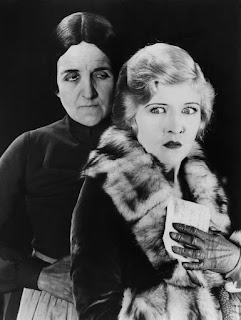
As the Gothic begins to appear on film, the menacing Grace Poole version dominates as the more potent form of the character. We get an early taste of housekeepers to come in the old dark house picture, The Cat and the Canary. Directed by Paul Leni, this 1927 silent film is memorable largely because of its creepy housekeeper, a dead-eyed horror humorously christened Mammy Pleasant. Like later and more familiar Gothic housekeepers, Mammy Pleasant acts as a menacing presence, constantly watching the heroine but refusing to divulge the secrets of the house to her. In addition, Mammy reveals the housekeeper’s evolving taste for a rather morbid, deadpan brand of humor. In one conversation, another character says, “You must have been lonely here these twenty years, Mammy Pleasant,” to which she replies, “I don’t need the living ones.” Mammy also operates as a predictor of doom, alarming the houseguests with her assertion that “something terrible will happen here tonight!” Mammy’s dark hair, dour expression, and thin, tight lips become the standard equipment of Gothic housekeepers forever more, making her an important figure in the character’s cinematic development.

Of course, the lynchpin figure in the evolution of the Gothic housekeeper is Mrs. Danvers, the terrifying antagonist who protects the territory of her dead mistress in Daphne du Maurier’s 1938 novel, Rebecca. The nameless heroine recalls her first encounter with Mrs. Danvers thus:
Someone advanced from the sea of faces, someone tall and gaunt, dressed in deep black, whose prominent cheek-bones and great, hollow eyes gave her a skull’s face, parchment-white, set on a skeleton’s frame.
She came towards me, and I held out my hand, envying her for her dignity and her composure, but when she took my hand hers was limp and heavy, deathly cold, and it lay in mine like a lifeless thing. (67-68)
The heroine’s language loads Mrs. Danvers with images of death and horror, and it also sets the stage for the housekeeper’s function as the guardian of the dead Rebecca. Mrs. Danvers is the housekeeper not of a living home but of a tomb that enshrines the memory of her lost idol; she rejects the new mistress of Manderley as an interloper and seeks to drive her away. Obsessive, manipulative, and in total control of the house, Mrs. Danvers imprisons the new Mrs. de Winter in Manderley while simultaneously trying to eject her from it. When she feels that Rebecca’s ownership of Manderley can no longer be protected, Mrs. Danvers sets fire to the house rather than see the second Mrs. de Winter successfully inhabit it.

            Alfred Hitchcock’s 1940 adaptation of Rebecca is a watershed moment in the history of the female Gothic film, not least because it perfectly captures the menacing allure of Mrs. Danvers’ character. Among its eleven Oscar nominations was a Best Supporting Actress nod for Judith Anderson, who delivers a truly iconic performance as Mrs. Danvers. Her appearance in the movie owes something to Mammy Pleasant while capturing the spirit of du Maurier’s description, if not the letter, for Anderson’s version is menacingly alive, with piercing eyes and a coiled braid of black hair perfectly arranged above the severe white line of her part. On screen, Mrs. Danvers controls the heroine with her gaze and her gestures; we can see her watching Joan Fontaine’s mousy victim with a predator’s glittering interest. In the famous bedroom scene in which Mrs. Danvers tries to drive the heroine to commit suicide, Hitchcock faithfully recreates du Maurier’s written description, but the visual representation lends the moment an additional sense of suspense and horror. Mrs. Danvers leans over the heroine, her burning eyes intensely fixed on her victim, her power over the younger woman tellingly displayed in their physical positions. In this scene and in others throughout the film, Anderson creates a definitive image of the Gothic housekeeper, endowing her with characteristics and mannerisms that will be hallmarks of the character in the popular imagination from 1940 onward.

Edith Barrett as Mrs. Fairfax
The box office success and Best Picture Oscar of Rebecca inspired a wave of female Gothic films in the early 1940s, including, somewhat ironically, a 1943 film adaptation of Jane Eyre, also starring Joan Fontaine as the heroine. For the housekeeper character, however, this is a throwback to the pre-Danvers era, back to the dual figures of good and bad household guardians. Edith Barrett plays a nervous, rather frail Mrs. Fairfax, with English stage actress Ethel Griffies in an uncredited appearance as Grace Poole (Hitchcock fans might remember Griffies as the skeptical ornithologist in The Birds). Barrett again plays the family secret keeper in the same year’s Eyre-inspired Val Lewton horror film, I Walked with a Zombie. Lewton’s picture has no menacing housekeeper; the most important domestic servant is Alma, a cheerful young black woman played by Theresa Harris. Barrett, however, fills in for the housekeeper as Mrs. Rand, the mother of the two male leads; she alone knows what really happened to her son’s first wife, the zombified Jessica. Like the motherly housekeepers of older Gothic stories, Mrs. Rand tries to help Frances Dee’s heroine even as she withholds the most important family secrets from her, but she lacks a menacing female counterpart.

More interesting, perhaps, is the 1946 adaptation of Anya Seton’s 1944 novel, Dragonwyck, written after both the original novel and the film version of Rebecca and thus ostensibly able to capitalize on the evolving conventions of the female Gothic genre. The film trailer, in fact, proudly announces the new picture’s appeal to fans of the earlier work. Like Rebecca, Dragonwyck draws from Jane Eyre as its source material, but it translates the Gothic action to nineteenth-century New York and the upper class Dutch society of the Patroons. Differences between the novel and the film affect the representations of the housekeeper characters, but both offer some insight into the type’s importance to the genre by showing the pitfalls of tinkering with effective conventions.

The novel itself takes a problematic dual approach to the housekeeper figure. As in Jane Eyre, we have two domestic characters who highlight the heroine’s outsider status and possess power and information that might be able to help or harm her. The official housekeeper, Magda, resents the heroine’s arrival and persistently gives her the cold shoulder, reserving her loyalty for the mistress of the house. Seton does very little with Magda, failing to provide even a single detailed description of her appearance. She gives greater attention to the other, more ominous domestic secret keeper, the ancient mixed-race servant, Zélie. Zélie gets all of the creepiest, most Gothic scenes, revealing to the newcomer the haunted history of Dragonwyck and foretelling the doom of the Van Ryn family members. Seton gives this character a suitably striking introduction:
The door opened and a strange woman walked in, shutting the door behind her. A thin old figure in a shapeless black dress who came over to the bed and gazed down at the frightened girl. The woman was nearly six feet tall and erect, her coarse black hair, which showed no gray, drawn back into a scraggy knot, her face a ruddy brown crisscrossed with wrinkles from which peered two shrewd little eyes as black as dewberries
“What do you want?” whispered Miranda.
“Me old Zélie,” said the woman in a harsh accented voice, touching her slab-like chest. “I want to see what you look laike.” (49)
Unfortunately, Seton abruptly writes both Magda and Zélie out of the book about a third of the way through, and no similar character fills the resulting gap. The problems with Seton’s treatment may help to explain why her novel is little read today, since she mishandles two different variations on one of the genre’s most important character types.

Director Joseph L. Mankiewicz’s film adaptation makes some marked changes to Seton’s novel, especially in the housekeeper department. Sadly, the movie completely drops Zélie, who would be quite provocative, to say the least, to see on screen. It transfers her ominous warnings and insider knowledge to Magda, revising Seton’s flat, barely described character into something audiences might more properly expect in a female Gothic tale. Played by the very capable character actress, Spring Byington, the movie Magda embodies both the menacing and the maternal, and the result is a woman who strikes both the audience and Gene Tierney’s heroine as slightly insane. In one early scene, for example, Magda suddenly veers off from seemingly friendly talk to warn, “One day, you’ll wish with all your heart you’d never come to Dragonwyck.” Byington’s character occupies a middle distance between Mrs. Fairfax and Mrs. Danvers, which makes her interesting in terms of the housekeeper’s changing role in the genre, but the movie, like the novel, drops Magda midway through, and thus the potential for a really serious engagement of the housekeeper figure remains unrealized.

Unlike Anya Seton, Shirley Jackson takes full advantage of the creepy housekeeper in her 1959 novel, The Haunting of Hill House, which was adapted into the film, The Haunting, in 1963. The film makes a number of changes to the original text, but it faithfully preserves the unnerving housekeeper, Mrs. Dudley, while also highlighting her relationship to Mrs. Danvers through casting and costume decisions. Like earlier housekeepers, Mrs. Dudley possesses insider knowledge of the house she oversees, and she resents the presence of the newcomers who disrupt her routine. Hill House has no master or mistress to command her loyalties, and Mrs. Dudley’s feelings about the house are never quite clear, just as everything else about Hill House remains shrouded in questions and doubt. Jackson does, however, hint at the connection between Mrs. Dudley and Hill House near the end of the novel, when she describes Mrs. Dudley as “shudder[ing] in her sleep” from six miles away when the heroine touches a kitchen door (171). In contrast to the visitors, Mrs. Dudley seems to understand and respect the house, never trespassing against its unspoken rules, and in return the house never affects her as it does the others.

Jackson offers little description of the character when she first appears in the novel, but she does provide a truly memorable exchange with the protagonist, Eleanor, a few paragraphs later.
“I don’t stay after I set out dinner,” Mrs. Dudley went on. “Not after it begins to get dark. I leave before the dark comes.”
“I know,” Eleanor said.
“We live over in the town, six miles away.”
“Yes,” Eleanor said, remembering Hillsdale.
“So there won’t be anyone around if you need help.”
“I understand.”
“We couldn’t even hear you, in the night.”
“I don’t suppose-“
“No one could. No one lives any nearer than the town. No one else will come any nearer than that.”
“I know,” Eleanor said tiredly.
“In the night,” Mrs. Dudley said, and smiled outright. “In the dark,” she said, and closed the door behind her.
(27-28)
The ominous warning from the housekeeper becomes a kind of nervous joke between Eleanor and Theodora, but it sets the stage for the horrors to come and provides both characters and readers with important information about Hill House. The locals are afraid of the place, none of them will have anything to do with it, and the residents can expect no assistance when their presumptuous occupation rouses the house into action. The inmates of the house laugh at Mrs. Dudley just as they laugh at the strange things that happen in Hill House; both frighten them, although they cannot necessarily explain why. 

            The film adaptation, directed by Robert Wise, reflects these elements of the novel and builds on them by making the most of the character conventions established by earlier films like Rebecca. Rosalie Crutchley, whose earlier roles had included the terrifying Madame Defarge in a 1958 adaptation of A Tale of Two Cities, is just the sort of actress for the Gothic housekeeper role, with a thin face, dark hair, and a most unnatural smile. Her somber attire and pinned-up hair, both black of course, signal her sorority with Mrs. Danvers and Mammy Pleasant, and Crutchley delivers Mrs. Dudley’s lines to great effect, especially in the scene mentioned earlier. Building on the character as originally created in Jackson’s novel, the film reveals the conventional traits that have come to be associated with the Gothic housekeeper. Mrs. Dudley, as much an insider as Hill House allows, lays out the house rules to Eleanor and the other guests in a way that emphasizes her own power and position of authority. “I don’t wait on people,” she tells the newcomers firmly. “What I agreed to, it doesn’t mean I wait on people” (27). She clearly knows more about the house than she is willing to tell, and her veiled warnings serve only to alarm the visitors and the audience without helping them prepare for the terrors that they will face. Like Mrs. Danvers, Mrs. Dudley projects menace rather than maternal comfort, and the film emphasizes this aspect by eliminating a kitchen scene in which Jackson has Mrs. Dudley gossiping about the young people in a very motherly, ordinary fashion. Unfortunately, by the time the next film adaptation of The Haunting of Hill House arrived in 1999, the Gothic housekeeper character had become so familiar that Mrs. Dudley is merely a cliché, another stale note in an over-played symphony of horrors.

Mrs. Slydes frightens a guest in House on Haunted Hill.
Anything repeated often enough to be a cliché is already ripe for parody, and in the years after the original film adaptation of The Haunting the Gothic housekeeper became an obvious target. William Castle had helped to entrench the conventions of the character with films like House on Haunted Hill in 1959 and especially 13 Ghosts in 1960, which featured The Wicked Witch of the West herself, Margaret Hamilton, as a creepy housekeeper complete with black dress, tight bun, and dour expressions, who also turned out to be a medium able to communicate with the ghosts who haunted her employers’ house. Today, the website, tvtropes.com, even has an entry for “Creepy Housekeeper” that identifies her major traits and aligns her with another stock character, the “Crusty Caretaker.” Most importantly, the incarnation of the creepy housekeeper chosen for the entry’s quote and image is not Mammy Pleasant, Mrs. Danvers, Magda, or Mrs. Dudley, it is Cloris Leachman as Frau Blücher in Mel Brooks’ 1974 Gothic horror parody, Young Frankenstein. The character, as written by Mel Brooks and Gene Wilder and performed by Leachman, incorporates all of the Gothic housekeeper clichés and then revels in them, permanently altering the way in which movie audiences perceive her role. 

Young Frankenstein, as its name suggests, draws its inspiration from James Whale’s 1931 Frankenstein and 1935 Bride of Frankenstein, and the origins of Frau Blücher can also be found there. In the second Whale film, Irish character actress Una O’Connor plays a frequently hysterical housekeeper named Minnie, although Whale uses her for comic effect rather than horror. Despite her shrieking, Minnie herself is all motherly concern, much like Mrs. Fairfax in Jane Eyre. In Young Frankenstein, Frau Blücher’s costume and position in the household are references to O’Connor’s character, but her creepy and often menacing behavior develops from housekeepers like Mrs. Danvers and Mrs. Dudley. Leachman also sports the thin lips, severe bun, and sinister facial expressions of the more menacing housekeeper type. In fact, Frau Blücher is so absurdly terrifying that horses whinny in fear every time her name is mentioned. Early on, the movie exploits one particularly popular housekeeper trope, in which the taciturn household guardian conducts newcomers through the mysterious domain over which she reigns, often with a large candle in hand. Frau Blücher carries a holder with three candles, all of them markedly unlit, as she warns Frederick to “stay close to the candles. The stairway can be… treacherous.” Like other Gothic housekeepers, but unlike Minnie, Frau Blücher has special insider knowledge about her house and its family. She manipulates Frederick Frankenstein into resuming his grandfather’s research, apparently out of loyalty to the deceased Victor, with whom she was in love. Brooks and Wilder, of course, play all of these plot elements for laughs, but they depend upon the already established conventions of the housekeeper role and show the extent to which the writers expect the audience to be familiar with them. The parody succeeds so well that Frau Blücher usurps the place of earlier, more serious treatments of the character to become the quintessential example of the type. 

The entwined literary and cinematic evolution of the Gothic housekeeper demonstrates the ways in which genre conventions gather force and then sometimes sink under their own weight. In this case, the housekeeper character, along with the rest of her genre’s conventions, developed first in literary works of the eighteenth and nineteenth centuries and then gathered new steam with the rise of film. She reached her peak when Rebecca took the world by storm, thanks in part to the ways in which the film version capitalized on her potential. After that, other literary works and films could only repeat what had already been accomplished or twist that representation for parodic effect, since efforts to tinker with the formula were problematic at best. Audiences today will come to any housekeeper character with a very distinct mental image, that developed by the earlier Gothic novels and films, but they will also almost certainly have a sense of the character as inherently clichéd and even ridiculous, given the immense cultural impact of the later parody. We haven’t seen much of the Gothic housekeeper in recent years, perhaps because Mrs. Danvers and Frau Blücher have so completely occupied the spaces in which such a character can stand. Perhaps the recent return of Hammer films will bring the creepy housekeeper back to us in a new but still eerily familiar form. For now, however, it is the housekeeper herself who has become haunted, not by the ghosts of her employers’ house, but by the enduring influence of her own most iconic incarnations.

This essay was written for presentation at the 2012 meeting of the Popular Culture Association in the South (PCAS). The Works Cited page is intentionally excluded in order to discourage plagiarism of the material. This content is the intellectual property of the author and must be properly cited if referenced elsewhere. The author reserves the right to send Mrs. Danvers to have a little personal chat with any plagiarists!

Thursday, August 23, 2012

The Good, the Bad, and the Ending of LES DIABOLIQUES (1955)


Spoiler alert! This essay discusses the ending of the film at length. Viewers who want to be surprised by the ending should not read this post until after they have seen the movie for themselves.

Henri-Georges Clouzot’s 1955 French thriller, Les Diaboliques (also known as Diabolique), is famous for its twist ending, which the film’s promotional material begged viewers to keep secret in order to preserve the shock value for later audiences. Like the best surprise endings, the twist of Les Diaboliques hides in plain sight; it is both unexpected and inevitable. In fact, the clues about the movie’s ending are everywhere in the scenes that precede it, even in the title of the film itself. Aptly named “The Fiends” for its diabolical characters, Les Diaboliques presents us with two characters who rightly lay claim to such a title, while its third protagonist is persistently associated with angels and saints. Two of these characters belong together, but the film encourages the viewer to mistake which two in spite of its own strong hints about the truth.

The set-up misleads us by suggesting that the two women are the titular fiends for plotting the murder of the man both of them seem to hate. Nicole (Simone Signoret) is the smarter, tougher, and more ruthless of the pair, while Christina (Véra Clouzot) is the meeker follower. Nicole is the sexually transgressive mistress, while Christina is the legal wife, but Nicole seems far more determined to murder Michel (Paul Meurisse), which is immediately suspicious since Nicole does not act like the kind of woman who would take such a risk without getting some material good from it. Michel is a faithless brute, to be sure, but Christina balks at murder because her religious faith has already dissuaded her from getting a divorce. She only goes along with the plot at Nicole’s insistence, even though Michel has obviously abused her and openly hopes for her death.

In spite of her real abhorrence for Michel, Christina is no fiend, and nearly every scene in the movie places her firmly in the realm of the angels. Even her name associates her with her Christian faith. With her prayers and pigtails, she embodies the asexual purity of the virgin martyr; she even keeps an altar in her bedroom. Only once do we see Michel initiate a sexual encounter with Christina, and this scene plays out as a rape that cuts away as Christina pathetically protests. The camera shoots Christina in a way that complements our sense of her as victim and martyr, emphasizing her pale face and small size. These roles are established early on and are repeated as the various physicians foretell her death; she is slowly succumbing to heart failure even as the movie begins, and she becomes increasingly fragile as the narrative unfolds, especially after the disappearance of Michel’s corpse. 

As it turns out, the real fiends of the story are Nicole and Michel, who have concocted an incredibly complicated plot to kill Christina. By making Christina believe she has committed murder they intend to destroy her heart both literally and figuratively. Truly demonic in their cruelty and greed, Nicole and Michel refuse to wait patiently for Christina to die on her own, and they manipulate her in the most painful and vicious manner imaginable. They are, in short, a perfect couple, a pair of pitiless fiends. The only justification for their elaborate scheme - they could just jump out of a closet a few times and accomplish the same goal, and in Gaslight all it takes are some flickering lamps and a few missing items -  is their wicked delight in tormenting Christina spiritually as well as physically. 

Christina’s death at the end of the movie is thrown into some doubt when a young student at the boarding school says that he saw her and spoke to her, but this, too, supports our sense of her character as a religious martyr. Christina dies terrified by Michel’s apparent return from the grave, her heart finally exhausted by fear, but we know that death was inevitable for her, anyway. Michel has merely hastened the event. Michel and Nicole are caught and punished for their actions, which gives us a sense of justice in this world for Christina, but the anecdotal account of her return suggests spiritual justice, too. There is no reason to think that Christina is physically alive at the end of the movie – that would merely be a stay of execution for her, and nothing in the film implies that she stages her death as Michel had staged his. Instead, the story of her reappearance and kindness to the boy convey an idea of Christina’s soul being preserved; she is free now from her own ruined body and her antagonists’ cruelty. For a religious martyr, that’s as good an ending as one is going to get.

If you like Les Diaboliques, try other twisted thrillers like Gaslight (1944), The Spiral Staircase (1945), and, of course, Vertigo (1959), which also began as a story by Pierre Boileau and Thomas Narcejac. For a better sense of the religious overtones of the film, try watching The Passion of Joan of Arc (1928) first and then looking at Clouzot’s representation of Christina again.