It's December 1941 when Ilsa walks into Rick's Cafe Americain. "In all the gin joints in all the towns in all the world," he complains, "she walks into mine." It is not, however, simply chance, since Rick's Cafe occupies a border space between European chaos and American safety. Through that space Ilsa and her freedom fighter husband, Victor Laszlo, must journey if they are to continue the work of the resistance and survive. It's hard to believe that the story of Casablanca (1942) unfolds exactly 75 years ago this month, especially now, when we seem to be experiencing the history that the ignorant are doomed to repeat. Its message is suddenly seen not in the rearview mirror of nostalgia but up ahead of us, and terrifyingly close. There has never been a better time to visit this film again, but we have to look beyond the sentimental romance and consider the darker warnings that Casablanca sounds.
We generally celebrate Casablanca as a love story, albeit one with a triangular, adulterous twist. Even Lauren Bacall focused on that element in her recorded introduction to a video release of the picture; it's hard sometimes to get past the soft light on Ingrid Bergman's face and the wounded expression on Bogart's as they gaze at each other. There's "As Time Goes By" and that iconic scene with the plane. There are lines like "Here's looking at you, kid." These elements are an important part of the movie's appeal, but they're also the sweetness that helps us take our medicine. The film knows that. As Rick says, "It doesn't take much to see that the problems of three little people don't amount to a hill of beans in this crazy world."
Around and behind the romance, Casablanca sounds an alarm about the chaos threatening to overtake the world, about the danger of being complacent or refusing to stick your neck out for anyone. Rick and Louis both start the film as morally ambivalent characters; while they don't become perfect men, they do ultimately figure out what side they need to be on and how to commit to the fight. As in any time of crisis, there are men who look only to profit from the misery of others, and there are those, like the Nazis, who are eager to command and destroy. Parasites, profiteers, and strongmen thrive on the collapse of civilization, at least in the short term. Ugarte and Ferrari hope to make fortunes on the letters of transit. The pickpocket warns of vultures even as he makes off with the wallets of the unsuspecting. Major Strasser looks to impose Nazi order on a supposedly neutral space and crush Laszlo's resistance. Indifference, selfishness, and outright cruelty abound.
At the same time, we are presented with evidence of the decency and spirit of innocent people trapped in this dangerous situation. Even at his most jaded, Rick stocks his cafe with refugee employees, including Carl and Sascha. He helps the young Bulgarian couple after the girl comes to him for advice about surrendering to the sexual coercion of Louis. There are other moments of humanity in the bar; they seem like minor scenes, but they reinforce the message we are meant to understand. Carl speaks kindly to the elderly couple who practice their English and hope for a better life in America. Yvonne rediscovers her love of country. Of course, Victor Laszlo embodies the noblest, most courageous values of the force for good. He has been captured, imprisoned, tortured, pursued, and threatened with all the fury of the Reich, yet he prevails with dignity and determination. He does not compromise with evil. The scene in which he leads the cafe patrons in singing "La Marseillaise" remains powerful even after 75 years. It is a moment of protest, courage, and hope in the face of unfathomable horror. That, to me, is the very heart of Casablanca and what it means.
Although the film was made after the United States entered the war, the original play, Everybody Comes to Rick's, was written before that, when the country had retreated into an isolationist position and left critical allies like Great Britain and France to face the onslaught alone. One wonders what Americans thought would happen once the Nazis and Japanese finished their march across the rest of the world. The events of Casablanca unfold in the last days of Americans' collective slumber. As Rick laments, "I bet they're asleep in New York. I bet they're asleep all over America." They would be rudely awakened on December 7, 1941, when the Japanese attacked Pearl Harbor. They would be fully conscious by the time Casablanca arrived in theaters in late 1942 and early 1943. It went on to win the Oscar for Best Picture in 1944. By the time people saw Casablanca they could really understand the message it had to share; they were in the thick of the war and fighting for real. They knew that they, like Rick and Louis, would have to make a stand. They hoped for leaders like Victor Laszlo to show them the way.
It's important to remember that many of the supporting players who helped make Casablanca had personal stakes in its story well before Pearl Harbor. There are very few Americans in the cast. Conrad Veidt and his Jewish wife had escaped Germany in the 1930s because his very public opposition to the Nazis made him a target. (Read this wonderful tribute to Veidt on Birth.Movies.Death for more about his life and devotion to the Allied cause.) He played Nazi villains in Hollywood to highlight the danger they posed. S.Z. Sakall was a Hungarian Jew who fled Hungary for Hollywood in 1940; all three of his sisters died in Nazi concentration camps. (Paula's Cinema Club offers this excellent post about Sakall's life and work.) The film's director, Michael Curtiz, was also a Hungarian, although he had left Europe in the 1920s. Paul Henreid, an Austro-Hungarian, strongly opposed the Nazis and became a US citizen in 1941, while fellow Austro-Hungarian Peter Lorre, who was Jewish, left his acting career in Germany after 1933 and fled to the United States. Even Madeleine Lebeau, who played Yvonne, fled her native France as the Germans invaded. (The last surviving member of the cast, she died in May of this year. You can read her New York Times obituary here.) They were immigrants and refugees who knew too well the nature of the threat the world was facing.
These are things we can ponder as we watch Casablanca in December 2016, with the 75th anniversary of Pearl Harbor also happening this month. In this late age we again find fascism and authoritarian rule on the rise. Around the world, desperate refugees seek to escape war and chaos while the vultures gather to pick over their bones. Disinformation and self-interest keep many blind to the dangers we face, especially in the United States, which once prided itself on being a beacon for democracy, a light in the dark of a troubled world. People are in danger. Freedom is in peril. The basic human rights of millions, both at home and abroad, are being denied. Already we find ourselves facing the same choice as Rick, whether to stick our necks out or look out only for ourselves. We must look to the real world's Victor Laszlos for inspiration. I hope that for you, and for all of us, it will be the beginning of beautiful friendships with like-minded souls. In the meantime, we'll always have Casablanca.
Showing posts with label Peter Lorre. Show all posts
Monday, December 5, 2016
Sunday, June 21, 2015
Classic Films in Focus: THE BEAST WITH FIVE FINGERS (1946)
The Beast with Five Fingers (1946) is a surprisingly effective chiller from director Robert Florey and screenwriter Curt Siodmak, who also penned horror classics like The Wolf Man (1941) and I Walked with a Zombie (1943). For genre fans, the chief draw of the picture is Peter Lorre as an obsessed astrologist, but Lorre gets competition for our attention from the ambulatory human hand that gives the movie its title. Well-executed special effects, interesting characters, and a score by Max Steiner all contribute to the film's appeal, with J. Carrol Naish putting in a particularly entertaining appearance as the police commissioner in charge of unraveling the mystery of the murderous hand.
Lorre plays Hilary Cummins, the secretary to Francis Ingram (Victor Francen), a crippled pianist living in a lavish Italian villa. Ingram's obsessive attachment to his attractive nurse, Julie (Andrea King), makes her decide to leave, but before she can depart Ingram dies under somewhat suspicious circumstances. Strange events then begin to occur, and it appears that the dead man's hand may be on the loose. Julie and her friend, Bruce Conrad (Robert Alda), become pariahs to the locals because of the bad luck of the house, while Hilary claims to have seen the killer hand in action. Meanwhile, Ingram's greedy relatives try to undermine the validity of a will that leaves the entire estate to Julie, including the books vital to Hilary's astrological research.
While the cast is solid across the board, Lorre stands out for his portrayal of the decidedly weird astrologist, who lurks around the corners of the villa's many rooms and rapidly comes unglued once the hand starts wreaking havoc. It's never hard to believe in Lorre as a head case, but Hilary starts out as a more subtle example of the type and builds up to full blown insanity, when we find him wild-eyed and wielding a hammer against his dismembered nemesis. J. Carroll Naish also deserves special attention as the police chief, who brings some levity to the situation but is smart enough to figure out the case. Naish invests the character with so much personality that we aren't surprised when he gets the picture's closing scenes. The young couple played by Andrea King and Robert Alda are there for the romance and to give us someone to root for, with Alda's somewhat shifty character a nice change from the usual straight arrow types who fill this role. In contrast to them we get Charles Dingle and John Alvin as Ingram's obnoxious brother-in-law and nephew, who are both so mercenary that the audience longs to see the hand get a grip on them. Victor Francen doesn't have many scenes before his character gets killed, but he does a fine job setting the stage for the vengeful hand with his virtuoso airs.
Two additional elements, special effects and music, make The Beast with Five Fingers memorable. Several techniques bring the hand to life, and we see it accomplish all kinds of strange feats, from playing the piano to crawling across the floor. It's very similar to Thing from The Addams Family, but instead of being played for laughs this hand gives us the creeps. Its escape from the pianist's tomb evokes a marvelous sense of dread, and the one-handed corpse gripping a knife in its remaining fingers suggests a gruesome act of post-mortem determination. Because the hand has to play by itself, piano music performed with one hand dominates the musical score, especially Bach's haunting "Chaconne in D Minor," as transcribed by Brahms. We first hear it played by Ingram; later, the restless hand performs the piece, with the intensity reaching its peak during the film's climax. Max Steiner, best remembered for creating the iconic theme for Gone with the Wind (1939), elevates this production by making us take the musical aspect seriously, with the score for the other scenes also heightening the charged atmosphere.
For more hand horror with Peter Lorre, see Mad Love (1935), in which the actor really gets to cut loose with his madman persona. Other horror movies featuring J. Carroll Naish include Dr. Renault's Secret (1942) and House of Frankenstein (1944), but you'll also find him playing Sitting Bull in Annie Get Your Gun (1950) and Sitting Bull (1954). Robert Florey directed The Marx Brothers in The Cocoanuts (1929) and Bela Lugosi in Murders in the Rue Morgue (1932).
Lorre plays Hilary Cummins, the secretary to Francis Ingram (Victor Francen), a crippled pianist living in a lavish Italian villa. Ingram's obsessive attachment to his attractive nurse, Julie (Andrea King), makes her decide to leave, but before she can depart Ingram dies under somewhat suspicious circumstances. Strange events then begin to occur, and it appears that the dead man's hand may be on the loose. Julie and her friend, Bruce Conrad (Robert Alda), become pariahs to the locals because of the bad luck of the house, while Hilary claims to have seen the killer hand in action. Meanwhile, Ingram's greedy relatives try to undermine the validity of a will that leaves the entire estate to Julie, including the books vital to Hilary's astrological research.
While the cast is solid across the board, Lorre stands out for his portrayal of the decidedly weird astrologist, who lurks around the corners of the villa's many rooms and rapidly comes unglued once the hand starts wreaking havoc. It's never hard to believe in Lorre as a head case, but Hilary starts out as a more subtle example of the type and builds up to full blown insanity, when we find him wild-eyed and wielding a hammer against his dismembered nemesis. J. Carroll Naish also deserves special attention as the police chief, who brings some levity to the situation but is smart enough to figure out the case. Naish invests the character with so much personality that we aren't surprised when he gets the picture's closing scenes. The young couple played by Andrea King and Robert Alda are there for the romance and to give us someone to root for, with Alda's somewhat shifty character a nice change from the usual straight arrow types who fill this role. In contrast to them we get Charles Dingle and John Alvin as Ingram's obnoxious brother-in-law and nephew, who are both so mercenary that the audience longs to see the hand get a grip on them. Victor Francen doesn't have many scenes before his character gets killed, but he does a fine job setting the stage for the vengeful hand with his virtuoso airs.
Two additional elements, special effects and music, make The Beast with Five Fingers memorable. Several techniques bring the hand to life, and we see it accomplish all kinds of strange feats, from playing the piano to crawling across the floor. It's very similar to Thing from The Addams Family, but instead of being played for laughs this hand gives us the creeps. Its escape from the pianist's tomb evokes a marvelous sense of dread, and the one-handed corpse gripping a knife in its remaining fingers suggests a gruesome act of post-mortem determination. Because the hand has to play by itself, piano music performed with one hand dominates the musical score, especially Bach's haunting "Chaconne in D Minor," as transcribed by Brahms. We first hear it played by Ingram; later, the restless hand performs the piece, with the intensity reaching its peak during the film's climax. Max Steiner, best remembered for creating the iconic theme for Gone with the Wind (1939), elevates this production by making us take the musical aspect seriously, with the score for the other scenes also heightening the charged atmosphere.
For more hand horror with Peter Lorre, see Mad Love (1935), in which the actor really gets to cut loose with his madman persona. Other horror movies featuring J. Carroll Naish include Dr. Renault's Secret (1942) and House of Frankenstein (1944), but you'll also find him playing Sitting Bull in Annie Get Your Gun (1950) and Sitting Bull (1954). Robert Florey directed The Marx Brothers in The Cocoanuts (1929) and Bela Lugosi in Murders in the Rue Morgue (1932).
Saturday, November 8, 2014
Classic Films in Focus: TALES OF TERROR (1962)
Most of Roger Corman's Poe movies stretch the author's short stories into feature length plots, but in Tales of Terror (1962) the director opts for an anthology approach, presenting a handful of tales in three distinct segments. Vincent Price, naturally, stars in all three, but his costars change with each story; Peter Lorre and Basil Rathbone make particularly memorable appearances, along with leading ladies Debra Paget, Leona Gage, Maggie Pierce, and Joyce Jameson. The segments vary in tone and quality, but overall Tales of Terror offers a good time for fans of Corman's unique take on the horror genre, and those who admire Vincent Price get the special pleasure of seeing him play three very different Poe characters in rapid succession.
The anthology opens with "Morella," in which Price plays a lonely widower haunted by the premature death of his beautiful wife (Leona Gage). The return of his dying daughter (Maggie Pierce) stirs him to long repressed emotion, but her presence also awakens the malevolent spirit of Morella. In "The Black Cat," Peter Lorre stars as the drunken Montresor, whom Price antagonizes in the guise of the wine critic Fortunato. When Fortunato has an affair with Montresor's wife (Joyce Jameson), Montresor decides to murder both of them, but his wife's pet cat thwarts his attempts to hide the crime. Price returns as the title character in the final segment, "The Case of M. Valdemar," in which Basil Rathbone plays a sinister mesmerist who seeks to control a dead man's will.
"Morella," the weakest of the three acts, makes for an awkward start to the collection, since it is neither seriously uncanny nor amusingly campy. Morella's grudge against her husband and daughter is never entirely clear, although the final conflagration does present an interesting spectacle. Both of the other segments, though wildly different from one another, succeed better and reward the viewer's perseverance. "The Black Cat" combines the plot of Poe's original version with that of "The Cask of Amontillado," twisting both tales into a single narrative that exploits its stars' talent for pitch black comedy. Lorre's Montresor is a drunkard and a buffoon, while Price's character is a supercilious fop, but both excel at this kind of work, and Lorre milks the part for every bit of dry, dark humor. The last story breaks in the other direction, toward the truly horrific, with Valdemar's soul held hostage in his corpse by the diabolical Carmichael. Basil Rathbone gives a chilling performance, especially toward the end, when Carmichael uses his power over the dead man to claim Valdemar's widow and fortune for himself.
Aside from Poe, whose work Corman always adapts very loosely, Vincent Price serves as the unifying element for the three vignettes, and his different roles give viewers a chance to survey his varying approaches to horror. He plays it straight in both "Morella" and "The Case of M. Valdemar," first as the haunted victim of horrors and then as the monstrous being who haunts others. In "Morella" he also displays signs of nervous decay, and Price is always reliable as a character who is rapidly coming unglued. His Valdemar does not become a ghoul willingly, but Price makes for a very unnerving animated corpse, and his climactic scene might be one of the scariest bits of the actor's career. In "The Black Cat" he indulges in the gallows humor for which he is well remembered by cult horror-comedy fans, romping through gruesome gags and hamming it up enthusiastically, especially during the wine tasting contest. Lorre makes an excellent partner in crime for this sort of macabre merriment; his short, rotund figure and dour expressions contrast Price's elegant height and overly refined manner perfectly. Price gets to work through all of these modes at greater length in the other Corman productions and in his later work during the 1970s, but the anthology of shorts provides a chance to compare and contrast his methods in each segment. Even when the material is not as good as it might be, as in the case of "Morella," Price gives it his best, and he's always fun to watch.
To see Price, Lorre, and Rathbone together again, move on to The Comedy of Terrors (1963), which also features Joyce Jameson and Boris Karloff. Corman reunites Lorre and Price for The Raven (1963), as well, and you can catch Price and Rathbone together in the much earlier Tower of London (1939). For a survey of Price's roles in other Corman Poe pictures, see House of Usher (1960), The Pit and the Pendulum (1961), and The Tomb of Ligeia (1964). Twice Told Tales (1963) offers a similar anthology of stories, this time from the works of Nathaniel Hawthorne, with Price again starring in every segment. Basil Rathbone is best remembered for playing Sherlock Holmes, but if you like the idea of him as a horror star, check out The Son of Frankenstein (1939), The Black Cat (1941), and The Black Sleep (1956).
The anthology opens with "Morella," in which Price plays a lonely widower haunted by the premature death of his beautiful wife (Leona Gage). The return of his dying daughter (Maggie Pierce) stirs him to long repressed emotion, but her presence also awakens the malevolent spirit of Morella. In "The Black Cat," Peter Lorre stars as the drunken Montresor, whom Price antagonizes in the guise of the wine critic Fortunato. When Fortunato has an affair with Montresor's wife (Joyce Jameson), Montresor decides to murder both of them, but his wife's pet cat thwarts his attempts to hide the crime. Price returns as the title character in the final segment, "The Case of M. Valdemar," in which Basil Rathbone plays a sinister mesmerist who seeks to control a dead man's will.
"Morella," the weakest of the three acts, makes for an awkward start to the collection, since it is neither seriously uncanny nor amusingly campy. Morella's grudge against her husband and daughter is never entirely clear, although the final conflagration does present an interesting spectacle. Both of the other segments, though wildly different from one another, succeed better and reward the viewer's perseverance. "The Black Cat" combines the plot of Poe's original version with that of "The Cask of Amontillado," twisting both tales into a single narrative that exploits its stars' talent for pitch black comedy. Lorre's Montresor is a drunkard and a buffoon, while Price's character is a supercilious fop, but both excel at this kind of work, and Lorre milks the part for every bit of dry, dark humor. The last story breaks in the other direction, toward the truly horrific, with Valdemar's soul held hostage in his corpse by the diabolical Carmichael. Basil Rathbone gives a chilling performance, especially toward the end, when Carmichael uses his power over the dead man to claim Valdemar's widow and fortune for himself.
Aside from Poe, whose work Corman always adapts very loosely, Vincent Price serves as the unifying element for the three vignettes, and his different roles give viewers a chance to survey his varying approaches to horror. He plays it straight in both "Morella" and "The Case of M. Valdemar," first as the haunted victim of horrors and then as the monstrous being who haunts others. In "Morella" he also displays signs of nervous decay, and Price is always reliable as a character who is rapidly coming unglued. His Valdemar does not become a ghoul willingly, but Price makes for a very unnerving animated corpse, and his climactic scene might be one of the scariest bits of the actor's career. In "The Black Cat" he indulges in the gallows humor for which he is well remembered by cult horror-comedy fans, romping through gruesome gags and hamming it up enthusiastically, especially during the wine tasting contest. Lorre makes an excellent partner in crime for this sort of macabre merriment; his short, rotund figure and dour expressions contrast Price's elegant height and overly refined manner perfectly. Price gets to work through all of these modes at greater length in the other Corman productions and in his later work during the 1970s, but the anthology of shorts provides a chance to compare and contrast his methods in each segment. Even when the material is not as good as it might be, as in the case of "Morella," Price gives it his best, and he's always fun to watch.
To see Price, Lorre, and Rathbone together again, move on to The Comedy of Terrors (1963), which also features Joyce Jameson and Boris Karloff. Corman reunites Lorre and Price for The Raven (1963), as well, and you can catch Price and Rathbone together in the much earlier Tower of London (1939). For a survey of Price's roles in other Corman Poe pictures, see House of Usher (1960), The Pit and the Pendulum (1961), and The Tomb of Ligeia (1964). Twice Told Tales (1963) offers a similar anthology of stories, this time from the works of Nathaniel Hawthorne, with Price again starring in every segment. Basil Rathbone is best remembered for playing Sherlock Holmes, but if you like the idea of him as a horror star, check out The Son of Frankenstein (1939), The Black Cat (1941), and The Black Sleep (1956).
Wednesday, September 10, 2014
Classic Films in Focus: 20,000 LEAGUES UNDER THE SEA (1954)
Adapted from the novel by Jules Verne, Disney’s large scale Technicolor adventure provides plenty of eye-popping aquatic scenery, which helped it win a pair of Oscars for Special Effects and Best Art Direction. 20,000 Leagues Under the Sea (1954) also offers classic film fans a unique combination of iconic stars, including James Mason as the enigmatic Captain Nemo, Kirk Douglas as a feisty sailor, and Peter Lorre as a scientist’s nervous assistant. While its pace might seem a bit slow by modern standards, especially for younger children, the effects and actors make the picture well worth the two hours it takes to watch, and 20,000 Leagues Under the Sea remains one of the best and most influential of Disney’s live action features.
Paul Lukas plays Professor Pierre Aronnax, who embarks on a ship with his assistant, Conseil (Peter Lorre), to investigate rumors of an enormous sea monster that is destroying vessels at sea. When the supposed monster attacks their ship, Aronnax, Conseil, and sailor Ned Land (Kirk Douglas) are thrown overboard, where they discover that the creature is, in fact, a technologically advanced submarine controlled by the misanthropic Captain Nemo (James Mason). Nemo reveals to the men a world of oceanic wonders, but his destructive methods cause them to question his sanity and look for opportunities to escape.
Lukas and Mason are the intellectual, dramatic leads as the idealistic scientist and his grimly jaded host. They represent different perspectives on science and the nature of man, and their debates hinge on philosophical, scientific, and academic principles. While Mason in particular gives a memorably brooding performance, the film does tend to slow down when Nemo and Aronnax hold the screen. Livelier scenes focus on Ned Land and the perpetually woeful Conseil, both of whom have far more pragmatic attitudes about their situation. Lorre plays comic relief with the same deadpan genius that characterizes many of his late career performances. Kirk Douglas’ Ned might be a greedy, impulsive fool, but he’s still the most energetic and charismatic character in the movie, especially when he’s singing “A Whale of a Tale” or goofing around with Nemo’s pet sea lion.
The submarine takes both the characters and the audience on an amazing adventure, with elaborate underwater scenes of divers mourning a fallen comrade and harvesting the bounty of the sea. Peril abounds, as Nemo first attempts to drown his three visitors and then involves them in dangerous expeditions, including an obligatory island encounter with cannibals. The giant squid fight sequence holds up well, even after sixty years, and the Nautilus is a fantastic early example of steampunk design, simultaneously elegant and menacing. These elements would have a lasting effect on the American cultural consciousness, especially with the ride at Walt Disney World recreating the experience for generations of fans from 1971 until 1994. Luckily, the film has outlasted the attraction it inspired.
Richard Fleischer, who directed 20,000 Leagues Under the Sea, also made The Narrow Margin (1952), Fantastic Voyage (1966), and Soylent Green (1973). See more of James Mason in A Star is Born (1954), North by Northwest (1959), and Journey to the Center of the Earth (1959). Paul Lukas won the Oscar for Best Actor for Watch on the Rhine (1943), but you’ll also find him in Dodsworth (1936) and The Lady Vanishes (1938). Other Kirk Douglas films from the 1950s include Ace in the Hole (1951), Lust for Life (1956), and Paths of Glory (1957). Be sure to catch more funny performances by Peter Lorre in Arsenic and Old Lace (1944), The Raven (1963), and The Comedy of Terrors (1963). For a family-friendly film festival of classic movie adaptations of Jules Verne, try Around the World in Eighty Days (1956), Mysterious Island (1961), and In Search of the Castaways (1962).
Paul Lukas plays Professor Pierre Aronnax, who embarks on a ship with his assistant, Conseil (Peter Lorre), to investigate rumors of an enormous sea monster that is destroying vessels at sea. When the supposed monster attacks their ship, Aronnax, Conseil, and sailor Ned Land (Kirk Douglas) are thrown overboard, where they discover that the creature is, in fact, a technologically advanced submarine controlled by the misanthropic Captain Nemo (James Mason). Nemo reveals to the men a world of oceanic wonders, but his destructive methods cause them to question his sanity and look for opportunities to escape.
Lukas and Mason are the intellectual, dramatic leads as the idealistic scientist and his grimly jaded host. They represent different perspectives on science and the nature of man, and their debates hinge on philosophical, scientific, and academic principles. While Mason in particular gives a memorably brooding performance, the film does tend to slow down when Nemo and Aronnax hold the screen. Livelier scenes focus on Ned Land and the perpetually woeful Conseil, both of whom have far more pragmatic attitudes about their situation. Lorre plays comic relief with the same deadpan genius that characterizes many of his late career performances. Kirk Douglas’ Ned might be a greedy, impulsive fool, but he’s still the most energetic and charismatic character in the movie, especially when he’s singing “A Whale of a Tale” or goofing around with Nemo’s pet sea lion.
The submarine takes both the characters and the audience on an amazing adventure, with elaborate underwater scenes of divers mourning a fallen comrade and harvesting the bounty of the sea. Peril abounds, as Nemo first attempts to drown his three visitors and then involves them in dangerous expeditions, including an obligatory island encounter with cannibals. The giant squid fight sequence holds up well, even after sixty years, and the Nautilus is a fantastic early example of steampunk design, simultaneously elegant and menacing. These elements would have a lasting effect on the American cultural consciousness, especially with the ride at Walt Disney World recreating the experience for generations of fans from 1971 until 1994. Luckily, the film has outlasted the attraction it inspired.
Richard Fleischer, who directed 20,000 Leagues Under the Sea, also made The Narrow Margin (1952), Fantastic Voyage (1966), and Soylent Green (1973). See more of James Mason in A Star is Born (1954), North by Northwest (1959), and Journey to the Center of the Earth (1959). Paul Lukas won the Oscar for Best Actor for Watch on the Rhine (1943), but you’ll also find him in Dodsworth (1936) and The Lady Vanishes (1938). Other Kirk Douglas films from the 1950s include Ace in the Hole (1951), Lust for Life (1956), and Paths of Glory (1957). Be sure to catch more funny performances by Peter Lorre in Arsenic and Old Lace (1944), The Raven (1963), and The Comedy of Terrors (1963). For a family-friendly film festival of classic movie adaptations of Jules Verne, try Around the World in Eighty Days (1956), Mysterious Island (1961), and In Search of the Castaways (1962).
Friday, September 6, 2013
Classic Films in Focus: STRANGE CARGO (1940)
It might not be the most enlightening title, but Strange Cargo is certainly an apt way to describe the content of this 1940 drama from director Frank Borzage. Joan Crawford and Clark Gable lead an ensemble cast in a very strange story, indeed, which mixes a prison escape plot with a theme of spiritual redemption spurred by divine intervention. The result is a picture that will appeal to certain classic movie fans but simply baffle others; those who like Angel on My Shoulder (1946) and The Bishop’s Wife (1947) will also enjoy Strange Cargo, while Joan Crawford fans will appreciate the leading lady’s tough and distinctly unglamorous performance. The presence of notable supporting players like Ian Hunter, Peter Lorre, Eduardo Ciannelli, Paul Lukas, and Albert Dekker also enhances the interest of this picture for fans of character actors with long and varied careers.
Crawford plays Julie, an “entertainer” on a remote penal colony situated on a jungle island. When she’s unwillingly accosted by prisoner Verne (Gable), Julie is ordered off the island for fraternizing with the convicts, even though she has no money to pay for her passage. Julie’s forced departure coincides with a prison break by Verne and several other men, including loutish Moll (Albert Dekker), wife poisoner Hessler (Paul Lukas), and youngster Dufond (John Arledge), as well as the mysterious Cambreau (Ian Hunter). The escapees make their way toward the coast, and along the way Verne and Julie meet once again and press on together, venturing through a dangerous jungle and then facing an even deadlier ocean voyage in a small open boat. One by one, the convicts experience redemptive epiphanies about their lives and die, with Cambreau as their confessor and comforter. Eventually Verne, too, must confront his sins as well as Cambreau’s otherworldly origin.
Strange Cargo basically tells two very different stories with one set of characters. The first story, the more concrete and conventional of the two, is the prison break plot. The usual treachery, forced cooperation, and high mortality rate all make their appearances, with Moll and Verne vying for alpha male status among the men. Julie’s presence is an odd feminine addition to the setup, but it gives Verne something to possess as a symbol of his dominance, and her experiences on the island show how vicious and masculine this setting can be. The second story draws on the long tradition of the spiritual redemption narrative, which has its icons in stories like that of Paul on the road to Damascus, St. Augustine in his Confessions, and John Bunyan in Grace Abounding to the Chief of Sinners. With Cambreau as the agent of God’s forgiveness, the characters - sinners all - experience conversion and salvation, although the diabolical murderer Hessler pointedly rejects Cambreau’s offer of grace, slinking off to find new victims like the Devil in a medieval morality play. For most of the characters, salvation arrives just in time for their souls to ascend to Heaven, but the religious nature of the story insists that such deaths are victories because of the larger, eternal stakes for which Cambreau is playing.
The performances help to sell this unusual narrative merger, especially Joan Crawford’s fearless portrayal of Julie. The role requires little makeup, less wardrobe, and plenty of dirt and sweat, but Crawford tackles it all, and the fierce quality that defines the actress suits the character perfectly. Gable, no slouch at playing a hard luck type, either, makes Verne attractive enough that we forgive his rough manner even though his faults are clearly on display. The supporting players provide a diverse group, with Peter Lorre sweaty and reprehensible as Julie’s stool pigeon admirer, Eduardo Ciannelli intense as the convict Telez, and Paul Lukas really chilling as the unrepentant Hessler. Albert Dekker does an excellent job showing both sides of Moll, who acts like a brute but harbors a deep and honest affection for the young Dufond. Every convict except for Hessler has his better nature as well as his flaws, which gives the actors plenty to work with in their roles. Of course, the whole thing hinges on Ian Hunter’s beatific Cambreau, whose serene but solid presence upholds the others at the darkest moments of their lives. Hunter makes his angelic character heavenly without being stiff, and his face glows with charitable love for his fellow escapees. In the film’s climax, he becomes a Christ figure, his arms stretched across a beam as Verne finally has his own epiphany about the nature of man and God. It’s a heavy-handed moment, to be sure, but it’s consistent with the film’s message and underscores what has gone before.
For more angels among men, see It’s a Wonderful Life (1946), Angels in the Outfield (1951), or Wings of Desire (1987). Frank Borzage, who won two Oscars for his work, also directed A Farewell to Arms (1932), The Mortal Storm (1940), and Stage Door Canteen (1943). See more of Crawford and Gable in Possessed (1931), Dancing Lady (1933), and Chained (1934). You’ll find Ian Hunter playing paternal and princely types in A Midsummer Night’s Dream (1935), The Adventures of Robin Hood (1938), and The Little Princess (1939). Paul Lukas won the Oscar for Best Actor for Watch on the Rhine (1943), and he also appears in The Lady Vanishes (1938) and 20,000 Leagues Under the Sea (1954). Eduardo Ciannelli played many small and uncredited roles, but you can catch him giving a very memorable performance as the murderous guru in Gunga Din (1939). Finally, look for Albert Dekker in The Killers (1946), Kiss Me Deadly (1955), and The Wild Bunch (1969).
Strange Cargo is currently available for streaming on Warner Archive Instant.
Crawford plays Julie, an “entertainer” on a remote penal colony situated on a jungle island. When she’s unwillingly accosted by prisoner Verne (Gable), Julie is ordered off the island for fraternizing with the convicts, even though she has no money to pay for her passage. Julie’s forced departure coincides with a prison break by Verne and several other men, including loutish Moll (Albert Dekker), wife poisoner Hessler (Paul Lukas), and youngster Dufond (John Arledge), as well as the mysterious Cambreau (Ian Hunter). The escapees make their way toward the coast, and along the way Verne and Julie meet once again and press on together, venturing through a dangerous jungle and then facing an even deadlier ocean voyage in a small open boat. One by one, the convicts experience redemptive epiphanies about their lives and die, with Cambreau as their confessor and comforter. Eventually Verne, too, must confront his sins as well as Cambreau’s otherworldly origin.
Strange Cargo basically tells two very different stories with one set of characters. The first story, the more concrete and conventional of the two, is the prison break plot. The usual treachery, forced cooperation, and high mortality rate all make their appearances, with Moll and Verne vying for alpha male status among the men. Julie’s presence is an odd feminine addition to the setup, but it gives Verne something to possess as a symbol of his dominance, and her experiences on the island show how vicious and masculine this setting can be. The second story draws on the long tradition of the spiritual redemption narrative, which has its icons in stories like that of Paul on the road to Damascus, St. Augustine in his Confessions, and John Bunyan in Grace Abounding to the Chief of Sinners. With Cambreau as the agent of God’s forgiveness, the characters - sinners all - experience conversion and salvation, although the diabolical murderer Hessler pointedly rejects Cambreau’s offer of grace, slinking off to find new victims like the Devil in a medieval morality play. For most of the characters, salvation arrives just in time for their souls to ascend to Heaven, but the religious nature of the story insists that such deaths are victories because of the larger, eternal stakes for which Cambreau is playing.
The performances help to sell this unusual narrative merger, especially Joan Crawford’s fearless portrayal of Julie. The role requires little makeup, less wardrobe, and plenty of dirt and sweat, but Crawford tackles it all, and the fierce quality that defines the actress suits the character perfectly. Gable, no slouch at playing a hard luck type, either, makes Verne attractive enough that we forgive his rough manner even though his faults are clearly on display. The supporting players provide a diverse group, with Peter Lorre sweaty and reprehensible as Julie’s stool pigeon admirer, Eduardo Ciannelli intense as the convict Telez, and Paul Lukas really chilling as the unrepentant Hessler. Albert Dekker does an excellent job showing both sides of Moll, who acts like a brute but harbors a deep and honest affection for the young Dufond. Every convict except for Hessler has his better nature as well as his flaws, which gives the actors plenty to work with in their roles. Of course, the whole thing hinges on Ian Hunter’s beatific Cambreau, whose serene but solid presence upholds the others at the darkest moments of their lives. Hunter makes his angelic character heavenly without being stiff, and his face glows with charitable love for his fellow escapees. In the film’s climax, he becomes a Christ figure, his arms stretched across a beam as Verne finally has his own epiphany about the nature of man and God. It’s a heavy-handed moment, to be sure, but it’s consistent with the film’s message and underscores what has gone before.
For more angels among men, see It’s a Wonderful Life (1946), Angels in the Outfield (1951), or Wings of Desire (1987). Frank Borzage, who won two Oscars for his work, also directed A Farewell to Arms (1932), The Mortal Storm (1940), and Stage Door Canteen (1943). See more of Crawford and Gable in Possessed (1931), Dancing Lady (1933), and Chained (1934). You’ll find Ian Hunter playing paternal and princely types in A Midsummer Night’s Dream (1935), The Adventures of Robin Hood (1938), and The Little Princess (1939). Paul Lukas won the Oscar for Best Actor for Watch on the Rhine (1943), and he also appears in The Lady Vanishes (1938) and 20,000 Leagues Under the Sea (1954). Eduardo Ciannelli played many small and uncredited roles, but you can catch him giving a very memorable performance as the murderous guru in Gunga Din (1939). Finally, look for Albert Dekker in The Killers (1946), Kiss Me Deadly (1955), and The Wild Bunch (1969).
Strange Cargo is currently available for streaming on Warner Archive Instant.
Wednesday, November 28, 2012
Classic Films in Focus: THE MALTESE FALCON (1941)
Few classic films are more iconic than The Maltese Falcon (1941). It occupies the same rarefied space reserved for The Wizard of Oz (1939), Gone with the Wind (1939), and Casablanca (1942), yet its mood and style set it apart from the lavish spectacles created by the first two films, while its razor sharp nastiness makes it a different picture entirely from the third, even though they share several of the same stars. The Maltese Falcon is also unique in its role as the first appearance of a wholly new kind of American film, the noir picture, even though its roots lie in the gangster movies and European expressionist films of the 1930s. As lean and wolfish as Sam Spade himself, The Maltese Falcon remains one of the most famous of all movies because each of its many parts works so perfectly that the whole does indeed become the stuff that dreams are made of.
Based very closely on the novel by Dashiell Hammett, The Maltese Falcon presents the story of Sam Spade (Humphrey Bogart), a private detective in San Francisco who finds his latest case more trouble than he expected when his partner, Miles Archer (Jerome Cowan), turns up dead. His attractive client (Mary Astor) offers Spade so many different names and half truths that getting to the bottom of Miles' murder requires getting involved with the mysterious lady's affairs right up to Spade's frequently imperiled neck. The whole seedy business boils down to a pack of thieves and a near mythical statue that all of them are willing to kill to possess.
Director John Huston penned the screenplay himself, and he wisely retained Hammett's grimly humorous lines and almost the entire plot of the original novel; this is really one of the most faithful adaptations of a literary work ever filmed for the big screen, and it says something about the slim elegance of Hammett's prose that such fidelity is even possible, even more that a faithful adaptation can simultaneously make for such outstanding cinema. Hammett's brilliant, jaded dialogue would come to epitomize noir cool, with lines like "Mrs. Spade didn't raise any children dippy enough to make guesses in front of a district attorney, an assistant district attorney, and a stenographer" and "When you're slapped, you'll take it and like it." Naturally, there are a few changes. A subplot involving a girl in Gutman's retinue gets dropped, and the end of the film differs in some subtle but important ways. Oddly enough, Huston's ending is actually a little nicer than Hammett's, if one can call either ending "nice" at all.
Hammett had described his protagonist as "rather pleasantly like a blond Satan" in the novel, and of course Bogart is not blond, but he captures perfectly the balance of light and dark that make up Sam Spade's character. Spade is no hero, although he eventually tells Brigid O'Shaughnessy that he isn't as crooked as she might think, that being morally ambiguous is part of the job of being a private detective. He catches Miles' killer not because he liked Miles (he didn't), but because it's bad for business to let a job like that get by right under the detective's own nose. Spade lives a rough life and likes it that way as long as it pays well enough, and Bogart's devilish grin conveys his control over every ugly situation, particularly when he needles the tightly wound Wilmer (Elisha Cook, Jr.) and dances his way around the questions of the local cops.
The rest of the cast give the performances of their careers here. Peter Lorre, Sydney Greenstreet, Mary Astor, and Elisha Cook, Jr. make for as faithless and dishonorable a den of thieves as one could hope for; their chemistry as a group crackles with equal parts menace and humor. As the effeminate Joel Cairo, Lorre walks a very fine line, suggesting the sexual attraction Cairo feels for Wilmer but keeping it subtle enough to get by the censors. Hammett had been able to get away with more of that aspect of the character in the novel, but it takes a character actor as brilliant as Lorre to make it work on screen without tempting the fate of the censors' morally anxious editors. Effie Perine, played beautifully by Lee Patrick, might be the only really lovable character in the whole thing, which is precisely why Spade won't give her the time of day. Astor, Patrick, and Gladys George as Iva Archer make a fascinating trinity of the feminine types that populate the noir world, and it's no surprise that the bad girls outnumber the good ones two to one.
The Maltese Falcon earned three Oscar nominations in 1942, although it won nothing, and How Green Was My Valley (1941) carried away all of the honors instead. In retrospect, Huston couldn't have felt too bad about that, since the other film that lost to the sentimental family drama that year was Citizen Kane (1941). For more of Bogart's best films, see The Big Sleep (1946), The Treasure of the Sierra Madre (1948), and The African Queen (1951), the last two of which were also directed by Huston. Look for Mary Astor in The Great Lie (1941), for which she won a Best Supporting Actress Oscar, and in The Palm Beach Story (1942) and Meet Me in St. Louis (1944). Don't miss Peter Lorre in M (1931) and Mad Love (1935), two early roles that helped to define the course of his macabre career. Elisha Cook Jr. turns up in all sorts of places, from Shane (1953) to Rosemary's Baby (1968), but he's great fun to watch in House on Haunted Hill (1959). You'll find Sydney Greenstreet in Christmas in Connecticut (1945) and The Woman in White (1948), but The Maltese Falcon and Casablanca are certainly his most memorable appearances on film.
An earlier version of this review originally appeared on Examiner.com. The author retains all rights to this content.
Based very closely on the novel by Dashiell Hammett, The Maltese Falcon presents the story of Sam Spade (Humphrey Bogart), a private detective in San Francisco who finds his latest case more trouble than he expected when his partner, Miles Archer (Jerome Cowan), turns up dead. His attractive client (Mary Astor) offers Spade so many different names and half truths that getting to the bottom of Miles' murder requires getting involved with the mysterious lady's affairs right up to Spade's frequently imperiled neck. The whole seedy business boils down to a pack of thieves and a near mythical statue that all of them are willing to kill to possess.
Director John Huston penned the screenplay himself, and he wisely retained Hammett's grimly humorous lines and almost the entire plot of the original novel; this is really one of the most faithful adaptations of a literary work ever filmed for the big screen, and it says something about the slim elegance of Hammett's prose that such fidelity is even possible, even more that a faithful adaptation can simultaneously make for such outstanding cinema. Hammett's brilliant, jaded dialogue would come to epitomize noir cool, with lines like "Mrs. Spade didn't raise any children dippy enough to make guesses in front of a district attorney, an assistant district attorney, and a stenographer" and "When you're slapped, you'll take it and like it." Naturally, there are a few changes. A subplot involving a girl in Gutman's retinue gets dropped, and the end of the film differs in some subtle but important ways. Oddly enough, Huston's ending is actually a little nicer than Hammett's, if one can call either ending "nice" at all.
Hammett had described his protagonist as "rather pleasantly like a blond Satan" in the novel, and of course Bogart is not blond, but he captures perfectly the balance of light and dark that make up Sam Spade's character. Spade is no hero, although he eventually tells Brigid O'Shaughnessy that he isn't as crooked as she might think, that being morally ambiguous is part of the job of being a private detective. He catches Miles' killer not because he liked Miles (he didn't), but because it's bad for business to let a job like that get by right under the detective's own nose. Spade lives a rough life and likes it that way as long as it pays well enough, and Bogart's devilish grin conveys his control over every ugly situation, particularly when he needles the tightly wound Wilmer (Elisha Cook, Jr.) and dances his way around the questions of the local cops.
The rest of the cast give the performances of their careers here. Peter Lorre, Sydney Greenstreet, Mary Astor, and Elisha Cook, Jr. make for as faithless and dishonorable a den of thieves as one could hope for; their chemistry as a group crackles with equal parts menace and humor. As the effeminate Joel Cairo, Lorre walks a very fine line, suggesting the sexual attraction Cairo feels for Wilmer but keeping it subtle enough to get by the censors. Hammett had been able to get away with more of that aspect of the character in the novel, but it takes a character actor as brilliant as Lorre to make it work on screen without tempting the fate of the censors' morally anxious editors. Effie Perine, played beautifully by Lee Patrick, might be the only really lovable character in the whole thing, which is precisely why Spade won't give her the time of day. Astor, Patrick, and Gladys George as Iva Archer make a fascinating trinity of the feminine types that populate the noir world, and it's no surprise that the bad girls outnumber the good ones two to one.
The Maltese Falcon earned three Oscar nominations in 1942, although it won nothing, and How Green Was My Valley (1941) carried away all of the honors instead. In retrospect, Huston couldn't have felt too bad about that, since the other film that lost to the sentimental family drama that year was Citizen Kane (1941). For more of Bogart's best films, see The Big Sleep (1946), The Treasure of the Sierra Madre (1948), and The African Queen (1951), the last two of which were also directed by Huston. Look for Mary Astor in The Great Lie (1941), for which she won a Best Supporting Actress Oscar, and in The Palm Beach Story (1942) and Meet Me in St. Louis (1944). Don't miss Peter Lorre in M (1931) and Mad Love (1935), two early roles that helped to define the course of his macabre career. Elisha Cook Jr. turns up in all sorts of places, from Shane (1953) to Rosemary's Baby (1968), but he's great fun to watch in House on Haunted Hill (1959). You'll find Sydney Greenstreet in Christmas in Connecticut (1945) and The Woman in White (1948), but The Maltese Falcon and Casablanca are certainly his most memorable appearances on film.
An earlier version of this review originally appeared on Examiner.com. The author retains all rights to this content.
Saturday, November 3, 2012
Classic Films in Focus: BLACK ANGEL (1946)
Based on a novel by Cornell Woolrich, Black Angel (1946) is a minor film noir from the classic period that merits attention more for its cast than its convoluted plot. Woolrich's work produced some interesting source material for movies, notably The Leopard Man (1943), Rear Window (1954), and The Bride Wore Black (1968), and that list alone ought to say something about the kind of story Black Angel has to tell. It's certainly no walk in the park, but its twists and turns never quite deliver, perhaps because the ending is so obvious that the suspense can't really build effectively. The dedicated classic film fan may well find the movie worth watching, however, because of the performances of noir regulars Dan Duryea and Peter Lorre.
The heroine of the picture is Catherine Bennett (June Vincent), whose husband is convicted of killing Mavis Marlowe (Constance Dowling), the former wife of boozy musician Martin Blair (Dan Duryea). Cathy asks Martin to help prove her husband's innocence, and their joint investigation leads them to Marko (Peter Lorre), an oily nightclub owner who obviously has something to hide. Posing as a musical act, Martin and Cathy go undercover at the club, but their dangerous gamble might not be enough to save Kirk Bennett (John Phillips), especially if Marko turns out to be the wrong man.
It would be inconsiderate to spoil the "shock" ending, but the movie telegraphs it so insistently that surely nobody is really going to be surprised. That's one weakness in the film, but another is June Vincent's Cathy, so resolutely a "good girl" type that she's determined to save the life of a man who was not only cheating on her but submitting to blackmail to keep her from finding out about it. The picture opens with the murder of the femme fatale character, but even in her few minutes on the screen Mavis Marlowe manages to be a lot more interesting than Cathy Bennett. It might be that the story leaves little room for her character to develop, but it might also be June Vincent's performance that leaves something to be desired. Either way, she can't really carry the picture, and we're left scratching our heads about her dogged devotion to her faithless spouse.
Dan Duryea and Peter Lorre, on the other hand, are great fun to watch. Duryea makes a memorable heavy in pictures like Ball of Fire (1941) and Scarlet Street (1945), but here he's more sympathetic, still a hard luck case but a nice enough guy as long as he stays on the wagon. Lorre gets to be the tough guy for a change, and he pulls it off beautifully, proving his own versatility in character roles. Of course, his most memorable work is with extreme characters, like the serial killer in M (1931) or Joel Cairo in The Maltese Falcon (1941), but here he shows that he can play a more subtle line, as well. Between the two of them they almost make up for the lackluster heroine's plot.
For more classic noir with Dan Duryea, be sure to see Scarlet Street (1945). You'll find Peter Lorre in dozens of great pictures, but M (1931) made him a star, while his performance in Casablanca (1942) helped ensure his enduring celebrity. For more from director Roy William Neill, try Frankenstein Meets the Wolf Man (1943) or any of the Sherlock Holmes pictures starring Basil Rathbone and Nigel Bruce.
An earlier version of this review originally appeared on Examiner.com. The author retains all rights to this content.
The heroine of the picture is Catherine Bennett (June Vincent), whose husband is convicted of killing Mavis Marlowe (Constance Dowling), the former wife of boozy musician Martin Blair (Dan Duryea). Cathy asks Martin to help prove her husband's innocence, and their joint investigation leads them to Marko (Peter Lorre), an oily nightclub owner who obviously has something to hide. Posing as a musical act, Martin and Cathy go undercover at the club, but their dangerous gamble might not be enough to save Kirk Bennett (John Phillips), especially if Marko turns out to be the wrong man.
It would be inconsiderate to spoil the "shock" ending, but the movie telegraphs it so insistently that surely nobody is really going to be surprised. That's one weakness in the film, but another is June Vincent's Cathy, so resolutely a "good girl" type that she's determined to save the life of a man who was not only cheating on her but submitting to blackmail to keep her from finding out about it. The picture opens with the murder of the femme fatale character, but even in her few minutes on the screen Mavis Marlowe manages to be a lot more interesting than Cathy Bennett. It might be that the story leaves little room for her character to develop, but it might also be June Vincent's performance that leaves something to be desired. Either way, she can't really carry the picture, and we're left scratching our heads about her dogged devotion to her faithless spouse.
Dan Duryea and Peter Lorre, on the other hand, are great fun to watch. Duryea makes a memorable heavy in pictures like Ball of Fire (1941) and Scarlet Street (1945), but here he's more sympathetic, still a hard luck case but a nice enough guy as long as he stays on the wagon. Lorre gets to be the tough guy for a change, and he pulls it off beautifully, proving his own versatility in character roles. Of course, his most memorable work is with extreme characters, like the serial killer in M (1931) or Joel Cairo in The Maltese Falcon (1941), but here he shows that he can play a more subtle line, as well. Between the two of them they almost make up for the lackluster heroine's plot.
For more classic noir with Dan Duryea, be sure to see Scarlet Street (1945). You'll find Peter Lorre in dozens of great pictures, but M (1931) made him a star, while his performance in Casablanca (1942) helped ensure his enduring celebrity. For more from director Roy William Neill, try Frankenstein Meets the Wolf Man (1943) or any of the Sherlock Holmes pictures starring Basil Rathbone and Nigel Bruce.
An earlier version of this review originally appeared on Examiner.com. The author retains all rights to this content.
Wednesday, October 24, 2012
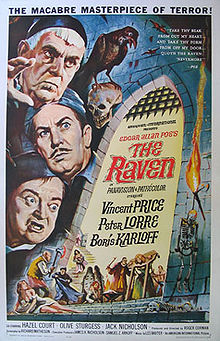
Classic Films in Focus: THE RAVEN (1963)
The Raven is certainly one of the most famous poems ever written in the English language, and it has earned a particular place of honor in the realm of popular culture, where everyone from John Carradine and James Earl Jones to John De Lancie and Christopher Walken has recorded a version of its irresistible lines. Roger Corman's loose adaptation of Edgar Allan Poe's iconic poem is more a lark than an "ominous bird of yore," but that won't stop fans of the poem or the horror director's work from enjoying this funny, star-studded horror-comedy.
Vincent Price stars as Dr. Erasmus Craven, a scholarly magician whose nightly studies are interrupted when a large raven seeks admittance to his home. The bird turns out to be Dr. Bedlo (Peter Lorre), another practitioner of the dark arts. Along with their respective offspring, Bedlo and Craven make a journey to the castle of a rival sorcerer, Dr. Scarabus (Boris Karloff), where the magicians enter into a deadly contest of supernatural skill.
While the stars of the film are some of horror's most prolific masters, The Raven relies primarily on comedy for its effect. The performers all seem to be having a good time, although Peter Lorre's hangdog looks and hilarious dialogue make him a real scene-stealer. Any viewer with an affection for Price, Lorre, and Karloff will enjoy this romp, although it's best to come at the picture with an expectation of campy pleasures rather than credible thrills. Scream queen Hazel Court plays Craven's supposedly dead wife, Lenore, but one of the most interesting casting choices in the film is the appearance of a very young Jack Nicholson as Lorre's son, Rexford. Nicholson had worked with Corman before in the original film version of The Little Shop of Horrors (1960), but seeing the three time Oscar winner as a handsome young fellow in tights is an opportunity not to be missed.
Fans of horror-comedy who enjoy The Raven might move on to other examples of the genre, including The Ghostbreakers (1940) and Abbott and Costello Meet Frankenstein (1948). If Corman's Poe pictures suit your tastes, try House of Usher (1960), Tales of Terror (1962), and The Masque of the Red Death (1964). You'll find Price, Lorre, and Karloff joined by the elegant Basil Rathbone in another delightfully macabre horror-comedy, The Comedy of Terrors (1963), directed by Jacques Tourneur. Richard Matheson, best known today for his often filmed novel, I Am Legend, wrote the screenplays for both The Raven and The Comedy of Terrors.
An earlier version of this review originally appeared on Examiner.com. The author retains all rights to this content.
Vincent Price stars as Dr. Erasmus Craven, a scholarly magician whose nightly studies are interrupted when a large raven seeks admittance to his home. The bird turns out to be Dr. Bedlo (Peter Lorre), another practitioner of the dark arts. Along with their respective offspring, Bedlo and Craven make a journey to the castle of a rival sorcerer, Dr. Scarabus (Boris Karloff), where the magicians enter into a deadly contest of supernatural skill.
While the stars of the film are some of horror's most prolific masters, The Raven relies primarily on comedy for its effect. The performers all seem to be having a good time, although Peter Lorre's hangdog looks and hilarious dialogue make him a real scene-stealer. Any viewer with an affection for Price, Lorre, and Karloff will enjoy this romp, although it's best to come at the picture with an expectation of campy pleasures rather than credible thrills. Scream queen Hazel Court plays Craven's supposedly dead wife, Lenore, but one of the most interesting casting choices in the film is the appearance of a very young Jack Nicholson as Lorre's son, Rexford. Nicholson had worked with Corman before in the original film version of The Little Shop of Horrors (1960), but seeing the three time Oscar winner as a handsome young fellow in tights is an opportunity not to be missed.
Fans of horror-comedy who enjoy The Raven might move on to other examples of the genre, including The Ghostbreakers (1940) and Abbott and Costello Meet Frankenstein (1948). If Corman's Poe pictures suit your tastes, try House of Usher (1960), Tales of Terror (1962), and The Masque of the Red Death (1964). You'll find Price, Lorre, and Karloff joined by the elegant Basil Rathbone in another delightfully macabre horror-comedy, The Comedy of Terrors (1963), directed by Jacques Tourneur. Richard Matheson, best known today for his often filmed novel, I Am Legend, wrote the screenplays for both The Raven and The Comedy of Terrors.
An earlier version of this review originally appeared on Examiner.com. The author retains all rights to this content.
Sunday, October 21, 2012
Classic Films in Focus: MAD LOVE (1935)
Also known as The Hands of Orlac, Mad Love (1935) offers an unusually literate and even lyrical take on the mad doctor motif, a staple of the classic horror genre. This MGM production from director Karl Freund features well-known horror stars like Peter Lorre and Colin Clive in the leading roles, and it retains its creepy charms thanks to their performances and a number of startling flourishes that modern viewers will still find unsettling more than 75 years after the film's original release. Mad Love is an especially good place to enjoy the peculiar talents of genre icon Peter Lorre, here cast as a strangely sympathetic monster whose worst actions stem from passionate but unrequited love.
Lorre plays the brilliant but unhinged surgeon Dr. Gogol, who spends his days curing lame children and his evenings obsessing over the beautiful actress, Yvonne (Frances Drake). When Yvonne's pianist husband, Stephen Orlac (Colin Clive), loses his hands in a train wreck, Gogol secretly replaces them with the hands of Rollo (Edward Brophy), a knife-throwing murderer recently sent to the guillotine. Stephen soon becomes disturbed by his hands' predilection for hurling sharp objects, while Gogol hatches a plan to drive Stephen mad in order to claim Yvonne for himself.
In addition to his bald head and unnerving expression, Dr. Gogol possesses a curiously poetic soul. He seizes upon a wax figure of Yvonne as his personal Galatea, hoping that his love for the original will make him another Pygmalion. Later, having decided with Oscar Wilde that "each man kills the thing he loves," Gogol tries to strangle Yvonne with her own hair while reciting "Porphyria's Lover," the Robert Browning poem about a similarly homicidal lover. The literary connections underline Gogol's dual identity as a man who might give life or take it away. We see these opposing sides of him in various scenes throughout the film, as he operates on crippled children but also compulsively attends executions. Because he has the capacity to do good and appreciate beauty, Gogol demands our sympathy even as we recoil from his madness. He evokes the same conflicted response in Yvonne, a dangerous reaction given its results.
Colin Clive might seem an odd choice for the romantic lead, for he is not at all handsome, but there's great poetic justice in having the former Dr. Frankenstein fitted with a dead man's hands. The dead man, Rollo, is himself a character from Tod Browning's 1932 film, Freaks, with Edward Brophy reprising the role. Frances Drake makes a lovely heroine, especially in her costume from the theater of horrors where she performs, although some of her transitions with the wax figure can be jarring.
Don't miss the scene in which Gogol impersonates a resurrected Rollo, definitely one of Lorre's scariest and most hysterical performance highlights. Karl Freund is best remembered today as the director of The Mummy (1932). For more of Peter Lorre's villains, see M (1931), The Man Who Knew Too Much (1934), and The Maltese Falcon (1941). Colin Clive plays Dr. Frankenstein in both the 1931 film and The Bride of Frankenstein (1935), but you'll also find him in Christopher Strong (1933) and Jane Eyre (1934).
Lorre plays the brilliant but unhinged surgeon Dr. Gogol, who spends his days curing lame children and his evenings obsessing over the beautiful actress, Yvonne (Frances Drake). When Yvonne's pianist husband, Stephen Orlac (Colin Clive), loses his hands in a train wreck, Gogol secretly replaces them with the hands of Rollo (Edward Brophy), a knife-throwing murderer recently sent to the guillotine. Stephen soon becomes disturbed by his hands' predilection for hurling sharp objects, while Gogol hatches a plan to drive Stephen mad in order to claim Yvonne for himself.
In addition to his bald head and unnerving expression, Dr. Gogol possesses a curiously poetic soul. He seizes upon a wax figure of Yvonne as his personal Galatea, hoping that his love for the original will make him another Pygmalion. Later, having decided with Oscar Wilde that "each man kills the thing he loves," Gogol tries to strangle Yvonne with her own hair while reciting "Porphyria's Lover," the Robert Browning poem about a similarly homicidal lover. The literary connections underline Gogol's dual identity as a man who might give life or take it away. We see these opposing sides of him in various scenes throughout the film, as he operates on crippled children but also compulsively attends executions. Because he has the capacity to do good and appreciate beauty, Gogol demands our sympathy even as we recoil from his madness. He evokes the same conflicted response in Yvonne, a dangerous reaction given its results.
Colin Clive might seem an odd choice for the romantic lead, for he is not at all handsome, but there's great poetic justice in having the former Dr. Frankenstein fitted with a dead man's hands. The dead man, Rollo, is himself a character from Tod Browning's 1932 film, Freaks, with Edward Brophy reprising the role. Frances Drake makes a lovely heroine, especially in her costume from the theater of horrors where she performs, although some of her transitions with the wax figure can be jarring.
Don't miss the scene in which Gogol impersonates a resurrected Rollo, definitely one of Lorre's scariest and most hysterical performance highlights. Karl Freund is best remembered today as the director of The Mummy (1932). For more of Peter Lorre's villains, see M (1931), The Man Who Knew Too Much (1934), and The Maltese Falcon (1941). Colin Clive plays Dr. Frankenstein in both the 1931 film and The Bride of Frankenstein (1935), but you'll also find him in Christopher Strong (1933) and Jane Eyre (1934).
Tuesday, September 18, 2012
10 Classic Movies Inspired by Edgar Allan Poe
Quoth the raven, "Nevermore!"
Movies and shorts inspired by the works of Edgar
Allan Poe first appeared during the silent era, but Poe’s greatest age came in
the 1960s, when Roger Corman made the author his macabre muse for a series of
cult horror classics. With Vincent Price as his leading man, Corman defined the
Poe movie canon for generations of horror fans. Here are ten classic movies
inspired by Poe’s works, with special emphasis on the Corman pictures.
The
Black Cat
(1934) – Universal monster stars Boris Karloff and Bela
Lugosi head up the cast in this hit film from the golden age of classic horror.
Like most movie “adaptations” of Poe’s work, the story takes many liberties
with the original text and functions more as a tribute to Poe’s influence than
a strict translation.
The
Raven
(1935) – Following on the success of the 1934 picture, this
Universal horror treatment again teams Karloff and Lugosi in the lead roles,
although the story is once more really a tribute to Poe’s work than an actual
adaptation of it.
The
Black Cat
(1941) – Well-known stars like Basil Rathbone, Broderick
Crawford, and Bela Lugosi appear in this adaptation from Universal Pictures and
director Albert S. Rogell.
House
of Usher
(1960) – Corman’s first Poe movie stars horror favorite Vincent
Price as Roderick Usher. While Corman’s film is more faithful to Poe than many
other pictures, the story still makes major changes to the plot of the original
tale, including a romance between the house guest and Madeline Usher.
Pit
and the Pendulum
(1961) – Richard Matheson wrote the screenplay for this Corman
adaptation of one of Poe’s best-known tales, which stars Vincent Price, John
Kerr, and Barbara Steele in the leading roles.
Premature
Burial
(1962) – Ray Milland and scream queen Hazel Court star in
this Corman production, the only Poe picture not to star Vincent Price.
Tales
of Terror
(1962) – Richard Matheson once again contributes the
screenplay for Corman’s anthology of shorts inspired by several Poe tales,
including “The Black Cat,” “Morella,” “The Cast of Amontillado,” and “The Facts
in the Case of M. Valdemar.” The teaming of Peter Lorre and Price for this
picture’s version of “The Cask of Amontillado” is a highlight for fans.
The
Raven
(1963) – This horror comedy from Corman unites Vincent Price
with Boris Karloff, Peter Lorre, and Hazel Court for a rather silly but fun take
on Poe’s most famous poem. A young Jack Nicholson also appears as Peter Lorre’s
son.
The
Masque of the Red Death
(1964) – Vincent Price and Hazel Court star in yet another
Corman film, which also incorporates elements from a different Poe story,
“Hop-Frog.”
The
Tomb of Ligeia
(1964) – Price stars with Elizabeth Shepherd in the last of
Corman’s Poe pictures, this time a story of obsession that reaches beyond the
grave. The outdoor location shots early in the movie set this picture apart
from the earlier Corman productions.
While The
Haunted Palace (1963) is often listed with the Poe films, and its title is
taken from a poem featured in “The Fall of the House of Usher,” the story
actually comes from H.P. Lovecraft. Still, you’ll find Vincent Price teamed up
with Lon Chaney, Jr., Elisha Cook, Jr., and Debra Paget in this bonus “Poe
picture” from Corman.
An earlier version of this article originally appeared on Examiner.com. The author retains all rights to this content.
Subscribe to:
Posts (Atom)