Showing posts with label family film. Show all posts

Friday, March 8, 2024

Rough and Dirty Girlhood in ANNIE (1982)

In his original review of the 1982 film musical, Roger Ebert offers qualified - and often rather faint - praise for Annie but says he doesn't know if kids will actually like the movie. Ebert doesn't find the story's heroine very compelling or believable, but it's noteworthy that all of the other child characters and performers he mentions in comparison are boys: Oliver Twist in Oliver! (1968), Henry Thomas in E.T. (1982), and Ricky Shroder in general. I recently rewatched Annie, and I have a very different perspective on the picture from the late, great reviewer, having actually been a ten year old girl (the same age as Annie herself) when I first saw the movie in theaters in 1982. While certain elements have aged poorly or lack the same appeal they had when I was a child, I can still see why my younger sister and I were so thoroughly charmed by the spunky heroine and her fellow orphans that we belted out "Tomorrow" incessantly and even got dolls of some of the characters. Yes, we were kids who liked Annie, and although we enjoyed the music and the adult characters very much, what really appealed to us was the depiction of girlhood as we experienced it, a rough and dirty childhood full of fights, conflict, and unbrushed hair.

Our culture as a whole has long imagined girls as more or less the opposite of boys. Girls are dear little things who play with dolls while waiting to grow up into loving wives and mothers. Even when they're protagonists and not merely supporting characters, most of them have to be pretty, kind, and generally well-behaved as models of permissible girl behavior. Shirley Temple, the quintessential "little girl" of Hollywood, wins everyone over with her dimpled sweetness, and even Alice and Dorothy are depicted as very "proper" girls in most of their film and TV adaptations (when their girlhood is not erased entirely by making them teenagers or even adults). There are exceptions, of course, like the Little House on the Prairie books and TV series, but celebrated girl-centered stories are harder to come by than stories about boys, and stories about groups of young girls (not marriageable young women) are even rarer.

Annie dispenses with all of those well-worn stereotypes about who and what girls are, replacing the usual sugar and spice with Depression era spunk. It's both a girl's version of Oliver Twist and a prepubescent take on Gold Diggers of 1933 (1933), with a scrappy crew of orphan girls trying to survive by their wits, camaraderie, and sheer stubbornness. Imagine the delight my little sister and I experienced seeing these dirty, grumpy, combative girls playing tricks on Miss Hannigan (Carol Burnett) and fighting amongst themselves just like we often did, much to our mother's dismay. We were girls who played outside, got dirty, tore our clothes, and only brushed our hair under duress. Annie and her friends provided a rare chance to see girls who looked and acted like us on the big screen, and we loved them for it. It helped that they weren't preternaturally cute or beautiful, like so many of the little and big girls Hollywood showcases. Mop wig aside, Aileen Quinn's Annie seemed like a kid we'd like to know, even if we felt disappointed that she had to be rescued by adults in the final act. We were hoping she'd kick Tim Curry's Rooster right off the top of the train bridge and send him screaming to his death, but at least she tore up the ill-gotten check and made her initial escape all by herself, while her friends persevered in their race to uncover the villains' deception.

In the decades since Annie, Hollywood movies have made some progress in telling stories about girls, especially in films like Matilda (1996), but Japan's Hiyao Miyazaki has done far better with My Neighbor Totoro (1988), Kiki's Delivery Service (1989), Spirited Away (2001), and Howl's Moving Castle (2004), just to name a few of the Studio Ghibli movies to center the experiences of young girls as interesting and not idealized characters. Women film reviewers, however, are still well aware of the dearth of great movies about young girls, as Anya Jaremko-Greenwold opines in the 2016 Atlantic essay, "Why Hollywood Doesn't Tell More Stories for - and About - Girls." Given that Hollywood still doesn't make many movies like Annie, I'm glad that today's little girls can see the 1982 version in spite of its dated elements. Maybe, at this very moment, some stubborn little girl with tangled pigtails and a dirty face is watching the movie on Netflix as the orphans sing "It's the Hard Knock Life" and delighting in the vision of girls who look and act like her.

Related Posts:

"My Life at the Movies" (2011)

"High School Movies, Then and Now" (2018)

Saturday, December 17, 2022

Classic Films in Focus: MURDER, HE SAYS (1945)

Fred MacMurray and Marjorie Main most famously appear together in the 1947 comedy classic, The Egg and I, but Murder, He Says (1945) offers an earlier pairing that pits the two against one another as hapless city slicker and unscrupulous backwoods crook. This comic mystery from director George Marshall bursts with physical comedy, sight gags, and cartoon peril that even the youngest viewers can appreciate; I first saw Murder, He Says many decades ago, and the memory of its loony fun has stayed with me ever since. MacMurray and Main are the chief attractions in this homicidal hoot, but the supporting cast features entertaining, offbeat performances from Porter Hall, Jean Heather, Peter Whitney, Barbara Pepper, and Helen Walker as MacMurray's attractive ally.

The story opens with locals concerned about the lawless Fleagle gang just as professional pollster Pete Marshall (MacMurray) arrives in town looking for his missing coworker. Pete soon discovers that his predecessor had a fateful encounter with the Fleagles, who also take Pete prisoner with the intention of murdering him. The Fleagle matriarch, Mamie (Marjorie Main), spares Pete so she can use him to get dying Grandma Fleagle (Mabel Paige) to reveal the location of a fortune in stolen cash, but Pete only acquires a confusing clue before the old lady expires. Everyone in the house rushes to find the loot while thwarting or betraying the others, but the confusion increases when two different women claiming to be Bonnie Fleagle turn up and demand the money.

The Fleagles are as nutty and sinister a gang as any madcap comedy could invent, but their wackiness overpowers their ability to terrorize. Main leads the pack as bad-tempered but duplicitous Mamie, alternating between imitations of human tenderness and cracks of her much-used whip. The role lets Main cut loose with an extreme version of her usual character type; Mamie is a rough matriarch with no heart of gold to redeem her brusque manner. Mamie's current husband, a mild-looking little man named Mr. Johnson, is played by comedy stalwart Porter Hall with sly amiability and amoral intentions. Peter Whitney does double duty as identical twins Bert and Mert, a hilarious gag that the picture fully commits to in repeated scenes that frequently have Whitney acting against himself. Of the other family members, Grandma and the real Bonnie (Barbara Pepper) make brief but memorable appearances, while Jean Heather gets a sympathetic but rather tragic role as Mamie's daughter, Elany, a pretty sort of Ophelia figure whose main job is to sing the nonsense song wherein the clue to the stolen cash is hidden. Together they're a lot to keep track of as the rapid action unfolds, especially in a house full of trap doors, secret passages, and even radioactive poison. Each character, though, is played with enough energy and comedy to be memorable, even if nobody can tell Bert and Mert apart.

MacMurray and Helen Walker play the sane characters in the midst of this mayhem, but their roles also have great comedy moments. Walker's tough act in her first scene gives way to her development as the hero's love interest and partner against the Fleagles, but she gamely keeps up the deception for much of the movie. While he starred in dramas and serious films like Double Indemnity (1944), MacMurray is also widely celebrated as a comedy lead in pictures like The Egg and I (1947), The Shaggy Dog (1959), and The Absent-Minded Professor (1961). Murder, He Says belongs very much to the second set, despite its title, which recalls a song written for the 1943 film, Happy Go Lucky, and predates the arrival of the Miss Marple comedy, Murder She Said, in 1961. As the unlucky but quick-thinking Pete, MacMurray is constantly on the move, falling into traps, climbing out windows, and always trying to stay one step ahead of the violent but incompetent Mert and Bert. His scenes with the imaginary ghost are especially fun and will remind viewers of Harvey (1950), which might well be intentional as the original stage version had appeared in 1944.

For more of Marjorie Main's comic roles, see The Women (1939), Heaven Can Wait (1943), and The Harvey Girls (1946). George Marshall's other comedy films include The Ghost Breakers (1940), Hold That Blonde! (1945), and Scared Stiff (1953). Look for Helen Walker in Brewster's Millions (1945), Cluny Brown (1946), and Call Northside 777 (1948). Jean Heather appears in supporting roles in Double Indemnity and Going My Way (1944), but her film career was cut short by a 1947 car accident that damaged her face. If the clue tune in Murder, He Says sounds weirdly familiar, you probably listen to NPR's All Things Considered, which features an identical song as its theme music.

You can find Murder, He Says on DVD or stream it on The Criterion Channel (as part of the December 2022 Screwball Comedy lineup).


Thursday, December 15, 2022

Classic Films in Focus: YOU NEVER CAN TELL (1951)

I've seen a lot of unusual classic movies, but You Never Can Tell (1951) might be in a class all by itself when it comes to animal themed reincarnation private detective mystery comedies. Directed by film writer Lou Breslow, this offbeat picture stars Dick Powell as a murdered German Shepherd who comes back to earth as a human private detective in order to reveal the identity of his killer. If that sounds like a lot to process, there's also a reincarnated racehorse (Joyce Holden) along for the trip to serve as his assistant! Imagine Angel on My Shoulder (1946) mixed with The Shaggy Dog (1959) and Murder, My Sweet (1944) and you begin to get an idea of You Never Can Tell. As bizarre as that sounds, the whole thing comes together to create a delightful romp with some hilarious performances from Powell and Holden as the animals in human form. Those who enjoy oddball comedies will find plenty of laughs in this wacky gem, and it's definitely zany enough to hold the attention of younger viewers who are used to cartoon antics.

Powell plays private detective Rex Shepherd, who was previously known as King before his untimely demise thanks to a killer who slipped the dog a fatal dose of poison. King was murdered because he inherited the immense fortune of his misanthropic owner, and public opinion says his caretaker, the lovely young Ellen Hathaway (Peggy Dow), is the most likely culprit, since she inherited the money after King's death. Determined to expose the real murderer, King asks to return to Earth as a human being, where he presents himself to Ellen as a private eye who can clear her name and get justice for King. The racehorse Golden Harvest comes with him to be his sidekick, Goldie (Holden), but the two have a limited amount of time before they must either return to animal heaven or be stuck living out second lives as human beings.

There's not really much mystery about the killer's identity here, since King/Rex knows who poisoned him, but the noir angle lets Powell play the hard-boiled detective type again after his 1944 outing as Philip Marlowe in Murder, My Sweet and subsequent noir roles. Rex looks and talks like a detective but also enjoys snacking on dog food, chasing balls, and sitting on previously forbidden chairs. His biggest problem is convincing the cops that he's not insane, a criminal, or both, since he can't exactly explain his situation to them. Powell is having fun here, but Joyce Holden proves a scene-stealer as Goldie, and she gallops off with the picture at every opportunity. Her costume, complete with ponytail, straw hat, stirrups belt, and horseshoes under the soles of her pumps, is funny on its own, but Holden's performance goes all in on the Kentucky Thoroughbred persona. The regular human characters are pretty tame in comparison: Peggy Dow has ample charm and warmth as Ellen, but Charles Drake is a bit bland as dog trainer turned suitor Perry Collins. We don't see him for long, but it's also worth mentioning that King is played by animal star Flame the Wonder Dog, here nearing the end of his acting career after starring as Shep, Rusty, and Pal in a string of features and shorts.

Rex watches as Goldie surveys the latest racing news.

The scenes on Earth feature constant gags and comic takes on the private detective plot, but the weirdest moments of You Never Can Tell take place in the afterlife, where King joins other dead animals to appear before their ruler/god, who is, of course, a lion. The cinematography for this segment makes the setting even stranger, and the scene goes on longer than you might want or expect, especially if you're showing this movie to kids who will immediately ask if animals have souls or go to heaven. The picture's commitment to this sequence is impressive, though, and it does show us why King wants to return to Earth and what he's giving up to do that. It also sets up the idea that other animals have become humans before (the movie even has an unwieldy portmanteau name for them - "humanimals"), so we aren't too surprised when Goldie identifies some of these animal people later in the picture. 

If You Never Can Tell sounds like a treat, check out other animal themed comedies like Francis (1950), Rhubarb (1951), and The Incredible Mr. Limpet (1964). Lou Breslow was primarily a film writer; in addition to the story for You Never Can Tell, he also worked on A-Haunting We Will Go (1942), Murder, He Says (1945), and Bedtime for Bonzo (1951). Dick Powell rose to fame in musicals like 42nd Street (1933) and Gold Diggers of 1933 (1933), while Peggy Dow also appears in Harvey (1950) and Bright Victory (1951). Look for Joyce Holden in The Milkman (1950), Iron Man (1951), and Private Eyes (1953).

Saturday, March 21, 2020

Classics for Coronavirus: Robinson Crusoe

The world is staying home this spring as a pandemic spreads through our countries, leaving many people to cope with the unfamiliar experience of social isolation. Literature and film are suddenly lifelines to adventure, community, and knowledge, and some of them can really teach us a few things about how to live while cut off from the rest of the world. As I keep up with the news this month I find myself thinking especially about Robinson Crusoe, Daniel Defoe's iconic castaway and master of social distancing. Defoe's original novel, published in 1719, has inspired many subsequent books, films, and television series, and there's never been a better excuse or time to explore them. Here are some of my favorite Robinson Crusoe revisions and adaptations.

1) Robinson Crusoe on Mars (1964) - This is probably my favorite of the films inspired by the novel because it takes Defoe's story and mixes it into 60s sci-fi, Paul Mantee stars as the castaway astronaut on the red planet, but you'll also find Adam West in a supporting role early in the film. Try this one if you're already a fan of classic sci-fi or you really loved The Martian (2015)!

2) The Martian (2015) - Matt Damon's turn as a castaway astronaut on Mars isn't a direct adaptation of Robinson Crusoe, but it certainly owes a lot to Defoe, and it makes a perfect double feature with Robinson Crusoe on Mars. When he gets left behind on Mars, Mark Watney uses science and creativity to survive. You'll really learn to appreciate potatoes!

3) Cast Away (2000) - If you want to come back to earth for your isolation, try the Tom Hanks hit in which a FedEx employee survives a plane crash and is stranded on a remote island. This is very much a modern Crusoe tale, although Crusoe's eventual companion, Friday, is a lot more useful than the soccer ball that Hanks' character names Wilson. Hanks, of course, has been in the news recently after being diagnosed with COVID-19 while filming in Australia, but I hope his time in medical isolation was a lot less traumatic than being marooned on an uninhabited island!

4) Swiss Family Robinson (1960) - Defoe's original story inspired the 1812 family classic, which is also worth handing to your kids while they're at home, but the 1960 Disney film adaptation is probably the best known of the numerous film treatments. John Mills and Dorothy McGuire star as the parents of a shipwrecked family with several sons, and this one makes a good family pick for kids who are too young for the films I've already listed. Best of all, you can stream it on Disney Plus if you're already sick of the two Frozen movies!

5) Lost in Space (1965-1968) - The Crusoe family tree adds another branch with this 60s TV revision of Swiss Family Robinson, which gave the world the iconic line, "Danger, Will Robinson!" Make your kids watch the 1960 Disney film first and then introduce the 60s TV series, the 1998 feature film version, or the newest 2018 TV series version (although the 1998 film is not particularly good, the new series is getting high marks).

Whether you're an adult looking for interesting ways to spend your time at home or a parent trying to craft educational but fun activities for kids, an exploration of Robinson Crusoe's literary and cinematic legacy is a timely choice. The original story is a good place to start if you have the patience for 18th century literature - it's a good read and a true classic with enormous influence. Otherwise try jumping in with any of the films and TV series listed here.


Thursday, February 4, 2016

Classic Films in Focus: MIRACLE ON 34TH STREET (1947)

Although it has been remade several times, the original 1947 release of Miracle on 34th Street is still the best and most charming incarnation of this heart-warming tale of holiday faith. Its attractions include an Oscar-winning Santa Claus performance courtesy of Edmund Gwenn and a memorable early appearance from a very young Natalie Wood, as well as lovely Maureen O’Hara and the very likable John Payne as the romantic leads. With its three Oscar wins and its enduring appeal, Miracle on 34th Street thoroughly deserves its status as a holiday classic, one of those movies that it just wouldn’t be Christmas without.

The story opens at the Macy’s Thanksgiving Day Parade, where Macy’s employee Doris Walker (Maureen O’Hara) recruits a singular Santa (Edmund Gwenn) as a last-minute replacement. Soon the kindly Kris Kringle is working at the store, where he delights customers and their children but alarms Doris by insisting that he really is Santa Claus. When Kris’ sanity is called into question, Doris’ handsome neighbor (John Payne) comes to his defense in court.

The love story between O’Hara and Payne works perfectly well, but the movie is really more interested in Kris Kringle and little Susan (Natalie Wood), Doris’ skeptical daughter. Their scenes together burst with sentimental feeling and gentle good humor as they pretend to be monkeys, blow bubble gum, and gradually build a relationship despite Susan’s doubts. For many people, Gwenn’s Kris is the quintessential Santa Claus, generous and droll with just a hint of mischief in his twinkling eyes. The story leaves it up to the viewer to decide if Kris really is the jolly old elf, but, as the Magic 8 Ball would say, “Signs point to yes.”

Behind the holiday cheer lie some serious themes, including Doris’ loss of faith following the end of her marriage to Susan’s father. Susan clearly yearns for a paternal figure, as her friendship with the neighborly Fred makes clear, but she’s also incomplete because her mother has discouraged her from believing in anything or even using her imagination. Fred and Kris must work together to heal this broken little family, an accomplishment perfectly symbolized by the film’s closing scene. Like most of the very best Christmas movies, this one balances its sweetness with melancholy and the bitterness of experience, and the spirit of Christmas is as much about acknowledging those feelings as it is about merriment and goodwill.

Director George Seaton had his other big directorial success with The Country Girl (1954), but he wrote twice as many screenplays as he directed. Maureen O’Hara can be found in How Green Was My Valley (1941), The Black Swan (1942), and The Quiet Man (1952). Look for John Payne in The Razor’s Edge (1946) and Kansas City Confidential (1952). Edmund Gwenn also stars in Sylvia Scarlett (1935), Pride and Prejudice (1940), and Them! (1954). See a more grown-up Natalie Wood in Rebel Without a Cause (1955), The Searchers (1956), and West Side Story (1961). Don’t miss memorable character actress Thelma Ritter in a brief, uncredited role as a mother who speaks to Santa.

Wednesday, September 10, 2014

Classic Films in Focus: 20,000 LEAGUES UNDER THE SEA (1954)

Adapted from the novel by Jules Verne, Disney’s large scale Technicolor adventure provides plenty of eye-popping aquatic scenery, which helped it win a pair of Oscars for Special Effects and Best Art Direction. 20,000 Leagues Under the Sea (1954) also offers classic film fans a unique combination of iconic stars, including James Mason as the enigmatic Captain Nemo, Kirk Douglas as a feisty sailor, and Peter Lorre as a scientist’s nervous assistant. While its pace might seem a bit slow by modern standards, especially for younger children, the effects and actors make the picture well worth the two hours it takes to watch, and 20,000 Leagues Under the Sea remains one of the best and most influential of Disney’s live action features.

Paul Lukas plays Professor Pierre Aronnax, who embarks on a ship with his assistant, Conseil (Peter Lorre), to investigate rumors of an enormous sea monster that is destroying vessels at sea. When the supposed monster attacks their ship, Aronnax, Conseil, and sailor Ned Land (Kirk Douglas) are thrown overboard, where they discover that the creature is, in fact, a technologically advanced submarine controlled by the misanthropic Captain Nemo (James Mason). Nemo reveals to the men a world of oceanic wonders, but his destructive methods cause them to question his sanity and look for opportunities to escape.

Lukas and Mason are the intellectual, dramatic leads as the idealistic scientist and his grimly jaded host. They represent different perspectives on science and the nature of man, and their debates hinge on philosophical, scientific, and academic principles. While Mason in particular gives a memorably brooding performance, the film does tend to slow down when Nemo and Aronnax hold the screen. Livelier scenes focus on Ned Land and the perpetually woeful Conseil, both of whom have far more pragmatic attitudes about their situation. Lorre plays comic relief with the same deadpan genius that characterizes many of his late career performances. Kirk Douglas’ Ned might be a greedy, impulsive fool, but he’s still the most energetic and charismatic character in the movie, especially when he’s singing “A Whale of a Tale” or goofing around with Nemo’s pet sea lion.

The submarine takes both the characters and the audience on an amazing adventure, with elaborate underwater scenes of divers mourning a fallen comrade and harvesting the bounty of the sea. Peril abounds, as Nemo first attempts to drown his three visitors and then involves them in dangerous expeditions, including an obligatory island encounter with cannibals. The giant squid fight sequence holds up well, even after sixty years, and the Nautilus is a fantastic early example of steampunk design, simultaneously elegant and menacing. These elements would have a lasting effect on the American cultural consciousness, especially with the ride at Walt Disney World recreating the experience for generations of fans from 1971 until 1994. Luckily, the film has outlasted the attraction it inspired.

Richard Fleischer, who directed 20,000 Leagues Under the Sea, also made The Narrow Margin (1952), Fantastic Voyage (1966), and Soylent Green (1973). See more of James Mason in A Star is Born (1954), North by Northwest (1959), and Journey to the Center of the Earth (1959). Paul Lukas won the Oscar for Best Actor for Watch on the Rhine (1943), but you’ll also find him in Dodsworth (1936) and The Lady Vanishes (1938). Other Kirk Douglas films from the 1950s include Ace in the Hole (1951), Lust for Life (1956), and Paths of Glory (1957). Be sure to catch more funny performances by Peter Lorre in Arsenic and Old Lace (1944), The Raven (1963), and The Comedy of Terrors (1963). For a family-friendly film festival of classic movie adaptations of Jules Verne, try Around the World in Eighty Days (1956), Mysterious Island (1961), and In Search of the Castaways (1962).

Thursday, August 28, 2014

Classic Films in Focus: THE INCREDIBLE MR. LIMPET (1964)

Don Knotts stars in The Incredible Mr. Limpet (1964), one of the weirdest war comedies ever made, in which a nearsighted amateur ichthyologist transforms into a fish and then becomes an unlikely hero during World War II. This family-friendly picture combines animation and live action for its strange fish tale, and it possesses an odd charm that still works on viewers of all ages, thanks to Knotts’ sweetly funny performance and plenty of lively action that keeps the story in motion. Jack Weston, Carole Cook, and Andrew Duggan also make memorable appearances, but the movie really belongs to Knotts and the colorful undersea world where he finds friendship, adventure, and love.

Knotts plays Henry Limpet, a timid, bookish fellow whose wish to be a fish comes true when he falls off a pier at Coney Island. While his wife, Bessie (Carole Cook), and overbearing pal, George (Jack Weston), give him up as drowned, Henry embarks on a new life underwater, where he makes friends with a hermit crab (Paul Frees) and attracts the admiration of the lovely Ladyfish (Elizabeth MacRae). Henry also finds purpose when he realizes that his unique situation allows him to help the US Navy hunt down Nazi U-boats in the Atlantic.

Most people immediately think of Knotts as Barney Fife, and his popularity on The Andy Griffith Show more or less defined his career, but as Henry Limpet Knotts gets to play a gentler, less buffoonish character. There are distinct shades of a Jimmy Stewart type in Knott’s Henry; he might be obsessed with fish, but he’s a sweet guy, very bright, and really just waiting for a chance to prove himself. Henry longs to serve his country in spite of his 4F status, and his magical transformation gives him a chance to become both a hero and a figure of romance. He first appears as a puny, undersized human, but he makes for a strapping and extraordinary fish. Knotts even gets to sing the movie’s signature song, “I Wish I Were a Fish,” and though he’s no crooner it further shows that the actor had more range than many Barney Fife fans might expect.

The supporting actors in the live action scenes mostly react to Knotts, even when he’s playing the milquetoast human version of Henry. As George Stickel, Jack Weston is overbearing when Henry is a man but amusingly in awe of his pal as a fish, and he serves as the link between Henry’s two worlds. Carole Cook seems like a terrible harridan of a wife to Henry until she thinks he has drowned, and then she reveals a surprising tenderness toward him that makes us reassess our sense of her character. Andrew Duggan plays Harlock with a mix of befuddlement and practical acceptance of whatever gets the job done, but even in the framing sequences Harlock and Stickel look like they’d rather forget all about incidents they still can’t really believe. Elizabeth MacRae’s Ladyfish might be the least interesting character in the whole picture, with her sexy voice and vacuous personality, but Paul Frees invests Crusty the hermit crab with a feisty loyalty that makes him a highlight of the story.

Arthur Lubin, who directed The Incredible Mr. Limpet, also made Buck Privates (1941), Francis the Talking Mule (1950), and Rhubarb (1951), as well as a whole series of Francis sequels. For more of Don Knotts’ film career, see No Time for Sergeants (1958), The Ghost and Mr. Chicken (1966), and The Apple Dumpling Gang (1975). Look for Jack Weston in Wait Until Dark (1967) and The Thomas Crown Affair (1968). Veteran voice actor Paul Frees earned more than 300 screen credits for his film and television work, and you might recognize him as the voice of Barney Bear, Wally Walrus, Boris Badenov, Snuffy Smith, Charlie Beary, Ludwig Von Drake, and a host of other animated characters.

Wednesday, July 2, 2014

Classic Films in Focus: I REMEMBER MAMA (1948)

Nominated for five Academy Awards, I Remember Mama (1948) is one of those movies that requires a handful of hankies to watch, especially for those who have fond memories of their own mothers. George Stevens’ nostalgic melodrama has all the right ingredients for a classic tearjerker, including a sweet, sincere performance from Irene Dunne as the idealized matriarch, whose dedication to her family knows no bounds. Barbara Bel Geddes also makes a lasting impression in her second screen role as the narrator of the tale, but the cast is full of talented character actors who each bring something special to the picture and enhance its appeal. While it might prove too sentimental for some modern viewers, those who enjoy heartwarming family stories will find much to love in I Remember Mama, which wisely balances laughter and tears in its depiction of the Hanson family’s experiences.

Barbara Bel Geddes stars as Katrin, the daughter of Norwegian immigrants living in San Francisco in the first decade of the twentieth century. Along with her brother and two sisters, Katrin grows up under the devoted protection of her father, Lars (Philip Dorn), and mother, Marta (Irene Dunne), who make many sacrifices for the benefit of their children. As Katrin enters adulthood and becomes a writer, she recounts the many ups and downs of the family’s life together, but she focuses most on the selfless love and support of her mother.

Both Dunne and Bel Geddes earned Oscar nominations for their performances, but the picture really belongs to Dunne, who manages to make Mama an angel without making her dull. Equally adept at comedy and sentiment, Dunne gives Mama enough good humor and strength to see her through almost any crisis, even little Dagmar’s emergency surgery. Some mothers might sit at home and cry, but Mama disguises herself as a cleaning lady in order to sneak into the ward and keep her promise to her daughter. Scenes that might otherwise play as maudlin, like the euthanization of an injured pet cat, are lightened by Dunne’s handling of the moment. The audience believes in Mama because of Dunne’s performance of her; the role would bring Dunne the last of five Best Actress nominations, and it’s a shame she never won. Bel Geddes, fresh-faced and girlish, looks far younger than her actual age as the adolescent Katrin; her youthful appearance and soft voice lend credibility to her role as a teenager still trying to find her place in the world. Katrin spends much of her time on the sidelines, watching and taking note of her mother’s actions, but Bel Geddes shines in the few key scenes where she takes center stage.

The two lead actresses get ample support from the rest of the cast, which features some memorable players who bring both depth and humor to their roles. Oskar Homolka is quite the scene-stealer as Uncle Chris, the overbearing patriarch whose loud personality masks his loving, generous spirit. Ellen Corby plays timid Aunt Trina with such a yearning for happiness that she alone of Marta’s three sisters commands our sympathy. Both Homolka and Corby picked up Oscar nominations for their performances, pitting Corby and Bel Geddes against each other for Best Supporting Actress (they lost to Claire Trevor in Key Largo). Trina’s mild-mannered suitor is played by Edgar Bergen, appearing without his wooden sidekick, Charlie McCarthy; as Mr. Thorkelson, he functions mostly as a comical figure but has a tender scene with Trina near the very end of the picture. Dedicated classic movie fans will also appreciate the contributions of Rudy Vallee, Florence Bates, Cedric Hardwicke, and Barbara O’Neil in brief but effective appearances.

The original story of I Remember Mama came from Mama’s Bank Account, a novel by Kathryn Forbes, which was adapted into a stage play by John Van Druten. A television series and Broadway musical followed, proving the story’s enduring appeal to audiences. For more of Irene Dunne, see The Awful Truth (1937), Love Affair (1939), and My Favorite Wife (1940). Barbara Bel Geddes is best remembered today as Ellie Ewing on the television series, Dallas, but you’ll also find her in Blood on the Moon (1948), Panic in the Streets (1950), and Vertigo (1958). See Oskar Homolka in Sabotage (1936), The Invisible Woman (1940), and Ball of Fire (1941). Like Barbara Bel Geddes, Ellen Corby had her most memorable role on television, as Grandma Walton on The Waltons, and she also has a small part in Vertigo; look for more of her in Caged (1950), Angels in the Outfield (1951), and Shane (1953).

Tuesday, April 8, 2014

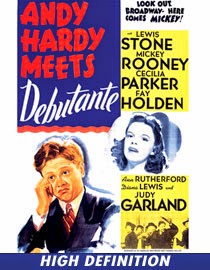
Classic Films in Focus: ANDY HARDY MEETS DEBUTANTE (1940)

This installment of the popular Andy Hardy series takes the Hardy family out of idyllic Carvel and sends them off to New York City, where teenage Andy promptly gets himself into all kinds of trouble. Despite the change of venue, it’s a typical Andy Hardy story, with youthful mistakes, romantic entanglements, and Mickey Rooney’s boundless zeal. You don’t have to have seen all of the previous Hardy pictures to drop into the action, although it does help if you have seen Love Finds Andy Hardy (1938), the earlier movie that introduces Judy Garland’s Betsy Booth character. Garland’s return to the world of the Hardy family makes Andy Hardy Meets Debutante a particularly appealing picture for fans of her collaborations with the energetic Rooney. For newcomers, the distinctive mix of adolescent romance, humor, and wide-eyed American idealism sums up the essence of the Hardy films’ enduring appeal.

At home in Carvel, Andy is nursing a crush on New York society girl, Daphne Fowler (Diana Lewis), and he foolishly brags about knowing her when his friends discover his passion. Andy is forced to prove his claims when Judge Hardy (Lewis Stone) takes the whole family to New York as part of his mission to protect the Carvel Orphanage from big city lawyers who want to defund it. Andy’s friend, Betsy (Judy Garland), tries to help him, but Andy suffers a series of shocks to his ego as he attempts to meet Daphne, and even Judge Hardy becomes concerned about the implications of Andy’s behavior.

Part of Andy Hardy’s appeal is his penchant for getting into scrapes; neither an angel nor a complete reprobate, he’s a twentieth-century Tom Sawyer with a waggish sense of fun and a lively eye for the ladies. Wherever Andy goes, girl trouble follows, and in this outing he has Polly Benedict (Ann Rutherford), Betsy, and Daphne to juggle. Andy thinks he’s too sophisticated for Polly, and he treats Betsy like a kid, but he soon finds out that the wealthy Daphne is out of his league. “There are millions of nice people in the world,” Daphne’s mother tells him, “and Daphne can’t be friends with all of them.” The irony of his comeuppance never seems to dawn on Andy, but the audience sees quite clearly that he reaps as he has sown. His taste in girls needs adjusting, anyway, if he can favor Daphne over her more available competition. Polly, the hometown favorite, wins our approval thanks to Ann Rutherford’s flashing eyes and bold manner, while Judy Garland makes Betsy so sweet and sadly lovestruck that we root for her even though we know that Polly has already staked her claim. Garland’s performance of “Alone,” which starts as a gag and ends with tears, is an emotional highlight of the picture that showcases the young star’s tremendous talent.

Comedy tempered with sentiment is the Andy Hardy formula, and the threat to the orphanage provides a counterweight to Andy’s romantic hijinks. Judge Hardy proves his faith in the system, lectures Andy on American ideals, and wins over a courtroom with the assistance of an adorable orphan, all of which will strike modern viewers as terribly naive. Still, with the Depression in the rearview mirror and the war directly ahead, Americans in 1940 must have wanted very much to believe in the benevolent paternal authority that Judge Hardy embodies. Andy’s relationship with his father gets a great deal of play, while his mother, aunt, and sister hardly make appearances at all. The serious part of Andy Hardy Meets Debutante has nothing to do with women but concerns itself with Andy’s emerging identity as a man with a particular place in the world.

The Andy Hardy series continued until 1958, when Mickey Rooney made his final bow as the character in Andy Hardy Comes Home. George B. Seitz directed most of the Andy Hardy pictures, beginning with A Family Affair (1937), You’re Only Young Once (1937), and Judge Hardy’s Children (1938). For more of Mickey Rooney’s youthful roles, see A Midsummer Night’s Dream (1935), Captains Courageous (1937), and Boys Town (1938). Diana Lewis, who was married to William Powell for more than forty years, retired from acting in the early 1940s after roles in Bitter Sweet (1940), Go West (1940), and Johnny Eager (1941). If you enjoy the collaborative work of Rooney and Garland, be sure to see their musicals together, particularly Babes in Arms (1939), Strike Up the Band (1940), and Babes on Broadway (1941).

Andy Hardy Meets Debutante is currently available for streaming on Warner Archive Instant.

Friday, December 20, 2013

Christmas Movie Blogathon: THE MUPPET CHRISTMAS CAROL (1992)

This post is part of the Christmas Movie Blogathon hosted by Family Friendly Reviews. Check out the links for all of the related posts!

Charles Dickens' A Christmas Carol has been adapted for the big screen many times, and almost all versions have their merits, but as both a former English Literature professor and a Muppet scholar I have to admit that The Muppet Christmas Carol (1992) is far and away my favorite take on the classic holiday tale. Despite its alterations for the sake of its furry, feathery, and felt-made cast, The Muppet Christmas Carol is surprisingly faithful to the spirit of the original text, and it goes one better than many more traditional adaptations with its inclusion of a Dickensian narrator and its representation of the three Christmas Ghosts.

Michael Caine takes the lead role as Scrooge, playing a rather demented and imposing version of the old miser, while the Muppets fill most of the supporting roles. Kermit the Frog plays long-suffering Bob Cratchit, with Miss Piggy as his loyal if temperamental spouse, and Fozzie Bear appears as Fozziewig, Scrooge's generous old employer. Statler and Waldorf split the Marley role into a duo (Jacob and Bob), and other familiar Muppet characters make appearances throughout the picture. The Great Gonzo lives up to his name as Charles Dickens, who narrates the story with the help of Rizzo the Rat. The collected cast of human and Muppet players goes through a more or less familiar version of the story, with songs and comedy added to bring the text in line with the usual Muppet style.

Several elements of this version stand out. First, Gonzo's performance as Charles Dickens is one of his best roles, combining the wry narratorial voice of the original story with the Muppet's inherent weirdness for a startlingly funny but effective commentary on the action as it unfolds. "I know this story like the back of my hand," Gonzo boasts to Rizzo. When pressed to prove it, he then covers his eyes and begins to describe his hand instead of telling the story. Rizzo is, as always, a hilarious sidekick to the blue daredevil; Dave Goelz and Steve Whitmire had already perfected their comic chemistry with the two characters by the time this film was made, and their dialogue together makes for the movie's most quotable lines. More importantly, Gonzo's presence returns to the story something that is missing in most adaptations. We get back lines like, "He was a tight-fisted hand at the grindstone, Scrooge!" and "Darkness was cheap, and Scrooge liked it." Dickens' narrator is a crucial part of the story's humor and appeal, but most versions lose him in the dramatic revision.

The Ghosts are another outstanding element of the Muppet adaptation. Specially created for the film, the Ghosts are strikingly faithful to Dickens' descriptions of them, especially the luminous Ghost of Christmas Past, who floats hauntingly thanks to a special shooting technique that involved the puppet being filmed in a tank of oil. The Ghost of Christmas Present lacks Ignorance and Want hidden beneath his robes, but his forgetful good humor and size make him a delightful presence, combining elements of both Father Christmas and Christ. The Ghost of Christmas Yet to Come is so scary that Gonzo and Rizzo abandon the picture until the finale, but the film's creators make the right call by keeping the gravitas and foreboding of those scenes. Taken together, the Ghosts are not only marvels of puppetry innovation but also compelling realizations of Dickens' figures, more spectral and miraculous than human actors because the medium liberates them from mortal constraints.

Like many family friendly adaptations of the story, The Muppet Christmas Carol does shift the focus of Dickens' text by casting its primary figure, Kermit, as Bob Cratchit. This encourages us to see ourselves in Bob and to see him as the story's central figure (the Mickey Mouse version does the same thing). Michael Caine, however, does such a terrific job as Scrooge that we never lose him among the Muppets, and that helps us to keep our attention where it's supposed to be. Dickens never wanted us to see ourselves as Bob Cratchit; his story depends on us understanding that we are Scrooge, selfish and querulous even in the face of our own salvation. Caine revels in Scrooge's meanest lines, but he also conveys nostalgia, regret, and tenderness in the character, all emotions that have to exist within him already in order to be called forth by the Ghosts' visitations. Bob is an object to rouse Scrooge's dormant pity, but A Christmas Carol isn't his story; he has no dynamic narrative arc to pursue. For contrast, you might watch Kermit taking on the George Bailey role in It's a Very Merry Muppet Christmas Movie (2002), which revises It's a Wonderful Life (1946) and prefigures the plot of The Muppets (2011) in quite a few ways.

For more literary Muppetry, you might try Muppet Treasure Island (1996), which features Tim Curry as Long John Silver. Brian Henson, who directed both adaptations, is of course the son of Muppets creator Jim Henson, who died in 1990. The Muppet Christmas Carol was the first feature made after his death, which gives it a certain bittersweet quality for lifelong Muppet fans. Head back to The Muppet Movie (1977) for the first big-screen Muppet adventure, or flash forward to The Muppets (2011) to see what Disney is doing with the characters now. Muppets Most Wanted, the newest Muppet movie, is due out in 2014.

Can't get enough Muppet-inspired criticism and commentary? I really am something of an expert on the subject. Check out Kermit Culture: Critical Perspectives on Jim Henson's Muppets and The Wider Worlds of Jim Henson. Both books were published by McFarland and are available in paperback and Kindle editions on Amazon. If movie reviews are more your thing, try Beyond Casablanca: 100 Classic Movies Worth Watching, which is also in both paperback and Kindle versions on Amazon.

Tuesday, December 17, 2013

Disney Report - December 2013

Depending on how you feel about Disney, Walt Disney World might be considered a gold mine for classic movie fans, since it contains rides, tributes, and swag devoted to films like Snow White and the Seven Dwarfs, Sleeping Beauty, and Cinderella. Disney films are probably the only classic movies some people ever see, and plenty of children get their first experience with  "old movies" in front of a TV where some grand old Disney classic is playing.

I'm a lifelong Disney fan, and this month we made another trek to the Land of the Magnificent Mouse to spend a week mugging with characters and flying around on Dumbo. We head to Orlando every two or three years, which is enough time for there to be something new every trip. Here's a rundown of the recent additions we encountered on our December 2013 trip.

New Fantasyland - Sure, Beauty and the Beast and The Little Mermaid are too recent to be classics in the strictest sense, but it has been 22 years since Belle fell for her hairy prince, and 24 years have passed since Ariel wished for those feet! The new section of Fantasyland celebrates the Disney renaissance of the 1990s with some gorgeous new attractions. Ariel has a high-tech ride with some very spiffy animatronics, and Belle has an elaborate meet-and-greet that features some eye-popping technology. Be Our Guest takes the Disney restaurant experience to a whole new level, and the food is pretty darn good, too. Overall, the new section is a great addition to Fantasyland and shows how much progress Disney has made in improving its experiences, even if the recently rolled out Magic Bands are creating some problems throughout the park (we didn't use them, so I can't really speak to that aspect of the park experience).

Sorcerers of the Magic Kingdom - Disney has introduced interactive games in several parks to keep folks busy while they wait for their Fastpass times on rides, and SotMK seems to be the big hit of the bunch. You can get free packs of starter cards and then use them to battle Disney villains throughout the Magic Kingdom; the technology and theming for these encounters are top-notch, with Disney using otherwise dead space in some very creative ways. If you get hooked, you can buy booster packs of cards in the park or online at the Disney Store. Judging from the huge binders of cards folks were toting around, this game really has a addictive appeal for card-collecting types. There's also a home game you can play with the cards when you aren't tooling around the Magic Kingdom.

Test Track - What happened? The corporate sponsor changed, and it feels like all the humor and charm in this already rather flat attraction has fizzled completely. We never loved the old Test Track, but the new version made us positively nostalgic for it. At least you still get the high speed experience at the end.


Mickey's Very Merry Christmas Party - This was our first time doing a special seasonal event, and we really enjoyed it. The park was not at all crowded, we snacked on "free" cocoa and cookies, and we got great character encounters with special characters who aren't usually out. If you want to meet the Disney princes or the Seven Dwarfs, then this is the party for you. (Note: These events also have special Sorcerers of the Magic Kingdom cards!)

As always, I had a ball on The Great Movie Ride at Hollywood Studios, although the Kid tells me she was not impressed with their version of Gene Kelly. Our favorites continue to be classic rides like The Haunted Mansion, The Jungle Cruise (currently the "Jingle" Cruise with seasonal jokes), and Pirates of the Caribbean. I missed Snow White's Scary Adventures, but the princess greeting hall that replaced it seems to be jam-packed at all hours, and hopefully the new Dwarfs coaster will open soon to bring that film back into action in the park.


One of the biggest pleasures of this trip was having photos made with the characters. The Kid decided to hunt autographs and photos this time, after several years of pin trading, and we all loved interacting with the hilarious characters. Chip & Dale tried on the Kid's bracelet, Tigger stole her autograph book, and the Wicked Stepmother and Stepsisters from Cinderella had us cracking up at their antics. If you're only in the parks for the rides, you're really missing a lot of the fun, and we were glad we stopped to visit with Mickey, Goofy, and the rest of the colorful inhabitants of the parks.

What's your favorite Disney film or Disney theme park experience? Let me know in the comments!


Tuesday, December 3, 2013

Classic Films in Focus: ALICE IN WONDERLAND (1951)

As a longtime devotee of Lewis Carroll, I'm well aware that Disney's Alice in Wonderland (1951) takes some liberties with its source material, but it remains one of my favorite classic Disney films nonetheless. It's certainly one of the weirder Walt pictures, thanks to Carroll's strange characters and penchant for Victorian nonsense, but it paints a vibrant, memorable picture, and it also offers some fiendishly catchy tunes and a number of great voice performances from classic character actors like Sterling Holloway and Ed Wynn. More importantly, Alice in Wonderland breaks away from Disney's princess in peril tradition to depict a determined heroine making it through her adventures all by herself, without a single prince in sight.

Like Carroll's original story, the Disney adaptation follows the adventures of young Alice (Kathryn Beaumont) as she chases the White Rabbit (Bill Thompson) into Wonderland. Once there, Alice encounters all sorts of odd inhabitants, including the grinning Cheshire Cat (Sterling Holloway), the Mad Hatter (Ed Wynn), and the Caterpillar (Richard Haydn). She also makes the acquaintance of the murderous Queen of Hearts (Verna Felton), who invites Alice to play croquet but also threatens to cut off her head. Alice wants to return home, but first she must stand trial before the Queen's court and confront her strange adversaries.

Carroll's two books, Alice's Adventures in Wonderland and Through the Looking-Glass, revel in in-jokes and clever wordplay, and most of this gets streamlined or eliminated in the Disney film, although the core story about a girl's adventure remains the same. Alice is grappling with the strangest adventure of all, that of growing up, and to her the world of adults is as bizarre and incomprehensible as anything Wonderland has to offer. Like Wendy in Peter Pan, Alice stands on the edge of leaving childhood behind, but unlike Wendy Alice doesn't have to play second fiddle to any boys. She must navigate complex social rules, conquer etiquette, and learn to deal with false friends. That might not sound as exciting as fighting pirates or slaying a dragon, but for Alice it turns out to be quite a challenge, and her reward is not a prince but a reclamation of herself and her place in the real world. In an era when most Disney heroines passively waited for their princes to save them, Alice's story makes a very refreshing change.

Aside from its proto-feminist heroine, Alice in Wonderland offers plenty of charms in its bouncy tunes and crazy characters. "A Very Merry UnBirthday," "I'm Late," and even "Painting the Roses Red" have an infectious energy that makes them irresistible earworms (don't let your kids watch the picture if you aren't prepared to listen to them sing the songs for days afterward). Kathryn Beaumont, who would also provide Wendy's voice for the 1953 Peter Pan, gives Alice a very proper English accent without laying it on too thick, but the veteran character actors steal the show, especially Sterling Holloway as the mischievous Cheshire Cat. Ed Wynn, Verna Felton, and Richard Haydn are joined by Heather Angel, Thurl Ravenscroft, J. Pat O'Malley, and The Mellomen as some of Wonderland's other residents, and hardcore Disney fans will have no trouble recognizing most of their voices.

Alice in Wonderland has been adapted many times both before and after the 1951 Disney version, with the most recent big screen treatment also coming from Disney in 2010. For the sake of comparison, you might also have a look at the 1985 and 1999 TV movies, although the 1933 version might appeal more to classic movie fans, since it features W.C. Fields as Humpty-Dumpty and Cary Grant as the Mock Turtle (Sterling Holloway is in it, too, but in this earlier outing he plays the Frog). Brooke Shields plays Alice in a quick but crazy adaptation on a 1980 episode of The Muppet Show, and that's a fun one if you can track it down. Listen for Verna Felton as unpleasant matriarchal types in Dumbo (1941) and Lady and the Tramp (1955) and as the sweeter Fairy Godmother in Cinderella (1950). Don't miss Ed Wynn in Mary Poppins (1964), and be sure to appreciate Sterling Holloway's distinctive rasp in Dumbo, Mickey and the Beanstalk (1947), and, of course, the original Disney stories about Winnie the Pooh.

Monday, December 2, 2013

Classic Films in Focus: DUMBO (1941)

Disney classics are probably the one group of “old” movies that many people see even if they aren’t particularly enthusiastic about film. After all, these movies surround us throughout our lives, thanks in part to relentless Disney marketing. They inspire theme park rides and countless toys, harried parents trot them out to entertain moody toddlers, and they have become such a part of American childhood that you’d worry about a kid who doesn’t know who Dumbo is. With familiarity, however, comes apathy, if not actual contempt. We might easily take a movie like Dumbo for granted, especially because even the very youngest viewers seem attracted to it, but this 1941 animated feature can speak just as eloquently to a thoughtful adult who is willing to give it some time and attention.

You probably know the story. Dumbo is a baby elephant born into the circus, where his oversized ears become a source of embarrassment and endless abuse. As much as his mother loves him, she cannot protect him from the cruelty of others, and eventually she winds up imprisoned. Poor Dumbo, alone and frightened, has to find his own place in the circus, but he gets some help from a tiny mouse named Timothy and a flock of friendly crows. When Dumbo finally discovers his talents, he’s ready to confront those who mistreated him and take pride in his unique identity.

It seems like a simple story, and it is simply told, but there’s a lot of heartbreak and soul-searching in Dumbo. Anyone who has ever been teased or bullied will recognize the psychological damage that Dumbo endures. His mother’s peers criticize and reject him, the circus patrons mock and provoke him, and the clowns assume that nothing they do to him matters because “elephants ain’t got no feelings.” Dumbo is the individual as outcast, the lonely soul cast adrift on a cold sea. Neither his innocence nor his youth protect him. Difference marks him as the object of scorn and derision, and thus the little elephant stands in for all of the oppressed. His moment of terror and sacrifice, high on the burning circus platform, might as well be a crucifixion.

Think that’s reading too much into a children’s film? Look at Dumbo’s cinematic peers. Like Charlie Chaplin’s Little Tramp, he is a silent everyman, sweet-natured but suffering. Compare him to the iconic martyr in The Passion of Joan of Arc (1928); clown makeup takes the place of shorn hair and a straw crown. Despite his appeal to preschoolers, Dumbo is a deep character, embodying existential and spiritual questions of the most profound nature. His happy ending is hard won, and maybe even at odds with his essence, but that’s the one place where the story defers to its audience’s desire for poetic justice. Before that triumphant finale, Dumbo will break your heart, and that’s what makes it such a powerful and enduring film.

Forgive the stereotyped crows (at least they sing well), and listen for Disney voice regulars Sterling Holloway and Verna Felton as Mr. Stork and the elephant matriarch. Dumbo won an Oscar for Best Musical Score, and it should have won Best Original Song for “Baby Mine,” which could wring sentimental tears from a turnip. For more circus stories, see Chaplin’s The Circus (1928), the Marx Brothers’ At the Circus (1939), The Greatest Show on Earth (1952), and Jumbo (1962).

Saturday, November 30, 2013

Modern Movies: FROZEN (2013)

I admit it. I had written Frozen off because of the awful trailers. I wasn't even planning to see it, which is a huge statement given that I'm a lifelong Disney fan. Luckily, early reviews started begging folks to ignore the trailers and see the picture, anyway. If you're still on the fence about Frozen, let me join the chorus of reviewers urging you to see it. Despite what might be one of the worst marketing campaigns in Disney history, Frozen is a visual and narrative delight packed with fresh characters, great songs, and an ending that has been a long time coming for the princess set.

The story, more or less inspired by Hans Christian Andersen's fairy tale, The Snow Queen, revolves around two sisters. The elder, Elsa (Idina Menzel), was born with magical powers over ice and snow, although she struggles to control them. The younger, Anna (Kristen Bell), is a rambunctious, impulsive people person who doesn't understand why her beloved sister pulls away from her as they grow up. When Anna rushes into an engagement with Prince Hans (Santino Fontana), Elsa is so horrified that she loses control over her powers right in the middle of her own coronation ball, thus revealing to everyone the strange and dangerous ability that she possesses. Elsa flees, accidentally throwing the whole country into deep winter as she goes, and Anna pursues her in hopes of reconciling with her sister and ending the magical ice age. Along the way, Anna gets some help from the rustic Kristoff (Jonathan Groff), as well as a friendly reindeer, an enchanted snowman, and a family of trolls.

One thing that sets Frozen apart from other Disney princess stories is the focus on sisters. Yes, romance develops over the course of the story, but the relationship at the movie's heart is that between Elsa and Anna. That makes Frozen a thoughtful follow-up to Brave, which was about a young heroine's relationship with her mother. At long last, Disney is moving us away from narratives where women only have poisonous, competitive relationships with each other and the goal is to snag the prince and the throne. Elsa doesn't need a prince to be queen; in fact, she doesn't need anything except acceptance of herself and a repaired relationship with her sister. Anna does need romantic love, but her narrative arc also rejects the traditional Disney formula in some very surprising - and welcome - ways.

The voice actors really bring a lot to their characters without being celebrity distractions from them. Veronica Mars star Kristen Bell is a delightful, spunky presence as Anna, and it's great to hear her perform the character's musical numbers. Idina Menzel, however, really knocks it out of the park as Elsa, especially on the power house theme, "Let It Go." Her Broadway voice soars and raises the bar for every Disney heroine song that will come after this, so much so that I'm unclear why Disney felt the need to have Demi Lovato perform a single version for the picture's closing credits. As annoying as Olaf the snowman is in the trailers, he's actually very funny in the film, especially during his ironic musings on the nature of warmth and summer. Josh Gad, who provides Olaf's voice, does a fantastically funny job with "In Summer," which will make you laugh and wince at the same time. Santino Fontana and Jonathan Groff both have excellent voices for their characters, although the scene stealer of the picture is definitely Alan Tudyk as the Duke of Weselton.

The third act contains many shocks and twists, and I'll refrain from indulging in spoilers. I will say that Frozen is good enough and nuanced enough to be worth seeing even if you don't have children. Ignore the trailers, let go of what you think Disney princess movies are like, and make time to see Frozen while it's still in theaters. The excellent and very meta Mickey Mouse short that opens the movie is just the icing on a cold but delicious holiday treat.


Saturday, September 7, 2013

Classic Films in Focus: ROBIN HOOD (1973)

Robin Hood has appeared on film many times, with Errol Flynn providing the most iconic version of the Sherwood outlaw, and the 1973 Disney version clearly takes its cues from the earlier pictures. The twist in this animated rendition of the classic tale is that all of the characters are depicted as talking animals, with the crafty Robin appropriately assuming the form of a handsome fox. Disney’s Robin Hood also adopts a folksy attitude that might not be historically accurate but really works quite well with the story and justifies the voices of familiar actors like Phil Harris, George Lindsey, Andy Devine, Ken Curtis, and Pat Buttram. With its classic story, colorful characters, and memorable songs, Robin Hood delivers good-humored family fun and makes a perfect starting point for introducing very young viewers to Robin and his band of friends.

In this version, as always, Robin Hood (Brian Bedford) and his comrade Little John (Phil Harris) live in Sherwood Forest and rob the rich in order to help the poor. Their enemies include the scheming Sheriff of Nottingham (Pat Buttram) and the evil Prince John (Peter Ustinov), who are using the absence of King Richard to squeeze the realm for their own gain. While dodging the Sheriff and doling out coins to the oppressed, Robin also finds time to rekindle an old romance with lovely lady fox, Maid Marian (Monica Evans), but a plot to execute Friar Tuck (Andy Devine) forces a climactic confrontation between our heroes and the Prince’s lackeys.

The movie juxtaposes its vision of "Merrie Olde England" with a distinctly American rural character, although a few key figures, including Robin and Prince John, retain their English accents and manners. We’re introduced to the film’s unique merger of English village and American country by the appearance of our narrator, Allan-a-Dale, a rooster voiced by the drawling popular singer Roger Miller. Kids today might have no idea who Miller is, but audiences in 1973 would have recognized the Grammy Award winning singer’s voice from his hit songs, including “King of the Road” and “England Swings.” The folksy ambience is enhanced by Western character actors Andy Devine as Friar Tuck, Pat Buttram as the Sheriff, and Ken Curtis as the vulture guard Nutsy. Southerner George Lindsey, best known as Goober on The Andy Griffith Show, provides the voice for Trigger, while bandleader and radio comedian Phil Harris, who grew up in Nashville, lends his lazy, subtle drawl to Little John.

The swashbuckling action is mostly light-hearted, with the archery contest fight a particular highlight, although Robin does face some more serious peril in the climactic finale. The outlaws are especially funny in an early caper conducted in drag as gypsy fortune tellers, and Phil Harris gets off some great lines in Little John’s scenes with Prince John at the contest. Terry-Thomas works the fork-tongued speech of Sir Hiss to wonderful effect, while Peter Ustinov perfectly conveys the effete villainy of Prince John, and together these two make their rotten characters more hilarious than threatening, especially when they find themselves outwitted by Robin yet again. Prince John, a lion without a mane, has a particularly hilarious habit of sucking his thumb and calling for his mother in times of distress; the psychosexual subtext of the character is undoubtedly lost on kids, but they'll still laugh heartily at the prince's childish tantrums.

Robin Hood earned an Oscar nomination for the song, “Love,” but you’ll probably find the songs performed by Roger Miller more memorable, and “Whistle Stop” has achieved a whole new level of popularity thanks to the “Hampster Dance” internet meme. Several of the voice artists appear in other Disney films: listen to Phil Harris in The Jungle Book (1967) and The Aristocats (1970), and catch Pat Buttram and George Lindsey as the troublesome hounds in The Aristocats. Adults will appreciate Peter Ustinov’s Oscar-winning performances Spartacus (1960) and Topkapi (1964). If the Disney version of the story is a hit with younger viewers, follow up with the 1938 Errol Flynn film.

Tuesday, September 3, 2013

Classic Films in Focus: MARY POPPINS (1964)

Disney has had a hit or miss history with its live action films, but Mary Poppins (1964), directed by Disney veteran Robert Stevenson, stands as a testament to the studio’s ability to make really fine pictures with human stars, and the film’s five Oscar wins and thirteen nominations make it Disney’s best contender of all time at the Academy Awards. Of course, a lot of the movie’s appeal stems from the captivating Julie Andrews, making her big screen debut as the practically perfect nanny and taking home a Best Actress Oscar for her performance. Today, Mary Poppins is still a thoroughly charming family film that also rewards seasoned cinephiles with appearances by a number of favorite stars, including Glynis Johns, David Tomlinson, and even Elsa Lanchester and Jane Darwell.

Andrews plays the title character, who arrives as the new nanny in the rather dysfunctional Banks family. Mrs. Banks (Glynis Johns) spends all of her energy on the suffragist cause, while Mr. Banks (David Tomlinson) devotes himself to his work at the bank and thinks that his home ought to be businesslike, as well. Little Jane (Karen Dotrice) and Michael (Matthew Garber) Banks, lost in this shuffle, delight in their new nanny’s magical abilities and embark on a series of adventures with her and her friend, Bert (Dick Van Dyke), but their chatter about their unusual outings only riles Mr. Banks. A crisis ensues, but Mary Poppins’ lessons eventually put everything right.

Julie Andrews demonstrates the enormous talent that would take her through an impressive subsequent career, leading to two more Best Actress nominations. She sings, dances, and acts beautifully, and she looks simply adorable with her bright eyes, pert little nose, and trim figure. It’s impossible not to fall in love with her, especially during musical numbers like “A Spoonful of Sugar,” “Stay Awake,” and, of course, “Supercalifragilisticexpialidocious.” Andrews’ Mary is always ladylike, but she still evinces a lively sense of humor, even under the most trying circumstances. The subtle suggestion of romance between Mary and Bert adds a touch of melancholy to an adult’s perception of the story, since we know that Mary will only stay until the wind changes.

Children will enjoy the combination of live action and animation used in the chalk drawing sequence, as well as the energetic dance numbers and Dick Van Dyke’s affable comedy. Be sure to point out to them that Van Dyke also plays the elderly Mr. Dawes at the bank, a role that proves he can do a decent English accent if not a plausible Cockney one. Classic movie fans will be pleased to see a variety of familiar faces among the supporting cast, including Hermione Baddeley and Reta Shaw as the servants, Elsa Lanchester as Katie Nana, Arthur Treacher as the constable, and Reginald Owen as the aptly named Admiral Boom. Ed Wynn has a particularly fun role as Uncle Albert, while the great character actress Jane Darwell makes her final screen appearance as the woman who sells food for the birds.

Robert Stevenson also directed the somewhat similar follow-up picture, Bedknobs and Broomsticks (1971), as well as Old Yeller (1957), The Love Bug (1968), and The Shaggy D.A. (1976). For more of Julie Andrews, see The Sound of Music (1965), Thoroughly Modern Millie (1967), and Victor Victoria (1982). Dick Van Dyke also stars in the family classic, Chitty Chitty Bang Bang (1968), and you’ll find both David Tomlinson and Glynis Johns in the mermaid comedy, Miranda (1948). For more magical nannies, try the two Nanny McPhee films starring Emma Thompson.

Tuesday, June 18, 2013

Classic Films in Focus: GO WEST (1925)

Although it’s set in its own modern day, Go West (1925) provides Buster Keaton with the opportunity to exploit the comic possibilities of Western staples like cattle drives, cowboy life, and the cultural conflict between urban and rural perspectives. These elements give the silent comedy its unique character in the Keaton oeuvre, with its own particular gags, even though the basic situation of Keaton’s awkward, earnest protagonist remains more or less the same. Although it lacks the jaw-dropping brilliance of Keaton’s best films, Go West still provides plenty of entertainment, and young viewers will especially appreciate the main character’s odd romance with a four-footed heroine.

Keaton plays the unfortunate Friendless, who follows Horace Greeley’s advice to “go West” after striking out in Indiana and New York. He falls into a job as a cowhand, where he finally finds a friend in a sweet-natured cow named Brown Eyes. When Brown Eyes gets sent to the stockyards by the rancher (Howard Truesdale), Friendless goes to great lengths to save her.

Like Keaton’s most famous film, The General (1926), Go West features the spectacle of our hapless hero atop a moving train, but the most memorable scenes in this picture involve the huge herd of cattle and the chaos that they inspire during their rampage through city streets. The unruly herd routs the locals by venturing into barber shops, department stores, and Turkish bath houses, with Friendless doggedly shooing them back out despite persecution as the cause of these intrusions. Keaton then stages a bizarre version of the running of the bulls, inducing the cattle to follow him by donning a red devil costume that works rather better than his character might like.

Less showy but more subtly subversive is Keaton’s substitution of a cow for his usual love interest. Brown Eyes plays the same role as the heroine in other Keaton films; like Annabelle Lee in The General, Brown Eyes has to be rescued from frequent peril, but her kindness is the transformative experience in the protagonist’s life, and to him she’s worthy of the utmost devotion. The actual girl in Go West, played by Kathleen Myers, never really competes with Brown Eyes for Friendless’ affection, as the picture’s final gag makes clear. Being a cow, however, Brown Eyes has some unique problems for her protector to solve, such as her inability to stand up to the other cattle due to her lack of horns. Friendless’ solution provides one of the silliest images of the film, which is certain to leave kids rolling in the aisles with laughter.

Keaton not only stars but also writes and directs on Go West; for more of his work in front of and behind the camera, see Sherlock Jr. (1924) and Seven Chances (1925). Don’t miss The General (1926), Steamboat Bill, Jr. (1928), and the earlier short, One Week (1920), as examples of Keaton’s most celebrated work. Any of the Keaton films will work well to introduce children to silent movies, but if the kids love Brown Eyes they’ll also fall for the monkey in The Cameraman (1928).

Monday, May 27, 2013

Classic Films in Focus: SUSANNAH OF THE MOUNTIES (1939)

Loosely adapted from a 1936 novel , Susannah of the Mounties (1939) is one of Shirley Temple's lesser films, particularly in comparison with her other 1939 film, The Little Princess. Both pictures came late in Temple's career as a child star and were directed by Walter Lang and William A. Seiter, but The Little Princess remains a favorite with her fans, while Susannah of the Mounties shows how thin the standard Temple plot had worn after so many similar pictures. Moreover, the film's insensitive, stereotyped depiction of the First Nations people of Canada makes it problematic for a modern audience, and children who see the movie will need to have an adult present to discuss its racial issues.

Temple stars as Susannah Sheldon, the only survivor of an Indian attack on a wagon train crossing the Canadian frontier. Taken in by a Mountie called Monty (Randolph Scott), Sue adapts to life with the Mounties and even makes friends with a chief's son (Martin Good Rider), but her new home is threatened by the outbreak of renewed hostilities.

The faults of the film do not lie with Temple, who gives a perfectly good performance as feisty Sue. In fact, Sue proves a rather interesting departure from some of the star's sugary sweet heroines; she is jealously attached to Monty and resents his budding romance with Vicky Standing (Margaret Lockwood). She also has a scrappy relationship with Little Chief, and her scenes with kindly old Pat (J. Farrell MacDonald) are fun, especially when she helps him keep his hairpiece on during an attack. She doesn't sing or dance much this time out, but her acting measures up to her usual standard.

The treatment of the native characters bears a lot in common with that seen in Peter Pan (1953), with a lot of stilted dialogue about "palefaces" with "forked tongues" punctuated with grunts. The chief, Big Eagle, is played by Jewish actor Maurice Moscovitch as a living cigar store statue, while swarthy Victor Jory, who was, at least, actually Canadian, plays the villainous Wolf Pelt. The film depicts native resistance to the settlers and the railroad as unreasonable, and the peace treaty reached at the end is really more a voluntary surrender on the part of the chief, a tacit acknowledgement that the whole conflict was just a foolish mistake on the part of the Indians. Cultural and racial problems of this kind pop up in many classic movies, of course, and they're even present in a lot of Temple's better films, but here there's little else going on to rescue the story from its dated imperialism. Canadians might also find fault with the film's version of the story as an American Western; there's really nothing about the movie that reflects its ostensible setting in a meaningful way.

For a more enjoyable Temple outing with cowboy star Randolph Scott, try Rebecca of Sunnybrook Farm (1938). Margaret Lockwood appears in the Hitchcock thriller, The Lady Vanishes (1938), and in Carol Reed's Night Train to Munich (1940). You'll find character actor J. Farrell MacDonald in hundreds of small or uncredited roles; here at least he gets a number of good scenes. Walter Lang also directed Temple in The Blue Bird (1940), while William A. Seiter directed two of her 1936 films, Dimples and Stowaway. For more (and better) Shirley Temple pictures, try Heidi (1937), Wee Willie Winkie (1937), The Bachelor and the Bobby-Soxer (1947), and Fort Apache (1948).

An earlier version of this review originally appeared on Examiner.com. The author retains all rights to this content.

Friday, May 3, 2013

Classic Films in Focus: REBECCA OF SUNNYBROOK FARM (1938)

For family friendly classic movies, it's hard to beat Shirley Temple's pictures. Admittedly, they follow a certain formula, but they're short, sweet, and often spiced with interesting supporting players. Directed by Allan Dwan, Rebecca of Sunnybrook Farm is an excellent example of the usual Temple set-up, although fans of the 1903 novel by Kate Douglas Wiggin will be disappointed by the movie's mere lip service to the original text. Even classic movie buffs who aren't particularly wild about Shirley Temple can enjoy Rebecca of Sunnybrook Farm for its star-studded cast, which includes not only Randolph Scott and Gloria Stuart but also Jack Haley, Bill Robinson, and William Demarest.

Temple, of course, plays a sweet little girl in need of a home. This time she's Rebecca Winstead, initially under the suspect care of her stepfather, Uncle Harry (William Demarest), who tries to sell the kid into a show business contract during a radio contest. Harry pawns Rebecca off onto her aunt Miranda (Helen Westley) when he thinks his plans have failed, although radio executive Tony Kent (Randolph Scott) is really interested in having Rebecca on the air. Luckily, Tony's country retreat happens to be next door to Aunt Miranda's farm, which allows Rebecca to pursue her chance at stardom and promote a romance between Tony and her cousin, Gwen (Gloria Stuart).

Temple gives a reliably spunky, cute performance, with several song numbers and a nice dance routine with Bill "Bojangles" Robinson, who appeared with her in several films. Jack Haley, best remembered today for his role as the Tin Man in The Wizard of Oz (1939), doesn't dance this time but makes great use of his comic talent as Kent's bumbling assistant, and he does get to sing a bit. Gloria Stuart and Randolph Scott make fine romantic leads and prospective parents for the pint-sized heroine, and Scott has an especially affable charm once we move to the country scenes. Some romantic squabbling between Temple regular Helen Westley and lanky character actor Slim Summerville provides additional comic relief. The most surprising member of the cast might be William Demarest as Rebecca's oily, shiftless stepfather; he's not a very terrible villain, just a cupcake compared to some of Temple's female adversaries in other pictures, but his skill at the pratfall comes in handy, and he's certainly believable as a two-bit grifter.

For more films from Temple's heyday, try Stowaway (1936), Heidi (1937), and The Little Princess (1939). Cowboy star Randolph Scott played mostly in Westerns, including Jesse James (1939), The Tall T (1957) and Ride the High Country (1962), but he also appears with Temple in Susannah of the Mounties (1939). Gloria Stuart gained early fame for roles in films like The Invisible Man (1933) and then earned an Oscar nomination near the very end of her life for Titanic (1997). Look for William Demarest in celebrated classics like Mr. Smith Goes to Washington (1939), Sullivan's Travels (1941), and The Lady Eve (1941). He earned an Oscar nomination for Best Supporting Actor for The Jolson Story (1946) but gained more lasting fame for his role on the television series, My Three Sons. Director Allan Dwan, who had started out back in the silent era, also directed Heidi and the John Wayne war picture, Sands of Iwo Jima (1949).

An earlier version of this review originally appeared on Examiner.com. The author retains all rights to this content.