The theme for this year's CMBA Blogathon is "Planes, Trains, & Automobiles," which makes the 1946 musical, The Harvey Girls, an obvious choice. The movie won an Oscar for its train themed song, "On the Atchison, Topeka and Santa Fe," and it depicts, in a fictionalized and colorful way, the importance of the train in bringing women to the American West. Adapted from a novel by Samuel Hopkins Adams, The Harvey Girls stars Judy Garland, Cyd Charisse, and Virginia O'Brien as three young women who head West on the train to find new opportunities and romance. While it's not a perfect picture, this is a fun, lively musical that tells an often unknown story about women's part in settling the frontier, made even more entertaining by the presence of outstanding actors like Angela Lansbury, Marjorie Main, Ray Bolger, and John Hodiak.
The Harvey Girls were real people; these young women went West to staff the Harvey Houses that sprang up along the railroad lines in the late 19th century. Fred Harvey recruited young women with good backgrounds and civilized manners to work in his establishments, where train passengers found a short rest and a good meal during their stops. For women of that time, there were few respectable job opportunities out West, but the Harvey Houses provided good wages along with room and board. The crisp uniforms and cheerful manners of the Harvey Girls brought a wholesome, civilized femininity to rough country, and their presence helped to tame wild frontier towns. One notable Harvey House location was the Grand Canyon, where the Fred Harvey Company provided concessions and visitor services until 1968. Today, the El Tovar Hotel at the South Rim includes a display honoring the Harvey Girls and the 1946 film tribute to their legacy. Becoming a Harvey Girl changed the lives of many women who yearned for independence and adventure. Over 100,000 young women took the opportunity that the Harvey Houses offered, and you can learn more about their stories by watching the trailer for the 2013 documentary film, The Harvey Girls: Opportunity Bound.
In the movie, Judy Garland's character, Susan, doesn't set out to be a Harvey Girl at all. She responds to a call for a mail-order bride, but when she meets the intended groom (Chill Wills) she jumps at the chance to become a Harvey Girl like the other young women on her train. Marjorie Main plays a funny but effective chaperone and manager for the young ladies in her charge, while Cyd Charisse and Virginia O'Brien appear as two Harvey Girls who befriend Susan. The girls encounter a different type of Western womanhood in Angela Lansbury's saloon singer, Em, who doesn't appreciate the competition or the straitlaced morality of the new arrivals. Susan attracts the interest of the bar's owner, Ned Trent (John Hodiak), while Virginia O'Brien's character, Alma, engages in an awkward but entertaining romance with Chris (Ray Bolger). Sadly, O'Brien disappears from the movie in the third act, thanks to shooting delays that made her pregnancy impossible to hide, but she does get in a particularly funny performance with the song, "The Wild, Wild West."
If The Harvey Girls romanticizes the real experiences of the women who staffed the restaurants on the Santa Fe lines, it also depicts women as individuals who went West for many reasons, and not just as daughters, wives, or prostitutes. Women's Westerns have been few and far between in Hollywood history, but when they do come along they reveal fascinating hints at stories that have largely been left untold. As a musical comedy, The Harvey Girls is lighter and sweeter than Westward the Women (1951) or cattle queen dramas like The Furies (1950) and Johnny Guitar (1954), but it does a great job leaving the viewer wanting to know more about the real women who took that chance for a new life out West. Trains made Harvey Houses necessary, and Harvey Houses made a place for young women to earn a living and lead independent lives. That's a theme worth singing about!
You can find a full-length review of The Harvey Girls in my book, Beyond Casablanca: 100 Classic Movies Worth Watching, available on Kindle at Amazon.com. For more about The Harvey Girls, try the 1994 book by Lesley Poling-Kempes, The Harvey Girls: Women Who Opened the West.
Showing posts with label Judy Garland. Show all posts
Wednesday, October 21, 2015
Monday, June 22, 2015
Classic Films in Focus: ZIEGFELD GIRL (1941)
Ziegfeld Girl (1941) provides a different perspective on the Ziegfeld Follies from Best Picture Winner The Great Ziegfeld (1936); it focuses on a trio of chorines rather than the showman himself, who never actually appears in the picture. Judy Garland, Lana Turner, and Hedy Lamarr star as three young women whose Broadway experiences lead to different fates, and each shines in her respective role. Direction from Robert Z. Leonard heightens the drama and romance, and Jimmy Stewart gives a memorable performance as Turner's unhappy beau. Like other films about the Follies, Ziegfeld Girl includes lavish recreations of the original stage spectacles, with Busby Berkeley directing the show-stopping musical numbers.
Judy Garland plays Vaudeville baby Susan, who has the talent to become a star and the unflagging support of her performer father (Charles Winninger). Lana Turner is Sheila, an elevator girl picked out for the chorus by Ziegfeld himself, much to the dismay of her boyfriend, Gil (Jimmy Stewart). Hedy Lamarr plays Sandra, the wife of a gifted but unsuccessful violinist (Philip Dorn); she takes the chorus job for the income but wounds her husband's pride in the process, which strains their marriage to the breaking point. Each of the three women finds moments of happiness and heartbreak, but only one is destined for tragedy.
The three leading ladies are markedly different from one another, just like their characters, but each adds to the movie's overall appeal in her own unique way. Garland's Susan, fresh faced and girlish, is the innocent kid; she just wants to put on a good show and make it in the business. In spite of her unconventional upbringing on the Vaudeville stage, she's so unspoiled that her idea of romance is a root beer at the soda fountain. She's very similar to the teen characters Garland plays in her pictures with Mickey Rooney, including the Betsy Booth role in the Andy Hardy series. Lana Turner is a little more mature as Sheila, who is old enough to marry Gil but quickly gets distracted by money, male attention, and booze. Her downward spiral into alcoholic self-destruction takes Gil along with her until he ends up working for a gangster and going to jail. Both Turner and Stewart get plenty of dark moments that convey the bitter heartache their characters endure over the course of the film. Lamarr's Sandra is the oldest of the three women, and her story starts at a low point, when she and her husband, Franz, have had to pawn his violin to buy food. Sandra, so striking that even the chorus girls nickname her "Beautiful," has no desire for fame or attention, but she takes the job to help Franz even though it drives him away. Lamarr's breathtaking beauty is displayed most effectively in the stage production numbers, but she also brings an air of Continental experience to her character, who already knows more than the others about life, loss, and love.
The supporting cast is stocked with familiar faces. Charles Winninger does especially well as Susan's Pop, who has to face his own rejection by the Follies when Susan gets her big break. His character represents the the Vaudeville roots of the Broadway shows and a way of life that was fast disappearing as the twentieth century gathered steam. Jackie Cooper connects the characters of Susan and Sheila as Sheila's younger brother, Jerry, who worries about his sister while falling for her talented friend. Tony Martin provides music and illicit romance as the show's solo singer, Frank, who woos Sandra even though they are both still married. Since Ziegfeld himself never turns up in person, Edward Everett Horton fills in as his representative, Noble Sage, who has to handle a crowd of chorus girls and keep the show going. In smaller but still memorable roles are Eve Arden, Dan Dailey, Felix Bressart, and Fay Holden, each getting at least a few good scenes and, in Arden's case especially, some excellent lines.
The Follies get a third movie treatment with Ziegfeld Follies (1945), which also features Judy Garland. Robert Z. Leonard directed The Great Ziegfeld (1936), as well, and his other films include Dancing Lady (1933), Pride and Prejudice (1940), and In the Good Old Summertime (1949). For more of the gorgeous Hedy Lamarr, see Algiers (1938), Experiment Perilous (1944), and Samson and Delilah (1949). You'll find both Lana Turner and Judy Garland in Love Finds Andy Hardy (1938), but Turner is best remembered today for her femme fatale turn in The Postman Always Rings Twice (1946). Ziegfeld Girl was the last picture Jimmy Stewart made before departing for the Army and World War II; his next movie, five years later, would be It's a Wonderful Life (1946).
Judy Garland plays Vaudeville baby Susan, who has the talent to become a star and the unflagging support of her performer father (Charles Winninger). Lana Turner is Sheila, an elevator girl picked out for the chorus by Ziegfeld himself, much to the dismay of her boyfriend, Gil (Jimmy Stewart). Hedy Lamarr plays Sandra, the wife of a gifted but unsuccessful violinist (Philip Dorn); she takes the chorus job for the income but wounds her husband's pride in the process, which strains their marriage to the breaking point. Each of the three women finds moments of happiness and heartbreak, but only one is destined for tragedy.
The three leading ladies are markedly different from one another, just like their characters, but each adds to the movie's overall appeal in her own unique way. Garland's Susan, fresh faced and girlish, is the innocent kid; she just wants to put on a good show and make it in the business. In spite of her unconventional upbringing on the Vaudeville stage, she's so unspoiled that her idea of romance is a root beer at the soda fountain. She's very similar to the teen characters Garland plays in her pictures with Mickey Rooney, including the Betsy Booth role in the Andy Hardy series. Lana Turner is a little more mature as Sheila, who is old enough to marry Gil but quickly gets distracted by money, male attention, and booze. Her downward spiral into alcoholic self-destruction takes Gil along with her until he ends up working for a gangster and going to jail. Both Turner and Stewart get plenty of dark moments that convey the bitter heartache their characters endure over the course of the film. Lamarr's Sandra is the oldest of the three women, and her story starts at a low point, when she and her husband, Franz, have had to pawn his violin to buy food. Sandra, so striking that even the chorus girls nickname her "Beautiful," has no desire for fame or attention, but she takes the job to help Franz even though it drives him away. Lamarr's breathtaking beauty is displayed most effectively in the stage production numbers, but she also brings an air of Continental experience to her character, who already knows more than the others about life, loss, and love.
The supporting cast is stocked with familiar faces. Charles Winninger does especially well as Susan's Pop, who has to face his own rejection by the Follies when Susan gets her big break. His character represents the the Vaudeville roots of the Broadway shows and a way of life that was fast disappearing as the twentieth century gathered steam. Jackie Cooper connects the characters of Susan and Sheila as Sheila's younger brother, Jerry, who worries about his sister while falling for her talented friend. Tony Martin provides music and illicit romance as the show's solo singer, Frank, who woos Sandra even though they are both still married. Since Ziegfeld himself never turns up in person, Edward Everett Horton fills in as his representative, Noble Sage, who has to handle a crowd of chorus girls and keep the show going. In smaller but still memorable roles are Eve Arden, Dan Dailey, Felix Bressart, and Fay Holden, each getting at least a few good scenes and, in Arden's case especially, some excellent lines.
The Follies get a third movie treatment with Ziegfeld Follies (1945), which also features Judy Garland. Robert Z. Leonard directed The Great Ziegfeld (1936), as well, and his other films include Dancing Lady (1933), Pride and Prejudice (1940), and In the Good Old Summertime (1949). For more of the gorgeous Hedy Lamarr, see Algiers (1938), Experiment Perilous (1944), and Samson and Delilah (1949). You'll find both Lana Turner and Judy Garland in Love Finds Andy Hardy (1938), but Turner is best remembered today for her femme fatale turn in The Postman Always Rings Twice (1946). Ziegfeld Girl was the last picture Jimmy Stewart made before departing for the Army and World War II; his next movie, five years later, would be It's a Wonderful Life (1946).
Monday, August 11, 2014
Classic Films in Focus: THE PIRATE (1948)
In the same year that she starred with Fred Astaire in Easter Parade (1948), Judy Garland partnered with Hollywood’s other reigning hoofer, Gene Kelly, in the Caribbean musical romance, The Pirate (1948). Garland and Kelly had already starred together in For Me and My Gal (1942), and they make a very lively pair in this odd, boisterous romp, which also benefits from Cole Porter’s songs and Vincente Minnelli’s direction. With its tropical setting and heated dance numbers, The Pirate pulses with sexual energy, but it moderates its plot about a young girl’s bedroom fantasies of kidnap and ravishment with liberal doses of comedy. Supporting appearances from Walter Slezak, Gladys Cooper, and the fabulous Nicholas Brothers also make this picture worthwhile for musical and comedy fans.
Garland stars as Manuela, whose arranged marriage to the much older Don Pedro (Walter Slezak) threatens to extinguish her hope for a life of romance and adventure. Her beauty attracts the admiration of Serafin (Gene Kelly), a traveling actor who pursues Manuela to her hometown and disrupts the wedding by claiming to be the infamous pirate, Mack the Black Macoco. Serafin’s ruse backfires, however, when the real Macoco connives to have the actor executed for the outlaw’s crimes.
The plot of the story is surprisingly lusty, with Manuela as both desired object and desiring subject. She yearns for the rough embrace of Macoco the pirate, primarily because she is bored with her conventional, sheltered upbringing and has no idea what an encounter with a real pirate would be like. Don Pedro, fat, rich, and determined to live a quiet life, represents the very opposite of everything that Manuela thinks she wants, but Serafin doesn’t live up to her ideal, either, since he’s merely a rakish entertainer. Manuela gets to live her fantasy, even if it’s just pretend, when Serafin poses as Macoco and demands that Manuela be delivered to him as a sacrifice to save the town. This is kinky stuff for 1948 and sweet-faced Judy Garland, but the movie treats the subject with such ironic humor that it gets passed off as a harmless lark. Still, it’s hard to imagine the production heaving with the same urgency without Gene Kelly in those delightfully tight pants, even if his wig looks a bit silly.
Several of the musical numbers contribute to the heady sexual atmosphere. Louis B. Mayer might have destroyed the alarmingly sexy “Voodoo” number that was meant to be in the picture, but the songs that remain give the audience plenty of heat. Kelly’s “Nina” number has him trying to make out with every girl in port, and the pirate ballet sequence shows off both his dancing ability and his naked legs. Garland waxes rhapsodically about “Mack the Black” and literally lets her hair down to fantasize about being carried off by the buccaneer. Other songs moderate the prevailing mood of the picture with comedy or more traditional romance; the best of the lot is the first performance of “Be a Clown,” which features Kelly with the incredibly talented Nicholas Brothers.
The Pirate succeeds at balancing sensuality with comedy thanks to its cast. Kelly is obviously having a ball as the waggish Serafin; he plays at being a swashbuckler like Douglas Fairbanks and hams up his theatrical bits like John Barrymore. Garland, already fragile and edging toward the end of her MGM career, still looks lovely and has the strength to hold her own against Kelly. The scene in which she throws a roomful of breakable objects at him is quite a spectacle. Gladys Cooper is both maternal and mercenary as Manuela’s Aunt Inez, while Walter Slezak has some very good scenes as the dour Don Pedro. George Zucco makes a brief but memorable appearance as the Viceroy who wants to hang Macoco, and Reginald Owen also turns up in a small supporting role.
For more of Garland and Kelly, see their third and final film together, Summer Stock (1950). Vincente Minnelli also directed Garland, who was his wife from 1945 to 1951, in Meet Me in St. Louis (1944) and The Clock (1945); he directed Kelly again in An American in Paris (1951) and Brigadoon (1954). For more of Walter Slezak, see Lifeboat (1944) and People Will Talk (1951). Don’t miss the Nicholas Brothers in Stormy Weather (1943), which offers a better and more extended example of their amazing technique.
Garland stars as Manuela, whose arranged marriage to the much older Don Pedro (Walter Slezak) threatens to extinguish her hope for a life of romance and adventure. Her beauty attracts the admiration of Serafin (Gene Kelly), a traveling actor who pursues Manuela to her hometown and disrupts the wedding by claiming to be the infamous pirate, Mack the Black Macoco. Serafin’s ruse backfires, however, when the real Macoco connives to have the actor executed for the outlaw’s crimes.
The plot of the story is surprisingly lusty, with Manuela as both desired object and desiring subject. She yearns for the rough embrace of Macoco the pirate, primarily because she is bored with her conventional, sheltered upbringing and has no idea what an encounter with a real pirate would be like. Don Pedro, fat, rich, and determined to live a quiet life, represents the very opposite of everything that Manuela thinks she wants, but Serafin doesn’t live up to her ideal, either, since he’s merely a rakish entertainer. Manuela gets to live her fantasy, even if it’s just pretend, when Serafin poses as Macoco and demands that Manuela be delivered to him as a sacrifice to save the town. This is kinky stuff for 1948 and sweet-faced Judy Garland, but the movie treats the subject with such ironic humor that it gets passed off as a harmless lark. Still, it’s hard to imagine the production heaving with the same urgency without Gene Kelly in those delightfully tight pants, even if his wig looks a bit silly.
Several of the musical numbers contribute to the heady sexual atmosphere. Louis B. Mayer might have destroyed the alarmingly sexy “Voodoo” number that was meant to be in the picture, but the songs that remain give the audience plenty of heat. Kelly’s “Nina” number has him trying to make out with every girl in port, and the pirate ballet sequence shows off both his dancing ability and his naked legs. Garland waxes rhapsodically about “Mack the Black” and literally lets her hair down to fantasize about being carried off by the buccaneer. Other songs moderate the prevailing mood of the picture with comedy or more traditional romance; the best of the lot is the first performance of “Be a Clown,” which features Kelly with the incredibly talented Nicholas Brothers.
The Pirate succeeds at balancing sensuality with comedy thanks to its cast. Kelly is obviously having a ball as the waggish Serafin; he plays at being a swashbuckler like Douglas Fairbanks and hams up his theatrical bits like John Barrymore. Garland, already fragile and edging toward the end of her MGM career, still looks lovely and has the strength to hold her own against Kelly. The scene in which she throws a roomful of breakable objects at him is quite a spectacle. Gladys Cooper is both maternal and mercenary as Manuela’s Aunt Inez, while Walter Slezak has some very good scenes as the dour Don Pedro. George Zucco makes a brief but memorable appearance as the Viceroy who wants to hang Macoco, and Reginald Owen also turns up in a small supporting role.
For more of Garland and Kelly, see their third and final film together, Summer Stock (1950). Vincente Minnelli also directed Garland, who was his wife from 1945 to 1951, in Meet Me in St. Louis (1944) and The Clock (1945); he directed Kelly again in An American in Paris (1951) and Brigadoon (1954). For more of Walter Slezak, see Lifeboat (1944) and People Will Talk (1951). Don’t miss the Nicholas Brothers in Stormy Weather (1943), which offers a better and more extended example of their amazing technique.
Friday, April 18, 2014
Classic Films in Focus: EASTER PARADE (1948)
This colorful MGM musical includes all the bonnets and fancy new outfits one might expect from a movie called Easter Parade, but the chief attraction of the 1948 film is the pairing of two of the genre’s biggest stars, Fred Astaire and Judy Garland, as a song and dance team trying to make it big in the Ziegfeld era. The Irving Berlin tunes and supporting performances from Ann Miller and Peter Lawford also make Easter Parade a memorable springtime confection, although like most sweets - and Fred Astaire musicals - it’s a little light on substance. If, however, you’re looking for an antidote to the heavy religious epics that often dominate the Easter movie lineup, then Easter Parade is a perfect choice, a light, bright romantic romp bursting with humor and style.
Astaire pays famous hoofer Don Hewes, whose Easter celebration is cut short when his partner, Nadine (Ann Miller), announces that she’s leaving for a solo career. Determined to win Nadine back by showing her that he doesn’t need her, Don sets out to make a successful partner of the next girl he meets, who happens to be novice dancer Hannah Brown (Judy Garland). Don’s friend, Johnny (Peter Lawford), promptly falls for Hannah, but Hannah pines for Don, while Don still harbors feelings for Nadine. As one Easter gives way to the next, the performers see their careers take off, but their romantic lives remain stalled, especially after a jealous Nadine makes a public play for Don’s attention.
Two very different partners give Fred Astaire a chance to change pace in the film’s dance numbers. Ann Miller is the more powerful and assertive dancer of the two leading ladies, but Judy Garland excels at light comedy bits like “We’re a Couple of Swells” and the Vaudeville montage sequence. As singers, Miller brings the sex appeal with “Shakin’ the Blues Away,” while Garland pulls out the pathos in her rendition of “Better Luck Next Time.” Astaire’s solo performances are also a lot of fun, especially the “Drum Crazy” piece in the toy store, where Don distracts a rival customer from a stuffed Easter bunny by dancing with a whole collection of brightly painted drums. Of course, the earworm of the lot is “Easter Parade,” which you might well end up crooning for days once you hear Garland sing it.
The plot serves mostly to string the musical segments together, which helps to explain why we get so little resolution about what happens with Nadine and Johnny at the end. Astaire’s character seems headed into Pygmalion territory early on, but he realizes his mistake and stops trying to make Hannah into another Nadine, so the only remaining tension depends on the characters’ misplaced affections. Ann Miller’s stage diva is the closest thing the story has to an antagonist, but it’s really very hard to dislike her when her performances are so delightful. Nadine is shallow, uses dogs as fashion accessories, and hopes that Don and Hannah will be a flop, but Hannah imagines Nadine as much more of a threat than she really is. The handsome, young Peter Lawford ought to give the much older Astaire more competition for the heroine’s attention, but as likable as he is Lawford lacks the charisma that makes a short, balding, middle-aged dancer one of Hollywood’s greatest stars.
Be sure to appreciate the screen debut of Jules Munshin as the hilarious headwaiter; he would go on to star with Gene Kelly in Take Me Out to the Ballgame (1949) and On the Town (1949). Director Charles Walters worked with Astaire again in The Barkleys of Broadway (1949) and also directed Garland in Summer Stock (1950). Although Easter Parade is the only true pairing of Fred Astaire and Judy Garland, you’ll find both of them in separate numbers in Ziegfeld Follies (1945). See more of Peter Lawford in Good News (1947), Little Women (1949), and Royal Wedding (1951), which also stars Fred Astaire.
Astaire pays famous hoofer Don Hewes, whose Easter celebration is cut short when his partner, Nadine (Ann Miller), announces that she’s leaving for a solo career. Determined to win Nadine back by showing her that he doesn’t need her, Don sets out to make a successful partner of the next girl he meets, who happens to be novice dancer Hannah Brown (Judy Garland). Don’s friend, Johnny (Peter Lawford), promptly falls for Hannah, but Hannah pines for Don, while Don still harbors feelings for Nadine. As one Easter gives way to the next, the performers see their careers take off, but their romantic lives remain stalled, especially after a jealous Nadine makes a public play for Don’s attention.
Two very different partners give Fred Astaire a chance to change pace in the film’s dance numbers. Ann Miller is the more powerful and assertive dancer of the two leading ladies, but Judy Garland excels at light comedy bits like “We’re a Couple of Swells” and the Vaudeville montage sequence. As singers, Miller brings the sex appeal with “Shakin’ the Blues Away,” while Garland pulls out the pathos in her rendition of “Better Luck Next Time.” Astaire’s solo performances are also a lot of fun, especially the “Drum Crazy” piece in the toy store, where Don distracts a rival customer from a stuffed Easter bunny by dancing with a whole collection of brightly painted drums. Of course, the earworm of the lot is “Easter Parade,” which you might well end up crooning for days once you hear Garland sing it.
The plot serves mostly to string the musical segments together, which helps to explain why we get so little resolution about what happens with Nadine and Johnny at the end. Astaire’s character seems headed into Pygmalion territory early on, but he realizes his mistake and stops trying to make Hannah into another Nadine, so the only remaining tension depends on the characters’ misplaced affections. Ann Miller’s stage diva is the closest thing the story has to an antagonist, but it’s really very hard to dislike her when her performances are so delightful. Nadine is shallow, uses dogs as fashion accessories, and hopes that Don and Hannah will be a flop, but Hannah imagines Nadine as much more of a threat than she really is. The handsome, young Peter Lawford ought to give the much older Astaire more competition for the heroine’s attention, but as likable as he is Lawford lacks the charisma that makes a short, balding, middle-aged dancer one of Hollywood’s greatest stars.
Be sure to appreciate the screen debut of Jules Munshin as the hilarious headwaiter; he would go on to star with Gene Kelly in Take Me Out to the Ballgame (1949) and On the Town (1949). Director Charles Walters worked with Astaire again in The Barkleys of Broadway (1949) and also directed Garland in Summer Stock (1950). Although Easter Parade is the only true pairing of Fred Astaire and Judy Garland, you’ll find both of them in separate numbers in Ziegfeld Follies (1945). See more of Peter Lawford in Good News (1947), Little Women (1949), and Royal Wedding (1951), which also stars Fred Astaire.
Tuesday, April 8, 2014
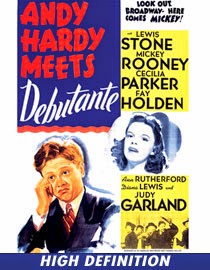
Classic Films in Focus: ANDY HARDY MEETS DEBUTANTE (1940)
This installment of the popular Andy Hardy series takes the Hardy family out of idyllic Carvel and sends them off to New York City, where teenage Andy promptly gets himself into all kinds of trouble. Despite the change of venue, it’s a typical Andy Hardy story, with youthful mistakes, romantic entanglements, and Mickey Rooney’s boundless zeal. You don’t have to have seen all of the previous Hardy pictures to drop into the action, although it does help if you have seen Love Finds Andy Hardy (1938), the earlier movie that introduces Judy Garland’s Betsy Booth character. Garland’s return to the world of the Hardy family makes Andy Hardy Meets Debutante a particularly appealing picture for fans of her collaborations with the energetic Rooney. For newcomers, the distinctive mix of adolescent romance, humor, and wide-eyed American idealism sums up the essence of the Hardy films’ enduring appeal.
At home in Carvel, Andy is nursing a crush on New York society girl, Daphne Fowler (Diana Lewis), and he foolishly brags about knowing her when his friends discover his passion. Andy is forced to prove his claims when Judge Hardy (Lewis Stone) takes the whole family to New York as part of his mission to protect the Carvel Orphanage from big city lawyers who want to defund it. Andy’s friend, Betsy (Judy Garland), tries to help him, but Andy suffers a series of shocks to his ego as he attempts to meet Daphne, and even Judge Hardy becomes concerned about the implications of Andy’s behavior.
Part of Andy Hardy’s appeal is his penchant for getting into scrapes; neither an angel nor a complete reprobate, he’s a twentieth-century Tom Sawyer with a waggish sense of fun and a lively eye for the ladies. Wherever Andy goes, girl trouble follows, and in this outing he has Polly Benedict (Ann Rutherford), Betsy, and Daphne to juggle. Andy thinks he’s too sophisticated for Polly, and he treats Betsy like a kid, but he soon finds out that the wealthy Daphne is out of his league. “There are millions of nice people in the world,” Daphne’s mother tells him, “and Daphne can’t be friends with all of them.” The irony of his comeuppance never seems to dawn on Andy, but the audience sees quite clearly that he reaps as he has sown. His taste in girls needs adjusting, anyway, if he can favor Daphne over her more available competition. Polly, the hometown favorite, wins our approval thanks to Ann Rutherford’s flashing eyes and bold manner, while Judy Garland makes Betsy so sweet and sadly lovestruck that we root for her even though we know that Polly has already staked her claim. Garland’s performance of “Alone,” which starts as a gag and ends with tears, is an emotional highlight of the picture that showcases the young star’s tremendous talent.
Comedy tempered with sentiment is the Andy Hardy formula, and the threat to the orphanage provides a counterweight to Andy’s romantic hijinks. Judge Hardy proves his faith in the system, lectures Andy on American ideals, and wins over a courtroom with the assistance of an adorable orphan, all of which will strike modern viewers as terribly naive. Still, with the Depression in the rearview mirror and the war directly ahead, Americans in 1940 must have wanted very much to believe in the benevolent paternal authority that Judge Hardy embodies. Andy’s relationship with his father gets a great deal of play, while his mother, aunt, and sister hardly make appearances at all. The serious part of Andy Hardy Meets Debutante has nothing to do with women but concerns itself with Andy’s emerging identity as a man with a particular place in the world.
The Andy Hardy series continued until 1958, when Mickey Rooney made his final bow as the character in Andy Hardy Comes Home. George B. Seitz directed most of the Andy Hardy pictures, beginning with A Family Affair (1937), You’re Only Young Once (1937), and Judge Hardy’s Children (1938). For more of Mickey Rooney’s youthful roles, see A Midsummer Night’s Dream (1935), Captains Courageous (1937), and Boys Town (1938). Diana Lewis, who was married to William Powell for more than forty years, retired from acting in the early 1940s after roles in Bitter Sweet (1940), Go West (1940), and Johnny Eager (1941). If you enjoy the collaborative work of Rooney and Garland, be sure to see their musicals together, particularly Babes in Arms (1939), Strike Up the Band (1940), and Babes on Broadway (1941).
Andy Hardy Meets Debutante is currently available for streaming on Warner Archive Instant.
At home in Carvel, Andy is nursing a crush on New York society girl, Daphne Fowler (Diana Lewis), and he foolishly brags about knowing her when his friends discover his passion. Andy is forced to prove his claims when Judge Hardy (Lewis Stone) takes the whole family to New York as part of his mission to protect the Carvel Orphanage from big city lawyers who want to defund it. Andy’s friend, Betsy (Judy Garland), tries to help him, but Andy suffers a series of shocks to his ego as he attempts to meet Daphne, and even Judge Hardy becomes concerned about the implications of Andy’s behavior.
Part of Andy Hardy’s appeal is his penchant for getting into scrapes; neither an angel nor a complete reprobate, he’s a twentieth-century Tom Sawyer with a waggish sense of fun and a lively eye for the ladies. Wherever Andy goes, girl trouble follows, and in this outing he has Polly Benedict (Ann Rutherford), Betsy, and Daphne to juggle. Andy thinks he’s too sophisticated for Polly, and he treats Betsy like a kid, but he soon finds out that the wealthy Daphne is out of his league. “There are millions of nice people in the world,” Daphne’s mother tells him, “and Daphne can’t be friends with all of them.” The irony of his comeuppance never seems to dawn on Andy, but the audience sees quite clearly that he reaps as he has sown. His taste in girls needs adjusting, anyway, if he can favor Daphne over her more available competition. Polly, the hometown favorite, wins our approval thanks to Ann Rutherford’s flashing eyes and bold manner, while Judy Garland makes Betsy so sweet and sadly lovestruck that we root for her even though we know that Polly has already staked her claim. Garland’s performance of “Alone,” which starts as a gag and ends with tears, is an emotional highlight of the picture that showcases the young star’s tremendous talent.
Comedy tempered with sentiment is the Andy Hardy formula, and the threat to the orphanage provides a counterweight to Andy’s romantic hijinks. Judge Hardy proves his faith in the system, lectures Andy on American ideals, and wins over a courtroom with the assistance of an adorable orphan, all of which will strike modern viewers as terribly naive. Still, with the Depression in the rearview mirror and the war directly ahead, Americans in 1940 must have wanted very much to believe in the benevolent paternal authority that Judge Hardy embodies. Andy’s relationship with his father gets a great deal of play, while his mother, aunt, and sister hardly make appearances at all. The serious part of Andy Hardy Meets Debutante has nothing to do with women but concerns itself with Andy’s emerging identity as a man with a particular place in the world.
The Andy Hardy series continued until 1958, when Mickey Rooney made his final bow as the character in Andy Hardy Comes Home. George B. Seitz directed most of the Andy Hardy pictures, beginning with A Family Affair (1937), You’re Only Young Once (1937), and Judge Hardy’s Children (1938). For more of Mickey Rooney’s youthful roles, see A Midsummer Night’s Dream (1935), Captains Courageous (1937), and Boys Town (1938). Diana Lewis, who was married to William Powell for more than forty years, retired from acting in the early 1940s after roles in Bitter Sweet (1940), Go West (1940), and Johnny Eager (1941). If you enjoy the collaborative work of Rooney and Garland, be sure to see their musicals together, particularly Babes in Arms (1939), Strike Up the Band (1940), and Babes on Broadway (1941).
Andy Hardy Meets Debutante is currently available for streaming on Warner Archive Instant.
Friday, July 12, 2013
Putting on a Show: Mickey Rooney and Judy Garland
Note: This post is part of the Dynamic Duos Blogathon hosted by Once Upon a Screen and Classic Movie Hub. Visit the host sites for complete lists of all of the great blogs participating in this event!
Looking back, they seem like such different Hollywood creatures: Mickey Rooney, so resilient and tough that in 2013 he’s still with us after more than 300 film and television appearances, and Judy Garland, a bright but fragile star who blazed through fewer than 40 roles before her tragically premature death in 1969. Together, though, they made nine films and ruled the screen as one of the most popular Hollywood duos of the classic era, beginning with Thoroughbreds Don’t Cry in 1937 and ending in 1948 with Words and Music.
What made Rooney and Garland such a hit with audiences? It had - and still has - a lot to do with their youth and the fresh-faced, innocent quality of their onscreen chemistry. At their best, in films like Babes in Arms (1939) and Strike Up the Band (1940), their romantic attraction has a sweetness wholly unassociated with sex. Theirs is a puppy love, eager, sentimental, and simply told if they can just get themselves to grow up enough to say it. They are the boy and the girl next door, denizens of an unfallen age, where putting on a show can solve almost any problem life can dish out.
When they made their first film together in 1937, Garland was still a relative newcomer, but Rooney was already a big star, thanks to his breakthrough title role in the Mickey McGuire shorts and performances in feature films like A Midsummer Night’s Dream (1935), Little Lord Fauntleroy (1936), and Captains Courageous (1937). The lead in the first Andy Hardy film, A Family Affair (1937), helped to propel him to even greater fame, and from 1939 to 1941 the short, boyish star was the top box office actor in the country.
Judy’s own star was rising in those years, especially after the huge success of The Wizard of Oz in 1939. She had become part of the Andy Hardy cast with Love Finds Andy Hardy in 1938, and she went on to appear with Rooney in two more of the Hardy films: Andy Hardy Meets Debutante (1940) and Life Begins for Andy Hardy (1941). Andy Hardy, however, already had his primary love interest in Polly Benedict, played by Ann Rutherford, so Garland’s Betsy Booth generally pined in vain for Andy’s affection.
In the “show” pictures the pair really got to demonstrate their compatibility, dancing, singing, plotting, and laughing together as various characters who stage musical revues to save their families, themselves, or their schools. Mickey possesses an almost manic energy in these movies, with big gags, wild dance routines, and crazy costumes. Judy, wide-eyed and adorable, does not yet reveal the toll her fame would take, and her musical performances seem almost effortless.
Judy’s characters tend to be the sincerer and more sensible ones, while Mickey’s hot-blooded young fellows often need to be reminded of the core values of friendship, honesty, and integrity. When MGM varies that formula, as they do in Girl Crazy (1943), things can go a bit off the rails, but when they get it just right in the earlier films, like Strike Up the Band, they really show the two stars at their irresistible best.
If you want to see the Rooney and Garland films for yourself, Turner Classic Movies has a DVD collection of four of their collaborations: Babes in Arms, Strike Up the Band, Babes on Broadway, and Girl Crazy. It includes introductions from Mickey Rooney for each of the films, in which he talks about his memories of Judy Garland and their time together. Warner Archive has also just released a new volume of Andy Hardy films on DVD, which includes Love Finds Andy Hardy. The other Hardy films with Judy Garland are included on an earlier volume of the collection. Babes on Broadway is also currently available on Warner Archive Instant.
Looking back, they seem like such different Hollywood creatures: Mickey Rooney, so resilient and tough that in 2013 he’s still with us after more than 300 film and television appearances, and Judy Garland, a bright but fragile star who blazed through fewer than 40 roles before her tragically premature death in 1969. Together, though, they made nine films and ruled the screen as one of the most popular Hollywood duos of the classic era, beginning with Thoroughbreds Don’t Cry in 1937 and ending in 1948 with Words and Music.
What made Rooney and Garland such a hit with audiences? It had - and still has - a lot to do with their youth and the fresh-faced, innocent quality of their onscreen chemistry. At their best, in films like Babes in Arms (1939) and Strike Up the Band (1940), their romantic attraction has a sweetness wholly unassociated with sex. Theirs is a puppy love, eager, sentimental, and simply told if they can just get themselves to grow up enough to say it. They are the boy and the girl next door, denizens of an unfallen age, where putting on a show can solve almost any problem life can dish out.
When they made their first film together in 1937, Garland was still a relative newcomer, but Rooney was already a big star, thanks to his breakthrough title role in the Mickey McGuire shorts and performances in feature films like A Midsummer Night’s Dream (1935), Little Lord Fauntleroy (1936), and Captains Courageous (1937). The lead in the first Andy Hardy film, A Family Affair (1937), helped to propel him to even greater fame, and from 1939 to 1941 the short, boyish star was the top box office actor in the country.
Judy’s own star was rising in those years, especially after the huge success of The Wizard of Oz in 1939. She had become part of the Andy Hardy cast with Love Finds Andy Hardy in 1938, and she went on to appear with Rooney in two more of the Hardy films: Andy Hardy Meets Debutante (1940) and Life Begins for Andy Hardy (1941). Andy Hardy, however, already had his primary love interest in Polly Benedict, played by Ann Rutherford, so Garland’s Betsy Booth generally pined in vain for Andy’s affection.
In the “show” pictures the pair really got to demonstrate their compatibility, dancing, singing, plotting, and laughing together as various characters who stage musical revues to save their families, themselves, or their schools. Mickey possesses an almost manic energy in these movies, with big gags, wild dance routines, and crazy costumes. Judy, wide-eyed and adorable, does not yet reveal the toll her fame would take, and her musical performances seem almost effortless.
Judy’s characters tend to be the sincerer and more sensible ones, while Mickey’s hot-blooded young fellows often need to be reminded of the core values of friendship, honesty, and integrity. When MGM varies that formula, as they do in Girl Crazy (1943), things can go a bit off the rails, but when they get it just right in the earlier films, like Strike Up the Band, they really show the two stars at their irresistible best.
If you want to see the Rooney and Garland films for yourself, Turner Classic Movies has a DVD collection of four of their collaborations: Babes in Arms, Strike Up the Band, Babes on Broadway, and Girl Crazy. It includes introductions from Mickey Rooney for each of the films, in which he talks about his memories of Judy Garland and their time together. Warner Archive has also just released a new volume of Andy Hardy films on DVD, which includes Love Finds Andy Hardy. The other Hardy films with Judy Garland are included on an earlier volume of the collection. Babes on Broadway is also currently available on Warner Archive Instant.
Tuesday, July 9, 2013
Classic Films in Focus: ZIEGFELD FOLLIES (1945)
Florenz Ziegfeld, Jr. and his legacy captivated Hollywood, especially once the rise of the talkies made Ziegfeld style entertainments possible onscreen. Most classic Hollywood musicals opt for a narrative framework to hold their production numbers together, but others, like Ziegfeld Follies (1945), take the master’s approach to the musical and comedy revue. If you’re looking for a plot or any real meaning, you certainly won’t find it here, but you will find a charming collection of sketches and musical numbers performed by some of the biggest stars of the day, including Fred Astaire, Judy Garland, and Gene Kelly.
The revue opens as a kind of sequel to The Great Ziegfeld (1936), with William Powell reprising his role as the Broadway producer, now relocated to heavenly quarters. As Ziegfeld looks back on his career and ponders the kind of show he would make if he were still alive, the film transitions to a series of comedy bits, dances, and songs, mostly featuring MGM stars of the 1940s with a few nods to the old days thrown in.
The retrospective segment is done with stop-motion animation, which gets the picture off to a quirky start that kids might appreciate more than adults. Several of the other sequences also favor oddity over artistry, especially the comedy sketches with Fanny Brice and Red Skelton, but both of those stars know their way around a laugh, and Brice’s appearance brings some real Ziegfeld history to the film. Less successful is the pink circus number that sees Lucille Ball inexplicably cracking a whip at a crowd of sexy cat ladies; it would make more sense if this number were also played for laughs, but Ball is presented in full glamor mode, and the sequence seems to take itself seriously, even if the audience can’t. The Virginia O’Brien song, however, is lovably offbeat, just like the singer herself. O’Brien counters the opening song’s tribute to lovely ladies by singing the praises of manly men; the performance prefigures her memorable “Wild, Wild West” number in The Harvey Girls (1946), which would come out the next year.
Fans of Fred Astaire will find a lot to like in Ziegfeld Follies because he appears more often than any other performer in the film, but the highlight is a rare dance duet with Gene Kelly, which offers a first-rate opportunity to contrast the physical styles of the two stars. Other memorable performances include Lena Horne singing “Love” and Judy Garland giving a mock interview as a great dramatic actress. You’ll also find Cyd Charisse, Kathryn Grayson, Lucille Bremer, James Melton, Marion Bell, and Esther Williams in the revue’s more serious numbers, while Edward Arnold, Hume Cronyn, Victor Moore, William Frawley, and Keenan Wynn all appear in the comedy sketches.
Different directors worked on various segments of the picture, including Vincente Minnelli, George Sidney, Lemuel Ayers, and Charles Walters. If you enjoy the musical revue format, try Till the Clouds Roll By (1946) and That’s Entertainment! (1974). For more Ziegfeld films, see The Great Ziegfeld (1936) and Ziegfeld Girl (1941). Ziegfeld also appears as a character in many Broadway star stories, including The Jolson Story (1946), The Story of Will Rogers (1952), The Eddie Cantor Story (1953), and Funny Girl (1968).
You can currently see Ziegfeld Follies in HD on Warner Archive Instant.
The revue opens as a kind of sequel to The Great Ziegfeld (1936), with William Powell reprising his role as the Broadway producer, now relocated to heavenly quarters. As Ziegfeld looks back on his career and ponders the kind of show he would make if he were still alive, the film transitions to a series of comedy bits, dances, and songs, mostly featuring MGM stars of the 1940s with a few nods to the old days thrown in.
The retrospective segment is done with stop-motion animation, which gets the picture off to a quirky start that kids might appreciate more than adults. Several of the other sequences also favor oddity over artistry, especially the comedy sketches with Fanny Brice and Red Skelton, but both of those stars know their way around a laugh, and Brice’s appearance brings some real Ziegfeld history to the film. Less successful is the pink circus number that sees Lucille Ball inexplicably cracking a whip at a crowd of sexy cat ladies; it would make more sense if this number were also played for laughs, but Ball is presented in full glamor mode, and the sequence seems to take itself seriously, even if the audience can’t. The Virginia O’Brien song, however, is lovably offbeat, just like the singer herself. O’Brien counters the opening song’s tribute to lovely ladies by singing the praises of manly men; the performance prefigures her memorable “Wild, Wild West” number in The Harvey Girls (1946), which would come out the next year.
Fans of Fred Astaire will find a lot to like in Ziegfeld Follies because he appears more often than any other performer in the film, but the highlight is a rare dance duet with Gene Kelly, which offers a first-rate opportunity to contrast the physical styles of the two stars. Other memorable performances include Lena Horne singing “Love” and Judy Garland giving a mock interview as a great dramatic actress. You’ll also find Cyd Charisse, Kathryn Grayson, Lucille Bremer, James Melton, Marion Bell, and Esther Williams in the revue’s more serious numbers, while Edward Arnold, Hume Cronyn, Victor Moore, William Frawley, and Keenan Wynn all appear in the comedy sketches.
Different directors worked on various segments of the picture, including Vincente Minnelli, George Sidney, Lemuel Ayers, and Charles Walters. If you enjoy the musical revue format, try Till the Clouds Roll By (1946) and That’s Entertainment! (1974). For more Ziegfeld films, see The Great Ziegfeld (1936) and Ziegfeld Girl (1941). Ziegfeld also appears as a character in many Broadway star stories, including The Jolson Story (1946), The Story of Will Rogers (1952), The Eddie Cantor Story (1953), and Funny Girl (1968).
You can currently see Ziegfeld Follies in HD on Warner Archive Instant.
Sunday, June 30, 2013
Classic Films in Focus: GIRL CRAZY (1943)
By 1943, Mickey Rooney and Judy Garland had made more than half a dozen movies together, so Girl Crazy (1943) was both a return to a tested formula and an attempt to do something a little different with the two stars. Once again we have the “let’s put on a show” plot that justifies a series of musical numbers, but Rooney and Garland’s characters have more mature parts to play and a more complicated twist to their usual romance. Fans of the two stars will probably like this picture well enough, but Girl Crazy doesn’t come off quite as successfully as their earlier collaborations, largely because of the way the story sets up the main characters and their relationships.
Rooney is Danny Churchill, Jr., a rich man’s son and a playboy who has an eye for the ladies. In order to make something of him, his father ships Danny off to a remote Western college with no female students, but Danny promptly meets the dean’s granddaughter, Ginger (Judy Garland), and tries to impress her. Ginger rebuffs Danny’s advances at first, but eventually she warms up to him, and the two decide to stage a Western rodeo show to save the college from closing.
The sweet, adolescent quality of Rooney and Garland’s romance is a big part of their earlier films’ appeal, but in Girl Crazy Rooney’s character comes off as something of a masher, putting the moves on every girl he sees, and it’s harder to accept him as an adult romantic lead. He looks foolishly out of place, whether partying on stage in his tuxedo or moseying about the desert in his ridiculous cowboy duds. If Ginger has the pick of every handsome man in town, why would she go for the short, overeager Danny? Their love affairs make more sense when the two are childhood friends and sweethearts from the start, as they are in Babes in Arms (1939). Garland’s character is also problematic; Ginger is very much a Ginger Rogers personality, prickly and resistant to romance, which works great in the Fred and Ginger movies but not so much here. Ginger Rogers had, in fact, originated the role in the 1930 Broadway production, and the character was renamed "Ginger" from the original "Molly" in her honor. Once she decides to like Danny, Ginger’s character works better as a Judy Garland role, but she never manages the perfect balance of attraction and repulsion that makes Rogers so much fun in films like Swing Time (1936).
Despite these problems, there are things to like about Girl Crazy. Big band fans will love seeing Tommy Dorsey and his orchestra in several numbers, with Dorsey playing himself as one of Danny’s nightclub friends. Guy Kibbee is lovable as the college dean, and a young Nancy Walker livens up the group as Ginger’s streetwise cousin, Polly. June Allyson makes an early feature film appearance as a specialty singer, and Busby Berkeley directs a particularly lavish Western finale featuring the song, “I’ve Got Rhythm.” Other musical highlights include “Bidin’ My Time” and “Fascinating Rhythm.” Even if she’s not ideally suited to her character, Garland looks and sounds great, and Rooney also gets a fun number in “Could You Use Me.”
Try the earlier Judy Garland and Mickey Rooney films for a chance to see the two stars in their best collaborations, starting with Love Finds Andy Hardy (1938) and Babes in Arms (1939). Garland, of course, is best remembered for The Wizard of Oz (1939), but see some of her later musicals, too, including Meet Me in St. Louis (1944), The Harvey Girls (1946), and Easter Parade (1948). Mickey Rooney, a living legend in 2013, has earned four Oscar nominations and appeared in more than 300 films and television programs, starting with the Mickey McGuire shorts of the late 1920s. Catch him in Little Lord Fauntleroy (1936), A Family Affair (1937), and Captains Courageous (1937) for some of his best adolescent roles. Norman Taurog, who directed everything except the finale, also directed Mickey Rooney in Boys Town (1937), Young Tom Edison (1940), and Men of Boys Town (1941).
Rooney is Danny Churchill, Jr., a rich man’s son and a playboy who has an eye for the ladies. In order to make something of him, his father ships Danny off to a remote Western college with no female students, but Danny promptly meets the dean’s granddaughter, Ginger (Judy Garland), and tries to impress her. Ginger rebuffs Danny’s advances at first, but eventually she warms up to him, and the two decide to stage a Western rodeo show to save the college from closing.
The sweet, adolescent quality of Rooney and Garland’s romance is a big part of their earlier films’ appeal, but in Girl Crazy Rooney’s character comes off as something of a masher, putting the moves on every girl he sees, and it’s harder to accept him as an adult romantic lead. He looks foolishly out of place, whether partying on stage in his tuxedo or moseying about the desert in his ridiculous cowboy duds. If Ginger has the pick of every handsome man in town, why would she go for the short, overeager Danny? Their love affairs make more sense when the two are childhood friends and sweethearts from the start, as they are in Babes in Arms (1939). Garland’s character is also problematic; Ginger is very much a Ginger Rogers personality, prickly and resistant to romance, which works great in the Fred and Ginger movies but not so much here. Ginger Rogers had, in fact, originated the role in the 1930 Broadway production, and the character was renamed "Ginger" from the original "Molly" in her honor. Once she decides to like Danny, Ginger’s character works better as a Judy Garland role, but she never manages the perfect balance of attraction and repulsion that makes Rogers so much fun in films like Swing Time (1936).
Despite these problems, there are things to like about Girl Crazy. Big band fans will love seeing Tommy Dorsey and his orchestra in several numbers, with Dorsey playing himself as one of Danny’s nightclub friends. Guy Kibbee is lovable as the college dean, and a young Nancy Walker livens up the group as Ginger’s streetwise cousin, Polly. June Allyson makes an early feature film appearance as a specialty singer, and Busby Berkeley directs a particularly lavish Western finale featuring the song, “I’ve Got Rhythm.” Other musical highlights include “Bidin’ My Time” and “Fascinating Rhythm.” Even if she’s not ideally suited to her character, Garland looks and sounds great, and Rooney also gets a fun number in “Could You Use Me.”
Try the earlier Judy Garland and Mickey Rooney films for a chance to see the two stars in their best collaborations, starting with Love Finds Andy Hardy (1938) and Babes in Arms (1939). Garland, of course, is best remembered for The Wizard of Oz (1939), but see some of her later musicals, too, including Meet Me in St. Louis (1944), The Harvey Girls (1946), and Easter Parade (1948). Mickey Rooney, a living legend in 2013, has earned four Oscar nominations and appeared in more than 300 films and television programs, starting with the Mickey McGuire shorts of the late 1920s. Catch him in Little Lord Fauntleroy (1936), A Family Affair (1937), and Captains Courageous (1937) for some of his best adolescent roles. Norman Taurog, who directed everything except the finale, also directed Mickey Rooney in Boys Town (1937), Young Tom Edison (1940), and Men of Boys Town (1941).
Thursday, June 20, 2013
Classic Films in Focus: BABES IN ARMS (1939)
The Busby Berkeley musical Babes in Arms (1939) proved an important moment in Mickey Rooney’s career; his role as showbiz hopeful Mickey Moran earned him his first Oscar nomination for Best Actor, in a year when the competition included Clark Gable for Gone with the Wind, Laurence Olivier for Wuthering Heights, and Jimmy Stewart for Mr. Smith Goes to Washington. They would all lose to Robert Donat for Goodbye, Mr. Chips, but the nomination put Rooney at the top of Hollywood’s list of leading men when he was still a teenager. It was also his first musical with Judy Garland as his leading lady; the two had appeared in films together before, but the new formula would be a big enough hit to inspire a whole series of Garland and Rooney musicals. Today, Babes in Arms shows its age, especially in some of its vaudeville numbers, but it still offers plenty to interest fans of its two young stars.
Rooney stars as Michael “Mickey” Moran, a child of vaudeville performers who have fallen on hard times with the rise of the talkies. Along with his girlfriend, Patsy (Judy Garland), his sister, Molly (Betty Jaynes), and their pal, Don (Douglas McPhail), Mickey hopes to turn things around for the older entertainers by staging a new show with the other kids. There’s a lot riding on their success, since meddlesome Miss Steele (Margaret Hamilton) is trying to have all of the youngsters sent away to learn trades at a state work school. The assistance of former child star Baby Rosalie (June Preisser) might save the show, but only if it doesn’t ruin Mickey and Patsy’s relationship.
Rooney is more a comedian than a singer, but he gets plenty of opportunities to exercise his usual energetic humor, and his impressions of Clark Gable and Lionel Barrymore are especially funny. Garland looks achingly young, even more so than she does in her better known film from that year, The Wizard of Oz. The two share a sweet, innocent chemistry that justifies their frequent pairings, and both of them carry their more dramatic scenes effectively. They get ample support from older actors like Charles Winninger, Guy Kibbee, Margaret Hamilton, and Henry Hull, but June Preisser proves a real scene-stealer as Baby Rosalie, a Shirley Temple type whose precious act has grown stale with adolescence. Preisser also does some jaw-dropping acrobatics that you have to see to believe; it’s worth noting that Preisser, Rooney, and Garland had all been vaudeville performers in real life before they made the jump to films.
The songs in Babes in Arms cover a lot of territory, although viewers will recognize several of them from their use in the later classic, Singin’ in the Rain (1952). Busby Berkeley directs most of the numbers with great restraint considering his penchant for dizzy spectacle, but he does provide a more traditional Berkeley treatment for the finale of “God’s Country.” The number that will give most viewers pause is the minstrel sequence, done with the entire group of youngsters, including Rooney and Garland, in full blackface. Despite its attempt to pay tribute to the vaudeville convention, the number is sure to make modern audiences profoundly uncomfortable, if not outraged, by its use of the most noxious racial stereotypes. Fortunately, the performance gets cut short by a plot point, but it goes on much too long for anyone watching it today. Be prepared to have a thoughtful discussion about the history of blackface in Hollywood if you watch this picture with the family.
Babes in Arms also earned an Oscar nomination for Best Music Scoring. For more of Rooney and Garland’s musicals, see Strike Up the Band (1940), Babes on Broadway (1941), and Girl Crazy (1943). Busby Berkeley is best remembered for gloriously surreal musical productions in 42nd Street (1933), Gold Diggers of 1933 (1933), and Footlight Parade (1933). June Preisser also appears in Strike Up the Band and with Rooney in two of the Andy Hardy films. Groomed as the next Jeanette MacDonald and Nelson Eddy, neither Betty Jaynes nor Douglas McPhail ever became stars, but they were actually married to one another from 1938-1941, which casts an interesting light on their performance as sweethearts in Babes in Arms.
Rooney stars as Michael “Mickey” Moran, a child of vaudeville performers who have fallen on hard times with the rise of the talkies. Along with his girlfriend, Patsy (Judy Garland), his sister, Molly (Betty Jaynes), and their pal, Don (Douglas McPhail), Mickey hopes to turn things around for the older entertainers by staging a new show with the other kids. There’s a lot riding on their success, since meddlesome Miss Steele (Margaret Hamilton) is trying to have all of the youngsters sent away to learn trades at a state work school. The assistance of former child star Baby Rosalie (June Preisser) might save the show, but only if it doesn’t ruin Mickey and Patsy’s relationship.
Rooney is more a comedian than a singer, but he gets plenty of opportunities to exercise his usual energetic humor, and his impressions of Clark Gable and Lionel Barrymore are especially funny. Garland looks achingly young, even more so than she does in her better known film from that year, The Wizard of Oz. The two share a sweet, innocent chemistry that justifies their frequent pairings, and both of them carry their more dramatic scenes effectively. They get ample support from older actors like Charles Winninger, Guy Kibbee, Margaret Hamilton, and Henry Hull, but June Preisser proves a real scene-stealer as Baby Rosalie, a Shirley Temple type whose precious act has grown stale with adolescence. Preisser also does some jaw-dropping acrobatics that you have to see to believe; it’s worth noting that Preisser, Rooney, and Garland had all been vaudeville performers in real life before they made the jump to films.
The songs in Babes in Arms cover a lot of territory, although viewers will recognize several of them from their use in the later classic, Singin’ in the Rain (1952). Busby Berkeley directs most of the numbers with great restraint considering his penchant for dizzy spectacle, but he does provide a more traditional Berkeley treatment for the finale of “God’s Country.” The number that will give most viewers pause is the minstrel sequence, done with the entire group of youngsters, including Rooney and Garland, in full blackface. Despite its attempt to pay tribute to the vaudeville convention, the number is sure to make modern audiences profoundly uncomfortable, if not outraged, by its use of the most noxious racial stereotypes. Fortunately, the performance gets cut short by a plot point, but it goes on much too long for anyone watching it today. Be prepared to have a thoughtful discussion about the history of blackface in Hollywood if you watch this picture with the family.
Babes in Arms also earned an Oscar nomination for Best Music Scoring. For more of Rooney and Garland’s musicals, see Strike Up the Band (1940), Babes on Broadway (1941), and Girl Crazy (1943). Busby Berkeley is best remembered for gloriously surreal musical productions in 42nd Street (1933), Gold Diggers of 1933 (1933), and Footlight Parade (1933). June Preisser also appears in Strike Up the Band and with Rooney in two of the Andy Hardy films. Groomed as the next Jeanette MacDonald and Nelson Eddy, neither Betty Jaynes nor Douglas McPhail ever became stars, but they were actually married to one another from 1938-1941, which casts an interesting light on their performance as sweethearts in Babes in Arms.
Wednesday, March 20, 2013
My Grandmother and Marjorie Main
In order to explain my deep and abiding affection for character actress Marjorie Main, I have to begin with my grandmother. Her name was Maudie Mae, and she was a big-boned country woman, born and raised in rural Alabama in the early part of the 20th century. She had a 7th grade education and an old-time preacher for a husband, and she was the youngest of 18 children of another preacher, a stony-faced man who held two Bibles when his photograph was taken.
Maudie, whom we called "Mamaw," loved loud outfits, musk perfume, and people of all kinds. She smelled like biscuits, which she turned out by the thousands in all the kitchens she called home. She erupted in a great whoop whenever she was surprised, and I'm pretty sure she told her entire life story to every K-Mart cashier and grocery clerk she ever met. She had a funny tendency toward malapropism and always referred to cheese as "cheeses." She wrapped up leftover rolls in restaurants and carried them home in her purse. She was rough around the edges and garrulous and fussy, and I loved her very much.
Watching Marjorie Main reminds me of Maudie Mae, sometimes so forcefully that I find myself in tears, even though my grandmother died more than 20 years ago. Main excelled at playing the kind of character my grandmother was in real life, and the actress does it so well that she always makes us love her for all her faults and hard edges. Like Maudie, Main was a preacher's daughter. Both would die of cancer, although Main had the longer life of the two. There are differences, of course. Main was well educated and never had any children, even though she played so many motherly types on film.
Ma Kettle is the role that came to define Main's career; she played the character in ten movies, from The Egg and I (1947) to The Kettles on Old MacDonald's Farm (1957). It's that Ma Kettle image that most strongly resembles my grandmother, always in turmoil but truly big-hearted, holding the family together with grits, glue, and gumption. Main inhabits similar types in many of her other films; she's a rough maternal force that we can't help but love, even if her antics sometimes embarrass her offspring. You'll find her playing the same type in Heaven Can Wait (1943) and Meet Me in St. Louis (1944).
If you want to appreciate Marjorie Main, here are 10 films in which she appears. Whether you've had a Mamaw in your life or not, Main is one of those actresses you'll be glad to see again and again, and she turns up in some very interesting places.
1) Stella Dallas (1937) - Main plays the mother of Barbara Stanwyck's working-class heroine in this film destined to wring tears from every tender-hearted viewer who has ever wept at Dumbo.
2) The Women (1939) - In this all-female drama, Main appears as the proprietor of a divorce ranch in Reno, making her the mother hen to a coterie of unhappy heroines, including Norma Shearer, Paulette Goddard, and Rosalind Russell.
3) A Woman's Face (1941) - Main is almost unrecognizable as the white-haired, sour-faced housekeeper in this Joan Crawford melodrama. If you want to see a different side of the actress, this is the movie to watch.
4) Heaven Can Wait (1943) - Who would believe Eugene Pallette and Marjorie Main as the parents of a heroine as lovely as Gene Tierney? The two revel in a comic goldmine during their scenes, especially during a heated argument over the possession of the funny papers.
5) Meet Me in St. Louis (1944) - Even though she's technically the family's maid, Main still exudes crusty maternal devotion to the Smith clan, watching over Judy Garland, Margaret O'Brien, and the rest of the household.
6) The Harvey Girls (1946) - Once again appearing with Judy Garland, Main provides maternal guidance for a group of young ladies hired to tend a Harvey House, including Garland, Cyd Charisse, and Virginia O'Brien.
7) The Egg and I (1947) - In her first appearance as Ma Kettle, Main steals the picture from Claudette Colbert and Fred MacMurray, with some help from Percy Kilbride as the shiftless Pa.
8) Ma and Pa Kettle (1949) - Main and Kilbride begin their series of stand-alone Kettle films with this picture, in which Pa wins the grand prize for inventing a new tobacco slogan. Their 15 children make sure that the chaos never lets up. I'm pretty sure that my grandmother would have found this movie hilarious, and it's certainly a favorite with my father, her youngest son.
9) Summer Stock (1950) - Here's a third pairing of Main with Garland, this time with Main as the housekeeper to Garland's beleaguered heroine. Gene Kelly also stars.
10) The Long, Long Trailer (1953) - Main has a brief but memorable role in this comedy with Lucille Ball and Desi Arnaz.
This post is dedicated to the memory of my grandmother, Maudie Garlen, who was born in 1912 and died, too soon, in 1992. She was a great character, a good woman, and a glorious cook. The secrets of her butter roll have never been unraveled, and her chocolate pie has yet no equal. I will miss her for the rest of my life.
![]() |
| Mamaw (in the hat) with her sisters at a family reunion. |
Watching Marjorie Main reminds me of Maudie Mae, sometimes so forcefully that I find myself in tears, even though my grandmother died more than 20 years ago. Main excelled at playing the kind of character my grandmother was in real life, and the actress does it so well that she always makes us love her for all her faults and hard edges. Like Maudie, Main was a preacher's daughter. Both would die of cancer, although Main had the longer life of the two. There are differences, of course. Main was well educated and never had any children, even though she played so many motherly types on film.
Ma Kettle is the role that came to define Main's career; she played the character in ten movies, from The Egg and I (1947) to The Kettles on Old MacDonald's Farm (1957). It's that Ma Kettle image that most strongly resembles my grandmother, always in turmoil but truly big-hearted, holding the family together with grits, glue, and gumption. Main inhabits similar types in many of her other films; she's a rough maternal force that we can't help but love, even if her antics sometimes embarrass her offspring. You'll find her playing the same type in Heaven Can Wait (1943) and Meet Me in St. Louis (1944).
If you want to appreciate Marjorie Main, here are 10 films in which she appears. Whether you've had a Mamaw in your life or not, Main is one of those actresses you'll be glad to see again and again, and she turns up in some very interesting places.
1) Stella Dallas (1937) - Main plays the mother of Barbara Stanwyck's working-class heroine in this film destined to wring tears from every tender-hearted viewer who has ever wept at Dumbo.
2) The Women (1939) - In this all-female drama, Main appears as the proprietor of a divorce ranch in Reno, making her the mother hen to a coterie of unhappy heroines, including Norma Shearer, Paulette Goddard, and Rosalind Russell.
3) A Woman's Face (1941) - Main is almost unrecognizable as the white-haired, sour-faced housekeeper in this Joan Crawford melodrama. If you want to see a different side of the actress, this is the movie to watch.
4) Heaven Can Wait (1943) - Who would believe Eugene Pallette and Marjorie Main as the parents of a heroine as lovely as Gene Tierney? The two revel in a comic goldmine during their scenes, especially during a heated argument over the possession of the funny papers.
5) Meet Me in St. Louis (1944) - Even though she's technically the family's maid, Main still exudes crusty maternal devotion to the Smith clan, watching over Judy Garland, Margaret O'Brien, and the rest of the household.
6) The Harvey Girls (1946) - Once again appearing with Judy Garland, Main provides maternal guidance for a group of young ladies hired to tend a Harvey House, including Garland, Cyd Charisse, and Virginia O'Brien.
7) The Egg and I (1947) - In her first appearance as Ma Kettle, Main steals the picture from Claudette Colbert and Fred MacMurray, with some help from Percy Kilbride as the shiftless Pa.
8) Ma and Pa Kettle (1949) - Main and Kilbride begin their series of stand-alone Kettle films with this picture, in which Pa wins the grand prize for inventing a new tobacco slogan. Their 15 children make sure that the chaos never lets up. I'm pretty sure that my grandmother would have found this movie hilarious, and it's certainly a favorite with my father, her youngest son.
9) Summer Stock (1950) - Here's a third pairing of Main with Garland, this time with Main as the housekeeper to Garland's beleaguered heroine. Gene Kelly also stars.
10) The Long, Long Trailer (1953) - Main has a brief but memorable role in this comedy with Lucille Ball and Desi Arnaz.
This post is dedicated to the memory of my grandmother, Maudie Garlen, who was born in 1912 and died, too soon, in 1992. She was a great character, a good woman, and a glorious cook. The secrets of her butter roll have never been unraveled, and her chocolate pie has yet no equal. I will miss her for the rest of my life.
Monday, February 25, 2013
Classic Films in Focus: THAT'S ENTERTAINMENT! (1974)
One of the highlights of the new Best of Warner Bros. Musicals Collection is the 1974 montage picture, That's Entertainment!, which showcases some of the greatest moments in movie musical history, although admittedly with an MGM slant. For fans of the genre, the picture is a welcome chance to revisit favorite songs and stars and also catch a few more obscure moments from classic musicals. It's a sentimental and satisfying trip down memory lane, made even more nostalgic by the presence of many now departed stars as the hosts and hostesses of our journey.
The film goes all the way back to the early days of movie musicals and moves back and forth as it considers particular films and stars who have been influential in defining the genre. Not surprisingly, Fred Astaire and Gene Kelly get the lion's share of the attention, although Judy Garland and Liza Minnelli also have prominent spots, and non-musical stars like Jimmy Stewart and Elizabeth Taylor also make appearances. Short introductory segments filmed mostly on the now destroyed MGM backlot serve to organize the musical clips, which feature Singin' in the Rain (1952), Royal Wedding (1951), Meet Me in St. Louis (1944), The Harvey Girls (1946), and Good News (1947), among many others.
While the film includes all of the expected hits, the more offbeat segments might well appeal the most to musical fans, since here are numbers both unexpected and seldom seen. Clark Gable croons "Puttin' on the Ritz," and Jimmy Stewart and Joan Crawford both have their musical moments reviewed. Stewart provides some context for these numbers by recalling how eager the MGM studio heads were to try every performer out in a musical or two, regardless of actual talent for song and dance. Luckily, MGM found plenty of real ability in the stars who would become synonymous with the genre.
Most of the films included in the Best of Warner Collection are full-length musical narratives, including The Jazz Singer (1928), The Wizard of Oz (1939), Yankee Doodle Dandy (1942), and, naturally, Singin' in the Rain (1952). Even with 20 films in the set, however, there's a lot that has to be left out, and That's Entertainment! helps to fill in the gaps and provide an overview of the musical's history and appeal. The picture was a big enough success to spawn two theatrical sequels and a 1995 direct-to-video release, and you might track those down if you enjoy the original.
For more classic movie musicals, check out the rest of the films included in the Best of Warner Bros. 20 Film Collection, or use That's Entertainment! as a starting point to guide you on to the films of Fred Astaire, Gene Kelly, Judy Garland, Bing Crosby, Esther Williams, and June Allyson. For more Warner musicals, try Footlight Parade (1933) and other Busby Berkeley productions of the 1930s.
See also: "Warner releases lavish musicals collection" on Examiner.com
Disclaimer: Warner Bros. has provided a review copy of this film free of charge to the reviewer. No promise of a positive review is made to the studio in exchange for this product.
The film goes all the way back to the early days of movie musicals and moves back and forth as it considers particular films and stars who have been influential in defining the genre. Not surprisingly, Fred Astaire and Gene Kelly get the lion's share of the attention, although Judy Garland and Liza Minnelli also have prominent spots, and non-musical stars like Jimmy Stewart and Elizabeth Taylor also make appearances. Short introductory segments filmed mostly on the now destroyed MGM backlot serve to organize the musical clips, which feature Singin' in the Rain (1952), Royal Wedding (1951), Meet Me in St. Louis (1944), The Harvey Girls (1946), and Good News (1947), among many others.
While the film includes all of the expected hits, the more offbeat segments might well appeal the most to musical fans, since here are numbers both unexpected and seldom seen. Clark Gable croons "Puttin' on the Ritz," and Jimmy Stewart and Joan Crawford both have their musical moments reviewed. Stewart provides some context for these numbers by recalling how eager the MGM studio heads were to try every performer out in a musical or two, regardless of actual talent for song and dance. Luckily, MGM found plenty of real ability in the stars who would become synonymous with the genre.
Most of the films included in the Best of Warner Collection are full-length musical narratives, including The Jazz Singer (1928), The Wizard of Oz (1939), Yankee Doodle Dandy (1942), and, naturally, Singin' in the Rain (1952). Even with 20 films in the set, however, there's a lot that has to be left out, and That's Entertainment! helps to fill in the gaps and provide an overview of the musical's history and appeal. The picture was a big enough success to spawn two theatrical sequels and a 1995 direct-to-video release, and you might track those down if you enjoy the original.
For more classic movie musicals, check out the rest of the films included in the Best of Warner Bros. 20 Film Collection, or use That's Entertainment! as a starting point to guide you on to the films of Fred Astaire, Gene Kelly, Judy Garland, Bing Crosby, Esther Williams, and June Allyson. For more Warner musicals, try Footlight Parade (1933) and other Busby Berkeley productions of the 1930s.
See also: "Warner releases lavish musicals collection" on Examiner.com
Disclaimer: Warner Bros. has provided a review copy of this film free of charge to the reviewer. No promise of a positive review is made to the studio in exchange for this product.
Saturday, September 8, 2012
Classic Movie Stars for Kids
It’s
never too early to start watching old movies with your children; if they’re old
enough to appreciate Dumbo and Aladdin, then there are plenty of
classic movies they can enjoy, and you can watch with them and actually be
entertained by the experience. Introduce the youngsters in your life to classic
films with the movies of some of these iconic stars. Modern culture constantly
builds on and references the classics, so you'll be entertaining your children
at the same time that you make them smarter and savvier consumers of their own
generation's culture. You might even learn something yourself!
Charlie Chaplin - The Little
Tramp still has a magical effect, and children will be as charmed by his
sympathetic character as they are amused by the physical comedy. Be warned,
though, that Chaplin's best films mingle scenes of suffering and misery with
their comedy, and tender-hearted viewers may well end up in tears over the
indignities and disappointments endured by Chaplin's childlike hero. The Gold Rush (1925) had our resident
junior cinephile sobbing, but she proclaimed the picture a winner in the end.
Try Easy Street (1917) for a short
introduction to Chaplin's style, then move on to The Gold Rush (1925), The
Circus (1928), City Lights
(1931), and Modern Times (1936).
Revival versions of the silent films feature some narration and sound effects
as well as musical scores composed by Chaplin himself. Boys might appreciate
knowing that the films of Charlie Chaplin (as well as Buster Keaton) inspired
the signature style of movie kung-fu master Jackie Chan, whose pictures often
pay homage to specific scenes from Chaplin's films.
The Marx
Brothers
- Groucho, Harpo, Chico, and Zeppo are sure to make young viewers laugh with
their comic antics on the screen, while adults will appreciate the subtler
humor of Groucho's rapid patter. In addition to being zany comedians, the Marx
Brothers were accomplished musicians; kids will marvel at Chico's wild piano
numbers and Harpo's amazingly sophisticated performances on the harp. The
earliest films can be more difficult for younger viewers to follow; start with A Day at the Races (1937), and then move
on to Duck Soup (1933) and A Night in Casablanca (1946) for their
faster action and musical numbers. Kids will almost certainly find Virginia
O'Brien's bizarre lullaby number in The
Big Store (1941) hilarious, even though it ranks at the bottom of Marx
Brothers films for most fans. Kids who have seen Animaniacs cartoons will find the Marx Brothers well worth
watching; Wakko, Yakko, and Dot frequently take their comedy cues directly from
the original sibling team. In addition, your kids will finally know what those
silly glasses with the attached mustaches are all about.
Judy Garland - Most kids see
The Wizard of Oz (1939) at a very
early age, but Garland (born Frances Gumm) made other musicals that younger
viewers will also enjoy. In fact, The
Wizard of Oz might not be the best place to start with kids because it's
really a very frightening film, and plenty of adults will tell you that the
winged monkeys, the twister, and the Wicked Witch of the West all inspired
their childhood nightmares for years. Try Meet
Me in St. Louis (1944), The Harvey
Girls (1946), The Pirate (1948),
and Easter Parade (1948) for family
friendly musical performances from Garland and a host of Hollywood stars. The Harvey Girls is a particularly fun
picture with catchy songs and wonderful character actresses; it also features
Ray Bolger, who played the lovable Scarecrow in The Wizard of Oz. The romantic Easter
Parade might appeal most to older girls, while The Pirate offers silly Caribbean comedy that younger boys and
girls will probably enjoy equally well, especially because Gene Kelly puts in
an energetic performance as Garland's rakish love interest.
(For more about Judy Garland, see "10 classic movies starring Judy Garland" on Examiner.com.)
Burt Lancaster - For kids who
love action and adventure, you can hardly do better than Lancaster, whose early
career as a street acrobat and circus performer enabled him to include some
amazing feats of agility and physical prowess in his swashbuckler films. Look
for films that feature Lancaster's childhood friend and partner Nick Cravat;
these are the lighter, more family appropriate pictures from Lancaster's long
and varied career. The Flame and the
Arrow (1950) and The Crimson Pirate
(1952) are guaranteed winners, full of thrilling acrobatics and light-hearted
escapades. Cravat plays a mute character in both movies because his thick Bronx
accent just didn't work in a period setting, but like Charlie Chaplin he proved
to be a master of silent expression. Older kids who enjoy Lancaster's robust style
will also like The Professionals
(1966), but be careful about exposing younger viewers to Lancaster's grittier
work. If your youngsters demand more swashbuckling action, move on to classic
films from Errol Flynn and Tyrone Power, both of whom made outstanding examples
of the genre.
Don't
stop there! Classic movies abound with comedy, action, and music to keep the
whole family entertained all summer long. If you really want to embark on an
exploration of classic films with your kids, try picking up a copy of Ty Burr's
2007 book, The Best Old Movies for
Families: A Guide to Watching Together.
An earlier version of this article was originally posted on Examiner.com. The author retains all rights to this content.
Thursday, August 30, 2012
Classic Films in Focus: THE WIZARD OF OZ (1939)
Certainly
one of the top ten classic movies on almost any list, The Wizard of Oz (1939) has never ceased to attract new fans, and
it remains the definitive adaptation of L. Frank Baum's classic novel, despite
many contenders to that title both before and after. Its winning combination of
story, spectacle, and sound draws viewers into its magical world, and, unlike
Dorothy, they rarely yearn to go home. Directed by Victor Fleming (with help
from George Cukor, Mervyn Le Roy, and King Vidor) and starring the divinely
adorable Judy Garland, The Wizard of Oz
may well be the perfect first film for the classic movie newcomer.
Garland
stars as Dorothy Gale, a young Kansas girl who finds herself transported to the
fabulous land of Oz after a cyclone carries her away from home. Unfortunately
for Dorothy, her house crushes a wicked witch, which raises the ire of the
witch's even more wicked sister (Margaret Hamilton). Dorothy sets off for the
Emerald City in the hope that the powerful wizard there can return her to
Kansas, and along the way she acquires three companions: a sympathetic
Scarecrow (Ray Bolger), a sentimental Tin Man (Jack Haley), and a reluctant
Lion (Bert Lahr). At the wizard's command, the friends attempt to earn their
desired rewards by defeating the witch and her strange minions, but the
seemingly Great and Terrible Oz turns out to be a rather different character
from what they expected.
Beautifully
nuanced performances from each and every actor make the characters live in our
hearts. Garland is impossibly girlish and sweet, her big brown eyes round with
a sense of wonder that we can't help but share. Bolger, Haley, and Lahr all
endow their inhuman characters with tremendous humanity; they are funny because
they are so likably real, and there's a sweetly platonic sense of romance in
the Scarecrow's relationship with Dorothy. It's no wonder that she'll miss him
"most of all." Margaret Hamilton sets the bar for wicked witches
everywhere, and Frank Morgan pops up all over the place as an assortment of
different characters, suggesting the dreamlike nature of Dorothy's adventure.
Even
kids who have never known a world without 3D and CGI can appreciate the visual
artistry of The Wizard of Oz. Its
special effects have stood the test of time amazingly well, from the cyclone
bearing down on Dorothy's farm to the army of winged monkeys filling the sky.
The costumes and makeup still look fantastic, especially now that carefully
restored versions of the film are available on DVD and Blu-ray. If anything,
the effects and costumes might be too good for younger viewers; it's best to
think about a child's tolerance for winged monkey attacks, scarecrow
dismemberment, and witch melting before leaving your youngster to watch the
picture alone. On the plus side, that first glimpse of Technicolor Oz is a
moment of pure movie magic, an epiphany about film's unique ability to
transport us to other worlds and change the way we see our own.
The Wizard of Oz earned six
Oscar nominations; it won two, and Garland won a special Juvenile Award for her
performance. It might have done better at the Academy Awards had it not come
out in the single greatest year in Hollywood history, but that year would not
have been as great without it. For more of Judy Garland and Ray Bolger, see The Harvey Girls (1946). The character actors
who make up the cast of The Wizard of Oz
turn up in hundreds of classic movies; they were some of Hollywood's hardest
working performers, even though they never won or were even nominated for
Academy Awards. Garland, of course, has become one of the most beloved stars of
all time. See her in Meet Me in St. Louis
(1944), Easter Parade (1948), and A Star is Born (1954) for more of her
best performances.
This review was originally posted on Examiner.com. The author retains all rights to this content.
For more about Judy Garland, read "10 classic movies starring Judy Garland" on Examiner.com.
Subscribe to:
Posts (Atom)