Showing posts with label animated movies. Show all posts

Thursday, April 28, 2022

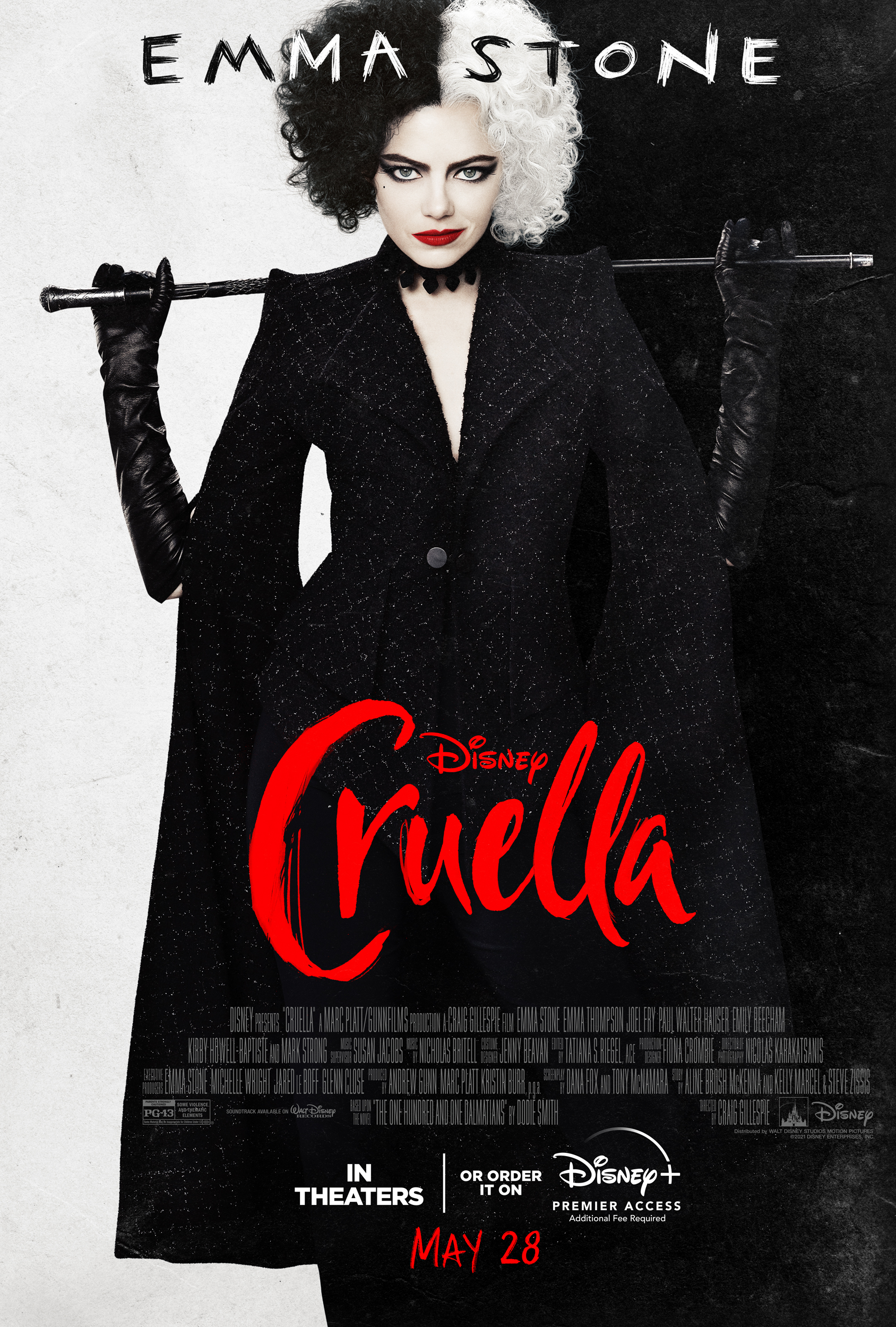
The What-If Alternate Timeline of CRUELLA (2021)

When it first arrived, Disney's 2021 reboot of the various films based on 101 Dalmatians was widely discussed as yet another "prequel" to a well-known Disney property, but in order to appreciate Cruella fully you have to stop thinking about it as a prequel and instead consider it as an alternate timeline narrative similar to the multiverse arcs now at work in the Marvel franchise. This is NOT the story of how the villain of the 1961 animated movie became that character, and it's not the story of the villain from the 1996 live action movie, either. Instead, Emma Stone's version of Cruella is a character with a narrative arc all her own, distinct from those of the other Cruellas but still affected by many of the same elements with alternate versions of the same characters. She's much like the central Loki character played by Tom Hiddleston in the Disney Plus series; she is one of many possible Cruella variants, some of whom are truly villainous and some of whom are dynamic enough to become protagonists in their own right rather than merely antagonists to more conventionally heroic characters. When read this way, Cruella becomes a much more interesting and engaging movie, one that rewrites the iconic villain, sure, but also one that reaches deep into the sources of inspiration that formed the original Disney character.


Fidelity to the 1961 animated classic is already an odd demand, not only because live action versions of that story were already made in the late 90s but because the original Disney movie is itself unfaithful to its source material in several significant ways. Dodie Smith's beloved 1956 children's novel features many characters and scenes that aren't in the Disney film. A third adult Dalmatian (the one actually named Perdita) is removed completely, with a dog originally named Missus assuming her name and erasing her from the story. The novel's Roger is wealthy because he is a "financial wizard" and not a struggling musician, so the family can afford all of their Dalmatians even when they end up with 101 of them (note that the 101st Dalmatian of the novel also isn't in the movie because he's the liver spotted love interest of the original Perdita). The Cruella of the book is more explicitly demonic and even more vicious than the movie version; she is also married to a submissive furrier who enables her obsession with fur coats. The changes don't make the Disney adaptation a bad movie, but they do make it a significantly different story from the novel. The live action versions get farther afield still, making Roger an American video game creator, Anita a fashion designer, and Cruella a fashion house owner and Anita's employer. In fact, the versions are so different (and set in different eras to boot) that the 2021 movie cannot possibly function as a true prequel to any of them.

Tallulah!

Instead, Cruella is its own story, a reinvention of the character that combines her most iconic traits with bits and pieces of the previous versions in order to make her a dynamic protagonist rather than a static villain. The movie does not attempt to make us like or forgive the other Cruellas; we like this new Cruella partly because she isn't them. Our glimpse of her childhood recalls the schoolgirl connection with Anita from the novel, her mannerisms are taken from the 1961 Disney film, and her fashion career is borrowed from the 1996 movie, but she is not simply a younger version of any of these characters. Disney opts to do something different by mining the tradition of the anti-heroine as filtered through one of the most important inspirations for the 1961 Cruella, the legendary actress and all around hellraiser Tallulah Bankhead. The film even signals the affiliation with a clip of Tallulah demonstrating her distinctive, throaty laugh in Alfred Hitchcock's 1944 thriller, Lifeboat. We see it play on a television set in a room with Estella/Cruella early in the story. Bankhead, known for her genius, self-destructive behavior, terrible driving, and theatrical personality, was definitely no saint, but this new version of Cruella has her charisma and charm as well as her less likeable qualities. It's refreshing to see a complicated, difficult, too-much female character be the heroine of her own life without having to be either a traditionally good person or a completely amoral anti-heroine of the Becky Sharp variety.

Because this Cruella is not the same as the previous versions, she can make different choices and develop different values. She loves fashion but isn't specifically obsessed with fur. She has a found family that she mistreats at times but ultimately loves, which includes several dogs. She is even the person who gives Pongo and Perdita to Roger and Anita, which she certainly wouldn't do if she wanted to make Dalmatian fur coats. Near the end of the movie, Cruella says about the Baroness: "The good thing about evil people is that you can always trust them to do something, well, evil." Cruella, despite her name, is not that kind of person, because her Estella side makes her capable of doing good. Currently, a sequel to the movie is in the works, and most fans and critics seem to expect it to launch us into the more familiar dog-napping, coat-making territory of the original story, but I really hope it doesn't go in that direction, because this Cruella deserves better. It's certainly possible that she might become a newer version of the Baroness, the murderous mother whom she deposes in the film, and therefore ruthless enough to become a full-blown villain, but it would be much more satisfying to see her continue to make bold new choices for herself, to continue to be the future she embodies in Cruella and not the past that she sees as the Baroness. To rope this Cruella back into the framework of the original story would be a grave disservice to her and to viewers who fell for her eccentric, outlandish personality.

I've watched Cruella a couple of times now, and while I have concerns about Disney's persistent efforts to strip mine its own properties, I think this movie is one of the best live action treatments of a classic Disney story and far more interesting and fun than the previous attempts to cash in on the Dalmatians' popularity, largely because it isn't about the dogs. It's fun, it's visually engaging, it features terrific performances from Stone and Emma Thompson, and it offers us a Disney "heroine" who is very different from the usual crowd of princesses and whose transgressive modernity is part of her appeal. I don't care that it isn't actually a prequel to 101 Dalmatians; that's why it works. This Cruella might well be brilliant and bad and a little bit mad, but she's more 70s counterculture rock goddess than maniacal puppy murderer, and I'd like to see any additional films about her continue to give her the freedom to be her own version of herself.



Tuesday, March 21, 2017

My Life in Films: Favorite Movies by Year

Film Twitter has prompted me to join in on the recent lists of people's favorite movies for each year of their lives. At 45, I feel like that's a lot of territory to cover, and of course a lot of the movies I watch these days came out long before I was born, but I have seen most of the big hits for most of the years in question.

I want to clarify my process a bit before I get to the actual list. As I looked at the films for each year, I asked myself the following questions:

1) Do I own the movie? If I didn't feel the need to buy it, then it's probably not my favorite.
2) How many times have I voluntarily watched this movie? Have I watched it again recently?
3) How much of this movie can I quote or recite from memory? The more of it I know by heart, the bigger the impression it has obviously made.
4) Do I own merchandise and/or clothing celebrating my love for this movie? Since I'm wearing a Yoda t-shirt as I type this post, it would be silly to pretend that I'm not a sucker for Star Wars and/or Muppets. Not all movies get merchandise, of course, but if I love something enough to wear it on a shirt I'm probably pretty attached to it.

I didn't pick the "best" movie from each year; I picked a favorite. I didn't think about Oscars or box office appeal (or lack thereof) or whether hipsters would approve of my choices. Sometimes the decisions were excruciatingly hard, and there are three or even four really close seconds that on a different day might get the edge over the one I chose today. I didn't pick any of these to impress anyone; I'm a lifelong geek with a deep love for science fiction, fantasy, Disney, animation, and comic books. I like quirky, funny stuff. I like super heroes. I picked movies that I go back to many times because they make me happy, so you won't see a lot of tragic downers on this list because my favorite movies are the ones that make me want to keep living. Your list will be different, and that's OK.

So, without further delay, here's a favorite film for every year of my life so far...

1972 Dracula A.D. 1972   (Cushing & Lee do disco Dracula - I can't help it)
1973 Robin Hood    (yes, the Disney one)
1974 Young Frankenstein    (Sweet mystery of life at last I've found you!)
1975 Monty Python and the Holy Grail      (Just a little peril...)
1976 Murder by Death     (I love the cast; I love the parody of the genre)
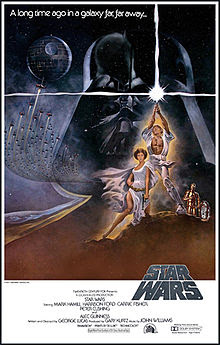
1977 Star Wars     (Changed my life)
1978 Invasion of the Body Snatchers    (Donald Sutherland's goggle-eyed stare!)
1979 The Muppet Movie    (Makes me deeply happy. Can you picture that?)
1980 The Empire Strikes Back    ("I love you." "I know.")
1981 Raiders of the Lost Ark    (Bad dates. Plus, Nazi punching!)
1982 The Last Unicorn      (Makes me cry. One of my favorite books ever.)
1983 Return of the Jedi     (Yes, I even like the Ewoks.)
1984 Ghostbusters     (There is no Dana!)
1985 Back to the Future     (Still so much fun)
1986 Labyrinth     (Tough year of choices, but I'm going for Bowie & weird Muppets)
1987 The Princess Bride    (Come, my love, I'll tell you a tale...)
1989 Indiana Jones and the Last Crusade    (My favorite Indy movie)
1990 Back to the Future III    (I love the Western steampunk vibe)
1991 The Addams Family    (Because it's awesome & so is the pinball machine)
1992 The Muppet Christmas Carol    (Light the lamp, not the rat!)
1993 Groundhog Day    (Because we watch it every year)
1994 The Lion King     (Hakuna matata!)
1995 Babe    (I grew up with Border Collies, and James Cromwell is great.)
1996 Matilda    (A girl reads books - what's not to love?)
1997 The Fifth Element   (Super green!)
1998 Dark City    (Ebert's favorite for 1998 and mine, too)
1999 The Iron Giant    (What you currently have - IN YOUR MOUTH - is art!)
2000 O Brother, Where Art Thou? (For the Preston Sturges allusion & so much more)
2001 Monsters Inc.    (Put that thing back where it came from or so help me...!)
2002 Lilo & Stitch    (It's hard to be weird, whether you're a girl or an alien experiment)
2003 Peter Pan    (best adaptation yet of this story)
2004 Hellboy     (I love everything about this movie)
2005 Wallace & Gromit: The Curse of the Were-Rabbit  (My favorite W&G)
2006 Penelope    (Modern fairy tale with a very cool cast)
2007 Hot Fuzz   (The soundtrack alone wins for me, but movie is so delightful)
2008 Miss Pettigrew Lives for a Day (So English. Hilarious & heartbreaking.)
2009 Star Trek   (Trek is back! Nimoy is back! Joy!)
2010 Scott Pilgrim vs. the World    (I'm team Knives)
2011 The Muppets   (For embodying my nostalgic love perfectly)
2012 The Avengers   (Joss Whedon! Agent Coulson!)
2013 Belle    (Gets my 18th century groove on in a big way - lovely film)
2014 Guardians of the Galaxy   (It's all about Rocket and Groot)
2015 Mad Max: Fury Road    (Motorcycle matriarchs - heck, yeah)
2016 Star Trek Beyond    (Trek done right - plus, Simon Pegg!)

Since it's only March, it's too early to declare a favorite for 2017, but it looks like a full year of contenders. Hopefully it will end up being another year where it's really hard to choose.

Thursday, April 14, 2016

Classic Movies for Cat Lovers

Cats have been on my mind a lot this month. In March, our family adopted two kittens, Ginger Peach and Earl Greyer, having mourned the deaths of our senior dog, Tess, in January, and our 20 year old cat, Grendel, back in October. Ginger has indeed been a peach, but little Earl quickly succumbed to a fatal disease that could not have been identified until the symptoms appeared (it's called FIP, or feline infectious peritonitis, and it's about the worst possible thing that can happen to a cat). The day Earl died I found myself thinking about that scene in The Strange Love of Martha Ivers (1946), where young Martha's kitten is killed by her vicious aunt (Judith Anderson). Martha then promptly murders her aunt, and the audience doesn't feel sorry for the old hag one bit. If I could push FIP down a flight of stairs I certainly would. Having held a dying kitten in my arms, that scene's emotional trauma now resonates for me in a very personal way.

Earl Greyer and Ginger Peach
Life, however, has to move on. Maybe Martha wouldn't have grown up to be such a rotten incarnation of Barbara Stanwyck if she could have just gotten a new kitten. Ginger sits in my lap as I type this post, purring and biting my arm, and next week we expect to welcome another kitten into our home. I'm still thinking about movies and cats, but brainstorming names for the new little guy makes me think more about movies with especially significant cat characters. Here are a few of those movies, in case you also find yourself thinking about naming a new kitty in the near future.

CAT PEOPLE (1942)

If I were getting a black female cat, I'd be seriously tempted to name her for Simone Simon or her character, Irena, in this iconic Jacques Tourneur horror made under the supervision of genre maestro Val Lewton. Simon plays an immigrant bride who fears that consummating her marriage with her American husband will cause her to transform into a huge, bloodthirsty cat. As it turns out, she's right to be worried. We don't really see much of Irena in panther form, but the movie just oozes feline atmosphere, and it's one of my very favorite Lewton films. Horror is eternally obsessed with cats, especially black ones, but they often skulk around the scenery without ever being named. This movie's existence offers two great names in its star and its protagonist, and really Simone and Irena would be perfect for a pair of kitten sisters.

THE THIRD MAN (1949)

It's not much help in the name department as far as the actual cat is concerned, but Carol Reed's brilliant film noir does have a very important cat character. In one of the movie's many iconic scenes, the presence of the presumably dead Harry Lime (Orson Welles) is revealed when his devoted cat comes up to his hiding place on a shadowy street. Given his disappearing Cheshire grin act, Harry Lime would actually make a great name for a cat, and Orson is pretty good, too, especially if the cat seems likely to get chunky as he ages! Cats on Film has a very interesting post about the cat in The Third Man, with some discussion of the cat's thematic and Freudian significance.

RHUBARB (1951)

This Ray Milland vehicle is the best place to appreciate cat actor Orangey, who appears in several memorable pictures but here takes the title role. While Orangey is not the most original name for a reddish orange cat, Rhubarb is definitely a good choice. This is a great movie for cat lovers, and it's packed with funny scenes. Unfortunately, Orangey doesn't get a name at all in his other most famous film, Breakfast at Tiffany's (1961), where he's just called Cat. My friend Terry at Shroud of Thoughts has a really excellent post about Orangey and his career, if you want to know more about him.


BELL, BOOK & CANDLE (1958)

Jimmy Stewart and Kim Novak star in this supernatural romance, made the same year as their most famous pairing in Vertigo. The cat in this instance is Pyewacket, a Siamese who acts as Novak's familiar. The name comes from an account in Matthew Hopkins' 1647 pamphlet, "The Discovery of Witches," which also contains gems like Elemanzer, Greedigut, and Peck in the Crown. If you subscribe to the T.S. Eliot theory of cat naming, Hopkins seems like your go-to source for unique feline monikers, and he's even a movie character himself, played by Vincent Price in the 1968 horror, The Conqueror Worm (aka Witchfinder General). Pyewacket is a good name for a Siamese or any cat who has that supernatural vibe, and it seems like it might work equally well for a boy or a girl. If you want to know more about this particular movie cat, Cinema Cats has a nice discussion of Pyewacket's history and the making of the film.

KURONEKO (1968)

Here's another movie about black cats, this time from Japan. This is a strange, supernatural tale about two women who become murderous cat spirits after they are brutally raped and murdered by a group of samurai. It's also a tragic love story; the protagonist is the son of one victim and the husband of the other, and the women must struggle between their desire to be reunited with him and their sworn quest for vengeance. Obviously, Kuroneko is a name for a black cat only, since it means "black cat" in Japanese! If you need an additional Japanese cat name, you might go with Onibaba, which is also the title of a 1964 film by Kaneto Shindo, the director of Kuroneko. According to Wikipedia, Onibaba means "demon hag," which works pretty well for a cat.

THE ARISTOCATS (1970)

Eventually all discussions of movie-inspired animal names turn to Disney, and The Aristocats is the richest single source for cat names in the studio's history thus far. We have white, fluffy Duchess (voiced by Eva Gabor), tough orange tomcat Thomas O'Malley (Phil Harris), and the kittens: Marie, Toulouse, and Berlioz. There's also a swinging cat band that includes Billy Bass (Thurl Ravenscroft) and Scat Cat (Scatman Crothers). For more Disney cat names, you could go with Thomasina of The Three Lives of Thomasina (1963), Bagheera of The Jungle Book (1967), or Oliver of Oliver & Company (1988). In general, Disney gives more love to dogs than cats, but they do provide some good names that would work for cats, especially in their villains. You could name your cat Maleficent, Ursula, or even Chernabog!

Of course, you could also name a cat after a classic movie star. Tallulah, Veronica, Bette, and Elsa Lanchester would all make great names for female cats; for boys you could go with Valentino, Bela, Boris, Basil, or Errol Flynn. Have any of you out there named a cat for a film character or star? Tell us about it in the comments!


Thursday, August 28, 2014

Classic Films in Focus: THE INCREDIBLE MR. LIMPET (1964)

Don Knotts stars in The Incredible Mr. Limpet (1964), one of the weirdest war comedies ever made, in which a nearsighted amateur ichthyologist transforms into a fish and then becomes an unlikely hero during World War II. This family-friendly picture combines animation and live action for its strange fish tale, and it possesses an odd charm that still works on viewers of all ages, thanks to Knotts’ sweetly funny performance and plenty of lively action that keeps the story in motion. Jack Weston, Carole Cook, and Andrew Duggan also make memorable appearances, but the movie really belongs to Knotts and the colorful undersea world where he finds friendship, adventure, and love.

Knotts plays Henry Limpet, a timid, bookish fellow whose wish to be a fish comes true when he falls off a pier at Coney Island. While his wife, Bessie (Carole Cook), and overbearing pal, George (Jack Weston), give him up as drowned, Henry embarks on a new life underwater, where he makes friends with a hermit crab (Paul Frees) and attracts the admiration of the lovely Ladyfish (Elizabeth MacRae). Henry also finds purpose when he realizes that his unique situation allows him to help the US Navy hunt down Nazi U-boats in the Atlantic.

Most people immediately think of Knotts as Barney Fife, and his popularity on The Andy Griffith Show more or less defined his career, but as Henry Limpet Knotts gets to play a gentler, less buffoonish character. There are distinct shades of a Jimmy Stewart type in Knott’s Henry; he might be obsessed with fish, but he’s a sweet guy, very bright, and really just waiting for a chance to prove himself. Henry longs to serve his country in spite of his 4F status, and his magical transformation gives him a chance to become both a hero and a figure of romance. He first appears as a puny, undersized human, but he makes for a strapping and extraordinary fish. Knotts even gets to sing the movie’s signature song, “I Wish I Were a Fish,” and though he’s no crooner it further shows that the actor had more range than many Barney Fife fans might expect.

The supporting actors in the live action scenes mostly react to Knotts, even when he’s playing the milquetoast human version of Henry. As George Stickel, Jack Weston is overbearing when Henry is a man but amusingly in awe of his pal as a fish, and he serves as the link between Henry’s two worlds. Carole Cook seems like a terrible harridan of a wife to Henry until she thinks he has drowned, and then she reveals a surprising tenderness toward him that makes us reassess our sense of her character. Andrew Duggan plays Harlock with a mix of befuddlement and practical acceptance of whatever gets the job done, but even in the framing sequences Harlock and Stickel look like they’d rather forget all about incidents they still can’t really believe. Elizabeth MacRae’s Ladyfish might be the least interesting character in the whole picture, with her sexy voice and vacuous personality, but Paul Frees invests Crusty the hermit crab with a feisty loyalty that makes him a highlight of the story.

Arthur Lubin, who directed The Incredible Mr. Limpet, also made Buck Privates (1941), Francis the Talking Mule (1950), and Rhubarb (1951), as well as a whole series of Francis sequels. For more of Don Knotts’ film career, see No Time for Sergeants (1958), The Ghost and Mr. Chicken (1966), and The Apple Dumpling Gang (1975). Look for Jack Weston in Wait Until Dark (1967) and The Thomas Crown Affair (1968). Veteran voice actor Paul Frees earned more than 300 screen credits for his film and television work, and you might recognize him as the voice of Barney Bear, Wally Walrus, Boris Badenov, Snuffy Smith, Charlie Beary, Ludwig Von Drake, and a host of other animated characters.

Tuesday, June 3, 2014

Classic Films in Focus: SNOW WHITE AND THE SEVEN DWARFS (1937)

Among Walt Disney’s greatest accomplishments, rivaling even the creation of Mickey Mouse himself, stands Snow White and the Seven Dwarfs (1937), which introduced Hollywood to the feature-length animated film. Disney wanted to create a visually stunning narrative that would appeal to both children and adults; he risked everything he had on the picture, and its success made possible all of the later Disney productions as well as animated movies made by other studios. Thus, the release of Snow White was truly a watershed moment in the history of film. Now, nearly 80 years after its debut, Snow White and the Seven Dwarfs does show its age in a few places, but it still shines brightly as an animated masterpiece, with gorgeous images, a gripping story, and a cast of unforgettable characters.

Disney’s version adapts the familiar fairy tale from the Brothers Grimm, in which a princess is abused by her jealous stepmother for being more beautiful than the older woman. The Queen sends Snow White into the forest with a huntsman who has been ordered to kill her, but instead he warns her to run away and never return. In the forest, she is assisted by kindly animals and the assorted dwarfs, who try to protect her but cannot keep the Queen’s magic mirror from revealing that she still lives. Bent on revenge, the Queen resorts to dark magic to eliminate her competition, but true love finally arrives to save the day.

Although much has been said in the decades since about the “Disneyfication” of fairy tales, Snow White actually hews pretty close to its source material. It doesn’t balk at being scary, especially during Snow White’s flight through the forest and the Queen’s transformation. It does eliminate the repetition of the Queen’s attempts to murder Snow White, but that both improves the pace of the story and downplays the heroine’s irritating gullibility. The princess herself, as lovely as she is, is the most dated character in the picture. Her childishness makes the prince’s romantic interest seem forced, and she also displays a bothersome talent for domestic despotism when she orders the dwarfs around in their own house. Later Disney princesses have more developed and mature personalities, but Snow White sets a pattern for domesticity, passivity, and starry-eyed romanticism that takes a very long time for Disney films to break. On the plus side, the movie nails the concept of the Disney villain and paves the way for a great tradition that will include such memorable menaces as Maleficent, Cruella De Vil, Ursula, and Scar.

Snow White won a special Oscar honoring its achievement as a pioneer effort in animation, and it still shows us what brilliant traditional animation can look like. The 1937 film did for hand-drawn animation what Pixar would later do for CGI with Toy Story (1995), but along with great films using the medium both movies also opened the door for a lot of mediocre imitations. Unlike so much of the bad animation that has flooded the market over the years, Snow White lavishes detail and attention on every character and scene, using live models to give the dwarfs in particular their distinctive heft and bounce. Snow White’s innocent beauty and the Queen’s violent pride come to life thanks to teams of artists who rendered their subjects with equal measures of devotion and skill. Every element of the picture, from its uncredited voice cast to its musical score, contributes to Disney’s ambitious vision, but the animation itself is the heart and soul of the production, a revelation about the art form’s potential to tell deeply compelling stories of adventure, love, and even death.

For more of Walt Disney’s classic animated films, see Pinocchio (1940), Dumbo (1941), and Sleeping Beauty (1959). Animation is not merely an American medium; for a global perspective on Disney’s legacy, try modern masterpieces like My Neighbor Totoro (1988), The Triplets of Belleville (2003), The Secret of Kells (2009), and The Illusionist (2010). You’ll find very different takes on the Snow White story in Ball of Fire (1941), Snow White and the Huntsman (2010), Mirror Mirror (2012), and Blancanieves (2012). The 2007 Disney feature, Enchanted, pokes loving fun at the studio’s past princess tales, especially Snow White and Cinderella (1950).


NB - Although it's gone from Orlando, you can still ride Snow White's Scary Adventures at Disneyland in California. I have vague memories of seeing the movie for the first time, but I'll never forget the sheer terror induced by this ride when the witch popped out at every turn. Scary adventures, indeed! In the Magic Kingdom at Walt Disney World, Snow White is attracting a whole new generation of fans with the opening of the Seven Dwarfs Mine Train.

Tuesday, December 17, 2013

Disney Report - December 2013

Depending on how you feel about Disney, Walt Disney World might be considered a gold mine for classic movie fans, since it contains rides, tributes, and swag devoted to films like Snow White and the Seven Dwarfs, Sleeping Beauty, and Cinderella. Disney films are probably the only classic movies some people ever see, and plenty of children get their first experience with  "old movies" in front of a TV where some grand old Disney classic is playing.

I'm a lifelong Disney fan, and this month we made another trek to the Land of the Magnificent Mouse to spend a week mugging with characters and flying around on Dumbo. We head to Orlando every two or three years, which is enough time for there to be something new every trip. Here's a rundown of the recent additions we encountered on our December 2013 trip.

New Fantasyland - Sure, Beauty and the Beast and The Little Mermaid are too recent to be classics in the strictest sense, but it has been 22 years since Belle fell for her hairy prince, and 24 years have passed since Ariel wished for those feet! The new section of Fantasyland celebrates the Disney renaissance of the 1990s with some gorgeous new attractions. Ariel has a high-tech ride with some very spiffy animatronics, and Belle has an elaborate meet-and-greet that features some eye-popping technology. Be Our Guest takes the Disney restaurant experience to a whole new level, and the food is pretty darn good, too. Overall, the new section is a great addition to Fantasyland and shows how much progress Disney has made in improving its experiences, even if the recently rolled out Magic Bands are creating some problems throughout the park (we didn't use them, so I can't really speak to that aspect of the park experience).

Sorcerers of the Magic Kingdom - Disney has introduced interactive games in several parks to keep folks busy while they wait for their Fastpass times on rides, and SotMK seems to be the big hit of the bunch. You can get free packs of starter cards and then use them to battle Disney villains throughout the Magic Kingdom; the technology and theming for these encounters are top-notch, with Disney using otherwise dead space in some very creative ways. If you get hooked, you can buy booster packs of cards in the park or online at the Disney Store. Judging from the huge binders of cards folks were toting around, this game really has a addictive appeal for card-collecting types. There's also a home game you can play with the cards when you aren't tooling around the Magic Kingdom.

Test Track - What happened? The corporate sponsor changed, and it feels like all the humor and charm in this already rather flat attraction has fizzled completely. We never loved the old Test Track, but the new version made us positively nostalgic for it. At least you still get the high speed experience at the end.


Mickey's Very Merry Christmas Party - This was our first time doing a special seasonal event, and we really enjoyed it. The park was not at all crowded, we snacked on "free" cocoa and cookies, and we got great character encounters with special characters who aren't usually out. If you want to meet the Disney princes or the Seven Dwarfs, then this is the party for you. (Note: These events also have special Sorcerers of the Magic Kingdom cards!)

As always, I had a ball on The Great Movie Ride at Hollywood Studios, although the Kid tells me she was not impressed with their version of Gene Kelly. Our favorites continue to be classic rides like The Haunted Mansion, The Jungle Cruise (currently the "Jingle" Cruise with seasonal jokes), and Pirates of the Caribbean. I missed Snow White's Scary Adventures, but the princess greeting hall that replaced it seems to be jam-packed at all hours, and hopefully the new Dwarfs coaster will open soon to bring that film back into action in the park.


One of the biggest pleasures of this trip was having photos made with the characters. The Kid decided to hunt autographs and photos this time, after several years of pin trading, and we all loved interacting with the hilarious characters. Chip & Dale tried on the Kid's bracelet, Tigger stole her autograph book, and the Wicked Stepmother and Stepsisters from Cinderella had us cracking up at their antics. If you're only in the parks for the rides, you're really missing a lot of the fun, and we were glad we stopped to visit with Mickey, Goofy, and the rest of the colorful inhabitants of the parks.

What's your favorite Disney film or Disney theme park experience? Let me know in the comments!


Tuesday, December 3, 2013

Classic Films in Focus: ALICE IN WONDERLAND (1951)

As a longtime devotee of Lewis Carroll, I'm well aware that Disney's Alice in Wonderland (1951) takes some liberties with its source material, but it remains one of my favorite classic Disney films nonetheless. It's certainly one of the weirder Walt pictures, thanks to Carroll's strange characters and penchant for Victorian nonsense, but it paints a vibrant, memorable picture, and it also offers some fiendishly catchy tunes and a number of great voice performances from classic character actors like Sterling Holloway and Ed Wynn. More importantly, Alice in Wonderland breaks away from Disney's princess in peril tradition to depict a determined heroine making it through her adventures all by herself, without a single prince in sight.

Like Carroll's original story, the Disney adaptation follows the adventures of young Alice (Kathryn Beaumont) as she chases the White Rabbit (Bill Thompson) into Wonderland. Once there, Alice encounters all sorts of odd inhabitants, including the grinning Cheshire Cat (Sterling Holloway), the Mad Hatter (Ed Wynn), and the Caterpillar (Richard Haydn). She also makes the acquaintance of the murderous Queen of Hearts (Verna Felton), who invites Alice to play croquet but also threatens to cut off her head. Alice wants to return home, but first she must stand trial before the Queen's court and confront her strange adversaries.

Carroll's two books, Alice's Adventures in Wonderland and Through the Looking-Glass, revel in in-jokes and clever wordplay, and most of this gets streamlined or eliminated in the Disney film, although the core story about a girl's adventure remains the same. Alice is grappling with the strangest adventure of all, that of growing up, and to her the world of adults is as bizarre and incomprehensible as anything Wonderland has to offer. Like Wendy in Peter Pan, Alice stands on the edge of leaving childhood behind, but unlike Wendy Alice doesn't have to play second fiddle to any boys. She must navigate complex social rules, conquer etiquette, and learn to deal with false friends. That might not sound as exciting as fighting pirates or slaying a dragon, but for Alice it turns out to be quite a challenge, and her reward is not a prince but a reclamation of herself and her place in the real world. In an era when most Disney heroines passively waited for their princes to save them, Alice's story makes a very refreshing change.

Aside from its proto-feminist heroine, Alice in Wonderland offers plenty of charms in its bouncy tunes and crazy characters. "A Very Merry UnBirthday," "I'm Late," and even "Painting the Roses Red" have an infectious energy that makes them irresistible earworms (don't let your kids watch the picture if you aren't prepared to listen to them sing the songs for days afterward). Kathryn Beaumont, who would also provide Wendy's voice for the 1953 Peter Pan, gives Alice a very proper English accent without laying it on too thick, but the veteran character actors steal the show, especially Sterling Holloway as the mischievous Cheshire Cat. Ed Wynn, Verna Felton, and Richard Haydn are joined by Heather Angel, Thurl Ravenscroft, J. Pat O'Malley, and The Mellomen as some of Wonderland's other residents, and hardcore Disney fans will have no trouble recognizing most of their voices.

Alice in Wonderland has been adapted many times both before and after the 1951 Disney version, with the most recent big screen treatment also coming from Disney in 2010. For the sake of comparison, you might also have a look at the 1985 and 1999 TV movies, although the 1933 version might appeal more to classic movie fans, since it features W.C. Fields as Humpty-Dumpty and Cary Grant as the Mock Turtle (Sterling Holloway is in it, too, but in this earlier outing he plays the Frog). Brooke Shields plays Alice in a quick but crazy adaptation on a 1980 episode of The Muppet Show, and that's a fun one if you can track it down. Listen for Verna Felton as unpleasant matriarchal types in Dumbo (1941) and Lady and the Tramp (1955) and as the sweeter Fairy Godmother in Cinderella (1950). Don't miss Ed Wynn in Mary Poppins (1964), and be sure to appreciate Sterling Holloway's distinctive rasp in Dumbo, Mickey and the Beanstalk (1947), and, of course, the original Disney stories about Winnie the Pooh.

Monday, December 2, 2013

Classic Films in Focus: DUMBO (1941)

Disney classics are probably the one group of “old” movies that many people see even if they aren’t particularly enthusiastic about film. After all, these movies surround us throughout our lives, thanks in part to relentless Disney marketing. They inspire theme park rides and countless toys, harried parents trot them out to entertain moody toddlers, and they have become such a part of American childhood that you’d worry about a kid who doesn’t know who Dumbo is. With familiarity, however, comes apathy, if not actual contempt. We might easily take a movie like Dumbo for granted, especially because even the very youngest viewers seem attracted to it, but this 1941 animated feature can speak just as eloquently to a thoughtful adult who is willing to give it some time and attention.

You probably know the story. Dumbo is a baby elephant born into the circus, where his oversized ears become a source of embarrassment and endless abuse. As much as his mother loves him, she cannot protect him from the cruelty of others, and eventually she winds up imprisoned. Poor Dumbo, alone and frightened, has to find his own place in the circus, but he gets some help from a tiny mouse named Timothy and a flock of friendly crows. When Dumbo finally discovers his talents, he’s ready to confront those who mistreated him and take pride in his unique identity.

It seems like a simple story, and it is simply told, but there’s a lot of heartbreak and soul-searching in Dumbo. Anyone who has ever been teased or bullied will recognize the psychological damage that Dumbo endures. His mother’s peers criticize and reject him, the circus patrons mock and provoke him, and the clowns assume that nothing they do to him matters because “elephants ain’t got no feelings.” Dumbo is the individual as outcast, the lonely soul cast adrift on a cold sea. Neither his innocence nor his youth protect him. Difference marks him as the object of scorn and derision, and thus the little elephant stands in for all of the oppressed. His moment of terror and sacrifice, high on the burning circus platform, might as well be a crucifixion.

Think that’s reading too much into a children’s film? Look at Dumbo’s cinematic peers. Like Charlie Chaplin’s Little Tramp, he is a silent everyman, sweet-natured but suffering. Compare him to the iconic martyr in The Passion of Joan of Arc (1928); clown makeup takes the place of shorn hair and a straw crown. Despite his appeal to preschoolers, Dumbo is a deep character, embodying existential and spiritual questions of the most profound nature. His happy ending is hard won, and maybe even at odds with his essence, but that’s the one place where the story defers to its audience’s desire for poetic justice. Before that triumphant finale, Dumbo will break your heart, and that’s what makes it such a powerful and enduring film.

Forgive the stereotyped crows (at least they sing well), and listen for Disney voice regulars Sterling Holloway and Verna Felton as Mr. Stork and the elephant matriarch. Dumbo won an Oscar for Best Musical Score, and it should have won Best Original Song for “Baby Mine,” which could wring sentimental tears from a turnip. For more circus stories, see Chaplin’s The Circus (1928), the Marx Brothers’ At the Circus (1939), The Greatest Show on Earth (1952), and Jumbo (1962).

Saturday, November 30, 2013

Modern Movies: FROZEN (2013)

I admit it. I had written Frozen off because of the awful trailers. I wasn't even planning to see it, which is a huge statement given that I'm a lifelong Disney fan. Luckily, early reviews started begging folks to ignore the trailers and see the picture, anyway. If you're still on the fence about Frozen, let me join the chorus of reviewers urging you to see it. Despite what might be one of the worst marketing campaigns in Disney history, Frozen is a visual and narrative delight packed with fresh characters, great songs, and an ending that has been a long time coming for the princess set.

The story, more or less inspired by Hans Christian Andersen's fairy tale, The Snow Queen, revolves around two sisters. The elder, Elsa (Idina Menzel), was born with magical powers over ice and snow, although she struggles to control them. The younger, Anna (Kristen Bell), is a rambunctious, impulsive people person who doesn't understand why her beloved sister pulls away from her as they grow up. When Anna rushes into an engagement with Prince Hans (Santino Fontana), Elsa is so horrified that she loses control over her powers right in the middle of her own coronation ball, thus revealing to everyone the strange and dangerous ability that she possesses. Elsa flees, accidentally throwing the whole country into deep winter as she goes, and Anna pursues her in hopes of reconciling with her sister and ending the magical ice age. Along the way, Anna gets some help from the rustic Kristoff (Jonathan Groff), as well as a friendly reindeer, an enchanted snowman, and a family of trolls.

One thing that sets Frozen apart from other Disney princess stories is the focus on sisters. Yes, romance develops over the course of the story, but the relationship at the movie's heart is that between Elsa and Anna. That makes Frozen a thoughtful follow-up to Brave, which was about a young heroine's relationship with her mother. At long last, Disney is moving us away from narratives where women only have poisonous, competitive relationships with each other and the goal is to snag the prince and the throne. Elsa doesn't need a prince to be queen; in fact, she doesn't need anything except acceptance of herself and a repaired relationship with her sister. Anna does need romantic love, but her narrative arc also rejects the traditional Disney formula in some very surprising - and welcome - ways.

The voice actors really bring a lot to their characters without being celebrity distractions from them. Veronica Mars star Kristen Bell is a delightful, spunky presence as Anna, and it's great to hear her perform the character's musical numbers. Idina Menzel, however, really knocks it out of the park as Elsa, especially on the power house theme, "Let It Go." Her Broadway voice soars and raises the bar for every Disney heroine song that will come after this, so much so that I'm unclear why Disney felt the need to have Demi Lovato perform a single version for the picture's closing credits. As annoying as Olaf the snowman is in the trailers, he's actually very funny in the film, especially during his ironic musings on the nature of warmth and summer. Josh Gad, who provides Olaf's voice, does a fantastically funny job with "In Summer," which will make you laugh and wince at the same time. Santino Fontana and Jonathan Groff both have excellent voices for their characters, although the scene stealer of the picture is definitely Alan Tudyk as the Duke of Weselton.

The third act contains many shocks and twists, and I'll refrain from indulging in spoilers. I will say that Frozen is good enough and nuanced enough to be worth seeing even if you don't have children. Ignore the trailers, let go of what you think Disney princess movies are like, and make time to see Frozen while it's still in theaters. The excellent and very meta Mickey Mouse short that opens the movie is just the icing on a cold but delicious holiday treat.


Saturday, September 7, 2013

Classic Films in Focus: ROBIN HOOD (1973)

Robin Hood has appeared on film many times, with Errol Flynn providing the most iconic version of the Sherwood outlaw, and the 1973 Disney version clearly takes its cues from the earlier pictures. The twist in this animated rendition of the classic tale is that all of the characters are depicted as talking animals, with the crafty Robin appropriately assuming the form of a handsome fox. Disney’s Robin Hood also adopts a folksy attitude that might not be historically accurate but really works quite well with the story and justifies the voices of familiar actors like Phil Harris, George Lindsey, Andy Devine, Ken Curtis, and Pat Buttram. With its classic story, colorful characters, and memorable songs, Robin Hood delivers good-humored family fun and makes a perfect starting point for introducing very young viewers to Robin and his band of friends.

In this version, as always, Robin Hood (Brian Bedford) and his comrade Little John (Phil Harris) live in Sherwood Forest and rob the rich in order to help the poor. Their enemies include the scheming Sheriff of Nottingham (Pat Buttram) and the evil Prince John (Peter Ustinov), who are using the absence of King Richard to squeeze the realm for their own gain. While dodging the Sheriff and doling out coins to the oppressed, Robin also finds time to rekindle an old romance with lovely lady fox, Maid Marian (Monica Evans), but a plot to execute Friar Tuck (Andy Devine) forces a climactic confrontation between our heroes and the Prince’s lackeys.

The movie juxtaposes its vision of "Merrie Olde England" with a distinctly American rural character, although a few key figures, including Robin and Prince John, retain their English accents and manners. We’re introduced to the film’s unique merger of English village and American country by the appearance of our narrator, Allan-a-Dale, a rooster voiced by the drawling popular singer Roger Miller. Kids today might have no idea who Miller is, but audiences in 1973 would have recognized the Grammy Award winning singer’s voice from his hit songs, including “King of the Road” and “England Swings.” The folksy ambience is enhanced by Western character actors Andy Devine as Friar Tuck, Pat Buttram as the Sheriff, and Ken Curtis as the vulture guard Nutsy. Southerner George Lindsey, best known as Goober on The Andy Griffith Show, provides the voice for Trigger, while bandleader and radio comedian Phil Harris, who grew up in Nashville, lends his lazy, subtle drawl to Little John.

The swashbuckling action is mostly light-hearted, with the archery contest fight a particular highlight, although Robin does face some more serious peril in the climactic finale. The outlaws are especially funny in an early caper conducted in drag as gypsy fortune tellers, and Phil Harris gets off some great lines in Little John’s scenes with Prince John at the contest. Terry-Thomas works the fork-tongued speech of Sir Hiss to wonderful effect, while Peter Ustinov perfectly conveys the effete villainy of Prince John, and together these two make their rotten characters more hilarious than threatening, especially when they find themselves outwitted by Robin yet again. Prince John, a lion without a mane, has a particularly hilarious habit of sucking his thumb and calling for his mother in times of distress; the psychosexual subtext of the character is undoubtedly lost on kids, but they'll still laugh heartily at the prince's childish tantrums.

Robin Hood earned an Oscar nomination for the song, “Love,” but you’ll probably find the songs performed by Roger Miller more memorable, and “Whistle Stop” has achieved a whole new level of popularity thanks to the “Hampster Dance” internet meme. Several of the voice artists appear in other Disney films: listen to Phil Harris in The Jungle Book (1967) and The Aristocats (1970), and catch Pat Buttram and George Lindsey as the troublesome hounds in The Aristocats. Adults will appreciate Peter Ustinov’s Oscar-winning performances Spartacus (1960) and Topkapi (1964). If the Disney version of the story is a hit with younger viewers, follow up with the 1938 Errol Flynn film.

Tuesday, September 25, 2012

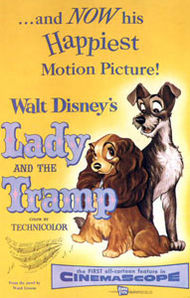
Classic Films in Focus: LADY AND THE TRAMP (1955)


I'll be the first to admit that Lady and the Tramp (1955) is not the most important or the most aesthetically creative of Walt Disney's classic animated films, but it remains my favorite nonetheless. It makes me laugh and cry every time I see it, and by now I have seen it many, many times. What more can you ask for in a classic film? Beautifully drawn, movingly sincere, and oddly enough more human than many of the films featuring human characters, Lady and the Tramp is the Disney movie for dog lovers and hopeless romantics alike.

The story follows the early life and growth of Lady, a pampered Cocker Spaniel in an elegant Victorian home. Lady gets a shock when she discovers that her owners' feelings about her have changed because they are expecting a baby, and she gets an even bigger shock when mean Aunt Sarah is called in to care for the baby while Jim Dear and Darling leave town for a few days. The canine heroine eventually finds herself tangled up with a rakish stray called The Tramp, but his attentions only manage to land her in trouble, first in the dog pound and then in the dog house back at home. Of course, being a Disney film, a happy ending is guaranteed, with the budding romance of Lady and the Tramp evoked most memorably in the spaghetti eating scene.

Barbara Luddy provided the voice of Lady, and it was a perfect part for the Disney regular, who would go on to be the voice of the fairy Merryweather in Sleeping Beauty (1959) and of Kanga in numerous Winnie the Pooh films. In Lady and the Tramp, Luddy's voice has a soft sweetness undercut with just enough rasp to make her feisty as well as feminine. The voice that dominates the film, though, is that of the incomparable Peggy Lee, the chanteuse best known today, perhaps, for the hit song "Fever." Lee lent her voice to four different characters in the film, Darling, Siamese cats Si and Am, and Peg, and she also helped write several of the songs featured in the picture. We hear Lee singing numerous times during the film, but the highlight is certainly her rendition of "He's a Tramp," sung by Peg, the bedraggled Pekingese at the dog pound. Lee had some legal quarrels with Disney over her work on the movie, but, in the long run, it has served her well, introducing her to generations of youngsters who otherwise would never have heard her gorgeous sound.

The danger in which the movie can place its characters is one of the reasons that Lady and the Tramp has such pathos; imagine one of the Disney princesses being thrown into prison and made to watch another prisoner dragged away to his death. The pound scene is one of the film's most moving moments; certainly the animals are humanized to a certain extent, but their misery is very real, as anyone who has walked the kennels of an animal shelter can attest. Lady's fear and confusion are emotions any pet might feel at suddenly being dumped in such an unfamiliar place. Lady spends almost the entire movie being bound, caged, threatened, muzzled, and shot at, and Tramp is literally being carted away to his execution when Jock and Trusty rush to the rescue. Trusty's encounter with the dog pound carriage, and Jock's reaction, can still bring tears to the eyes of viewers who have watched the movie dozens of times and know perfectly well how it ends. (Walt insisted that Trusty had to survive the crash because he remembered the emotional fallout from killing Bambi's mother.)

There's also the romantic angle of the movie to consider. For young girls, Tramp might well be their first encounter with the figure of the charming rogue, that lovable scruffy guy who isn't exactly a knight in shining armor but who manages to win the day and the girl anyway. Disney would revisit this territory to great effect in its treatment of Robin Hood (1973). Tramp is, quite literally, the Han Solo of the canine world; he lacks the pedigree of a prince, but he makes up for it in dash and swagger and the thrill of going out with the bad boy instead of the football team captain. As a dog, Tramp can get away with being a lot more dangerous an object of affection. Parents in 1955 would have had a heart attack had this romance played out between a human debutante and a rogue from the wrong side of the tracks, and not until Aladdin in 1992 would Disney try out this kind of love story with people instead of animals. Even more daring is the fact that Lady spends the night with Tramp out on Lovers Lane; I doubt Disney would try that scene with human characters even in this enlightened age. 

I have never been a big fan of the classic princess films, largely because their heroines are all too insipid and ineffectual for my tastes, but Lady and the Tramp can be more egalitarian because it features dogs instead of people, and that is part of its charm. Lady might be all that her name implies, but she still gets to chase chickens, bark at rats, and exercise her animal spirits. She gets to run around town with a tough, sexy guy, too. It might be a dog's life, but I'll take that over being a narcoleptic princess any day. 

If you love dog movies, see more of Disney’s canine capers in 101 Dalmatians (1961), The Fox and the Hound (1981), and Bolt (2008). Try live action classics like Lassie Come Home (1943), Old Yeller (1957), and Greyfriars Bobby: The True Story of a Dog (1961). Plague Dogs (1982) is a gripping emotional drama from Watership Down author Richard Adams, but don’t show it to children unless you intend to scar them for life.

An earlier version of this review originally appeared on Examiner.com. The author retains all rights to this content.

Monday, September 10, 2012

Classic Disney Movies Based on Children's Books


Most of the classic Disney princess movies come straight out of fairy tales, but the family film studio has also combed other literary sources for many of its popular productions. Successful children's novels from around the world have served as the inspiration for some of Disney's most beloved animated and live-action pictures, although Walt Disney and his screenwriters were rarely very faithful to the original texts. Whether you're trying to get youngsters interested in classic movies or in reading good books, these Disney adaptations can make for a good starting point. Here are just a few of the classic Disney films that owe their existence to novels written for young readers.

Pinocchio (1940) - Italian writer Carlo Collodi created the original story of the wooden boy, which first appeared in Italy in 1883. Today you can find many versions of Pinocchio's story, and the novel that first imagined this puppet hero remains a classic in its own right. Try the Puffin Classics edition of the book for an inexpensive introduction to Collodi's enduring tale of adventure, transformation, and paternal love. Be forewarned, though, that a lot of bad things happen to Pinocchio, and Collodi's story has a moral tone much like the work of Hans Christian Andersen.

Bambi (1942) - While some of the novels adapted for Disney films remain well-known and widely available, Austrian author Felix Salten's 1923 tale of a young deer is harder to find. Older children who can handle more somber and realistic depictions of animal life might find the story very engaging, but, like the Disney movie, it might be too much for younger children to handle. Aladdin has a 1988 paperback edition still available from online retailers like Amazon.com, although the 1929 sequel, Bambi's Children, appears to be out of print. Try your local library for copies of both books.

101 Dalmatians (1961) - Disney has turned Dodie Smith's original novel into a whole series of movies and spin-off productions, including its own 1996 live-action remake of the animated film. The 1961 picture simplifies the novel by reducing the number of adult dogs involved in the story, but for the most part the Disney film takes its cues from Smith's charming tale. Dog lovers are sure to find the original book a winner, and anglophiles will enjoy its very English character. The Puffin edition provides Smith's full text for a very reasonable price, and the story is a perfect choice for reading aloud, particularly at Christmas, when much of the action takes place. Starlight Barking, a long-forgotten sequel to Smith's novel, is also now back in print.

Mary Poppins (1964) - P.L. Travers' long contention with Walt Disney over the adaptation of her very popular book series has been much discussed in Disney movie circles, but the 1964 live-action musical proved a watershed event in the career of its star, Julie Andrews, and hopefully the film's success has brought readers back to the English writer's original works. The movie won five Oscars and was nominated for thirteen, making it one of Disney's greatest screen accomplishments. Numerous paperback editions of all of the Mary Poppins novels are in print, and kids who enjoy the movie will probably like to find out about all of Mary's other adventures with the Banks family.

The Jungle Book (1967) - Film studios have frequently turned to the works of Rudyard Kipling for their stories, so it should be no surprise that Disney would offer its own adaptation of a Kipling tale. Kipling's original novella (it's really more a collection of stories than a proper novel) appeared in 1894. Although it's a fun movie with some terrific songs, the Disney version strays pretty far from the source material. Kids who enjoy talking animal novels like The Warriors and The Guardians of Ga'Hoole series ought to enjoy this influential literary classic. Disney also produced a live-action version starring Jason Scott Lee in 1994, although it's more interesting for its cast than its fidelity to Kipling. If your kids enjoy the original story, they should also love Neil Gaiman's Newbery-winning revision, The Graveyard Book (2008).

Bedknobs and Broomsticks (1971) - Adapted from the novels by Mary Norton, who also penned The Borrowers books, the 1971 Disney live-action film capitalized on the similar combination of Englishness, magic, and music that had made Mary Poppins such a hit. The movie is very good, especially with Angela Lansbury and David Tomlinson in the lead roles, but it has very little in common with Norton's texts. Look for Norton's original stories as The Magic Bed-knob and Bonfires and Broomsticks; a combined edition of both stories is available from Sandpiper. There's no guarantee, though, that fans of one version will like the other.

Other classic Disney films adapted from books include Song of the South (1946), Alice in Wonderland (1951), Treasure Island (1950), Peter Pan (1953), 20,000 Leagues Under the Sea (1954), and Old Yeller (1957). Almost all of these are based on true classics that you and your children can find at your local library or bookstore, and many of them are also free on ereaders like the Kindle and the Nook.

An earlier version of this article originally appeared on Examiner.com. The author retains all rights to this content.