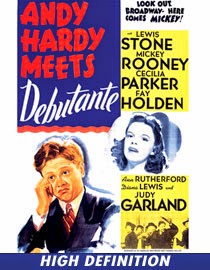
This installment of the popular Andy Hardy series takes the Hardy family out of idyllic Carvel and sends them off to New York City, where teenage Andy promptly gets himself into all kinds of trouble. Despite the change of venue, it’s a typical Andy Hardy story, with youthful mistakes, romantic entanglements, and Mickey Rooney’s boundless zeal. You don’t have to have seen all of the previous Hardy pictures to drop into the action, although it does help if you have seen Love Finds Andy Hardy (1938), the earlier movie that introduces Judy Garland’s Betsy Booth character. Garland’s return to the world of the Hardy family makes Andy Hardy Meets Debutante a particularly appealing picture for fans of her collaborations with the energetic Rooney. For newcomers, the distinctive mix of adolescent romance, humor, and wide-eyed American idealism sums up the essence of the Hardy films’ enduring appeal.
At home in Carvel, Andy is nursing a crush on New York society girl, Daphne Fowler (Diana Lewis), and he foolishly brags about knowing her when his friends discover his passion. Andy is forced to prove his claims when Judge Hardy (Lewis Stone) takes the whole family to New York as part of his mission to protect the Carvel Orphanage from big city lawyers who want to defund it. Andy’s friend, Betsy (Judy Garland), tries to help him, but Andy suffers a series of shocks to his ego as he attempts to meet Daphne, and even Judge Hardy becomes concerned about the implications of Andy’s behavior.
Part of Andy Hardy’s appeal is his penchant for getting into scrapes; neither an angel nor a complete reprobate, he’s a twentieth-century Tom Sawyer with a waggish sense of fun and a lively eye for the ladies. Wherever Andy goes, girl trouble follows, and in this outing he has Polly Benedict (Ann Rutherford), Betsy, and Daphne to juggle. Andy thinks he’s too sophisticated for Polly, and he treats Betsy like a kid, but he soon finds out that the wealthy Daphne is out of his league. “There are millions of nice people in the world,” Daphne’s mother tells him, “and Daphne can’t be friends with all of them.” The irony of his comeuppance never seems to dawn on Andy, but the audience sees quite clearly that he reaps as he has sown. His taste in girls needs adjusting, anyway, if he can favor Daphne over her more available competition. Polly, the hometown favorite, wins our approval thanks to Ann Rutherford’s flashing eyes and bold manner, while Judy Garland makes Betsy so sweet and sadly lovestruck that we root for her even though we know that Polly has already staked her claim. Garland’s performance of “Alone,” which starts as a gag and ends with tears, is an emotional highlight of the picture that showcases the young star’s tremendous talent.
Comedy tempered with sentiment is the Andy Hardy formula, and the threat to the orphanage provides a counterweight to Andy’s romantic hijinks. Judge Hardy proves his faith in the system, lectures Andy on American ideals, and wins over a courtroom with the assistance of an adorable orphan, all of which will strike modern viewers as terribly naive. Still, with the Depression in the rearview mirror and the war directly ahead, Americans in 1940 must have wanted very much to believe in the benevolent paternal authority that Judge Hardy embodies. Andy’s relationship with his father gets a great deal of play, while his mother, aunt, and sister hardly make appearances at all. The serious part of Andy Hardy Meets Debutante has nothing to do with women but concerns itself with Andy’s emerging identity as a man with a particular place in the world.
The Andy Hardy series continued until 1958, when Mickey Rooney made his final bow as the character in Andy Hardy Comes Home. George B. Seitz directed most of the Andy Hardy pictures, beginning with A Family Affair (1937), You’re Only Young Once (1937), and Judge Hardy’s Children (1938). For more of Mickey Rooney’s youthful roles, see A Midsummer Night’s Dream (1935), Captains Courageous (1937), and Boys Town (1938). Diana Lewis, who was married to William Powell for more than forty years, retired from acting in the early 1940s after roles in Bitter Sweet (1940), Go West (1940), and Johnny Eager (1941). If you enjoy the collaborative work of Rooney and Garland, be sure to see their musicals together, particularly Babes in Arms (1939), Strike Up the Band (1940), and Babes on Broadway (1941).
Andy Hardy Meets Debutante is currently available for streaming on Warner Archive Instant.
Showing posts with label Mickey Rooney. Show all posts
Tuesday, April 8, 2014
Monday, August 12, 2013
TCM Summer Under the Stars: Growing Up with Mickey Rooney
This post is part of the TCM Summer Under the Stars Blogathon hosted by Sittin' on a Backyard Fence and ScribeHard on Film. Visit their blogs to links for all of the blogathon posts!
Turner Classic Movies celebrates Mickey Rooney on August 13, 2013, with a full day of films starring the perpetually energetic but rather unlikely leading man. Even if it's a cliche, Mickey Rooney can really only be described as a living legend. Born in 1920, the 93 year old actor has more than 300 film and television appearances to his credit and is still working, with six roles in 2011 and 2012 combined. In a career that has spanned 87 years (so far), Rooney has been the classic Hollywood face that generations of viewers have grown up with and literally known all their lives.
Think about it. If every star born in 1920 were still alive and working today, you'd be seeing Yul Brynner, Gene Tierney, Walter Matthau, Ricardo Montalban, DeForest Kelley, Shelley Winters, Toshiro Mifune, Jack Webb, Denver Pyle, Virginia Mayo, Jack Elam, and Montgomery Clift turning up in the movies of the last two years. Maureen O'Hara, also born in 1920, has stuck around with Rooney, but she made her last TV movie appearance in 2000, more than a decade ago. Whatever you might think of Rooney's personal life (and it has been a doozy), you have to admire the willpower and determination of a man who entered the world that long ago and has been making his mark on it ever since.
The first audiences to grow up with Rooney saw him as a child himself in the Mickey McGuire shorts of the 1920s, which is where the young Joe Yule, Jr. picked up his new first name. In the 1930s, viewers knew him as the teen protagonist of the Andy Hardy films and other boys' stories, including Boys Town (1938), which is one of the films in the TCM lineup. You can also see Rooney in the Andy Hardy role in Family Affair (1936), and you can catch some of his other youthful performances in the early hours of the day on Tuesday. The TCM schedule includes two of the "kids putting on a show" pictures that Rooney made with Judy Garland: Strike Up the Band (1940) and Girl Crazy (1943).
Many of the later films on the TCM roster show Rooney's more adult, dramatic side, with performances inQuicksand (1950), The Strip (1951), and Requiem for a Heavyweight (1962). Youngsters who grew up in the 1970s, however, won't know Rooney from Pulp (1972) but will remember him in TV specials like The Year without a Santa Claus (1974) and Disney movies like Pete's Dragon (1977). The first movie that I really remember noticing Mickey Rooney in is The Black Stallion (1979), which I saw in the theater as a little girl and found utterly enthralling. I didn't know then that Rooney's role as a trainer was a tribute to his performances in Thoroughbreds Don't Cry (1937) and especially National Velvet (1944).
Even kids who are still growing up in 2013 have seen Rooney. He had a memorable role in Night at the Museum (2006) and a cameo in The Muppets (2011). That makes Rooney a great choice for some family viewing time on Tuesday. If your youngsters haven't gone back to school yet, try A Family Affair, Boys Town, Strike Up the Band, and Girl Crazy as some quality together time. If you miss them on TCM, you can find them on DVD and on streaming in various places. Watch with the kids and ask them if they recognize that funny guy and his distinctive voice. Maybe he sounds like Tod in The Fox and the Hound (1981)? Does he sound a lot like Sparky in Lady and the Tramp II: Scamp's Adventure (2001)? Maybe they remember that mean little old man who gave Ben Stiller a hard time in Night at the Museum. Then amaze the whippersnappers with the story of a little boy who grew up and grew old in front of the whole world, who made more than 300 movies and is still making millions of people laugh and cry today, thanks to the special, magical power of film.
For more about Mickey Rooney, see this post: "Putting on a Show: Mickey Rooney and Judy Garland," from the recent Dynamic Duos blogathon hosted by Classic Movie Hub.
Turner Classic Movies celebrates Mickey Rooney on August 13, 2013, with a full day of films starring the perpetually energetic but rather unlikely leading man. Even if it's a cliche, Mickey Rooney can really only be described as a living legend. Born in 1920, the 93 year old actor has more than 300 film and television appearances to his credit and is still working, with six roles in 2011 and 2012 combined. In a career that has spanned 87 years (so far), Rooney has been the classic Hollywood face that generations of viewers have grown up with and literally known all their lives.
Think about it. If every star born in 1920 were still alive and working today, you'd be seeing Yul Brynner, Gene Tierney, Walter Matthau, Ricardo Montalban, DeForest Kelley, Shelley Winters, Toshiro Mifune, Jack Webb, Denver Pyle, Virginia Mayo, Jack Elam, and Montgomery Clift turning up in the movies of the last two years. Maureen O'Hara, also born in 1920, has stuck around with Rooney, but she made her last TV movie appearance in 2000, more than a decade ago. Whatever you might think of Rooney's personal life (and it has been a doozy), you have to admire the willpower and determination of a man who entered the world that long ago and has been making his mark on it ever since.
The first audiences to grow up with Rooney saw him as a child himself in the Mickey McGuire shorts of the 1920s, which is where the young Joe Yule, Jr. picked up his new first name. In the 1930s, viewers knew him as the teen protagonist of the Andy Hardy films and other boys' stories, including Boys Town (1938), which is one of the films in the TCM lineup. You can also see Rooney in the Andy Hardy role in Family Affair (1936), and you can catch some of his other youthful performances in the early hours of the day on Tuesday. The TCM schedule includes two of the "kids putting on a show" pictures that Rooney made with Judy Garland: Strike Up the Band (1940) and Girl Crazy (1943).
Many of the later films on the TCM roster show Rooney's more adult, dramatic side, with performances inQuicksand (1950), The Strip (1951), and Requiem for a Heavyweight (1962). Youngsters who grew up in the 1970s, however, won't know Rooney from Pulp (1972) but will remember him in TV specials like The Year without a Santa Claus (1974) and Disney movies like Pete's Dragon (1977). The first movie that I really remember noticing Mickey Rooney in is The Black Stallion (1979), which I saw in the theater as a little girl and found utterly enthralling. I didn't know then that Rooney's role as a trainer was a tribute to his performances in Thoroughbreds Don't Cry (1937) and especially National Velvet (1944).
Even kids who are still growing up in 2013 have seen Rooney. He had a memorable role in Night at the Museum (2006) and a cameo in The Muppets (2011). That makes Rooney a great choice for some family viewing time on Tuesday. If your youngsters haven't gone back to school yet, try A Family Affair, Boys Town, Strike Up the Band, and Girl Crazy as some quality together time. If you miss them on TCM, you can find them on DVD and on streaming in various places. Watch with the kids and ask them if they recognize that funny guy and his distinctive voice. Maybe he sounds like Tod in The Fox and the Hound (1981)? Does he sound a lot like Sparky in Lady and the Tramp II: Scamp's Adventure (2001)? Maybe they remember that mean little old man who gave Ben Stiller a hard time in Night at the Museum. Then amaze the whippersnappers with the story of a little boy who grew up and grew old in front of the whole world, who made more than 300 movies and is still making millions of people laugh and cry today, thanks to the special, magical power of film.
For more about Mickey Rooney, see this post: "Putting on a Show: Mickey Rooney and Judy Garland," from the recent Dynamic Duos blogathon hosted by Classic Movie Hub.
Friday, July 12, 2013
Putting on a Show: Mickey Rooney and Judy Garland
Note: This post is part of the Dynamic Duos Blogathon hosted by Once Upon a Screen and Classic Movie Hub. Visit the host sites for complete lists of all of the great blogs participating in this event!
Looking back, they seem like such different Hollywood creatures: Mickey Rooney, so resilient and tough that in 2013 he’s still with us after more than 300 film and television appearances, and Judy Garland, a bright but fragile star who blazed through fewer than 40 roles before her tragically premature death in 1969. Together, though, they made nine films and ruled the screen as one of the most popular Hollywood duos of the classic era, beginning with Thoroughbreds Don’t Cry in 1937 and ending in 1948 with Words and Music.
What made Rooney and Garland such a hit with audiences? It had - and still has - a lot to do with their youth and the fresh-faced, innocent quality of their onscreen chemistry. At their best, in films like Babes in Arms (1939) and Strike Up the Band (1940), their romantic attraction has a sweetness wholly unassociated with sex. Theirs is a puppy love, eager, sentimental, and simply told if they can just get themselves to grow up enough to say it. They are the boy and the girl next door, denizens of an unfallen age, where putting on a show can solve almost any problem life can dish out.
When they made their first film together in 1937, Garland was still a relative newcomer, but Rooney was already a big star, thanks to his breakthrough title role in the Mickey McGuire shorts and performances in feature films like A Midsummer Night’s Dream (1935), Little Lord Fauntleroy (1936), and Captains Courageous (1937). The lead in the first Andy Hardy film, A Family Affair (1937), helped to propel him to even greater fame, and from 1939 to 1941 the short, boyish star was the top box office actor in the country.
Judy’s own star was rising in those years, especially after the huge success of The Wizard of Oz in 1939. She had become part of the Andy Hardy cast with Love Finds Andy Hardy in 1938, and she went on to appear with Rooney in two more of the Hardy films: Andy Hardy Meets Debutante (1940) and Life Begins for Andy Hardy (1941). Andy Hardy, however, already had his primary love interest in Polly Benedict, played by Ann Rutherford, so Garland’s Betsy Booth generally pined in vain for Andy’s affection.
In the “show” pictures the pair really got to demonstrate their compatibility, dancing, singing, plotting, and laughing together as various characters who stage musical revues to save their families, themselves, or their schools. Mickey possesses an almost manic energy in these movies, with big gags, wild dance routines, and crazy costumes. Judy, wide-eyed and adorable, does not yet reveal the toll her fame would take, and her musical performances seem almost effortless.
Judy’s characters tend to be the sincerer and more sensible ones, while Mickey’s hot-blooded young fellows often need to be reminded of the core values of friendship, honesty, and integrity. When MGM varies that formula, as they do in Girl Crazy (1943), things can go a bit off the rails, but when they get it just right in the earlier films, like Strike Up the Band, they really show the two stars at their irresistible best.
If you want to see the Rooney and Garland films for yourself, Turner Classic Movies has a DVD collection of four of their collaborations: Babes in Arms, Strike Up the Band, Babes on Broadway, and Girl Crazy. It includes introductions from Mickey Rooney for each of the films, in which he talks about his memories of Judy Garland and their time together. Warner Archive has also just released a new volume of Andy Hardy films on DVD, which includes Love Finds Andy Hardy. The other Hardy films with Judy Garland are included on an earlier volume of the collection. Babes on Broadway is also currently available on Warner Archive Instant.
Looking back, they seem like such different Hollywood creatures: Mickey Rooney, so resilient and tough that in 2013 he’s still with us after more than 300 film and television appearances, and Judy Garland, a bright but fragile star who blazed through fewer than 40 roles before her tragically premature death in 1969. Together, though, they made nine films and ruled the screen as one of the most popular Hollywood duos of the classic era, beginning with Thoroughbreds Don’t Cry in 1937 and ending in 1948 with Words and Music.
What made Rooney and Garland such a hit with audiences? It had - and still has - a lot to do with their youth and the fresh-faced, innocent quality of their onscreen chemistry. At their best, in films like Babes in Arms (1939) and Strike Up the Band (1940), their romantic attraction has a sweetness wholly unassociated with sex. Theirs is a puppy love, eager, sentimental, and simply told if they can just get themselves to grow up enough to say it. They are the boy and the girl next door, denizens of an unfallen age, where putting on a show can solve almost any problem life can dish out.
When they made their first film together in 1937, Garland was still a relative newcomer, but Rooney was already a big star, thanks to his breakthrough title role in the Mickey McGuire shorts and performances in feature films like A Midsummer Night’s Dream (1935), Little Lord Fauntleroy (1936), and Captains Courageous (1937). The lead in the first Andy Hardy film, A Family Affair (1937), helped to propel him to even greater fame, and from 1939 to 1941 the short, boyish star was the top box office actor in the country.
Judy’s own star was rising in those years, especially after the huge success of The Wizard of Oz in 1939. She had become part of the Andy Hardy cast with Love Finds Andy Hardy in 1938, and she went on to appear with Rooney in two more of the Hardy films: Andy Hardy Meets Debutante (1940) and Life Begins for Andy Hardy (1941). Andy Hardy, however, already had his primary love interest in Polly Benedict, played by Ann Rutherford, so Garland’s Betsy Booth generally pined in vain for Andy’s affection.
In the “show” pictures the pair really got to demonstrate their compatibility, dancing, singing, plotting, and laughing together as various characters who stage musical revues to save their families, themselves, or their schools. Mickey possesses an almost manic energy in these movies, with big gags, wild dance routines, and crazy costumes. Judy, wide-eyed and adorable, does not yet reveal the toll her fame would take, and her musical performances seem almost effortless.
Judy’s characters tend to be the sincerer and more sensible ones, while Mickey’s hot-blooded young fellows often need to be reminded of the core values of friendship, honesty, and integrity. When MGM varies that formula, as they do in Girl Crazy (1943), things can go a bit off the rails, but when they get it just right in the earlier films, like Strike Up the Band, they really show the two stars at their irresistible best.
If you want to see the Rooney and Garland films for yourself, Turner Classic Movies has a DVD collection of four of their collaborations: Babes in Arms, Strike Up the Band, Babes on Broadway, and Girl Crazy. It includes introductions from Mickey Rooney for each of the films, in which he talks about his memories of Judy Garland and their time together. Warner Archive has also just released a new volume of Andy Hardy films on DVD, which includes Love Finds Andy Hardy. The other Hardy films with Judy Garland are included on an earlier volume of the collection. Babes on Broadway is also currently available on Warner Archive Instant.
Sunday, June 30, 2013
Classic Films in Focus: GIRL CRAZY (1943)
By 1943, Mickey Rooney and Judy Garland had made more than half a dozen movies together, so Girl Crazy (1943) was both a return to a tested formula and an attempt to do something a little different with the two stars. Once again we have the “let’s put on a show” plot that justifies a series of musical numbers, but Rooney and Garland’s characters have more mature parts to play and a more complicated twist to their usual romance. Fans of the two stars will probably like this picture well enough, but Girl Crazy doesn’t come off quite as successfully as their earlier collaborations, largely because of the way the story sets up the main characters and their relationships.
Rooney is Danny Churchill, Jr., a rich man’s son and a playboy who has an eye for the ladies. In order to make something of him, his father ships Danny off to a remote Western college with no female students, but Danny promptly meets the dean’s granddaughter, Ginger (Judy Garland), and tries to impress her. Ginger rebuffs Danny’s advances at first, but eventually she warms up to him, and the two decide to stage a Western rodeo show to save the college from closing.
The sweet, adolescent quality of Rooney and Garland’s romance is a big part of their earlier films’ appeal, but in Girl Crazy Rooney’s character comes off as something of a masher, putting the moves on every girl he sees, and it’s harder to accept him as an adult romantic lead. He looks foolishly out of place, whether partying on stage in his tuxedo or moseying about the desert in his ridiculous cowboy duds. If Ginger has the pick of every handsome man in town, why would she go for the short, overeager Danny? Their love affairs make more sense when the two are childhood friends and sweethearts from the start, as they are in Babes in Arms (1939). Garland’s character is also problematic; Ginger is very much a Ginger Rogers personality, prickly and resistant to romance, which works great in the Fred and Ginger movies but not so much here. Ginger Rogers had, in fact, originated the role in the 1930 Broadway production, and the character was renamed "Ginger" from the original "Molly" in her honor. Once she decides to like Danny, Ginger’s character works better as a Judy Garland role, but she never manages the perfect balance of attraction and repulsion that makes Rogers so much fun in films like Swing Time (1936).
Despite these problems, there are things to like about Girl Crazy. Big band fans will love seeing Tommy Dorsey and his orchestra in several numbers, with Dorsey playing himself as one of Danny’s nightclub friends. Guy Kibbee is lovable as the college dean, and a young Nancy Walker livens up the group as Ginger’s streetwise cousin, Polly. June Allyson makes an early feature film appearance as a specialty singer, and Busby Berkeley directs a particularly lavish Western finale featuring the song, “I’ve Got Rhythm.” Other musical highlights include “Bidin’ My Time” and “Fascinating Rhythm.” Even if she’s not ideally suited to her character, Garland looks and sounds great, and Rooney also gets a fun number in “Could You Use Me.”
Try the earlier Judy Garland and Mickey Rooney films for a chance to see the two stars in their best collaborations, starting with Love Finds Andy Hardy (1938) and Babes in Arms (1939). Garland, of course, is best remembered for The Wizard of Oz (1939), but see some of her later musicals, too, including Meet Me in St. Louis (1944), The Harvey Girls (1946), and Easter Parade (1948). Mickey Rooney, a living legend in 2013, has earned four Oscar nominations and appeared in more than 300 films and television programs, starting with the Mickey McGuire shorts of the late 1920s. Catch him in Little Lord Fauntleroy (1936), A Family Affair (1937), and Captains Courageous (1937) for some of his best adolescent roles. Norman Taurog, who directed everything except the finale, also directed Mickey Rooney in Boys Town (1937), Young Tom Edison (1940), and Men of Boys Town (1941).
Rooney is Danny Churchill, Jr., a rich man’s son and a playboy who has an eye for the ladies. In order to make something of him, his father ships Danny off to a remote Western college with no female students, but Danny promptly meets the dean’s granddaughter, Ginger (Judy Garland), and tries to impress her. Ginger rebuffs Danny’s advances at first, but eventually she warms up to him, and the two decide to stage a Western rodeo show to save the college from closing.
The sweet, adolescent quality of Rooney and Garland’s romance is a big part of their earlier films’ appeal, but in Girl Crazy Rooney’s character comes off as something of a masher, putting the moves on every girl he sees, and it’s harder to accept him as an adult romantic lead. He looks foolishly out of place, whether partying on stage in his tuxedo or moseying about the desert in his ridiculous cowboy duds. If Ginger has the pick of every handsome man in town, why would she go for the short, overeager Danny? Their love affairs make more sense when the two are childhood friends and sweethearts from the start, as they are in Babes in Arms (1939). Garland’s character is also problematic; Ginger is very much a Ginger Rogers personality, prickly and resistant to romance, which works great in the Fred and Ginger movies but not so much here. Ginger Rogers had, in fact, originated the role in the 1930 Broadway production, and the character was renamed "Ginger" from the original "Molly" in her honor. Once she decides to like Danny, Ginger’s character works better as a Judy Garland role, but she never manages the perfect balance of attraction and repulsion that makes Rogers so much fun in films like Swing Time (1936).
Despite these problems, there are things to like about Girl Crazy. Big band fans will love seeing Tommy Dorsey and his orchestra in several numbers, with Dorsey playing himself as one of Danny’s nightclub friends. Guy Kibbee is lovable as the college dean, and a young Nancy Walker livens up the group as Ginger’s streetwise cousin, Polly. June Allyson makes an early feature film appearance as a specialty singer, and Busby Berkeley directs a particularly lavish Western finale featuring the song, “I’ve Got Rhythm.” Other musical highlights include “Bidin’ My Time” and “Fascinating Rhythm.” Even if she’s not ideally suited to her character, Garland looks and sounds great, and Rooney also gets a fun number in “Could You Use Me.”
Try the earlier Judy Garland and Mickey Rooney films for a chance to see the two stars in their best collaborations, starting with Love Finds Andy Hardy (1938) and Babes in Arms (1939). Garland, of course, is best remembered for The Wizard of Oz (1939), but see some of her later musicals, too, including Meet Me in St. Louis (1944), The Harvey Girls (1946), and Easter Parade (1948). Mickey Rooney, a living legend in 2013, has earned four Oscar nominations and appeared in more than 300 films and television programs, starting with the Mickey McGuire shorts of the late 1920s. Catch him in Little Lord Fauntleroy (1936), A Family Affair (1937), and Captains Courageous (1937) for some of his best adolescent roles. Norman Taurog, who directed everything except the finale, also directed Mickey Rooney in Boys Town (1937), Young Tom Edison (1940), and Men of Boys Town (1941).
Thursday, June 20, 2013
Classic Films in Focus: BABES IN ARMS (1939)
The Busby Berkeley musical Babes in Arms (1939) proved an important moment in Mickey Rooney’s career; his role as showbiz hopeful Mickey Moran earned him his first Oscar nomination for Best Actor, in a year when the competition included Clark Gable for Gone with the Wind, Laurence Olivier for Wuthering Heights, and Jimmy Stewart for Mr. Smith Goes to Washington. They would all lose to Robert Donat for Goodbye, Mr. Chips, but the nomination put Rooney at the top of Hollywood’s list of leading men when he was still a teenager. It was also his first musical with Judy Garland as his leading lady; the two had appeared in films together before, but the new formula would be a big enough hit to inspire a whole series of Garland and Rooney musicals. Today, Babes in Arms shows its age, especially in some of its vaudeville numbers, but it still offers plenty to interest fans of its two young stars.
Rooney stars as Michael “Mickey” Moran, a child of vaudeville performers who have fallen on hard times with the rise of the talkies. Along with his girlfriend, Patsy (Judy Garland), his sister, Molly (Betty Jaynes), and their pal, Don (Douglas McPhail), Mickey hopes to turn things around for the older entertainers by staging a new show with the other kids. There’s a lot riding on their success, since meddlesome Miss Steele (Margaret Hamilton) is trying to have all of the youngsters sent away to learn trades at a state work school. The assistance of former child star Baby Rosalie (June Preisser) might save the show, but only if it doesn’t ruin Mickey and Patsy’s relationship.
Rooney is more a comedian than a singer, but he gets plenty of opportunities to exercise his usual energetic humor, and his impressions of Clark Gable and Lionel Barrymore are especially funny. Garland looks achingly young, even more so than she does in her better known film from that year, The Wizard of Oz. The two share a sweet, innocent chemistry that justifies their frequent pairings, and both of them carry their more dramatic scenes effectively. They get ample support from older actors like Charles Winninger, Guy Kibbee, Margaret Hamilton, and Henry Hull, but June Preisser proves a real scene-stealer as Baby Rosalie, a Shirley Temple type whose precious act has grown stale with adolescence. Preisser also does some jaw-dropping acrobatics that you have to see to believe; it’s worth noting that Preisser, Rooney, and Garland had all been vaudeville performers in real life before they made the jump to films.
The songs in Babes in Arms cover a lot of territory, although viewers will recognize several of them from their use in the later classic, Singin’ in the Rain (1952). Busby Berkeley directs most of the numbers with great restraint considering his penchant for dizzy spectacle, but he does provide a more traditional Berkeley treatment for the finale of “God’s Country.” The number that will give most viewers pause is the minstrel sequence, done with the entire group of youngsters, including Rooney and Garland, in full blackface. Despite its attempt to pay tribute to the vaudeville convention, the number is sure to make modern audiences profoundly uncomfortable, if not outraged, by its use of the most noxious racial stereotypes. Fortunately, the performance gets cut short by a plot point, but it goes on much too long for anyone watching it today. Be prepared to have a thoughtful discussion about the history of blackface in Hollywood if you watch this picture with the family.
Babes in Arms also earned an Oscar nomination for Best Music Scoring. For more of Rooney and Garland’s musicals, see Strike Up the Band (1940), Babes on Broadway (1941), and Girl Crazy (1943). Busby Berkeley is best remembered for gloriously surreal musical productions in 42nd Street (1933), Gold Diggers of 1933 (1933), and Footlight Parade (1933). June Preisser also appears in Strike Up the Band and with Rooney in two of the Andy Hardy films. Groomed as the next Jeanette MacDonald and Nelson Eddy, neither Betty Jaynes nor Douglas McPhail ever became stars, but they were actually married to one another from 1938-1941, which casts an interesting light on their performance as sweethearts in Babes in Arms.
Rooney stars as Michael “Mickey” Moran, a child of vaudeville performers who have fallen on hard times with the rise of the talkies. Along with his girlfriend, Patsy (Judy Garland), his sister, Molly (Betty Jaynes), and their pal, Don (Douglas McPhail), Mickey hopes to turn things around for the older entertainers by staging a new show with the other kids. There’s a lot riding on their success, since meddlesome Miss Steele (Margaret Hamilton) is trying to have all of the youngsters sent away to learn trades at a state work school. The assistance of former child star Baby Rosalie (June Preisser) might save the show, but only if it doesn’t ruin Mickey and Patsy’s relationship.
Rooney is more a comedian than a singer, but he gets plenty of opportunities to exercise his usual energetic humor, and his impressions of Clark Gable and Lionel Barrymore are especially funny. Garland looks achingly young, even more so than she does in her better known film from that year, The Wizard of Oz. The two share a sweet, innocent chemistry that justifies their frequent pairings, and both of them carry their more dramatic scenes effectively. They get ample support from older actors like Charles Winninger, Guy Kibbee, Margaret Hamilton, and Henry Hull, but June Preisser proves a real scene-stealer as Baby Rosalie, a Shirley Temple type whose precious act has grown stale with adolescence. Preisser also does some jaw-dropping acrobatics that you have to see to believe; it’s worth noting that Preisser, Rooney, and Garland had all been vaudeville performers in real life before they made the jump to films.
The songs in Babes in Arms cover a lot of territory, although viewers will recognize several of them from their use in the later classic, Singin’ in the Rain (1952). Busby Berkeley directs most of the numbers with great restraint considering his penchant for dizzy spectacle, but he does provide a more traditional Berkeley treatment for the finale of “God’s Country.” The number that will give most viewers pause is the minstrel sequence, done with the entire group of youngsters, including Rooney and Garland, in full blackface. Despite its attempt to pay tribute to the vaudeville convention, the number is sure to make modern audiences profoundly uncomfortable, if not outraged, by its use of the most noxious racial stereotypes. Fortunately, the performance gets cut short by a plot point, but it goes on much too long for anyone watching it today. Be prepared to have a thoughtful discussion about the history of blackface in Hollywood if you watch this picture with the family.
Babes in Arms also earned an Oscar nomination for Best Music Scoring. For more of Rooney and Garland’s musicals, see Strike Up the Band (1940), Babes on Broadway (1941), and Girl Crazy (1943). Busby Berkeley is best remembered for gloriously surreal musical productions in 42nd Street (1933), Gold Diggers of 1933 (1933), and Footlight Parade (1933). June Preisser also appears in Strike Up the Band and with Rooney in two of the Andy Hardy films. Groomed as the next Jeanette MacDonald and Nelson Eddy, neither Betty Jaynes nor Douglas McPhail ever became stars, but they were actually married to one another from 1938-1941, which casts an interesting light on their performance as sweethearts in Babes in Arms.
Subscribe to:
Posts (Atom)


