Showing posts with label Ann Rutherford. Show all posts

Wednesday, December 23, 2020

Classic Films in Focus: A CHRISTMAS CAROL (1938)


I'm generally a fan of adaptations of Charles Dickens' holiday standard, even the loose and the weird ones, but the 1938 version of A Christmas Carol from MGM strikes me as a bowdlerized, lightweight entry into the category, pleasant enough but not really willing to get to the heart of the story lest it dampen the audience's Yuletide cheer. The desire to keep things merry leads the film to make big changes to the source material, expanding the roles of the likable Fred and Bob and downplaying the darkness of Scrooge's journey. If you're looking for a spooky, thoughtful, or faithful adaptation of A Christmas Carol, look elsewhere; this one is more punch and pudding than poltergeists and poverty. That said, classic movie fans will enjoy the presence of stars like Reginald Owen and the Lockhart family, and I'm sure this gentle, condensed version has its ardent admirers.

Owen leads the cast as the cranky old miser, Scrooge, who berates his cheerful nephew, Fred (Barry MacKay), for enjoying the season and then fires his mild-mannered clerk, Bob Cratchit (Gene Lockhart), for accidentally hitting him with a snowball on Christmas Eve. Throwing economy to the wind, Bob then surprises his family with a lavish holiday feast and makes the best of the celebration while Scrooge endures his encounters with the various spirits, starting with his deceased partner, Jacob Marley (Leo G. Carroll). Scrooge's ghostly guides repeatedly take him to spy on the domestic lives of Fred and Bob, which inspires Scrooge to become invested in their welfare and wish to be included in their happiness. After his supernatural adventure, Scrooge makes Fred a partner in his firm and rehires Bob at double his old salary, thus forming around himself a happy circle of families who will benefit from his newfound generosity.

I genuinely enjoy inventive revisions of the Dickens story, but I like for them to be transparent about it. You know The Muppet Christmas Carol (1992) is going to take liberties with the story because most of the characters are Muppets, and even then it ends up being a surprisingly faithful version that leans into some of the darker elements of the narrative. The 1938 film, directed by Edwin L. Marin and with a screenplay by Hugo Butler, plays fast and loose with its source but keeps the atmosphere, the setting, and the most familiar bits of dialogue, making it seem like a faithful retelling even though it's not. For me the worst problem with this kind of adaptation of the Dickens text is its pandering to an audience that wants to identify with the sympathetic characters and not confront the uncomfortable truth that is central to the original story - WE ARE SCROOGE. Dickens didn't want or need to change the hearts of the Tiny Tims and Bobs and Freds; he wanted to confront the financially comfortable, the people who begrudgingly pay taxes and don't see "the poor" as their problem. If audiences don't feel called out by A Christmas Carol, then that version of the story is doing it wrong. Vastly enlarging the parts of Bob and Fred, diminishing Scrooge's meanness, and cutting out or radically altering whole chunks of the narrative lets the audience off the hook. We're left with a feel good story that won't even for a second consider the ruinous financial consequences of Bob's shopping spree. In Dickens' time the Cratchits would have been out on the street before New Year and the brood of children dispersed to the workhouses, as Dickens himself was when he was a child. The specter of real poverty haunted Dickens and haunts his stories, and it ought to be lurking under the robe of every Christmas Carol adaptation if one is going to do right by the story and its author, even if that particular scene about Ignorance and Want gets left out of most film versions.

I won't lay the blame for these shortcomings at the feet of the film's actors, for each of them embodies the watered-down versions of their characters as well as they can. Reginald Owen's Scrooge is pinched but never very terrible, and he melts like a snowball when confronted with his own childhood. He's a cranky, fussy, little old man, and Owen gives him lively feeling in his more childish moments. Barry MacKay's Fred is a handsome if conventional romantic lead, the first character we meet in the opening scene and thus more central to the story than is typical, while Gene Lockhart plays Bob Cratchit as genial, round, and playful. One of the more interesting tidbits of this picture is the presence of the gathered Lockhart family, including Gene's wife, Kathleen, as Mrs. Cratchit, and introducing classic TV favorite June Lockhart in an uncredited role as the Cratchits' daughter, Belinda. Of the ghosts I think the most convincing is character actor Leo G. Carroll as Marley, but Ann Rutherford makes an attractive Ghost of Christmas Past, even if she looks nothing like the apparition imagined by Dickens. Terry Kilburn's Tiny Tim doesn't seem particularly frail aside from his obligatory crutch; he's downright hearty as Tiny Tims go, but that decision is entirely in keeping with the rest of this picture, and thus it's no surprise that the end of the movie feels no need to reassure us about his continued existence.

As one of the most popular texts for adaptation, there's a Christmas Carol movie for every fan's taste, but the 1938 picture doesn't suit mine. Those who love it are welcome to it, but if it isn't for you, either, try the 1951 adaptation starring Alistair Sim, which is considered by many to be the gold standard of Christmas Carol movies, or the more recent live action versions starring George C. Scott (1984) or Patrick Stewart (1999). I'm deeply fond of the Muppet treatment, mainly for Michael Caine's dead serious performance as Scrooge and the fantastic puppetry that brings the Christmas Ghosts to life, but I also love the modernized Bill Murray version in Scrooged (1988) because it brings the themes of Dickens' story into the 20th century in a thoughtful, funny, and provocative way. There's also the fictionalized account of Dickens' experience writing the story in The Man Who Invented Christmas (2017), which takes its own liberties with Dickens' biography but works beautifully as a commentary on the heart of his story and the personal history that inspired it.

Tuesday, April 8, 2014

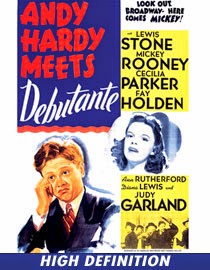
Classic Films in Focus: ANDY HARDY MEETS DEBUTANTE (1940)

This installment of the popular Andy Hardy series takes the Hardy family out of idyllic Carvel and sends them off to New York City, where teenage Andy promptly gets himself into all kinds of trouble. Despite the change of venue, it’s a typical Andy Hardy story, with youthful mistakes, romantic entanglements, and Mickey Rooney’s boundless zeal. You don’t have to have seen all of the previous Hardy pictures to drop into the action, although it does help if you have seen Love Finds Andy Hardy (1938), the earlier movie that introduces Judy Garland’s Betsy Booth character. Garland’s return to the world of the Hardy family makes Andy Hardy Meets Debutante a particularly appealing picture for fans of her collaborations with the energetic Rooney. For newcomers, the distinctive mix of adolescent romance, humor, and wide-eyed American idealism sums up the essence of the Hardy films’ enduring appeal.

At home in Carvel, Andy is nursing a crush on New York society girl, Daphne Fowler (Diana Lewis), and he foolishly brags about knowing her when his friends discover his passion. Andy is forced to prove his claims when Judge Hardy (Lewis Stone) takes the whole family to New York as part of his mission to protect the Carvel Orphanage from big city lawyers who want to defund it. Andy’s friend, Betsy (Judy Garland), tries to help him, but Andy suffers a series of shocks to his ego as he attempts to meet Daphne, and even Judge Hardy becomes concerned about the implications of Andy’s behavior.

Part of Andy Hardy’s appeal is his penchant for getting into scrapes; neither an angel nor a complete reprobate, he’s a twentieth-century Tom Sawyer with a waggish sense of fun and a lively eye for the ladies. Wherever Andy goes, girl trouble follows, and in this outing he has Polly Benedict (Ann Rutherford), Betsy, and Daphne to juggle. Andy thinks he’s too sophisticated for Polly, and he treats Betsy like a kid, but he soon finds out that the wealthy Daphne is out of his league. “There are millions of nice people in the world,” Daphne’s mother tells him, “and Daphne can’t be friends with all of them.” The irony of his comeuppance never seems to dawn on Andy, but the audience sees quite clearly that he reaps as he has sown. His taste in girls needs adjusting, anyway, if he can favor Daphne over her more available competition. Polly, the hometown favorite, wins our approval thanks to Ann Rutherford’s flashing eyes and bold manner, while Judy Garland makes Betsy so sweet and sadly lovestruck that we root for her even though we know that Polly has already staked her claim. Garland’s performance of “Alone,” which starts as a gag and ends with tears, is an emotional highlight of the picture that showcases the young star’s tremendous talent.

Comedy tempered with sentiment is the Andy Hardy formula, and the threat to the orphanage provides a counterweight to Andy’s romantic hijinks. Judge Hardy proves his faith in the system, lectures Andy on American ideals, and wins over a courtroom with the assistance of an adorable orphan, all of which will strike modern viewers as terribly naive. Still, with the Depression in the rearview mirror and the war directly ahead, Americans in 1940 must have wanted very much to believe in the benevolent paternal authority that Judge Hardy embodies. Andy’s relationship with his father gets a great deal of play, while his mother, aunt, and sister hardly make appearances at all. The serious part of Andy Hardy Meets Debutante has nothing to do with women but concerns itself with Andy’s emerging identity as a man with a particular place in the world.

The Andy Hardy series continued until 1958, when Mickey Rooney made his final bow as the character in Andy Hardy Comes Home. George B. Seitz directed most of the Andy Hardy pictures, beginning with A Family Affair (1937), You’re Only Young Once (1937), and Judge Hardy’s Children (1938). For more of Mickey Rooney’s youthful roles, see A Midsummer Night’s Dream (1935), Captains Courageous (1937), and Boys Town (1938). Diana Lewis, who was married to William Powell for more than forty years, retired from acting in the early 1940s after roles in Bitter Sweet (1940), Go West (1940), and Johnny Eager (1941). If you enjoy the collaborative work of Rooney and Garland, be sure to see their musicals together, particularly Babes in Arms (1939), Strike Up the Band (1940), and Babes on Broadway (1941).

Andy Hardy Meets Debutante is currently available for streaming on Warner Archive Instant.