Showing posts with label Val Lewton. Show all posts

Wednesday, October 29, 2025

Cult Classics: THE FOG (1980)

Horror movies got much gorier after the advent of the slasher, and the most iconic chillers of the 1980s tend to lean into that genre and its enthusiasm for arterial spray, but John Carpenter's The Fog (1980) is an atmospheric throwback to the subtler style of horror master Val Lewton, the hands-on producer (and often uncredited writer) behind moody RKO masterpieces like Cat People (1942) and I Walked with a Zombie (1943). The Fog is a very different picture from other Carpenter projects like Halloween (1978), The Thing (1982), and They Live (1988), which is the reason it's one of my favorite movies from the director's oeuvre. Fans of eerie but bloodless classic horror will find a lot to appreciate in the way this movie unfolds its tale of long-simmering supernatural revenge, and those looking for more female-led stories will enjoy the emphasis on Adrienne Barbeau as the DJ heroine with Jamie Lee Curtis and her mother, Janet Leigh, also playing major roles.

Barbeau leads as Stevie Wayne, a late-night DJ in the town of Antonio Bay. Stevie's overnight shifts in a lighthouse allow her to witness and report the arrival of a mysterious fog that coincides with the disappearance of three local fishermen, including the husband of town mayor Kathy Williams (Janet Leigh). As the coastal California town prepares to celebrate its centennial, the local priest, Father Patrick Malone (Hal Holbrook), discovers his grandfather's diary and learns that a cabal of six founders started the community with a shocking act of betrayal, which is now literally coming back to haunt the townspeople on the hundredth anniversary of the crime. Meanwhile, hitchhiker Elizabeth (Jamie Lee Curtis) gets a ride into Antonio Bay with town resident Nick (Tom Atkins), and their efforts to find out what happened to the fishermen lead them to numerous close encounters with the supernatural threat.

Despite reshoots that bowed to the increasing expectation for gory ghosts and peril, The Fog remains a classic haunt at its core, with the eerie titular fog getting a lot more screen time than the spectral mariners. The opening campfire tale, also a late addition, sets the mood with John Houseman telling a group of children about the wreck of the Elizabeth Dane, a ship carrying a colony of leprosy victims to the bay. Between the introductory ghost story and the diary found by Father Malone, we know pretty much everything we need to know about why these murderous spirits are emerging from the fog to avenge themselves a century later. The fog and its ghosts are not so much mysterious as they are unstoppable, a conjoined force of fate that moves at its own pace, slowly but surely descending on Antonio Bay until the town's debt is fully paid. The goriest scenes happen early, with the murders of the fishermen and the subsequent discovery of just one corpse by Elizabeth and Nick, but these are pretty tame compared to Jaws (1975) or other horror films of the era, and mostly the mariners are shadowy figures who drag their victims away into the fog. John Carpenter has talked about his desire to make a movie inspired by Val Lewton's subtle but chilling horror classics (see this 2022 Collider article for more on that), and it's easy to see their influence even after the additions meant to appeal to the horror-going audiences of 1980.

While I love the Lewton-inspired atmosphere of The Fog, I also appreciate its commitment to agency and variety for its female characters. Co-writers Carpenter and Debra Hill offer us more women than men as our central characters, with Carpenter's wife at the time, Adrienne Barbeau, in heroic mode as a single mother who strives to protect the community and also find a way to save her young son as the fog closes in on him and his elderly babysitter. In a different horror movie, Jamie Lee Curtis's hitchhiking Elizabeth might be condemned to a gory death in her underwear, but instead she's smart, empathetic, and able to recover quickly from each close call. Janet Leigh doesn't have any scenes with her daughter until the third act, but her character is also presented as a fully realized individual, and despite her small town political status she's far more likeable than the mayor in Jaws. She's prickly with her assistant but grateful for her all the same, and she strives to forge ahead in her mayoral duties even as she worries about her missing husband. The two male leads, Hal Holbrook and Tom Atkins, seem perfectly comfortable with their female costars, and their characters both eschew the casual sexism exhibited by the fishermen and weatherman Dan O'Bannon (Charles Cyphers). Not every character who gets killed by the ghosts deserves that fate, but the picture doesn't see women as obvious victims just because they're women, and several of the male victims give us little reason to mourn their loss.

For more great ghost stories, try The Uninvited (1944), The Haunting (1963), The Changeling (1980),  and Lady in White (1988). Adrienne Barbeau also appears in Carpenter's Escape from New York (1981), Wes Craven's Swamp Thing (1982), and George A. Romero's Creepshow (1982). Jamie Lee Curtis became an iconic scream queen in the 1980s thanks to films like The Fog, the Halloween series, and Prom Night (1980), but over the decades she has proven herself a versatile actress and great comedic star, eventually winning an Academy Award for her role in Everything Everywhere All at Once (2022). Her mother, Janet Leigh, is of course best remembered for Psycho (1960). For my other favorite John Carpenter movies, see Escape from New York, Christine (1983), and Big Trouble in Little China (1986). 

As of October 2025, you can watch a wide range of John Carpenter films on the Criterion Channel, which is celebrating the director with a curated collection of his work. 

See also: "Hogarthian Gothic: Imagining the Madhouse in Val Lewton's BEDLAM" 

Thursday, September 16, 2021

Five Favorite Films: Val Lewton

I wouldn't normally think about making a five favorite films list for a producer, but Val Lewton is special. Born Vladimir Leventon in what is now Ukraine, Lewton headed the horror unit for RKO in the 1940s and made brilliant, moody horror pictures on shoestring budgets. He eschewed gimmicks and gore in favor of subtext and atmosphere, even when the titles assigned to him to make films out of suggested conventional B horror fare. Lewton worked with his writers and directors throughout the making of his horror films, giving his productions a distinct character that can be seen in all five of the films listed below. Don't be afraid to give Lewton a try if you're not into blood and guts; these are smart, delightfully creepy pictures that let your imagination do most of the work.

Cat People (1942)

The most famous of Lewton's pictures and arguably the best, Cat People features direction by Jacques Tourneur and a terrific performance from Simone Simon, who stars as the Serbian bride of a bland American engineer (Kent Smith). The couple can't consummate the marriage because Irena fears that doing so will transform her into a murderous cat, but the strain on the relationship also threatens to drive her to extremes. Female monsters are rare in classic horror, which makes Irena even more important, as she struggles with many of the same fears and doubts that plague Larry Talbot (Lon Chaney Jr.) in The Wolf Man (1941).

I Walked with a Zombie (1943)

Tourneur also directs this dreamy post-colonial revision of Jane Eyre, which stars Frances Dee as a Canadian nurse who travels to the West Indies to care for the comatose wife of a plantation manager (Paul Holland). Local rumors say that the wife has been turned into a zombie, which sets Nurse Betsy on a quest to find out the truth about her patient and cure her if possible. Important supporting performers include the calypso musician Sir Lancelot and Edith Barrett as the manager's mother. This one is a must for fans of the many Jane Eyre inspired movies that followed the success of Rebecca in 1940.

The Curse of the Cat People (1944)

Tasked with crafting a sequel to the successful original, Lewton instead produced this completely different story about a lonely little girl (Ann Carter) and her "imaginary" friend, using the love triangle from the original as the setup for the adult characters. Oliver Reed (Kent Smith) is still a bland stick but has replaced the dead Irena with more conventional wife Alice (Jane Randolph), and they don't know what to make of their sad, misfit daughter, Amy. Only the ghostly Irena (Simone Simon) brings the child company and comfort, but Irena might not be able to help Amy against the paranoid threat posed by a kindly neighbor's mentally unstable daughter. Robert Wise, who was brought in to finish the picture, earned his first directing credit for this film.

The Body Snatcher (1945)

Wise is also the director for this adaptation of a short story by Robert Louis Stevenson, which features horror icons Boris Karloff and Bela Lugosi as well as Henry Daniell as a doctor who benefits from the infamous corpse stealing trade of 19th-century Edinburgh. The story capitalizes on the notoriety of the Burke and Hare crimes of the period and provides a truly menacing role for Karloff as Cabman John Gray, the body snatcher of the title. Karloff would end up getting some of his best roles in Lewton pictures and was perfectly suited for the more intellectual, artistic brand of horror that the producer specialized in making.

Bedlam (1946) 

This original story about the infamous 18th-century London madhouse is a personal favorite; Lewton got the idea from William Hogarth's Bedlam scene in The Rake's Progress and even stages a shot to recreate the image. Anna Lee stars as feisty comic actress Nell Bowen, who makes enemies of the wrong people and is thus falsely identified as a madwoman and locked up in Bedlam, where the villainous keeper (Boris Karloff) grossly abuses his authority. Mark Robson directs this unabashedly artsy period piece, which might not appeal to everyone but hits all the right buttons for those familiar with Hogarth's prints and the history of the notorious asylum.   

For even more films from Val Lewton, check out The Leopard Man (1943), The Seventh Victim (1943), and Isle of the Dead (1945). Lewton might have made more great films but died tragically young of a heart attack in 1951, at the age of 46.

See also: "Hogarthian Gothic: Imagining the Madhouse in Val Lewton's Bedlam"

Tuesday, October 18, 2016

Classic Films in Focus: THE CURSE OF THE CAT PEOPLE (1944)

Ostensibly a sequel to the 1942 horror classic, Cat People, The Curse of the Cat People (1944) is in reality a completely different kind of tale. It's not really a horror movie and not really a sequel to the original film, even though it brings back most of the characters from the earlier outing and carries over some of their concerns. RKO producer Val Lewton, along with directors Gunther V. Fritsch and Robert Wise, engage in cinematic sorcery to weave this sad, sweet story out of the leftover bits of a psychosexual nightmare, but there are still some moments of terror to be found, especially in the sinister performance of Elizabeth Russell as a daughter scorned to the brink of madness.

Ann Carter plays our young protagonist, Amy Reed, whose loneliness and dreamy ways frustrate her father, Oliver (Kent Smith), largely because of his obsession with normalcy after the tragic death of his strange first wife, Irena (Simone Simon). Amy's mother, Alice (Jane Randolph), also worries about Irena's legacy, which she thinks of as a curse visited on Amy, but both parents are counseled by Amy's teacher (Eve March) to have more patience with their only child. Longing for friends, Amy visits an eccentric old lady, Mrs. Farren (Julia Dean), but she also begins to see the kindly ghost of Irena, who comforts her when she feels most rejected and alone. When Amy follows Irena into a winter storm, she encounters real peril, especially when her arrival at Mrs. Farren's house leads to tragedy.

RKO wanted a sequel to Cat People to cash in on the low-budget horror's success, but as always Val Lewton had something different in mind. Instead of another story of sexual repression and bestial transformation, The Curse of the Cat People offers a ghostly fairy tale that delves into the psychology of children and their imaginary friends. Amy is a sad Alice wandering through a dismal Wonderland, where adults make little sense with their contradictory commands to believe and not believe what they tell her. Rejected by other children and keenly aware of her failure to be the child her father expects, Amy feels drawn toward Irena, who becomes a friendly playmate and confidante. We never know for sure if Irena is real or imaginary; she tells Amy things that suggest knowledge that Amy couldn't possibly have, but the ambiguity is typical of Lewton's best films.

Whether she's a cat woman, an imaginary friend, or a sympathetic ghost, Irena is never the source of terror in this story. The most frightening characters are Mrs. Farren and her daughter, Barbara (Elizabeth Russell), who make for a Gothic duo of feminine domestic dysfunction. Mrs. Farren likes Amy, but she's clearly mad, fashioned in the Miss Havisham mold in her creepy Victorian home. Russell, who had appeared briefly as a fellow Serbian cat woman in Cat People, here has a larger and more tragic role as the daughter whom Mrs. Farren rejects as an impostor, claiming that her real daughter died years ago. Jealous of Amy and driven to the edge of insanity by her isolation and suffering, Barbara swears she will murder the little girl for usurping Mrs. Farren's affection. Ironically, Barbara serves mostly as a foil for Amy, showing the consequences of parental rejection and neglect. Unless Oliver and Alice change their ways, Amy might become as damaged as Barbara, even if Barbara doesn't kill her. The ending underlines the ways in which Irena, Amy, and Barbara are all connected, and if it doesn't put a lump in your throat you haven't been paying attention.

Oddly enough, The Curse of the Cat People is also a Christmas movie, and it hints at Lewton's deeply literate sense of story with its references to Irving's Sleepy Hollow and the poetry of Robert Louis Stevenson. For more of Lewton's eerie best, see I Walked with a Zombie (1943), The Leopard Man (1943), and Bedlam (1946). Ann Carter's other work as a child actor includes The Two Mrs. Carrolls (1947) and Song of Love (1947), but she made her final film appearance at the tender age of 16. Look for the bewitching Simone Simon in The Devil and Daniel Webster (1941) and La Ronde (1950), and see Kent Smith in The Spiral Staircase (1945) and The Damned Don't Cry (1950). If you want more classic horror with Elizabeth Russell, try The Corpse Vanishes (1942) and Weird Woman (1944); she also has an uncredited role as a ghost in The Uninvited (1944).

Thursday, February 13, 2014

Classic Films in Focus: THE LEOPARD MAN (1943)

The Leopard Man (1943) provides another example of the collaborative efforts of RKO producer Val Lewton and director Jacques Tourneur, a pair best known for their work on the iconic horror classic, Cat People (1942). Although this movie returns us to feline territory, the story takes a more practical view of horror, with suggestions of the supernatural limited to the dark fate predicted by a fortune teller's cards. The Leopard Man is strictly a low-budget production, with few familiar stars in sight, but like most of Lewton's pictures it shows what a talented filmmaker can do with a lot of imagination and a very small amount of cash. It's not the first Lewton film a newcomer should see - that would be Cat People or I Walked with a Zombie (1943), also directed by Tourneur - but it's a worthwhile addition to the horror canon, and at only 66 minutes long it doesn't take much time to experience.

Dennis O'Keefe stars as Jerry, the manager and boyfriend of an attractive singer named Kiki (Jean Brooks). Jerry and Kiki are playing a gig in New Mexico when he decides to generate publicity by renting a showman's leopard for Kiki to use as a prop, but the leopard promptly escapes. Soon young women are turning up dead all over town; the leopard is the obvious suspect, but Jerry realizes that something more sinister might be taking place.

Suspense and atmosphere are the key elements in this picture, which depends on the creation of a certain mood much more than it relies on the actual leopard or the killer who impersonates him. We see very little of either predator during the movie's most riveting scenes, when the young women meet their violent ends. The most famous is the first death scene, in which a frightened girl finds herself locked out of her house as something terrible closes in. Her skeptical mother, safely on the inside, mocks her until the girl's screams become too horrific to ignore. By then it is too late, and we see the dark pool of the girl's blood ooze beneath the door. The next girl meets an equally gory death in a walled cemetery, while a third, more brazen than her fellow victims, tries to laugh at the death card the fortune teller repeatedly draws for her. These moments make the most effective use of pacing, shadow, and sound, especially as Clo-Clo (Margo), the third young woman, plays a constant rhythm on her castanets wherever she goes.

Other Lewton films rely on the star power of actors like Simone Simon, Boris Karloff, Frances Dee, or Anna Lee, but The Leopard Man lacks a really fascinating central character. Dennis O'Keefe and Jean Brooks have no air of mystery about them; they're just two all-American folks hoping to assuage their guilt by finding the leopard and the opportunistic killer. The first two victims are lovely but not especially interesting girls, and they have too little screen time for us to become really invested in them. More compelling are Clo-Clo and her fortune teller friend, Maria, played by the very capable Isabel Jewell; they get quite a bit of development, and Clo-Clo's feisty, sweet and salty personality makes her the most engaging female character in the movie. While it would spoil the movie's ending to say too much about the killer, this is definitely not a story that makes a protagonist out of the heavy, which might be a bit of a letdown given the title and the implied possibilities for psychological aberration.

The story of The Leopard Man is adapted from Cornell Woolrich's novel, Black Alibi; film noir fans will also know Woolrich as the writer behind Phantom Lady (1944), Black Angel (1946), and Rear Window (1954). For more Lewton horror, try Curse of the Cat People (1944), The Body Snatcher (1945), and Bedlam (1946). Jacques Tourneur is best remembered today as the director of Out of the Past (1947), but he also made The Flame and the Arrow (1950), Night of the Demon (1957), and The Comedy of Terrors (1963). You'll find Dennis O'Keefe in Brewster's Millions (1945), T-Men (1947), and Raw Deal (1948). Jean Brooks and Isabel Jewell also star in Lewton's 1943 film, The Seventh Victim. See more of the charismatic Margo in Lost Horizon (1937) and Viva Zapata! (1952).

The Leopard Man is currently available for streaming on Warner Archive Instant.

Thursday, October 31, 2013

Ten Classic Horror Films for Halloween

Happy Halloween! It's time for spooks, ghouls, and other things that go bump in the night, which means now is the perfect time to curl up with some classic horror movies. It's the season of Vincent Price, Christopher Lee, Peter Lorre, Lon Chaney, Boris Karloff, and other iconic horror stars, all of them still delightfully creepy even in films made more than fifty years ago. Here are ten of my favorite Halloween treats; as you can tell, I like my classic horror both classy and campy, although I'm not generally a big fan of gore.

1) THE DEVIL-DOLL (1936) - Tod Browning directs Lionel Barrymore in drag! The dolls, as creepy as they are, still aren't as scary as Rafaela Ottiano, who plays the wife of the scientist who creates them.

2) THE WOLF MAN (1941) - My favorite Universal monster makes his screen debut, with Lon Chaney, Jr., Claude Rains, Bela Lugosi, and scene-stealer Maria Ouspenskaya. "Even a man who is pure of heart, and says his prayers by night, may become a wolf when the wolfbane blooms, and the autumn moon shines bright..."

3) CAT PEOPLE (1942) - Val Lewton's signature horror gets extra class from director Jacques Tourneur, while Simone Simon's feline anti-heroine suffers the fatal pangs of romantic disappointment. The stalking sequences are still enough to make you nervous about being alone in dark places.

4) ARSENIC AND OLD LACE (1944) - No, it's not really a horror film, but it has such a good time playing with the conventions of the genre, from Peter Lorre's Dr. Einstein to Raymond Massey's Boris Karloff lookalike. There's something inherently absurd about homicidal old ladies, but we love the Brewster sisters all the more for their deadly idea of charity work! Besides, the story takes place on Halloween, which makes it the perfect movie to watch on October 31.

5) BEDLAM (1946) - I adore Val Lewton, so he gets a second film in my list. This one stars Boris Karloff and Anna Lee and takes place largely in the notorious 18th-century London madhouse. Gothic, literate, and full of great shocks, BEDLAM is not as well-known as CAT PEOPLE but definitely deserves more attention from classic horror fans.

6) EYES WITHOUT A FACE (1960) - Georges Franju's haunting tale of murder, mutilation, and madness is one of the scariest classic horror films I have ever seen, mostly because its images and themes stay with the viewer long after the movie ends. If you're looking for serious chills for Halloween, this is the picture for you.

7) THE HAUNTING (1963) - For serious scares I love this iconic haunted house chiller, which skillfully adapts the novel by Shirley Jackson and really puts the screws to the audience as well as the characters. Julie Harris and Claire Bloom fall apart magnificently when the house cranks up the horror, and that breathing door scene is something you'll never forget.

8) THE COMEDY OF TERRORS (1963) - This black comedy brings so many of my favorite horror players into one place. We have Jacques Tourneur directing and Richard Matheson writing, with Vincent Price, Peter Lorre, Boris Karloff, and Basil Rathbone playing the leads. You'll die laughing!

9) DRACULA A.D. 1972 (1972) - Disco Dracula! This is one of the trippier Hammer horrors to star both Christopher Lee and Peter Cushing in their vampire and Van Helsing roles, but it's just so much fun, including the house party performance of "Alligator Man."

10) HOUSE OF THE LONG SHADOWS (1983) - It's silly and more like a thrill ride than a straight horror story, but I can't resist this movie's dizzying array of classic horror stars. Who can resist Vincent Price, Christopher Lee, John Carradine, and Peter Cushing all together?

What are your favorite classic horror movies for Halloween?

Saturday, September 14, 2013

Classic Films in Focus: THE BODY SNATCHER (1945)

Adapted from a short story by Robert Louis Stevenson, The Body Snatcher (1945) is yet another example of producer Val Lewton’s genius for turning out elegant, literate horrors on a shoestring budget. This period tale of grave robbers in 19th-century Scotland benefits from the direction of Lewton protegee Robert Wise and the presence of genre icons Boris Karloff and Bela Lugosi, but the psychological effect of The Body Snatcher also hinges on a particularly memorable performance from Henry Daniell as a physician whose Faustian bargain with the resurrection man brings about his own undoing. Like most of the Lewton films for the RKO horror unit, The Body Snatcher eschews gore to revel in suggestion, but there is no shortage of unseen awfulness to stir the dark corners of the viewer’s imagination.

Karloff plays the title character, Cabman Gray, who drives a carriage for hire when he isn’t digging up corpses. Gray’s chief client is Dr. McFarlane (Henry Daniell), who loathes Gray but has too much history with him to escape the body snatcher’s power. When McFarlane takes on medical student Fettes (Russell Wade) as his assistant, he draws the young man into the dark side of Victorian medicine and exposes him to Gray’s machinations. Soon Gray begins providing corpses for McFarlane without waiting for them to die of natural causes, and McFarlane realizes that only one course of action will ever release him from Gray’s relentless grip.

Karloff and Daniell dominate the screen as two men who both hate and need one another, tied together by a past that evokes the lurid history of the notorious real life Edinburgh murderers Burke and Hare. Karloff plays Gray as a smiling villain who uses his friendly, obsequious manner to pacify his victims and disarm his enemies, which makes his outbursts of violence all the more shocking. Early in the film, he brutally kills a faithful little dog guarding its young master’s grave, so we understand the sort of outrageous cruelty of which he is capable. His opposite is Daniell’s McFarlane, mockingly called “Toddy” by Gray, who cannot smile even at those he really cares about, including his housekeeper, Meg (Edith Atwater), who is also secretly his wife. Gray is utterly, even gleefully, evil, while McFarlane is a man whose better nature has been corrupted by his involvement with the body snatcher’s trade.

The rest of the characters serve to react to the two protagonists and their ongoing conflict. Russell Wade, handsome but rather bland as Donald Fettes, must avoid repeating his teacher’s fate, and he also provides a muted romantic subplot with an attractive widow (Rita Corday) who has brought her crippled daughter (Sharyn Moffett) for treatment by Dr. McFarlane. The little girl, Georgina, adds some sentiment to the story with her plight, but she also brings irony in her childish obsession with Gray’s white horse, which otherwise functions as a symbol of death. Edith Atwater plays Meg to great effect, investing her with tragic resignation to the fate of the man she loves. Lugosi, oddly enough, has only a few scenes as Joseph, McFarlane’s servant, but his presence pays off with an opportunity to see him and Karloff together in one memorable, violent meeting.

Be sure to appreciate the beautiful singing voice and chilling fate of Donna Lee as the blind street girl, whose encounter with Gray is a quintessential moment of Lewton horror. For another collaboration between Val Lewton and Robert Wise, see Curse of the Cat People (1944), or try The Haunting (1963) for Wise’s most famous work in the horror genre. Karloff and Lugosi can be found in many Universal horror films both separately and together; see both of them in The Black Cat (1934), The Invisible Ray (1936), and Son of Frankenstein (1939). Career villain Henry Daniell has more memorable roles in The Sea Hawk (1940), The Great Dictator (1940), and Jane Eyre (1943); although not primarily a horror actor, Daniell did return to the genre for several episodes of the Boris Karloff television series, Thriller. For different tales of the resurrection men and their ghastly work, you might try more recent pictures like I Sell the Dead (2008) and Burke and Hare (2010), but it's also a frequent theme in the series of Frankenstein films.

Tuesday, October 30, 2012

Classic Horror for Halloween

Halloween is the perfect time to enjoy classic horror from cinema's early days. These movies make great ambience enhancers during your annual costume party, but they're also good choices for an October evening's main entertainment. Here are ten horror classics to get you in the spirit for Halloween. Look for them on streaming services like Netflix, Amazon Instant Video, or Hulu.

Nosferatu (1922) - F.W. Murnau's silent and unofficial adaptation of Stoker's famous novel packs plenty of visual thrills. Max Schreck's hideous Count Orlok is still considered the scariest movie vampire by many film fans.

Dracula (1931) - Bela Lugosi stars as the iconic count in Tod Browning's very loose adaptation, but Dwight Frye steals the movie as the doomed madman Renfield. Edward Van Sloan also creates a definitive interpretation of the Van Helsing character.

Frankenstein (1931) - Boris Karloff creates the popular face of the man-made monster in James Whale's stylish treatment of Shelley's classic novel. Be sure to follow up with The Bride of Frankenstein (1935), featuring Elsa Lanchester as the iconic monster's mate.

The Mummy (1932) - Karl Freund directs as Karloff once again establishes an icon in this tragic story of eternal love. Fans of the 1999 treatment by Stephen Sommers absolutely need to see this original version to appreciate the later director's love for his source material.

The Wolf Man (1941) - George Waggner helms this production with Lon Chaney, Jr., as the title character; Bela Lugosi also appears as the gypsy werewolf who passes his curse to the unlucky Larry Talbot. Don't miss excellent performances from Claude Rains and Maria Ouspenskaya in the supporting roles.

Cat People (1942) - Under the auspices of Val Lewton, Jacques Tourneur directs this elegant variation on the werewolf theme, with Simone Simon as the tortured heroine. The swimming pool scene is justly regarded as one of the finest moments in classic horror history.

Edith Scob stars in Eyes without a Face (1960).
Arsenic and Old Lace (1944) - This screwball comedy from Frank Capra is a Halloween staple for those who prefer lighter fare; Cary Grant stars as a newlywed whose dotty old aunts turn out to be homicidal maniacs. Look for Peter Lorre in a hilarious turn as the plastic surgeon who makes Mortimer Brewster's murderous brother (Raymond Massey) look like Boris Karloff!

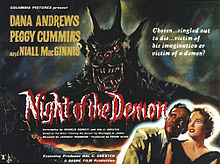
Night of the Demon (1957) - Another Jacques Tourneur outing, this British horror classic stars Dana Andrews as a scientist who doubts the existence of the supernatural, even when he himself becomes its target. Peggy Cummins also stars, but Niall MacGinnis steals the picture as the sinister Dr. Karswell.

Eyes Without a Face (1960) - This French masterpiece from Georges Franju delivers dreamlike horror as a guilt-ridden surgeon tries to replace his daughter's hideously disfigured face by stealing replacements from other young women. Edith Scob stars as the disfigured heroine, with Pierre Brasseur as her obsessed father and Alida Valli as his faithful accomplice.

The Haunting (1963) - Robert Wise's terrifying adaptation of Shirley Jackson's novel offers plenty of thrills without the gore for those who like their horror on the psychological side. Julie Harris, Claire Bloom, Richard Johnson, and Russ Tamblyn star as the unfortunate visitors who rouse the house's malevolent spirit.

Looking for even more classic horror? Check out all of the posts under the "horror" label, including full-length reviews of most of these films. You'll also find plenty of classic horror films in my book, Beyond Casablanca: 100 Classic Movies Worth Watching, now available on Amazon and Barnes & Noble.com.

An earlier version of this article originally appeared on Examiner.com. The author retains all rights to this content.

Tuesday, October 2, 2012

Classic Films in Focus: NIGHT OF THE DEMON (1957)


Jacques Tourneur, who had made his mark on horror directing Val Lewton's Cat People (1942), also helmed Night of the Demon (1957), and he had certainly learned a lot from his time with Lewton at RKO. Tourneur wanted to make another horror film in the same vein as Lewton's pictures, where the audience is kept in suspense about the reality of the supernatural aspects of the story, but pressure from higher up in the studio chain forced him to lay the movie's cards on the table, so to speak, and reveal the demon. It was a mistake, and Tourneur knew it, but it goes to show how little the studio brass sometimes understands its own medium. As a result, Night of the Demon is a flawed gem, but fans of classic horror certainly ought to find it worth watching, for its excellent qualities go a long away to make up for its faults.

Dana Andrews stars as skeptical man of science Dr. John Holden, who comes to England to help debunk the claims of a devil cult's charismatic leader, Dr. Julian Karswell (Niall MacGinnis). One of Holden's associates has recently turned up dead under rather unusual circumstances, and Joanna Harrington (Peggy Cummins), the niece of the deceased man, is certain that Karswell's cult is behind it all. Holden and Joanna join forces to unravel the mysteries of the demonic cult, but it soon becomes clear that Karswell will brook no meddling in his secrets, and our protagonists must race against Holden's date with death to reverse the terrible fate that has been declared for him.

Dana Andrews is a very fine actor, but this is not his best film, mainly because Holden is such a doubting Thomas that it takes him entirely too long to be afraid of anything. Much of a horror film's fear depends upon the audience's sympathetic sharing of the hero's own rising terror, and if the hero isn't afraid, then the audience isn't, either. When he finally does become frightened, the movie picks up, but it's rather late in the game by then. Peggy Cummins is more palpably afraid as Joanna, and she has a wonderful wide-eyed expression of horror, but the demon isn't after her. Maurice Denham makes a brief appearance as the doomed Dr. Harrington at the opening of the film, and he is perfectly terrified, which really helps to build the atmosphere as he makes a panicked journey through the woods at night to visit Karswell. It's too bad he gets replaced by Andrews' character so quickly.

Really, the best player in the whole movie is Niall MacGinnis as the villainous Karswell. With his twisted beard and portly frame, he steals every scene where he appears, but he is especially wonderful during a Halloween party for the village children, where he turns up dressed as a clown. Horror fans all know that clowns are not to be trusted, but Holden and Joanna are simple enough to think that the costume means that Karswell is just a harmless, jovial old man. We first see him pulling puppies out of a hat to amuse the youngsters, but later he conjures a wind storm that sends those same children shrieking across the lawn in fear. Crafty, duplicitous, and wry, Karswell acts as a kind of puppet master, controlling his cult followers and his enemies with equal finesse, until Holden finally realizes the serious stakes of the game and manages to outwit him.

Ignore the few brief scenes where the demon turns up; they are laughable and distracting. Focus instead on the opening shots of the fearful forest road, the wonderful scenes of Holden snooping through Karswell's mansion at night, and that great party sequence. The shots of the Hobart family are also delightful in a British Deliverance sort of way. What the studio executives didn’t understand, but we see so pointedly proven in the film, is that the scariest things are those we don’t see, and the most terrible monsters are those who remain hidden, in the dark of the trees or behind a clown’s painted face. This was Lewton’s great lesson to all of his directors, including Tourneur and Robert Wise, as the delicious horrors of The Haunting (1963) make clear.

If you haven't seen Tourneur's earlier horror films, Cat People is the place to start, with I Walked with a Zombie (1943) and The Leopard Man (1943) both excellent outings, as well. Oddly enough, Tourneur also directed the horror camp classic, The Comedy of Terrors (1963), with Vincent Price, Boris Karloff, Peter Lorre, and Basil Rathbone. If that kind of team-up doesn't make your head spin, nothing will. Dana Andrews is best remembered for his roles in The Ox-Bow Incident (1943), Laura (1944), and The Best Years of Our Lives (1946). See more of Peggy Cummins in Gun Crazy (1950), and look for Niall MacGinnis as Zeus in the mythological classic, Jason and the Argonauts (1963).

An earlier version of this review originally appeared on Examiner.com. The author retains all rights to this content.

Monday, October 1, 2012

Classic Films in Focus: THE HAUNTING (1963)


Shirley Jackson is best known today for her literature anthology standard, "The Lottery," but her 1959 novel, The Haunting of Hill House, is widely regarded as one of the best modern horror stories; the 1963 film adaptation, called simply The Haunting, brings Jackson's eerie tale of fear and psychological collapse onto the big screen. Like Jackson's novel and many classic horror films, The Haunting eschews concrete images of terror in favor of mounting dread and shadowy, unseen threats, and the effect is terrific. Excellent directorial work from Robert Wise and powerhouse performances from the cast combine with the film's masterful source material to make The Haunting a true classic of the genre, sure to please fans of Val Lewton's seminal work in horror and delight those who enjoy the thrills and pleasures of an old-fashioned haunted house.

Julie Harris plays Nell Lance, the emotionally unstable protagonist of this tale of terror, who has recently been liberated from a life of servitude to her bed-ridden mother by the old lady's death. Nell feels both ecstatic and guilty about her mother's demise, but, eager to seize a chance to do something different for once in her life, she signs on to assist in the paranormal research project at Hill House. The team is led by Dr. John Markway (Richard Johnson), a man who wants to prove that the supernatural is real and who thinks that dismal Hill House, with its past history of death and disaster, is just the place for his experiment. Also joining the group are the mysterious Theo (Claire Bloom) and Hill House's presumptive heir, Luke (Russ Tamblyn); once gathered, the four characters quickly find themselves experiencing very strange things indeed. Terrible noises erupt in the night, doors open and close by themselves, writing appears on walls, and cold spots chill the air in certain ominous locations. All the while, fragile Nell responds to the house's evil by becoming more and more unhinged.

Robert Wise had learned the art of horror direction under Val Lewton's astute tutelage, and that influence reveals itself very clearly in The Haunting, where shadows and inanimate objects are invested with mind-bending terror through camera angles, timing, and the characters' reactions. We never see anything really scary in Hill House, but the film constantly suggests that something awful lurks just outside our sight. The justly famous scene in which a door bends and warps in response to some supernatural pressure from the other side is an excellent example of Wise's style here. Like Nell and Theo, we pant in anticipation and horror at the idea that whatever is causing the door's mad contortion will come through and get us, but nothing Wise can show us can be as dreadful as our imagination of it. The black and white cinematography lends itself to this sort of shadow play; watch the way light and dark are used throughout the picture to enhance the idea that something unnatural and unseen lives within this house. Every room is full of statues and mirrors, so that no shot escapes from them; faces are everywhere, watching us, moving in the corners of our sight. The cluttered populations of busts and carved figures give the rooms a funereal air, like the house itself is a kind of indoor cemetery.

Wandering through this Gothic atmosphere we get Julie Harris, stiffly defensive by day in her buttoned jackets and pinned up hair, ghostly and girlish by night in a long white gown, loose tresses trailing behind her as she runs barefoot down the dark and menacing halls. Nell is brittle, sensitive, and deeply repressed, just the kind of victim on whom the house can work its spell. Singularly inexperienced in human relationships, Nell pines with schoolgirl passion for the married Markway and recoils prudishly from Theo's lesbian advances, if only because she is terrified by the feelings that Theo's attentions stir up in her. There might be a touch too much voiceover from Nell over the course of the film, but Wise is trying to remind us how much the story depends upon the secret workings of Nell's mind, and with film there's really no other way to do that.

Take time to appreciate Rosalie Crutchley’s delightfully chilling performance as the housekeeper, Mrs. Dudley. Avoid the 1999 remake of the film; it leaves nothing to the imagination and functions more like an amusement park ride than a real horror film. If you like The Haunting, move backwards in time to Wise's films with Val Lewton, including The Curse of the Cat People (1944) and The Body Snatcher (1945). For what it's worth, Wise's major films before and after The Haunting were West Side Story (1961) and The Sound of Music (1965). Perhaps it was all that singing and dancing that made him feel just a bit homicidal.

An earlier version of this review originally appeared on Examiner.com. The author retains all rights to this content.

Friday, September 14, 2012

Classic Films in Focus: BEDLAM (1946)


In the 1730s, the celebrated English artist William Hogarth created a series of paintings called A Rake's Progress, which rapidly became some of the most famous images of the age. A little more than two centuries later, the visionary film producer Val Lewton took the last of Hogarth's series as the inspiration for his curiously erudite horror film, Bedlam (1946), although the studio heads at RKO probably had no idea what Lewton was up to, since they were really only paying him to churn out a series of cheap horror pictures that nobody was meant to take seriously. What they got instead were some of the most elegant and intelligent horror films ever made, including Cat People (1942) and I Walked with a Zombie (1943). While Bedlam is less well known today than some of Lewton's other pictures, it remains a visually striking and wonderfully effective example of his work, even if it takes a doctoral degree in eighteenth-century studies to appreciate every nuance and allusion that the film contains.

The final scene of The Rake's Progress
Bedlam makes its relationship to Hogarth, and especially The Rake's Progress, very plain at the beginning of the film. The opening credits appear over a series of ten Hogarth prints, ominously beginning with “The Company of Undertakers” and even more ominously ending with “The Idle 'Prentice Executed at Tyburn.” The final scene of A Rake's Progress is actually the sixth piece to appear in this procession. Over it, the credits proclaim that the film was "suggested" by the image that is shown. The other images hint at the events and characters of the film. "The Scene in Bridewell" from A Harlot's Progress and “Strolling Actresses Dressing in a Barn” both prefigure the heroine, a young actress and social climber evocatively named Nell Bowen (Anna Lee). Scenes from the career of the Industrious 'Prentice suggest the hero, the Quaker brick mason Hannay (Richard Fraser), while the opening and closing images allude to Apothecary General Master Sims, the villainous keeper of the Bedlamites, played by the incomparable Boris Karloff. Hogarth's prints reappear throughout the film as interstitial pieces between scenes, so the audience's attention is repeatedly brought back to them as the plot unfolds.

One can imagine original theater audiences of Bedlam being a bit stymied by this parade of pictures; one does not usually expect a low-budget horror film to contain a series of quick lessons on eighteenth-century art, and television runs of the film in later years routinely cut the Hogarth images out. Lewton's use of Hogarth is, however, entirely in keeping with his approach to the RKO films, which frequently turn on literary themes and reveal an unexpectedly sophisticated aesthetic sensibility. Lewton's The Body Snatcher (1945) is an adaptation of a short story by Robert Louis Stevenson, Mademoiselle Fifi (1944) takes its inspiration from the works of Guy de Maupassant, and even I Walked With A Zombie turns out to be a post-colonial revision of Jane Eyre. Thus Hogarth's presence as the driving force behind the film makes perfect sense within the context of Lewton's own ideas about the true nature of his cinematic efforts.

Anna Lee as Nell Bowen
Lewton's use of Hogarth as the film's point of origin encourages the conscious viewer to look more closely and critically at the film itself, much as one views an actual Hogarth print, in which every detail appears for a purpose and furthers the creator's ideological ends. The inmates of the asylum, for example, function as powerful symbolic figures, from Dorothea the Dove, Dan the Dog, and Tom the Tiger to the Gilded Boy. Even their names indicate their archetypal significance. Lewton pitches the fight for sanity as a kind of epic, a sexualized power struggle waged deep within a literal and psychological Underworld between the strong-willed Nell and the sadistic Sims. The imprisoned maiden's persecution by the leering and masculine master also gives the whole film a strong Gothic flavor, which makes sense given that the Gothic was another creation of the eighteenth century. As the film unfolds, Lewton adds more layers, at times recreating Hogarth's images in cinematic tableaux or mixing in references to other period texts, including the 1604 play The Honest Whore and Christopher Smart's Jubilate Agno, written in the mid-eighteenth century when that English poet was himself an inmate in a madhouse.

Lewton, who wrote the screenplay for the movie under the pseudonym Carlos Keith, knew that very little of this aspect of Bedlam would ever be recognized by its audience. Thus he ensures that the film makes perfect sense without this knowledge, relying as it does on the familiar enough plot of the sane person thrown among the mad. The Cabinet of Dr. Caligari (1920), One Flew over the Cuckoo's Nest (1975), and Gothika (2003) have all explored this territory, as well, though none of them with Lewton's intensely literate sense of the idea. Lewton and his director, Mark Robson, also make great use of Boris Karloff's craggy features and mannered villainy; there was something about Karloff that Lewton must have recognized as perfectly suited to his kind of horror, for he used him in The Body Snatcher and Isle of the Dead (1945) as well as Bedlam. If the people in the theater seats never understood the full meaning of what they saw, they at least knew enough to shiver at Karloff's delicious evil, and perhaps shadowy monsters of the subconscious stirred in the dark corners of their psyches, awakened by the strangely disturbing images that flickered there on the screen.

For even more films from Val Lewton, try The Leopard Man (1943), The Seventh Victim (1943), and Curse of the Cat People (1944). After his collaborations with Lewton, Mark Robson went on to direct Peyton Place (1957) and The Inn of the Sixth Happiness (1958), both of which earned him nominations for Best Director. You’ll find more of versatile actress Anna Lee in How Green Was My Valley (1941), Fort Apache (1948), and The Sound of Music (1965). Boris Karloff is best remembered for his monstrous character in Frankenstein (1931), but he’s also fun to watch in Scarface (1932), The Mummy (1932), and The Comedy of Terrors (1963).

An earlier version of the review originally appeared on Examiner.com. The author retains all rights to this content.