Showing posts with label Frankenstein. Show all posts

Monday, October 26, 2026

Introducing the Sparkytopia Snail Mail Club

I've been writing one thing or another all of my adult life, including academic essays, classic movie reviews, and introductions for editions of classic novels, but at heart I'm a creative writer still hoping to pitch the right novel manuscript to the right agent at the right time. Luckily for me, my incredibly talented artist kid, Sparky, is launching a new snail mail club and has graciously allowed me to contribute the original short stories that will accompany their characters and art in each issue. I'm truly excited to help them bring the whimsical world of Sparkytopia to life!

Preview of the Puppystein issue
 

If you're not familiar with snail mail clubs, they're a huge trend right now among artists and other creatives looking to reach audiences who hunger for human-made, tangible joy in an increasingly digital and AI-dominated world. Remember when going to the mailbox was exciting? I certainly do. Before social media, I was a prolific letter writer and Christmas card sender, and I miss the pleasure of getting personal mail instead of bills and advertisements. There are hundreds of snail mail clubs catering to different tastes, budgets, and interests, and you can find lists of them on sites like MailClubly. Whether it's art, history, original fiction, recipes, or travel, you'll find your interests represented in someone's club.


The Sparkytopia snail mail club will build on Sparky's original characters and the world they inhabit through monthly issues containing stickers, small prints, and special surprises lovingly created by Sparky as well as short stories contributed by me. You'll get to know three overlapping groups of characters: the cute neighborhood kids of Sparkytopia, the friendly monsters of spooky Sparky Hollow, and the fashionable teens of the Petticoat Party. We've been working together to imagine the adventures of these characters and the stories that bring them to life. I'm especially enjoying writing stories for the Sparky Hollow monsters - Count Catcula, Puppystein and his Bride, and Wilbur the Werebear - and it has been a delight to watch Sparky design all of the new characters whose stories are forthcoming. 

Sparkytopia mascot Prince Rory

Sparky's art evokes the joy and whimsy of picture book illustrations with bright colors and bold line work. As an expansion of their work as a full-time freelance illustrator and digital artist, the snail mail club will deliver that nostalgic joy to subscribers' mailboxes every month. Fans of cozy art, cute characters, and sweet, funny stories will find a lot to enjoy in each issue, which is suitable for all ages but intended to appeal to tweens, teens, and adults. Each story will run about 500-600 words.


The launch issue introduces Sparky Hollow's adorable Puppysteins, Godwin and Shelley, and their quest for the perfect wedding cake in the short story, "Puppystein Takes the Cake." The issue includes 2 vinyl stickers (one of each character), a handmade interior envelope, a welcome letter, the story, an exclusive B&W mini print that can also be used as a coloring page, and a short recommendation list of Frankenstein-related fun. 


If you're interested in the Sparkytopia snail mail club, you can learn more or sign up here:

https://mailclubly.com/@sparkytopia


I wrote a previous post about how classic movie monsters inspire some of Sparky's art, which you can read here. Wish us both luck as we work to make this collaboration a success! 


Wednesday, August 20, 2025

Classic Movie Monsters Inspire Sparkytopia Art

As a parent and a classic movie fan, it's deeply gratifying when your love for something gets passed on to a new generation. That's why I'm so excited to be interviewing my own kid for this post! Sparky has grown up watching me talk and write about old movies, literature, and popular culture, so I'm always delighted to see those influences in their work as a professional freelance illustrator. Recently, I was able to sit down with them for an interview about their deep love for classic movie monsters and how that inspiration appears in their art. 

While I hope you'll enjoy learning about Sparky's art, I also hope this post will encourage you to share your favorite classic movies with the young people in your life. You never know which ones will click with them and become inspiration for them in the future! You can also learn more about Sparkytopia at their website.


Q: Tell us a little bit about your background as an artist.

I graduated from Ringling College of Art and Design in 2023 with a BFA in Illustration, but I've been drawing for as long as I can remember! In the past two years, I've mostly focused on growing my artistic brand online by offering commissions to individual clients and creating merchandise for my store. I tend to lean towards cute, approachable themes, usually featuring animal characters and bright colors to capture a little childhood nostalgia in every piece.

Q: What inspired you to create art featuring animal versions of classic movie monsters?

I have always been a big fan of classic movie monsters; there's something so traditionally Halloween-y about them! Halloween is also my favorite holiday, so I always jump at the chance to do something spooky for the season. I've been doodling them in my spare time for years, so it was only a matter of time before I worked up something finished to add to my shop designs. It would've been a bit strange to do human characters next to all of my original stickers, so combining classic monster themes with cute animals was a good way to render them in my style. 

Q: Do you have some favorite classic monster movies or a favorite monster? What do you love about them?

I am personally fond of the tragedy of The Creature from the Black Lagoon (1954). I love him dearly, and The Shape of Water (2017) only made me have more feelings about gill men. I find myself yearning to love them as they truly deserve! He's such a fantastic piece of special effects, but it makes it difficult to draw him in a way that pays homage to his original design and reflects my personal style. I do really enjoy Frankenstein (1931), but I have to say I prefer the book's representation of the monster more than the film's, even if Boris Karloff is absolutely iconic. 


Q: Do you have a favorite monster-inspired piece from the work you've done so far? Are there any particular elements that you're especially proud of in that piece?

To my surprise, my favorite is King Tutankhanyan, my mummy character! I didn't expect to love him as much as I do, but I put a lot of time and effort into both the character and shirt designs. The fact that he's specifically a sphynx cat helps elevate him into a more unique character, so he feels a lot more like my little guy and not just a generic mummy. It was a challenge to hand-letter the accurate hieroglyphics on his shirt design, but I think it was all worth it!

Q: Are there other monsters or movie-inspired characters you still want to celebrate with future art projects?

I intend to create a Bride for my existing Puppystein's Monster design. I can't let the lady ghouls go unrepresented! I have some sketches made for an Invisible Man, even if I worry he's a little niche compared to the other monsters. I would still love to do a gill man, but I just haven't found the right vision for him yet! In the distant future, it would be nice to have more drawings of each of my preexisting monsters hanging out together, but I'd like to expand the roster a little before I let them exist in a proper shared universe. I hope you're looking forward to what's to come!

Sparkytopia art is available in their shops on Ko-fi and Threadless. 
You can follow Sparkytopia on Instagram, Bluesky, Tumblr, and numerous other social media platforms. 

Thursday, October 24, 2024

10 Classic Frankenstein Movies Worth Watching

This fall I taught a lifetime learning class about the history and cinematic legacy of Frankenstein, so of course I've had the iconic tale of gods and monsters on my mind throughout the Halloween season. One of the reasons for the story's enduring success is its adaptability; like Shakespearean plays, Frankenstein can change with the times to reflect an era's particular fears about life, death, science, and what it means to be human. Even from the early days, movie versions of Mary Shelley's 1818 novel have varied wildly from their source material, altering both story and meaning to suit their own aims. Here are 10 of my favorite Frankenstein movies, presented in chronological order, to make a frightful film festival for monster movie fans.

1) Frankenstein (1931)

The original Universal movie has to start this list because Boris Karloff and Colin Clive create indelible images with their performances as the Creature and his creator (inexplicably renamed Henry Frankenstein). I think it drags a bit when it leaves the laboratory to focus on Henry's domestic life and worried loved ones, but its influence over later adaptations continues to be felt, especially when we see Shelley's articulate, philosophical Creature reduced to a shuffling, undead thing.


2) The Bride of Frankenstein (1935)

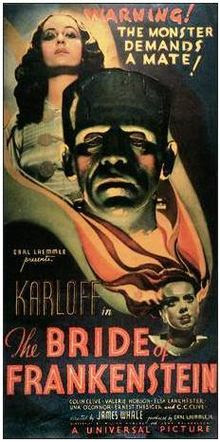
I prefer the sequel to the first Universal picture because it lets James Whale and his cast loose from the limitations of the first movie's roots in a stage play adaptation of the novel. It's wilder, weirder, and a lot more fun all the way through, especially with Ernest Thesiger, Una O'Connor, and Elsa Lanchester joining Karloff and Clive for this outing. If you only see one of the classic Universal entries, this is the one to watch.

3) Son of Frankenstein (1939)

The next generation succumbs to the family's penchant for reanimation in this follow-up, with Karloff returning as the Creature and Basil Rathbone stepping in as Wolf Frankenstein, the son of the original scientist. This one is also notable for its gorgeous German expressionist sets and for Bela Lugosi's appearance as Ygor, the first time that name refers to Dr. Frankenstein's assistant. This is probably the best of the later Universal films, although I do enjoy Frankenstein Meets the Wolf Man (1943) for its revival of the long-suffering werewolf, Larry Talbot (Lon Chaney, Jr.).

4) Abbott and Costello Meet Frankenstein (1948)

More treat than terror, this horror comedy is a Halloween favorite that pits Abbott and Costello against a ghoulish gang of classic monsters, including Glenn Strange as the Creature, Bela Lugosi as Dracula, and Lon Chaney, Jr. as Larry Talbot, aka the Wolf Man. If you want to introduce kids to classic Universal monsters without scaring them too much, this movie is a great choice. You even get Vincent Price making a cameo "appearance" as the Invisible Man at the very end!

5) The Curse of Frankenstein (1957)

Hammer started its own series of Frankenstein films with this adaptation, which stars a very creepy looking Christopher Lee as the Creature and Peter Cushing as Dr. Frankenstein. Scream queen Hazel Court also appears as Elizabeth, and the whole thing is rendered gorier because it's in color. Although Cushing's character is condemned to execution in the first movie, he survives to wreak more havoc with his experiments in The Revenge of Frankenstein (1958), The Evil of Frankenstein (1964), Frankenstein Created Woman (1967), Frankenstein Must Be Destroyed (1969), and Frankenstein and the Monster from Hell (1974).

6) Young Frankenstein (1974)

No list of Frankenstein movies would be complete without this comedy gem from Mel Brooks, with Gene Wilder starring as Frederick Frankenstein, the unwilling heir to his family's legacy who nonetheless ends up building a Creature of his own. The movie uses sets from the original Universal films and is stuffed with gags that work best if you've seen both the 1931 movie and the 1935 sequel. Often hailed as one of the best comedies of all time, it's still uproariously funny 50 years later.

7) Frankenweenie (1984)

Tim Burton has a long-standing love affair with the Frankenstein story, as evidenced by Edward Scissorhands (1990) and the 2012 stop motion remake of this 1984 live action short, but I like the short for its brevity and concentrated weirdness. Disney originally considered this version too scary for kids and fired Burton because of it, but Burton's later success caused Disney to reconsider the short's appeal. Kids today are unlikely to be phased by anything in Frankenweenie, especially those who have already seen any of Burton's other, later films.

8) The Bride (1985)

Fair warning that I haven't rewatched The Bride in a long time, but it makes the list for nostalgia's sake because I first saw it in the 80s and loved it then, partly for its focus on a female Creature (played by Jennifer Beals) and partly for its casting of rock god Sting as Dr. Frankenstein. The movie also stars Clancy Brown as the male Creature and Cary Elwes as another man with a romantic interest in the heroine. I won't pretend this is a brilliant movie, but it is very much a product of its era, and my inner teenager still regards it with affection.

9) The Monster Squad (1987)

Speaking of the 80s and nostalgia, The Monster Squad brings plenty of love for classic monsters and a Goonies sensibility to its horror comedy hijinks, with a group of kids who band together to fight the evil schemes of Count Dracula (Duncan Regehr) and his minions. Frankenstein's Creature, played by Tom Noonan, is supposed to be helping the vampire but turns out to be an ally to the kids, and his friendship with a little girl (Ashley Bank) makes a sweet counterpoint to the tragic scene with a different girl in the 1931 film. This one might actually be too scary (and too free-wheeling with its profanity and sexual references) for very young kids, but it's a perfect pick for tweens, teens, and adult monster kids.

10) Gods and Monsters (1998)

Although it isn't technically a horror movie or an adaptation of Shelley's novel, this fictionalized account of the last days of James Whale is an insightful look at the director's life and work, and it seems fitting to end this list here. Ian McKellen gives a brilliant and moving performance as the aging Whale, and the picture includes flashbacks to the making of Whale's most memorable films. Brendan Fraser costars as Whale's young gardener. Gods and Monsters earned three Oscar nominations, with nods for McKellen as Best Actor and Lynn Redgrave as Best Supporting Actress, and it won the award for Best Screenplay. 

See also: 10 Classic Movies Starring Boris Karloff and 10 Classic Movies Directed by James Whale

Thursday, October 8, 2020

A LEGO Treat for Frankenstein Fans


I'm always excited when my two obsessions - LEGO and classic movies - overlap, and when they do it's usually related to classic horror. This year LEGO has added something especially fun in time for Halloween, a new Brickheadz set for an official Universal Frankenstein! Fans are hoping that more licensed Universal monster characters will follow, but right now we just have the iconic creature first played on the big screen by Boris Karloff in James Whale's 1931 film. 

The Brickheadz line has been very popular the last few years, running about $10 for a set that builds one character with an oversized head. Licensed characters have been especially plentiful, including lots of Star Wars figures, but seasonal ones like Santa Claus and the Easter Bunny have also been frequent additions to the lineup. Frankenstein's monster is a delightful new part of this series, rendered in shades of gray and black to better reflect the image of the Universal version of the character. If you're not into complex builds, don't worry; the Brickheadz take just a few minutes to assemble and make perfect cubicle or desk adornments and will also fit neatly onto a display shelf with your other classic horror collectibles. The box art is also wonderful, with Karloff's version of the creature prominently featured.


Over the years LEGO has released a number of sets and themes with obvious ties to classic horror, and they've always been fun, but this new, official connection with Universal makes me hope that we will see even more Brickheadz and minifigure scale sets in 2021. Right now the Hidden Side theme is my favorite collection of sets because of the spooky atmosphere and ghost figures, but a Dracula's Castle set would be a dream come true (it should have armadillos, of course, just to be extra faithful to the film). If and when LEGO releases information about upcoming Universal Monster sets, I'll be sure to let you know about it here on the blog!

If you want your own Frankenstein Brickheadz, you can find him on the LEGO Shop at Home website for $9.99. I don't have a LEGO store nearby, and with COVID it's difficult to travel to the closest one in the next state over, so I don't know if you can find the set at LEGO Stores, although I assume that you can if you have one near you. If you visit the website, be sure to check out the other fun Halloween items, including the Hidden Side theme and the gorgeous (but so expensive) Haunted House exclusive set.

Related Posts:

10 Classic Movies Directed by James Whale

FRANKENSTEIN MEETS THE WOLF MAN (1943)

LEGO Monster Fighters: Making AFOL Dreams Come True 

Die Toten Reiten Schnell


Monday, November 2, 2015

Classic Films in Focus: THE BRAIN THAT WOULDN'T DIE (1962)

A low-budget cult classic, The Brain that Wouldn't Die (1962) offers all the twisted delights one could ask for in a science fiction horror movie of this type. It's sleazy, gruesome, and short, with a parade of scantily clad women and a mad surgeon hellbent on attaching his girlfriend's severed head to the best body he can find. Although its cut corners and abrupt ending keep it solidly in the realm of the B movie, The Brain that Wouldn't Die benefits from some surprisingly effective acting and several creative, if ghoulish, approaches to its material. Fans of drive-in horror won't need the popular Mystery Science Theater 3000 treatment of this particular picture to appreciate its many macabre charms.

Jason Evers (billed as Herb) stars as transplant surgeon Dr. Bill Cortner, who attempts strange experiments to advance his science in spite of the warnings of his mentor father. When Bill's girlfriend, Jan (Virginia Leith), is conveniently decapitated in a car wreck caused by Bill, the obsessed surgeon grabs the head and revives it in his secret lab. Jan doesn't appreciate being kept alive in this state, but she finds she has gained telepathic powers from the serum Bill uses to sustain her, and she forms a bond with a hideous failed experiment that Bill keeps locked in the lab's closet. Bill, meanwhile, roams the town looking for an attractive body to go with Jan's head. He finds disfigured body model Peggy (Marilyn Hanold), whose scarred face and perfect figure make her a seemingly perfect fit for Bill's insane plans.

The film packs a wealth of provocative material into its 82 minute package, and its science fiction elements reflect both its era and its cinematic roots. Brain movies proved popular in the 1950s and 1960s, with pictures like Donovan's Brain (1953) and Fiend without a Face (1958) exploring different aspects of the theme. The Brain that Wouldn't Die definitely cashes in on that trend, but it also borrows heavily from the 1930s Frankenstein films. Bill's first creation is very like Frankenstein's creature, a menagerie of stolen parts grafted together and condemned to a tortured mockery of life, while Jan becomes the Bride, intended not for the monster but for Bill himself. The quickie B movie lacks the class of James Whale's 1931 Frankenstein, but, given that director's very morbid sense of humor, it's not hard to imagine Whale loving the bizarre spectacle of "Jan in the Pan." The 1962 feature also has the freedom to go a lot farther with its gore, although later TV and video versions often cut the bloodiest scenes. The death of Bill's assistant, Kurt (played by Anthony La Penna under the name Leslie Daniel), revels in macabre irony, even if its effects elements seem simplistic by modern horror standards. The movie also reveals a prurient interest in women's bodies, with Bill cruising strip joints and city streets for potential donors to Jan's reconstruction. He looks them over carefully, the camera following his gaze as he assesses all the key parts of each woman's figure. Luckily, the plot also adopts a female revenge angle that justly punishes Bill for his lecherous hubris.

There are many glaring flaws in The Brain that Wouldn't Die, including a car accident that doesn't actually show a car, a head that can laugh without lungs, and an ending that leaves one particularly obvious thread dangling, but the performances themselves are much more energetic than one often finds in movies of this kind. Evers has just the right obsessive conviction as the crazed surgeon; we only wonder why Jan likes him in the first place, since he seems pretty far gone from the start. Even in the slower opening scenes, which lay out the medical explanations and ethical questions for the transplant experiments to follow, Evers gives Bill an intense, driven quality that also reveals his deep-rooted psychological need to rebel against and surpass his more cautious father. The creepy appeal of the picture, however, really depends on Virginia Leith's bodiless vengeance as Jan. When we first see her, she glows with adoration for Bill, but her conventional personality vanishes along with her limbs. As a head, she becomes something unnatural, powerful, and filled with seething hatred for the egomaniac who forces her to live. Leith's husky whispers and piercing laughter dominate every scene in the lab, and they're what the viewer will remember after the final shot ends.

For a freakish triple feature, follow up with The Man with Two Brains (1983) and Re-Animator (1985). Joseph Green, who directed The Brain that Wouldn't Die, was primarily a distributor of low-budget pictures rather than a filmmaker, but his one hit cult wonder has ensured his place in horror history. Jason Evers was primarily a television actor, but he turns up in The Green Berets (1968), The Illustrated Man (1969), and Escape from the Planet of the Apes (1971). Look for Virginia Leith in Stanley Kubrick's Fear and Desire (1953), Violent Saturday (1955), and A Kiss Before Dying (1956).

In February of 2015, Wired ran this interesting article about the reanimation genre of horror and The Lazarus Effect (2015); The Brain that Wouldn't Die gets plenty of credit for its influence on subsequent films.


Thursday, April 16, 2015

Classic Films in Focus: FRANKENSTEIN MEETS THE WOLF MAN (1943)

Universal Studios enjoyed so much success with its various monsters that the temptation to make endless sequels and combinations of characters proved too tempting, and movies like Frankenstein Meets the Wolf Man (1943) appeared in large numbers throughout the 1930s and 40s. Of course, the quality of these pictures declines in direct proportion with their quantity, but fans of classic horror enjoy them as much for their flaws as for their virtues. Frankenstein Meets the Wolf Man plays mostly as a direct sequel to the 1941 film, The Wolf Man, and it features Lon Chaney's Larry Talbot/Wolf Man character far more than it does Frankenstein's monster. While it lacks the narrative coherence of the original film, it does offer a second encounter with some wonderful characters, and the cast brings together an impressive cadre of classic horror's most reliable stars.

The plot resurrects Larry Talbot (Lon Chaney, Jr.) four years after his assumed death. Talbot, distraught at being alive and cursed by lycanthropy again, eventually makes his way to the home of Dr. Frankenstein, in the hope that the infamous doctor can end his eternal life. Unfortunately, the doctor is dead, and Larry finds and revives the monster (Bela Lugosi) instead. The unfortunate village near Frankenstein's castle falls prey to the depredations of both werewolf and monster, prompting panic and a rising mob, while Larry's doctor, Frank Mannering (Patric Knowles), and the attractive Baroness Elsa Frankenstein (Ilona Massey) struggle to bring Larry and the monster to a peaceful end.

The plot fails to resolve itself, probably because Universal wanted to keep its monsters alive for additional sequels, and editing decisions cut much of Lugosi's role out of the final version of the picture. Technically speaking, the only Frankenstein in the film is Elsa, who is actually the granddaughter of the original mad scientist and the daughter of his son, who had taken up the family vocation in The Ghost of Frankenstein (1942). Frank Mannering ends up being the doctor who must face the temptation of controlling life and death, and he never gets insane enough to be much fun.

Chaney continues to imbue Larry Talbot with tragic pathos, and his transformation scenes are really quite good, better even than those seen in the original film. Rejoining him on his journey to Frankenstein's castle is Maria Ouspenskaya as Maleva, and she makes the movie worth watching all by herself. Dwight Frye has a small role as one of the villagers (you'll miss him if you aren't watching for him), and Lionel Atwill, another regular in the genre, plays the reasonable town mayor. Lugosi, sadly, has little to do; many of the scenes featuring the monster are really stunt doubles, and the monster's limited screen time makes him merely a minor character, despite the title's implication to the contrary.

I can't tell you why Patric Knowles ends up playing two different characters named Frank between The Wolf Man and this film, but it makes for a rather odd sense of deja vu if you watch both movies in rapid succession. Maybe he just makes a perfect foil to Chaney, or perhaps director Roy William Neill wanted to bring back as many of the original film's cast as possible. Even Chaney's beloved German Shepherd, Moose, who played the role of the wolf in the original movie, makes a brief appearance in the sequel. Chaney himself would bring Larry Talbot back for more suffering in House of Frankenstein (1944), House of Dracula (1945), and Abbott and Costello Meet Frankenstein (1948). You can see more of Maria Ouspenskaya in Love Affair (1939), Waterloo Bridge (1940), and Dance, Girl, Dance (1940). Roy William Neill's directorial credits include many Sherlock Holmes adventures with Basil Rathbone, but he also directed Black Angel (1946).

Thursday, November 6, 2014

10 Classic Science Fiction Movies Every Geek Should Know

Recently I gave a talk at Rocket City NerdCon about classic science fiction movies, with an emphasis on some of the essential classics that every fan should see. Here, for those of you who didn't make it to the panel, is the list from the talk. Getting it down to just ten movies proved more or less impossible, as you'll see from the way I cheated on #3 and #6! I also talked about some bonus picks that might not be the best sci-fi movies ever made, but they certainly are memorable and fun. Have you seen all of these movies? What classic sci-fi films are your favorites?

1) A TRIP TO THE MOON (1902) – Georges Melies, France

The silent that helped to start it all; you can't escape the influence of Melies, especially that grimacing moon with the rocket in his eye.

2) METROPOLIS (1927) – Fritz Lang, Germany

Lang eventually made his way to Hollywood, where he made several excellent noir films, but his sci-fi silent gave us an early taste of dystopia and robotic doppelgangers. Among the modern artists influenced by Lang's film are musician Janelle Monae, whose debut album was called Metropolis and focused on the adventures of an android heroine named Cindi Mayweather. Her later albums, The ArchAndroid and The Electric Lady, have continued to explore the themes set forth by Lang's work and related sci-fi classics like Blade Runner.

3) FRANKENSTEIN (1931) and THE BRIDE OF FRANKENSTEIN (1935) – James Whale, US

Mary Shelley helped to establish one of the enduring themes of science fiction, that of the scientist who goes too far, with her 1818 novel, and James Whale provided the iconic cinematic adaptation with Boris Karloff as the shuffling monster. The sequel also offers us the iconic image of the Bride, played with hissing perfection by Elsa Lanchester (who also plays Mary Shelley herself in the film's framing scenes).

4) THE DAY THE EARTH STOOD STILL (1951) – Robert Wise, US

Not all aliens come to conquer us, as Klaatu (Michael Rennie) proves in this important picture from the beginning of the 1950s golden age of sci-fi. While his robot underling strikes fear, Klaatu himself is a gentle visitor who even attracts the romantic interest of a lovely earthling woman (Patricia Neal).

5) THE THING FROM ANOTHER WORLD (1951) – Christian Nyby, US (uncredited help from producer Howard Hawks)

There have been numerous Thing remakes, but the original started it all, with James Arness weirdly cast as the menacing monster.

6) THE BEAST FROM 20,000 FATHOMS (1953) – Eugene Lourié, US and GOJIRA (1954) – Ishiro Honda, Japan

Kaiju movies made their debut in the 1950s; Ray Harryhausen's stop-motion work brought the prehistoric Beast to life a year before Ishiro Honda unleashed Godzilla, but both helped to usher in a new age of rampaging monsters meting out some karmic payback on mankind. 

7) CREATURE FROM THE BLACK LAGOON (1954) – Jack Arnold, US

The last of the great Universal monsters to arrive on the scene, the Creature is a distinctly sci-fi being, basically a kaiju on a much smaller scale (and with an eye for the ladies). Can we blame him for fancying Julie Adams? Of course not. 

8) FORBIDDEN PLANET (1956) – Fred M. Wilcox, US

Shakespeare goes sci-fi in this influential tale of a lone scientist and his daughter living on an alien world, where a mysterious creature kills everyone else. Leslie Nielsen plays the straight romantic lead, while Robby the Robot makes his first appearance. 

9) INVASION OF THE BODY SNATCHERS (1956) – Don Siegel, US

Communist paranoia gets freaky when alien doubles start taking over a town. Like The Thing, Invasion spawned numerous remakes, including the 1978 version with Donald Sutherland, but it's hard to beat Kevin McCarthy and Dana Wynter in the original.

10) THE FLY (1958) – Kurt Neumann, US

Another classic with a significant remake, the original version of The Fly has a fabulously wild ending, but most of the story is really about the doomed love of a married couple and the way in which scientific ambition destroys their lives. Vincent Price, so often the monster, this time plays the scientist's brother, who has to figure out why his sister-in-law killed the man she loved.

BONUS PICKS

20,000 LEAGUES UNDER THE SEA (1954) - Richard Fleischer, US
For steampunk fans, this Disney live-action adventure is a must. Kirk Douglas, James Mason, and Peter Lorre add to the fun.

THEM! (1954) - Gordon Douglas, US
Giant ants once again prove that atomic testing is bad news. Edmund Gwenn, Joan Weldon, James Arness, and Fess Parker all make memorable appearances, but the ants are really the stars.

THE BLOB (1958) - Irvin S. Yeaworth, Jr., and Russell S. Doughten, Jr., US
Stranger even than middle-aged Steve McQueen as a high school student is the Blob itself, but Burt Bacharach's swinging theme makes a weird B-picture a priceless delight.

ATTACK OF THE GIANT LEECHES (1959) - Bernard L. Kowalski, US
Atomic era horror so bad it’s great! This one is just for fans of bad 50s sci-fi. Get the popcorn and settle in for some truly awful cliches and bad monster costumes.

DR. JEKYLL AND MR. HYDE (1920, 1931, and 1941) - Various directors
Multiple takes on Robert Louis Stevenson's story show more of the dark side of science. One of the great lessons of the sci-fi movie is: Never use yourself as a guinea pig. Sadly, neither Dr. Jekyll nor any of his fellow scientists ever seem to learn.

ISLAND OF LOST SOULS (1932) - Erle C. Kenton, US
H.G. Wells' The Island of Dr. Moreau gets a stylish horror treatment in this gem starring Charles Laughton as the inhumane scientist who wants to transform animals into men. 

ROBINSON CRUSOE ON MARS (1964) - Byron Haskin, US
The title pretty much says it all, right? Paul Mantee and Victor Lundin star, but the star you'll remember is Adam West. This is a great example of the "astronaut in peril" genre most recently embodied by Gravity (2013).

Tuesday, July 22, 2014

10 Classic Movies Directed by James Whale

Born on July 22, 1889, the English director James Whale stands with Tod Browning as one of the most important developers of the 1930s horror genre. Both directors worked to give the iconic Universal horrors their sense of style, but Whale set the bar particularly high with his combination of terror and sly, subversive comedy in The Bride of Frankenstein (1935). Whale directed 23 films over the course of his career, but the Universal horrors are the pictures for which he is best remembered today. In honor of Whale's birthday, here are ten classic movies where you can see the director's hand at work.

1) Journey's End (1930) - Whale's first directorial effort was an adaptation of a 1928 stage play about World War I. Its cast included two actors who would later be major players in the Universal horror unit: Colin Clive and David Manners.

2) Waterloo Bridge (1931) - This romantic drama about a prostitute and a soldier stars Mae Clarke and Douglass Montgomery, but it was also the third screen appearance of 23 year old Bette Davis. A 1940 adaptation of the Robert Sherwood play would prove more enduring with stars Vivien Leigh and Robert Taylor.

3) Frankenstein (1931) - Whale's first horror picture would shape the genre for decades to come, influencing countless later adaptations of Mary Shelley's Gothic novel. With Boris Karloff as the resurrected monster and Colin Clive as his mentally unbalanced creator, Whale crafted a stylish, wry, and genuinely terrifying masterpiece. Mae Clarke, Edward Van Sloan, and the deliriously mad Dwight Frye also contributed to Whale's success with their performances.

4) The Old Dark House (1932) - As the name implies, this film belongs to the "old dark house" genre of horror, with Whale emphasizing the absurdly comedic possibilities of the conventional plot. The collected cast makes this picture a delight for classic movie fans, with Boris Karloff, Charles Laughton, Gloria Stuart, Melvyn Douglas, Ernest Thesiger, and Raymond Massey all in the mix, but the strangest pleasure is Elspeth Dudgeon cross-dressed to play the elderly Sir Roderick Femm.

5) The Invisible Man (1933) - Whale's next horror production took the darkly humorous aspect of the genre to a whole different level, with the increasingly mad Claude Rains gamboling invisibly and wreaking havoc all over the English countryside. The film was the first screen role for Rains, who remains unseen until the very last shot, but his voice proved the real draw. Gloria Stuart and Henry Travers star as the friends trying to save Rains from himself, but Una O'Connor also demonstrates her ample talent for scene-stealing and an ear-piercing pitch.

6) The Bride of Frankenstein (1935) - Whale's earlier efforts paved the way for this outstanding picture, which also mingles absurd comedy with its gripping horror. The film reunited Whale with Boris Karloff, Colin Clive, Ernest Thesiger, Dwight Frye, and Una O'Connor, but its most iconic, if only briefly seen, performer is the young Elsa Lanchester as both Mary Shelley and the shock-haired Bride.

7) Show Boat (1936) - Whale is remembered primarily for his horror, but this 1936 musical drama proved that he could also tap into tender emotions. Generally considered the best film adaptation of the original stage play, Whale's Show Boat gave the world both spectacle and sentiment, with touches of the Whale humor still in evidence. The cast includes many top stars, from Irene Dunne and Allan Jones to Charles Winninger and Helen Morgan, but the film is known today primarily for Paul Robeson's performance as Joe and his powerful rendition of "Old Man River."

8) The Great Garrick (1937) - After The Bride of Frankenstein, Whale moved away from horror, making several dramas and war films. This picture took Whale into the territory of the romantic comedy, with a period setting and Brian Aherne as David Garrick, the great theater personality of the 18th century. Other notable members of the cast include Olivia de Havilland, Edward Everett Horton, Lionel Atwill, and Lana Turner.

9) The Man in the Iron Mask (1939) - Whale continued the period theme with this adaptation of the Alexandre Dumas adventure, with Louis Hayward starring in the double role of the twin royals. Swashbuckling regulars in the cast include Alan Hale and Montagu Love, but Joan Bennett, Warren William, Joseph Schildkraut, and Albert Dekker also make appearances.

10) They Dare Not Love (1941) - Sadly, by the beginning of the 1940s Whale's career was more or less over.  Show Boat had been his last truly memorable work. They Dare Not Love, a World War II drama starring George Brent, Martha Scott, and Paul Lukas, would be his last feature film.

In 1998, Whale's story became familiar to a new generation of moviegoers with the release of Gods and Monsters, adapted from Christopher Bram's novel, Father of Frankenstein. In the film, Ian McKellen plays the director at the very end of his life, while Brendan Fraser stars as the gardener who befriends him. You can also learn more about Whale by reading James Curtis' 2003 biography, James Whale: A New World of Gods and Monsters.

Monday, August 26, 2013

Classic Films in Focus: HOUSE OF FRANKENSTEIN (1944)

Plenty of the later Universal horror movies pack in the monsters, but House of Frankenstein (1944) really outdoes the rest by jamming a whole madhouse of familiar players into its many roles, not only as the headlining creatures but also as supporting characters. The story is so convoluted and episodic that it’s certainly not the chief attraction, but classic horror fans who know their stars will find the parade of performers entertaining in its own way, and Boris Karloff gets a particularly fun role as the devious and obsessive mad doctor whose adventures string together the appearances of Dracula, the Wolf Man, and Frankenstein’s monster. Directed by Erle C. Kenton, House of Frankenstein is by no means the best of the Universal horrors, but taken scene by scene and monster by monster it does provide some unique twists on the usual situations.

Karloff plays aspiring Frankenstein successor Dr. Niemann, who escapes from prison along with his hunchbacked assistant, Daniel (J. Carrol Naish). They hitch a ride from a traveling horror show and then murder its owner, Lampini (George Zucco), so that Niemann can assume his identity. Posing as the showman, Niemann resurrects Count Dracula (John Carradine) as an accomplice in his extensive revenge plot against the men who sent him to prison, but the vampire promptly becomes distracted by attractive female prey (Anne Gwynne). Later, in the ruins of Frankenstein’s castle, Niemann finds the Wolf Man (Lon Chaney, Jr.) and Frankenstein’s creature (Glenn Strange) frozen in ice and revives both of them, but he finds werewolf Larry Talbot harder to control than the other monsters. Daniel, meanwhile, becomes enamored of a pretty gypsy girl (Elena Verdugo) and grows jealous of her attention to Talbot.

While Karloff had originally gained fame playing the lumbering monster, he shows in this film that he can just as easily assume the role of the creator, and his Niemann is a fine example of the wild-eyed devotee of transgressive science. There are references to an earlier experiment in which Niemann transplanted a human brain into a dog, so from the start we know that he might actually be crazier than the original Frankenstein or any of his ill-fated heirs. More importantly, Niemann lies to and takes advantage of the dangerous supernatural beings he encounters; this is a man mad enough to play Dracula for a dupe and plot to make a science experiment out of the Wolf Man’s body and brain. He really only cares about Frankenstein’s creature; the rest of the monsters are just convenient means to his nefarious ends. Inevitably, Niemann’s duplicity catches up with him, but it’s ironically the lowly hunchback, tired of being played for a sucker, who raises the hand of vengeance against the scheming doctor.

The rest of the cast keep things interesting in spite of the disjointed plot. John Carradine has a brief but effective run as Count Dracula; his lean physique prefigures that of Christopher Lee even as he retains the aristocratic manners of Lugosi. Lon Chaney, Jr. makes his usual contribution as doomed Larry Talbot, this time with the added interest of a tragic love affair with the spirited gypsy girl. His role as part of a romantic triangle with the girl and the hunchback puts him into the odd position of playing Captain Phoebus in their version of the Victor Hugo tale, although Larry really does seem to return the gypsy’s affection. J. Carrol Naish proves one of the most inspired additions to the collection with his pathetic, jealous Daniel, who commits most of the murders in the film and yet still commands a degree of sympathy from the audience for his unrequited love. The victims and supporting characters are played by a who’s who of favorite actors, including George Zucco, Sig Ruman, Lionel Atwill, Frank Reicher, and Glenn Strange under all the makeup taking Karloff’s place as the creature.

Like most of the Universal monster pictures, House of Frankenstein kills off all of the creatures by the final scene, but House of Dracula (1945) brings them back to life for another round. For a different sort of horror from director Erle C. Kenton, try Island of Lost Souls (1932). Look for the many faces of Boris Karloff in The Mummy (1932), the Mr. Wong series, and Bedlam (1946). Lon Chaney, Jr. plays the Wolf Man in several Universal films, beginning with The Wolf Man (1941). Versatile character actor J. Carrol Naish turns up in more than 200 film and television roles, but he earned Oscar nominations for Best Supporting Actor in Sahara (1943) and A Medal for Benny (1945). He’s hard to recognize under the makeup and feathers, but you’ll also find him playing Chief Sitting Bull in Annie Get Your Gun (1950).

Monday, August 19, 2013

Classic Films in Focus: HOUSE OF DRACULA (1945)

Released in 1945, House of Dracula is one of the many monster movie sequels that Universal churned out in an effort to keep audiences coming back for more of their favorite fiends, and, like Frankenstein Meets the Wolf Man (1943), House of Frankenstein (1944), or the later Abbott and Costello Meet Frankenstein (1948), this picture takes a “more is more” approach to its monsters. This particular mad monster party has some intriguing components, but it squanders its potential with a disastrous third act that doesn’t so much end as simply stop. Up until that frustrating finale, the picture has its appeal, especially in the performance of John Carradine as a thin, hypnotic Count and the creative twists applied to the mad doctor and hunchback staples.


Onslow Stevens stands at the center of the action as the good Doctor Edelmann, who is approached first by Dracula (John Carradine) and then by Larry Talbot (Lon Chaney, Jr.) for cures to their unique conditions. Dracula, as it turns out, really only wants to get close to Edelmann’s attractive nurse, Miliza (Martha O’Driscoll), and Edelmann pays a terrible price for trying to cure the vampire, even as his efforts to help Larry seem more hopeful. Edelmann also discovers the Frankenstein’s creature (Glenn Strange) in the caves beneath his castle, but his hunchbacked assistant, Nina (Jane Adams), repeatedly warns him against resurrecting the monster.

As the ostensible protagonist of the story, Onslow Stevens makes a good showing, especially during his Jekyll and Hyde moments later in the picture. Stevens is not particularly well-known today, but he worked a long and prolific career in film and television, and in Edelmann he has a role that allows him to play with many classic horror types at once. Edelmann is both Van Helsing and Victor Frankenstein as well as Jekyll and Hyde, a good man who resists evil until he is tragically overcome by it. His approach to the monstrous makes House of Dracula as much science fiction as horror; Edelmann treats vampirism as a blood condition and uses transfusions to combat it, although his treatment of lycanthropy proves far more successful, in part because Dracula doesn’t really to be cured, while Larry is ready commit suicide if he can't find a way to escape his werewolf curse.

The monsters, as usual, have the most fun here, with John Carradine leading the charge as an effective incarnation of the famous Count. Carradine has the mesmerizing eyes needed for this role, and the screen makes the most of them with several close-up shots. He doesn’t bother with a fake foreign accent, but his deep voice carries notes of aristocratic culture and seductive menace nonetheless. Dracula’s inevitable death scene begins the series of bad endings that plague the second half, but the Count still manages to make his influence felt beyond the grave. Lon Chaney, Jr. is back in familiar territory with his Larry Talbot role, which he wears as comfortably as a favorite suit, and we get some fun transformation sequences with lots of hair and teeth. Glenn Strange, however, has very little to do as the creature, whose few scenes are sometimes borrowed from earlier films with other actors in the makeup. As the love interest of both vampire and werewolf, Martha O’Driscoll is pretty but a bit flat, especially in her trance scenes with Dracula, and Jane Adam’s hunchbacked Nina proves a far more interesting female character. The abrupt ending that literally brings down the house on these characters is especially unfair to Nina, who ought to have a much better final moment than the throwaway treatment she receives.

Be sure to notice Lionel Atwill in one of his last screen roles as the police inspector. Erle C. Kenton, who directed House of Dracula, also headed up the terrific Island of Lost Souls (1932) as well as The Ghost of Frankenstein (1942) and House of Frankenstein (1944). For more early but memorable performances by John Carradine, see Stagecoach (1939), The Grapes of Wrath (1940), and Blood and Sand (1941); the actor appeared in more than 300 films and television programs, including many cult horror classics as well as serious Oscar contenders. Lon Chaney, Jr. made his first appearance as Larry Talbot in The Wolf Man (1941), but he went on to play the character many times, and he also starred in other monster roles in Son of Dracula (1943) and The Mummy's Curse (1944).

Tuesday, October 30, 2012

Classic Horror for Halloween

Halloween is the perfect time to enjoy classic horror from cinema's early days. These movies make great ambience enhancers during your annual costume party, but they're also good choices for an October evening's main entertainment. Here are ten horror classics to get you in the spirit for Halloween. Look for them on streaming services like Netflix, Amazon Instant Video, or Hulu.

Nosferatu (1922) - F.W. Murnau's silent and unofficial adaptation of Stoker's famous novel packs plenty of visual thrills. Max Schreck's hideous Count Orlok is still considered the scariest movie vampire by many film fans.

Dracula (1931) - Bela Lugosi stars as the iconic count in Tod Browning's very loose adaptation, but Dwight Frye steals the movie as the doomed madman Renfield. Edward Van Sloan also creates a definitive interpretation of the Van Helsing character.

Frankenstein (1931) - Boris Karloff creates the popular face of the man-made monster in James Whale's stylish treatment of Shelley's classic novel. Be sure to follow up with The Bride of Frankenstein (1935), featuring Elsa Lanchester as the iconic monster's mate.

The Mummy (1932) - Karl Freund directs as Karloff once again establishes an icon in this tragic story of eternal love. Fans of the 1999 treatment by Stephen Sommers absolutely need to see this original version to appreciate the later director's love for his source material.

The Wolf Man (1941) - George Waggner helms this production with Lon Chaney, Jr., as the title character; Bela Lugosi also appears as the gypsy werewolf who passes his curse to the unlucky Larry Talbot. Don't miss excellent performances from Claude Rains and Maria Ouspenskaya in the supporting roles.

Cat People (1942) - Under the auspices of Val Lewton, Jacques Tourneur directs this elegant variation on the werewolf theme, with Simone Simon as the tortured heroine. The swimming pool scene is justly regarded as one of the finest moments in classic horror history.

Edith Scob stars in Eyes without a Face (1960).
Arsenic and Old Lace (1944) - This screwball comedy from Frank Capra is a Halloween staple for those who prefer lighter fare; Cary Grant stars as a newlywed whose dotty old aunts turn out to be homicidal maniacs. Look for Peter Lorre in a hilarious turn as the plastic surgeon who makes Mortimer Brewster's murderous brother (Raymond Massey) look like Boris Karloff!

Night of the Demon (1957) - Another Jacques Tourneur outing, this British horror classic stars Dana Andrews as a scientist who doubts the existence of the supernatural, even when he himself becomes its target. Peggy Cummins also stars, but Niall MacGinnis steals the picture as the sinister Dr. Karswell.

Eyes Without a Face (1960) - This French masterpiece from Georges Franju delivers dreamlike horror as a guilt-ridden surgeon tries to replace his daughter's hideously disfigured face by stealing replacements from other young women. Edith Scob stars as the disfigured heroine, with Pierre Brasseur as her obsessed father and Alida Valli as his faithful accomplice.

The Haunting (1963) - Robert Wise's terrifying adaptation of Shirley Jackson's novel offers plenty of thrills without the gore for those who like their horror on the psychological side. Julie Harris, Claire Bloom, Richard Johnson, and Russ Tamblyn star as the unfortunate visitors who rouse the house's malevolent spirit.

Looking for even more classic horror? Check out all of the posts under the "horror" label, including full-length reviews of most of these films. You'll also find plenty of classic horror films in my book, Beyond Casablanca: 100 Classic Movies Worth Watching, now available on Amazon and Barnes & Noble.com.

An earlier version of this article originally appeared on Examiner.com. The author retains all rights to this content.

Friday, October 26, 2012

Classic Films in Focus: THE CURSE OF FRANKENSTEIN (1957)

Although Mary Shelley's novel has been filmed many times, every adaptation of Frankenstein is unique, a point that The Curse of Frankenstein (1957) helps to prove. Director Terence Fisher's version of the Frankenstein story offers a different take than the iconic 1931 picture from James Whale; it brings in more Gothic atmosphere and revels in an early opportunity for full color gore. With Hammer stars Peter Cushing and Christopher Lee in the roles of the scientist and his monster, The Curse of Frankenstein has great appeal for fans of classic horror, and its deviations from the source material offer some fascinating commentary on the cultural evolution of Shelley's modern Prometheus.

Cushing plays Baron Victor Frankenstein, who comes into his title and his wealth at an early age and uses the opportunity to hire himself a tutor with expert qualifications in science. His chosen mentor is Paul Krempe (Robert Urquhart), who teaches the younger man everything he knows but eventually grows uncomfortable with the direction of Victor's research. Consumed by his desire to create life, Victor ignores his intended bride, Elizabeth (Hazel Court), although he does find time to carry on a callous affair with the resident maid, Justine (Valerie Gaunt). Eventually, Victor's efforts bring the Monster (Christopher Lee) into being, but the master cannot control his creation, despite numerous operations to alter the creature's brain.

Peter Cushing makes an excellent Frankenstein; he perfectly conveys the sneering narcissism of the aristocracy and looks both incredibly intelligent and insufferably aware of it. The character of Paul is created as a foil to Victor, and Robert Urquhart has an open, sincere expression that marks him as Victor's opposite; both men are technically scientists, but Paul imagines science as a way to help humanity, while Victor sees it as a path to godlike power. The two women also function as foils to one another; Hazel Court's Elizabeth is utterly innocent, unable to imagine that Victor might be capable of wrong, while Valerie Gaunt's Justine is a jealous schemer who attempts to blackmail Victor into marrying her. Both women mistake the character of their man, but Justine pays the steeper price for the error. There's a terrible irony in Victor's decision to let the monster destroy Justine after she reveals that she is pregnant with his child; he is choosing one kind of offspring over another, an act that symbolizes his rejection of the entire natural world. This is not the death that Justine suffered in Shelley's novel, but it fits with the film's interpretation of Victor's character and drives home the point that Shelley makes about the protagonist as a figure of paternal failure.

When he finally appears, Christopher Lee's creature reveals an appearance more zombie than golem, with a green, decayed face and one pale, clouded eye, but like Karloff's character he lacks the powers of thought and speech. An early scene in which Victor describes the beautiful hands he has stolen for his creature helps to explain why Lee's own elegant, tapered fingers extend from his sleeves while his heavily made-up face presents such a mockery of human expression. He's certainly harder to look at than Karloff, but he's also more fragile and pathetic, especially after Victor resurrects him for a second time and begins carving up his already damaged brain. The lion's share of the story belongs to Cushing's amoral, ambitious Victor, but Lee does his best with his limited role, although it would have been interesting for Hammer to hew more closely to Shelley's novel and let Lee's tremendously eloquent intelligence inhabit that patchwork frame. A year later, Horror of Dracula (1958) would offer the pair more evenly matched opponents with Cushing as Van Helsing and Lee as the bloodthirsty count.

For more of classic Cushing and Lee, go on to Horror of Dracula and then to The Mummy (1959). Both enjoyed long careers with particularly good roles late in life; look for Cushing as Grand Moff Tarkin in Star Wars (1977) and Lee as Saruman in The Lord of the Rings trilogy and as Count Dooku in the Star Wars prequels. You'll find Robert Urquhart as Gawaine in Knights of the Round Table (1953), but he had better success with television than he did in films. Scream queen Hazel Court appears in The Raven (1962) and several other Roger Corman horror films. Hammer fans might appreciate the Turner Classic Movies DVD set that includes The Curse of Frankenstein as well as Horror of Dracula, Dracula Has Risen from the Grave, and Frankenstein Must Be Destroyed.

An earlier version of this review originally appeared on Examiner.com. The author retains all rights to this content.

Wednesday, October 24, 2012

Reflections on Classic Horror

Years ago, I attempted to teach a unit on horror to a class of college freshmen. It was an unmitigated disaster. We watched the 1941 Universal horror classic, The Wolf Man, in class, and the students complained as though they had all been scheduled with lengthy dentist appointments. Their objections were endless: it wasn't scary, it was too slow, it was in (gasp!) black and white! After the movie they suggested that their primitive ancestors might have found The Wolf Man scary because people didn't know anything about good special effects then, or because, way back in 1941, people still believed in werewolves.

Yes, they actually said that, and, yes, I wept for the future. The anecdote suggests the need to answer some questions about classic horror movies. Are they supposed to be scary? What did the people who saw them when they were new think about them? Why don't we find them scary today?

It's important to dispel the whole "ignorance of good special effects" myth right away. Early filmmakers saw their medium as a bold frontier, and anything was possible. They were capable of creating dazzling effects without a single computer. I can think of no better example than the winged monkeys of The Wizard of Oz (1939). They have continued to terrify children and disturb adults for seventy years. Margaret Hamilton's Wicked Witch of the West is pretty darn scary, too, but those monkeys just give people the chills.

Granted, The Wizard of Oz is not technically a horror film, but what about Nosferatu (1922), The Man Who Laughs (1928), and Freaks (1932)? The first two films use incredible make-up effects to create unparalleled spectacles of deformity, while the third one skips the whole idea of artifice and shows us the real thing. One can certainly argue that some films have not fared as well, and their effects can look dated to the sophisticated twenty-first century eye, but many early films reveal a level of creativity rarely seen in movies today, and it's clear that they could and did put make-up, costuming, and effects of all kinds to very good use.

What did the original viewers think? People passed out in droves at the first screenings of Eyes Without a Face (1960), much to the director's delight, and the makers of Freaks were sued by one woman who claimed that the film had caused her to have a miscarriage. As a whole, people enjoyed horror movies, but certainly not because they believed that Dracula, the Mummy, the Wolf Man, and Frankenstein's monster were real. Partly they loved the actors who disappeared into those fascinating roles, and partly they loved the fun of a harmless thrill.

They wanted to be pleasurably frightened, but they did not want to be traumatized or assaulted by what they saw. With World War II and plenty of visceral horror out in the real world, people of that era didn't seem to feel any need to see the minutiae of human anatomy dissected for them on screen. There's a now famous scene in Frankenstein (1931), in which the monster drowns a little girl, that was cut from the final release version of the film. It was considered too awful for people to see; it represented a line that the film could not cross without losing its original audience. Clearly, the threshold for what constituted the horrific was much lower then than it is today.

Even more important is the fact that early horror films simply rely on a different aesthetic and dramatic foundation than most modern examples of the genre. The roots of these films lie in the nineteenth century, in the Romantic and Gothic literary movements, where the idea of terror exists in tandem with beauty and awe. It's no accident that both Frankenstein and Dracula were novels from this period long before they were films, and other movies drew their material from works by Edgar Allan Poe, Victor Hugo, and Robert Louis Stevenson.

The key concept here is that of the "sublime," in which subjects are drawn to things that evoke both terror and awe, like mountains, oceans, and vast deserts. In early horror, the monsters and supernatural events become the embodiments of the sublime; they both fascinate and terrify, attract and repel. It's this understanding of the sublime and its psychological force that makes The Cabinet of Dr. Caligari (1920) so brilliant.

Furthermore, the early films borrow psychological complexity from their literary forebears; characters struggle against their monstrosity, grappling with destiny itself, and in doing so they symbolize the universal experience of inner conflict. William Godwin had done a very good job illustrating this struggle in Caleb Williams way back in 1794, but we see it worked out beautifully in horror classics like Dracula's Daughter (1936), The Wolf Man (1941), and Cat People (1942), just to name a few.

Classic horror films do not, in general, bludgeon the viewer with their terrors; they brush against the psyche with the subtlety of a moth's wing. They are less scary, perhaps, but they are more elegant and thoughtful. I am very fond of quite a few modern horror films, but the ones I like take their cues from the classics. True horror fans appreciate those early films as well as their descendants, and they understand that terror can take many different forms, not merely that of a disfigured maniac wielding a large, sharp weapon. Those old movies reveal their macabre charms to the viewer who is wise enough to see them.

An earlier version of this article originally appeared on Examiner.com. The author retains all rights to this content.

Friday, October 12, 2012

Classic Films in Focus: SON OF FRANKENSTEIN (1939)

After the success of Frankenstein (1931) and The Bride of Frankenstein (1935), it’s not really a surprise that Universal would continue the series with a third film, although Son of Frankenstein (1939) takes us forward in time to the next generation of the famously doomed family. Boris Karloff returns as the iconic creature, this time in company with Basil Rathbone, Bela Lugosi, and Lionel Atwill, all of whom create memorable characters in their respective roles. Although it is not as well-known as the first two films, partly because of the departure of James Whale as director, this third movie is a worthy entry in the series that also boasts one of Lugosi’s more entertaining performances as the living dead man, Ygor.

Many years after his father’s death, Baron Wolf von Frankenstein (Rathbone) and his family return from England to the ancestral home, much to the dismay of the local villagers, who believe that the son will bring back the horrors of his father’s time. Soon enough, Wolf encounters the mangled Ygor (Lugosi), who leads him to the comatose but living creature (Karloff) and encourages him to restore it to its former power. Hoping to vindicate his father’s work, Wolf revitalizes the monster with predictably disastrous results, while Inspector Krogh (Atwill) struggles to protect the baron’s family from threats both within and without the walls of their estate.

Rathbone makes an elegant and interesting Frankenstein, a man torn between his family’s past and future. On one side he has his lovely wife (Josephine Hutchinson) and his curly-mopped young son (Donnie Dunagan) to think about and defend, but on the other he feels drawn by his father’s legacy and an overwhelming desire to continue and validate the dead man’s work. As he sinks deeper into the fatal project, he becomes increasingly unhinged, and Rathbone delivers a particularly manic performance in the final scenes. Karloff doesn’t really have that much to do as the monster, but Lugosi creates a fantastic character in the menacing, broken-necked Ygor; variations of the figure would become an integral part of later Frankenstein stories, and Lugosi deserves credit for making such a strong impression, even though Dwight Frye had originated a similar character under the name of Fritz in the original Whale film. Lionel Atwill also has a memorable role as the one-armed police inspector, whose bizarre movements are copied almost exactly by Kenneth Mars in Young Frankenstein (1974). The film creates a very suggestive connection between Inspector Krogh, who lost his arm to the creature when he was a small child, and Frankenstein’s own young son, Peter.

Director Rowland V. Lee might not be as brilliant as James Whale, but Son of Frankenstein still possesses a very effective visual style. The Gothic scenery is wonderfully evocative of the German expressionist tradition in silent horror, with interiors that recall The Cabinet of Dr. Caligari (1920) and Nosferatu (1922). Long shadows cut across oversized arches and cold, angular rooms, giving the Frankenstein home all the warmth and charm of an echoing tomb. The Baroness is struck by the character of her new home from the very start, and we understand why she eventually admits to feeling afraid all the time even though she has no idea of the lumbering horror her husband’s house conceals.

You’ll find both Karloff and Atwill in House of Frankenstein (1944), although Glenn Strange takes over the role of the creature. See more of Karloff in The Mummy (1932), Bedlam (1946), and The Comedy of Terrors (1963). Lugosi, best known for Dracula (1931), also appears in The Wolf Man (1941), The Ghost of Frankenstein (1942), and Frankenstein Meets the Wolf Man (1943). Don’t miss Basil Rathbone’s performances in The Adventures of Robin Hood (1938) and The Mark of Zorro (1949); he is also remembered today for his many screen appearances as Sherlock Holmes.

An earlier version of this review originally appeared on Examiner.com. The author retains all rights to this content.