Showing posts with label movie tourism. Show all posts

Monday, May 27, 2024

Meeting Marilyn at Universal Studios

This spring has been one thing after another! Family travel, a totaled car, an actual tornado that hit my neighborhood, and a couple of bouts of minor illness have kept me away from the blog for too long. I hope to get a full movie review up soon, but to make up for my absence here's a highlight from my trip to Universal Studios Orlando in April: me cracking up the Marilyn Monroe impersonator with my impression of Jack Lemmon saying "Daphne!" 


In spite of Universal's tremendous history as a film studio, the parks really lean into the more recent blockbusters (I'm hoping the new Universal Monsters area at Epic Universe will actually honor the classic versions and not just the reboots, but we'll see). Marilyn is one of relatively few classic movie characters featured at the theme park, and she didn't have much of a line when we saw her out greeting guests. Of course I complimented her dress from The Seven Year Itch (1955). That led to a wonderful little conversation about Billy Wilder and then Some Like It Hot (1959), which I had just rewatched a few weeks before our trip.


I was impressed by the performer's knowledge of Marilyn and her films; she had clearly worked hard to know her character even though most of the guests won't be able to appreciate her efforts. If you happen to visit the Orlando parks, do take a few minutes to chat with "Marilyn" if you see her!

Monday, July 10, 2023

A Vivien Leigh Tribute in Stratford-Upon-Avon


As I was walking from the Royal Shakespeare Company to Holy Trinity Church in Stratford-Upon-Avon, I came across this sweet little tribute to legendary actress Vivien Leigh. Best remembered today for Oscar winning film roles as Scarlett O'Hara in Gone with the Wind (1939) and Blanche DuBois in A Streetcar Named Desire (1951), Leigh was also a stage actress who starred in productions of Twelfth Night, Macbeth, and Titus Andronicus at the Royal Shakespeare Company in 1955. You can learn more about Leigh's connections to Shakespeare in this 2015 post from Sylvia Morris at The Shakespeare Blog. It's clear that someone in the area continues to honor Leigh's memory; one of the two potted plants was a fairly recent arrival and still boasted blooms.

If you're ever in Stratford-Upon-Avon, I highly recommend the backstage tour at the RSC, which includes wonderful stories about classic stars of stage and screen. There's also a free exhibit onsite called "The Play's the Thing," which tells the history of the RSC and features costumes worn by some of the most notable performers to appear there (you will NOT spend a day at the RSC without learning a lot about Judi Dench, but she's fabulous and deserves the attention). You'll also find displays dedicated to Laurence Olivier and John Gielgud, both of whom shared the stage with Leigh. Olivier, of course, also shared a turbulent romance with the beautiful actress, who suffered from mental illness and tuberculosis throughout much of her career. If you want to learn more about Leigh and Olivier, check out the excellent blog, Vivien Leigh & Laurence Olivier, by Kendra Bean.


Wednesday, October 2, 2019

It's Alive! Touring the Kirk Hammett Collection

Metallica guitarist Kirk Hammett is a dedicated classic horror and science fiction fan who is sharing his love for these movies through a touring exhibit of posters and other artifacts from his personal collection. "It's Alive! Classic Horror and Sci-Fi Art from the Kirk Hammett Collection" is currently on exhibit at the Royal Ontario Museum in Toronto, where I caught up with it earlier this month for a delightful tour of gorgeous posters for some of of my all-time favorite films.

Hammett's collection features some amazing posters, including art for Frankenstein (1931), Island of Lost Souls (1932) Dracula's Daughter (1936), I Walked with a Zombie (1943), and dozens of other films. The exhibit organizes the posters by film, era, genre, or star so that groupings have a common theme of some sort, with the major monsters and stars getting special areas that focus on them. The displays also include some three dimensional items like props, costumes, and several of Hammett's custom horror themed guitars. Particularly fun are the excellent wax figures of Bela Lugosi and Boris Karloff wearing costumes from their films. The exhibit stages a number of items so visitors can take selfies with them, which makes the experience even more fun.

My sister and I were the first people to visit the exhibit on our morning at the ROM, which allowed us plenty of space to take photos and talk about the movies. A true classic horror enthusiast can easily spend an hour in the exhibit, but it's small enough to tour in about 30 minutes if you're pressed for time. During our visit the accompanying soundtrack was a Hammett instrumental cover of Blue Oyster Cult's "Nosferatu," which played with a video in the section displaying Hammett's guitars. Because the exhibit was empty when we arrived I could hear the creepy, familiar opening notes of the song perfectly, which cast a tingle of delicious dread over the whole exhibit.

If you're able to visit Toronto in the near future, the Kirk Hammett exhibit is absolutely worth the trip and the extra admission price. The exhibit will remain at the ROM until January 5, 2020. It will then move to the Columbia Museum of Art in South Carolina and be available there from February 15 until May 17, 2020. If you can't get to the exhibit in person there's a gorgeous photo book of the collection available on Amazon for $20.97, which is a great deal compared to the amount you'd pay for it at one of the museum shops.


Wednesday, January 16, 2019

Classic Movie Tourism: King Kong on Broadway


Some 85 years after the great ape's original screen debut, King Kong has made a triumphant return to New York City, this time as the star of his own Broadway musical. There have been plenty of sequels, reboots, revisions, and reincarnations featuring the oversized cinema gorilla, but I've never seen anything quite like this version of the familiar tale. It's an amazing marriage of puppetry and performance that brings Kong to life in a completely new way while also issuing some loving correctives to the thornier aspects of the original film.

The result is truly breathtaking, even if the songs aren't quite as memorable as one might like. I didn't come out of King Kong humming any particular tune, but I did come out with a stunned sense of awe and a weepy teenager overcome by the emotional rapport the audience develops with the incredibly sympathetic Kong. The eponymous ape moves, grunts, and breathes like a living thing, but his soulful and expressive eyes are his most impressive feature. Once you see him, you believe in him, even though the talented puppeteers working his enormous body are always in view.

The new stage production keeps the setting and some of the primary characters from the 1933 film, namely the ape himself, heroine Ann Darrow, and ambitious filmmaker Carl Denham. It eliminates the heroic love interest so that the focus stays squarely on Ann and Kong, and this Ann doesn't need a big, strong man to come and rescue her anyway. She's a brave, kind, adventurous protagonist whose version of the famous Fay Wray scream is a war cry of empowerment rather than a distress signal. The musical also eliminates the racist elements of the movie - there are no human natives on this Skull Island - and goes one better by making Ann herself black. These changes sharpen the focus of the story and breathe new life into it, making this a Kong adventure that resonates with a broad modern audience.

The human performances also make this new incarnation worth catching while the original cast is still attached. Christiani Pitts is a firebrand Ann, feisty and capable, and she gives powerful voice to songs like "Queen of New York" and "The Wonder." Eric William Morris understands the slippery line required for the selfish but seductive Carl; we have to like him enough to see why Ann goes with him in the first place, but Carl is the closest the musical comes to a villain, since he's incapable of understanding the perspectives of Ann or Kong, much less appreciating that they might have equal claims to happiness and self-determination. Lumpy, played by Erik Lochtefeld, offers an antidote to Carl with his sadly sweet affection for Ann, though I couldn't tell if it was the character or the actor or both who strongly brought James Cromwell to mind during his scenes.

As a feminist with a lifelong love of classic movies, puppetry, and musicals, I'm probably the perfect audience for a show like King Kong, but even if you're only casually interested in one or two of those categories this is a production worth seeing. It offers a fresh and thoughtful take on a story most of us think we already know, and it shows how that story can continue to change and appeal to new audiences. 85 years later, King Kong is alive and well on Broadway, and I hope that this show will enjoy all of the success that it truly deserves. It's absolutely stunning, and my entire family loved it.

Related posts:

Classic Films in Focus: KING KONG (1933)

Classic Films in Focus: MIGHTY JOE YOUNG (1949)

Thursday, April 6, 2017

California 2017: Highlights from the Warner Bros. Studio Tour

We spent spring break in Los Angeles and Anaheim this year, ostensibly to tour colleges for our teenager (whose dream school is Cal Arts). While I was once again too early to revel in the delights of the TCM Film Festival in Hollywood, I did manage to enjoy plenty of movie buff destinations, from Hollywood Blvd. to Disneyland. One of our best side trips was a morning at the Warner Bros. Studios in Burbank, where we took in a guided tour. Lauren, our tour guide, was a TCM addict and classic film fan, so she was the perfect person to tell us all about the studio's golden age stars and productions!

Here are a few photos of classic Hollywood items from the museum showcase near the end of the Warner Bros. Studio Tour.

First up is a dress worn by the great Olivia de Havilland in The Private Lives of Elizabeth and Essex (1939), which also stars Bette Davis and Errol Flynn as the title characters. It's not one of the more elaborate costumes from the film, but it was still wonderful to see something the actress wore in the picture. It was even nicer because de Havilland celebrated her 100th birthday last summer and is still with us.

Also on display is the microphone used in The Jazz Singer (1927), which is, of course, the perfect item to symbolize the picture that really ushered in the talkie era. It's so big that I inevitably thought of Singin' in the Rain (1952) when I saw it, remembering how much trouble those clunky nuisances gave Gene Kelly and Jean Hagen when their characters tried to make the jump from silent films to sound!

I was also delighted to find a few items from The Music Man (1962), starring Robert Preston and Shirley Jones. My husband and daughter were horrified when I immediately began singing "Seventy-Six Trombones" while staring at this display case, but, honestly, could you have resisted the urge? That trombone is right there. They're lucky it wasn't a costume worn by Ron Howard, or I might have struck up "Gary, Indiana" or "Wells Fargo Wagon" and never stopped.

These photos are just a fraction of what we saw on the tour, which took all morning and was worth every penny. If you find yourself in the LA area, I definitely recommend the Warner Bros. tour as a top pick. Although it also provides a lot of exhibits geared toward fans of modern movies and TV shows, there's plenty for classic movie buffs to appreciate. The only disappointment is the gift shop at the end, which has absolutely nothing to celebrate the studio's long history. Come on, Warner! Can't you even get us a Casablanca fridge magnet or a Rick's Cafe Americain coffee mug?

Wednesday, June 8, 2016

Film, Fact & Fiction: Buffalo Bill

Buffalo Bill's
defunct
     -- e.e. cummings

Like many historical figures of the American West, William F. Cody, better known as Buffalo Bill, became a legend within his own lifetime. Unlike many of his contemporaries, however, Cody engineered the process himself, carefully crafting the persona of Buffalo Bill for his own ends. His flair for showmanship led him to create the Wild West show that entertained people all over the world and perpetuated many of the images of the Old West that we still see in films and other media today. At the center of that show was the man himself, larger than life, dressed in decorated buckskin and tall boots and crowned with flowing locks. Cody, who died in 1917, even appeared in some early film footage promoting his show; if he had lived to see the way cinema would continue his legacy he would no doubt have been pleased. Like other icons of the West, Cody has been depicted in numerous films, although most of them have succumbed to the lure of his public persona and few have looked into the facts of his actual life. An overview of Cody's appearances in classic movies reveals the extent to which Buffalo Bill looms over our imaginary Western landscape, but it also shows how much of Cody's real life has yet to be depicted on film.


Cody actually plays himself in the first entry for depictions of Buffalo Bill on IMDB, a 1915 three-reel silent known as The Circus Girl's Romance or Patsy of the Circus. (There is also a 1912 production called The Life of Buffalo Bill, in which he is credited as himself, and a host of other shorts and documentary shorts, mostly depicting the Wild West show. Look for these under William F. Cody as an actor rather than Buffalo Bill as a character.) This was not a new tactic for the showman, who had been playing himself in stage shows starting in 1872, when he alternated between having real adventures out West and then starring in fictionalized versions of them for the stage back in Chicago. He even took to wearing his stage costume on his frontier expeditions. The plays served as tie-ins to the huge number of dime novels that starred Buffalo Bill as their hero; in all, some 1,700 stories would be produced.

The novels were long on heroics but very short on facts. While the fictional Bill roamed the frontier and fought with Indians, the real William Cody struggled through a long-distance marriage and the deaths of three of his four children, including his five year old son, Kit Carson Cody, and his eleven year old daughter, Orra. Restless, extravagant, and always hatching a new plan for wealth and fame, Cody hit great heights as well as terrible depths over the course of his life. In 1904 he endured scandal when he unsuccessfully sued his wife, Louisa, for divorce, only to have his own affairs and alcoholism revealed to the public. The couple eventually reconciled, and Cody died on January 10, 1917, at the home of his sister in Denver, Colorado. His last living child, Irma Cody Garlow, died of the flu in 1918, and Louisa died in 1921, having outlived both her husband and all four of her children. (See the William F. Cody Archive for a longer biographical account.)

After his death, Cody continued to be popular in films and was played by a wide variety of actors. George Waggner played him in John Ford's silent, The Iron Horse (1924), and Duke R. Lee played him in both 1922 and 1927. The dawn of the talkie era brought more depictions, with lots of noisy excitement to bring both the frontier and the Wild West show to life. Moroni Olsen gets significant screen time as the showman in the 1935 Barbara Stanwyck vehicle, Annie Oakley, a very free-handed biographical account of the sharpshooter's rise to fame. Although it's not the place to look for historical accuracy, it's an excellent picture and a lively rendering of the height of the Wild West show's success. In 1940 Roy Rogers played a youthful version of Bill in the aptly named Young Buffalo Bill, which touched off a series of other productions depicting the icon's early adventures. George Reeves took up that vein with the serial, Pony Express Days, in 1940, followed by child actor Dickie Moore a decade later in Cody of the Pony Express. Other actors who took on the role in subsequent years included Charlton Heston and Clayton Moore, and even more performers played Buffalo Bill once television took hold.

A few films from the classic era provide the most memorable screen depictions of Cody. He was treated to a full biopic production with Buffalo Bill in 1944, in which Joel McCrea plays Cody and Maureen O'Hara plays Louisa. Ironically, Moroni Olsen, who had played Bill in Annie Oakley back in 1935, here appears as Louisa's father. The picture also features Linda Darnell, Thomas Mitchell, and Anthony Quinn. Cody is probably best remembered by movie fans as he appears in Annie Get Your Gun (1950), the musical account of Annie Oakley's life starring Betty Hutton. In this picture, Louis Calhern portrays the showman, while Howard Keel costars as Annie's love interest and eventual husband, Frank Butler. In 1976, after the heyday of the classic Western had ended, Robert Altman offered a satirical look at the legend in Buffalo Bill and the Indians, starring Paul Newman in the title role.

You can find Buffalo Bill in plenty of more recent films and television series. He's played by Keith Carradine in Wild Bill (1995) and by J.K. Simmons in Hidalgo (2004). New depictions are certainly still on the horizon; Buffalo Bill is a hard figure to resist, even if we always seem more interested in the legend instead of the man.

If you want to learn more about the real William F. Cody, add a visit to Cody, Wyoming, to your bucket list. Cody founded the town, which is named in his honor, and it's there that you'll find the Buffalo Bill Center of the West. The museum includes a large wing devoted to the story of the man and his myths, where you'll find not only a talking hologram of Buffalo Bill but also countless artifacts and personal items from his family and Buffalo Bill's Wild West show. While you're there, pop into the historic Irma Hotel for a buffet lunch. Cody built the hotel and named it for his daughter in 1902; the huge bar was a gift to Cody from Queen Victoria. The town will give you a palpable sense of Cody's legacy beyond his depictions on the silver screen.


Monday, June 6, 2016

Guns of the Old Western in Wyoming

We spent last week in Montana and Wyoming, mostly touring Yellowstone and Grant Teton National Parks, but I'm happy to say that I still found some balm for my classic movie loving soul. One of the best spots for indulging a cinema obsession was Cody, Wyoming, where we spent a full day exploring the Buffalo Bill Center of the West, a five museum complex affiliated with the Smithsonian and a treasure trove for all kinds of fascinating knowledge. I'll talk about Buffalo Bill's personal history and the movies in another post, but this time I want to focus on the Cody Firearms Museum, one of the five museums in the Center.


I'm not normally a gun fan; I grew up around them but find them disconcerting. In Westerns, however, I accept that guns are a necessary and iconic part of frontier culture, where homesteaders and cowboys might have good reasons for keeping firearms handy. Thus, as we were breezing through the firearms museum, not really paying too much attention to exhibits on Glocks and whatnot, I came up short when we arrived at an exhibit about guns in Westerns. This was a gun exhibit that could get my attention!


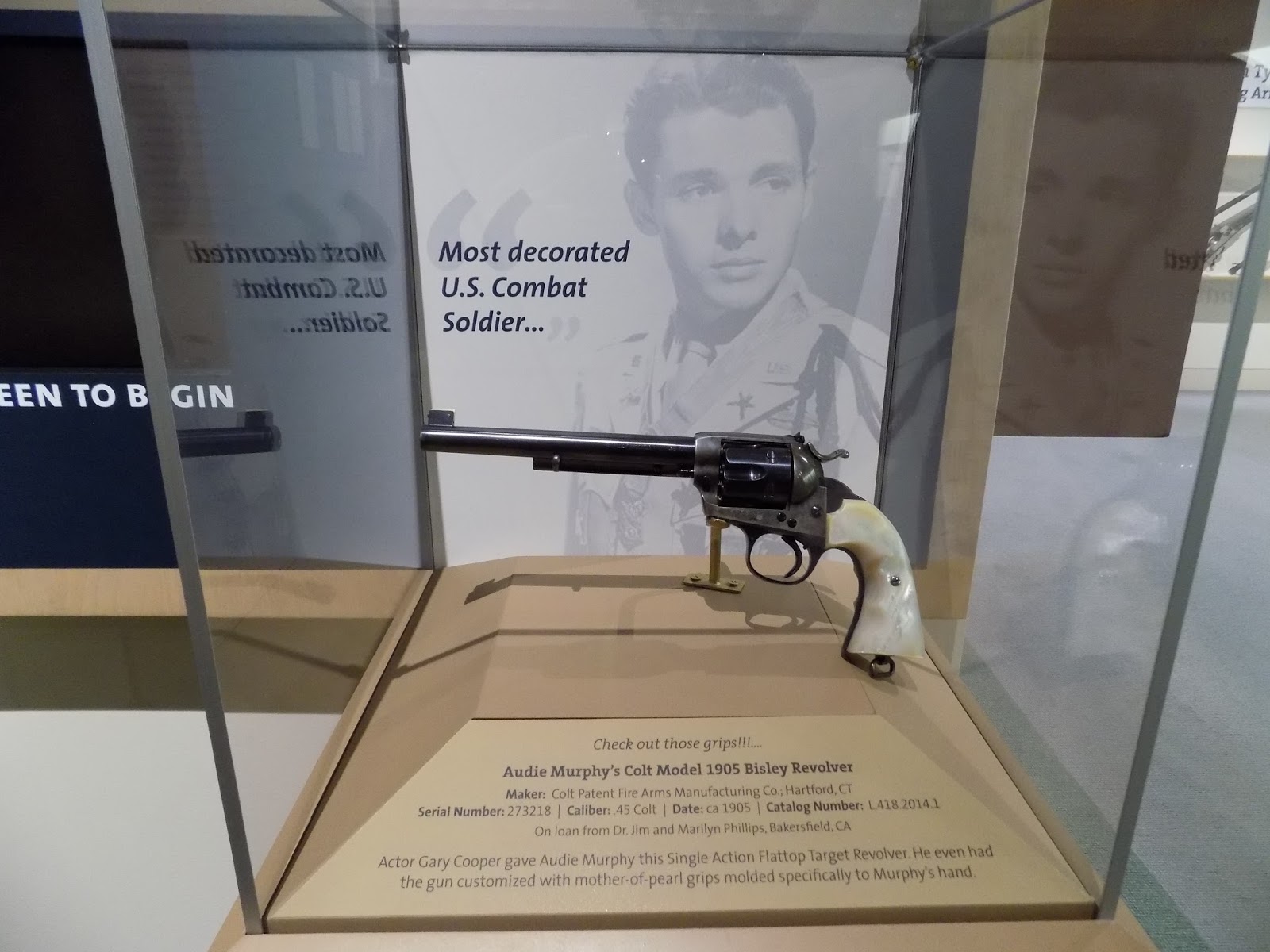
The display of Western Movie & TV Guns is not really large, but it does feature some gems sure to delight any true fan of the genre. The main cases contain the belts and guns of the stars of Bonanza as well as guns used by the stars of Gunsmoke, Bat Masterson, and The Lone Ranger. They also include a gun used by Gary Cooper in Vera Cruz (1954) and High Noon (1952). Another display pays tribute to World War II hero and Western star Audie Murphy. The gun displayed with it, a Colt Model 1905 Bisley Revolver, was a gift to Murphy from Gary Cooper.


The highlight of the exhibit, however, is the iconic rifle that gives its name to the 1950 Anthony Mann Western, Winchester '73. Displayed in a case by itself, it's an impressive sight, with a production still from the film serving as its backdrop. A closer look, however, reveals that the weapon was signed by all of the film's stars, starting with James Stewart himself. It's a fabulous piece of movie memorabilia that absolutely belongs here, surrounded not only by other Western firearms but by a history of the Winchester and its importance to the settling of the frontier.

If you're ever out around Yellowstone, make time for a stop in Cody, Wyoming. There's a lot of history here for a Western devotee to devour, as well as a nightly gunfight in the street and a whole lot of gift shops and rodeos.

Thursday, March 17, 2016

War Stories: The National World War II Museum

For many classic movie fans, the films of the World War II era hold special significance. These were the movies made during and immediately after the war, and the conflict impacted every aspect of American life, including film. Favorite stars like James Stewart and Clark Gable left the safety of Hollywood to join in the fight, as did directors like John Huston and John Ford, while Hollywood back home churned out pictures to boost morale and reflect the hopes and fears of the American people. For a lot of today's classic movie buffs, an early love for old movies was fostered by family members, especially grandparents, who lived through this era. Watching the films of the forties is a deeply personal way to connect with the experiences of the Greatest Generation; we reflect on the courage and sacrifices of our elders when we sit down with The Best Years of Our Lives, Since You Went Away, Casablanca, and even It's a Wonderful Life.

 
Another way to engage that era and its heroes - both honored and unknown - is to visit The National World War II Museum in New Orleans. This enormous museum complex takes visitors through the history of the war, on both the European and Pacific fronts, with richly detailed displays and presentations enhanced by a wealth of personal stories and artifacts. I recently had the good fortune to spend a full day at the museum, and I was tremendously impressed and deeply moved by what I found. This is an essential item for your bucket list if you have any interest in the World War II era, whether you're a classic movie fan or not.

 
The museum offers an outstanding centerpiece experience with the Beyond All Boundaries 4D film, which costs a little extra to do but makes for an immersive start to a day of touring. Narrated by Tom Hanks, the film includes motorized seats and props that take viewers right into the action from Pearl Harbor to Tokyo. Imagine Disney's The American Experience but wholly devoted to World War II and you'll get a general idea of the technical and narrative power of this attraction. It's actually worth the cost of admission all by itself. The interactive Final Mission also takes guests into wartime experience with a brief recreation of a submarine battle on board the USS Tang. In the Road to Berlin and Road to Tokyo exhibits, guests travel through time from the war's beginning to its end, pausing along the way to encounter artifacts, videos, and themed areas that recreate the many places in which battles were fought. At the start of your visit, you're issued a special dog tag that allows you to trace the story of one person connected to the war; you can check in with your person throughout your day at various displays, which helps to create the sense of a story unfolding in real time, not the distant past. From the moment you enter the train station themed start of the museum to the moment you leave, every exhibit offers a thoughtful, engrossing, and emotional experience.

 
Naturally, as a classic movie buff and fan of 40s films, I spent my day on the lookout for exhibits that connected with my cinematic passion. I was not disappointed. I found a display about Clark Gable's service with the US Air Force, although it didn't discuss the tragic death of his wife, Carole Lombard, who was killed in a plane crash while supporting the war effort by selling war bonds. Her death inspired a devastated Gable to enlist. I also located a display about the war work of director John Huston, who made films for the Army Signal Corps (which you can learn more about in Mark Harris' book, Five Came Back: A Story of Hollywood and the Second World War). In an area themed to look like the inside of a Quonset Hut, I found a truly gorgeous display of pinup girls, including Rita Hayworth, Betty Grable, Lynn Bari, Evelyn Ankers, and Carole Gallagher.

While the exhibits were rarely specifically about the movies, they did show the importance of movie culture to the era, and a few displays really spoke to me because of the cinematic moments that they mirrored. An exhibit about the Merchant Marine brought Alfred Hitchcock's Lifeboat (1944) to mind; I learned a lot that enhanced my understanding of that film and its particular wartime moment. The bombers in the aircraft exhibit immediately made me think of that powerful scene in The Best Years of Our Lives when Dana Andrews' character, Fred, relives his memories of the war while crouching in the nose of a discarded plane. Every display helped me to understand the history that forged the era and its films, and I came away eager to rewatch wartime pictures with a better understanding of the themes and references that I might have missed before.

I also had a much more personal mission at The National World War II Museum. I was looking for references to the USS Franklin, the ship on which my grandfather, Stokes Albritton, served during the war. In the last years of his life he spoke frequently about his memories of the ship and his life in the US Navy, and I was glad to be the listener to those poignant, funny, and terrible tales. His son, John, was born in New York during the war; my grandmother lived there so that they could be together during his brief trips back to port. It was a long, long way from Jesup, Georgia, and she was alone with a baby most of the time. My grandfather was a gentle man, big but quiet, with a wry sense of humor and a razor sharp memory when it came to anecdotes and local history. On March 19, 1945, he was on the Franklin when she took devastating damage from a Japanese attack less than 50 miles from the Japanese mainland. As sailors died and flames roared around him, he replaced gunners who had been killed and fired until he was blown overboard by an explosion. He spent many hours in the water, surrounded by debris and dead men who had been his friends, before he was picked up by another ship and reunited with the Franklin. He was awarded the Purple Heart for his service.


Almost at the end of the day, as we drew toward the last few exhibits in the Road to Tokyo, I found the Franklin. A video showed film footage of the smoking ship; I wondered where in that carnage my grandfather was when the film was shot. A display spoke of the attack and the legend of "the ship that wouldn't die." Another display honored Father Joseph T. O'Callahan, of whom my grandfather had often spoken. For a moment I could hear my grandfather's voice, speaking of that day, in my memory. I felt as if he was with me again. That moment, so brief in a life that spanned 89 years, defined who he was a person. He might not have been famous, but he was my family's greatest hero, and it meant so much to see the story of his ship in the museum, there were millions of people could consider what it meant. It brings tears to my eyes even now to think about it. For this, and for everything else it does to keep these memories alive, The National World War II Museum will always have my gratitude.

Stokes Albritton

Follow the link to learn more about The National World War II Museum for yourself.
Here's newsreel footage of the Franklin under attack. 
You can also watch the 2011 documentary, USS Franklin: Honor Restored, to learn about the attack and its controversial aftermath.


Tuesday, January 26, 2016

Homes of Classic Hollywood Stars: Four Vintage Postcards


Here's Cary Grant's beach home in Santa Monica, California. The postcard was manufactured by Western Publishing & Novelty Co. of Los Angeles. The house was originally built for Norma Talmadge in 1929, but Grant lived there from 1939 to 1942 with housemate Randolph Scott. According to Wikimapia, lots of stars spent some time in this house, including Merle Oberon and David Niven. You can read all about the neighborhood and its classic stars in this article from Curbed Los Angeles.


This postcard shows Bing Crosby's Toluca Lake home in North Hollywood. Longshaw Card Co. of Los Angeles produced the card. The original house on the site burned in 1943, and the home seen above was built to replace it. Later owners included Andy Griffith and Jerry Van Dyke. According to the LA Times, the home sold in 2009 for $10 million.


Another postcard from Longshaw shows the Beverly Hills home of Hollywood bad boy, Errol Flynn. Like the three other cards, this one includes a picture of the star resident. It's hard to imagine Flynn getting up to his usual mischief in such a stately manor! The Errol Flynn Blog has a great list of places associated with the actor; as you might expect, he got around.


This last card is the only one that lacks a photo of the star, which is a shame, since it's also the only one depicting the home of an actress. This is Irene Dunne's Holmby Hills residence; Tichnor Art Company produced the postcard. Dunne lived in the home for more than 40 years, but it was demolished after her death and replaced (such a pity!). The Irene Dune Site has a nice collection of photos showing Dunne in the home in March 1950.

Personal Notes -

I found these while sorting through some of my late mother-in-law's belongings. They lay in a heap of vintage postcards that she probably inherited from her mother or grandmother, given that many were addressed to her grandmother and were from her uncle; I don't know if she actually knew that these were among the lot. You can imagine my delight at finding them! Scans of the postcards are already available online thanks to copies for sale on Amazon and Ebay, but I thought many of my classic movie friends might not know about them and would enjoy seeing them. I think I'm going to get them framed and put them up in my study.

Wednesday, December 23, 2015

Stars of the Stands: Classic Hollywood at the Kentucky Derby Museum

We jaunted off to Louisville, Kentucky, last week for a few days' respite from the holiday blues, hoping to recapture our enchantment with the city from a previous visit years before. While this year's trip had its hits and misses, one unexpected treat was an exhibit about classic Hollywood and the Kentucky Derby at the Kentucky Derby Museum. The exhibit, called "Stars of the Stands," included photographs and movie clips that demonstrated the long standing fascination of Tinseltown types with the glamorous gambling at Churchill Downs.

The exhibit introduced its topic by talking about the simultaneous growth of the Derby and Hollywood in the 1930s, when actors and studio heads began to flock to the Kentucky Derby in greater numbers. The allure was partly the spectacle and the chance to be seen by reporters and the public, but the interest of the stars and the moguls also led to movies being made about the Derby and horse racing in general. At the same time, the adoration of celebrities for jockeys helped to make the jockeys themselves into celebrities.


Stars featured in the exhibit included Joe E. Brown, Ann Sheridan, Bob Hope, and Jayne Mansfield, all of whom attended the Derby. According to Jim Bolus, author of the book, Derby Fever, Brown was a regular Derby attendee who liked to joke that the Kentucky Derby was his "favorite charity." Photos depicted stars watching the race, celebrating or lamenting their gambling luck, and hobnobbing with favorite jockeys, trainers, and owners.


In a small theater area, a string of newsreel clips revealed dozens of other stars at the Derby, from Claudette Colbert to Ronald Reagan (although by the time he was shown attending Reagan had already moved on to politics). Movie clips showed bits of pictures with a local racing angle like In Old Kentucky (1935), starring Will Rogers, and Kentucky (1938), starring Loretta Young, Richard Greene, and Walter Brennan, Other movies about horse racing in general also got some play, including Thoroughbreds Don't Cry (1937), starring Judy Garland and Mickey Rooney. There were also shorts on display, with Charlie McCarthy and Edgar Bergen turning up for At the Races (1934). Among the featured cartoons were Gallopin' Gals (1940) and the Goofy short, They're Off (1948).


While the exhibit constituted only a small part of the Kentucky Derby Museum, it was really fascinating to see how the history of the race had influenced and been impacted by Golden Age Hollywood. It's always fun to discover a tribute to classic movies and their stars where you don't expect it, and the Stars of the Stands exhibit elevated my experience at the museum and made it even more memorable. If you happen to visit Louisville anytime soon, do drop by the Kentucky Derby Museum and enjoy the Stars of the Stands as well as the many other excellent exhibits.


Wednesday, May 20, 2015

Classic Movie Atmosphere at Disney's Hollywood Studios

We visit Walt Disney World in Orlando every few years, and I always enjoy the classic Hollywood vibe at Disney's Hollywood Studios. Here are a few photos from our most recent trip showing some of the ways that the park makes classic movie fans feel right at home.


The nod to classic costume designers Adrian and Edith Head was one of my favorite little touches. Replicas of gowns from the 1920s and 1930s could also been seen in many shop windows, although, sadly, the merchandise within the stores tended to be the same old theme park souvenirs. I keep hoping that Studios will add more interesting items to their stores, but we did manage to find some neat Oswald the Lucky Rabbit stuff this trip.


The main entrance area of the park is bright with neon and signs that recall Hollywood's Golden Age, including this Planet Hollywood sign. If only the real Planet Hollywood chain was this cool!


The mock movie posters at the Planet Hollywood shop also pay tribute to classic films. The sci-fi one is clearly a reference to the iconic promo image for Forbidden Planet (1956), while the Flyboys Over Hollywood poster reminds me of both the original and remake versions of The Dawn Patrol. I often wonder how many tourists actually stop to look at these little details, much less know what they mean.


These next two bring to mind Gone with the Wind (1939) and Out of the Past (1947), but they also summarize the whole genres of romance and film noir. I wonder how many old movie posters the designers looked at when they made these?

Every time I visit I notice something I hadn't really seen before, which is one of the reasons going back to Disney is always fun. I hope that by the next time I go, I'll have lots of new classic movie details to appreciate with the TCM updates at The Great Movie Ride!

Saturday, May 16, 2015

Great Movie Ride Still Awaits TCM Updates

The Great Movie Ride at Disney's Hollywood Studios is due for a makeover as part of a new partnership with Turner Classic Movies, but it appears that classic film fans will have to wait longer than the original target date of Spring 2015 to see the updated look of the attraction. As of May 2015, there is still no sign of the upgrades or TCM's sponsorship of the ride, which takes guests on a whirlwind tour of classic favorites like Singin' in the Rain, Mary Poppins, and The Wizard of Oz.

For those (like myself) who enjoy the nostalgic attraction, the announcement of the TCM partnership was good news all around. The Great Movie Ride has been a staple at the park since 1989, but its focus is decidedly old school compared to more popular rides like Star Tours and The Tower of Terror. Many guests certainly don't get the enthusiasm for old movies, and some treat it like the Studios' version of The Hall of Presidents, i.e. a really good place to take a nap. The TCM partnership signals the park's determination to keep The Great Movie Ride around even though massive renovations are on the horizon at Studios over the next few years.

According to the TCM announcement from November 2014, the refurbishment of The Great Movie Ride will include a new pre-ride video featuring Robert Osborne, a new montage at the end of the ride, and a photo opportunity for guests with a classic movie theme. The queue area will also get TCM branding and new digital movie posters to entertain guests while they wait. While it would be great to have a gift shop offering classic movie themed souvenirs, it's unclear right now whether the photo op area will include anything else that guests can take home from their adventure through film history. (Dear Disney, I do believe in fairies, I'm wishing upon a star, and I want a proper classic movie gift shop!)

While there's a lot of construction and renovation going on all around Walt Disney World right now, it seems that the updates to The Great Movie Ride are somewhat lower on the priority list. At least with the Sorcerer Mickey hat no longer obscuring the view, the ride has better visibility at the center of the park. Let's hope that Robert Osborne and the new TCM trappings will make their appearances soon.

Monday, December 29, 2014

Classic Movie Tourist: The Ernest Hemingway Home in Key West

I spent the week of Christmas this year in the Florida Keys, where the warm weather and bright blue water worked hard to dispel my usual holiday malaise, despite a particularly wretched end of the year at home. As usual, I kept an eye out for classic movie connections during my travels. I didn't make it over to see the African Queen in Key Largo, but I did manage a visit to the Hemingway House in Key West, which bursts with its own significance for fans of golden age Hollywood.


As most cinephiles know, Ernest Hemingway wrote numerous works that were adapted for the big screen, including A Farewell to Arms (1932 and 1957), For Whom the Bell Tolls (1943), To Have and Have Not (1944), and The Old Man and the Sea (1958). The Hemingway House features nods to the movie adaptations with walls of posters in various rooms, while bookcases display copies of the novels themselves. For an English professor turned classic movie blogger, places like this are pure catnip.


Speaking of cats, the Hemingway House is also famous for its plethora of polydactyl felines, whose extra toes make them oddball celebrities in their own right. 52 cats currently make their home at the house, according to Rusty, our tour guide. Given Hemingway's importance to classic Hollywood, it's no surprise that many of the resident cats have been named in honor of iconic stars. My perusal of the cat cemetery turned up Kim Novak, Ava Gardner, Marilyn Monroe, John Wayne, Errol Flynn, Jimmy Stewart, Joan Crawford, and Charlie Chaplin, just to name a few.


While a visit to the Hemingway House encouraged me to rewatch some of my favorite classic adaptations of Hemingway's work, it also made me curious about other classic movies with connections to the Florida Keys. There's Key Largo (1948), of course, but less familiar are pictures like The Prisoner of Shark Island (1936), Mercy Island (1941), and Reap the Wild Wind (1942). I'm especially interested now in seeing The Prisoner of Shark Island, since we spent a day out at Dry Tortugas National Park, where Fort Jefferson once housed Dr. Samuel Mudd, who is played in the movie by Warner Baxter. The John Ford picture also stars Gloria Stuart, Harry Carey, and John Carradine. I have just added it to my Netflix queue, and of course I will write a review here on the blog once I finish watching it!


Monday, September 29, 2014

History, Hollywood, and a Famous Train: THE GENERAL and THE GREAT LOCOMOTIVE CHASE

In The General (1926), Buster Keaton plays a Confederate train engineer who doggedly pursues his beloved locomotive when Yankees make off with it. Thirty years later, The Great Locomotive Chase (1956) tells basically the same story, this time with Jeffrey Hunter as the Southern engineer and Fess Parker as the Yankee spy who steals the train. Both the silent comedy and the Disney live action picture take their inspiration from a real event during the Civil War, when a group of Union spies stole a locomotive named The General in Kennesaw, Georgia, and drove it north, sabotaging rail lines and telegraph wires behind them. While both of the movies naturally take liberties with the historical record, classic movie fans can get the true story that inspired the films by visiting The Southern Museum of Civil War and Locomotive History in Kennesaw, where the famous train from the 1862 incident is the star attraction.


The museum, which is an affiliate of the Smithsonian, sits just off the railroad tracks in a quiet section of Kennesaw, not far from Interstate 75 but seemingly worlds away from the bustle of the metro Atlanta area. Trains roaring down the line are the most exciting spectacle outside the museum, where the enticing aroma of freshly cooked burgers wafts across the tracks from the nearby Burgerfi location. Around the grounds, visitors will find a handful of historical markers noting the starting point of The Great Locomotive Chase and Kennesaw's former identity as the town of Big Shanty. The General has its own marker, but inside the museum guests can see the real deal, a huge and meticulously restored locomotive that toured the country under its own power during Civil War anniversary years until it came to stay in Kennesaw.


While the engine is undoubtedly the crown jewel of the museum, other exhibits give visitors an in-depth look at the role played by railroads during the Civil War and the aftermath of Reconstruction. The Glover Machine Works section shows how industrial locomotives were assembled, while other displays reveal the Union's strategy for crippling the South by destroying the critical rail infrastructure. It's a must-see facility for train nuts of any age, but for cinephiles the engine itself and the display cases around it are the big draw.

The museum is well aware of the movie history associated with The General. Near the locomotive, cases hold posters and other items from the 1926 and 1956 movies, including the coat worn by Fess Parker in The Great Locomotive Chase. Segments of the Disney film dominate the museum's movie about the events, with local footage spliced in to tell a shorter and more historically accurate version of the adventure. Both classic movies are for sale on DVD in the small gift shop, where a television runs one or the other throughout the day. Sadly, you won't find much other merchandise related to the films, but you will find generic train items and Civil War themed gifts of all sorts.


Getting a sense of the real story gives film fans a chance to assess the two movies and their different takes on the events. Keaton's picture makes the Confederate character a true hero, battling some rather shady Yankee saboteurs who not only steal his train but also kidnap his girl. The Disney production casts the Union in a more positive light, with Fess Parker as a doomed war hero (the real James J. Andrews was captured and ultimately hanged by the South). Jeffrey Hunter, best remembered today for his role in The Searchers (1956), plays William A. Fuller, the Southern engineer determined to recover his stolen train. It's interesting to note that Hunter appeared in both the Western and the Civil War adventure in the same year. Other actors of note in the Disney film include Harry Carey, Jr., Slim Pickens, and Kenneth Tobey. As entertaining as both movies are - The General in particular is a cinematic masterpiece of the first order - the truth turns out to be just as fascinating, with a story full of courage, action, and daring risks on both sides. Fuller and Andrews both strike us as heroic characters, despite the great divide between North and South, and it's easy to see why Hollywood would find their stories so compelling.


If you happen to be traveling along I-75 at some point in the future, stop in at The Southern Museum in Kennesaw and see The General for yourself. It is definitely worth a visit for history buffs, train lovers, and classic movie fans.

Tuesday, September 23, 2014

Classic Movie Tourist: The Margaret Mitchell House

The Atlanta area includes several places where devotees can get their Gone with the Wind fix: the Road to Tara Museum is in Jonesboro, and Marietta is home to the Gone with the Wind Museum. In the heart of the city, however, you'll find the Margaret Mitchell House, where the author lived for a number of years and where she wrote much of the novel after an auto accident left her housebound. The restored house is part of the Atlanta History Center, and for $13 ($10 for seniors and students), visitors can enjoy a guided tour of the apartment where Mitchell lived as well as several exhibits about her life, the novel, and the blockbuster film that premiered in Atlanta in 1939.

For most people, the book and the movie are inextricably entwined. It's fair to say that more people have seen the 1939 picture than have actually read Mitchell's lengthy saga. When Scarlett O'Hara appears in the cultural consciousness, she is inevitably played by Vivien Leigh, and Clark Gable fully occupies the role of the roguish Rhett Butler. The other major actors in the film have also become part of the GWTW legacy, including Olivia de Havilland, Hattie McDaniel, Leslie Howard, and even Butterfly McQueen. The exhibits at the Margaret Mitchell House reflect this aspect of the story's history; many of the displays focus on the film adaptation, which makes the museum a great destination for fans of the stars involved.


"The Making of a Film Legend" section features video about the picture's production history and a large portrait of Scarlett O'Hara that was seen in the movie. Another highlight of the exhibit is the actual door to Tara used in the film; visitors can stand in front of it and imagine themselves waving from the plantation mansion's steps. In the "Stars Fall on Atlanta" exhibit, there are photographs and keepsakes from the movie premiere, which Atlanta society turned into a huge series of parties with celebrity guests.


Of course, classic movie fans will want to browse the gift shop, where GWTW items of all sorts can be found. The shop also offers prints of production stills and promo photos depicting Gable and Leigh as well as posters for the film release. Hattie McDaniel magnets, Tara Christmas ornaments, and books about a variety of GWTW related subjects are also available. I was pleased to find Kendra Bean's new book, Vivien Leigh: An Intimate Portrait, prominently displayed on the front table.

If you're headed to Atlanta any time in the near future, the Margaret Mitchell House is definitely worth a visit. It's located at 979 Crescent Avenue NE in Atlanta, not far from many of the city's other major tourist attractions. The museum is open 10 AM to 5:30 PM Monday through Saturday and noon to 5:30 PM on Sunday. House tours are included in admission and are offered regularly throughout the day.


Wednesday, April 2, 2014

Classic Movie Stars at Madame Tussauds Hollywood

Marilyn Monroe
Classic movie fans might be pleasantly surprised by the number of Old Hollywood stars immortalized in wax at Madame Tussauds Hollywood. While the majority of the exhibits do focus on more recent celebrities familiar to the rank and file tourists who flock to Hollywood Blvd., Madame Tussauds makes an effort to celebrate those who came before, as well. The figures themselves are quite good, and their placement encourages visitors to cozy up to Jimmy Stewart and Bette Davis or even get into the action with Peter O'Toole and Alfred Hitchcock. Here are some photo highlights of the classic star figures on display at Madame Tussauds Hollywood.

Have a drink with Bette Davis.
Among the classic stars you'll find the heavy hitters, of course, including Marilyn Monroe, Audrey Hepburn, Humphrey Bogart, Katharine Hepburn, Bette Davis, and Judy Garland. All are shown in costumes from their films, and some have scenes with backdrops and props to recreate particular moments from their most memorable roles. For Alfred Hitchcock you can actually get into the famous shower scene and pretend you're Janet Leigh about to meet her demise in Psycho - Hitch stands out front ready to roll cameras. You can also mount a camel next to Peter O'Toole in Lawrence of Arabia, although it's hard to get camel rider and wax figure together in a good shot.

Charlie Chaplin is the museum's only real nod to the silent era, but it's nice to see the Little Tramp included in the menagerie. He hangs out near other comedians like George Burns and Bob Hope in the first section of the classic Hollywood exhibits. You can pose next to the figures and even touch them, although the staff do ask that visitors not touch the figures' faces or hair (which makes sense).


Fred and Ginger dance divinely.
Gene Kelly is sadly absent, but the musical gets its tribute in the form of Fred Astaire and Ginger Rogers, forever frozen mid-dance.

Bogart is avoiding those leeches.
Judy Garland appears as Dorothy against an Oz backdrop, naturally, while Bogart and Katharine Hepburn have a nice scene from The African Queen. You can even get in the boat and help Kate steer, which is fun.

George Bailey never escapes Bedford Falls.
If you visit the museum yourself, be sure to turn the flash off if you want good photos of the figures. They look much better that way.


One thing that struck me about the figures was how tall or short different stars were. I was especially surprised at how tall Jimmy Stewart is in his It's a Wonderful Life scene! My 5 foot 8 inch husband barely reached Clint Eastwood's shoulder, but he was glad to at least be a little taller than Raquel Welch in her One Million Years BC costume.

Madame Tussauds Hollywood is not a cheap ticket, and you'll be more likely to get your money's worth out of it if you also care about modern stars like Anne Hathaway, Bruce Willis, and Johnny Depp. The superhero exhibit includes Hugh Jackman as Wolverine and Chris Hemsworth as Thor, which will appeal to genre fans and younger kids, and there are rooms for pop stars and athletes, too. Still, if you have always dreamed of mugging with the classic stars in their signature roles, Madame Tussauds is ready to make that dream come true.

Note: Figures on display do change over time, so you might see different stars depending on when you go. John Wayne was conspicuously absent from the Western room, for example. Maybe he was off having his boots cleaned. For a different perspective and set of photos, see Kenda Bean's post about her trip to the attraction in 2010 (naturally, she has lots of photos of Vivien Leigh!).