Showing posts with label Reel West. Show all posts

Wednesday, June 8, 2016

Film, Fact & Fiction: Buffalo Bill

Buffalo Bill's
defunct
     -- e.e. cummings

Like many historical figures of the American West, William F. Cody, better known as Buffalo Bill, became a legend within his own lifetime. Unlike many of his contemporaries, however, Cody engineered the process himself, carefully crafting the persona of Buffalo Bill for his own ends. His flair for showmanship led him to create the Wild West show that entertained people all over the world and perpetuated many of the images of the Old West that we still see in films and other media today. At the center of that show was the man himself, larger than life, dressed in decorated buckskin and tall boots and crowned with flowing locks. Cody, who died in 1917, even appeared in some early film footage promoting his show; if he had lived to see the way cinema would continue his legacy he would no doubt have been pleased. Like other icons of the West, Cody has been depicted in numerous films, although most of them have succumbed to the lure of his public persona and few have looked into the facts of his actual life. An overview of Cody's appearances in classic movies reveals the extent to which Buffalo Bill looms over our imaginary Western landscape, but it also shows how much of Cody's real life has yet to be depicted on film.


Cody actually plays himself in the first entry for depictions of Buffalo Bill on IMDB, a 1915 three-reel silent known as The Circus Girl's Romance or Patsy of the Circus. (There is also a 1912 production called The Life of Buffalo Bill, in which he is credited as himself, and a host of other shorts and documentary shorts, mostly depicting the Wild West show. Look for these under William F. Cody as an actor rather than Buffalo Bill as a character.) This was not a new tactic for the showman, who had been playing himself in stage shows starting in 1872, when he alternated between having real adventures out West and then starring in fictionalized versions of them for the stage back in Chicago. He even took to wearing his stage costume on his frontier expeditions. The plays served as tie-ins to the huge number of dime novels that starred Buffalo Bill as their hero; in all, some 1,700 stories would be produced.

The novels were long on heroics but very short on facts. While the fictional Bill roamed the frontier and fought with Indians, the real William Cody struggled through a long-distance marriage and the deaths of three of his four children, including his five year old son, Kit Carson Cody, and his eleven year old daughter, Orra. Restless, extravagant, and always hatching a new plan for wealth and fame, Cody hit great heights as well as terrible depths over the course of his life. In 1904 he endured scandal when he unsuccessfully sued his wife, Louisa, for divorce, only to have his own affairs and alcoholism revealed to the public. The couple eventually reconciled, and Cody died on January 10, 1917, at the home of his sister in Denver, Colorado. His last living child, Irma Cody Garlow, died of the flu in 1918, and Louisa died in 1921, having outlived both her husband and all four of her children. (See the William F. Cody Archive for a longer biographical account.)

After his death, Cody continued to be popular in films and was played by a wide variety of actors. George Waggner played him in John Ford's silent, The Iron Horse (1924), and Duke R. Lee played him in both 1922 and 1927. The dawn of the talkie era brought more depictions, with lots of noisy excitement to bring both the frontier and the Wild West show to life. Moroni Olsen gets significant screen time as the showman in the 1935 Barbara Stanwyck vehicle, Annie Oakley, a very free-handed biographical account of the sharpshooter's rise to fame. Although it's not the place to look for historical accuracy, it's an excellent picture and a lively rendering of the height of the Wild West show's success. In 1940 Roy Rogers played a youthful version of Bill in the aptly named Young Buffalo Bill, which touched off a series of other productions depicting the icon's early adventures. George Reeves took up that vein with the serial, Pony Express Days, in 1940, followed by child actor Dickie Moore a decade later in Cody of the Pony Express. Other actors who took on the role in subsequent years included Charlton Heston and Clayton Moore, and even more performers played Buffalo Bill once television took hold.

A few films from the classic era provide the most memorable screen depictions of Cody. He was treated to a full biopic production with Buffalo Bill in 1944, in which Joel McCrea plays Cody and Maureen O'Hara plays Louisa. Ironically, Moroni Olsen, who had played Bill in Annie Oakley back in 1935, here appears as Louisa's father. The picture also features Linda Darnell, Thomas Mitchell, and Anthony Quinn. Cody is probably best remembered by movie fans as he appears in Annie Get Your Gun (1950), the musical account of Annie Oakley's life starring Betty Hutton. In this picture, Louis Calhern portrays the showman, while Howard Keel costars as Annie's love interest and eventual husband, Frank Butler. In 1976, after the heyday of the classic Western had ended, Robert Altman offered a satirical look at the legend in Buffalo Bill and the Indians, starring Paul Newman in the title role.

You can find Buffalo Bill in plenty of more recent films and television series. He's played by Keith Carradine in Wild Bill (1995) and by J.K. Simmons in Hidalgo (2004). New depictions are certainly still on the horizon; Buffalo Bill is a hard figure to resist, even if we always seem more interested in the legend instead of the man.

If you want to learn more about the real William F. Cody, add a visit to Cody, Wyoming, to your bucket list. Cody founded the town, which is named in his honor, and it's there that you'll find the Buffalo Bill Center of the West. The museum includes a large wing devoted to the story of the man and his myths, where you'll find not only a talking hologram of Buffalo Bill but also countless artifacts and personal items from his family and Buffalo Bill's Wild West show. While you're there, pop into the historic Irma Hotel for a buffet lunch. Cody built the hotel and named it for his daughter in 1902; the huge bar was a gift to Cody from Queen Victoria. The town will give you a palpable sense of Cody's legacy beyond his depictions on the silver screen.


Monday, June 6, 2016

Guns of the Old Western in Wyoming

We spent last week in Montana and Wyoming, mostly touring Yellowstone and Grant Teton National Parks, but I'm happy to say that I still found some balm for my classic movie loving soul. One of the best spots for indulging a cinema obsession was Cody, Wyoming, where we spent a full day exploring the Buffalo Bill Center of the West, a five museum complex affiliated with the Smithsonian and a treasure trove for all kinds of fascinating knowledge. I'll talk about Buffalo Bill's personal history and the movies in another post, but this time I want to focus on the Cody Firearms Museum, one of the five museums in the Center.


I'm not normally a gun fan; I grew up around them but find them disconcerting. In Westerns, however, I accept that guns are a necessary and iconic part of frontier culture, where homesteaders and cowboys might have good reasons for keeping firearms handy. Thus, as we were breezing through the firearms museum, not really paying too much attention to exhibits on Glocks and whatnot, I came up short when we arrived at an exhibit about guns in Westerns. This was a gun exhibit that could get my attention!


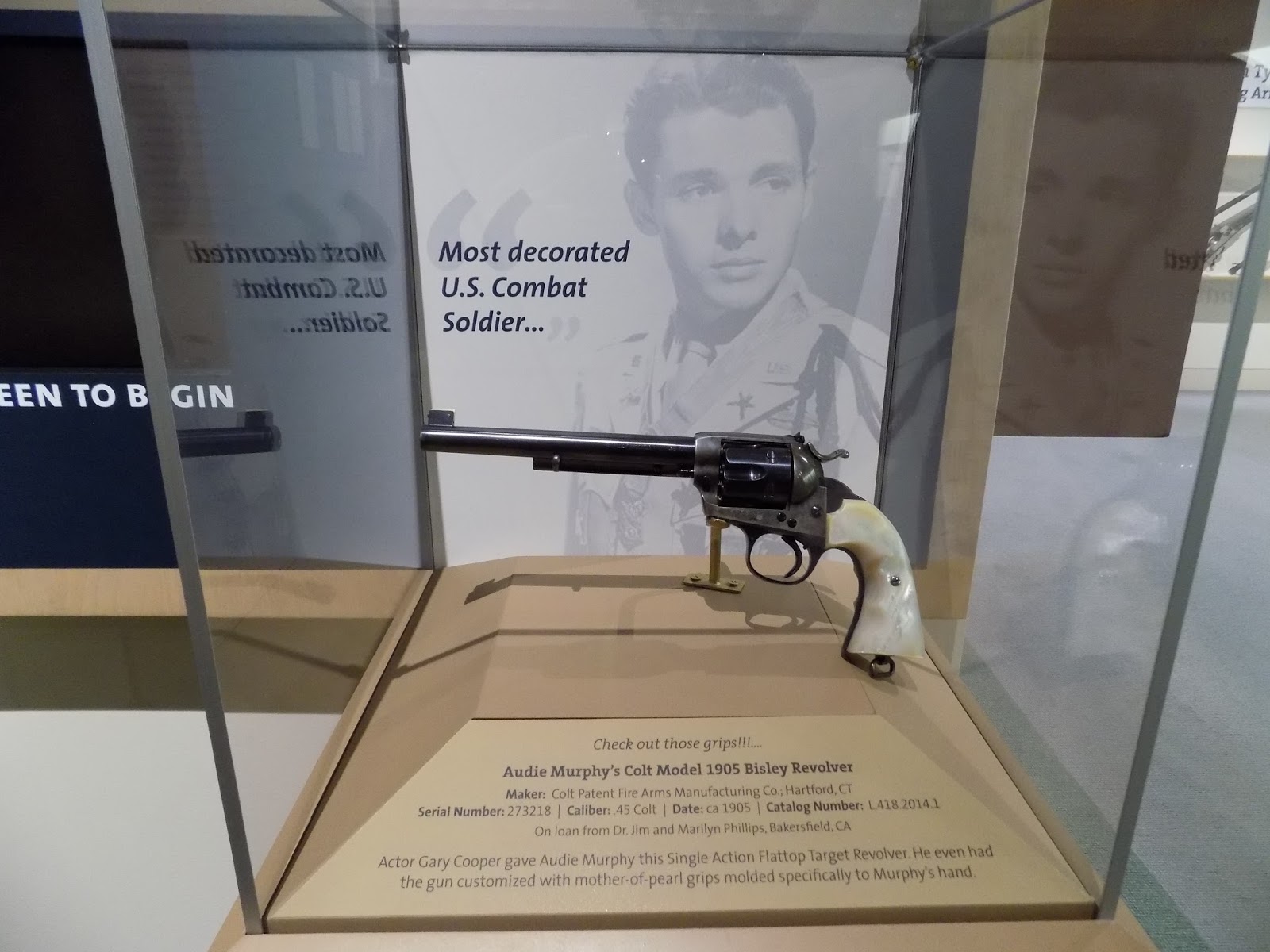
The display of Western Movie & TV Guns is not really large, but it does feature some gems sure to delight any true fan of the genre. The main cases contain the belts and guns of the stars of Bonanza as well as guns used by the stars of Gunsmoke, Bat Masterson, and The Lone Ranger. They also include a gun used by Gary Cooper in Vera Cruz (1954) and High Noon (1952). Another display pays tribute to World War II hero and Western star Audie Murphy. The gun displayed with it, a Colt Model 1905 Bisley Revolver, was a gift to Murphy from Gary Cooper.


The highlight of the exhibit, however, is the iconic rifle that gives its name to the 1950 Anthony Mann Western, Winchester '73. Displayed in a case by itself, it's an impressive sight, with a production still from the film serving as its backdrop. A closer look, however, reveals that the weapon was signed by all of the film's stars, starting with James Stewart himself. It's a fabulous piece of movie memorabilia that absolutely belongs here, surrounded not only by other Western firearms but by a history of the Winchester and its importance to the settling of the frontier.

If you're ever out around Yellowstone, make time for a stop in Cody, Wyoming. There's a lot of history here for a Western devotee to devour, as well as a nightly gunfight in the street and a whole lot of gift shops and rodeos.

Tuesday, April 16, 2013

Reel West: Old Tucson Studios

Take the stage to High Chaparral
If you love classic Westerns, Old Tucson Studios might just be your personal piece of heaven. The working movie lot has been hanging around on the outskirts of Tucson, Arizona, since 1939, when it was built for the filming of, naturally, Arizona, which starred Jean Arthur and William Holden. Since then it has been the home of some 200 productions for film and television, from Rio Bravo (1959) and Three Amigos! (1986) to The High Chaparral and  Little House on the Prairie. These days it also doubles as a Western movie buff theme park, with shows and attractions designed to tickle a John Wayne fan's fancy until the cows come home. In exchange for the cost of admission and few hours of your time, you can stride the streets where the Duke's boots kicked up dust and dozens of other silver screen cowboys have fought their showdowns and drunk their beer.

I admit I was nervous about visiting the place myself. I was afraid it would be tacky and crammed with cheap souvenirs at marked up prices. As it turns out, Old Tucson's biggest oversight might actually be a lack of shops. The place is decidedly uninterested in selling you anything beyond an entertaining day of shows and maybe some lunch and a cold sarsaparilla. In many ways, it's the exact opposite of Tombstone, which is all shops and no substance, and I suspect a lot of people who head to Tombstone would be better off checking out Old Tucson instead.

You can easily spend the entire day at Old Tucson, so don't get any fancy ideas about cramming in
I'm in the show!
the equally intense Arizona-Sonora Desert Museum and the scenic Saguaro National Park while you're on that side of town. The studio has shows that run all day long, and you more or less have to be there from opening to closing to catch them all. The schedule runs the gamut from funny skits to shootouts to musical revues, so there's something to suit every Western buff's preference.

Audience participation is a given at several shows. I was delighted to be picked for the stunt show (I admit to chatting up Ty, the actor, beforehand about being a classic movie blogger and author - did I stack the deck in my favor? You bet!). It's worth noting that you'll see the same group of actors throughout the day in different shows; by the end of a visit you might feel awfully fond of them, and you'll certainly appreciate their energy and enthusiasm. They have a dirty, sweaty, and dangerous job, but they really seem to love it.

Loop Rawlins
One of the highlights of the day is definitely a performance by Loop Rawlins, a Cirque du Soleil veteran and rope trick master. He also does some nifty tricks with guns and whips, but the lasso is his best instrument. If matinee Westerns were still in vogue today, Loop would be a huge star. He has the looks, the talent, and the charm of the old cowboy kings. All he really needs is a smart horse!

You can take a guided tour of the studios and learn all about the history of the location and the movies that have been made there. There's also a sentimental John Wayne tribute film and a really fun musical review of songs from classic Westerns. If you can sing the words to "My Rifle, My Pony and Me" you'll love it. You can also catch a stagecoach ride out to the High Chaparral set and learn why you really wouldn't want to ride the stage to Lordsburg, much less to San Francisco.

I didn't expect much from the food at the studio, but I was pleasantly surprised by a tasty sandwich at the pharmacy deli counter, and the prickly pear lemonade from the candy shop really hit the spot. The biggest restaurant on site is Big Jake's BBQ, but there's also Pony Express Pizza and an ice cream stand that sells raspados in addition to the usual cones.

First-time visitors might be wondering if the price of admission is worth it. If you really love classic
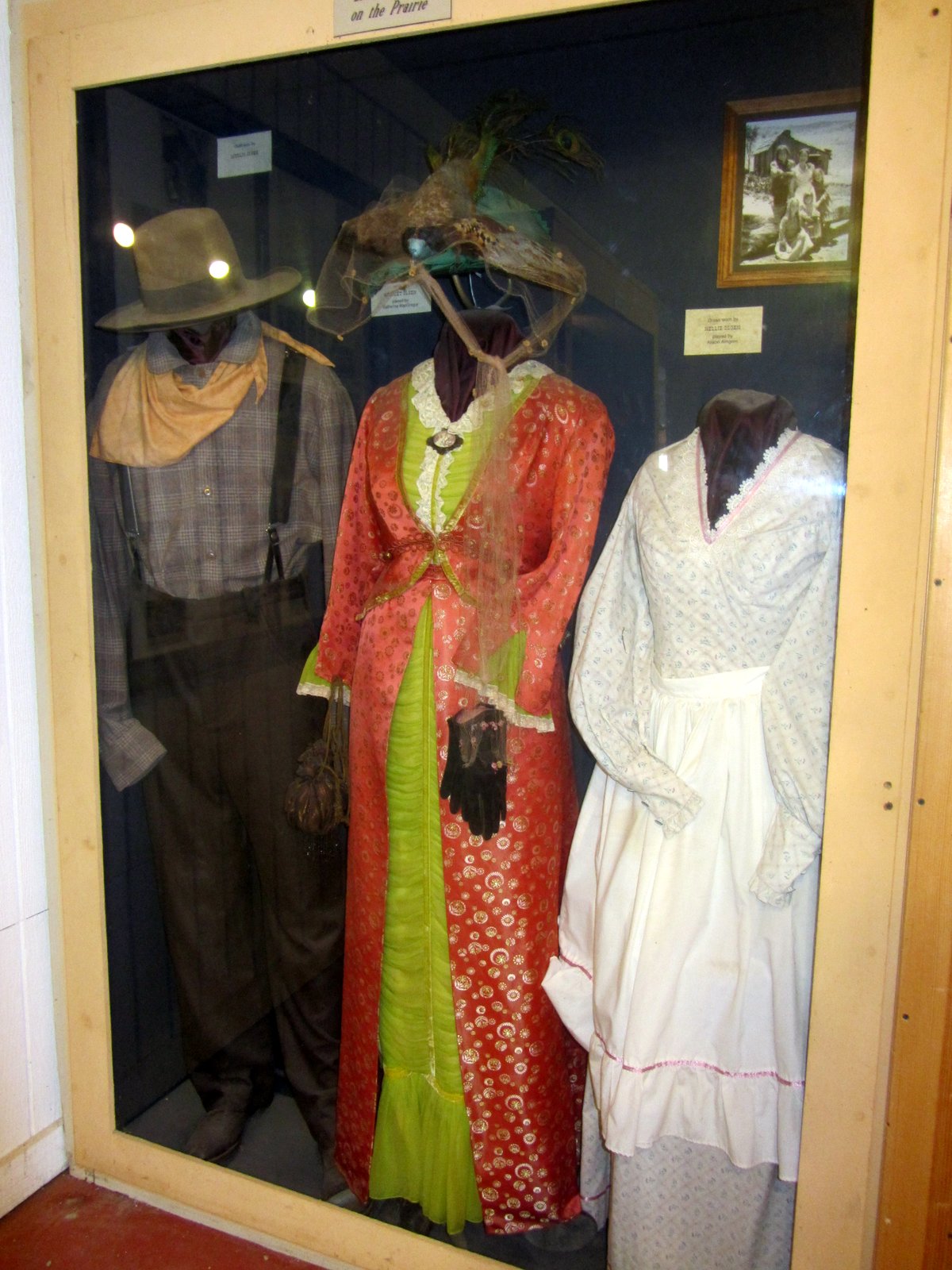
Little House on the Prairie costumes
Westerns, it's one of the best attractions you can visit anywhere, hands down. If you have kids who play cowboy all day, they'll love it, too. If, however, you love to shop and can't tell Tex Ritter from Randolph Scott, this probably ain't your kind of establishment, and you best mosey on down the road. Need to gauge your family's interest in a full day of such fare? Test the waters with a trip to Trail Dust Town in Tucson, and be sure to stay for the evening shootout show. If that leaves your group whooping and hollering with delight, then they're ready for Old Tucson.

Here's a partial list of films and television shows shot at Old Tucson Studios:

Little House on the Prairie
Tombstone (1993)
Bonanza
Gunsmoke
How the West was Won
Wild Wild West (1999)
The Quick and the Dead (1995)
The Outlaw Josey Wales (1976)
Three Amigos! (1986)
Rio Bravo (1959)
McLintock! (1963)
Joe Kidd (1972)
The High Chaparral
Young Guns II (1990)
El Dorado (1966)
Rio Lobo (1970)
3:10 to Yuma (1957)
Winchester '73 (1950)
Broken Arrow (1950)
Gunfight at the OK Corral (1957)
Hombre (1967)
The Villain (1979)
Last Train from Gun Hill (1957)