My Westerns lifetime learning class is wrapping up this week, and my students have asked me about a top ten list of classic Westerns. I imagine there are plenty of such lists naming the "best" Westerns, but I'd rather make mine a list of personal favorites. I do aim for some diversity in terms of decade, focus, director, and stars, but these are all Westerns that I enjoy tremendously every time I see them. I'm not including the comedy and parody films that prospered late in the day, although I do really love Cat Ballou (1965), Butch Cassidy and the Sundance Kid (1969), and, for reasons even I can't fully explain, Paint Your Wagon (1969). Here, then, are ten of of my all-time favorite Westerns, listed in chronological order.
1. STAGECOACH (1939)
2. MY DARLING CLEMENTINE (1946)
3.WESTWARD THE WOMEN (1951)
4. HIGH NOON (1952)
5. SHANE (1953)
6. THE MAN FROM LARAMIE (1955)
7. BAD DAY AT BLACK ROCK (1955)
8. THE SEARCHERS (1956)
9. RIO BRAVO (1959)
10. THE PROFESSIONALS (1966)
What are your favorite classic Westerns?
Showing posts with label John Wayne. Show all posts
Monday, May 16, 2016
Monday, May 9, 2016
10 Great Westerns of the 1950s
The 1950s produced a bumper crop of A-level Westerns with some of Hollywood's biggest stars in the leading roles, including some we don't necessarily associate with the genre. Over the course of the decade, darker and more complex psychological Westerns appealed to adult viewers, even as the matinee cowboys continue to ride high with the Saturday morning crowd. Westerns and film noir provided fertile territory for directors and actors, with many jumping between the two genres and even blurring the line at times about which was which. Of course, John Wayne and John Ford were still on the scene, but a new generation of Western icons was also developing, with Lee Marvin making his presence known and director Delmer Daves venturing into the genre with Broken Arrow in 1950. You could spend a long time watching Westerns from the 1950s (check out 50 Westerns from the 50s for proof), but here are just ten great Westerns - one from each year of the decade - to get you started.
1) WINCHESTER '73 (1950) - Anthony Mann and James Stewart begin a fruitful collaboration in the genre with this picture, which focuses on the hands through which the coveted title rifle must travel. The cast also includes Shelley Winters, Dan Duryea, and Stephen McNally, but viewers will also find early appearances by Rock Hudson (as a Native American) and Tony Curtis. Mann and Stewart would go on to make four more Westerns together: Bend of the River (1952), The Naked Spur (1953), The Far Country (1954), and The Man from Laramie (1955), all of which are well worth watching.
2) WESTWARD THE WOMEN (1951) - Probably the least familiar picture on this list, this women's Western is truly unique in its focus on the suffering and determination of a group of women headed West by wagon train to marry settlers on the frontier. William A. Wellman directs an ensemble cast headed up by Robert Taylor as the women's guide, with Denise Darcel and Hope Emerson getting top billing among the many fine actresses. Renata Vanni gives an especially moving performance as one of the group's older members.
3) HIGH NOON (1952) - A four-time Oscar winner, this dramatic Western appears on almost any top ten list for the genre, and for good reason. Its real-time unfolding adds urgency to the story as we watch the clock tick down to Frank Miller's fateful arrival, while Gary Cooper's Oscar-winning performance is noble and moving, even if he is much too old to be marrying Grace Kelly. A terrific supporting cast helps seal the deal, including Thomas Mitchell, Lon Chaney Jr., Henry Morgan, Lloyd Bridges, and Katy Jurado. Tex Ritter, a singing cowboy from the matinee herd, provides the film's mournful title song, which inspired many later Westerns to have their own, similar themes.
4) SHANE (1953) - George Stevens directs this chivalric romance recast as frontier drama with Alan Ladd in the lead as the Wild West's version of a knight errant. Building their own rustic Camelot on the range are Van Heflin and Jean Arthur as the Starretts, with young Brandon De Wilde giving an Oscar-nominated performance as their son. Jack Palance, also nominated for Best Supporting Actor, is Shane's rival gunslinger. Other familiar faces in the cast include Ben Johnson, Elisa Cook Jr., and Ellen Corby.
5) JOHNNY GUITAR (1954) - Joan Crawford makes a rare genre appearance in this very unusual Western from Nicholas Ray, with Sterling Hayden as the title character. There's a lot of noir atmosphere seeping through, no surprise with Ray in the director's chair and Crawford and Hayden in the leads. The supporting cast is full of Western favorites, though, including Ward Bond, John Carradine, Royal Dano, Ernest Borgnine, and Paul Fix. Look out for a truly vicious performance by Mercedes McCambridge as Crawford's rival.
6) BAD DAY AT BLACK ROCK (1955) - Spencer Tracy stars in John Sturges' modern take on Western themes, once again with noir atmosphere turning everything a shade darker and dirtier. Tracy's one-armed WWII veteran comes to Black Rock on a mission of peace, but he finds out that Black Rock has a secret its residents will kill to hide. The landscape and the town speak to the lingering traces of the Old West, and the rest of the cast is packed with genre stalwarts, including Robert Ryan, Walter Brennan, Ernest Borgnine, and Lee Marvin. Tracy earned an Oscar nomination for Best Actor for his performance, while Sturges picked up a nod for Best Director, but every aspect of this film exudes excellence. It's just as hard-hitting today as it was in 1955.
7) THE SEARCHERS (1956) - John Ford and John Wayne deliver their most iconic collaboration with this epic tale of loss and obsession, with Wayne in the lead as ex-Confederate soldier Ethan Edwards, who embarks on a years-long quest to find his niece (Natalie Wood) after she is kidnapped by the Comanche. This is a darker, more morally complicated character for Wayne, but he suits the role perfectly. Widely considered one of the greatest Westerns of all time, this picture is the go-to example of Ford and Wayne's work together, with a rich subtext and emotional supporting performances that reward multiple viewings.
8) 3:10 TO YUMA (1957) - Delmer Daves directs Van Heflin and Glenn Ford in this tense character study of two very different men brought together by fate. Ford plays the smooth-talking, opportunistic outlaw, while Heflin plays the upright rancher with the dangerous job of getting the captured bandit to the train that will take him to prison. From there the lines between good man and bad begin to blur, with the outlaw and the rancher each coming to understand the nature of the other. Frankie Laine sings the theme song, which harks back to the melancholy theme of High Noon.
9) THE BIG COUNTRY (1958) - At 165 minutes, this is an epic Western, indeed, with Gregory Peck leading an impressive cast under the direction of William Wyler. Peck plays a former sea captain who heads West to take up ranching with his fiancee but, predictably, finds drama and strife as he becomes embroiled in a bitter feud. Burl Ives won the Oscar for Best Supporting Actor for his performance, but other notable cast members include Jean Simmons, Charlton Heston, Chuck Connors, Carroll Baker, and Alfonso Bedoya.
10) RIO BRAVO (1959) - Howard Hawks and John Wayne strike back against the serious (and often left-leaning) tone of many 1950s Westerns with the rollicking Rio Bravo, which is more interested in action than psychological analysis. Wayne plays Sheriff John T. Chance, who gets a very motley crew of assistants when the bad guys turn up to reclaim one of their own from Chance's jail. Dean Martin is the alcoholic Dude, trying to sober up enough to hold a gun, and Walter Brennan plays crusty old Stumpy. Dreamy Ricky Nelson sings and shoots as Colorado, while Angie Dickinson gives Wayne some romantic trouble as Feathers. The picture is usually seen as a rebuttal to High Noon, and it presages the kind of movie Wayne would continue to make from here until the end of his career. However, for the A Western as pure entertainment, this one is hard to beat.
For even more great Westerns from the 1950s, try The Gunfighter (1950), The Baron of Arizona (1950), The Furies (1950), Vera Cruz (1954), Seven Men from Now (1956), and Gunfight at the O.K. Corral (1957). You'll find full-length reviews for many of the Westerns listed here in my books, Beyond Casablanca: 100 Classic Movies Worth Watching and Beyond Casablanca II. Both are available on Amazon Kindle.
1) WINCHESTER '73 (1950) - Anthony Mann and James Stewart begin a fruitful collaboration in the genre with this picture, which focuses on the hands through which the coveted title rifle must travel. The cast also includes Shelley Winters, Dan Duryea, and Stephen McNally, but viewers will also find early appearances by Rock Hudson (as a Native American) and Tony Curtis. Mann and Stewart would go on to make four more Westerns together: Bend of the River (1952), The Naked Spur (1953), The Far Country (1954), and The Man from Laramie (1955), all of which are well worth watching.
![]() |
| Westward the Women |
2) WESTWARD THE WOMEN (1951) - Probably the least familiar picture on this list, this women's Western is truly unique in its focus on the suffering and determination of a group of women headed West by wagon train to marry settlers on the frontier. William A. Wellman directs an ensemble cast headed up by Robert Taylor as the women's guide, with Denise Darcel and Hope Emerson getting top billing among the many fine actresses. Renata Vanni gives an especially moving performance as one of the group's older members.
3) HIGH NOON (1952) - A four-time Oscar winner, this dramatic Western appears on almost any top ten list for the genre, and for good reason. Its real-time unfolding adds urgency to the story as we watch the clock tick down to Frank Miller's fateful arrival, while Gary Cooper's Oscar-winning performance is noble and moving, even if he is much too old to be marrying Grace Kelly. A terrific supporting cast helps seal the deal, including Thomas Mitchell, Lon Chaney Jr., Henry Morgan, Lloyd Bridges, and Katy Jurado. Tex Ritter, a singing cowboy from the matinee herd, provides the film's mournful title song, which inspired many later Westerns to have their own, similar themes.
4) SHANE (1953) - George Stevens directs this chivalric romance recast as frontier drama with Alan Ladd in the lead as the Wild West's version of a knight errant. Building their own rustic Camelot on the range are Van Heflin and Jean Arthur as the Starretts, with young Brandon De Wilde giving an Oscar-nominated performance as their son. Jack Palance, also nominated for Best Supporting Actor, is Shane's rival gunslinger. Other familiar faces in the cast include Ben Johnson, Elisa Cook Jr., and Ellen Corby.
5) JOHNNY GUITAR (1954) - Joan Crawford makes a rare genre appearance in this very unusual Western from Nicholas Ray, with Sterling Hayden as the title character. There's a lot of noir atmosphere seeping through, no surprise with Ray in the director's chair and Crawford and Hayden in the leads. The supporting cast is full of Western favorites, though, including Ward Bond, John Carradine, Royal Dano, Ernest Borgnine, and Paul Fix. Look out for a truly vicious performance by Mercedes McCambridge as Crawford's rival.
6) BAD DAY AT BLACK ROCK (1955) - Spencer Tracy stars in John Sturges' modern take on Western themes, once again with noir atmosphere turning everything a shade darker and dirtier. Tracy's one-armed WWII veteran comes to Black Rock on a mission of peace, but he finds out that Black Rock has a secret its residents will kill to hide. The landscape and the town speak to the lingering traces of the Old West, and the rest of the cast is packed with genre stalwarts, including Robert Ryan, Walter Brennan, Ernest Borgnine, and Lee Marvin. Tracy earned an Oscar nomination for Best Actor for his performance, while Sturges picked up a nod for Best Director, but every aspect of this film exudes excellence. It's just as hard-hitting today as it was in 1955.
7) THE SEARCHERS (1956) - John Ford and John Wayne deliver their most iconic collaboration with this epic tale of loss and obsession, with Wayne in the lead as ex-Confederate soldier Ethan Edwards, who embarks on a years-long quest to find his niece (Natalie Wood) after she is kidnapped by the Comanche. This is a darker, more morally complicated character for Wayne, but he suits the role perfectly. Widely considered one of the greatest Westerns of all time, this picture is the go-to example of Ford and Wayne's work together, with a rich subtext and emotional supporting performances that reward multiple viewings.
8) 3:10 TO YUMA (1957) - Delmer Daves directs Van Heflin and Glenn Ford in this tense character study of two very different men brought together by fate. Ford plays the smooth-talking, opportunistic outlaw, while Heflin plays the upright rancher with the dangerous job of getting the captured bandit to the train that will take him to prison. From there the lines between good man and bad begin to blur, with the outlaw and the rancher each coming to understand the nature of the other. Frankie Laine sings the theme song, which harks back to the melancholy theme of High Noon.
9) THE BIG COUNTRY (1958) - At 165 minutes, this is an epic Western, indeed, with Gregory Peck leading an impressive cast under the direction of William Wyler. Peck plays a former sea captain who heads West to take up ranching with his fiancee but, predictably, finds drama and strife as he becomes embroiled in a bitter feud. Burl Ives won the Oscar for Best Supporting Actor for his performance, but other notable cast members include Jean Simmons, Charlton Heston, Chuck Connors, Carroll Baker, and Alfonso Bedoya.
10) RIO BRAVO (1959) - Howard Hawks and John Wayne strike back against the serious (and often left-leaning) tone of many 1950s Westerns with the rollicking Rio Bravo, which is more interested in action than psychological analysis. Wayne plays Sheriff John T. Chance, who gets a very motley crew of assistants when the bad guys turn up to reclaim one of their own from Chance's jail. Dean Martin is the alcoholic Dude, trying to sober up enough to hold a gun, and Walter Brennan plays crusty old Stumpy. Dreamy Ricky Nelson sings and shoots as Colorado, while Angie Dickinson gives Wayne some romantic trouble as Feathers. The picture is usually seen as a rebuttal to High Noon, and it presages the kind of movie Wayne would continue to make from here until the end of his career. However, for the A Western as pure entertainment, this one is hard to beat.
For even more great Westerns from the 1950s, try The Gunfighter (1950), The Baron of Arizona (1950), The Furies (1950), Vera Cruz (1954), Seven Men from Now (1956), and Gunfight at the O.K. Corral (1957). You'll find full-length reviews for many of the Westerns listed here in my books, Beyond Casablanca: 100 Classic Movies Worth Watching and Beyond Casablanca II. Both are available on Amazon Kindle.
Friday, June 20, 2014
Classic Films in Focus: 3 GODFATHERS (1948)
John Ford offers a distinctly Western take on the Christmas story in 3 Godfathers (1948), where there’s no sign of the usual snow and comfortable holiday cheer. In their place we witness the parched terrain of the desert frontier and a grueling journey by our protagonists, three not so very bad men struggling to save an orphaned newborn even though they are on the run from the law. As usual, much of the appeal of a John Ford picture stems from its cast, with John Wayne leading a collection of the usual suspects, including Ward Bond, Harry Carey, Jr., Jane Darwell, and Mildred Natwick. With Ford’s characteristic blend of toughness and sentiment and a visual style bursting with religious iconography, 3 Godfathers delivers a surprisingly soulful tribute to the original story of the three wise men, but Western devotees will find it worthwhile at any time of year.
Wayne leads a trio of cattle rustlers turned bank robbers as Robert Hightower, with the Mexican Pete (Pedro Armendáriz) and the boyish Abilene Kid (Harry Carey, Jr.) as his accomplices. The three men ride into Welcome, Arizona, and accidentally make small talk with the sheriff (Ward Bond) and his wife (Mae Marsh) before robbing the bank, and their luck only gets worse from there. As the sheriff’s posse cuts them off from all sources of water, Hightower and his gang are forced to run ever deeper into the desert, where they find a dying woman who places her newborn son under their protection. The three men put the child’s welfare before their own to fulfill their promise to his mother, but they have little hope of saving themselves, much less the helpless baby.
As he had in Ford’s Stagecoach (1939) nearly a decade earlier, Wayne plays an outlaw with a sentimental side, but his tribulation in the desert suggests that Hightower still has some penance to pay for his sins. The pervasive themes of the picture deal with redemption, self-sacrifice, and the symbolic importance of water, a precious commodity in both the American wilderness and the land of the Israelites. Musical cues reinforce these elements, from the mournful lament of “Streets of Laredo” to “Shall We Gather at the River.” The camera dwells on the relentless heat of the arid frontier, the drops of water falling on the baby’s face, and the image of a derelict wagon sitting forlornly beside a hopelessly broken tank. Wayne’s best scenes occur in the extremity of these moments, especially when he returns from his first visit to the wagon and the useless water tank. The film has many dark episodes, but that is the worst of the lot, as Hightower sits contemplating the countless lives that will be lost because of one man’s foolish actions. For that man there is no redemption; even his wife rejects him by naming her baby Robert William Pedro Hightower, after the three men who arrive just in time to help the child be born. Bob Hightower, whose paternal nature has already revealed itself in his behavior toward the wounded Kid, becomes a true father in that moment, and his arc toward salvation begins.
Ford’s regular supporting players are all in fine form, with Ward Bond enjoying an especially meaty role as the sheriff, Perley Sweet. Harry Carey, Jr. is a credit to his father, to whom the picture is dedicated, with his performance as the sweet-natured William, whose outlaw title as the Abilene Kid contrasts with his inherent goodness and faith. At 43, Mildred Natwick is more than a decade too old for her character, and she only has one big scene, but she really knows how to make it count. Other reliable Ford actors in the background include Jane Darwell, Ben Johnson, and Hank Worden. In addition we get the delightful Pedro Armendáriz and silent film veteran Mae Marsh. Armendáriz proves quite the scene-stealer with his exuberant personality, while Marsh makes a good counterpart to Ward Bond as the sheriff’s wife, especially in the final scenes.
Fans of the Western are sure to appreciate the film’s opening tribute to Harry Carey, who died in 1947. For more of John Ford, John Wayne, and the Ford crowd of characters, see Fort Apache (1948), She Wore a Yellow Ribbon (1949), The Quiet Man (1952), and The Searchers (1956). Ford also directed powerhouse classics like The Grapes of Wrath (1940), How Green Was My Valley (1941), and The Man Who Shot Liberty Valance (1962). Mae Marsh is best remembered as the doomed sister in The Birth of a Nation (1915), but she actually has uncredited roles in a number of Ford pictures, and both she and Pedro Armendáriz appear in Fort Apache. Be sure to catch the late-career performances of Harry Carey, Jr. in The Long Riders (1980), Gremlins (1984), and especially The Whales of August (1987).
Wayne leads a trio of cattle rustlers turned bank robbers as Robert Hightower, with the Mexican Pete (Pedro Armendáriz) and the boyish Abilene Kid (Harry Carey, Jr.) as his accomplices. The three men ride into Welcome, Arizona, and accidentally make small talk with the sheriff (Ward Bond) and his wife (Mae Marsh) before robbing the bank, and their luck only gets worse from there. As the sheriff’s posse cuts them off from all sources of water, Hightower and his gang are forced to run ever deeper into the desert, where they find a dying woman who places her newborn son under their protection. The three men put the child’s welfare before their own to fulfill their promise to his mother, but they have little hope of saving themselves, much less the helpless baby.
As he had in Ford’s Stagecoach (1939) nearly a decade earlier, Wayne plays an outlaw with a sentimental side, but his tribulation in the desert suggests that Hightower still has some penance to pay for his sins. The pervasive themes of the picture deal with redemption, self-sacrifice, and the symbolic importance of water, a precious commodity in both the American wilderness and the land of the Israelites. Musical cues reinforce these elements, from the mournful lament of “Streets of Laredo” to “Shall We Gather at the River.” The camera dwells on the relentless heat of the arid frontier, the drops of water falling on the baby’s face, and the image of a derelict wagon sitting forlornly beside a hopelessly broken tank. Wayne’s best scenes occur in the extremity of these moments, especially when he returns from his first visit to the wagon and the useless water tank. The film has many dark episodes, but that is the worst of the lot, as Hightower sits contemplating the countless lives that will be lost because of one man’s foolish actions. For that man there is no redemption; even his wife rejects him by naming her baby Robert William Pedro Hightower, after the three men who arrive just in time to help the child be born. Bob Hightower, whose paternal nature has already revealed itself in his behavior toward the wounded Kid, becomes a true father in that moment, and his arc toward salvation begins.
Ford’s regular supporting players are all in fine form, with Ward Bond enjoying an especially meaty role as the sheriff, Perley Sweet. Harry Carey, Jr. is a credit to his father, to whom the picture is dedicated, with his performance as the sweet-natured William, whose outlaw title as the Abilene Kid contrasts with his inherent goodness and faith. At 43, Mildred Natwick is more than a decade too old for her character, and she only has one big scene, but she really knows how to make it count. Other reliable Ford actors in the background include Jane Darwell, Ben Johnson, and Hank Worden. In addition we get the delightful Pedro Armendáriz and silent film veteran Mae Marsh. Armendáriz proves quite the scene-stealer with his exuberant personality, while Marsh makes a good counterpart to Ward Bond as the sheriff’s wife, especially in the final scenes.
Fans of the Western are sure to appreciate the film’s opening tribute to Harry Carey, who died in 1947. For more of John Ford, John Wayne, and the Ford crowd of characters, see Fort Apache (1948), She Wore a Yellow Ribbon (1949), The Quiet Man (1952), and The Searchers (1956). Ford also directed powerhouse classics like The Grapes of Wrath (1940), How Green Was My Valley (1941), and The Man Who Shot Liberty Valance (1962). Mae Marsh is best remembered as the doomed sister in The Birth of a Nation (1915), but she actually has uncredited roles in a number of Ford pictures, and both she and Pedro Armendáriz appear in Fort Apache. Be sure to catch the late-career performances of Harry Carey, Jr. in The Long Riders (1980), Gremlins (1984), and especially The Whales of August (1987).
Monday, June 16, 2014
Classic Films in Focus: SHE WORE A YELLOW RIBBON (1949)
She Wore a Yellow Ribbon (1949) is the second act in John Ford’s trilogy of cavalry films, and it does indeed wave the patriotic frontier banner pretty fervently, but the title’s feminine pronoun also suggests the picture’s deep preoccupation with the familial and romantic aspects of cavalry life. With John Wayne cast in a distinctly paternal role, this narrative contemplates an older man’s relationship with his substitute children, both the younger officers under his command and a young woman who stands in for his own lost daughters. While the usual Western battles and chases, plus Ford’s beloved Monument Valley, provide the story with its excitement and grandeur, the domestic scenes form its sentimental heart. Wayne and Ford fans justly rank She Wore a Yellow Ribbon as a favorite, but fine performances from Victor McLaglen, Mildred Natwick, and Ben Johnson also help to cement the picture’s enduring appeal.
Wayne plays Captain Nathan Brittles, a career cavalry officer facing a plethora of problems in the days just before his retirement. A massive Indian uprising is destabilizing the entire territory, even as Brittles’ commanding officer (George O’Brien) saddles his patrol with two women trying to catch the stagecoach back to the East. The tough and experienced Abby Allshard (Mildred Natwick) proves her mettle as a cavalry officer’s wife, but her attractive niece, Olivia (Joanne Dru), creates conflict between Brittles’ junior officers, Lieutenant Cohill (John Agar) and Lieutenant Pennell (Harry Carey, Jr.). With the brash younger chiefs of the tribes stirring up trouble and the women slowing his progress, Brittles must keep order within his ranks and strive to head off a deadly frontier war.
John Wayne gives a particularly sensitive performance that prefigures some of his later, more mature roles, especially those in which he takes on overtly paternal roles. In his early forties when he made this picture, Wayne is aged with a little makeup and a lot of gray hair to portray the older Captain Brittles, who dreads his retirement from the only life he has known for forty years. The usual Duke bravado is tempered by Brittles’ emotional attachment to his long dead wife, who lies buried in the fort’s cemetery along with his two small daughters. Brittles frequently visits the graves to tend to them and report on the day’s events. We understand that his fatherly interest in the headstrong Olivia has a lot to do with his yearning for his lost family; his own daughters might be about Olivia’s age had they lived, and he even tells his wife that Olivia reminds him of her. With the living he is less able to articulate his feelings; he silently pats Olivia on the shoulder and jokingly bickers with his devoted comrade, Sgt. Quincannon (Victor McLaglen), but the people around him know exactly how to interpret his behavior, and he is fiercely admired and respected by his men.
Ford stocks the supporting cast with his usual company of players, a reliable crowd of tremendously talented actors who lend both humor and gravitas to all of Ford’s films. Victor McLaglen provides comic relief as the thirsty sergeant who is following his captain into retirement, while Mildred Natwick brings great courage and warmth to her role as “Old Iron Pants,” the cavalry wife who only leaves the fort to get her niece away before the long, hard winter. John Agar and Harry Carey, Jr. both look fine in their blue uniforms, even if Carey seems a bit miscast as a privileged son of eastern wealth, but Ben Johnson steals their thunder with his charismatic, casually brave Southerner, Sgt. Tyree. It’s never clear why Olivia doesn’t set her sights on him instead of the other young men. Beautiful Joanne Dru, who had already starred with John Wayne in Red River (1948), makes an excellent Olivia; her strong chin and flashing eyes tell us that she could, in fact, “be Army” if she would just set aside her stubborn pride and settle on one of her suitors. Filling in the smaller roles are George O’Brien, Arthur Shields, and Chief John Big Tree as the elderly Pony That Walks, who laments that old men like himself and Brittles cannot stop young men from going to war.
She Wore a Yellow Ribbon won an Oscar for its sweeping Technicolor cinematography, making it the only Academy Award winner or nominee of the cavalry trilogy. For the full trio, see Fort Apache (1948) and Rio Grande (1950). John Ford’s best pictures with John Wayne include Stagecoach (1939), The Searchers (1956), and The Man Who Shot Liberty Valance (1962), though you’ll find Victor McLaglen and Mildred Natwick joining the director and star for memorable roles in the cherished Irish romance, The Quiet Man (1952). Catch Ben Johnson, Joanne Dru, and Harry Carey, Jr. in Ford’s Wagon Master (1950). Take time to appreciate Ford’s love affair with popular songs and music; just as “She Wore a Yellow Ribbon” dominates the score of this film, so “Streets of Laredo” informs 3 Godfathers (1948) and “My Darling Clementine” lends its yearning theme to the 1946 film that shares its name.
Wayne plays Captain Nathan Brittles, a career cavalry officer facing a plethora of problems in the days just before his retirement. A massive Indian uprising is destabilizing the entire territory, even as Brittles’ commanding officer (George O’Brien) saddles his patrol with two women trying to catch the stagecoach back to the East. The tough and experienced Abby Allshard (Mildred Natwick) proves her mettle as a cavalry officer’s wife, but her attractive niece, Olivia (Joanne Dru), creates conflict between Brittles’ junior officers, Lieutenant Cohill (John Agar) and Lieutenant Pennell (Harry Carey, Jr.). With the brash younger chiefs of the tribes stirring up trouble and the women slowing his progress, Brittles must keep order within his ranks and strive to head off a deadly frontier war.
John Wayne gives a particularly sensitive performance that prefigures some of his later, more mature roles, especially those in which he takes on overtly paternal roles. In his early forties when he made this picture, Wayne is aged with a little makeup and a lot of gray hair to portray the older Captain Brittles, who dreads his retirement from the only life he has known for forty years. The usual Duke bravado is tempered by Brittles’ emotional attachment to his long dead wife, who lies buried in the fort’s cemetery along with his two small daughters. Brittles frequently visits the graves to tend to them and report on the day’s events. We understand that his fatherly interest in the headstrong Olivia has a lot to do with his yearning for his lost family; his own daughters might be about Olivia’s age had they lived, and he even tells his wife that Olivia reminds him of her. With the living he is less able to articulate his feelings; he silently pats Olivia on the shoulder and jokingly bickers with his devoted comrade, Sgt. Quincannon (Victor McLaglen), but the people around him know exactly how to interpret his behavior, and he is fiercely admired and respected by his men.
Ford stocks the supporting cast with his usual company of players, a reliable crowd of tremendously talented actors who lend both humor and gravitas to all of Ford’s films. Victor McLaglen provides comic relief as the thirsty sergeant who is following his captain into retirement, while Mildred Natwick brings great courage and warmth to her role as “Old Iron Pants,” the cavalry wife who only leaves the fort to get her niece away before the long, hard winter. John Agar and Harry Carey, Jr. both look fine in their blue uniforms, even if Carey seems a bit miscast as a privileged son of eastern wealth, but Ben Johnson steals their thunder with his charismatic, casually brave Southerner, Sgt. Tyree. It’s never clear why Olivia doesn’t set her sights on him instead of the other young men. Beautiful Joanne Dru, who had already starred with John Wayne in Red River (1948), makes an excellent Olivia; her strong chin and flashing eyes tell us that she could, in fact, “be Army” if she would just set aside her stubborn pride and settle on one of her suitors. Filling in the smaller roles are George O’Brien, Arthur Shields, and Chief John Big Tree as the elderly Pony That Walks, who laments that old men like himself and Brittles cannot stop young men from going to war.
She Wore a Yellow Ribbon won an Oscar for its sweeping Technicolor cinematography, making it the only Academy Award winner or nominee of the cavalry trilogy. For the full trio, see Fort Apache (1948) and Rio Grande (1950). John Ford’s best pictures with John Wayne include Stagecoach (1939), The Searchers (1956), and The Man Who Shot Liberty Valance (1962), though you’ll find Victor McLaglen and Mildred Natwick joining the director and star for memorable roles in the cherished Irish romance, The Quiet Man (1952). Catch Ben Johnson, Joanne Dru, and Harry Carey, Jr. in Ford’s Wagon Master (1950). Take time to appreciate Ford’s love affair with popular songs and music; just as “She Wore a Yellow Ribbon” dominates the score of this film, so “Streets of Laredo” informs 3 Godfathers (1948) and “My Darling Clementine” lends its yearning theme to the 1946 film that shares its name.
Friday, May 9, 2014
Katharine Hepburn in ROOSTER COGBURN
This post is part of the Great Katharine Hepburn Blogathon hosted by Margaret Perry at The Great Katharine Hepburn. Visit her blog for links to all of the participating posts!
Young Katharine Hepburn is a glorious creature, a perfect combination of brains and beauty, but old Katharine Hepburn is the version that really gives me hope. Even when I was young I loved this weathered, grayer version of the iconic star; I grew up around older people and found them familiar, comfortable in their own skin, and inspiring because of their experience and tenacity. I still feel that way today, which is why I spend my time volunteering for lifetime learning programs. Older people are full participants in the human experience, although our popular and movie cultures often seem to think that the world belongs only to the young. Released in 1975, when Hepburn was 68 years old, Rooster Cogburn (1975) offers a welcome antidote to our collective obsession with youth, with two aging stars giving richly nuanced performances. Katharine Hepburn and John Wayne, as opposite one another as any two actors could be, prove to us that the later years of our own lives can be as adventurous, romantic, and meaningful as we choose, even if we don't find ourselves facing down desperadoes on the American frontier.
The movie is ostensibly a sequel to True Grit (1969), with Wayne reprising his Oscar-winning role as the cantankerous lawman, Rooster Cogburn. Hepburn plays yet another determined female who horns in on Cogburn's mission to bring killers to justice; like Mattie Ross in the original film, Eula Goodnight is looking for the man who murdered her father. Unlike Mattie, Eula is a Yankee spinster of advanced years who possesses a wry sense of humor. She baffles and fascinates Rooster, and a chaste kind of love blooms between them as they struggle to complete their task and survive a series of deadly encounters.
Hepburn's Eula has a lot in common with her Rose Sayer character in The African Queen (1951), but Miss Goodnight is far better prepared for the dangerous wilderness she inhabits; she seems far more at home on the frontier than we find Rose in her African village. A good rider and an excellent shot, Eula irritates Rooster with her morality but quickly earns his respect. She proves her fortitude and courage repeatedly, especially when the villainous Hawk (Richard Jordan) and his gang attack the small posse. Hepburn is utterly believable in the role; she has the grace and carriage of a lady as well as the fierce independence of a pioneer. She invests Eula with so many of the qualities that we associate with Hepburn herself: intelligence, passion, confidence, and humor. We understand why Wayne's Rooster finds her an irresistible force.
Wayne was also 68 the year Rooster Cogburn was released, but unlike Hepburn he had only a few more years to live. He would die in 1979, while Hepburn endured until 2003, almost a quarter of a century longer. Both show their ages in the film, but despite his greater size Wayne is actually the frailer of the pair. Perhaps that mellows his persona a bit; he seems content to share an amiable, bickering chemistry with his leading lady. Of course, Wayne had plenty of experience with fiery redheads as costars; his films with Maureen O'Hara were proof that he worked well with that kind of onscreen pairing. Hepburn is also mellower; despite deep differences in their political views, she really seems to glow with warmth toward Wayne, at least on screen.
I won't argue that Rooster Cogburn is among the best pictures either star ever made, or even that it is a great film. It has its flaws, and it arrived at a point in movie history when the Western was on its way out. Rooster Cogburn is, however, a great testament to the enduring appeal of its two stars; it speaks to us of aging proudly, defiantly, and with courage. Critics at the time might have complained that Hepburn and Wayne were too old for their roles, but I think they are perfectly cast. Like Rooster Cogburn himself, they can still outcrow anything in the barnyard. I hope I'm half as grand as that in 2040, when I wake up and find that I, too, am 68. Maybe I'll watch Rooster Cogburn to celebrate.
Young Katharine Hepburn is a glorious creature, a perfect combination of brains and beauty, but old Katharine Hepburn is the version that really gives me hope. Even when I was young I loved this weathered, grayer version of the iconic star; I grew up around older people and found them familiar, comfortable in their own skin, and inspiring because of their experience and tenacity. I still feel that way today, which is why I spend my time volunteering for lifetime learning programs. Older people are full participants in the human experience, although our popular and movie cultures often seem to think that the world belongs only to the young. Released in 1975, when Hepburn was 68 years old, Rooster Cogburn (1975) offers a welcome antidote to our collective obsession with youth, with two aging stars giving richly nuanced performances. Katharine Hepburn and John Wayne, as opposite one another as any two actors could be, prove to us that the later years of our own lives can be as adventurous, romantic, and meaningful as we choose, even if we don't find ourselves facing down desperadoes on the American frontier.
The movie is ostensibly a sequel to True Grit (1969), with Wayne reprising his Oscar-winning role as the cantankerous lawman, Rooster Cogburn. Hepburn plays yet another determined female who horns in on Cogburn's mission to bring killers to justice; like Mattie Ross in the original film, Eula Goodnight is looking for the man who murdered her father. Unlike Mattie, Eula is a Yankee spinster of advanced years who possesses a wry sense of humor. She baffles and fascinates Rooster, and a chaste kind of love blooms between them as they struggle to complete their task and survive a series of deadly encounters.
Hepburn's Eula has a lot in common with her Rose Sayer character in The African Queen (1951), but Miss Goodnight is far better prepared for the dangerous wilderness she inhabits; she seems far more at home on the frontier than we find Rose in her African village. A good rider and an excellent shot, Eula irritates Rooster with her morality but quickly earns his respect. She proves her fortitude and courage repeatedly, especially when the villainous Hawk (Richard Jordan) and his gang attack the small posse. Hepburn is utterly believable in the role; she has the grace and carriage of a lady as well as the fierce independence of a pioneer. She invests Eula with so many of the qualities that we associate with Hepburn herself: intelligence, passion, confidence, and humor. We understand why Wayne's Rooster finds her an irresistible force.
Wayne was also 68 the year Rooster Cogburn was released, but unlike Hepburn he had only a few more years to live. He would die in 1979, while Hepburn endured until 2003, almost a quarter of a century longer. Both show their ages in the film, but despite his greater size Wayne is actually the frailer of the pair. Perhaps that mellows his persona a bit; he seems content to share an amiable, bickering chemistry with his leading lady. Of course, Wayne had plenty of experience with fiery redheads as costars; his films with Maureen O'Hara were proof that he worked well with that kind of onscreen pairing. Hepburn is also mellower; despite deep differences in their political views, she really seems to glow with warmth toward Wayne, at least on screen.
I won't argue that Rooster Cogburn is among the best pictures either star ever made, or even that it is a great film. It has its flaws, and it arrived at a point in movie history when the Western was on its way out. Rooster Cogburn is, however, a great testament to the enduring appeal of its two stars; it speaks to us of aging proudly, defiantly, and with courage. Critics at the time might have complained that Hepburn and Wayne were too old for their roles, but I think they are perfectly cast. Like Rooster Cogburn himself, they can still outcrow anything in the barnyard. I hope I'm half as grand as that in 2040, when I wake up and find that I, too, am 68. Maybe I'll watch Rooster Cogburn to celebrate.
Wednesday, March 19, 2014
Classic Films in Focus: THE SEARCHERS (1956)
The darkest and most iconic of John Ford's Westerns, The Searchers (1956) also presents cowboy legend John Wayne in one of his most psychologically complex roles as a man whose attitudes and decisions clearly place him on the losing side of history. Ford offers all of the elements that serve as his genre hallmarks: Monument Valley's desolate grandeur, Wayne's rugged masculinity, and moments of domestic humor that leaven the narrative's somber tone. Many of Ford's favorite stock players bring their contributions, as well, including Ward Bond, Olive Carey, Ken Curtis, Hank Worden, and Harry Carey, Jr. The story, more or less faithfully adapted from the novel by Alan Le May, resonates powerfully thanks to Ford's approach and the thoughtful performances of the principal stars, making The Searchers essential viewing for Western fans and anyone interested in the art of cinema.
Wayne plays former Confederate soldier Ethan Edwards, who returns home to visit his brother's family just before they are brutally slaughtered in a Comanche attack led by Scar (Henry Brandon). The raiding party abducts Ethan's nieces, the only survivors, prompting Ethan to set out on a quest to reclaim the girls. Martin Pawley (Jeffrey Hunter), a young man taken in by the Edwards clan, joins Ethan in the search, even though many years pass before they find any trace of Debbie (Natalie Wood), who has since grown up as part of the Comanche tribe.
Wayne's character is undoubtedly the protagonist of this adventure, but his role as hero is not so clear, especially when we understand that he means to kill Debbie in order to erase the sexual and racial pollution of her Comanche experience. Ethan harbors an intensely racist hatred for the Comanche, partly as a result of his mother's death in an earlier raid, but his decision to fight for the Confederacy in the Civil War suggests other, connected prejudices as part of his basic nature. Ford also hints at Ethan's adulterous love for his brother's wife, Martha (Dorothy Jordan); his dogged quest for revenge might be as much about penance for his own sins as it is about family honor, Debbie's suffering, or any heroic impulses.
The other participants in this drama have more straightforward motivations. Jeffrey Hunter's handsome features perfectly express the loyalty and sincerity of Ethan's constant companion, Martin, who takes a more progressive view of Native Americans thanks to his own racially mixed heritage. Martin first joins Ethan to save the girls from the Comanche raiders, but he ultimately stays, despite the life and love that slip through his fingers at home, to save Debbie from Ethan himself. Sisters Lana and Natalie Wood play Debbie in the bookend scenes that frame the central search, and both make the most of their brief appearances. They remind us that Debbie is a person in her own right, not merely a symbol of Ethan's failures or the unwilling embodiment of his deepest fears. The film might stir our consciences with its depiction of Ethan's deadly prejudice, but it falls back on genre stereotypes in the casting of the German actor Henry Brandon as Scar, an absolute villain who revels in showing off his collection of settlers' scalps.
Be sure to appreciate leading lady Vera Miles in a supporting role as Martin's love interest, Laurie. For more of John Ford's Westerns with John Wayne, see Stagecoach (1939), She Wore a Yellow Ribbon (1949), and The Man Who Shot Liberty Valance (1962). Jeffrey Hunter stars in Belles on Their Toes (1952), King of Kings (1961), and The Proud Ones (1956), but he is also remembered today as the original captain of the USS Enterprise in the pilot episode of Star Trek. You'll find Vera Miles in The Wrong Man (1956), Psycho (1960), and in The Man Who Shot Liberty Valance, while Natalie Wood stars in Rebel without a Cause (1955), West Side Story (1961), and Splendor in the Grass (1961).
Wayne plays former Confederate soldier Ethan Edwards, who returns home to visit his brother's family just before they are brutally slaughtered in a Comanche attack led by Scar (Henry Brandon). The raiding party abducts Ethan's nieces, the only survivors, prompting Ethan to set out on a quest to reclaim the girls. Martin Pawley (Jeffrey Hunter), a young man taken in by the Edwards clan, joins Ethan in the search, even though many years pass before they find any trace of Debbie (Natalie Wood), who has since grown up as part of the Comanche tribe.
Wayne's character is undoubtedly the protagonist of this adventure, but his role as hero is not so clear, especially when we understand that he means to kill Debbie in order to erase the sexual and racial pollution of her Comanche experience. Ethan harbors an intensely racist hatred for the Comanche, partly as a result of his mother's death in an earlier raid, but his decision to fight for the Confederacy in the Civil War suggests other, connected prejudices as part of his basic nature. Ford also hints at Ethan's adulterous love for his brother's wife, Martha (Dorothy Jordan); his dogged quest for revenge might be as much about penance for his own sins as it is about family honor, Debbie's suffering, or any heroic impulses.
The other participants in this drama have more straightforward motivations. Jeffrey Hunter's handsome features perfectly express the loyalty and sincerity of Ethan's constant companion, Martin, who takes a more progressive view of Native Americans thanks to his own racially mixed heritage. Martin first joins Ethan to save the girls from the Comanche raiders, but he ultimately stays, despite the life and love that slip through his fingers at home, to save Debbie from Ethan himself. Sisters Lana and Natalie Wood play Debbie in the bookend scenes that frame the central search, and both make the most of their brief appearances. They remind us that Debbie is a person in her own right, not merely a symbol of Ethan's failures or the unwilling embodiment of his deepest fears. The film might stir our consciences with its depiction of Ethan's deadly prejudice, but it falls back on genre stereotypes in the casting of the German actor Henry Brandon as Scar, an absolute villain who revels in showing off his collection of settlers' scalps.
Be sure to appreciate leading lady Vera Miles in a supporting role as Martin's love interest, Laurie. For more of John Ford's Westerns with John Wayne, see Stagecoach (1939), She Wore a Yellow Ribbon (1949), and The Man Who Shot Liberty Valance (1962). Jeffrey Hunter stars in Belles on Their Toes (1952), King of Kings (1961), and The Proud Ones (1956), but he is also remembered today as the original captain of the USS Enterprise in the pilot episode of Star Trek. You'll find Vera Miles in The Wrong Man (1956), Psycho (1960), and in The Man Who Shot Liberty Valance, while Natalie Wood stars in Rebel without a Cause (1955), West Side Story (1961), and Splendor in the Grass (1961).
Tuesday, April 16, 2013
Reel West: Old Tucson Studios
| Take the stage to High Chaparral |
I admit I was nervous about visiting the place myself. I was afraid it would be tacky and crammed with cheap souvenirs at marked up prices. As it turns out, Old Tucson's biggest oversight might actually be a lack of shops. The place is decidedly uninterested in selling you anything beyond an entertaining day of shows and maybe some lunch and a cold sarsaparilla. In many ways, it's the exact opposite of Tombstone, which is all shops and no substance, and I suspect a lot of people who head to Tombstone would be better off checking out Old Tucson instead.
You can easily spend the entire day at Old Tucson, so don't get any fancy ideas about cramming in
| I'm in the show! |
Audience participation is a given at several shows. I was delighted to be picked for the stunt show (I admit to chatting up Ty, the actor, beforehand about being a classic movie blogger and author - did I stack the deck in my favor? You bet!). It's worth noting that you'll see the same group of actors throughout the day in different shows; by the end of a visit you might feel awfully fond of them, and you'll certainly appreciate their energy and enthusiasm. They have a dirty, sweaty, and dangerous job, but they really seem to love it.
| Loop Rawlins |
You can take a guided tour of the studios and learn all about the history of the location and the movies that have been made there. There's also a sentimental John Wayne tribute film and a really fun musical review of songs from classic Westerns. If you can sing the words to "My Rifle, My Pony and Me" you'll love it. You can also catch a stagecoach ride out to the High Chaparral set and learn why you really wouldn't want to ride the stage to Lordsburg, much less to San Francisco.
I didn't expect much from the food at the studio, but I was pleasantly surprised by a tasty sandwich at the pharmacy deli counter, and the prickly pear lemonade from the candy shop really hit the spot. The biggest restaurant on site is Big Jake's BBQ, but there's also Pony Express Pizza and an ice cream stand that sells raspados in addition to the usual cones.
First-time visitors might be wondering if the price of admission is worth it. If you really love classic
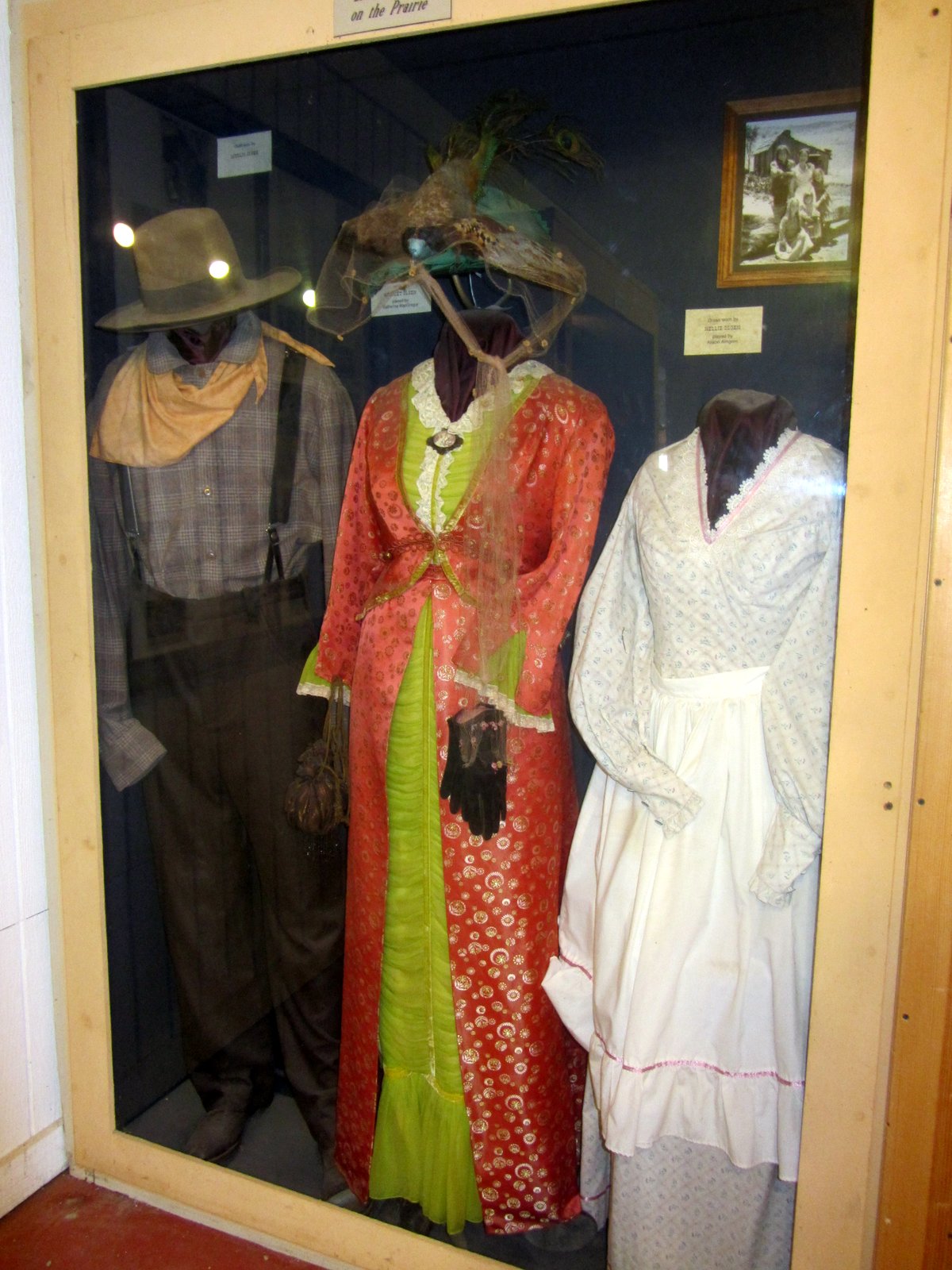
| Little House on the Prairie costumes |
Here's a partial list of films and television shows shot at Old Tucson Studios:
Little House on the Prairie
Tombstone (1993)
Bonanza
Gunsmoke
How the West was Won
Wild Wild West (1999)
The Quick and the Dead (1995)
The Outlaw Josey Wales (1976)
Three Amigos! (1986)
Rio Bravo (1959)
McLintock! (1963)
Joe Kidd (1972)
The High Chaparral
Young Guns II (1990)
El Dorado (1966)
Rio Lobo (1970)
3:10 to Yuma (1957)
Winchester '73 (1950)
Broken Arrow (1950)
Gunfight at the OK Corral (1957)
Hombre (1967)
The Villain (1979)
Last Train from Gun Hill (1957)
Tuesday, April 2, 2013
Classic Films in Focus: MCLINTOCK! (1963)
Maureen O'Hara is classic Hollywood's poster girl for the battle of the sexes. With her beautiful face, striking red hair, and strong personality, she is both heroine and harridan, attractive to men as much for her fight as for her figure. In McLintock! (1963), her worthy opponent is frequent co-star John Wayne, although even he spends most of the movie on the run from the inevitable domestic showdown with his formidable feminine counterpart. Since this is 1963, you can probably predict how that combat will end, but it's a fun show in spite of that, with a cast of reliable Western stalwarts and a surprisingly sentimental subplot about the fate of the West's original inhabitants. In fact, McLintock! remains a great favorite among John Wayne fans, beloved for its feisty comedy and the Duke's particular charisma with his leading lady.
Successful cattle rancher George Washington McLintock (Wayne) is the boss of everything except his wife, Katherine (Maureen O'Hara), who left him several years ago, although McLintock has never figured out why. When their grown daughter, Becky (Stefanie Powers), returns from school back East, Katherine also comes back into town, even though she's still fighting mad at McLintock. Young Becky's affections are torn between a citified local dandy (Jerry Van Dyke) and a handsome new ranch hand (Patrick Wayne), while the elder McLintocks lock horns in a marital battle that encompasses the entire town. Meanwhile, McLintock tries to help the region's last Comanche warriors make their case to a tribunal of unsympathetic government officials.
The domestic comedy plays out as a frontier "Taming of the Shrew," where the male characters appreciate high-spirited women but see them as just another kind of wildlife that needs to be conquered and put to work, like more attractive versions of the horses and cattle that roam the open range. It's a sexist premise, but at least the women put up a good fight, and O'Hara's Katie is so ornery and venomous that some measure of comeuppance seems justified. Becky proves to have plenty of her mother's temper, and her courtship with Dev (played by Wayne's son, Patrick) reaches a comic highpoint when Becky demands that her father shoot the offending young man but ends up being subjected to a spanking herself. It's the kind of scene that many people now find rather uncomfortable, but such gender conflicts got big laughs in similar films like Annie Get Your Gun (1950), Kiss Me Kate (1953), and, of course, The Taming of the Shrew (1967).
Countering this sense of domestic violence as comedy is an unexpectedly nostalgic and sympathetic view of Native Americans. The Comanches of the Old West are depicted as inhuman, marauding savages in many movies, including The Searchers (1956), which many consider Wayne's best film. In McLintock! we see Wayne's character defending and respecting the Comanche people, even though he fought with them in earlier days. The character of Davey, a young Native American who has been to college and who works in the town, also makes an interesting commentary about racial identity and the struggle for equality. Of course, like the film's women, the Comanches are doomed to lose to the white men, but they have a poignant final scene as they ride out into the desert, disappearing from the world like figures in a dream.
You'll find a whole round-up of Western veterans filling out the supporting roles, including Chill Wills, Strother Martin, Edgar Buchanan, and Hank Worden. Yvonne De Carlo has a plum role as the widowed mother of Patrick Wayne's character, and her drunk scene with the Duke is particularly funny. O'Hara and Wayne made five pictures together in all, including The Quiet Man (1952) and Big Jake (1971), but for more romantic sparring see her with Tyrone Power in The Black Swan (1942). Patrick Wayne can also be found costarring with his father in The Searchers (1956), The Alamo (1960), and Big Jake (1971). For more Westerns from director Andrew V. McLaglen, the son of veteran character actor Victor McLaglen, try Shenandoah (1965), The Rare Breed (1966), and Chisum (1970).
An earlier version of this review originally appeared on Examiner.com. The author retains all rights to this content.
Successful cattle rancher George Washington McLintock (Wayne) is the boss of everything except his wife, Katherine (Maureen O'Hara), who left him several years ago, although McLintock has never figured out why. When their grown daughter, Becky (Stefanie Powers), returns from school back East, Katherine also comes back into town, even though she's still fighting mad at McLintock. Young Becky's affections are torn between a citified local dandy (Jerry Van Dyke) and a handsome new ranch hand (Patrick Wayne), while the elder McLintocks lock horns in a marital battle that encompasses the entire town. Meanwhile, McLintock tries to help the region's last Comanche warriors make their case to a tribunal of unsympathetic government officials.
The domestic comedy plays out as a frontier "Taming of the Shrew," where the male characters appreciate high-spirited women but see them as just another kind of wildlife that needs to be conquered and put to work, like more attractive versions of the horses and cattle that roam the open range. It's a sexist premise, but at least the women put up a good fight, and O'Hara's Katie is so ornery and venomous that some measure of comeuppance seems justified. Becky proves to have plenty of her mother's temper, and her courtship with Dev (played by Wayne's son, Patrick) reaches a comic highpoint when Becky demands that her father shoot the offending young man but ends up being subjected to a spanking herself. It's the kind of scene that many people now find rather uncomfortable, but such gender conflicts got big laughs in similar films like Annie Get Your Gun (1950), Kiss Me Kate (1953), and, of course, The Taming of the Shrew (1967).
Countering this sense of domestic violence as comedy is an unexpectedly nostalgic and sympathetic view of Native Americans. The Comanches of the Old West are depicted as inhuman, marauding savages in many movies, including The Searchers (1956), which many consider Wayne's best film. In McLintock! we see Wayne's character defending and respecting the Comanche people, even though he fought with them in earlier days. The character of Davey, a young Native American who has been to college and who works in the town, also makes an interesting commentary about racial identity and the struggle for equality. Of course, like the film's women, the Comanches are doomed to lose to the white men, but they have a poignant final scene as they ride out into the desert, disappearing from the world like figures in a dream.
You'll find a whole round-up of Western veterans filling out the supporting roles, including Chill Wills, Strother Martin, Edgar Buchanan, and Hank Worden. Yvonne De Carlo has a plum role as the widowed mother of Patrick Wayne's character, and her drunk scene with the Duke is particularly funny. O'Hara and Wayne made five pictures together in all, including The Quiet Man (1952) and Big Jake (1971), but for more romantic sparring see her with Tyrone Power in The Black Swan (1942). Patrick Wayne can also be found costarring with his father in The Searchers (1956), The Alamo (1960), and Big Jake (1971). For more Westerns from director Andrew V. McLaglen, the son of veteran character actor Victor McLaglen, try Shenandoah (1965), The Rare Breed (1966), and Chisum (1970).
An earlier version of this review originally appeared on Examiner.com. The author retains all rights to this content.
Sunday, February 10, 2013
Classic Films in Focus: FORT APACHE (1948)
The classic Western has many moods, but the tone of John Ford's Fort Apache (1948) is decidedly dark. Its clouds gather slowly, relieved sometimes by deceptive moments of gaiety and light, but still the storm comes on. Loosely based on the events of Custer's Last Stand, Fort Apache is technically a John Wayne picture, although Wayne takes a secondary role, while the full weight of hubris and its subsequent punishment fall on the shoulders of Henry Fonda as the doomed colonel who stubbornly leads his men to death.
Fonda plays Lieutenant Colonel Owen Thursday, who arrives with his sprightly daughter, Philadelphia (Shirley Temple), at Fort Apache only to upset the balance of the residents' lives. Determined to win glory and prove himself to the world, Thursday ignores the experience and advice of those around him, including the seasoned Captain York (Wayne), and pushes toward a disastrous encounter with the Apache chief, Cochise, and his warriors.
Ford balances comedy and tragedy in his scenes and his actors, reflecting the ebb and flow of ordinary life, even in times of crisis. Without Thursday, the denizens of the fort have formed a benevolent community of friendship and mutual respect, but their new leader soon undermines their peace with his arrogance and contempt. He even forbids his daughter to keep company with the fort's favorite son, although the young lovers persist in their romance in spite of his authority. As Thursday, Fonda gives a brilliantly layered performance; he knows to soften just enough every now and then to keep us hoping that he'll live to see the error of his ways, even though his doom is clearly written on his brow. Temple is pertly pretty as Philadelphia, an energetic rather than an elegant girl, but filled with a pioneer spirit that promises much for her survival in this untamed frontier. Wayne watches the events unfold with a grim recognition of the coming end, but his presence is a comfort to the viewer because we know that he can be trusted when everything else falls apart.
Other supporting players also contribute to the film's powerful effect. Ward Bond is jovial and kind as the O'Rourke family patriarch, and George O'Brien has a particularly moving role as Captain Collingwood. Anna Lee and Irene Rich make the fort's women solid and sympathetic, and Guy Kibbee is very good as the sociable doctor. Ford favorites like Victor McLaglen and Pedro Armendariz also put in reliable character performances. The role of young Michael O'Rourke was the first screen appearance of John Agar, who happened to be married to Shirley Temple at the time. The couple would divorce in 1949, but Agar's acting career continued, and he went on to appear in a number of noteworthy Westerns, including Ford's She Wore a Yellow Ribbon (1949) and Big Jake (1971), as well as many cult sci-fi films.
For more of John Ford's Westerns with John Wayne, see Stagecoach (1939), The Searchers (1956), and The Man Who Shot Liberty Valance (1962). Fonda made a number of memorable Westerns, including The Ox-Bow Incident (1943) and My Darling Clementine (1946), but you could also explore other sides of the actor in Jezebel (1938), The Lady Eve (1941), and 12 Angry Men (1957). See more of teenage Shirley Temple in The Bachelor and the Bobby-Soxer (1947), or for contrast catch her earlier work with John Ford in Wee Willie Winkie (1937). With well over 200 screen appearances, the marvelous character actor Ward Bond can be found almost everywhere, from The Maltese Falcon (1941) to It's a Wonderful Life (1946) and Rio Bravo (1959), but he was a particular favorite with John Ford, who gave him memorable roles in many of his films.
An earlier version of this review originally appeared on Examiner.com. The author retains all rights to this content.
Fonda plays Lieutenant Colonel Owen Thursday, who arrives with his sprightly daughter, Philadelphia (Shirley Temple), at Fort Apache only to upset the balance of the residents' lives. Determined to win glory and prove himself to the world, Thursday ignores the experience and advice of those around him, including the seasoned Captain York (Wayne), and pushes toward a disastrous encounter with the Apache chief, Cochise, and his warriors.
Ford balances comedy and tragedy in his scenes and his actors, reflecting the ebb and flow of ordinary life, even in times of crisis. Without Thursday, the denizens of the fort have formed a benevolent community of friendship and mutual respect, but their new leader soon undermines their peace with his arrogance and contempt. He even forbids his daughter to keep company with the fort's favorite son, although the young lovers persist in their romance in spite of his authority. As Thursday, Fonda gives a brilliantly layered performance; he knows to soften just enough every now and then to keep us hoping that he'll live to see the error of his ways, even though his doom is clearly written on his brow. Temple is pertly pretty as Philadelphia, an energetic rather than an elegant girl, but filled with a pioneer spirit that promises much for her survival in this untamed frontier. Wayne watches the events unfold with a grim recognition of the coming end, but his presence is a comfort to the viewer because we know that he can be trusted when everything else falls apart.
Other supporting players also contribute to the film's powerful effect. Ward Bond is jovial and kind as the O'Rourke family patriarch, and George O'Brien has a particularly moving role as Captain Collingwood. Anna Lee and Irene Rich make the fort's women solid and sympathetic, and Guy Kibbee is very good as the sociable doctor. Ford favorites like Victor McLaglen and Pedro Armendariz also put in reliable character performances. The role of young Michael O'Rourke was the first screen appearance of John Agar, who happened to be married to Shirley Temple at the time. The couple would divorce in 1949, but Agar's acting career continued, and he went on to appear in a number of noteworthy Westerns, including Ford's She Wore a Yellow Ribbon (1949) and Big Jake (1971), as well as many cult sci-fi films.
For more of John Ford's Westerns with John Wayne, see Stagecoach (1939), The Searchers (1956), and The Man Who Shot Liberty Valance (1962). Fonda made a number of memorable Westerns, including The Ox-Bow Incident (1943) and My Darling Clementine (1946), but you could also explore other sides of the actor in Jezebel (1938), The Lady Eve (1941), and 12 Angry Men (1957). See more of teenage Shirley Temple in The Bachelor and the Bobby-Soxer (1947), or for contrast catch her earlier work with John Ford in Wee Willie Winkie (1937). With well over 200 screen appearances, the marvelous character actor Ward Bond can be found almost everywhere, from The Maltese Falcon (1941) to It's a Wonderful Life (1946) and Rio Bravo (1959), but he was a particular favorite with John Ford, who gave him memorable roles in many of his films.
An earlier version of this review originally appeared on Examiner.com. The author retains all rights to this content.
Friday, December 7, 2012
Having Myself a Classic Movie Christmas
We're a full week into December, and it's time to get serious about classic Christmas movies. TCM is showing 33 of them this month, including several fan favorites and a lot of less obvious choices, but I'm mostly a traditionalist when it comes to classic holiday films (with a few notable exceptions). Here are six movies I have to watch over the holidays this year, or it just won't be Christmas.
1) It's a Wonderful Life (1946) - My father loves this movie, and I grew up watching it several times each holiday season. It still gets to me today, and I love the huge cast of memorable performers, from the big name leads to the veteran character players. This year I actually get to host a screening of the Capra classic at our local library!
2) White Christmas (1954) - I just love everything about this film, from its WWII patriotism and selfless themes to its crazy drag version of "Sisters" and Mary Wickes' nosy housekeeper. The songs are fantastic, the mood is nostalgic and sweet, and the holidays aren't complete without Danny, Bing, Rosemary, and Vera-Ellen.
3) Three Godfathers (1948) - So I've got a well-established thing for classic Westerns, especially those John Ford/John Wayne collaborations, and this one is simply a Yuletide treasure. Yes, it's another iteration of the now familiar "three men and a baby" plot, and not even the first Western to have the title or tell the story, but the Duke, Pedro Armendariz, and Harry Carey, Jr., are just so lovable and rough that I can't resist them. Personal favorites like Ward Bond, Mildred Natwick, and Jane Darwell help to make this one a holiday essential at my house.
4) The Muppet Christmas Carol (1992) - Yes, there are lots of great versions of Charles Dickens' Christmas tale, but this one is my favorite hands-down, not just for the goofy Muppet humor but for the incredible puppetry work on the Ghosts, especially the Ghost of Christmas Past. Hey, I love the Muppets so much I co-edited two books about them, so nobody can be surprised if I spend time watching Muppet holiday movies every time December rolls around (I watch all of the other Muppet holiday shows, too, but this one is the best). Gonzo as Charles Dickens? Genius! Michael Caine as Scrooge? Fabulous!
5) Scrooged (1988) - Bill Murray's irreverent take on A Christmas Carol is a riot, and it's even got Robert Mitchum! The Ghosts are especially fun, thanks to over-the-top performances from David Johansen and Carol Kane. Bobcat Goldthwait steals his scenes as an ex-employee pushed a little too far by Bill Murray's modern-day Scrooge.
6) Rudolph, the Red-Nosed Reindeer (1964) - Having grown up a veritable resident of the Island of Misfit Toys, I find Rudolph's outcast protagonist deeply sympathetic in this quirky TV classic. We actually watch all of the Rankin/Bass holiday specials each year, but this one is especially funny and poignant, and full of quotable lines thanks to Larry Mann as Yukon Cornelius. "It's a night not fit for man nor beast! Here's the man... and here's the beast!" - such lines are endlessly repeated in my family this time of year.
Of course, I'll be watching other holiday films this month, including Christmas in Connecticut (1945), Miracle on 34th Street (1947), 101 Dalmatians (1961), A Christmas Story (1983), and even Gremlins (1984), but these six are at the top of my nice list when it comes to Christmas pleasures. Bake some cookies, make a cup of cocoa, and tell me about your favorite Christmas movies in the comments section below!
1) It's a Wonderful Life (1946) - My father loves this movie, and I grew up watching it several times each holiday season. It still gets to me today, and I love the huge cast of memorable performers, from the big name leads to the veteran character players. This year I actually get to host a screening of the Capra classic at our local library!
2) White Christmas (1954) - I just love everything about this film, from its WWII patriotism and selfless themes to its crazy drag version of "Sisters" and Mary Wickes' nosy housekeeper. The songs are fantastic, the mood is nostalgic and sweet, and the holidays aren't complete without Danny, Bing, Rosemary, and Vera-Ellen.
3) Three Godfathers (1948) - So I've got a well-established thing for classic Westerns, especially those John Ford/John Wayne collaborations, and this one is simply a Yuletide treasure. Yes, it's another iteration of the now familiar "three men and a baby" plot, and not even the first Western to have the title or tell the story, but the Duke, Pedro Armendariz, and Harry Carey, Jr., are just so lovable and rough that I can't resist them. Personal favorites like Ward Bond, Mildred Natwick, and Jane Darwell help to make this one a holiday essential at my house.
4) The Muppet Christmas Carol (1992) - Yes, there are lots of great versions of Charles Dickens' Christmas tale, but this one is my favorite hands-down, not just for the goofy Muppet humor but for the incredible puppetry work on the Ghosts, especially the Ghost of Christmas Past. Hey, I love the Muppets so much I co-edited two books about them, so nobody can be surprised if I spend time watching Muppet holiday movies every time December rolls around (I watch all of the other Muppet holiday shows, too, but this one is the best). Gonzo as Charles Dickens? Genius! Michael Caine as Scrooge? Fabulous!
5) Scrooged (1988) - Bill Murray's irreverent take on A Christmas Carol is a riot, and it's even got Robert Mitchum! The Ghosts are especially fun, thanks to over-the-top performances from David Johansen and Carol Kane. Bobcat Goldthwait steals his scenes as an ex-employee pushed a little too far by Bill Murray's modern-day Scrooge.
6) Rudolph, the Red-Nosed Reindeer (1964) - Having grown up a veritable resident of the Island of Misfit Toys, I find Rudolph's outcast protagonist deeply sympathetic in this quirky TV classic. We actually watch all of the Rankin/Bass holiday specials each year, but this one is especially funny and poignant, and full of quotable lines thanks to Larry Mann as Yukon Cornelius. "It's a night not fit for man nor beast! Here's the man... and here's the beast!" - such lines are endlessly repeated in my family this time of year.
Of course, I'll be watching other holiday films this month, including Christmas in Connecticut (1945), Miracle on 34th Street (1947), 101 Dalmatians (1961), A Christmas Story (1983), and even Gremlins (1984), but these six are at the top of my nice list when it comes to Christmas pleasures. Bake some cookies, make a cup of cocoa, and tell me about your favorite Christmas movies in the comments section below!
Saturday, September 8, 2012
10 Classic Movies About Football
"Go
out and win one for the Gipper!"
Fall
is the perfect time to explore classic Hollywood's cinematic celebrations of one
of America’s great passions, the game of football. Classic football movies tend
to feature college teams like West Point and Notre Dame, and they often focus
on the determined coaches who lead the teams rather than the players themselves,
although underdogs and beloved legends also get the star treatment. Here are
ten classic movies that depict America’s love affair with football. You'll find
silent film star Harold Lloyd at the kick-off with The Freshman (1925) and the Duke himself, John Wayne, scoring the
final touchdown as an embattled college coach in Trouble Along the Way (1953).
1.
The Freshman (1925)
2.
West Point (1927)
3.
Horse Feathers (1932)
4.
Navy Blue and Gold (1937)
5.
Knut Rockne All American (1940)
6.
Good News (1947)
7.
The Spirit of West Point (1947)
8.
Father was a Fullback (1949)
9.
Jim Thorpe: All American (1951)
10.
Trouble Along the Way (1953)
Spotlight films
The Headliner: Knute Rockne All American (1940)
Dir.
Lloyd Bacon
An
all-star cast makes Knute Rockne the
standard for classic football movies, with its sentimental charge to "win
one for the Gipper" one of Hollywood's most quotable lines. Pat O'Brien
stars as the dedicated coach, with Donald Crisp and Ronald Reagan as supporting
players. Based on the story of the real life Notre Dame coach, the film
celebrates the legendary coach's contributions to the game and ensures that
Ronald Reagan will forever be known as "the Gipper," even to people
who have never seen the film.
The Hidden Gem: Good News (1947)
Dir.
Charles Walters
With
a screenplay by Betty Comden and Adolph Green, Good News stars Peter Lawford as a college football star and June
Allyson as his coed love interest. Originally a stage musical and already made
into a film in 1930, Good News is set
on a college campus during the 1920s. The song, "Pass That Peace
Pipe," earned an Oscar nomination, thanks in part to an energetic
performance by Joan McCracken.
The Cult
Classic: Horse Feathers (1932)
Dir.
Norman Z. McLeod
The
Marx Brothers make a mockery of college and its sacred institutions in this
wacky farce, with straight man Zeppo actually playing the son of his real life
brother, Groucho. The usual antics ensue as Groucho, Chico, and Harpo introduce
chaos at every turn, and the final scene brings the entire Marx crew onto the
field for some truly unorthodox plays, including a touchdown made in a
horse-drawn garbage cart.
Although it looks like very few, if any, of these movies are available for streaming on Netflix, you will find several that you can rent for streaming from Amazon at $2.99 per movie.
An earlier version of this article appeared on Examiner.com. The author retains all rights to this content.
Monday, July 30, 2012
A Day with the Duke on August 1
Turner Classic Movies kicks off its 2012 Summer
Under the Stars program with an all-day celebration of John Wayne on August 1,
which will thrill some classic movies fans and irritate others. John Wayne has
always been a polarizing figure – people either love him or hate him. Younger
women, in particular, often tell me of their disdain for Wayne and for Westerns
in general. Now, I happen to love the Duke, which might be an odd thing for a
feminist literary scholar to admit, but there’s a lot to be said in John Wayne’s
defense, and these highlights from the TCM lineup provide some compelling evidence of the star’s true
value.
Take STAGECOACH (1939), for instance. As the Ringo
Kid, Wayne is a younger, gentler outlaw figure, courting Claire Trevor’s fallen
angel with deference and tact. Viewers who are only accustomed to the old,
craggy Duke of the late 1960s and early 70s might be surprised at the smooth,
handsome features of the youthful star. Wayne was already 32 when STAGECOACH
was released, and he had been in Hollywood for more than a decade, but the film
represents a major turning point in the actor’s career as the first film he
would make with director John Ford.
THE SEARCHERS (1956) is the film many consider the
best of Ford’s pictures with Wayne; it has even been called the greatest
example of the entire Western genre. Wayne takes a much darker role as Ethan
Edwards, a man obsessed with finding his niece (Natalie Wood) after Comanche
raiders kill her family and kidnap her. If you don’t think John Wayne could
act, try watching this picture and thinking about how much of the story is left
in the subtext, with only the characters’ expressions to suggest what is really
going on.
In opposition to the heavy drama of THE SEARCHERS
are films like RIO BRAVO (1959) and MCLINTOCK! (1963), where the Duke shows his
lighter side. Whether he’s being flustered by Angie Dickinson or rattled by
Maureen O’Hara, Wayne has a wonderful knack for playing the manly man utterly
confused by the womanly woman. You don’t think that John Wayne can be funny?
Try the scene in RIO BRAVO in which he plants a big kiss on Walter Brennan’s
cantankerous old Stumpy.
Finally, SHE WORE A YELLOW RIBBON (1949) shows Wayne
playing a character much older than himself, a sentimental widower who still
visits his wife’s grave and questions his place in the world on the eve of his
retirement from the Army. Despite his name, Nathan Brittles is really quite a
softie, taking a very paternal interest in Joanne Dru’s heroine and her
romantic conflicts.
What all of these films have in common is a Wayne
character deeply involved with the women in his world, which is fascinating
given that Wayne is so often held up as the ultimate macho star. We think of
Wayne with a rifle in his arms, but just as often it’s a woman he holds. The
rifle determines the outcomes of other men’s lives, but the woman dictates the
destiny of the man himself. This dynamic makes Wayne’s Westerns endlessly
interesting to me, and the films being shown on TCM offer a great chance to
catch the Duke in action with a variety of leading ladies and in several
different modes. It’s also a perfect opportunity for viewers who don’t think
they like John Wayne to give the star another chance.
The Virtual Virago also writes about classic movies as the National Classic Movies Examiner. For full-length reviews of other John Wayne films, try FORT APACHE (1948), THE QUIET MAN (1952), and THE SHOOTIST (1976).
Saturday, June 23, 2012
Cemetery Scenes: The Presence of the Dead in John Ford’s Westerns
The
great Westerns strike a balance between the opposing experiences that define
life on the frontier; they understand that the thrill of adventure comes hand
in hand with the very real threat of death. Cowboys and cavalry fire their guns
and gallop across the open land like eternal mythic heroes, but all around them
we see evidence of mortality and feel the burden shouldered by survivors.
Nowhere is this memento mori
sensibility more present than in the Westerns of John Ford, where dead
characters frequently function as mute participants in the lives of the
protagonists, watching and listening from the grave while those still living
struggle to make sense of the events that unfold. In three of Ford’s best known
films, My Darling Clementine (1946), She Wore a Yellow Ribbon (1949), and The Searchers (1956), cemetery scenes
highlight the relationships between the living and the dead and remind us of
the human cost of settling the Western frontier.
In
My Darling Clementine, Henry Fonda’s
Wyatt Earp is a quiet, reflective character, and his visits to the lonely grave
of his youngest brother, James, remind us that Wyatt has already paid dearly
for his life on the range. Only briefly alive in the film, James is the
sacrificial lamb whose murder roots his brothers in Tombstone and spurs them to
action against the corrupt Clanton family. Ironically, Wyatt seems to talk more
to his dead brother than he does to the two who are still alive, perhaps because
James is no longer bound by the masculine code of behavior that normally
governs men’s relationships. The graveside chats with James allow Wyatt to
reveal a more sensitive, communicative side of himself, one that must be
carefully guarded in the world of living men, where stoicism and action are
highly prized. James’ persistent presence, symbolized by his grave, also
reminds the audience why Wyatt and his remaining brothers are in this fight,
not because they enjoy killing but because justice demands it.
The
humanizing element of the cemetery scene is particularly important in She Wore a Yellow Ribbon, in which John
Wayne’s aging Captain Nathan Brittles frequently visits the graves of his wife
and daughters. We never learn the exact cause of their deaths, although the
graves indicate that all three died more or less at the same time, suggesting
either an Indian attack or some terrible accident. While the younger men vie
for the attentions of Olivia Dandridge (Joanne Dru), Brittles clearly considers
himself still married to his dead wife, making reports to her about events at
the fort and his own reflections on them. Other reminders of the dead family
appear throughout the film. Photographs of Mrs. Brittles and the two daughters
repeatedly turn up in important shots, and the frame that holds them is
decorated with a yellow ribbon that connects them to Olivia and the other women
of the fort. It’s clear from the way that the film treats the Brittles family
relationship that Olivia functions as a surrogate daughter to Nathan; she is
about the same age that his daughters would be had they lived. Bittersweet and
tender, these moments in the film soften Wayne’s character and suggest the
importance of love and family even to career soldiers on the rugged frontier.
In
The Searchers, the film’s critical
cemetery scene takes place very early, when young Debbie Edwards (Lana Wood) is
kidnapped by the Indian raiding party led by Scar (Henry Brandon). The grave in
question belongs to Debbie’s grandmother, the mother of Wayne’s troubled
protagonist, Ethan Edwards. The grave suggests the way in which the Edwards’
tragic frontier story repeats itself, with the elder Mrs. Edwards also a victim
of Indian attack. Just before her entire family is murdered by the Comanche
raiders, Debbie is sent to the grave to hide, but this time the dead can
provide no consolation to the living. Mrs. Edwards serves only as a silent
witness to her granddaughter’s fate. Driven almost to madness by these repeated
losses at the hands of the Comanche, Ethan launches an obsessive search for his
niece (who might actually be his daughter, but that’s a different thread of the
film’s twisted plot). His goal is to kill Debbie and thus return her to the
family circle symbolized by the Edwards cemetery plot, which will complete the
connection between Debbie and her grandmother, even though Debbie actually
survives the original attack. Although it offers no protection to the little
girl, the grave does offer the audience a better understanding of the Edwards story
and a glimpse into the true origin of Ethan’s hatred.
In
each of these films, the cemetery represents the presence of the past in the
lives of the protagonists. For Wyatt Earp, Nathan Brittles, and the Edwards
clan, the cemetery holds family members who remain crucial to the stories of
the surviving characters, reaching out beyond the grave to motivate, comfort,
or bear witness. In their own ways, they are as important as any of the living
characters in the films, reminding us that the dead are always with us.
This post was originally published at the now defunct classic movie blog, The Cinementals.
Subscribe to:
Posts (Atom)