Showing posts with label Anthony Mann. Show all posts

Monday, June 6, 2016

Guns of the Old Western in Wyoming

We spent last week in Montana and Wyoming, mostly touring Yellowstone and Grant Teton National Parks, but I'm happy to say that I still found some balm for my classic movie loving soul. One of the best spots for indulging a cinema obsession was Cody, Wyoming, where we spent a full day exploring the Buffalo Bill Center of the West, a five museum complex affiliated with the Smithsonian and a treasure trove for all kinds of fascinating knowledge. I'll talk about Buffalo Bill's personal history and the movies in another post, but this time I want to focus on the Cody Firearms Museum, one of the five museums in the Center.


I'm not normally a gun fan; I grew up around them but find them disconcerting. In Westerns, however, I accept that guns are a necessary and iconic part of frontier culture, where homesteaders and cowboys might have good reasons for keeping firearms handy. Thus, as we were breezing through the firearms museum, not really paying too much attention to exhibits on Glocks and whatnot, I came up short when we arrived at an exhibit about guns in Westerns. This was a gun exhibit that could get my attention!


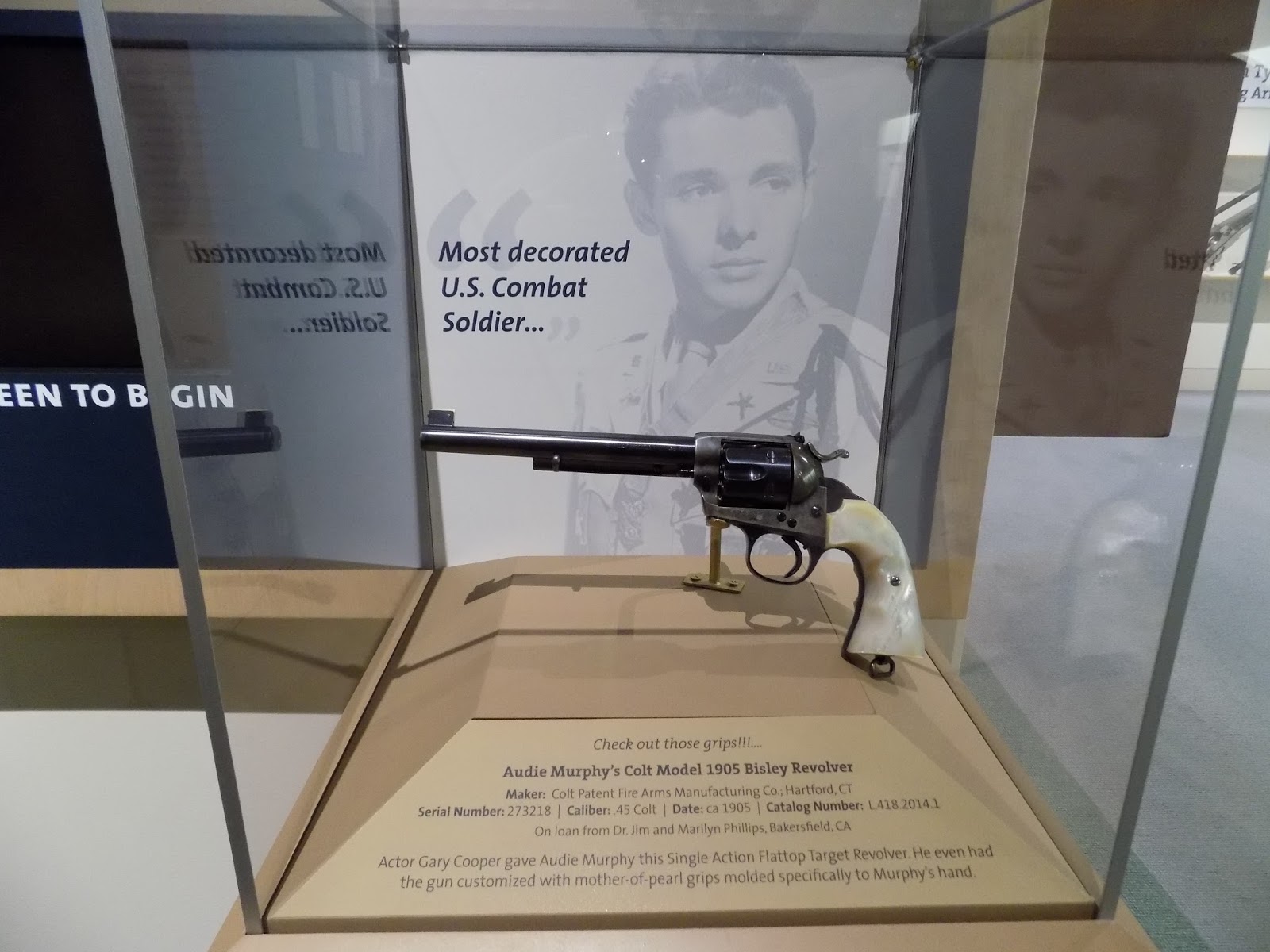
The display of Western Movie & TV Guns is not really large, but it does feature some gems sure to delight any true fan of the genre. The main cases contain the belts and guns of the stars of Bonanza as well as guns used by the stars of Gunsmoke, Bat Masterson, and The Lone Ranger. They also include a gun used by Gary Cooper in Vera Cruz (1954) and High Noon (1952). Another display pays tribute to World War II hero and Western star Audie Murphy. The gun displayed with it, a Colt Model 1905 Bisley Revolver, was a gift to Murphy from Gary Cooper.


The highlight of the exhibit, however, is the iconic rifle that gives its name to the 1950 Anthony Mann Western, Winchester '73. Displayed in a case by itself, it's an impressive sight, with a production still from the film serving as its backdrop. A closer look, however, reveals that the weapon was signed by all of the film's stars, starting with James Stewart himself. It's a fabulous piece of movie memorabilia that absolutely belongs here, surrounded not only by other Western firearms but by a history of the Winchester and its importance to the settling of the frontier.

If you're ever out around Yellowstone, make time for a stop in Cody, Wyoming. There's a lot of history here for a Western devotee to devour, as well as a nightly gunfight in the street and a whole lot of gift shops and rodeos.

Monday, May 9, 2016

10 Great Westerns of the 1950s

The 1950s produced a bumper crop of A-level Westerns with some of Hollywood's biggest stars in the leading roles, including some we don't necessarily associate with the genre. Over the course of the decade, darker and more complex psychological Westerns appealed to adult viewers, even as the matinee cowboys continue to ride high with the Saturday morning crowd. Westerns and film noir provided fertile territory for directors and actors, with many jumping between the two genres and even blurring the line at times about which was which. Of course, John Wayne and John Ford were still on the scene, but a new generation of Western icons was also developing, with Lee Marvin making his presence known and director Delmer Daves venturing into the genre with Broken Arrow in 1950. You could spend a long time watching Westerns from the 1950s (check out 50 Westerns from the 50s for proof), but here are just ten great Westerns - one from each year of the decade - to get you started.

1) WINCHESTER '73 (1950) - Anthony Mann and James Stewart begin a fruitful collaboration in the genre with this picture, which focuses on the hands through which the coveted title rifle must travel. The cast also includes Shelley Winters, Dan Duryea, and Stephen McNally, but viewers will also find early appearances by Rock Hudson (as a Native American) and Tony Curtis. Mann and Stewart would go on to make four more Westerns together: Bend of the River (1952), The Naked Spur (1953), The Far Country (1954), and The Man from Laramie (1955), all of which are well worth watching.

Westward the Women

2) WESTWARD THE WOMEN (1951) - Probably the least familiar picture on this list, this women's Western is truly unique in its focus on the suffering and determination of a group of women headed West by wagon train to marry settlers on the frontier. William A. Wellman directs an ensemble cast headed up by Robert Taylor as the women's guide, with Denise Darcel and Hope Emerson getting top billing among the many fine actresses. Renata Vanni gives an especially moving performance as one of the group's older members.

3) HIGH NOON (1952) - A four-time Oscar winner, this dramatic Western appears on almost any top ten list for the genre, and for good reason. Its real-time unfolding adds urgency to the story as we watch the clock tick down to Frank Miller's fateful arrival, while Gary Cooper's Oscar-winning performance is noble and moving, even if he is much too old to be marrying Grace Kelly. A terrific supporting cast helps seal the deal, including Thomas Mitchell, Lon Chaney Jr., Henry Morgan, Lloyd Bridges, and Katy Jurado. Tex Ritter, a singing cowboy from the matinee herd, provides the film's mournful title song, which inspired many later Westerns to have their own, similar themes.

4) SHANE (1953) - George Stevens directs this chivalric romance recast as frontier drama with Alan Ladd in the lead as the Wild West's version of a knight errant. Building their own rustic Camelot on the range are Van Heflin and Jean Arthur as the Starretts, with young Brandon De Wilde giving an Oscar-nominated performance as their son. Jack Palance, also nominated for Best Supporting Actor, is Shane's rival gunslinger. Other familiar faces in the cast include Ben Johnson, Elisa Cook Jr., and Ellen Corby.

5) JOHNNY GUITAR (1954) - Joan Crawford makes a rare genre appearance in this very unusual Western from Nicholas Ray, with Sterling Hayden as the title character. There's a lot of noir atmosphere seeping through, no surprise with Ray in the director's chair and Crawford and Hayden in the leads. The supporting cast is full of Western favorites, though, including Ward Bond, John Carradine, Royal Dano, Ernest Borgnine, and Paul Fix. Look out for a truly vicious performance by Mercedes McCambridge as Crawford's rival.

6) BAD DAY AT BLACK ROCK (1955) - Spencer Tracy stars in John Sturges' modern take on Western themes, once again with noir atmosphere turning everything a shade darker and dirtier. Tracy's one-armed WWII veteran comes to Black Rock on a mission of peace, but he finds out that Black Rock has a secret its residents will kill to hide. The landscape and the town speak to the lingering traces of the Old West, and the rest of the cast is packed with genre stalwarts, including Robert Ryan, Walter Brennan, Ernest Borgnine, and Lee Marvin. Tracy earned an Oscar nomination for Best Actor for his performance, while Sturges picked up a nod for Best Director, but every aspect of this film exudes excellence. It's just as hard-hitting today as it was in 1955.

7) THE SEARCHERS (1956) - John Ford and John Wayne deliver their most iconic collaboration with this epic tale of loss and obsession, with Wayne in the lead as ex-Confederate soldier Ethan Edwards, who embarks on a years-long quest to find his niece (Natalie Wood) after she is kidnapped by the Comanche. This is a darker, more morally complicated character for Wayne, but he suits the role perfectly. Widely considered one of the greatest Westerns of all time, this picture is the go-to example of Ford and Wayne's work together, with a rich subtext and emotional supporting performances that reward multiple viewings.

8) 3:10 TO YUMA (1957) - Delmer Daves directs Van Heflin and Glenn Ford in this tense character study of two very different men brought together by fate. Ford plays the smooth-talking, opportunistic outlaw, while Heflin plays the upright rancher with the dangerous job of getting the captured bandit to the train that will take him to prison. From there the lines between good man and bad begin to blur, with the outlaw and the rancher each coming to understand the nature of the other. Frankie Laine sings the theme song, which harks back to the melancholy theme of High Noon.

9) THE BIG COUNTRY (1958) - At 165 minutes, this is an epic Western, indeed, with Gregory Peck leading an impressive cast under the direction of William Wyler. Peck plays a former sea captain who heads West to take up ranching with his fiancee but, predictably, finds drama and strife as he becomes embroiled in a bitter feud. Burl Ives won the Oscar for Best Supporting Actor for his performance, but other notable cast members include Jean Simmons, Charlton Heston, Chuck Connors, Carroll Baker, and Alfonso Bedoya.

10) RIO BRAVO (1959) - Howard Hawks and John Wayne strike back against the serious (and often left-leaning) tone of many 1950s Westerns with the rollicking Rio Bravo, which is more interested in action than psychological analysis. Wayne plays Sheriff John T. Chance, who gets a very motley crew of assistants when the bad guys turn up to reclaim one of their own from Chance's jail. Dean Martin is the alcoholic Dude, trying to sober up enough to hold a gun, and Walter Brennan plays crusty old Stumpy. Dreamy Ricky Nelson sings and shoots as Colorado, while Angie Dickinson gives Wayne some romantic trouble as Feathers. The picture is usually seen as a rebuttal to High Noon, and it presages the kind of movie Wayne would continue to make from here until the end of his career. However, for the A Western as pure entertainment, this one is hard to beat.

For even more great Westerns from the 1950s, try The Gunfighter (1950), The Baron of Arizona (1950), The Furies (1950), Vera Cruz (1954), Seven Men from Now (1956), and Gunfight at the O.K. Corral (1957). You'll find full-length reviews for many of the Westerns listed here in my books, Beyond Casablanca: 100 Classic Movies Worth Watching and Beyond Casablanca II. Both are available on Amazon Kindle.

Thursday, August 14, 2014

Build-Your-Own-Blogathon: Bad Apples in BEND OF THE RIVER (1952)

This post is part of the Build-Your-Own-Blogathon hosted by the Classic Film and TV Cafe. It follows Caftan Woman's discussion of T-Men (1947), which shares its director, Anthony Mann, with Bend of the River (1952). Visit the Classic Film and TV Cafe for a complete list of the blogs participating in this blogathon!


"That kind can't change. When an apple's rotten, there's nothing you can do except throw it away or it will spoil the whole barrel." - Jeremy Baile

Director Anthony Mann collaborated with Jimmy Stewart on a number of excellent Westerns, including the 1952 film, Bend of the River, which takes the rugged country of the Pacific Northwest as its frontier territory. It's a story about gold fever, moral decay, and second chances, with Stewart as a former outlaw trying to turn over a new leaf as an honest man. Stewart's Glyn McLyntock is, of course, a good apple, no matter how shady his past, but the movie also presents us with a parade of foils and variations on the same theme. Jay C. Flippen and Chubby Johnson play for the angels as the movie's older good men, with Flippen especially crucial to Stewart's character as the leader of the Oregon settlers, but the less exemplary characters prove far more numerous. Arthur Kennedy and Rock Hudson play men whose moral compasses need more recalibration than Stewart's, while Howard Petrie depicts the rapid transformation of a good man gone wrong over gold, and Harry Morgan plays one of the dirtiest little apples ever seen in a Western barrel. These slippery, complicated performances help make Bend of the River a smart study of psychology as well as an exciting frontier adventure, and the bad apples inform our understanding of the hero's own inner struggle.

"$100,000 is a lot of money." - Emerson Cole (Arthur Kennedy)

Glyn's primary counterpart throughout the picture is Kennedy's Emerson Cole, a man who has so much in common with Glyn that Glyn tends to think of their destinies as inextricably linked. Cole shares Glyn's past as a raider, and he has enough integrity to appreciate it when Glyn saves his life, but Cole lacks the essential strength of character that sets Glyn apart. Cole likes fast living and violence; he's quick to draw his gun, even when lesser measures would suffice. Kennedy plays Cole as an enigma at first, encouraging us to like him even when we don't trust him, but the lure of wealth proves too much for him to resist. Even the love of Laura (Julie Adams) means nothing to him once a fortune comes within reach. Glyn offers him multiple chances at true redemption, but Cole succumbs to greed.

"You're real fast with that gun, kid, but you're soft." - Emerson Cole (Arthur Kennedy)

Hudson's handsome young gambler, Trey Wilson, makes the relationship between Glyn and Cole into a triangle. His essential nature is ambiguous early on; as a gambler, he is clearly a man who values money, but he doesn't like to kill. Cole even scolds him for being too soft-hearted. Trey throws in with Glyn and Cole without much thought, and he doesn't have to choose between them until it becomes clear that the two older men are moving in starkly different directions. Even then, Trey keeps his cards hidden, so that we're never quite sure which side he's on until the very end of the film. Trey actually fills two Western character types at once. Despite his worldly demeanor and flashy clothes, he is also this film's version of the Kid who has to decide which model of masculinity he wants to embrace; he can chase wealth and become like Cole, or he can do the right thing and emulate Glyn.

"I could get fifty times what you paid for that food. It's gold, do you understand, gold!" - Tom Hendricks (Howard Petrie)

Howard Petrie plays Tom Hendricks, the Portland official who first welcomes the settlers with open arms but later betrays their trust by reselling their winter supplies at wildly inflated prices. If Hendricks seems a little too friendly at first, that merely sets the stage for his later corruption, when we see him at his overflowing money table with a mad gleam in his eyes. Hendricks' fall mirrors that of the entire community; when Glyn and Jeremy (Jay C. Flippen) return to Portland looking for their supplies, they find the formerly pleasant town transformed into a filthy den of violence, greed, and lust. Hendricks is so far gone that he doesn't care if his double dealing costs the settlers their lives; he is even willing to kill Glyn and Jeremy to protect his financial interest. Tellingly, Cole doesn't seem to process the warning of Hendricks' fate; he's too busy shooting Hendricks' men while they try to run away.

"We're going to the gold camp with this food." - Shorty (Harry Morgan)

While most of the other flawed men in the film have some good qualities, Harry Morgan's Shorty is about as rotten as they come. Along with Red (Jack Lambert) and Long Tom (Royal Dano), Shorty never makes any move unless he's going to get paid for it. Shorty is a far cry from the uncertain but good-hearted character Morgan played in The Ox-Bow Incident (1943). He's a dirty, narrow-eyed sneak, always watching for the opportunity to take advantage of the others. He and the other workers conspire to hijack the food supply and sell it at the highest possible price in the gold mining camp; like Hendricks, they don't care if the settlers starve to death as a result. Unlike Hendricks, Shorty and his pals were never good in the first place. Their worst scene comes when they intentionally drop a wagon on Jeremy, Glyn, and Cole in an effort to murder all three at once.

"Any man can make a mistake." - Laura (Julie Adams)

These men run the gamut in terms of moral character, and each one shapes his own fate through his choices. The corruption of the weaker men reminds us how much is at stake in Glyn's struggle for redemption. Glyn knows that the kind of life he once led can only end badly, but his determination to do right and take a harder path makes him a hero in this story more than any skill with a rifle or knife. While there are plenty of bad apples in Bend of the River, they only make the good ones look that much better.