Showing posts with label Gary Cooper. Show all posts

Monday, July 1, 2019

Classic Films in Focus: CASANOVA BROWN (1944)

What does a viewer expect going into a movie that features multiple marriages, a burning mansion, a kidnapped baby, and a clueless new father on a crash course in infant care? Hilarity seems like a reasonable answer, but that's not what we get with Casanova Brown (1944). While its plot summary sounds like truly outrageous material for a screwball comedy, the end result is quite tame, with far quieter performances than one might expect in a story about characters who take everything to extremes. It's not a terrible film, but it's by no means a great example of the genre, especially when compared to Gary Cooper's better known foray into screwball comedy in the hilarious Ball of Fire (1941). Here Cooper lacks the high energy of a proper screwball heroine to react to, even though he has dueling leading ladies in Teresa Wright and Anita Louise. In the end, Casanova Brown is a modestly amusing picture that offers an instructive example of what makes screwball tick by leaving out an essential component.

Cooper plays Casanova Brown, a domesticated descendant of that other Casanova who stumbles into marriage rather more often than he should. On the eve of his wedding to the cosmopolitan Madge (Anita Louise), Cass discovers that his short-lived union with Isabel (Teresa Wright) has produced a child, whom Isabel plans to put up for adoption. Enamored at first sight of his newborn daughter and horrified by the idea of her being given away, Cass kidnaps the baby from the hospital and attempts to care for her while holed up in a local hotel. Meanwhile, both Madge and Isabel are searching for him with their fathers in tow.

There's certainly plenty of chaos and reversal on hand to fuel a screwball comedy. Cooper's Casanova is no Italian adventurer, much less a predatory seducer, but he still ends up at the altar with three different women. He seems to have a preternatural ability to create crises, as he does when his hastily hidden cigarette reduces Isabel's family home to a smoldering ruin, thus provoking the argument that ends his brief marriage. His reaction to Isabel's plan for their baby is to impersonate a doctor, make off with the infant, and then enlist half the hotel staff in his obsessive baby nursing efforts. Whatever the situation, Casanova Brown always seems to make exactly the wrong choice at the worst possible moment, and most of the film's best scenes rely on that disastrous trait.

The problem lies with the development of the two female characters, neither of whom clicks with Cooper or inhabits her role convincingly. I love Teresa Wright in other films, especially Shadow of a Doubt (1943), but here she seems so painfully young as a love interest for Cooper, and she's far too wounded and pitiful to be a proper screwball heroine. Her Isabel is a sad victim of her parents' foolishness, her groom's stubbornness, and her own inability to stand up for herself. Madge, meanwhile, who ought to be a scheming socialite man eater of the first order, is never even remotely awful enough to warrant being left at the altar. Moreover, Anita Louise looks far more age appropriate as a mate for Cooper than Wright (who was actually in her mid-20s in 1944 but looks so much like a kid that even Casanova mentions it), and one has to wonder about a man who prefers a childlike bride over an actual adult. The only real case made against Madge is the constant harping of her father (Frank Morgan) about how controlling and tight-fisted the Ferris women are, and it's clear that his resentment stems from his own greedy desire to run through his wife's fortune at the utmost speed. Louise might have made a more villainous Madge if the script provided any fodder, but Wright is flatly out of place, even if the role hadn't been so weakly written. Screwball needs screwy women to shake up the social order and disrupt expectations, and when they aren't present the picture falls flat.

Aside from Ball of Fire, try iconic screwball comedies like My Man Godfrey (1936), Bringing Up Baby (1938), Midnight (1939), or The Lady Eve (1941) to see the fireworks when everything goes right. Sam Wood, who directed Casanova Brown, was on firmer ground with more melodramatic material like Goodbye, Mr. Chips (1939), Kitty Foyle (1940), and Kings Row (1942), each of which earned him an Oscar nomination for Best Director. Gary Cooper won Oscars for Sergeant York (1941) and High Noon (1952), while Teresa Wright won the Best Supporting Actress award for Mrs. Miniver (1942). You can see both of them, once again paired romantically, in The Pride of the Yankees (1942).

Monday, June 6, 2016

Guns of the Old Western in Wyoming

We spent last week in Montana and Wyoming, mostly touring Yellowstone and Grant Teton National Parks, but I'm happy to say that I still found some balm for my classic movie loving soul. One of the best spots for indulging a cinema obsession was Cody, Wyoming, where we spent a full day exploring the Buffalo Bill Center of the West, a five museum complex affiliated with the Smithsonian and a treasure trove for all kinds of fascinating knowledge. I'll talk about Buffalo Bill's personal history and the movies in another post, but this time I want to focus on the Cody Firearms Museum, one of the five museums in the Center.


I'm not normally a gun fan; I grew up around them but find them disconcerting. In Westerns, however, I accept that guns are a necessary and iconic part of frontier culture, where homesteaders and cowboys might have good reasons for keeping firearms handy. Thus, as we were breezing through the firearms museum, not really paying too much attention to exhibits on Glocks and whatnot, I came up short when we arrived at an exhibit about guns in Westerns. This was a gun exhibit that could get my attention!


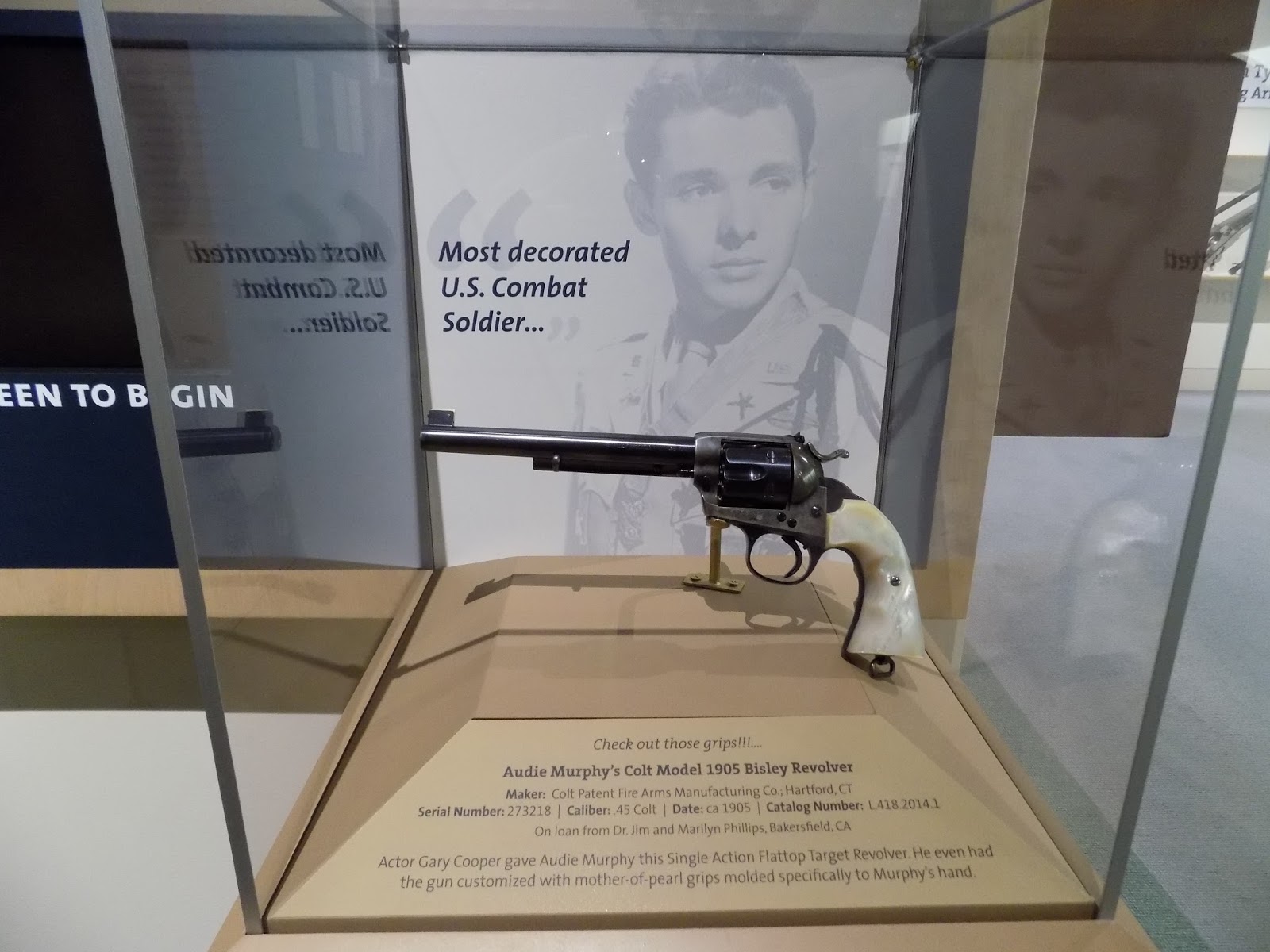
The display of Western Movie & TV Guns is not really large, but it does feature some gems sure to delight any true fan of the genre. The main cases contain the belts and guns of the stars of Bonanza as well as guns used by the stars of Gunsmoke, Bat Masterson, and The Lone Ranger. They also include a gun used by Gary Cooper in Vera Cruz (1954) and High Noon (1952). Another display pays tribute to World War II hero and Western star Audie Murphy. The gun displayed with it, a Colt Model 1905 Bisley Revolver, was a gift to Murphy from Gary Cooper.


The highlight of the exhibit, however, is the iconic rifle that gives its name to the 1950 Anthony Mann Western, Winchester '73. Displayed in a case by itself, it's an impressive sight, with a production still from the film serving as its backdrop. A closer look, however, reveals that the weapon was signed by all of the film's stars, starting with James Stewart himself. It's a fabulous piece of movie memorabilia that absolutely belongs here, surrounded not only by other Western firearms but by a history of the Winchester and its importance to the settling of the frontier.

If you're ever out around Yellowstone, make time for a stop in Cody, Wyoming. There's a lot of history here for a Western devotee to devour, as well as a nightly gunfight in the street and a whole lot of gift shops and rodeos.

Monday, May 9, 2016

10 Great Westerns of the 1950s

The 1950s produced a bumper crop of A-level Westerns with some of Hollywood's biggest stars in the leading roles, including some we don't necessarily associate with the genre. Over the course of the decade, darker and more complex psychological Westerns appealed to adult viewers, even as the matinee cowboys continue to ride high with the Saturday morning crowd. Westerns and film noir provided fertile territory for directors and actors, with many jumping between the two genres and even blurring the line at times about which was which. Of course, John Wayne and John Ford were still on the scene, but a new generation of Western icons was also developing, with Lee Marvin making his presence known and director Delmer Daves venturing into the genre with Broken Arrow in 1950. You could spend a long time watching Westerns from the 1950s (check out 50 Westerns from the 50s for proof), but here are just ten great Westerns - one from each year of the decade - to get you started.

1) WINCHESTER '73 (1950) - Anthony Mann and James Stewart begin a fruitful collaboration in the genre with this picture, which focuses on the hands through which the coveted title rifle must travel. The cast also includes Shelley Winters, Dan Duryea, and Stephen McNally, but viewers will also find early appearances by Rock Hudson (as a Native American) and Tony Curtis. Mann and Stewart would go on to make four more Westerns together: Bend of the River (1952), The Naked Spur (1953), The Far Country (1954), and The Man from Laramie (1955), all of which are well worth watching.

Westward the Women

2) WESTWARD THE WOMEN (1951) - Probably the least familiar picture on this list, this women's Western is truly unique in its focus on the suffering and determination of a group of women headed West by wagon train to marry settlers on the frontier. William A. Wellman directs an ensemble cast headed up by Robert Taylor as the women's guide, with Denise Darcel and Hope Emerson getting top billing among the many fine actresses. Renata Vanni gives an especially moving performance as one of the group's older members.

3) HIGH NOON (1952) - A four-time Oscar winner, this dramatic Western appears on almost any top ten list for the genre, and for good reason. Its real-time unfolding adds urgency to the story as we watch the clock tick down to Frank Miller's fateful arrival, while Gary Cooper's Oscar-winning performance is noble and moving, even if he is much too old to be marrying Grace Kelly. A terrific supporting cast helps seal the deal, including Thomas Mitchell, Lon Chaney Jr., Henry Morgan, Lloyd Bridges, and Katy Jurado. Tex Ritter, a singing cowboy from the matinee herd, provides the film's mournful title song, which inspired many later Westerns to have their own, similar themes.

4) SHANE (1953) - George Stevens directs this chivalric romance recast as frontier drama with Alan Ladd in the lead as the Wild West's version of a knight errant. Building their own rustic Camelot on the range are Van Heflin and Jean Arthur as the Starretts, with young Brandon De Wilde giving an Oscar-nominated performance as their son. Jack Palance, also nominated for Best Supporting Actor, is Shane's rival gunslinger. Other familiar faces in the cast include Ben Johnson, Elisa Cook Jr., and Ellen Corby.

5) JOHNNY GUITAR (1954) - Joan Crawford makes a rare genre appearance in this very unusual Western from Nicholas Ray, with Sterling Hayden as the title character. There's a lot of noir atmosphere seeping through, no surprise with Ray in the director's chair and Crawford and Hayden in the leads. The supporting cast is full of Western favorites, though, including Ward Bond, John Carradine, Royal Dano, Ernest Borgnine, and Paul Fix. Look out for a truly vicious performance by Mercedes McCambridge as Crawford's rival.

6) BAD DAY AT BLACK ROCK (1955) - Spencer Tracy stars in John Sturges' modern take on Western themes, once again with noir atmosphere turning everything a shade darker and dirtier. Tracy's one-armed WWII veteran comes to Black Rock on a mission of peace, but he finds out that Black Rock has a secret its residents will kill to hide. The landscape and the town speak to the lingering traces of the Old West, and the rest of the cast is packed with genre stalwarts, including Robert Ryan, Walter Brennan, Ernest Borgnine, and Lee Marvin. Tracy earned an Oscar nomination for Best Actor for his performance, while Sturges picked up a nod for Best Director, but every aspect of this film exudes excellence. It's just as hard-hitting today as it was in 1955.

7) THE SEARCHERS (1956) - John Ford and John Wayne deliver their most iconic collaboration with this epic tale of loss and obsession, with Wayne in the lead as ex-Confederate soldier Ethan Edwards, who embarks on a years-long quest to find his niece (Natalie Wood) after she is kidnapped by the Comanche. This is a darker, more morally complicated character for Wayne, but he suits the role perfectly. Widely considered one of the greatest Westerns of all time, this picture is the go-to example of Ford and Wayne's work together, with a rich subtext and emotional supporting performances that reward multiple viewings.

8) 3:10 TO YUMA (1957) - Delmer Daves directs Van Heflin and Glenn Ford in this tense character study of two very different men brought together by fate. Ford plays the smooth-talking, opportunistic outlaw, while Heflin plays the upright rancher with the dangerous job of getting the captured bandit to the train that will take him to prison. From there the lines between good man and bad begin to blur, with the outlaw and the rancher each coming to understand the nature of the other. Frankie Laine sings the theme song, which harks back to the melancholy theme of High Noon.

9) THE BIG COUNTRY (1958) - At 165 minutes, this is an epic Western, indeed, with Gregory Peck leading an impressive cast under the direction of William Wyler. Peck plays a former sea captain who heads West to take up ranching with his fiancee but, predictably, finds drama and strife as he becomes embroiled in a bitter feud. Burl Ives won the Oscar for Best Supporting Actor for his performance, but other notable cast members include Jean Simmons, Charlton Heston, Chuck Connors, Carroll Baker, and Alfonso Bedoya.

10) RIO BRAVO (1959) - Howard Hawks and John Wayne strike back against the serious (and often left-leaning) tone of many 1950s Westerns with the rollicking Rio Bravo, which is more interested in action than psychological analysis. Wayne plays Sheriff John T. Chance, who gets a very motley crew of assistants when the bad guys turn up to reclaim one of their own from Chance's jail. Dean Martin is the alcoholic Dude, trying to sober up enough to hold a gun, and Walter Brennan plays crusty old Stumpy. Dreamy Ricky Nelson sings and shoots as Colorado, while Angie Dickinson gives Wayne some romantic trouble as Feathers. The picture is usually seen as a rebuttal to High Noon, and it presages the kind of movie Wayne would continue to make from here until the end of his career. However, for the A Western as pure entertainment, this one is hard to beat.

For even more great Westerns from the 1950s, try The Gunfighter (1950), The Baron of Arizona (1950), The Furies (1950), Vera Cruz (1954), Seven Men from Now (1956), and Gunfight at the O.K. Corral (1957). You'll find full-length reviews for many of the Westerns listed here in my books, Beyond Casablanca: 100 Classic Movies Worth Watching and Beyond Casablanca II. Both are available on Amazon Kindle.

Friday, January 30, 2015

Classic Films in Focus: MOROCCO (1930)

Marlene Dietrich makes her Hollywood debut in Morocco (1930), with Josef von Sternberg, her director for The Blue Angel (1930), presenting his star to the American cinema scene. True to the promise of its exotic locale, Morocco offers a feast of smoldering gazes and sexual tension, raised to a fever pitch by relentless desert heat. Dietrich, a world weary siren, stirs the blood of two leading men, Gary Cooper and Adolphe Menjou, both compelling as rival embodiments of passion and ease. Just as it did for American audiences then, Morocco provides a fine introduction to Dietrich now, giving us a chance to experience her ineffable allure at the very height of its power.

The story opens in Morocco with Tom Brown (Gary Cooper), a member of the Foreign Legion who passes the time by seducing every woman he sees. The wealthy Monsieur La Bessiere (Adolphe Menjou) and jaded singer Amy Jolly (Dietrich) soon arrive by boat, although Amy rejects La Bessiere's constant offers of service. Tom, naturally, makes a play for the cool chanteuse, but he and Amy feel drawn to each other more powerfully than either can explain. Unfortunately, Tom's previous affair with the wife of Adjutant Caesar (Ullrich Haupt) has consequences that may take him beyond Amy's reach forever.

Dietrich certainly makes an impression with her performance, especially during her first appearance at the crowded club where foreigners and natives gather. Dressed in a man's tuxedo and completely unconcerned about the rabble's reaction, she seduces with languid assurance and a knowing gaze. She compounds the sexual ambiguity of her man's clothes by kissing another woman on the lips in payment for a flower from her hair, a daring act even in a Pre-Code film. In case we miss the point of all this, Dietrich then comes out in a skimpy costume and sings "What am I bid for my apple?" Both La Bessiere and Tom buy apples, making their sexual interest clear, but only Tom ends the song with the key to Amy's room. Throughout the film, Dietrich's persona exudes experience; she knows the difference between sex and love, enough that Tom's many affairs don't trouble her at all. Real devotion, however, is new to each of the three main characters; Tom discovers decency he didn't know he possessed, while La Bessiere adores Amy so selflessly that he will even help her into the arms of his rival, if that is what it takes to makes her happy. For Amy, a woman's devotion is embodied by the small band of women who follow the Legionnaires. The camera lingers on them as she watches them shoulder their burdens and trudge across the barren sand after the men they love.

Morocco is a talking picture that retains the aura of a silent film; its characters express themselves more eloquently and honestly with looks and actions than with words. They are not given to long-winded speeches, even in response to the most complicated questions. When La Bessiere asks Amy if she loves Tom, she answers, "I don't know. I hope not." Still, when she looks at him, we have no doubt about the state of her heart. Tom presents himself as an unrepentant cad. "Anybody who has faith in me is a sucker," he says, yet we later find him carving Amy's name inside a heart, as lovestruck as any earnest boy, despite the native girl perched on his knee. Madame Caesar, played by Eve Southern, rarely speaks at all, but her burning eyes follow Tom with desperate desire. The visual quality of the picture emphasizes the symbolic, from Amy's slow destruction of La Bessiere's card to the final scene, in which Amy's action, utter madness in any real world, is the only ending imaginable.

Morocco earned four Oscar nominations, including nods for Dietrich and von Sternberg. For their later Hollywood collaborations, try Shanghai Express (1932), The Scarlet Empress (1934), and The Devil is a Woman (1935). Catch more of Dietrich at her best in Destry Rides Again (1939), Witness for the Prosecution (1957), and Touch of Evil (1958). Gary Cooper won Best Actor Oscars for Sergeant York (1941) and High Noon (1952), but he was a silent film veteran whose big break came in 1926 with The Winning of Barbara Worth. Urbane Adolphe Menjou also stars with Cooper in A Farewell to Arms (1932); his other films from the 1930s include Morning Glory (1933), Little Miss Marker (1934), and A Star is Born (1937).

Thursday, January 22, 2015

Classic Films in Focus: BALL OF FIRE (1941)

In Howard Hawks' Ball of Fire (1941), Barbara Stanwyck turns her tough dame persona to comedic purpose, a feat she also performed that year in the Preston Sturges comedy, The Lady Eve (1941). Both are terrific examples of the screwball genre, but while the Sturges picture relies on biblical allusions, the Hawks film ventures into the world of fairy tales. The ball of fire that Stanwyck plays in this movie is a street savvy Snow White, a little drifted perhaps, but still sweet enough to charm seven reclusive professors and one very inexperienced Prince Charming, represented to great effect by Gary Cooper. With Hawks' lively direction, a brilliant screenplay by Billy Wilder and Charles Brackett, and winning performances from Stanwyck and Cooper, Ball of Fire has plenty to offer already, but it becomes a veritable treasure trove of delights thanks to a supporting cast that includes Dana Andrews, Dan Duryea, Henry Travers, Oskar Homolka, S.Z. Sakall, and an utterly unrecognizable Richard Haydn.

Stanwyck plays nightclub singer and mobster moll Sugarpuss O'Shea, who has to hide out from the district attorney's office when her boyfriend, Joe Lilac (Dana Andrews), is pinned for a murder rap. A perfect spot conveniently appears at the home of a group of professors working on an encyclopedia. The grammarian, Professor Potts (Gary Cooper), needs a consultant about modern slang, and Sugarpuss certainly knows her way around a colorful phrase. Sugarpuss takes up residence in the house, much to the delight of the seven elderly professors and the bewilderment of the much younger Potts, and soon enough the bashful scholar falls for the duplicitous dame. Joe Lilac, however, has his own plans for Sugarpuss, and the mild-mannered academics must take on a crew of gun-toting gangsters to help true love conquer all.

Cooper is surprisingly hilarious as the straight arrow Potts, but Stanwyck gets all of the best lines, thanks to a plot that hinges on her character's knowledge of slang. Always a great talker, the actress gets dialogue that really zings in this picture, although the modern viewer might sometimes be as befuddled as Professor Potts about what it all means. Slinging slang from "corny" to "yum yum," Stanwyck's character teaches Potts a previously unknown physical vocabulary, as well, making the kissing scenes especially fun. In gowns designed by Edith Head, Stanwyck is truly radiant, particularly in a spangled number that catches the light just so to throw sparkles onto the screen and stardust into Cooper's eyes. Cooper makes a perfect match for the actress; his Potts is a dynamic character, stuffy and focused at first, then suspicious and confused, and at last a head over heels romantic driven by love. He ends the picture a yodeling, boxing man on fire. It turns out that kisses can wake up Prince Charming just as well as they work on Snow White.

The supporting players are all winners, from Dana Andrews as the scheming Joe Lilac to Allen Jenkins as the garbage man, but the actors playing the professors are some of classic film's most beloved characters. They give the animated dwarfs of Snow White (1937) plenty of competition for cartoonish appeal with their quirky passions and odd bodies. Familiar faces abound. S.Z. Sakall and Leonid Kinskey are both remembered by most viewers for their roles in Casablanca (1942), while Henry Travers is best known as the bumbling angel of It's a Wonderful Life (1946). Oskar Homolka, who had played the heavy in Hitchcock's Sabotage (1936), proves a scene-stealer among the group, especially when his character attempts to drive. The most memorable of the bunch, however, turns out to be Richard Haydn, heavily made up as Professor Oddly and employing the same bizarre voice he would later use as the Caterpillar in Alice in Wonderland (1951). A widower and a botanist, Oddly trades laughs for sentimental tears in his best scene, in which he recalls his love for his long dead wife. It's almost impossible to recognize the actor known today as Max in The Sound of Music (1965), but Haydn it is, making his second big screen appearance at the age of 36, four years younger than Gary Cooper.

Take a moment to appreciate Kathleen Howard and Mary Field as the movie's other women, and be sure to notice Elisha Cook, Jr. in a bit role early on. Ball of Fire earned four Oscar nominations, including a nod for Stanwyck as Best Actress, but went home empty-handed. For more comedy from Howard Hawks, try Twentieth Century (1934), Bringing Up Baby (1938), and Gentlemen Prefer Blondes (1953). Survey Barbara Stanwyck's remarkable career with Baby Face (1933), Double Indemnity (1944), and The Furies (1950). Gary Cooper won Best Actor Oscars for Sergeant York (1940) and High Noon (1952), and he also stars with Stanwyck in Meet John Doe (1941) and Blowing Wild (1953). Get a better view of Dana Andrews in Laura (1944), and don't miss Dan Duryea in Scarlet Street (1945).

Thursday, August 23, 2012

Classic Films in Focus: MR. DEEDS GOES TO TOWN (1936)


Frank Capra’s favorite themes are all in play in Mr. Deeds Goes to Town (1936), which stars lanky Gary Cooper as a typical Capra hero, an all-American everyman standing in opposition to a corrupt and selfish world. Equal parts social commentary and romance, Mr. Deeds Goes to Town sets the stage for later Capra pictures like Mr. Smith Goes to Washington (1939) and It’s a Wonderful Life (1946) but still shows a lot of the feisty chemistry of It Happened One Night (1934). In addition to Cooper, the movie features an especially effective performance from Jean Arthur as the cynical city girl whose world view is shaken by Deeds’ transparent decency.

Cooper plays the appropriately named Longfellow Deeds, a small town postcard poet who unexpectedly inherits a huge fortune and is whisked away to a life of luxury in New York City. Everyone he meets there is on the make, including the estate’s crooked lawyers and reporter Babe Bennett (Jean Arthur), who deceives Deeds in order to milk him for outrageous headlines but ends up falling for his straightforward charm. Babe inevitably throws her allegiance over to Deeds in an effort to save him from the schemes of a cabal of greedy attorneys who want his fortune for themselves.

Everything we really need to understand about the hero is included in his name, which has the same symbolic transparency as “Jefferson Smith.” Cooper really is a long fellow, but his character’s improbable given name mostly underscores his identity as a populist poet, in other words, a man who speaks for the people. In the city, however, words become the twisted weapons of the enemy, and then we literally know our hero by his deeds. These two elements of his personality play out in Deeds’ decision to give his unwanted wealth away to victims of the Depression and his eventual courtroom defense of that act, which the lawyers have seized as evidence of Deeds’ mental instability.

Cooper plays Deeds as a more formidable combatant than the Capra heroes embodied by Jimmy Stewart; he’s far more ready and able to knock his opponents down, and he does in fact punch quite a few people over the course of the picture. Jean Arthur, one of Capra’s favorite leading ladies, plays Babe as the twin sister to her character in Mr. Smith Goes to Washington; both are too smart for their own good but prove remarkably vulnerable to the naïve, straight arrow type. Douglass Dumbrille is always entertaining as a villain people love to hate, and his two-faced attorney is a perfect figure of every professional stereotype. Silent era veteran H.B. Warner, another Capra regular, puts in a memorable if brief appearance as the bemused judge who presides over Deeds’ insanity hearing.

Frank Capra won his second Best Director Oscar for Mr. Deeds Goes to Town, which earned five Academy Award nominations in all. For more of Gary Cooper, see Sergeant York (1941), The Pride of the Yankees (1942), and High Noon (1952), as well as the hilarious screwball comedy, Ball of Fire (1941). Don’t miss Jean Arthur’s final film appearance in Shane (1953). Douglass Dumbrille can also be seen in Baby Face (1933), A Day at the Races (1937), and The Ten Commandments (1956).

This review was originally posted on Examiner.com. The author retains all rights to this content.