Showing posts with label kids. Show all posts

Tuesday, May 13, 2014

Muppet Madness: The Kid's Muppet-Themed Birthday Party

We take our movies and our Muppets pretty seriously at our house, so I can't claim that I was surprised when the Kid declared that she wanted a Muppet-themed birthday party this year. Her trip to see Muppets Most Wanted at Disney's El Capitan Theatre in Hollywood had been quite the religious experience (for her and for me!). Surely, I thought, with a brand new movie out, Disney would have some Muppet themed party supplies on the market. The party would be easy!

Alas, no. Although Disney has done a good job getting more Muppet merchandise into the pipeline in a general way, apparently it never occurred to them that kids might want Muppet-themed birthday parties in the wake of the latest film. Maybe they're just distracted by the relentless snowball of success that is Frozen. We couldn't find any Muppet-themed party supplies in town. The Kid was beginning to look a bit glum. Now that she's turning thirteen, I can see the end of her wanting to have this kind of party at all; I didn't want to let her down.

So we got creative. I started work on handmade party invitations and a Muppet-themed centerpiece; thank goodness it was a short guest list, so we didn't need a huge pile of invitations. We decided to capitalize on the "Rainbow Connection" as a motif and have rainbow colored tableware and treats. (Actually, rainbow stuff is also harder to find than you might expect, unless, perhaps, you live near a gay pride center). I found a case of Muppet Pez dispensers on Amazon and ordered them as the main party favors. Slowly the pieces began to come together.

Now, I'm into Muppets, so much so that I have co-edited two essay anthologies about them, so of course I have Muppet stuff lying around my house. Unfortunately, it isn't necessarily the kind of stuff you use for party decorations. I have Christopher Finch's terrific book, Jim Henson: The Works. I have copies of  my own two books, Kermit Culture and The Wider Worlds of Jim Henson. I don't, however, think that the kids would have enjoyed a book display, no matter how informative and engaging the texts. ("Hey, kids, let's listen to Dr. Garlen give a fascinating reading of her essay on high and low aesthetic cultural values as represented by Gonzo the Great!") Luckily, I also have a stuffed Gonzo and a secret stockpile of Muppet stickers, and we put those to work for our cause.

For snacks, we had Piggy pink and Kermit green cupcakes, rainbow Jello, and rainbow sherbet. Rainbow Jello looks super, but it takes forever to make all of those layers, and I had to keep repeating "Roy G Biv" to myself while I made each new level. We also had a colorful tray of veggies and a bowl of rainbow Goldfish crackers, but as you can probably imagine we had a lot of veggies left over at the end. Who knew kids would rather eat cupcakes than raw carrots?

The Kid wanted us to have a Muppet-themed activity, so I made a 20 Questions kind of game where we pinned the names of Muppet characters to the kids' backs and had them ask yes or no questions to figure out which one they had. We had easy, medium, and hard questions, but I might have gotten a teensy bit carried away with the hard ones. Hey, I was sure the Kid and our other junior Muppet fan would get Camilla, Uncle Deadly, Link Hogthrob, and Lew Zealand! It's not like I asked them to guess Bobby Benson's Baby Band or Wayne & Wanda (OK, maybe I did put Marvin Suggs in there. I have a sadistic streak). The kids who didn't know anything about the Muppets - and I'm sad to tell you that such children do exist in the world, poor deprived little urchins that they are - got the softball Muppet standards like Kermit, Miss Piggy, and Animal.

The party was a big success, and we scored a last minute win by finding a giant Kermit balloon at a grocery store in town. Hopefully the Kid will have some memories to cherish. I'll take it as a sign that I'm raising her right if she shares my enthusiasm for Muppets and classic movies. Actually, I guess I ought to be thankful she didn't decide she wanted to have a Gene Kelly or Marx Brothers themed birthday party instead! Seriously, I wouldn't put that past her.

Nobody give her any funny ideas like that for next year!


Tuesday, September 25, 2012

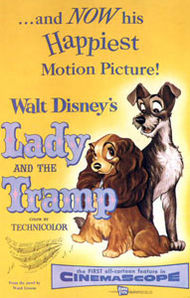
Classic Films in Focus: LADY AND THE TRAMP (1955)


I'll be the first to admit that Lady and the Tramp (1955) is not the most important or the most aesthetically creative of Walt Disney's classic animated films, but it remains my favorite nonetheless. It makes me laugh and cry every time I see it, and by now I have seen it many, many times. What more can you ask for in a classic film? Beautifully drawn, movingly sincere, and oddly enough more human than many of the films featuring human characters, Lady and the Tramp is the Disney movie for dog lovers and hopeless romantics alike.

The story follows the early life and growth of Lady, a pampered Cocker Spaniel in an elegant Victorian home. Lady gets a shock when she discovers that her owners' feelings about her have changed because they are expecting a baby, and she gets an even bigger shock when mean Aunt Sarah is called in to care for the baby while Jim Dear and Darling leave town for a few days. The canine heroine eventually finds herself tangled up with a rakish stray called The Tramp, but his attentions only manage to land her in trouble, first in the dog pound and then in the dog house back at home. Of course, being a Disney film, a happy ending is guaranteed, with the budding romance of Lady and the Tramp evoked most memorably in the spaghetti eating scene.

Barbara Luddy provided the voice of Lady, and it was a perfect part for the Disney regular, who would go on to be the voice of the fairy Merryweather in Sleeping Beauty (1959) and of Kanga in numerous Winnie the Pooh films. In Lady and the Tramp, Luddy's voice has a soft sweetness undercut with just enough rasp to make her feisty as well as feminine. The voice that dominates the film, though, is that of the incomparable Peggy Lee, the chanteuse best known today, perhaps, for the hit song "Fever." Lee lent her voice to four different characters in the film, Darling, Siamese cats Si and Am, and Peg, and she also helped write several of the songs featured in the picture. We hear Lee singing numerous times during the film, but the highlight is certainly her rendition of "He's a Tramp," sung by Peg, the bedraggled Pekingese at the dog pound. Lee had some legal quarrels with Disney over her work on the movie, but, in the long run, it has served her well, introducing her to generations of youngsters who otherwise would never have heard her gorgeous sound.

The danger in which the movie can place its characters is one of the reasons that Lady and the Tramp has such pathos; imagine one of the Disney princesses being thrown into prison and made to watch another prisoner dragged away to his death. The pound scene is one of the film's most moving moments; certainly the animals are humanized to a certain extent, but their misery is very real, as anyone who has walked the kennels of an animal shelter can attest. Lady's fear and confusion are emotions any pet might feel at suddenly being dumped in such an unfamiliar place. Lady spends almost the entire movie being bound, caged, threatened, muzzled, and shot at, and Tramp is literally being carted away to his execution when Jock and Trusty rush to the rescue. Trusty's encounter with the dog pound carriage, and Jock's reaction, can still bring tears to the eyes of viewers who have watched the movie dozens of times and know perfectly well how it ends. (Walt insisted that Trusty had to survive the crash because he remembered the emotional fallout from killing Bambi's mother.)

There's also the romantic angle of the movie to consider. For young girls, Tramp might well be their first encounter with the figure of the charming rogue, that lovable scruffy guy who isn't exactly a knight in shining armor but who manages to win the day and the girl anyway. Disney would revisit this territory to great effect in its treatment of Robin Hood (1973). Tramp is, quite literally, the Han Solo of the canine world; he lacks the pedigree of a prince, but he makes up for it in dash and swagger and the thrill of going out with the bad boy instead of the football team captain. As a dog, Tramp can get away with being a lot more dangerous an object of affection. Parents in 1955 would have had a heart attack had this romance played out between a human debutante and a rogue from the wrong side of the tracks, and not until Aladdin in 1992 would Disney try out this kind of love story with people instead of animals. Even more daring is the fact that Lady spends the night with Tramp out on Lovers Lane; I doubt Disney would try that scene with human characters even in this enlightened age. 

I have never been a big fan of the classic princess films, largely because their heroines are all too insipid and ineffectual for my tastes, but Lady and the Tramp can be more egalitarian because it features dogs instead of people, and that is part of its charm. Lady might be all that her name implies, but she still gets to chase chickens, bark at rats, and exercise her animal spirits. She gets to run around town with a tough, sexy guy, too. It might be a dog's life, but I'll take that over being a narcoleptic princess any day. 

If you love dog movies, see more of Disney’s canine capers in 101 Dalmatians (1961), The Fox and the Hound (1981), and Bolt (2008). Try live action classics like Lassie Come Home (1943), Old Yeller (1957), and Greyfriars Bobby: The True Story of a Dog (1961). Plague Dogs (1982) is a gripping emotional drama from Watership Down author Richard Adams, but don’t show it to children unless you intend to scar them for life.

An earlier version of this review originally appeared on Examiner.com. The author retains all rights to this content.

Monday, September 17, 2012

Classic Films in Focus: BEDKNOBS AND BROOMSTICKS (1971)


Loosely based on the novel by Mary Norton, Bedknobs and Broomsticks (1971) followed up Disney's enormous success with Mary Poppins (1964), and on paper the two pictures must look very similar. Here we have two musical comedies set in England, both involving magic and a handful of cute but troublesome children, both combining live action and animation, and both directed by Robert Stevenson and starring David Tomlinson. Bedknobs and Broomsticks, however, differentiates itself from the earlier film by replacing its spoonful of sugar with equal parts vinegar and poisoned dragon's liver, and the result is a more nuanced, less treacly story that offers a thoughtful treatment of its adult characters while still delivering plenty of entertainment for the kids.

Angela Lansbury stars as independent spinster Eglantine Price, who reluctantly takes in three orphaned children evacuated from London because of the Blitz. Carrie, Paul, and Charlie (Cindy O'Callaghan, Roy Snart, and Ian Weighill) soon discover that Miss Price is secretly training to become a witch in order to fight the Nazis with her magic, but her correspondence course in witchcraft comes to an abrupt end. Determined to finish the lessons, Miss Price and the children travel to London using an enchanted bedknob, where they meet "Professor" Emelius Browne (David Tomlinson), who turns out to be nothing but a former stage magician and con man. Nevertheless, they enlist Browne's assistance and embark on a series of adventures to learn the rest of the spells needed to repel a Nazi invasion.

Lansbury and Tomlinson really shine in their roles. Both of the successful character actors are here solidly middle-aged and an unlikely pair for a romance, but they balance the humor and pathos of their characters beautifully. Their musical numbers are lively and fun, although the melancholy tint of "Portobello Road" most accurately captures the subtler mood of the film as a whole. The London waifs, truly a Dickensian trio, are played with enthusiasm by the child actors, particularly Ian Weighill. A wonderful cast of supporting players helps to round out the film, including Roddy McDowall, Sam Jaffe, and Reginald Owen. These are names that veteran classic movie fans will certainly recognize; McDowall, however, is probably the most familiar, having starred as a child in top-shelf classics like How Green was My Valley (1941) and Lassie Come Home (1943).

The scenes that combine live action and animation serve as the film's show pieces, but the numerous musical numbers also have their charms. In addition to "Portobello Road" we get the aquatic duet, "The Beautiful Briny," and the hypnotically catchy "Substitutiary Locomotion." DVD versions of the film also include an extended cut of "Portobello Road" plus an additional number from Tomlinson called "With a Flair." The longer rendition of "Portobello Road" provides an energetic - if historically incorrect - introduction to the many different countries that formed part of the British Empire at the time of World War II, and it's well worth watching even though it was deemed too long at the time of the film's original release. 

The serious war theme that persists underneath the merriment of music and magic might escape the notice of very young viewers, but adults should pick up on it immediately. The children, already orphans, lose their guardian in London when a Nazi bomb falls on their home. Another bomb, this one unexploded, provides Emelius with a swanky temporary refuge, even though his general cowardice has prevented him from signing up for military duty. Nobody, however, really escapes the war, and the film offers an excellent opportunity to discuss the nature of war and its impact on non-combatants with children who might not have thought about such issues before. Contrast Eglantine's determination to help with Emelius' reluctance, and give some attention to the old men, veterans of World War I, who form the slightly silly but deeply noble Home Guard.

Bedknobs and Broomsticks earned five Oscar nominations and won for Best Visual Effects. If you want to see the breadth of Angela Lansbury's career, catch her early appearances in Gaslight (1944) and The Picture of Dorian Gray (1945) and then move on to The Manchurian Candidate (1962) and more recent films like Nanny McPhee (2005). Kids, of course, will recognize her as the voice of Mrs. Potts in Disney's Beauty and the Beast (1991). You can see a young David Tomlinson in the 1948 mermaid comedy, Miranda, starring his Mary Poppins costar, Glynis Johns; he can also be found in Tom Jones (1963) and The Love Bug (1968). 

An earlier version of this review originally appeared on Examiner.com. The author retains all rights to this content.

Monday, September 10, 2012

Classic Disney Movies Based on Children's Books


Most of the classic Disney princess movies come straight out of fairy tales, but the family film studio has also combed other literary sources for many of its popular productions. Successful children's novels from around the world have served as the inspiration for some of Disney's most beloved animated and live-action pictures, although Walt Disney and his screenwriters were rarely very faithful to the original texts. Whether you're trying to get youngsters interested in classic movies or in reading good books, these Disney adaptations can make for a good starting point. Here are just a few of the classic Disney films that owe their existence to novels written for young readers.

Pinocchio (1940) - Italian writer Carlo Collodi created the original story of the wooden boy, which first appeared in Italy in 1883. Today you can find many versions of Pinocchio's story, and the novel that first imagined this puppet hero remains a classic in its own right. Try the Puffin Classics edition of the book for an inexpensive introduction to Collodi's enduring tale of adventure, transformation, and paternal love. Be forewarned, though, that a lot of bad things happen to Pinocchio, and Collodi's story has a moral tone much like the work of Hans Christian Andersen.

Bambi (1942) - While some of the novels adapted for Disney films remain well-known and widely available, Austrian author Felix Salten's 1923 tale of a young deer is harder to find. Older children who can handle more somber and realistic depictions of animal life might find the story very engaging, but, like the Disney movie, it might be too much for younger children to handle. Aladdin has a 1988 paperback edition still available from online retailers like Amazon.com, although the 1929 sequel, Bambi's Children, appears to be out of print. Try your local library for copies of both books.

101 Dalmatians (1961) - Disney has turned Dodie Smith's original novel into a whole series of movies and spin-off productions, including its own 1996 live-action remake of the animated film. The 1961 picture simplifies the novel by reducing the number of adult dogs involved in the story, but for the most part the Disney film takes its cues from Smith's charming tale. Dog lovers are sure to find the original book a winner, and anglophiles will enjoy its very English character. The Puffin edition provides Smith's full text for a very reasonable price, and the story is a perfect choice for reading aloud, particularly at Christmas, when much of the action takes place. Starlight Barking, a long-forgotten sequel to Smith's novel, is also now back in print.

Mary Poppins (1964) - P.L. Travers' long contention with Walt Disney over the adaptation of her very popular book series has been much discussed in Disney movie circles, but the 1964 live-action musical proved a watershed event in the career of its star, Julie Andrews, and hopefully the film's success has brought readers back to the English writer's original works. The movie won five Oscars and was nominated for thirteen, making it one of Disney's greatest screen accomplishments. Numerous paperback editions of all of the Mary Poppins novels are in print, and kids who enjoy the movie will probably like to find out about all of Mary's other adventures with the Banks family.

The Jungle Book (1967) - Film studios have frequently turned to the works of Rudyard Kipling for their stories, so it should be no surprise that Disney would offer its own adaptation of a Kipling tale. Kipling's original novella (it's really more a collection of stories than a proper novel) appeared in 1894. Although it's a fun movie with some terrific songs, the Disney version strays pretty far from the source material. Kids who enjoy talking animal novels like The Warriors and The Guardians of Ga'Hoole series ought to enjoy this influential literary classic. Disney also produced a live-action version starring Jason Scott Lee in 1994, although it's more interesting for its cast than its fidelity to Kipling. If your kids enjoy the original story, they should also love Neil Gaiman's Newbery-winning revision, The Graveyard Book (2008).

Bedknobs and Broomsticks (1971) - Adapted from the novels by Mary Norton, who also penned The Borrowers books, the 1971 Disney live-action film capitalized on the similar combination of Englishness, magic, and music that had made Mary Poppins such a hit. The movie is very good, especially with Angela Lansbury and David Tomlinson in the lead roles, but it has very little in common with Norton's texts. Look for Norton's original stories as The Magic Bed-knob and Bonfires and Broomsticks; a combined edition of both stories is available from Sandpiper. There's no guarantee, though, that fans of one version will like the other.

Other classic Disney films adapted from books include Song of the South (1946), Alice in Wonderland (1951), Treasure Island (1950), Peter Pan (1953), 20,000 Leagues Under the Sea (1954), and Old Yeller (1957). Almost all of these are based on true classics that you and your children can find at your local library or bookstore, and many of them are also free on ereaders like the Kindle and the Nook.

An earlier version of this article originally appeared on Examiner.com. The author retains all rights to this content.

Saturday, September 8, 2012

Classic Movie Stars for Kids


It’s never too early to start watching old movies with your children; if they’re old enough to appreciate Dumbo and Aladdin, then there are plenty of classic movies they can enjoy, and you can watch with them and actually be entertained by the experience. Introduce the youngsters in your life to classic films with the movies of some of these iconic stars. Modern culture constantly builds on and references the classics, so you'll be entertaining your children at the same time that you make them smarter and savvier consumers of their own generation's culture. You might even learn something yourself!

Charlie Chaplin - The Little Tramp still has a magical effect, and children will be as charmed by his sympathetic character as they are amused by the physical comedy. Be warned, though, that Chaplin's best films mingle scenes of suffering and misery with their comedy, and tender-hearted viewers may well end up in tears over the indignities and disappointments endured by Chaplin's childlike hero. The Gold Rush (1925) had our resident junior cinephile sobbing, but she proclaimed the picture a winner in the end. Try Easy Street (1917) for a short introduction to Chaplin's style, then move on to The Gold Rush (1925), The Circus (1928), City Lights (1931), and Modern Times (1936). Revival versions of the silent films feature some narration and sound effects as well as musical scores composed by Chaplin himself. Boys might appreciate knowing that the films of Charlie Chaplin (as well as Buster Keaton) inspired the signature style of movie kung-fu master Jackie Chan, whose pictures often pay homage to specific scenes from Chaplin's films.

The Marx Brothers - Groucho, Harpo, Chico, and Zeppo are sure to make young viewers laugh with their comic antics on the screen, while adults will appreciate the subtler humor of Groucho's rapid patter. In addition to being zany comedians, the Marx Brothers were accomplished musicians; kids will marvel at Chico's wild piano numbers and Harpo's amazingly sophisticated performances on the harp. The earliest films can be more difficult for younger viewers to follow; start with A Day at the Races (1937), and then move on to Duck Soup (1933) and A Night in Casablanca (1946) for their faster action and musical numbers. Kids will almost certainly find Virginia O'Brien's bizarre lullaby number in The Big Store (1941) hilarious, even though it ranks at the bottom of Marx Brothers films for most fans. Kids who have seen Animaniacs cartoons will find the Marx Brothers well worth watching; Wakko, Yakko, and Dot frequently take their comedy cues directly from the original sibling team. In addition, your kids will finally know what those silly glasses with the attached mustaches are all about.

Judy Garland - Most kids see The Wizard of Oz (1939) at a very early age, but Garland (born Frances Gumm) made other musicals that younger viewers will also enjoy. In fact, The Wizard of Oz might not be the best place to start with kids because it's really a very frightening film, and plenty of adults will tell you that the winged monkeys, the twister, and the Wicked Witch of the West all inspired their childhood nightmares for years. Try Meet Me in St. Louis (1944), The Harvey Girls (1946), The Pirate (1948), and Easter Parade (1948) for family friendly musical performances from Garland and a host of Hollywood stars. The Harvey Girls is a particularly fun picture with catchy songs and wonderful character actresses; it also features Ray Bolger, who played the lovable Scarecrow in The Wizard of Oz. The romantic Easter Parade might appeal most to older girls, while The Pirate offers silly Caribbean comedy that younger boys and girls will probably enjoy equally well, especially because Gene Kelly puts in an energetic performance as Garland's rakish love interest. 
(For more about Judy Garland, see "10 classic movies starring Judy Garland" on Examiner.com.)

Burt Lancaster - For kids who love action and adventure, you can hardly do better than Lancaster, whose early career as a street acrobat and circus performer enabled him to include some amazing feats of agility and physical prowess in his swashbuckler films. Look for films that feature Lancaster's childhood friend and partner Nick Cravat; these are the lighter, more family appropriate pictures from Lancaster's long and varied career. The Flame and the Arrow (1950) and The Crimson Pirate (1952) are guaranteed winners, full of thrilling acrobatics and light-hearted escapades. Cravat plays a mute character in both movies because his thick Bronx accent just didn't work in a period setting, but like Charlie Chaplin he proved to be a master of silent expression. Older kids who enjoy Lancaster's robust style will also like The Professionals (1966), but be careful about exposing younger viewers to Lancaster's grittier work. If your youngsters demand more swashbuckling action, move on to classic films from Errol Flynn and Tyrone Power, both of whom made outstanding examples of the genre.

Don't stop there! Classic movies abound with comedy, action, and music to keep the whole family entertained all summer long. If you really want to embark on an exploration of classic films with your kids, try picking up a copy of Ty Burr's 2007 book, The Best Old Movies for Families: A Guide to Watching Together

An earlier version of this article was originally posted on Examiner.com. The author retains all rights to this content.