Showing posts with label Frieda Inescort. Show all posts

Tuesday, October 13, 2015

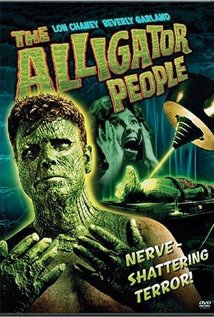
Classic Films in Focus: THE ALLIGATOR PEOPLE (1959)

Like The Fly (1958), The Alligator People (1959) merges science fiction and horror with a premise about dangerous experimentation gone horribly wrong, although in the second movie's case the combination of animal and human traits is intentional rather than tragically coincidental. Thus we get Richard Crane, as the increasingly reptilian victim of medical innovation, wandering the Louisiana swamps with one seriously bad case of gator face, while Beverly Garland chases after him as a dedicated wife who just won't take "no" for an answer. Most horror fans will come to The Alligator People for Lon Chaney, Jr., who plays a drunken villain, or for another example of the drive-in sci-fi chiller that flowered in the 1950s, but additional attractions can be found in the direction of Roy Del Ruth and performances from experienced players like Bruce Bennett, George Macready, and Frieda Inescort, each of whom helps to nudge the picture beyond mere B-movie spectacle.

Garland is the story's protagonist, a newly married nurse named Joyce Webster whose husband, Paul (Richard Crane), vanishes from a train on their honeymoon. Joyce tracks Paul to his family's plantation in the swamps, where she meets his mother, Mrs. Hawthorne (Frieda Inescort), who gives Joyce an icy welcome and tries to force her to leave. Determined to uncover the truth, Joyce stays until her mother-in-law and a local medical researcher, Dr. Sinclair (George Macready), reveal that Paul is suffering the side effects of a radical treatment for injuries he sustained in a plane crash during the war. Joyce joins their efforts to reverse Paul's transformation, but chaos erupts when a loutish plantation worker, Manon (Lon Chaney, Jr.), transfers his violent hatred for alligators to the alligator man.

The Alligator People is by no means a great film, and it often makes choices that are typical of its genre, but it also offers pleasant surprises. The pseudo-science of the central plot is wrapped in a strange psychological setup that presents Joyce, now known as Jane, as a victim of trauma induced amnesia as a result of her experience. Bruce Bennett appears in the frame scenes as one of two sexist doctors who can't stop mentioning how attractive the nurse is even as they use hypnosis to dredge up her horrible past. On the plus side, the frame tale serves a practical purpose in that it lets the audience know right away that this story won't end well for the alligator man or his bride, much as the opening of The Fly sets that story on its unbending course toward tragedy. The sexism also gets a much appreciated rebuke in the stalwart devotion of Joyce, who refuses to give up her search or abandon her husband once she sees his monstrous transformation. She even goes after him at the end, screaming not so much at his freakish appearance as his awful demise. Sure, his alligator head looks utterly fake, and we can even see the seams in his bodysuit, but Beverly Garland's performance as Joyce helps us focus on the drama of the situation rather than its special effects budget.

The success of the movie depends mostly on Garland, who plays Joyce as an active, intelligent woman caught up in overwhelming horror, but several supporting performances are worth noting. Lon Chaney. Jr. makes his presence felt as the belligerent Manon, a far nastier role than the actor's best known characters in other horror films. With his hook hand and his lecherous eye, Manon is a true monster; he provides a telling contrast to Paul, who loses the appearance of humanity but retains its inner qualities, even to the bitter end. Frieda Inescort also turns in a good performance as Paul's distraught mother; her accent wanders a bit, but she navigates the emotional territory of her character with greater assurance, letting her stern rejection of Joyce melt into shared misery over a loved one's terrible fate. Richard Crane gets less screen time as Paul, since he mostly skulks around the bayou in hiding, but his opening scenes set the stage for his later anguish. Hold on to the subtle cues on his handsome face as he talks about his accident with Joyce; that subtlety is lost later, but its emotional impact endures. Bruce Bennett and George Macready are both somewhat underused in their roles, but they give their doctors far more animation than such characters usually have in these pictures.

Some sci-fi B movies of this era are beloved precisely because they are campy and badly done, but The Alligator People takes a more serious tone, and despite its faults it's really a much better picture than it probably has any right to be. Give some of the credit for that to Roy Del Ruth, who also directed Born to Dance (1936), It Happened on Fifth Avenue (1947), and On Moonlight Bay (1951). See more of Beverly Garland in D.O.A. (1950), Not of This Earth (1957), and Twice-Told Tales (1963); she also enjoyed a long and varied television career and was even nominated for an Emmy. Lon Chaney, Jr. is best remembered for The Wolf Man (1941), but he plays supporting roles in many films, including The Black Castle (1952), The Black Sleep (1956), and The Haunted Palace (1963). Catch Frieda Inescort in Pride and Prejudice (1940), You'll Never Get Rich (1941), and The Return of the Vampire (1943). For similar 50s creature features, try I Was a Teenage Werewolf (1957), Attack of the 50 Foot Woman (1958), and Return of the Fly (1959).


Wednesday, June 26, 2013

Classic Films in Focus: THE RETURN OF THE VAMPIRE (1944)

This Columbia production directed by Lew Landers puts Bela Lugosi back into a vampire’s cape and fangs, but The Return of the Vampire (1944) is not exactly a success when it comes to following up on the iconic Dracula (1931). Despite a number of inspired elements, the film fails with its two most visible characters, the vampire and his werewolf lackey, and in a horror film that’s a problem that simply can’t be ignored. Still, Lugosi fans will probably want to see The Return of the Vampire just for more of the actor’s burning eyes and sinister accent, and at just 69 minutes long it’s easy enough to sit through if you can put up with one of classic horror’s worst werewolf attempts.

Lugosi rises from the grave as Armand Tesla, a vampire who is first defeated in 1918 by Dr. Walter Saunders (Gilbert Emery) and Lady Jane Ainsley (Frieda Inescort). Decades later, during the bombing of World War II, Tesla is revived when German shells reveal his coffin. He reclaims his werewolf servant, Andreas (Matt Willis), and sets out for revenge against Lady Jane by threatening her son, John (Roland Varno), and his fiancee, Nicki (Nina Foch).

There are a lot of things to admire in this film, beginning with the progressive casting of a female scientist as the vampire’s opponent. Frieda Inescort is completely credible as the courageous and intelligent Lady Jane, and it’s interesting to note that the story never sexualizes her struggle with Tesla at all. Is she too old or too practical for such ploys? At any rate, the vampiric seduction focuses entirely on the innocent young Nicki, whom Tesla first attacks when she is just a little girl, and lovely Nina Foch has some good scenes wandering about under Tesla’s seductive mind control. The movie also uses the World War II backdrop well, with the vampire hunt complicated by constant bombing and the monsters finding plenty of places to hide in the damaged ruins of the city. The cemetery scenes offer plenty of fog and spooky atmosphere, and the idea of Tesla assuming the identity of a scientist fleeing Nazi Germany is also a timely touch.

The monsters themselves, however, disappoint, especially the lackluster werewolf. We never understand how Tesla transforms Andreas into a werewolf in the first place; who knew that lycanthropy was a result of hypnosis? The makeup for the wolf man lacks originality, and Andreas never manages to be scary, partly because he talks and acts like a regular person in full werewolf form. He’s really just a hairy Renfield, without Dwight Frye’s manic madness. Lugosi doesn’t have much to do as Tesla; he mostly stands in doorways and whispers hypnotically at people from offscreen. In the scenes where he pretends to be Dr. Bruckner, there’s really nothing sinister about him at all, and even rising from his coffin he seems too solid and ordinary to be a terrifying ruler of the undead. Given Lugosi’s performances in other films, the fault here lies with the material he is given, not with the actor himself, but this is certainly not the place to start watching Lugosi’s work.

Lew Landers (as Lewis Friedlander) also directed Bela Lugosi in The Raven (1935); for Lugosi’s more memorable films, see Dracula (1931), White Zombie (1932), and Abbott and Costello Meet Frankenstein (1948). You’ll also find the horror icon in smaller roles in Island of Lost Souls (1932), The Wolf Man (1941), and The Body Snatcher (1945). Frieda Inescort appears in Pride and Prejudice (1940), The Letter (1940), and A Place in the Sun (1951). Nina Foch went on to earn an Oscar nomination for Best Supporting Actress for her role in Executive Suite (1954); see more of her in My Name is Julia Ross (1945) and An American in Paris (1951).