Showing posts with label dogs. Show all posts

Thursday, April 28, 2022

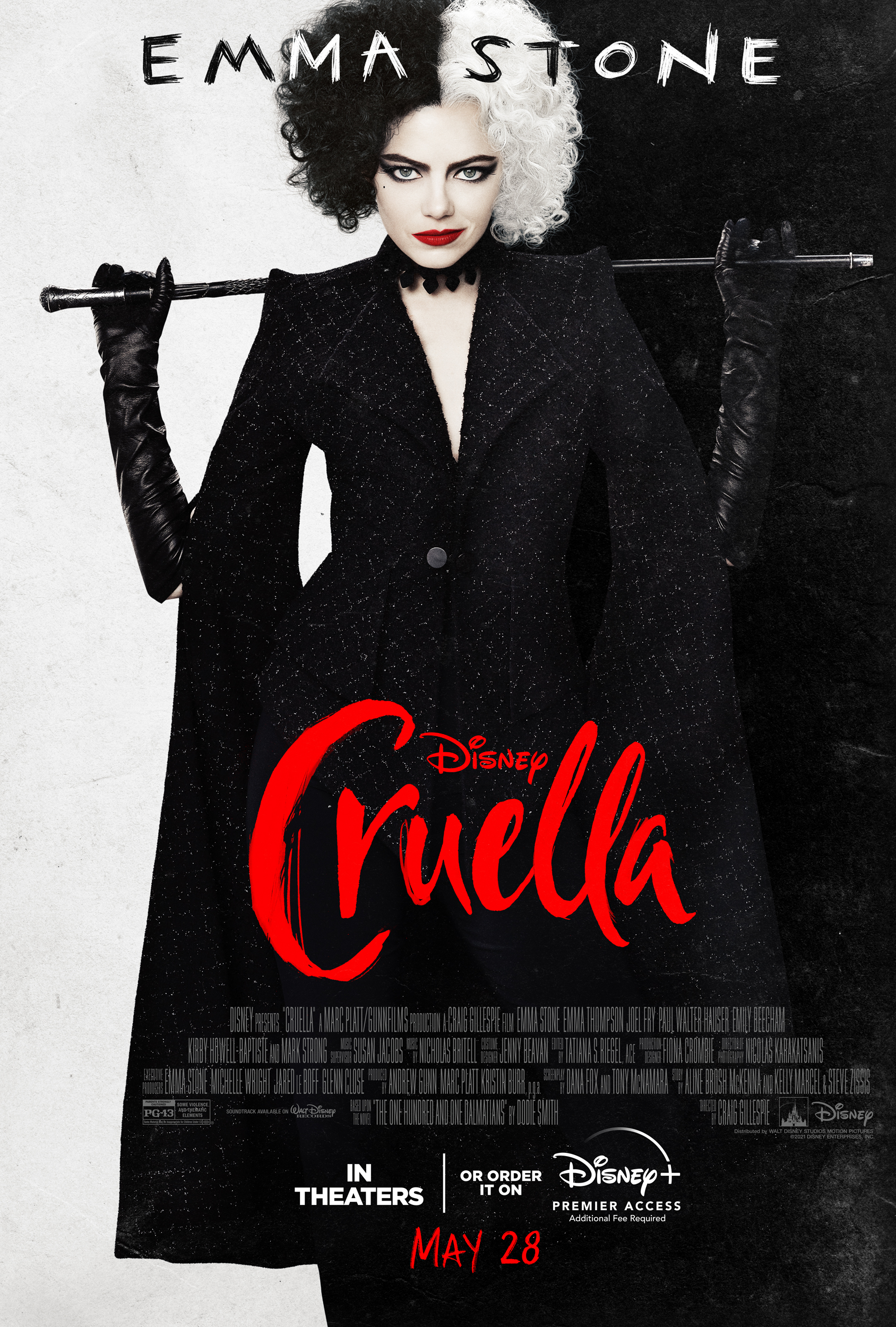
The What-If Alternate Timeline of CRUELLA (2021)

When it first arrived, Disney's 2021 reboot of the various films based on 101 Dalmatians was widely discussed as yet another "prequel" to a well-known Disney property, but in order to appreciate Cruella fully you have to stop thinking about it as a prequel and instead consider it as an alternate timeline narrative similar to the multiverse arcs now at work in the Marvel franchise. This is NOT the story of how the villain of the 1961 animated movie became that character, and it's not the story of the villain from the 1996 live action movie, either. Instead, Emma Stone's version of Cruella is a character with a narrative arc all her own, distinct from those of the other Cruellas but still affected by many of the same elements with alternate versions of the same characters. She's much like the central Loki character played by Tom Hiddleston in the Disney Plus series; she is one of many possible Cruella variants, some of whom are truly villainous and some of whom are dynamic enough to become protagonists in their own right rather than merely antagonists to more conventionally heroic characters. When read this way, Cruella becomes a much more interesting and engaging movie, one that rewrites the iconic villain, sure, but also one that reaches deep into the sources of inspiration that formed the original Disney character.


Fidelity to the 1961 animated classic is already an odd demand, not only because live action versions of that story were already made in the late 90s but because the original Disney movie is itself unfaithful to its source material in several significant ways. Dodie Smith's beloved 1956 children's novel features many characters and scenes that aren't in the Disney film. A third adult Dalmatian (the one actually named Perdita) is removed completely, with a dog originally named Missus assuming her name and erasing her from the story. The novel's Roger is wealthy because he is a "financial wizard" and not a struggling musician, so the family can afford all of their Dalmatians even when they end up with 101 of them (note that the 101st Dalmatian of the novel also isn't in the movie because he's the liver spotted love interest of the original Perdita). The Cruella of the book is more explicitly demonic and even more vicious than the movie version; she is also married to a submissive furrier who enables her obsession with fur coats. The changes don't make the Disney adaptation a bad movie, but they do make it a significantly different story from the novel. The live action versions get farther afield still, making Roger an American video game creator, Anita a fashion designer, and Cruella a fashion house owner and Anita's employer. In fact, the versions are so different (and set in different eras to boot) that the 2021 movie cannot possibly function as a true prequel to any of them.

Tallulah!

Instead, Cruella is its own story, a reinvention of the character that combines her most iconic traits with bits and pieces of the previous versions in order to make her a dynamic protagonist rather than a static villain. The movie does not attempt to make us like or forgive the other Cruellas; we like this new Cruella partly because she isn't them. Our glimpse of her childhood recalls the schoolgirl connection with Anita from the novel, her mannerisms are taken from the 1961 Disney film, and her fashion career is borrowed from the 1996 movie, but she is not simply a younger version of any of these characters. Disney opts to do something different by mining the tradition of the anti-heroine as filtered through one of the most important inspirations for the 1961 Cruella, the legendary actress and all around hellraiser Tallulah Bankhead. The film even signals the affiliation with a clip of Tallulah demonstrating her distinctive, throaty laugh in Alfred Hitchcock's 1944 thriller, Lifeboat. We see it play on a television set in a room with Estella/Cruella early in the story. Bankhead, known for her genius, self-destructive behavior, terrible driving, and theatrical personality, was definitely no saint, but this new version of Cruella has her charisma and charm as well as her less likeable qualities. It's refreshing to see a complicated, difficult, too-much female character be the heroine of her own life without having to be either a traditionally good person or a completely amoral anti-heroine of the Becky Sharp variety.

Because this Cruella is not the same as the previous versions, she can make different choices and develop different values. She loves fashion but isn't specifically obsessed with fur. She has a found family that she mistreats at times but ultimately loves, which includes several dogs. She is even the person who gives Pongo and Perdita to Roger and Anita, which she certainly wouldn't do if she wanted to make Dalmatian fur coats. Near the end of the movie, Cruella says about the Baroness: "The good thing about evil people is that you can always trust them to do something, well, evil." Cruella, despite her name, is not that kind of person, because her Estella side makes her capable of doing good. Currently, a sequel to the movie is in the works, and most fans and critics seem to expect it to launch us into the more familiar dog-napping, coat-making territory of the original story, but I really hope it doesn't go in that direction, because this Cruella deserves better. It's certainly possible that she might become a newer version of the Baroness, the murderous mother whom she deposes in the film, and therefore ruthless enough to become a full-blown villain, but it would be much more satisfying to see her continue to make bold new choices for herself, to continue to be the future she embodies in Cruella and not the past that she sees as the Baroness. To rope this Cruella back into the framework of the original story would be a grave disservice to her and to viewers who fell for her eccentric, outlandish personality.

I've watched Cruella a couple of times now, and while I have concerns about Disney's persistent efforts to strip mine its own properties, I think this movie is one of the best live action treatments of a classic Disney story and far more interesting and fun than the previous attempts to cash in on the Dalmatians' popularity, largely because it isn't about the dogs. It's fun, it's visually engaging, it features terrific performances from Stone and Emma Thompson, and it offers us a Disney "heroine" who is very different from the usual crowd of princesses and whose transgressive modernity is part of her appeal. I don't care that it isn't actually a prequel to 101 Dalmatians; that's why it works. This Cruella might well be brilliant and bad and a little bit mad, but she's more 70s counterculture rock goddess than maniacal puppy murderer, and I'd like to see any additional films about her continue to give her the freedom to be her own version of herself.



Tuesday, September 25, 2012

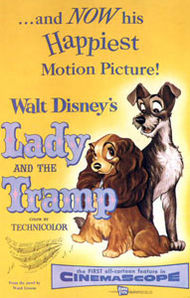
Classic Films in Focus: LADY AND THE TRAMP (1955)


I'll be the first to admit that Lady and the Tramp (1955) is not the most important or the most aesthetically creative of Walt Disney's classic animated films, but it remains my favorite nonetheless. It makes me laugh and cry every time I see it, and by now I have seen it many, many times. What more can you ask for in a classic film? Beautifully drawn, movingly sincere, and oddly enough more human than many of the films featuring human characters, Lady and the Tramp is the Disney movie for dog lovers and hopeless romantics alike.

The story follows the early life and growth of Lady, a pampered Cocker Spaniel in an elegant Victorian home. Lady gets a shock when she discovers that her owners' feelings about her have changed because they are expecting a baby, and she gets an even bigger shock when mean Aunt Sarah is called in to care for the baby while Jim Dear and Darling leave town for a few days. The canine heroine eventually finds herself tangled up with a rakish stray called The Tramp, but his attentions only manage to land her in trouble, first in the dog pound and then in the dog house back at home. Of course, being a Disney film, a happy ending is guaranteed, with the budding romance of Lady and the Tramp evoked most memorably in the spaghetti eating scene.

Barbara Luddy provided the voice of Lady, and it was a perfect part for the Disney regular, who would go on to be the voice of the fairy Merryweather in Sleeping Beauty (1959) and of Kanga in numerous Winnie the Pooh films. In Lady and the Tramp, Luddy's voice has a soft sweetness undercut with just enough rasp to make her feisty as well as feminine. The voice that dominates the film, though, is that of the incomparable Peggy Lee, the chanteuse best known today, perhaps, for the hit song "Fever." Lee lent her voice to four different characters in the film, Darling, Siamese cats Si and Am, and Peg, and she also helped write several of the songs featured in the picture. We hear Lee singing numerous times during the film, but the highlight is certainly her rendition of "He's a Tramp," sung by Peg, the bedraggled Pekingese at the dog pound. Lee had some legal quarrels with Disney over her work on the movie, but, in the long run, it has served her well, introducing her to generations of youngsters who otherwise would never have heard her gorgeous sound.

The danger in which the movie can place its characters is one of the reasons that Lady and the Tramp has such pathos; imagine one of the Disney princesses being thrown into prison and made to watch another prisoner dragged away to his death. The pound scene is one of the film's most moving moments; certainly the animals are humanized to a certain extent, but their misery is very real, as anyone who has walked the kennels of an animal shelter can attest. Lady's fear and confusion are emotions any pet might feel at suddenly being dumped in such an unfamiliar place. Lady spends almost the entire movie being bound, caged, threatened, muzzled, and shot at, and Tramp is literally being carted away to his execution when Jock and Trusty rush to the rescue. Trusty's encounter with the dog pound carriage, and Jock's reaction, can still bring tears to the eyes of viewers who have watched the movie dozens of times and know perfectly well how it ends. (Walt insisted that Trusty had to survive the crash because he remembered the emotional fallout from killing Bambi's mother.)

There's also the romantic angle of the movie to consider. For young girls, Tramp might well be their first encounter with the figure of the charming rogue, that lovable scruffy guy who isn't exactly a knight in shining armor but who manages to win the day and the girl anyway. Disney would revisit this territory to great effect in its treatment of Robin Hood (1973). Tramp is, quite literally, the Han Solo of the canine world; he lacks the pedigree of a prince, but he makes up for it in dash and swagger and the thrill of going out with the bad boy instead of the football team captain. As a dog, Tramp can get away with being a lot more dangerous an object of affection. Parents in 1955 would have had a heart attack had this romance played out between a human debutante and a rogue from the wrong side of the tracks, and not until Aladdin in 1992 would Disney try out this kind of love story with people instead of animals. Even more daring is the fact that Lady spends the night with Tramp out on Lovers Lane; I doubt Disney would try that scene with human characters even in this enlightened age. 

I have never been a big fan of the classic princess films, largely because their heroines are all too insipid and ineffectual for my tastes, but Lady and the Tramp can be more egalitarian because it features dogs instead of people, and that is part of its charm. Lady might be all that her name implies, but she still gets to chase chickens, bark at rats, and exercise her animal spirits. She gets to run around town with a tough, sexy guy, too. It might be a dog's life, but I'll take that over being a narcoleptic princess any day. 

If you love dog movies, see more of Disney’s canine capers in 101 Dalmatians (1961), The Fox and the Hound (1981), and Bolt (2008). Try live action classics like Lassie Come Home (1943), Old Yeller (1957), and Greyfriars Bobby: The True Story of a Dog (1961). Plague Dogs (1982) is a gripping emotional drama from Watership Down author Richard Adams, but don’t show it to children unless you intend to scar them for life.

An earlier version of this review originally appeared on Examiner.com. The author retains all rights to this content.