Showing posts with label Arizona. Show all posts

Monday, April 22, 2013

Classic Films in Focus: THE BARON OF ARIZONA (1950)

We associate Vincent Price with certain kinds of roles, although generally speaking he played villains in both his early dramas and his later horror films, sliding from oily Sir Walter Raleigh in The Private Lives of Elizabeth and Essex (1939) to the deranged anti-heroes of Corman's cult classics in the 1960s. Price's character in Samuel Fuller's The Baron of Arizona (1950) lies somewhere in between those ends; he's a morally ambivalent but imaginatively ambitious protagonist whom we grow rather fond of in spite of his dirty deeds. At once a Western, a heist adventure, and a romance, The Baron of Arizona succeeds on all fronts because Vincent Price so perfectly captures both the good and the evil that exist within the main character, whose grandiose scheme involves swindling the entire state of Arizona right out from under the United States government.

Price plays a fictionalized version of real-life con man James Addison Reavis, who really did try to claim Arizona through a series of elaborate forgeries and deceptions. A rogue and a swindler by nature, Reavis takes in and raises a young girl (Karen Kester) whom he purports to be the heir to the Spanish land grant; when she grows up (to be played as an adult by Ellen Drew), Reavis marries her and begins styling himself as the Baron of Arizona. Aiding him, to some degree unwittingly, are the girl's foster father, Pepito (Vladimir Sokoloff), and governess, Loma (Beulah Bondi). All the while, the government struggles desperately to poke holes in Reavis' claim, with forgery expert John Griff (Reed Hadley) at the forefront of the effort.

The movie streamlines and romanticizes the historical account, but the omissions strengthen the narrative and encourage our sympathy with Reavis, even when we know he's up to no good. Price walks a very fine line in performing the character as a theatrical scoundrel who still possesses enough credibility for us to hope for his eventual redemption. We have to be able to understand why Sofia falls in love with him and why other women find him so irresistible, and we also have to believe that the steadfast love of a woman like Sofia might actually inspire an alteration in Reavis' deeply devious heart. Ellen Drew does a particularly good job embodying this transformative devotion; her elegant features and soulful eyes work on the audience much more quickly than they do on Reavis himself, and we want Reavis to change because we want him to deserve her misplaced faith and affection.

As a Western, The Baron of Arizona depicts a fascinating chapter in the history of the West, and James Wong Howe's cinematography offers plenty of dust and frontier scenery to help things along. The monastery scenes in Spain are also a highlight, with Reavis biding his time as a novice monk for several years just to get a chance to alter one critical manuscript. There's a lot of adventure and derring-do involved in Reavis' magnificent scheme, including escapades with gypsies and encounters with angry lynch mobs, and Price carries it all in grand style. It's hard to imagine another actor capable of playing such a role, except perhaps for Tyrone Power, but it's a part tailor-made for the talents of Price.

For other more ambiguous Price roles, try Laura (1944), Dragonwyck (1946) or the very strange Confessions of an Opium Eater (1962), or see him in an unusually heroic mode in His Kind of Woman (1951). Look for Ellen Drew in Preston Sturges' Christmas in July (1940) and Val Lewton's Isle of the Dead (1945). Character actress Beulah Bondi turns up in many classic films, but you're most likely to remember her as Ma Bailey in It's a Wonderful Life (1946). Writer and director Samuel Fuller also made Pickup on South Street (1953), The Naked Kiss (1964), and The Big Red One (1980).

Tuesday, April 16, 2013

Reel West: Old Tucson Studios

Take the stage to High Chaparral
If you love classic Westerns, Old Tucson Studios might just be your personal piece of heaven. The working movie lot has been hanging around on the outskirts of Tucson, Arizona, since 1939, when it was built for the filming of, naturally, Arizona, which starred Jean Arthur and William Holden. Since then it has been the home of some 200 productions for film and television, from Rio Bravo (1959) and Three Amigos! (1986) to The High Chaparral and  Little House on the Prairie. These days it also doubles as a Western movie buff theme park, with shows and attractions designed to tickle a John Wayne fan's fancy until the cows come home. In exchange for the cost of admission and few hours of your time, you can stride the streets where the Duke's boots kicked up dust and dozens of other silver screen cowboys have fought their showdowns and drunk their beer.

I admit I was nervous about visiting the place myself. I was afraid it would be tacky and crammed with cheap souvenirs at marked up prices. As it turns out, Old Tucson's biggest oversight might actually be a lack of shops. The place is decidedly uninterested in selling you anything beyond an entertaining day of shows and maybe some lunch and a cold sarsaparilla. In many ways, it's the exact opposite of Tombstone, which is all shops and no substance, and I suspect a lot of people who head to Tombstone would be better off checking out Old Tucson instead.

You can easily spend the entire day at Old Tucson, so don't get any fancy ideas about cramming in
I'm in the show!
the equally intense Arizona-Sonora Desert Museum and the scenic Saguaro National Park while you're on that side of town. The studio has shows that run all day long, and you more or less have to be there from opening to closing to catch them all. The schedule runs the gamut from funny skits to shootouts to musical revues, so there's something to suit every Western buff's preference.

Audience participation is a given at several shows. I was delighted to be picked for the stunt show (I admit to chatting up Ty, the actor, beforehand about being a classic movie blogger and author - did I stack the deck in my favor? You bet!). It's worth noting that you'll see the same group of actors throughout the day in different shows; by the end of a visit you might feel awfully fond of them, and you'll certainly appreciate their energy and enthusiasm. They have a dirty, sweaty, and dangerous job, but they really seem to love it.

Loop Rawlins
One of the highlights of the day is definitely a performance by Loop Rawlins, a Cirque du Soleil veteran and rope trick master. He also does some nifty tricks with guns and whips, but the lasso is his best instrument. If matinee Westerns were still in vogue today, Loop would be a huge star. He has the looks, the talent, and the charm of the old cowboy kings. All he really needs is a smart horse!

You can take a guided tour of the studios and learn all about the history of the location and the movies that have been made there. There's also a sentimental John Wayne tribute film and a really fun musical review of songs from classic Westerns. If you can sing the words to "My Rifle, My Pony and Me" you'll love it. You can also catch a stagecoach ride out to the High Chaparral set and learn why you really wouldn't want to ride the stage to Lordsburg, much less to San Francisco.

I didn't expect much from the food at the studio, but I was pleasantly surprised by a tasty sandwich at the pharmacy deli counter, and the prickly pear lemonade from the candy shop really hit the spot. The biggest restaurant on site is Big Jake's BBQ, but there's also Pony Express Pizza and an ice cream stand that sells raspados in addition to the usual cones.

First-time visitors might be wondering if the price of admission is worth it. If you really love classic
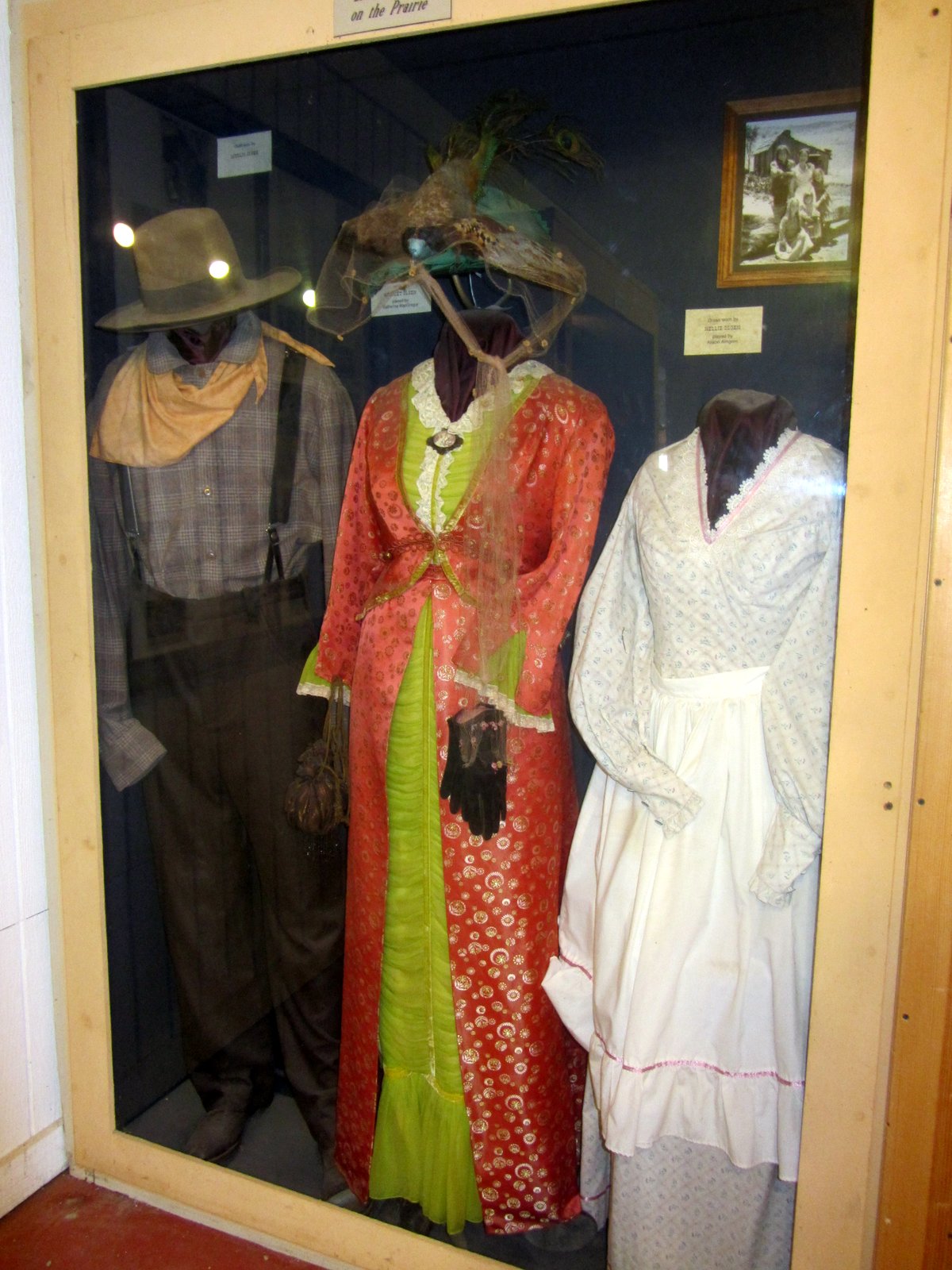
Little House on the Prairie costumes
Westerns, it's one of the best attractions you can visit anywhere, hands down. If you have kids who play cowboy all day, they'll love it, too. If, however, you love to shop and can't tell Tex Ritter from Randolph Scott, this probably ain't your kind of establishment, and you best mosey on down the road. Need to gauge your family's interest in a full day of such fare? Test the waters with a trip to Trail Dust Town in Tucson, and be sure to stay for the evening shootout show. If that leaves your group whooping and hollering with delight, then they're ready for Old Tucson.

Here's a partial list of films and television shows shot at Old Tucson Studios:

Little House on the Prairie
Tombstone (1993)
Bonanza
Gunsmoke
How the West was Won
Wild Wild West (1999)
The Quick and the Dead (1995)
The Outlaw Josey Wales (1976)
Three Amigos! (1986)
Rio Bravo (1959)
McLintock! (1963)
Joe Kidd (1972)
The High Chaparral
Young Guns II (1990)
El Dorado (1966)
Rio Lobo (1970)
3:10 to Yuma (1957)
Winchester '73 (1950)
Broken Arrow (1950)
Gunfight at the OK Corral (1957)
Hombre (1967)
The Villain (1979)
Last Train from Gun Hill (1957)