Otto Preminger directs this top-notch noir tale of misplaced love and murder, which stars Dana Andrews as a small-time grifter who falls for luscious Linda Darnell but woos wealthy Alice Faye. It's a love triangle with a couple of kinks thrown into it, and the title, Fallen Angel, might equally apply to Andrews or Darnell, both of whom exhibit the cynical worldview born of hard knocks and bitter disappointment. In addition to the trio of excellent leads, the picture boasts an impressive supporting cast that includes Anne Revere, Percy Kilbride, Bruce Cabot, Charles Bickford, and the always entertaining John Carradine as a traveling spiritualist who pretends to talk to the dead.
Eric Stanton (Dana Andrews) blows into town on his last dollar and promptly gets an eyeful of Linda Darnell's sultry Stella, sometime waitress at the diner run by Pop (Percy Kilbride). Like every other mook in the joint, Eric goes for the dark-haired beauty but can't convince her that he's not just another two-bit loser. In order to get enough money to marry Stella, Eric courts the maidenly June Mills (Alice Faye), much to the consternation of her elder sister, Clara (Anne Revere). Eric intends to marry and divorce June, but when Stella turns up dead on his wedding night, Eric finds himself on the list of suspects being pursued by Mark Judd (Charles Bickford), another of Stella's admirers who happens to be a cop.
Harry Kleiner's screenplay is adapted from the novel by Marty Holland, who also wrote the story of The File on Thelma Jordan (1950), and it shades Stella in particular with more nuance than we often see in a femme fatale. She never encourages Eric or any of the other men who hang around her like flies, and she makes it clear that she wants a wedding ring and a home before she'll take any guy into her arms. She steals a little cash from Pop's till, but she's no monster; Eric is the one who hatches the plan to seduce and betray June, not Stella. Nonetheless, the film sets Stella up as the fallen angel, the beautiful but bad girl, especially in the way it introduces her. We're encouraged to think of her that way even as the picture slowly reveals how little Stella deserves her fate and how much more fallen Eric is than Stella has ever been.
Andrews is in fine noir form as Eric; it's the kind of role that lets him use both his charm and his edge of jaded ruthlessness. He talks his way into Professor Madley's spiritualist racket and then into June's good graces, but he has a lot more trouble sweet-talking the justly skeptical Stella. Perhaps that's why he likes her so much in the first place. The audience is left to wonder if June's virtuous love is enough to reform Eric, especially when we know he only marries her for the cash. Alice Faye, of course, is perfect as June; if Eric and Stella are both fallen angels, June is still wearing her halo in Heaven. Faye is one of the few actresses who can make such a good girl role appealing, and late in the film she gets a chance to reveal the sturdy spirit that Junes possesses in addition to her virtue. June might have married a man she barely knows, but when she takes a vow she means it, and that comes as quite a revelation to Eric.
Take time to savor the performances by Carradine, Revere, and Kilbride in their supporting roles; Kilbride has a particularly fine moment right at the end, when the depth of Pop's devotion finally transcends the pathetic. For more Otto Preminger noir with Dana Andrews, see Laura (1944) and Where the Sidewalk Ends (1950). Preminger also directs Linda Darnell in Forever Amber (1947) and The 13th Letter (1951). Alice Faye is remembered more for films like In Old Chicago (1938), That Night in Rio (1941), and the colorful wartime musical, The Gang's All Here (1943). You'll find Charles Bickford and Anne Revere in The Song of Bernadette (1943), while Percy Kilbride is best known today for his starring role as Pa Kettle in the Ma and Pa Kettle films, starting with The Egg and I (1947).
Showing posts with label Dana Andrews. Show all posts
Monday, February 19, 2018
Friday, July 17, 2015
Classic Films in Focus: THE BEST YEARS OF OUR LIVES (1946)
The Best Years of Our Lives (1946) is a different kind of war story, but its focus on the domestic aftermath of World War II is still powerful today, nearly seventy years after its original release. It certainly spoke to the cultural moment in 1946, winning seven Academy Awards out of eight nominations, including Best Picture, Best Director, Best Actor, and Best Supporting Actor. Moving, thoughtful, and packed with great performances from first-rate stars, The Best Years of Our Lives is one of those classic pictures that everyone should see, especially those interested in the toll of the war on the men who fought it and the families who were left behind.
Fredric March plays former banker Al Stephenson, who returns from years of service in World War II and struggles to resume his civilian life. His wife, Milly (Myrna Loy), has waited faithfully, but his children have grown up in his absence, and his perspective has been permanently altered by his wartime experiences. His companions on the return trip face problems of their own. Fred (Dana Andrews) suffers from traumatic memories of his time as a combat pilot and finds himself unable to land a decent job, while his materialistic wife (Virginia Mayo) resents their poverty and his intrusion on her independence. Homer (Harold Russell), a young sailor, struggles the most; having lost both of his hands in the war, he angrily rejects his family's pity and questions whether his devoted high school sweetheart (Cathy O'Donnell) really wants him for a husband.
Although March won Best Actor for his performance, the strength of the picture really relies on the combined efforts of the ensemble cast, with each character adding a distinct personality and perspective. Director William Wyler weaves the stories together so that each narrative thread gets the attention it merits, and each actor gets a chance to shine. Dana Andrews offers a compelling look at the loss of importance a returning war hero might experience as well as the effects of PTSD, and Fred's crumbling marriage provides a stark contrast to the gentler romantic experiences of Al and Homer. Not every girl waited for her guy to come home, and not every couple could pick up where they left off when the war was over. The film, however, wants to reassure audiences still piecing their own lives back together, so Fred discovers a better love interest in Al's daughter, Peggy (Teresa Wright), who reacts very differently than Fred's wife to his financial problems and his frequent nightmares. Harold Russell, a non-actor who had lost his hands in a military training accident, gives viewers a moving and utterly realistic picture of the wounded veteran's post-war life as Homer, who uses metal hooks strapped to his stumps in place of his lost limbs. Russell might not have the Hollywood looks of his costars, but that only strengthens our sense of his role as an everyman, a regular, all-American guy who might be anyone's brother, son, or sweetheart. The Academy gave Russell an Honorary Oscar for inspiring veterans, never guessing that he might actually win Best Supporting Actor for his role, so Russell ultimately made Oscar history by winning two awards for a single performance.
Unlike war movies that rallied American commitment to the effort during the war or glorified its battles afterward, The Best Years of Our Lives never shows a single combat scene, even in Fred's flashback moments in the cockpit of a decommissioned plane. It does not aim to depict the adrenaline fueled, masculine world of the war itself, but rather the workaday world of jobs and wives and quiet nights at home that follow when the battlefields are left behind, when men must figure out how to be ordinary citizens again and women must learn to love them in spite of how they have changed. Al drinks too much, Fred wakes up screaming, and Homer pushes away the people who care about him most. Each has been irrevocably altered by his experiences, but each works hard to find a way forward. Milly and Homer's girl, Wilma, face their own problems in trying to build futures with these new versions of once familiar men, while Fred's wife, Marie, is unwilling or unable to accept the struggling, humbled civilian after the conveniently absent hero. She's the only person who seems genuinely sorry that the war is over. For her, perhaps, the best years of her life were those when Fred's paycheck arrived without Fred to tell her how to spend it, but for the others, we hope, the years alluded to in the film's title lie ahead. In 1946 it was still an open question, but in the film that hope glimmers like a fervent, quiet prayer. Hadn't these men and women, who had sacrificed so much, earned it with their blood and tears?
Take the time to appreciate Hoagy Carmichael and Gladys George in small supporting roles as the pianist, Butch, and Fred's stepmother, Hortense. William Wyler won two additional Best Director Oscars for Mrs. Miniver (1942) and Ben-Hur (1959), with a total of twelve Best Director nominations over the course of his impressive career. For more of Fredric March, see Dr. Jekyll and Mr. Hyde (1931), The Barretts of Wimpole Street (1934), and I Married a Witch (1942). Myrna Loy is best remembered as William Powell's witty costar in The Thin Man movies, but check out Pre-Code roles in Thirteen Women (1932) and The Mask of Fu Manchu (1932) for a contrast to her later, more maternal persona. Don't miss Dana Andrews in The Ox-Bow Incident (1943), Laura (1944), and Beyond a Reasonable Doubt (1956). If you like Virginia Mayo's bad girl act, be sure to catch her in White Heat (1949).
Fredric March plays former banker Al Stephenson, who returns from years of service in World War II and struggles to resume his civilian life. His wife, Milly (Myrna Loy), has waited faithfully, but his children have grown up in his absence, and his perspective has been permanently altered by his wartime experiences. His companions on the return trip face problems of their own. Fred (Dana Andrews) suffers from traumatic memories of his time as a combat pilot and finds himself unable to land a decent job, while his materialistic wife (Virginia Mayo) resents their poverty and his intrusion on her independence. Homer (Harold Russell), a young sailor, struggles the most; having lost both of his hands in the war, he angrily rejects his family's pity and questions whether his devoted high school sweetheart (Cathy O'Donnell) really wants him for a husband.
Although March won Best Actor for his performance, the strength of the picture really relies on the combined efforts of the ensemble cast, with each character adding a distinct personality and perspective. Director William Wyler weaves the stories together so that each narrative thread gets the attention it merits, and each actor gets a chance to shine. Dana Andrews offers a compelling look at the loss of importance a returning war hero might experience as well as the effects of PTSD, and Fred's crumbling marriage provides a stark contrast to the gentler romantic experiences of Al and Homer. Not every girl waited for her guy to come home, and not every couple could pick up where they left off when the war was over. The film, however, wants to reassure audiences still piecing their own lives back together, so Fred discovers a better love interest in Al's daughter, Peggy (Teresa Wright), who reacts very differently than Fred's wife to his financial problems and his frequent nightmares. Harold Russell, a non-actor who had lost his hands in a military training accident, gives viewers a moving and utterly realistic picture of the wounded veteran's post-war life as Homer, who uses metal hooks strapped to his stumps in place of his lost limbs. Russell might not have the Hollywood looks of his costars, but that only strengthens our sense of his role as an everyman, a regular, all-American guy who might be anyone's brother, son, or sweetheart. The Academy gave Russell an Honorary Oscar for inspiring veterans, never guessing that he might actually win Best Supporting Actor for his role, so Russell ultimately made Oscar history by winning two awards for a single performance.
Unlike war movies that rallied American commitment to the effort during the war or glorified its battles afterward, The Best Years of Our Lives never shows a single combat scene, even in Fred's flashback moments in the cockpit of a decommissioned plane. It does not aim to depict the adrenaline fueled, masculine world of the war itself, but rather the workaday world of jobs and wives and quiet nights at home that follow when the battlefields are left behind, when men must figure out how to be ordinary citizens again and women must learn to love them in spite of how they have changed. Al drinks too much, Fred wakes up screaming, and Homer pushes away the people who care about him most. Each has been irrevocably altered by his experiences, but each works hard to find a way forward. Milly and Homer's girl, Wilma, face their own problems in trying to build futures with these new versions of once familiar men, while Fred's wife, Marie, is unwilling or unable to accept the struggling, humbled civilian after the conveniently absent hero. She's the only person who seems genuinely sorry that the war is over. For her, perhaps, the best years of her life were those when Fred's paycheck arrived without Fred to tell her how to spend it, but for the others, we hope, the years alluded to in the film's title lie ahead. In 1946 it was still an open question, but in the film that hope glimmers like a fervent, quiet prayer. Hadn't these men and women, who had sacrificed so much, earned it with their blood and tears?
Take the time to appreciate Hoagy Carmichael and Gladys George in small supporting roles as the pianist, Butch, and Fred's stepmother, Hortense. William Wyler won two additional Best Director Oscars for Mrs. Miniver (1942) and Ben-Hur (1959), with a total of twelve Best Director nominations over the course of his impressive career. For more of Fredric March, see Dr. Jekyll and Mr. Hyde (1931), The Barretts of Wimpole Street (1934), and I Married a Witch (1942). Myrna Loy is best remembered as William Powell's witty costar in The Thin Man movies, but check out Pre-Code roles in Thirteen Women (1932) and The Mask of Fu Manchu (1932) for a contrast to her later, more maternal persona. Don't miss Dana Andrews in The Ox-Bow Incident (1943), Laura (1944), and Beyond a Reasonable Doubt (1956). If you like Virginia Mayo's bad girl act, be sure to catch her in White Heat (1949).
Thursday, January 22, 2015
Classic Films in Focus: BALL OF FIRE (1941)
In Howard Hawks' Ball of Fire (1941), Barbara Stanwyck turns her tough dame persona to comedic purpose, a feat she also performed that year in the Preston Sturges comedy, The Lady Eve (1941). Both are terrific examples of the screwball genre, but while the Sturges picture relies on biblical allusions, the Hawks film ventures into the world of fairy tales. The ball of fire that Stanwyck plays in this movie is a street savvy Snow White, a little drifted perhaps, but still sweet enough to charm seven reclusive professors and one very inexperienced Prince Charming, represented to great effect by Gary Cooper. With Hawks' lively direction, a brilliant screenplay by Billy Wilder and Charles Brackett, and winning performances from Stanwyck and Cooper, Ball of Fire has plenty to offer already, but it becomes a veritable treasure trove of delights thanks to a supporting cast that includes Dana Andrews, Dan Duryea, Henry Travers, Oskar Homolka, S.Z. Sakall, and an utterly unrecognizable Richard Haydn.
Stanwyck plays nightclub singer and mobster moll Sugarpuss O'Shea, who has to hide out from the district attorney's office when her boyfriend, Joe Lilac (Dana Andrews), is pinned for a murder rap. A perfect spot conveniently appears at the home of a group of professors working on an encyclopedia. The grammarian, Professor Potts (Gary Cooper), needs a consultant about modern slang, and Sugarpuss certainly knows her way around a colorful phrase. Sugarpuss takes up residence in the house, much to the delight of the seven elderly professors and the bewilderment of the much younger Potts, and soon enough the bashful scholar falls for the duplicitous dame. Joe Lilac, however, has his own plans for Sugarpuss, and the mild-mannered academics must take on a crew of gun-toting gangsters to help true love conquer all.
Cooper is surprisingly hilarious as the straight arrow Potts, but Stanwyck gets all of the best lines, thanks to a plot that hinges on her character's knowledge of slang. Always a great talker, the actress gets dialogue that really zings in this picture, although the modern viewer might sometimes be as befuddled as Professor Potts about what it all means. Slinging slang from "corny" to "yum yum," Stanwyck's character teaches Potts a previously unknown physical vocabulary, as well, making the kissing scenes especially fun. In gowns designed by Edith Head, Stanwyck is truly radiant, particularly in a spangled number that catches the light just so to throw sparkles onto the screen and stardust into Cooper's eyes. Cooper makes a perfect match for the actress; his Potts is a dynamic character, stuffy and focused at first, then suspicious and confused, and at last a head over heels romantic driven by love. He ends the picture a yodeling, boxing man on fire. It turns out that kisses can wake up Prince Charming just as well as they work on Snow White.
The supporting players are all winners, from Dana Andrews as the scheming Joe Lilac to Allen Jenkins as the garbage man, but the actors playing the professors are some of classic film's most beloved characters. They give the animated dwarfs of Snow White (1937) plenty of competition for cartoonish appeal with their quirky passions and odd bodies. Familiar faces abound. S.Z. Sakall and Leonid Kinskey are both remembered by most viewers for their roles in Casablanca (1942), while Henry Travers is best known as the bumbling angel of It's a Wonderful Life (1946). Oskar Homolka, who had played the heavy in Hitchcock's Sabotage (1936), proves a scene-stealer among the group, especially when his character attempts to drive. The most memorable of the bunch, however, turns out to be Richard Haydn, heavily made up as Professor Oddly and employing the same bizarre voice he would later use as the Caterpillar in Alice in Wonderland (1951). A widower and a botanist, Oddly trades laughs for sentimental tears in his best scene, in which he recalls his love for his long dead wife. It's almost impossible to recognize the actor known today as Max in The Sound of Music (1965), but Haydn it is, making his second big screen appearance at the age of 36, four years younger than Gary Cooper.
Take a moment to appreciate Kathleen Howard and Mary Field as the movie's other women, and be sure to notice Elisha Cook, Jr. in a bit role early on. Ball of Fire earned four Oscar nominations, including a nod for Stanwyck as Best Actress, but went home empty-handed. For more comedy from Howard Hawks, try Twentieth Century (1934), Bringing Up Baby (1938), and Gentlemen Prefer Blondes (1953). Survey Barbara Stanwyck's remarkable career with Baby Face (1933), Double Indemnity (1944), and The Furies (1950). Gary Cooper won Best Actor Oscars for Sergeant York (1940) and High Noon (1952), and he also stars with Stanwyck in Meet John Doe (1941) and Blowing Wild (1953). Get a better view of Dana Andrews in Laura (1944), and don't miss Dan Duryea in Scarlet Street (1945).
Stanwyck plays nightclub singer and mobster moll Sugarpuss O'Shea, who has to hide out from the district attorney's office when her boyfriend, Joe Lilac (Dana Andrews), is pinned for a murder rap. A perfect spot conveniently appears at the home of a group of professors working on an encyclopedia. The grammarian, Professor Potts (Gary Cooper), needs a consultant about modern slang, and Sugarpuss certainly knows her way around a colorful phrase. Sugarpuss takes up residence in the house, much to the delight of the seven elderly professors and the bewilderment of the much younger Potts, and soon enough the bashful scholar falls for the duplicitous dame. Joe Lilac, however, has his own plans for Sugarpuss, and the mild-mannered academics must take on a crew of gun-toting gangsters to help true love conquer all.
Cooper is surprisingly hilarious as the straight arrow Potts, but Stanwyck gets all of the best lines, thanks to a plot that hinges on her character's knowledge of slang. Always a great talker, the actress gets dialogue that really zings in this picture, although the modern viewer might sometimes be as befuddled as Professor Potts about what it all means. Slinging slang from "corny" to "yum yum," Stanwyck's character teaches Potts a previously unknown physical vocabulary, as well, making the kissing scenes especially fun. In gowns designed by Edith Head, Stanwyck is truly radiant, particularly in a spangled number that catches the light just so to throw sparkles onto the screen and stardust into Cooper's eyes. Cooper makes a perfect match for the actress; his Potts is a dynamic character, stuffy and focused at first, then suspicious and confused, and at last a head over heels romantic driven by love. He ends the picture a yodeling, boxing man on fire. It turns out that kisses can wake up Prince Charming just as well as they work on Snow White.
The supporting players are all winners, from Dana Andrews as the scheming Joe Lilac to Allen Jenkins as the garbage man, but the actors playing the professors are some of classic film's most beloved characters. They give the animated dwarfs of Snow White (1937) plenty of competition for cartoonish appeal with their quirky passions and odd bodies. Familiar faces abound. S.Z. Sakall and Leonid Kinskey are both remembered by most viewers for their roles in Casablanca (1942), while Henry Travers is best known as the bumbling angel of It's a Wonderful Life (1946). Oskar Homolka, who had played the heavy in Hitchcock's Sabotage (1936), proves a scene-stealer among the group, especially when his character attempts to drive. The most memorable of the bunch, however, turns out to be Richard Haydn, heavily made up as Professor Oddly and employing the same bizarre voice he would later use as the Caterpillar in Alice in Wonderland (1951). A widower and a botanist, Oddly trades laughs for sentimental tears in his best scene, in which he recalls his love for his long dead wife. It's almost impossible to recognize the actor known today as Max in The Sound of Music (1965), but Haydn it is, making his second big screen appearance at the age of 36, four years younger than Gary Cooper.
Take a moment to appreciate Kathleen Howard and Mary Field as the movie's other women, and be sure to notice Elisha Cook, Jr. in a bit role early on. Ball of Fire earned four Oscar nominations, including a nod for Stanwyck as Best Actress, but went home empty-handed. For more comedy from Howard Hawks, try Twentieth Century (1934), Bringing Up Baby (1938), and Gentlemen Prefer Blondes (1953). Survey Barbara Stanwyck's remarkable career with Baby Face (1933), Double Indemnity (1944), and The Furies (1950). Gary Cooper won Best Actor Oscars for Sergeant York (1940) and High Noon (1952), and he also stars with Stanwyck in Meet John Doe (1941) and Blowing Wild (1953). Get a better view of Dana Andrews in Laura (1944), and don't miss Dan Duryea in Scarlet Street (1945).
Tuesday, March 18, 2014
Classic Films in Focus: BEYOND A REASONABLE DOUBT (1956)
Fritz Lang directed Beyond a Reasonable Doubt (1956) quite late in his career, almost forty years after he got his start making silent films in Germany, but this courtroom noir has a lot in common with the director’s earlier pictures, especially in terms of suspense. Like M (1931), Fury (1936), and The Woman in the Window (1944), Beyond a Reasonable Doubt plays with our expectations about criminals and crime, making the assurance of its title a striking counterpoint to our own evolving uncertainty as the narrative unfolds. Legal experts might find numerous bones to pick with its representation of the judicial process, but film noir fans who like their thrillers pitch black will enjoy this twisted thrill ride through the dark, which also offers a particularly effective performance from Dana Andrews as its leading man.
Andrews plays up-and-coming novelist Tom Garrett, who wants to postpone his wedding to the stylish Susan (Joan Fontaine) so that he can prove his talent by finishing his second book. Susan’s father, Austin Spencer (Sidney Blackmer), happens to be Tom’s former boss in the newspaper business, and he intrigues Tom with a scheme to protest the death penalty by framing an innocent man for murder. Assured by Austin that he will be exonerated before an execution can take place, Tom agrees to be the guinea pig and incriminate himself in the murder of a burlesque dancer, but he eventually comes much closer to the electric chair than he expected.
The story might or might not work as a commentary on the death penalty, given how things turn out, but it certainly succeeds at casting doubt on the whole process by which criminal cases are tried. The district attorney, Roy Thompson (Philip Bourneuf), takes a hard line on crime mainly because he aspires to become governor, not because he has any particular devotion to justice. Tom is indicted, then tried and found guilty solely on the basis of circumstantial evidence; the idea that a jury might be persuaded to execute a man on such flimsy evidence proves their susceptibility to the ambitious attorney’s slick courtroom tactics. Our own doubts increase as we see Austin and Tom planting and documenting their clues; might Austin have an ulterior motive in playing this dangerous game? Might Tom?
If the men come off as untrustworthy, the women at least can be relied on for their honesty, even when they themselves are being deceived. Joan Fontaine plays Susan as a smart, sensible woman accustomed to being treated as an equal, so we know that no good can come of Austin and Tom’s decision to keep their whole plan a secret from her. With her elegant carriage and carefully selected clothes, Susan is the opposite of the brassy, low-brow Dolly Moore (Barbara Nichols), a stripper who becomes the key witness in Tom’s trial, but Susan is also a foil to the unseen Patty Gray, the murdered girl whom Tom is accused of strangling. Patty might be the closest this movie comes to a femme fatale, but because she is already dead her influence on the other characters and the plot remains ghostly, uncertain, a matter of secondhand gossip and half-remembered history. She’s a blue-collar Rebecca, haunting the narrative until the truth comes out in the shocking final scene.
Beyond a Reasonable Doubt was Fritz Lang’s last American picture; for more of his Hollywood films, try Scarlet Street (1945), House by the River (1950), and The Big Heat (1953). Look for Dana Andrews in The Ox-Bow Incident (1943), Laura (1944), and The Best Years of Our Lives (1946). Joan Fontaine won an Oscar for Best Actress for her performance in Alfred Hitchcock’s Suspicion (1941), but she is also remembered today as the star of Rebecca (1940), The Constant Nymph (1943), and Jane Eyre (1943). Horror fans will recognize Sidney Blackmer from Rosemary’s Baby (1968); his earlier work includes Little Caesar (1931), Heidi (1937), and a number of appearances as President Theodore Roosevelt in films like In Old Oklahoma (1943).
Beyond a Reasonable Doubt is currently available for streaming on Warner Archive Instant.
Andrews plays up-and-coming novelist Tom Garrett, who wants to postpone his wedding to the stylish Susan (Joan Fontaine) so that he can prove his talent by finishing his second book. Susan’s father, Austin Spencer (Sidney Blackmer), happens to be Tom’s former boss in the newspaper business, and he intrigues Tom with a scheme to protest the death penalty by framing an innocent man for murder. Assured by Austin that he will be exonerated before an execution can take place, Tom agrees to be the guinea pig and incriminate himself in the murder of a burlesque dancer, but he eventually comes much closer to the electric chair than he expected.
The story might or might not work as a commentary on the death penalty, given how things turn out, but it certainly succeeds at casting doubt on the whole process by which criminal cases are tried. The district attorney, Roy Thompson (Philip Bourneuf), takes a hard line on crime mainly because he aspires to become governor, not because he has any particular devotion to justice. Tom is indicted, then tried and found guilty solely on the basis of circumstantial evidence; the idea that a jury might be persuaded to execute a man on such flimsy evidence proves their susceptibility to the ambitious attorney’s slick courtroom tactics. Our own doubts increase as we see Austin and Tom planting and documenting their clues; might Austin have an ulterior motive in playing this dangerous game? Might Tom?
If the men come off as untrustworthy, the women at least can be relied on for their honesty, even when they themselves are being deceived. Joan Fontaine plays Susan as a smart, sensible woman accustomed to being treated as an equal, so we know that no good can come of Austin and Tom’s decision to keep their whole plan a secret from her. With her elegant carriage and carefully selected clothes, Susan is the opposite of the brassy, low-brow Dolly Moore (Barbara Nichols), a stripper who becomes the key witness in Tom’s trial, but Susan is also a foil to the unseen Patty Gray, the murdered girl whom Tom is accused of strangling. Patty might be the closest this movie comes to a femme fatale, but because she is already dead her influence on the other characters and the plot remains ghostly, uncertain, a matter of secondhand gossip and half-remembered history. She’s a blue-collar Rebecca, haunting the narrative until the truth comes out in the shocking final scene.
Beyond a Reasonable Doubt was Fritz Lang’s last American picture; for more of his Hollywood films, try Scarlet Street (1945), House by the River (1950), and The Big Heat (1953). Look for Dana Andrews in The Ox-Bow Incident (1943), Laura (1944), and The Best Years of Our Lives (1946). Joan Fontaine won an Oscar for Best Actress for her performance in Alfred Hitchcock’s Suspicion (1941), but she is also remembered today as the star of Rebecca (1940), The Constant Nymph (1943), and Jane Eyre (1943). Horror fans will recognize Sidney Blackmer from Rosemary’s Baby (1968); his earlier work includes Little Caesar (1931), Heidi (1937), and a number of appearances as President Theodore Roosevelt in films like In Old Oklahoma (1943).
Beyond a Reasonable Doubt is currently available for streaming on Warner Archive Instant.
Tuesday, October 2, 2012
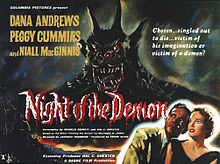
Classic Films in Focus: NIGHT OF THE DEMON (1957)
Jacques
Tourneur, who had made his mark on horror directing Val Lewton's Cat People (1942), also helmed Night of the Demon (1957), and he had
certainly learned a lot from his time with Lewton at RKO. Tourneur wanted to
make another horror film in the same vein as Lewton's pictures, where the
audience is kept in suspense about the reality of the supernatural aspects of
the story, but pressure from higher up in the studio chain forced him to lay
the movie's cards on the table, so to speak, and reveal the demon. It was a
mistake, and Tourneur knew it, but it goes to show how little the studio brass
sometimes understands its own medium. As a result, Night of the Demon is a flawed gem, but fans of classic horror certainly
ought to find it worth watching, for its excellent qualities go a long away to
make up for its faults.
Dana
Andrews stars as skeptical man of science Dr. John Holden, who comes to England
to help debunk the claims of a devil cult's charismatic leader, Dr. Julian
Karswell (Niall MacGinnis). One of Holden's associates has recently turned up
dead under rather unusual circumstances, and Joanna Harrington (Peggy Cummins),
the niece of the deceased man, is certain that Karswell's cult is behind it
all. Holden and Joanna join forces to unravel the mysteries of the demonic
cult, but it soon becomes clear that Karswell will brook no meddling in his
secrets, and our protagonists must race against Holden's date with death to
reverse the terrible fate that has been declared for him.
Dana
Andrews is a very fine actor, but this is not his best film, mainly because
Holden is such a doubting Thomas that it takes him entirely too long to be
afraid of anything. Much of a horror film's fear depends upon the audience's
sympathetic sharing of the hero's own rising terror, and if the hero isn't
afraid, then the audience isn't, either. When he finally does become
frightened, the movie picks up, but it's rather late in the game by then. Peggy
Cummins is more palpably afraid as Joanna, and she has a wonderful wide-eyed
expression of horror, but the demon isn't after her. Maurice Denham makes a
brief appearance as the doomed Dr. Harrington at the opening of the film, and
he is perfectly terrified, which really helps to build the atmosphere as he
makes a panicked journey through the woods at night to visit Karswell. It's too
bad he gets replaced by Andrews' character so quickly.
Really,
the best player in the whole movie is Niall MacGinnis as the villainous
Karswell. With his twisted beard and portly frame, he steals every scene where
he appears, but he is especially wonderful during a Halloween party for the
village children, where he turns up dressed as a clown. Horror fans all know
that clowns are not to be trusted, but Holden and Joanna are simple enough to
think that the costume means that Karswell is just a harmless, jovial old man.
We first see him pulling puppies out of a hat to amuse the youngsters, but
later he conjures a wind storm that sends those same children shrieking across
the lawn in fear. Crafty, duplicitous, and wry, Karswell acts as a kind of
puppet master, controlling his cult followers and his enemies with equal
finesse, until Holden finally realizes the serious stakes of the game and
manages to outwit him.
Ignore
the few brief scenes where the demon turns up; they are laughable and
distracting. Focus instead on the opening shots of the fearful forest road, the
wonderful scenes of Holden snooping through Karswell's mansion at night, and
that great party sequence. The shots of the Hobart family are also delightful
in a British Deliverance sort of way.
What the studio executives didn’t understand, but we see so pointedly proven in
the film, is that the scariest things are those we don’t see, and the most
terrible monsters are those who remain hidden, in the dark of the trees or
behind a clown’s painted face. This was Lewton’s great lesson to all of his
directors, including Tourneur and Robert Wise, as the delicious horrors of The Haunting (1963) make clear.
If
you haven't seen Tourneur's earlier horror films, Cat People is the place to start, with I Walked with a Zombie (1943) and The Leopard Man (1943) both excellent outings, as well. Oddly
enough, Tourneur also directed the horror camp classic, The Comedy of Terrors (1963), with Vincent Price, Boris Karloff,
Peter Lorre, and Basil Rathbone. If that kind of team-up doesn't make your head
spin, nothing will. Dana Andrews is best remembered for his roles in The Ox-Bow Incident (1943), Laura (1944), and The Best Years of Our Lives (1946). See more of Peggy Cummins in Gun Crazy (1950), and look for Niall MacGinnis
as Zeus in the mythological classic, Jason
and the Argonauts (1963).
An earlier version of this review originally appeared on Examiner.com. The author retains all rights to this content.
Subscribe to:
Posts (Atom)