Tuesday, January 21, 2014

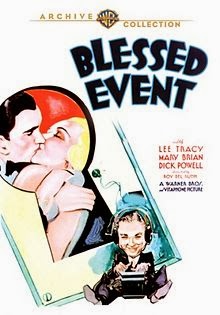
Classic Films in Focus: BLESSED EVENT (1932)

Although it's billed as a comedy, Roy Del Ruth's Pre-Code picture, Blessed Event (1932), actually gets into some pretty dark territory, thanks to an amoral protagonist who earns fame and fortune by airing other people's secrets in a sleazy tabloid column. Like Red-Headed Woman (1932) and Baby Face (1933), it's the kind of story that can only come from the Pre-Code era, replete with Prohibition drinking, sex scandals, and mobster violence. In this instance, the familiar theme of the social climber's willingness to use other people in order to get to the top is exemplified by Lee Tracy, who presents a masculine take on the street smart persona we often associate with Harlow and Stanwyck. Fans of the wisecracking star will appreciate his performance in Blessed Event, while those who favor the Busby Berkeley musicals of the period will enjoy seeing the big screen debut of Dick Powell as Tracy's chief target and social rival.

Tracy plays the ambitious Alvin Roberts, who gets his big break in the newspaper business by running short gossip pieces about the city's expectant mothers. He pens particularly juicy quips about the wealthy and the unwed, which earns the paper thousands of new readers and attracts death threats and lawsuits for Roberts. Alvin's girlfriend, Gladys (Mary Brian), has misgivings about the unethical nature of his work, but Alvin persists until a desperate pregnant woman (Isabel Jewell) embroils him in a dangerous situation with a mob boss (Edwin Maxwell) wants to murder Alvin to keep his name out of the affair.

The movie never pretends that Alvin's column isn't salacious, vicious, and under-handed, but it does offer us glimpses of Alvin's better nature. He supports and lives with his doting mother (Emma Dunn), whom he loves so much that he lets her listen to his nemesis, Bunny Harmon (Dick Powell), on the radio. He's smart, funny, and gifted with a cheerful disposition, even when confronted with gangsters who want to shut him up. One of Tracy's best scenes comes when tough guy Frankie Wells (Allen Jenkins) arrives to lean on Alvin but ends up being horrified into submission by Alvin's vivid recreation of a death row execution. The gossip columnist is presented to us as a 1930s version of the immortal trickster figure, a yellow press descendant of Coyote, Ananzi, and Brer Rabbit. He's not necessarily a good guy, but he's a lot of fun to watch.

Alvin steps over a line, though, when he prints the "blessed event" piece about Dorothy Lane, the pitiful little singer who begs him not to report her condition in the paper. Isabel Jewell gives a heartbreaking - although uncredited - performance as the pregnant girl. She's so pale and despairing that we expect any minute to hear that she has thrown herself out of a window after Alvin runs the tidbit in spite of her pleas. The story teeters on the edge of tragedy once she is introduced, and the ending can only ameliorate the damage that Alvin causes her. Once printed, his words can never be taken back, a fact that he doesn't appreciate until the very end of the film. Although most of the story makes light of scandalous pregnancies and quick marriages, this plot suggests the more serious plight of young women suffering Dorothy's fate; she loses her job, her home, her reputation, and even the support of her married lover in the wake of Alvin's disclosure.

Be sure to appreciate Ruth Donnelly as Alvin's assistant, Ned Sparks as a sour-faced colleague, and, of course, Dick Powell as the handsome radio crooner, Bunny Harmon. See more of Lee Tracy in Doctor X (1932), Dinner at Eight (1933), and Bombshell (1933). Roy Del Ruth also directed Blonde Crazy (1931), Born to Dance (1936), and Topper Returns (1941). Look for Mary Brian in The Front Page (1931), and don't miss Isabel Jewell in her best-known role as Emmy Slattery in Gone with the Wind (1939).

Blessed Event is currently available for streaming on Warner Archive Instant.

Friday, January 17, 2014

A Sneak Peek at BEYOND CASABLANCA II

I am almost ready to announce the publication of BEYOND CASABLANCA II: 101 CLASSIC MOVIES WORTH WATCHING, and with any luck it will be ready for readers in the next few days. In the mean time, I wanted to share the Table of Contents so that you can get a peek at the 101 movies I'm reviewing in the new book. Here are all of the films included in the new collection!


Angels with Dirty Faces (1938)
The Apartment (1960)
The Bachelor and the Bobby-Soxer (1947)
The Bad Seed (1956)
The Band Wagon (1953)
The Birds (1963)
Blood and Sand (1941)
The Bride of Frankenstein (1935)
Brief Encounter (1945)
The Canterville Ghost (1944)
Cape Fear (1962)
Captains Courageous (1937)
The Cat and the Canary (1927)
Charade (1963)
Cheaper by the Dozen (1950)
Creature from the Black Lagoon (1954)
The Curse of Frankenstein (1957)
Desk Set (1957)
Dial M for Murder (1954)
The Divorcee (1930)
The Doll (1919)
Don’t Bother to Knock (1952)
Dragonwyck (1946)
The Enchanted Cottage (1945)
Eyes without a Face (1960)
Father of the Bride (1950)
Fort Apache (1948)
42nd Street (1933)
Fury (1936)
The Girl from Missouri (1934)
Grand Hotel (1932)
The Greatest Show on Earth (1952)
The Great Race (1965)
Guess Who’s Coming to Dinner (1967)
The Gunfighter (1950)
Gunga Din (1939)
The Haunting (1963)
High Sierra (1941)
Holiday (1938)
House on Haunted Hill (1959)
How Green Was My Valley (1941)
Hush… Hush, Sweet Charlotte (1964)
I Married a Witch (1942)
The Innocents (1961)
Island of Lost Souls (1932)
Jane Eyre (1943)
Jason and the Argonauts (1963)
The Jazz Singer (1927)
Jewel Robbery (1932)
Lawrence of Arabia (1962)
The Letter (1940)
Lifeboat (1944)
Little Caesar (1931)
The Lodger (1944)
Love Finds Andy Hardy (1938)
Mad Love (1935)
The Man from Laramie (1955)
McLintock! (1963)
Midnight (1939)
Mister Roberts (1955)
Modern Times (1936)
Monkey Business (1952)
Mr. Deeds Goes to Town (1936)
The Music Man (1962)
My Darling Clementine (1946)
National Velvet (1944)
Niagara (1953)
Night Nurse (1931)
Night of the Demon (1957)
Of Human Bondage (1934)
On Approval (1944)
On Dangerous Ground (1952)
The Palm Beach Story (1942)
Pat and Mike (1952)
Peeping Tom (1960)
The Phantom of the Opera (1925)
Roman Holiday (1953)
Ruggles of Red Gap (1935)
Safety Last! (1923)
Seven Brides for Seven Brothers (1954)
The Seven Year Itch (1955)
Stalag 17 (1953)
Steamboat Bill, Jr. (1928)
The Strange Love of Martha Ivers (1946)
The Stranger (1946)
Swing Time (1936)
Tension (1949)
They Drive by Night (1940)
The Thing from Another World (1951)
The Three Musketeers (1948)
Torch Song (1953)
Touch of Evil (1958)
The Trouble with Angels (1966)
Vertigo (1958)
Wait Until Dark (1967)
Westward the Women (1951)
White Christmas (1954)
Witness for the Prosecution (1957)
The Women (1939)
Yankee Doodle Dandy (1942)
You Can’t Take It with You (1938)

If you read the blog very often, you'll recognize some of these movies as ones that I have reviewed here, but lots of the reviews are exclusive to the new book. As you can see, I'm venturing a little farther forward in time with this collection by including movies from the 1960s. That trade-off means the focus is a little more explicitly American and British; one of these days I'll put together a world cinema collection, but for now my audience tends to be more mainstream. Like the original book, BEYOND CASABLANCA II offers movies from many different genres, decades, directors, and stars, and balancing all of those elements with the need to get most of the alphabet covered is no small task.

BEYOND CASABLANCA II is going to be available exclusively on Kindle for now; I want to see how it does before I commit to doing a print edition. The retail price will be $4.99, but I hope to run a free promo for it once it goes live.

Tuesday, January 14, 2014

Classic Movies and the Bechdel Test: Part One

In the last few weeks, the Bechdel Test has been getting quite a bit of press, particularly with awards season heating up and people eager to argue about movies in general. In case you don't know, it's a concept - derived from a cartoon by Alison Bechdel - that grades movies based on their inclusion of women as fully fledged characters rather than window dressing or plot fodder.

The criteria are pretty simple. The movie has to 1) have at least two female characters, 2) who must talk to each other, and 3) about a topic other than a man. It doesn't really address the quality of the movie as art at all, but it does reveal the deeply ingrained gender bias in most of our modern blockbusters (you know, those movies that are made almost exclusively for a male 17-35 year old audience).

Being both a trained feminist scholar a classic movie blogger, I am interested in what the Bechdel Test might or might not tell us about films made before the modern blockbuster era. Do more classic movies pass? Which of the best-known classic movies fail the test, and why? How many high quality but lesser known pictures pass the test with flying colors and aren't familiar today partly because of their focus on women characters who aren't utterly obsessed with the men in their lives?

Since this is part one of a multi-part series of posts, let's start with some of the biggies. Here are ten extremely well-known classic movies. Do they pass or fail? What does it mean - if anything - if they do? I'll let you make your own observations in the comments below, and then I'll recap the discussion in the next post. I'd love to get a robust conversation started to fuel the next several posts!

1) GONE WITH THE WIND (1939)

2) IT'S A WONDERFUL LIFE (1946)

3) CITIZEN KANE (1941)

4) SINGIN' IN THE RAIN (1952)

5) VERTIGO (1958)

6) ALL ABOUT EVE (1950)

7) THE SEARCHERS (1956)

8) THE WIZARD OF OZ (1939)

9) SUNSET BLVD. (1950)

10) THE BIRTH OF A NATION (1915)

Remember, passing or failing the Bechdel Test is not a measure of the movie's artistic or even moral merit. 12 ANGRY MEN is a great movie with no female characters at all, and THE AFRICAN QUEEN fails outright since it only has two characters of note in the whole picture. I just want to start an ongoing discussion of the way classic movies might or might not treat women differently than the modern films that inspired the Bechdel Test in the first place.

Comment away!

Friday, January 3, 2014

Classic Films in Focus: HIT THE DECK (1955)

Like the more celebrated musical, On the Town (1949), Hit the Deck (1955) tells the story of three sailors looking for love during a brief shore leave, although in this case the action takes place in San Francisco rather than New York City. The two movies also share a common star in Ann Miller, who plays a sailor's love interest in both pictures; in this later production, Miller is joined by Debbie Reynolds and Jane Powell as the other two leading ladies, a combination that makes Hit the Deck worth watching all by itself. The sailors, played by Tony Martin, Russ Tamblyn, and Vic Damone, certainly have their hands full with this trio of song and dance icons, and the movie offers each star an opportunity to shine. Hit the Deck is not, perhaps, a truly great musical, but it offers plenty of colorful fun for fans of the genre and its stars.

Tony Martin brings the characters together as Bill, who asks his irate girlfriend, Ginger (Ann Miller), to find dates for his pals during their shore leave. Sick of waiting for a marriage proposal, Ginger throws Bill out, but Danny (Russ Tamblyn) finds a girl for himself when he meets Carol (Debbie Reynolds). Meanwhile, Danny's sister, Susan (Jane Powell), flirts with a much older man (Gene Raymond), which inspires Danny and his friends to invade the lovers' interlude in order to protect Susan's virtue. The fight with Susan's admirer lands the boys in hot water with the shore patrol, but it also gives Rico (Vic Damone) a chance to get acquainted with Danny's sister.

Martin and Miller play the older, more experienced couple here, with a long protracted engagement that has soured their relationship. Ginger's profession as a club performer gives Miller plenty of song and dance numbers and some eye-popping costumes that show off her famous legs, while her tempestuous relationship with Bill suits the actress' strong screen personality. Damone and Powell are the middle pair, getting their romance off to a rocky start as Rico forcibly hauls Susan out of her admirer's hotel room, and Tamblyn and Reynolds are both energetically cute as the kids of the gang. An additional, and perhaps unnecessary, romantic plot involves Rico's mother (Kay Armen) and a middle-aged florist (J. Carrol Naish), but their story is sweet enough to make the padding forgivable.

None of the songs in Hit the Deck has that unforgettable quality that marks a superior musical, although "The Lady of the Bayou" showcases Ann Miller's ample charms, and the fun house sequence makes great use of Tamblyn and Reynolds' youthful pep. The sense of deja vu one might experience on seeing the picture is not due solely to the parallels with On the Town; the original stage play by Hubert Osborne had already been adapted as a 1925 silent film with Richard Barthelmess and as the better known 1936 picture, Follow the Fleet, with Fred Astaire, Ginger Rogers, and Randolph Scott. Despite suffering somewhat from comparisons with these other musicals, Hit the Deck does have a few extra attractions to offer, including Walter Pidgeon as Danny's rear admiral dad, Jane Darwell as the admiral's housekeeper, and Richard Anderson in a small but memorable role as a Navy lieutenant.

Director Roy Rowland, who spent the 1930s working with short films, also made Our Vines Have Tender Grapes (1945), The 5,000 Fingers of Dr. T (1953), and Meet Me in Las Vegas (1956). For more of Ann Miller, see You Can't Take It with You (1938), Easter Parade (1948), and Kiss Me Kate (1953). Russ Tamblyn and Jane Powell both star in Seven Brides for Seven Brothers (1954); look for Powell in A Date with Judy (1948) and Royal Wedding (1951), and see Tamblyn in West Side Story (1961) and The Haunting (1962). Singer Tony Martin can also be found in Ziegfeld Girl (1941), The Big Store (1941), and Till the Clouds Roll By (1946). Vic Damone, Debbie Reynolds, and Jane Powell all appear in Athena (1954), and most of the cast also turns up in Deep in My Heart (1954).

Sunday, December 29, 2013

Classic Films in Focus: HONOLULU (1939)

Comedies about mistaken or switched identity go all the way back to the Ancient Romans and the Menaechmus brothers, but the most familiar iteration of the plot might be Mark Twain's The Prince and the Pauper, which has been adapted, revised, and parodied so many times that even Barbie and Mickey Mouse have had a go at it. The 1939 musical comedy, Honolulu, clearly draws from this much-visited well of inspiration, although in this case neither of the identical strangers could be considered a pauper, since one is a movie star and the other owns a Hawaiian pineapple plantation. Honolulu doesn't break any new cinematic ground, especially in its dated racial stereotypes, and its plot is feather light, but it's as frothy a concoction as any sweet tropical treat, and fun performances from Robert Young, Eleanor Powell, and Gracie Allen make it well worth the short time it takes to watch.

Robert Young plays movie idol Brooks Mason and plantation owner George Smith, who exchange places so that Mason can relax in Hawaii while Smith gets some cosmopolitan polish in New York. On the boat over to the islands, Mason meets dancer Dorothy (Eleanor Powell) and courts her as George Smith, only to find his romantic plans complicated by Smith's off-and-on fiancee, Cecelia (Rita Johnson). Chaos ensues, especially as "Brooks Mason" is repeatedly mobbed by fans and "George Smith" is jailed for theft, but the biggest challenge is getting both men paired up with the right partners before the wrong George says "I do" to Cecelia at the altar.

Robert Young has the most to do in the picture, since he plays not one but two protagonists, but Eleanor Powell gets top billing, and her dance numbers are really the movie's chief attraction. The Hawaiian hula sequence, which is the most famous bit, is really a terrific performance by Powell, and her duet with Gracie Allen, who plays her sidekick, Millie, is also great fun. Powell's tribute to Bill Robinson, done in blackface, proves more troublesome for the modern viewer, but it makes an interesting counterpoint to Fred Astaire's similar performance of "Bojangles of Harlem" in Swing Time (1936). In between Powell's dance routines, Robert Young provides comedy and some semblance of a romantic plot, although the best doppelganger gags occur early in the film.

You won't get much Hawaiian atmosphere from the sound stage sets, but Honolulu makes up for its phony backdrops with a chance to see Burns and Allen on the big screen. The comedy duo made quite a few shorts and a couple of features together throughout the 1930s, but Honolulu would be the last movie to star both of them, and we have to wait until the very end to see them actually in a shot together. Allen has a lot more screen time than her wisecracking spouse, and she's a riot, especially during a shipboard sequence when a costume party inspires her to dress up as Mae West and perform "The Leader Doesn't Like Music" with The King's Men dressed as The Marx Brothers.

Eddie Anderson and Willie Fung both get relegated to their usual comic relief roles as stereotyped domestics, but at least the movie credits both actors for their work. Don't miss Sig Ruman and Ruth Hussey in small roles; Hussey plays the leading lady in the movie scene that opens the picture. Director Edward Buzzell also made Marx Brothers films like Go West (1940) and Esther Williams vehicles like Neptune's Daughter (1949). See more of Eleanor Powell in Born to Dance (1936), Lady Be Good (1941), and Ship Ahoy (1942). Robert Young also stars in The Canterville Ghost (1944), The Enchanted Cottage (1945), and Crossfire (1947).

You can find Honolulu and several other Eleanor Powell movies currently streaming on Warner Archive Instant.

Friday, December 27, 2013

Classic Films in Focus: IT HAPPENED ON 5TH AVENUE (1947)

Most holiday movie viewers are familiar with a handful of classic pictures that get a lot of airing this time of year, especially It's a Wonderful Life (1946), but there are actually quite a few seasonally appropriate movies that attract admiration from serious fans. It Happened on 5th Avenue (1947) is not as celebrated as other Christmas classics, but it's a favorite with the classic movie crowd nonetheless, largely because of its lighter take on the well-worn holiday themes of generosity, reformation, and hope. This domestic comedy about a hobo who changes the lives of everyone around him also offers viewers some great performances from lesser known stars, particularly Victor Moore and Charles Ruggles, as well as a chance to see a young Alan Hale, Jr. before his Gilligan's Island days.

Victor Moore stars as Aloysius T. McKeever, a homeless man who moves into a business tycoon's New York mansion when the owner vacates the premises for the winter. Generosity inspires him to invite the newly evicted Jim (Don DeFore) to join him in the house, but both men are surprised when the owner's daughter, Trudy (Gale Storm), turns up, although Trudy adopts a false identity in order to convince them to take her in. Soon the house gains several other occupants, much to McKeever's consternation, while Trudy's father, Mike (Charles Ruggles), and mother, Mary (Ann Harding), also move in under assumed identities at Trudy's insistence.

The action takes place in the last several weeks of the year, with Christmas playing a large part in the story, but really you could watch the movie at any time. The message, however, takes on a particular resonance during the holidays, when the parallels to A Christmas Carol and It's a Wonderful Life become clearer. McKeever, a strange angel indeed, is an agent of redemption and renewal who works his peculiar magic on Mike, Mary, Trudy, and Jim, helping each to gain a new perspective and attain the things that really matter in life. Jim, whom we meet early on, has a George Bailey quality about him; he's full of plans and frustrations, but he needs some intervention - divine or otherwise - to set him on the right path up from his low point. Mike is our Scrooge, a rich man who has lost sight of himself and his family in pursuit of more and more money. Divorced from his wife and somewhat estranged from his daughter, Mike has created a lot of unhappiness in the people around him, but he ends up eating a pretty big slice of humble pie during his incognito residence in his own home.

Most classic movie fans will recognize Victor Moore from his supporting role as Fred Astaire's sidekick in Swing Time (1936), and It Happened on 5th Avenue really puts him in the spotlight. He reflects all the facets of his character's complex personality, and like most great clowns he is both funny and deeply sad. Don DeFore and Charles Ruggles both play it more or less straight against Moore, but Ruggles also has a plum role that lets him explore different moods and emotions. Of the lot, Ruggles has the most dynamic character to play, and his best scenes are those with Ann Harding. The rekindled romance between the older O'Connors has more depth to it than the love affair blooming between the younger couple, and once Trudy's mother shows up much of our attention shifts to Mike and Mary. It's a treat, though, to see Alan Hale, Jr. in a supporting role as one of Jim's wartime pals, even if he doesn't have that much to do.

It Happened on 5th Avenue earned an Oscar nomination for Best Original Story, but without big name stars or constant television airings it has never become a really well-known holiday classic. That makes it a great choice for anyone looking to get beyond the usual menu of holiday fare before the season officially ends, and it would be an excellent New Year entertainment if your plans involve a comfy spot on the couch. See more of silent film veteran Victor Moore in Gold Diggers of 1937 (1937), Make Way for Tomorrow (1937), and Ziegfeld Follies (1945). Look for Charles Ruggles, often credited as Charlie, in Trouble in Paradise (1932), Ruggles of Red Gap (1935), and Bringing Up Baby (1938). Don DeFore stars in Romance on the High Seas (1948), while Ann Harding appears opposite Leslie Howard in The Animal Kingdom (1932). Director Roy Del Ruth made the 1931 version of The Maltese Falcon and other pre-Code pictures like Blonde Crazy (1931) and Lady Killer (1933) before moving on to comedies and musicals like Du Barry Was a Lady (1943).

Tuesday, December 24, 2013

Merry Christmas from Virtual Virago!

Merry Christmas, Season's Greetings, and Happy Holidays to everyone who takes the time to visit here at Virtual Virago! Hope your holiday is filled with good friends and classic movies. May 2014 be a great year for all film buffs, book lovers, and LEGO fans!

Whether you're watching It's a Wonderful Life, A Christmas Carol, White Christmas, Die Hard, or Scrooged, Christmas is a great time to remember all that the movies do to enrich our lives. It's a genuine pleasure to be part of a community of people who love and appreciate film, not just the classics but all movies. You make the internet a better, nicer, and more knowledgeable place.

I'm looking forward to sharing another year of movies with all of you!