Wednesday, October 3, 2012

Classic Films in Focus: CONFESSIONS OF AN OPIUM EATER (1962)


Directed by low-budget master Albert Zugsmith, Confessions of an Opium Eater (1962) bears only the vaguest resemblance to Thomas De Quincey’s 1821 autobiographical account of the same name. Actually, very little opium use takes place in the film, but the one extended sequence of drug-induced nightmare more or less justifies the title. Touted by Warner Archive as “sex, drugs, and Vincent Price!” this is a fun cult horror classic for fans of the iconic star, although it certainly swims pretty deep in Orientalist hysteria.

Price plays Gilbert De Quincey, the ostensible descendent of Thomas. Gilbert is a mysterious Westerner with a penchant for Asian philosophy, and in 19th century Chinatown he involves himself in a dangerous tong war fueled by opium and a secretive sex trade. Gilbert intends to stop the slave auctions where wealthy Chinese men buy “wives” kidnapped from Asian countries, but he finds himself powerfully attracted to Ruby Low (Linda Ho), an ambitious woman who uses the auctions to her own advantage.

Price himself doesn’t disappoint, although he is relatively reserved compared to many of his better-known roles. His rich, deep voice suits the hypnotic voiceover well, and he has some excellent scenes of action and peril. Most of his leading ladies are attractive if not especially memorable, but tiny Yvonne Moray steals the picture from Price every time she appears. A veteran of The Terror of Tiny Town (1938) and The Wizard of Oz (1939), Moray gets the movie’s best lines, and her scenes are certainly the funniest and most interesting of the whole picture. Her character, a “pretty Chinese midget,” is not one you’ll find in many other films, and really I think she makes the movie with her huge personality packed into a pint-sized body.

Price’s Gilbert is the only Western character we see in most of the film, although he does meet up with a freeloading sailor in the opium den. The Asian characters, not surprisingly, conform to Orientalist stereotypes, and the slave auction ultimately plays out as an erotic, exotic floor show, with plenty of gyrating body parts and scantily clad girls. Zugsmith made his reputation as a maker of exploitation films, so none of this will come as a shock if you know the genre and its conventions. Just don’t go into it looking for anything progressive in terms of racial or sexual images.

Albert Zugsmith also directed Sex Kittens Go to College (1960), Fanny Hill: Memoirs of a Woman of Pleasure (1964), and Violated! (1974), but he deserves more serious credit as the producer of Written on the Wind (1956), The Incredible Shrinking Man (1957), and Orson Welles’ legendary noir thriller, Touch of Evil (1958). For more of Vincent Price’s work from this period, check out Roger Corman horror classics like Tales of Terror (1962) and The Raven (1963). Confessions of an Opium Eater is currently available on DVD from Warner Archive.

Disclaimer: Warner Archive has provided a review copy of this film free of charge to the reviewer. The reviewer makes no promise of a positive or negative review to any studio based on the receipt of review copies or any other material goods.

Classic Films in Focus: THE BIRDS (1963)


The Birds (1963) was Alfred Hitchcock’s next theatrical project after the popular success of Psycho in 1960, and like Psycho it delves more thoroughly into the horror genre than the director’s earlier pictures. Although some of its special effects show their age, The Birds remains one of Hitchcock’s best known films, in part because the deranged title creatures have become such a commonplace in modern popular culture, with references and allusions everywhere from High Anxiety (1977) and The Far Side cartoons to episodes of Animaniacs (“The Boids”) and even Arthur (“The Squirrels”). Based on a story by Daphne du Maurier, The Birds is also famous for its introduction of Tippi Hedren as one of Hitchcock’s most inscrutable icy blondes, but its real appeal lies in its unnerving depiction of a natural world in revolt, a theme that would be picked up in countless horror films that followed.

Hedren stars as Melanie Daniels, a mercurial socialite who meets Mitch Brenner (Rod Taylor) in a San Francisco bird shop and decides to pursue him to his home in Bodega Bay. There she meets Mitch’s former girlfriend, Annie (Suzanne Pleshette), whose own feelings about Mitch complicate the development of a friendship between the two women. Melanie’s arrival in the community coincides with the beginning of a series of deadly bird attacks, and she eventually ends up barricaded inside Mitch’s home with his mother, Lydia (Jessica Tandy), and young sister, Cathy (Veronica Cartwright). As the birds violently descend on the house in repeated waves, the survivors’ nerves weaken, but there appears to be no cause or explanation for the assault.

The human performances are solid in terms of building our own anxiety about the unfolding events, with Jessica Tandy especially good as Mitch’s needy mother. Hedren plays Melanie as a generally unlikable character, but if we liked her too much we would not perversely root for the birds to get her. The famous closet scene is really about giving the audience what it wants, which creates a different and more subtle kind of horror if we stop to think about it. Pleshette’s Annie strikes a more sympathetic chord, which the director promptly plucks in the most disturbing manner, while Taylor’s Mitch wrings our pity as the only level-headed man surrounded by all of these hysterical women. He brings new meaning to the term “hen-pecked” as he tries to wrangle his flock of helpless but emotionally demanding biddies.

The actual birds represent the upheaval of natural order, a theme with a long history going at least as far back as Shakespeare and the Elizabethan world order. In the modern context, however, we see nature as inherently rebellious, liable to rise up and strike without warning or obvious reason. Natural order simply collapses, and our delusions about being the dominant species are laid bare. Hitchcock provocatively uses the birds to create a visual vocabulary that presages things to come, particularly the rise of the zombie as popular culture’s most horrific symbol of nature out of joint. The birds have a great deal in common with the zombies in George A. Romero’s Night of the Living Dead (1968), which would arrive just five years later to define the conventions of its specific genre. Watch the sequences in which the birds attempt to break through the barriers into the Brenners’ home, for instance, or the moment when Mitch has to reach out through the window while the birds mass around it, viciously pecking his vulnerable flesh. Hitchcock seems to be trying to give birth to the zombie movie without realizing that one might actually use zombies to do it.

You’ll never look at pigeons in the park in quite the same way once you’ve seen the film. See more of Hedren with Hitch in Marnie (1964), and catch Rod Taylor in The Time Machine (1960). Oddly enough, Taylor also provides the voice of Pongo in the Disney classic, 101 Dalmatians (1961). If you want to explore the diverse range of animal attack movies, you might try fan favorites like Jaws (1975), Cujo (1983), and The Ghost and the Darkness (1996), or even cult classics like Them! (1954) and Night of the Lepus (1972).

Tuesday, October 2, 2012

Book Signing at the Huntsville Public Library

A quick break from this month's classic horror posts for this announcement!

I'll be talking about Beyond Casablanca: 100 Classic Movies Worth Watching and signing copies of the book at the Huntsville Madison County Public Library on Friday, October 12, 2012, from 1-2 p.m.

The event will take place just before my Friday Film Festival screening for LearningQUEST, so I hope a lot of my lifetime learning friends will be able to come.

If you can't make it, you can still order the book on Amazon or Barnes & Noble.com. I'll also be doing some special public film events and talks closer to the end of the year.

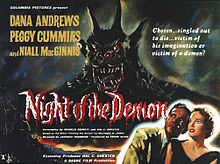
Classic Films in Focus: NIGHT OF THE DEMON (1957)


Jacques Tourneur, who had made his mark on horror directing Val Lewton's Cat People (1942), also helmed Night of the Demon (1957), and he had certainly learned a lot from his time with Lewton at RKO. Tourneur wanted to make another horror film in the same vein as Lewton's pictures, where the audience is kept in suspense about the reality of the supernatural aspects of the story, but pressure from higher up in the studio chain forced him to lay the movie's cards on the table, so to speak, and reveal the demon. It was a mistake, and Tourneur knew it, but it goes to show how little the studio brass sometimes understands its own medium. As a result, Night of the Demon is a flawed gem, but fans of classic horror certainly ought to find it worth watching, for its excellent qualities go a long away to make up for its faults.

Dana Andrews stars as skeptical man of science Dr. John Holden, who comes to England to help debunk the claims of a devil cult's charismatic leader, Dr. Julian Karswell (Niall MacGinnis). One of Holden's associates has recently turned up dead under rather unusual circumstances, and Joanna Harrington (Peggy Cummins), the niece of the deceased man, is certain that Karswell's cult is behind it all. Holden and Joanna join forces to unravel the mysteries of the demonic cult, but it soon becomes clear that Karswell will brook no meddling in his secrets, and our protagonists must race against Holden's date with death to reverse the terrible fate that has been declared for him.

Dana Andrews is a very fine actor, but this is not his best film, mainly because Holden is such a doubting Thomas that it takes him entirely too long to be afraid of anything. Much of a horror film's fear depends upon the audience's sympathetic sharing of the hero's own rising terror, and if the hero isn't afraid, then the audience isn't, either. When he finally does become frightened, the movie picks up, but it's rather late in the game by then. Peggy Cummins is more palpably afraid as Joanna, and she has a wonderful wide-eyed expression of horror, but the demon isn't after her. Maurice Denham makes a brief appearance as the doomed Dr. Harrington at the opening of the film, and he is perfectly terrified, which really helps to build the atmosphere as he makes a panicked journey through the woods at night to visit Karswell. It's too bad he gets replaced by Andrews' character so quickly.

Really, the best player in the whole movie is Niall MacGinnis as the villainous Karswell. With his twisted beard and portly frame, he steals every scene where he appears, but he is especially wonderful during a Halloween party for the village children, where he turns up dressed as a clown. Horror fans all know that clowns are not to be trusted, but Holden and Joanna are simple enough to think that the costume means that Karswell is just a harmless, jovial old man. We first see him pulling puppies out of a hat to amuse the youngsters, but later he conjures a wind storm that sends those same children shrieking across the lawn in fear. Crafty, duplicitous, and wry, Karswell acts as a kind of puppet master, controlling his cult followers and his enemies with equal finesse, until Holden finally realizes the serious stakes of the game and manages to outwit him.

Ignore the few brief scenes where the demon turns up; they are laughable and distracting. Focus instead on the opening shots of the fearful forest road, the wonderful scenes of Holden snooping through Karswell's mansion at night, and that great party sequence. The shots of the Hobart family are also delightful in a British Deliverance sort of way. What the studio executives didn’t understand, but we see so pointedly proven in the film, is that the scariest things are those we don’t see, and the most terrible monsters are those who remain hidden, in the dark of the trees or behind a clown’s painted face. This was Lewton’s great lesson to all of his directors, including Tourneur and Robert Wise, as the delicious horrors of The Haunting (1963) make clear.

If you haven't seen Tourneur's earlier horror films, Cat People is the place to start, with I Walked with a Zombie (1943) and The Leopard Man (1943) both excellent outings, as well. Oddly enough, Tourneur also directed the horror camp classic, The Comedy of Terrors (1963), with Vincent Price, Boris Karloff, Peter Lorre, and Basil Rathbone. If that kind of team-up doesn't make your head spin, nothing will. Dana Andrews is best remembered for his roles in The Ox-Bow Incident (1943), Laura (1944), and The Best Years of Our Lives (1946). See more of Peggy Cummins in Gun Crazy (1950), and look for Niall MacGinnis as Zeus in the mythological classic, Jason and the Argonauts (1963).

An earlier version of this review originally appeared on Examiner.com. The author retains all rights to this content.

Monday, October 1, 2012

Classic Films in Focus: THE HAUNTING (1963)


Shirley Jackson is best known today for her literature anthology standard, "The Lottery," but her 1959 novel, The Haunting of Hill House, is widely regarded as one of the best modern horror stories; the 1963 film adaptation, called simply The Haunting, brings Jackson's eerie tale of fear and psychological collapse onto the big screen. Like Jackson's novel and many classic horror films, The Haunting eschews concrete images of terror in favor of mounting dread and shadowy, unseen threats, and the effect is terrific. Excellent directorial work from Robert Wise and powerhouse performances from the cast combine with the film's masterful source material to make The Haunting a true classic of the genre, sure to please fans of Val Lewton's seminal work in horror and delight those who enjoy the thrills and pleasures of an old-fashioned haunted house.

Julie Harris plays Nell Lance, the emotionally unstable protagonist of this tale of terror, who has recently been liberated from a life of servitude to her bed-ridden mother by the old lady's death. Nell feels both ecstatic and guilty about her mother's demise, but, eager to seize a chance to do something different for once in her life, she signs on to assist in the paranormal research project at Hill House. The team is led by Dr. John Markway (Richard Johnson), a man who wants to prove that the supernatural is real and who thinks that dismal Hill House, with its past history of death and disaster, is just the place for his experiment. Also joining the group are the mysterious Theo (Claire Bloom) and Hill House's presumptive heir, Luke (Russ Tamblyn); once gathered, the four characters quickly find themselves experiencing very strange things indeed. Terrible noises erupt in the night, doors open and close by themselves, writing appears on walls, and cold spots chill the air in certain ominous locations. All the while, fragile Nell responds to the house's evil by becoming more and more unhinged.

Robert Wise had learned the art of horror direction under Val Lewton's astute tutelage, and that influence reveals itself very clearly in The Haunting, where shadows and inanimate objects are invested with mind-bending terror through camera angles, timing, and the characters' reactions. We never see anything really scary in Hill House, but the film constantly suggests that something awful lurks just outside our sight. The justly famous scene in which a door bends and warps in response to some supernatural pressure from the other side is an excellent example of Wise's style here. Like Nell and Theo, we pant in anticipation and horror at the idea that whatever is causing the door's mad contortion will come through and get us, but nothing Wise can show us can be as dreadful as our imagination of it. The black and white cinematography lends itself to this sort of shadow play; watch the way light and dark are used throughout the picture to enhance the idea that something unnatural and unseen lives within this house. Every room is full of statues and mirrors, so that no shot escapes from them; faces are everywhere, watching us, moving in the corners of our sight. The cluttered populations of busts and carved figures give the rooms a funereal air, like the house itself is a kind of indoor cemetery.

Wandering through this Gothic atmosphere we get Julie Harris, stiffly defensive by day in her buttoned jackets and pinned up hair, ghostly and girlish by night in a long white gown, loose tresses trailing behind her as she runs barefoot down the dark and menacing halls. Nell is brittle, sensitive, and deeply repressed, just the kind of victim on whom the house can work its spell. Singularly inexperienced in human relationships, Nell pines with schoolgirl passion for the married Markway and recoils prudishly from Theo's lesbian advances, if only because she is terrified by the feelings that Theo's attentions stir up in her. There might be a touch too much voiceover from Nell over the course of the film, but Wise is trying to remind us how much the story depends upon the secret workings of Nell's mind, and with film there's really no other way to do that.

Take time to appreciate Rosalie Crutchley’s delightfully chilling performance as the housekeeper, Mrs. Dudley. Avoid the 1999 remake of the film; it leaves nothing to the imagination and functions more like an amusement park ride than a real horror film. If you like The Haunting, move backwards in time to Wise's films with Val Lewton, including The Curse of the Cat People (1944) and The Body Snatcher (1945). For what it's worth, Wise's major films before and after The Haunting were West Side Story (1961) and The Sound of Music (1965). Perhaps it was all that singing and dancing that made him feel just a bit homicidal.

An earlier version of this review originally appeared on Examiner.com. The author retains all rights to this content.

Classic Horror in October!

Scream for classic horror!
THE BLOG GOES BUMP IN THE NIGHT ALL MONTH LONG!

It's the witching hour, a perfect time to announce that the blog will be going all classic horror for the month of October! I'll be looking at classic horror films, profiling stars, reviewing books, and creating lists to take us into Halloween. Do you have a favorite classic horror film or star you'd like to see featured? Let me know!

Upcoming posts will include reviews of films starring Boris Karloff, Bela Lugosi, Vincent Price, Christopher Lee, and many more. I'll be giving some special attention to personal favorites from cult horror producer Val Lewton, but the month of posts will run the gamut from the truly terrifying to the hilariously haunted.

Hope you enjoy the October celebration of Gothic ghosts, grinning ghouls, and things that go bump in the night!